Chapter VIII · THE AGE OF CATHERINE THE GREAT (continued 2)
Reading edition
OUTBREAK OF THE AUSTRO-RUSSIAN WAR WITH TURKEY
After the meeting at Kherson the two imperial allies prepared to direct their forces against the whole extent of the Turkish frontier, from the Adriatic to the Black Sea. Care was taken, however, to furnish an excuse for the participation of Austria, by inciting the Turks to make the first attack; for only in such a case was Austria bound to furnish auxiliaries to the Russians. To this end Bulgakov, Catherine’s ambassador at Constantinople, was ordered by every means to excite commotions among the Greeks, Bulgarians, Wallachians, and Slavonians, as well as in Egypt and in Asia Minor. The Turks, justly incensed at these intrigues, insisted upon a distinct declaration of their views on the part of the Russians; and when they received for answer only the usual diplomatic subterfuge that the ambassador must wait for instructions from St. Petersburg, they immediately declared war, sent Bulgakov to the state prison of the Seven Towers, and nothing but the threatening interference of the English minister could have prevented them from inflicting summary vengeance upon him, to show their righteous displeasure at the conduct of his government. Catherine and Joseph had now gained their wishes. The Turks were the first to declare war, and a pretence was thus afforded to the Russians to call upon the Austrians for that aid which they were bound by treaty to render in case of an attack on the part of the Turks.
Catherine published a manifesto, in which after a long enumeration of the pretended wrongs ascribed to the Porte, she added that, provoked by a conduct, in itself so offensive, she had, very unwillingly, been obliged to have recourse to arms, as the only means left her for the support of those rights which she had acquired at the price of so much blood, and to avenge her wounded dignity, suffering from the violence that had been used towards her minister at Constantinople; that entirely innocent of all the calamities inevitably engendered by war, she relied with confidence, not only on the Almighty protection and the assistance of her allies, but on the prayers of the Christian world, for triumph in a cause so just as that which she was obliged to defend. This manifesto was soon followed up by a second, which declared that the Porte had arrogantly presumed to insist on a categorical answer to its absurd demands; and that the empress, forced to repel the aggression of the enemy of the Christian name, armed herself with confidence, under the protection of that just God who had so long and so powerfully shielded the Russian Empire.
Had Potemkin been as great a general as he was capable of devising magnificent plans and playing the Russian tyrant, great things would have been accomplished in 1787, for all the preparations for the war had been made long beforehand. Field-Marshal Romanzov was to share the command of the army with Potemkin; that is to say, he was to do all the work, and the other was to engross all the merit. Romanzov declined this thankless office, and Potemkin stood alone at the head of the army; but he did not succeed in deceiving posterity, for no one has ever ascribed to him what was effected by the officers under his command—by Repnin, Paul Potemkin, Suvarov, Kamenskoi, Galitzin, and Kutusov, all of whom became more or less renowned in later wars. Potemkin found in Suvarov precisely such an instrument as he needed: for to that general the will of the empress or her favourite was in all cases a law paramount to all moral obligations, or any feelings of humanity. He was sent to Kinburn, the chief object of the campaign being apparently the siege of Otchakov, by the main body under Potemkin, whilst other divisions were despatched to observe the movements of the Tatars in the Kuban.
[1787-1788 A.D.]
Kinburn was a small fortress occupied by the Russians, and situated upon a promontory directly opposite to Otchakov, in and around which the Turkish army was stationed. The object of Suvarov’s mission was to frustrate the efforts of the Turkish fleet to land a division on the promontory of Kinburn; and he executed the task in a masterly manner. At first he remained perfectly quiet in the fortress, after having erected a battery at the extremity of the promontory, in order to cannonade the Turkish ships from the land, at the same moment in which they might be attacked by the Russian fleet. He allowed the Turks to proceed without molestation till they had disembarked from six thousand to seven thousand men; he then sent a few regiments of Cossacks against them, and at the same time charged them at the head of two battalions of infantry with fixed bayonets, and exterminated them all. Immediately afterwards he employed his battery against the Turkish fleet. The prince of Nassau-Siegen, who had the command of the Russian gunboats of Nikolaiev, attacked the Turkish ships at the very entrance of what is called the Liman, and within range of Suvarov’s guns, to whose well-directed fire he was indebted for a great share of the advantages which he gained.
The whole remaining part of the year 1787, as well as the spring and a great part of the summer of 1788, elapsed without anything important having been undertaken; the whole of the Russian land-forces were, however, directed towards the Bug, in order to push forward with the greatest expedition to the Danube. The Turks had already suffered defeats at sea and in the Caucasus. The Russian fleet in the Black Sea, which was almost wholly commanded by foreigners, nearly annihilated the Turkish navy; generals Tallitzin and Tekeli massacred the Tatars of the Kuban, and Tamara reduced Georgia and Lesghistan. In August, Potemkin at length marched against Otchakov, but very wisely left the whole conduct of the military operations to Suvarov, the victor of Kinburn. The Russian operations were delayed in expectation of an Austrian army, which, in connection with a Russian force under Soltikov, was to make an incursion into Moldavia. This delay was protracted till King Gustavus began to exhibit symptoms of making an attack on the provinces contiguous to Sweden, which were now deprived of means of defence. He had to revenge on Russia a long series of wrongs, crowned by the intolerable conduct of Catherine’s ambassador Razumovski, whom she had sent to form conspiracies against him, and to persecute and insult him in his own capital.
THE SWEDISH WAR (1788-1790 A.D.)
[1788 A.D.]
Gustavus III would also willingly have induced Denmark to take part in the movement against Russia; in this, however, he was unsuccessful, although supported by England and Prussia. Razumovski, the Russian ambassador, was ordered to leave Stockholm on the 23rd of June, and went to the army in Finland. The king appeared as if he designed immediately to march against St. Petersburg, which excited no small concern in the minds of the government, because, in confident reliance on the king’s misunderstanding with the Swedish nobles, the whole of their good troops had been despatched to the frontiers of Turkey.
The king of Sweden was acquainted with the feelings of his nobles, consequently with those of the generals and officers of his army; he therefore endeavoured to deprive the malcontents of the apparently legal point of a refusal to serve, by changing the offensive war which he contemplated into a defensive one, and for this purpose had recourse to a very childish subterfuge. There had been a long-existing dispute between the two countries respecting the bridge over the small river Kimmene, the boundary between the two states, whether it should be painted in Swedish or Russian colours; he provoked the Russians to maintain this disputed right by force of arms, and then proclaimed that he had been attacked by them, and was therefore justified in carrying on a defensive war without consulting the estates. We leave it undecided whether he took possession of the bridge by force, and thereby compelled the Russians to resist force by force; or whether, as the best accounts allege, he caused some Swedes to be clothed in Russian uniforms in order to attack his own soldiers, and in this way to justify an offensive war.
The distance from the river Kimmene to St. Petersburg is less than 150 miles. There would have been no difficulty in storming the small fortresses of Viborg and Friedrichsham, which lay upon the route, and an unexpected attack from the sea might probably have led to the surprise and capture of Kronstadt and Kronslot, the former of which is less than twenty miles from the open waters, and the latter is situated on a sand-bank in the sea.[54] The favourable moment, however, for an attack by sea had been already allowed to pass by the king’s brother Charles, duke of Södermanland, who commanded the Swedish fleet, and by land the king was precipitate when he ought to have delayed, and hesitated when everything depended on rapidity.
On the 22nd of June Duke Charles, with fifteen ships of the line and five frigates, had fallen in with three sail of Russian ships, to the north of the island of Gothland, which he ought to have captured, but was restrained by a feeling of reluctance to begin the war (which was then actually commenced), and immediately a superior Russian fleet appeared. Admiral Greig, an Englishman, commanded it; his fleet outnumbered the Swedish by two ships of the line and two frigates, and therefore the issue of the engagement between the two fleets which took place on the 17th of July was the less inglorious for the Swedes. They fell in with the Russians off the island of Hogland, and fought with great skill and courage; they lost, it is true, one of their line-of-battle ships, but took one of the Russian fleet in its stead; at length, however, they were compelled to seek for safety in the harbour of Sveaborg, where they were kept in a state of blockade by the Russians during the whole of the campaign. The secretary of the king’s embassy in St. Petersburg delivered such an extremely absurd ultimatum that no other answer was given than an order from the commandant to take his departure from the capital. Gustavus commanded armaments to be prepared and a commissariat to be provided, but left the whole superintendence to others, who neglected everything, and instead of preparing means to oppose entered into secret correspondence with the Russians. All this immediately appeared when the king at length resolved to storm the fortress of Friedrichsham. He found himself destitute of heavy artillery and other materials of war, which he supposed were all in readiness, and whilst the artillery was being slowly brought up by land, the nobles were devising the most shameful treason.
[1789 A.D.]
It was arranged that Friedrichsham should be at once attacked both by sea and by land; and Siegeroth had actually landed his troops and commenced operations when he suddenly received counter orders, because the troops which were with the king refused obedience. In these circumstances, Gustavus had no other alternative than to return to Stockholm, in order there to recover his royal dignity and power which he had lost at Friedrichsham. He entered Stockholm in September, and thenceforth occupied himself in preparing a coup d’état, which he accomplished on the 17th of February in the following year. Meanwhile, his traitorous nobles had concluded a truce with Russia, which was so far advantageous to Gustavus that it liberated his fleet from its captivity in the bay of Sveaborg. He was now dictator and autocrat; he had at command the means of prosecuting the war with Russia: but the favourable moment was past, and the Russians had already completed all their preparations by land and sea for the defence of their provinces bordering upon Sweden. Gustavus’ project of burning the Russian fleet in the harbour of Copenhagen was discovered beforehand, and brought him nothing but disgrace. When he again joined the army in Finland, his Swedes gave evidence of their attachment and courage; but he himself again contrived to injure the success of the war by his interference in its conduct. In the murderous fights which ensued from the middle of June till the end of July, both the Russians and Swedes lost great numbers of men, without any other gain on either side than military renown. The Swedes in the meantime were unfortunate at sea, and could not have profited by their success had they been victorious by land.
Admiral Ehrenswerd commanded the Swedish flotilla of flat-bottomed boats, constructed for navigating the rocky shallows of the coast, whilst the similar Russian fleet was under the orders of the prince of Nassau-Siegen, who had shortly before been commander of the Russian fleet in the Black Sea, and had fallen into disputes with Potemkin, which led to his being sent to the Baltic. The Russian ships of the line were under the command of Admiral Tchitchakov, and had on board a considerable number of British naval officers of experience. This fleet had on the 26th of June fallen in with that of the Swedes, which was so injured in an engagement between Bornholm and Gothland as to be obliged to return to Karlskrona. The unfortunate issue of the battle was generally ascribed to disloyalty on the part of some of the naval officers.
The king still persisted in his determination of opening up a way for himself to St. Petersburg, and therefore of storming Friedrichsham. He himself directed the execution of the project, although he was, properly speaking, merely a volunteer with his army. By his interference he exposed the Swedish army to considerable loss, on the same day (August 24th) on which the Russian flotilla gained an important victory over the Swedes at Rogensalm. Friedrichsham, according to the king’s command, was to be stormed by the three generals, Siegroth, Kaulbart, and Platen; the assault, however, failed of success, and the Swedes were obliged to retire: their flotilla was twice beaten. The first victory of the Russians at Rogensalm was attributed to the prince of Nassau-Siegen, who, however, was accompanied by three or four persons who rendered him the same service which the British officers did to Admiral Tchitchakov. On the 1st of September the Swedish flotilla experienced a defeat at Högfors, and the land army, commanded by the king, was there also compelled to retreat. The loss in human life was indeed great, but the real injury small, for the Swedish army continued till the beginning of winter to occupy its quarters on the frontiers of Russia.
The Campaign of 1790; the Treaty of Varela
[1790 A.D.]
During the winter, Gustavus withdrew from his army, but he resumed his duties as commander in March, 1790, and was now careful to supply all the deficiencies of the two previous years. On the 15th of April, in Finland, he reduced the two important posts of Kärnakoski and Pardakovski near Vilmanstrand; his Swedes were victorious at Valkiala; and on the 30th repulsed the Russians in their attempt to recover the two posts just mentioned. On the 4th and 5th of May the Swedes were afterwards beaten at Aberfors by the Russian general Numsen, and lost twelve pieces of cannon. The king having again taken Pardakovski, the key of Savolax, immediately caused a portion of his land forces to embark in the flotilla, of which he himself assumed the command, and ordered the remainder of the army to press forward by the shore towards St. Petersburg, relying on the assistance of the fleet, which was to receive them on board in case of a defeat. The fleet consisted of nineteen large ships, twenty-seven galleys, and a number of gunboats, which in all mounted about two thousand guns. It was absolutely necessary to the execution of this adventurous undertaking that Friedrichsham should in all haste be reduced by storm. The king, having been successful on the 15th in a naval engagement, made his third attempt at storming the fortress on the 17th and 18th of May, and notwithstanding a great loss in men failed in effecting his object. Although the way by land thus remained barred, he nevertheless persisted in his design of terrifying the empress in her capital.
Gustavus, having now embarked a greater number of Swedish troops than before, reached Viborg, and on the 2nd of June, 1790, disembarked a division of his army at Blörke, about forty miles from St. Petersburg. The whole success of this rash enterprise depended on his remaining master of the sea. In order to maintain this superiority, Duke Charles was to prevent the junction of the two Russian fleets, one of which was lying in Kronstadt and the other in Revel, and on the 3rd of June he was ordered to engage the division of the fleet in the former harbour. The Swedish fleet was no sooner thus withdrawn from its position than an opportunity was afforded to the Russians to form a junction between their two fleets, which actually took place on the day the duke entered the sound of Viborg (June 6th). The Swedish fleet was blockaded by the Russian squadrons, consisting, when united, of thirty ships of the line and eighteen frigates; the former, however, continued to keep up its connection with the flotilla. It appears that both the Swedish fleets would have been entirely lost had the two Russian admirals been qualified for such a command. Captain Pélissier, who had served in Holland, is said to have given Admiral Tchitchakov advice which he ought to have followed, had he not been too obstinately attached to his own opinions; Pélissier even pointed out to generals Suchtelen and Soltikov the places where they ought to have erected their batteries in order effectually to bar the egress of the Swedish fleet from the bay; no attention, however, was paid to his advice. The prince of Nassau-Siegen proved himself to be in no respect superior as a commander to Tchitchakov. On the other hand, if the advice of Duke Charles had been adopted, the Russians would have been victorious without a battle; King Gustavus and Stedingk, however, rescued the honour of the Swedish name.
The Swedes had now been closely shut up in the bay of Viborg for three weeks, and at the end of June were reduced to extremities; in the beginning of July a grand council of war was held. Duke Charles and many other members of the council recommended a capitulation, but the king and Stedingk were in favour of making a desperate effort to force their way through the enemy’s line. The attempt was accordingly made on the 3rd of July, and through Tchitchakov’s neglect it was so far successful, as it enabled the Swedish fleet to bring the blockading squadron to an engagement. But the Swedes lost in it not only seven ships of the line, three frigates, and more than thirty galleys and gunboats, but almost the whole of the royal guards, the queen’s regiment, and that of Upland, amounting to six thousand or seven thousand men, which had been put on board the fleet. Whilst the larger Swedish ships thus endeavoured to gain the open sea, the flotilla had withdrawn for safety into an arm of the gulf, which runs parallel to the shore and stretches towards Friedrichsham. This inlet, called the sound of Suenske, is extremely difficult of access on the side towards Friedrichsham, in consequence of a group of rocky islands at its mouth, but it may be safely reached through the open harbour of Asph. By this way the prince of Nassau-Siegen determined to pass into the sound with the Russian flotilla, and attack the Swedes in their place of refuge.
The latter were well protected from the attack of the Russian fleet by rocks, and when the prince gave orders for the assault, on the 9th, the sailors were so exhausted and his orders for battle were so unskilful that the king of Sweden gained a splendid victory on that and the following day. The loss of the Russians was so great as to have surpassed any which they had suffered since the Seven Years’ War. Fifty-five vessels were captured, a number of others destroyed, and fourteen thousand Russians either taken prisoners or slain. In spite of this signal victory, the king of Sweden now awoke from his dream of humbling the pride and glory of Russia; already he began to cast his eyes towards France, and in the following year he dreamed his monarchical dream in favour of the French émigrés. The idea of becoming the Godefroy de Bouillon of the aristocratic and monarchical crusade, which Burke at that time proclaimed in the English parliament and in his work on the French Revolution, had been awakened in his mind in 1790, and the empress of Russia found means of confirming him in his visionary projects. Moreover his means were exhausted, and he therefore lent a favourable ear to the proposal of Galvez, the Spanish ambassador, who began to mediate for a peace between Sweden and Russia.
This peace, concluded at Varela on the Kimmene on the 14th of August, 1790, served to show how empty all Gustavus’ splendour was, and how unreal and inefficient were all the efforts he had made. It was now seen that all the blood had been shed to no purpose, and all the treasures of his very poor kingdom mischievously squandered, for everything remained on the footing on which it had been in the spring of 1788.
PROGRESS OF THE AUSTRO-RUSSIAN WAR WITH TURKEY
We now return to the war in which Austria and Russia were jointly engaged against Turkey. The whole Austrian army was ready to take the field at the end of the year 1787: it formed an immense cordon stretching from the mountains on the coast of the Adriatic Sea to the Carpathians, and consisted of a main body and five divisions. Unhappily, the emperor Joseph was desirous of commanding the main army in person, under the unskilful direction of Lacy, his military Mentor, who, like his pupil Mack, was a good drill-sergeant, but no general. The main body consisted of 25,000 infantry and 22,000 horse, and the whole of the troops together amounted to 86,000 cavalry and 245,000 foot, accompanied by 898 pieces of artillery.
In February, 1788, Russia and Austria had simultaneously declared war against the Turks; but in August of that year England and Prussia entered into an alliance, the main object of which was to place Prussia in a situation to prevent the aggrandisement of Austria, if necessary, by force of arms. This, however, was superfluous in 1788, because the diversion effected by the king of Sweden prevented the Russians from proceeding with their usual rapidity, and the emperor Joseph by his presence with the army frustrated the effect of his immense armaments. The dissatisfaction with the whole conduct of the war became so general that Joseph was at length obliged earnestly to entreat Laudon, who had been the popular hero of the Austrians since the time of the Seven Years’ War, and whom the emperor had hitherto neither employed nor consulted, to assume the command of the army in Croatia.
Successes of Laudon (1788 A.D.)
Laudon, having made an express stipulation that the emperor was not to interfere with his plans marched against the Turks, defeated them under the walls of Dubitza the very day after he joined the army, and reduced that fortress; then, pushing into the heart of Bosnia, he compelled Novi to surrender, whilst the emperor himself was obliged to hasten to the aid of the army in the Bannat, which was very hard pressed by the Turks. The division under Wartensleben, which should have supported it, had been driven back by the Turks, who succeeded, in consequence of an incomprehensible neglect on the part of the Austrians, in getting complete possession of the rocky bed through which the Danube has forced a passage at a distance of six-and-twenty miles above New Orsova. The pass, which is not more than a pistol-shot in width, is commanded by a fortified cleft in the rock, called Veterani’s Hole, and this post the Austrians should and could have maintained when the main body of the Turks appeared at Old Orsova on the 7th of August; this, however, they neglected to do. The Austrian general suffered himself to be defeated and lost thirteen pieces of cannon, and as his communications with the main army were cut off, he was obliged to retreat so far that the garrison of this important post was left to its fate. The Turks sacrificed great numbers of men in order to seize this fastness, by the possession of which they immediately became masters of the whole navigation of the Danube as far down as Belgrade. As soon as the Danube was lost, the imperial army found itself threatened in the rear.
Nothing but disaster attended the operations of Joseph and Wartensleben. The army under the prince of Coburg was somewhat less unfortunate. Khotin, which the Russians had captured in the last war without firing a shot, was reduced by it after a most heroic resistance of three months; and this was the last exploit of a campaign in which thirty thousand Austrians fell in desultory skirmishes, and forty thousand were swept off by pestilence—losses but poorly compensated by the capture of Szabatch, Khotin, Dubitza, and Novi. Circumstances, however, afterwards proved more favourable. Jassy was taken; in October, the Russians were in possession of five districts of Moldavia and of several passes in Wallachia, and the main army was again able to extend the limits of its operations. Wartensleben sat down with a part of the army before Mahadia; and the emperor kept possession of the country from Pantchova to Semlin.
Victories of Suvarov (1788-1789 A.D.)
After the massacre perpetrated by Suvarov upon the Turks on the promontory of Kinburn, the Russians had remained for a long time quiet; but by their possession of the coasts they effectually prevented the Turks from landing any troops, and by the capture of the island of Beresam wholly excluded them from the mouth of the Dnieper. It was not till late in the year 1788 that Potemkin summoned Suvarov from Kinburn to conduct the siege of Otchakov, where, however, he was wounded, and after his return to Kinburn the siege made very little progress. The avarice of Potemkin deprived the soldiers of the necessary supplies; and the dreadful cold and disease proved far more injurious to them than the attacks of their enemies.
At length the frost became so intense that the men were obliged to excavate pits for dwellings, but the same frost also opened up a means of attacking the fortress and reducing it after the Russian fashion, that is, without regard to the sacrifice of thousands of men, a few weeks earlier than they could otherwise have done. The city is completely protected on the side towards the Black Sea by a marshy lake called Liman; and now that the lake was frozen, Potemkin issued orders to storm the fortress from the sea side, where it was weakest. The Russians were cruelly sacrificed: one regiment was no sooner mowed down than another was compelled to advance, and above four thousand men were slain before the storming of Otchakov was effected (December 16th), an exploit which was afterwards extolled to heaven. The Russians, having at length borne down all resistance and forced their way into the city, were compensated for their losses and sufferings during the siege by three days’ murder and pillage; they put citizens and soldiers, men, women, and children to the sword without mercy or distinction. It is said that twenty thousand Turks perished in this massacre; but this piece of Russian heroism, which was not performed by Potemkin himself but by others at his command, was also rewarded after the Russian fashion. Every soldier who had taken part in the siege received a medal of honour, whilst Potemkin, who had contributed nothing to its success, derived the only real advantage. The empress had previously deprived Razumovski of the office of hetman, which she now conferred upon Potemkin, who received in addition a present of 100,000 rubles, besides what he had appropriated to himself out of the moneys destined for the besieging army, and what he had seized out of the rich booty which fell into his hands after the capture of the city.
The death of the sultan Abd-el-Habed in April, 1789, made no change in the relations between the Turks and Russians. His successor, Selim, continued to prosecute the war, and Suvarov having recovered from the effects of his wound again joined Potemkin’s army, and was put at the head of the division which was to co-operate with the Austrians. Laudon had now the command of the whole Austrian army; the prince of Coburg, however, retained that of the division which was to keep open the communications with the Russians; and again he gave such numerous proofs of his incapacity to conduct any great undertakings, or even to help himself out of trifling difficulties, that the history of the campaign of 1789 alone ought to have prevented the emperor Leopold from entrusting him with the command against the French, who possessed generals and soldiers of a very different kind from those of the Turks. Selim III had succeeded in getting on foot a very considerable force which was destined to operate on the extreme point of Moldavia, where that country touches upon Transylvania, and is separated from Wallachia by a small river, which also divides the little town of Fokshani into two parts, one belonging to Moldavia, and the other to Wallachia. Coburg was advancing thither slowly and methodically, when the Turkish army encamped in the neighbourhood of the town turned suddenly upon him, and filled him with such apprehensions of being completely shut in that, instead of boldly doing what Suvarov afterwards did, he anxiously besought that general’s speedy assistance.
Suvarov’s army was lying at Belat in Moldavia; when the news reached him he at once began a march of between forty and fifty miles in a direct line over mountains, across ravines and pathless wilds, and in less than thirty-six hours reached the Austrians on the 30th of July, at five o’clock in the evening. At eleven that night he sent the plan of the attack upon the Turks, which was to commence at two in the morning, to the astonished prince, who had never heard of such rapidity of movement, or seen it equalled even on parade. The bewildered prince went three times to Suvarov’s quarters without having seen him; in the battle he made no claim to the supreme command, which should have belonged to him as the eldest general, but submitted as a subordinate to Suvarov’s orders. The Turks, to the number of between fifty and sixty thousand men, were in position at Fokshani when the Russians and Austrians with forty thousand men passed the river Purna and stormed their fortified camp, mounting the ramparts and driving them in at the point of the bayonet, as if they were assaulting ordinary field-works. The camp was taken in an hour, with the loss of about eight hundred men; the whole body of the Turkish infantry fell into disorder, their cavalry galloped off, were scattered in all directions, and pursued for some miles with the greatest impetuosity and vehement zeal. The whole of the baggage and artillery, all the stores collected in Fokshani, a hundred standards and seventy pieces of cannon, fell into the hands of the victors; the Austrians exhibited the same zeal, perseverance, and courage as the Russians, and had they possessed such a commander as Suvarov, they would have reaped immense fruits from the victory, but they became sensible, as early as August, that they were in want of a proper leader.
Suvarov returned to Moldavia; Coburg looked quietly on whilst the Turks were collecting a new army, and suffered the grand vizir to advance without obstruction in Wallachia. The Turks directed Hassan Pasha, who lay in Ismail, to make an expedition against Repnin, whilst the grand vizir was to march against Prince Coburg, who had taken up a position at Martinesti, on the river Rimnik. The news of this fresh attack no sooner reached the Austrian camp than Coburg, instead of attempting to help himself, again had recourse to Suvarov, who had already drawn nearer to Coburg from Belat. The grand vizir’s army, which had been estimated at one hundred thousand men, pushed forward rapidly by Braila (Ibrahil), and compelled the advanced posts of the prince to retire into their camp. Suvarov received the prince’s letter on the 16th of September, immediately gave orders to march, and two days afterwards succeeded in forming a junction with the Austrians, at the very moment in which they were to have been attacked by the Turks.
Austrian and Russian Valour; Austria’s Withdrawal (1789-1790 A.D.)
The Austrians then proved anew that they were not to be surpassed when not commanded as usual by princes and privileged persons, who become generals whilst they sleep. Coburg, as he had previously done at Fokshani, totally relinquished the command at Martinesti to Suvarov, who immediately availed himself of the oversight of the Turks in not fortifying their camp before they offered battle, and attacked them by storm in their unfinished trenches. The issue was as glorious as it had been on the 31st of July at Fokshani; the contest, however, was more obstinately maintained. On this occasion the Russians formed the left wing, whilst the centre and right were occupied by the Austrians, whose admirably served artillery scattered the Turkish cavalry, which had made an attempt to surround and cut off the small body of the Russians. The victory in this dangerous and hard-fought battle was gained not merely by the courage, activity, and bayonets of the Austrian and Russian infantry, but especially by the great military skill of the commander. His orders to avoid the village of Bochsa, and first to drive the Turks out of the woods by which they were covered before commencing the main attack, have been greatly admired, and above all his prudence in not sacrificing the infantry in a blind storm, which was the more remarkable in a general accustomed to bring everything to a rapid determination.
The victory was splendid, the booty immense, the Turkish army a second time utterly dispersed—a necessary consequence of the nature of its composition—and the number of killed and wounded much greater than at Fokshani. Prince Coburg, on account of this victory, in which he was entitled to little share, was created a field-marshal; Suvarov received the dignity of a count of the empire from the emperor Joseph, and the empress of Russia for once gave an honourable surname to a man who had really earned it by his personal services; she raised him to a level with her Tchesmian Orlov and her Taurian Potemkin, and called him Rimnikski, from the name of the river on the banks of which he had been victorious.
The victory of Rimnik and the capture of Belgrade by Laudon on the 9th of October were the harbingers of greater success. Hassan Pasha, the Turkish high-admiral and celebrated conqueror of Egypt, whose confidence in his good fortune had encouraged him to assume the command of an army, was totally defeated at Tobak, in Bessarabia, by Prince Potemkin, and his discomfiture was followed by the surrender of Bender, Akerman, Kilia Nova, and Isatza, and by the investment of Ismail. At the same time the prince of Coburg took Bucharest and Hohenlohe, forcing the passes which lead into Wallachia, made himself master of Rimnik and Krajova. Laudon also reduced Semendria and Kladova, and blockaded Orsova, which, being situated in an island of the Danube, was inaccessible to regular attacks. By these conquests the allies became masters of the whole line of fortresses which covered the Turkish frontier; the three grand armies, originally separated by a vast extent of country, were rapidly converging to the same point, and threatened, by their united force, to overbear all opposition, and in another campaign to complete the subversion of the Ottoman empire in Europe.
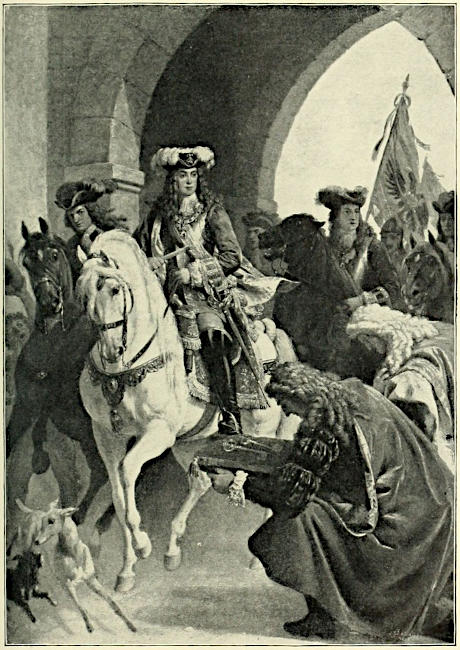
AUSTRIANS ENTERING BELGRADE
(From the painting by Karl von Blaas in the Ruhmeshalle of the Arsenal in Vienna)
But in the midst of this successful career, the increasing ferment in the hereditary states of Austria, the rebellion in the Netherlands, and, still more, the interposition of the maritime powers and Prussia, checked the hopes of Joseph at the very moment when his projects of aggrandisement seemed hastening to their completion. Justly alarmed at the successes of the two imperial courts, the three combined powers incited Poland to throw off the yoke of Russia, delivered the king of Sweden from Danish invasion, and laid the foundation of a general alliance for reducing the overgrown power of Austria and Russia. The king of Prussia even encouraged the rising discontents in Hungary, fomented the troubles which the impolitic innovations of Joseph had excited in the Netherlands, and, in the beginning of 1790, opened a negotiation with the Porte for the conclusion of an offensive alliance, intended not only to effect the restoration of the dominions conquered during the existing war, but even of the Crimea, and the territories dismembered by the two imperial courts from Poland.
The only power to which Joseph might have turned as a counterpoise to this combination was France, from whose recent change of system he had flattered himself with hopes of a cordial support, and from which he had even received private largesses to a considerable amount. But now France was in the throes of her great revolution, and Joseph was left without a resource. Worn down by innumerable calamities and disease, he died in February, 1790; and his successor, Leopold, was fortunate enough to conclude a separate peace with the Porte.
Russia Prosecutes the War; the Storm of Ismail (1790 A.D.)
Russia continued to prosecute the war against the Turks without the aid of Austria. Ismail still held out, and Potemkin, who had been besieging it for seven months, began to grow impatient. Living in his camp like one of those satraps whom he even surpassed in luxury, he was surrounded by a crowd of courtiers and ladies, who exerted every effort to amuse him. One of these ladies, pretending to read the decrees of fate in the arrangement of a pack of cards, predicted that he would take the town at the end of three weeks. Potemkin answered, with a smile, that he had a method of divination far more infallible. He instantly sent orders to Suvarov to come from Galatz and take Ismail in three days. Suvarov arrived and took such measures as would seem to indicate that he designed a renewal of the regular siege; he drew together the scattered divisions of the troops, formed them into a large besieging army of about forty thousand men, and ordered the small Russian fleet to come into the neighbourhood of the city; but his real design was to follow the course he had successfully pursued before Otchakov, take advantage of the frost, and reduce the fortress by storm.
Had not Ismail, according to ancient usage, been built without advanced works, even a general like Suvarov would scarcely have ventured on such an attack, which in the actual condition of the defences was attended by such murderous consequences. On the 21st of September the city was twice summoned, and on both occasions the garrison and inhabitants were threatened with the fate of Otchakov. The Turks, however, did not suffer themselves to be terrified into submission, and the fearful storm was commenced on the 22nd, at four o’clock in the morning. The wall was not mounted till eight o’clock, after an unexampled slaughter; but still the hottest part of the struggle took place in the city itself. Every street was converted into a fortress, every house became a redoubt, and it was twelve o’clock before the Russians, advancing through scenes of carnage and desperate resistance, reached the market-place, where the Tatars of the Crimea were collected. The Tatars fought for two hours with all the energy of despair, and after they had been all cut to pieces the struggle was still carried on by the Turks in the streets. Suvarov at length opened a passage for his cavalry through the gates into the devoted city; they charged through the streets, and continued to cut down and massacre the people till four o’clock in the afternoon. At the conclusion of this dreadful butchery the Russians received the reward which had been promised them when they were led to the storm and to certain death,—the city was given up for three days to the mercy of the victorious troops.
[1791 A.D.]
Suvarov himself, in his official report of this murderous enterprise, states that in the course of four days 33,000 Turks were either slain or mortally wounded, and 10,000 taken prisoners. He rates the loss of the Russians at 2000 killed and 2500 wounded: a number which seems to us as improbably small as the usual accounts, which assign 15,000 as the Russian loss, seem exaggerated. There were two French émigrés present at this storm, one of whom afterwards became celebrated as a Russian governor-general and French minister, and the other as a Russian general in the war against his countrymen. The first was the duke de Richelieu, or as he was then called de Fronsac, and the second the count de Langeron. Kutusov also served in this affair under Suvarov and led the sixth line of attack.
European Intervention; the Treaty of Jassy (1792 A.D.)
About this time the whole diplomacy and aristocracy of Europe were busily employed in endeavouring to rescue the Turks, in order to check the dangerously rapid progress of the French and Polish revolutionists. There speedily grew up such a general desire as the English wished to promote—of two evils to choose the least—to secure and uphold the empire of the Turks and to let the nationality of Poland perish. Russia, however, declined the proffered mediation of England in the war with the Turks, as she had resolved for this time to give up her conquests in Turkey in order to indemnify herself in Poland: she accepted merely the intervention of the friendly Danes.
Potemkin and the empress were not unthankful for Suvarov’s servility, since he threw himself and all his services at their feet, and ascribed everything to them alone. Repnin, whom Potemkin left at the head of the army when he went to St. Petersburg in October, 1790, pursued a very different course, doing more in two months than Potemkin had done in three years. He crossed the Danube with his army, pushed forward into Bulgaria, and caused the whole Turkish army to be attacked and beaten near Badadagh by Kutusov, after Gudovitch, the brother of him who had been the faithful aide-de-camp of Peter III, had completely put down the Tatars in the Kuban in January, 1791. At the head of forty thousand Russians, Repnin then advanced against one hundred thousand Turks, under the command of the same vizir, Yussuf, who had fought with such success against the emperor Joseph in the Bannat.
Potemkin eager to appropriate the impending victory, started with great expeditiousness from St. Petersburg when both armies were ready for battle (July, 1791). He took it for granted that Repnin would certainly await his arrival at the army; but he did no such thing. He offered battle before the arrival of Potemkin, whose custom it was to enjoy the fruits in the gathering of which he had no share. The victory which Repnin gained over the great Turkish army in July at Matchin led to a violent altercation between him and Potemkin, who came too late to have any participation in the honours of the day; Repnin, however, still remained in command of the army. Potemkin afterwards did everything in his power to prevent the peace for which Repnin was to negotiate, although he clearly saw that the course of events required the Russians to give up this wholesale conquest of Turkish provinces. Happily, his death left Repnin’s hands free, and a treaty was concluded at Jassy on the 9th of January, 1792, between Russia and the Porte, by which the former acquired nothing more than the fortress of Otchakov, the surrounding territory from the Dniester to the Bug, and the protectorate of Georgia.
THE DEATH OF POTEMKIN (1792 A.D.); SÉGUR’S CHARACTERISATION
[1792 A.D.]
Not long after Potemkin’s arrival at Jassy, where his headquarters or, to speak more properly, his capital and his court were established, he was seized with a malignant fever, and presumed to treat it with the same haughty contempt with which he had long been used to treat his fellow men: he laughed at his physicians, and ate salt meat and raw turnips. His disease growing worse, he desired to be conveyed to Otchakov, his beloved conquest, but had not travelled more than a few miles before the air of his carriage seemed to stifle him. His cloak was spread by the road-side; he was laid on it, and there expired in the arms of his favourite niece Branicka. Catherine fainted three times when she heard of his death: it was necessary to bleed her; she was thought to be dying. She expressed almost as much grief as at the death of Lanskoi; but it was not the lover she regretted: it was the friend whose genius assimilated with her own, whom she considered as the support of her throne and the executor of her vast projects. Catherine, holding her usurped sceptre, was a woman and timid: she was accustomed to behold in Potemkin a protector whose fortune and glory were intimately connected with her own. The character of this Russian vizir has been thus sketched by Count Ségur, who, as ambassador to St. Petersburg, lived long in habits of intimacy with him:
“Prince Gregory Alexandrovitch Potemkin was one of the most extraordinary men of his times; but in order to have played so conspicuous a part, he must have been born in Russia and have lived in the reign of Catherine II. In any other country, in any other time, with any sovereign, he would have been misplaced; and it was a singular stroke of chance that created this man for the period that tallied with him, and brought together and combined all the circumstances with which he could tally.
“In his person were collected the most opposite defects and advantages of every kind. He was avaricious and ostentatious, despotic and popular, inflexible and beneficent, haughty and obliging, politic and confiding, licentious and superstitious, bold and timid, ambitious and indiscreet. Lavish of his bounties to his relations, his mistresses, and his favourites, yet frequently paying neither his household nor his creditors. His consequence always depended on a woman, and he was always unfaithful to her. Nothing could equal the activity of his mind or the indolence of his body. No dangers could appal his courage; no difficulties force him to abandon his projects. But the success of an enterprise always brought with it disgust. He wearied the empire by the number of his posts and the extent of his power. He was himself fatigued with the burden of his existence; envious of all that he did not do, and sick of all that he did. Rest was not grateful to him, nor occupation pleasing. Everything with him was desultory—business, pleasure, temper, carriage. In every company he had an embarrassed air, and his presence was a restraint on every company. He was morose to all that stood in awe of him, and caressed all such as accosted him with familiarity.
“Ever promising, seldom keeping his word, and never forgetting anything, none had read less than he—few people were better informed. He had talked with the skilful in all professions, in all the sciences, in every art. None better knew how to draw forth and appropriate to himself the knowledge of others. In conversation he would have astonished a scholar, an artist, an artisan, or a divine. His information was not deep, but it was very extensive. He never dived into a subject, but he spoke well on all subjects.
“The inequality of his temper was productive of an inconceivable oddity in his desires, his conduct, and his manner of life. One while he formed the project of becoming duke of Courland; at another he thought of bestowing on himself the crown of Poland. He frequently gave intimations of an intention to make himself a bishop or even a simple monk. He built a superb palace, and wanted to sell it before it was finished. One day he would dream of nothing but war; and only officers, Tatars, and Cossacks were admitted to him: the next day he was busied only with politics; he would partition the Ottoman Empire, and put in agitation all the cabinets of Europe. At other times, with nothing in his head but the court, dressed in a magnificent suit, covered with ribbons presented to him by every potentate, displaying diamonds of extraordinary magnitude and brilliance, he was giving superb entertainments without any cause.
“He was sometimes known for a month, and in the face of all the town, to pass whole evenings at the apartments of a young woman, seeming to have alike forgotten all business and all decorum. Sometimes also, for several weeks successively, shut up in his room with his nieces and several men whom he honoured with his intimacy, he would lounge on a sofa, without speaking, playing at chess, or at cards, with his legs bare, his shirt collar unbuttoned, in a morning gown, with a thoughtful front, his eyebrows knit, and presenting to the view of strangers, who came to see him, the figure of a rough and squalid Cossack. These singularities often put the empress out of humour, but rendered him more interesting to her. In his youth he had pleased her by the ardour of his passion, his valour, and his masculine beauty. Being arrived at maturity, he charmed her still by flattering her pride, calming her apprehensions, confirming her power, and caressing her fancies of oriental empire, the expulsion of the barbarians, and the restoration of the Grecian republics.
“Potemkin began everything, completed nothing, disordered the finances, disorganised the army, depopulated his country, and enriched it with other deserts. The fame of the empress was increased by his conquests. The admiration they excited was for her; and the hatred they raised, for her minister. Posterity, more equitable, will perhaps divide between them both the glory of the successes and the severity of the reproaches. It will not bestow on Potemkin the title of a great man; but it will mention him as an extraordinary person; and, to draw his picture with accuracy, he might be represented as the real emblem, as the living image of the Russian Empire. For, in fact, he was colossal like Russia. In his mind, as in that country, were cultivated districts and desert plains. It also partook of the Asiatic, the European, the Tatar, and the Cossack; the rudeness of the eleventh century, and the corruption of the eighteenth; the surface of the arts, and the ignorance of the cloisters; an outside of civilisation, and many traces of barbarism.”j
THE QUESTION OF THE IMPERIAL SUCCESSION
Some time before the death of Potemkin, Catherine had begun proceedings intended to bar the czarevitch Paul from the imperial succession.a She was by no means the cruel, heartless mother that many writers are inclined to represent; but she knew her son thoroughly well, and foreseeing how destructive of all good his reign would be she could not think without fear of how the empire, which under her rule had made such rapid strides in the path of prosperity, glory, and civilisation, would after her remain without any guarantee for the stability and durability of its existence. With the intention of preserving the country from such a misfortune, Catherine wished to make over the throne to the grand duke Alexander Pavlovitch and therefore the setting aside of the czarevitch appeared in her eyes a state necessity. Meanwhile it is sufficiently well known that Catherine had long been accustomed to place the interests of the state above everything and to sacrifice to them all other considerations and feelings; therefore the difficulties with which so daring an administrative step was doubtless accompanied could not stop the creator of the changes of the year 1762. “Obstacles are created in this world,” Catherine once wrote, “in order that persons of merit may set them aside and thus add to their reputation; that is the meaning of obstacles.” Circumstances were also favourable to this new change contemplated by Catherine, for at that time no law existed that exactly established the order of succession to the throne. The statute of Peter the Great of the year 1722 was still maintained in full power, and by this statute the reigning Russian sovereigns had the right of naming anyone they liked as their successors to the throne according to their own judgment, without being restrained by any ancient right of primogeniture; and in cases where the heir already designated showed himself incapable, he could be removed from the throne.
The diary of Krapovitski can serve as a proof that in the year 1787, after Catherine’s return from her travels in the south of Russia, the question as to the necessity of changing the succession to the throne had already matured in the mind of the empress; she entered upon the historical study of the matter and read “the right of will of monarchs.” On the 20th of August, in connection with this same question, Catherine discussed with her secretary the extent to which the misfortunes of the czarevitch Paul Petrovitch had been caused by the false opinion that as eldest son the throne must belong to him. Further, on the 25th of August, Krapovitski writes: “Ukases as to the heirs to the throne, named since the time of Catherine I, have been asked for, and in the explanations a sort of displeasure was manifested.” To what conclusions the historical study of the measures taken by Peter the Great led Catherine may be seen from the context of the following remarks, written by the empress’ own hand:
“It must be acknowledged that the parent is unhappy who sees himself obliged for the safeguard of the public good to remove his offspring. This is a condition which accompanies or is joined to the autocratic and parental power. And thus I esteem that the most wise monarch Peter I had doubtlessly the strongest reasons for the removal of his ungrateful, disobedient, and incapable son, who was filled with hatred, malice, and viperous envy against him. He sought to find some particle of evil in his father’s deeds and actions which were conceived in the spirit of good, he listened to flatterers, shut his ears to the truth, and nothing was so pleasing to him as to hear his most glorious father defamed and spoken evil of. He himself was a sluggard, a coward, double-faced, unstable, gloomy, timid, drunken, passionate, obstinate, bigoted, ignorant man, of most mediocre intelligence and of weak health.”
Independent of these remarks, Catherine’s ideas are even more clearly expressed in other rough draughts concerning the Greek project and written in her own hand. She writes as follows: “Should the successes of the war give Russia the means and occasion to drive out completely the enemies of the name of Christ from the European frontiers, then Russia, in return for such an entirely Christian service rendered to the human race, would reserve to herself the restoration on the ruins of the barbaric power, of the ancient Greek Empire. Russia would promise to leave such an empire incomplete independence, to entrust and give it up to the young Russian grand duke Constantine Pavlovitch, who must then give his promise not to make in any case any hereditary or other pretensions to the succession of all the Russias, as equally his brother must do in regard to the Greek succession.” All these writings clearly testify that at the time of the second Turkish war the empress Catherine had definitively come to the conclusion that the welfare of the state required the setting aside from the succession of the czarevitch Paul Petrovitch and his replacement by the grand duke Alexander Pavlovitch.
Meanwhile the czarevitch on his part did all that was possible to justify in the eyes of Russia Catherine’s intentions to exclude him from the throne. A contemporary who was in close relations with him, T. V. Rostopschin writes as follows: “It is impossible to see without shuddering and pity what the grand duke’s father does; it is as if he sought for every means of inspiring hatred and disgust. He has taken it into his head that disrespect and neglect are shown to him; therefore for this reason, he catches and cavils at everything and punishes without distinction. Every day one only hears of violence, of quarrels about trifles of which any private individual would be ashamed. He sees a revolution everywhere; he sees Jacobite in everything.”
Catherine’s correspondence shows that already in the year 1791 the plan of excluding the czarevitch Paul from the throne was no secret to those who were in her intimacy. On the 1st of September, 1791, the empress in a letter to Grimm expresses herself quite definitely on the matter; in relating her supposition as to the consequences of the French Revolution, she writes: “But this will not be in my time and, I hope, not in the time of Alexander.” Finally on the 14th of August, 1792, Catherine communicates to Grimm considerations which allow the nomination of Alexander as heir to be regarded as a matter settled. “Why should the coronation be hurried on?” writes she; “in the words of Solomon there is a time for everything. First we will marry Alexander, and then we will crown him with all possible ceremonies, solemnities, and popular festivities. Oh, how happy he will be himself, and how happy others will be with him!” The following letter addressed by Catherine to Count V. P. Mussin-Pushkin on the 14th of September, 1792, written by the empress’ own hand, is characteristic of the relations which subsisted at that time between the czarevitch Paul Petrovitch and his mother:
Count Valentine Platonovitch:
I herewith enclose a copy of Kushilev’s letter to the governor of this town in which he says that the czarevitch has been pleased to order that more than half of the Alexandrovski square, as the plan sent by him to the governor indicates, should be given up to a certain merchant. The order itself is a mad one and of the greatest insolence. Tell Kushilev to come to you and tell him in my name that if he again dares to send such letters anywhere I will send him where the ravens will not have to seek for his bones; and tell the grand duke that in future he is not to send any orders by you at anyone’s request.
September 17th, 1793.
Catherine.
Find out beforehand if this was certainly written by the grand duke.
In the year 1794 the empress had recourse to decisive measures for the accomplishment of the projected change and notified to the council her intention of setting aside her son Paul as her successor giving as reasons his character and his incapacity. The entire council was ready to submit to this decision, but was stopped by Count V. P. Mussin-Pushkin, who said that the character and instincts of the heir might change when he became emperor; these remarks put a stop to Catherine’s intention of declaring her grandson Alexander as her successor, and for a time the matter rested there. But the opposition that Catherine met with in the council naturally did not stop her in the pursuit of the aim she had in view. As has already been observed, obstacles, in her opinion, are only created in order that they may be set aside by persons of merit; guided by such principles, the empress remained true to herself and to the matter that was so close to her heart and continued to seek for fresh ways of carrying through her intentions.k Nevertheless all her efforts failed in the end, and, as we shall see, Catherine’s son succeeded her in due course.a
THE LAST OF THE FAVOURITES
Plato Zubov, the twelfth and last of Catherine’s avowed favourites, succeeded in some degree to the position which Potemkin had held as a sort of vice-emperor. Zubov had superseded Momonov, who, soon wearying of the faded charms of a mistress of sixty, became enamoured of the young princess Sherbatov, and had the courage to avow it and ask permission to marry her. Catherine had pride and generosity enough to grant his request without any reproaches. She saw him married at court to the object of his affection, and sent him to Moscow loaded with presents. But it was currently reported that Momonov was so imprudent as to mention to his wife some particulars of his interviews with the empress, and that she divulged them with a levity which Catherine could not forgive. One night, when the husband and wife were gone to rest, the master of the police at Moscow entered their chamber; and, after showing them an order from her majesty, left them in the hands of six women, and retired to an adjoining room. Then the six women, or rather the six men dressed as women, seized the babbling lady, and having completely stripped her, flogged her with rods in the presence of Momonov, whom they forced to kneel down during the ceremony. When the chastisement was over, the police-master re-entered the room and said: “This is the way the empress punishes a first indiscretion. For the second, people are sent to Siberia.”
It was in the spring of 1789, when the empress was at Tsarskoi Selo, that Momonov was married and dismissed. Lieutenant Zubov commanded the detachment of horse-guards in attendance, and being the only young officer in sight he owed his preferment to that fortunate circumstance. Nicholas Soltikov, to whom he was distantly related, and who was at that time in high credit, took pains to promote his interest, hoping to find in him a protector against Potemkin, whom he heartily disliked. After some secret conferences in presence of the Mentor, Zubov was approved, and sent for more ample information to Mademoiselle Protasov and the empress’ physician. The account they gave must have been favourable, for he was named aide-de-camp to the empress, received a present of a hundred thousand roubles (£10,000) to furnish him with linen, and was installed in the apartment of the favourites with all the customary advantages.
The next day this young man was seen familiarly offering his arm to his sovereign, equipped in his new uniform, with a large hat and feather on his head, attended by his patron and the great men of the empire, who walked behind him with their hats off, though the day before he had danced attendance in their ante-chambers. His own were now filled with aged generals and ministers of long service, all of whom bent the knee before him. He was a genius discerned by the piercing eye of Catherine; the treasures of the empire were lavished on him, and the conduct of the empress was sanctioned by the meanness and the shameful assiduities of her courtiers.
Debaucheries at Catherine’s Court
The new favourite was not quite five-and-twenty years old, the empress was upwards of sixty. Yet even at this advanced period of her life she revived the orgies and lupercalia which she had formerly celebrated with the brothers Orlov. Valerian, a younger brother of Zubov, and Peter Soltikov, their friend, were associated in office with the favourite. With these three young libertines did the aged Catherine spend her days, while her armies were slaughtering the Turks, fighting the Swedes, and ravaging Poland; while her people were groaning in wretchedness and famine, and devoured by extortioners and tyrants.
It was at this time she formed a more intimate society, composed of her favourites and most trusty ladies and courtiers. This society met two or three times a week, under the name of the Little Hermitage. The parties were frequently masqued, and the greatest privacy prevailed. They danced, played at forfeits, joked, romped and engaged in all sorts of frolics and gambols. Leov Narishkin acted the same part there as Roquelaure at the court of Louis XIV; and a fool by title, Matrona Danilovna, seconded him. This was an old gossip, whose wit consisted only in uttering the most absurd vulgarities; and as she was allowed the common right of fools, that of saying anything, she was loaded with presents by the lower order of courtiers. Such foreign ministers as enjoyed the favour of the empress were sometimes admitted to the Little Hermitage. Ségur, Cobenzl, Stedingk, and Nassau chiefly enjoyed this distinction; but Catherine afterwards formed another assembly, more confined and more mysterious, which was called the Little Society. The three favourites of whom we have just been speaking, Branicka, Protasov, and some confidential women and valets-de-chambre, were its only members. In this the Cybele of the north celebrated her most secret mysteries. The particulars of these amusements are not fit to be repeated.
[1793 A.D.]
Catherine survived Potemkin but four years. The last ten years of her reign carried her power, her glory, and her political crimes to their highest pitch. When the great Frederick, dictator of the kings of Europe, died, she remained the eldest of the crowned heads of the continent; and if we except Joseph, all those heads together were unequal to her own. If Frederick was the dictator of these kings, Catherine became their tyrant. The immense empire which she had subjected to her sway; the inexhaustible resources she derived from a country and a people as yet in a state of infancy; the extreme luxury of her court, the barbarous pomp of her nobility, the wealth and princely grandeur of her favourites, the glorious exploits of her armies, and the gigantic views of her ambition threw Europe into a sort of fascination; and those monarchs who had been too proud to pay each other even the slightest deference felt no abasement in making a woman the arbiter of their interests, the ruling power of all their measures.
THE SUBJUGATION AND FINAL PARTITION OF POLAND (1796 A.D.)
The annihilation of Poland, long meditated, was now resolved on. The empress could never forgive that nation either for the act of the diet in 1788, which abrogated the constitution dictated by violence in 1775, or the alliance of Prussia accepted in contempt of her own, or, above all, the constitution decreed at Warsaw on the 3rd of May, 1791. Big with these ideas of revenge, she gave orders to Bulgakov, her minister at Warsaw, to declare war against Poland.
The diet being assembled received this declaration with a majestic calmness, which was rapidly succeeded by the generous enthusiasm of a nation roused to self-defence. The king himself pretended to share the feelings that animated his people; and the Poles had the weakness to believe that, having abandoned his former servility to Russia and his customary indolence, he was becoming the defender of their freedom. An army was collected in haste, and the command of it given to the king’s nephew, Joseph Poniatowski, an inexperienced young man, all of whose efforts were obstructed or misdirected by his traitorous uncle.
The Poles could have opposed the designs of Catherine with an army of fifty thousand men; but they never yet could be brought to unite their forces; and their different corps were soon after pressed between an army of eighty thousand Russians, who fell back from Bessarabia upon the territory which extends along the Bug, another of ten thousand collected in the environs of Kiev, and a third of thirty thousand, which had penetrated into Lithuania.
We shall not here attempt to draw the picture of the various battles that drenched the plains of Poland with blood, and which, notwithstanding some advantages obtained by the Poles, consumed the greater part of their troops. It was then that the illustrious Kosciuszko, who as yet was nothing more than one of the lieutenants of young Joseph Poniatowski, displayed qualities that justly obtained him the confidence of the nation, the hatred of the Russians, and the esteem of Europe.
During all this time Catherine, not trusting alone to the power of her own arms, had been negotiating with unremitted assiduity. She proposed the definitive partition of Poland to Frederick William, who was undoubtedly no less desirous of it than herself. She secretly won over to her views the two brothers Kassakovski, the hetman Branicki, Rejevuski, and particularly Felix Potocki, who, while flattering himself perhaps with the hopes of mounting the throne of Poland, became only the slave of Russia. She even insisted that Stanislaus Augustus should make a public declaration that it was necessary to yield to the superiority of the Russian arms. He submitted to this indignity; but was not on that account treated by the empress with greater indulgence.
In 1793 the confederation of the partisans of Russia assembled at Grodno, where the Russian general proudly seated himself under the canopy of the throne he was about to overturn. The Russian minister Sievers, at the same time, published a manifesto (April 9th) in which he declared that his sovereign would incorporate with her dominions all the territory of Poland which her arms had conquered. The king of Prussia, in concert with Catherine, had already marched an army into Poland.
The Russians, dispersed about the provinces of that kingdom, committed depredations and ravages of which history furnishes but few examples. Warsaw became likewise the theatre of their excesses. The Russian general Igelström, who governed that city, connived at the disorders of his soldiers, and made the wretched inhabitants feel the whole weight of his arrogance and barbarity. The defenders of Poland had been obliged to disperse. Their property was confiscated; their families were reduced to servitude. Goaded by so many calamities, they once more took the resolution to free their country of the Russians. Some of them assembled, and sent an invitation to Kosciuszko to come and put himself at their head. That general had retired to Leipsic, with Hugh Kolonti, Zajonchek, and Ignatius Potocki, a man of great knowledge and sagacity, a sincere friend to his country, and in all respects the opposite of his cousin Felix. These four Poles joined eagerly in the resolution adopted by their honest countrymen: but they were sensible that, in order to succeed, they must begin by giving liberty to the peasants, who till then had been treated in Poland like beasts of burden.
Kosciuszko and Zajonchek repaired, with all expedition, to the frontiers of Poland. The latter proceeded to Warsaw, where he had conferences with the chiefs of the conspirators. A banker named Kapustas, a bold and artful man, made himself responsible for the inhabitants of the capital. He saw likewise several officers, who declared their detestation of the Russian yoke. All, in short, was ripe for an insurrection, when the Russian commanders, to whom Kosciuszko’s presence on the frontiers had given umbrage, forced him to postpone it for a time. To throw the Russians off their guard, Kosciuszko went into Italy, and Zajonchek to Dresden, whither Ignatius Potocki and Kolonti had retired, but all at once Zajonchek appeared again at Warsaw. The king himself impeached him to the Russian general Igelström, who had a conference with him, and ordered him to quit the Polish territory. No alternative now remained for him but to proceed immediately to action, or to abandon the enterprise altogether. Zajonchek resolved on the former.
[1794 A.D.]
In 1794 Kosciuszko was recalled from Italy, and arrived at Cracow, where the Poles received him as their deliverer. In spite of the orders of the Russians, Colonel Madalinski pertinaciously refused to disband his regiment. Some other officers had joined him. Kosciuszko was proclaimed general of his little army, amounting to three thousand foot and twelve hundred horse; and the act of insurrection was almost immediately published on the 24th of March. Three hundred peasants, armed with scythes, ranged themselves under the standard of Kosciuszko. That general soon found himself faced by seven thousand Russians, who were put to flight after a vigourous resistance.
On hearing at Warsaw of the success of Kosciuszko, the Russian general Igelström caused all those to be arrested whom he suspected to have any concern in the insurrection; but these measures served only the more to irritate the conspirators. The insurrection broke out on the 18th of April. Two thousand Russians were put to the sword. Their general, being besieged in his house, requested permission to capitulate; and profiting by the delay that was granted him, he escaped to the Prussian camp, which lay at a little distance from Warsaw. Vilna, the capital of Lithuania, followed the example of Warsaw; but the triumph of the insurgents was there less terrible. Colonel Iazinski, who was at their head, conducted himself with so much skill, that he took all the Russians prisoners, without shedding a drop of blood. The inhabitants of the cantons of Chelm and of Lublin declared themselves also in a state of insurrection, and were imitated by three Polish regiments who were employed in the service of the Russians. Some of the principal partisans of Russia, the hetman Kassakovski, the bishop his brother, Zabiello, Ozarovski, and Ankvitch were sentenced to be hanged, the first at Vilna, and the others at Warsaw.
Kosciuszko exerted himself to the utmost to augment his army. He got recruits among the peasants; and to inspire them with more emulation he wore their dress, ate with them, and distributed encouragements among them; but those men too long degraded in Poland were not yet deserving of the liberty that was offered them. They distrusted the intentions of the nobles, who, on their side, for the most part lamented the loss of their absurd prerogatives. Stanislaus Augustus and his partisans augmented still further the ill-will of the nobles, by representing to them the intentions of Kosciuszko as disastrous to their order, and by caballing continually in favour of Russia.
[1795 A.D.]
In the mean time, the empress, not satisfied with augmenting the number of her troops in Poland, had sent her best generals thither. After several battles, in one of which Frederick William, who had advanced to support the Russians, fought at the head of his troops against Kosciuszko, who was striving to prevent the junction of the Russian generals, Suvarov and Fersen, the Polish commander was attacked by the latter at Macziewice on the 4th of October. His talents, his valour, and his desperation were unable to prevent the Poles from yielding to numbers. Almost the whole of his army were cut to pieces or obliged to lay down their arms. He himself, covered with wounds, was taken prisoner, ejaculating, “Finis Poloniæ!”
All who were able to escape from the conquerors went and shut themselves up in Praga, the eastern suburb of Warsaw, where 26,000 Poles and 104 heavy cannon and mortars defended the bridges over the Vistula and the approach to the capital. Suvarov was soon before the gates with an effective force of but 22,000 men and 86 field pieces; but even with such odds against him he resolved to do as he had done at Ismail, and carry the Polish lines at the point of the bayonet. After cannonading the defences for two days he gave the order for the assault at daybreak on the 4th of November. The trenches were carried after a desperate fight of five hours; the Russians swept into the town, murdering all before them, old men, women, and children; the wooden houses were speedily on fire; the bridges were broken down, so that the helpless crowds who attempted to escape into the city were remorselessly driven into the Vistula. Besides 10,000 Polish soldiers, 12,000 citizens of every age and sex perished in this wanton butchery.
Warsaw itself capitulated on the 5th of November, and was delivered up to the Russians on the 6th. Poland was now annihilated. One division of its troops after another was disarmed, and all the generals and officers who could be seized were carried off. The king, however, who could be induced to do anything if his comforts were spared, was used as an instrument to give to power the impress of right. He was again set nominally at the head of the kingdom till the robbers had agreed upon the division of the spoil, and had no longer need of him. Suvarov held a splendid military court for a year in Warsaw, far eclipsing the king, till at length the city was given up to the Prussians.
The whole of the year 1795 was spent in negotiations with Prussia, and the last treaty for the partition of Poland was not signed till the 24th of October, 1795. In December, Suvarov travelled from Warsaw to St. Petersburg, where the empress appropriated the Taurian palace for his residence, and nominated a special household for his service. On the 1st of January, 1796, Warsaw was first given up to the Prussians, and negotiations were carried on till the 21st of October, 1796, respecting the boundaries of the palatinates of Warsaw and Cracow. By virtue of this partition, first finally arranged in October, 1796, Austria obtained the chief parts of the waiwodeship of Cracow, the palatinates of Sendomir and Lublin, together with a portion of the district of Chelm and portions of the waiwodeships of Brzesc, Podalachia, and Massovia, which lie along the left bank of the Bug. All these districts contain about 834 German square miles. Prussia received those portions of Massovia and Podalachia which touch upon the right bank of that river, in Lithuania those parts of the palatinates of Troki and Samogitia which lie to the left of the Niemen, and, finally, a district in Little Poland which belonged to the waiwodeship of Cracow, making in all about one thousand German square miles. Russia received the whole of what had hitherto been Polish Lithuania as far as the Niemen, and to the frontiers of the waiwodeships of Brzesc and Novogrodek, and thence to the Bug, together with the greater part of Samogitia. In Little Poland she obtained that part of Chelm which lies on the right bank of the Bug and the remainder of Volhinia, in all about two thousand German square miles. During the negotiations for the partition, Russia caused Stanislaus Augustus to lay down the crown. The three partitioning powers ensured him a yearly income of 200,000 ducats, and promised to pay his debts.
THE ANNEXATION OF COURLAND (1795 A.D.)
Catherine had now conquered, either by her arms or by her intrigues, almost one-half of Poland, the Crimea, the Kuban, and a part of the frontiers of Turkey. But she had no need of armaments and battles for usurping another rich and well-peopled country. Courland and Semigallia, where still reigned Duke Peter, the feeble son of the famous Biren, had long been prepared for that annexation, which was now effected almost without an effort. The flattering reception given to the Courish nobles in St. Petersburg by the empress, distinctions, honours, posts, and pleasures, rendering their abode in the imperial residence far preferable to continuing in Mittau, and made them desirous of being under the sway of the sovereign of a vast empire, rather than live in obedience to a duke the obscurity of whose origin they could not forget, and whom they regarded as their inferior. To bring the people to the same way of thinking as the nobles, Catherine artfully embroiled them with their neighbours, and created for them reasons of alarm.
She began by instigating the inhabitants of Livonia to insist upon the fulfilment of an ancient convention, by which the Courlanders were obliged to bring all their merchandises to Riga: certainly a very strange and hard condition, by which a nation, that had on its coasts excellent harbours happily situated, should be obliged to go, at a great expense, to embark the products of its soil in a foreign city. The quarrel between the Livonians and the Courlanders was not yet terminated, when the empress sent engineers into Courland, to mark out a canal, to facilitate the transport of the merchandises of that country into Livonia. The Courlanders seeing this, and fearing lest they should be soon forced to make use of this canal, thought it better for them to be protected than oppressed by the empress, and to be her subjects rather than her neighbours.
Catherine, being informed of these dispositions, called the duke of Courland to her, under the pretence of conferring with him on matters of importance. No sooner was that prince at the foot of the throne of the autocratrix of the north, than the states of Courland held an assembly, wherein it was proposed to put the country under the supremacy of Russia. The principal members of the grand council faintly opposed this motion, observing, that before they proceeded to a resolution it would be expedient to wait the return of the duke. The oberburgraf Hoven rose up, and spoke a long time in favour of Russia. Some councillors expressed themselves of his opinion; others reproached him with treason. The dispute grew warm on both sides; challenges were reciprocally given and swords were about to be drawn, when the Russian general Pahlen appeared in the assembly. His presence restored tranquillity. No one presumed to raise his voice against Russia; and the proposal of the nobles was adopted.
The next day, March 18th, 1795, the act was drawn up, by which Courland, Semigallia, and the circle of Pilten made a formal surrender of themselves to the empress of Russia; and it was carried to St. Petersburg, where the duke of Courland learned, from the mouth of his own subjects, that they themselves had deprived him of his dominions. The empress immediately sent a governor thither. Some discontent, however, remained in Courland; discontent brought on proscription, and the possessions of the proscribed were given to the courtiers of Catherine. The favourite, Plato Zubov, and his brother Valerian obtained a great part of those rich and shameful spoils.j
LAST YEARS AND DEATH OF CATHERINE
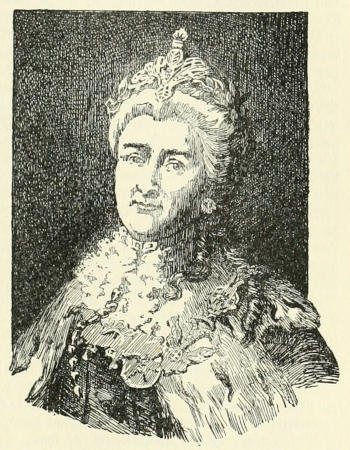
Catherine II
(1729-1796)
Before the breaking out of the French Revolution the governments of Louis XVI and Catherine II had entered into active negotiations for the formation of a quadruple alliance that should include Austria, Russia, and the two houses of Bourbon, and should have for its object the checking of England’s maritime pretensions and the encroachments of Prussia. After the taking of the Bastille Catherine realised that she could no longer count upon the support of France, since that country was exclusively occupied with its own interior transformation. She kept anxious watch, however, upon the course of events in Paris, and manifested the liveliest antipathy to the new principles, falling ill at the news of the king’s execution on the 21st of January. Led by fear into a violent reaction, the correspondent of Voltaire and Diderot set a close watch upon all Russians suspected of liberalism. She destroyed a tragedy of Kniaznin and exiled to Siberia Radichtchev, the author of a curious book entitled Journey from St. Petersburg to Moscow, in which were many sharp reflections on serfdom; Novikov was confined at Schlüsselburg, his printing houses were closed and all his enterprises ruined. She dismissed Genêt, the French ambassador, refused to recognise either the constitution of 1791 or the French Republic, issued an ukase announcing the rupture of diplomatic relations with France, refused to the tri-colour admission to Russian parts, expelled all French subjects who refused to swear allegiance to the monarchical principle, extended a warm welcome to French refugees, and lost no time in acknowledging Louis XVIII.
In 1792 she published her famous note on the restoration of royal power and aristocratic privileges in France, asserting that only ten thousand men would be necessary to effect a counter-revolution. She encouraged Gustavus III, who was assassinated by his nobles at a masked ball (March 16th, 1792), to place himself at the head of a crusade against democracy. She further urged England to assist the count d’Artois in a descent he had planned upon the French coast, and stimulated the zeal of Austria and Prussia. Notwithstanding this, though she had repeatedly negotiated treaties for subsidies and promised troops, she took care never to become involved in a war with the west. “My position is taken,” she said, “my part assigned; I shall watch the movements of Turkey, Poland, and Sweden.”
The latter country became reconciled to France after the death of Gustavus III. The punishment of the Jacobins of Warsaw and Turkey was an easier and more lucrative piece of work. We should also take into account an admission that she made to her vice-chancellor Ostermann in 1791: “Am I wrong? I cannot avow all to the courts of Berlin and Vienna, but I wish to keep them engaged in these affairs so that I may have freedom to carry on my unfinished enterprises.” She excused herself for not taking part in the anti-revolutionary crusade by alleging the war with Turkey; then when in consequence of the revolution of the 3rd of May she was obliged to hasten the Peace of Jassy, she made the Polish war her excuse; and when this was ended she affected to excite Suvarov and his soldiers against the atheists of the west, but in reality thought only of gaining her own ends in the east. Muhammed, the new king of Persia, had recently invaded Georgia and burned Tiflis, the capital of Heraclius, a protégé of the empress. Catherine summoned to her court an exiled brother of Muhammed’s and charged Valerian Zubov with the conquest of Persia. [His armies were actually under way when the death of Catherine led to the abandonment of the enterprise.]
[1796 A.D.]
Without being aware of it Catherine II really performed greater service to France than to the coalition. By her intervention in Poland and her projects against the east she had excited the jealousy and suspicion of Prussia and Austria. She took care to pit them against each other; made the second partition with Frederick William in spite of Austria, and effected the third with Francis II to the extreme dissatisfaction of Prussia. She contributed indirectly to weaken and dissolve the coalition, being herself prevented from joining it by the Polish insurrection that received so much encouragement from France. She died on the 17th of November, 1796, at the age of sixty-seven. Since Ivan the Terrible no monarch had extended the limits of the empire by such vast conquests. Catherine made the Niemen, the Dniester, and the Black Sea the boundaries of Russia.d
A RUSSIAN ESTIMATE OF CATHERINE
The personality of the empress was as though created for a throne. We do not meet in history with any other woman so fitted to rule. On all and each she produced a profound impression. No one has spoken more harshly and disadvantageously of the empress’ qualities than Masson, yet this pamphleteer-writer observes that during the space of ten years, having had occasion to see Catherine once or twice a week, he was always struck by her unusually attractive personality, by the dignity with which she held herself, and by the amiability of her behaviour to everyone.
In her Memoirsg Catherine herself has left a detailed narrative of the course of her development, of her aspirations after power, and of her unscrupulousness in the means she used to attain her aims. The empress’ frankness in this respect amounts almost to cynicism. In maturity she at last became an autocratic sovereign. After the terrible humiliations, the bitter trials she had endured in her youth, her delight when she found herself in the enjoyment of unbounded power was all the greater. The fact that the fundamental change in her surroundings, the rapid passage from entire dependency to entire potency, did not in any wise awaken in her any despotic inclinations testifies to the goodness inherent in her nature; when her son was subjected in his turn to a like change in outward circumstances his despotism knew no bounds.
We have seen that the unfavourable circumstances in which Catherine found herself until the year 1762 exercised a baneful influence upon her character; whereas the power and preponderance which she later acquired had an ennobling effect upon her nature. Until then she had been necessarily obliged often to have resource to mean and trifling measures to better her position and to revenge herself on her opponents; when she was able to exert full power, to enjoy the advantages of her position, the respect of her contemporaries, the adoration of the persons that surrounded her, she no longer needed to employ those means which are generally made use of by the weak in their struggle against the strong. At the time when a sharp watch was kept over her, when she was not trusted by either Elizabeth or Peter, she understood how to dissemble, to play the hypocrite, to feign humility and modesty, whilst in her soul she was filled with arrogance and contempt for mankind. Now that she had surrounded herself entirely with persons devoted to her she could act openly and nobly. The grand duchess in her isolation had been remarkable for her coldness, her mistrust of mankind, her suspiciousness; the empress on the contrary gave full scope to the development of feelings of benevolence, condescension, indulgence, and sincere attention to the interests of the persons that surrounded her. It was not without reason that Peter and Elizabeth had mistrusted Catherine and been suspicious of her character; it was not without reason, either, that in after times many people highly esteemed Catherine’s kindheartedness.
The history of the court under Peter I, under the empress Anna, and under Elizabeth is full of examples of tyranny, cruelty, and arbitrariness; all Catherine’s contemporaries were astonished at the mildness of her behaviour to those around her and rejoiced at the absence of stiff formalities and hard measures in her intercourse with her subordinates. In spite of her quick temper and impulsiveness, Catherine had complete control over herself, and in her intercourse with her fellow creatures she was governed by principles of humanity. “I like to praise and reward loudly, to blame quietly,” she once justly remarked in conversation with Ségur; she sought to avoid occasions of offending anyone, and was particularly careful in her intercourse with servants; “I will live to make myself not feared,” she once said, observing that the stove-heater, who had deserved reproof for some neglect, avoided meeting her. Often when Catherine had given an order she would make excuses for the trouble and labour it occasioned. Krapovitski gives instances of such solicitude on her part; more than once the empress, when impatient or irritated, having expressed herself somewhat sharply, afterwards acknowledged her hastiness and endeavoured to repair her fault.
It is said that Catherine, who awoke early and usually rose at six in the morning, so valued the tranquillity of her servants that without requiring assistance she dressed herself, lit the fire, and without disturbing anyone sat down to her books and papers. Various anecdotes are to be found in the narratives of contemporaries testifying to her indulgence to her servants and her want of sufficient severity in her intercourse with them. When she was in a passion she turned up her sleeves, walked about the room, drank a glass of water, and deferred judgment. Her capacity for removing any misunderstanding that might have arisen between herself and others was particularly remarkable. In her letters to various great lords we meet with frequent exhortations not to give way to despair but to take courage, to believe in their own capacities, and to hope for success. In moments of danger she knew how to raise the spirits of those around her, inspiring them with firmness and courage.
The distinguishing features of Catherine’s character were gaiety, humour, and an inclination for fun and amusements. She once remarked: “As to the gaiety of character of Frederick the Great, it must be observed that it proceeded from his superiority: was there ever a great man who was not distinguished by his gaiety and who did not possess in himself an inexhaustible store of it.” She took the greatest pleasure in going to masquerades and, while preserving the strictest incognito, talking to various people; she herself related in detail how she had once gone to a masquerade in male attire and had made a declaration of love to a young girl who never suspected that it was the empress talking to her. It must not be regarded as a matter of chance or an act of complaisance that such a multitude of anecdotes testifying to the magnanimity of Catherine have been preserved; many contemporaries who do not unconditionally praise her maintain however that she was capable of listening to unpleasing truths, of recognising her faults and deficiencies, and of restraining her anger. Such assertions are to be met with in Razumovski, Derjavin, Mussin-Pushkin, and Teplov.
Of course traits are not wanting which show her obstinacy, self-will, and arrogance. Derjavin cites several circumstances to prove that in her actions Catherine was often governed by personal considerations and desires rather than the real good of the state and strict justice. It is also not without reason that she is reproached with the fact that, while protesting against the use of tortures and corporal punishment, she allowed full scope to the cruelties of Sheshkovski who frequently with his own hand tortured accused persons in the most atrocious manner; we cannot however determine how far the empress was cognisant of his barbarous treatment. Referring to some instances of arbitrariness and infringement of the law, Prince Sherbatov remarks that the empress held herself above the law and that she thus herself set a pernicious example to the great noblemen and dignitaries who imitated her in this respect.
As to Catherine’s piety, Frederick II plainly accused her of hypocrisy and bigotry. We bear in mind that it was not easy for her to adopt the orthodox faith, but that when she had adopted it she used outward piety as a means of strengthening her position in Russia. By strictly observing the rules of the church, and conscientiously fulfilling her religious duties, she endeavoured to produce a certain impression on her subjects. At the same time she remained true to the principles of toleration preached in the literature of enlightenment. When Voltaire reproached her, saying that she humiliated herself by kissing the priest’s hand, she justified herself by replying that it was only an outward observance which would little by little become obsolete. There is no doubt that Catherine’s piety did not spring from any deep feeling. In her letters to Grimm, sallies against Luther and the Lutherans are to be met with more than once; she despised Lutherans for their intolerance and several times praised the orthodox faith as the best in the world; she compared it to an oak tree with deep roots.
Side by side with such remarks we meet with bold sallies both from the lips and in the letters of the empress against excessive piety and fanaticism; such are certain caustic remarks referring to Maria Theresa and the queen of Portugal. In certain jeux d’esprit which she allowed herself in connection with questions of the church and religion in her letters to Grimm, the same rationalism is to be observed as that which distinguished the votaries of French literature of the time. Catherine praised the works of Nicholas Sebaldus Nothanker, especially, because hypocrisy was condemned in them. Deep religious and philosophical questions she did not like; her chief characteristic was a certain worldliness. Her point of view was optimistic and her principal rule of earthly wisdom, gaiety. She did not like to meditate on sad events, to give way to grief, to dwell upon gloomy subjects; and this partly explains her esteem for Voltaire, whom she called the “god of gaiety.” This playfulness and vivacity, this freshness and gaiety she preserved to the end of her life.h