Chapter VI · PETER THE GREAT (continued 3)
Reading edition
These were remarkable words, and worthy the pupil of Holland and England, worthy of a prince to whom superstition was a most inveterate enemy. In reality, he was a believer, but not credulous; and even while he knelt on the field of victory, he gave thanks to God alone for the reward of so many toils, and could separate the cause of heaven from that of the priests; it was his wish that they should be citizens. We have seen that he subjected them to the same taxes as his other subjects; and because the monks eluded them he diminished their numbers. He unmasked the superstitious impostures of the priests, who all sought to close up every cranny by which the light might have a chance of reaching them.
For this reason, they held St. Petersburg in abhorrence. According to their description of it, this half-built city, by which Russia already aspired to civilisation, was one of the mouths of hell. It was they who obtained from the unfortunate Alexis a promise that it should be destroyed. Their prophecies repeatedly fixed the epoch at which it would be overthrown by the wrath of heaven. The labours upon it were then suspended, for so great was the fear thus inspired that the orders of the terrible czar were issued almost in vain.
On one occasion, these lying priests were for some days particularly active; they displayed one of their sacred images, from which the tears flowed miraculously; it wept the fate which impended over those who dwelt in this new city. “Its hour is at hand,” said they, “and it will be swallowed up, with all its inhabitants, by a tremendous inundation.” On hearing of this miracle of the tears, the treacherous construction which was put upon it, and the perturbation which it occasioned, Peter thought it necessary to hasten to the spot. There, in the midst of the people, who were petrified with terror, and of his tongue-tied court, he seized the miraculous image, and discovered its mechanism; the multitude were stupefied with a pious horror, but he opened their eyes by showing them, in those of the idol, the congealed oil, which was melted by the flame of tapers inside, and then flowed drop by drop through openings artfully provided for the purpose.
[1719 A.D.]
At a later period he did still more; the horrible execution of a young Russian by the priests was the cause. This unfortunate man had brought back from Germany a highly valuable knowledge of medicine, and had left there some superstitious prejudices. For this reason all his motions were watched by the priests; and they at last caught up some thoughtless words against their sacred images. They immediately arrested the regenerated young Russian, sentenced him without mercy, and put him to a torturing death. But this individual evil produced a general good. Indignant at their cruelty, Peter deprived the clergy of the right of condemning to death. The priests lost a jurisdiction which they alleged they had possessed for seven centuries, from the time of Vladimir the Great, and thus the source of their power was forever annihilated by this execrable abuse of it.
It was particularly in that sanguinary year, so fatal to the last hope which the old Russians placed in his successor, that Peter seemed in haste to sever them from their ancient customs, by giving an entirely new form to the administration of his empire. As far back as 1711, he had already replaced the old supreme court of the boyars by a senate, a sovereign council, into which merit and services might obtain admission, independent of noble origin. Subsequently, and every year, other changes had been effected. Thus, in 1717, he brought from France, along with a commercial treaty, the institution of a general police. But, in 1718, instead of the old prikaz, he substituted, at one stroke, colleges for foreign affairs, naval affairs, finance, justice, and commerce, and fixed, by a general regulation, and with the utmost minuteness, the functions and privileges of each of them.
At the same time, when capable Russians were not to be found, he appointed his Swedish prisoners, and the most eminent of the foreigners, to fill these administrative and judicial situations. He was careful to give the highest offices to natives, and the second to foreigners, that the native officers might support, against the pride and jealousy of their countrymen, these foreigners who served them as instructors and guides. For the purpose of forming his young nobles for the service of the state, he adjoined a considerable number of them to each college; and there merit alone could raise them from the lowest stations to the first rank.
RENEWED HOSTILITIES WITH SWEDEN (1719-1721 A.D.)
[1719-1720 A.D.]
The death of Charles XII was immediately followed by a revolution in Sweden. His sister Ulrica Eleonora, who was married to the crown prince of Hesse-Cassel, succeeded him on the throne; but the constitution was changed, the despotic authority of the crown was reduced to a mere shadow, and the queen and her husband became the tools of an oligarchy who usurped all the powers of the state. The czar and the new queen mutually protested their desire for peace; but Peter at the same time announced to the Swedish plenipotentiaries that, if the propositions he had made were not accepted within two months, he would march forty thousand men into Sweden to expedite the negotiations.
A project for the pacification of the north, the very opposite from that conceived by Görtz, was formed by the diet of Brunswick. The concocters of this scheme started from the principle that the German possessions of Sweden were more onerous than profitable to that power, as the occasions of interminable wars. It was resolved, therefore, that they should be abandoned to the powers that had conquered them; but as it was reasonable that the new possessors should purchase the ratification of their titles by some services to the common cause, they were required to aid Sweden in recovering possession of Finland and of Livonia, the granary of that kingdom. Of all the czar’s conquests nothing was to be left to him but St. Petersburg, Kronstadt, and Narva; and, if he refused to assent to this arrangement, all the contracting powers were to unite their forces and compel him to submit. This was one of those brilliant and chimerical schemes with which diplomatists sometimes allow their minds to be so dazzled as not to be convinced of their impracticability until after a lavish waste of blood.
Whilst the allies were in imagination depriving Peter of his conquests, Siniavin, his admiral, took from the Swedes two ships of the line and a brigantine, which were carrying corn to Stockholm. The queen of Sweden, however, encouraged by the promises made her by Lord Carteret, the ambassador of George I, intimated to the czar that she would break off the conferences at Åland if he did not consent to restore all the provinces he had conquered. By way of reply, Peter went in June, 1719, with a fleet of 30 ships, 150 galleys, and 300 barges, carrying in all 40,000 men, to Åland, took up his station for a while under the cliffs of the island of Lämeland, and sent Apraxin to ravage the wastes on the right of Stockholm, whilst Lessy destroyed everything on the left of the city. North and south Telge, Nyköping, Norköping, Osthammer, and Oregrund, together with two small towns, were burned, besides 150 noble mansions, 43 mills, 1,360 villages, 21 copper, iron, and tile works—among the iron works one was worth 300,000 dollars; 100,000 cattle were slaughtered, and 80,000 bars of iron thrown into the sea. The mines were blown up and the woods set on fire, and Stockholm itself was seriously threatened. Meanwhile, the English fleet under Admiral Norris again entered the Baltic. Peter sent a message to the English admiral asking peremptorily whether he came only as a friend to Sweden or as an enemy to Russia. The admiral’s answer was that as yet he had no positive orders. This equivocal reply did not hinder Peter from keeping the sea, and incessantly harassing the Swedes before the eyes of their naval allies.
The Swedish oligarchs and their mock king[43] had reckoned in vain upon the intercession of the English ambassador, and the aid of the admiral and his fleet. Carteret was not even listened to by Peter, and Admiral Norris did not venture to attack the Russians, because he knew that the English nation was dissatisfied with the politics of their king and of his ministers, who favoured his Hanoverian plans. The Swedes were at length obliged to acquiesce in the Russian demands; negotiations for peace were again commenced in Nystad at the end of the year 1720, but their conclusion was only brought about at the close of the following year by the exercise of some further cruelties on the part of the Russians. The Swedes had demanded a cessation of hostilities during the whole time in which the negotiations were pending, but Peter only granted it till May, 1721, in order to compel the council of state to come to a resolution by that time; and as they still procrastinated, the whole coast of Sweden was again plundered and devastated in the month of June.
[1721 A.D.]
The Russian incendiaries landed in sight of the English, whose fleet under Admiral Norris, still continued in the Baltic, but did not venture to lend any assistance to the Swedes. The whole coast, from Gefle as far as Umeå, was ravaged; four small towns, nineteen villages, eighty nobles’ and five hundred peasants’ houses burned; twelve iron-works and eight saw-mills destroyed; six galleys and other ships carried away. Peter’s plenipotentiaries at last prevailed—for he so jocularly called his soldiers and sailors who were committing such horrible destruction in Sweden. Negotiations were again opened in Nystad, a small town in Finland, and the war of twenty-one years was closed by a peace dictated by the conquering czar.
The provinces ceded to Russia by the Peace of Nystad (September 10th, 1721) were Livonia, Esthonia, and Karelia, together with Viborg, Kexholm, and the island of Ösel; on the other hand, Peter restored Finland, with the exception of Viborg and Kexholm, and promised to pay two millions of dollars, but in the first years of the peace scarcely paid off half a million.
From this time forward, the despotic sway and military oppression of Russia became the dread of all neighbouring countries and people. All contributed to the external greatness and splendour of the ruler of a barbarous but powerful race of slaves, whom he constrained to adopt the vestments of civilisation. The czar commanded in Poland and Scandinavia, where weak or wicked governments were constantly in dread from the discontent of the people. He also gained an influence in Germany, which ultimately caused no small anxiety to the emperor and the empire. The Russian minister Bestuzhev played the chief part in Sweden in all political affairs, sometimes by counsel and sometimes by threats, sometimes by mediation and sometimes by commands. Bestuzhev was powerful in the Swedish council, and at the same time, in compliance with the wishes of his master, allured artists, artisans, workmen, and all those who had been deprived of occupation or ruined by the late inroads of the Russians, to remove with their tools, manufactures, and trades to Russia. Peter employed these people in all parts of his empire to raise up manufactories, to originate trades, and to set mines and iron-works in action.
The Russian minister spoke in a no less commanding tone in Copenhagen than in Sweden, for Denmark was also frightened by Peter’s threats to adopt and second the cause of the duke of Holstein. The duke was detained in Russia by repeated promises, of whose fulfilment there was little prospect. The Poles, through Russian mediation, were at length reconciled to their king, and the Russians not only kept firm possession of Courland, but remained in Poland itself, under the pretence of preserving the peace of the country. Peter, nevertheless, in his negotiations with Görtz and Charles XII, had showed himself well inclined to sacrifice King Augustus to his plans; but this scheme was frustrated by the death of Charles.
PETER AS ADMINISTRATOR
Peter had now achieved a prodigious amount of external and internal power; yet the original nucleus of it all was nothing more than fifty young companions in debauchery, whom he transformed into soldiers, and the remains of a sailing-boat, which had been left forgotten in a magazine. In twenty-five years this seed, nursed by a skilful and vigorous hand, had, on the one part, produced two hundred thousand men, divided into fifty-five regiments, and cantoned, with three hundred field pieces, in permanent quarters; a body of engineers, and, particularly, of formidable artillerymen; and fourteen thousand pieces of cannon, deposited in a great central establishment, in the fortresses, and three military magazines on the frontiers of the three chief national enemies, the Turks, the Poles, and the Swedes. On the other hand, from the relics of the sailing boat had arisen thirty ships of the line, a proportionate number of frigates and smaller vessels of war, two hundred galleys with sails and oars, and a multitude of experienced mariners.
But with what treasures did Peter undertake the moral and physical transformation of such an extensive empire? We behold an entire land metamorphosed, cities containing a hundred thousand souls, ports, canals, and establishments of all kinds, created; thousands of skilful Europeans attracted, maintained and rewarded; several fleets built, and others purchased; a permanent army of a hundred and twenty thousand men, trained, equipped, provided with every species of arms and ammunition, and several times renewed; subsidies of men and money given to Poland; and four wars undertaken. One of these wars spread over half of Europe and when it lasted twenty-one years the treasury from which it was fed still remained full. And Peter, whose revenues on his accession did not exceed a few hundred thousand pounds, declared to Munich that he could have carried on the war for twenty-one years longer without contracting any debt.
Will order and economy be sufficient to account for these phenomena? We must, doubtless, admire them in the czar, who refused himself every superfluity at the same time that he spared nothing for the improvement of his empire. Much must have been gained when, after having wrested the indirect taxes from the boyars, who were at once civil, military, and financial managers, and from those to whom the boyars sold in portions the collecting of them, Peter, in imitation of Holland, entrusted the finances to committees composed of select merchants. We may also feel less surprised at the increase of his revenue, after we have seen him subjecting to taxation the clergy as well as the laity; suppressing a number of monasteries, by forbidding monastic vows to be taken before the age of fifty; and uniting their estates to the domains of the crown, which were swelled by confiscations, by the reversion of his brother Ivan’s appanage, and by his conquests from the Swedes.
We must remark, at the same time, that he had opened his states to foreign commerce and to the treasures of Europe, which were carried thither to be exchanged for the many raw materials which had hitherto remained valueless; we must consider the augmentation of revenue which necessarily ensued, and the possibility of requiring to be paid in money a multitude of taxes which had previously been paid in kind. Thus, in place of quotas of provisions, which were brought from great distances and were highly oppressive to the people, he substituted a tax; and the sum raised was applied to the payment of contractors. It is true that even under this new system the state was shamefully robbed; for the nobles contrived in secret to get the contracts into their own hands, in order to fatten upon the blood of the people; but Peter at length perceived them; the evil betrayed itself by its own enormity. The czar then created commissions of inquiry, passed whole days in them, and, during several years, keeping these great peculators always in sight, made them disgorge by fines and confiscations, and punished them by the knout, the halter, and the axe.
To this superintendence by the head of the state, which, subsequently to 1715, the contraction of the war within a narrower circle allowed him to exert, let us add the increase of salary to the collectors, which deprived them of all pretext for misconduct. Nor must it be forgotten that most of the stipends were paid in kind; and that, for several years, the war, being carried on out of the empire, supplied its own wants. It must be observed, too, that the cities and provinces in which the troops were afterwards quartered furnished their pay on the spot, by which the charge of discount was saved; and that the measures which they adopted for their subsistence appear to have been municipal, and consequently as little oppressive as possible. Finally, we must remark, in 1721, the substitution, in place of the Tatar house-tax, of a poll-tax, which was a real impost on land, assessed according to a census repeated every twenty years, the payment of which the agriculturists regulated among themselves, in proportion to the value of their produce.
At the same time, the reformer refused to foreigners the privilege of trading with each other in Russia; he even gave to his subjects exclusively the right of conveying to the frontiers of the empire the merchandise which foreigners had bought from them in the interior. Thus he ensured to his own people the profit of carriage. In 1716 he chose rather to give up an advantageous alliance with the English than to relinquish this right in their favour.
But all the causes we have enumerated will not yet account for the possibility of so many gigantic undertakings and such immense results, with a fixed revenue in specie which, in 1715, was estimated by an attentive observer at only some millions of roubles. But in the fiscal expedients of a despotic empire it is to fluctuating revenue, illegal resources, and arbitrary measures that we must direct our attention; astonishment then ceases, and then begins pity for one party, indignation against another, and surprise excited by the ignorance with respect to commercial affairs which is displayed by the high and mighty geniuses of despotism, in comparison with the unerring instinct which is manifested by the humblest community of men who are free.
It is the genius of Russian despotism, therefore, that we must question as to the means by which it produced such gigantic results; but however far it may be disposed to push its frightful candour, will it point out to us its army recruited by men whom the villages sent tied together in pairs, and at their own expense—soldiers at a penny a day, payable every four months, and often marching without pay; slaves whom it was thought quite enough to feed, and who were contented with some handfuls of rye or of oats made into gruel or into ill-baked bread; unfortunate wretches who, in spite of the blunders of their generals, were compelled to be victorious, under pain of being decimated! Or will this despotism confess that, while it gave nothing to these serfs, who were enlisted for life, it required everything from them; that, after twenty-one years of war, it compelled them to dig canals, like miserable bond-slaves? “For they ought to serve their country,” said Peter, “either by defending or enriching it; that is what they are made for.”
Could this autocrat pride himself on the perennial fulness of an exchequer which violated its engagements in such a manner that most of the foreigners who were in his service were anxious to quit it? What answer could he make to that hollow and lengthened groan which, even yet, seems to rise from every house in Taganrog, and in St. Petersburg, and from his forts, built by the most deadly kind of statute-labour, and peopled by requisitions? One half of the inhabitants of the villages were sent to construct them, and were relieved by the other half every six months; and the weakest and the most industrious of them never more saw their homes!
These unfortunate beings, whatever might be their calling, from the common delver to the watchmaker and jeweller, were torn without mercy from their families, their ploughs, their workshops, and their counting-houses. They travelled to their protracted torture at their own expense; they worked without any pay. Some were compelled to fill up swamps, and build houses on them; others, to remove thither suddenly, and establish their trade there; and all these hapless men, one part of whom were bent to the earth with toil, and the other part in a manner lost in a new world, were so badly fed and sheltered, or breathed such a pestilential air, that the Russians of that period used to say that St. Petersburg was built upon a bed of human skeletons.
Listen to the complaints of the nobles and the richest merchants: after the gift of a hundred vessels had been required from them, they were forced to unite in this slough to build stone houses, and were also constrained to live there at a much greater expense than they would have incurred in their own homes. And when even the clergy remonstrated against the excessive taxes laid upon the priests (who were able to indemnify themselves out of their flocks) who can be astonished at the possibility of so many creations, and at the plenitude of a treasury which opened so widely to receive and so scantily to disburse?
Personal services, taxes in kind, taxes in money—these were the three main sources of the power of the czar. We have just seen what estimate we ought to form as to the manner in which the first of these was employed. As to the taxes in kind and in money, how could the insulated cries of such a multitude of taxpayers, who were scattered over so wide a space, have reached the present age, if the excess of a simultaneous and universal evil had not blended them into one vast clamour, stronger than time and space? It is from this we learn the names of the throng of taxes which were laid upon everything, and at every opportunity, for the war, the admiralty, the recruiting-service, for the horses used in the public works, for the brick and lime-kilns required in the building of St. Petersburg, for the post-office, the government offices, the extraordinary expenses, for the contributions in kind, for the requisitions of men and their pay and subsistence, and for the salaries of those who were in place; to which must be added innumerable other duties on mills, ponds, baths, beehives, meadows, gardens, and, in the towns, on every square fathom of land which bore the name of black, or non-free. And all this was aggravated by other exorbitant and grinding burdens, and by fleecing the artisans in proportion to their industry and their assumed wealth—the result of which was that they concealed both; the most laborious of them buried their earnings that they might hide them from the nobles; and the nobles intrusted their riches to foreign banks, that they might hide them from the czar.
To this we have yet to add the secondary oppressions; collectors, whose annual pay was, for a long time, only six roubles; and who, nevertheless, accumulated fortunes in four years, for they converted to their own use two thirds of the sums which they extorted; executing by torture whoever was unable to pay, they made the most horrible misuse of the unlimited powers which according to the practice of absolute governments, were necessarily entrusted to them—despotism being unable to act otherwise than by delegation.
These men had the right of levying taxes on all the markets of the country, of laying whatever duties they pleased upon commodities, and of breaking into houses, for the purpose of preventing or discovering infractions of their orders, so that the unfortunate people, finding that they had nought which they could call their own, and that everything, even to their industry, belonged to the czar, ceased to exert themselves for more than a mere subsistence, and lost that spirit which only a man’s personal interest can inspire. Accordingly, the forests were peopled with men driven to desperation, and those who at first remained in the villages, finding that they were obliged to pay the taxes of the fugitives as well as their own, speedily joined their companions.
What can bear witness more strongly to the disordered state of those times than the facts themselves? They show us grandees, who were possessed of the highest credit, repeatedly convicted of embezzling the public money; others hanged or beheaded! and a vice-chancellor himself daring, without any authority, to give places and pensions, and, in so poor a country, contriving to purloin nearly a hundred and fifty thousand pounds. It was not, therefore, the czar alone whom the people accused of their sufferings. But such is the tenure of despotism that, in depriving the people of their will, it takes upon itself the whole responsibility. All, however, agree that, about 1715, they beheld their czar astounded at the aspect of such numerous evils; they acknowledge the efforts which he had made, and that all of them had not been fruitless.
But, at the same time, to account for the inexhaustible abundance of the autocrat’s treasury, they represent him to us as monopolising everything for his own benefit, giving to the current coin of his empire the value which suited his purpose, and receiving it from foreigners at no more than its intrinsic worth. They accuse him of having engrossed the purchase or sale of numberless native and foreign productions, either by suddenly taxing various kinds of merchandise or by assuming the right of being the exclusive purchaser, at his own price, to sell again at an exorbitant price when he had become the sole possessor. They say also that, forestalling everything, their czar made himself the sole merchant trading from European Russia to China and Siberia, as well as the sole mint-master, the sole trader in tobacco, soap, talc, pitch, and tar; that having also declared himself the only public-house keeper in an empire where drunkenness held sovereign sway, this monopoly annually brought back into his coffers all the pay that had been disbursed from them.
When, in 1716, he wished to defray the expenses of his second journey to Holland, and at the same time avoid being a loser by the rate of exchange, what was the plan which he adopted? He laid hands on all the leather intended for exportation, which he paid for at a maximum fixed by himself, and then exported it on his own account, the proceeds being made payable in Holland, where it was purchased by foreigners.
It is thus that many of his contemporaries explain the riches of a prince who was the principal manufacturer and merchant of a great empire—the creator, the superintendent of its arts. In his eyes, his subjects were nothing more than workmen, whose labours he prompted, estimated, and rewarded according to his own pleasure; he reserved to himself the sale of the produce of their industry, and the immense profits which he thus gained he employed in doubling that produce.
What a singular founder of commerce in his empire was a monarch who drew it all within his own sphere and absorbed it in himself! We may, however, be allowed to believe that he sometimes became a merchant and manufacturer, as he became a soldier and a sailor, for the sake of example, and that the obstinate repugnance of his ignorant subjects to many branches of industry and commerce long compelled him to retain the monopoly of them, whether he would or not. It is curious to remark how his despotism recoiled upon himself when he interfered with matters so impatient of arbitrary power as trade and credit. Soloviev is an example of this. Assisted by the privileges which Peter had granted to him, that merchant succeeded in establishing at Amsterdam the first commercial Russian factory that had ever been worthy of notice; but in 1717, when the czar visited Holland for the second time, his greedy courtiers irritated him against their fellow countryman. Soloviev had not chosen to ransom himself from the envy which his riches inspired. They therefore slandered him to their sovereign; he was arrested and sent back to Russia; his correspondents lost their advances; confidence was ruined, and the autocrat, by confiscating this source of riches, destroyed his work with his own hand. Yet he had a glimpse of something like free-trade principles. He would never impose any higher penalty on smuggling than confiscation. “Commerce,” he said, “is like a timid maiden, who is scared by rough usage, and must be won by gentle means. Smuggle who will, and welcome. The merchant who exposes himself to the chance of having his goods confiscated runs a greater risk than my treasury. If he cheats me nine times and I catch him the tenth, I shall be no loser by the game.”
The Church and the Aristocracy
Peter had never been at any pains to conceal his indifference or contempt for the national church; but it was not until that culminating point in his history at which we are now arrived that he ventured to accomplish his design of abolishing the office of patriarch. He had left it unfilled for one-and-twenty years, and he formally suppressed it after the conclusion of the Peace of Nystad; when heaven had declared in his favour, as it seemed to the multitude, who always believe the Deity to be on the strongest side. In the following year, however, the synod, in spite of Theophanes, its president, whom we may consider as his minister for religious affairs, dared to desire that a patriarch might be appointed. But bursting into a sudden passion Peter started up, struck his breast violently with his hand and the table with his cutlass, and exclaimed, “Here, here is your patriarch!” He then hastily quitted the room, casting, as he departed, a stern look upon the panic-struck prelates.
Of the two conquests which Peter consummated about the same time—that over Sweden and that by which he annihilated the independence of the Russian clergy—it is hard to say which was the more gratifying to his pride. Someone having communicated to him the substance of a paper in the English Spectator, in which a comparison was made between himself and Louis XIV, entirely to his own advantage, he disclaimed the superiority accorded to him by the essayist, save in one particular: “Louis XIV,” said he, “was greater than I, except that I have been able to reduce my clergy to obedience, while he allowed his clergy to rule him.”
Soon after the abolition of the patriarchate, Peter celebrated the marriage of Buturlin, the second kniaz papa of his creation, with the widow of Sotov, his predecessor in that mock dignity. The bridegroom was in his eighty-fifth year, and the bride nearly of the same age. The messengers who invited the wedding guests were four stutterers; some decrepit old men attended the bride; the running footmen were four of the most corpulent fellows that could be found; the orchestra was placed on a sledge drawn by bears, which being goaded with iron spikes made with their horrid roarings an accompaniment suitable to the tunes played on the sledge. The nuptial benediction was given in the cathedral by a blind and deaf priest with spectacles on. The procession, the marriage, the wedding feast, the undressing of the bride and bridegroom, the ceremony of putting them to bed were all in the same style of repulsive buffoonery. Among the coarse-minded courtiers this passed for an ingenious derision of the clergy.
The nobles were another order in the state whose resistance, though more passive than that of the clergy, was equally insufferable to the czar. His hand had always been heavy against that stiff-necked race. He had no mercy upon their indolence and superstition, no toleration for their pride of birth or wealth. As landed proprietors he regarded them merely as the possessors of fiefs, who held them by the tenure of being serviceable to the state. Such was the spirit of the law of 1715 relative to inheritances, which till then had been equally divided; but from that date the real estate was to descend to one of the males, the choice of whom was left to the father, while only the personal property was to pass to the other children. In this respect the law was favourable to paternal authority and aristocracy; but its real purpose was rendered obvious by other clauses. It decreed that the inheritors of personal property should not be permitted to convert it into real estate until after seven years of military service, ten years of civil service, or fifteen years’ profession of some kind of art or of commerce. Nay, more, if we may rely on the authority of Perry, every heir of property to the amount of five hundred roubles, who had not learned the rudiments of his native language or of some ancient or foreign language, was to forfeit his inheritance.
The great nobles had ere this been shorn of their train of boyar followers, or noble domestics, by whom they were perpetually attended, and these were transformed into soldiers, disciplined in the European manner. At the same time several thousand cavalry were formed out of the sons of the priests, who were free men, but not less ignorant and superstitious than their fathers. Against the inertness of the nobles, too, Peter made war even in the sanctuary of their families. Every one of them between the ages of ten and thirty, who evaded an enlistment which was termed voluntary, was to have his property confiscated to the use of the person by whom he was denounced. The sons of the nobles were arbitrarily wrested from them; some were placed in military schools; others were sent to unlearn their barbarian manners and acquire new habits and knowledge among polished nations; many of them were obliged to keep up a correspondence with the czar on the subject of what they were learning; on their return, he himself questioned them, and if they were found not to have benefited by their travels, disgrace and ridicule were their punishment. Given up to the czar’s buffoon, they became the laughing-stocks of the court, and were compelled to perform the most degrading offices in the palace. These were the tyrannical punishments of a reformer who managed that he might succeed in doing violence to nature by beginning education at an age when it ought to be completed, and by subjecting grown-up men to chastisements which would scarcely be bearable for children.
It is with reason that Mannstein reproaches Peter with having expected to transform, by travels in polished countries, men who were already confirmed in their habits, and who were steeped to the core in ignorance, sloth, and barbarism. “The greatest part of them,” he says, “acquired nothing but vices.” This it was which drew upon Peter a lesson from his sage; for such was the appellation which he gave to Dolgoruki. That senator having pertinaciously, and without assigning any reason, maintained that the travels of the Russian youth would be useless, made no other reply to an impatient and passionate contradiction from the despot than to fold the ukase in silence, run his nail forcibly along it, and then desire the autocrat to try whether, with all his power, he could ever obliterate the crease that was made in the paper.
[1722 A.D.]
At last, by his ukase of January 24th, 1722, Peter annihilated the privileges of the old Russian aristocracy, and under the specious pretext of making merit the only source of social distinction, he created a new order of nobility, divided into eight military and as many civil grades, all immediately and absolutely dependent on the czar. The only favour allowed to the old landed aristocracy was that they were not deprived of the right of appearing at court; but none of them could obtain the rank and appointments of an officer, nor, in any company, the respect and distinctions exclusively belonging to that rank, until they had risen to it by actual service. Such was the fundamental principle of that notorious system called the tchin;[44] and plausible as it may appear upon a superficial view, it has been fruitful of nothing but hideous tyranny, corruption, chicanery, and malversation. The modern nobility of Russia is in fact but a vile bureaucracy. The only thing truly commendable in the ukase of 1722 is that it degrades to the level of the rabble every nobleman convicted of crime and sentenced to a punishment that ought to entail infamy. Previously, as the reader has already seen, a nobleman might appear unabashed in public, and claim all the privileges of his birth, with his back still smarting from the executioner’s lash.
Commerce with the East
Peter had always encountered great difficulty in attracting to St. Petersburg the commerce of central Russia, which the merchants obstinately persisted in throwing away upon Archangel. Yet at St. Petersburg they enjoyed several privileges, and a milder climate allowed of two freights a year, while at Archangel the ice would admit of only one. To this must be added the advantage of a calmer sea, a better port, lower duties, a much shorter distance, and a much larger concourse of purchasers; but no persuasion could make the Russians abandon the old routine, until at last Peter treated them like ignorant and stubborn children, to whom he would do good in spite of themselves. In 1722 he expressly prohibited the carrying of any goods to Archangel but such as belonged to the district of that government. This ordinance at first raised a great outcry among the traders, both native and foreign, and caused several bankruptcies; but the merchants, accustoming themselves by degrees to come to St. Petersburg, at last found themselves gainers by the change.
The trade with the Mongols and Chinese had been jeopardised by the extortions of Prince Gagarin, the governor of Siberia, and by acts of violence committed by the Russians in Peking and in the capital of Contaish, the prince pontiff of a sect of dissenters from Lamaism. To check the growth of this evil, Peter sent Ismailov, a captain in the guards, to Peking, with presents to the emperor, among which were several pieces of turnery, the work of his own hands. The negotiation was successful; but the Russians soon lost the fruits of it by fresh acts of indiscretion, and were expelled from China by order of Kam-hi. The Russian court alone retained the right of sending a caravan every three years to Peking; but that right again was subsequently lost in consequence of new quarrels. The court finally renounced its exclusive privilege, and granted the subjects leave to trade freely on the Kiakhta.
WAR WITH PERSIA (1722-1724 A.D.)
Peter’s attention had long been directed to the Caspian Sea with a view to making it more extensively subservient to the trade of Russia with Persia and central Asia, which as yet had been carried on at Astrakhan alone, through the medium of Armenian factors. Soon after the Peace of Nystad had left the czar free to carry his arms towards the East, a pretext and an opportunity were afforded him for making conquests on the Caspian shores. The Persian Empire was falling to pieces under the hand of the enervated and imbecile Husain Shah. The Lesghiians, one of the tributary nations that had rebelled against him, made an inroad into the province of Shirvan, sacked the city of Shemakha, put the inhabitants to the sword, including three hundred Russian traders, and plundered Russian property to the amount of 4,000,000 roubles. Peter demanded satisfaction; the shah was willing to grant it, but pleaded his helpless condition, and entreated the czar to aid him in subduing his rebellious subjects.
This invitation was promptly accepted. Peter set out for Persia on the 15th of May, 1722, his consort also accompanying him on this remote expedition. He fell down the Volga as far as the city of Astrakhan, and occupied himself in examining the works for the canals that were to join the Caspian, Baltic, and White seas, whilst he awaited the arrival of his forces and material of war. His army consisted of twenty-two thousand foot, nine thousand dragoons, and fifteen thousand Cossacks, besides three thousand sailors on board the several vessels, who, in making a descent, could do the duty of soldiers. The cavalry marched by land through deserts, which are frequently without water; and beyond those deserts, they were to pass the mountains of Caucasus, where three hundred men might keep a whole army at bay; but Persia was in such anarchy that anything might be attempted.
The czar sailed above a hundred leagues southward from Astrakhan, as far as the small fortified town of Andreeva, which was easily taken. Thence the Russian army advanced by land into the province of Daghestan; and manifestoes in the Persian and Russian language were everywhere dispersed. It was necessary to avoid giving any offence to the Ottoman Porte, which besides its subjects, the Circassians and Georgians, bordering on this country, had in these parts some considerable vassals, who had lately put themselves under its protection. Among them, one of the principal was Mahmud D’Utmich, who styled himself sultan, and had the presumption to attack the troops of the emperor of Russia. He was totally defeated, and the public account says “his country was made a bonfire.”
In the middle of September, Peter reached Derbent, by the Persians and Turks called Demir-kapu, i.e. Iron Gate, because it had formerly such a gate towards the south; it is a long narrow town, backed against a steep spur of the Caucasus; and its walls, at the other end, are washed by the sea, which, in stormy weather, is often known to break over them. These walls may be justly accounted one of the wonders of antiquity; they were forty feet high and six broad; flanked with square towers at intervals of fifty feet. The whole work seemed one single piece, being built of a kind of brown free-stone, and a mortar of pounded shells, the whole forming a mass harder than marble itself; it was accessible by sea, but, on the land side, seemed impregnable. Near it were the ruins of an old wall, like that of China, unquestionably built in times of the earliest antiquity; it was carried from the Caspian to the Black Sea, and probably was a rampart thrown up by the ancient kings of Persia against the numerous barbarian hordes dwelling between those two seas. There were formerly three or four other Caspian gates at different passages, and all apparently built for the same end; the nations west, east, and north of this sea having ever been formidable barbarians; and from these parts principally issued those swarms of conquerors which subdued Asia and Europe.
On the approach of the Russian army, the governor of Derbent, instead of standing a siege, laid the keys of the city at the emperor’s feet—whether it was that he thought the place not tenable against such a force, or that he preferred the protection of the emperor Peter to that of the Afghan rebel Mahmud. Thus the army quietly took possession of Derbent, and encamped along the sea-shore. The usurper Mahmud, who had already made himself master of a great part of Persia, had neglected nothing to be beforehand with the czar and hinder him from getting into Derbent; he raised the neighbouring Tatars, and hastened thither himself; but Derbent was already in the czar’s hands.
[1723 A.D.]
Peter was unable to extend his conquests further, for the vessels with provisions, stores, horses, and recruits had been wrecked near Astrakhan; and as the unfavourable season had now set in he returned to Moscow and entered it in triumph (January 5th, 1723), though he had no great reason to boast of the success of his ill-planned expedition.
Persia was still divided between Husain and the usurper Mahmud; the former sought the support of the emperor of Russia; the latter feared him as an avenger who would wrest from him all the fruits of his rebellion. Mahmud used every endeavour to stir up the Ottoman Porte against Peter. With this view, he sent an embassy to Constantinople; and the Daghestan princes, under the sultan’s protection, having been dispossessed of their dominions by the arms of Russia, solicited revenge. The Divan were also under apprehensions for Georgia, which the Turks considered part of their dominions. The sultan was on the point of declaring war, when the courts of Vienna and Paris diverted him from that measure. The emperor of Germany made a declaration that if the Turks attacked Russia he should be obliged to join in its defence; and the marquis de Bonac, ambassador from France at Constantinople, seconded the German menaces; he convinced the Porte that their own interest required them not to suffer the usurper of Persia to set an example of dethroning sovereigns, and that the Russian Empire had done no more than the sultan should have done.
During these critical negotiations, the rebel Mahmud had advanced to the gates of Derbent, and laid waste all the neighbouring countries, in order to distress the Russians. That part of ancient Hyrcania, now known by the name of Ghilan, was not spared, which so irritated the people that they voluntarily put themselves under the protection of the Russians. Herein they followed the example of the shah himself, who had sent to implore the assistance of Peter the Great; but the ambassador was scarcely on the road ere the rebel Mahmud seized on Ispahan, and the person of his sovereign. Thamaseb, son of the captive shah, escaped, and getting together some troops fought a battle with the usurper. He was not less eager than his father in urging Peter the Great to protect him, and sent to the ambassador a renewal of the instructions which the shah Husain had given.
Though this Persian ambassador, named Ismail Beg, was not yet arrived, his negotiation had succeeded. On his landing at Astrakhan, he heard that General Matufkin was on his march with fresh troops to reinforce the Daghestan army. The town of Baku, from which the Persians called the Caspian Sea, the sea of Baku, was not yet taken. He gave the Russian general a letter to the inhabitants, exhorting them, in his master’s name, to submit to the emperor of Russia; the ambassador continued his journey to St. Petersburg, and General Matufkin went and sat down before the city of Baku. The Persian ambassador reached the czar’s court at the same time as the news of the surrender of that city (August, 1723).
Baku is situated near Shemakha, where the Russian factors were massacred; and although in wealth and number of people inferior to it, is very famous for its naphtha, with which it supplies all Persia. Never was treaty sooner concluded than that of Ismail Beg. The emperor Peter, desirous of revenging the death of his subjects, engaged to march an army into Persia, in order to assist Thamaseb against the usurper; and the new shah ceded to him, besides the cities of Baku and Derbent, the provinces of Ghilan, Mazandaran, and Astarabath.
Ghilan, as we have already noticed, is the southern Hyrcania; Mazandaran, which is contiguous to it, is the country of the Mardi; Astarabath borders on Mazandaran; and these were the three principal provinces of the ancient kings of the Medes. Thus Peter by his arms and treaties came to be master of Cyrus’ first monarchy; but this proved to be but a barren conquest, and the empress Anna was glad to surrender it thirteen years afterwards in exchange for some commercial advantages.
So calamitous was the state of Persia that the unhappy sophy Thamaseb wandering about his kingdom, pursued by the rebel Mahmud, the murderer of his father and brothers, was reduced to supplicate both Russia and Turkey at the same time, that they would take one part of his dominions to preserve the other for him. At last it was agreed between the emperor Peter, the sultan Achmet III, and the sophy Thamaseb, that Russia should hold the three provinces above mentioned, and that the Porte should have Kasbin, Tauris, and Erivan, besides what it should take from the usurper.
LAST YEARS AND DEATH OF PETER
[1723-1724 A.D.]
Peter, at his return from his Persian expedition, was more than ever the arbiter of the north. He openly took into his protection the family of Charles XII, after having been eighteen years his declared enemy. He invited to his court the duke of Holstein, that monarch’s nephew, to whom he betrothed his eldest daughter, and from that time prepared to assert his rights on the duchy of Schleswig-Holstein, and even bound himself to it in a treaty which he concluded with Sweden (February, 1724). He also obtained from that power the title of royal highness for his son-in-law, which was a recognition of his right to the throne, should King Frederick die without issue. Meanwhile he held Copenhagen in awe of his fleet, and ruled there through fear, as he did in Stockholm and Warsaw.
The state of Peter’s health now warned him that his end was near; yet still he delayed to exercise the right of naming a successor, which he had arrogated to himself in 1722. The only step he took which might be interpreted as an indication of his wishes in that respect was the act of publicly crowning his consort Catherine. The ceremony was performed at Moscow (May 18th, 1724) in the presence of the czar’s niece, Anna, duchess of Courland, and of the duke of Holstein, his intended son-in-law. The manifesto published by Peter on this occasion deserves notice; after stating that it was customary with Christian monarchs to crown their consorts, and instancing among the orthodox Greek emperors Basilides, Justinian, Heraclius, and Leo the Philosopher, he goes on to say:
“It is also known how far we have exposed our own person, and faced the greatest dangers in our country’s cause, during the whole course of the last war, twenty-one years successively, and which, by God’s assistance, we have terminated with such honour and advantage, that Russia never saw a like peace, nor gained that glory which has accrued to it by this war. The empress Catherine, our dearly beloved consort, was of great help to us in all these dangers, not only in the said war but likewise in other expeditions, in which, notwithstanding the natural weakness of her sex, she voluntarily accompanied us, and greatly assisted us with her advice, particularly at the battle of the river Pruth against the Turks, where our army was reduced to 22,000 men, and that of the Turks consisted of 270,000. It was in this desperate exigency that she especially signalised a zeal and fortitude above her sex; and to this all the army and the whole empire can bear witness. For these causes, and in virtue of the power which God hath given us, we have resolved, in acknowledgment of all her fatigues and good offices, to honour our consort with the imperial crown, which, by God’s permission, shall be accomplished this winter at Moscow; and of this resolution we hereby give notice to all our faithful subjects, our imperial affection towards whom is unalterable.”
In this manifesto nothing was said of the empress’ succeeding to the throne; but the nation were in some degree prepared for that event by the ceremony itself, which was not customary in Russia, and which was performed with sumptuous splendour. A circumstance which might further cause Catherine to be looked upon as the presumptive successor was that the czar himself, on the coronation day, walked before her on foot, as first knight of the order of St. Catherine, which he had instituted in 1714 in honour of his consort. In the cathedral he placed the crown on her head with his own hand. Catherine would then have fallen on her knees, but he raised her up, and when she came out of the cathedral the globe and sceptre were carried before her.
It was not long before Peter was with difficulty restrained from sending to the block the head on which he had but lately placed the crown. We have already mentioned that the enmity of his first wife is said to have sprung from her jealousy of Anne de Moens, who was for awhile the czar’s mistress, and whom, as Villebois tells us, he had serious thoughts of raising to the throne. But she submitted to his passion only through fear, and Peter, disgusted with her coldness towards him, left her to follow her inclinations in marrying a less illustrious lover. Five-and-twenty years afterwards Eudoxia was avenged through the brother of her rival. Anne de Moens, then the widow of General Balk, was about the person of Catherine, and the handsome and graceful young Moens de la Croix was her chamberlain. A closer intimacy soon arose between them, and so unguarded were they that Villebois, who saw them together only in public during a very crowded reception at court, says that their conduct was such as left no doubt on his mind that the empress was guilty. The czar’s suspicions were roused, and he set spies upon Catherine.
The court was then at Peterhof; Prince Repnin, president of the war department, slept not far from the czar; it was two o’clock in the morning; all at once the marshal’s door was violently thrown open, and he was startled by abrupt and hasty footsteps: he looked round in astonishment; it was Peter the Great; the monarch was standing by the bedside; his eyes sparkled with rage, and all his features were distorted with convulsive fury. Repnin tells us that at the sight of that terrible aspect he was appalled, gave himself up for lost, and remained motionless; but his master, with a broken and panting voice, exclaimed to him, “Get up! speak to me! there’s no need to dress yourself”; and the trembling marshal obeyed.
He then learned that, but the instant before, guided by too faithful a report, the czar had suddenly entered Catherine’s apartment; that the crime was revealed, the ingratitude proved; that at daybreak the empress should lose her head—that the emperor was resolved!
The marshal, gradually recovering his voice, agreed that such a monstrous act of treachery was horrible; but he reminded his master of the fact that the crime was as yet known to no one, and of the impolicy of making it public; then, growing bolder, he dared to call to recollection the massacre of the strelitz, and that every subsequent year had been ensanguined by executions; that, in fine, after the imprisonment of his sister, the condemning of his son to death, and the scourging and imprisonment of his first wife, if he should likewise cut off the head of his second, Europe would no longer look upon him in any other light than that of a ferocious prince, who thirsted for the blood of his subjects and even of those who were a part of himself. Besides, he added, the czar might have satisfaction by giving up Moens to the sword of the law upon other charges; and as to the empress, he could find means to rid himself of her without any prejudice to his glory.
While Repnin was thus advising, the czar, who stood motionless before him, gazed upon him intently and wildly, and kept a gloomy silence. But in a short time, as was the case when he was labouring under strong emotions, his head was twisted to the left side, and his swollen features became convulsively contracted—signs of the terrible struggle by which he was tortured. And yet the excessive working of his mind held his body in a state of frightful immovability. At length, he rushed precipitately out of the chamber into the adjoining room. For two whole hours he hastily paced it; then suddenly entering again like a man who had made up his mind, he said to Repnin, “Moens shall die immediately! I will watch the empress so closely that her first slip shall cost her life!”
Moens and his sister were at once arrested. They were both confined in the winter palace, in an apartment to which none had admission except the emperor himself, who carried them their food. At the same time a report was spread that the brother and the sister had been bribed by the enemies of the country, in hopes of bringing the empress to act upon the mind of the czar prejudicially to the interests of Russia. Moens was interrogated by the monarch in presence of General Uschakov; and after having confessed whatever they pleased, he lost his head on the block (November 27th). At the same time his sister, who was an accomplice in the crime and a favourite of Catherine, received the knout, and was banished to Siberia; her property was confiscated; her two sons were degraded and were sent to a great distance, on the Persian frontier, as private soldiers.
Moens walked to meet his fate with manly firmness. He always wore a diamond bracelet, to which was a miniature of Catherine; but, as it was not perceived at the time of his being seized, he found means to conceal it under his garter; and when he was on the scaffold he confided this secret to the Lutheran pastor who accompanied him, and under cover of his cloak slipped the bracelet into his hand to restore it to the empress.
The czar was a spectator of the punishment of Moens from one of the windows of the senate. The execution being over, he got upon the scaffold, took the head of Moens by the hair, and expressed with brutal energy how delighted he was with the vengeance he had taken. The same day Peter had the cruelty to conduct Catherine in an open carriage round the stake on which was fixed the head of her unfortunate lover. He watched her countenance attentively, but fortunately she had self-command enough not to betray her grief. Repnin adds that, from that dreadful night till his death, Peter never more spoke to the empress except in public, and that, in his dwelling, he always remained separate from her.e
[1725 A.D.]
Peter the Great only lived to his fifty-third year. In spite of frequent attacks of illness and of his calling himself an old man, the emperor might have hoped to live yet a long while and to be able to dispose of his great inheritance in accordance with the interests of the state. But his days were already numbered. When Peter came to St. Petersburg in March, 1723, on his return from Persia, he appeared in much better health than before the campaign; in the summer of 1724 he became very weak, but in the second half of September he grew visibly better, walked at times in his gardens, and sailed on the Neva. On the 22nd of September he had a very severe attack; it is said that he fell into such a state of irritation that he struck the doctors and called them asses; afterwards he again became better, and on the 29th of September he was present at the launching of a frigate, although he told the Dutch minister Wild that he still felt rather weak. In spite of this he set off in the beginning of October to inspect the Ladoga canal, against the advice of his doctor Blumentrost; then he went to the Olonetz iron works and hammered out with his own hands a bar of iron of the weight of three pouds;[45] from there he went to Starya Rusa to inspect the salt works, and in the beginning of November he went by water to St. Petersburg. But there, at a place called Lakta, he saw that a boat coming from Kronstadt with soldiers had run aground; he allowed no one to restrain him, but went himself to their assistance and helped to float the boat and save the people, standing up to his waist in the water. The attacks were speedily renewed; Peter arrived at St. Petersburg ill and could not regain his health; the affair of Mons also aggravated his condition. He occupied himself but little with affairs, although he showed himself as usual in public. On the 17th of January, 1725, the malady increased; Peter ordered that a movable church should be constructed near his sleeping room and on the 22nd he made his confession and received the sacrament; his strength began to leave him, he no longer cried out as before from the violence of the pain but only groaned. On the 27th all criminals were pardoned who had been condemned to death or to the galleys according to the articles of war, excepting those guilty of the first two offences against the law—murder and repeated robbery; the noblemen who had not appeared at the military reviews at the appointed time were also pardoned. On that day, at the expiration of the second hour, Peter asked for paper and tried to write, but the pen fell out of his hand; of that which he had written only the words “give up everything” could be deciphered; he then ordered his daughter Anna Petrovna to be called so that she might write under his dictation, but he could not pronounce the words. The following day, the 28th of January, at the beginning of the sixth hour after midnight, Peter the Great was no more. Catherine was almost unceasingly with him, and it was she who closed his eyes.
In terrible physical sufferings, in full recognition of the weakness of humanity, asking for the comfort afforded by religion, died the greatest of historical workers. We have already spoken in the proper place of how the work of Peter was prepared by all preceding history; how it necessarily proceeded from the same; how it was required by the people, who by means of a tremendous revolution in their existence and customs, by means of an extraordinary effort of strength, had to be brought forth from their hopeless condition into a new way, a new life. But this in nowise diminishes the greatness of the man who in the accomplishment of so difficult an exploit lent his mighty hand to a great nation, and by the extraordinary power of his will strained all her forces and gave direction to the movement.
SOLOVIEV’S ESTIMATE OF PETER’S WORK
Revolutionary epochs constitute a critical time for the life of nations, and such was the epoch of the reformation of Peter. Complaints of the great burdens were to be heard from all sides—and not without cause. The Russian knew no rest from recruiting: recruiting for painful, ceaseless military service in the infantry, and for the newly created naval service; recruiting of workmen for new and difficult labour in distant and unattractive places; recruiting of scholars for the schools, and of young men to be sent to study abroad. For the army and for the fleet, for the great works and undertakings, for the schools and the hospitals, for the maintenance of diplomats and diplomatic bribery, money was necessary. But there was no money in the impoverished state, and heavy taxes in money and in kind had to be levied upon all; in necessary cases they were deducted from the salaries; well-to-do people were ruined by the construction of houses in St. Petersburg; everything that could be taken was taken, or farmed out; the poor people had one object of luxury—oak coffins; but these were confiscated by the fiscus and sold at a high price; raskolniki (dissenters) had to pay double taxes; the bearded had to pay for the privilege of wearing their beards. Orders upon orders were issued; men were to seek for ores and minerals, and for dye-stuffs; they were to tend their sheep not as they had previously done, to dress the skins differently, to build boats in a new way, to dare weave no narrow pieces of cloth, to take their goods to the west instead of to the north.[46] New government centres were created, new courts established, the people did not know where to turn, the members of these new institutions and courts did not know how to go about their novel duties, and official papers were sent from one place to another.
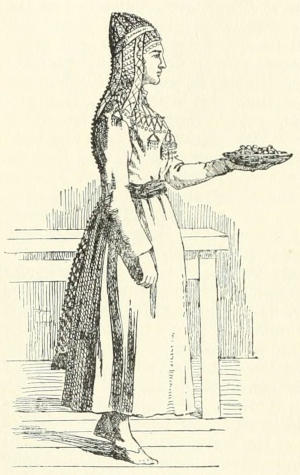
A Bashkirian Woman
The standing army pressed heavily on the unarmed population. People tried to escape from the hard service and hide themselves, but all were not successful, and cruel punishments threatened the disobedient. Illiterate nobles were forbidden to marry. Meanwhile beneath the new French frocks and wigs there was the old coarseness of manners; the same want of respect for human dignity in oneself and in others; the same hideous drunkenness and noisy brawling with which every festivity was terminated. Woman was brought into the society of men, but she was not surrounded with the respect due to her sex and obligations; pregnant women were made to drink to excess. The members of the highest institutions quarrelled and abused each other in the coarsest manner; bribery was as bad as before; the weak were subjected to every violence from the strong, and, as formerly, the noble was permitted to oppress the moujik (peasant), the well-born the base-born.
But this is only one side: there is another. The people were passing through a hard school—the stern teacher was not sparing in punishments for the idle and those who violated the regulations; but the matter was not limited to threats and punishments alone. The people were really learning, learning not only figures and geometry, not only in Russian and foreign schools; the people were learning the duties of citizens, the work of citizens. At the emission of every important regulation, at the inauguration of every great reform, the lawgiver explains why he acts thus, why the new is better than the old. The Russians then received such instruction for the first time; what now seems to us so simple and within the reach of all was first learned by these people from the edicts and manifestoes of Peter the Great.
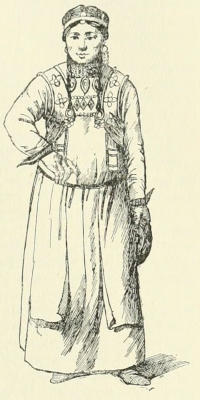
A Peasant of Little Russia
For the first time the mind of the Russian was awakened, his attention directed to the great questions of political and social organisation; whether he turned sympathisingly or unsympathisingly to the words and deeds of the czar was a matter of indifference—he was obliged to think over these words and deeds, and they were continually there to arouse him. That which might have ruined a decrepit society, a people incapable of development—the shocks of the epoch of reforms, the utter restlessness—developed the forces of a vigorous young nation which had been long asleep and required a violent shock to awaken it. And there was much to be learned. Above was the governing senate, the synod; everywhere was collegiate organisation, the advantages of which were set forth in the church statutes. Everywhere the principle of election was introduced. The trade guilds were withdrawn from the jurisdiction of the local governors and given their own independent administration. Peter’s whole system of government was directed against the chief evils from which ancient Russia had suffered: the immaturity of forces, the want of a public spirit, the lack of independence of action, the absence of initiative capacity. The former council of the czar (douma) had suffered from all the deficiencies enumerated. Peter established the senate, to which fidelity had to be sworn and the ukases of which had to be obeyed as the ukases of the czar himself. Peter was not jealous of the power created by him: he did not limit it; but on the contrary he continually and without ceremony required that it should profit by its importance, that it should really be a governing body. Peter’s reproaches and rebukes to the senate were directed against its slowness, its languor, its want of management, and its inability to carry its decrees into immediate effect. The Russian of former times who had received a commission from the government went about in leading strings. He was not trusted, his smallest movement was feared, he was swathed like a child in long detailed instructions, and upon every fresh occasion that presented itself and was not defined in the instructions, the grown up child required teaching. This habit of asking for orders greatly angered Peter: “Act according to your own consideration, how can I tell you from such a distance!” he wrote to those who asked him for instructions. He employed the collegiate system—whether he had met with it in the west or whether it had been advised by Leibnitz is a matter of indifference; he employed it everywhere as the most powerful method of training the Russian people to unrestrained public activity. Instead of separate individuals, institutions came to the front, and over all rose the state, the real significance of which the people of Russia now learned for the first time when they had to take the oath.
Having set forth the importance of the state, and demanding that heavy sacrifices should be made, to this new divinity, himself giving the example, he nevertheless took measures that the individual should not be crushed, but should receive the requisite, balancing development. The first place must here naturally be given to the civilisation introduced by Peter, to the acquaintance with other nations in advance of Russia. We know that before the time of Peter the bond of the family was powerfully maintained in Russia; its prolonged existence is easily explained by the condition of society, which was unable to safeguard its members, and who were therefore obliged to seek security in private associations, chief among which was the natural blood relationship between members of the same family or clan. The elder protected the younger, and had power over them because they had to answer to the government for them. It was thus in every sphere of society; the independent Russian never presented himself alone, but always accompanied by his brothers and nephews; to be without clan and family was equivalent to being in the utmost poverty. It is easy to understand that the clan association hindered the development of personality; the state could not give to personal merit power over clan rights; jealous to the last degree of any insult to the honour of his clan, the ancient Russian was indifferent to his own personal honour. But by the end of the seventeenth century the demands of the state had so increased that the unity of the clan could not withstand them, and the destruction of precedence (mestnitchestov) struck a blow to the clan bond in the highest class of society, among those in the service of the czar. The reform of Peter struck a final blow by its decided, exclusive attention to personal merit, by raising persons “above their old parents” (that is, their kinsfolk), by bringing into the service a large number of foreigners; it became advantageous for new men to appear to have no clan relations, and many of them began willingly to trace their origin from foreign countries.
As to the lower ranks of the population, the blow to the clan bond was brought about by the poll-tax; the former expression, “such a one with his brothers and nephews,” began to disappear, for the brothers and nephews had to pay separately each for himself, and appeared as separate, independent individuals. And not only did the former clan relations disappear, but even within the family itself, while requiring the deepest respect from children to their parents,[47] Peter recognised the right of the individual, and enjoined that marriages should be celebrated by the agreement of the children, and not by the will of their parents; the right of the person was also recognised in the bond-servant, for the landowner had to swear that he would not compel his peasants to marry against their will. We have heard the dispassionate declaration of a contemporary Russian as to the corruption of persons in the service of the czars in the seventeenth and the beginning of the eighteenth centuries, of their indifference to honour, so that amongst them the shameful saying was current: “Flight may be dishonourable, but it is salutary.” Under Peter this saying was extirpated, and he himself testified that in the second half of the Northern War flight from the field of battle had ceased. Finally the personality of woman was recognised in consequence of her liberation from the terem.[48]
Thus were the people of Russia trained in the stern school of reform. The terrible labour and privations they endured were not in vain. A vast and comprehensive programme was traced out for many future years, not on paper but on the earth which must open up its riches to the Russian, who through science had acquired the full right of disposing of it; on the sea, where the Russian fleet had now appeared; on the rivers, united by canals; it was traced out in the state by the new institutions and regulations; it was traced out in the people by the new civilisation, by the enlarging of its mental sphere, by the rich stores of mental food furnished by the west, now disclosed to his view, and by the new world created within Russia herself. The greater part of all this was only in its beginnings; the rest in rough outline—for much only the materials were prepared, only indications made; and therefore we have called the work of the epoch of reform a programme, which Russia is fulfilling until now, and will continue to fulfil, and any deviation from which has always been accompanied by grievous consequences.
Clearly recognising that the Russian people must pass through a hard school, Peter did not hesitate to subject it to the painful, humiliating position of a pupil; but at the same time he succeeded in balancing the disadvantages of such a position by glory and greatness: in converting it into an active one, he succeeded both in creating the political importance of Russia and the means for its maintenance. A difficult problem presented itself to Peter; for the education of the Russian people it was necessary to call in foreign instructors, directors who naturally endeavoured to subject their pupils to their influence, to set themselves above them; but this humiliated the pupils, of whom Peter wished to make masters as soon as possible. He did not give way to the temptation, did not accept proposals to carry the work to a speedy success with the aid of learned foreigners; he desired that his own Russian subjects should pass through an active, practical school, even though it might occasion great losses and be accompanied by great discomforts. We have seen how he hastened to rid himself of a foreign field-marshal, how he put Russians in all the highest positions and foreigners only in secondary ones; and we have also seen how he was rewarded for his faith in his people and his devotion to it.
It was with the same uncommon caution, with the skill required for remaining within due bounds that Peter solved the difficult problem of church reform. He destroyed unipersonal government and replaced it by the collegiate or council system, which fully corresponded with the spirit of the eastern church; we have seen that one of Peter’s chief cares was to raise the Russian clergy by means of education; in spite of his strong and comprehensible aversion to monasticism he did not abolish this institution as did Henry VIII of England—he only tried to give it a greater activity corresponding to its character.
From whatever point of view we study the epoch of reforms, we must fall into wonderment both at the mental and physical powers of Peter. Powers are developed by their exercise, and we do not know of any historical worker whose sphere of activity was so vast. Born with an unusually wide-awake intellect, Peter cultivated this quickness of perception to the highest degree. From his youth he listened and looked to everything himself, was not guided or restricted by anyone, but was excited and aroused by the state of society, already then on the threshold of changes and hesitating between two directions, agitated by the question of the old and new, when by the side of ancient Moscow the advance guard of the west, the German suburb, was already in view. Peter’s nature was cast in the old Russian heroic mould, he loved breadth and scope; this explains the fact that besides his conscious attraction for the sea he had also an unconscious attraction for it: the heroes of ancient Russia yearned for the wide steppes—the new hero yearned after the broad ocean; places shut in by mountains were displeasing and wearisome to him. Thus he complained to his wife of the situation of Karlsbad: “This place is so merry that it might almost be called an honorable prison, for it is so squeezed in between mountains that the sun can hardly be seen.” In another letter he calls Karlsbad a hole in the ground.
To the powers of a hero of ancient times corresponded passions not moderated by any regular, skilful education. We are aware to what lengths the unbridled passions of a vigorous man could be carried in ancient Russian society, unrestrained as it was by due bounds: how then could such a society put a check upon the passions of a man who stood at the very summit of power? But an observant contemporary woman has very justly declared with regard to Peter that he was both a very good and a very bad man. Without denying or diminishing the dark side of Peter the Great’s character, let us not forget the brighter side, which outweighed the dark and was able to attach people so strongly to him. If his wrath burst forth at times so terribly against those whom he regarded as the enemies of the country and of the general welfare, yet he attached to himself strongly, and was strongly attached to persons of opposite tendencies.
An unusual greatness, joined to the recognition of the insignificance of mere human intellect, a stern insistence on the fulfilment of duties, a stern demand for truth, the capacity of listening to the harshest objections, an extraordinary simplicity, sociability, and kind heartedness—all these qualities powerfully attached to Peter the best of the men who had occasion to come in contact with him; and it is therefore easy to understand the impression produced upon them by the news of the death of the great emperor. Nepluev writes as follows: “In the month of February, of the year 1725, I received the lamentable news that the father of the country, the emperor Peter I had departed this life. I watered this paper with my tears, both out of duty to my sovereign and in remembrance of his many kindnesses and favours to me; verily I do not lie when I say that I was unconscious for more than twenty-four hours, for it would have been sinful for me to have been otherwise. This monarch brought our country into equality with others; he taught us to know that we, too, are men; in a word, whatever you look upon in Russia was all begun by him, and whatever will be done in future will be drawn from the same source; as to me personally, above what I have already written, the sovereign was a good and merciful father. May the Lord grant to his soul, which laboured so greatly for the common good, rest with the righteous!”
Another person who was in close contact with Peter (Nartov) says: “If it should ever happen to a philosopher to look through the archives of Peter’s secret acts, he would shudder with horror at what was done against the monarch. We who were the servants of that great sovereign sigh and shed tears, when we sometimes hear reproaches against the hard-heartedness and cruelty which were not in reality to be met with in him. If many knew what he endured and by what sorrows he was cut to the heart, if they knew how indulgent he was to the weaknesses of humanity and how he forgave crimes that did not deserve mercy they would be amazed. And although Peter the Great is no longer with us, yet his spirit lives in our souls, and we, who had the felicity of being near this monarch, shall die faithful to him, and the ardent love we had for our earthly god will be buried together with us. We are not afraid to proclaim the deeds of our father, in order that a noble fearlessness and truth shall be learned from them.”i
KOSTOMAROV’S ESTIMATE OF PETER
As an historical character Peter presents an original phenomenon, not only in the history of Russia but in the history of all humanity, of all ages and all nations. The immortal Shakespeare by his artistic genius created in Hamlet an inimitable type of a man in whom reflection takes the ascendancy over his will and does not permit him to give substance or effect to his desires and intentions. In Peter not the genius of the artist, understanding the meaning of human nature, but nature herself created the opposite type—that of a man with an irresistible, indefatigable will in whom every thought was at once transformed into action. “I will it, because I count it good, and what I will must infallibly be”—such was the device of the whole life and work of this man.
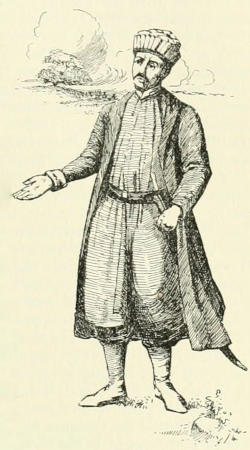
A Kabardinian
He was distinguished by an aptitude and enterprise unattainable for ordinary mortals. Not having received any regular education, he wished to know everything and was obliged to study a great deal; however, the Russian czar was gifted with such a wealth of capacities that even with his short preparation he astounded persons who had spent their lives over what Peter only studied by the way. All that he learned he endeavoured to apply in Russia in order to transform her into a mighty European state. This was the thought that he cherished sincerely and wholly during the continuation of his entire life. Peter lived at a time when it was impossible for Russia to remain in the same beaten track, but must necessarily enter upon the path of renovation. Being gifted with mental clearsightedness, he recognised this necessity of his fatherland and set about the task with all the force of his gigantic will.
Peter’s autocracy, inherited from his forefathers, helped him more than anything. He created the army and the fleet, although for this was required an innumerable multitude of human sacrifices and the fruits of many years of national labour. All was offered by the people for this object, although the people itself did not clearly understand it and therefore did not desire it; but everything was given because the czar wished it. Incredible taxes were imposed, hundreds of thousands of the healthy young generation were sent to the war or to hard and painful labour never to return again. The people were ruined and impoverished in order that Russia might gain the sea, that she might extend her frontiers and organise an army capable of being measured against its neighbours. The Russians had grown attached to their ancient manners and customs, they hated everything foreign; immersed in outward forms of piety, they showed an aversion to the sciences. The autocratic czar compelled them to adopt foreign dress, to study foreign sciences, to disdain the customs of their forefathers, and to forswear their most sacred traditions. And the Russians mastered themselves; they were obedient because it was the wish of their autocratic sovereign.
During the whole of his reign Peter struggled against the prejudices and evil nature of his subjects and dependants; he prosecuted embezzlers of the public funds, takers of bribes, imposters, and lamented that things were not done in Russia as he could have wished. His partisans sought and even now seek to find in all this the cause of the obdurate vices and defects of the ancient Russian. But looking into the matter dispassionately, it follows that much must be ascribed to the character of Peter’s action. It is impossible to make a man happy against his own will or to force his nature. History shows us that, in a despotically ruled society, the vices that chiefly hinder the fulfilment of the most laudable and salutary preconceived designs of the power are most frequently and saliently manifested. What were the measures that Peter employed for bringing his great reforms to fulfilment? The tortures of the Preobrajenski Edict and the secret chancery, sentences of a painful death, prisons, the galleys, the knout, the tearing of the nostrils, espionage, the encouragement by rewards of informers. It is comprehensible that by such means Peter could inoculate neither civil courage, nor the feeling of duty, nor that love for one’s neighbour which is above all material or intellectual forces and more powerful than knowledge itself; in a word, although he established a multitude of institutions and created a new political organisation for Russia, yet Peter was not able to create a living, new Russia.
Possessed by the abstract idea of the state and sacrificing to this idea the temporary prosperity of the people, Peter did not act sincerely by the people. For him they only existed as the ciphers in a total—as the material good for the construction of the edifice of the state. He valued the Russian people as far as they were necessary to him in creating soldiers, masons, excavators, sailors; or, by their laboriously earned kopeck, in furnishing him with means for the maintenance of the state mechanism. Peter himself by his personality might serve as a model for the people he ruled over and transformed only in his boundless, untiring love of work; but in nowise by the moral qualities of his character. He did not even endeavour to restrain his passions, which not unfrequently led him to furious outbursts and bloody actions, although he severely punished like actions in those he ruled over. Peter allowed drunkenness and double dealing in himself, yet he prosecuted these same vices in his subjects. Many shocking actions that he committed have been justified by the sophisms of political necessity. To what an extent his ferocity and bloodthirstiness were carried is shown by the fact that he was not afraid to lower his royal dignity by taking upon himself the office of hangman during the time of the savage execution of the strelitz. Throughout his reign a bloody vapour arose from those who were tortured and put to death in accordance with the Preobrajenski Edict and contaminated the air of Russia, but it evidently did not trouble the slumbers of her sovereign.
Peter himself justified his cruel punishments by the requirements of justice, but facts prove that he was not equally inflexible in his justice to all and did not set an example to others in the indulgence he showed to his favourite, Menshikov, at whose hands such iniquities were committed as would have cost others their lives. His own outward political actions were not distinguished by irreproachable integrity and rectitude; the Northern War can never be justified from the point of view of justice. It is also impossible to call honourable the expedient Peter made use of with the English king George when, in spite of the clearest evidence, he assured him of his devotion and non-participation in the pretender’s designs. How far Peter respected the rights of neighbouring foreign nations when he had no reason to fear them is shown by his savage behaviour to the uniat monks of Polosk—an action for which he himself would have probably punished by death any one of his subjects who had thus dared to take the law into his own hands in a foreign land.
All the dark sides of Peter’s character may of course be easily excused by the features of the age in which he lived; it may justly be pointed out to us that for the greater part such traits are also to be found in the characters of his contemporaries. It remains indubitable that Peter surpassed the sovereigns contemporary with him by the vastness of his intellect and by his untiring love of work; but in moral respects he was not better than many of them; and it was for this reason that the society which he wished to re-create did not rise superior to those societies which were governed by Peter’s contemporaries. Until Peter’s reign Russia was plunged in ignorance; and, boasting of her bigoted, ceremonial piety, glorified herself with the name of the New Israel, whilst in reality she was by no means a “new Israel.” By his despotic measures Peter created out of her a monarchy that was a terror to foreigners by her army and fleet; he communicated to the upper class of her people the outward marks of European civilisation; yet Russia after Peter did not in reality become the “new Israel” that she had desired to be before his time.
All Peter’s pupils, the men of new Russia who outlived him, were entangled in their own snares; following their own egotistical aims, they perished on the scaffold or in exile, and the Russian public man adopted in his conscience the rule that he might do anything he found profitable, although it might be immoral, justifying himself by the fact that other nations did the same. Yet, in spite of all this, as a historical royal worker Peter has preserved for us in his personality such an exalted moral trait that it involuntarily draws our heart to him; this trait is his devotion to the ideal to which he wholly consecrated his soul during all his lifetime. He loved Russia, loved the Russian people, loved it in the sense of the mass of Russian men who were his contemporaries and subjects in the sense of that ideal to which he desired to bring his people; and this love constitutes in him that great quality which incites us, beyond our own will, to love his personality, setting aside both his bloody tribunal and all his demoralising despotism reflecting a baneful influence even on posterity. Because of Peter’s love for the ideal of the Russian people, the Russians will love Peter until he himself loses the national ideal, and for the sake of this love they will forgive him all that a heavy burden has laid upon his memory.d
HAXTAUSEN’S ESTIMATE OF PETER’S INFLUENCE
From the sixteenth to the seventeenth centuries a national spirit dominated entirely. Moreover, Russian sovereigns had, for many years, perceived that the people were behind other nations who had sprung into being as late as themselves or who were inferior either in origin or in physical or intellectual faculties. To remedy this tardy growth they conceived it necessary to put themselves into direct contact with the west in order to borrow its light and imitate its progress. The best way of accomplishing this was, they thought, to get as many foreigners as possible into the country to train the young; to give the state new institutions, and remodel the old on western principles. Ivan Vasilievitch had already drawn a crowd of foreigners, and particularly Germans; had even tried to put his army on a European footing. The successors of the Romanov branch followed zealously in this path, but no prince felt more strongly than Peter I the necessity of letting Russia take a foremost place in Europe. His quick impetuous nature detested slow and incomplete measures. To him, to sow without reaping, or prune without tasting the fruits, was labour provoking all his repugnance.
The impetus he gave Russia is that in which she still continues. Everywhere in the public and social life of this people is to be noticed the impulse he gave. It is an accomplished fact that no human power can annul; so all inquiry to find out if this impetus was necessary and favourable to Russia would be inopportune and sterile. There is, however, no doubt that in Peter’s haste in his work of reform he did not sufficiently consider national things both great and good; that he introduced a crowd of foreign innovations, some mediocre, some positively bad, without pausing to think whether they were suitable to the climate, the established order of things, or if they would fit in harmoniously with Russian nationality.j
FOOTNOTES