Chapter VIII · THE AGE OF CATHERINE THE GREAT
Reading edition
We must acknowledge that in many respects Catherine was far from irreproachable; her very accession to the throne casts a dark shadow on her moral image. But the reproaches that must be made to her on this account cannot but be counteracted by the thirty-four years of greatness and prosperity which Russia enjoyed under her and to which the popular voice has given the appellation of the Age of Catherine.—Shehebalski.b
[1762-1796 A.D.]
There are few names so popular in Russia and so dear to her as that of Catherine II. The generation of men who belonged to her time spoke of her with the most profound emotion. Memoirs and reminiscences of her contemporaries breathe almost without exception the same ardent devotion—a sort of worship of her. In opposition to these feelings, foreign reports of her represent her as cruel, heartless, and unscrupulous to the last degree. Some authors represent her as a sort of monster. However strange such contradictions may appear, they can readily be accounted for. Foreigners view Catherine II more from the side of her external policy, which was certainly often unsparing and unscrupulous in the means employed; they refer caustically to her private life, which was certainly not irreproachable. Russians, on the other hand, felt above all the influence of her interior administration, which contrasted sharply from that of her predecessors by its mildness, and which was full of useful and liberal reforms. The Russians of her day could not remain indifferent to the glory with which Catherine surrounded Russia. And thus to the descendants of Catherine, acquainted as they are with the reports given of her both by Russians and foreigners, she appears as the two-faced god of antiquity; her visage when turned to the neighbouring powers is stern and unwelcoming; that, on the contrary, which is turned toward Russia is full of majesty and mildness.
[1762 A.D.]
The state of affairs was very much entangled when Catherine ascended the throne, both in the interior of the empire and in respect to exterior policy. One of the first acts of the new empress was the conclusion of peace with all those who had taken part in the Seven Years’ War. Not seeing any advantage to Russia in helping the king of Prussia in his war against the German emperor and his allies, Catherine did not consider it necessary to assist the latter. “I am of tolerably martial tastes,” said she, in the first days after her accession to the throne, to one of the ambassadors to the Russian court, “but I will never begin war without a cause; if I begin war, it will not be as the empress Elizabeth did—to please others, but only when I find it favourable for myself.” These words are characteristic of all Catherine’s further foreign policy; to listen to them was not without profit for foreign courts, which, during the preceding reigns, had certainly been over-spoiled by the complaisance of the Russians.
The next circumstance must have enlightened them still further as to how little Catherine had the intention of allowing herself to be restrained by considerations which did not tend to the furtherance of the glory and prosperity of her dominions. We have already seen by what persistency—sometimes even to the sacrifice of their dignity—the preceding governments had succeeded in obtaining the recognition of their right to the imperial title. France had recognised it only under Elizabeth, and that under the condition that at all foreign courts the Russian ambassador must, as previously, yield the precedence to the French ambassador; the late empress Elizabeth herself engaged that this should be done. When Catherine came to the throne, it was proposed to her to renew this engagement; she, however, very decidedly refused to do so, and commanded that it should be declared that she would break off all relations with those courts that did not recognise her in the quality of empress—a title, she added, which, however, was in no degree more exalted than that of the czars. Such were the first acts of the new empress in regard to foreign governments: they were bold, firm, and determined.b
CATHERINE’S OWN VIEWS ON RUSSIA
[1763 A.D.]
The interior condition of Russia and the position at that time occupied by Catherine are best described by herself, in her own words. In the very beginning of the year 1764 the procurator-general, A. I. Glebov, was removed from his functions. As his successor in this weighty and responsible office the empress named Prince A. A. Viasemski. The procurator-general had to superintend the finances of the empire, to direct the senate, and to govern all the interior affairs of the nation, thus uniting in himself the powers of minister of finance, of justice, and of home affairs. He was subordinate to none except the law, the good of the country, and the will of the empress. He was the right hand of the empress: “In cases where you may be in doubt,” said Catherine to him, “consult with me, and put your trust entirely in God and in me; and I, seeing how gratifying your conduct is to me, will not forsake you.” Prince Viasemski was still a young man—he was not yet thirty-seven years of age. A pupil of the land-forces cadet corps, he had taken part in the Prussian War—not, however, in the character of a brave soldier, but as the executor of “secret orders.” At the accession of Catherine to the throne he was already quartermaster-general. In 1763 he was entrusted with the pacification of the peasants in the eastern provinces of Russia. He was well educated, industrious, and was recognised by everyone as an absolutely honest man. It was this last circumstance that determined Catherine’s choice. Having selected for herself her “closest helper,” with whom she would have to be in constant relations, the empress considered it necessary once for all to have a clear explanation with him, and with her own hand wrote him “instructions” in which she expressed her own views on Russia, on the chief branches of the administration, and on herself personally, drawing her portrait for him as empress:
“The Russian Empire,” wrote Catherine, “is so vast in its extent that any other form of government excepting that of an autocratic sovereign would be prejudicial to it; for any other would be slow of accomplishment and would include in itself a multitude of diverse interests and passions which tend to the weakening of the administrative power. No, there must be one sovereign, invested with authority to destroy evil, and who esteems the public welfare as his own. Other rulers are, in the words of the Gospel, hirelings.”
The first institution in the empire is the senate. Catherine thus describes it to the young procurator-general: “In the senate you will find two parties, but in my opinion a wise policy does not require that much regard should be paid to them, lest too much firmness should thus be given them: in this manner they will disappear the sooner; I have only kept a watchful eye over them and have used men according to their capabilities for one object or another. Both parties will now try to catch you for their side. In one you will find men of upright character, although not of far-seeing intellects; in the other I think their views are wider, but it is not clear whether they are always advantageous. Some think that because they have been in one or another country for a long time, everything must be arranged in politics for the good of their beloved land, and everything else without exception meets with their criticism, in spite of the fact that all interior administration is founded on the law of the rights of nations. You must not regard either one party or the other, but be courteous and dispassionate in your behaviour to both, listening to everything, having only the good of the country and justice in view, and walking in firm steps to the shortest road to truth.”
The senate “by its want of attention to the deeds of certain of my forefathers left its fundamental principles, and oppressed other courts through which the lower tribunals fell greatly into decline. The servility and meanness of persons in these tribunals is indescribable and no good can be expected until this evil is done away with. Only the forms of bureaucracy are fulfilled, and people do not dare to act uprightly although the interests of the state thus suffer. The senate having once passed its proper bounds, it is now difficult to accustom it to the necessary order in which it should stand. Perhaps for the ambition of some members, the former measures have some charm, but at any rate while I live, it will remain my duty to command.”
The “servility” of the members of the government offices was ascribed to the senate, but the senate was not to repair the evil it had occasioned. By a ukase of the 19th of December, 1763, Catherine required that the “government offices should be filled by worthy and honest men.” The motive of this ukase is explained in the above cited instructions to Prince Viasemski. In these instructions Catherine draws his attention to the great burdensomeness for the people of the duties on salt and wine, but she confides to his particular care the question of silver or copper money, which had long interested her, as well as the position of trade and commerce. “This very delicate matter,” she says, “of which many persons find it unpleasant to hear must however be looked into and examined by you.” Catherine did not conceal from herself that the laws required amending. “Lack of time alone,” she says, “has prevented the introduction of reforms.”
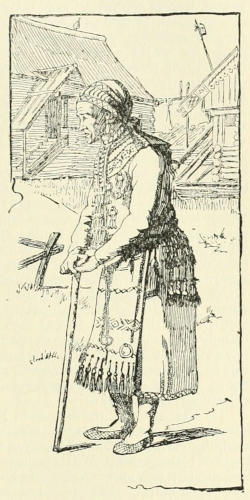
An Old Mordvinian Woman
Catherine did not forget to tell the young procurator-general what her views were on the frontier country of Russia: “Little Russia, Livonia, and Finland are provinces that must be governed in conformity with their privileges; to violate them by revoking them all suddenly would be quite unseemly, to call them foreign countries, however, and treat them on such a basis would be more than an error—it might rightly be called stupidity. These provinces, as also that of Smolensk, must by the lightest possible means be gradually russianised so that they shall cease to be looked upon as wolves in the forest. The attainment of such an object is quite easy if sensible persons are chosen for the governors of these provinces. When there is no longer a hetman in Little Russia, we must endeavour to abolish even the appellation of hetman.”
Having initiated Prince Viasemski into the most secret matters, having reminded him that a procurator-general in the exercise of his functions is obliged to oppose the most powerful personages and that therefore the sovereign power is his only support, Catherine in the following passage expressed her views on her own sovereign power:
“You ought to know with whom you have to do. Occasions will arise daily which will lead you to seek my counsel. You will find that I have no other aims than the highest welfare and glory of the fatherland and desire nothing but the happiness of my subjects of whatever condition they may be. My only aspiration is that both within and without my dominions tranquillity, contentment, and peace should be preserved. I love truth above all things, and you may speak it, fearing nothing; I shall encourage discussion, if good can be accomplished by it. I hear that all esteem you as an honest man; I hope to show you by experience that persons with such qualities can live happily at court. I will add that I require no flattery from you, but solely frankness and sincerity in your dealings, and firmness in the affairs of state.” Such an administration programme and such political principles gave Catherine full right to look calmly towards the future.c
THE POLISH SUCCESSION; THE POLICY OF THE NATIONS
A subject of deep gravity soon claimed her attention—the approaching death of the king of Poland and the consequent opening of the succession. Two parties were contending for power in Warsaw—the court party with minister Brühl and his son-in-law Mniszek at its head, and the party which looked to Russia for support and had for chiefs the Czartoriski. The first-named faction wished to assure the succession to the prince of Saxony, an aim in which France and Austria shared, and the second, planning to elect a piast or native noble who should belong to their party, chose as candidate a nephew of the Czartoriski, Stanislaus Poniatovski. Thus France, which in 1733 had waged war in the cause of a piast against the Saxon candidate, now came to support the Saxon against Poniatovski. The face of affairs had completely changed, and the Polish monarchy, growing weaker day by day, arrived at the point where it could no longer stand erect save by the aid of Saxony, a German state. Frederick II had as much reason to dread an increase of power for Saxony as for Poland, since Saxony was an inveterate enemy of Prussia in the empire, as was Poland in the regions of the Vistula. Russia, which had formerly fought against Stanislaus Leszczynski, father-in-law of Louis XV, was now to oppose the candidate favoured by France and Austria; it was eager also to prevent the accession to the throne of any Polish noble wielding too much power of his own. The choice, therefore, of Stanislaus Poniatovski, a simple gentleman without personal following or influence, met fully the desires of Frederick II, the interests of the Russian Empire, and the private feelings of Catherine II, who was happy to bestow a crown upon one of her former lovers.
[1765 A.D.]
When Augustus III finally died, the diets of convocation and of election stirred up great agitation all over the country. The two rival parties waged fiercer strife than ever; at last the Czartoriski called upon the Russian army to help drive out their enemies, and it was under the protection of foreign bayonets that Poniatovski inaugurated that fatal reign during which Poland was to be three times dismembered and in the end wiped completely from the list of nations. Three principal causes were to bring about the ruin of the ancient royal republic:
(1) The national movement in Russia, which aimed to complete its territory on the west and recover, so said its historians, the provinces which had formerly been part of the domain of St. Vladimir, or White Russia, Black Russia, and Little Russia. With the national question was mingled another which had already led, under Alexander Mikhailovitch, to a first dismemberment of the Polish states. Complaints against the operations of the uniates had multiplied in Lithuania, and Russia had frequently attempted to intervene. Peter the Great protested to Augustus II against the treatment accorded to his co-religionists in Poland, and Augustus had issued an edict assuring free exercise of the orthodox religion; but this never went into effect owing to the inability of the monarchy to repress the zeal of the clergy and the Jesuits. In 1723 Peter begged the intervention of the pope, but his petition was refused and the abuses continued.
(2) The covetousness of Prussia. Poland being in possession of western Prussia, that is the lower Vistula including Thorn and Dantzic, eastern Prussia was completely cut off from the rest of the Brandenburg monarchy, which was thus made a divided state. The government of Warsaw committed, moreover, the serious error of confounding Protestant and orthodox dissenters and harassing them alike.
(3) The inevitable enkindling of Poland in its turn by the spirit of reform that spread abroad during the eighteenth century. Poniatovski and the most enlightened of his countrymen had long perceived the contrast presented by national anarchy as it prevailed at home and the order that was being established in neighbouring states. Nevertheless, while Prussia, Russia, and Austria were exerting every effort to re-form themselves into strictly modern states, Poland still clung obstinately to the traditions of the feudal ages, and allowed the other European monarchies to get so far ahead that when at last the impulse to reform did come it hastened the dissolution of the country.
From a social point of view Poland was a nation of agricultural serfs, above which had been superimposed a numerous petty nobility that was itself in bondage to a few great families, against whom even the king was powerless. There existed no third estate unless we can designate by that name a few thousand Catholic bourgeois and a million Jews, who had no interest in maintaining a condition of things that condemned them to everlasting opprobrium. From an economical point of view the country had only a limited agriculture carried on by serfs after the most primitive methods; but little commerce, no industries, and no public finances. From a political standpoint the “legal” nation was composed exclusively of gentleman—rivalry between the great families, anarchy in the diets, the liberum veto, and the inveterate habit of invoking foreign intervention having destroyed in Poland all idea of law or even of state. From a military point of view Poland was still in the feudal stage of undisciplined militia; it had scarcely any organised troops outside the cavalry formed of nobles, no infantry, but little artillery, and no fortresses worthy the name on frontiers that were thus left open to the enemy. What means of defence had a nation divided against itself, guilty of having received gold from the enemy, against the three powerful monarchies which beset it on all sides, and whose ambassadors had more power than its own king in his diets?
Catherine and Frederick were agreed on two essential points: to vindicate the rights of dissenters and prevent any reform in the anarchial constitution which made Poland their easy prey. By affecting to espouse the cause of tolerance they could blind Europe to their real designs against the integrity of the country, and Poland’s own noisy fanaticism would further enable them to conceal their object.
In 1765 Koninski, an orthodox bishop of White Russia, presented a memoir to the king of Poland in which were recounted all the vexations which the followers of the Greek religion had been made to suffer in his kingdom. “The missionary fathers,” said the memoir, “were particularly remarkable for their zeal; upheld by the secular authorities they were in the habit of summoning all the Greco-Russian inhabitants of the villages and banding them together like a flock of sheep six weeks at a time, forcing them to confess, and displaying thorny rods and stakes to intimidate the rebellious, separating children from their parents and wives from husbands. In case of stubborn resistance the recalcitrant ones were severely beaten, their hands were burned, or they were confined in prison for several months.”
Russia supported the dissenters in the Polish diet and Stanislaus promised to sustain them. To do this it was necessary to assure to the people the free exercise of their religion, and to the nobles the political rights of which they had been despoiled under preceding legislators. The diet of 1766 violently opposed this proposition, and the deputy Gourovski who had tried to speak in favour of the dissenters narrowly escaped assassination.
[1767-1768 A.D.]
Repnin, Catherine’s ambassador, urged the dissenters to resort to the legal method of confederation. Those of the orthodox faith united at Sluth, the Protestants, under the patronage of the Prussian ambassador, at Thorn; even at Radom there was a confederation of Catholics and of all those who feared a reform in the constitution or the abolition of the liberum veto. Russia, which with Prussia had guaranteed the support of this absurd constitution, took these also under its protection. Such were the auspices under which was opened the diet of 1767; the Poles seemed insensible to the attack made on their independence and exerted themselves solely to maintain intolerance. Soltik, bishop of Cracow, Zaluski, bishop of Kiev, and two other of the pope’s ambassadors were the most ardent in opposing the project of reform. Repnin had them seized and carried to Russia, and so persistently had Poland shown herself in the wrong that Europe applauded an act, in itself a violation of the rights of men, which seemed to assure liberty of conscience. The diet yielded and consented to the dissenting nobles being granted equal rights with the Catholics; in any case the state religion was to remain that of Rome.
POLAND IS DISMEMBERED
In 1768 a treaty was drawn up between Poland and Russia by the terms of which no modification could be made in the constitution without the consent of the latter power. This was equivalent to legalising foreign intervention, from the abuse of which Poland was to perish. The Russian troops evacuated Warsaw, and the confederates sent deputies to render thanks to the empress.
The Radom Confederation, the most considerable of the three, which had taken up arms solely to prevent reforms in the constitution, not to support the dissenters, was gravely dissatisfied with the result. On its dissolution another and still more numerous confederation was formed, that of Bar in Podolia, which had for object the maintenance of the liberum veto and the securing of exclusive privileges to Catholics. It sent deputies to the courts of Dresden, Vienna, and Versailles to awaken interest in its cause. In the west opinions differed; on which side were right, the Polish nation, the brightest promise for the future? Were they at Warsaw with the king, the senate, and all those who had striven for the enfranchisement of the dissenters and the reconstruction of Poland, or were they at Bar with the turbulent nobles who, guided by fanatical priests, had revolted in the name of the liberum veto and religious intolerance? Voltaire and most of the French philosophers declared for the king; but the minister of Louis XV, Monsieur de Choiseul, favoured the confederates, without taking into consideration that in weakening the power of the Polish king he was weakening Poland itself. The royal army consisting of only nine thousand men, the government committed the grievous blunder of calling upon Russia for aid, and the result was that the Muscovite troops succeeded in recapturing from the confederates Bar, Berdichev, and Cracow. The Cossacks of the Ukraine, the Zaparogians and the laïdamaks or brigands were called to arms and a savage war, at once national, religious, and social, ensued, desolating the provinces of the Dnieper. The massacre of Ouman, a town belonging to Count Potocki, horrified the inhabitants of the Ukraine.
The confederates obtained the support of the Viennese court and established a council at Teschen, and their headquarters at Eperies, in Hungary. They were still in possession of three strongholds in Poland. Choiseul sent them money and commissioned successively De Taules, Dumouriez, and the baron de Viomesnil to assist in their organisation. From the memoirs of Dumouriez we learn that the forces of the confederation, distributed about over all Poland, consisted of sixteen thousand cavalry divided into five or six separate bands, each commanded by an independent chief. Dumouriez with his undisciplined troops was defeated at Landskron (1771); but Viomesnil, Dussaillans, and Choisy became masters of the château of Cracow (1772), which was finally recovered by Souvorov. An attempt made by certain confederates on the 3rd of November, 1771, to obtain possession of the person of the king, excited noisy but insincere indignation at the three northern courts, and increased Voltaire’s aversion to the confederates.d
By the treaty of St. Petersburg (signed August 5th, 1772), the palatinates of Malborg, Pomerania, Warmia, Culm (except Dantzic and Thorn), and part of Great Poland was ceded to Prussia. Austria had Galicia, Sandomir, Cracow, and part of Podolia. Russia had Polotsk, Vitepsk, Mikislav, and Polish Livonia. The next point was to execute the treaty. A pretext could not long be wanting for the armed interference of all the three powers: each had been expressly invited by some one of the parties which divided that unhappy country, which were perpetually engaged in civil war. The three bandit chiefs despatched armies into Poland, and Europe waited with much anxiety the issue of this step. Its suspense was not of long continuance: the Treaty of St. Petersburg was presented to the Polish king and senate; and manifestoes, stating the pretensions of each power, were published.
Never were documents so insulting laid before rational men. King and senate could oppose little resistance to demands so powerfully supported; but their consent alone could not sanction the dismemberment of the republic. Hence the diet was convoked. That eight or ten members only should resist the destruction of their country, that all the rest should tamely sanction it, might appear incredible if it were not a matter of history. In this monstrous robbery the lion’s share fell to Russia. She acquired an extent of territory estimated at 3,440 square leagues, with one million and a half of inhabitants: Austria had 2,700 leagues, but a greater population, viz. two millions and a half: Prussia had scarcely 1,000 square leagues, and less than a million of people.
As the three co-robbers were so courageous as to set at defiance both justice and public opinion, so magnanimous as to show themselves in their real character to all posterity, it may appear matter of surprise that they did not seize on the whole of the kingdom. But though they had resolved to seize the remainder, they were cautious enough to await the course of events—to take advantage of any favourable circumstance that might arise. The French Revolution furnished them with it. That event had many admirers in Poland, many who wished to imitate it at home. It was easy for the three neighbouring powers to take umbrage at the progress of republican opinions; to assert, as indeed truth authorised them to assert, that the Poles were in communication with the heads of the movement in Paris. In reality, in the year 1791 a new constitution was proclaimed, exceedingly like a republic. The reduction of Dantzic and Thorn, the two most important possessions in the north of Europe, convinced the Poles that they had been duped. Catherine was not a woman to let others derive the sole advantage where anything was to be gained. Preparatory to active operations, she declared war against Poland. The diet resolved to resist; but, as usual, the Poles were divided among themselves. One party declared for Russia; and though the greater number declared for independence, they could not be brought to combine. Success after success was obtained by the Russian general; the empress negotiated the details of another partition with Prussia; and the king and the diet were, as before, compelled to sanction it. By it the Russian frontier was extended to the centre of Lithuania and Volhinia; while the remainder of Great and a part of Little Poland were ceded to Frederick William. Much to the honour of Austria, she had no hand in this second iniquity.
The territory of the republic was now reduced to about 4,000 square miles; and her army, by command of the czarina, was in future not to exceed fifteen thousand men. The Poles were never deficient in bravery; and they were, on this occasion, sensitive to the national shame. They felt that the narrow limits still allowed them would soon be passed, and that their remaining provinces were intended soon to be incorporated with the neighbouring states. A general insurrection was organised; an army voluntarily arose, and Kosciuszko placed himself at its head. For a time wonders were wrought by the patriots; though opposed by two great enemies—Russia and Prussia—they expelled the enemy from most of the fortresses; and even when Austria acceded to the coalition and took Cracow they were not desponding. To effect impossibilities, however, was an absurd attempt: the majority felt it to be so, and they sullenly received the foreign law. Kosciuszko was made prisoner; the last outworks of the last fortress were reduced; Warsaw capitulated; Stanislaus was deposed; and a third partition ended the existence of the Polish Republic. By it Austria had Cracow, with the country between the Pilitza, the Vistula, and the Bug. Prussia had Warsaw, with the territory to the banks of the Niemen. The rest, which, as usual, was the lion’s share, fell to Russia.
War with Turkey (1769-1774 A.D.)
[1769 A.D.]
The wars with this power occupied a considerable portion of Catherine’s reign; yet they were not originally sought by her. The Porte, at the suggestion of the French ambassador, whose master was anxious to divert her from her meditated encroachments on Poland, was, unfortunately for itself, induced to declare war against her. The Grand Seignior, indeed, was the ally of the republic; and he was one of the parties to guarantee its independence. But his dominions were not tranquil; the discipline of his armies was impaired, while that of the Russians was improving every day. Perhaps, however, he was ignorant of the disadvantages which must attend the prosecution of the war: certainly his pride was flattered by the insinuation that he held in his hands the balance of power in eastern and northern Europe. In 1769 hostilities commenced by the invasion of the Crimea, the khan of which was the vassal of the Porte. Azov and Taganrog were soon taken; Moldavia was entered; Servia was cleared of the Tatar allies. Before Kotzim, however, Prince Galitzin received a check, and was forced to repass the Dniester. A second attempt on that important fortress was equally unsuccessful. But the Turks, who pursued too far, were vanquished in some isolated engagement; and the campaign of 1769 ended by the acquisition of Kotzim.
The operations of the following year were much more decisive. Galitzin, disgusted by the arrogance of the favourite Orlov, resigned the command into abler hands than even his own—those of Count Romanzov. The reduction of Jassy and Brailov was preparatory to two great victories, which rendered the name of Romanzov forever memorable in the annals of his country. The first was on the banks of the Pruth. The Turks, in number eighty thousand, under the khan of the Crimea, were intrenched on a hill, in a position too strong to be assailed. But after three weeks, they became wearied of their inactivity; and believing, from a feint of the Russian general, that he was about to retire, twenty thousand of them rushed down the hill. They were repulsed with terrible loss; the remainder carried dismay into the camp; and the Russians, taking advantage of the circumstances, ascended, forced the intrenchments, killed many, compelled the rest to flee, and seized considerable booty, with thirty-eight pieces of cannon. Retreating towards the Danube, the Turks effected a junction with the grand vizir, whose army was thereby increased to 150,000.
Unaware of its extent, Romanzov pursued with ardour, and was suddenly in the presence of his formidable competitor. His position was a critical one. The vizir was intrenched; and the khan, resolved to efface the shame of his recent defeat, wheeled round his left flank, and encamped behind him. Hence he could not move backwards or forwards. On the following day the vizir gave the signal of battle; and the contest raged for some hours with desperate fury. Annoyed at the perpetual discharges of the enemy’s artillery, which alarmingly thinned his ranks, the count ordered his men to fix their bayonets and rush on the intrenchments. Here the struggle was more deadly than before; but in the end numbers yielded to discipline and valour. The Turks fled, the vizir with them, leaving immense stores (among which were 143 pieces of cannon) in the power of the victors, and nearly one-third of their number on the field. Romanzov now crossed the Dniester; one of his generals, Repnin, reduced Ismailov; the other, Panin, took the most important fortress, Bender, after a siege of three months; while a detachment from the main army seized the capital of Bessarabia.
Nor were these the only successes of the year. Not satisfied with warfare on land, Catherine resolved to try her fortunes on the deep; and to do what none of her predecessors had ever dreamed—to send a powerful fleet into the Mediterranean, for the purpose of assailing her enemy in Greece. Many new ships were built; many English naval officers persuaded to command them, and to teach her seamen the arts by which the superiority of England had been so long maintained. The Greeks were impatient for the arrival of their co-religionists; the czarina’s gold had gained over the chiefs, and a general insurrection of the people was meditated. Her designs were truly gigantic—no less than to drive the Mohammedans from Europe. The fleet sailed, arrived in the Archipelago, disembarked both on the islands and the continent; and while the Turkish possessions were assailed on the Danube, they were equally perilled in these southern latitudes.
A terrible warfare now commenced—the Greeks everywhere butchering the Mohammedans, the latter retaliating. A naval battle was inevitable; the hostile fleets met between Scio and Natolia: the engagement continued until night, to the manifest advantage of the Russians. That very night the Turkish admiral was so foolish as to run his ships into a narrow bay, in which he was instantly blockaded. Some fire-ships, sent by Vice-Admiral Elphinstone, a Scotchman in the service of the empress, set all of them on fire; and at sunrise the following morning not a flag was to be seen. This blow sensibly affected the Turks, especially as the appearance of the Russians in the Mediterranean had encouraged Tripoli, Egypt, and Syria to rebel against the Porte. Ali Bey, the governor of Egypt, an able, ambitious, and enterprising insurgent, was ready to assist his allies with all his might; but the incapacity yet egregious haughtiness of the Russian admiral, Alexis Orlov, prevented them from deriving much advantage from the union. The year, however, was one of brilliant success; and Catherine was so elated that she built a magnificent palace, which she called after the bay in which the last victory was gained.
[1771-1774 A.D.]
In the spring of 1771, Orlov again resorted to the Mediterranean, where the Russian fleet still lay, with the intention of forcing the Dardanelles; while the armies on the Danube renewed their operations. The position of Turkey was, indeed, critical: not only was one-half of the empire in revolt, but the plague had alarmingly thinned the population. Fortunately, however, for this power, the same scourge found its way into the heart of Russia: its ravages were as fatal at Moscow as at Constantinople; and it no more spared the Christians on the Danube than it did the Mohammedans. This calamity slackened, but did not suspend operations. If the Russians were sometimes repulsed, the balance of success was decidedly in their favour. The famous lines of Perekop, from the Euxine to the sea of Azov were forced by Prince Dolgoruki, though they were defended by fifty thousand Tatars; the whole of the Crimea, one fortress excepted, was subdued; and the surname of Krimski, or Conqueror of the Crimea, was given to the victor. The country, however, was not incorporated with the empire: on the contrary, while it was declared independent of the Porte, it was proclaimed as merely under the protection of Russia. The khan, Selim Girai, being thus expelled, proceeded to Constantinople, where he died. The exertions of the fleet, however, did not correspond with those of the land forces: all that Orlov effected was to destroy the Turkish commerce on the Levant.
During the year 1772 no hostilities were committed, and negotiations for peace were undertaken. Though the two contracting parties, which sent their representatives to Bucharest, could not agree on the conditions, both were anxious to recruit their strength, after the heavy losses they had sustained both by the sword and the plague. Catherine too had another motive for temporary inaction; she was busily effecting the first partition of Poland. With the return of the following spring, however, the banks of the Danube were again the theatre of war; but this campaign was not destined to be so glorious as the one of 1771. Its opening was unfavourable for the Russians: while a body of fourteen thousand, under Prince Repnin, were crossing that river, they were surprised by one of the Turkish generals; many perished; about six hundred, with the prince himself, were made prisoners and sent to Constantinople. Shortly afterwards, Romanzov who had passed that river and was marching on Silistria, was compelled to retrace his steps. At Roskana a considerable body of his troops was defeated by the vizir. This harassing warfare—for the Turks carefully avoided a general action—thinned the ranks and, what is worse, depressed the spirits of the invaders. Romanzov was no less averse to such a risk. Nor did the fleet in the Mediterranean effect anything to counterbalance their indecisive yet destructive operations. What little advantage there was belonged to the Turks.
The campaign of 1774 promised to be more important than the preceding; and the Porte, from the rebellion of Pugatchev, was confident of success. Several actions on the Danube, which, however bravely contested, led to no result, were yet considered as indicative of a severe if not a decisive struggle. But the anticipation was groundless. Though several bodies of Tatars, who were to effect a diversion in favour of Pugatchev, were defeated; though the Danube was crossed; though twenty-five thousand of the Turks were repulsed by Soltikov, and another body still stronger by Suvarov, though the vizir himself was blockaded in Shumla—Europe was disappointed in its expectations; for negotiations were opened for a peace which was soon concluded.
The Treaty of Kutchuk-Kainardji (1774 A.D.)
[1774 A.D.]
By the Treaty of Kutchuk-Kainardji (July, 1774) Russia obtained the free navigation of the Black Sea, the right of passage through the Danube, a large tract of land between the Bug and the Dnieper, with the strong fortresses of Azov, Taganrog, Kertch, and Kinburn. The rest of the Crimea was ceded—not, indeed, to the Turks, but to its own khan, who, though declared independent, must of necessity be the creature of the empress, in whose hands those fortresses remained. They were the keys to his dominions, and even to the command of the Black Sea. A sum of money sufficient to defray the expenses of the war was also stipulated; but it was never paid. The advantages which Russia derived from the other articles were ample enough: among them, not the least, was the commerce of the Levant and of the Black Sea.e
THE MIGRATION OF THE KALMUCKS
It seemed as if Catherine’s reign was destined to be marked by the most extraordinary events, and one of them was this simultaneous departure of a horde variously estimated at from three hundred thousand to six hundred thousand Tatars, an example at the end of the eighteenth century of one of those great migratory movements which history never expected again to record. Catherine was humiliated with having to furnish the example; it was in too striking contrast with that happiness which her philosophic friends said the human race enjoyed in her empire; and the peaceful migration of an indignant and angry people gave the formal lie to all the praises loud shouted by philanthropy. Our readers will not regret to find here were details of this unexpected event which suddenly made in the Russian Empire an empty spot, more than fifteen hundred versts in length, between Tzaritsin and Astrakhan. These Tatars, known under the name of Kalmucks, were originally included in three principal tribes. At first subject to China, they had been frequently at war either with it or with themselves. One of their khans, Amusanan, defeated and pursued by the Chinese, had taken refuge at Tobolsk in Siberia, where he died about 1757. These troubles, whose origin dated back more than sixty years, had in 1696 caused a great number of Kalmucks of the three tribes to reunite, quit a country devastated by constant war, and seek new homes at the eastern extremity of the Russian Empire.
They settled or located themselves in a vast stretch of territory close to the Caspian Sea, between the Ural and the Volga. The Chinese claimed that according to some ancient treaties Russia had to return all fugitive subjects, but received no reply except that there was nothing to prevent a wandering people from settling in waste places, a reply which seventy-five years later the Chinese made use of on their own part with advantage. Russia received these fugitive hordes and did not delay in getting service out of them. Another Tatar nation composed principally of Lesghians, who lived beyond Kisliar and were greedy for pillage, made frequent incursions into the empire and depopulated the border by the quantity of slaves they brought back with them. The new Kalmucks were charged with keeping them out and performed the duty if not with constant success, at least with a fidelity which did them great credit. The government felt that this permanent defence was more advantageous to it than a contribution necessarily small and hard to collect would be; and consequently, guided a long time by this wise principle, it contented itself with taking annually from the Kalmucks a certain number of men and horses for the light cavalry; but when once it deviated from a rule which it should never have broken, troubles began and the cupidity of its agents multiplied particular iniquities under pretext of collecting for the public funds. The Russian governors and even the minor officials were confirmed in the belief that everything was permitted them because they were sure that everything would be ignored.
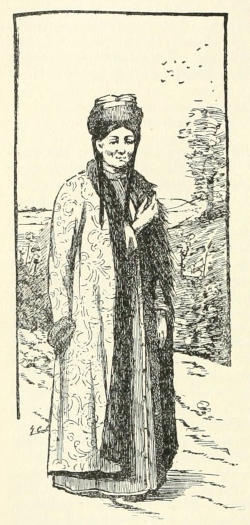
A Kalmuck Woman
Several of the Kalmuck chiefs were treated with indignity. It was established as a state maxim that they had no right to complain against injustice; all protest was regarded as a crime. Finally the khan Ubashi, alive to his people’s misfortunes and wretched himself through the pride and rapacity of his oppressors who had taken his only son from him, dared to draw a picture of his sad position and wished to present it at St. Petersburg. But all means of getting there were closed to him. This attempt only aggravated his fate and vengeance was now added to oppression. Here is exhibited a truly interesting spectacle. This numerous people who, by joining the Lesghians, could, especially in the condition that Russia then was, give it the greatest alarm and mete out terrible retaliation, had no thought of using force. They had come to seek peace and had been deprived of it, so they withdrew. They withdrew without making use of arms, at least none but what they were forced to by the necessity of defending themselves and of procuring what they stood in need of for themselves and their large herds in occupying a front about one hundred leagues wide over a route nearly twelve hundred leagues in length.
The preparations for this journey were made with a secrecy which concealed them from Russia’s knowledge. A nomadic people travels with no other equipment than its herds, which furnish its drink and a portion of its nourishment. Obliged often to change locality in order to obtain grazing grounds, it might without arousing suspicion creep nearer and nearer the frontiers and even cross them without being stopped by detachments sent in pursuit. This is what happened. The preparations were furthered by the Ural Cossacks, who had experienced the same troubles with Russian officials and who were shortly to rise in open rebellion under Pugatchev. Furthermore the migration was carried out like all those of northeastern peoples—with this difference, however: the others came to Europe to invade realms and destroy and replace the inhabitants; while this one was returning to its ancestral home to reunite itself to the empire it had left at the end of the preceding century. In fact, while all known migrations have taken place from the northeast and east to the west and south, this is the single exception which retrograded from west to east.
It divided itself into several columns in order to have sufficient stretch of territory to pasture the herds, and the first column left the Volga on the 16th of December, 1770. This prodigious assemblage of men, women, and children, formed of more than eighty thousand families and taking with it an immense number of cattle, was after a few days on the march vainly attacked by the Russians, continued its journey, was sometimes obliged to use force in making its way, and on the 9th of August appeared in the Elenth country on the borders of China near the river Obi. Its progress may be calculated at about five leagues per day, a rate that seems almost incredible when one thinks of all that composed the body. They also had with them as prisoners a hundred Russian soldiers as well as an officer named Dudun who had commanded them, who is believed to have been French. It was indeed a strange destiny for this officer to be brought to China as the slave of a Kalmuck!
The Kalmucks Reach China
Ubashi, shortly after leaving the Volga, had informed the Chinese of the migration; and precautions were taken in advance that the arrival of such an enormous crowd should occasion no disorder. The emperor of China erected forts and redoubts in the most important places to watch the passing carefully and collect the necessary provisions. The Kalmucks, received like old subjects, found on arriving provision for clothing, food, and shelter. They were worn out by fatigue and in an extremely ragged condition. They had made their way north of the Caspian Sea, one division skirted the borders of Siberia to gain the fertile banks of the Irtish, the other kept farther south near the Usben country in order to reach that of the Elenths without crossing the Kobi desert, where no sustenance would have been found.
They lost on the way more than a third of their number by fatigue, by sickness, and in the battles they were frequently obliged to wage, especially against the wandering Tatars. They were but four hundred thousand on arriving. To each family was assigned a piece of ground suitable as much for pasturage as for agriculture, to which the government desired that they should devote themselves—an efficient means of fixing a people and attaching it to the soil which it cultivates. Ubashi appeared at court and was received with honour. Twenty thousand other Tatar families who had accompanied Amusanan in his flight or were dispersed along the Siberian frontiers followed the example of the Tatars of the Volga, and returned to their old homes. The Chinese government seemed truly paternal in greeting these children whose long misfortunes finally brought them back to their ancestral homes.
Catherine on learning of their departure became justly indignant against the Russian officials who by force of bad treatment had pushed the Kalmucks to this extremity; but the wrong was done, and it was impossible to right it. As soon as she knew what route they had taken she took measures to have the Peking government send them back. The emperor replied that these people were returning to their old homes, that he could not refuse them an asylum, and for the rest if she wished to know the reason of their flight she had only to ask those who had overwhelmed these people, their chiefs, and even their khan with outrages and injustices. Catherine, despairing of bringing them back, was obliged to make use of several bodies of light troops to protect the frontiers the Kalmucks had recently left.f
INSURRECTIONS AND PRETENDERS
A riot in Moscow having clearly revealed the depths of barbarism in which were still plunged the lower classes of the capital—the domestic serfs, lackeys, and factory-workers; the insurrection headed by Pugatchev will show what elements of disorder were still fermenting in the most remote provinces of the empire. The peasants upon whom fell the whole burden of state charges, as well as the exactions of proprietors and functionaries, dreamed in their ignorance of all sorts of impossible changes, and were always ready to follow impostors; many were the false Peters and Ivans and Pauls who started up with worthless claims to trade on the credulity of these simple minds, deeply imbued as they were with the distrust of “women on the throne.” The raskolniks, made savage and fanatical by previous persecutions, remained in their forests on the Volga, irreconcilable enemies of this second Roman empire that was stained with the blood of so many martyrs. The Cossacks of the Don and the Zaparogians of the Dnieper chafed under a yoke to which they were unused, and the pagan, Mussulman, or orthodox tribes of the Volga were but awaiting an opportunity to regain their former liberty and retake the lands occupied by the Russians.
How little these various ungovernable elements could accommodate themselves to the conditions of a modern state has been shown, when, in 1770, three hundred thousand of the Kalmuck-Turguts abandoned their encampments. Add to these malcontents a crowd of vagabonds of all sorts, ruined nobles, unfrocked monks, fugitive serfs, and pirates of the Volga, and it will be seen that Russia contained in its eastern portion all the materials necessary for an immense jacquerie, such as had before been unchained by the false Dmitri, or Stenka Radzin.
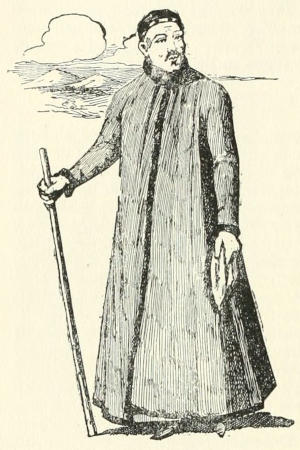
A Bokharian of Siberia
It was the Cossacks of the Jaik, cruelly repressed after their insurrection in 1766, who were to provide the rebel serfs with a leader in the person of Emilian Pugatchev, a raskolnik who had escaped from prison to Siberia. Passing himself off as Peter III, who had been rescued from the hands of the executioner, he raised the banner of the Holsteins and declared his intention of marching on St. Petersburg to punish his wife and place his son on the throne. With a following of but three hundred men he laid siege to the little fortress of Jaik. All the troops that were sent against him passed over to his side. He caused all the officers to be hanged, and put to death all the nobles in the towns through which he passed, capturing by means of such terrorisation several small fortresses on the steppes. By his intimates who knew the secret of his origin, he was treated in private as a simple Cossack, but the populations were deceived and received him with the ringing of bells. Certain Polish confederates who were captives in these regions organised for him a body of artillery. For nearly a year he kept Kazan and Orenburg in a state of terror, defeating all the generals that were sent against him. Peasants began to rise against the nobles, Tatars and other tribes against the Russians, until the bitterest of social wars was unchained in the whole Volga basin. Moscow with its one hundred thousand serfs was thrown into agitation; among the lower classes there was talk of liberty and extermination of the masters. Catherine II charged Alexander Bibikov to check the progress of sedition.
Bibikov was aghast, on arriving at Kazan, to see the extent of the demoralisation. He set about reassuring the nobles and soothing the lower classes, but in letters to his wife he wrote: “Conditions are frightful, I fear all will go ill!” Without great confidence in his own troops he decided to attack the impostor, whom he recognised as merely an instrument in the hands of the Cossacks. He defeated Pugatchev twice, once at Tatistchev and once at Kargula, dispersing his army and seizing his cannon. Bibikov died in the full flush of victory, but his lieutenants, Michelson, Collongues, and Galitzin, continued to pursue the vanquished pretender. Hunted to the lower Volga, Pugatchev suddenly ascended the river and pillaged and burned Kazan, but was afterwards defeated on the Kazanka. Descending the river he entered Saransk, Samara, and Tsaritsin, and though hotly pursued by his enemies took time to establish there new municipalities. Meanwhile the populations on the route to Moscow were awaiting his coming, and to meet this expectation innumerable Peter III’s and Pugatchevs arose, who at the head of furious bands went about assassinating proprietors and burning châteaux. It was high time that Pugatchev should be brought to justice. Tracked down between the Volga and the Jaik by Michelson and the indefatigable Suvarov, he was taken to Moscow, where the people were given the spectacle of his execution.
[1775 A.D.]
These troubles had been a warning to Catherine II, and she still bore them in mind when she destroyed the Zaparogian Republic in 1775. The valiant tribes of the Dnieper, expulsed under Peter the Great and recalled under Anna Ivanovna, no longer recognised their former territory of Ukraine. Southern Russia, freed from the incursions of the Tatars, was rapidly being colonised; cities were springing up on all sides and the vast herb-covered steppes were becoming transformed into cultivated fields. The Zaparogians were highly displeased at the transformation, and wished to have their lands restored to them in their former condition. They protected the haïdamaks who were constantly harassing the colonists, until Potemkin, the actual creator of “new” Russia, wearied of such uncomfortable neighbours, occupied on the empress’ order the sitcha and destroyed it. The malcontents fled for refuge to the lands of the sultan; the rest were organised into the Cossacks of the Black Sea, and in 1792 the island of Phanagoria and the southern shore of the sea of Azov were assigned to them as residence. Such was the end of the great Cossack uprising which is heard of to-day only in the songs of the kobzars.d
FAVOURITISM UNDER CATHERINE II
During the reign of Catherine favouritism attained a very wide development. In her Memoirsg we meet with the following characteristic passage which is not devoid of interest: “I was endowed by nature with great sensitiveness, and an exterior which if not beautiful was, nevertheless, attractive; I pleased from the first moment and did not require to employ for this purpose artifice or embellishments. By nature my soul was of such a sociable character that always when anyone had spent a quarter of an hour with me, he felt perfectly at ease and could converse with me as if he had known me for a long time. By my natural indulgence I inspired confidence in those that had to do with me; because everyone was aware that nothing was pleasanter to me than to act benevolently and with the strictest honesty. I may venture to say (if I may be allowed thus to speak of myself) that I was like a knight of liberty and lawfulness; I had rather the soul of a man than that of a woman; but there was nothing repellent in this, for to the intellect and character of a man was united in me the charm of a most amiable woman. I trust I may be pardoned these words and expressions of my self-love: I use them counting them as true, and not desiring to screen myself by any false modesty.
“I have said that I pleased; consequently half of the temptation that arises is already included in that fact itself; the other half in such cases naturally follows from the very essence of human nature, because to be subjected to temptation and to yield to it are very near to each other. Although the very highest principles of morality may be impressed on the mind, yet they soon become involved, and feelings appear which lead one immeasurably further than one thinks. For my part even until now I do not know how they can be averted. People perhaps may say that there is one means—flight; but there are cases, positions, circumstances where flight is impossible; in fact where can one flee to, where seek a refuge, where turn aside amidst a court that makes a talk over the smallest action? And thus if you cannot flee, then in my opinion there is nothing more difficult than to shun that which is essentially pleasing to you. Believe me, all that may be said to you against this is hypocrisy and founded on a want of knowledge of the human heart. A man is not master over his own heart; he cannot at his will squeeze it in his fist and then set it free again.”
Both contemporaries and posterity have not without foundation harshly judged favouritism under Catherine. One-sidedness and harshness of judgment in this respect have however deprived both contemporaries and immediate posterity of the possibility of dispassionately estimating the personality of the empress in general. Taking into consideration Catherine’s unusual capacities, the circumstances in which she was placed, and her temperament, it is impossible not to acknowledge that in accusing her we must not lose sight of the age in general and of the morals at the court in particular. Favouritism was no new apparition under Catherine. Almost the same state of things had arisen during the reign of Elizabeth Petrovna. A particularly unpleasant impression, however, is made by frequent changes of favourites. One after another in turn there were “in favour”: Gregory Orlov, Vasiltchikov, Potemkin, Zavadovski, Zoritch, Korsakov, Lanskoi, Ermolov, Mamonov and Zubov. Both Russians and foreigners have harshly censured Catherine for the rapidity of these changes, which were unexpected and sometimes without any visible cause. On the other hand, even writers who are unfavourable to Catherine have praised her for the fact that not one of the favourites banished from the court was ever persecuted or punished, while history presents a multitude of examples of cruelty and extreme arbitrariness on the part of crowned women in parallel cases.
It must be acknowledged, however, that favouritism, given the unbounded cupidity of Catherine’s favourites and of their relations, friends, and acquaintances, cost the treasury and the nation very dear.h
Under the influence of new favourites and other confidants, the second half of Catherine’s reign assumed an essentially different character as regards her actuating motives, although in the outward course of events a certain resemblance to the first half was preserved. When Catherine began to reign she had in mind a policy of peaceful splendour, advised also by Panin; she would willingly have secured the sovereignty of Poland by pacific means. It was only the force of circumstances which drew her into an undesired war.
Now her ambition assumed a different direction; we behold her recklessly bent on high-handed conquests, taking the initiative and deliberately making plans to bring about new wars. And, as this has often proved the case when government is vested in a woman, the change was caused by the most intimate personal circumstances. It would be out of place here to relate in detail the paltriness of all the court intrigues. It will suffice to recall the fact that Catherine, weary of the brutal tyranny of Gregory Orlov, tried to shake off his yoke and only succeeded with difficulty in wrenching herself free. She sent him at the time of the plague to Moscow, much against his will, and his numerous enemies hardly concealed their hope that he might never return. The empress endeavoured to keep him at a distance when he returned, but he struggled to remain master of the field and to stand his ground, although he saw himself supplanted in her personal favour by an insignificant young officer of the guards called Vasiltchikov.
The Rise of Potemkin
When Catherine began after a time to feel ashamed of the insignificance of this young man, the much discussed General Gregory Alexandrovitch Potemkin, known to the empress in the days of her quarrels with her husband, knew how to take advantage of this favourable moment to force himself almost by violence into the long coveted position of her acknowledged and honoured favourite. The Orlovs tried for some time to wrest from him his sway over Catherine and over Russia, but they were obliged finally to give way, and retired to the ancient capital of the empire—which had remained the national capital, the capital of ancient Muscovy and the refuge of all who had reasons for avoiding the court.
There is much in this strife that is characteristic of time and place. When Gregory Orlov was forced to start on his dangerous journey to Moscow, many hoped, as already pointed out, that he would never return. When he reappeared safe and sound and in excellent health, and it was feared that he might regain his lost position in the favour of the empress, many a shrewd man was unable to conceal his vexation. The distinguished German doctor, Tode, to whom may be ascribed practically all the expedient measures taken in Moscow against the plague, remained not only unrewarded, but was unable for a long time to obtain compensation for the loss of his wardrobe. When he finally expressed his astonishment thereat, one of the senators is said to have solved the riddle with the dry remark: “Well, why did you bring the count back alive?” Then when Gregory Orlov got married in Moscow it was quite seriously proposed in the senate that the marriage should be dissolved as sinful, and that the fallen favourite and his wife should be shut up in penitential monasteries because they had married within the prohibited degrees. The empress, who had bestowed upon her former friend the title of prince as a consolation and a farewell, was angered by this decree and caused it to be revoked. However, in spite of the protection afforded him, Gregory Orlov came to a tragic end a few years later (1783). He died insane—as tradition will have it, a violent death, one of the mysterious occurrences that will never be cleared up.
But the empress Catherine, generally so acute, was singularly deceived concerning Potemkin, the Prince of Darkness, as he was afterwards called from a play on his name. He was the son of an insignificant nobleman of Smolensk, a retired major, and bore a name till then unknown in Russian history; a man of doubtful capabilities, ignorant, and in fact distinguished by nothing but a boundless and unscrupulous egotism, by an immense craving for coarse, extravagant pleasures, and by the nefarious energy with which he pursued his selfish desires. The first condition for his enjoyment of life was the power to exercise a boundless autocracy and to be able to tread under foot not only those who bowed before him but also those who attempted to resist him.
The empress, however, as a woman and conscious of her unauthorised position, feeling the need of energetic support, saw in the man, whose almost gigantic frame seemed to betoken a titanic nature, something really extraordinary, and believed him destined to accomplish great deeds. Thus Potemkin retained his ascendancy even after he had withdrawn from her most intimate favours under the pretence of long-continued ill-health, and had thrust forward all sorts of handsome insignificant young men who were one after the other loaded with riches. Potemkin understood how to increase the distrust which the empress felt for her son, and to keep it constantly awake. He made her believe that she was continually surrounded by dangers; that he was the only one who would protect her, and more especially that he was the only one who would wish to do so under all circumstances. On the other hand he flattered her vanity still more than her ambition by plans on an adventurously large scale, by fantastic pictures of fame and greatness which he suggested to her imagination. Thus, he pointed to the conquest of Constantinople, the expulsion of the Turks from Europe, the foundation of a Greek empire on the Bosporus, not as triumphs which one might hope to see realised in the future but as deeds which might and should be accomplished within the next few years.
The general idea was not originated by Potemkin. Field-Marshal Munich had already pointed out to the empress that Constantinople was the necessary goal of Russian aspirations. But formerly an object so remote in time and place aroused but little interest. Now everything seemed to have advanced within grasp; the empress was to wear the crown of the new Greek empire during her lifetime; now the idea aroused in her the wildest enthusiasm. The very fact that no cautious statesman would consider these plans only made Potemkin appear all the greater in her eyes; his assurance raised him far above the everyday mediocrity of the others.
The eldest grandson of the empress received the name of Alexander, the second the no less significant name of Constantine. The former was in due time to inherit the Greek crown from his grandmother. They took care in a manner which bordered on exaggeration to make prophesies, or to announce to the whole world the vast schemes with which they deluded themselves. The young prince was not christened according to the Russo-Greek but the somewhat different oriental-Greek ritual, as it was practised in the churches of his future empire. They tried to procure a Greek nurse for him, but as that did not succeed they at least chose one called Helen. Greek playfellows were found for him, and he learned modern Greek as if it were his mother tongue.
The fascination which Potemkin exercised over Catherine may be attributed to her feeling of insecurity, to the support Potemkin promised her, and to the vast prospects he opened out for her ambition. There is one thing calculated to astonish us and that is that neither the empress nor Potemkin was able to realise how insufficient was the actual might of Russia at that time to carry out these gigantic schemes. It was scarcely surprising that Potemkin should be unable to judge of this, for he was an ignorant man, who was wanting in the most elementary political foresight and was besides no thinker. But how came it that Catherine should be so deceived, who had studied earnestly and had by that time accumulated a varied experience? How could it escape her that the comparatively limited financial resources of the empire, more especially, would prove quite inadequate, particularly as they were anything but well husbanded? They gave themselves up light-heartedly to the magic of the banknote press and thus brought down untold calamities upon Russia, as has been the case also in other countries. But this calamity did not stand alone; it is in fact not to be regarded as an independent manifestation, but rather as one of a whole series of necessary consequences of a premature effort of Russia to lay claim to a world-power of such magnitude and importance, before her might was fully established at home or had attained sufficient maturity.
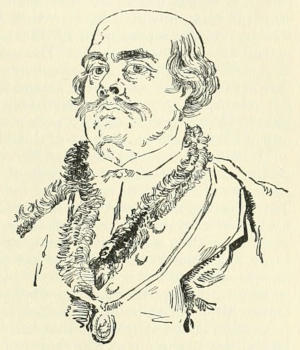
General Suvarov
(1729-1800)
The fact that the forces of the empire must from that time be almost entirely devoted to the support of a foreign policy; that little, if anything, could be done for the development of culture and industry (and that only as a matter of secondary importance), that no consideration could be given to the most necessary reforms—none of these circumstances worked Russia such visible and tangible harm as the flooding of the country with unconsolidated paper money doomed in advance to depreciation; as matters stood, this was probably a greater evil. When Russia entered upon the grasping policy of Potemkin she began to lay out her future in advance, so to speak, and that on a scale utterly out of proportion to the actual gain which might be or which was in fact attained. The evils which resulted have continued to work themselves out down to the present day. As in this way the germs of a future power were constantly being sacrificed in order to conjure up power in the present by overdrawing the resources in hand, the real advancement of the empire was paralysed, and even the actual might in which they gloried remained partly a sham which certainly did not correspond with the reality. When later it became necessary for Russia to participate in the momentous struggles which involved the destiny of Europe, her power was not matured, concentrated, or husbanded at the decisive moment—as for instance the power of Prussia by Frederick William I; her future prospects were encumbered by a heavy burden and by manifold obligations, the inner development was behind the times, and her financial position was shaken. It became necessary continually to make fresh, feverish efforts, which always over-reached the possibilities of the present and which hindered the inner development afresh, involved the future deeper and deeper, and exhausted its resources.i
The Official Status of the Favourite
It may be deemed necessary in this place to explain what were the duties expected from and the distinguished honours paid to the favourites of Catherine. When her majesty had made choice of a new favourite, she created him her general aide-de-camp, in order that he might accompany her wherever she went, without incurring public censure. From that period the favourite occupied in the palace an apartment under that of his royal mistress, with which it communicated by a private staircase. The first day of his installation he received a present of 100,000 rubles, and every month he found 12,000 placed on his dressing-table. The marshal of the court was ordered to provide him a table of twenty-four covers, and to defray all his household expenses. The favourite was required to attend the empress wherever she went, and was not permitted to leave the palace without asking her consent. He was forbidden to converse familiarly with other women; and if he went to dine with any of his friends, the absence of the mistress of the house was always required.
Whenever the empress cast her eyes on one of her subjects, with the design of raising him to the post of favourite, he was invited to dinner by some one of her female confidants, on whom she called as if it were by chance. There she would draw the new candidate into discourse, and judge how far he was worthy of her destined favour. When the opinion she had formed was favourable, a significant look apprised the confidant, who, in her turn, made it known to the object of her royal mistress’ pleasure. The next day he was examined as to the state of his health by the court physician, and as to some other particulars by Mademoiselle Protasov, one of the empress’ ladies, after which he accompanied her majesty to the Hermitage, and took possession of the apartment that had been prepared for his reception. These formalities began upon the choice of Potemkin, and were thenceforth constantly observed.
When a favourite had lost the art of pleasing, there was also a particular manner of dismissing him. He received orders to travel, and from that moment all access to her majesty was denied him; but he was sure of finding at the place of his retirement such splendid rewards as were worthy of the munificent pride of Catherine. It was a very remarkable feature in her character that none of her favourites incurred her hatred or vengeance, though several of them offended her, and their quitting office did not always depend on herself.
Potemkin’s Schemes of Conquest
[1775-1780 A.D.]
Potemkin’s rule commenced at the very time in which the Peace of Kutchuk-Kainardji was concluded (July, 1774). The disputes with Poland and the rebellion of Pugatchev were no sooner ended than he immediately violated every condition of that treaty, well knowing that the empress would approve of everything he might do. Dowlet Gerai, who was elected khan by the now independent Tatars, still remained much more favourably disposed to the Turks than to the Russians: the latter, therefore, by means of money and intrigues, raised up a pretender against him; and then, under pretence of an armed mediation, a Russian army occupied a part of the Crimea, and seemed disposed to make the khan a prisoner, and to seize the whole province. Dowlet Gerai took refuge with the Turks in April, 1775, and Sahim Gerai, who was a mere creature of Russia, was elected in his stead, to the great satisfaction of the Russians, who foresaw that the majority of the Tatars would oppose the new khan, and thus furnish them with another pretext for a renewal of hostilities. A war with the Porte appeared unavoidable, and Romanzov received commands to collect a considerable army on the Dnieper, whilst Repnin in Constantinople was endeavouring to deceive the sultan, and Potemkin betrayed the unfortunate Sahim Gerai.
By this time Potemkin had ceased to be the personal favourite of the empress; but he himself recommended his successors in that post to her notice. Potemkin was indispensable to Catherine in consequence of those colossal undertakings which procured her the name of Great; and because the fear with which he inspired all her enemies secured to her the possession of the throne, which she withheld from her son Paul. Zavadovski had become the occupant of the apartments of the royal palace in November, 1776, and been created a major-general; as soon, however, as he fell under Potemkin’s suspicion, the latter authoritatively insisted upon his dismissal. Zavadovski had turned against his patron, and was an eager favourer of the Orlovs and Field-Marshal Romanzov. For this reason Potemkin succeeded in obtaining leave of absence for the favourite in July, 1777, in order to provide during his temporary retirement a substitute who should eventually displace him. Potemkin had long before selected a Major Zoritch for his adjutant, who was politically insignificant, but very attractive in his hussar uniform, with a view to present him to the empress. Zavadovski had no sooner left the palace than he carried his design into effect, and the empress made Zoritch a colonel adjutant-general and her companion. At the expiration of nine months, he too fell under Potemkin’s displeasure, and was obliged to retire, for the empress was completely under the control of her minister. Next came Korsakov, a handsome sergeant in the guards, who was suddenly raised to the rank of aide-de-camp general. He too was indignant at Potemkin’s unbounded pride and avarice, but attempted in vain to open the eyes of the empress; he was obliged to yield to the influence of the indispensable tyrant after he had enjoyed the favour of the empress for fifteen months.
The circumstances of the year 1778 were peculiarly favourable to the accomplishment of Potemkin’s plans of conquest, for war had broken out in the spring between France and England, and both powers were so fully occupied in the west that they had no leisure to attend to the concerns of the east. Potemkin, therefore, sent an army, commanded by Suvarov, against the Kuban and Bedjiak Tatars, whilst other Russians penetrated into the Crimea and were guilty of the most cruel devastations. This led to the seizure of some Russian ships in the straits of the Dardanelles on the part of the sultan, who was, however, unable to commence a war without the aid and co-operation of France. But that power, unwilling to break with Russia, insisted on mediating, and the sultan was forced to acquiesce. The result was that the Russian ships were restored, and the sultan formally recognised Sahim Gerai as the rightful ruler of the Crimea.
Catherine was so pleased with the conduct of France on this occasion that she embraced with alacrity the plan of the armed neutrality, which was devised by the French minister Vergennes; and in 1780 she put herself at the head of that league which was joined by almost all the powers of Europe except Great Britain. It was formed for the purpose of resisting the right asserted by the English navy to make prize of an enemy’s goods, or of goods shipped for an enemy’s port, wherever found, and even though covered by a neutral flag. The leading principle of the league was that free ships make free goods. Great Britain would not admit this; but at that time she did no more than expostulate with her good friend and ally the empress of Russia. It was not until the reign of Paul that she waged war for the maintenance of the opposite principle, which she later repudiated during the Crimean War.
From this time forward, as we have seen, Potemkin, Voltaire, and a host of flatterers amused the empress with dreams of the restoration of a Byzantine empire, and the erection of a new capital on the Black Sea. Sahim Gerai prized the slavish title of a lieutenant-colonel in the guards of a foreign empress more than that of prince of a nation to which the Russian czars for many years had been vassals, and he renounced the national costume of his people in order to glitter in a Russian uniform and wear the decorations of the order of St. Anne. Potemkin contrived every month to alienate him more and more from his people, till at last this miserable man was induced to lay down his khanate, from which he derived a revenue of three or four millions of rubles, in order, as he thought, to revel peacefully in the enjoyment of some hundred thousand rubles, which Potemkin was to pay him as the newly appointed Russian governor-general of Tauris, as the country was now to be called. Potemkin was too much accustomed to receive and not to give, and to contract debts without thinking of paying them, to give himself much concern about the payment of the promised salary, although the empress was led to believe that the yearly sum always charged to her was in reality regularly paid to the khan.
[1783 A.D.]
The shamelessness of the Russian government on this occasion fully equalled the audacity of their manifestoes respecting the partition of Poland, or that of the state-papers of a Genz and a Talleyrand. In the Russian manifestoes published in April, 1783, it was made as clear as the sun to the Tatars that the empress and Potemkin were really proposing to confer upon them the most signal benefits. It was stated that the Tatars, as Russian subjects, were in future to be delivered from all the evils of their internal disputes, and by the incorporation of the Crimea, the Kuban, and the eastern Nogaians an end was to be put to those oppressions from which they had hitherto suffered from the Turks and the Russians alternately. What the correspondence was between these promises and the subsequent reality may be learned from all the works of travellers who visited these districts, and gave accounts of the Crimea and the Tatars a generation or two later. That numerous, free, and rich race of people, clothed in silks and of noble appearance, had then dwindled into a crowd of starving beggars; their magnificent tented cities had become gipsy encampments, and their houses and palaces exhibited mere masses of ruin and decay.
These manifestoes, indeed, as is usually the case, were not intended for those to whom they were addressed, but merely to conceal in a cloud of words, from the eyes of those at a distance, the cruelties and bloodshed with which they were accompanied. The Tatars made an effort to defend their liberties, and their magnates made no secret of their dissatisfaction; Potemkin, therefore, had recourse to one of those heroic means which usually find defenders enough when they are applied for the support of the true faith and of autocratic government, and are only reviled and execrated in the hands of a Danton and a Robespierre. He proposed by a single massacre summarily to annihilate the malcontents, and to awe the rest into submission by the dread of a similar fate. Posorovski received express orders to make himself master of the malcontents, their families, and adherents, and put them all to the sword; he, however, possessed moral courage enough to decline the business of an executioner. Potemkin’s cousin was not so scrupulous. According to the accounts, whose unanimous testimony we are obliged to follow, even when it appears to us incredible, Paul Potemkin caused above thirty thousand Tatars, of every age and sex, to be massacred in cold blood, and in this way procured for his cousin the easily won title of the Taurian, and the place of grand-admiral of the Black Sea and governor-general of the new province of Tauris.
The massacre in Tauris took place in April, 1783, and the Turks were unable to render any assistance to the Tatars without foreign support. Among the European powers, however, England was at that time fully occupied with the disturbances which in the following year brought Pitt to the helm of affairs; France was glad to see an end to the American war; Joseph II was bound by the Treaty of Tsarskoi Selo; Frederick II hoped to become master of Thorn and Dantzic, if Russia was well-disposed towards him; and Gustavus III of Sweden was the only monarch who could have rendered any aid. In the very same year, however, Gustavus suffered himself to be induced to go to Friedrichsham, where he sold himself to the empress; nothing, therefore, was now left to the Turks but to yield to their destiny. The sultan did what had been done by the king of Poland a few years before; by his consent he changed that into a righteous and legal possession which, being seized in the midst of peace, was previously a robbery. The whole territory of the Tatars, the Crimea, the island of Taman, and a great part of the Kuban were ceded to Russia, and a treaty of commerce was forced upon the Turks, by virtue of which the Russian consuls in the various ports of Turkey were erected into a power wholly independent of the government of the country. This treaty of commerce had been drawn up by Panin before he had been obliged to yield to the superior influence of Potemkin and withdraw from public affairs; and it was now concluded on the 10th of June, 1783. By virtue of this treaty the Turks were obliged to submit the decision of all mixed civil cases in which a Russian and a Turk were the respective parties, not to the local tribunals, nor to the higher authorities, nor to a court of arbitration, but to the Russian consul; and in all pecuniary transactions the claims of a Russian against a Turk were urged with much greater strictness than in those cases in which the Turk was the claimant and the Russian the debtor.
In the eyes of the world, which regards only externals, Potemkin was now a great and admired statesman; and so absolute was his sway over the empress herself, that she not only tolerated his insolence, his total neglect of all pecuniary obligations, his tyranny over all classes, and his imperial expenditure and magnificence, but allowed him to help himself to an unlimited extent out of the coffers of the state. Potemkin on the one hand did homage to the empress as if she were a goddess, and on the other he suffered himself to treat her with the most insolent familiarity and rudeness. He would even saunter from his own apartments into hers in his dressing-gown and slippers, with his stockings hanging down and his legs bare. He went so far as to extort from those who enjoyed the empress’ favour a part of the money which they received from her, and yet he allowed poor Sahim Gerai to starve. He never paid him the assigned pension of 100,000 rubles which was yearly debited to the empress’ account, and even the displeasure of Catherine could not induce him to bestow upon this Russian protégé the simplest means of life.
The founding of a new Russo-Grecian capital, with which Potemkin now busied himself, was a magnificent piece of flattery for the empress, but for which she was unhappily obliged to pay too dear. Catherine indulged with Voltaire in those visionary schemes of a utopian Greece, of a civilisation of which she and not the people was to be the source, of an enlightenment, industry, and trade to be carried into these conquered deserts by ukases and courtiers; Potemkin acted according to this fancy. He first erected a city with buildings of every description, and then sought for inhabitants, or forcibly drove them for a time from all quarters, when he wished to make a court-spectacle of this theatrical city and to enchant the empress. It was of no consequence to him that his city fell to pieces and its inhabitants disappeared as soon as he turned away his eyes. The new city was called Kherson, a name long since obscured by that of Odessa; the empress granted 18,000,000 rubles, most of which, however, Potemkin diverted to his own private use. The situation was badly chosen, and yet this shadow of a capital was for a length of time charmed into existence by innumerable arts of fraud and open violence; and the deserts of which it was to be the metropolis were erected into a province, to which Potemkin gave the name of Catherine’s Glory (Slava Ekatharina). Another province, somewhat farther to the north, near the celebrated falls of the Kaidak, was also honoured with the name of the empress, and called Iekatarinoslav.
GENERAL SUVAROV
The general to whom Potemkin at this time assigned the congenial task of havoc and destruction in the country of the Nogaian Tatars and in Kuban was Suvarov, a man who from that period till the end of the century had the misfortune to be continually employed as the instrument of a murderous military despotism. In Poland he executed three times those orders of annihilation which were issued from St. Petersburg. He destroyed the Turks and sacrificed the Russians by thousands at the will of Potemkin. He subsequently shared Paul’s hatred against the French and every thought of civil freedom, and performed the same kind of heroic deeds for that madman’s pleasure as he had previously done at the bidding of Potemkin. He was undoubtedly one of the greatest generals of modern times, but wholly destitute of humanity, for he sacrificed thousands without hesitation in order to secure a victory or storm a fortress, when either was calculated to produce a splendid effect though but for the moment. He not only flattered the empress, but even the common soldiers and their superstitions. Though he was a man of various knowledge, and had made himself master of all the arts of life as practised in the highest society, he assumed at court the character of a sort of court-fool, and acted often as if he were mad, merely in order to carry out some surprising piece of flattery. In the company of the common soldiers he affected the manners of the semi-barbarous Russian, lived as they did themselves, submitted to every privation which they might be called upon to endure, and knelt and prayed before every wayside image, often when the roads were deep with mud.
THE FAVOURITES LANSKOI AND IERMOLOV
[1785 A.D.]
At the time when a high-flown sentimentality was the fashion in Germany, and the empress was past fifty, she indulged in a fit of romantic love for the insipid and spiritless Lanskoi. This turn in her affections was very agreeable to Potemkin, for Lanskoi neither took up the cause of the destitute khan, nor yielded to the allurements of the king of Prussia, the emperor Joseph II, or the English, when they were desirous of engaging him in affairs of state. Potemkin freely permitted the empress to indulge her visionary love for the wonderfully handsome and youthful face which captivated her affections, and did not grudge her, among the many gross and degrading scenes of her life, the enjoyment of one romantic passion, after the manner of Werther and Siegwart, from the year 1780 till July, 1784. Catherine’s love for Lanskoi had been romantic in his life, and her sorrow at his death was not less extravagant; but notwithstanding all this ideality, she had been also careful to show him substantial proofs of her affection at the cost of the country. She bestowed upon him not only all possible titles, orders, and decorations—diamonds, plate, and collections of every kind, but he left behind him in cash a property of 7,000,000 rubles.
The fantastic mourning for Lanskoi was no sooner evaporated than the empress allowed Potemkin, who presented candidates for every office, to supply her with a substitute for her departed lover. In order to exclude all other pretenders, Potemkin on every such occasion was prepared to fill the vacancy; and with this view he had for some time made Lieutenant Iermolov one of his adjutants. In 1785 this man became the declared favourite of the empress, and soon ventured to pursue a course which Lanskoi would never have thought of. He directed Catherine’s attention to the tyranny of Potemkin, and gave her some hints respecting his behaviour towards Sahim Gerai. The empress expressed her displeasure without naming the person who had made her acquainted with the unhappy fate of the khan; Potemkin, however easily guessed that no man in the empire would dare to speak ill of him to the empress except Iermolov. He therefore threateningly replied, “That must have been said by the White Moor,” as he was accustomed to call Iermolov on account of his fair countenance and flat nose.
Catherine did not hesitate severely to reproach Potemkin for his harsh and unjust conduct towards the khan, and she even wavered for some months between her favourite and this son of the Titans, whom she regarded as her protector and the creator of her glory and her greatness. At the end of June, 1786, a fresh scene occurred, by which the empress was compelled to declare either for the one or the other. Iermolov had made a new attempt to alienate the empress from Potemkin; the latter, therefore, haughtily insisted that either Iermolov or he must retire from her service; Catherine felt herself constrained to adhere to Potemkin, and Iermolov went upon his travels. During the course of the year he had been loaded with riches, and on his departure he was furnished with 100,000 rubles and imperial recommendations to the Russian ambassadors at all the European courts. On the day after his departure Momonov, another adjutant of Potemkin, occupied his place.
JOSEPH II VISITS CATHERINE; A SPECTACULAR TOUR
[1787 A.D.]
About this period Potemkin repeatedly travelled from St. Petersburg to Tauris and back with all the expedition of a courier, whilst he was engaged in the building of Kherson, in order to prepare a splendid triumph for the empress. The neglected Sahim Gerai hastened thither to meet him and make him acquainted with the urgency of his wants; but Potemkin, instead of rendering him any assistance, banished him to Kaluga, where he fell into a state of the deepest poverty. He then conceived that he might find some relief from his fellow believers, and fled to Turkey, but the sultan caused him to be arrested as a traitor and renegade at Khotin, to be conveyed to Rhodes, and there despatched by the bow-string (1787). The plan contemplated by Potemkin and the empress was to raise the grand duke Constantine, second grandson of the empress, to the dignity of emperor of Byzantium, at the expense of the Turks, and at the same time to incorporate the kingdom of Poland with Russia. The new city of Kherson was no sooner ready for this grand theatrical representation than the empress was to travel thither to receive the homage of her new subjects, and to deceive the world by an ostentatious display of magnificence and pomp.
Joseph II was invited to meet the empress in Kherson, in order to consult with her upon a partition of the Turkish Empire; but Constantine himself was in the first instance left at home. The luxury and extravagance exhibited by Potemkin during the empress’ journey and the fêtes prepared for her reception and entertainment at Kherson were worthy of the heaven-storming characters of the pair. They remind us of the extravagance of the Abassides and the descendants of Timur, with this difference—that civilisation and the arts were strangers to the people of the caliphs and of the Great Mogul. Never perhaps was there seen in monarchical Europe, where such things are not rare, such a gross abuse of the wealth and well-being of the people, and such insult cast on public opinion by a contemptible comedy, as on the occasion of this imperial progress.
It began in January, 1787, and was continued night and day. To facilitate the journey by night, Potemkin had caused great piles of wood to be erected at every fifty perches, which were kindled at nightfall, and imparted to the whole district almost the brightness of day. On the sixth day the cortège reached Smolensk, and fourteen days afterwards Kiev, where the degraded Polish magnates, who made a trade of their nation, their honour, and their friendship, were assembled to offer their homage to the empress and join in the revelry of her court. Potemkin himself had gone forward in advance in order to arrange the side-scenes of the theatre which he erected from St. Petersburg to Kherson. Deserts were peopled for the occasion; and palaces were raised in the trackless wild. The nakedness of the plains was disguised by villages built for the purpose of a day, and enlivened by fireworks. Chains of mountains were illuminated. Fine roads were opened by the army. Howling wildernesses were transformed into blooming gardens; and immense flocks and herds were driven to the sides of the road in order to delight the eyes of the empress in her hasty transit. The rocks in the Dnieper were sprung, that the empress might descend the stream as conveniently as she had travelled thither in the chamber of her sledge. At the beginning of May the whole party embarked on the river in fifteen splendid galleys at Krementshuk, and on the following day Stanislaus of Poland presented himself at Kaniev, in order, as it were, by his insipid and pitiful character to serve as a foil to the monarchial splendour of a woman. He accepted an alms of 100,000 rubles for the expenses of his journey, was very graciously received by Potemkin, treated with coldness and indifference by the empress, and as if his royal Polish income was simply a Russian pension he begged for an augmentation. He was not ashamed to acknowledge to all the courts whose ambassadors accompanied the empress that he regarded his kingdom as a Russian province, for he besought the empress to grant the succession to his nephew and to his nation the free navigation of the Dnieper. As is customary in such cases, there was no lack of promises; but none of his petitions were really granted, for it was impossible either to value or respect him, and in his situation he was incapable of inspiring fear.
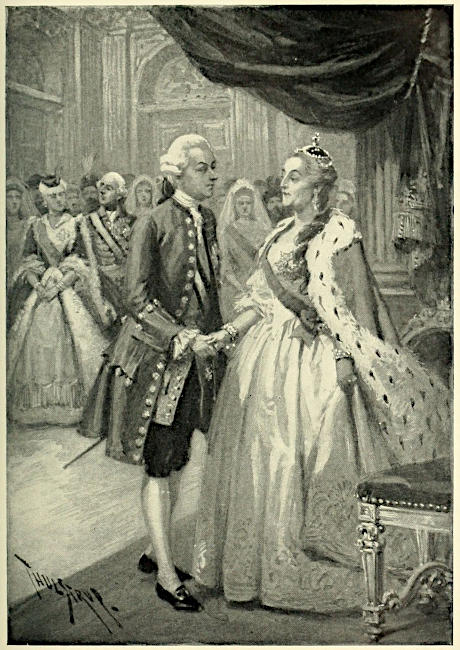
MEETING OF CATHERINE II OF RUSSIA AND JOSEPH II OF AUSTRIA
(Painted for The Historians’ History of the World by Thure de Thulstrup)
The emperor Joseph, who had anticipated the arrival of his ally in Kherson, travelled to meet her as far as Kaidak, and returned with her. He soon perceived that she was shamefully deluded by the appearance of prosperity, civilisation, and population, and that soon as she had passed through all was again to become empty and deserted. Like the villages, flocks, and men by the wayside, the new buildings in which the distinguished travellers passed their nights and the houses and shops in Kherson all vanished again when they had served their temporary purpose. It will not be regarded as incredible that 7,000,000 rubles were expended on the journey, when it is known that the throne itself, which was erected for the empress in what was called the admiralty at Kherson, cost 14,000. Catherine made a magnificent entry into the new city, passing under a triumphal arch, on which was inscribed in the Greek tongue, “The way to Byzantium.”