Chapter XII · ALEXANDER II, THE CZAR LIBERATOR (continued 2)
Reading edition
Thus terminated the Russo-Turkish War of 1877-1878—that decisive struggle for the liberation of the Slavonians of the Balkan peninsula, and although in consequence of the interference of Europe Russia was far from attaining what she had a right to expect after the enormous sacrifices she had made, and the glorious victories she had gained, nevertheless the great and sacred object of the war was attained; on the memorable day of the emancipation of the peasants in Russia, also the Slavonian nations of the Balkan peninsula were liberated, by the help of Russia and her great monarch, from the Turkish yoke which had oppressed them for ages. To the emperor Alexander II, who gave freedom to many millions of his own subjects, was allotted also the glorious rôle of liberator of the Balkan Christians, by whom he was a second time named the Czar Liberator!
SPREAD OF EDUCATION AND CIVILISATION
The new order of things established in Russia, thanks to the great reforms of Emperor Alexander II, called forth a particular want of educated, enlightened men. They were necessary to the wise interpretation and execution of the luminous ideas of the czar-liberator.
Recognising that the spread of education amongst the people is an indispensable condition of its prosperity, the emperor Alexander II, who had become convinced by a personal survey of Russia, that one of the chief obstacles to her progress lay in the ignorance of the people, wished to give to his subjects the means for the highest degree of enlightenment. This solicitude was expressed in a radical reform of all the educational establishments of the empire, beginning with the university and finishing with the national schools. Properly speaking, it may be asserted that the primary national schools and village schools were created during the reign of Alexander II, for until his reign the primary education of the people was in a sad condition, and amongst them an almost total ignorance prevailed.
His legislation for the education of the masses should justly be numbered amongst the most important works of the Czar Liberator. But many were the other reforms accomplished by him that also had a great and beneficent signification for the Russian people. During the reign of the emperor Alexander II the country which had until then but few means of intercommunication, became covered with a network of railways. In conjunction with the extraordinarily rapid development of railway communication, the postal service was perfected, the telegraph made its appearance, while commerce and trade acquired wide development. Finally, essential changes and improvements were introduced into the financial administration of the empire; the police was reorganised and certain modifications were granted to the press, in consequence of which there was a powerful awakening in the intellectual life of the people.
THE DEATH OF ALEXANDER II
In studying the wars which took place during the reign of Alexander II, it is impossible not to remark that they were all entered upon and carried on, not under the influence of ambition, not with the thirst for conquest, but exclusively out of a feeling of humanity, in order to preserve those living on the frontiers of the Russian empire from the plundering incursions of half savage Asiatic tribes (as was the case in the subjection of the Caucasus, of Khokand, Bokhara, and Khiva), or for the deliverance of the oppressed co-religionists of Russia (as, for example, the deliverance of the Slavonians of the Balkans).
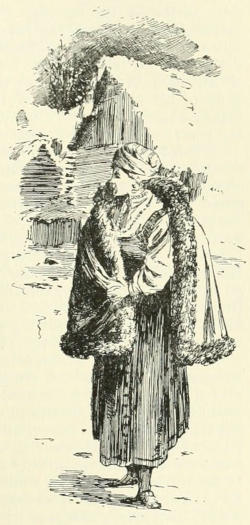
A Winter Costume
The emperor Alexander II was actively solicitous for the welfare of his subjects during the twenty-six years of his glorious reign, never losing sight of the exaltation of the country and the consolidation of the prosperity of the nation. But in spite of the indefatigable labours and fatherly care of the emperor Alexander II, in spite of the enormous services he rendered to the country, of his boundless goodness of heart, his great clemency and unusual humanity—amongst the Russian people were to be found those who had more than once tried by violence to shake the existing state and social organisation of Russia and who did not stop at any crime for the attainment of their ends. Their boundless audacity finally reached the last limits, and they dared more than once to make attempts on the life of the Czar-Liberator.
On the 2nd of March, 1880, the 25th year of the reign of the emperor Alexander II was accomplished, and this memorable day was celebrated with heartfelt enthusiasm in both capitals and throughout the whole Russian Empire. But amongst the millions of joyous Russian hearts, for one man alone in Russia the festivity was not a festivity. That man was the czar himself, the creator of the happiness of many millions of Russians and the cause of the rejoicings. The emperor did not doubt the sincere affection of the people towards him; he knew and felt that Russia loved her czar with all her soul; but at the same time he knew and felt, that in spite of all the glory of his reign, in spite of the great measures he had accomplished, the Russian land bore a handful of malcontents, whose designs it was beyond the power of anyone to arrest.
[1881 A.D.]
The fatal 13th of March, 1881, came. About one o’clock in the afternoon the emperor drove in a carriage from the Winter Palace in St. Petersburg, accompanied by his usual escort, to the Michael riding school to assist at a grand military parade, appointed to take place that day. Coming out of the riding school at the end of the parade, at about a quarter to three, and learning that the grand duke Michael Nikolaivitch, who was present at the parade intended to visit the grand duchess Catherine Mikhailovna at the Mikhailovski palace, the emperor proposed to his brother that they should go together. After spending about half an hour at the Mikhailovski palace the emperor came out alone, without the grand duke and told the coachman to “drive home by the same way.” The carriage set off along the Catherine canal, in the direction of the Theatre bridge.
At three o’clock in the afternoon, at a distance of about 50 sajens from the corner of the Engineer street, the emperor’s carriage as it drove along the side of the canal, past the garden of the Mikhailovski palace came alongside a young man at the footpath of the canal; he afterwards turned out to be the citizen Nicholas Ivanovitch Rissakov. When he came on a line with the imperial carriage, Rissakov turned his face towards it, and before the escort could notice anything, quickly threw beneath the feet of the horses harnessed to the carriage, something white like snow, which afterwards turned out to be an explosive instrument wrapped up in a handkerchief. At the same instant a deafening crash, like a salvo of artillery, resounded; two Cossacks riding behind the czar’s equipage fell from their horses wounded, and a fourteen year old peasant boy, mortally wounded, lay groaning on the pavement; a thick cloud of snow and splinters filled the air. The emperor’s carriage appeared much damaged by the explosion, all the four windows and the little glass behind were broken, the frame of the door was splintered at the side and back, the side of the carriage was broken and the bottom seriously injured. When he had thrown the explosive instrument under the carriage, Rissakov began to run off in the direction of the Nevski Prospect, but at a few sajens from the spot where the explosion had taken place, he slipped, fell, and was seized by some soldiers who came up. The emperor himself was entirely uninjured. He ordered the coachman to stop the horses, opened the left door, got out of the carriage, and went to the spot where Rissakov was already surrounded by a crowd of people.
Then, when the emperor, desiring to examine the spot where the explosion had taken place, had left Rissakov, and had made a few steps along the pathway of the canal, another man—who turned out to be a Pole named Grinevetzki—waiting till the emperor was at a distance of two arskins from him, raised his arms and threw something on the footpath at the very feet of the emperor. At the same moment, not more than four or five minutes after the first explosion, another deafening explosion was heard, after which a mass of smoke, snow and scraps of clothing enveloped everything for some moments. When the column of smoke dispersed, to the stricken gaze of the spectators a truly awful sight was presented: about twenty men more or less severely wounded by the two explosions lay on the pavement, and amongst them was the emperor. Leaning his back against the railing of the canal, without his cap or riding cloak, half sitting on the footpath, was the monarch; he was covered with blood and breathing with difficulty; the bare legs of the august martyr were both broken, the blood flowed copiously from them, and his face was covered with blood. The cap and cloak that had fallen from the emperor’s head and shoulders, and of which there remained but blood-stained and burnt fragments, lay beside him.
At the sight of such an unexpected, such an incredible disaster, not only the uninjured, but also the sufferers from the explosion rushed to the emperor’s help. Raising the wounded emperor, who was already losing consciousness, the persons who surrounded him, with the grand duke Michael, who had arrived on the spot, carried him to the sledge of Colonel Dvorginski, who had been following the emperor’s equipage. Leaning over the emperor’s shoulder, the grand duke inquired if he heard, to which the emperor replied, “I hear,” and then in answer to the question of how he felt the emperor said: “Quicker ... to the palace,” and then as if answering the proposal to take him to the nearest house to get help, the emperor said, “Take me to the palace to die ... there.” These were the last words of the dying monarch, heard by an eye-witness of the awful crime of the 13th of March. After this the emperor was placed in Colonel Dvorginzki’s sledge and transported to the Winter Palace. When the palace was reached the emperor was already unconscious, and at 25 minutes of 4 o’clock Alexander II was no more.
The emperor Alexander II was great not only as the czar of a nation of many millions, but by a life devoted to the welfare of his subjects; he was great as the incarnation of goodness, love and clemency. The autocratic monarch of one of the vastest empires of the world, this czar was governed in all his actions by the dictates of his loving heart. Showing himself a great example of self-sacrificing human love, he lived only in order to exalt the land of Russia, to alleviate the necessities and consolidate the welfare of his people.d
FOOTNOTES