Chapter IX · RUSSIA IN THE NAPOLEONIC EPOCH (continued 2)
Reading edition
If the victory at Pultusk, of which Bennigsen boasted, and on account of which he was afterwards rewarded by his emperor, and appointed commander-in-chief, was very doubtful, on the other hand, Prince Galitzin completely defeated the French at Golymin, on the very day on which they were to attack Buxhövden, at Ostrolenka. This victory, too, was the more glorious, inasmuch as the Russians were less numerous than their opponents. The French, however, had not been able to bring up their artillery; and the superiority of the Russians in this particular decided the event. The weather and the time of the year rendered active operations impossible for some weeks. Bennigsen retired to Ostrolenka, and afterwards still farther; whilst the French, under Ney and Bernadotte, were scattered in the country on the farther side of the Vistula, in which Ney at length pushed forward as far as Heilsberg.
[1807 A.D.]
In January, 1807, Bennigsen and Napoleon came, almost simultaneously, upon the idea of changing the seat of war from the extreme east to the west. In the east, the struggle was afterwards carried on by two particular corps—a Russian, under Essen, and a French, first under Lannes, and then under Savary. This bloody struggle, however, had no influence on the issue of the war. Bennigsen no sooner learned that Ney had scattered his troops widely over the country on the farther side of the Vistula, than he broke up his quarters, and resolved to attack him, before Bernadotte, who was near, could come to his relief; but he was too late. Ney had already retreated when Bennigsen arrived; whether it was as the French allege, because Napoleon, who had seen the danger with which he was threatened, sent him orders to retreat, which arrived on the very day on which he was to be attacked by the Russians, or that General Markov was at first too eager, and Bennigsen afterwards too irresolute. Ney luckily marched from Heilsberg, nearer to the Vistula, and Bennigsen followed him hesitatingly, so that Bernadotte was able to keep him employed for some days till Napoleon came up. On receiving news of Bennigsen’s march, the French emperor had sent orders to all his corps to renew the campaign on the 27th, and he had so taken his measures, that before the Russians had any suspicion of an attack, the main army of the French would fall upon their left flank, whilst they were on their march. For this purpose, Bernadotte was to allure Bennigsen quite to the Vistula; and then to advance again as soon as Napoleon had outflanked the left of the Russians.
The despatch containing these orders for Bernadotte fell into the hands of the Russians, through the inexperience of the officer entrusted with it, who failed to destroy the document at the right time. Thus warned of the impending danger, and finding themselves pressed on all sides, they allowed their stores and heavy baggage, at various places, to fall into the hands of the enemy, and thereby escaped being surrounded. After considerable sacrifices, they succeeded, on the 6th of February, in reaching the Prussian town of Eylau, which is only nine hours’ distance from Königsberg. Soult attacked their rear, on the low hills behind the town, on the 7th, and drove them in; on the following day a general engagement took place. The honour of the victory is probably due to the Russians, as even Savary admits, who shared in the battle. It is not less certain, however, that the whole advantage accrued to the French, who, indeed, admit that the battle was one of the most dreadful recorded in history. The French accuse Bernadotte of having, by his delay, prevented the victory from being complete; whilst the Russians are just enough to admit that Lestocq, with his Prussians, saved their wing from utter defeat. The number of deaths in the battle, and on the day preceding it, was immense. Great numbers fell, not by the sword, but by cold, want, and excessive exertion. Whole battalions and regiments of the French—as, for example, that of Colonel Sémelé—were literally annihilated. Few prisoners were made, because the whole battle was fought with the bayonet.
The royal family of Prussia was placed in a very melancholy position by the issue of the battle, for they were obliged, in the middle of winter, to flee to Menel, where they found themselves among Russians, of whom their own emperor alleged, that, notwithstanding his despotic power, he was not able to restrain their barbarity, or to put a stop to their rapacity. Here, in the farthest corner of Prussia, they received news every month of the fall of one fortress after another, or of forced contributions levied upon their people.
The French army also retired after the battle of Eylau as well as the Russians. Bennigsen marched towards Königsberg, and although Berthier, on the morning of the 7th, wrote to the empress that they would be in Königsberg with their army on the following day, the French, nevertheless, drew off nearer to the Vistula. Nothing important was undertaken by either party for some months, but vigorous preparations were made for a new struggle; whilst new means were tried to prevent Prussia from taking any energetic measures—that is, from forming a close union with England and Russia. The king hesitated between the bold advice of Hardenberg and his friends, and the unconditional submission to the will of Napoleon, which was recommended by von Zastrov. The Russians were thoroughly dissatisfied with the English, and complained of being very badly supported by them; they suffered want of all kinds, were worse treated in many places in Prussia than the French, and even borrowed 660,000 dollars in coin from the king of Prussia.
Hardenberg, who accompanied his master to Tilsit, succeeded in having a new treaty entered into at Bartenstein between Russia and Prussia. Its principle was the same as that of the agreement made on the 12th of October, of the preceding year, at Grodno, by virtue of which the emperor bound himself to support the cause of the king with all his forces. In this treaty, it was not only promised, just as if they were before Paris, that Prussia should receive back all that had been lost, but it was formally determined what was to be done with the conquests wrested from France, and how even the left bank of the Rhine was to be partitioned among the allies.
About this time Bennigsen was appointed commander-in-chief of the Russian armies; but he is generally accused of incapacity, and fearful descriptions are given of the disorders, fraud, and embezzlement which prevailed, and of the plunder and barbarity which they practised against unfortunate Prussia. The emperor Alexander, as soon as he arrived at the army, did everything in his power to restore order; he was able, however, only to remedy single abuses; even Nicholas, who manifests a degree of severity from which Alexander shrank back, is not able to reach the source of the evil. Towards the end of May, Bennigsen thought his troops already sufficiently reinforced to make an attack upon the French, and drive them across the Vistula; whilst the combined army of English, Swedes, and Prussians, were to make an attack from Pomerania. The French army, lying from Dantzic to the Narev, was brought, before the beginning of June, when the campaign commenced, to 150,000 men, whose pay and sustenance were drawn from the requisitions and contributions imposed on Prussia. In April, 1807, the French senate passed a decree levying 80,000 conscripts, 60,000 of whom were to be immediately sent to the army; and the Poles, too, deceived by the hope of the restoration of their nationality, raised a body of between 25,000 and 30,000 men, among whom were whole regiments recruited by the Polish nobility, or formed exclusively of nobles who volunteered their service, although Napoleon limited all the expectations of the Poles to the country on this side of the Vistula.
As soon as Bennigsen, in the beginning of June, made a serious movement in advance towards the Vistula, a series of murderous engagements began, similar to those which preceded the battle of Eylau; on the 9th, the main body of both armies came in sight of each other at Heilsberg, and on the 10th the French made an attempt to drive the Russians from their position. The united corps of Soult and Lannes, supported by the cavalry under Murat, made repeated attempts to force the Russians to give way; they, however, kept their ground.
Bennigsen afterwards heard, at Wehlau, that the French had separated into two divisions, and he resolved on the 13th, instead of continuing his route on the farther side of the Alle, to wheel about before Wehlau, and attack the French. By this step, as all writers admit, he gave himself into the hands of his great opponent, who never suffered his enemy to commit a fault with impunity. The position taken up by Bennigsen was such as to leave him no alternative between victory and destruction, for he had the Alle in his rear, and a marsh on one flank. Napoleon took advantage of this mistake, as usual; and the orders which he issued before the battle prove that he was sure of the victory. About five o’clock in the evening of the 14th of June, a battery of twenty guns gave the signal for the fight; it was bravely maintained on both sides, and both armies suffered great loss. The French accounts exaggerate the number of the Russians who were led into the battle of Friedland, as well as the number of prisoners: certain it is, however, that seventeen thousand Russians were either killed or wounded.
After the battle of Friedland, there was no longer any account to be taken of the Prussians: and it was a piece of great good fortune that such a sovereign as Alexander reigned in Russia, otherwise Prussia would have been wholly lost. Lestocq, with his Prussians, was obliged hastily to cross the Haff to Memel; and their magazines, considerable stores of powder and ammunition, together with one hundred thousand muskets, which the English had sent by sea to Königsberg, fell, with the town, into the hands of the French. Bennigsen was not very closely pursued on the other side of the Alle; he passed the Niemen on the 19th, and burned down the bridge behind him; immediately afterwards, Bonaparte arrived in Tilsit. Of all the Prussian fortresses, Colberg alone might have been able to maintain itself for some weeks, and Graudenz was saved merely by the peace. The treaty with England, which the Prussian minister signed in London on the 17th of June, and by which £1,000,000 sterling was promised in subsidies, came too late.
Schladen informs us that all those who were about the king of Prussia had so completely lost courage, that Von Hardenberg, Von Stein, Von Schladen himself, and many others who recommended perseverance, found none upon whom they could reckon. With respect to the Russians, he informs us that there was a party who assumed a threatening aspect—that the army was dissatisfied with the war—that the grand duke Constantine behaved often very rudely towards the Prussians, and allowed himself to be used as an instrument for working on the fears of his brother Alexander. On the 7th of June, the emperor manifested a disposition altogether contrary to the agreements and partition-projects of the convention of Bartenstein. He was dissatisfied with England, and perceived that the Austrians had no other object than to fish in troubled water, and he was, therefore, desirous, as much as possible, to withdraw from the whole affair. He proposed a truce for himself, with a clause that the Prussians also should obtain a cessation of hostilities; but the Russians and Prussians were to negotiate each for themselves respecting the conditions. Napoleon having entertained the proposal, Russia agreed, that during the continuance of the truce, the French should retain possession of the whole of Poland, except the circle of Bielostok. The agreement was signed on the 21st, and a four weeks’ notice of the renewal of hostilities was reserved. By the terms of the truce granted to Prussia, the French remained in possession of the whole kingdom; and the few fortresses which were not yet reduced were not to be supplied either with new works, ammunition, or provisions. Blücher, who commanded the Prussian auxiliary forces in Pomerania, was to leave the king of Sweden to his fate. The peace was to be negotiated at Tilsit, and for that purpose one half of the town was to be declared neutral.k
Meeting of Alexander and Napoleon at Tilsit (1807 A.D.)
Napoleon desired, as far as means and powers would allow, to give all possible pomp and solemnity to the interview with his mighty adversary. With this object, in the middle of the Niemen, opposite Tilsit, a raft was constructed, on which were two pavilions, covered in white cloth. The one which was destined for the two monarchs was of vaster dimensions and was adorned with all possible luxury; the other and smaller one was for their suites. On the frontals of the pavilions were painted in green, on the Russian side, an enormous A, and on the side turned towards Tilsit an N of equal size. To the annoyance of the Prussians, the monogram of Frederick William III was absent from the decorations of the Niemen raft. The French guards were ranged in lines, fronting the river. “All this army,” writes an eye-witness, “awaited the appearance of their invincible leader, their thunder-bearing semi-divinity, in order to greet him at the moment of his swift passage to the wharf.” Thousands of the inhabitants of Tilsit and French soldiers covered the high left bank of the Niemen.
The emperors got into the boats simultaneously. When both boats put off, the grandeur of the spectacle, the expectation of an event of world-wide importance took the ascendency over all other feelings. Universal attention was concentrated upon the boat that carried that wonderful man, that leader of armies, the like of whom had never been seen or heard of since the times of Alexander the Great and Julius Cæsar. Napoleon stood on the boat in front of his suite, solitary and silent, his arms folded on his breast as he is represented in pictures. He wore the uniform of the Old Guard and the ribbon of the Legion of Honour across his shoulder, and on his head that little historical hat, the form of which has become famous throughout the world. Reaching the raft somewhat sooner than Alexander, Napoleon rapidly got onto it, and hastened to meet the emperor. The rivals embraced and silently entered the pavilion, accompanied by the joyful acclamations of the troops and the inhabitants, who were witnesses of a world-wide event—the reconciliation of Russia and France. At that moment a large boat put off from the left bank of the Niemen, having on it about twenty armed soldiers—and remained between the raft and the Russian shore. Evidently Napoleon did not hesitate to take open measures of safeguarding against any possible unforeseen occurrences.
That day the king of Prussia did not assist at the interview: Napoleon did not wish to see him, and Frederick William remained on the right bank of the Niemen. “In that fateful hour, whilst the destiny of his monarchy was being decided, his gaze was constantly fixed and his ear directed towards the raft, as though he desired to listen to the conversation between the two emperors. Once he went down to the edge of the river and only stopped when the water was up to his horse’s middle.” The first interview between Alexander and Napoleon lasted an hour and fifteen minutes. “I detest the English no less than you do,” were the first words of the emperor Alexander, “and I am ready to support you in everything that you undertake against them.” “If such is the case,” answered Napoleon, “then everything can be arranged and peace secured.”
Taking advantage of Alexander’s inimical disposition towards Great Britain, Napoleon entered upon a terrible philippic against the perfidy of Albion, representing it as a greedy, extortionate nation ever ready to sacrifice everyone, even its most faithful allies, for its own profit. In further conversation Napoleon strove to instil into Alexander that he was victimised by his allies, that he was mistaken in protecting the Germans, those ungrateful and envious neighbours, and in supporting the interests of a set of greedy merchants who showed themselves to be the representatives of England; all this was occasioned, according to him, by a feeling of generosity carried to excess, and by doubts which arose from the incapacity or corruption of ministers. After this Napoleon began to praise the valour and bravery of the Russian troops, with which he had been much struck at Austerlitz, Eylau, and Friedland; he considered that the soldiers on both sides had fought like veritable Titans and was of the opinion that the united armies of Russia and France might dominate the world, and give to it prosperity and tranquillity. Up till now Russia had squandered her forces, without having any recompense in view; by an alliance with France she would acquire glory, and in any case reap substantial advantages. Of course Russia was bound by certain obligations to Prussia, and in that respect it was indispensable that the honour of the emperor Alexander should be carefully guarded. In conclusion Napoleon expressed his intention of restoring to Prussia sufficient territory honourably to rid the emperor of his ally; after that, he affirmed, the Russian cabinet would be in a position to pursue a fresh line of policy similar in everything to that of the great Catherine. Only such a policy, in Napoleon’s opinion, could be possible and advantageous for Russia.
Having flattered Alexander as emperor, Napoleon in order to complete the charm proceeded to flatter him as a man. “We shall come to an agreement sooner,” said he, “if we enter upon negotiations without intermediaries, setting aside ministers, who frequently deceive or do not understand us; we two together shall advance matters more in a single hour than our intermediaries in several days. Nobody must come between you and me; I will be your secretary and you shall be mine,” added Napoleon. Upon this basis he proposed to the emperor Alexander for convenience’s sake to transfer the negotiations to Tilsit, declaring the position of the town to be a central one. The emperor gladly accepted Napoleon’s invitation, and it was settled that negotiations should at once be entered upon in order to come to a definitive agreement[55] on the matter.g
RUSSIA DECLARES WAR AGAINST ENGLAND (1807 A.D.)
The English government, alleging that in the secret articles of the treaty of Tilsit, of which they had possessed themselves, they had proof of Napoleon’s design to seize the Danish fleet, fitted out an expedition against Denmark with extraordinary celerity. Copenhagen was bombarded for three days, and a great part of the city destroyed. The Danes then capitulated (September 7), and surrendered their fleet to the English, with all their naval stores in their arsenals and dockyards.
The expedition against Copenhagen was soon followed by a declaration of war on the part of Russia against England. In the manifesto published on this occasion (September 16th), Alexander complained bitterly of the bad faith of England, as manifested especially in the little aid she had afforded to the allies who had taken up arms in a cause in which she was more directly interested than any other power, and in the robber-like act of aggression she had committed against Denmark. He annulled all former conventions between Russia and England, especially that of 1801; proclaimed anew the principle of the armed neutrality; and declared that there should be no communication between the two powers until Denmark had received just compensation, and peace was concluded between France and England. In consequence of this declaration, an embargo was laid on all the English vessels in Russian ports, and Prussia was compelled to follow this example.
THE CONQUEST OF FINLAND (1807 A.D.)
It was not till the 6th of October that a formal demand was made upon Sweden to close the ports of the Baltic against English ships and trade. The king persevered in his alliance with England; and finally, because the emperor of Russia had conferred upon Napoleon the order of St. Andrew, he sent back his insignia; whereupon Alexander not only returned his Swedish order, but quietly adopted measures to take possession of Finland, whilst the Danes were preparing, in concert with the French, to invade the western provinces of Sweden. Although in the months of November and December, Gustavus repeatedly declined the proposals of the Russians for a union against England, everything went on in Sweden as in times of the most profound peace; and even when the Russian forces were collected on the very frontiers of Finland, the unfortunate king adopted no measures of defence whatever. On the 21st of January he was, for the last time, called upon to declare war against England; he replied by concluding a new alliance with her on the 8th of February. On the 21st, the Russians invaded Finland, without any specific declaration of war, and on the 14th of March, 1808, Denmark declared war against Sweden. The whole of Finland as far as Vasa, the island of Åland, and even the islands of Gotland, Åbo, Sveaborg, and all the fortresses, were taken possession of by the Russians even before the Swedish army and fleet were prepared. It was not till the end of April and beginning of May that a Swedish army under Klingspor and Aldercreutz, supported by a Swedish fleet, appeared in the field, and fought with various success.
We have lately seen Alexander take military possession of the Danubian provinces as a “material guarantee,” whilst affecting not to be at war with Turkey. This was in exact conformity with Russian precedents. Finland, as we have said, was occupied without a declaration of war; but manifestoes were issued by General Buxhövden, one of which contained the following passage: “Good neighbours, it is with the greatest regret that my most gracious master, the emperor of all the Russias, sees himself forced to send into your country the troops under my orders. But his majesty the king of Sweden, whilst withdrawing more and more from the happy alliance of the two greatest empires in the world, draws closer his connections with the common enemy, whose oppressive system and unparalleled conduct towards the most intimate allies of Russia and of Sweden herself cannot be coolly endured by his imperial majesty. These motives, as well as the regard which his imperial majesty owes to the safety of his own states, oblige him to place your country under his protection, and to take possession of it in order to procure by these means a sufficient guarantee in case his Swedish majesty should persevere in the resolution not to accept the equitable conditions of peace that have been proposed to him, etc.”
When the Russians took possession of Finland, the king gave them a pretence for incorporating it with their empire, which, however, they would no doubt have done in any case. He caused Alopeus, the Russian ambassador, to be arrested. This took place on the 3rd of March, and on the 25th a declaration was published on the part of the emperor of Russia, announcing to all the powers that “from that moment he regards the part of Finland hitherto reputed Swedish, and which his troops had only been able to occupy after divers battles, as a province conquered by his arms, and that he unites it forever to his empire.”
It was easy to anticipate that the superior force of the Russians must in the end prevail; although the Russian garrison in Gotland, and that in the island of Åland, were at first taken prisoners, the island occupied, and the Russians beaten by land at Vasa on the 26th of July, and by sea at Roggerwick on the 26th of August. The Swedes lost all the advantages they had thus gained by the bloody battle fought at Ormais on the 14th of September, and by the defeat at Lokalar on the 18th. The Russian generals, probably in order to give courage to the malcontents, who were very numerous in Sweden, issued orders not to receive any letters or any flags of truce which were sent in the king’s name, and carried on negotiations with the Swedish generals alone, for a suspension of arms, which was concluded for an indefinite time, on the 20th of September, but only continued till the 27th of October, when the Russians resumed hostilities, and the Swedes were driven to the north, across the Kemistrom. On the 20th of November a new truce was agreed upon between the Swedish general Adlercreutz and the Russian general Kamenskoi, with the reserve of fourteen days’ notice before renewal of operations. By the conditions of this agreement the Swedes were to evacuate the whole of Uleåborg, and to retire completely behind the Kemistrom, with all their artillery, arms, and stores.
On the 13th of March in the following year a revolution was effected in Sweden, by which Gustavus was deposed; his uncle, the duke of Södermanland, became regent, and was afterwards proclaimed king (June 5, 1809) under the title of Charles XIII. At Stockholm the people flattered themselves that the dethronement of Gustavus would speedily bring peace to Sweden; but it was not so. Alexander refused to treat with a government so insecure as a regency, and hostilities continued. General Knorring who had passed the Gulf of Bothnia on the ice with twenty-five thousand Russians, took possession of the Åland islands, and granted the Swedes a cessation of hostilities, to allow them time to make overtures of peace. Apprised of this arrangement, Barclay de Tolly, who had crossed the gulf with another body of Russians towards Vasa, and taken possession of Umeå, evacuated west Bothnia, and returned to Finland. A third Russian army, under Shuvalov penetrated into west Bothnia by the Torneå route, and compelled the Swedish army of the north under Gripenberg to lay down their arms (March 25th). This sanguinary affair occurred entirely through ignorance; because in that country, lying under the 66th degree of north latitude, they were not aware of the armistice granted by Knorring. On the expiry of the truce, hostilities began again in May, and the Russians took possession of the part of west Bothnia lying north of Umeå.
The peace between Russia and Sweden was signed at Frederikshamm on the 17th of September. The latter power adhered to the continental system, reserving to herself the importation of salt and such colonial produce as she could not do without. She surrendered Finland, with the whole of east Bothnia, and a part of west Bothnia lying eastward of the river Torneå. The cession of these provinces, which formed the granary of Sweden and contained a population of 900,000 souls, was an irreparable loss to that kingdom which had only 2,344,000 inhabitants left. In the following year Bernadotte, prince of Ponte Corvo, was elected crown prince of Sweden, and eventual successor to the throne, under the name of Charles John.
The loss of Finland had been but slightly retarded by some advantages gained over the Russian fleet by the combined squadrons of England and Sweden. The Russian vessels remained blockaded on the coast of Esthonia, but in an unassailable position, from which they were at last delivered by the weather and the exigencies of navigation in those dangerous seas. Another Russian fleet under Admiral Siniavin, which sailed to Portugal to co-operate with the French against the English, was obliged to surrender to Admiral Cotton after the convention of Cintra. It was afterwards restored to Russia. The war declared by that power against England in 1807, was little more than nominal, and was marked by no events of importance.
WAR WITH PERSIA AND WITH TURKEY
The annexation of Georgia to Russia, effected as we have seen, in the beginning of Alexander’s reign, drew him into a war with Persia, which did not terminate until 1813. The principal events of that war were the defeat of the Persians at Etchmiadzin by Prince Zitzianov (June 20, 1804); the conquest of the province of Shirvan by the same commander (January, 1806); the taking of Derbent by the Russians (July 3rd); and the defeat of the Persians by Paulucci, at Alkolwalaki (September 1st, 1810).
About 1805 the condition of the Ottoman Empire, badly organised and worse governed, was such that everything presaged its approaching dissolution. Everywhere the sultan’s authority was disregarded. Paswan Oglu, pasha of Widdin, was in open revolt. Ali Pasha of Janina was obedient only when it suited his convenience. Djezzar, the pasha of Syria, without declaring himself an enemy to the Porte, enjoyed an absolute independence. The sect of the Wahhabees was in possession of Arabia. After the departure of the English from Egypt, first the beys, and afterwards Muhammed Ali reigned over that country, and only paid their yearly tribute to the sultan when they pleased. In Servia, Czerni George was making himself independent prince of the Slavonians of the Danube. Ipsilanti and Morusi, both Greeks, by the permission, or rather by the command of Russia, were appointed hospodars of Moldavia and Wallachia, for seven years at least, and were therefore rather subjects of the Russians than of the Turks. Selim III, who had reigned since 1789, convinced that the Porte could never re-establish its authority except by better organising the army, had endeavoured to model it on the European system. This attempt afterwards cost him his throne.
The English and Russian ambassadors ruled either alternately or together in Constantinople. But for their interference the old friendship between France and the Porte would most likely have been restored in July, 1802. At the time of the foundation of the empire in France, the sultan hesitated long whether he would lean upon the English and Russian, or upon the French influence, for he felt a great want of confidence in Napoleon, since he had been informed by the English of the language which fell from the emperor in conversation with Lord Whitworth. He was reported to have taken the partition of Turkey for granted—as a thing unavoidable; and that on such partition the province of Egypt ought necessarily to fall to the share of France. This conversation was printed, in 1803, among the documents connected with the renewal of the war between England and France, and was communicated to the sultan. The French, indeed, in their official journals, contradicted the allegation; but who ever put any faith in their official journals?
On this ground we must explain the fact that the Turks favoured the Russians in the war which they were carrying on with the Persians; suffered them to sail up the Rion (ancient Phasis), and even to build a fort at its mouth. They were even desirous of renewing the friendly alliance formed with Russia in 1798, which renewal, indeed, the emperor of Russia was afterwards unwilling to confirm, because the English had taken care to have the inviolability of the Turkish Empire incorporated in the treaty of 1798. Had, therefore, the emperor of Russia ratified the alliance, he would have guaranteed to the Turks the actual condition of their empire in Europe, which he did not wish to do. This excited the suspicion of the Turks, who inclined more and more towards the French, and did not suffer themselves to be frightened by the threats of the English and Russians. Immediately after the Peace of Presburg, the Turks, who had previously acknowledged Napoleon’s empire, sent a new ambassador to Paris. In return, Napoleon sent engineers, officers, artillerymen, workmen, and materials, in order to enable the sultan to improve his army, artillery, and the bulwarks of his empire; whilst, on the other hand, the Russian ambassador, Italinski, and the English ambassador, Arbuthnot, threatened war if the alliance with the French was not relinquished; and Italinski’s threats fell with a double weight because a corps of Russians were ready for action on the Bug.
About the time at which Napoleon adopted the resolution of attacking Prussia also, and therefore foresaw a war with Russia, a Turkish army was assembled to take the field against the Russians on the Turkish frontiers, and Napoleon clearly saw how advantageous to him a war between the Russians and the Turks would be. He therefore sent General Sébastiani as ambassador extraordinary to Constantinople. Sébastiani arrived there in August, 1806; and soon gained so great an influence that for some time the Divan was entirely under his direction. At his instance it refused to renew the treaty of alliance with England, which was on the point of expiring; and it dismissed Ipsilanti and Morusi, as creatures of Russia, from their offices. In consequence of the threatening language held by Arbuthnot, the English ambassador, they were reinstated; but when this took place hostilities had already begun. The emperor Alexander had ordered General Michelson to enter Moldavia and Wallachia. The Porte then declared war against Russia (December 30th); but deviating for the first time from a barbarous custom, it allowed Italinski, the Russian minister, to depart unmolested.
A few days afterwards, Arbuthnot quitted Constantinople, after having repeatedly demanded the renewal of the alliance and the expulsion of Sébastiani. On the 19th of February, 1807, an English fleet, commanded by Vice-Admiral Duckworth, forced the passage of the Dardanelles, and appeared before Constantinople. Duckworth demanded of the Divan that the forts of the Dardanelles and the Turkish fleet should be surrendered to him; that the Porte should cede Moldavia and Wallachia to Russia, and break off alliance with Napoleon. But instead of profiting by the sudden panic which his appearance had excited, he allowed the Turks time to put themselves in a posture of defence. Encouraged and instructed by Sébastiani, they made their preparations with such energy and success that in the course of eight days the English vice-admiral found that he could not do better than weigh anchor and repass the Dardanelles.
Shortly afterwards Admiral Siniavin appeared in the Archipelago, and incited the Greek islanders to throw off the Turkish yoke; whilst Duckworth sailed to Egypt upon a fruitless expedition in favour of the mameluke beys against Muhammed Ali. Siniavin defeated the Turkish fleet on the 4th of April, captured several ships, and took possession of some islands. The bad condition of his ships, however, compelled him to give up the blockade of the Dardanelles, and to retire, in order to refit, after having another time defeated the Turkish fleet. Meanwhile, Selim had been deposed. His successor, Mustapha IV, declared that he would continue to prosecute the war with England and Russia. But Siniavin, before he retired to refit, met the Turkish fleet off Lemnos, on the 1st of July: the Turks were beaten, lost several ships, and a great many men.
The campaign of the Russians on the Danube, in 1807, was not productive of any decisive result, as General Michelson received orders to detach the third army corps to oppose the French in Poland, Czerni George, the leader of the revolted Servians, took Belgrade, Shabatz, and Nish, penetrated into Bulgaria, where he was reinforced by some Russian troops, and gained divers signal advantages. The war was conducted with more success on the frontiers of the two empires in Asia. The seraskier of Erzerum was entirely defeated by General Gudovitch (June 18); and that victory was the more important, as it prevented the Persians from making a bold diversion in favour of the Turks.
The emperor Alexander had agreed by the public articles of the Treaty of Tilsit (July, 1807) to evacuate Moldavia and Wallachia; but this was only a collusion between the two contracting parties. The Russians not only aimed at the permanent possession of the two provinces, but regarded all the Slavonians of the Danube as allies or subjects of the czar. When the Turks, on the 14th of July, concluded a peace with Czerni George, whereby Servia became in some measure independent—and Czerni George afterwards called himself prince of Servia—a Russian general guaranteed the treaty by his signature, as one of the parties to the agreement. In the following year Radovinikin, a Russian envoy, repaired to Belgrade to establish the new principality; called an assembly of the nobles; drew up a sketch of a constitution for Servia, and tried to organise the administration.
The French general, Guilleminot, was sent to the Turkish camp to negotiate a truce on the terms ostensibly laid down in the Treaty of Tilsit: namely, that the Russians should evacuate Moldavia and Wallachia, but that the Turks should not occupy the two provinces until after the conclusion of a definitive peace. But Guilleminot’s instructions contained a direct command to use the whole weight of the French influence in favour of the Russians and against the Turks; even one of Napoleon’s greatest admirers, although owning occasional republican scruples, admits that their tone was very equivocal. In fact, it very soon became obvious that the whole mission of the general was a mere piece of diplomatic imposture and treachery. A congress was held at Slobozia, in the neighbourhood of Giurgevo, on the 24th of August, 1807, and a truce was signed, which, it was said, was to continue till the 30th of April, 1808. The Russians were to withdraw; the fortresses of Ismail, Braila, and Giurgevo to be given up to the Turks, whose troops, however, were to evacuate Moldavia and Wallachia in thirty-five days. Everything, however, which afterwards took place in consultation between the French and Russians, in reference to Turkey, bore upon a scheme of partition.
The Russians at length, on the 7th of August, had left Cattaro and the other strong places in Dalmatia to the French; their emperor, on the 9th, had ceded all his rights as protector of the republic of the seven united islands to Napoleon, and the latter was busy making preparations thence to extend his operations and his dominion further to the east. Marmont, who administered the province of Dalmatia, received orders to fortify Ragusa more strongly, and to make a report on the best plan to be adopted in case it should be desirable to send an army quickly from Corfu, through Albania, Macedonia, and Thrace. The Russians continued to be quiet observers of all this, and in the mean time made firm their footing in the provinces on the Danube. They made a pretence of the conduct of the Turks on the occupation of Galatz, and their ill-treatment of the inhabitants of Moldavia, for not fulfilling the agreement entered into at Slobozia. The Russian troops, who, according to the terms of the treaty, were already retiring, received contrary orders; and the Turks, again driven out of the two provinces, occupied Galatz anew.
The conduct of the negotiation respecting the division of the Turkish booty, was committed to the chief of Napoleon’s secret police, who had been actively engaged in the murder of the duke d’Enghien. He now held a princely rank as the duke of Rovigo, and was sent to St. Petersburg with this and similar commissions. In the Russian capital the emperor Alexander and the duke acted as rivals in the art of dissimulation; the emperor loaded him with civilities of all kinds, as some compensation for the coolness and contempt with which he was at first treated, to a surprising extent, by the empress-mother and the Russian nobility. He was, indeed, soon consoled, for the slaves of the czar were as zealous in showing respect in the presence of their master, as they were gross in their insolence when not under his observation. The accounts which Savary gives us of the political principles of the pious emperor and his chancellor, and their complete agreement with Napoleon’s morality and his own, would be quite incredible to us, did he not literally quote their words. Savary’s secret report to the emperor Napoleon, partly written in the form of a dialogue, is to be found among the fragments of Napoleon’s unprinted correspondence. A contempt for public agreements, and the plunder of Sweden, even before the declaration of war, astonish us less than Romanzov’s audacious contempt of the opinion of all Europe; he thought it not worth a moment’s consideration; and this was quite in accordance with the language held by his master in speaking on the subject of Turkey. Thibaudeau has given so correct an opinion of both the emperors—of the nature of their consultations—of Savary and Romanzov that we cannot do better than refer the reader to the words of that writer.
Turkey would at that time undoubtedly have been partitioned, had Austria been willing to follow the numerous gentle hints to join the alliance of the emperors, who imagined themselves able to make their will the right and law of all nations; or if Napoleon had not found it inconsistent with his plans to bring on at an unfavourable moment a new war with Austria, which he clearly foresaw in 1808. The Russians, in the mean time, remained, throughout the whole of the year 1808, in quiet possession of the provinces which had been previously evacuated by them, and ruled not only in them, but extended their dominion as far as Belgrade, for the new prince of Servia was likewise under Russian protection. The army under the command of the grand vizir, which lay at Adrianople during the winter of 1807-1808, dwindled, during the continuance of the truce of Slobozia, to a few thousand men, because, according to ancient custom, the janissaries returned to their homes in winter; it again increased, however, in the beginning of summer. Bairaktar’s army, which was organised on the new European principle, was computed at from twenty to thirty thousand men; it remained on the Danube till its leader, at length, resolved to put an end to the anarchy prevailing in Constantinople. He deposed Mustapha IV, who supported the faction of the janissaries, and placed his brother, Mahmud, on the throne. Bairaktar perished, however, in an insurrection (November 14th), and Mahmud, too, would have been murdered, had he not been the last scion of the imperial family. But he was compelled entirely to change his ministry, and to resign the government into the hands of those who enjoyed the favour of the ulemas and the janissaries.
During the disturbances in the internal affairs of the Turkish Empire, the foreign relations continued the same as they were in the year 1807, immediately after the truce of Slobozia. When Napoleon’s plan of removing the negotiations respecting a peace between the Russians and the Turks to Paris failed of success, he found it advisable, in consequence of an impending war with Austria, to give the Turks into the hands of the Russians. One of the chief causes of the war between France and Austria in 1809 was the close union between the latter power and England in reference to Turkish affairs, which appeared in the co-operation of Lord Paget and Baron von Stürmer, the English and Austrian ambassadors in Constantinople. It was the Austrians who mediated the peace between England and the Porte of the 5th of January, 1809, after the conclusion of which the Turks refused to cede Moldavia and Wallachia to the Russians, at the congress of Jassy, as they had formerly done at Bucharest. This led to a new war, of which we shall have to speak hereafter.
CONGRESS OF ERFURT (1808 A.D.)
[1808 A.D.]
In consequence of the complete stoppage of trade which followed the declaration of war in 1807, Russia suffered much more severely than England, and the Russian magnates, supported by the aversion of the emperor’s mother to Napoleon, were very far from showing that good-will to the French which their emperor manifested for Napoleon and his representatives. This was soon experienced by Savary, duke of Rovigo, who, though overloaded with marks of politeness by the emperor, in reality proved unable to make any way at the court of St. Petersburg. Caulaincourt, duke of Vicenza, was afterwards deceived for some years by appearances, and by Alexander’s masterly art of dissimulation; but Napoleon soon came to experience in Spain that the personal proofs of friendship exhibited by the emperor were by no means always in accordance with the Russian policy. The emperor Alexander himself, for example, on the urgent request of Caulaincourt, acknowledged Joseph Bonaparte as king of Spain; whilst Strogonov, the Russian ambassador in Madrid, alleged that he had no instructions to that effect, and corresponded with the insurgents. In the same way, Admiral Siniavin, who, on the breaking out of war with England, had taken refuge in Lisbon with nine ships of the line and a frigate, not only refused to render any assistance to Marshal Junot, who was threatened in that city by the English, but even to make a demonstration as if he were prepared to assist him. The manner in which he afterwards capitulated, on the 3rd of September, 1808, to Admiral Cotton, who caused his ships to be taken to England, might indicate a very different disposition, especially as the ten ships were afterwards given back.
There was, indeed, no want of interchange of civilities between the two emperors. Whoever compares the attentions and marks of regard which have been recorded as shown by the one to the other with the secret intrigues which they were at the same moment weaving against each other in Turkey and Spain, and with the open enmity which was shown as early as 1811, will learn from such a comparison what is the real worth of diplomatic and princely friendships. The emperor of Russia made presents to his imperial brother of vessels and ornaments of malachite and other precious stones, which the latter exhibited in the Salon du Prix in the Tuileries, in order to be able to boast of the friendship of the emperor of Russia in presence of the circles of the faubourg St. Germain. Busts of Alexander were manufactured in the imperial porcelain manufactory at Sèvres, and were everywhere to be seen in the palace and rooms of the imperial family. All who had access to the court, or wished to make themselves agreeable to the emperor, found it necessary to purchase these ornaments, and place them conspicuously in their houses. The friendship was so intimate that one of the emperor of Russia’s adjutants accompanied the emperor of the French when he went to Bayonne to set aside the whole reigning family of Spain. This adjutant, however, was the same Tchernitchev who was engaged in constantly travelling backwards and forwards between St. Petersburg and Paris, who surrounded Napoleon, in spite of all his police, with a net of Russian espionage, and bribed all the employés who were venal in order to obtain papers. He intrigued with ladies to elicit secrets from them; and finally, in 1812, he even purchased a copy of the plan of operations for the war, when it was too late to change it.
Napoleon knew that Austria was thinking of taking advantage of the general discontent and the secret associations in Germany to frustrate the plans of France and Russia with respect to Poland and Turkey; he was, therefore, very desirous of assuring himself once more of the Russian emperor before his journey to Spain. This design was a cause of great anxiety to the very numerous partisans of the English and Prussian policy at the Russian court, when the question was raised of a conference between the two emperors in Erfurt. Von Schladen, the friend of the minister von Stein, therefore presented a memorial to the emperor of Russia, shortly before his departure to Erfurt on the 7th of September, 1808, in which Alexander was forewarned of all that would take place there. From this it may be seen that the emperor of Russia was continually receiving secret counsel and warning from the enemies of the French, and that he played his part in Erfurt more ably than Napoleon, from whom he separated, as even the French writers report, with all the outward signs of indescribable friendship and esteem, but inwardly full of distrust. Von Schladen says very freely to the emperor, that he had given him the advice laid down in his memorial, “in order that he might see through the sophisms, falsehoods, and deceptions which were prepared for him by Napoleon, and awaited him in Erfurt.”
On his way to the congress, the emperor visited the king and queen of Prussia in Königsberg, and arrived on the 26th of September in Weimar, where his brother Constantine had been staying since the 24th. On the 27th Napoleon entered Erfurt, and at one o’clock drove out a distance of several miles from the town to meet the emperor of Russia, who was coming from Weimar. Our modest object does not permit us to incorporate in our prose the poetry of the subsequent festivities, nor in glowing language to extol the skill displayed by the masters of the ceremonies. That splendour enough was exhibited in Erfurt may be sufficiently gathered from the fact that the four vassal-kings of the confederation of the Rhine, thirty-four princes, twenty-four ministers of state, and thirty generals, were by express command to summon up for the occasion everything which imagination could suggest in the way of courtly splendour and extravagance. Talma and the Parisian company of actors had been sent to Erfurt, to act, as Napoleon said, before a pit of kings. Two armchairs were placed for the two emperors, whilst the other rulers sat behind them on common chairs. We know not what truth there was in the story, which was at that time in every mouth, and related in all the French works written for effect, that the emperor Alexander, whilst Talma was being applauded on the stage, played his own part with Napoleon in the pit in quite as masterly a manner. The latter, amidst applause, pronounced the following line:
The friendship of a great man is a favour of the gods.
when the emperor seized Napoleon’s hand, made a profound bow, and feelingly exclaimed: “That I have never more truly felt than at the present moment.” The festivities continued from the 27th of September till the 14th of October, and furnished to the Germans the most melancholy spectacle of their princes and nobles conducting themselves publicly, not only as slaves of Napoleon, but even as servants and flatterers of all his generals and courtiers.
In order to flatter the emperor of Russia, Napoleon acted as if he had been influenced by Alexander’s application in favour of Prussia; but in reality, oppressed the king and his subjects afterwards just as before. He profited by Alexander’s admiration and friendship to make a show of his pretended willingness to conclude a peace with England. Though he had written three times directly to the king of England, and had always been referred to the minister, he nevertheless prevailed upon Alexander to unite with him in signing another letter addressed to King George. The result was such as might have been foreseen; the object, however, was attained: the letters and answers were printed, and officially commented upon in the journals.
The negotiations were carried on personally in Erfurt between the two emperors themselves, and much was agreed upon which neither the one nor the other intended to observe. A written treaty of alliance was besides concluded by Romanzov and Champagny, which was calculated with a view to a new war with Austria. The substance of the agreement consists in a closer alliance of the two powers against England, and the cession of Moldavia and Wallachia to Russia. Hitherto Napoleon had only been willing to concede this last point on conditions which referred to Silesia. In the fifth article of the Treaty of Erfurt, which was kept strictly secret, the two emperors agreed to conclude a peace with England on condition only that that country should acknowledge Moldavia and Wallachia as a part of the Russian Empire. Then follow several articles on the cession of those Turkish provinces. In the eleventh article it is stated, that further negotiations were to be carried on respecting a further partition. It was agreed, too, that the treaty was to be kept secret for ten years. Buturlin boasts, with reason, that the emperor Alexander in Erfurt, by his Greco-Slavonian arts of deception, gained a victory over the Italo-Gallic talents of Napoleon; and, in fact, the very highest triumph is to outwit the deceiver.
Even as early as this Napoleon is said to have thrown out the idea of a marriage with Catherine Pavlovna, Alexander’s sister, which inferred, of course, a previous separation from the empress Josephine. Alexander, on his part, is said to have raised difficulties on the question of religion, and to have referred the matter to his mother, who very speedily had the princess betrothed to Duke Peter of Oldenburg. Moreover, the reception of the duke of Oldenburg into the confederation of the Rhine was one of the results of the meeting in Erfurt.
[1809-1810 A.D.]
The war which broke out in April, 1809, between France and Austria, put the sincerity of the Russo-French alliance to a practical test. Russia complied with the letter of her engagements to the one belligerent power by declaring war against the other; but Prince Galitzin, who was to have made a powerful diversion in Galicia, came so late into the field and his movements were so dilatory that it was evident he had no desire to contribute to the success of his sovereign’s ally. There was no longer any show of cordiality in the diplomatic intercourse between France and Russia; but both parties found it convenient for the present to dissemble their mutual alienation. By the Treaty of Schönbrunn, signed by vanquished Austria (October 14th, 1809), that power ceded, partly to France and partly to the confederation of the Rhine, several towns in Germany and Italy, with their dependencies; she was despoiled, in favour of the duchy of Warsaw, of all western Galicia and the city of Cracow; and surrendered to Russia a territory whose population was estimated at 400,000 souls. The emperor of Austria, moreover, recognised the rights which Napoleon arrogated over the monarchies of the south of Europe, adhered to his continental system, and renounced all the countries comprised under the name of the Illyrian Provinces. But the house of Habsburg, true to the adage, Tu, felix Austria, nube, retrieved its fortunes at the expense of its pride, by bestowing a daughter in marriage on the conqueror.
RENEWED WAR WITH TURKEY (1810 A.D.)
Immediately after Alexander’s return from Erfurt orders were given to open negotiations with the Turks. The conference took place at Jassy; but it was immediately broken off after the Russian plenipotentiaries had demanded, as preliminary conditions, the cession of Moldavia and Wallachia, and the expulsion of the British minister from Constantinople. Hostilities were then resumed. The Russians were commanded by Prince Prosorovski, and after his death by Prince Bagration. With the exception of Giurgevo, all the fortresses attacked by them fell into their hands, until they encountered the army of the grand vizir, near Silistria, and being defeated with a loss of ten thousand men (September 26th), were compelled to evacuate Bulgaria. The grand vizir, without taking advantage of his victory, retired to winter quarters.
In May, 1810, the Russian main army, under Kamenskoi, again crossed the Danube at Hirsova, passed through the Dobrudja, and marched straight against the Turkish main army to Shumla and Varna. At the same time, the corps of Generals Langeron and Sacken proceeded to blockade Silistria and Rustchuk. The Turks could nowhere keep the field. At Kavarna they were routed; at the storming of Bazardjik they lost ten thousand men; at the storming of Rasgrad three thousand. Silistria was reduced in seven days by Langeron. So far everything was favourable for the Russians. If they had added to their advantages the conquest of Rustchuk, the passes of Tirnova and of Sophia towards Adrianople would have been open, the fortress of Shumla would have been avoided, and the main army of the enemy would have been manœuvred out of it. The taking of Rustchuk, and above all the sparing of the troops, was consequently the next problem for General Kamenskoi. Instead of doing this, the Russians attempted to storm almost simultaneously the fortifications of Varna, Shumla, and Rustchuk, were repulsed from these three places, the defence of which was conducted by English officers, and suffered so enormously, that the Turks felt themselves strong enough to come out from behind their intrenchments, and attack the Russian camp before Shumla. They failed, however, in their attempt to storm it.
[1810-1811 A.D.]
To relieve Rustchuk, the grand vizir sent Mukhtar Pasha with picked troops, by way of Tirnova, to the Danube. But if the Turks with their united forces were too weak to force the Russians to abandon the intrenchments before Shumla, they could certainly not expect with a part of their army to rout the enemy near Rustchuk, where he stood with his united forces between their separate wings. Only in case Mukhtar Pasha, who had increased his forces to forty thousand men, entered Wallachia at Turna, and marched against Giurgevo, could the offensive have a meaning, or any influence, upon the siege of Rustchuk, because here it met with the weak point of the enemy. But to enter upon the offensive with an army in Wallachia, whilst the Russians stood before the fortresses of the Danube in Bulgaria, never came into the heads of the Turks. Mukhtar Pasha intrenched himself at the mouth of the Yantra to cover the passes of Tirnova and Sophia. On the 7th of September he was attacked in front, flank, and rear, held out with his best troops till the next morning, and then surrendered with five thousand men, and all his artillery. After this Sistovo and Cladova capitulated, and on the 27th of September Rustchuk and Giurgevo surrendered.
The road to Adrianople was now open for the Russians, but their enormous losses, caused by their own folly, would have prevented their assuming the offensive beyond the Balkan for this year, even if the season had not been so far advanced. Reinforcements for the next year could not be expected, as Napoleon was preparing to attack Russia, and therefore they began to negotiate. Another insurrection of the janissaries interrupted these negotiations, but did not induce the grand vizir to profit by this opportunity, and fall with his whole force upon the Russians, who, at this time, were scattered over the country from Widdin to Sophia and thence as far as Varna. Not until Czerni George, in February, 1811, had placed the principality of Servia under the protection of Russia, did the grand vizir awake from his apathy in Thrace, and cross the Balkan, with only fifteen thousand men. He, however, proceeded so slowly that Kamenskoi had time enough to assemble sufficient forces.
They met at Lofteh on the Osma; the Turks were defeated, and lost three thousand men. Achmed Pasha, however, a violent and sturdy soldier, without any higher military education, led fifty thousand fresh troops to Shumla, and insisted upon their taking the offensive. The Russians had received no reinforcements, but Kutusov had taken the command. Without any considerable losses, he concentrated his small army at Silistria and Rustchuk, and abandoned Bulgaria as far as the latter place, after having rased the fortresses. In the battle before Rustchuk, on the 4th of July, the Turks were driven back, but on the 7th, they forced the twenty thousand Russians who stood on the right bank of the Danube to give up Rustchuk also, though not until its works had been rased.
Instead of crossing the river from the Dobrudja, and operating with a superior force upon the Russian lines of communication, the grand vizir allowed himself to be induced, by the retreat of Kutusov, to cross the Danube at Rustchuk, without a fortress in his rear. Arrived on the left bank with his main army, a Russian flotilla barred his retreat, while Russian corps recrossed the Danube above and below Rustchuk, and took possession of the town (no longer fortified) and of the Turkish camp (September 7th). The grand vizir fled, but his main army, still consisting of 25,000 men and 56 pieces of artillery, was forced to surrender in the vicinity of Giurgevo. A few days afterwards Count St. Priest took Shirtov, with the whole of the Turkish flotilla on the Danube. Nicopoli and Widdin next surrendered, so that by the end of the campaign the Russians were masters of the whole right bank of the Danube. The Servians, also, aided by a body of Russians, had wrested from the Turks the last fortresses they held in the principality.
The grand vizir asked for a suspension of arms, with a view to negotiating a peace; but the terms now demanded by the victorious Russians were such as the Porte would not accede to. The war was continued in 1811, but always to the disadvantage of the Turks. Resolved on a last desperate effort, they assembled a formidable army whilst the conference at Bucharest was still pending. At last, the rupture between France and Russia changed the aspect of affairs, and compelled the latter power to abandon the long-coveted prey when it was already in its grasp. The Russian minister, Italinski, contented himself with requiring that the Pruth should for the future form the boundary between the two empires. The sultan regarded even this concession as disgraceful; but the Russians carried their point by bribery, and the Treaty of Bucharest was concluded. Its chief provisions were these:
Article 4. The Pruth, from the point where it enters Moldavia to its confluence with the Danube, and thence the left bank of the latter to its embouchure on the Black Sea at Kilia, shall be the boundary between the two empires. Thus the Porte surrendered to Russia a third of Moldavia, with the fortresses of Khoczim and Bender, and all Bessarabia, with Ismail and Kilia. By the same article, the navigation of the Danube is common to the subjects of Russia and Turkey. The islands enclosed between the several arms of the river below Ismail are to remain waste. The rest of Moldavia and Wallachia are to be restored to the Turks in their actual condition. Article 6. The Asiatic frontier remains the same as it was before the war. Article 8 relates to the Servians, to whom the Porte grants an amnesty and some privileges, the interpretation of which offers a wide field for the exercise of diplomatic subtlety. Article 13. Russia accepts the mediation of the Porte for the conclusion of a peace with Persia, where hostilities had begun anew, at the instigation of the English ambassador.
WAR WITH NAPOLEON
Notwithstanding all the demonstrations to the contrary made since the Peace of Tilsit, England, Russia, Prussia, and also Austria partially, always continued to maintain a certain mutual understanding, which was, however, kept very secret, and somewhat resembled a conspiracy. The most distinguished statesmen both in Russia and Prussia felt how unnatural was an alliance between Napoleon, Alexander, and Frederick William III, and directed attention to the subject. This was also done on the part of England, and it is certain that the emperor Alexander, as early as the meeting in Erfurt in 1808, expressed his doubts respecting the duration of his alliance with France. The conduct of Russia in the campaign against Austria, in 1809, first shook Napoleon’s confidence in his ally. Mutual complaints and recriminations ensued; but neither party thought it advisable to give any prominence to their disunion, and Napoleon, even when he had entered, through Thugut, upon the subject of an Austrian marriage, still continued to carry on negotiations for an alliance with a Russian princess.
The enlargement of the territory of the duchy of Warsaw, extorted by Napoleon at the Peace of Schönbrunn, at length led to an exchange of diplomatic notes, which tended strongly to a war. The Poles naturally expected from Napoleon and his advisers that he would in some way give new life and currency to the name of Poland; against this the emperor of Russia earnestly protested. The whole of the diplomatic correspondence between Russia and France in the years 1810 and 1811 turns upon the use of the words Poles and Polish, although Russia had again obtained by the Peace of Schönbrunn a portion of Austrian Poland, as it had previously obtained a part of Prussian Poland by the Peace of Tilsit. Seeing that the whole of western Galicia, Zamoisk, and Cracow had been united to the duchy of Warsaw by the Peace of Schönbrunn, Russia called upon the emperor of the French to bind himself expressly by treaty not to revive the names of Pole and kingdom of Poland.
Before the end of 1809 many notes were exchanged concerning this point, apparently so insignificant, but in reality so important for the peace and safety of the Russian Empire. Napoleon agreed to give the assurance so earnestly desired by Alexander, and Caulaincourt, the French ambassador in St. Petersburg, signed a regular concession of the Russian demand in January, 1810. By the first two articles of this agreement it was laid down that the word Poland, or Polish, was not to be used when any reference was made to the enlargement of the duchy of Warsaw. By the third article the two emperors bound themselves not to revive or renew any of the old Polish orders. In the fifth, the emperor of the French agreed not further to enlarge the duchy of Warsaw by the addition of provinces or cities belonging to the former state of Poland.
This agreement, signed by Caulaincourt, still required the confirmation of the emperor of the French: and Napoleon had given instructions to his ambassador only to agree to such an arrangement on condition that the agreement was drawn up in the usual diplomatic manner: that is to say, in employing words and phrases so chosen as to be capable of any subsequent interpretation which may best suit the parties. This was not done. The articles were very brief, the language so clear and definite as to be incapable of mistake or misrepresentation. Without directly refusing his sanction to the treaty, Napoleon required that it should be couched in different language, and caused a new draft of it to be presented in St. Petersburg. The Russians saw at once through his purpose, and Alexander expressed his displeasure in terms which plainly indicated to the French ambassador his belief that Napoleon was really meditating some hostile measures against him, and was only seeking to gain time by the treaty.
This occurred in February, 1810; in the following months both Romanzov and Caulaincourt took the greatest possible pains to bring the question to a favourable issue, and negotiations continued to be carried on respecting this subject till September. They could not agree; and after September there was no more talk of the treaty, much less of its alteration. The relation between the two emperors had undergone a complete change in the course of the year.
The cupidity of Russia, far from being glutted by the possession of Finland, great part of Prussian and Austrian Poland, Moldavia, and Bessarabia, still craved for more. Napoleon was, however, little inclined to concede Constantinople and the Mediterranean to his Russian ally (to whose empire he assigned the Danube as a boundary), or to put it in possession of the duchy of Warsaw. The Austrian marriage, which was effected in 1809, naturally led Russia to conclude that she would no longer be permitted to aggrandise herself at the expense of Austria, and Alexander, seeing that nothing more was to be gained by complaisance to France, consequently assumed a threatening posture, and condescended to listen to the complaints of his agricultural and mercantile subjects. No Russian vessel durst venture out to sea, and a Russian fleet had been seized by the British in the harbours of Lisbon. At Riga lay immense stores of grain in want of a foreign market. On the 31st of December, 1810, Alexander published a fresh tariff permitting the importation of colonial products under a neutral flag (several hundred English ships arrived under the American flag), and prohibiting the importation of French manufactured goods. Not many weeks previously, on the 13th of December, Napoleon had annexed Oldenberg to France. The duke, Peter, was nearly related to the emperor of Russia, and Napoleon, notwithstanding his declared readiness to grant a compensation, refused to allow it to consist of the grand-duchy of Warsaw, and proposed a duchy of Erfurt, as yet uncreated, which Russia scornfully rejected.
[1811-1812 A.D.]
The alliance between Russia, Sweden, and England was now speedily concluded. Sweden, which had vainly demanded from Napoleon the possession of Norway and a large supply of money, assumed a tone of indignation, threw open her harbours to the British merchantmen, and so openly carried on a contraband trade in Pomerania, that Napoleon, in order to maintain the continental system, was constrained to garrison Swedish Pomerania and Rügen and to disarm the Swedish inhabitants. Bernadotte, upon this, ranged himself entirely on the side of his opponents, without, however, coming to an open rupture, for which he awaited a declaration on the part of Russia. The expressions made use of by Napoleon on the birth of the king of Rome at length filled up the measure of provocation. Intoxicated with success, he boasted, in an address to the mercantile classes, that he would, in despite of Russia, maintain the continental system, for he was lord over the whole of continental Europe; and that if Alexander had not concluded a treaty with him at Tilsit, he would have compelled him to do so at St. Petersburg. The pride of the haughty Russian was deeply wounded, and a rupture was nigh at hand.
Russia had, meanwhile, anticipated Napoleon in making preparations for war. As early as 1811, a great Russian army stood ready for the invasion of Poland, and might, as there were at that time but few French troops in Germany, easily have advanced as far as the Elbe. It remained, however, in a state of inactivity. Napoleon instantly prepared for war and fortified Dantzic. His continual proposals of peace, ever unsatisfactory to the ambition of the czar, remaining at length unanswered, he declared war.k
But, to get within reach of Russia, it was necessary for Napoleon to pass beyond Austria, to cross Prussia, and to conciliate Sweden and Turkey; an offensive alliance with these four powers was therefore indispensable. Austria was subject to the ascendency of Napoleon, and Prussia to his arms: to them, therefore, he had only to declare his intentions; Austria voluntarily and eagerly entered into his plans, and Prussia he easily prevailed on to join him.
Austria, however, did not act blindly. Situated between the two giant powers of the north and the west, she was not displeased to see them at war: she looked to their mutually weakening each other, and to the increase of her own strength by their exhaustion. On the 14th of March, 1812, she promised France thirty thousand men, but she prepared prudent secret instructions for them. She obtained a vague promise of an increase of territory as an indemnity for her share of the expenses of the war, and the possession of Galicia was guaranteed to her. She admitted, however, the future possibility of a cession of part of that province to the kingdom of Poland, but in exchange for that she would have received the Illyrian Provinces. The sixth article of the secret treaty establishes this fact.
The success of the war, therefore, in no degree depended on the cession of Galicia, or the difficulties arising from the Austrian jealousy respecting that possession. Napoleon consequently might, on his entrance into Vilna, have publicly proclaimed the liberation of the whole of Poland, instead of betraying the expectations of her people, confounding and rendering them indifferent by expressions of doubtful import. This was one of those decisive issues which occur in politics as well as in war, and which determine the future. No consideration ought to have made Napoleon swerve from his purpose. But whether it was that he reckoned too much on the ascendency of his genius, or the strength of his army and the weakness of Alexander; or that, considering what he left behind him, he felt it too dangerous to carry on so distant a war slowly and methodically; or whether, as we shall presently be told by himself, he had doubts of the success of his undertaking, certain it is that he either neglected or could not yet venture to proclaim the liberation of that country whose freedom he had come to restore. Yet he had sent an ambassador to her diet; and when this inconsistency was remarked to him he replied that that nomination was an act of war, which only bound him during the war, while by his words he would be bound both in war and peace. Thus it was that he made no other answer to the enthusiasm of the Lithuanians than evasive expressions, at the very time he was following up his attack on Alexander to the very capital of his empire.
He even neglected to clear the southern Polish provinces of the feeble hostile armies which kept the patriotism of their inhabitants in check, and to secure, by strongly organising their insurrection, a solid basis of operation. Accustomed to short methods and to rapid attacks, he wished to do as he had done before, in spite of the difference of places and circumstances; for such is the weakness of man that he is always led by imitation, either of others or of himself, which in the latter case is habit, for habit is nothing more than the imitation of one’s self. Accordingly, it is by their strongest side that great men are often undone!h
Napoleon Invades Russia (1812 A.D.)
[1812 A.D.]
On the 24th of June, 1812, Napoleon crossed the Niemen, the Russian frontier, not far from Kovno. The season was already too far advanced. It may be that, deceived by the mildness of the winter of 1806 to 1807, he imagined it possible to protract the campaign without peril to himself until the winter months. No enemy appeared to oppose his progress. Barclay de Tolly, the Russian commander-in-chief, pursued the system followed by the Scythians against Dairus, and perpetually retiring before the enemy gradually drew him deep into the dreary and deserted steppes. This plan originated with Scharnhorst, by whom General Lieven was advised not to hazard an engagement until the winter, and to turn a deaf ear to every proposal of peace. General Lieven, on reaching Barclay’s headquarters, took into his confidence Colonel Toll, a German, Barclay’s right hand, and Lieutenant-Colonel Clausewitz, also a German, afterwards noted for his strategical works.
General Pfül, another German, at that time high in the emperor’s confidence, and almost all the Russian generals opposed Scharnhorst’s plan, and continued to advance with a view of giving battle: but on Napoleon’s appearance at the head of an army greatly their superior in number, before the Russians had been able to concentrate their forces, they were naturally compelled to retire before him; and, on the prevention, for some weeks, of the junction of a newly levied Russian army under Prince Bagration with the forces under Barclay, owing to the rapidity of Napoleon’s advance, Scharnhorst’s plan was adopted as the only one feasible.
Whilst the French were advancing, a warm and tedious discussion was carried on so long in the imperial Russian council of war at Vilna, whether to defend that city, or adopt the plan of Barclay de Tolly, the minister of war and commander-in-chief, that they were at length obliged to march precipitately to the Dvina with the sacrifice of considerable stores, and to take possession of a fortified camp which had been established at Drissa. As late as the 27th the emperor Alexander and the whole of his splendid staff and court were assembled at a ball, at the castle of Zacrest, near Vilna, belonging to General Bennigsen, so that the French found everything on the 28th just as it had been prepared for the reception of the emperor of Russia. They plundered the castle, and carried off the furniture as booty; the Russians were even obliged to leave behind them considerable quantities of ammunition and provisions.
In this way the line of the Russian defences was broken through; and even a portion of their army under Platov and Bagration would have been cut off, had the king of Westphalia obeyed the commands of his brother with the necessary rapidity. The difficulties of carrying on war in such an inhospitable country as Lithuania and Russia became apparent even at Vilna; the carriages and wagons fell behind, the cannon were obliged to be left, discipline became relaxed, above ten thousand horses had already fallen, and their carcases poisoned the air. General Balakov could scarcely be considered serious in the proposals which he then made for peace in the name of the emperor of Russia, because the Russians required as a preliminary to all negotiation that the French army should first retire behind the Niemen. The mission of a general, who had been minister of police, and had therefore had great experience in obtaining information, had no doubt a very different object in view from that of making peace at such a moment.
Napoleon, in the hope of overtaking the Russians, and of compelling them to give battle, pushed onwards by forced marches; the supplies were unable to follow, and numbers of the men and horses sank from exhaustion, owing to over-fatigue, heat, and hunger. On the arrival of Napoleon in Witepsk, of Schwarzenberg in Volhinia, of the Prussians before Riga, the army might have halted, reconquered Poland, have been organised, the men put into winter quarters, the army have again taken the field early in the spring, and the conquest of Russia have been slowly but surely completed. But Napoleon had resolved upon terminating the war in one rapid campaign, upon defeating the Russians, seizing their metropolis, and dictating terms of peace. He incessantly pursued his retreating opponent, whose footsteps were marked by the flames of the cities and villages and by the devastated country to their rear. The first serious opposition was made at Smolensk, whence the Russians, however, speedily retreated after setting the city on fire. On the same day, the Bavarians, who had diverged to one side during their advance, had a furious encounter at Polotsk with a body of Russian troops under Wittgenstein. The Bavarians remained stationary in this part of the country for the purpose of watching the movements of that general, whilst Napoleon, careless of the peril with which he was threatened by the approach of winter and by the multitude of enemies gathered to his rear, advanced with the main body of the grand army from Smolensk across the wasted country upon Moscow, the ancient metropolis of the Russian empire.
Russia, at that time engaged in a war with Turkey, whose frontiers were watched by an immense army under Kutusov, used her utmost efforts, in which she was aided by England, to conciliate the Porte in order to turn the whole of her forces against Napoleon. By a master-stroke of political intrigue, the Porte was made to conclude a disadvantageous peace at Bucharest on the 28th of May, as we have already related. A Russian army under Tchitchakov was now enabled to drive the Austrians out of Volhinia, whilst a considerable force under Kutusov joined Barclay. Buturlin, the Russian historian of the war, states that the national troops opposed to the invaders numbered 217,000 in the first line, and 35,000 in the second. Chambray, whose details are very minute, after deducting the men in hospital, gives the number of those present under arms as 235,000 of the regular army, without reckoning the garrisons of Riga, etc. This computation exceeds that of Buturlin, under the same circumstances, by 17,000. M. de Fezensac allows 230,000 for the total of the two armies of Barclay de Tolly and Bagration, but adds the army of Tormassov on their extreme left, 68,000, and that defending Courland, on the extreme right, 34,000, to make up the Russian total of 330,000 men.
Had the Russians at this time hazarded an engagement, their defeat was certain. Moscow could not have been saved. Barclay consequently resolved not to come to an engagement, but to husband his forces and to attack the French during the winter. The intended surrender of Moscow without a blow was, nevertheless, deeply resented as a national disgrace; the army and the people raised a clamour. Kutuzov, though immeasurably inferior to Barclay, was nominated commander-in-chief, took up a position on the little river Moskva near Borodino, about two days’ journey from Moscow. A bloody engagement took place there on the 7th of September, in which Napoleon, in order to spare his guards, neglected to follow up his advantage with his usual energy, and allowed the defeated Russians, whom he might have totally annihilated, to escape. Napoleon triumphed; but at what a price!—after a fearful struggle, in which he lost forty thousand men in killed and wounded, the latter of whom perished, almost to a man, owing to want and neglect.k
The Abandonment of Moscow
On his birthday, which was the 30th of August (11th of September of the Russian calendar), the emperor Alexander received a report from Prince Kontonzov of the battle that had taken place at Borodino on the 26th of August, and which as the commander-in-chief wrote, “had terminated by the enemy not gaining a single step of territory in spite of their superior forces.” To this Kutuzov added that after having spent the night on the field of battle, he had, in view of the enormous losses sustained by the army, retreated to Mozhaisk. The losses on either side amounted to forty thousand men. As Ermolov very justly expressed it, “the French army was dashed to pieces against the Russian.” Although the emperor Alexander was not led into any error as to the real signification of the battle of Borodino, yet wishing to maintain the hopes of the nation as to the successful termination of the struggle with Napoleon and their confidence in Kutuzov, he accepted the report of the conflict of the 26th of August as the announcement of a victory. Prince Kutuzov was created general field-marshal and granted a sum of 100,000 rubles. Barclay de Tolly was rewarded with the order of St. George of the second class, and the mortally wounded Prince Bagration with a sum of 50,000 rubles. Fourteen generals received the order of St. George of the third class, and all the privates who had taken part in the battle were given five rubles each.
Prince Kutuzov’s despatch of the 27th of August to the emperor Alexander was read by Prince Gortchakov at the Nevski monastery before a thanksgiving service which took place in the presence of their majesties, and was printed in the Northern Post. But the following lines were omitted from the report: “Your imperial majesty will deign to agree that after a most sanguinary battle, which lasted fifteen hours, our army and that of the enemy could not fail to be in disorder. Moreover, through the losses sustained this day the position has naturally become incompatible with the depleted number of our troops—therefore, all our aims being directed to the destruction of the French army, I have come to the decision to fall back six versts, that is, beyond Mozhaisk.”
A moment of anxious expectation approached in St. Petersburg. Meanwhile Kutuzov, retreating step by step, led the army to Moscow, and on the 1st of September he assembled a council of war at the village of Filiakh. There was decided the fate of the first capital of the empire. After prolonged debates Kutuzov concluded the conference by saying: “I know that I shall have to pay the damage, but I sacrifice myself for the good of my country. I give the order to retreat.”
It was already towards nightfall when Rostoptchin received the following letter from Kutuzov: “The fact that the enemy has divided his columns upon Zvenigorod and Borovsk, together with the disadvantageous position now occupied by our troops, oblige me to my sorrow to abandon Moscow. The army is marching on the route to Riazan.” It was thus that Rostoptchin received the first definite information of Kutuzov’s intention to leave Moscow a few hours before the French were in sight of the capital; under these circumstances the Moscow commander-in-chief did all that was possible on his side and took all measures for setting the town on fire at the approach of the army. Rostoptchin departed unhindered in a droshky by the back gates.
When on the 2nd of September Napoleon reached the Dragomilovski barriers, he expected to find there a deputation, begging that the city might be spared; but instead of that he received the news that Moscow had been abandoned by its inhabitants. “Moscow deserted! What an improbable event! We must make sure of it. Go and bring the boyars to me,” said he to Count Darn, whom he sent into the town. Instead of the boyars a few foreigners were collected who confirmed the news that Moscow had been abandoned by nearly all its inhabitants. Having passed the night on the outskirts of the city, on the morning of the 3rd of September Napoleon transferred his headquarters to the Kremlin. But here a still more unexpected occurrence awaited him. The fires, which had already commenced the eve, had not ceased burning; and on the night between the 3rd and the 4th of September the flames, driven along by a strong wind, had enveloped the greater part of the town. At midday the flames reached the Kremlin, and Napoleon was forced to seek a refuge in the Petrovski palace, where he remained until the 6th of September, when the fire began to abate.[56] Nine tenths of the city became the prey of the flames, and pillage completed the calamities that overtook the inhabitants who had remained in it.
It was only on the 7th of September that the emperor Alexander received through Iaroslav a short despatch from Count Rostoptchin to the effect that Kutuzov had decided to abandon Moscow. The next day, the 8th of September, the fatal news of Napoleon’s occupation of the capital of the empire was confirmed by a despatch from the field-marshal dated the 4th of September and brought in by Colonel Michaud. Kutuzov wrote from the village of Jilin (on the march to the Borovsk bridge) as follows:
“After the battle of the 26th of August, which in spite of so much bloodshed resulted in a victory for our side, I was obliged to abandon the position near Borodino for reasons of which I had the honour to inform your imperial majesty. The army was completely exhausted after the combat. In this condition we drew nearer to Moscow, having daily greatly to do with the advance guard of the enemy; besides this there was no near prospect of a position presenting itself from which I could successfully engage the enemy. The troops which we had hoped to join could not yet come; the enemy had set two fresh columns, one upon the Borovsk route and the other on the Zvenigorod route, striving to act upon my rear from Moscow: therefore I could not venture to risk a battle, the disadvantages of which might have as consequences not only the destruction of the army but the most sanguinary losses and the conversion of Moscow itself to ashes.
“In this most uncertain position, after taking counsel with our first generals, of whom some were of contrary opinion, I was forced to decide to allow the enemy to enter Moscow, whence all the treasures, the arsenal, and nearly all property belonging to the state or private individuals had been removed, and in which hardly a single inhabitant remained. I venture most humbly to submit to your most gracious majesty that the entry of the enemy into Moscow is not the subjection of Russia. On the contrary, I am now moving with the army on the route to Tula, which will place me in a position to avail myself of the help abundantly prepared in our governments. Although I do not deny that the occupation of the capital is a most painful wound, yet I could not waver in my decision.
“I am now entering upon operations with all the strength of the line, by means of which, beginning with the Tula and Kaluga routes, my detachments will cut off the whole line of the enemy, stretching from Smolensk to Moscow, and thus avert any assistance which the enemy’s army might possibly receive from its rear; by turning the attention of the enemy upon us, I hope to force him to leave Moscow and change the whole line of his operations. I have enjoined General Vinzengerode to hold himself on the Tver route, having meanwhile a regiment of Cossacks on the Iaroslav route in order to protect the inhabitants against attacks from the enemy’s detachments. Having now assembled my forces at no great distance from Moscow I can await the enemy with a firm front, and as long as the army of your imperial majesty is whole and animated by its known bravery and our zeal, the yet retrievable loss of Moscow cannot be regarded as the loss of the fatherland. Besides this, your imperial majesty will graciously deign to agree that these consequences are indivisibly connected with the loss of Smolensk and with the condition of complete disorder in which I found the troops.”
This despatch from Prince Kutuzov was printed in the Northern Post of the 18th of September, with the exception of the concluding words of the report: “and with the condition of complete disorder in which I found the troops.” The sorrowful news brought by Colonel Michaud did not, however, shake the emperor Alexander in his decision to continue the war and not to enter into negotiations with the enemy. When he had finished listening to Michaud’s report, he turned to him with the following memorable words: “Go back to the army, and tell our brave soldiers, tell all my faithful subjects, wherever you pass by, that even if I have not one soldier left, I will put myself at the head of my dear nobles, of my good peasants, and will thus employ the last resources of my empire; it offers more to me than my enemies think for, but if ever it were written in the decrees of divine providence that my dynasty should cease to reign upon the throne of my ancestors, then, after having exhausted every means in my power, I would let my beard grow and go to eat potatoes with the last of my peasants, rather than sign the shame of my country and of my beloved people whose sacrifices I know how to prize. Napoleon or I—I or he; for he and I can no longer reign together. I have learned to know him; he will no longer deceive me.”
“The loss of Moscow,” wrote Alexander to the crown prince of Sweden on the 19th of September, “gives me at least the opportunity of presenting to the whole of Europe the greatest proof I can offer of my perseverance in continuing the struggle against her oppressor, for after such a wound all the rest are but scratches. Now more than ever I and the nation at the head of which I have the honour to be, are decided to persevere. We should rather be buried beneath the ruins of the empire than make terms with the modern Attila.”
The letter that Napoleon addressed to the emperor from Moscow, dated the 8th of September, in which he disclaimed the responsibility of the burning of the capital, was left unanswered. In informing the crown prince of it, the emperor Alexander added: “It contains, however, nothing but bragging.”
The Retreat of the Grand Army
At length the sorrowful days which the emperor Alexander had lived through passed by, and the hope of better things in the future manifested itself. On the 15th of October Colonel Michaud arrived in St. Petersburg from the army, for the second time; but on this occasion he was the bearer of the joyful intelligence of the victory of Tarontin, which had taken place on the 6th of October. The envoy also informed the emperor of the army’s desire that he should take the command of it in person. The emperor replied as follows:
“All men are ambitious, and I frankly acknowledge that I am no less ambitious than others; were I to listen to this feeling alone, I should get into a carriage with you and set off to the army. Taking into consideration the disadvantageous position into which we have induced the enemy, the excellent spirit by which the army is animated, the inexhaustible resources of the empire, the numerous troops in reserve, which I have lying in readiness, and the orders that I have despatched to the army of Moldavia—I feel undoubtingly sure that the victory must be inalienably ours, and that it only remains for us, as you say, to gather the laurels. I know that if I were with the army all the glory would be attributed to me, and that I should occupy a place in history; but when I think how little experience I have in the art of war in comparison with my adversary, and that in spite of my good will I might make a mistake, through which the precious blood of my children might be shed, then setting aside my ambition, I am ready willingly to sacrifice my glory for the good of the army. Let those gather the laurels who are worthier of them than I; go back to headquarters, congratulate Prince Michael Larionovitch with his victory, and tell him to drive the enemy out of Russia and then I will come to meet him and will lead him triumphantly into the capital.”
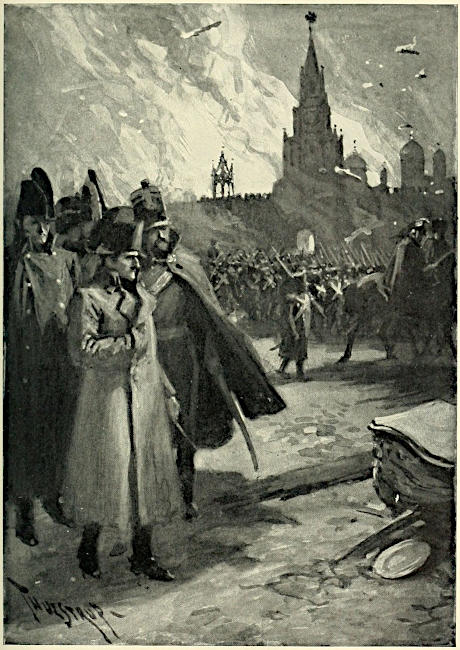
RETREAT OF NAPOLEON FROM THE BURNING CITY OF MOSCOW
(Painted for The Historians’ History of the World by Thure de Thulstrup)
At that time the fate of the grande armée was already definitively decided. Having lost all hope of the peace he so desired, Napoleon began to prepare for retreat. The defeat of his vanguard at Tarontin on the 6th of October hastened the departure of the French from Moscow; it began in the evening of the same day. Napoleon’s intention was first to move along the old Kaluga road, to join Murat’s vanguard, and then go on to the new Kaluga road; the emperor thus hoped to go round the Russian army and open a free access for himself to Kaluga. But the partisan Seslavin, who had boldly made his way through on to the Borovsk route discovered Napoleon’s movements. Standing behind a tree in the road, he saw the carriage in which was the emperor himself, surrounded by his marshals and his guards. Not satisfied with this exploit, Seslavin besides caught a non-commissioned officer of the Old Guard, who had got separated from the others in the thickness of the wood, bound him, and throwing him across his saddle, galloped off with him.
The intelligence obtained by Seslavin had for consequences the immediate move of Dokhtorov’s corps to Malo-Iaroslavetz; at the same time Kutuzov decided to follow from Tarontin with the whole army, and these arrangements led, on the 12th of October, to the battle near Malo-Iaroslavetz. The town passed from the hands of one side to the other eight times, and although after a conflict of eighteen hours it was finally given up to the French, yet Kutuzov succeeded in opportunely concentrating the whole army to the south of it, at a distance of two and one-half versts.