Chapter VI · PETER THE GREAT (continued 2)
Reading edition
But the people of Russia were well aware that mere personal ambition did not enter into the scheme of Peter, and that, although he had broken through many antiquated and revered customs, yet that he had conferred such permanent benefits upon the empire as entitled him to their lasting gratitude. Whatever prospects of success, therefore, Charles might have flattered himself upon deriving from the dissatisfaction of the great mass of the community were evidently vague and visionary. But the argument was sufficient for all his purposes in helping to inspire his soldiers with confidence. About this time the French envoy at the court of Saxony attempted to effect a reconciliation between Charles and the czar, when the former made his memorable reply that he would treat with Peter in Moscow; which answer being conveyed to Peter produced his equally memorable commentary—“My brother Charles wishes to play the part of Alexander, but he shall not find a Darius in me.”
Rapid preparations were made on both sides for the war which had now become inevitable. In the autumn of 1707 Charles commenced his march from Altranstadt, paying a visit to Augustus at Dresden as he passed through that city, and hastening onwards through Poland, where his soldiers committed such devastations that the peasantry rose in arms against them. He finally fixed his winter quarters in Lithuania. During the time occupied by these movements Peter was wintering at Moscow, where, after an absence of two years, he had been received with universal demonstrations of affection. He was busily occupied in inspecting the new manufactories that had been established in the capital, when news reached him of the operations of the Swedish army. He immediately departed, and, with six hundred of the guards established his headquarters in the city of Grodno. Charles no sooner heard of his arrival at that place than, with his usual impetuosity, he hastened forwards with only eight hundred men to besiege the town.
By a mistake, the life of Peter was nearly sacrificed. A German officer, who commanded the gate towards which Charles approached, imagining that the whole Swedish army was advancing, fled from his post and left the passage open to the enemy. General consternation prevailed throughout the city as the rumour spread; and the victorious Charles, cutting in pieces the few Russians who ventured to contest his progress, made himself master of the town. The czar, impressed with the belief that the report was true, retreated behind the ramparts, and effected his escape through a gate at which Charles had placed a guard. Some Jesuits, whose house, being the best in the town, was taken for the use of Charles, contrived in the course of the night to inform Peter of the real circumstances; upon which the czar re-entered the city, forced the Swedish guard, and contended for possession in the streets. But the approach of the Swedish army compelled him at last to retire, and to leave Grodno in the hands of the conqueror.
The advance of the Swedes was now marked by a succession of triumphs; and Peter, finding that Charles was resolved to pursue him, and that the invader had but five hundred miles to traverse to the capital, an interval unprotected by any places of consequence, with the exception of Smolensk, conceived a masterly plan for drawing him into a part of the country where he could obtain neither magazines nor subsistence for his army, nor, in case of necessity, secure a safe retreat. With this design he withdrew to the right bank of the Dnieper,[40] where he established himself behind sheltered lines, from which he might attack the enemy at an advantage, preserving to himself a free communication with Smolensk, and abundant means of retreat over a country that yielded plentiful resources for his troops.
In order to render this measure the more certain, he despatched General Goltz at the head of fifteen thousand men to join a body of twelve thousand Cossacks, with strict orders to lay waste the whole province for a circle of thirty miles, and then to rejoin the czar at the position he had taken up on the bank of the Dnieper. This bold movement was executed as swiftly as it was planned; and the Swedes, reduced to immediate extremity for want of forage, were compelled to canton their army until the following May. Accustomed, however, to the reverses of war, they were not daunted by danger or fatigue, but it was no longer doubtful that both parties were on the eve of decisive events. They regarded the future, however, with very different hopes. Charles, heated with victories, and panting for further acquisitions, surveyed the vast empire, upon the borders of which he now hung like a cloud, as if it were already within his grasp; while Peter, more wary and self-possessed, conscious of the magnitude of the stake for which he fought, and aware of the great difficulties of his situation, occupied himself in making provision against the worst.c
REVOLT OF THE COSSACKS OF THE DON; MAZEPPA
Meantime there were foes at home that had demanded the attention of he czar.a The strelitz were not the only military body belonging to old Russia whose existence had become incompatible with the requirements of a modern state. The undisciplined Cossack armies, which had hitherto formed a rampart for Russia against barbarian hordes, were also to undergo transformation. The empire had many causes of complaint against the Cossacks, particularly those of the Ukraine and the Don who had formerly sustained the usurper, Dmitri, and from whose ranks had issued the terrible Stenka Radzin.
In 1706 the Cossacks of the Don had revolted against the government of the czar because they were forbidden to give asylum in their camp to refugee peasants or taxpayers. The ataman Boulavine and his aids, Nekrassov, Frolov, and Dranyi, called them to arms. They murdered Prince George Dolgoruki, defeated the Russians on the Liskovata, took Tcherkask, and menaced Azov, all the while proclaiming their fidelity to the czar and accusing the voyevods of having acted without orders. They were in turn defeated by Vasili Dolgoruki, Bulavin was murdered by his own soldiers and Nekrassov with only two thousand men took refuge in the Kuban. After clearing out the rebel camps Dolgoruki wrote: “The chief traitors and mutineers have been hung, together with one out of ten of the others; and all the bodies have been placed on rafts and allowed to drift with the current that the Dontsi may be stricken with terror and moved to repent.”
Since the disgrace of Samoilovitch, Mazeppa had been the hetman of the Little Russian Cossacks in Ukraine. Formerly a page of John Casimir, king of Poland, he had in his youth experienced the adventure made famous by the poem of Lord Byron and the pictures of Horace Vernet. Loosened from the back of the untamed horse that fled with him to the deserts of Ukraine, he at once took rank in the Cossack army, and rose by means of treachery, practised against all the chiefs in turn, to fill the highest posts in the military service. His good fortune created for him numerous enemies; but the czar, who admired him for his intelligence and had faith in his fidelity, invariably delivered over to him his detractors. He put to death the monk Solomon for revealing his intrigues with Sophia and the king of Poland, and later denunciators shared the same fate.
Ukraine, meanwhile, was being undermined by various factions. In the Cossack army there was always a Russian party, a party that wished to restore the Polish domination, and a party which designed to deliver over the country to the Turks. In 1693 Petrik, a Turkish chief, invaded Ukraine but failed in his attempts at subjugation. Moreover, profound dissent existed between the army and the sedentary populations of Ukraine. The hetman was constantly scheming to make himself independent, the officers of the army objected to rendering an account of their actions to others, and the soldiers wished to live at the country’s expense without working or paying taxes. The farmers, who had founded the agricultural prosperity of the country, the citizens in towns who were not secure in the pursuit of their avocations, the whole peaceful and laborious population, in fact, longed to be free from this turbulent military oligarchy and called upon the czar at Moscow to liberate them.
Mazeppa represented the military element in Ukraine and knew that he was odious to the quiet classes. The czar showered proofs of confidence upon him, but Mazeppa had reason to fear the consolidation of the Russian state. The burdens that the empire imposed upon the vassal state were day by day becoming heavier, and the war against Charles XII served to increase them still more. There was everything to fear from the imperious humour and autocratic pretensions of the czar, and the imminent invasion of the Swedes was certain to precipitate a crisis; either Little Russia would become independent with the aid of strangers, or their defeat on her soil would deal the death-blow to her prosperity and hopes for the future. Knowing that the hour was approaching when he should be obliged to obey the white czar Mazeppa allowed himself to be drawn into communication with Stanislaus Leszczynski, the king of Poland elected by the Swedish party. The witty princess Dolskaia gave him an alphabet in cipher. Hitherto Mazeppa had given over to the czar all letters containing propositions of betrayal, just as the czar had surrendered to him his accusers. On receiving the letters of the princess he remarked with a smile: “Wicked woman, she wishes to draw me away from the czar.”
When, however, the hand of the sister of Menshikov was refused to one of his cousins, when the Swedish war and the passage of Muscovite troops limited his authority and increased taxation in his territory, when the czar sent urgent injunctions for the equipment of troops after the European fashion, and he could feel the spirit of rebellion against Moscow constantly growing around him, he wrote to Leszczynski that though the Polish army was weak in numbers it had his entire good will. His confidant Orlik was in the secret of all these manœuvres, and several of his subordinates who had divined them undertook to denounce him to the czar. The denunciation was very precise and revealed all the secret negotiations with the emissaries of the king and of the princess Dolskaia; but it failed before the blind confidence of the czar. Palei, one of the denunciators, was exiled to Siberia; Iskra and Kotchonbei, the remaining two, were forced by torture to avow themselves calumniators, and were then delivered over to the hetman and beheaded. Mazeppa realised that good fortune such as his could not long endure, and the malcontents urged upon him the consideration of the common safety. At this juncture Charles XII arrived in the neighbourhood of Little Russia. “It is the devil who brings him here!” cried Mazeppa, and placed between his two powerful enemies he exerted all his craft to preserve the independence of his little state without giving himself into the hands of either Charles XII or Peter the Great. When the latter invited him to join the army he feigned illness; but Menshikov approaching simultaneously with Charles XII, it was necessary to make a choice. Mazeppa left his bed, rallied his most devoted Cossacks about him, and crossed the Desna for the purpose of effecting a junction with the Polish army. At this the czar issued a proclamation denouncing the treason of Mazeppa, his alliance with the heretics, his plots to bring Ukraine once more under vassalage to Poland and to restore the temples of God and the holy monasteries to the uniates. Mazeppa’s capital, Baturin, was taken by Menshikov and rased to the ground, his accomplices perished on the wheel or the scaffold.g
MAZEPPA JOINS CHARLES XII; PULTOWA
[1708-1709 A.D.]
Mazeppa with his army passed over the Desna; his followers, however, believed they were being led against Charles, and deserted their hetman as soon as his views were known, because they had more to fear from Peter than to hope from Charles. The hetman joined the Swedes with only seven thousand men, but Charles prosecuted his march and despised every warning. He passed the Desna; the country on the farther side became more and more desolate, and appearances more melancholy, for the winter was one of the most severe; hundreds of brave Swedes were frozen to death because Charles insisted upon pursuing his march even in December and January. The civil war in Poland in the mean time raged more violently than ever, and Peter sent divisions of his Russians to harass and persecute the partisans of Stanislaus. The three men who stood in most immediate relation to the Swedish king, Piper, Rehnskold, and Levenhaupt, belonged, indeed, among the greatest men of their century; but they were sometimes disunited in their opinions, and sometimes incensed and harassed by the obstinacy of the king.
Mazeppa fell a sacrifice to his connection with Charles, his residence (Baturin) was destroyed by Menshikov, and his faithful Cossacks, upon Peter’s demand, were obliged to choose another hetman (November, 1708). Neither Piper nor Mazeppa could move the obstinate king to relinquish his march towards the ill-fortified city of Pultowa. Mazeppa represented to him in vain that, by an attack upon Pultowa he would excite the Cossacks of the Falls (Zaparogians) against him; and Piper entreated him, to no purpose, to draw nearer to the Poles, who were favourable to his cause, and to march towards the Dnieper; he continued, however, to sacrifice his men by his march, till, in February (1709), a thaw set in.
He was successful in gaining the favour of the Zaparogians through their hetman, Horodenski; but fortune had altogether forsaken the Swedes since January. In that month they were in possession of Moprik; in February, the battles at Goronodek and Rashevka were decided in favour of the Russians; in March, Sheremetrev took Gaditch, which was occupied by the Swedes, and thereby gave a position to the Russian army which could not but prove destructive to the Swedes, who were obliged to besiege Pultowa without the necessary means, because their intractable king insisted upon the siege. In April and May, the Swedes exerted themselves in vain in throwing up trenches before the miserable fortifications of Pultowa, whilst the Russians were enclosing them in a net. One part of the Russians had already passed the Vorskla in May, and Peter had no sooner arrived, in the middle of June, than the whole army passed the river, in order to offer a decisive engagement to the invaders.
Rehnskold acted as commander-in-chief at the battle of Pultowa; for Charles had received a dangerous wound in his foot ten days before, and was unable to mount his horse. The Swedes on this day performed miracles of bravery, but everything was against them, for the Russians fought this time at least for their country, and had at length gained experience in the field. The defeat of the Swedes is easily explained, when it is known that they were in want of all the munitions of war, even powder and lead, that they were obliged to storm the enemy’s fortifications in opposition to an overwhelming numerical force, and that Levenhaupt and Rehnskold were so much disunited in opinion that the former, in his report of the engagement at Pultowa, makes the bitterest complaints against the commander-in-chief, which have since that time been usually adopted by all historians. Of the whole Swedish army, only fourteen or fifteen thousand under Levenhaupt and Kreuz succeeded in erecting an ill-fortified camp on the Dnieper, where they were shut up by the Russians and the river.
This small force might possibly have succeeded in fighting its way into Poland, and Charles had at first adopted this determination; he was, however, with great trouble, induced to pass the Dnieper, and accompanied by a small guard, to take refuge in Turkey. His plan was to reach the Bug over the pasture lands which then belonged to the Tatars on the Black Sea, and, aided by the Turks and the Tatars, to make his way first to Otchakov and then to Bender, whence he hoped to persuade the Turks to take part in the Polish affairs. As soon as the king had escaped (July 10th, 1709), Levenhaupt, mourning over the sacrifice which the wilfulness of Charles had brought upon his Swedes, concluded a capitulation, in virtue of which all the baggage and artillery were surrendered to the Russians, together with the remnant of the Swedish army, which, calculating those who had been taken prisoners in the battle, amounted in all to about eighteen thousand men.
Charles’ flight to Bender, and his long residence of five years in Turkey, were the most favourable events which could have occurred for the accomplishment of Peter’s great plans. He was now master in Poland. In the Swedish, German, and French adventurers who had been in Charles’ army, he received the very best instructors of his people. Among those who entered into his service, there were experienced officers, artillerymen, architects, and engineers.
The Swedes, who for thirteen long years were neither set at liberty nor accorded by their impoverished country the usual support of prisoners of war, were distributed over the whole of Russia, and sent far into Siberia. They founded schools and institutions, in order to get a livelihood, and used their knowledge and experience against their will for the promotion of Peter’s designs. This was the more important, as there was not a man among those many thousand prisoners who was not in a condition to teach the Russians to whom he came something of immediate utility, drawn from his experience in his native land. Many never returned to their homes, because they had raised up institutions and commenced undertakings which were as advantageous to themselves as to the Russian Empire.e
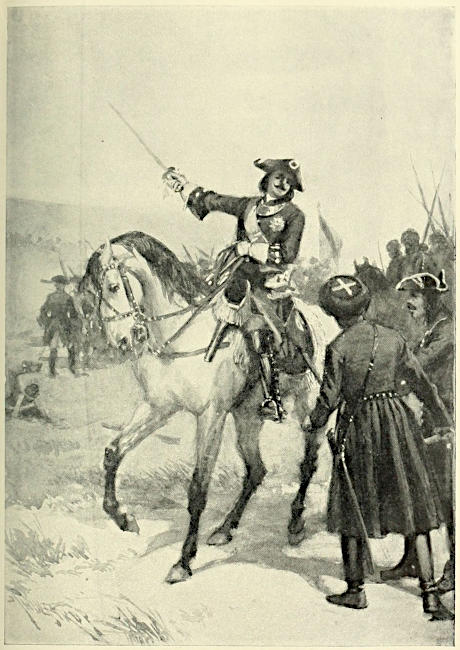
PETER THE GREAT AT THE BATTLE OF PULTOWA
(Painted for The Historians’ History of the World by Thure de Thulstrup)
PETER AND THE POWERS
[1711 A.D.]
A treaty was entered into by Poland, Prussia, and Denmark, which restored to those states the conquests of Gustavus Adolphus, and to Russia her sovereignty over her ancient possessions of Livonia, Ingria, and a part of Finland. When these preliminaries were settled, Peter went in person to make a defensive treaty with the elector of Brandenburg, the first king of Prussia; a mode of negotiation unusual amongst sovereigns, but which was perfectly consistent with the individual character and promptitude of the czar. Having concluded these important plans, he proceeded to reduce some Swedish fortresses, and to bombard the town of Riga, the capital of Livonia, where he lost between nine and ten thousand men by a pestilence that was then raging in that place. The garrison, struck down by two enemies—the plague and the Russians, and scarcely able to decide which was the more fatal—speedily capitulated; and Livonia was once more rendered tributary to Muscovy.
In the meanwhile Charles was employing all his interest at Constantinople to prevail upon the sultan to undertake a war against Russia, which the sultan was easily induced to embrace, in consequence of the ravages committed by the Muscovite troops on the frontiers of Turkey, and the rapidly extending power of the czar on the sea of Azov and the Black Sea. The khan of the Crimean Tatars naturally regarded with apprehension the Russian establishment at Azov, which the Turks had been forced to surrender a few years before; and he, therefore, strengthened the arguments that were submitted to the Divan to persuade them into a declaration of hostilities against the common enemy. A statement setting forth the formidable advances that Russia was making in her navy on the Don and in the harbour of Taganrog, and of the spirit of acquisition she was constantly exhibiting in her encroachments upon the border lands, was laid before the council by Poniatowski, the active friend of the Swedish king, and was immediately assented to by the mufti. In order to render the views of the sultan still more impressive, Count Tolstoi, the czar’s ambassador at Constantinople, was arrested in the public streets, and committed to the castle of the Seven Towers.
The indignity offered to Peter in the person of his minister was scarcely necessary to inflame his irritable temper. Within a short space of time his plenipotentiary in Saxony was broken on the wheel, and his ambassador in London imprisoned for debt; but these events had taken place before the battle of Pultowa, which suddenly elevated him to the highest consideration amongst contemporary sovereigns. The insult, therefore, which the sultan cast upon him by the arrest of Count Tolstoi was the more acutely felt, as it appeared to treat him with contempt in the very hour of victory. He soon made the necessary arrangements for the approaching war, sending one division of his army to Moldavia, another to Livonia; and fleets to Azov, the Baltic, and the Black Sea. It was necessary, however, to return to Moscow to make provision for the government during his absence, and while he was there he issued a conscription for the purpose of recruiting his army.
CATHERINE ACKNOWLEDGED AS PETER’S WIFE (1711 A.D.)
The time was now arrived for acknowledging before his subjects his marriage with Catherine, which had taken place privately in 1707; and accordingly, on the 6th of March, 1711, the czarina Catherine Alexievna was solemnly declared to be his legitimate wife. The ascendency which Catherine had acquired over him was not more extraordinary than it was propitious. Peter’s disposition was naturally impatient and cruel, and when he was excited to acts of severity he could not be restrained by any appeal to his reason or his humanity. The only influence that possessed any permanent power over him was that of female society; and the remarkably sweet temper of Catherine, who was never known to be out of humour, invariably tranquillised him, even in his most angry moods, so complete was the fascination she exercised over his mind that the agony of those spasmodic fits to which he was subject yielded to her soothing presence. Without forgetting the low condition from which she sprang, she maintained the pomp of majesty with irreproachable propriety, and united an air of ease and authority that excited the admiration of those by whom she was surrounded. She was not distinguished by that lofty beauty which would seem to sympathise with these august qualities; nor was she either very brilliant in conversation or of a very quick imagination, but she was graceful and animated; her features were pretty and expressive, and a tone of good sense and kindness always pervaded her actions. She was admirably formed for the sphere she embellished, and, above all, for the peculiar necessities of the era that called her to the throne. Her devotion to Peter was boundless. She constantly attended him, even upon occasions of the utmost danger, and especially upon this eventful expedition, when she accompanied him upon his campaign into Turkey.
WAR WITH TURKEY
The whole body of troops which the precautions of the czar had enabled him to collect amounted to 130,000 men; but, being distributed in different quarters, and failing to join the czar on the Pruth, as he expected, he was obliged to proceed with an army that fell short of 40,000 men. The perils of the enterprise were so apparent that Peter issued orders requiring the women who followed in the train of the army to return; but Catherine, who insisted upon remaining with the czar, prevailed upon him to retract his determination. This slight circumstance eventually proved to be the salvation of the czar and his empire.
From Sorokat the army proceeded to Jassy, where Peter was led to expect supplies from the prince of Wallachia, with whom he had entered into a secret negotiation; but the sultan, warned of the prince’s intended revolt, suddenly deposed him, and appointed Cantemir in his place. But Cantemir, who was a Christian prince, was no less inclined to assist the czar, and proffered him such aid as he could command; admitting very candidly, however, that his subjects were attached to the Porte,[41] and firm in their allegiance. In this extremity Peter found himself at the head of a very inadequate force in the heart of a wild and rugged country, where the herbage was destroyed by swarms of locusts, and where it was impossible to procure provisions for the troops. The dangers of his situation, however, offered a valuable test of the fidelity and endurance of the soldiers, who, although they suffered the most severe privation, never uttered a single complaint.
In this state of things, intelligence was received that the Turkish army had crossed the Danube, and was marching along the Pruth. Peter called a council of war, and declared his intention of advancing at once to meet the enemy; in which measure all the generals, except one, expressed their concurrence. The dissentient officer reminded the czar of the misfortunes of the king of Sweden in the Ukraine, and suggested to him the possibility that Cantemir might disappoint him; but Peter was resolved, and, after a fatiguing march for three nights over a desert heath, the troops arrived on the 18th of June at the river Pruth. Here they were joined by Prince Cantemir, with a few followers, and they continued their march until the 27th, when they discovered the enemy, to the number of 200,000 men, already crossing the river. There was no alternative left but to form the lines of battle; and Peter, perceiving that the enemy was endeavouring to surround him with cavalry, extended his lines a considerable way along the right bank.
The situation of the army at this juncture was extremely unfortunate. The great body of the Turkish soldiers were before the Russians on one side of the river, and on the other the hostile Tatars of the Crimea. The czar was thus completely surrounded, his means of escape by the river were cut off, and the great numbers of the Turks rendered a flight in the opposite direction impossible. He was placed in more critical circumstances than Charles at Pultowa, and he had been misled, like that unfortunate prince, by an ally who did not possess the power of fulfilling his promise. But his presence of mind and indomitable courage never forsook him. He formed his army, which consisted in detail of 31,554 infantry, and only 6,692 cavalry, into a hollow square, placing the women in the centre, and prepared to receive the disorderly but furious onslaught of the Turks. It is evident that, if the forces of the sultan had been commanded by skilful officers, the contest must have been speedily terminated. But the superior discipline of the Russians was shown in the steadiness with which they met the charge, and maintained themselves against such great odds. The Turks injudiciously confined their attack to one side of the square, by which, although the loss sustained by the Russians was immense, the czar was enabled constantly to relieve the troops, and supply the front with fresh men. The fight continued for three days. Their ammunition was at last exhausted, and there remained no choice between surrendering and making a desperate attempt to cut their way through the enemy. This latter proposition is said to have been entertained by Peter, who proposed to force a passage in the night, accompanied by his officers and a few select men; but it is extremely unlikely that he should have contemplated a step that must inevitably have sacrificed the czarina and the remnant of his brave army.
Catherine’s Heroism; the Peace of Pruth
It is not improbable, however, that Peter may have conceived some heroic design for forcing a passage; but the certainty of failure must have overruled such an intention almost as soon as it was formed. After the agitation of that eventful day, he surrendered himself to the anxiety by which he was oppressed, and, retiring to his tent on the third night, gave strict orders that he should be left undisturbed. It was on this occasion that the genius and influence of the czarina preserved the empire, her consort, and the army. She who had accompanied him through so many dangers, who had shared in the toils of the field without murmuring, and partaken in the fatigues consequent upon his reforms and improvements, had a right to be heard at a moment of such critical importance. In despite, therefore, of his prohibition she entered his tent, and representing to him the perils by which they were on all sides environed, urged upon him the necessity of seeking to negotiate a peace. She not only suggested this measure, which was probably the very last that might have occurred to Peter, but she undertook to carry it into effect herself. It is the immemorial custom in the East to approach all sovereigns, or their representatives, with presents, and Catherine, aware of that usage, collected all her own jewels and trinkets, and those of the women who had accompanied the expedition, giving a receipt for their value to be discharged on their return to Moscow, and dispatched the vice chancellor, accompanied by an officer, with a letter from Marshal Sheremetrev to the grand vizir, proposing negotiations for a treaty of peace.[42]
Some hours elapsed, and no answer was returned. It was supposed that the bearers of the letter were put to death, or placed under arrest, when a second officer was despatched with a duplicate of the letter, and it was determined in a council of war, that, should the vizir refuse to accept the proffered terms, an attempt should be made to break through the enemy’s ranks. With this view an intrenchment was rapidly formed, and the Russians advanced within a hundred paces of the Turkish lines. A suspension of arms, however, was immediately proclaimed by the enemy, and negotiations were opened for a treaty.
It would appear strange that the vizir should have consented to a cessation of hostilities under such circumstances, when the Russians were completely at his mercy; but he was aware that the Russian troops in Moldavia had advanced to the Danube after reducing the town of Brabilow, and that another division of the general army was on its march from the frontiers of Poland. He, therefore, considered it advisable to avail himself of that opportunity to dictate to Peter the terms upon which he wished to terminate the campaign, knowing that if he postponed the treaty he would be compelled to renew the war against the whole force of the empire. The conditions he proposed were sufficiently humiliating. He demanded the restitution of Azov, the demolition of the harbour of Taganrog, the renouncement of all further interference in the affairs of Poland and the Cossacks, a free passage for Charles back to his own country, and the withdrawal from the sea of Azov and the Black Sea. Peter subscribed to all these conditions, but refused to deliver up Prince Cantemir to the sultan, declaring that he would rather cede to the Turks the whole country as far as Kursk than violate his word.
This treaty, however, did not satisfy the expectations of Charles; and, indeed, obtained for him scarcely any advantage. The only passage it contained which directly related to him was that which bound Peter to give him a safe return home, and to conclude a peace with him, if the terms could be agreed upon. He never ceased to importune the sultan to dismiss the vizir and make war upon Russia, until the Porte, wearied by his ungrateful and frantic complaints, at last recalled the pension allowed him, and sent him an order to leave the Turkish dominions. The sequel of that monarch’s career presents a series of acts that abundantly justify the suspicion that his mind was shattered by the reverses of fortune he had undergone; for, after remaining five years in Turkey, and venturing with a band of grooms and valets, secretaries and cooks to make a stand against an army of janissaries, spahis, and Tatars he fled in the disguise of a courier to his own kingdom, where he had not been seen during that long interval and where his death had for some time been currently believed in.
The battle of the Pruth, so fatal in its results to Peter, was a very destructive engagement. If the statements of the czar be correct, his army, on the first day of the engagement, consisted of 31,554 infantry, and 6,692 cavalry, and was reduced on the last day to 22,000 men, which would make his loss amount to 16,246. The loss sustained by the Turks was still greater in consequence of their irregular and scattered method of attack. But numerical details cannot always be relied upon, since they are frequently modified to suit the views of one party or the other. There can be no doubt, however, that the czar fought at an extraordinary disadvantage, and that the losses on both sides were dreadful.
When the treaty was concluded, Peter returned into Russia, causing the fortresses of Samara and Kamenka to be demolished; but, as some unavoidable delay occurred in the surrender of Azov and Taganrog, the sultan became dissatisfied, and Peter entered into a fresh treaty, by which he pledged himself to evacuate Poland within three months; stipulating, however, that Charles, who was still intriguing with the Divan, should be required immediately to withdraw from Turkey. The fatigues of the campaign required repose; and Peter, who had suffered considerably by ill health, rested for some time at Carlsbad for the benefit of the waters.
When Peter returned to St. Petersburg, he again solemnised his wedding with the czarina, and held a festival in that city which was remarkable for its pomp and the expression it drew forth of the popular confidence. But this was only the prelude to fresh labours. He renewed his plans for the improvement of the country, laid down a number of new roads, cut several canals, enlarged his navy, and encouraged the erection of more substantial dwellings in the new city. His ultimate design of establishing St. Petersburg as the capital of the empire now gradually developed itself; and the first open measure he adopted towards the accomplishment of that object was the removal of the senate from Moscow. The commercial advantages the people had already gained through their communication with the Baltic had reconciled them to the change, and the opposition with which the return had been originally received was now considerably relaxed. But much remained yet to be done before the prosperity of the new capital could be secured. Resistance from without was more to be apprehended than remonstrances at home; and Peter was not slow to act upon the necessity of circumstances.
WAR WITH SWEDEN (1714 A.D.)
[1714 A.D.]
The possession of Pomerania, the most northerly of the German provinces, was necessary to the projects of the czar, who desired as much to humiliate the king of Sweden as to secure the safety of his establishment on the embouchure of the Neva. Pomerania, which lies north and south between the Baltic and Mecklenburg, had passed through the hands of several masters, and had at last been ceded to Gustavus Adolphus in the Thirty Years’ War. In order to render his design more certain, Peter entered into a league with the electors of Brandenburg and Hanover, and the king of Denmark, drawing up the articles himself, and the details of the necessary operations. Stralsund was first blockaded, and the allied forces proceeded along the Wismar road, followed at a distance by the Swedish troops under the command of Count Stenbock, who, coming up with the Danish and Saxon divisions before the Russians had time to join them, completely routed them in a few hours. This slight check to their progress was soon repaired by a victory obtained by Peter over Stenbock (whose march was signalised by disgraceful excesses), in the little town of Altona, close to Hamburg, which he reduced to ashes.
The Russian army went into quarters for the winter, and the campaign was again renewed with vigour in the following year, when Stenbock was compelled to abandon the town of Tenningen, into which he had obtained entrance by the intrigues of Baron Görtz, one of the most crafty and unprincipled diplomatists of his age. Stenbock and eleven thousand Swedes surrendered themselves prisoners of war, and although the ransom demanded for the liberation of that general was only 8,000 imperial crowns, he was suffered to linger in the dungeons of Copenhagen until the day of his death. Nearly the whole of Pomerania was overrun and partitioned amongst the allies, scarcely a place remaining in the possession of Sweden except Stralsund, the siege of which Peter confided to Menshikov, while he returned to St. Petersburg to make preparations for a descent upon Helsingfors in the gulf of Finland. His operations along the whole line of that coast were equally successful. He soon mastered Bergo and Åbo, the capital; and, transferring to St. Petersburg from the latter town a magnificent library, he raised a building for its reception, which still remains a witness to his enterprise and the spirit of improvement which seemed to preside over all his actions.
A Naval Victory; Peter’s Triumph
But the Swedes, viewing the encroachments of the czar in Finland with terror, and resolving to spare no means to arrest his progress, fitted out a considerable squadron to cruise in the gulf. The czar, however, was ready to meet them; and, setting sail from Kronstadt, fell in with them close to the island of Åland, where, after a severe engagement, he destroyed several of their ships, and took the admiral prisoner. The consternation which the news of this victory spread over Sweden was so great that even Stockholm trembled for its safety.
His return to St. Petersburg on this occasion was an ovation of more than ordinary magnificence. The czarina had just given birth to a daughter; and, upon his triumphal entry, Peter instituted the order of St. Catherine to commemorate his sense of her devotion and magnanimity. The galleys of the conquerors and the conquered sailed up the Neva in procession, and the czar, in his capacity of rear-admiral, presented to the senate a report of the battle, and was immediately created vice-admiral, amidst the rejoicings of the people. It was not the least remarkable feature in the character of this great man that he set the example, in his own person, of ascending through the different grades of the service by the force of his individual claims. At Pultowa he served as major-general, and in the action in the gulf of Finland he acted as rear-admiral, under the command of Admiral Apraxin. This precedent could not fail to have due weight with a people who had been so long accustomed to oppression and the right of the strong hand. It had more effect in generating a spirit of emulation, and in eradicating the prejudices and vices of feudal slavery, than a code of the wisest laws could have accomplished.
St. Petersburg presented a scene of festivity such as had never been known in Russia before. The intercourse of the people with other nations had in a few years changed the whole character of society. Balls and entertainments, upon a large scale, diffused amongst the inhabitants a taste for pleasures that had been hitherto unknown to them. Public dinners were given in the palace of the czar, to which all classes of persons were invited, and at which the different ranks were appropriately divided at separate tables, the czar passing from table to table, freely conversing with his subjects on matters connected with their particular trade or occupations. Civilisation was thus promoted in detail, and insinuated in the most agreeable shape into the domestic usages of the citizens.
PETER AT THE HEIGHT OF POWER
But while amusements occupied a part of the czar’s time, he was not forgetful of the more important affairs that demanded consideration. The necessity of establishing a naval force had always been apparent, and his recent victories over the Swedes sufficiently testified the facility with which it might be rendered available for the ulterior projects which the extension and security of the empire required. He accordingly devoted much care to the subject, and in an incredibly short period was master of so large a fleet that he contemplated a descent upon Sweden, and even calculated upon the possibility of entering Stockholm. Besides a variety of galleys and other vessels, he built fifty ships of war, which were all ready for sea within a twelvemonth.
The discovery of some large peculations amongst the ministers and several favourites of the court just at this juncture directed the czar’s proceedings, for a short time, into an unexpected channel. It appeared that Menshikov, Apraxin, and others who held high offices of trust and responsibility had, either by themselves or through their servants, embezzled a part of the finances of the empire; that the revenues were consequently in a state of confusion, that trade was greatly deranged, and that the payments to the army had been made very irregularly. The ministers, availing themselves of the new outlet for commerce, had monopolised its chief advantages; and the Dutch merchants complained bitterly of a system by which they were deprived of the greater part of their profits. Peter at once established an inquisition into the facts, and proceeded to act with the utmost rigour. He felt that the prosperity of his new capital depended mainly upon the justice with which its affairs were administered, and that its geographical position, which afforded it so complete a command of maritime resources, must cease to attract a foreign trade unless its fiscal officers possessed the confidence of the merchants. Menshikov and the rest pleaded that they had been engaged abroad in the service of the country, and could not be aware of the malpractices of their servants. The czar admitted that their plea was in some measure founded in justice; but, resolved to make an example, he confiscated the greater part of the property of those whose agents were proved to be guilty. The estates of the remainder were wholly forfeited; some individuals were sentenced to the knout, and others were banished to Siberia. This measure was loudly called for by the necessities of the case, and the inflexible honesty of the sovereign was never exercised with a more beneficial result.
The unhappy wife of Alexis, who had been treated by her husband with the most cruel neglect, expired in a few days after having given birth to a son, whose fortunes she committed to the guardianship of the czar. The court was plunged into deep affliction by this melancholy circumstance, and the czar in particular exhibited profound grief. But the birth of a prince to the czarina converted their mourning into congratulations, and the most extravagant festivities were held in honour of the event.
St. Petersburg had now gradually become the capital of Russia. Foreign merchandise imported at Archangel was prohibited from being sent to Moscow, and was consequently transmitted to St. Petersburg, which was the residence of the court, of the principal nobility, and of all the ambassadors from other powers, including at this period two from the East. The rapidity with which its prosperity advanced was unparalleled. Its manufactures increased with its external trade, and it soon assumed a rank equal to that of some of the most important cities in Europe. The fame and power of Peter were attaining their utmost height. Livonia, Esthonia, Karelia, Ingria, and nearly the whole of Finland were now annexed to the Russian Empire. He had established outlets to the sea by which he could communicate in security with civilised Europe; and within his own territories he had created new establishments adapted to the various departments of industry, to the army, the navy, and the laws. Prince Galitzin occupied Finland with a disciplined army; generals Bruce and Bauer had the command of thirty thousand Russians, who were scattered through Poland; Marshal Sheremetrev lay in Pomerania with a large force; Weimar had surrendered by capitulation, and all the sovereigns of the north were either his allies or his instruments. The dream of Russian aggrandisement appeared now to be realised almost in full by the sleepless activity and fertile genius of the czar. It was not surprising, therefore, that the people of Stockholm daily expected that he would appear before their gates, and, taking advantage of the disasters of their fugitive monarch, reduce Sweden to subjection, as he had previously laid waste the provinces that separated him from the coast of the Baltic Sea on the one side, and the Black Sea on the other. He was master of both shores of the gulf of Finland, and the possession of Sweden would have given him the entire command of the Baltic and the gulf of Bothnia, over which, even as it was, his flag ranged in freedom. But Peter was too politic to attempt at this juncture so enormous an extension of power. He was aware of the jealousies which such a disposition must have excited in Germany and Poland, and he wisely contented himself with the acquisitions he had already secured; suffering the headstrong Charles to bring his kingdom into greater jeopardy, in the hope, probably, that it might ultimately fall to pieces by its own weakness.
At this crisis of affairs the unprincipled Görtz endeavoured to effect a union between the two monarchs; and negotiations, having that object in view, were actually commenced, and might have been carried to a more decisive conclusion but for events which diverted the attention of both sovereigns into other channels. Görtz has been blamed for projecting this treaty of reconciliation, and accused of desiring to accomplish through its means a variety of results, such as the restoration of Pomerania to Sweden and the crown of Poland to Stanislaus, the dethronement of the king of England, and, by a conspiracy against the duke of Orléans, the reduction of France under a Spanish regency. It is very probable that the subtle minister might have contemplated some of these projects, that he might have anticipated from the combined armies of the two northern heroes the rescue of Spain and the advancement of Alberoni, and that he might have even calculated upon the cession of Pomerania and the recognition of Stanislaus. But, as the adviser of Charles XII, he was justified in seeking an alliance which must in any case have greatly benefited his master and protected his country against those imminent dangers that appeared to be impending over it at the moment; and if he looked beyond immediate advantages, to remote contingencies, the design was not, on that account, the less worthy of applause. As it was, it had the effect of openly confirming the dispositions of Peter towards Sweden, the czar declaring that he did not enter into war for the sake of glory, but for the good of the empire, and that he had no desire to exhibit any feelings of animosity against an enemy whom he had deprived of the power of doing mischief. Whatever faults may be charged upon Görtz—and there is no doubt that they were numerous enough—history must pronounce his conduct upon this occasion to have been guided by a sagacious policy.
PETER’S SECOND EUROPEAN TOUR (1717 A.D.)
[1717 A.D.]
Satisfied with the circumstances of the empire, and anxious to improve his knowledge of other nations, Peter now resolved to undertake a second tour through Europe. His first tour had been limited to practical inquiries into the useful arts; but his second was mainly addressed to an examination of the political systems of the European cabinets. When he first left his own country to acquire information abroad, he was young, ardent, uninstructed, and undistinguished; but now he had achieved a name that was famous all over the world, and he was regarded, with justice, as one of the most extraordinary persons of the age. During the nineteen years that had elapsed, in the interval, he had strengthened and enlarged his dominions, had traversed and subjugated many provinces, had succeeded in accomplishing the great purposes of his wise ambition, and had experienced amidst the splendid triumphs of his career some serious reverses, from which such a mind as his could not fail to extract useful admonitions. He went forth, followed by the gratitude of Russia, to improve his knowledge of the means by which he could contribute still more largely to her prosperity. The czarina accompanied him upon this journey, but being in her third pregnancy she rested for a short time at Schwerin, whence she soon afterwards set out to rejoin her husband at Holland. On her way, however, she was again taken ill, and delivered at Wesel of a prince, who died on the following day. This event, it appears, did not delay her intention of meeting her husband in Holland, as we find that in ten days afterwards she arrived in Amsterdam.
In the meantime Peter had visited Stralsund, Mecklenburg, Hamburg, and Pyrmont, and subsequently proceeded to Copenhagen, where he was received with great distinction by the king of Denmark. On this occasion, a squadron of British ships, under the command of Sir John Norris, and a squadron of Dutch ships, commanded by Rear-Admiral Grave, arrived at Copenhagen; and, it being understood that a Swedish fleet was out at sea, the four armaments, Russian, Danish, Dutch, and English, united under the standard of the czar, and put out to sea. Not falling in with the Swedes, who had secured their safety in Karlskrona, the fleets separated, and Peter, taking leave of the court of Denmark, proceeded to Hamburg. This incident was always referred to by Peter as one of the most gratifying circumstances of his life, and even his proudest victories appeared to afford him less pleasure than the recollection of the moment when he raised his flag as commander-in-chief of the united fleets.
From Hamburg he continued his route to Lubeck, and had a private interview with the king of Prussia at Havelberg, whence he returned by the Elbe to Hamburg. The anecdotes of his journey that have been preserved in a variety of personal memoirs are all calculated to show the simplicity of his manners and his natural aversion to parade and ceremony. At Nimeguen, where he arrived late at night in a common postchaise, accompanied by only two attendants, he is said to have supped upon poached eggs and a little bread and cheese, for which the landlord charged 100 ducats the next morning. Peter remonstrated against the demand, and inquired if eggs were so very scarce in that place. “No,” replied the landlord, “but emperors are.” Peter paid the bill, and was well satisfied to have purchased such a hint of European tactics at so small a rate.
At Amsterdam he was received with a feeling of delight almost approaching idolatry. The people regarded him as their pupil in the arts of commerce and ship-building; and shared in the glories of the victor of Pultowa, as if he were one of themselves. Nor did Peter hesitate in putting them as much at their ease in his presence as he had done when he had formerly lived amongst them, working like themselves and participating in their hard labour and rude fare. The cottage in which he had resided when he was learning the art of ship-building he now found just as he had left it, but distinguished by the name of the Prince’s House, and preserved in order by the affectionate people with unabated interest. Upon entering this humble scene, he was deeply affected, and desired to be left alone. The recollections that pressed upon him at that moment were not amongst the least impressive of his busy life.
His residence in Holland, where he remained for three months, exhibited a succession of trivial incidents connected with his former associates, all of whom were recognised by the czar with the greatest cordiality; but while he was thus engaged in revisiting the dockyards, in examining models, and receiving small tokens of popular attachment, he was not indifferent to matters of higher importance. The Hague, from the time of the Peace of Nimeguen, had acquired the reputation of being the centre of the negotiations of Europe, and was crowded with travellers and foreign ministers. The foundations of a European revolution were then being laid in the diplomatic circles of that place; and the czar prolonged his stay in the Netherlands, with a view to assure himself more clearly of the state of parties in the south and in the north, and to prepare for the side which, in the course of time, it might become advisable for him to take.
Keeping himself aloof from the intrigues by which he was surrounded, and availing himself of all the opportunities within his reach of improving his information respecting the state of Europe, he proceeded to fulfil his intention of visiting France, after he had satisfied his curiosity in Holland. Vast preparations, worthy of the occasion, were made in France for his reception; but Peter, with his accustomed contempt of splendour, desired to avoid the display as much as possible. Accompanied by four gentlemen, he outstripped the escorts, and entered Paris without ostentation. His journey was a succession of fêtes; wherever he appeared he was treated with magnificence. His fame had penetrated the haunts of art and science, as well as the halls of palaces; portraits of himself and the czarina, medals with flattering inscriptions, and the most ingenious devices, representing some of the events of his life, started up before him in places where he least expected to meet such evidences of his greatness. He stepped in the midst of triumphs, and renewed, in his ovation at the French capital, the whole history of his glories as a hero and a legislator. But he could not be flattered out of his simplicity. Declining the offers of the court, he retired to a private hotel in a remote quarter of the town, in order that he might employ his time agreeably to his own wishes, instead of being trammelled by the fatiguing and idle ceremonies of the Louvre.
He left Catherine behind him in Holland on this occasion, apprehending that the witty court of France, with its sarcasms and its ceremonials, might possibly wound by neglect the delicacy of a woman whose greatness of soul elevated her above the conventions of the palace. The marriage of Louis XIV with Madame de Maintenon bore some resemblance, it is true, to his own union with Catherine; but Madame de Maintenon was an accomplished person, and Catherine’s merits were of a different order. Catherine was a heroine, Madame de Maintenon a fascinating woman. Catherine had perilled life by the side of her husband, from the Pruth to the Baltic, upon land and sea; Madame de Maintenon, retreating from political display, was content to attest her devotion, and preserve her supremacy, in retirement. Catherine was of obscure origin, Madame de Maintenon was of noble birth; and while the czarina was publicly acknowledged by Peter, Madame de Maintenon became the wife of Louis XIV in private. Yet, although Peter determined not to risk the feelings of the czarina in the French court, especially as the death of Louis XIV had removed Madame de Maintenon from the position which she had previously held, the last wish he expressed on leaving Paris was to see that celebrated woman, the widow of the king.
Peter was not only a practical artist, but was well acquainted with those sciences upon which the practical arts are based. He possessed a mathematical mind and a skilful hand. The rapidity with which he accumulated knowledge could be paralleled only by the tenacity with which he retained it, and the facility with which he could employ it as the occasion served. At the Academy of Sciences they placed before him, amongst other curiosities, a map of Russia, which he instantly discovered to be full of errors, and pointed out to the exhibitors the mistakes they had made in the geography of his dominions, and of the tracts on the borders of the Caspian Sea. He afterwards accepted at their hands the honour of being admitted as a member of their body. He visited the manufactories and mercantile depots, and carried away all the information he could glean from them; had several private conferences with the French ministers in relation to the subsisting peace between the northern powers; and drew up the minutes of a treaty of commerce, which he caused to be shaped into regular form, and negotiated on his return to St. Petersburg.
Every moment was filled with business. He visited the tapestry of the Gobelins, the carpets of the Savonnerie, the residences of the goldsmiths, painters, sculptors, and mathematical instrument makers; and so far overcame his scruples against appearing in public that he went to see the French parliament, and attended public worship on two occasions in state. Amongst the objects that extracted unbounded admiration from him was the tomb of Cardinal Richelieu, one of the richest specimens of sculpture in Paris. But it was not on account of the glories of the chisel that it occupied his attention. He is said to have exclaimed, upon seeing it, “Great man! I would have given half of my empire to learn of thee how to govern the other half!”
Having satisfied his curiosity in France, he took his leave of that country, carrying with him several artisans for the purpose of establishing their different crafts in Russia. During the period of his short residence in the French capital he inspired a universal sentiment of respect. Although he did not hesitate to protest against the luxurious extravagance of the court, and even carried the expression of his opinions so far as to say that he “grieved for France and its infant king, and believed that the latter was on the point of losing his kingdom through luxury and superfluities”; yet the witty and satirical courtiers, who observed him closely, were compelled to bear testimony to the magnanimity of his nature. Contemporary criticism is of so much value in the attempt to determine historical character that the opinions which were pronounced concerning him at this period cannot be excluded from the estimate which posterity will make of his faults and merits. Louville,l who was attached to the court, describes him thus:
“His deportment is full of dignity and confidence, as becomes an absolute master. He has large and bright eyes, with a penetrating and occasionally stern glance. His motions, which are abrupt and hasty, betray the violence of his passions and the impetuosity of his disposition; his orders succeed each other rapidly and imperiously; he dismisses with a word, with a sign, without allowing himself to be thwarted by time, place, or circumstance, now and then forgetting even the rules of decorum; yet with the regent and the young king he maintains his state, and regulates all his movements according to the points of a strict and proud etiquette. For the rest, the court discovered in him more great qualities than bad ones; it considered his faults to be merely trivial and superficial. It remarked that he was usually sober, and that he gave way only now and then to excessive intemperance; that, regular in his habits of living, he always went to bed at nine o’clock, rose at four, and was never for a moment unemployed; and, accordingly, that he was well-informed, and seemed to have a better knowledge of naval affairs and fortification than any man in France.” The writers of that period, who possessed the best opportunities of becoming acquainted with his movements, speak in terms of admiration of the experienced glance and skilful hand with which he selected the objects most worthy of admiration, and of the avidity with which he examined the studios of the artists, the manufactories, and the museums. The searching questions which he put to learned men afforded sufficient proof, they observe, of the sagacity of a capacious mind, which was as prompt to acquire knowledge as it was eager to learn.
The journey of the czar through France, to rejoin the czarina at Amsterdam, was distinguished by the same insatiable love of inquiry. Sometimes he used to alight from his carriage, and wander into the fields to converse with the husbandmen, taking notes of their observations, which he treasured up for future use. The improvement of his empire was always present to his thoughts, and he never suffered an occasion to pass away, however trivial, from which he could extract a practical hint, without turning it to account. His activity appeared to be incapable of fatigue. From Amsterdam, accompanied by Catherine, he passed on to Prussia. Upon his arrival at Berlin he went at once to a private lodging; but the king sending his master of the ceremonies to attend upon him, the czar informed that officer that he would wait upon his majesty the next day at noon. Two hours before the time, a magnificent cortège of royal carriages appeared before the door of the czar’s lodging; but when noon arrived, they were informed that the czar was already with the king. He had gone out by a private way, to avoid the magnificence which he regarded as an impediment to action.
The character of Frederick of Prussia was distinguished by the same blunt, persevering, military qualities which belonged to that of Peter. He lived plainly, dressed like a common soldier, was extremely abstemious, and exhibited in his habits even a needless severity of discipline. The meeting, therefore, between sovereigns who so closely resembled each other in their tastes, who were equally self-devoted to the good of their people, and equally uncorrupted by the pomp and temptations of power, was a spectacle such as history rarely presents. The czarina was worthy of entering into the scene, for she was the only female sovereign in Europe who could share, without shrinking, the toils and difficulties of their career. Voltaire remarks that if Charles XII had been admitted to the group, four crowned heads would have been seen together, surrounded by less luxury than a German bishop or a Roman cardinal.
But, while Peter, Catherine, and Frederick entertained an utter contempt for ostentatious display, the fashion of the court, which was probably directed by the queen, rendered it necessary that the illustrious visitors should be treated with a show of grandeur and parade which they despised. They were entertained in a costly style at the palace; and their manners did not fail to excite the sarcasms and gossip of the courtiers, who were incapable of comprehending the real dignity of their character, and who were disappointed to find in the czar and czarina of Russia a couple of plain, rough, and, agreeably to their notions, vulgar persons. The particulars of this visit to the court of Prussia are minutely commemorated in the loose and satirical memoirs of the day; while the visits to Paris, Amsterdam, and London are recorded, without a single exception, in a spirit of grave admiration, that exhibits a curious contrast to the flippant tracasseries of Berlin.
Amongst the most pert and lively writers who chronicled the visit and caricatured the czar and his simple train of followers, is the markgräfin von Bayreuth. She gives a very amusing account in her memoirs of the reception at court; and says that when Peter approached to embrace the queen, her majesty looked as if she would rather be excused. Their majesties were attended, she informs us, by a whole train of what were called ladies, as part of their suite, consisting chiefly of young German women, who performed the part of ladies’ maids, chamber-maids, cook-maids, and washerwomen; almost every one of whom had a richly clothed child in her arms. The queen, it is added, refused to salute these creatures. At table the czar was seized with one of his convulsive fits, at a moment when he happened to have a knife in his hand, and the queen was so frightened that she attempted to leave the table; but Peter told her not to be uneasy, assuring her that he would do her no harm. On another occasion, he caught her by the hand with such force that she was obliged to desire him to be more respectful; on which he burst out into a loud fit of laughter, and said that she was much more delicate than his Catherine. But the most entertaining part of the whole is a sketch of the personal appearance of the uncultivated sovereigns. “The czarina,” says the markgräfin, “is short and lusty, remarkably coarse, and without grace or animation. One needs only see her to be satisfied of her low birth. At the first blush one would take her for a German actress. Her clothes looked as if bought at a doll-shop, everything was so old-fashioned and so bedecked with silver and tinsel. She was decorated with a dozen orders, portraits of saints, and relics, which occasioned such a clatter that when she walked one would suppose an ass with bells was approaching. The czar, on the contrary, is tall and well made. His countenance is handsome; but there is something in it so rude that it inspires one with dread. He was dressed like a seaman, in a frock, without lace or ornament.” The spirit of the tiring-woman shines through the whole of this saucy and superficial description. The markgräfin took the measure of the illustrious visitors as she would of her lady’s robe—colour, spangles, and shape. It never occurred to her that, in the little coarse woman who looked so like a German actress, she saw the heroine of the Pruth; and that the rude seaman who frightened the queen was the man who, amidst ignorant wonder and superstitious resistance, laid the foundations of the most gigantic empire that the world has ever seen! But the circumstances under which the markgräfin obtained her impressions were unfavourable to the formation of a just opinion, or, indeed, of any opinion at all. She was only eight years of age when she saw Peter and Catherine, although she had arrived at a mature age when she wrote her memoirs. She retained no more than the silly whispers and jests of the ante-chamber. She noted down what she heard rather than what she thought; but it serves to show very clearly the sort of atmosphere in which the eccentric Frederick moved, and the courtly weaknesses against which, in his own person, he must have been compelled to sustain a continual warfare.
On Peter’s return through Holland, he purchased a variety of pictures of the Dutch and Flemish schools, several zoölogical, entomological, and anatomical cabinets, and a large collection of books. With the treasures thus accumulated he laid the foundation of the imperial Academy of Sciences, the plan of which he drew up himself. He would probably have lingered longer in those countries, but for the intelligence which he received concerning the conduct of his son Alexis, which induced him to hasten to St. Petersburg under the agitation of bitter feelings, in which the natural dispositions of the father were drawn into direct collision with the duty of the sovereign.c
THE CZAREVITCH ALEXIS DISINHERITED (1718 A.D.)
The czar arrived at St. Petersburg from his foreign tour on the 21st of October, 1717. Twenty years before he had signalised his return from a first visit to civilised countries by the inhuman butchery of the strelitz, and now he was about to give still more appalling evidence of the deep depravity of his heart.
Peter’s early aversion to Eudoxia had a most deplorable influence on Alexis, the son she bore him in 1690. The dissensions between the father and the mother speedily diminished the father’s affection for Alexis. Moreover, as Peter’s vast labours prevented him from paying much attention to the education of his son, Alexis at first grew up under female tuition, and then fell into the hands of some of the clergy, under whose guidance he daily conceived a greater abhorrence for his father. This being observed by Peter, he put an end to the spiritual education, and appointed Menshikov superintendent of the prince’s preceptors.
Menshikov was no friend to Alexis, and the latter had been early inspired by his mother with contempt and aversion for the favourite of his father. The tutors who were now placed about the prince were not able to eradicate the prejudices impressed on his mind from his infancy, and now grown inveterate; besides, he had an unconquerable dislike to them as foreigners. The future sovereign of so vast an empire that was now reformed in all its parts, and by prosperous wars still further enlarged; the heir of a throne whose possessor ruled over many millions of people, had been brought up from his birth as if designed for a Russian bishop; theology continued to be his favourite study. With a capacity for those sciences which are useful in government, he discovered no inclination to them. Moreover, he addicted himself early in life to drunkenness and other excesses. There were not wanting such as flattered his perverse dispositions, by representing to him that the Russian nation was dissatisfied with his father, that it was impossible for him to be suffered long in his career of innovation, that even his life was not likely to hold out against so many fatigues, with many other things of a like nature.
The conduct of Alexis, particularly his indolence and sloth, were highly displeasing to Peter. Menshikov, from political motives, to preserve himself and Catherine, was constantly employed in fanning the czar’s resentment, while the adherents of Alexis, on the other hand, seized every opportunity to increase the aversion of the prince, who, from his very cradle, had never known what it was to love, and had only dreaded his father. Alexis at times even gave plain intimations that he would hereafter undo all that his father was so sedulously bringing about. Nay, when the latter, in 1711, appointed the prince regent during his absence, in the campaign of the Pruth, Alexis made it his first business to alter many things in behalf of the clergy, so as clearly to evince in what school he had been brought up.
The czar was in hopes of reforming his son by uniting him with a worthy consort; but even this attempt proved fruitless. The princess of Brunswick-Wolfenbüttel, who was selected for his bride, and to whom Alexis was married at Torgau, in 1711, notwithstanding all her eminent qualities of mind and heart and her great beauty, could make no impression on him, and sank under the load of grief brought on by this unhappy connection, soon after giving birth to a prince, who was called by the name of his grandfather, Peter (1715). By a continuance in his dissolute mode of life, by his bad behaviour towards his spouse, and his intercourse with persons who were notorious for their hatred of Peter and his reforms, Alexis seemed bent upon augmenting his father’s displeasure.
After the death of the princess, Peter wrote his son a letter, the conclusion of which ran thus: “I will still wait awhile, to see if you will amend; if not, know that I will deprive you of the succession, as a useless limb is cut off. Do not imagine I am only frightening you; nor would I have you rely on the title of being my eldest son; for since I do not spare my own life for the good of my country and the prosperity of my people, why should I spare yours? I shall rather commit them to a stranger deserving such a trust than to my own undeserving offspring.”
At this very juncture the empress Catherine was delivered of a prince, who died in 1719. Whether the above letter disheartened Alexis, or whether it was imprudence or bad advice, he wrote to his father that he renounced the crown, and all hopes of reigning. “God is my witness,” said he, “and I swear upon my soul, that I will never claim the succession; I commit my children into your hands, and for myself desire only a subsistence during life.”
His father wrote to him a second time. “I observe,” says he, “that all you speak of in the letter is the succession, as if I stood in need of your consent. I have represented to you what grief your behaviour has given me for so many years, and not a word do you say of it; the exhortations of a father make no impression on you. I have brought myself to write to you once more; but for the last time. If you despise my counsels now I am living, what regard will be paid to them after my death? Though you may now mean not to violate your promises, yet those bushy beards will be able to wind you as they please, and force you to break your word. It is you those people rely on. You have no gratitude to him who gave you life. Since you have been of proper age, did you ever assist him in his labours? Do you not find fault with, do you not detest everything I do for the good of my people? I have all the reason in the world to believe that, if you survive me, you will overthrow all that I have been doing. Amend, make yourself worthy of the succession, or turn monk. Let me have your answer either in writing, or personally, or I will deal with you as a malefactor.”
Though this letter was harsh, the prince might easily have answered that he would alter his behaviour; but he only acquainted his father, in a few lines, that he would turn monk. This assurance did not appear natural; and it is something strange that the czar, going to travel, should leave behind him a son so obstinate, but this very journey proves that the czar was in no manner of apprehension of a conspiracy from his son. He went to see him before he set out for Germany and France; the prince being ill, or feigning to be so, received him in bed, and confirmed to him, by the most solemn oaths, that he would retire into a convent. The czar gave him six months for deliberation, and set out with his consort.
He had scarcely reached Copenhagen when he received advice (which was no more than he might well expect) that Alexis admitted into his presence only evil-minded persons, who humoured his discontent; on this the czar wrote to him that he must choose the convent or the throne, and, if he valued the succession, to come to him at Copenhagen.
The prince’s confidants instilled into him a suspicion that it would be dangerous for him to put himself into the hands of a provoked father and a mother-in-law, without so much as one friend to advise with. He therefore feigned that he was going to wait on his father at Copenhagen, but took the road to Vienna, and threw himself on the protection of the emperor Charles VI, his brother-in-law, intending to continue at his court till the czar’s death.
This was an adventure something like that of Louis XI, who, whilst he was dauphin, withdrew from the court of Charles VII, his father, to the duke of Burgundy. Louis was, indeed, much more culpable than the czarevitch, by marrying in direct opposition to his father, raising troops, and seeking refuge with a prince, his father’s natural enemy, and never returning to court, not even at the king’s repeated entreaties.
Alexis, on the contrary, had married purely in obedience to the czar’s order, and had not revolted nor raised troops; neither, indeed, had he withdrawn to a prince in anywise his father’s enemy; and, on the first letter he received from his father, he went and threw himself at his feet. For Peter, on receiving advice that his son had been at Vienna, and had removed thence to Naples, then belonging to the emperor Charles VI, sent Romanzov, a captain of the guards, and Tolstoi, a privy-councillor, with a letter in his own hand, dated from Spa, the 21st of July, N.S. 1717. They found the prince at Naples, in the castle of St. Elmo, and delivered him the letter, which was as follows:
“I now write to you, and for the last time, to let you know that you had best comply with my will, which Tolstoi and Romanzov will make known to you. On your obedience, I assure you, and promise before God, that I will not punish you; so far from it, that if you return I will love you better than ever. But if you do not, by virtue of the power I have received from God as your father, I pronounce against you my eternal curse; and as your sovereign, I assure you I shall find ways to punish you; in which I hope, as my cause is just, God will take it in hand, and assist me in revenging it. Remember further that I never used compulsion with you. Was I under any obligation to leave you to your own option? Had I been for forcing you, was not the power in my hand? At a word, I should have been obeyed.”
Relying on the faith thus solemnly given by a father and a sovereign, Alexis returned to Russia. On the 11th of February, 1717, N.S., he reached Moscow, where the czar then was, and had a long conference in private with his father. A report immediately was spread through the city that a reconciliation had taken place between the father and son, and that everything was forgotten; but the very next day the regiments of guards were ordered under arms, and the great bell of Moscow tolled. The boyars and privy-councillors were summoned to the castle: the bishops, the archimandrites, and two monks of the order of St. Basil, professors of divinity, met in the cathedral. Alexis was carried into the castle before his father without a sword, and as a prisoner; he immediately prostrated himself, and with a flood of tears delivered to his father a writing, in which he acknowledged his crimes, declared himself unworthy of the succession, and asked only his life. The czar, raising him up, led him to a closet, where he put several questions to him, declaring, that if he concealed anything relating to his escape, his head should answer for it. Afterwards the prince was brought back into the council-chamber, where the czar’s declaration, which had been drawn up beforehand, was publicly read.
The father in this piece reproached his son with his manifold vices, his remissness in improving himself, his intimacy with the sticklers for ancient customs, his misbehaviour towards his consort: “He has,” says he, “violated conjugal faith, taking up with a low-born wench whilst his wife was living.” Alexis might fairly have pleaded that in this kind of debauchery he came immeasurably short of his father’s example. He afterwards reproaches him with going to Vienna, and putting himself under the emperor’s protection. He says that Alexis had slandered his father, intimating to the emperor Charles VI that he was persecuted; and that a longer stay in Muscovy was dangerous, unless he renounced the succession; nay, that he went so far as to desire the emperor openly to defend him by force of arms.e
Death of the Czarevitch Alexis
[1718 A.D.]
The proceedings against the czarevitch and his friends lasted for about half a year: they were begun in Moscow and continued in St. Petersburg; the cells of the fortress of the latter place were filled with prisoners, amongst whom were two members of the royal family—the czarevitch and Marie Alexievna; fresh persons were continually added to their number, denounced under the pressure of unbearable tortures. One of the differences between the legal proceedings of that period and the present consists in the fact that, when we now have the evidence of a crime before us, we endeavour to discover the persons guilty of it, whereas then they sought to find out whether someone had not done something criminal.
In May a “declaration” or manifesto was issued setting forth the czarevitch’s crimes. His whole life was related in the manifesto; mention was made of his idleness in studying, his disobedience to his father’s will, his ill treatment of his wife, and finally his flight and his apparent solicitation of the help of the German emperor and “the protection of an armed hand,”—which was not at all clearly proved by the evidence. There was, however, no mention in the manifesto of the fact that he had been promised an unconditional pardon and the permission to live at a distance with his beloved Euphrosyne. For all these offences, for his disobedience to his father, his treachery and dissimulation, the czarevitch and his “accomplices” were delivered up for judgment to the tribunal; but this tribunal was not an ordinary one: it was a special one, composed of persons named by Peter himself. Why was such a departure made from the usual order of things? In matters of peculiar importance, when it happened that persons in proximity to the throne were to be judged, it was not unfrequent in western Europe that special, so-called supreme tribunals were named. But this custom always gave reason to suppose that the members of those supreme tribunals were only chosen from amongst those who would be ready to fulfil the will of him who had named them.
The committee appointed to judge the czarevitch consisted of 127 members of the clergy and laity; in the instructions given by the czar to the first it was enjoined that they should act “without any hypocrisy or partiality”; in the instructions given to the laity the following was signified: “I ask you in order that this matter may be truthfully accomplished, without seeking to flatter me; without any respect for persons, to act righteously, and not to destroy your souls and mine, so that our consciences may be pure at the terrible day of judgment, and our country secure.” Such were the words that the czar addressed to the tribunal; they were fine in themselves, but their signification could not have been great, because the judges were not independent. The conceptions of the present time require that judges should not be afraid of being dismissed from their functions, of being deprived of the salaries accompanying these functions, and so on—then only can a judge be entirely impartial; but were the judges of the czarevitch and in general all the judges of that time in such a position? They were all persons in the government service and entirely dependent on their chiefs; in the present case whom was it they risked displeasing? The czar himself! It was natural that they should try and read the czar’s will in the eyes of Menshikov, Tolstoi, and others of his intimates.
On the 24th of June, 1718, the sentence of the supreme tribunal was pronounced. The clergy refused to pronounce sentence, but the laity unanimously decreed the penalty of death against the czarevitch. Execution, however, did not follow, but something far more terrible than a public death on the scaffold did—the czarevitch was tortured on the rack. In fact, during the last days of the sitting of the tribunal, he had been several times subjected to it and, he was even tortured after sentence had been passed upon him! All this was more than the feeble organism of the czarevitch could bear, and on the 26th of June he died in a cell of the Petersburg fortress. Amongst the number of his friends and sharers in his flight many were executed, others banished to distant places, to monasteries and fortresses; amongst the latter was also the czarevna Marie Alexievna, who was sent to Schlüsselburg.
Such is one of the darkest episodes of the reign of Peter. The czarevitch Alexis could not have continued the work commenced by his father; he could not have succeeded him; he might have been judged, even condemned, if the tribunal (but an impartial tribunal) had found him guilty, and his head might have fallen at the hands of the public executioner like that of a criminal. But he was promised pardon if he would return, and having returned he was delivered up to the tribunal, he was judged by persons in whose impartiality it is impossible to believe; finally he was tortured after sentence was pronounced, when everywhere, even to the most insignificant of men and the greatest of criminals, time is given to prepare for death. For these things history cannot forgive the czar. Upon contemporaries the judgment and death of the czarevitch produced a deep impression. There were persons who admired the czar’s decision to sacrifice his son to the welfare of the country and his great plans; they compared him to Brutus. But there were but few such persons and they for the greater part were foreigners and not Russians. The greatness of Brutus and civic virtues in general did not powerfully move the hearts of our forefathers; but each of them felt that it was unnatural for a father to take away his son’s life!
Terrible rumours as to the details of the czarevitch’s death began to be current amongst the people; some said that he had been secretly poisoned, others that he had been strangled, and yet others that the czar himself had cut off his head in the cell. All these were fables, but fables which, however, may even now be met with in the works of many foreign authors and which also prove how powerfully the imagination of contemporaries was affected by this event and how much it was talked of. That noble quality of human nature—sympathy with sufferings even when they are deserved—made the czarevitch dearer still to his numerous partisans. The idea that Peter had indeed been “changed” became stronger. The common people, the merchants, the clergy, even distinguished persons, when they were not afraid of being overheard, said: “Would such a thing have been possible if he were the rightful czar—would he have killed his son and made the czarevna take the veil?” In some more fanatical minds the idea became confirmed that the czarevitch was alive and the name of the unfortunate young man became, as did in previous times the name of the czarevitch Dmitri, an ensign for impostors and pretenders.h
DOMESTIC AFFAIRS
The appalling episode we have just related was so far from engrossing the thoughts of the czar that it hardly interrupted the course of his ordinary occupations. Nay, as if to darken still more the tragic horrors of the year 1718, by mingling with them the coarsest and most disgusting buffoonery, it was in that very year he instituted the crapulous burlesque of the Conclave. The occasion of it was this: During the czar’s visit to Paris, the doctors of the Sorbonne addressed him with the view of effecting a union between the Russo-Greek church and that of Rome, and they presented to him a memorial full of learned arguments against the schismatical tenets of his co-religionists. This memorial only gave great offence to the court of Rome, without pleasing either the emperor or the church of Russia.
“In this plan of reunion,” says Voltaire, “there were some political matters which they did not understand, and some points of controversy which they said they understood and which each party explained according to its humour. There was a question about the Holy Ghost, who, according to the Latins, proceeds from the Father and the Son; and according to the Greeks, at present, proceeds from the Father, through the Son, after having, for a long time, proceeded from the Father only. They quoted St. Epiphanius, who says that ‘the Holy Ghost is not the Son’s brother, nor the Father’s grandson.’ But the czar, at leaving Paris, had other business than to explain passages from St. Epiphanius; however, he received the Sorbonne’s memorial with great affability. They also wrote to some Russian bishops, who returned a polite answer; but the greater number received the overture with indignation.” It was to dissipate the apprehensions of this reunion that, after expelling the Jesuits from his dominions, he instituted the mock conclave, as he had previously set on foot other burlesque exhibitions, for the purpose of turning the office of patriarch into ridicule.
There was at his court an old man named Sotov, an enormous drunkard, and a court-fool of long standing; he had taught the czar to write, and by this service imagined that he deserved the highest dignities. Peter promised to confer on him one of the most eminent in the known world: he created him kniaz papa, that is to say, prince-pope, with a salary of 2,000 roubles, and a palace at St. Petersburg, in the Tatar ward. Sotov was enthroned by buffoons; four fellows, who stammered, were appointed to harangue him on his exaltation; his mock holiness created a number of cardinals, and rode in procession at the head of them, sitting astride on a cask of brandy, which was laid on a sledge drawn by four oxen. They were followed by other sledges loaded with food and drink; and the march was accompanied by the rough music of drums, trumpets, horns, hautboys, and fiddles, all playing out of tune; and the clattering of pots and pans, brandished by a troop of cooks and scullions. The train was swelled by a number of men dressed as monks of various Romish orders, and each carrying a bottle and glass. The czar and his courtiers brought up the rear, the former in the garb of a Dutch skipper, the latter in various comic disguises.
When the procession arrived at the place where the conclave was to be held the cardinals were led into a long gallery, part of which had been boarded off into a range of closets in each of which a cardinal was shut up with plenty of food and intoxicating liquors. To every one of their eminences were attached two conclavists—cunning young fellows, whose business it was to ply their principals well with drink, carry real or pretended messages to and fro between the members of the sacred college, and provoke them to bawl out all sorts of abuse of each other and of their respective families. The czar listened eagerly to all this ribaldry, not forgetting in the midst of his glee to note down on his tablets any hints of which it might be possible for him to make a vindictive use. The cardinals were not released from confinement until they were all agreed upon a number of farcical questions submitted to them by the kniaz papa.
The orgie lasted three days and three nights. The doors of the conclave were at last thrown open in the middle of the day, and the pope and his cardinals were carried home dead drunk on sledges—that is to say, such of them as survived; for some had actually died during the debauch, and others never recovered from its effects. This stupid farce was repeated three times; and on the last occasion especially it was accompanied with other abominations, which admit of no description. Peter himself had his death accelerated by his excesses in the last conclave.
From 1714 to 1717 Peter published ninety-two ordinances or regulations; in 1718 alone, in that year of crime, thirty-six ukases, or regulations, were promulgated, and twenty-seven in 1719. The majority of them related directly to his new establishments. The council of mines dates in its origin from that period, as do also the uniformity of weights and measures, the institution of schools for teaching arithmetic in all the towns of the empire; that of orphan-houses and foundling-hospitals, of workshops for the poor, and of manufactories of tapestry, silks, linens, and cloths for soldiers’ clothing; the founding of the city of Ladoga; the canal of the same name, which he began with his own hands; that of Kronstadt; the plan of another, which now unites the Baltic to the Caspian by the intermedium of the Volga; besides numerous measures of detail, including the police, the health of towns, lighting and cleansing, founded upon what he had remarked during the previous year in the great cities of Europe.
At this sanguinary epoch it was that, by this multitude of establishments for the promotion of all kinds of industry, he gave the most rapid impulse to the knowledge, commerce, and civilisation to which he sacrificed his son; as though, by thus redoubling his activity, he had sought to escape from himself, or to palliate, by the importance of the result, the horror of the sacrifice. In several of these ordinances it is remarkable that, either from the inconsistency which is inherent in our nature or from the pride of a despot, which believes itself to be detached from and above everything, he required respect to be paid to religion, at the very moment when, with such cruelty, he was paying no respect to the sanctity of his own oath; and yet the importance of keeping sworn faith must have been well known to a prince who one day said, “The irreligious cannot be tolerated because, by sapping religion, they turn into ridicule the sacredness of an oath, which is the foundation of all society.”
It is true that, on this occasion, pushing right into wrong, as he too often did, he mutilated and banished to Siberia a miserable creature who, when drunk, had been guilty of blasphemy. So intolerant was he against intolerance. The raskolniks were, and still are, the blind and uncompromising enemies of all innovation. One of them, at that period, even believed that he might avenge heaven by an assassination. Under the guise of a suppliant, this fanatic had easily penetrated into the chamber of the prince; he was already within reach of him, and, while he feigned to implore him, his hand was seeking for the dagger under his clothes, when, fortunately, it dropped and betrayed the assassin, by falling at the feet of the czar.
This abortive crime had made the persecution rage with redoubled fury when, all at once, a frightful report was spread; it was soon confirmed that several hundred of these wretched beings had taken refuge in a church, and, rather than abjure their superstitions, had set fire to their asylum, leaving nothing but their ashes to their persecutor. A horrible sacrifice, which, however, was not useless. Peter saw his error; his intolerance was only political—it was enlightened by these flames, which religious intolerance witnessed with such atrocious joy.
Yet, unable to forgive these sectaries an obstinacy which was victorious over his own, he once more tried against them the weapon of ridicule. He ordered that they should wear a bit of yellow stuff on their backs, to distinguish them from his other subjects. This mark of humiliation, however, they considered as a distinction. Some malignant advisers endeavoured to rouse his anger again, but he replied, “No; I have learned that they are men of pure morals; they are the most upright merchants in the empire; and neither honour nor the welfare of the country will allow of their being martyred for their errors. Besides, that which a degrading badge and force of reason have been unable to effect will never be accomplished by punishment; let them, therefore, live in peace.”