Chapter II
Reading edition
THE PERIOD OF TRANSITION
1648-1794
In the cities, though the pan's excesses were bound to be somewhat bridled there, the lot of the Jews was equally gloomy. They were treated like outlaws, were forbidden to engage in all but a few branches of trade or handicraft, or to live with Christians, or employ them as servants. In 1720 they were prohibited to build new synagogues or even repair the old ones. Sometimes the synagogues were locked "by order of ..." until a stipulated amount of money bought permission to reopen them. We of to-day can hardly imagine what pain a Jew of that time experienced when he hastened to the house of God on one of the great Holy Days only to find its doors closed by the police!
Their status was no better in Lithuania and Great Russia. The accession of Ivan IV, the Terrible (1533-1584), dealt their former comparative prosperity a blow from which it has not recovered to this day. As if to remove the impression of liberalism made by his predecessor and obliterate from memory his amicable relations with Doctor Leo, de Guizolfi, and Chozi Kolos, this monster czar, with the fiendishness of a Caligula, but lacking the accomplishments of his heathen prototype, delighted to invent tortures for inoffensive Jews. He expelled them from Moscow, and deprived them of the right of travel from place to place. During his occupancy of Polotsk he ordered all Jews residing there either to become converts to Greek Catholicism or choose between being drowned in the Dwina and burnt at the stake.
That all this should have left a marked impression on the mentality and intellectuality of the Jews, is little to be wondered at. The marvel is that they should have maintained their superiority over their surroundings, and continued to be a law-abiding and God-fearing people. While among the Russians and Poles the nobles who learned to read or write formed a rare exception, there was hardly one among the Jews, the very lowliest of them, who could not read Hebrew, and even translate it into the vernacular. Maimon tells us that in his early youth he became the family tutor of "a miserable farmer in a still more miserable village," who yet was ambitious of giving his children an education of some kind.
It is remarkable how quickly they recuperated from the blows they received. In 1648 thousands of people were killed, whole communities exterminated, Volhynia, Podolia, and a great part of Lithuania utterly ruined. In 1660, in those very places, we hear again of Jewish settlements, with synagogues and schools and a system of education of the kind described in the preceding chapter, and we hear of the Council of Lithuania struggling to re-establish and cement the shattered foundation of their self-government. Yet all their efforts improved the demoralized condition of the country but little. As always in national crises, the individual was sacrificed to the community, and deprived of the few rights remaining to him. The kehillot became brutally oppressive. There were no longer men of the stamp of Abraham Rapoport, Solomon Luria, Mordecai Jaffe, and Meïr Katz, to put their feet on the neck of tyranny. Without special permission no one could buy or sell, or move from one place to another, or learn a trade or practice a profession. Rabbinism became synonymous with rigorism, the coercion of untold customs became unbearable, and the spirit of Judaism was lost in a heap of innumerable rites. The Jew's every act had to be sanctioned by religion. He knew of the outward world only from the heavy taxes he paid in order to be allowed to exist, and from the bloody riots with which his people was frequently visited.
What was even more disastrous was the spiritual poverty of the masses. Seldom have the awful warnings of the great lawgiver been fulfilled so literally as during the eighteenth century:
And upon them that remain of you, I will send a faintness into their hearts in the land of their enemies; and the sound of a shaken leaf shall chase them; and they shall flee as fleeing from a sword; and they shall fall, when none pursueth. And they shall fall one upon another, as it were before a sword, when none pursueth: and ye shall have no power to stand before your enemies (Lev. 26: 36-37).
But the Lord shall give thee there a trembling heart, and failing of eyes, and sorrow of mind. And thy life shall hang in doubt before thee; and thou shalt fear day and night, and thou shalt have none assurance of thy life (Deut. 29: 65-66).
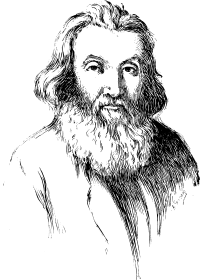
Isaac Bär Levinsohn, 1788-1860
Time was when all writers on the subject, usually Maskilim, thought it their duty to cast a stone at Hasidism. They described it as a Chinese wall shutting the Jews in and shutting the world out. It is becoming more and more plainly recognized and admitted, that it was, in reality, an attempt at reform rendered imperative by the tyranny of the kahal, the rigorism of the rabbis, the superciliousness of the learned classes, and the superstition of the masses. Its aim was to bring about a deep psychologic improvement, to change not so much the belief as the believer. It insisted on purity rather than profundity of thought. Unable to remove the galling yoke, it gave strength to its wearers by prohibiting sadness and asceticism, and emphasizing joy and fellowship as important elements in the fabric of its theology.
The founder of the sect has an interesting history. In his childhood he gave no evidence of future greatness. His education was of a low order, but his feeling heart and sympathetic soul won him the esteem of all that knew him. The woods possessed the same charm for him as for Wordsworth or Whitman. With the latter especially he seems to have much in common. While a child, he absented himself frequently from the narrow and noisy heder, and spent the day in the quiet of the neighboring woods. When he grew up, he accepted the menial position of a school usher. His office was to go from house to house, arouse the sleeping children, dress them, and bring them to heder. But the time soon came when humble and obscure Israel "revealed" himself to the world. Owing to his tact and knowledge of human nature, combined with the conditions of the times, his teachings spread rapidly. He was speedily crowned with the glory of a "good name" (Baal Shem Tob), and in the end he was immortalized.
Now, this Gaon of Vilna, or Hagra, was perhaps no less dissatisfied with prevailing conditions than the Besht, but his remedy for them was as different as the two personalities were unlike. He did not desire to abolish the Talmud, but rather to render it more attractive, by making its acquisition easier and putting its study on a scientific basis. Even in Lithuania, the citadel of the Talmud, the development of Talmudic learning had been hampered. In accordance with a Talmudic principle, mankind is continually degenerating, not only physically, but morally and mentally as well. It holds that if "the ancients were angels, we are mere men; if they were but men, we are asses." This high regard for antiquity produced a belief in the infallibility of the rabbis on the part of the Mitnaggedim, similar to that in their zaddikim by the Hasidim. No scholar of a later generation dared disagree with the statement of a rabbi of a previous generation. But as authorities sometimes conflict with each other, the Talmudists regarded it their duty to reconcile them or to prove, in the words of the ancient sages, that "these as well as those are the words of the living God." Similarly, the popes declared that, despite their contradictions, the Biblical translations of Sixtus V and Clement VIII were both correct.
From the South had come the impulse of religious revivalism through the followers of the Besht, and the North was showing signs of awakening through the reforms of the Gaon. At the same time a ray of enlightenment from the West pierced through the night. To make the regeneration of Slavonic Judaism complete, the element of estheticism had to be added to emotionalism and reason. From the warm South came Besht, from the studious North Hagra, and Rambman (Mendelssohn) made his appearance from the enlightened West. The triumvirate was complete.
Among these immigrants were two who may justly be regarded as the conducting medium through which the Haskalah currents were transmitted from Germany to Russo-Poland: Solomon Dubno, the indefatigable laborer in the province of Jewish science, and Solomon Maimon, the brilliant but unfortunate philosopher, both of them teachers in the house of Mendelssohn.
One better known to the outside world than Dubno, and who has engraved his name forever on the history of theology and philosophy, was Solomon Maimon (Nieszvicz, Lithuania, 1754—Niedersiegersdorf, Silesia, 1800). In his famous autobiography is mirrored the lot of hundreds of his countrymen who, like him, left their homes and hearths, their nearest and dearest, and led a wretched and miserable existence, all because they were anxious to be ma'amike be-hakmah ("delvers in knowledge"), as he himself might have said, and avail themselves of the opportunities for acquiring the truth and wisdom unattainable in their own land.
From this admirable work, in which he neither hides his follies nor flaunts his talents, we learn that Maimon possessed rare virtues. His sympathy for the poor, his ready helpfulness even at the sacrifice of himself, rendered him as uncommon in moral action as in philosophic speculation. To the English reader a striking parallelism suggests itself between him and his contemporary Oliver Goldsmith. Both were afflicted with generosity above their fortunes; both had a "knack at hoping," which led frequently to their undoing; neither could subscribe easily to the "decent formalities of rigid virtue"; and, as of the latter we may also say of the former, in the language of a reviewer, "He had lights and shadows, virtues and foibles—vices you cannot call them, be you never so unkind."
As Goldsmith came to London, so came Maimon to Berlin, "without friends, recommendation, money, or impudence." His only luggage was two manuscripts: a commentary on the works of Maimuni, whose name he had adopted, and to whom he paid divine reverence; and a treatise in which he attempted to rationalize the recondite doctrines of the Cabbala, and which he always kept by him "as a monument of the struggle of the human mind after perfection in spite of all hindrances which were put in its way." The little bundle, which, to the zealot Jewish elders of that community, seemed sufficient indication that Maimon was tainted with heresy, and that his intentions were to devote himself to the study of science and philosophy, proved a great impediment to entering Berlin; and when, after a long, incredible struggle, he was finally admitted, he found himself incapable of earning a livelihood. In his childlike naïveté he was betrayed by the very persons upon whom he relied most. All this could not deaden his love for knowledge and truth. By chance he obtained Wolff's Metaphysics, and this marked a new epoch in his life. "Not only the sublime science in itself," says he, "but also the order and mathematical method of the celebrated author, the precision of his explanations, the exactness of his reasoning, and the scientific arrangement of his expositions—all this kindled a new light in my mind."
So profound a thinker could not for long be a mere pupil. Wolff's argument a posteriori for the existence of God, in accordance with his philosophic hobby, the "principle of sufficient reason," displeased him wholly. A Hebrew letter to Mendelssohn, in which he shook the foundation of the Metaphysics by means of his irrefutable ontology, won him the admiration of the Berlin sage, who invited him to become his daily guest.
Maimon's intellect unfolded from day to day, until, some time afterwards, he astonished the philosophic world by his great work, Die Transcendentale Philosophie (Berlin, 1790), in reference to which Kant wrote to his beloved disciple Marcus Herz: "A mere glance at it enabled me to recognize its merits, and showed me, that not only had none of my opponents understood me and the main problem so well, but very few could claim so much penetration as Herr Maimon in profound inquiries of this sort." He demolished the prevalent Leibnitzo-Wolffian system in it, and proved that even the Kantian theory, though irrefutable from a dogmatic point of view, is exposed to severe attacks from the skeptic's point of view.
What could he not have accomplished, he to whom Kant and Goethe, Schiller and Körner paid tributes of unstinted praise, had he not been doomed to suffer and to starve. Only at the last moment, before he was silenced forever, was he able to say, Ich bin ruhig ("I am at peace"). Yet, in spite of the difficulties and impediments besetting him at every step, his promise of greatness and usefulness was not belied. In the Introduction to his commentary on Maimuni's Guide to the Perplexed (Gibe'at ha-Moreh), in which he attempted to reconcile his master's system with that of modern philosophy—even as the master had tried to reconcile Judaism with Aristotelianism—he gave a brief sketch of the development of modern thought. This part of his work was assiduously studied by his compatriots. Among his unpublished writings was found a work on mathematical physics, Ta'alumot Hokmah, and in his Talmudic treatise, Heshek Shelomoh, he inserted a dissertation, Ma'aseh Hosheb, on arithmetic, like a skilful physician putting a healing, though to some it may appear a repelling, balm into a delicious, attractive capsule.
Where Hurwitz failed, another of his countrymen was to succeed. Judah Litvack (1776-1836) removed from Berlin to Amsterdam, became prominent among the Dutch mathematicians, and wrote a Dutch work, Verhandeling over de Profgetallen Gen. ii (Amsterdam, 1817), which appeared in a second edition four years after the first. The author was elected a member of the Mathesis Artium Genetrix Society, and appointed one of the deputation sent to the Sanhedrin (February 12, 1807), before which he delivered a discourse in the German language.
It was not merely because of its business facilities that England appealed to the Slavonic Jews. Baruch Shklover, or Schick (1740-1812), went thither to study medicine, and it was from English literature that he selected the material for his Keneh ha-Middah (Prague, 1784; Shklov, 1793), on trigonometry. It would appear that the first Hebrew book, Toledot Ya'akob, printed for a Jew in England, was, as the name of the author, Eisenstadt, suggests, that of a Slavonic Jew. Although a silversmith by profession, Israel Lyons (d. 1770) was appointed teacher of Hebrew at the University of Cambridge. He acquired repute as a Hebrew scholar, and published, in 1757, the Scholar's Instructor, or Hebrew Grammar (4th ed., 1823), and in 1768 a treatise printed by the Cambridge Press, Observations and Inquiries Relating to Various Parts of Scripture History. In the same chosen field labored Hyman Hurwitz (1770-1844), the friend of Coleridge, who founded the Highgate Academy (1799), and wrote an Introduction to Hebrew Grammar, Vindica Hebraica, and Hebrew Tales, which were translated into various languages. He finally became professor of Hebrew in University College, London.
If the contributions of Slavonic Jews to Latin, German, French, Dutch, and English literature were not less considerable at that time than those of the Jews residing in the countries where these languages were respectively used as media, they excelled them in Hebrew literature. In the renaissance of the holy tongue, they played the most important part from the first. The striving for knowledge, not for the purpose of obtaining a coveted privilege, but for its own sake, became an irresistible passion, and it was accompanied by an unquenchable desire to disseminate knowledge among the masses, to make learning and wisdom common property. The Hebrew language being the best vehicle for the purpose, it was soon impressed into the service of Haskalah. The pioneer Maskilim learned to handle it with ease and clearness that would do credit to a modern writer in a much more developed European language.
From the middle of the fifteenth to the latter part of the eighteenth century, Hebrew literature consisted, if a few scattered books on philosophy, mostly translations from the Arabic, are excepted, mainly of Talmudic disquisitions, written in the rabbinic dialect and in a euphuistic style. Besides the great Maimuni, there were few able or willing to write Hebrew "as she should be spoke." The early German Maskilim, in trying to escape the Scylla of Rabbinism, fell victims to the Charybdis of Germanism. They possessed originality neither of style nor of sentiment, neither of rhyme nor of reason. Hebrew poetry was an adaptation of current German poetry. The very best the period produced, the Mosaïde of Wessely, was influenced by and largely an imitation of Klopstock and others. Like English classic poetry, it is pretty in form but poor in spirit. The element of nationality, or distinctiveness, the life-giving and soul-uplifting element in all poetry, as Delitzsch justly maintains it to be, was lacking in the German Maskilim, anxious for naturalization as they were. It was the Slavonic Maskilim who mastered Hebrew in its purity, as it had not been mastered since the day of Judah Halevi. In those days of transition the diligent student can find, in germ, what was later to develop into the resplendent poetical flowers produced by the Lebensohns, the Gordons, Dolitzky, Schapiro, Mane, and Bialik.
The century remarkable among other things for encyclopedia enterprises,—Chambers' Encyclopedia in England, the Universal Lexicon in Germany, and that wonderful and monumental work, the Encyclopédie in France—saw, before its close, a similar attempt, in miniature, in Hebrew and by a Slavonic Maskil. Whether the Hebrew encyclopedist was influenced by the example of Dr. Tobias Cohn's Ma'aseh Tobiah mentioned above, or was unconsciously imbued with the prevailing tendency of the times, it is impossible to tell. In any event, he resorted to the same means, and presented the Jewish world with a volume containing a little of every science known, under the innocent name The Book of the Covenant (Sefer ha-Berit, Brünn, 1797).
Steadily though slowly, brighter, if not better, days were coming. "Thought once awakened shall not again slumber." As Carlyle says of the French of that period, it became clear for the first time to the upturned eyes of the Jews, "that Thought has actually a kind of existence in other kingdoms [than the Talmud]; that some glimmerings of civilization had dawned here and there on the human species." They begin to try all things; they visit Germany, France, Denmark, Holland, even England; learn their literatures, study in their universities, and contribute their quota to the apologetic, controversial, scientific, and philosophic investigations "with a candor and real love of improvement which give the best omens of a still higher success." Fortune, indeed, has cast them also into a cavern, and they are groping around darkly. But this prisoner, too, is a giant, and he will, at length, burst forth as a giant into the light of day.
(Notes, pp. 310-314.)