Chapter IV
Reading edition
CONFLICTS AND CONQUESTS
1840-1855
Russian Jewry was astir with new life. In many places secular education was divorced for the first time from rabbinical speculation. Knowledge became an end in itself, and learning increased greatly. An investigation by Nicholas I convinced all who were interested that though the Talmud remained the chief subject of study, the number of educated Jews was far greater than commonly supposed. The upliftment of the masses was the beau-ideal of every Maskil, and Hebrew and even the much-despised Yiddish were employed to effect it. Ignorance was regarded as the bane of life, and enlightenment as the panacea for all the ills to which their downtrodden brethren were heirs. As their pious coreligionists deemed it the universal duty to be well-versed in the Talmud, so the Maskilim thought it incumbent upon everybody to be highly cultured. No obstacle was great enough to discourage them. They were willing martyrs to the goddess of Wisdom, at whose shrine they worshipped, and whose cult they spread in the most adverse circumstances.
Had the Government not interfered with the efforts of the Maskilim, or had it chosen a commission from among the Russian Jews themselves, among whom, as soon became evident to Nicholas himself, there were more than enough to do justice to an educational inquiry, the Haskalah movement would have continued to spread, notwithstanding the obstacles put in its way. But Nicholas was determined to reduce the number of Jews also by "re-educating" them in accordance with his own ideas. Every attempt made by the Jews to educate themselves was, therefore, checked. Even the noble efforts of Luria were stopped, his schools were closed, and his only rewards were "a gold medal from the czar and a short poem by Gottlober."
In Germany, since the time of Mendelssohn, the study of the Talmud had been on the wane. The great yeshibot formerly existing in Metz, Frankfort, Hamburg, Prague, Fiirth, Halberstadt, etc., disappeared, and the reforms introduced in the synagogue and the numerous converts to Christianity impressed the outside world with the idea that Judaism among German Jews was writhing in the agony of death. If the same disintegrating elements were introduced among the Russian Jews, the Government believed that they would ultimately come over to the Greek Catholic Church of their own accord. Hence it was anxious to learn the secret of this power and beamed graciously on several learned Jews of Germany.
For more than three years Lilienthal was one of the most popular personages in Europe. The eyes of all who had the amelioration of the lot of the Russian Jew at heart, it may be said the eyes of the civilized world, were fixed upon him as an epoch-maker in the history of the Jews. Nature had formed him, physically and mentally, to be a leader among his people, and his training and temperament made it easy for him to ingratiate himself into the favor of the great. It seemed that he was just the man to be the successful executor of the czar's plan.
The Maskilim, above all, hailed him as the champion of the cause of Haskalah. He was their Moses or Ezra, the God-sent redeemer of their benighted brethren out of the quagmire of fanaticism. From various cities numerous urgent appeals came to him to hasten the execution of his great plan. Wherever he went, he was enthusiastically received, a truly royal welcome was extended to him. The Vilna community appropriated five thousand rubles for the school fund, and pledged itself to raise more if it were found necessary; and he was invited also to Minsk by the kahal of the city.
Unfortunately, Lilienthal's tactics exposed him to suspicion, and the seed of discord was soon sown between him and his former admirers. He tried to serve two masters, the czar and the Jews, and he alienated both. The pious regarded him as a mere tool in the hands of the Government, for, they maintained, education without emancipation leads to conversion. The enlightened element also lost confidence in one who, instead of boldly attacking superstition, preferred, while in Minsk, to identify himself not only with the Mitnaggedim, but even with the Hasidim. He was also too headstrong and too vain of his achievements. Benjamin Mandelstamm, who, as he tell us in his letters, considered Lilienthal "as wise as Solomon and as enterprising as Moses," complains a little later of his arrogance, and at the last speaks of him with contempt. His assumed superiority grieved the Maskilim, and their former enthusiasm was rapidly replaced by hatred and persecution. He found it necessary to put himself under the protection of the police while in Minsk, and when he returned to Vilna his reception was far less hearty than it had been before.
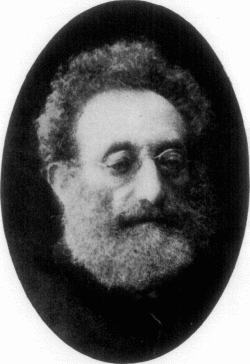
Alexander Zederbaum, 1816-1893
For Lilienthal's disillusionment came apace, and he finally recognized the error of his ways. In his book, My Travels in Russia, published both in English and in German, he admits that the opponents of the schools he advocated were after all in the right. Education without emancipation was indeed the straightest road to conversion. Witness the thirty thousand Jewish apostates in St. Petersburg and Moscow alone, most of whom hailed from the Baltic provinces, where the Jews were more cultured, but not less oppressed, than their brethren.
Those men—says he—who have acquired from study an idea of the rights of man, and that the Jew ought to enjoy the same privileges as every other citizen; those men who tried, by the knowledge they had obtained, to open for themselves better prospects in life, and now saw every hope frustrated by laws inimical to them only as Jews, ran, from mere despair, into the bosom of the Greek Church. The harassing care for a living, the terrible difficulties in surmounting them forced them, in an hour of distress, to deny their faith. I always compared them with the Anusim [forced converts] of Spain. Among them there is no religious indifference, as is the case in Western Europe and Germany; and I have met with many converted Jews there, who, with tears in their eyes, complained of heart-burnings and pangs of conscience; and they look upon themselves as eternally lost. Those tears will show a heavy balance against Czar Nicholas, when, bereft of his earthly power, he stands before the eternal tribunal.
Time helped greatly to restore, even to deepen, the affection of the Maskilim for Lilienthal. A modern critic speaking of "life and literature" in Hebrew, pictures him in glowing colors, and finishes his description thus:
Those upon whom the sun of civilization and freedom happened to cast a ray of light, showing them the path leading to a new life, were compelled to study the European literatures and sciences in garrets, in cellars, in any nook where they felt themselves secure from interference. Neither unaffiliated Jews nor the outer world knew anything about them. Like rebels they kept their secrets unto themselves, stealthily assembling from time to time, to consider how they might realize their ideal, and disclose to their brethren the fountainhead of the living waters out of which they drank and drew new youth and life. Whatever was novel was accepted with delight. They looked with envy upon the great intellectual progress of their western brethren. Fain would they have had their Jewish countrymen recognize the times and their requirements, but they could not give free utterance to their thoughts. On the contrary, they found it expedient to assume the mask of religion in order to escape the suspicion of alert zealots, and gain, if possible, new recruits. In many places societies were founded under the name of Lovers of the New Haskalah, the members of which observed such secrecy that even their kinsmen and those among whom they dwelt were unaware of their existence. If through the discovery of some forbidden book any of them happened to be detected, he never betrayed his friends. Such a one was usually compelled to marry, so that, being burdened with family cares, he might desist from his unpopular pursuits.
Aside from the hindrances which Haskalah encountered because of Nicholas's conversionist policy, it was greatly hampered by the geographical distribution of the Jews. Here again the czar defeated his own end by segregating the three or four million of his Jewish subjects in certain districts, technically called the Pale, the greatest ghetto the world has ever known. It was a Judea in itself. The Jews there seldom came in contact with outside civilization. The languages they used were Hebrew as the literary tongue, Yiddish among themselves, and the local Slavonic dialect with their non-Jewish neighbors. Russian was strange, not only to the great majority of Jews, but to the Russians themselves. It was merely the State language, and even the Government officials fell back on their mother tongue whenever they were at liberty to do so. It was this that made it very difficult for the Jews to be Russified.
But more efficacious than all other agencies was Mendelssohn's German translation of the Bible, and the Biur commentary published therewith. Renaissance and Reformation, those mighty, revolutionary forces, have entered every country by side-doors, so to say. The Jewish Pale was no exception to the rule. What Wycliffe's translation did for England, and Luther's for Germany, Mendelssohn's did for Russian Jewry. Like the Septuagint, it marked a new epoch in the history of Jewish advancement. It is said that Mendelssohn's aim was chiefly to show the grandeur of the Hebrew poetry found in the Bible, but by the irony of fate his translation displayed to the Russian Jew the beauty and elegance of the German language. To the member of the Lovers of the New Haskalah, surreptitiously studying the Bible of the "Dessauer," the Hebrew was rather a translation of, or commentary on, the German, and served him as a bridge to cross over into the otherwise hardly accessible field of German literature.
Warsaw, too, was a beneficiary of Germany, having been occupied by the Prussians before it fell to the lot of the Russians. It was there that practically the first Jewish weekly journals were published in Yiddish and Polish, Der Beobachter an der Weichsel, and Dostrzegacz Nadvisyansky (1823). There was opened the first so-called rabbinical seminary, with Anton Eisenbaum as principal, and Cylkov, Buchner, and Kramsztyk as teachers. The public schools were largely attended, owing to the efforts of Mattathias Rosen, and a year after a reformed synagogue had been organized in Odessa another was founded in Warsaw, where sermons were preached in German by Abraham Meïr Goldschmidt.
Stories were told how the deans of the yeshibot were frequently found to have mastered the very books they confiscated because of the teachings they inculcated. Before the reign of Nicholas I drew to its end, Haskalah centres were as numerous as the cities wherein Jews resided. In Byelostok the Talmudist Jehiel Michael Zabludovsky was lending German books to young Slonimsky, the future inventor and publicist; in Vlotslavek Rabbi Joseph Hayyim Caro was writing and preaching in classic German; in Zhagory, Hayyim Sack helped Leon Mandelstamm (1809-1889), the first Jewish "candidate," or bachelor, in philology to graduate from the St. Petersburg University (1844) and the assistant and successor of Lilienthal, in the expurgation and German translation of Maimuni's Mishneh Torah. When, in 1857, Mandelstamm resigned, he was followed by Seiberling, for fifteen years the censor of Jewish books in Kiev, upon whom a German university conferred the doctor's degree. The poverty-stricken Wolf Adelsohn, known as the Hebrew Diogenes, formed a group of Seekers after Light in Dubno, while such wealthy merchants as Abraham Rathaus, Lilienthal's secretary during his campaign in Berdichev, Issachar Bompi, the bibliophile in Minsk, Leon Rosenthal, financier and philanthropist in Brest-Litovsk, and Aaron Rabinovich, in Kobelyaki (Poltava), promoted enlightenment by precept and example. In Vilna, Joseph Sackheim's young son acted as English interpreter when Montefiore was entertained by his father, and Jacob Barit, the incomparable "Yankele Kovner" (1793-1833) another of Montefiore's hosts, was master of Russian, German, and French, and aroused the admiration of the Governor-General Nazimov by his learning and his ability.
But it is scarcely possible, nor would it be profitable, to enumerate either the places or the persons who were, so to speak, inoculated with the Haskalah virus. In Grodno, Kovno, Lodz, Minsk, Mohilev, Pinsk, Zamoscz, Slutsk, Vitebsk, Zhagory, and other places, they were toiling zealously and diligently, these anchorites in the desert of knowledge. Among them were men of all classes and callings, from the cloistered Talmudist to the worldly merchant. The path of Haskalah was slowly yet surely cleared. The efforts of the conservative Maskilim were not devoid of some good results, nor even were those of Nicholas, though aimed at Christianizing rather than civilizing, entirely wasted. With all their shortcomings, and though producing but few rabbis acceptable to Russo-Jewish congregations, the seminaries in Warsaw, Zhitomir, and Vilna were powers for enlightenment. In them the future prominent scientists, scholars, and litterateurs were reared, and there the foundations were laid for the activities of Goldfaden, Gurland, Harkavy, Kantor, Landau, Levanda, Mandelkern, Paperna, Pumpyansky, Rosenberg, Steinberg, and others. Their fate was that of Mendelssohn's Bible translation. The end became a means, the means, an end. But they not only "brought forth" great men, they rendered no less important a service in "bringing out" those already great. Had it not been for their professorships, men like Abramovitsch, Lerner, Plungian, Slonimsky, Suchastover, and Zweifel, who were not blessed with worldly goods like Fünn, Katzenellenbogen, Luria, or Strashun, would probably have sought in private teaching or petty trading a source of subsistence, and Judaism in general and Russian Jewry in particular would have sustained a considerable loss. They helped to prepare the soil, even to implant the germ, and
Once the germ implanted, Its growth, if slow, is sure.
Isaac Bär Levinsohn of Kremenetz, Volhynia (RiBaL, 1788-1860), was for many years a name to conjure with, not only among the Maskilim of all shades, but also among their opponents. Long before he reached man's estate, he had entered upon the career to which he was to dedicate his life. Even in those times of numerous child prodigies, Levinsohn was distinguished for his intellectual precocity. At the age of three he was ripe for the heder. At nine he was the author of a work on Cabbala. At ten he mastered the Talmud, and knew the entire Hebrew Bible by heart. But what singled him out among his classmates was his passionate love of secular knowledge. The son of Judah Levin, an erudite merchant who knew Hebrew and Polish to perfection, the grandson of Jekuthiel Solomon, famed for wealth and refinement, he evinced unusual ability in selecting and retaining what was good and true in everything he read. At fourteen he was familiar with the literatures of several nations, so that during the Franco-Russian war (1812) he easily secured an appointment as interpreter and secretary in the local police department. But excessive study caused ill-health, and at the suggestion of his physicians he went to Brody in Galicia, a fortunate incident in the otherwise solitary and gloomy life of the future reformer, for next to Germany Galicia played an important part in the Haskalah movement in Russia. There he met Joseph Perl, the noted educator; Doctor Isaac Erter, the immortal satirist; M.H. Letteris, the distinguished poet; S.L. Rapoport, one of the first and profoundest of Jewish historians, and Nahman Krochmal, the saintly philosopher. Into this circle of "shining ones" Levinsohn was introduced, and each and all left an impression, some greater, some less, upon his plastic soul. It was there and then, in the congenial company of friends of about his own age, that Levinsohn determined to devote himself to improving the educational system of his people and began to plan his work on Learning in Israel (Te'udah be-Yisraël), which procured for its author the foremost place in the history of the Haskalah movement.
The book was finished in 1823, but, owing to Levinsohn's pecuniary circumstances, it remained unpublished till 1828. Meanwhile it circulated in manuscript among the leading Maskilim of Russia, Austria, and Germany, and established its author's reputation wherever it was read. Levinsohn was one of those who understand the persuasive power of the still small voice of sweet reasonableness. He knew that a few convincing arguments couched in gentle language will accomplish more for the furtherance of an ideal than the trumpet call of a hundred clamoring militants, and Haskalah will make headway only when it can prove itself to be a help, and not a hindrance, to religion. Accordingly, he aimed to show that the Tanaim, Amoraim, Saboraim, Geonim, and rabbis of later generations were versed in the sciences, were familiar with foreign history, and interested in the affairs of the world. But these he quotes only as exemplars of broad-mindedness, they must no longer be regarded as authorities in secular knowledge. "Art and science," he says, "are steadily progressing.... To perfect ourselves in them we must resort to non-Jewish sources." This was a bold statement for those times, however mildly expressed. The Te'udah became a bone of contention. It was torn and burnt by fanatics, exalted to the skies by friends. The new apostle of enlightenment was forced to leave the city and reside for a while in Berdichev, Nemirov, Ostrog, and Tulchin. But wherever he went, his tribulation was sweetened by the enthusiasm of his admirers and the consciousness that his toil was not entirely wasted. In Warsaw and in Vilna his name was great, and Nicholas presented him with a thousand rubles as a mark of appreciation of the book, the fly-leaf of which bears the inscription "To science."
In the midst of his more serious studies Levinsohn diverted himself occasionally with lighter composition, in which many an antiquated custom served as the butt for his biting satire. In his youth he had a penchant for poetry, and his poem on the flight, or expulsion, of the French from Russia was complimented by the Government. His muse dealt with ephemeral themes, but his bons mots are current among his countrymen to this day. A novel sort of plagiarism was the fashion of the time. Authors attributed their work to others, instead of claiming the product of others as their own. Levinsohn's Hefker Welt, in Yiddish, and Sayings of the Saints and Valley of the Dead, in Hebrew, belong to this category. But the deep student did not persist long in this species of diversion. Wittgenstein, the field-marshal, and professors at the Lyceum of his town, supplied him with books, and he, an omnivorous reader, plunged again into his graver work, the result of which was the little book since translated into English, Russian, and German, Efes Dammim (No Blood!). As the name indicates, it was intended as a defence against the blood, or ritual murder, accusation. It was the right word in the right time and place. In Zaslav, Volhynia, this monstrous libel had been revived, and popular fury rose to a high pitch. Several years later the Damascus Affair stirred the Jewish world to determined action, designed to stamp it out once for all. To wage war against this superstitious belief seems to have fallen to the lot of several of Levinsohn's family. In 1757, when it asserted itself in Yampoly, Volhynia, his great-uncle, by the unanimous consent of the Council of the Four Countries, was sent to Rome to intercede with the Pope. After six years of pleading, he returned to his native land with a signed statement addressed to the Polish king and nobles, which declared the accusation to be utterly false. Another uncle of his had performed a similar task in 1749. True scion of a noble family, Levinsohn followed in their wake, and his effort was declared to be a "sharp sword forged by a master, to fight for our honor."
Everything was against Levinsohn when he started on his third great work, The House of Judah (Bet Yehudah). He found himself poor, sick, and alone, and deprived of his fine library. In those days, and for a long time before and afterwards, Hebrew authors were paid in kind. In return for their copyright they received a number of copies of their books, which they were at liberty to dispose of as best they could. Now, while Levinsohn's copies of his Bet Yehudah were still at the publisher's, a fire broke out, and most of them were consumed.
The Te'udah be-Yisraël had been prompted by a desire to prove the compatibility of modern civilization with Judaism. Levinsohn's object in writing his Bet Yehudah was the reverse. The impetus came from without the Jewish camp. The book represents the author's views on certain Jewish problems propounded by his Christian friend, Prince Emanuel Lieven, just as Mendelssohn's Jerusalem was written at the instigation of Lavater. Though there is a similarity in the causes that produced the two books, there is a marked difference in their methods. Mendelssohn treats his subject as an impartial non-Jewish philosopher might have done. He is frequently too reserved, for fear of offending. Levinsohn, in Greek-Catholic Russia, is strictly frank. He is conscious of the difficulties under which he is laboring. To discuss religion in Russia is far from agreeable. "It is," he says, "as if a master, pretending to exhibit his skill in racing, were to enter into competition publicly with his slave ... and at the same time wink at him to slacken his speed." Of one thing he is certain: Judaism is a progressive religion. It had been and might be reformed from time to time, but this can and must be only along the lines of its own genius. To improve the moral and material condition of the Jews by weaning them away from the faith of their fathers (as was tried by Nicholas) will not do. On the contrary, make them better Jews, and they will be better citizens.
The Bet Yehudah may justly be called the connecting link between the Te'udah, which preceded it, and Zerubbabel, which followed it. The latter, though written in Hebrew, was really intended exclusively for the Gentile world, as the former had been mainly for the Jewish world. It is a continuation, but not yet a conclusion, of the self-assigned task of Levinsohn. The Talmud, we have seen, was at that time the object of assaults of zealous Christians and disloyal Jews, and hostile works against Judaism were the order of the day. Most of them, however, like the fabulous snake, vented their poison and died. It was different with McCaul's poignant diatribe against the cause of Judaism and the honor of the Talmud, which had been translated into many languages. Montefiore, while in Russia, urged Levinsohn to defend his people against their traducers, and the bed-ridden sage, almost blind and hardly able to hold a pen, finally consented. What Zerubbabel accomplished, can be judged from the fact that in the second Hebrew edition of McCaul's Old Paths (1876) are omitted many of the calumnies and aspersions of the first edition, published in 1839.
Levinsohn's life was a continuous struggle against an insidious disease, which kept him confined to his bed, and prevented him from accepting any prominent position. But though, as he said, he had "neither brother, wife, child, nor even a sound body," he impressed his personality upon Russian Jewry as no one else, save the Gaon, had before him. His breadth of view and his sympathetic disposition gradually won him the respect and love of all who knew him. The zaddikim Abraham of Turisk and Israel Rasiner were his lifelong friends; the Talmudist Strashun acknowledged his indebtedness to him, and Rabbi Abele of Vilna remarked jestingly that the only fault to be found with the Te'udah was that its author was not the Gaon Elijah. He enjoyed prominence in Government circles, and Prince Wittgenstein was passionately fond of his company. Above all he endeared himself to the Maskilim. To him they looked as to their teacher and guide; him they consulted in every emergency. Lebensohn and Gottlober, Mandelstamm and Gordon, equally sought his criticism and advice. For all he had words of comfort and encouragement. The younger Maskilim he warned not to waste their time in idle versification, not to become intoxicated with their little learning; and the older ones he implored to respect the sentiments of their conservative coreligionists. "Take it not amiss," he would say to the latter, "that the great bulk of our people hearken not as yet to our new teachings. All beginnings are difficult. The drop cannot become a deluge instantaneously. Persevere in your laudable ambition, publish your good and readable books, and the result, though slow, is sure."
Thus lived and labored the first of the Maskilim, an idealist from beginning to end. Persecution did not embitter, nor poverty depress him. And when he passed away quietly (February 12, 1860) in the obscure little town in which he had been born, and which has become famous through him, it was felt that Russia had had her Mendelssohn, too. Strange to say, he little suspected the tremendous influence he exerted upon the Haskalah movement, but was quite sanguine of the success of his fight for "truth and justice among the nations." His work he modestly summed up in the epitaph which was inscribed on his tombstone at his request:
Out of nothing God called me to life. Alas, earthly life has passed, and I must Sleep again on the bosom of Mother Nature. Witness this stone. I fought with God's Foes, not with a Sword, but with the Word; I fought for Truth and Justice among the Nations And Zerubbabel and Efes Dammim testify thereto.
Contemporaneous with Isaac Bär Levinsohn, and hardly less distinguished and influential, was Mordecai Aaron Günzburg (ReMAG, Salanti, Kovno, December 3, 1795—Vilna, November 5, 1846). His family had been prominent in many walks of life since the fourteenth century, and, whether in the land of the Saxons or of the Slavs, represented the cream of the Jewries in which they lived. His father was a Maskil of great repute, who had written several treatises, in Hebrew, on algebra, geometry, optics, and kindred subjects. He sought to supplement his son Mordecai Aaron's heder education with a knowledge of secular sciences. But at that time and in that place not many were the books, outside the Talmud, accessible to a lad eager for learning, the only ones available being such as the Josippon, Zemah David, and Sheërit Yisraël on Jewish History, the Sefer ha-Berit, and a Hebrew translation of Mendelssohn's Phaedon on general philosophy. But the precocious and clear-minded youth did not need much to stimulate his love for history and his inclination to philosophy, and his intellectual development continued in spite of the untoward circumstances in which he happened to be placed.
Though he was "given" in marriage at a very early age, the proverbial "millstone" weighed but lightly upon the neck of young Günzburg. He never discontinued the habit of secluding himself in his study for hours, sometimes for days, at a time, and there writing down his thoughts in painstaking penmanship. These productions, with all their crudity, promised, according to a keen critic, the flowers which would one day "ripen into delicious fruit, not only pleasant to the sight but also delicious to the taste." In fact, even his religious views underwent but slight modification in later and maturer years. Ceremonial laws, or minhagim, were to him a social compact among the members of a sect. He who transgresses them is, eo ipso, excluded from the sect, as he who disregards the social code, though not immoral, is ostracized from society. This led him to the logical conclusion that every Jew must comply with the customs of his people, though his opinion as to their moral value may differ from that of the rest. He believed in freedom of thought, but would not concede freedom of action or even of expression, and would say with Bolingbroke, "Freedom belongs to a man as a rational creature, he lies under the restraint as a member of society."
At these conclusions, Günzburg arrived only after a long, severe, though silent, struggle in the seclusion of his closet. His active mind would not at first surrender unconditionally to the coercion of custom. But his conception of ceremonialism served him in good stead on many an occasion in his eventful life. Being an expedient to preserve harmony, it may and must vary with change of conditions. Accordingly, Günzburg always accommodated himself to his environment. In Vilna he subscribed to the regulations of the Shulhan 'Aruk, in Mitau he quickly and completely became Germanized. Such adaptability rendered him conspicuous wherever he went, and as early as 1829 his name was included among the learned of Livonia, Esthland, and Courland in the Biographical Dictionary then published by Recke and Napyersky.
His claim to fame, however, consists in the influence he exerted upon Russian Jews. Like Levinsohn, he was a constructive force. In his younger days, he had inveighed against the benighted rabbis and the antiquated garb, but moderation came with discretion. He would not sweep away by force the accumulation of hundreds of years. Judaism needed reforms of some sort, but these could not be brought about by the Russo-German-doctor-rabbis, men who could rede the seven riddles of the world, but whose knowledge of their own people and its spiritual treasures was close to the zero point. "For a rabbi," writes he, "Torah must be the integer, science the cipher. Had Aristotle embraced Judaism, notwithstanding his unparalleled erudition, he would still remain a sage, never become a rabbi." But he was as little satisfied with the exclusively Talmudistic rabbis. "O ye modern rabbis," he calls out in one of his essays, in which he stigmatizes Lilienthal's plans as the "gourd of Jonah," "you who stand in the place of seer and prophet of yore, is it not your duty to rise above the people, to intervene between them and the Government? And how can you expect to accomplish it, if the language and regulations of our country are entirely unknown to you?"
The impress Günzburg left upon Hebrew literature is of special importance. Until his time, despite the examples set by Satanov and Levin, Hebrew was stamped with the hallmark of medievalism. Like the Spanish entertainment in Dryden's Mock Astrologer, at which everything at the table tasted of nothing but red pepper, so the literature of that day was dominated by the style and spirit of the Talmud and saturated with its subtleties. Astronomy, philosophy, mathematics, and poetry swarmed with puns, alliterations, pedantic allusions; they were overladen with irrelevant notes and interwoven with quaint and strained interpretations. Günzburg was the first, with the exception of Erter perhaps, to try to remedy the evil. "Every writer," he maintained, "should guard himself against the fastidiousness or stiffness which results from pedantry, and take great pains not only with the content of his thoughts, but with the language in which these thoughts are couched." Simplicity, perspicuity, and conciseness, these he taught by precept and example, and though he was accused of "Germanizing" the Hebrew language, he persisted in his labor until he attained the foremost rank among the neo-Hebraic litterateurs.
In Günzburg we find the artistic temperament developed to a degree rare among Hebraists of even more recent years. He wrote only in moments of inspiration. At times he passed weeks and months without penning a line, but when once aroused he wrote unceasingly until he finished what he had begun. He was careful in the choice of his words, careful in the choice of his books, and would recommend nothing but the best. "I may not have genius enough," he would say, "to distinguish between better and best, but I do not lack common sense, to differentiate tares from weeds." Above all, he possessed a sense of honor, the greatest stimulus, as he maintained, to noble endeavors. "For as marriage is necessary to perpetuate the race, and food to sustain the individual, so is honor to the existence of the superior man."
Of the fifty years of his active life more than one-half was spent in literary labor. His books obtained a wide circulation, and, though they were rather expensive, became rare soon after their publication. Yet, strange to say, this eminent Hebraist seldom, if ever, lauds the beauties of the "daughter of Eber" (Hebrew) like his fellow-Maskilim since the days of the Meassefim, nor does he even think it incumbent on a Jew to be conversant with it.
Three periods have passed over me—he writes to a friend—since I dedicated myself to Hebrew. As a youth I loved it as a Jewish lad loves his betrothed, not because he is enamored of her charms, but because his parents have chosen her for him; as I grew older, I continued to love it as a Jewish man loves his wife, not because of real affection, but because she is the only one he knows; now that I am old, I still love her, as an elderly Jew loves his helpmate: he is aware that she lacks many of the accomplishments of which more educated women can boast, but, for all that, remembering her faithfulness in the past, he loves her also in the present, and loves her till he dies.
Günzburg was different from most of his contemporaries in another respect. He was a voluminous writer, but only a few of his books and essays bear on what we now call Jewish science. Zunz, Geiger, and Jost, seeing that Judaism was gradually losing its hold upon their Jewish countrymen, resorted to exploring and narrating, in German, the wonderful story of their race, in the hope of renewing its ebbing strength. Levinsohn, living amid a different environment, deemed it best to convince his fellow-Jews that secular knowledge was necessary, and religion sanctioned their pursuit thereof. Günzburg, the man of letters, determined to teach through the vehicle of Hebrew the true and the beautiful wherever he found it. He felt called upon to reveal to his brethren the grandeur of the world beyond the dingy ghetto, to tell them the stories not contained in the Midrash, Josippon, or the biographies of rabbis and zaddikim. He translated Campe's Discovery of the New World, compiled a history of ancient civilization, and narrated the epochal event of the nineteenth century, the conflict between Russia and France. He taught his fellow-Jews to think correctly and logically, to clothe their thoughts in beautiful expressions, and revealed his innermost being to them in his autobiography, Abi'ezer. As a writer he appears neither erudite nor profound. We cannot apply to his works what we may safely say of Elijah Vilna's and Levinsohn's, that "there is solid metal enough in them to fit out whole circulating libraries, were it beaten into the usual filigree." But he was elegant, cultured, intelligent, honorable; one who joined a feeling heart to a love for art; a Moses who struck from the rock of the Hebrew tongue refreshing streams for those thirsting for knowledge; a most amiable personality, and an altogether unusual character during the century-long struggle between light and darkness in the Jewry of Russia.
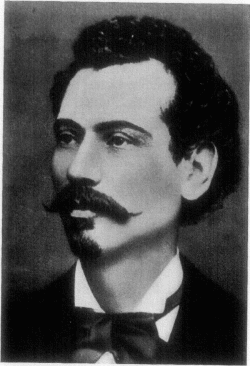
Perez Ben Mosheh Smolenskin, 1842-1885
(Notes, pp. 318-322.)