Chapter VI
Reading edition
THE AWAKENING
1881-1905
The reign of Alexander III, like that of Nicholas I, was devoid of even that faint glamor of liberalism which, in the days of Alexander I and Alexander II, had aroused deceptive hopes of better times. During the thirteen years of Alexander III's autocracy (1881-1894) not a ray of light was permitted to penetrate into Holy Russia. On May 14, 1881, the manifesto prohibiting the slightest infringement of the absolute power of the czar was promulgated, to continue unbroken till the Russo-Japanese war.
The liberal current which had carried away his predecessors when they first mounted the throne was checked, the sluices of Slavophilism were opened, the history of Russian thinkers became again, as Herzen said, "a long list of martyrs and a register of convicts."
Nicholas Ignatiev, a rabid reactionary, a second Jeffreys, became chief of the Ministry of the Interior; Katkoff, a repentant liberal and exile, was appointed the czar's chief adviser, the Richelieu behind the throne; and Pobyedonostsev, whom Turgenief called the "Russian Torquemada," obtained supremacy over Melikoff, and was appointed procurator of the Holy Synod. With such as these at the head of the Russian bureaucracy, there may have been some foundations for the rumor that an imperial ukase decreed the pillage and slaughter of the Jews, and the muzhiks, obedient to the behests of the "little father," and smarting under the pain of disappointment, vented their venom on their Jewish compatriots. Before the new czar had been on his throne three months, Russia was drenched with Jewish blood. There began saturnalia of rape, plunder, and murder, the like of which had been witnessed nowhere in Europe. For half a year the pogroms which began in Yelisavetgrad (April 27, 28) swept like a tornado over southern Russia, visiting more than one hundred and sixty communities with fire and sword, resulting in outrages on women, in the murder of old and young, in the ruin of millions of dollars of property. The Black Hundreds of the nineteenth century put to shame the Haidamacks of the eighteenth and the Cossacks of the seventeenth. In the words of the Bishop of Canterbury to Sir Moses Montefiore, it looked "as if the enemy of mankind was let loose to destroy the souls of so many Christians and the bodies of so many Jewish people."
But it would be a vain attempt, and out of keeping with the object of this work, to describe in detail the "bloody assizes" and the infernal tragedies that ensued upon the accession of Alexander III; the moral degeneracy and the economic ruin that spread over the mighty empire; the shudder that passed over the civilized world, and was expressed in indignation meetings held everywhere, especially in Great Britain and in the United States (February, 1882), to protest, "in the name of civilization, against the spirit of medieval persecution thus revived in Russia." Suffice it to say that even when the mob, tired of carnage, ceased its work of extermination, the bloodthirstiness of those in authority was not assuaged. Such a policy was inaugurated against the Jews as would, according to Pobyedonostsev, "force one-third of them to emigrate, another third to embrace Christianity, and the remainder to die of starvation." With this in view, his Majesty the Emperor, "prompted by a desire to protect the Jews against the Christians," was graciously pleased to give his assent to the Resolutions of the Committee of Ministers, on the third of May, 1882, i.e. to the notorious "temporary measures," or "May laws," framed by Ignatiev, against the will of the Council of the Empire.
These "temporary measures" have remained in force to this day. With them was resuscitated all the inimical legislation of the past, beginning with the time of Elizabeta Petrovna. What was favorable was suppressed; the unfavorable was most rigorously enforced. Jews living outside the Pale were driven back into it on the slightest pretext and in the most inhuman manner. To increase the already unendurable congestion, the Pale was made smaller than before. In accordance with the first clause of the "May laws," Jews were expelled from the villages within the Pale itself. In 1888 the districts of Rostov and Taganrog, which till then had belonged to the Pale, and had been developed largely through Jewish enterprise, were torn away and amalgamated with the Don district, in which Jews were not permitted to reside. This was followed by expulsions from St. Petersburg (1890), Moscow, (1891), Novgorod, Riga, and Yalta (1893), and the abrogation of the time-honored privileges of the Jews of Bokhara (1896). Even those who, as skilled artisans or discharged soldiers, had been privileged to reside wherever they chose, were expelled with their wives and the children born in their adopted city. Their only salvation lay in conversion. Converts were especially favored, and were offered liberal inducements. By becoming a convert to the Orthodox Russian Church, a Jew is immediately freed from all the degrading restrictions on his freedom of movement and his choice of a profession. Converts, without distinction of sex, are helped financially by an immediate payment of sums from thirteen to thirty rubles, and until recently were granted freedom from taxation for five years. If a candidate for Greek Christianity is married, his conversion procures him a divorce, and, unless she likewise is converted, his wife may not marry again. By conversion, a Jew may escape the consequence of any misdeed against a fellow-Jew, for, to quote the Russian code, "in actions concerning Jews who have embraced Christianity Jews may not be admitted as witnesses, if any objection is raised against them as such." The penal code provides that Jews shall pay twice and treble the amount of the fine to which non-Jews are liable under similar circumstances. Jews were excluded from the professions to which they had turned in the "sixties" and "seventies," and in which they had been eminently successful; they were not allowed to hold any civil or municipal office; they were forbidden even to be nurses in the hospitals or to give private instruction to children in the homes.
And still persecution did not cease. Not satisfied with starving the bodies of five millions of Jews, Russian legislators were determined to crush them intellectually. The Slavophils could not brook seeing "non-Russians" surpass their own people in the higher walks of life. The Jews, finally successful in emancipating themselves from the trammels of rabbinism, had transferred their extraordinary devotion from the Talmud to secular studies. They filled the schools and the universities of the empire with zealous and intelligent pupils, who carried off most of the honors. They contributed forty-eight pupils to the gymnasia out of every ten thousand, while the Christians contributed only twenty-two. This was regarded an unpardonable sin. "These Jews have the audacity to excel us pure Russians," Pobyedonostsev is reported to have exclaimed, and measures were taken to suppress their dangerous tendency. As early as 1875 a law was passed withholding from Jewish students the stipends they had hitherto received from a fund set aside for that purpose. In 1882 the number of Jewish students in the Military Academy of Medicine was limited to five per cent, and later it was reduced to zero. Thereafter one professional school after another adopted a percentage provision, and some excluded Jews altogether. Finally, "seeing that many Jewish young men, eager to benefit by a higher classical, technical, or professional education," presented themselves every year for admission to the universities, that they passed their examination and continued their studies at the various schools of the empire, the Government deemed it "desirable to put a stop to a state of affairs which is so unsatisfactory." Consequently the ministry limited the attendance of Jews residing in places within the Pale to ten per cent in all schools and universities (December 5, 1886; June 26, 1887), in places without the Pale to five per cent, and in Moscow and St. Petersburg to three per cent, of the total number of pupils in each school and university. Of the four hundred young Jews who had successfully passed their matriculation examination at the beginning of the scholastic year 1887-1888, and had thus acquired the right of entering the university, three hundred and twenty-six were refused admission, and in many schools and universities they were denied even the small per cent the law permitted.
The Russian Jews—says Zunser—sobered down from the orgies of assimilation, and its worshippers abandoned their idol. Those who had almost forgotten that they were of the camp of Israel began to return to its tents. The Jewish physicians, jurists, technologists, and the entire so-called Jewish "intelligentia," who heretofore had never cared to speak a word of Yiddish to a Jew, resumed their native tongue; they began to send their children to the Jewish hadarim, and adopted once more Jewish ways and customs. Several hundred Jewish university students, proverbially irreligious, sent to Vilna for tefillin [phylacteries]!
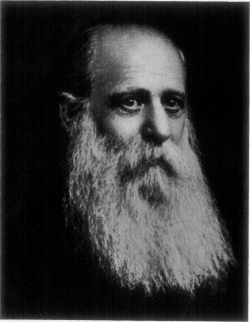
Moses Löb Lilienblum, 1843-1910
Those, however, were most affected who had been misled by dreams of assimilation. They suffered most, for they lost most. Their hopes were blighted, their hearts broken. The leading-strings proved to be a halter. They saw they had little to expect at the hands of those they had believed to have become fully civilized, and they were embittered toward civilization, which had showed them flowers, but had given them no fruit. In a work, Sinat 'Olam le-'Am 'Olam (Eternal Hatred for the Eternal People, Warsaw, 1882), Nahum Sokolov proved, like Smolenskin before him, that anti-Semitism was ineradicable, that the fight against the Jews was a fight to the death, that even emancipation helps little to remove the animosity innate in one people against another, and until the "end of days" foretold by the prophets of yore there will never cease the eternal hatred to the eternal people. This became the dominant opinion. It dawned upon many that the only salvation for the Jews lay in becoming a nation once more. A yearning for a new fatherland and a new country seized young and old. The times were auspicious. Cosmopolitanism was everywhere giving place to nationalism. The little Balkan States had broken the yoke of Ottoman rule, and become self-governing nations since 1878. In Poland, Hungary, and Ireland, home rule was advocated with fervor that threatened a revolution. Italy and Germany became united under their own king or emperor. And the Russian Jews, tired of the constant conflicts with the surrounding peoples, experienced the desire which had prompted their ancestors to be like all the other nations.
Sokolov's sentiments were reinforced in an anonymous pamphlet written by Doctor Leo Pinsker (1821-1891), one of the foremost physicians of Odessa. His Auto-Emancipation (Berlin, 1882) is now recognized as the forerunner of Herzl's Judenstaat, which appeared fifteen years later. Pinsker accepts as an axiom what Sokolov had tried to demonstrate as a proposition. Jew-hatred, he claims, like Lombroso in his work on anti-Semitism, is a "platonic hatred," a hereditary mental disease, which two thousand years' duration has so aggravated as to render it incurable. As the Jewish problem is international, it can be solved only by nationalism. He admits some of the charges brought against the Jews by anti-Semites, but Jewish failings result from Christian intolerance. In a land of their own they will develop into a Muster-nation, a model people.
The wretches—cries he—they mock the eagle that once soared sky-high, and saw divinity itself, because he can no longer fly after his wings are broken! Give us but our independence, allow us to take care of ourselves, grant us but a little strip of land like that of the Servians and Rumanians, give us a chance to lead a national existence, and then prate about our lacking manly virtues. What we lack is not genius (Genialität) but self-consciousness (Selbstgefühl) and appreciation of our value as men (Bewusstsein der Menschenwürde), of which we were deprived by you!
Of course, it requires many years and a great expenditure of money to establish a nation on a firm basis. But in Pinsker's dictionary the word "impossible" does not exist. "Far, very far," says he, "is the haven of rest towards which our souls are turning. We know not even whether it be East or West. But be the road never so long, it cannot seem too long to the wanderers of two thousand years."
Zionism, even Territorialism, among the Russian Jews is by no means solely the result of modern anti-Semitism. At the same time that Mordecai Manuel Noah was planning his Jewish state Ararat in western New York (1825), Gregori Peretz, who, as a child, had been converted, with his father, to the dominant religion, and had been advanced to the rank of an officer in his Majesty's army, was dreaming of the renationalization of his alienated brethren. As a leading figure in the councils of the Dekabrists, he never ceased his efforts until his comrades accepted the restoration of Israel to his pristine place among the nations of the earth as part of their revolutionary programme. But with the suppression of the Dekabrists by Nicholas I the scheme died "a-borning," and sank into oblivion. Later, David Gordon revived the yearnings of Judah Halevi by his articles in the weekly Ha-Maggid (1863), which he edited in Lyck, Prussia. Smolenskin's writings resound with a love for Zion from the very beginning of his literary career. And a rising young Hebraist, Eliezer ben Yehudah, while still a student of medicine, wrote, in 1878, and again in 1880, stirring letters to the editor of Ha-Shahar, in which he advocated the return to the Holy Land and the revival of the holy tongue as a conditio sine qua non for the realization of the Jewish mission. These views, at first advocated by the Hebrew-writing and Hebrew-reading Maskilim, gradually filtered into the various strata of Russo-Jewish society, and when the clouds began to gather fast in Russia's sky, and the change in the monarch's policy augured the approach of evil times, Zionism rapidly made enthusiastic converts even among the most Russified of the Jewish youth. On November 6, 1884, for the first time in history, a Jewish international assembly was held at Kattowitz, near the Russian frontier, where representatives from all classes and different countries met and decided to colonize Palestine with Jewish farmers.
Behold our sons, of whom we despaired, Return to us, the great and the small; God's grace is not ended, our power's unimpaired, Again we shall live, and rise after the fall!
Frug sang in Russian:
My own Nation, Thou art not alone; thy sons behold Coming back in crowds as in days of old!
And Zunser represented Rachel as soliloquizing in Yiddish:
Through the windows what am I seeing, Like turtle-doves hitherward fleeing? Are my Joseph and Benjamin knocking at my door? O Heavens, O mighty wonder! Those are my children yonder! Yes, my dearest and my truest coming home once more!
But Zionism is not exclusively either a political or a religious movement. It is both plus something else; it is eminently educational. It has produced novelists and poets, whose writings are full of the virility and beauty of a rejuvenated nation. In Jaffa it established a high school (Bet ha-Sefer), it inspired Doctor Chazanowicz to establish a national library, and ways and means are being considered to establish a national university in Palestine.
Even among the devotees of the arts it has given rise to a new romantic school, young painters and sculptors who are depicting their Judenschmerz.
Their cunning hands—says Mr. Leo Mielziner—have mastered the technique of their art, be it in Moscow or Munich, or Berlin, or Paris, but the heart which inspires their brush or mallet pulsates in Palestine. The wandering Jew in them pauses, not to portray the impression of the foreign lands and stranger customs, but to depict his own suffering, his own Heimweh, his own aspirations.
Struck, Ashkenasi, Maimon, Hirszenberg, Gottlieb, Epstein, Löbschütz, and Schatz are the leaders of this new movement. The last-named, together with Ephraim Moses Lilien of Galicia, perhaps the greatest Jewish illustrator of our time, has founded a national school, Bezalel, to propagate Jewish art in Palestine, on the same principles on which the great national art schools of other countries are based. The language of instruction is Hebrew.
As the number of those who read Hebrew was still considerable, Abraham Löb Shalkovich (Ben Avigdor) began, with the assistance of a number of Maskilim, the publication of "penny literature" (Sifre Agorah, Warsaw, 1893). Shortly afterwards the Ahiasaf Society and, a little later, the Tushiyah Society were founded. The object was to edit and publish "good and useful books in the Hebrew language for the spread of knowledge and the teaching of morality and culture among the Hebrew youth, also scientific books in all departments of learning." Both these associations have done admirable work. They have published many good text-books for teaching Hebrew and Jewish history, an illustrated periodical for children, Olam Katan (The Little World), and numerous works of interest to the adult. Among their publications were, besides the original writings of Peretz, Taviov, Frischman, Berdichevsky, Chernikhovsky, and others, also translations from Bogrov, Byron, Frug, Hugo, Nordau, Shakespeare, Spencer, Zangwill, Zola, critical biographies of Aristotle, Copernicus, George Eliot, Heine, Lassalle, Nietzsche, Rousseau, and a great many equally famous men of letters, which followed each other in promiscuous but uninterrupted succession, all handsomely printed and prettily bound, and sold at a moderate price.
One evil, however, remained, in the face of which both the Maskilim and the financiers found themselves utterly helpless, the evil of the exclusion of Jews from the universities. They could found elementary and high schools for the young, night schools and Sabbath Schools for the adult working-men, but to establish a university was an absolute impossibility. Jewish youths were again compelled, as in the days of Tobias Cohn and Solomon Maimon, to seek in foreign lands the education denied them in their own. Austria, Switzerland, France, and chiefly Germany, became once more the Meccas whither Russo-Jewish graduates repaired to finish their studies, and where they formed a sort of Latin Quarters of their own, and led almost a communal life. Their numbers in the German universities grew to such proportions, and their material condition became so wretched, that a society was organized in Berlin for the express purpose of helping them. On the other hand, the authorities protested (1906) against expending the funds granted each year for German educational institutions on the education of non-Germans, and the Akademischer Club of Berlin passed resolutions demanding a regulation against their admission. In Leipsic alone, of the six hundred and sixty-two foreign students who attended the university, three hundred and forty, or over one-half, are Russian Jews (1906). Of the five hundred and eighty-six students enrolled in the Commercial University, three hundred and twenty-two are foreigners, among whom Russians predominate, and of the eight hundred students who attend the Royal Conservatory of Music, three hundred are foreigners, also mostly Russians. Russians constitute two hundred and two of the three hundred and forty-seven pupils in the Dresden Polytechnicum, and sixty out of one hundred and thirty-seven in the Dresden Veterinary College, while in the Freiberg School of Mines and in the Tharand Forestry Academy they are in a majority, though they pay twice, and in some places three times, the amount of tuition fee required from the native students. The proportion is still greater in the Swiss universities of Basle, Berne, Geneva, Lausanne, and Zurich, where they sometimes constitute three-fourths of the entire student body in the medical schools (Geneva, 1907).
It is a curious fact—remarks a correspondent in the Pall Mall Gazette—the majority [of lady doctors practicing in Paris] are Russian Jewesses, just as are the greatest number of young women medical students. At a rough calculation there are three hundred ladies pursuing medical studies at the various schools, and working side by side with the male students. The reason of the invasion of the Jewess is, of course, the disabilities that exist in Russia for those of the faith of Israel ... disabilities that are hardly lessened in Germany. Moreover, there exists only one university in Russia, and that is in St. Petersburg. Some of the women who graduate in medicine do extremely well afterwards in practice, and are greatly in vogue in the highest society in Paris.... The lady doctor who is also a Russian subject has likewise found a field for her energies in China, where Russian influence is so dominant at the present moment.
Another writer, in Harper's Bazaar, speaking of girl-students in Paris, has this to say:
The Russian students are an interesting class in Paris. There are some one hundred and thirty of them in all, nearly all Hebrews, as the Russian universities admit only about four Jews to every hundred students. Their monthly allowance from their families is often no more than twenty dollars, and out of that they must pay board, room-rent, and all outside expenses. These Russian "new women" are extraordinary students. Mlle. Lepinska, one of the first to graduate in medicine, presented a thesis six hundred and sixty pages long to her astonished professors.
With pitying admiration the world looks on the struggle for enlightenment of these brave sons and daughters of Judah. Their trials and tribulations, their heart-burnings and disappointments, have inspired poets and painters, novelists and playwrights. From Chamisso's Abba Glusk Leczeka to Korolenko's Skazanye o Florye Rimlyaninye, czars have died or have been assassinated, statesmen have risen and fallen, but the Russian Jew, like the heroes of the poem or novel, did not wait to conquer by submitting. Thanks to his indomitable spirit he has made unexampled progress. Within the last twenty-five years he has not only emancipated himself, but he is now the most potent factor in the struggle for the emancipation of his countrymen. Within these years he has become the recognized torch-bearer of liberty and enlightenment in darkest Russia. Uvarov justified his inhuman treatment of the Jews by the plea that they are "orthodox and believers in the Talmud." The latest excuse (1904) of von Plehve was that "if we admitted Jews to our universities without restriction, they would surpass our Russian students and dominate our intellectual life." But neither the former prevails, nor the latter, nor their henchmen who fill the columns of the Grazhdanin, Kievlyanin, Novoye Vremya, and the like. The words and writings of such noble and world-famous Russians as Popoff, Demidov, Strogonoff, Bershadsky, Shchedrin, Tolstoi, and the cream of the Russian "intelligentia," as well as such foreigners as Mommsen, Gladstone, Leroy-Beaulieu, and Michael Davitt, will have their salutary effect. The consciousness of the Russian people will awaken. The attitude lately manifested both in St. Petersburg and the provinces against the Kontrabandisti, a libellous play written by an apostate Jew, Levin, will become more and more general. Then the heroic effort and the unexampled progress of the Russian Jews will be more fully appreciated, and a patriotic nation will gratefully acknowledge its indebtedness to that smallest but most energetic and self-sacrificing portion of its heterogeneous population, the Jews, who have done so much, not only for Jewish Russians, but for Christian Russians as well, to hasten the time when "many shall run to and fro, and knowledge shall be increased."
(Notes, pp. 327-330.)