The Fundamental Principles Of Old And New World Civilizations.
Reading edition
One evening, in February, 1898, I left my desk and, stepping to the window, looked out at Polaris and the circumpolar region of the sky, with a newly awakened and eager interest.
For thirteen years I had been studying and collecting material with the hope of obtaining some understanding of the calendar, religion and cosmogony of the ancient Mexicans, but had hitherto purposely refrained from formulating or expressing any conclusions on the latter subjects having felt unable to extract a clear and satisfactory understanding of the native beliefs from the chaotic mass of accumulated data under which they lay like the ruin of an ancient temple. Though frequently discouraged, I had, however, never ceased to pursue my research and to note carefully the slightest indication or suggestion which might prove of ultimate value. Becoming utterly absorbed in the collection of such notes, I found no time to publish anything during the past four years, though realizing, with regret, that those interested in my work might be disappointed at my delay in issuing the papers announced, in 1894, as speedily forthcoming. Slowly but steadily, however, I was gaining ground. Various excursions along new lines of research increased my experience and, in crossing and re-crossing the field of ancient Mexico, I frequently had occasion to observe certain familiar landmarks, from a new point of view, and illuminated by rays of fresh light proceeding from recently acquired sources. It was remarkable how often facts, which had seemed so hopelessly complicated, finally appeared to be quite simple and comprehensible. This was noticeably the case with the Aztec deities which, for years, had seemed to me as numberless. After closely studying their respective symbols, attributes and names, during several consecutive months, and subjecting them to a final minute analysis, I found that their number dwindled in a remarkable way and also verified the truth of the statement made by the anonymous author of the Biblioteca Nazionale manuscript which I was editing, that [pg 008] the Mexicans painted one and the same god under a different aspect “with different colours,” according to the various names they gave him in each instance.
It was particularly interesting to find that, in assuming that certain names designated different native deities, the early Spanish writers had committed a mistake as great as though someone, reading the litany of the Virgin in a Catholic prayer-book, for the first time, inferred that it was a series of invocations addressed to distinct divinities, amongst whom figured the “morning star,” a “mirror of justice,” and a “mystical rose,” etc. An examination of the texts of several native prayers preserved, established that the Mexicans addressed their prayers to a supreme Creator and ruler, whom they termed “invisible, incomprehensible and impalpable,” and revered as “the father and mother of all.” Some of their so-called idols were, after all, either attempts to represent in objective form, the attributes of the divine power, the forces of nature, the elements, etc., or rebus figures. As these “gods” or “idols” are enumerated farther on and are exhaustively treated in my commentary of the Biblioteca Nazionale manuscript, now in press, it suffices for my present purpose merely to mention here that the most mysterious figure of Mexican cosmogony, Tezcatlipoca, whose symbolical name literally means “shining mirror,” proved to be identical with Mictlantecuhtli, the lord of the underworld, whose title may also be interpreted as “the ruler or regent of the North,” since Mictlampa is the name of this cardinal point.
The Codex Fuenleal (Anales del Museo Nacional, Mexico, tomo ii, p. 88) preserves an important myth relating how Tezcatlipoca, after having been the sun, was cast down from this supreme position by Huitzilopochtli, “descended to the water,” but had arisen again in the shape of an ocelot, and transformed himself into the constellation of Ursa Major.
According to Sahagun the native name of this star-group was Citlal-Colotl or “star scorpion.” Reference to Nahuatl dictionaries revealed that this insect had doubtlessly been named colotl on account of its habit of recurving its tail when enraged.
The Nahuatl verb coloa means, to bend over or twist something, the adjective coltic is applied to something bent over or recurved. The noun colotli, which is almost identical with colotl, means “the cross-beams, the mounting, branch or handle of a cross” (“armadura de manga de cruz.” See Molina's dictionary).
[pg 009]
The above facts show that the idea underlying the name for Ursa Major is primarily that of “something bent over or recurved.” It is obvious that the form of the constellation answers to this description. It is, moreover, extremely significant to find, in the Maya language also, a certain resemblance between the words for scorpion and for a cross. This, in Maya, is zin-che and that for a scorpion is zin-au. The above data justify the induction that the native conception of a cross was connected with the idea of its arms being bent over or recurved, as in the Mexican calendar-swastika.
It is important to find the scorpion figured as one of several symbols of Mictlantecuhtli, the lord of the North, in his sculptured effigy preserved at the National Museum of Mexico (fig. 19).
It is more significant that the verb coloa, besides meaning “to bend over or twist something,” also expressed the action “of describing or performing a circle by walking around something.” Now this is precisely what Tezcatlipoca (the Ursa Major) is represented as doing on page 77 of the B.N. manuscript, since he figures there, surrounded by a circle of footsteps. I could but note that this fact showed that the name of Colotl, applied to the constellation, was not incompatible with its identification with Tezcatlipoca. Once my attention had been drawn to the action of walking, performed by this god, I naturally considered, with fresh interest, the peculiar fact that he is usually represented with one foot only. The circumstances under which he had been deprived of this member are set forth in several of the Codices wherein we see that, after he “descended to the water,” he had an encounter with an alligator, who had viciously bitten off his foot and carried it away. (See Féjérvary Codex, pp. 3 and 74. Vatican, II, p. 74.) Pictures representing Tezcatlipoca, after this event, display the broken end of the tibia exposed and the transverse section of the bone forming a ring, usually painted either white or red. Special pains seem to have been taken to accentuate the hollowness of the bone ring, since its centre is usually painted blue, the symbolical color of air, and conventionalized puffs of breath or air are shown as issuing from it (fig. 1). In some cases, as on the sculptured monolith called “the Stone of Tizoc,” these symbols of breath, issuing from the broken tibia, are figured in such a way that modern writers, ignoring what they were meant to represent, were led to identify them as some animal's tail attached to the foot of the deity. The hollow circle and puffs of air, constantly associated [pg 010] with the god, frequently figure as his ear ornament when his broken tibia is concealed (fig. 2, no. 3). Besides certain fanciful interpretations which have been given to this symbol, it has been explained as being a hieroglyph conveying the name Tezcatlipoca, and consisting of an obsidian mirror=tezcatl, and smoke=poctli. A possible objection to this assertion might be that in Mexican pictography, the mirror is invariably represented as jet-black, in a white or red frame. In the Codex Telleriano Remensis, a combination of symbols (of water, fire and a serpent) are figured as issuing from the base of the bone (fig. 1, nos. 5, 6). Having taken particular pains to collect all representations of the footless god, I was specially interested in one (Féjérvary, p. 1) in which he is figured as standing on the cross-shaped symbol ollin, the accepted meaning of which is Four Movements. The most remarkable and puzzling picture I found, however, is that (fig. 1, no. 2) in which the jaws of a tecpatl, the symbol of the North, are represented as holding one of Tezcatlipoca's ankles in a tight grip and practically fastening him thus to the centre of a diagonal cross. In this and other pictures (Codex Féjérvary, 41, 43 and 96) it is obvious that the artists had endeavored to convey the idea of a person permanently attached to one spot by one foot. The only form of locomotion possible to him would be to describe a circle by hobbling on one foot around the other, which would serve as an axis or pivot. The association of this peculiarity with the symbols of the North impressed me deeply and involuntarily caused [pg 011] me to think of a title bestowed in the Codex Fuenleal upon the supreme divinity, namely, “The Wheel of the Winds;” as well as of an expression employed by Tezozomoc (Cronica, p. 574). Referring to the constellations revered by the natives, he mentions “the North and its wheel.”
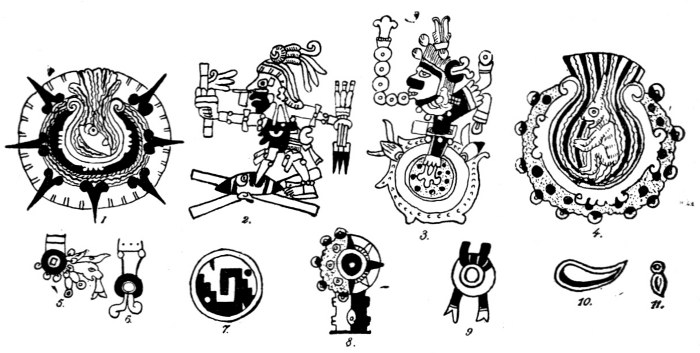
Figure 1
Realizing that some definite and important meaning must underlie the remarkable representations of Tezcatlipoca, I resorted to all possible means to gain an understanding of them. Referring to Nahuatl dictionaries, I found a variety of synonymous names for a person who limped or was lame or maimed. Amongst them was Popoztequi from poztequi, the verb, “to break a leg.” Other names were xopuztequi, xotemol and Icxipuztequi (icxitl=foot). The latter name happened to be familiar to me, for the commentator of the Vatican Codex, Padre Rios, gives it as the name of a god and translates it as “the lame devil.” He records it immediately after Mictlantecuhtli, the lord of the North, and designates it as the name of one of the four principal and primitive gods of the Mexicans.
The commentator of the Telleriano-Remensis Codex, moreover, records that these four gods were “said to have been stars and had fallen from the heavens. At the present time there are stars in the firmament named after them” (Kingsborough, vol. v, pp. 132 and 162).
Other synonymous terms for lame persons were icxinecuiltic and xonecuiltic. Tzimpuztequi, on the other hand, besides meaning lame, also signified something crooked, bent or incurvated. The second name furnished me with an important clue, for Sahagun distinctly records that the native name for the constellation Ursa Minor was Xonecuilli and that it was figured as an S (Historia, 1. vii, cap. 3). Besides, the Academia MS. of his monumental work contains the native drawing of this star-group reproduced as fig. 16, no. 1. He also states that S-shaped loaves of bread named xonecuilli were made at a certain festival in honor of this constellation, while the B.N. MS. records that a peculiar recurved weapon, figured in the hands of deities, was named xonequitl (fig. 16, nos. 2 and 3).
The above data furnished me with indisputable evidence of the existence, in ancient Mexico, of a species of star cult connected with the circumpolar constellations and with Tezcatlipoca, the lord of the North, the central figure of the native cosmogony. It was puzzling to find this god connected not only with the Ursa Major but also with Ursa Minor, but an indication suggesting a possible [pg 012] explanation or reconciliation of these apparent inconsistencies is furnished by the descriptions of the strange ritual performance, which was annually repeated at the festival Tlacaxipehualiztli and was evidently the dramatization of a sacred myth.
As an illustration and a description of this rite are contained in the B.N. MS. and the subject is fully treated in my commentary, I shall but allude here to its salient features. It represented a mortal combat between a prisoner, attached by a short piece of cord to the centre of a large circular stone, and five warriors, who fought him singly. The fifth, who was masked as an ocelot and always obtained victory in the unequal contest, fought with his left hand, being “left-handed,” a peculiarity ascribed to Huitzilopochtli. It was he who subsequently wore the skin of the flayed victim, an action which obviously symbolized a metamorphosis. One point is obvious: this drama exhibits the victor as a warrior who was able to circumscribe the stone freely and was masked as an ocelot—Tezcatlipoca—the Ursa Major, but was endowed, at the same time, with the left-handedness identified with Huitzilopochtli. This mythical personage vanquishes and actually wears the skin of the man attached to the stone; becomes his embodiment, in point of fact, and obtains the supremacy for which he had fought so desperately. In the light shed by the Codex Fuenleal, before cited, it was easy to see that the entire performance dramatized the mythical combat between Tezcatlipoca and Huitzilopochtli for the position of the ruling power, in the heavens—the sun. At the same time it was decidedly puzzling to find celestial supremacy personified by a man, firmly fastened to one spot, the centre of a stone circle. It was impossible not to perceive the identity of thought underlying the representation of this prisoner and the pictures of Tezcatlipoca, the one-footed or lame god—Xonecuilli the Ursa Minor. It was moreover of extreme interest to note the existence of traditional records, preserved in the native myths, of changes in the relative positions of celestial bodies and of the Ursa Major in particular.
Whilst dwelling upon the striking analogy existing between the representations of Tezcatlipoca held fast by the symbol of the North and the prisoner attached to what is described either as “a temalacatl, stone whorl” or “an image of the sun,” my gaze fell on a small model of the calendar-stone of Mexico, hanging above my desk, and rested on the symbol Ollin in its centre. The learned [pg 013] director of the National Museum of Mexico, Señor Troncoso (Anales del Museo Nacional, vol. ii), had expressed his view that this symbol was an actual figurative representation of the annual apparent movements of the sun, and recorded its positions at the solstitial and equinoctial periods. I had, moreover, submitted a drawing of this same figure to the eminent English astronomer, Prof. Norman Lockyer, and he had corroborated this view and established its correctness. On the other hand, I had long noted that the Ollin was usually figured with an eye, the symbol for star, in its centre (fig. 2, nos. 1, 3), and had also paid particular attention to the fact that the Mexicans had conceived the ideas of two suns, a young day sun and an ancient night or black sun. In the B. N. MS., on the mantas worn at their respective festivals, the day sun is depicted in a somewhat fanciful manner, in blue and red on a white field. The black sun is, however, represented in classical style, so to speak, as on the sculptured calendar-stone, with four larger and four smaller V-shaped rays issuing from it. In this connection it is well to recall here that the Mexicans had no specific name for the sun, beyond Tonatiuh, which merely means “that which sheds light” and could equally apply to the stars. In the picture-writings the image of the sun was employed to convey the word Teotl. But we find that this word, assumed to be equivalent to their “Dios” by the Spaniards, was also a reverential title bestowed upon chieftains and superiors and was constantly employed in the composition of words to signify something divine, supremely beautiful, etc. Whilst I was pondering on the possibility that the symbol Ollin might have represented the movements of the luminaries of night as well as the orb of day, my attention became fixed upon the four numerals in each of the ends of the [pg 014] symbol and I was struck by a certain resemblance between their positions and those of the four stars which form the body of the bear in the constellation of Ursa Major. It was then that it occurred to me, as mentioned in the opening sentence of this introduction, to look at the familiar constellations, with a view to verifying the resemblance noted above. As my gaze sought “the pointers” in Ursa Major, and then mechanically turned to Polaris, I thought of some passages I had recently re-read, in Professor Lockyer's Dawn of Astronomy, realizing that his observations, dealing with the latitude 26° (taking Thebes as representing Egypt), could equally apply to Mexico as this country stretches from latitude 15° to 31°.
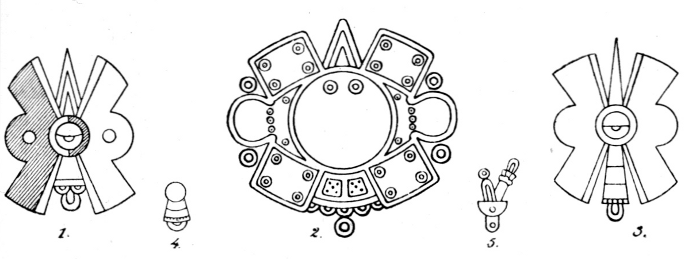
Figure 2
“The moment primitive man began to observe anything, he must have taken note of the stars, and as soon as he began to talk about them he must have started by defining, in some way or other, the particular star he meant.... Observers would first consider the brightest stars and separate them from the dimmer ones; they would then discuss the stars which never set (the circumpolar constellations) and separate them from those which did rise and set. Then they would naturally, in a northern clime, choose out the constellation of the Great Bear or Orion, and for small groups, the Pleiades (op. cit. p. 132).... A few years' observation would have appeared to demonstrate the absolute changelessness of the places of the rising and setting of the same stars. It is true that this result would have been found to be erroneous when a long period of time had elapsed and when observation became more accurate, but for hundreds of years the stars would certainly appear to represent fixity, while the movements of the sun, moon and planets would seem to be bound by no law ... would appear erratic, so long as the order of their movements was not known.”
The reflection that Ursa Major was probably the first constellation which made any deep impression upon the mind of prehistoric man in America, as elsewhere, lent an additional interest to the star-group, as I concentrated my mind upon its form and endeavored to imagine it in four equidistant positions, corresponding to the numerals in the symbol Ollin of the calendar-stone of Mexico (fig. 2, no. 2).
I succeeded in obtaining, in succession, mental images of the constellation in four opposite positions. This effort led to an unforeseen result which surprised me. In a flash of mental vision I perceived a quadrupled image of the entire constellation, standing [pg 015] out in scintillating brilliancy from the intense darkness of the wintry sky (fig. 3, no. 3). At the same moment I saw that it bore the semblance of a symmetrical swastika of giant proportions. This fact, so unexpectedly realized, gave rise to such an absorbing train of new ideas and interpretations of the data I had accumulated, that I left my window, on that memorable night, with a growing perception of the deep and powerful influence the prolonged observation of Polaris and the circumpolar constellations would naturally have exerted upon the mind of primitive man. Deeply impressed with the striking resemblance between the composite image of Polaris, Ursa Major, and certain forms of the swastika, I started on a fresh line of investigation, and devoted myself to the study of primitive astronomy and its influence upon the intellectual development of mankind in general and the American races in particular. After having worked, during thirteen years, without any preconceived ideas about the ancient Mexican civilization and without formulating any general conclusion concerning it, I saw all the knowledge I had slowly acquired fall into rank and file and organize itself into a simple and harmonious whole.
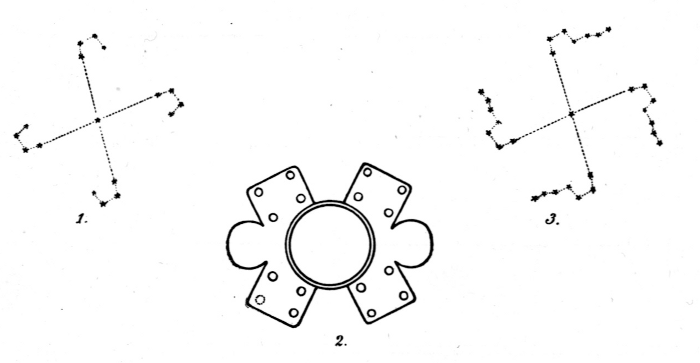
Figure 3
Realizing this I perceived how, with the origin of the swastika, I had found the origin of the set of primeval ideas which had governed the human race from its infancy and which, in Mexican and Central American civilizations, ultimately developed into their ingenious system of government and social organization.
[pg 016]
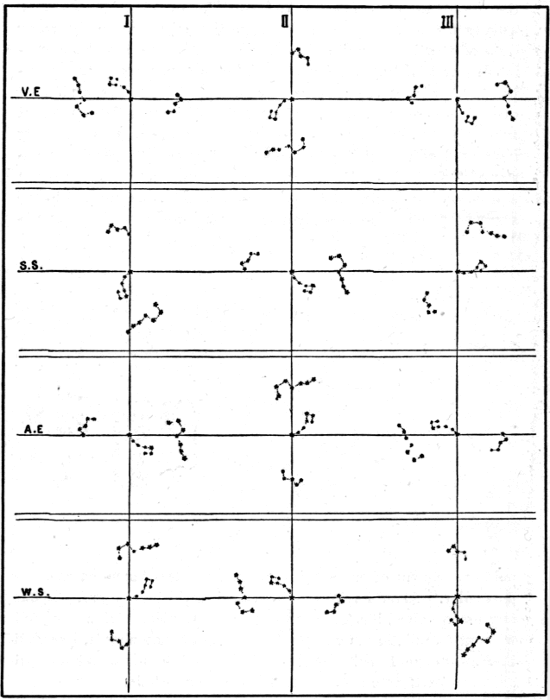
Plate I. Chart of the Polar Constellations. I: Just After Sunset. II: Midnight. III: Just Before Sunrise.
[pg 017]
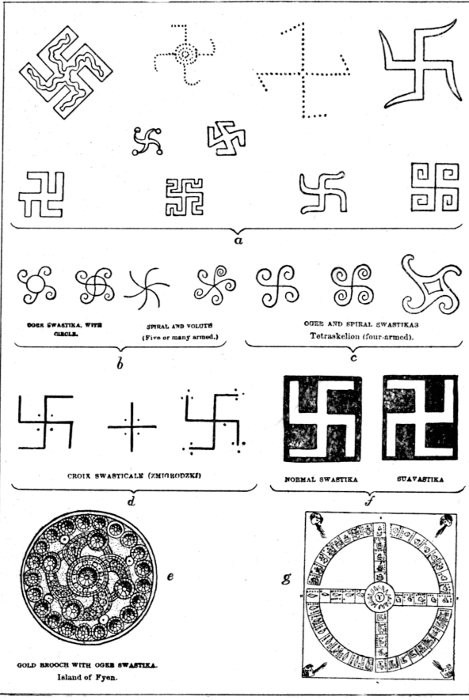
Plate II. Various Forms of the Swastika.
[pg 018]
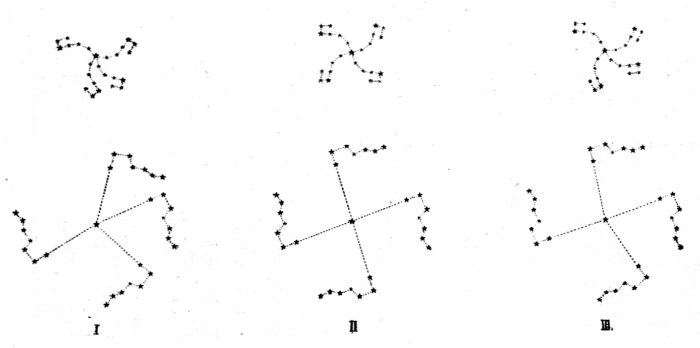
Figure 4
The sequel to the above episode was that, with the aid of my movable star-chart, I made the following notes of the apparent positions of the circumpolar constellations at the times of sunrise, midnight and sunset, choosing the periods of the solstices and equinoxes in order to obtain an exact division of the year (pl. i). Whilst studying these I realized that the midnight position was the only stable one, since the actual visibility of the constellations before dawn and after dusk would be subject to considerable variation, according to seasons, latitudes and atmospherical conditions. Having noted these positions, I next combined them separately, obtaining the remarkable results given in fig. 4. The combined midnight positions of the Ursa Major or Minor, at the four divisions of the year, yielded symmetrical swastikas, the forms of which were identical with the different types of swastika or cross-symbols (the normal, ogee and volute, etc.), which have come down to us from remote antiquity and are reproduced here for comparison (pl. ii, a-f). Reflection showed me that such composite pictures of the Ursa constellations constituted an exact record of their annual rotation, and afforded a perfect sign for the period of a year. I moreover perceived how the association of rotatory motion with the advance of time, and its division into fixed periods or cycles, would be the natural outcome of the recognition of the annual rotation of the star-groups.
The Calendar-Swastika, or cross of ancient Mexico (pl. ii, g) constitutes an absolute proof of the native association of the cross-symbol with the ideas of rotatory motion and the progress of [pg 019] time, and furnishes an indication that, in an analogous manner, the swastika may have been primarily and generally employed by primitive races, as a sign for a year or cycle. A close scrutiny of the respective forms of the crosses yielded by Ursæ Major and Minor shows that the normal swastika and suavastika may be explained as the separate representations of the two constellations—the angular break in the outline of Ursa Major suggesting the direction of the bend to the right of the arms of the normal swastika, whilst the form of Ursa Minor obviously suggests the bend to the left which is characteristic of the suavastika.
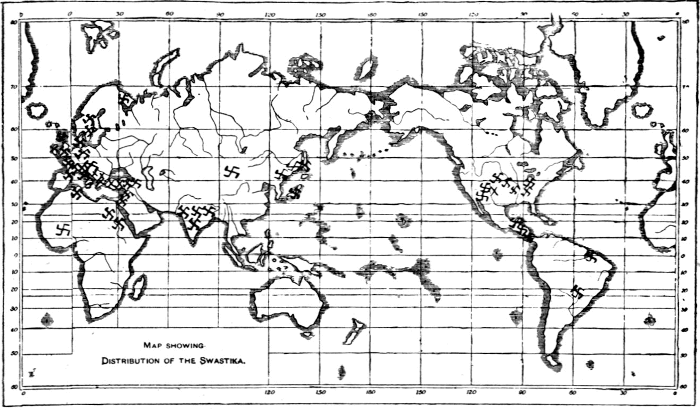
Figure 5
My growing conviction that the Bear constellations had furnished the archetype of the different forms of swastika and cross-symbols, found subsequent support when I referred to the map showing the geographical distribution of the ancient symbol published by Prof. Thomas Wilson in his valuable and comprehensive monograph on the subject,1 to which I am indebted for much information [pg 020] and several illustrations (pl. ii, a-f, etc.). The map, reproduced here (fig. 5), proves that, with two exceptions, which can be attributed to a migration southward, the employment of the swastika has been confined to the northern hemisphere, i. e., precisely to that portion of our globe from which the circumpolar constellations are visible.
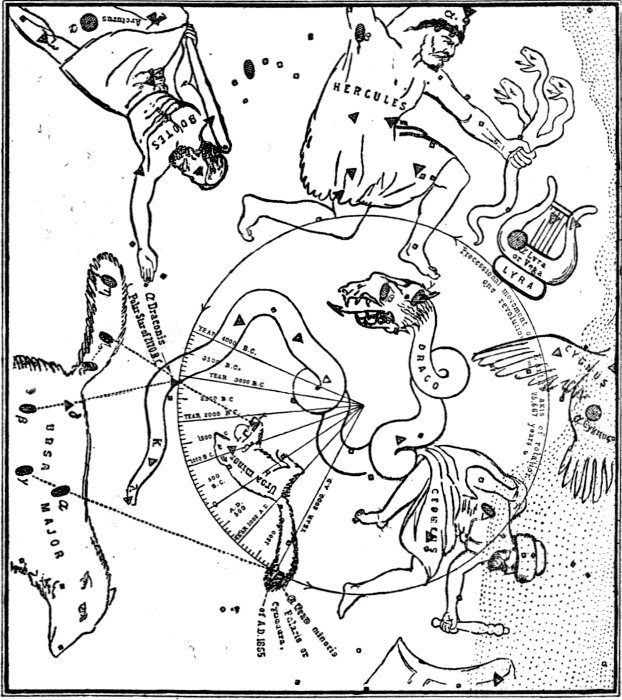
Figure 6. Star-Map, Representing The Precessional Movement Of The Celestial Pole From The Year 4000 B.C. To The Year 2000 A.D. (From Piazzi Smyth.)
The interesting possibility of being able to determine, approximately, the date in the world's history when the swastika began to be employed as a symbol, next occurred to me. Piazzi Smyth's star-map, discussed and reproduced in Professor Lockyer's work already cited (fig. 6), illustrates the changes of direction of the [pg 021] earth's axis in space, which gives rise to what is called the precession of the equinoxes and has a cycle of something like 25,000 or 26,000 years. Reference to this star-map (fig. 6) proved that the observations, leading to the adoption of the swastika as a symbol, could not possibly have been made until after Ursa Major had become circumpolar, about 4,000 B.C. At that period, when Draconis was the pole-star, the circle described about it by Ursa Major was considerably closer than it is at present. The accompanying illustrations (fig. 7), subject to correction, demonstrate the relative distance of the constellation about 2,770 B.C., 1,800 B.C., and 2,000 A.D., and show how much more strikingly impressive the polar region of the heavens was in remote antiquity.
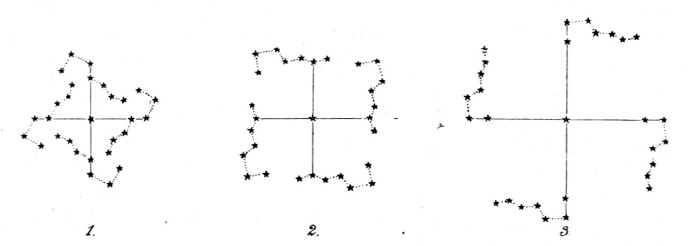
Figure 7.
Let us now briefly review some of the ideas which would naturally suggest themselves to the mind of the primitive observer, after he had recognized the apparent immovability of the polar-star, concentrated his attention upon this feature, and contrasted it with the varying motions of all other celestial bodies in general and with the rotation of the circumpolar star-groups in particular.
This recognition would lead to his gradually learning to utilize Polaris as a means of ascertaining direction. His appreciation of valuable guidance rendered in perilous wanderings would develop feelings of trust, dependence and gratitude towards the one changeless star which permanently rendered valuable services and under whose guidance difficult and essential nocturnal expeditions could be safely undertaken. Superiority and, eventually, extensive supernatural power would more and more be attributed to it, as knowledge was gained of the laws of motion from which it alone seemed to be exempt. This exemption would cause it to be viewed as superior to all other heavenly bodies and even to the sun, and it is easy [pg 022] to see how this idea, becoming predominant, might cause the cult of the pole-star to disestablish an organized sun-cult amongst some tribes. Historical evidence, to which I shall revert more fully proves, indeed, that a native American ruler and reformer actually employed the following reasoning in order to convert his council and people from the worship of the sun to that of a superior divinity which could have been no other but Polaris: “It is not possible that the sun should be the God who created all things, for if so he would sometimes rest and light up the whole world from one spot. Thus it cannot be otherwise but that there is someone who directs him and this truly is the true Creator.”
These words shed a whole flood of light upon primitive religious ideas at an early stage of development. They prove that the association of repose and immovability with the supreme power signified a radical change of thought, based upon prolonged astronomical observation, and indicated intellectual advancement. Attempts to render the new idea objective, to express it and impress it upon the multitude, would naturally end in the production of images of the supernatural power, representing or typifying immovability, changelessness, strength combined with absolute repose.
It is thus rendered evident what a deep significance may be embodied in the rudest images of supernatural beings in attitudes of repose, since a prolonged course of astronomical observation and reasoning may have preceded their production.
Simultaneously with the recognition of Polaris as an immutable centre of axial energy, the rotatory movement of Ursa Major must have excited interest and observation. It was inevitable that star-gazers should gradually recognize a constant agreement between certain positions of Ursa Major and Cassiopeia after dusk for instance, and the annual recurrence of rain, verdure and bountiful food-supplies.
The members of a tribe who, more observant than others, had learned to associate certain positions of these constellations with the seasons and, as a consequence, were able to decide when expeditions to distant localities, in quest of game or fruit, might be successfully undertaken, would naturally assume leadership and command obedience and respect.
The sense of responsibility, superiority and, possibly, rivalry would act upon such individuals as a powerful incentive to further [pg 023] observation and thought and it is evident that, as their mental faculties expanded and one generation transmitted its store of accumulated knowledge to the next, a regular caste of astronomer-leaders would develop, with a tendency to conceal the secrets of their power from the ignorant majority. A broken line, carved on a rock by one of these primitive observers, would have constituted a valuable secret note of the position of Ursa Major on a memorable occasion and would be looked upon as a mystic or magical sign by the uninitiated. A series of such inscriptions might represent the store of astronomical knowledge accumulated by several generations of observers, and it is interesting to recognize that such astronomical records as these were probably the first which men were impelled to perpetuate in a lasting form; since it was absolutely necessary that they should be permanently available for reference at prolonged intervals of time. What is more, the mere fact of being obliged to refer to these inscriptions would cause the astronomers to reside permanently in one locality. The habit of consulting the prophet or oracle before undertaking important steps, involving the welfare of the tribe, would gradually cause the rocks or cavern in which he resided to be invested with a certain sacredness.
It is thus evident that the first men, who rudely scratched the outline of Ursa Major or Minor on a rock, took what was probably one of the most momentous steps in the history of the human race, and it is easy to see how a variety of combinations of circumstances would have led many men, in widely-separated localities and at different periods of the world's history, to perform precisely the same action. In some cases, under favorable surroundings, the rudimentary attempt would mark the starting point for a long line of patient observation and study, which would inevitably lead to the creation of centres of intellectual growth, to the association of the different positions of the constellation with the seasons and culminate in the habitual employment of a swastika as the sign for a year, or cycle of time.2
[pg 024]
The idea of rotation, associated with calendar signs and periods, finds its most striking and convincing exemplification in the following description of the ancient Mexican game “of those who fly,” translated from Clavigero (op. et ed. cit. p. 236). This performance, which furnished a diversion to the Spaniards after the Conquest, had evidently been, originally, connected with religious ideas. “The Indians selected a tall, stout and straight tree, and, lopping off its branches, planted it firmly in the centre of the great square” (which was always situated in the centre of the city and had four roads leading to it from the four quarters). “On the summit they placed a large cylinder of wood, the shape of which was compared by the Spaniards to that of a mortar. Four strong ropes hung from this and supported a square frame composed of four wooden beams. Four other ropes were fastened by one end to the pole itself and wound around it thirteen times. Their loose ends were passed through holes in the middle of each beam and hung from these. Four Indians, masked as eagles or other birds, ascended the pole singly, by means of certain loops of cord, and mounting on the cylinder they performed in this perilous position a few dance-like movements. Each man then attached himself to the loose end of one of the hanging ropes, and then, with a violent jerk and at the same moment, the four men cast themselves into space from their positions on the beams. This simultaneous movement caused the frame and cylinder to revolve and uncoil the ropes to which the men were fastened and these descended to the ground after performing a series of widening circles in the air. Meanwhile a fifth individual, who had mounted the wooden cylinder [pg 025] after the others, stood on this as it revolved, beating a small drum with one hand, whilst he held a banner aloft with the other.” Whilst it is obvious that this peculiar and dangerous performance clearly symbolized axial rotation, typified by the revolving pivot and the four men in aërial motion, its full meaning and intention are only made clear by the following explanation recorded by Clavigero. “The essential point in this game was to calculate so exactly the height of the pole and the length of the ropes, that the men should describe precisely thirteen circles each before reaching the ground, so as to represent the cycle (of 4×13=)52 years.”
This passage constitutes absolute proof that the Mexican Calendar system was intimately associated with axial rotation and ideas such as could only have been derived from observation of Polaris and of the circumpolar constellations. The game itself was a beautiful and well-conceived illustration of the flight of time, typified by the aërial circles performed by the men masked as birds, and of its methodical division into fixed periods.
Leaving the subject of the calendar for the present we must revert to my tables recording the apparent annual and nocturnal axial rotation of the circumpolar constellations.
Whilst studying these the reflection naturally arose, that the people who observed Ursa Major must have paid equal attention to Cassiopeia and noticed that these constellations ever occupied opposite positions to each other as they circled around the pole. Dwelling on the fact that in ancient Mexico Ursa Major was associated with an ocelot, I remembered the many representations in which an ocelot is represented as confronting an eagle, usually in mortal combat. Mexican war-chiefs were classed into two equally honorable grades, designated as the “ocelots and the quauhtlis, i. e., eagles.” The constellation of Cassiopeia presents to me, a marked resemblance to the image of a bird with outspread wings, whose head is turned toward Polaris. The fact that when this star-group seems to be above, Ursa Major seems to be below, and vice versa, would obviously suggest the idea of an eternal combat between two adversaries who alternately succumbed and resuscitated. It was interesting on reasoning further, to note that once the above idea had taken root it must have been impossible not to associate in course of time, the quadruped and the bird with the elements to which they seemed to pertain, and gradually to conceive the idea of an everlasting antagonism between the powers of [pg 026] the sky and of the earth, or light and darkness, and other opposites which suggested themselves naturally, or were artificially created, by the fertile mind of man. In this connection it should be observed that the mythical adversary of Tezcatlipoca, the ocelot, designated as Ursa Major, is Huitzilopochtli, whose idol, in the Great Temple of Mexico, represented him masked as a hummingbird (see Atlas Duran). The special reason why this bird became associated with the god is explained by the following passage in Gomara (Histoire générale des Indes. Paris, 1584, chap. 96, p. 190): “This bird died, or rather fell asleep in the month of October and remained attached by its feet to a twig. It awakened again in April when the flowers blossomed. For this reason, in the language of the country it is named Huitzitzilin, the resuscitated.” We therefore see that whilst it is stated in the myth that the ocelot arose again after having been cast down from the sky by Huitzilopochtli, the very name of the latter betokened that the bird-god had also only just “resuscitated” from a presumably similar defeat.
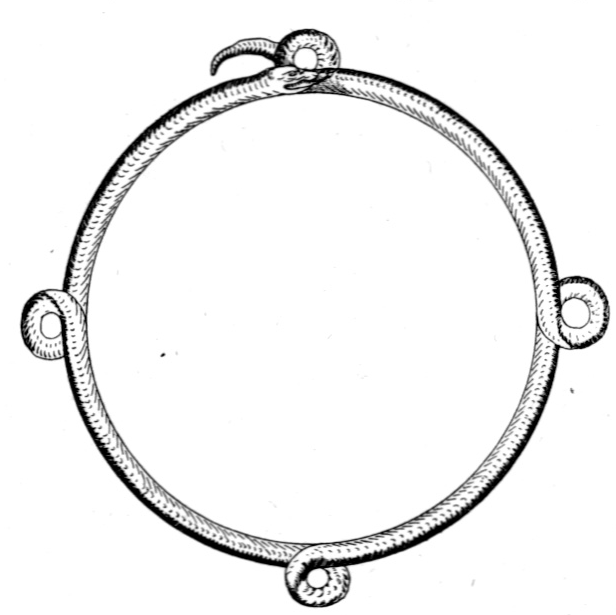
Figure 8.
As one and the same object may suggest several resemblances at the same time or consecutively, and thus give rise to a group of associations around a single figure, I venture to point out that the zigzag form of Cassiopeia may well have been compared to forked lightning and caused the idea of lightning and thunder to become indissolubly connected with the conception of a great celestial bird. Again there is the possibility that the same star-group may have more strikingly suggested, to other people, the idea of the winding body of a serpent describing a perpetual circle around a central star. In Mexico, as elsewhere, we find the serpent closely associated with the idea of time. It is represented as encircling the calendar wheel published by Clavigero (fig. 8). Four loops, formed of its body, mark the four divisions of the year. Twin serpents, whose heads and tails almost meet, are sculptured around the famous calendar-stone of Mexico. Four serpents whose bent [pg 027] bodies form a large swastika and whose heads are directed towards a central figure, are represented in the Codex Borgia in association with calendar-signs (fig. 9, cf. Féjérvary, p. 24). I shall have occasion to refer in detail to Mexican serpent-symbolism further on.
Meanwhile I would submit the interesting results obtained on combining the positions apparently assumed by the circumpolar constellations during a single night. The tables exhibit four composite groups representing the positions at the solstitial and equinoctial periods (fig. 10).
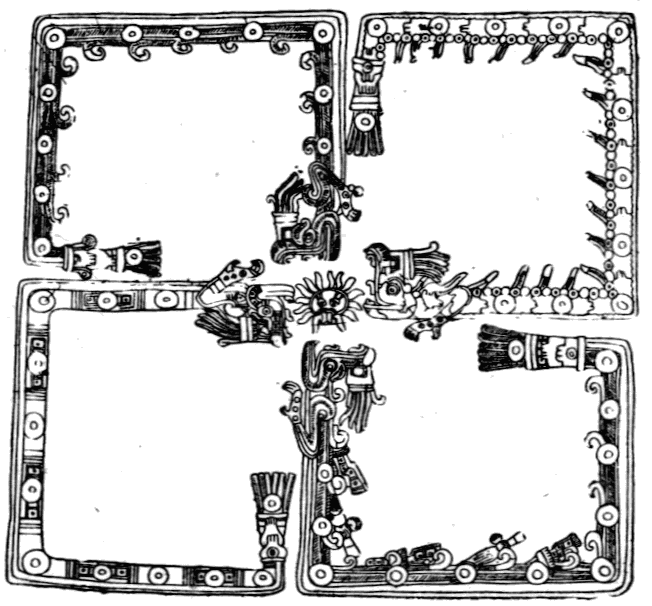
Figure 9.
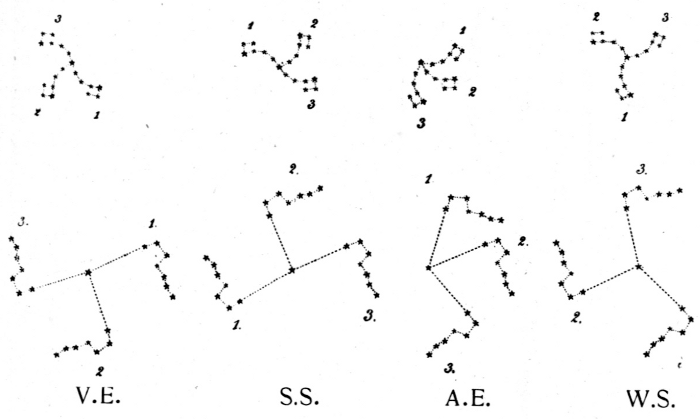
Figure 10.
The night of the winter solstice, the longest of the year, yielded alone a symmetrical figure. It resembled the well-known triskelion, the companion-symbol of the swastika (figs. 10 and 11). Just as this had proved to be the most natural of year symbols, so the triskelion revealed itself as a natural sign of the winter solstice, the period recognized and celebrated by most inhabitants of the [pg 028] northern hemisphere as the turning-point of the year. In a climate like that of Mexico and Central America, however, where the year divided itself naturally into a dry and a rainy season, it is evident that the winter solstice would be less observed and that the ardently-desired recurrence of the rainy season, after a long and trying period of drought, should be regarded as the annual event of utmost importance. Indeed, if carefully looked into, the entire religious cult of these people seems to express but one great struggling cry to the God of Nature for life-giving rain, and a hymn of thanksgiving for the annual, precious, but uncertain gift of water.
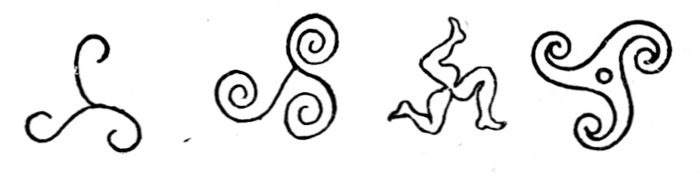
Figure 11.
To these supplicants the winter solstice betokened little or nothing and it is not surprising to find no proofs of the employment of the triskelion as a sacred symbol in ancient Mexico. On the other hand, it has been traced by Mr. Willoughby on pottery from Arkansas, and in Scandinavia, where the circumpolar constellations have doubtlessly been observed from remote times, and the winter solstice has ever been hailed as the herald of coming spring, the triskelion is often found associated with the swastika.
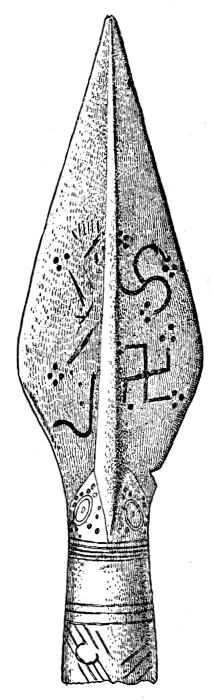
Figure 12.
I am indebted to Prof. Thomas Wilson's work already cited for the two following illustrations of objects exhibiting this association. The first is a spearhead found in Brandenburg, Germany (fig. 12). The second is a bronze brooch from Scandinavia, to which I shall presently revert (fig. 13). It exhibits, besides the [pg 029] triskelion, swastika and circle, the S-shaped figure which was, as I shall show further on, the sign actually employed by the ancient Mexicans and Mayas as the image of the constellation Ursa Minor, whose outline it indeed effectually reproduces.
Before referring to the Mexican and Maya representations of the star-group, I would next demonstrate that the sacred numbers of Mexico, and of other countries situated in the northern hemisphere, coincide exactly with the number of stars in the circumpolar constellations themselves and in simple combinations of the same.
Ursa Major and Ursa Minor each contains seven stars, and the number seven is the most widely-spread sacred number. Ancient traditions record that the race inhabiting Mexico consisted of seven tribes who traced their separate origins to seven caves, situated in the north. In memory of these, at the time of the Conquest, there were seven places of sacrifice in the city of Mexico. I shall recur to the number seven further on, in discussing the native social organization, and now direct attention to the five stars of Cassiopeia and to the fact that the combination of the stars in this constellation with Polaris and Ursa Major yields the number thirteen. This result is specially interesting since the entire Calendar-system of Mexico and Yucatan is based on the combination of the numerals 13+7=20, the latter again being 4×5.
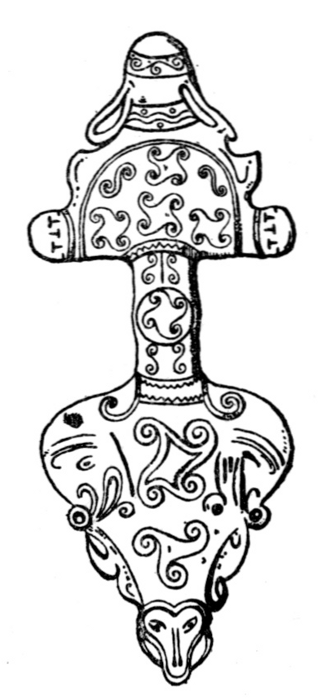
Figure 13.
On the other hand the same number, 13, is also obtained by the combination of the Ursæ star-groups with Polaris. The number 5 is constantly yielded by Cassiopeia and the four-fold repetitions of the groups supply the suggestion of the number 4. The combination of Ursa Minor and Cassiopeia yields 12. The accompanying figure exhibits swastikas composed of Ursa Minor accompanied by Ursa Major and Cassiopeia separated and combined (fig. 14). I next direct attention to the peculiar difference in the numerical values of the Ursæ swastikas.
In the first, the central star, surrounded by four repetitions of the seven-star constellation, yielded a total of twenty-nine stars—4x5+9. [pg 030] Further combinations will be seen by a glance at the Ursa Major swastika (fig. 4). The analysis of the Ursa Minor swastika is not so simple and occasions a certain perplexity.
When I had first combined the four positions of this constellation, I had, naturally, and without further thought, figured Polaris but once, as the fixed centre, whereas I had repeated the other stars of the compact group four times. It was not until I began to count the stars in the swastika that I realized how I had, unconsciously, made one central star stand for four, and thus deprived the composite group of the numerical value of three stars. On the other hand, if I repeated the entire constellation four times, I obtained a swastika with four repetitions of Polaris in the middle. In this way, however, Polaris became displaced, and the idea of a fixed centre was entirely lost. A third possible method of composing the swastika was to allow one central star for each cross-arm. But this gave two central stars, each of which would represent two stars. Unless enclosed in a circle and considered as a central group by themselves, the four and the two repetitions of Polaris could not convey the idea of a pivot or fixed centre. The three respective numerical values obtained from these experimental combinations were 4×6+1=25, 4×7=28, and finally 2×13 or 4×6+2=26. In each swastika the central star forcibly stood for and represented two or four (fig. 15).
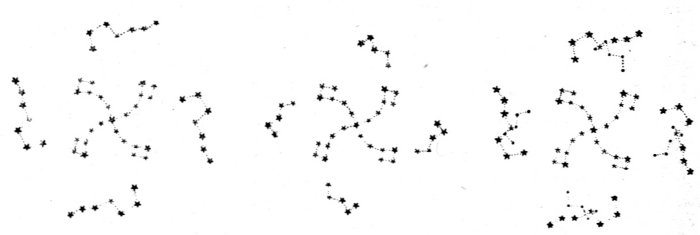
Figure 14.
In the triskelions the same perplexity arose: if Polaris was repeated, the idea of a fixed centre was lost (fig. 15); if figured singly, it nevertheless necessarily and inevitably stood as an embodiment of three stars. Reasoning from my own experience, I could but perceive, in the foregoing facts, a fruitful and constant source of mental suggestions, the natural outcome of which would be the association of the central star with an enhanced numerical [pg 031] value, and a familiarity with the idea of one star being an embodiment of two, three or four.
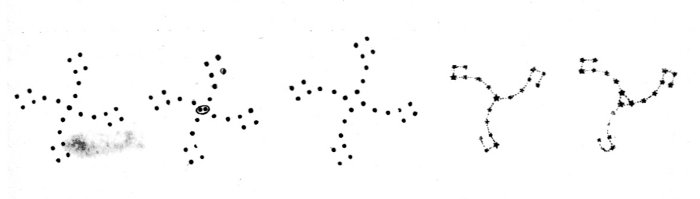
Figure 15.
As the evolution of religious thought and symbolism progressed, this idea would obviously lead to the conception of a single being uniting several natures in his person. In this connection it is certainly extremely interesting to find the serpent associated with the Calendar in Mexico and Yucatan, its Nahuatl name being homonymous for twin, i. e. two, and the Maya for serpent, can or cam, being homonymous for the number four. The serpent was, therefore, in both countries the most suggestive and appropriate symbol which could possibly have been employed in pictography, to convey the idea of dual or quadruple natures embodied in a single figure.3 Added to this the circumstance that, to the native mind, the serpent, upon merely shedding its skin, lived again, we can understand why the ancient Mexicans not only employed it as a [pg 032] symbol of an eternal renewal or continuation of time and of life, but also combined it with the idea of fecundity and reproductiveness. In Yucatan where the Maya for serpent, can, is almost homonymous with caan=sky or heaven and the adjective caanlil=celestial, divine, the idea of a divine or celestial serpent would naturally suggest itself. It is therefore not surprising to find, in both countries, the name of serpent bestowed as a title upon a supreme, celestial embodiment of the forces of nature and its image employed to express this association in objective form. In Yucatan one of the surnames of Itzamná, the supreme divinity, was Canil, a name clearly related to caanlil=divine and can=serpent.
In Mexico the duality and generative force implied by the word “coatl” are clearly recognizable in the native invocations addressed to “Our lord Quetzalcoatl the Creator and Maker or Former, who dwells in heaven and is the lord of the earth [Tlaltecuhtli]; who is our celestial father and mother, great lord and great lady, whose title is Ome-Tecuhtli [literally, two-lord=twin lord] and Ome-Cihuatl [literally, two-lady=twin lady”] (Sahagun, book vi, chaps. 25, 32 and 34).
The following data will suffice to render it quite clear that the Mexicans and Mayas employed the serpent as an expressive symbol merely, signifying the generative force of the Creator to whom alone they rendered homage. It is no less an authority than Friar Bartholomew de las Casas who maintained that “in many parts of the [American] Continent, the natives had a particular knowledge of the true God; they believed that He created the Universe and was its Lord and governed it. And it was to Him they addressed their sacrifices, their cult and homage, in their necessities...” (Historia Apologetica, chap. 121).
Friar Bartholomew specially adds that this was the case in Mexico according to the authority of Spanish missionaries and no one can doubt that this was the case when they read that in the native invocations, preserved by Sahagun, the supreme divinity is described as “invisible and intangible, like the air, like the darkness of night,” or as the “lord who is always present in all places, who is [as impenetrable as] an abyss, who is named the wind [air or breath] and the night.” “All things obey him, the order of the universe depends upon his will—he is the creator, sustainer, the omnipotent and omniscient.” He is termed “the father and mother of all,” “the great god and the great goddess,” “our lord and protector [pg 033] who is most powerful and most humane,”—“our lord in whose power it is to bestow all contentment, sweetness, happiness, wealth and prosperity, because thou alone art the lord of all things.” One prayer concludes thus: “Live and reign forever in all peace and repose thou who art our lord, our shelter, our comfort, who art most kind, most bountiful, invisible and impalpable!” (Sahagun, book vi, on the rhetoric, moral philosophy and theology of the Mexicans, chaps. 1-40). It is related that, in gratitude for the birth of a son, the ruler of Texcoco, Nezahual-coyotl erected a temple to the Unknown God.... It consisted of nine stories, to symbolize the nine heavens. The exterior of the tenth, which formed the top of the nine other stories, was painted black with stars. Its interior was encrusted with gold, precious stones and feathers and held “the said god, who was unknown, unseen, shapeless and formless” (Ixtlilxochitl, Historia Chichimeca ed. Chavero, p. 227; see also p. 244). A passage in Sahagun (book vi, chap. vii) states that “the invisible and imageless god of the Chichimecs was named Yoalli-ehecatl [literally, night-air or wind], which means the invisible and impalpable god ... by whose virtue all live, who directs by merely exerting his wisdom and will.” In the Codex Fuenleal (chap. 1) the remarkable title of “wheel of the winds=Yahualliehecatl,” is recorded as “another name for Quetzalcoatl.” This undeniably proves that the Mexicans not only figured the Deity by the image of a serpent but also thought of him as a wheel which obviously symbolized centrical force, rotation, lordship over the four quarters, i. e., universal rulership.
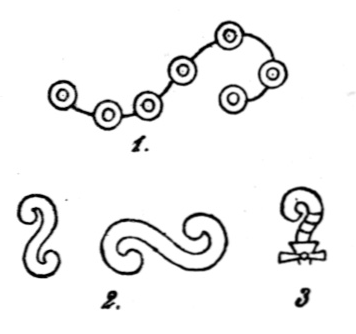
Figure 16.
Returning from these ideas of later development to the primitive source of their suggestion, let us now examine the native picture of Xonecuilli, Ursa Minor, preserved in the unpublished Academia MS. of Sahagun's Historia, in Madrid (fig. 16, no. 1). It is an exact representation of the star-group. The fact that the seven stars are figured of the same size in accurate relation to each other, either proves that the eyesight of the native astronomers was extremely keen and their atmosphere remarkably clear, or that possibly, the minor stars of the group were more brilliant in ancient times, than they are now. Astronomers tell us, for instance, that [pg 034] as late as the seventeenth century the star in the body of Ursa Major nearest to the tail, was as bright as the others, while it is now of the fourth magnitude only.
It must be admitted that the shape of the constellation resembles an S. An SS sign is mentioned by Sahagun (Historia, book viii, chap. 8) as occurring frequently, as a symbolical design on native textile fabrics. It figures as such, in the black garments of the female consort of Mictlantecuhtli in the Vienna Codex, pp. 23 and 33. He denounces it as suspect and hints that it was intimately connected with the ancient religion.
S-shaped sacred cakes, called Xonecuilli, were made during the feast of Macuilxochitl=five flowers, and are figured (fig. 16, no. 2) in the B. N. MS. (p. 69) with a four-cornered cross-shaped cake of a peculiar form (fig. 20, iii), which is found associated with five dots or circles in the Codices and also with the Tecpatl-symbol of the North (fig. 20, i and ii).
A recurved staff, which is held in the hand of a deity in the B. N. MS. is designated in the text as a xonoquitl (fig. 16, no. 3). Amongst the insignia of the “gods,” sent as presents by Montezuma to Cortés upon his landing at Vera Cruz, were three such recurved “sceptres,” the descriptions of which I have collated and translated in my paper on the Atlatl or Spear-thrower of the Ancient Mexicans (Peabody Museum Papers, vol. 1, no. 3, Cambridge, 1891, p. 22). In this work I presented my reasons for concluding that these recurved sceptres were ceremonial forms of the atlatl. I now perceive that they were endowed with deeper significance and meaning. The Nahuatl text of Sahagun's Laurentian MS. of the Historia de la Conquista (lib. xii, chap. iv) records the name of one of these staffs as “hecaxonecuilli,” literally “the curved or bent over, air or wind,” and describes it as made of “bent or curved wood, inlaid with stars formed of white jade=chalchihuite.” This passage authorizes the conclusion that four representations in the B. N. MS. of black recurved sceptres, exhibiting a series of white dots, are also heca-xonoquitl, inlaid with stars, and that all of these are none other but conventional representations of the constellation Xonecuilli, the Ursa Minor. In each case the deity, carrying the star-image, also displays the ecacozcatl the “jewel of the wind,” the well-known symbol of the wind-god. In one of these pictures (p. 50) he not only bears in [pg 035] his hand the star-image, but also exhibits a star-group on his head-dress, consisting of a central-star, on a dark ground, surrounded by a blue ring. Attached to this against a dark ground, six other stars are depicted, making seven in all. In connection with this star-group it is interesting to note that the hieroglyph, designated by Fra Diego de Landa as “the character with which the Mayas began their count of days or calendar and named Hun-Imix,” furnishes a case of an identical though inverted group (Relacion de las Cosas de Yucatan, ed. B. de Bourbourg, p. 237). Enclosed in a black ring, the glyph displays, above, a large black dot with six smaller ones grouped in a semicircle about it, and below, four perpendicular bars.
Subject to correction, I am inclined to interpret this glyph as a hieratic sign for the constellation Ursa Minor and its four movements, and to consider it as furnishing a valuable proof of the origin of the Maya Calendar.
The seemingly inappropriate procedure of figuring shining stars by black dots actually furnishes the strongest proof that a star group is thus represented; for, in the Maya language, “ek” is a homonym for star and black, and a black spot was, in consequence, the most expressive sign for a star. This fact affords a valuable explanation of the reason why the ocelot, whose skin is spotted with black, was employed as the figure of the nocturnal sky, and clearly proves that the Mexicans adopted this symbol and its meaning from the Mayas.
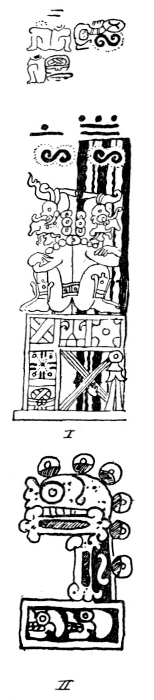
Figure 17.
We will now revert to the S-shaped sign. Its association with images of star is further exemplified in Mexican Codices. It occurs on the wall of a temple, in combination with symbols for stars and the North-Mictlan, which consist in this case, of skulls and cross-bones (fig. 17, ii).
In the Dresden Codex, of Maya origin, there is an extremely important page on which the S-sign occurs in connection with twin deities, besides rain and cross symbols (fig. 17, i). A careful examination [pg 036] of the group shows that one of the seated figures is accompanied by a downpour of water (painted blue in the original), besides the S-symbol which is also repeated above the head of his companion. Higher up, on the same page, the S occurs again in a group of glyphs alongside of twin-seated figures. These, as well as the single-seated form beneath them, have an eye or a large black spot surmounted by dots instead of a head (Vocabulaire de l'écriture hiératique de Yucatan, p. 38). Monsieur Léon de Rosny has identified this figure, which also occurs in the Codex Troano, as the image of the supreme divinity of the Mayas, of whom more anon, one of whose titles was Kin-ich-ahau, literally Sun-eye lord.
A similar sign consisting of the lower half of a human body seated, with a large eye on its knees is repeated several times in the Borgian Codex. This form is also figured as seated in a temple, without the eye-star, but three stars are on the roof and the S-sign is on the lower wall of the building (Borgian Codex, p. 16).
The above facts demonstrate that, in both MSS. derived from different sources, the same association of ideas is expressed.4 The S sign appears in connection with twin- or single-seated forms, surmounted by a symbol for star. It is unnecessary for me to lay further stress upon the obvious facts: that the only celestial body which could possibly have been associated with a seated form, suggesting repose, was Polaris. It is, moreover, only by assuming that the sign of the seated star represents the stationary pole-star that its combination in the Codices with the S-sign—Xonecuilli—Ursa Minor, can be understood. I likewise draw attention to the possibility that the S, or single representation of the constellation, may well have been employed as a sign for the summer solstice, [pg 037] since, in some localities, during the shortest night of the year, Ursa Minor may have been visible in one position only. Assuming that the triskelion was the sign for the winter solstice we should thus have natural signs for the two nights marking the turning-points of light and darkness in the year.
Reverting to fig. 17, i, from the Codex Dresdenis, I draw attention that it furnishes definite proof that the Mayas associated the idea of the immovable seated star with twin deities and that they connected the S-symbol with cross and rain symbols. A striking combination of the latter symbols is represented under the principal seated figures. It consists of a diagonal cross traversed perpendicularly by a band of blue water.
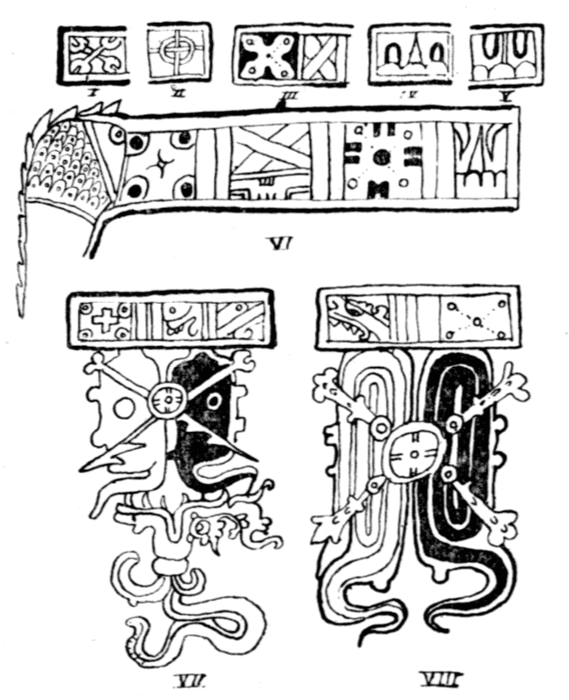
Figure 18.
Further Maya cross-symbols should be cursorily examined here, viz: fig. 18, i, ii, iii, vi, vii and viii. They will be found to consist of variations of two fundamental types, often figured alongside of each other and enclosed in a square, or circle. One type consists of two diagonally crossed bars, plain or representing cross bones (i). A rectilinear cross with interlaced circle (ii) is also found. The other type exhibits a small cross, square, circle or dot in the centre of the square with a circle in each corner. In some cases these are united by a series of dots to the central circle and thus form a diagonal cross (vi and viii) which is sometimes figured as contained in a flower with four petals, such as is also found in Mexican symbolism. The diagonal, dotted cross is frequently combined with four pairs of black bars, placed in the middle of each side of the square, pointing towards the centre. Similar pairs of black bars are figured in the B. N. MS. (p. 3) on the manta of Mictlantecuhtli, with stars, around one of his symbols, a spider. They likewise recur on two of several sacrificial papers on p. 69, amongst which one exhibits a diagonal [pg 038] cross, another the S-sign, while others display realistic drawings of stars with six or eight points.
The pairs of bars figure in the hieroglyph designated by Maya scholars as the sign for Kin, the sun, which may be seen in the centre of large diagonal cross-symbols in fig. 18, vii, viii, from the Dresden Codex: The cross, of fig. 18, vii, is composed of two bones and two arrowpoints, a particularly interesting combination considering that in the Maya a bone is bak, an arrow is kab-cheil and the name given to the gods of the four quarters “the sustainers of the world,” is Bakab. It cannot be denied that the phonetic elements of this name occur in the words for bones and arrows which form the cross, symbolic of the four quarters. In fig. 18, viii, the cross may be composed of four bones, but of this I am not certain. In both cases, however, the crosses rest on a curious double and parti-colored symbol and are associated with serpent signs, in which the open jaws and teeth are prominent features. It is noteworthy that while “can” or “cam” is the Maya for serpent, the word “camach” means jaw. The figure consisting of the upper jaw only of a serpent, in the left hand corner of the band above, fig. 18, viii, proves, therefore, to be a cursive phonetic sign for serpent.
The parti-colored symbol combined with the cross obviously signifies a duality, such as light and darkness, the Above and the Below and a series of dualities—possibly the two divisions of the year, the dry and rainy seasons. In Mexico we are authorized by documentary evidence, to give a wider and deeper interpretation to the symbol of duality, for it can be absolutely proven that the Mexican philosophers divided the heavens into two imaginary portions, and respectively identified these with the male and female principles.
In Nahuatl the West was designated as Cihuatlampa, “the place or part of the women.” The souls of the women who had earned immortality were supposed to dwell there, whilst the souls of the men resided in the East. In the appendix to book iii of Sahagun's Historia, it is described how, according to the native belief, the souls of the male warriors hailed the daily appearance of the sun above the eastern horizon, and escorted it to Nepantla, the zenith. Here the souls of the women awaited it and assumed the duty of escorting the sun to the western horizon, the symbol for which was calli=the house. The above passage indicates that [pg 039] the native philosophers imagined across the middle of the sky a line of demarcation, separating the portions of the heaven respectively allotted to the male and female souls. For four years after death these souls retained their human form, and then, after passing through nine successive heavens, entered into the celestial paradise where they assumed the forms of different kinds of butterflies and humming-birds. The names of these are enumerated in the Nahuatl text of Sahagun's Laurentian MS. (book iii).5 The symbolism of the humming-bird has already been explained by a passage cited from Gomara's Historia. In this connection it is extremely interesting to find the humming-bird represented in the B. N. MS., as sucking honey from a flower, which is attached by a cord, covered with bird's down, to a bone, the symbol of death.
This peculiar but expressive group of symbols figures only on the head-dresses of deities wearing certain other symbols, amongst which we find the Eca-cozcatl and Eca-xonequilli the image of Ursa Minor, already described.
The merest indication of the association of a circumpolar constellation with the idea of death (disappearance) and resurrection (re-appearance) is of special interest, since the ancient Mexicans located the Underworld, the “place of the dead,” in the North. Reflection showed, however, that such an association could only have suggested itself to the minds of star-observers living in southern latitudes, approximate to the equator, or in localities where the northern horizon was more or less shut off from view by intervening mountains. In such places Polaris would appear comparatively close to the boundary-line of the northern sky so that [pg 040] the Ursa constellations and Cassiopeia would be invisible to the local astronomers at midnight during that period of the year when one or the other of the star-groups seemingly stretched between Polaris and the northern horizon. A glance at plate I shows that, at the present time, it is about the period of the autumnal equinox that Ursa Minor would be invisible at midnight, in such localities, while Ursa Major would gradually disappear from view towards midnight, during a certain number of nights, according to latitude and locality, between the autumnal equinox and the winter solstice whilst Cassiopeia would seem to hover above the horizon. The total or partial alternate periodical disappearance of the two most familiar star-groups in the extreme North and their re-appearance after sometimes regular intervals of time could but have made a profound impression upon primitive astronomers and thinkers. Whilst the mere periodical reversal of the positions of Cassiopeia and Ursa Major suggested alternate victory and defeat, the actual though brief and partial disappearance of either star-group must have appeared to be a descent into an under-ground space, associated with darkness and death, followed by a resurrection. In his Cronica, Tezozomoc records, besides Mictlan (the land of the dead), another name for the underworld, Opochcal-ocan, literally, the place of the house to the left. This appellation can only be understood when it is realized that, in a sufficiently southern latitude, an observer, watching the setting of a circumpolar constellation below the horizon, would always see it disappear to his left and subsequently rise to his right. It is evident that in time this fact would give rise to the association of the left with the underworld, the lower region, and the right with the region above. The native idea of a dwelling in the underworld is further demonstrated by the bestowal of the symbol calli=house, upon the western horizon below which all heavenly bodies were seen to disappear. A definite connection between the West and one half of the North being thus established, it would naturally result that a corresponding union of the South and East would be thought of in time, and that these quarters would become associated with the rising of celestial bodies, i. e., with light, the Above, while the opposite quarters became identified with their setting, i. e., with darkness, the Below.
Pausing to review the foregoing conclusions, which I have shown [pg 041] to be the natural and inevitable result of simple but prolonged astronomical studies, observation and plain reasoning, we see that they led to a conception of the Cosmos as divided into seven parts, i. e., the fixed Centre, the pivot, primarily suggested by Polaris who was regarded as the creative, generative and ruling power of the universe; the Four Quarters, seemingly ruled by the central force and associated with the elements; the Above and the Below, suggested by the rising and setting of celestial bodies and associated with light and darkness, sky and earth, etc., etc.
Many of my readers will doubtless recognize at once that the above organization of the Cosmos into the Centre or Middle, the Above and the Below, and the Four Quarters, is precisely that which the Zuñi priests taught Mr. Frank Cushing, when they initiated him into their secret beliefs. Other explorers have recorded the same conception amongst different native American tribes and with these proofs that this set of ideas is still held on our Continent at the present time, I point out the fact that the Maya figures (fig. 18, vii and viii, from the Dresden Codex) become perfectly intelligible only when interpreted as representing the Centre, the Four Quarters, the Above and the Below, the latter figured by the dark and light halves of the dual sign. Furthermore, I can demonstrate that this fundamental set of elementary, abstract ideas, furnishing the first principles of organization, is plainly visible under the surface of the ancient Mexican civilization and can be traced not only in Yucatan and Central America, but also in Peru. In these countries, as I shall show, it assumed an absolute dominion over the minds of the native sages, directly suggesting the forms of government and social organization existing at the time of the Conquest and faintly surviving to the present day. It entirely controlled the development of aboriginal religious cult and philosophical speculations and pervaded not only the native architecture and decorative art, but also all superstitious rites and ceremonies, and entered into the very games and pastimes of the people.
The following table presents the bare outline of the scheme of organization exposed in the preceding text. In making it I have, after due consideration, definitely adopted the assignment of the Mexican symbols and colors to the cardinal points given by Friar Duran in the Calendar-swastika contained in his atlas and reproduced (pl. II, g).
[pg 042]
Each of these is North; West; South; then East. Symbols: Tecpatl, Flint; Calli, House; Acatl, Cane; Tochtli, Rabbit. Colors: Red; Yellow; Blue; Green. Elements: Fire; Earth; Air; Water. Warmth; Darkness; Breath; Rain.
Together, North and West are The Below, the “female” region. TEZCATLIPOCA=MICTLANTECUHTLI.
South and East are The Above, the “male” region, HUITZILOPOCHTLI.
Combined, they are The Centre. The dual, generative, ruling and directive Force. QUETZALCOATL. The Divine Twin.
Before proceeding to examine more closely the great edifice of human thought which was reared, in the course of centuries, on the ground plan designated above, we must retrace our steps and consider what a deep impression the gradual realization of the changes in the relative positions of Polaris and certain familiar star-groups must have produced upon those who were the first to realize them. Transporting ourselves back to the gray dawn of civilization, let us endeavor to understand the position of the native priest astronomers who, having received and transmitted a set of religious and cosmical ideas, based on the assumption of the absolute and eternal immutability of the centre of the heaven, Polaris, gradually became aware that it also was subject to change, evidently obeyed an unseen higher power and that the ancient order of things, recorded by their predecessors, had actually passed away.
It is obvious that, in all centres of astronomical observation and intellectual culture, a complete revolution of fundamental doctrine or thought must have taken place. A period of painful misgivings and doubt must have been passed through, during which an earnest and anxious observation of all celestial bodies must have seemed imperative and obligatory. Under such circumstances astronomy must have made great strides and astronomical observation become the foremost and highest duty of the intellectual leaders of the native races. Pyramids and temples would be built for the purpose of verifying and recording the positions of sun, moon, planets and stars, and the orientation of these buildings would be [pg 043] carefully planned accordingly. Before obtaining glimpses of the great evolution of religious thought which progressed on our Continent in olden times, it is well to realize, by means of Piazzi Smyth's map (fig. 6) that the world ceased to possess a brilliantly conspicuous, absolutely immovable pole-star for a prolonged period of time, stretching somewhere between 500 B.C. and 1200 A.D.
The ancient native chronicles record that under “divine” leadership great migrations of tribes took place within this period, the purpose of which was to find a locality which fulfilled certain ardently-desired conditions connected with religious cult.
From various centres of civilization in Mexico and Central America we also hear different accounts of how, at different times, small bands of earnest men, under a leader of superior intelligence, bent on a peaceable but unexplained errand, arrived from distant regions and departed for an unknown goal, after delaying just long enough to teach social organization and impart a higher civilization to the tribes encountered on their passage.
These preserved the memory of the title of the leader, in their different languages and he became the culture-hero of their tribe. The fact that, in each case, these sages taught the ignorant tribes the division of time and instituted the calendar, proves that they were skilled in astronomy.
From a sentence uttered by Montezuma to the native astronomers whom he termed “the Sons of the Night,” we learn that it was their custom “to climb mountains” so as “to study the stars.” When one considers the full import of the problems which had to be faced by these ancient sages, who earnestly endeavored to account for the great changes which had taken place in the heavens, within the memory of man, it seems natural to suppose that many an expedition was undertaken for the purpose of acquiring further astronomical knowledge, of finding, perhaps, the immovable star which had been revered in past ages by the ancestors of the native race.
The cult of Polaris may well have made such expeditions assume the aspect of an imperative religious duty and sacred pilgrimage. As all expeditions across Mexico and Central America would necessarily be limited by the oceans and be fruitless as far as Polaris was concerned, it is obvious that the line of exploration which would be ultimately adopted, would run from south to north and vice versa. A small band of enthusiasts, setting forth under the [pg 044] leadership of some of the most advanced thinkers of the time, would undoubtedly have been prepared to devote their entire lives to the object in view. As long as a single member of such an expedition existed, he would be a powerful and active agent in spreading the fundamental set of ideas derived from the observation of Polaris. In lapse of time, by transmission, its influence might travel to a region too remote perhaps for direct contact to have taken place.
If I have indulged in the foregoing line of conjecture and surmise, it is because it is my purpose also to demonstrate, by absolute proof, that the dominion of the above set of ideas extended over Yucatan, Honduras, Guatemala and even reached Peru, where its influence is distinctly visible.
It also extended far to the north in prehistoric times, for certain carved shell-gorgets which have been found in prehistoric graves in Illinois, Missouri and Tennessee exhibit emblems which have definite meanings in the Maya language, spoken in Yucatan.
In order to maintain this assertion I must make a slight digression from the main subject and revert to the myth already cited, recording the casting down from heaven of Tezcatlipoca who arose and ascended again in the form of an ocelot. There are interesting native pictures of this combat and the fall of the ocelot in the Vatican Codex ii, p. 34, the Féjérvary Codex, p. 56, and others equally important, representing the fall or descent of an eagle from the sky, to which I shall revert.
It is moreover recorded by Mendieta (p. 82) that Tezcatlipoca likewise descended or let himself down from the sky by a spider's thread, and in the Bodleian MS. (p. 12) there are two curious pictures one of an ocelot and a cobweb, the other of an ocelot, descending head foremost from stars. The same incident is also pictured in the Vienna Codex (p. 9) where the ocelot, attached by the tail, is connected by a cord with star-emblems.
There are two facts of special interest in regard to the above descent of Tezcatlipoca by a spider's thread. The first is that the title Tzontemoc=“he who descends head foremost” is recorded in the Codex Fuenleal immediately after the name Mictlantecuhtli. The second is that the spider is figured on the manta of Mictlantecuhtli in the B. N. MS. and is sculptured in the centre, above his forehead, in his sculptured image, identified as such by Señor Sanchez (Anales del Museo Nacional iii, p. 299) and reproduced here [pg 045] (fig. 19). It represents “the lord of the North or Underworld” descending, head foremost, with a tecpatl or flint knife issuing from his mouth and with outspread limbs, the outlines of which are almost lost under the multitude of symbols which are grouped around him. These symbols are carefully analyzed in my commentary on the B. N. MS. in which I also describe other known carved representations of the same conception and point out analogous pictures in the Maya Codices. The position of the limbs of the descending figure is best understood by a glance at fig. 20, ii, from the Dresden Codex. It represents a bar with cross symbols from which a human body is descending. The feet rest on dual symbols, about which more could be written than the scope of the present paper allows. A tecpatl or flint knife, attached to the body by a double bow with ends, may be seen between the dual symbols, and its presence is of utmost importance since it proves that the Mayas also associated the flint with the same figure. Instead of a head the body exhibits a sort of equidistant cross with four circles. Strange to say, the only analogous cross-figures I have been able [pg 046] to find in all the Codices are those reproduced in fig. 20, i, iii, and iv. The latter exhibits a curious, conventionalized flower growing on the top of a pyramid. Its stem and leaves are painted brown and are spotted, resembling the skin of an ocelot. As there is a Mexican flower, the Tigridia, of which the native name was ocelo-xochitl, it may be that it is this which is thus represented. Fig. 20, iii, from the B. N. MS., figures as a sacred cake, alongside of the S-shaped xonecuilli breads which were made in honor of Ursa Minor at a certain feast. Finally, fig. 20, i, represents a certain kind of ceremonial staff which is inserted between the two peaks of a mountain—a favorite method employed by the native scribes, to convey the idea that the object figured was in the exact centre. This kind of staff occurs frequently in certain Codices, sometimes being carried by a high priest. It invariably exhibits a flower-like figure with five circles and is surmounted by a tecpatl or flint knife. Without pausing to discuss the subject fully I merely point out here that, collectively, these symbols explain each other and convey the idea of the Centre and the Four Quarters evidently associated with the tecpatl, the symbol of the north, and the ocelot and xonecuilli=Ursa Minor. It is particularly interesting to note that the outspread human body is made to serve as a sort of cross-symbol. A careful study of the conventional representation of the face of “the lord of the North,” in fig. 19, gives the impression that it was also used to convey the idea of duality, or the union of two in one. The upper half of the face exhibits a numeral on either cheek under the eyes, seeming to convey the idea of dualities. The two circular ear ornaments, united by a band above the head, and the two nostrils united in one nose, seem to convey the idea of the union of the dualities, whilst the [pg 047] lower half of the face, which is rendered strikingly different to the upper, by being in higher relief and marked with perpendicular lines, exhibits a mouth from which a flint knife, with symbolical eye and fangs carved on it, is hanging like a tongue. I have already shown that the flint knife was regarded as the sacred producer of the “vital spark.” I may add here that I have also found, in the Codices, tecpatl-symbols on which the curved symbol of air or breath was figured. To my idea the sculptured face is meant to symbolize the dual creator, the dispenser of the spark and breath of life, whilst the human skull on his back betokens that he is also the giver of death. Though unable to enter fully into the subject here, I would nevertheless state that I can produce further data to prove that the human face was frequently employed for a symbolical purpose by the native American races who were evidently entirely under the dominion of the idea of duality, of the Above and Below and the life-producing union of both.
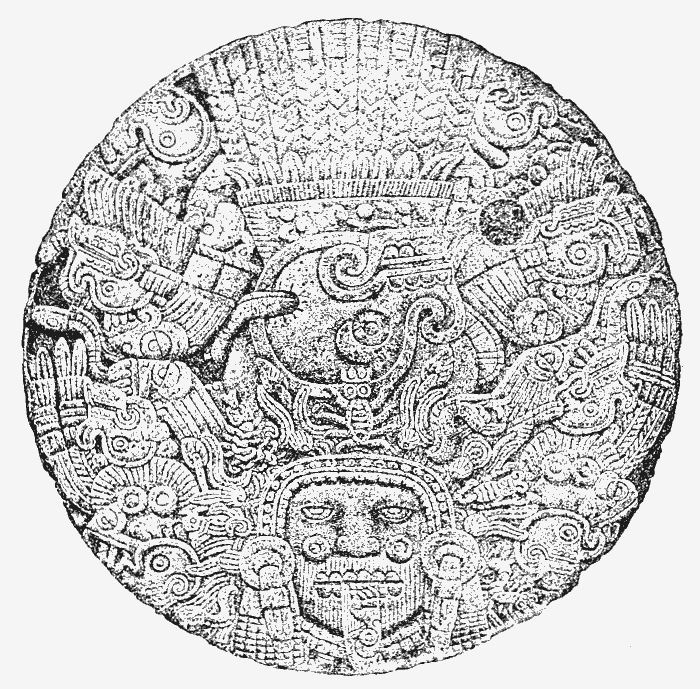
Figure 19.
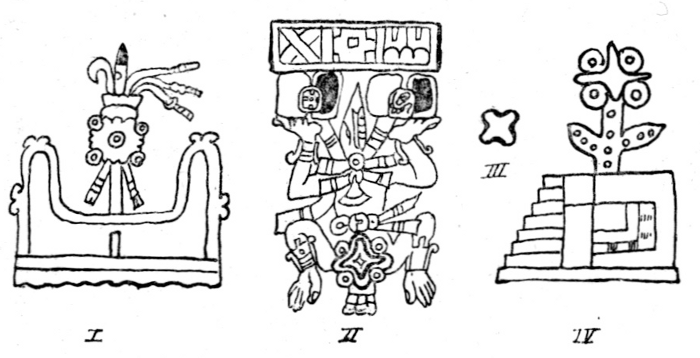
Figure 20.
The question why the spider, named “tocatl” in Nahuatl, should have been adopted as the chief symbol of Mictlantecuhtli, occupied me much until I found the clue to its significance in the Maya language. In this the word for North is Aman and the name for “the spider whose bite is mortal,” is Am. This striking fact may be interpreted as a positive proof that the spider-symbol, employed by the Mexicans, must have originated in Yucatan, from the mere homonymy of two Maya words.
On the other hand shell-gorgets exhibiting the effigy of a spider, and obviously intended to be worn with its head turned downwards, have not only been found in Illinois but also in Tennessee and Missouri. On the gorgets from the latter States a cross is carved on the body of the spider (fig. 22, a). As certain spiders exhibit cross-markings, it is, of course, possible that it was chosen as a cross-symbol for this reason only, in some localities, just as the butterfly was evidently adopted in Mexico, as an apt image of the Centre and the Four Quarters on account of its shape and its possession of four wings. The conventionalized figure of a butterfly, with a star on its body and four balls, painted with the colors of the quarters, was a sacred symbol which is minutely described by Sahagun and is figured on a manta in the B. N. MS. A glance at its reproduction (fig. 21, no. 13) shows how the form of the insect has been conventionalized so as to resemble the ollin (no. 12) and other Mexican cross-symbols (nos. 2, 4, 11, 14 [pg 048] etc.). The eye or star in its centre, like that in the ollin, and circle (no. 4), signify Polaris; the conventionalized head and antennæ are obviously made to convey the idea of “two in one,” of the Above and Below united in the Centre.
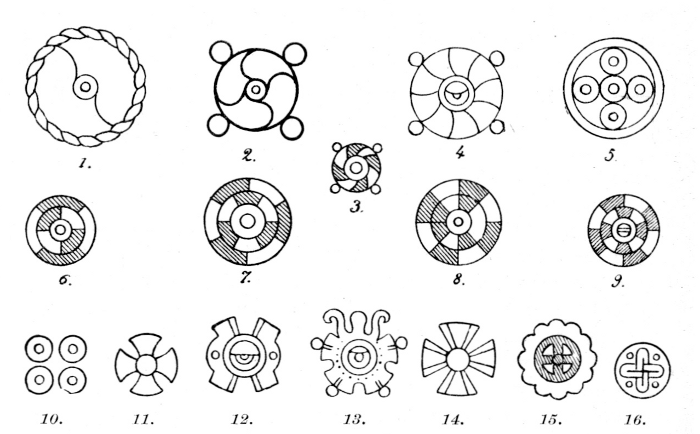
Figure 21.
I venture to suggest that the dragon-fly was employed as a cross-symbol in an analogous manner, on the Algonquin garment preserved at the Riksmuseum, Stockholm, and described by Dr. Hjalmar Stolpe in his admirable study on American art (Amerikansk Ornamentik, Stockholm, 1896, p. 30). As I shall revert to it later on, I now draw special attention to the circumstance that instead of the cross, on a spider-gorget from Tennessee, there is a round hole which, when the shell-disc is held aloft, lets a ray of light shine through and furnishes an apt presentation of a star. This and the cross furnish analogies to the Mexican and Maya symbols of Polaris which are too obvious to need to be emphasized. Nor do these gorgets alone furnish an undeniable indication that an identical symbolism extended from Yucatan to Illinois. Other gorgets, also figured in Mr. Wm. H. Holmes' monograph “Art in Shell,” several of which are in the Peabody Museum, from the stone graves in Tennessee, exhibit variously carved representations of a serpent. In all specimens the identical idea is carried out: the eye of the serpent forms the centre of the design on the disc and [pg 049] four circles on the body of the reptile, or four solid bars, interrupting a hollow line encircling the central motif, emphasized a division of the disc into four equal parts. The idea of the Serpent in repose, the Centre and the Four Quarters is thoroughly carried out and the true meaning of the design is only appreciated by the light of the Maya and Mexican symbolism which has already been so fully discussed.
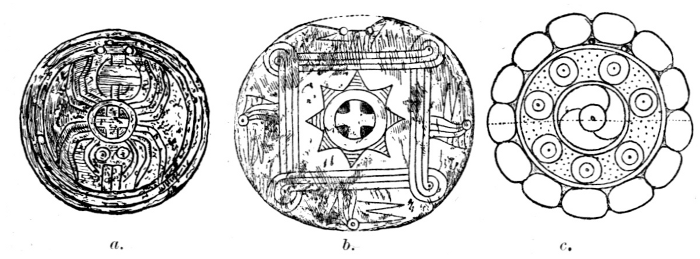
Figure 22.
The third Tennessee gorget reproduced here (fig. 22, c), from Mr. Holmes' work, exhibits a combination of numerals which is particularly interesting if confronted with the sacred numbers of the Mexicans and Mayas. From a central circle three curved lines issue in a fashion resembling those on fig. 21, no. 2, but the fact that the circular band exhibits seven double circles and the outer edge is divided into thirteen parts, is of special moment. Still another design, on a shell-gorget from Tennessee, not only exhibits the peculiarity, pointed out by Mr. Holmes, of a square with loops, resembling certain figures in Mexican Codices, but also other significant details which I shall point out (fig. 22, b). The cross in the centre occupies the centre of a star with eight rays and the four birds' heads at the sides of the square illustrate rotation from right to left. I am inclined to view in this gorget an emblem of Polaris with Cassiopeia in rotation around it, figured as a bird, but whether this is the case or not it must be conceded that it is indeed remarkable to find a set of symbols, consisting of the spider, the cross, the serpent and the bird, carved on prehistoric gorgets found in the United States whilst the deep meaning of these identical symbols is furnished by Maya and Mexican records. I venture to remark here that no more expressive and appropriate ornament [pg 050] than these shell-gorgets could have been designed, or worn by the ancient Maya or Mexican priests, prophets and leaders who, in a remote past, had guided themselves by the light of Polaris and instituted its cult as the basis of their native religion.
On realizing the above-mentioned identity of symbolism, it is impossible not to conclude that the prehistoric race which inhabited certain parts of the United States was under the dominion of the same ideas as were the Mexicans and Mayas. The indications point, in fact, to the probability that the origin of the employment of the spider-symbol originated in Yucatan, and if this be admitted then there is no reason to deny the possibility that the serpent-symbol came from there also, since the Maya language suggests an affinity between the serpent, can, and the sky=caan, and the numeral 4=can. I refrain, for the present, from expressing any final conclusion on this subject, which will doubtless afford ample food for reflection and argument to all interested in the important problem as to where the cradle of ancient American civilization was situated. But these symbolic gorgets go far towards substantiating Professor Putnam's oft-expressed conclusions that the ancient peoples of the central and southern portions of the United States were, to a certain extent, offshoots of the ancient Mexicans.
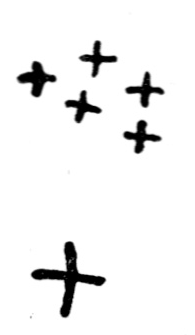
Figure 23.
Before abandoning the subject of native symbolism and star-emblems I should like to present, as a curiosity, with an appeal to specialists to enlighten me as to the astronomical knowledge of the Eskimos, an Eskimo drawing from Professor Wilson's instructive and useful monograph. It is said to represent a “flock of birds,” but so closely resembles Cassiopeia and Polaris that I am tempted to view it as an indication that the Eskimos may also have associated the idea of a celestial bird, or birds, wheeling around a central point, with the constellation and the pole-star (fig. 23). Having once ventured so far afield, I cannot refrain from presenting here an interesting set of aboriginal star-symbols, reproduced from Professor Wilson's comprehensive work (fig. 24), each composed of a cross combined, with a single exception, with a circle. I draw attention to the striking resemblance of some of these signs to those painted on the finely decorated pottery found on the hacienda of Don José Luna, in Nicaragua, and described by J. F. Brandsford, M.D. (Archaeological Researches in Nicaragua, Smithsonian Inst., 1881, p. 30, B), and suggest that, in [pg 052] both localities, the symbol may be a rudimentary swastika, and represent Polaris and circumpolar rotation.
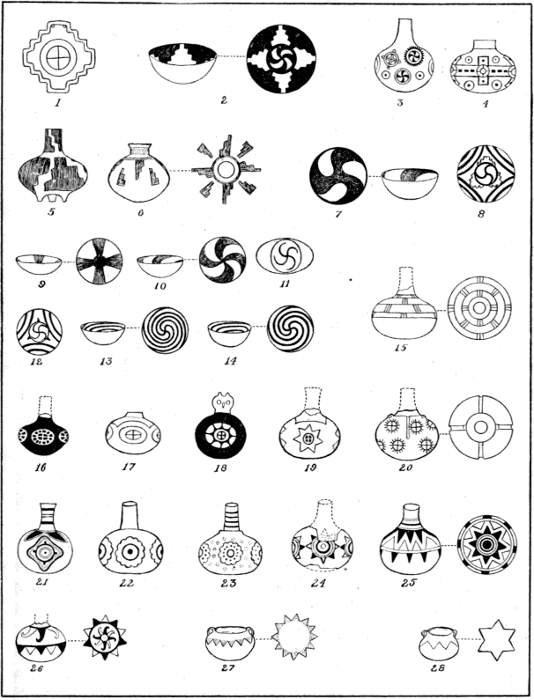
Plate III. 1. Shell gorget, Missouri. 2, 5-14. Pottery vessels, Arkansas. 3, 4, 15-17, 19-28. Pottery vessels, Missouri. 18. Pottery vessel, Kentucky. 6. National Museum. 3, 16, 17, 21, 24, 25. St. Louis Academy. All others Peabody Museum. Willoughby, “Pottery from the Mississippi Valley.” Journal of American Folk-lore, January-March, 1897.
In conclusion I refer the reader to Mr. C. C. Willoughby's valuable and most interesting “Analysis of the decorations upon pottery from the Mississippi Valley” (Journal Amer. Folk-lore, vol. x, 1897), in which he figures the remarkable specimens preserved in the Peabody Museum, Cambridge, the designs on which, as he states, “are mostly of symbolic origin and have been in use among various tribes within the historic period from the Great Lakes to Mexico.” With the kind permission of the editor of the Journal, I reproduce some of Mr. Willoughby's illustrations on Plate iii.

Figure 24. Crosses And Circles Representing Star Symbols, Arizona.
Returning to consider the probable result of the gradual diffusion of star-cult owing to natural causes and of the consequent divergence from the idea of the Centre, which had so deeply influenced the minds of primitive men during many centuries, with earnest, and extended astronomical observation, keeping pace with the development of the idea of the Above and Below, it is obvious that the utmost attention would be next given to the conspicuous star groups and planets which are visible at certain times and then seem to have departed or descended into the under world. Any one who has read the interesting communications by Herr Richard Andree (Globus. bd. lxiv, nr. 22), On the relation of the Pleiades to the beginning of the year amongst primitive people, followed by a note by Herr Karl von den Steinen on the same subject, will realize that widely-separated tribes of men, by dint of simple observation, knew the exact length of the periodical appearance and disappearance of this star group and regulated their year accordingly. Herr Andree cites, for instance, that “in the Society islands, the year was divided into two portions, the first of which was named Matari-i-inia=the Pleiades above. It began and lasted [pg 053] during the time when these constellations were visible close to the horizon after sunset. The second period, named Matarii-i-raro=the Pleiades below, began and lasted for the time during which the star-group was invisible after sunset” (W. Ellis, Polynesian Researches, vol. ii, p. 419, London 1829). That the ancient Mexicans had likewise observed the Pleiades and been deeply impressed by them is proven by the well-known fact that the ceremony of the kindling of the sacred fire, which betokened the commencement of a new cycle, was performed “when the Pleiades attained the zenith at midnight precisely.” In my complete monograph in the ancient Mexican calendar-system it will be my endeavor to present all the data I have collected concerning the degree of elementary astronomical knowledge attained by the native astronomers. I shall, therefore, content myself with pointing out here that besides the foregoing testimony about the Pleiades, the native name for which was the miec=the many, or the tianquiztli=the marketplace, there are records proving that the cult of the planet Venus was a firmly established feature of the native religion at the time of the Conquest. Sahagun records that the Nahuatl names for this planet were citlalpul or hueycitlallin both signifying “the great star.” “In the great temple of Mexico an edifice named ilhuicatitlan [literally, the land of the sky] consisted of a great, high column, on which the morning star was painted.... Captives were sacrificed in front of this column annually, at the period when the star re-appeared” (op. cit. appendix to book ii).
With regard to the connection of the Pleiades with the beginning of the Mexican cycle, it is interesting to note Herr Andree's statements that the most intimate connection of the star-group with the thoughts of primitive people, would naturally take place in such localities where its periodical movements coincided with the changes of season, wind and weather which affected agriculture. A survey of the data presented by Herr Andree shows that the cult of the Pleiades attained its greatest development amongst tribes inhabiting a southerly latitude. It was in South America, indeed, that the Peruvians, alongside of their highly developed sun-cult, rendered homage and offered sacrifices to the Pleiades. In Mexico, the cult of the Pleiades appears as intimately associated with that of the sun and to have assumed importance only in historical and comparatively recent times, probably when the periodicity of the sun's movements had been taught or recognized and the [pg 054] sign ollin, which is an exact presentation of the annual course of the sun, had been invented and adopted as a symbol. I have already pointed out that this sign occurs on the calendar-stone, for instance, which has a human face in its centre, bearing two numerals on the forehead and obviously symbolizing the union of two in one. In other instances the centre displays the eye, or star symbol and conveys the suggestion that the “four movements” of the circumpolar constellations were thereby symbolized. It may be that, in ancient Mexico, the two symbols, respectively referring to the movements of the sun and of the circumpolar star-groups, were emblematic of the two different cults or religions which existed alongside of each other. The first, the cult of the Above, of the Blue Sky, was directed towards the sun and the planets and stars intimately associated with sunrise and sunset, amongst them the Pleiades. The cult of the Below, of the Nocturnal Heaven, was directed towards the moon, Polaris and the circumpolar constellations—also to the stars and planets during the period of their disappearance and possibly in the same way to the enigmatical “Black Sun,” figured in the B. N. MS. which may have been the sun during its nightly stay in the House of the Underworld, whose door was in the west. In order to obtain an idea of the immense proportions ultimately assumed by these two diverging cults and the enormous influence they exerted upon the entire native civilization, it will be necessary to examine the form of the social organization in Montezuma's time.
In order to comprehend this, however, it is first necessary to study carefully the myths relating to its origin. Torquemada (lib. vi, chap. 41) cites the authority of Friar Andreas de Olmos for the following native account of the creation of man, which was differently recounted to him in each province. He states that the majority of the natives, however, agreed that “there was in heaven a god named ‘Shining Star’ (Citlal-Tonac) and a goddess named ‘She of the starry skirt’ (Citlal-Cue), who gave birth to a flint knife (Tecpatl). Their other children, startled at this, cast the flint down from the sky. It fell to earth at the place named ‘Seven caves’ and ‘produced 1,600 gods and goddesses,’ ” a figure of speech which evidently expressed the idea that, in coming in forcible contact with the soil the flint gave forth sparks innumerable which conveyed vitality to numberless beings. It is evidently the same idea of “life sparks” being called into existence by the union of [pg 055] heaven and earth which underlies the Texcocan version of the creation of man recorded as follows by Torquemada (op. et loc. cit.). “The sun ... shot an arrow towards the land of Acolma near the boundary of Texcoco. This made a hole in the ground whence issued the first man....”
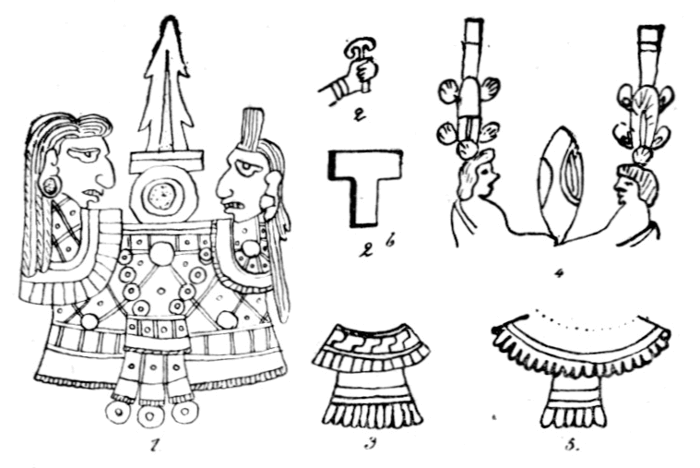
Figure 25.
The illustrated version of the above myths, given in the Vatican Codex i, designates the celestial progenitor of human life as Quetzalcoatl, also named Tonaca-Tecuhtli=the lord of our subsistence, Chicome-xochitl=“Seven roses or flowers” and Citlalla-Tonalla=“The Milky Way,” literally, The shining stars. The dual divinity is figured (fig. 25, no. 4) as two persons with the shaft of an arrow over each of their heads and with the symbol Tecpatl=flint, between them as the issue of their union. In the Borgian Codex (fig. 25, no. 1), a barbed arrowpoint, instead of the Tecpatl, figures between the celestial parents. Their union is symbolized by a covering, the shape of which, in further representations (fig. 25, nos. 3 and 5) in the same MS., offers resemblance to the tau-shaped windows which are such a common feature in Maya and also in Pueblo architecture (fig. 25, no. 2b). The preceding data, which could be amplified, seem to show that the natives associated the tau-shape not merely with the idea of the Male and Female principles, but also with the Above and the Below, or Heaven (air and water) and Earth (earth and fire). I shall have occasion, further on, to refer again to the symbolism of the native tau.
The above illustrations, however, definitely prove that the flint knife and the arrow (with a flint point, presumably), were indiscriminately designated as the medium by means of which the spark of life was created and imparted to earth-born beings.
It will be proved further that, at the period of the Conquest, the arrow was revered as an image of life-producing force in Yucatan and Mexico. The flint knife cased in wrappings was called “the son” of Cihuacoatl, the earth-mother, and was regarded as her [pg 056] special symbol. It is significant, therefore, to find that it was the emblem of office of one of the two high priests, who alone employed it, as a sacrificial knife, in performing his awful duty of immolating human victims.
The fact that the cane-shaft of an arrow figures above the head of the celestial couple in the Vatican Codex is particularly interesting because the name Ome-Acatl=Two-Cane, is given as the name of a divinity by Sahagun (book i, chap. 15) and that the ceremony of kindling the New Fire, at the commencement of a cycle of years was also associated with the calendar sign Ome-Acatl (Sahagun, book vii, chap. 10).
At a certain festival images of Omacatl were manufactured and carried by the devout to their houses in order to receive from them “blessings and multiplication of possessions” (Sahagun, book ii, chap. 19).
I draw attention to the fact that life is supposed to have proceeded from the union of stellar divinities, that the Tecpatl and flint are the well-known symbols for the North and Fire and that the Vatican commentator identifies the celestial parent as “Seven-Flowers.” What is more, Duran (vol. i, pp. 8 and 9) relates that the native race was organized into seven separate tribes and that these “claimed to have come out of ‘seven caves’ (Chicom-oztoc) which were situated in Teo-Culhuacan or Aztlan ‘a land of which all men know that it is in the North.’ ” Now Teo-Culhuacan is composed of the word Teotl, which designated the stars, the sun, the gods and, by extension, something divine or celestial. Culhua (cf. Coloa) means something bent over or recurved, or the action of describing a circle by moving around something, and can means “the place of” in Nahuatl. This locality is represented in the picture-writings by a strange and impossible mountain with a recurved summit (fig. 26, no. 1). Aztlan literally means “the land of whiteness, brightness, light.” In Duran's Atlas the seven caves are represented as containing men and women—the progenitors of the seven tribes. The order in which these are described, in the Mexican myth, as having issued from the caves, is instructive and sheds light upon the provenance and purpose of the tradition. It represents the Mexicans as the superior predestined race who remained in their cave the “longest, by divine command,” their “god having promised them this land.” The tradition relates that six tribes reached and settled down in the central plateau of Mexico, [pg 057] 302 years before the Aztecs arrived, under the leadership of Huitzilopochtli an oracular divinity, whose commandments were transmitted to the people by four priests (Duran, chap. ii).