The Fundamental Principles Of Old And New World Civilizations. (continued 11)
Reading edition
It is curious to note how the original carrying out of primitive and naïve rites by the queen and high-priestess gradually caused [pg 439] her presence to be regarded as essential for the “drawing out of the Nile from its source” and her person to be surrounded with utmost veneration and sanctity. As Prof. Flinders Petrie states, speaking of as far back as B.C. 1383-1365: “The marriage to a royal high priestess of Amen was, of course, purely a political necessity to legitimate the king's position.”
“It would seem that Hor-em-heb was not married to Nezem-mut until his accession, when he legalized his position by becoming husband of the high-priestess of Amen, as in the arrangement of the later dynasties. This marriage was an affair of politics solely, considering the age of the parties; Horemheb was probably between fifty and sixty at the time and if the queen was the same as Nefertiti's sister Nezem-mut, she must have been about the same age as Horemheb” (op. cit. pp. 183, 250). How long the female Egyptian ruler maintained her sway may, perhaps, best be seen by the following texts describing the political homage paid to the living goddess of the Egyptians under Ptolemaic and Roman rules.
One inscription clearly shows that, at the time of Ptolemy IX, Euergetes II, the living Isis was acknowledged as the sole ruler of the land of the south by the king and his wife, queen Cleopatra III, who jointly occupied the throne of northern Egypt. Jointly the latter dedicated a beautiful hall to the goddess Isis, as a place in which to celebrate the Tekhu feast and in which she might linger at this season (Brugsch, op. cit. ii, p. 284). I have found indications in other works that, in other localities, the goddess entered a secret chamber in the earth or pyramid or celebrated her sacred mysteries and festival on the sacred boat of the sun, in the sacred sea or lake belonging to the temple. In these cases it is obvious that the dominant idea was the performance of the sacred rites in the sacred centre or middle.
At a later period Cleopatra VII ascended the female throne at the age of seventeen and became high-priestess of Amen, the living image of Isis. It was understood that as soon as her brother Ptolemy XIV, then aged twelve, should come of age, she was to marry him. Partly for political reasons, akin to those which had caused king Horemheb, on his accession, to marry the high priestess of Amen, Julius Cæsar and Mark Antony become in succession the consorts of Cleopatra, after whose death Egypt became a Roman province. But the “land of the south,” and traditional, [pg 440] divine, feminine rulership, lingered on. Under the third prefect, Ælius Gallus, Candace, queen of the Ethiopians, invades Egypt at the head of her army. She was defeated, but the position of the high-priestess of Amen, the living Isis, continued to be such as to exact the homage and an act of propitiation from the Roman Emperor.
An inscription, from the time of Augustus, records that a beautiful monument, or “house,” had been erected by the “lord of the land, the autocrator, the son of the sun, Cæsar,” and was presented, at the time of the Isis festival, to its possessor, the great Isis, the mother of the god, the mistress of the lying-in-house, the splendid and mighty queen of Philæ, the benevolent princess of Abaton, the daughter of the sun. She is likewise named “she who is great or whose greatness extends towards the four quarters” and is designated as “the royal wife of the majesty of Osiris and the royal mother of Horus, the victorious bull,” i. e. the ka. It is stated that “she found the house of birth brilliantly adorned and well arranged in every way” and she installed herself in its interior on a given day, so as to bring forth her son in these surroundings. One of the rewards promised to Cæsar for the delicate attention and gift bestowed upon the goddess is “eternal and permanent occupation of the throne of Horus, the first of the living ones.” According to the Esne calendar a “divine birth” actually took place on a given date. Brugsch, referring to Plutarch and calendar texts, shows that the commencement of the Isis festival dated from the time when Isis assumed a phylactery, or amulet, to indicate that she had conceived.
Another inscription shows that Tiberius Claudius had caused the house to be renovated for “the mighty goddess Isis, the life giving mistress of Abaton, the good Hathor, the queen of the land of Nubia, the divine mother of the golden (Nub) Horus, the benevolent sister of Osiris, the great protectress who guards his son.” As Tiberius Claudius, in this text named himself her loving son, it is obvious that the day had passed away when solely her own divine son Horus would be the one legitimate and divine heir to the Egyptian throne. It is interesting to surmise what became of the children whose “divine births” continued to be celebrated as a sacred occurrence to which even a Roman Emperor yielded homage. The natural sequence would have been that, accompanied by a band of devoted followers, the sons of the sun, the young bulls, [pg 441] i. e. the ka, or divine twain, and their sisters, would seek distant lands in which jointly to establish new kingdoms on the ancient, familiar plan.
Collectively, the preceding evidence has afforded a realization of some of the curious but natural results of the prolonged cult of the dual principles of nature in Egypt, the most remarkable being, perhaps, the creation of a distinct, “divine” caste of individuals, from the naïve adoption of marriage and birth as consecrated religious rites, symbolical of the union of heaven and earth and the production of new life. While at one time, and in certain localities, this mode of symbolism obviously took the upper hand and fostered the growth of the artificial idea of the “divine rights of royalty,” there are evidences that, simultaneously, the union of the dual principles of nature was symbolized in one or more different archaic and primitive ways. These appear to have been separately adopted in various centres of thought where the disastrous and debasing consequences of the association of the idea of sex with the cult of heaven and earth, light and darkness, etc., were realized with disapproval.
We thus find that, even at Edfu, the ceremonial rite of lighting new sacred fire by means of a wooden instrument and friction was performed on the great Isis festival which was marked by the “divine birth.” According to the calendar of Canopus this fell on the first day of Payni, and a prescribed illumination of the temples and palace was kept up until the 30th or last day of the month. In the most ancient Egyptian calendars the “lighting of light” at the same period is also recorded (Brugsch, op. cit. ii, p. 470) and, according to Herodotus, the festival was named “the lighting of lamps” and was observed throughout all Egypt. He adds that “a religious reason is given why this night is illuminated and so honored” (ii, 61 and 62).
The influence of increasing astronomical knowledge likewise shows itself in the joint observation of the movements of sun, moon and stars and the determination of the relative positions of the latter to the sun at the periods of the equinoxes and solstices. Without taking period or sequence into consideration for the present, I merely note that we find evidence that, at one time, images of sun and moon, of the right and left eyes of Ra, or statues of Hathor-Isis and Osiris, replaced their living images in religious ceremonies.
[pg 442]
Sometimes the entire ritual seems to have consisted in the union of water, the produce of heaven, with seeds, the produce of earth; the ensuing germination and production of young shoots being deemed sacred and symbolical of the renewal of life. The fact that statuettes of Osiris have actually been found, made of paste containing various seeds, distinctly shows that, like the Babylonian Baal, the Egyptian male divinity was identified with the earth. Another indication of this is furnished by the descriptions of the feast of Pan, which fell at the period of the spring equinox. At this period the crop of dura, which had been sown by the king in the sacred fields at Denderah, at the time of the “Osiris mysteries,” immediately after the inundation had receded and “the earth was laid bare,” became ripe. The ceremony of cutting the first sheaf of dura was performed by the king, with the silex sickle=khepes.
While Osiris was thus directly associated with the produce of the earth there are also evidences that, just as Isis became identified with birth and life, her consort became the lord of death and of the underworld. Mysterious rites and human sacrifices seem to have been instituted in his honor. According to obscure myths Osiris himself had been foully murdered, his body cut into fourteen pieces and cast over the length and breadth of the land. His head was supposed to be preserved at Abydos, the chief centre of his worship, and shrines were erected over the other portions of his body. It will be a matter for further research to investigate whether the “mysteries of Osiris” did not include the dramatization of the death of Osiris, in which a human victim personified the god and was actually killed and dismembered.
It is, perhaps, worth noting here, as an analogy, how appropriately the ancient Mexican annual sacrifice of a youth, chosen among the most perfect, might have answered as a rendition of the drama of Osiris. The body of the victim was divided and the pieces distributed to a fixed number of priests and chieftains, who partook of them as sacred food. The head was preserved in the Great Temple itself, on the Tzompantli, and the large number of skulls seen there by the Spaniards constituted a proof of the great antiquity of the custom. The blood of the victim, poured upon seeds, seems to have been considered essential for bringing about the germination of the sacred shoots and typical of the union of the dual principles of nature and of life springing from death. Idols, formed of seeds moistened with human blood, were [pg 443] distributed to the participants in the ceremony. According to some authors this sacred paste, and not pieces of human flesh, constituted the consecrated food, eaten according to the prescribed ritual.
How far analogous rites were performed in Egypt remains to be seen; it is, at all events, certain that, by slow degrees, the cult of the dual principles of nature gave rise to the institution of strange unnatural rites, the original naïve meanings of which became obscured, debased or lost. While various localities of Egypt, notably Thebes and Abydos, appear to have become the birthplace of curious aberrations of the human intellect, there was one ancient and great centre of learning where monotheism and the knowledge of the fundamental scheme appear to have been preserved intact, namely, at Heliopolis, the ancient On or Anu of the North, named the “House of the Sun” by Jeremiah and “the Eye or Fountain of the Sun” by the Arabs. According to Mr. Wallis Budge, “its ruins cover an area three miles square ... the greatest and oldest Egyptian College or University for the education of the priesthood and laity stood here.... During the xxth dynasty the temple of Heliopolis was one of the largest and wealthiest of all Egypt and its staff was numbered by thousands. When Cambyses visited Egypt the glory of Heliopolis was well on the wane and, after the removal of the priesthood and sages of the temple to Alexandria, by Ptolemy II (B.C. 286), its downfall was well assured. When Strabo visited it (B.C. 24) the greater part of it was in ruins.... Heliopolis had a large population of Jews and it will be remembered that Joseph married the daughter of a priest of On (Annu).... Macrobius says that the Heliopolis of Syria or Baalbek, was founded by a body of priests who left the ancient city of Heliopolis of Egypt” (The Nile, p. 132).
Indirectly we learn the tenor of the doctrines and ideas held by the sages of Heliopolis at one period by the remarkable attempt to reform the religion of Egypt, carried out by their pupil, Amenhotep IV (about B.C. 1450). Evidently realizing, with his masters, the extent to which the ancient fundamental religion had become obscured and debased by the multiplication of images of the deity, and the institution of rival cults, which were shrouded in mystery and darkness, the young prince boldly made war against the priesthood of Amen-Ra and the cult of a “hidden god.”
Destroying the monstrous images which had originally been rebus figures only, and represented the supreme deity in partly [pg 444] human and animal form, he instituted the disk or circle as the simple and purer form under which the divinity was to be revered.118 Animated by the clear realization to what an extent the original communal or republican scheme of organization was being departed from by the artificial creation of a “divine” race of kings who claimed to be gods, he caused himself and his queen to be portrayed as simple mortals, and not as the deities Osiris and Isis. Choosing the sun as his emblem, this champion of pure light and open truth fought the Egyptian votaries of darkness. He erased the word Amen=hidden, from public monuments, changed his own name from Amenhotep to Chu-en-Aten=the brilliance or glory of the disk and founded a city also named Chu-aten, which was to be the centre of a new and reformed state. It seems evident that this was instituted on the familiar archaic plan and that the so-called “heresy of Amenhotep” was but an attempt, backed by the sages and philosophers of Heliopolis, to abolish the artificialities and abuses which had come into existence and destroyed the order of the state and the harmony of the primitive plan. It is well known that gradually Amenhotep's successors were obliged to yield to the hostility of the priesthood of the “hidden god” and that these, in turn, erased or defaced all images of the disk or aten within their reach.
Ineffectual though the grand attempt had been to reorganize state and religion and reëstablish republican principles, on the original plan, the knowledge of the original scheme seems to have been preserved intact during the following centuries, by the sages and philosophers of Heliopolis, by whom the primitive set of ideas seems to have been gradually developed into an abstract philosophical system. Reminding the reader that Plato spent “thirteen years in Egypt, in gaining an insight into the mysterious doctrines and priest-lore of the sacerdotal caste,” I also draw attention to the passage in his “Timæus,” in which Critias makes the statement [pg 445] that when Plato's ideal republic ... was being discoursed upon, he was reminded, to his surprise, of the account of a state given to the Greek sage, Solon, by the priests of Saïs, and perceived how, “in most respects, the republic described coincided with Solon's statements.” It is indeed striking how clearly we can recognize, in Plato's republic, the underlying, primitive, universal scheme in this case, highly developed, elaborated, transfigured and transformed into the philosophical ideal of a great intellect.
Before demonstrating which of the main features of Plato's cosmogony and ideal republic we have found actually carried out in practice, let us briefly refer to the most ancient descriptions of the primitive government of Greece, preserved in the Timæus and Critias, where the conversations held, by Solon, with the priests of Saïs are recorded. Solon (about 594 B.C.) on his arrival (at Saïs) “was very honorably received; and especially, on his inquiring about ancient affairs of those priests who possessed superior knowledge in such matters, he perceived that neither himself nor any one of the Greeks (so to speak) had any antiquarian knowledge at all.... One of their extremely ancient priests said to Solon: ‘you (Greeks) are all youths in intelligence, for you hold no ancient opinions derived from remote tradition nor any system of discipline that can boast of a hoary old age.... In this our country, ... the most ancient things are said to be here preserved ... and all the noble, great or otherwise distinguished achievements, performed either by ourselves, by you or elsewhere, of which we have heard the report, all these have been engraved in our temples in very remote times and preserved to the present day. The annals of our own city (Saïs) have been preserved eight thousand years in our sacred writings ... your state has a priority over ours of a thousand years.... I will briefly describe the law and more illustrious actions of those states which have existed nine thousand years ...’ ” (Timæus). It is interesting at this point to recall also the familiar statements made by the priests of Saïs to Solon, concerning the immense antiquity of the human race and the “multitude and variety of destructions which have been and will be undergone by the human race ... after which nations become young again, as at first, knowing nothing of the events of ancient times” (Timæus, v).
Referring the reader to the original text I merely point out here that the priest of Saïs, referring to the sacred writings themselves, [pg 446] assigned to remotest antiquity the principle of distribution and arrangement on which the state had originally been founded and established. In the Critias the description of the Athenian state, which “had been founded nine thousand” years before, contains the following particulars which will appear familiar to the reader. “To the gods was once locally allotted the whole earth.... Obtaining a country agreeable to them by just allotment, they chose regions for their habitations.... Different gods received by lot different regions.... Hephaestus and Athene, a brother and sister, both received one region as their common allotment ... their temple was built on the Acropolis ... whose northern and southern slopes were respectively associated with separate winter and summer residences.” The population was divided into classes and each caste occupied a fixed place of residence. “The outer parts, down the flanks (of the Acropolis) were inhabited by craftsmen and husbandmen who tilled the neighboring land; the warrior-classes lived separately, by themselves, in the more elevated parts around the temple of Athene and Hephaestus, which they had formed, as it were, into the garden of a single dwelling by encircling it with one enclosure” (The Critias, vi). “... On this site was a single fountain which furnished every part with abundant water....” “The ‘guardians of the state’ were the ‘leaders’ of the Greeks and as to their number they paid special attention that they should always have the same number of men and women that might serve in war, the whole being about twenty thousand.”
In the description given, in the Critias, of the state of Atlantis, the identical features recur, but are more fully described. In the centre of the island of Atlantis stood a mountain, surrounded by a plain, which was ultimately made square. The mountain was the residence of a pair of mythical lovers, consisting of a god and of a mortal woman, and became the birthplace of their offspring, “a divine race of kings.” “The god ... with his divine power, agreeably adorned the centre of the island, causing two fountains of water to shoot upwards from beneath the earth, one cold and the other hot, and making every variety of food to spring abundantly from the earth.” The central hill, from which thus proceeded all life and festivity, was at first “circularly enclosed, the land and sea being formed into alternate zones, greater and less, two out of land and three out of sea, from the centre of the island all equally distant.” The ten kings, born of the “divine union, [pg 447] lived each in his own district and city, and ruled supreme over his people. The government and commonwealth in each case was, by the injunction of the god, according to the laws which were handed down. The latter were inscribed on a column of orichalcum which was deposited in the centre of the island, in the temple of the god, where the ten kings originally assembled every fifth year. A fire burned near the column and a bull was sacrificed at its base, after which a sacred cup was filled with its blood and this was poured into the fire by way of purifying the column” (Critias, vii-xvi).
The above mention of a column is of interest when it is realized that, in historical times, the laws of Solon were actually inscribed on a square wooden pillar which was made to revolve or turn and was placed on the Acropolis. The presence of a revolving pillar on the Acropolis, the sacred centre of the Athenian state, is, moreover, curiously in keeping with the conception of axial energy set forth by Plato and awakens the desire to learn from Greek scholars what relationship, if any, there was between the Sanscrit aksa=axle or axis, the Greek akra (akris=summit, akros=most high, supreme, akrisios=mountain-top god) and the Egyptian ak=the Centre, and hak=a king; and whether the word polis=city was connected with polos=the pole-star, an axis, pivot or pole, from polein=to turn, and may be interpreted as the equivalent of the Egyptian An and Annu. It would also be important to learn whether the name of the principal ancient god of Greece, Apollo, who was revered under the form of a column at Delphi, can also be connected with the verb polein or pelein=to turn, as well as the name Polias i. e. the goddess protecting the city, a surname for Minerva (Athene) at Athens, where she was worshipped at one time as the protecting divinity of the Acropolis. The title Poliuchus, “protecting the city,” occurs as a surname of several divinities and particularly of Minerva Chalchioecus, “of the brazen house,” at Sparta and Athens. It is instructive likewise to compare the Greek words for axis=axon, and polis=city, with Helice, the name for Ursa Major and for a town in Arcadia, with the Egyptian Annu, An or On, the names of capitals, and the Egyptian word an=that which turns around. It will be for Greek and Egyptian scholars to enlighten us as to whether the Egyptian an and the Greek polis are synonyms; in which connection I draw their attention to the following suggestive passage of the Critias (vii).... “Yet before we narrate this we must briefly warn you not to [pg 448] be surprised at hearing Hellenic names given to barbarians ... and the cause of this you shall now hear. Solon made an investigation into the power of names and found that the early Egyptians, who committed these facts to writing, transferred these names into their own language; and he again, receiving the meaning of each name, introduced it by writing into our language.” While, on one hand, it is certain that the Egyptian astronomer-priests associated the pole star with the words An, Anu, Anubis, on the other, the following passages from Plato's works clearly demonstrate his views concerning axial rotation.119 A fresh interest is undoubtedly added to Plato's philosophy when it is regarded as the possible result of the thirteen years spent by him with the Egyptian priesthood, who may possibly have confided to him the entire sum of their ancient philosophy and accumulated store of knowledge, and who certainly seem to have imposed upon him the reticence and obscurity noticeable in the Republic, the Critias and the Timæus.
To those who have followed my investigation of the ancient state organization and cosmical conceptions of the ancient Egyptians, and noted the interpretation given to the pyramid and the fact that Amenophis instituted the disk as the image of the Supreme Being, the following detached extracts from Plato's Timæus will appear [pg 449] familiar and full of fresh significance. “To discover the Father and Creator of this universe (also called the heaven or the world) or his work is indeed difficult; and when discovered it is impossible to reveal him to mankind at large.... The composing (or framing) Artificer constituted the universe from entire elements of fire, water, air and earth and ... considering that it would thus be a whole animal.... He gave it also a figure becoming and allied to its nature; and to the animal destined to comprehend all others within itself that figure as the most becoming which includes within itself every sort of figure whatever. Hence he fashioned it in the shape of a sphere, perfectly round, having its centre everywhere equally distant from the bounding extremities.... He assigned to it a motion peculiar to itself ... making the world to turn constantly on itself and on same point, he gave it a circular motion ... he assigned to it a motion peculiar to itself, being that of all the seven kinds of motion.... As for the soul, he fixed it in the middle, extended it throughout the whole and likewise surrounded it with its entire surface ... and so, causing a circle to revolve in a circle, he established the world as one substantive, solitary object.... Let the universe be called heaven or the world or by any other name it usually receives.... The soul of this universe [pg 450] ... being composed of three parts ... being interwoven throughout from the middle to the very extremities of space and covering it even all around externally, though at the same time herself revolving within herself, originated the divine commencement of an unceasing and wise life throughout all time.... Time ... was generated with the universe.... Time ... an eternal image on the principles of numbers ... the perfect number of time completes a perfect year ... for this purpose ... were formed such of the stars as moved circularly through the universe....”
While a careful study of Plato's work will further elucidate his views concerning the quadruplicate nature of the universe, of its comprehensive unity, of axial rotation, the generation of time and of the principle of numbers, I point out that the following passage conveys the idea of applying the universal plan to the regulation of human thought: “This, however, we may assert, that God invented and bestowed sight upon us for the express purpose, that on surveying the circles of intelligence in the heavens, we might properly employ those of our minds, which, though disturbed when compared with the others that are uniform, are still allied to their circulation and that, having thus learned and being naturally possessed of a correct reasoning faculty, we might, by imitating the uniform revolutions of divinity, set right our own silly wanderings and blunders.”
There are two portions of Plato's cosmology to which I wish particularly to draw attention, because of the striking examples that exist, showing that the views therein expressed and suggestions given, were independently carried into practice in ancient times, in widely separated countries. One is the suggestive attempt to figure the Cosmos by geometrical images, a method which had been carried out by the pyramid-builders and Amenophis III and suggests an explanation for the origin and meaning of the geometrical decoration that prevailed at one period of antiquity. The other is the association of time with the principles of numbers, the most remarkable exemplifications of which are furnished by the Egyptian, Hindu, Chinese, Mexican and Maya cyclical systems, founded upon the associations of divisions of time and numerals, and even and uneven numbers with day-names, etc.
Having hastily noted some features of Plato's Cosmos let us next obtain an insight into the ideas associated with Polaris and the Septentriones by the ancient Greeks and their neighbors, before [pg 451] and after Plato's time. I gratefully acknowledge my indebtedness to Mr. Richard Hinckley Allen's “Star-names and their meanings” (New York, 1899), for the following valuable information and at the same time express my regret that his useful work was unknown to me when I wrote the preceding portion of my investigation.120
“Ursa Minor was not mentioned by Homer or Hesiod for, according to Strabo, it was not admitted among the constellations of the Greeks until about 600 B.C. when Thales, inspired by its use in Phœnicia, his probable birthplace, suggested it to the Greek mariners in place of its greater neighbor which till then had been their sailing guide. Thence its title Phœnice and Ursa Phœnicia. But it also shared, with Ursa Major, the titles Septentrio, Aratos, Amaxa, Aganna and Helice. It also bore the ‘early and universal title’ Kynosura or Cynosura, usually translated ‘the Dog's Tail,’ the origin of which is uncertain, Bournouf asserting that ‘it is in no way associated with the Greek word for dog.’ Cox identified the word with Lycosura (meaning tail or trail of light), which recalls the city of that name in Arcadia considered, by Pausanias, the most ancient in the world, having been founded by Lycaon some time before the Deluge of Deucalion.”
“Euclid said in his Phainomena: ‘A star is visible between the Bears, not changing its place, but always revolving upon itself’ (cf. Plato's Cosmos). Hipparchus, that the pole was ‘in a vacant spot forming a quadrangle with three other stars,’ both writers calling this Polos, the Polus of Lucan, Ovid and other classical Latins, and Euphratean observers had called their pole-star Pūl or [pg 452] Bil. But, although other astronomical writers used these words for some individual star, there is no certainty as to which was intended, for it should be remembered that, during many millenniums, the polar point has gradually been approaching our pole-star which, 2000 years ago, was far removed from it, in Hipparchus' time 12° 24' away, according to his own statement, quoted by Marinus of Tyre and cited by Ptolemy. Heraclitus, the Ionian philosopher of Ephesus of about 500 B.C., asserted that this constellation marked the boundary between the east and the west, which it may be regarded as doing when on the horizon.” This statement is of extreme importance as it proves an orientation of the north by the pole-star and not by the solstitial position of the sun. “Another name for it, πλενθιον, used for it or its quarter of the sky, was from the Greek, as seen in Plutarch's αἰ τῶν πλινθίων ὀπογραφαί the ‘fields’ or ‘spaces’ into which the augurs divided the heavens, the templa, or regiones cœli of the Latins....”
“In Homer's Iliad and Odyssey the use of the seven stars of Ursa Major in Greek navigation is clearly shown. The constellation is entitled the Bear=arctos, described, according to different translators, as ‘circling on high,’ ‘wheeling round,’ or ‘revolving around the axle of the sky.’121 Homer used, equally with Arctos, [pg 453] the name Amaxa=the wain or wagon, to designate the seven stars. Aratos called the constellation the ‘Wain-like Bear;’ and, alluding to the title Amaxa, asserted that the word was from ama=together, the Amaxai thus circling together around the pole; but no philologist accepts this and it might as well have come from axion=axle, referring to the axis of the heavens. In fact Hewitt goes far back of Aratos in his statement that the Sanscrit god Akshivan, the Driver of the Axle (aksha), was adopted in Greece as Ixion, whose well-known wheel was merely the circling course of this constellation. Anacreon mentioned it as a Chariot as well as a Bear; and Hesychius had it Aganna, an archaic word from agein, ‘to carry,’ singularly like, in orthography at least, the Akkadian title for the Wain stars, Aganna or Akanna, the Lord of Heaven; and Aben Ezra called it Ajala, the Hebrew word for ‘waggon.’ The name Helice from Ελιξ, the Curved, or Spiral One, apparently first used by Aratos and Apollonius Rhodius, became common as descriptive of its twisting around the pole, ... Sophocles having the same thought in his mention of ‘the circling paths of the Bear.’ Some, however, derived the name from the curved or twisted positions of the chief stars.... Helice was also the name of a city in Arcadia, the country so intimately connected with the Bears, whose inhabitants were called the Bear race.”
As far back as Hesiod's time the constellation was associated in myth, with the name Kallisto, “the beautiful,” which “La Lande referred to the Phœnician Kalitsah or Chalitsa, Safety, as its observation helped to a safe voyage. Another version of the Grecian myth associated the constellation with Artemis, the Roman Diana [i. e. the huntress, cf. Ishtar and Isis-Satit].” The apparent connection of the name Artemis with Themis=“law and justice personified,” should be noted here.
The preceding statements establish that, in ancient Greece, Polaris was identified with the celestial Polos and was described as a star, not changing its place, but always revolving on itself and it appears superfluous to point out how closely Plato's Cosmos agrees with the current astronomical theories. The Ursæ, on the other hand, were identified with the titles Helice, referring to axial rotation, and with the names Aganna (Akanna) Arctos and Amaxa, which are identical in sound with the words we have found associated with Polaris and the Septentriones in the ancient Egyptian texts.
[pg 454]
Deferring the demonstration that a number of the natural objects or animals represented in the Egyptian rebus signs, which were merely employed in hieratic script to express the syllables an, am, ar, ak, etc., are to be found as actual names for Polaris and the Ursæ in different western Asiatic and other countries, I shall now briefly show that, in remotest historical times, the Grecian states were established upon the model of an ideal republic such as is outlined in Plato's works, in accordance with current cosmological conceptions. According to ancient tradition the aborigines of Attica were first civilized under Cecrops who is said to have come hither from Saïs, Egypt, about 1500 B.C.
Turning to Iwan Mueller's monumental “Alterthumswissenschaft” (iv. Handbuch der Griechische Alterthümer), let us examine the data he presents concerning the beginnings of Athenian culture.
“The historical inhabitants of Attica belonged to the Ionic race and claimed to be autochthonous.... They were grouped into four tribes: the Geleontes, Argadeis, Aigikoreis and Hopletes. The existence of these four tribes is usually connected with a territorial division of Attica into four parts and their names are supposed to have been derived from the location and occupation of each tribe. The Geleontæ=the shining ones, are said to have formed the priest or warrior caste and to have lived in Pedion. The Argadæi were the agriculturists and were situated in the plain of Thriasis. The Aigikoræi or goatherds were assigned to Diakria. Authorities still disagree about the habitation of the Hopletes, ‘the armed ones.’ The interpretation of these names is still open to doubt. An ancient tradition attributes to them an Ionic derivation.... On the other hand, it is probable that when they emigrated to Attica the tribe remained separate and became associated with their place of residence ... at a later period the phratries were associated with localities.... Each of the four castes had its chieftain and an equality of rank seems to have been maintained. In ancient times the citizens were divided into three classes: the Eupatridæ or nobility; the Geomoræ or farmers; and the Demiurgæ or artisans, merchants, potters or fishermen,—in fact all who exercised some occupation.
“The political unity of Attica was centred in the plain of Cephisos, which was the kernel of the country. In the lower part of the plain, about a mile from the sea, situated on a plateau, and [pg 455] crowning a high rocky elevation, lay the ancient fortress Cekropia, the residence of Cecrops and Erechtheus, the mythical, earth-born forefathers of the Athenians. At the foot of the fortress, a lower town gradually grew up and spread itself towards the south. This primitive Athens originally formed only the nucleus of a small kingdom situated in the plains and surrounded by enemies.... According to an Attic tradition Cecrops collected the inhabitants of Attica into 12 ... tribes, states or communities.... The names of several of these have been shown to have also been applied to capitals which were independent centres of government. Athens, the centre of the state, developed into a large city in which the nobility of the whole country resided and where many artisans also settled. The majority of the citizens lived, however, in the surrounding country.... The harvest festival, held at ancient Athens, in honor of the goddess Athene, the patroness of agriculture, was also a general feast for all inhabitants of Attica ...” (pp. 104-108).
The foregoing suffices to establish that, in remotest antiquity, Attica was divided into four territorial divisions, with a central seat of government, the capital, which formed the fifth division. The inhabitants of the four regions constituted four tribes, each under its own chieftain. Each tribe became identified with a different occupation and ultimately constituted castes which remained associated with their place of residence. Simultaneously with this territorial distribution, another classification of the population was evolved, which divided it into three strata, corresponding to the upper, central and lower caste and thus yielded a total of seven great divisions of the state, which thus reveals itself as having been a heptarchy and explains the constitution of the Heptanomis, which existed in Central Egypt under Greek rule.
From the preceding material it appears that when Solon divided the people into four classes, he merely reinstated the most ancient form of state organization known in Greece. It would be interesting to learn how far the following offices had been previously known. It is well known that Solon instituted nine archons (literally leaders), which seem to have been the equivalents to the group of “nine gods” mentioned in Egypt in association with the supreme god or goddess. The characteristic feature of the archons appears to have been the fact that they were elected and that the first archon was surnamed Eponymos and gave his name to the year; [pg 456] the second archon, entitled Basileus, was the king, and the third, Polemarchas, was a warrior. The remaining six were collectively called Thesmothetes, administrators of right or justice. Under the above was the Council of Four Hundred. Each of the four phylæ fell into three parts or thirds, producing a total of 12, a number corresponding to the organization of twelve tribes, communities or states. Each of these was divided into 4 Naucrariæ, under 48 captaincies. The following extracts from Iwan Müller's work supply us with further details concerning the Athenian government and show that variants of the same existed at different periods, throughout ancient Greece.
“At Athens, in historical times, the members of one tribe formed a corporation, recognized a common ancestor, observed a form of ancestral cult and kept a tribal register with the names of all newly born children (p. 20). The tribes formed corporations within the state, and each had its own cult and chieftain.... The Doric nation consisted of three such tribes.... In Ephesus the citizens were divided into five ‘gens’ (i. e., four quarters and centre). It is certain that in Athens, Cyrene, and Chios, the phratries were communities with separate forms of cult, who worshipped beside their tribal deities, Zeus Phratrios and Athena Phratria ...” (pp. 20 and 21).
“In Teos the towns inhabited by a ‘gens’ were divided into at least seven quarters.... In Tenos each gens was known as ‘a tower,’ and each individual bore the name of his tower and his gens.” Pausing here for an instant, I draw attention to the recurrence in Greece of certain features of the Great Plan which must now be familiar to the reader: the association of divisions of people with a “tower,” an artificial “high place” or mountain, the development and existence of separate forms of cult, corresponding to tribal and territorial divisions; the supreme cult of a male and female divinity, corresponding to the traditions that the state was founded by two individuals and was governed by two rulers. An illustration of this is furnished by Sparta, which “was governed by two kings, belonging to two different royal families ... the origin of this custom is unknown ... these kings usually were at enmity with each other....” “The population of Sparta was primarily divided into five ‘phyles,’ identified with five local districts. The names of the latter, Pitane, Mesoa, Limnai, Konoura and Dyme, were identical with those of the five Comes or [pg 457] group of separate communities which had constituted the state of Sparta at the time of Thucydides.” It will be perceived that this organization corresponds to that of a capital and four provinces. Simultaneously the population was grouped into three main classes and twenty-seven phratries.
Considering that in ancient times the belief prevailed, and was shared by the Spartans themselves, that Lycurgus had introduced his scheme of organization from Crete, it is interesting to learn that “the Cretans themselves claimed that their laws dated from a remote antiquity and had been communicated to Minos and Rhadamanthus by Zeus himself.” In one of the most ancient portions of the Odysseus, Idomeneus is represented as ruling in particular over cities situated in the middle of the island. In historical times the central rulership or monarchy had been abolished and “the state was ruled by ten chiefs of tribal divisions, who bore in common the title Cosmos and held office for the limit of one year.” Although the most ancient accounts of the maritime supremacy of Crete under its king Minos, the “son of Zeus,” are regarded as grossly exaggerated, modern authorities agree that, on account of its geographical position, Crete must undoubtedly have been an extremely important centre of maritime commerce, during a prolonged period.
On this account, and because the Spartans acknowledged to have received their scheme of organization from Crete, I draw particular attention to the design on a coin from Cnossus, the most important capital of Crete, which recently arrested my attention. It is preserved at the Berlin Museum and is reproduced in Spamer's work, already cited (fig. 72, 14 and 15). On the obverse, it exhibits the fabulous Minotaurus the monster, half man and half bull, who is stated to have ruled the island. On the reverse, is a geometrical figure, representing a swastika, in the centre of which is the five-dot group. A similar coin also found on the site of Cnossus, and assigned to B.C. 700, is preserved at the British Museum. Its reverse exhibits also the five-dot group and the swastika, between whose branches are four large dots or circles. In the Berlin Museum specimen the latter are replaced by squares containing cross lines. To any one familiar, in the first case, with the scheme of organization into five Comes, i. e. 4+1, such as has been shown to have been adopted in Sparta and elsewhere in Greece, the design on the reverse of both coins appears perfectly intelligible. No geometrical or cursive sign could more clearly express the [pg 458] scheme or ground-plan upon which the most ancient form of government in Greece has been shown to have also rested.
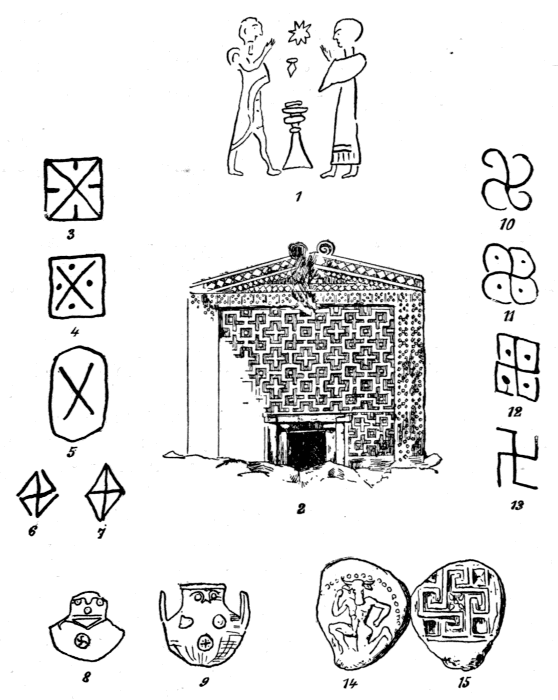
Figure 72.
As to the image of the Minotaurus on the obverse of the Berlin coin: to any one familiar with the widespread system of figuring the state under the form of a human being or of a quadruped, and of symbolizing its ruler as its head, the image appears intelligible as that of the quadruplicate state. The circumstance that the head is that of a bull seems to indicate that, like the Egyptians, the Cretans applied the title “bull” to their king; thence perhaps the fable that the island was at one time governed by the monster [pg 459] Minotaurus who claimed as annual tribute, from conquered tribes, seven youths and maidens. It is striking how perfectly the geometrical figures on the reverse of both coins, which I hold to represent territorial divisions, seem to form the complement to the image of the state represented in semi-human and semi-animal form. Interesting variants of the same design appear on two coins of the same period in the British Museum collection. One of these, from Syracuse, exhibits a swastika, in the centre of which is a human head—a sign which I should interpret as the image of a state and its single central ruler. A coin from Corinth displays a plain swastika only, which suffices to indicate, however, that its state organization was on the familiar plan.
In connection with the swastika and five-dot group it is interesting to examine some ancient Egyptian seals exhibiting crosses with four dots or strokes (fig. 72, 3-5), and to compare these with Rhodian specimens (10-13). On vases found by Schliemann on the site of Troy (8 and 9), we find, in one case a swastika and in the other a cross and four dots in a circle forming the nave. It is interesting to compare the Athenian nos. 6 and 7, one being a swastika and the other a cross in a lozenge.122 An extremely curious instance of an entire decoration of a building consisting of crosses and five-dot groups, is furnished by the cenotaph erected by a late king in honor of Midas, king of Phrygia (fig. 72, 2), which, curiously enough, offers much resemblance to the geometrical style of stucco decorations of the ruins of Mitla, Mexico.123 The presence of the swastika on coins assigned to about B.C. 700 and its use in Greece, where plain cross-symbols had previously been employed, naturally leads to the inquiry as to the oldest-dated swastikas which have hitherto been found in Greece and Egypt.
In his important work on the subject already referred to, Prof. Thomas Wilson (op. cit. pp. 806 and 833), cites the opinions of Prof. Max Müller and Count Goblet d'Alviella as agreeing with that of Waring, who states that “the swastika is sought for in vain in Babylonia, Assyria and Phœnicia,” and “had no foothold in Egypt.” The same authority says that: “the only sign approaching the fylfot in Egyptian hieroglyphics ... is not very similar to our fylfot ... and forms one of the hieroglyphs of Isis” [pg 460] (Ceramic Art in Remote Ages, p. 82). On the other hand, Professor Goodyear says (Grammar of the Lotus, p. 356): “The earliest dated swastikas, hitherto found in Egypt, occur on the foreign Cyprian and Carian [?] pottery fragments of the time of the twelfth dynasty [B.C. 2466-2266] discovered by Mr. Flinders Petrie in 1889. In the Third Memoir of the Egypt Exploration Fund, Prof. Flinders Petrie published illustrations of Greek vases showing unmistakable swastikas which, though found at Naukratis in Egypt, are not Egyptian, but Greek.”
The only other examples of the swastika in Egypt cited by Prof. Thomas Wilson are those woven on Coptic grave cloths made of linen and reproduced in “Die Gräber- und Textilfunde von Achmim-Panopolis by R. Forrer.” These grave cloths pertained to the Christian Greeks who migrated from their country during the first centuries of our era and settled in Upper Egypt, in Coptos and the surrounding cities. I am able to add another instance of the employment of the swastika in Egypt, which, although of Coptic origin, attaches itself to ancient Egypt.
I have already pointed out that, in Lepsius' Book of the Dead, the foremost of the gods of the four quarters, represented in mummy form, exhibited a cross on his right shoulder. During a recent visit to the Berlin Museum, my attention was arrested by seeing a swastika painted in precisely the same position, on the right shoulder of the stucco mummy case of a man, from Hermopolis, dated from the second century after Christ (Catalogue No. 11649). This remarkable coincidence seems to furnish conclusive evidence that, long before the introduction of Greek culture and Christian influence, the plain cross was employed by the ancient Egyptians in precisely the same way as, subsequently, the swastika by the Copts. To some of my readers the question will perhaps suggest itself whether some early Christian sects and, amongst them, communities of Greek Copts, did not interpret the mission of Christ literally, as an attempt to reëstablish an earthly “kingdom of heaven” on the ancient plan, the knowledge of which had been preserved at Heliopolis, by the sages and philosophers of Egypt and the large Hebrew colony established there.
Returning to the swastika: From the account given by Prof. Thomas Wilson (op. cit., 810) of Schliemann's observations on the swastikas he discovered, during his excavations on the site of Troy, we learn that, whereas the swastika occurs on thousands of whorls [pg 461] found in the third, fourth and fifth cities, but few whorls were found in the first and second cities, which were the deepest and oldest and none of these bore the swastika mark. These observations, added to the appearance of the swastika in Egypt at a comparatively late period, appear to prove that, whereas the cross-symbol was known in remotest antiquity in Asia Minor and Egypt and expressed the same meaning as the swastika, i. e. Polaris and circumpolar rotation and the quadruplicate organization of the Cosmos suggested by these natural phenomena, it was only the form or shape of the cross which underwent a change at a certain period. The earliest-dated specimens of this new form, given to a more ancient symbol, occur on the pottery fragments found in Egypt by Prof. Flinders Petrie. The presence of the swastika, on the whorls found in the ruins of the third city built on the site of Troy, also indicates that its adoption occurred at a fixed date and marked a new departure.
Referring back to page 21, where I show that the observations which led to the adoption of the swastika as a symbol could not possibly have been made until after Ursa Major had become circumpolar, about B.C. 4000, I point out that the oldest swastikas which have hitherto been found corroborate this view, since they are all posterior to the time when Ursa Major became circumpolar. Long anterior to its adoption, however, the primordial set of ideas, suggested to the human mind by the observation of natural phenomena, had reached an advanced stage of development, and had been worked out, applied to the regulation of human life and symbolized, in various ways, in widely separated countries.
It is impossible to conclude my comparative research, which has been rewarded by a most unexpected wealth of material, without enumerating a few facts connected with the earliest histories of Rome, ancient Ireland, Britain, Wales and Scandinavia. These brief and doubtlessly imperfect résumés will have fulfilled their purpose if they stimulate inquiry and evoke authoritative statements by learned specialists.
ANCIENT ROME.
Whether Rome “was founded by the common resolve of a Latin confederacy or by the enterprise of an individual chief, is beyond the reach even of conjecture. The date fixed upon for the commencement of the city is, of course, perfectly valueless in its [pg 462] precision” (Chambers' Encyclopædia). “According to Varro the city of Rome was founded B.C. 753, but Cato places the event four years later.... The day of its foundation was the 21st of April, which was sacred to the rural goddess Pales. There seems to be some uncertainty whether Romulus gave his name to the city or derived his own from it, but those who ascribe to the city a Grecian origin ... assert that Romulus and Roma are both derived from the Greek word for ‘strength.’ The city, we are assured, had another name which the priests were forbidden to divulge; but what that was it is now impossible to discover.124 There is, however, some plausibility in the conjecture that it was Pallanteum, and from the great care with which the Palladium, or image of Pallas, was preserved, it seems probable that the city was supposed to be under the care of that deity. If this conjecture be correct, the Pelasgic origin of Rome cannot be doubted, for Pallas was a Pelasgic deity....
“The institution of the vestal virgins was older than the city itself and was regarded by the Romans as the most sacred part of their religious system. In the time of Numa there were but four ... their duty was to keep the sacred fire on the altar in the temple of Vesta from being extinguished and to preserve a certain sacred pledge on which the very existence of Rome was supposed to depend.125 What this pledge was we have no means of discovering; some supposed that it was the Trojan Palladium; others, some traditional mystery brought by the Pelasgi from Samothrace. One fact is certain: that the Palatine is regarded as the oldest portion of the city and the original site and centre of the embryo mistress of the world and mother of cities, the Roma quadrata, fragments of whose walls have been brought to light.126
“Tradition relates that it was on the Palatine that Romulus marked out the Pomœrium, a space around the walls of the city, on which it was unlawful to erect buildings.... The next ceremony was the consecration of the comitium, or place of public assembly. A vault was built under ground and filled with the firstlings of all the natural productions that sustain human life and with [pg 463] earth which each foreign settler had brought from his home. This place was called Mundus” (History of Rome, Goldsmith's abridgment, 21st edition, by W. C. Taylor, p. 13).
This fact furnishes evidence that the sacred central cosmical vault over which a mound may have been formed by the earth contributed from different quarters, was regarded as a synopsis of all, and that sanctity was also attached to the central place of assembly where justice was administered at regular intervals, weekly markets were held and religious rites were celebrated.127
Tradition relates that, after the foundation of the central “Mundus,” the founder of Rome established the Sabine town which occupied the Quirinal and part of the Capitoline hills. “The name of this town most probably was Quirium ... the two cities were united on terms of equality and the double-faced Janus, stamped on the earliest Roman coins was probably a symbol of the double state.” It is significant to find not only that Janus was sometimes depicted with four faces instead of two, in which case he was called Janus Quadrifrontis, but that references are also made to the female form of Janus=Jana, the latter being identified with Diana. Considering that it was from Quirium that the Roman youths obtained Sabine wives by force, which had been refused to their entreaties, it would seem as though, originally, as elsewhere, the men and women of the community resided separately and that stringent laws regulated their intercourse. In other ancient communities it has been shown how the separation of the sexes created in time an upper and lower class, and to the same origin may perhaps be assigned the most remarkable feature of the Roman constitution, i. e. the two-fold division of the people into patricians and plebeians.
While the foregoing statements throw light upon the ideas associated with the Middle and show that Rome was originally a dual state, the following facts furnish indications of a quadruplicate division. At an early period Rome was laid out and enclosed in a square, the population was divided into four tribes and mention [pg 464] is made of “the state, under Servius Tullius, being an entity divided into four cities and twenty-six tribes ... this being strictly a geographical division analogous to our parishes. The division of the city into four tribes continued until the reign of Augustus (B.C. 29)....”128
The four chief religious corporations of ancient Rome, mentioned in the Century Dictionary, evidently correspond to this fourfold division and it is specially stated of one of these corporations that it was represented and governed by a group consisting of seven “septemvir epulones” who formed a “septemvirate.”
The number of septemvirs corresponded to the “seven hills” which were enclosed by Tullus Hostilius, and it is stated that there were seven places of worship in ancient Rome. It is interesting to find that between A.D. 193 and 211, Septimius Severus, a native of an ancient Punic colony in Africa, erected a Septizonium (an edifice consisting, like the Babylonian zikkurat, of seven stories) on the Palatine, where a large temple of Apollo had previously been built.129
Although it is thus evident that, at different periods, seven-fold division was carried out in ancient Rome, it was not until after the reign of Theodosius, according to some authors, that the seven-day [pg 465] period was imported from Alexandria and the term “septimana” adopted in Rome. “Previously to this Rome had counted her periods by eight days, the eighth day itself being originally called Nundinæ—a term later applied to the whole cycle” (Chambers' Encyclopædia). Noting that the period of eight (=2×4) days accords with the quadruplicate system applied to the primitive state, I draw attention to the numerical classification of the citizens of Rome employed during centuries, which so curiously agrees with the system carried out in Peru at a widely sundered period (see p. 141).
Ten households formed a gens (clan or family); ten clans or one hundred households formed a curia or wardship; and ten wardships, or one hundred clans, or one thousand households formed a populus, civitas or community. As it is stated that, at one time, Rome consisted of four cities, it is obvious that the above numbers, quadrupled, constituted the state which thus included forty wardships, four hundred gentes and four thousand households. As each gens possessed a chieftain, endowed with paternal authority over its members, there must, at one time, have been four hundred of these “patricians,” whose number is thus found to correspond to the Greek “Council of 400” and curiously enough to the “four hundred Tochtli” or governors of the ancient Mexican commonwealth.
A noteworthy feature of the attempt to institute the Decemvirate in Rome (5th century B.C.) was the arrangement that the ten chosen men exercised office in prescribed rotation for one day, each ruling, in consequence, for thirty-six days in the year which, like the Egyptian, then consisted of three hundred and sixty days and of an epact of five days. The assignment of a day to each chieftain finds its parallel not only in Assyria but also in ancient America (see p. 181).
In connection with the Roman communal organization, attention is drawn to what appears to be a remarkable survival of an extremely ancient and natural mode of distinguishing the wardships. It is well known that, according to tradition, the republic of Siena, Italy, was founded at a remote period “by the sons of Remus, the twin brother of Romulus.” The following facts prove that, to this day, certain features of its social organization exhibit an affinity to that of primitive Rome. “Siena, from the earliest day, has been divided into contrade or parishes. Each contrada has its special church, generally of great antiquity, and each contrada is [pg 466] named after some animal, or natural object, these names being symbolical of certain trades or customs. There are now the wolf, giraffe, owl, snail, tower, wave, goose, tortoise, etc., in all seventeen. Each has its colors, heralds, pages, music, flags; all the mediæval paraphernalia of republican subdivision” (Frances Eliot, Diary of an idle woman in Italy i, p. 19).
The employment of the names of animals and natural objects as distinctive marks for a wardship offers a curious analogy to the American institution of tribal names and totems.
The circumstance that, in remotest times, the king of Rome, the acknowledged metropolis or mother city, was accompanied, on public occasions, by twelve lictors or administrators of justice, each carrying the axe tied in a bundle of rods, shows that, at one time, the government was administered by thirteen individuals—a method we shall find again in ancient Ireland and Scandinavia. The history of Rome reveals that the different variants of governmental scheme adopted, one after the other, under influences emanating from Greece and Egypt, were reared upon the familiar universal plan. The most striking instance of this is, however, furnished by the details preserved of the groundwork on which Constantine founded (A.D. 330) the city he intended to be the capital of a universal empire, and named the New or Second Rome.
Historians relate that the peninsula of Byzantium offered striking resemblances to the sites of Carthage and Rome. The design of Constantine embraced the entire peninsula with the seven hills upon it. “On foot, with a lance in his hand, professing to be under the guidance of divine inspiration, the emperor directed the line which was traced as the boundary of the destined capital.” ... “In imitation of Rome at that period, the city was divided into 2×7=fourteen wards (regiones).... Its centre was marked by a column ... surmounted by a bronze colossus of Apollo. The church of S. Sophia, built on the site of an ancient temple of Wisdom, was subsequently dedicated to 'the Holy Eternal Wisdom' by Justinian. In the court called the Forum Augusteum, one side of which was formed by the palace and the other by the church, stood the Milliarium Aureum, not, as at Rome, a gilt marble pillar, but a spacious edifice, the centre from which all the roads of the empire were measured and on the walls of which the distances to all the chief places were inscribed.... In the new reunited empire quadruple division was maintained, the [pg 467] empire being divided into four parts, each forming a prætorian prefecture under a prætorian prefect, who, being the lieutenant of the emperor, ruled over the governors and people of the province with absolute power. The four prefectures were subdivided into thirteen dioceses, each governed by a vice-prefect named vicarius, the total number of dioceses being fifty-two.”
This system of numeration is of particular interest as it is not only identical with the system of a modern pack of cards, the origin of which is unknown, but is also the same as the Mexican year cycle (see p. 297). Vestiges of sevenfold organization are traceable in the appointment by Constantine, of “seven ministers of the palace” who exercised “sacred” functions about the person of the emperor, and the division of all Gaul into seven provinces placed under the governorship of the Vicar of the Seven Provinces. In conclusion I venture to point out that the four-storied amphitheatre of Vespasian (A.D. 71), the Pantheon of Agrippa (A.D. 23) and the Mausoleum of Hadrian (A.D. 138) appear to have a cosmical character, the first having been planned to hold the entire population of Rome, around a central space in which, originally, the circling chariot simulated the circuit of the celestial “plaustrum” or “carro”=chariot, the Latin name given to Ursa Major.
While, on public festivals, the amphitheatre must have appeared as a synopsis of the whole empire and may also have been originally used for nocturnal, religious or political assemblages, the great Pantheon enclosing the images of twelve deities, may well have been a conscious attempt to represent the all-embracing Cosmos of Egyptian and Greek philosophy, the framed view of the heaven, seen through the central opening in the dome, being the symbol of the “hidden and invisible god,” of the initiated. To Hadrian, who visited Egypt twice and was undoubtedly acquainted with the idea of Plato's Cosmos or Theos, the idea of building a great circular structure in the centre of which he would be laid to rest, would naturally have suggested itself. Passing from a consideration of the buildings which, with the pyramids, appear to be among the grandest exponents of natural philosophy and religion ever reared by the hand of man, and clearly appear to have been planned under the direct influence of Egyptian and Greek philosophy, let us briefly glance at the mode in which the identical fundamental scheme was perpetuated among some northern peoples.
[pg 468]
ANCIENT IRELAND, BRITAIN AND WALES.
It is a remarkable fact that, in ancient Ireland, we find distinct traces of a state, founded on the same crystallized artificial system that has been found at the basis of the most ancient civilizations of the world. “There is really no authentic history of Ireland before the introduction of Christianity into the country, but there are some genuine traditions which appear based upon truth, because they accord with and explain the peculiar customs which were found to prevail in the island at the time of the English invasion. These traditions declare, that the original Celtic inhabitants were subdued by an Asiatic colony, or at least by the descendants of some Eastern people at a very remote period; they aver that the conquerors were as inferior to the original inhabitants in numbers as they were superior in military discipline and the arts of social life; they describe the conquest as a work of time and trouble and assert that, after its completion, an hereditary monarchy and hereditary aristocracy were for the first time established in Ireland....”
“At some unknown period Ireland was divided into five kingdoms, Ulster, Leinster, Connaught, Munster and Meath ... the latter being the property of the paramount sovereign ...” (W. C. Taylor, History of Ireland, 1837).
John O'Neil cites “the very oldest Irish books, according to which two brothers, the leaders of the Milesian colonization, divided Ireland into Northern and Southern kingdom.” Elsewhere he relates how a prince of the north had been united in marriage to the princess of the south and that “the mythical Niall-Navi-giallach of the nine treasures had had a Northern king for father and a Southern princess for mother.” Besides this subdivision which strikingly recalls the ancient Egyptian, O'Neil brings out the remarkable fact that definite positions in relation to each other and the cardinal points were assigned to the five Irish kings and tells us that “we have a fuller and later division when, in the central hall, the miodh-chuarta of Tara, the king of Erinn sat in the centre, with his face to the East, the king of Ulster being at his North, the king of Munster at his South, while the king of Leinster sat opposite to him and the king of Connaught behind him” (op. cit. i, 463).
I refer the reader to his extremely interesting comparison (i, p. 369) of ancient Ireland being “an Irish instance of a Chinese [pg 469] ‘Middle Kingdom,’ ” and to the data given in connection with the great hall of Tara, which was called Meath or Mid-court, Miodchuarta (pronounced Micôrta), and the Northern hill of Miodhchaoinn (or Midkena), guarded by Miodhchaoinn and his three sons, the guardians of the hill being thus four in all. O'Neil also refers to “the great idol or castrum of Kilair ... which was surrounded by twelve smaller ones and was called the stone and umbilicus of Hibernia and, as if placed in the midst and middle of the land, ‘medio et meditullio’....” “Meath itself, where this Kilair navel stood, was anciently the central one of the five divisions of Ireland and is called Media by Giraldus Cambrensis, ... and connected with the words medi-tullium and medi-tullus.” The legend states that “the castrum of Kilair and the stones around it were transported by Merlin to Stonehenge and ‘set up in the same order.’ ”130 “At Mag Slecht was the chief idol of Ireland, called Cenn Craich (Mound-chief) covered with gold and silver, and twelve other idols about it, covered with brass” (O'Neil, p. 273).
“The five Irish kingdoms were again subdivided into several principalities inhabited by distinct ‘septs,’ each ruled by its own carfinny or chieftain. The obedience of these local rulers or toparchs to the provincial sovereign was regulated, like his to the general monarch, by the powers that he possessed for enforcing authority.... The succession to every degree of sovereignty was regulated by the law of tanistry, which limited heredity right to the family but not to the individual.... Each district was deemed the common property of the entire sept; but the distribution of the several shares was entrusted to the toparch.... The lower orders were divided into freemen and hetages, or as they were called by the Normans, villanis. The former had the privilege of choosing their tribe; the latter were bound to the soil and transferred with it in any grant or deed of sale.”
Ruined groups of buildings, consisting of seven sanctuaries or churches, situated around a round, high tower, usually with four windows near the top, opening to the cardinal points, exist in various parts of Ireland, the Seven Churches in County Wicklow being the most famous example. The cosmical character of the [pg 470] round towers has been set forth by John O'Neil, to whose work I refer the reader. According to my views the groups testify to the establishment, at one time, of several septarchies in Ireland, the geographical centres of which, as in Assyria and elsewhere, were marked in this case by the cosmical round tower, figuring the axis or spindle, around which each sept built its council house, for religious and political assemblies.131 In connection with such it is interesting to read what Cæsar says of the priests and judges of Gaul, which was organized into seven provinces, as late as at the time of Constantine: “These Druids held a meeting at a certain time of the year in a consecrated place in the country of the Carnutes [modern Chartres] which country is considered to be in the centre of all Gaul.” It is well known that anterior to the Roman Conquest there existed in Britain a long-established, seven-fold state, governed by seven kings, compared by John Speed (1630) to seven crowned pillars.
The kingdom of Mercia included the counties in the centre of the kingdom and is said to have been founded by Crida or Creoda. The central and chief ruler of Britain was styled Bretwalda. It is well known that Stonehenge, which is associated in folk-lore with the number seven, is situated in the heart of the plain region of England and is supposed to have been the seat of central religion and government.132
It is moreover acknowledged by Knight that the ancient Britons were a people who evidently had some great principle of association in their religion as in their industry. The familiar fact, that at one period the ancient Kent, Cantium, was governed by four kings, also styled “the four princes of Cantii,” furnishes an indication that quadruplicate division was also known to the ancient Britons.
[pg 471]
A few instructive facts concerning Welsh Druidism may be appropriately cited here.
Morien has pointed out that the Druidic Celi Ced corresponds to Amen-Ra, the Egyptian Hidden Sun. According to Welsh system the universe was born of Celi-Ced, a dual power, Celi being the masculine and Ced the feminine principle. Ceridwen is termed the Welsh Isis, and her name translated as “the producing woman.” Celi is invariably represented as hidden, the three Hus representing him in manifestation.
“The three Hus are: Hu cylch y Cengant=the Hu of the circle of infinitude; Hu cylch y Sidydd=the Hu of the circle of the zodiac and Hu yn Nghnawd=Hu incarnate. The latter was incarnate in the Arch Druid. He, standing in the middle of the Gorsedd circle, where the triple life lines met, implied by his action that the three emanations which had their root in the dual Ced-Celi, focussed themselves in him. He stood facing the east where the sun rises” (cf. the ceremonial position assumed by the king of Erin in council and that of the Roman augur on drawing his templum). “The name for the physical sun was Huan, translated as ‘the abode of divinity.’ ” “The Druidic bards of N. Wales worshipped Beli.”133
In Welsh legend a god named Peredur Paladye Hir (of the long spear or pal) is associated with his brother, both sons of Eliffer, one of the thirteen princes of the north. Peredur is one of seven brothers; there were seven profound mysteries of Druidism, i. e. seven divisions of the reverberations of the Word, emanating from Ced, and the seven Tattaras or seven rays.
SCANDINAVIA.
According to the Icelandic historian Snorri Sturlesson, whose opinion was the re-echo of ancient traditional beliefs, Odin and his eight sons and four companions, twelve in all, were earthly kings and priests of a sacerdotal caste, who had emigrated from Asia—perhaps from Troy—and who conquered and ruled over various parts of Scandinavia and Northern Germany where, after their death, they were regarded by the people as deities (Chambers' Encyclopædia).
O'Neil states “that Odin was named Mith-Odinn (Mid-Odin?) [pg 472] by Saxo Grammaticus,” and quotes the following: “Odinn died in his bed, in Sweden, and when he was near his death he made himself be marked with the point of a spear and said he was going to Godheim” (Ingliga Saga). “The twelve godes or diar or drotnar of Odin were obviously cognate to our god as a name of a deity. They (or the priests who represented them) directed sacrifices and judged the people, and all the people served and obeyed them” (O'Neil i, p. 76).
A strange reality is given to Odin and his twelve “godes,” when it is realized that at Mora, near Upsala, Sweden, there exists the ancient stone throne on which the ancient kings of Sweden were crowned and this central stone is surrounded by twelve lesser stones, just as the Irish “Mound-chief” was surrounded by twelve idols.
While the above facts suffice to indicate that, in remotest antiquity, the government of the state was vested in one supreme and twelve minor chiefs, the following brief extracts from the Eddas reveal the cosmical beliefs of the Norsemen: “In the cold north existed Niflheim in the middle of which was a well from which sprang twelve rivers. In the south existed the warm Muspelheim. There was a contention between both of these worlds.... The union of heat and cold produced Oergelmer or Chaos, and the first human being, Ymir. The revolving eye of the Norse world-millstone was directly above Oergelmer and through it the waters flowed to and from the great fountain of the Universe waters.” Ymir drew his nourishment from four streams of milk proceeding from the mythical cow Aedhumla. Subsequently he was slain by three divine brothers who carried his body to the middle of Ginnungagap, and formed from it the earth and the heavens ... of his skull they formed the heavens, at each of the four corners of which stood a dwarf, viz: Austri at the East, Vestri at the west, Northri at the north and Suthri at the south.... When heaven and earth were formed, the chief gods or Oesir, of whom there were twelve, met in the Centre of the world and built Midgardr or Asgard, the yard, city or stronghold of the Middle and of the Asen=the gods. It was situated on the Himinbiorg, or Hill of Heaven, on the summit of which was the ash-tree, Yggdrasil, whose branches spread over the whole world and tower over the heavens.
The following is from the prose Edda: “Then the sons of [pg 473] Bõr built in the middle of the universe the city called Asgard, where dwell the gods and their kindred, and from that abode work out so many wondrous things both on earth and in the heavens above it. There is in that city a place called Hlidskjalf, and when Odin is seated there upon his lofty throne, he sees over the whole world.”
In the Eddas we find evidences that while Odin or All-fader was the ruler of heaven, his powerful son Thor was “the ruler of Thrudheim and drove through the world in a chariot and became the supreme god.”
The following facts, taken from Mr. Allen's “Star-names,” established the association of Thor with Polaris and the Ursæ. “In ancient times the northern nations termed Ursa Major ‘the wagon of Odin, Woden or Wuotan, the father of Thor.’134 The Danes, Swedes and Icelanders also knew it as Stori Vagn, the Great Wagon and as Karl's Vagn; Karl being Thor, their chief god of whom the old Swedish Rhyme Chronicle of Upsala says ‘... The god Thor was the highest of them. He sat naked as a child, seven stars in his hand and Charles' Wain.’ ”
The “throne of Thor” or “Smaller Chariot,” was the name given to Polaris (Ursa Minor) by the early Danes and Icelanders and their descendants still call it the “Litli Vagn,” the little wagon. The Finns, apparently alone among the northern nations of Europe in this conception, named Ursa Minor, Vähä Otawa, the Little Bear. They, however, termed Polaris, Taehti, “the star at the top of the heavenly mountain.”
It is striking how clearly, in Scandinavia, the Middle is associated with a sacred mountain and tree, the world axis, a heavenly city, an enthroned central god, and with Polaris, Ursa Major and the idea of eternal circumpolar rotation expressed by the wain eternally wheeled around the throne of Thor. To any one imbued with the ideas set forth above, the signification of the Scandinavian, Druidic, New Year festival, the name for which was “the wheel” (yule, yeol, yeul, hjol, hiugl, hjul), must clearly appear as the date on which the complete circuit of the Ursæ around the [pg 474] pole, was ceremonially registered. It is obvious that this could best be expressed by a circle being drawn around the swastika or cross, to which the fourth arm would be added, completing thus the registration of the four seasons, marked by the opposite positions assumed by the Ursæ at nightfall. It is well known that the wheel-cross, swastika, triskeles and S-figure constitute, with the winding serpent and the tau, named Thor's hammer, the main symbols of ancient Scandinavia (see fig. 13, p. 29 and fig. 38, p. 119). I venture to point out how obviously Thor's hammer symbolizes the union of the Above and Below, the heaven represented by the horizontal line resting on the perpendicular support, symbolizing the sacred pole, column, mountain and tree intimately associated with Polaris, the world axis.
As a suggestion only, I venture to point out how, the old Norse name for star being tjara and for tree=tar, the rôle of the tree in Druidic cult would be fully accounted for, the initiated only being aware that it was but a rebus symbol of the secret or hidden star-god Polaris.
It can readily be seen how natural or artificial elevations and erected stones, trees, staffs or poles must have been used as means of determining the positions of the Ursæ at the public celebration of the Yule festival and that the ceremony of kindling of new fire was observed at the time when the “wheel” was supposed to begin its new annual revolution.
Reflection clearly shows that pole-star worship must have taken a stronger hold upon the ancient inhabitants of Scandinavia and their descendants, the seafaring Vikings, than upon any other nation. We are compelled to admit that the recognition that Polaris formed the centre of axial rotation and the middle of the sky, would have impressed itself most profoundly upon observers stationed in the latitude where winter darkness prevailed and the pole-star appeared to be nearly overhead. Under such conditions the association of the opposite positions of the Septentriones with directions in space, i. e., the cardinal points, would be most striking.
What is more: the re-appearance of the sun, after the long darkness of a northern winter, must have established the idea of a fixed relationship between certain positions of Ursa Major and the solstitial position of the sun. It may indeed be said that the observation of the solstices and equinoxes was forced upon the inhabitants of the north as nowhere else on the globe and that it [pg 475] may perhaps be therefore designated as the birthplace of primitive astronomy.
The origin of the idea of an all-pervading duality and the chains of association which linked Light and the Sun to air and water, and to the male element, whilst Darkness and the Nocturnal Heaven became connected with earth, fire and woman, are clearly accounted for in the circumpolar regions only, where the year divides itself into a period of light in which independent and roaming out-door life was possible, and a period of darkness during which family life, in underground fire-lit dwellings, was compulsory. If fathomed, the mind of the Eskimo to-day may possibly reveal the germs of identical associations of ideas, for it would seem as though existence in the polar regions would infallibly stamp them indelibly upon the consciousness of all living creatures, until they unconsciously pervaded their entire being and even affected the structural organization of the human brain.135
The tendency to believe that the human race must have spent its infancy near the pole and received there an intellectual stamp, which could not have been conveyed to it so clearly in any other latitude, is undoubtedly encouraged by the opinion of various authorities, that “all forms of life must have originated at the pole, this having been the first habitable portion of our world.” This view is exhaustively treated in William Fairfield Warren's “Paradise Found, the cradle of the human race at the North Pole” (Boston, 1885), to which I refer the reader and which contains much valuable data which I would have incorporated in the present investigation had I had earlier access to the volume. It would seem as though Warren's conclusions were in perfect accord with the conclusions arrived at by some leading palæontologists, geologists and botanists, concerning the distribution of life on the globe. These are conveniently summarized in the article on “Distribution” in the Encyclopædia Britannica, from which the following detached excerpts are made for the benefit of the reader.
“The general result arrived at is that the great northern continents [pg 476] represent the original seat of mammalian life and the regions of its highest development.... The tertiary fauna of North America, compared with that of Europe, exhibits proofs of a former communication between the two northern continents both in the North Atlantic and North Pacific, but always, probably, in rather high latitudes. This is indicated both by the groups which appear to have originated in one continent and then to have passed across to the other and also by the entire absence from America of many important groups which abounded in Europe (and vice versa) indicating that the communication between the two hemispheres was always imperfect and of limited duration.... On the other hand, the marked continuity of the Northern Flora (with only a gradual east and west change in the arctic regions, but with an increased divergency southwards) requires it to be treated as a whole, although it has long been divided into that of the old and new world by the severance of North America from Northern Asia and by the barrier to an interchange of vegetation in the upheaval of the Rocky Mountain range. The old and new world divisions of the flora which, no doubt, began to diverge from the mere influence of distance, have now had that divergence immensely increased by isolation.... Large American genera (of the intermediate flora) have sent off offsets into Eastern Asia which, gradually diminishing in number of species and sometimes slightly modifying their character, have spread over the whole of Asia and invaded almost every part of Europe.... With regard to the arctic alpine flora, Hooker found that, estimating the whole arctic flora at 762 species, arctic East America possessed 379 of which 269 are common to Scandinavia. Of the whole flora 616 species are found in arctic Europe and of these 586 are Scandinavian and this leads Hooker to the striking observation that ‘the Scandinavian flora is present in every latitude of the globe and is the only one that is so.’ According to Bentham, Scandinavia, which would, according to older rules, have been termed the centre of creation for the arctic regions, may now be termed the chief centre of preservation within the arctic circle owing, perhaps, to its more broken conformation and partly to that warmer climate ... which was, during the glacial period a means of preservation of some colder species which were everywhere expelled or destroyed.... We may infer that, towards the close of the Tertiary epoch, the continuous circumpolar land was covered with [pg 477] a vegetation also largely composed of identical plants, but adapted to a warmer climate. As the climate became less warm there would commence a migration southwards which would result in the modified descendants of these plants being now blended with the vegetation of central Europe and the United States. As the glacial period gradually advanced, the tropical plants will have retreated from both sides towards the equator followed in the rear by the temperate productions and these by the arctic. When the climate of the earth again ameliorated, the migration took place in a reverse direction and in this way mountain ranges became the havens of refuge for the fragments of the original arctic flora which were exterminated on the lowlands. An indication of the great antiquity of the arctic alpine flora is afforded by the fact of its absence in the comparatively modern volcanic mountains of France.... If it be granted that the polar area was once occupied by the Scandinavian flora and that the cold of the glacial epoch did drive this vegetation downwards ... in arctic America ... where there was a free southern extension and dilatation of land for the same Scandinavian plants to occupy, these would multiply enormously in individuals....”
The following remarkable results of recent botanical research will be found to be of profound interest to investigators and to support the foregoing conclusions. Amongst the many important discoveries of hitherto undescribed species of plants, made by the distinguished botanists Mr. Stephen Sommier and Dr. Emile Levier during their expedition in the Caucasus mountains, in 1890, was that of a species of fungus named Exobasidium discoideum Ell., which was found growing on the Rhododendron flaro L. This fungus was submitted to Prof. P. Magnus of Berlin, who pronounced it to be the identical Exobasidium which has been found growing on the Azalea viscosa L. in New Jersey, U. S. A. The following is the authoritative statement of Prof. P. Magnus which appears in Messrs. S. Sommier and E. Levier's Enumeratorio plantarum caucas: acta horti petropolitani, vol. XVI. St. Petersburg, 1899.
“The occurrence of the identical species of fungus on two closely related plants, which respectively grow in the Caucasus and in North America and are missing in intermediate countries, deserves our deepest interest.... These plants are relics of the Tertiary period, during which North America and Europe still [pg 478] formed a continuous floral area. While the plants, on which the fungus grew, differentiated into two closely related species, in two at present widely separated but formerly connected radii of distribution, the parasitical Exobasidium remained outwardly unaltered. This is exactly like the case of another fungus, Uromyces glycyrrhizæ, which I have described and explained in the ‘Berichten der Deutschen Botanischen Gesellschaft’ (Bd. VII, 1890, S. 377-384). Exobasidium disc. is also a parasitical fungus which has been growing on the parent form of Rhododendron viscosum and Rhododendron flavum ever since that period when North America and Europe were continuous and possessed the same flora.”
I am also indebted to Professor Magnus and to Dr. Levier for the following names of closely allied species of plants which are found in America and Asia only, it being particularly noticeable that it is in Asia Minor and the Caucasus mountains that the relatives of the American species are most frequently met with.
Platanus occidentalis: North America. Platanus orientalis: Asia Minor. Liquidambar styraciflua: North America. Liquidambar styraciflua: Asia. Rhododendron viscosum: North America. Rhododendron flavum: Caucasus Mts. Rhododendron maximum: North America. Rhododendron ponticum: Causasus Mts.
Professor Magnus has, moreover, recently pointed out that the fungus Uropyxis, which is a widespread American species and grows in Mexico, has a representative in Manchuria. In his monograph on Uropyxis, Professor Magnus enumerates further species of fungi which occur in America and Asia only and are missing in other portions of the world (P. Magnus, Berichten der Deutschen Botanischen Gesellschaft, Jahrgang 1899. Band xvii, Heft 3).
Referring the reader to Professor Edward S. Morse's trite article, Was Middle America peopled from Asia? (Appleton's Popular Science Monthly, November, 1898), I cite, from this, the following authoritative statements: “From the naturalist's standpoint the avenues have been quite as open for the circumpolar distribution of man as they have been for the circumpolar distribution of other animals and plants, down to the minutest land snail and low fungus. The ethnic resemblances supposed to exist between the peoples of [pg 479] the two sides of the Pacific may be the result of an ancient distribution around the northern regions of the globe.”
The very remarkable survival of certain plants and fungi, dating from the Tertiary period, in two such widely sundered countries as Asia Minor and North America, certainly finds a curious and striking parallel in the analogy of the cosmical ideas and social organization of Babylonia and Assyria with those of Mexico.
What is more: A cosmical scheme, attributable to a prolonged observation of natural celestial phenomena, such as could best have been carried on in circumpolar regions, has been shown to be as widespread as the Scandinavian flora which “is present in every latitude and is the only one that is so.”
Many of my readers will doubtless be inclined to explain the identity of cosmical and religious conceptions, social organization, and architectural plans shown to have existed in the past between the inhabitants of both hemispheres, as the result of independent evolution, dating from the period when primitive man, emerging from savagery, was driven southward from circumpolar regions, carrying with him a set of indelible impressions which, under the influence of constant pole-star worship, sooner or later developed and brought forth identical or analogous results.
Those who hold this view may perhaps go so far as to consider the possibility that, before drifting asunder, the human race had already discovered, for instance, the art of fire-making and of working in stone, had adopted the sign of the cross as a year-register, and evolved an archaic form of social organization. To many this view may furnish a satisfactory explanation of the universal spread of identical ideas and the differentiation of their subsequently independent evolution.
On the other hand, another class of readers may prefer to think that, while both hemispheres may have originally been populated by branches of the same race, at an extremely low stage of intellectual development, civilization and a plan of social organization may have developed and been formulated sooner in one locality than in another, owing to more favorable conditions and thence have been spread to both continents by a race, more intelligent and enterprising than others, who became the intermediaries of ancient civilization.
The great problem of the origin of American peoples lies far beyond the scope of the present work and its final solution can [pg 480] only be obtained at some future day by the joint coöperation of Americanists and Orientalists. On the other hand certain incontrovertible facts which throw light upon the question of prehistoric contact have been coming under my observation during my prolonged course of study and the presentation of these may advance knowledge by acting as a stimulus to discussion, inquiry and research by learned specialists.
For ready reference I submit the following tabulated record of the widely sundered countries in which are found, applied to the governmental scheme, the same cosmical divisions, respectively consisting of four, seven and thirteen parts, the group being invariably associated with the idea of an all-embracing One, constituting the Four in One, Seven in One and Thirteen in One. It is superfluous to add that, in each country enumerated, the existence of more or less distinct traces of an ancient pole-star worship and the cult of the sacred Middle, the Above and Below and Four Quarters, i. e., the four, seven and thirteen directions in space, have been recorded in the preceding pages. Important additional facts, acquired by reference to Hewitt's Ruling Races of Prehistoric Times, to which my attention was directed by Mr. Stansbury Hagar, and to other valuable works, will be found included in the following summary.
It would be of utmost assistance to me in my future researches and I would regard it as a personal favor if specialists would draw my attention to any deficiencies they may detect, and inform me of the latest results of their individual investigations bearing upon the subjects under consideration.
INDIA.
Seven zones, seven directions in space, seven sages.
“The conception of the confederated kingdom formed of six dependent and allied states surrounding the seventh ruling state in the centre.”... “It is this conception which is worked out in the six kingdoms surrounding the central kingdom of Jambudvipa, into which they divided India. This form of kingdom still survives in those which form the tributary states of Chota Nagpore, for in all of these the central province is ruled by the king and those surrounding it by his subordinate chiefs ...”136 (Hewitt, Ruling Races of Prehistoric Times, p. 256).
[pg 481]
Four lakes, four rivers, four cosmical divisions, four guardians, p. 320.
“In the Gond ‘Song of Lingal,’ it is related how, Lingal, having been slain by the confederacy [of six kingdoms surrounding seventh], came to life again, and with four new-born Gonds, founded a new race of Gonds; taught them to build houses and to grow millets.... He divided the people into four tribes.... With these he united the four tribes descended from the Gonds he had brought down in his first avatar.... These formed the eight united races of the tortoise-earth.... Lingal placed among them priests ... who married the new-comers to the daughters of the previous immigrants.... This ... marks the first stage of the union of the Kushikas and the Maghadas, the latter being the race who worshipped the mother-Maga as the sacred alligator (Hewitt).
“According to the Mahābhārata the two races of Kushikas and Maghadas were united under one king.... This land was called by Hindu geographers Saka-dvipa, said in the Mataya Purana to be the land of the mountain whence Indra gets the rain;” that is of the mountain called Khar-sah-kurra, Ushidhan and Savkanta. “This mountain stood as the meeting point of the two confederacies [pg 482] of the patriarchal tribes and the matriarchal races.... Each confederacy is formed by six kingdoms surrounding a seventh or ruling kingdom in the centre.... This, in the Iranian federation, is Khavaniras or Huaniratha and in India, Jambu-dvipa, the land of the Jambu tree.”
Hewitt publishes an interesting drawing (reproduced as fig. 73, c), formed “by the union of the four triangles representing the Southeastern and Northwestern races, who all looked on the mother mountain of the East, whence Indra gets the rain, as their national birthplace, where they became united as the Kushite race, the confederation of civilized man. It represents the Greek cross and the double dorje or thunderbolt of Vishnu and Indra and also a map of the Indian races, as distributed at the time of the union. It also forms, with spaces left open for the parent rivers, ... an octahedron or eight-sided figure ... and the angles of the tribal angles form the swastika ... the sign of the rain-god ..., the great Sar of the Phœnicians....” Referring the reader to Hewitt's interesting discussion of this figure with which he associates the origin of the swastika, I point out a fact he barely notices, namely that the figure coincides with the description of Mt. Meru, associated with four lakes, four rivers, four mythical animals and four guardians (p. 320). It is in connection with the cosmical Middle Mountain that the foundation of an earthly kingdom on the same plan becomes significant and the distribution of races figured by Mr. Hewitt assumes utmost importance. The representation of the four races by “tribal triangles,” is of special interest when collated with the Egyptian sign for city or state and the pyramid, the building of which I have several times alluded to as an event facilitating, symbolizing and commemorating the foundation of a quadruplicate state (pp. 220 and 221).