The Fundamental Principles Of Old And New World Civilizations. (continued 6)
Reading edition
The Copan swastika enables us to come to another interesting conclusion. It is a refined representation of the set of thoughts suggested by Polaris, the idea of a stable centre being graphically rendered. Movement in four directions is also symbolized. As, in the latitude of Copan, Ursa Minor is the only circumpolar constellation which could have been observed in four opposite positions, it is obvious that Ursa Minor with Polaris must have constituted the Maya Celestial Heart or Life=cuxabal. The following points remain to be discussed in connection with the Copan swastika.
1. To be complete and in keeping with native modes of representation it must have originally been painted with the symbolical colors of the Four Quarters.
2. It is on a wooden club from Brazil or Guiana that, strange to say, I find a cross symbol with bifurcated branches, which most closely resembles the Copan type. Directing the readers to the illustration of this club as fig. 8, pl. xv, in Dr. Stolpe's work already cited, I would ask them to examine also his fig. 7, with a design expressing dual and quadruple divisions; fig. 9b, with circles containing cross lines; 9a, with what resembles somewhat a Maltese cross but also conveys duality; fig. 11b with a cross in a scalloped circle and a curious disc between four signs, with a band of alternate black and white squares and its reverse 11a, with triangles, to which I shall revert; and figs. 10c and d, each with a mound from which a tree is growing. Though tempted to refer to many other symbols I shall limit myself to pointing out that his fig. 1, pl. xiv, exhibits a group of five circles in a circle which strikingly recall the Mexican examples and the Maya ho=5. As each of the foregoing symbols is intelligible and belongs to a group of ideas which I have shown to have been general throughout America, but to have necessarily originated in the northern hemisphere, it seems pretty clear that they must have gradually found their way to Brazil and Guiana from the north by means of coast navigation and traffic.
3. Concerning the bowl in the hand of the figure occupying the [pg 225] middle of the swastika a few remarks should be added to those already given on pp. 72 and 93.
Formed of clay the bowl was an expressive symbol of the earth. Placed in elevated positions on the terraces of the temples, and filled by the first annual showers which fell upon the parched earth, the bowl of celestial water naturally became invested with peculiar sanctity, and was gradually regarded as containing particular life-giving qualities. One use to which bowls full of water were put, in ancient Mexico, seems to explain further the ideas associated with them. It is well known that bowls of water were used at night for divination purposes, just as were black obsidian mirrors. This seems to prove that the latter were a subsequent invention which was adopted because it permanently afforded a surface for purposes of reflection.
In the native Maya chronicles the reflection of a star upon the trembling and moving surface of the water, is given as the image of the Creator and Former, the Heart of Heaven, and it was believed that the divine essence of life was thus conveyed to earth by light shining on and into the waters. It is well known that it was customary for the priests of the Great Temple of Mexico to bathe at midnight after fasting, in a sacred pool so deep that the water appeared to be black. This artificially-produced peculiarity would have rendered its surface particularly useful for the observation and registration of the movements of stars by their reflections.
Thomas Gage quaintly tells us, moreover, that at the consecration of a certain idol “made of all kinds of seeds that grow in the country ... a certain vessell of water was blessed with many words and ceremonies, and that water was preserved very religiously at the foot of the Altar for to consecrate the King when he was crowned and also to blesse any Captain Generall, when he should be elected for the Warres, with only giving him a draught of that water” (op. cit., p. 53). It is well known that infants also underwent a form of baptism.
The preceding and other evidence, which is scarcely required, enables us to realize the full significance which the symbol of a bowl surmounted by the glyph ik=life, breath, soul, was intended to express and convey.
The collection of rain-water in vessels, exposed so as to receive the reflection of the one immovable star-god, was doubtlessly employed as a test of the stability of the Middle of the Earth by [pg 226] many generations of priest-astronomers. The sanctity attached to this water, as having absorbed the divine essence of light and the attribution of life-giving properties to it, was but the natural sequence of such star-observation. As the title “the lord of the vase or bowl”=Cum-ahau, indicates, the supreme priest of Heaven alone seems to have attended to all rites concerning the sacred bowl and the distribution of its celestial life-giving contents. The symbolical decoration of many native bowls will be found to corroborate this view of their employment and of the virtue attributed to their contents.
By this time I trust that my readers will realize with me that, at Copan, the native set of ideas had long taken deep root and flourished. We have seen that the identical numerical divisions of time and tribes and the same symbolism prevailed as have been traced in Peru, Guatemala, Mexico, Yucatan, Zuñi, etc. The following monuments will still further establish this kinship of thought. Copan contains two stone slabs which answer to the description of an amay-tun, inasmuch as they are square and appear to be memorial stones. Let us see whether some clue to their purpose can be obtained from the carvings upon them.
On each of the four sides of altar K four personages are carved, all seeming to be of equal rank. Of these 4×4=16 chieftains, eight wear a breast ornament in the form of a double serpent, whilst the remaining eight wear a somewhat plainer kind. On the west side the two central figures face each other and two diminutive glyphs are carved in the space between them. The most striking feature about the representation of these personages is, that each of them is seated, cross-legged, on a different composite glyph; some of these exhibit animal forms. This is a fact of utmost importance, for it definitely connects distinct personalities, obviously chieftains with composite glyphs, some composite parts of which are obviously totemic. On the upper surface of this monolith there are 6×6=36 single glyphs, which yield 9 groups of 4. If these 9×4 be added to the 4×4 glyphs on which the chieftains are respectively seated, we obtain 13 groups of 4, equivalent to 52. It is superfluous to repeat that there are fifty-two years in the Mexican cycle and that just as this square altar has 16 figures carved around it, the great monolithic Stone of Tizoc in the City of Mexico has 16 groups. In the latter case each group is accompanied by the name of a tribe and its capital. [pg 227] It looks very much as though the glyphs on which the chieftains on Altar K are seated also express tribal names.
A careful study of the other square monolith at Copan, known as the Alligator altar, will enable us to form a better estimate of the probable meaning of glyphs, employed as seats by chieftains. The Alligator altar takes its name from the sculptured animal which is stretched over its upper surface. Human figures are represented as connected with the different parts of the animal's body, in a way which forcibly recalls Mr. Cushing's explanation of how the various members of a tribe were associated with a part only of their totemic animal and bore the name of this part as their title of honor, according to a strict order of precedence.
According to Mr. Maudslay's description: “Upon the upper surface of the monument are two apparently human figures seated upon the arms of the alligator. Both figures are much weather worn; each has what appears to be a glyph in its hand, which is outstretched toward the alligator's head. Between the alligator's arms and legs four human figures are seated in similar positions, two on each side of the body. These figures have large mask head-dresses and carry offerings in their hands. There are two figures on the north side of the monument, one on either side of the tail of the alligator; each is seated on a glyph. The figures are human, but in place of a human head each figure is surmounted by a glyph. Each figure holds a glyph with the numeral ten attached to it in its outstretched hand.”
Since the above partial description of the altar was written, Mr. Maudslay has found that one of the above glyphs is “Mol” and the other “Zip,” and has identified the glyph used as a head for each figure as the day-sign Cabal. This fact is of particular interest as the meaning of this sign seems to be connected with Caban=the Below, and the two figures with Cabal heads are sculptured at each side of the alligator's tail which is the part of least honor, not only according to Zuñi etiquette, but also according to Mexican ideas, the word for tail being employed, metaphorically, for vassals.
To this description I would add that a careful study of the cast of this monument in the South Kensington Museum, and of the illustrations in Mr. Maudslay's work reveals that, of the four figures on the west side, one only has a human head, whilst two have human bodies with animal heads and one a semi-human face and [pg 228] the body of a bird. Of the four figures on the east side, the first represents a man seated on a glyph, the second a human body with an animal head and the third and fourth semi-animal, bird and human figures. Amongst the recognizable animal forms represented, we distinguish an ocelot, an unmistakable alligator's head and the head of a monster with huge jaw and serrated teeth which strongly resembles the Mexican sign Cipactli, a nondescript “marine monster.” One detail is worthy of special notice: the left hand of one of the figures on the east side terminates in a serpent's head, in a fashion recalling that of the Santa Lucia bas-reliefs.
The following résumé will make the distribution of the figures and glyphs on the altar quite clear. Top: outstretched alligator body, whose legs and claws are sculptured over the corners of the altar. On each shoulder 1 figure with glyph=2. On each knee 2 figures=4, making a total of 6 figures on the top. On east and west sides respectively, 4 figures; on north side 2 figures, on the south side 4 figures on composite glyphs=14. The total number of figures on top and sides is 20, each of which is intimately associated with a glyph. Under the snout of the alligator, on the south side, there are 2×4=8 glyphs.
When carefully analyzed we ultimately find that the surface of the altar exhibits in the first case two chieftains of equal rank, but respectively seated on the right and left forelegs of the tribal totem. To my idea this demonstrates that the dual rulership, such as existed elsewhere, prevailed at Copan, and that two lords of the alligator tribe were entitled the right and left forelegs or “arms” of the animal totem. It should be noted here that the Maya name for alligator is chiuan or ain. The dictionaries contain also the following names for the same or allied species: Sea-lizard, alligator (?), ixbaan; lizard in general=ix-mech, or mech, ix-be-bech, ixzeluoh and ix-tulub. Obviously occupying positions of less honor there are 2×2=4 chiefs of equal rank but seated, respectively, on the right and left hind legs of the totem. These again are evidently equivalent to the four sub-rulers of Mexico and Yucatan, the Maya Bacabs or Chacs.
Lastly, the twenty different figures, connected with particular glyphs, are equivalent to the division of the tribe into as many portions, minus the head. The eight glyphs associated with this added to the twelve glyph-figures, complete the numeric organization [pg 229] into twenty. From this monument, the sides of which were probably painted, originally, in four colors, it would seem that the alligator clan, ruled by two chiefs and four lesser rulers, was organized into twelve divisions of people and eight classes of another kind. A circular tablet at Quirigua, which I shall describe further on, exhibits a subdivision into 2×6=12+5+3=20.
It is not necessary to emphasize how remarkably the Copan altar conforms to the Zuñi method of clan-organization. It suffices for my present purpose merely to establish the community of thought which existed throughout, but which found its highest artistic expression and development in Central America.
There are several other smaller carved monoliths, one of which usually lies in front of a stela. For this reason they have been popularly named “altars,” just as the stelæ have been called “idols.” The majority of these “altars” contradict this appellation by their utterly unsuitable shapes and profuse carvings on their upper, often irregular, rounded surfaces. Some of these monoliths consist of a monstrous head, the shape of which is almost lost under an indescribable mass of ornamentation. In some cases, however, they recall the semblance of the large glyphs on which chieftains are represented as seated on the carved sides of the square monoliths just described. So strongly do some of these resemble certain forms, that I venture to express my belief that, on ceremonial occasions, these carved heads may have served as the seats or stools of honor for chieftains of the rank of those portrayed on the bas-reliefs. The Maya word tem, the plural form for which is tetem, seems to be applicable to such totemistic carved stones. It is translated as stone altar, seat or bench (cf. Nahuatl word te-tl=stone). Other minor monoliths are carved with glyphs. “Altar G,” illustrated in Mr. Maudslay's work, exhibits four glyphs only—an interesting number, replete with significance to the native mind.
The number 24 occurs on Altar R on which the glyphs are disposed as 2×4=8+2×8=24. The number 24 recurs on the top of Altar U, where the glyphs are disposed in 3 rows of 8 each. At the same time the back of this altar exhibits 5×10=50 and its sides 2×2=4 glyphs, which may possibly constitute separate records. In the majority of foregoing cases the glyphs are single and comparatively simple. On Altar S, however, we have double and quadruple glyphs, the latter obviously being a highly developed cursive method of recording facts, rendered possible by the minute [pg 230] classification of all things in the State into definite divisions with fixed relationships to each other.
Having lingered so long in Copan we can but glance at Quirigua and note its most remarkable features. This ruined city lies on Motagua river, 1,800 feet below and at about a distance of twenty-five to thirty miles from Copan. It is now subjected to almost annual inundations from the river and its situation in marshy surroundings renders it extremely unhealthy. It may have been partly on this account that the neighboring capital of Copan was founded in an elevated and salubrious position.
An interesting fact has been pointed out to me by Mr. Maudslay, namely, that the ground plan of both groups of ruins is almost exactly the same, Copan being only somewhat the larger of the two. This identity proves that the same distinct scheme of orientation was carried out in both places and that importance was undoubtedly attached to the relative positions of the pyramid-temples, courts and buildings.65 A proof that two distinct castes of rulers existed and were respectively associated with the northern and southern regions of the capital is furnished by a circumstance communicated to me by Mr. Maudslay. In Copan, as well as at Quirigua, some of the individuals sculptured on the stelæ are beardless, whilst others have beards which seem to be sometimes [pg 231] artificial. These stelæ usually stood at the sides of the great courts, and at the bases of the pyramid-temples. Mr. Maudslay has observed that in both places, all of the bearded effigies are situated to the north of the beardless ones. The first, for instance, occupy the northern and the second the southern side of a court; their respective positions being clearly intentional since it recurs in both cases. This circumstance furnishes additional proof that, in these capitals as elsewhere, the same great primary division into the Above and Below prevailed and shows that the representative rulers of these two castes respectively wore beards or none.
The beard, as an insignia of rank, occurs in several Mexican MSS. and careful observation shows that it is most frequently represented as worn by a high-priest, usually painted black and sometimes wearing the skin of an ocelot. It is found associated with advanced age and with red, the color of the north, a fact which coincides with the position assigned to bearded effigies at Copan and Quirigua. In Mexican Codices the culture hero, Quetzalcoatl, is figured with a beard, and tradition records that this was his distinctive feature. Images of Quetzalcoatl=the air-god, represent him with a beard, and the calendar-sign Ehecatl=wind, is composed of an elongated mouth and chin to which a beard is attached.
Several of the monuments at Quirigua are the largest of the kind which have been found on the American continent. Stelæ E and F are twenty-two and twenty-five feet high respectively, and both exhibit two human effigies standing back to back. In [pg 232] point of fact, with a few exceptions, amongst which are female effigies, the majority of stelæ at Quirigua are double, namely, A, C, D, E, F, K, in Mr. Maudslay's work, part xi. I cannot but regard this as a proof that in a peaceful, flourishing and long-established state, the dual form of government maintained itself successfully for an extended period of time. On Stela E is one of the most remarkable ancient American portrait-statues that has yet been discovered. It portrays a man with noble and strongly marked features, an aquiline nose and a narrow chin beard, like a goatee.
The Maya dictionaries supply us with the clue to the meaning attached to the beard in pictorial art. The word for beard is meex and for “bearded man,” ah-meex, or ah-meexnal, if the beard was long. On the other hand, ah-mek-tancal is the Maya name for “governor and ruler of people or of a town,” and ah-mektanpixan means high priest. The first two syllables of these titles, being identical with the word for a “bearded man,” seem to explain the reason for the association of rank with a beard, and vice versa. Added to preceding data it aids in forming the conclusion that the bearded personages on the stelæ were “high-priests or rulers of people and of towns,” that the beard or goatee was the mark of supreme rank and that artificial ones were sometimes worn.
The beardless effigies, on the other hand, obviously represent individuals belonging to a different caste; and the fact that stelæ exist at Copan and Quirigua on which two figures are carved, back to back, proves that the assignment of the effigies of the two types to separate sides of the courts was preceded by a time when a closer unity prevailed between the dual rulers. The existence of stelæ with female figures proves that here, as well as in Mexico and Peru, there had been a period when “the Below and the cult of the Earth-mother were presided over by a woman.”
On each side of the great Stela F is carved the initial followed by 6×6=36 glyphs, which fact seems to indicate that six glyphs pertained to each of the six regions and recorded facts relating thereunto. On the sides of Stela F, each initial is followed by 34 glyphs only, the count being shorter than that of Stela E by 2×2=4. One side of Stela C exhibits the initial followed by 2×13 glyphs grouped in parallel lines, then a horizontal band with 4 glyphs; the other side the initial followed by 4×6=24 and a group of 4 glyphs. Stela D is particularly remarkable on account of the six squares of pictorial glyphs which follow the [pg 233] “Initial” which, in this case, exhibits the head and body of a jaguar in its centre. I refer to Mr. Maudslay's interesting conclusion that these pictorial glyphs preceded, in date, the more cursive method of representing the initial series. In consequence of this jaguar initial, Stela A becomes particularly noticeable, because one of the personages upon it has a beard, whilst the other is masked as an ocelot or jaguar.
A vivid sense of the actuality of the bond that existed between the ancient dwellers at Copan and Quirigua, their totemic animals and symbolic coloring, is obtained on reading Mr. Maudslay's following description of the excavation of mound 4 at Copan (Report Proceedings Geographical Society, 1886, p. 578).... “The excavation was then continued ... when more traces of [human] bones were found mixed with red powder and sand.... Continuing the excavation ... a skeleton of a jaguar was found lying under a layer of charcoal ... the teeth and part of the skeleton had been painted red. At about 100 yards to the south of this mound I shortly afterwards opened another ... mound ... and found a few small fragments of human bones, two small stone axes and portions of another jaguar's skeleton and some dog's teeth, showing that the interment of animals was not a matter of chance.”
If we add this to the accumulation of evidence I have presented, showing that in Mexico and Yucatan the ocelot was associated with the north, the color red, the underworld, the nocturnal cult and with bearded priests, we must admit that there is hope that, some day, we may be as familiar with the life and customs of the ancient Americans as we are now with those of the ancient Egyptians, Greeks and Romans.
Strange animal effigies in stone have been found at Quirigua: one (B) somewhat resembles a dragon and exhibits complex glyphs; another (G) has been named an armadillo and has 2×8=16 glyphs carved on its lower and 2×20=40 on its upper sides.
A circular slab deserves special mention: in its centre is a seated figure. Forming a band around the edge, to the right of the figure are 6 glyphs and 6 others are to his left=12 in all. Above him to his left are 5 and to his left are 3 glyphs. This peculiar distribution of 20 glyphs is of peculiar interest.
The crowning glory of Quirigua, however, is the gigantic block of stone, completely covered with intricate carvings and glyphs, [pg 234] which is known as the “Great Turtle,” and of which splendid casts, made from Mr. Maudslay's moulds, are now exhibited in the South Kensington Museum, London, and in the American Museum of Natural History, New York. Of the many features of this remarkable monument, which can be studied in Mr. Maudslay's forthcoming part xi of the Biologia Centrali-Americana, the seated figure, occupying a prominent place and obviously representing the central ruler, deserves special mention. In his right hand he holds a peculiar sceptre similar to that held by the personage on Stela E. His left hand is concealed under a carved face, a detail which recalls the Santa Lucia bas-reliefs.
Palenque and its group of sister cities now claim our notice. Of the latter Men-ché particularly arrests our attention on account of its name, the second part of which means tree and by extension, tribe. The word men is of particular interest, for it is not only the name of a dog in the Maya Calendar but signifies precisely the same as the Mexican word toltecatl, namely, master-builder, artificer or artisan, an adept in manufacture. The habitual form of employing the word would be ah-men, meaning he who is a master builder, etc.; while men-ah or men-yah signifies work or production of manual labor. The first part of the Nahuatl word aman-teca, signifying artisan, artificer, seems to be a corrupt rendering of the Maya ah-men. That Men-ché, which is also known as Lorillard City, was a centre of the highest development of native-sculpture and art seems proven by the truly admirable and exquisitely fine workmanship of the bas-reliefs obtained there by Mr. Maudslay, and now exhibited at the British Museum. In execution and finish they undoubtedly surpass any specimens of ancient American art I have ever seen.
A search for the possible derivation of the word men leads to mehen, the name for “sons or nephews in the male line,” mehen-ob, the descendants, mehen-tzilaan=genealogy and parentage (a word which sheds some light on the meaning of the ancient capital Tzilan in Yucatan). Mehen is also employed as meaning something little, small or minute.
From the above data it may be inferred that Men-ché may have originally signified “the tree or tribe of the sons or nephews in the male line,” and that these people may have so identified themselves with the arts of building and working in precious metals and stone, etc., that their title was used as a designation for these industries. [pg 235] It is certainly remarkable that, situated at an easy distance on the same river Usumacinto, there is the great ruined city of Palenque66 (pronounced by the natives Pa-lem-ke) which seems also to have originally terminated in ché=tree or tribe and to be derived from palil, pal or palal=vassal, servant, subject, also small child. Let us see how far the monuments of Palenque justify and support this translation of its name.
Referring the reader to Mr. Maudslay's Biologia, and to Mr. Holmes' Archæological Studies, Pt. ii, and other well-known works on the ruins of Palenque, I shall confine myself to a cursory examination of the four principal isolated pyramid-temples, known, respectively, as the temples of the Inscriptions, of the Sun, of the Cross and of the Cross No. 2. Although the orientation of these edifices is not accurate they may be roughly said to face the cardinal points as follows:—
The temple “of the Inscriptions” faces the north, that “of the Sun” the east, whilst the temple “of the Cross” faces the south and that “of Cross 2,” the west. Dr. Brinton has already shown that the well-known symbol on the famous “Tablet of the Cross” is not a cross, but the conventional symbol for “tree” of the type I have illustrated in the preceding fig. 53. As Cross No. 2 unquestionably belongs to the same category, it results that these two temples would be more correctly designated as “of the Tree” and that they furnish us with an interesting parallel of the Peruvian quisuar can-cha, or “place of the tree,” where the Inca erected two trees which typified his father and mother and were “as the root and stems of the Incas.” The Palenque “trees,” moreover, closely resemble those on the Mexican Féjérvary chart (fig. 52) inasmuch as, in each case, the tree is surmounted by a bird and is flanked by two human figures.
It has already been shown in the preceding pages that in ancient America the tree was generally employed as a symbol for tribe and that the Maya word for tree=ché occurs as an affix signifying tribe or people not only in Qui-ché, Man-ché (the latter a tribe inhabiting the region of Menché and Palenque) etc., but also in the names of tribes inhabiting the southern regions of North America.
[pg 236]
Assuming, therefore, upon convincing and substantial evidence which will be further corroborated, that the “Tablet of the Cross” represents a tree, the symbol of tribal life, the next step is to interpret the bird perched upon it and generally acknowledged to be a quetzal (pronounced kay-tzal) as the totem of the tribe, which also probably expresses its name. The tree is represented as associated with serpent symbolism and as growing from a vase=ho-och placed on a monstrous head=ho-ol, the idea conveyed being that it flourished in the centre or middle, while the head signifies, as has been shown, the capital and also the chief. On the vase is carved a symbol to which I draw special attention, as it recurs on the right hand end of the carved band below the tree, is met with in Maya calculiform glyphs and is also frequently employed in ancient Mexico. It represents the corolla of a four-petalled flower which obviously symbolized the Four-in-One, which permeated the native civilizations.
The word for “flower” being nic in Maya and xochitl (pronounced hoochitl) in Nahuatl, it must be admitted that the symbol of a vase with a flower seems to afford an instance of a bilingual rebus, as the Maya hooch is identical in sound to the Nahuatl xoch-itl. Even without this, however, the meaning of the tree and serpent, the bird, the vase, the quadripartite flower, and the head, would have been generally and equally intelligible to native tribes, being familiar symbols constantly employed in metaphorical speech.
Mr. Maudslay has pointed out and illustrated in his work (Biologia, pl. 92, pt. x) that the side branches of the “cross” simulate bearded serpents' heads, whilst their recurved upper jaws are covered with what resemble buds of flowers, seeds or beads. The Palenque “cross” is indeed characterized by being profusely decorated with “bead or seed-like ornaments and appendages” some of which resemble beads or seeds, figured in some instances, like those on the Copan swastika, the meaning of which seems supplied by the previously cited Zuñi text. It does not appear to be a mere matter of chance that the following Maya words, culled from the dictionaries, are so closely connected: yax-ché=a sort of ceiba tree, the emblem of celestial life of the Mayas; yax-chumil and yax-pa-ibe=adjectives primitive, original; adverb firstly, at the beginning; yaxil, verb=to make something new, to commence, begin; yaxil-tun=bead or pearl; yax-mehen-tzil=eldest son.
[pg 237]
According to this incontrovertible evidence we find that the sacred tree of life of the Mayas was designated by the word yax, signifying first, original, new, etc.; that the same root enters into the composition of the word for eldest son and finally for “bead.” The latter curious agreement is accentuated by the well-known fact that the Mexicans employed in metaphorical speech the word cuzcatl=bead made of some precious stone, to designate “father, mother, lord, captain, governor; those who are like a sheltering tree to the people” (Olmos, cap. viii). A term of particular endearment for a son was “gold-bead” (teocuitla-cuzcatl). Olmos moreover records no less than eight metaphorical designations for a “Tree, or first father, origin of generation, lord or governor,” and appellations for twenty-nine “Relatives who issue from one stem or trunk.”
Collectively, the evidence set forth in the preceding pages identifies the image on the famous “Tablet of the Cross,” as a symbolical representation of the “Tree of Life of the Eldest Sons,” chiefs or nobility of a tribe, whose totemic bird was the quetzal.67 Before completing the description of this tablet, the analogous representation of a tree on the “Temple of the Cross 2” should be examined. This is generally known as the foliated Cross and like its counterpart it issues from a vase with a quadriform emblem, and a monstrous head. Its branches are composed of conventionalized maize plants on which human heads and faces occupy the places of the corn-cobs whilst their hanging hair simulates the tassels of the ripe corn. The maize-leaves are decorated with groups of seed-like beads amongst which distinct representations of maize seeds are discernible. These form, indeed, the leading motif of the seed decorations and indicate that the “appendages” to the groups of seed-like beads on the Copan swastika were but conventionalized maize-seeds. The branches of the maize-tree are surmounted by a conventionally ornamented head from which hangs a necklace of beads with a medallion consisting of a face surrounded by a beaded frame. Above the head the totemic quetzal bird is repeated under almost precisely the same form but in a [pg 238] reversed position. It is interesting to note that the Maya name for maize is ixim, which added to the ché=tree, yields ixim-ché, a word which actually occurs as the local name of the ancient capital of Guatemala, named “Iximché-tecpan.” To this curious fact should be also added that “ix” is the prefix employed to designate the feminine gender and that Ix-chel is “the name of the Maya goddess of medicine and of child-birth.”
An extremely interesting composite symbol is carved under the feet of the personage standing next to the “maize-tree,” to the right of the spectator. It consists of the realistically carved large convolute sea-shell such as constituted the Mexican symbol of parturition. An almost grotesque human figure is represented as issuing from it and holding in its hand a maize plant which bends upwards and curves over the shell. Its leaves are drawn with maize-seeds on and amongst them, in the same conventional way that has been noticed on the central tree, and human heads again simulate the corn-cob. An acquaintance with Mexican and Zuñi symbolism enables us to grasp the significance of this composite symbol which figuratively expresses the common birth and growth of the substance of plant and human life. The personage who stands over this symbol, facing the tree and the tail of the bird which surmounts it, holds a curiously decorated emblem in his hand, of which more anon. A small twig bearing three terminal leaves issues from his head. Behind him are 4 perpendicular columns with 17 glyphs in each; whilst a detached series, consisting of 13 smaller glyphs, is carved in front and above him.
At the opposite side of the tree, facing the almost unrecognizable head of the bird, a personage stands on an elaborately carved monstrous head, covered with a maize-plant. He is wearing a necklace and medallion like that on the tree itself. His head is surmounted by a high cap bearing a conventionalized flower-bud. A belt in the form of a serpent with open jaws, encircles his waist and he is holding aloft in his hands, a miniature, human, seated figure with folded arms, a bead necklace and an indescribable head-dress and masked face. His attitude indicates that, by offering this figure, he is performing some rite. On the other hand, a conventionalized sign for water seems to be issuing from the bird's head and descending upon the figure whilst puffs of breath and seeds issuing from its beak seem to be directed towards the tiny effigy of a human being.
[pg 239]
Reverting now to the “Tablet of the Cross I,” we find precisely analogous figures at its sides, only in reversed positions. To the right of the spectator stands the priest with a tall hat surmounted by the flower-bud, somewhat resembling a fleur-de-lis. The small human figure he is offering is recumbent and is being held out so as to come in contact with the pendant issuing from the bird's head.
The figure on the opposite side, with the head-dress and twig with three leaves, is facing the central tree and holding a staff which, in this case although combined with other emblems, clearly appears to represent a young maize plant, with its roots below, and growing shoot with leaves above. As on the other tablets there are columns of glyphs behind each figure, whilst the personage holding the maize-plant is associated with a detached group, in two portions, consisting of 10+4 glyphs, and is standing on a large glyph associated with a numeral.
Having thus cursorily brought out some special points observable on both “Cross Tablets,” let us now glance at the tablet in the “Temple of the Sun.” On this we again find columns of glyphs and a personage at each side of a central figure. The same peculiarities and differences of costume are observable here as on the preceding tablets; but each personage holds a small, grotesque human figure with a long nose, and each stands on the back of a human being, that to the left of the spectator especially appearing to be a conquered enemy.68
Two over-burdened-looking seated figures, one of which is clothed in a spotted ocelot's skin, occupy the centre and support, on their bowed shoulders, a curious emblem terminating in open serpents' jaws. The large head (of a jaguar?) is in the centre and above this issue two puffs of breath with seeds, forming a double recurved figure so identical in shape and detail to a single branch of the Copan swastika that one might imagine it was carved by the same hand. On this tablet, instead of a tree, the centre is occupied by a shield, exhibiting a face and having tufts of feathers at its four rounded [pg 240] corners. This rests on two crossed lances with decorated handles surmounted by large points.
In this connection it is interesting and important to note that, in ancient Mexico, lands conquered and acquired in warfare were termed “mil chimalli,” literally, “field of the shield,” a metaphor which was also probably known to the Mayas.
Glancing next at the “Temple of Inscriptions,” the fourth of the large detached temples of Palenque, we find that its interior is characterized by the most extensive mural inscriptions found in America, consisting entirely of hieroglyphics. Four exterior free pillars, however, “contain on their outer faces, modelled in bold relief, life-sized figures of women holding children in their arms” (Holmes).
Having brought out the particular point that, in each of the four temples described, adults are represented in the act of carrying or offering children or diminutive and strangely grotesque conventionalized effigies of human beings, I would note that the only analogous grotesque figures with long noses, I know of, are those on the sceptres held in the hand by the seated personage on the “Great Turtle” and by the individual carved on Stela E at Quirigua. It is noteworthy that the left hand of the latter personage holds a shield displaying a face and recalling that carved on the tablet of the Palenque “Temple of the Sun.” Analogous grotesque figures also surround the personage carved on Stela F at Copan. These facts indicate that the Quirigua “Great Turtle,” the stelæ at Quirigua and Copan and the Palenque tablets, were erected by people sharing the same cult and ritual observance, one feature of which was the carrying of diminutive human effigies, with exaggerated and almost grotesque noses.
A clue to the significance of this rite is supplied by the text of the Codex Telleriano-Remensis (Kingsborough, vol. v, p. 134) relating to the Mexican 20-day period Iz-calli, the last of the year. “It was the feast of Fire, because at this season the trees became warmed and began to bud. In it was celebrated the festival Pil-quixtia, meaning ‘human life or nature which had always escaped destruction although the world itself had been destroyed several times.’ ”
“Izcalli signifies as much as liveliness, and in this 20-day period all mothers lifted their children by their heads and holding them [pg 241] aloft called out, Izcalli, Izcalli, as though they said 'aviva'=live, live.... This was the period of production ... thanks were rendered to the nature which is the cause of the production.... Every four years they feasted for 8 days in memory of the three times that the world was destroyed. They name this ‘four times Lord,’ because this escaped destruction, although all was destroyed. They designated the festival as that of ‘renovation’ and said that when it and the fast came to an end the bodies of men became like those of children. Therefore, in order to figure [or symbolize] this festival, adults led certain children by the hand, in the sacred dance.”
Slightly incoherent though this text may be, it furnishes a most valuable supplement to the descriptions of the same festival by other authorities. As this is exhaustively treated in my forthcoming text to the “Life of the Indians ” in which all available authorities are quoted and collated, I shall confine myself here to some facts which bear a special relation to the subject of this paper. In Mexico another name for the festival period Izcalli, was Xilomaniztli=the birth or sprouting of the young maize. According to Duran, izcalli signified “the creating or bringing up” and in order to make the growth of children coincide with that of the young maize, parents, during this period, stretched the limbs and every part of the bodies of all infants of tender age.
Another observance which was held at this time was in anticipation of the New Year and consisted in the raising and planting of high poles or wands with branches, in the courtyards of the temples and in the streets. These typified the new life; “the budding and rejoicing of the trees.” Another New Year custom was that of carrying budding branches or young shoots of maize in the hand, on a particular day named Xiuh-Tzitzquilo, literally, “the taking of the year in one's hands.” The explanation of this metaphor is given by Duran who states that “the natives consider that the year, with its months and days, is like a branch with its twigs and leaves.”
A passing mention must be moreover made of the two movable festivals celebrated by the Mexicans, in which they scattered broken egg-shells on the roads and streets as a rite of thanksgiving for “the life bestowed upon the chicken in the shell” by the divine power. In the image of this festival contained in the “Life of the Indians,” the egg-shells are represented at the foot of a [pg 242] tree bearing seven blossoms; the seated divinity in front of this wears a bird-mask and carries a staff with a heart in his hand. These festivals were named respectively, seven flowers and one flower.
Briefly summarizing the foregoing data, we find it proven that, deeply impressed with the wonderful renewal of life in nature, the ancient Mexicans rendered periodical thanksgiving for this in its various forms. The budding tree, the young shoots of the maize, all seedlings, the broken egg-shells from which the young chickens had emerged, were adopted as emblems of the renewal of life. The child was likewise looked upon as the renewal of the human race and every four years a thanksgiving festival “of renovation” was solemnized in which children took a special part. In my work on the Calendar system I shall show how far this festival “of new birth” coincided with astronomical phenomena. From Landa we learn that in the Maya months “Chen or Yax,” on a day designated by the priest, a festival was celebrated named Ocna: “the renovation of the temple in honour of the Chacs, the gods of the maize-fields.” This was held each year ... all idols and incense-burners were renewed and if necessary the building was rebuilt or renovated and, “in commemoration of this, an inscription in the native characters was fixed to the walls.”
Referring to other chapters of Landa's work we find that, as in Mexico, the Yucatec children received a “child's name” at birth which was changed when, having accomplished the third year, they were “reborn” and received a new name, i. e. the combined name of their father and mother. On attaining puberty they obtained an individual name which they preserved during life-time. A knowledge of the social organization of these people enables one to grasp the full importance and significance of these changes of name, which were accompanied by ritual observances and betokened the enrolment of the children into their respective classes and sub-classes and a consequent reorganization of certain departments of the State. It appears that in ancient times the ceremonial of the “new birth,” or re-naming of the children, took place every four years, simultaneously with the thanksgiving feast for the “continuation of the human race.”
A careful analysis of native words and metaphors tends to show, moreover, that the children born within each four-year-period were collectively regarded as “a fresh growth upon the tribal tree.” In [pg 243] Mexico the word for leaf=atlapalli, was employed as a metaphor for the lower class, whilst in Peru the male and female descendants of the Incas were represented by gold and silver fruits upon the trees of their male and female ancestry. The collection of such scattered scraps of testimony enables us to reconstruct the drift of native thought and realize that the registration of individuals was associated with the conception of a tribal tree bearing four branches and covered with blossoms, fruits and leaves which faded and fell but were replaced by fresh growths.
We learn from Duran that so careful a record was kept of the population, by the Mexican priesthood, “that not even a newborn babe could escape detection.” The reason for this strict vigilance is clear, for the welfare of the community and the harmonious working of the complex machinery of state depended upon the constant renewal of vacancies caused by deaths in each department of industry and government.
After this excursion into the realm of native thought let us now return to the Palenque tablets, placed in detached temples which approximately face the four cardinal points. On the tablet of the “Temple of the Cross” we have a tribal tree with symbols of the Middle and of the Four Quarters and of duality. A priest with a flower on his head presents a diminutive human figure to the totemic bird perched on the tree. Another, with a leafy branch on his head-dress, holds a conventional sceptre simulating a young growing shoot of maize. Behind each figure are rows of glyphs and in the upper corner to the left of the spectator is the septenary series headed by the initial-sign.
In the “Temple of Cross II” we have a variant of the identical representation in which the maize plant and the sea shell are prominent. If I may hazard a suggestion of the meaning of these two tablets, I should say that they appear to be tribal registers most probably relating to the increase and decrease of the male and female population in all divisions and classes, during a fixed period of time. Both seem to commemorate the “renovation” or “new growth” of the tribal tree in a mode which would have been as intelligible to a Mexican, for instance, as to a Maya. The fact that the “Temple of the Sun” and that of the “Inscriptions” obviously held analogous registers, points to the alternative possibilities (1) that each temple was destined to preserve [pg 244] the register of the population and social organization, etc., of one of the four quarters of the capital and state, according to years; (2) that the trees in the “Cross temples” figured the male and female lineages of the ruling caste, whilst the tablet in the “Temple of the Sun” recorded the numbers of conquered people reduced to slavery and the “Temple of Inscriptions” preserved the register of female children or of vassals; (3) that each of the four temples preserved a complete register of the entire state and had been erected consecutively at the conclusion or beginning of eras, the difference observable in the central motif conveying the salient feature or event marking each special epoch and recording, according to years, the organization of the state during its course.
In the face of this possibility as well as the probability that each glyph was painted and implied a year, it is interesting to note that, including the initial glyph, the “Tablet of the Cross” exhibits 108 glyphs on the side to the left and 124 on the side to the right of the spectator=a total of 232; the “Tablet of the Cross II” exhibits 76 to the left and 83 to the right=159; and that in the “Temple of the Sun,” 70 to the left, 159 to the right and 12 in the middle=241. The “Temple of Inscriptions” exhibits the initial series (see Maudslay, Biologia, pt. x, pl. 82) and entire walls covered with glyphs, some of which, as on the tablets enumerated above, are accompanied by numerals whilst others are not.
In a future publication I shall submit illustrations of these monuments with the ripened results of my investigations concerning them. For my present purpose it suffices to have produced substantial proofs that the ancient dwellers in Palenque employed the same metaphors, the same cursive method of registration and held the same fundamental principles of organization that have been shown to underlie the civilizations of Peru, Guatemala, Yucatan, and Mexico and still survive amongst the Zuñis and more northern tribes. It is obvious that, at Palenque and the neighboring Menché and Ixkun, an integral civilization, based on these principles, had existed for an incalculable length of time. Strangely enough it seems to form so close a link between Maya and Mexican culture that it almost seems justifiable to surmise that both Maya and Nahuatl languages were spoken in these ancient ruined cities.
Proceeding mentally northwards we will not linger at the ruins of Mitla, the name of which seems to indicate that it had lain to [pg 245] the north of a great ancient centre of government, since Mictlan in Nahuatl and Mitnal in Maya both designate the region of the underworld and the north.
Reaching the ultimate stage of our mental exploration of the American Continent we now transport ourselves to the Valley of Mexico and, on the site of the ancient capital of Montezuma and his coadjutor, face the three great monolithic monuments which are popularly known as the Calendar Stone, the Stone of Tizoc and Huitzilopochtli. In 1886, at the Buffalo Meeting of the American Association for the Advancement of Science, I presented a “Preliminary Note of an Analysis of the Mexican Codices and Graven Inscriptions,” in which the opinion was advanced that the “Calendar Stone” was identical with the “circular elaborately carved tablets which, according to Padre Duran, were erected in each market-place in ancient Mexico, and were held in great veneration. They were frequently consulted and by them the market-days were regulated.”
“All writers concur in stating that the market was held on each fifth day, when all adults were obliged by law to resort to the appointed market-place. The entire produce and manufacture of the state were brought there, even from great distances, severe penalties being incurred by those who bartered the products of agriculture or manual labor on the highway or elsewhere. On the broad, straight, cemented roads which led from the four quarters to the heart of the capital, ‘resting places’ for the wayfarers and carriers were provided at fixed intervals. The enormous concourse of people, the variety of produce exhibited in the market-places of Montezuma's capital filled the conquerors with wonder and admiration. From Cortés, Bernal Diaz, Sahagun and others we learn that the market was a special charge of the supreme chief of Mexico; that appointed officers presided in state over it whilst others moved among the throng superintending the traffic. Standard measures were kept and rigorous punishment awaited those who sold by false measure or bartered stolen property.”
After making the preceding statements I advanced the opinion “that the periodical market-day was the most important regulator of the Mexican social organization and that the monolith generally known as the Calendar-stone was the Market-stone of the City of Mexico. It bears the record of fixed market days; and I venture to suggest that from these the formation of the Mexican Calendar system originated. The stone shows the existence of communal [pg 246] property and of an equal division of general contributions into certain portions....”
I concluded the above communication with the statement: “Before publishing my final results I shall submit them to a searching and prolonged investigation. An examination of the originals of many of the Codices reproduced in Lord Kingsborough's ‘Mexican Antiquities’ will be necessary to determine important points and during the forthcoming year my line of researches will be in this direction.” In my youthful enthusiasm and inexperience I little foresaw, when I wrote the above sentences, that I should spend thirteen years in diligent research before I felt ready to express my ripened conclusions concerning the Calendar-stone. Although the results I am about to submit are final they are necessarily incomplete, their full presentation with adequate illustrations being included in my forthcoming special work on the Social and Calendaric system of ancient America. For the present I have limited myself to the reproduction of the outline drawing of the monolith made by the late Dionysio Abadiano of Mexico and published in his somewhat fanciful work on this subject.69 No one, however, had studied the Calendar-stone more carefully than he; and, besides being extremely accurate in outline, his drawing has the merit of including the eight deep circular holes which were drilled at regular intervals outside of the worked border of the stone as well as the groups of smaller circular and shallow depressions which Señor Abadiano discovered on the outer unworked portion of the monolithic block. Without discussing here the question whether the eight drill holes were intended to support a species of gnomon, as Leon y Gama first maintained, or merely served for the guidance of those who carved this marvel of accurate workmanship and symmetrical design, I shall merely point out that, although the group of circular depressions in the block, in the lower corner to the left of the spectator, offers a certain resemblance to the form of the constellation of Ursa Major, this may be merely the result of chance.
Facing the problem of the meaning and purpose of the “Calendar-stone,” after thirteen years of assiduous study, I find that the interpretation I suggested in 1886, is substantially strengthened and corroborated by freshly accumulated evidence. The difference is that I now lay less stress upon the phonetic elements and [pg 247] values of the symbols, although, as I shall set forth in the special publication alluded to, no study of the monument can be considered complete unless these be carefully analyzed and understood. The one great stride in advance that I think I have made is the recognition that the monolith is an image of the Great Plan or Scheme of Organization which has been expounded in the preceding pages and which permeated every branch of native thought.
The monument represents the high-water mark reached in the evolution of a set of ideas, which were suggested to primitive man by long-continued observation of the phenomena of Nature and by the momentous recognition of the
“northern star,
Of whose true-fixed, and resting quality,
There is no fellow in the firmament.
The skies are painted with unnumber'd sparks,
They are all fire, and every one doth shine;
But there's but one in all doth hold his place.”70
This inscribed tablet, which constitutes one of the most important documents in the history of the human race, is as clearly an image of the nocturnal heaven as it is of a vast terrestrial state which once existed in the valley of Mexico, and had been established as a reproduction upon earth of the harmonious order and fixed laws which apparently governed the heavens.
The monument exposes these laws, the dominion of which probably extended throughout the American Continent, and still faintly survive in some existing aboriginal communities. It not only sets forth the organization of state government and the subdivision of the people into classes bearing a fixed relation to each other, but also serves as a chart of the territory of the State, its capital and its four provinces, and minor topographical divisions. Finally, it reveals that the progress of time, the succession of days, years and epochs, i. e. the Calendar, was conceived as a reproduction of the wheel of sinistral revolution described by the circumpolar constellations around Polaris. The Septentriones served as an indicator, composed of stars, the motive power of which emanated from the central luminary. This marked not only the march of time each night, but also the progress of the season by the four contrapositions apparent in the course of a year, if observed at a fixed hour of the night.
[pg 248]
The twenty familiar day and year signs of the native calendar are carved on a band which encircles the central figure on the stone. I am now in a position to prove satisfactorily that these signs were not merely calendaric and that they equally designated four principal and 4×4=16 minor groups of stars; four chiefs and 4×4=16 minor tribal groups or divisions of men.
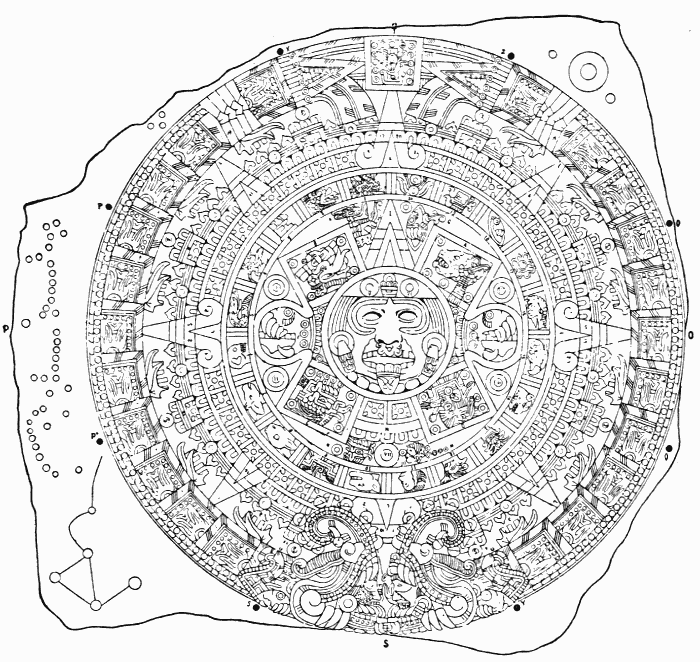
Figure 56.
Merely a few indications will suffice to prove how completely and unmistakably the symmetrical design on the monolith (fig. 56) expounds the great plan which had impressed itself so deeply and indelibly upon the minds of the native philosophers and influenced all their thoughts and speculations.
The head and face in the middle of the monument conveys the [pg 249] idea of duality, being masked, i. e. doubled-faced and bearing the number 2 carved on its forehead. It conveyed the conception of a divine power who ruled heaven and earth from a changeless and fixed centre in the heaven; expressed the dual government of the earth by twin-rulers who dwelt in a central capital. It typified light and the heaven itself with its two eyes; the sun and moon and darkness and the earth by the mouth; whilst the symbols for breath issuing from both nostrils and the tongue protruding from the mouth denoted the power of speech, which was so indissolubly connected with the idea of chieftainship by the Mexicans that a title for the chief was “the Speaker.” The central head likewise denoted a “complete count”=one man, and was expressive of a great era of time, embodying twenty epochs.
As a synopsis of the whole, the following titles recorded in the chronicles would be applicable to the central ruler, celestial or terrestrial: the two lord, the divine twin; the two-lord and two lady; the quadruple lord, “He who looks in four directions;” the lord of the thirteen powers; the one lord, i. e. embodying a complete count=20; the lord of five (i. e. of the Middle and Four Quarters); of seven, i. e. of the Middle, Above, Below, and Four Quarters; of thirteen, i. e. of the duplication or male and female or celestial and terrestrial divisions of the Above, Below and Four Quarters plus the Middle.
Surrounding the central head are four square divisions arranged in two separate parts, each of which includes what appears to be in one case the right, and in the other the left, conventionalized claw (forepaw?) of an animal armed with hooked nails, such as Mictlantecuhtli, the lord of the North, is represented with.
The square compartments contain symbols of the four elements so disposed that air and water are appropriately associated with the hand to the right (=male region) and fire and earth with the hand to the left side (=the female region) of the central head. But this is not all, for another carefully devised relation between the elements likewise appears upon careful examination. In the middle, carved above the central face and between the symbols for air and fire, is the conventionalized “ray of the Sun,” or pyramid which typifies “that which ascends or is above” the upper elements and the Above. As its opposite we find below, situated between the symbols of earth and water, a ring with a concentric circle representing the drop of water=“that which [pg 250] descends.” As the Moon was inseparably associated with water and the Below, it is doubtlessly included in the symbolism.
One more point which will receive due attention in my monograph remains to be briefly noticed. As the symbol for air=east is situated to the right of the symbol for north, and the earth=west is to its left, it is clear that the central face is conceived as looking down from above upon the spectator. It is only when the stone is considered as placed face downward that the symbols assume their proper positions as regards the cardinal points. This reversal, which is the natural result of the association of the east and south with the right hand of the middle personage, suggests that the monolith may have been originally designed to be let into the flat or slanting ceiling of a building. As a parallel instance I will state that, some years ago, Señor Troncoso pointed out to me a fact he had noticed, namely, that the relative positions of the cardinal points on the Féjérvary chart were reversed and that it must have been intended to be looked at from underneath.
Each of the element symbols is accompanied by four numerals placed in the angles of the squares, with one exception, where one numeral was obviously dislodged from its proper position by an encroaching emblematic ornament. The positions of these numerals and of their square enclosures are what recalled to my mind the opposite positions assumed by Ursa Major in its annual rotation around the axis of the heaven. Just as the central face primarily represented Polaris, so these squares figured the four contrapositions of the great constellation. The peculiar, almost cross-shaped figure resulting from the union and association of the symbols of the Centre, and of the Above, Below, Right, Left=Four Quarters, is a well-known conventional sign, generally known as a “nahui-ollin.” The accepted translation of this name is “four movements,” from olinia, verb=to move, and no name could be more appropriate for a symbol which, to my idea, like the swastika, actually represents the movement of the most conspicuous of septentrional constellations to four opposite places.
At the same time, as the nahui-ollin on the stone encloses symbols of the four elements, the union of which was believed by the native philosophers to be essential for the production and maintenance of life, I was led to observe also the fact that the words for life and heart, and the verbs to be alive, to live, to resuscitate, etc., are all derivatives from the root yuli, or yoli, which [pg 251] undoubtedly has a common origin with the verb olinia=to move. It therefore not only appears that, to the native mind, motion and life were indissolubly linked together, but that the name nahui-ollin must have signified four-fold life as well as movement. It likewise typified the four sides of the great pyramid which formed the nucleus of the capital and was crowned by two temples, respectively occupied by symbolical images of the “Divine Twins.” It is impossible not to realize that, in ancient Mexico, the pyramid constituted an image of the entire system.
Each of its sides obviously pertained to one of the four regions and was probably painted with its symbolical color.71 It seems safe to assume that the pyramid was originally erected by the coöperation of people from the four quarters of the capital and state and was possibly added to at fixed intervals so that it represented not only the constitution of the commonwealth, but testified to its age and growth. The widely-prevalent primitive custom that each individual should add one or more stones to a heap of stones, as an individual contribution, may have been carried out in the building of pyramids, the origin of which will be discussed further on.
Although it is almost superfluous to do so, as by this time the set of associated ideas must be familiar to the reader, I shall briefly summarize some of the chief four-fold division or organization of which the nahui-ollin was the graphic symbol. It represented:
1. The four elements or substances and kinds of life.
2. The four regions of the heaven, each composed, in turn, of four sub-regions.
3. The four provinces of the state, each containing four districts.
4. The four quarters of the capital, each of which had four wards.
[pg 252]
Like the nahui-ollin the pyramid was an image or embodiment of the fundamental all-pervading principle. Both therefore equally expressed further meanings which I shall proceed to enumerate.
5. Four stars and also four star-groups or planets which seem to have been associated with the cardinal points and are indicated by four discs exhibiting two concentric circles and four glyphs placed around them. Although at a disadvantage, not being able to substantiate my statement here, I shall mention that, amongst the above, the Pleiades and the planets Venus and Jupiter doubtlessly figure, the latter as two evening and two morning stars.
6. The human lords of the four regions who respectively governed the four divisions of the population, who were classified as the Fire, Air, Water and Earth people, the identical classification being applied in turn to each class and so on ad infinitum.
7. Rotation or a movement encircling the four quarters imagined as “quadruple motion.” This was not confined to the Septentriones, for the ancient Mexican astronomers had recognized what they termed the “four movements of the Sun”—namely, its apparent rising in the east and progress to the north; and setting in the west and progress to the south. According to Leon y Gama, the first to describe the stone in 1832, the central “nahui ollin” portrayed the “four movements of the sun” and recorded the solstices and equinoxes. His opinion has since been shared by other writers, amongst whom I cite Señor Troncoso. According to Sir Norman Lockyer, moreover, the symbol does correctly and appropriately figure the annual course of the sun. It must be admitted that the invention of a figurative symbol which not only records the annual rotation of the circumpolar star-groups but also the annual apparent course of the sun is an achievement which has never been surpassed in primitive astronomy and merits admiration and recognition. The record of the periodical movements of the heavenly bodies, constitutes, at the same time naturally a register of the four seasons.
8. Simultaneously with the division of the year into four equal parts, the ollin (and pyramid) typified the division of the 20-day period into four quarters as well as the four 13 year periods which constituted the epoch of fifty-two years. As the Calendar periods will be discussed in my monograph on the subject, I shall only mention here a fact showing how completely the quadruplicate idea had influenced native speculation. The Mexicans believed that [pg 253] four great eras had passed since the creation of the world and designated these as the earth, air, fire and water eras. They believed that, although humanity had always escaped utter annihilation, the world had been almost completely destroyed by three of the elements in succession at the end of three of these eras. At the time of the Conquest, the Mexicans supposed themselves to be living in a fourth age which was doomed to perish by fire.
9. According to the distinguished Mexican scholar Señor Alfredo Chavero, the symbols in the nahui-ollin commemorated the four epochs of the world's history and I readily accept this as one of the many significations of the quadruplicate figure.
Leaving the nahui-ollin for the present, let us next consider the band, with compartments, which encloses it and exhibits the twenty symbols hitherto only known as calendaric signs,—four of which were year- as well as day-signs, whilst sixteen were day-signs only. Their relative positions show that they were intended to be read from right to left.
A profusion of evidence, however, exists showing that individuals bore the day-names as personal appellations, not only in Mexico but also in Central America. Amongst the Quichés for instance, members of the “Royal house of Cavek” are designated in the Popol Vuh, as three deer, nine dog, etc.
It thus follows that the twenty signs were not merely names of years and days, but also designated the tribes and clans. The element-symbols which marked every fifth day and the years and constitute the major signs, likewise were the names of the four great divisions of the people, and of their respective chieftains. On the other hand the 4×4=16 minor signs, applied not only to days but to the 4×4=16 clans. At the same time the element names conveyed in a general way the occupation of each of the four divisions of people as well as their places of abode in reference to the capital. Accordingly, the earth people would specially attend to agriculture, mining, the manufacture of pottery, etc.; water people to irrigation, the furnishing of drinks, fishing, etc.; the fire people to all occupations which had to do with fire: the procuring of combustibles for fire and lighting, cooking, the working in metals, etc.
As on the stone, the sign calli=house is in juxtaposition to the symbol for air, it may be inferred that the air people were the builders, the masons, the artificers, the Nahuatl name for which [pg 254] was “toltecatl.” As the air symbol occupies the place of highest honor in reference to the central face, namely, above the right hand, it is evident that the builders, or “toltecas,” were the caste which enjoyed the highest consideration. Their totem was the bird, the inhabitant of the air. The second rank in honor was held by the fire people placed to the left, above. Their totem was the ocelot.
Without going further into details for the present, I merely point out that the identical division of the members of each community and association with the elements, etc., was carried out throughout the state. This method clearly established the relation and also determined the geographical position of each class of people in reference to the whole.
The carved band on the Calendar-stone, with its twenty signs, determined once and for all time the exact position to be taken up in all public assemblages, in councils, sacred dances, and likewise controlled the exposition of the products of the land in the great market-place. What is more: each division of the people, by reason of its indissoluble union to one element and one region, also had its own season during which it led in ceremonial observances. So skilfully was the lunar ceremonial or religious year devised that each sign, without any distinction, ruled a period of thirteen days. At the same time the period fell into four divisions headed by the four principal or element signs.
In the solar or civil year, each sign had its day, but as the computation of years passed by, each sign in due rotation ruled during one year. It was only when each sign had had an equal rule that the cycle completed itself, and, in turn, became a part of a greater cycle of time. To realize the marvellous ingenuity with which the rotation of days and consequently the working of the entire machinery of state was carried on, it is necessary to have before one's eyes, a series of reconstructive tables, such as I have prepared for my paper on the subject. For the present, however, I trust that some idea of the harmonious organization of the state may have been conveyed to the reader.
One important feature remains for consideration. As already mentioned, one of the four annual midnight positions of the Bear star-groups, and presumably a “royal star,” pertained to each cardinal-point and consequently to each of the four divisions of people. To this statement, which can be supported by substantial evidence, I must add that each of the sixteen minor signs likewise [pg 255] designated constellations, of which there were thus four in each region of the heaven. The twenty familiar day-signs thus actually constituted also the native zodiac. As the region to which each constellation pertains is clearly designated by the cardinal-point signs, their identification is merely a matter of time. Since ten of the signs represent animals, and these were the clan totems, it is easy to realize how animal forms, composed of stars, came to be traced in the heavens.
Deferring further discussion of the native zodiac I will but point out what an intimate relation was thus established and maintained between star-groups and human beings; and how the periodical rotation and stations of the celestial bodies actually guided or, at all events, coincided with the periods of human activity in various branches.
I am not, as yet, prepared to formulate a final opinion on the meaning of the narrow band that surrounds the zodiacal belt, which is at the same time the list of years and days and of tribes and clans, but shall merely note that it exhibits four large and four lesser rays which designate the quarters and half-quarters of the whole. A few words concerning the symbolism of these rays should find place here. In Nahuatl the ray was named “tona-mitl,” literally “the shining arrow,” “shaft of light.” Ixtlilxochitl tells us that it was an ancient custom of his people on taking possession of new territory “to shoot with utmost force four arrows, in the directions of the four regions of the world.”72 This interesting passage shows us that the rays, i. e. arrows of light, carved on the stone, conveyed the idea of possession of the four regions and four sub-regions by the central power.
Returning to an examination of the concentric band to which the rays are attached: It exhibits also 4×10 groups of five dots, two of which groups are almost concealed by star-symbols on the recurved open jaws of the serpents' heads which meet at the bottom of the stone. Above this band and placed exactly between the larger and lesser rays are single compartments with five-dot groups. It has been interesting to detect the reason why two five-dot groups were carved, as I have already pointed out, immediately under the central head. They evidently supply the missing groups whose places are filled up by the recurved upper jaws of the serpents, [pg 256] heads at the bottom of the monolith. From the care taken to preserve a visible record of these two groups, it is obvious that a special importance was attached to the recording of eight five-dot groups besides the forty in the band, making a total of 4×12=48 groups, or 10+2=12 to each quarter.
As the Mexican name for market was macuil-tianquiztli, literally the “Five (day) market” and the Maya word for capital was homonymous with five=ho, it is evident that these five dot groups would have conveyed the idea of “market,” market-day and possibly market-town, to a Mexican. To a Maya-speaking people they would have appeared to express practically the same thought, since all capitals, large or small, were market-places and absorbed and redistributed the product of quadruple provinces within the radius of its jurisdiction. The inference that the five-dot groups may have served as a topographical register of the larger and minor capitals existing in each quarter of the state, is substantiated by more evidence than can be produced here. I have moreover found indications that this belt may have served as a sort of moon-calendar which was also an attempt at an adjustment of lunar to solar periods.73 Before, however, an estimate can be made [pg 257] of the full meaning of this belt formed by the two great serpents which encircle the entire monument, more time and labor will have to be expended.
One point about the twin serpents is clear; they are represented as springing from a square enclosing the symbol Acatl accompanied by 13 which has been generally interpreted as a calendar date. It seems to me to be more deeply significant than a mere date, especially as it appears to designate the point of departure for the progressive movement of the two serpents whose open jaws enclose human heads in profile which together form one face. The upper jaws end in two recurved appendages, each exhibiting seven star symbols. As these obviously typify night or darkness and the open jaws seem to threaten to absorb or engulf the ray of the sun pointing downwards, it appears as though these typified a disappearance of light into the underworld of darkness and destruction.
The symbolical surroundings of the downward ray are in striking contrast to its opposite, the upward ray, which reaches to the 13 Acatl sign and points to what appears to be the place of origin or birth of the twin serpents. It certainly seems that this all-embracing and enfolding twin pair are designed to typify the dual forces of nature under a form which would also express quadruplication. By what must be termed a stroke of genius the designer of the monolith chose to represent the forms of two serpents, relying upon the fact that Nahuatl-speaking people would see in each serpent (=coatl) a twin (=coatl). Did he not also realize that to a Maya each serpent (=can) would mean 4 (=can) and that the pair would appear to embody or express the numerals 4 and also 8?
It is noteworthy that each serpent is represented with one claw and that these two added to those contained in the central nahui-ollin complete the four-limbed figure which was essentially the image of a complete count=the state, the nation, the era, etc. In this monument, as elsewhere, it is possible to follow the development of the symbolism expressed by two heads which form but one, [pg 258] twin-bodies which mean four and of four limbs which represent the digital count=20.
Under different aspects the same theme repeats itself again and again upon the stone, which proves that the master minds who planned and wrought it destined it to be the image of a plan based on the idea of a central and yet all-embracing, dual, yet quadruple force or power.
The preceding rapid sketch I have given of the wide-reaching significance of this remarkable monument will, I hope, be found to amply support and corroborate the view I advanced in 1886, when I pointed out that the “Calendar-stone” answered to the description given by Duran, of the “circular elaborately carved tablets which were kept in each market-place and were held in great veneration.” I trust that it is now clear why it should have been frequently consulted and why the market-days were regulated according to the carved indications upon the surface. Engraved upon it were the Great Plan and its laws of organization and rotation. It clearly determined, once and for all, the sequence of the days; the relation of all classes of the population to each other and to the whole, and set forth not only the place each group should occupy in the market-place, but also the product or industry with which it was associated and the periods when its contributions to the commonwealth should be forthcoming in regular rotation. The stone was therefore not only the tablet but the wheel of the law of the State and it can be conjectured that its full interpretation was more or less beyond the capacity of all but an initiated minority, consisting of the elders, chiefs and priests.
Postponing for the present further discussion of this, the most precious and remarkable monument which has ever been unearthed on the American Continent, let us briefly bestow attention upon the two other monoliths which may be said to be its companions and obviously belong to the same period and civilization. In 1886, in the preliminary note cited above, I advanced the view that the first of these, generally known as the “Sacrificial stone,” was a “law-stone of a similar nature [to the Calendar-stone] which recorded, however, the periodical collection of certain tributes paid by subjugated tribes and others whose obligation it was to contribute to the commonwealth of Mexico.” I pointed out that the “frieze around the stone consists of groups, placed at intervals, of the flint-knives (tecpatl) with conventionally carved teeth (tlantli) [pg 259] giving in combination the word ‘tecpatlantli.’ This occurs in Sahagun's Historia, as the name given to the ‘lands of the tecpan or palace,’ and in one of the native works I find designated the four channels into which the produce of these lands was diverted.” I likewise noted that “the periods indicated on it differ from those on the Calendar-stone,” which might more appropriately be designated as the ancient Mexican wheel of the law or of the Great Universal Plan.
Thirteen years of painstaking research have only served to strengthen me in my interpretation of the “Sacrificial-stone.” The frieze around it exhibits sixteen groups, each consisting of the repeated representation of a warrior characterized by having one foot only. In each case he is figured as seizing by the hair a different individual, who bows his head and offers the weapon he holds in his right hand to his victor. Amongst the sixteen subjugated personages are two women and above each are hieroglyphs expressing the names of well-known localities, some of which are mentioned in native chronicles as having been conquered in historical times by Mexican rulers.
In my account of the Plan of the Ancient City of Mexico, I shall illustrate these hieroglyphs, locate the places to which they refer and further discuss this monument. Meanwhile I shall but state that it undoubtedly belongs to the same category of monuments as the tablets in the “Temple of the Sun” at Palenque; the bas-relief at Ixkun and that in the house of the “Tennis-court” at Chichen-Itza where warriors in a procession render homage to a seated personage, by presenting their spear-throwers to him in precisely the same manner as shown on the Mexican Tribute-Stone.
The upper surface of this exhibits the same division into eight parts, marked by four large and four smaller rays, pointing to the quarters and half-quarters. Observation shows that of the sixteen localities four were assigned to each quarter and it is evident that the monument determined the time and the order in which the tribute for each was paid and collected at the capital. The one-footed man again graphically symbolizes axial rotation and conveys the idea of a central ruler who in turn seizes and exerts control upon 4×4 tribal chiefs. The monument establishes, moreover, the interesting fact that amongst the subjugated communities were two gynocracies, represented by women who, instead of spear-throwers, present their weaving shuttle to the victor.
[pg 260]
We shall next consider a monument whose uncouth and ugly form embodies a deep and nobly planned conception of the “divine twin,” or “divine Four,” that so completely dominated the minds of the native philosophers.
Let us now carefully examine the monolith now preserved in the National Museum of Mexico (fig. 57). Leon y Gama, having observed that what appeared to be the foundation of the statue was carved and that massive projections existed under its so-called arms, logically concluded that the original design had been to support the figure from the sides, so that its base was lifted from the ground and the figure upon it exposed to view from underneath. His inference is borne out by the carving on the base which belongs to the same category as the image of Mictlan-tecuhtli, and represents a semi-human body, of quadriform shape soaring downward.
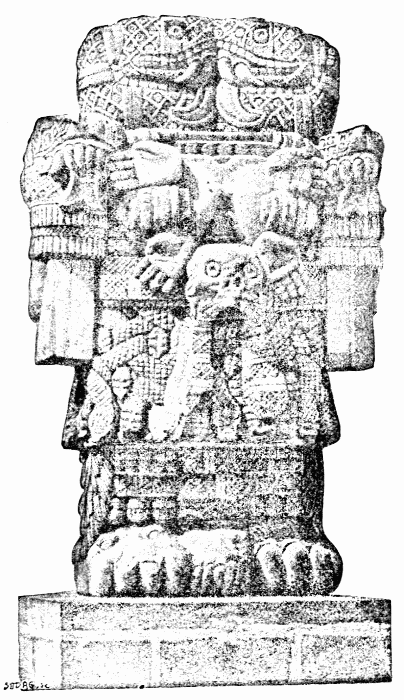
Figure 57.
The centre (fig. 51) exhibits on a square the five-dot figure, and the square, in turn, is enclosed in a circle; the whole symbolism relating to the now well-worn theme of the centre and four quarters and the union of the earth=the square and the heaven=the circle. It clearly exhibits a skull attached to each limb, typifying the four quarters or the clans and their chiefs, whilst the hands hold the larger heads, emblematic of supreme dual rulership. It is interesting to [pg 261] find that the above carving, under the feet of the sculptured figure, embodies the entire meaning of the statue, which is but a variation of the native philosophical theme of “Divine Twain” or Quetzalcoatl. Two serpents' heads surmount a semi-human body and meeting form the semblance of two single faces turned to the front and back of the statue. By this ingenious device the unity, yet duality of the divine twin is graphically rendered and one-half of each countenance is represented as belonging to each serpent. These are thus shown to be indissolubly linked together, yet distinct. Their single, yet dual head has four eyes, eight fangs and two forked tongues. The figure and skirt composed of intertwined rattlesnakes, constitute feminine attributes given to the symbolical figure of the “twin-lord and twin-lady,” the “father and mother of all.” Instead of hands the arms terminate in serpents' heads and the huge feet in great claws.
Between these, in the front and at the back, a rattlesnake's body and head appear. The belt consists of a large snake whose head and tail hang down in front, as the ends of a bow. A skull is attached to the front and another to the back of the belt. In the latter case it surmounts a fan-shaped, curiously plaited ornamental appendage partly decorated with feathers. Forming a sort of necklace in front are four hands, i. e. 4×5=20 and two conventionalized hearts. At the back there are two hands and two hearts and an intricate knot which fastens the necklace, the real meaning of which is far from what it may appear to be. It probably signified the same as the painted hearts and hands on ceremonial garments of which Sahagun tells us that “they meant that the people who wore them lifted their hearts and hands to the Creator to implore for rain and food.” At the same time, the arrangement in front clearly reveals the sculptor's allusion to the head, two hearts, four hands and twenty fingers, which symbolize these familiar numerical divisions. An indication that this symbolical statue was probably designed and executed by the same master who made the circular stone of the Great Plan, is furnished by the calendar sign 13 Acatl, which is carved under the skull at the back of the figure.
Deferring an investigation of the significance of this date, I shall now draw attention to what is to me the most interesting and important feature of the whole image. The view of the top of the two heads, as may be seen by the accompanying reproduction [pg 262] from a photograph (fig. 58) exhibits, at their line of union, a small square with diagonal cross-lines. The position of this symbol which resembles the top view of a pyramid and forms, as it were, the apex of the statue, every detail of which is deeply symbolical, clearly reveals the sanctity and importance attached to this graphic image of the Centre, the union of four in one or vice versa, the theme on which the native mind played numberless and endless variations.
A reflection, again forced upon one in studying the monumental composite image of the dual and quadruple forces of nature, is that it must have been as intelligible to a Maya as to a Mexican, and conveyed the conception of Kukulcan to the one and Quetzalcoatl to the other. Several facts point, however, to the greater probability that the original conception of the monument must have arisen amongst Maya-speaking people.
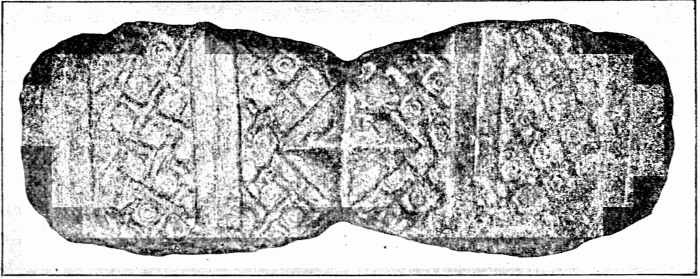
Figure 58.
The divided square, simulating a pyramid and so obviously a symbol of four=can, carved on the head of a serpent=can, throws an interesting light upon the probable derivation of the affix=can, which occurs in certain names of localities in Mexico, and in some cases distinctly stands for “mountain.” It is a fact which has already been cited in Señor Antonio Penafiel's useful work on the Geographical names of Mexico that, in the pictographic hieroglyphs of localities the affix can signifies a town, being synonymous with the tepec, i. e. tepetl, the Nahuatl name for mountain or town. One of many similar instances, which could be produced, is illustrated in his fig. xxiii, 1, where can obviously stands for the mountain which is represented as twisted or bent [pg 263] over (colhua), in the hieroglyph for Colhuacan. The hieroglyphs for the towns Acayocan and Tenayocan, furnish a similar employment of the mountain to express the sound can. The sense of the affix can, meaning a town, only becomes clear when we interpret it as the name of the artificial mountain with four sides, the pyramid, which was the symbol of four=the Maya can, and was the emblem of a central capital. This is convincingly proven by the Codex Mendoza for instance, in which it is shown that the Mexican mode of recording the conquest of a tribe was to paint their hieroglyphic name and a picture of the destruction of the pyramid temple which had stood in the centre of their capital. In other words, the conquered town ceased to be a centre of rule—its captive chieftain was taken to the capital, where the horrible rite of sacrifice performed upon him and the tearing out of his heart likewise symbolized the destruction of the independent life of the tribe or integral whole he represented in his person. It was thus brought home to the conquered people that they had ceased to exist as an independent body, and the distribution of the chieftain's flesh to the ritualistic cannibals graphically symbolized its absorption into the great central state. It is necessary to emphasize here that these horrible rites were of comparatively recent origin and had been invented by the Mexicans for the purpose of intimidating their vassals, after a prolonged period of wars and bloodshed, which menaced the very existence of the integral state. The presence in Mexico of numerous names of towns, ending in can, seems to indicate the influence, in ancient times, of the Maya-speaking civilization to which the origin of the pyramid must be assigned. The association of the latter with the word can is strikingly illustrated in the name of Teotihua-Can, where stand the ruins of two of the largest and most imposing pyramids of ancient America. The base of the larger of the two has been estimated at about 700 feet square, it being impossible to take an exact measurement owing to the mass of accumulated débris which covers the lower part of the structure.
The base of the second pyramid measures about 475 feet square. The sides of both pyramids rose at an angle of about 45 degrees and were in each case interrupted by four terraces. This double application of a quadruple division merits special attention, as it produced besides the four great 4×4 lesser sections, the sacred centre of the terraces, which crowned each structure. Historical [pg 264] tradition relates that the larger pyramid, known as the “Enclosure of the Sun (=Tonatiuh-I-Tzacual),” originally bore on its summit a colossal image of the sun, covered with plates of gold, whilst the other, the “Enclosure of the Moon” exhibited a similar image, covered with silver. The distinguished and reliable historian Orozco y Berra quotes this tradition adding that the soldiers of Cortés despoiled the images of their precious metals and that the Bishop Zumarraga ordered a further destruction of all monuments at Teotihuacan.
The tradition which records the existence of a silver and of a gold image, cannot be dismissed as unfounded, because it meets with a certain amount of corroboration by other data. In the first case the so-called “battered goddess,” a mutilated stone image, which was found in the courtyard at the base of the “Pyramid of the Moon,” looks as though it may have been the very monument which was once plated with silver. Traces of concentric bands of ornamentation seem to indicate that its round face had originally occupied the centre of a sculptured disc, in which case this must have had a diameter of about twelve feet. In Peru, as already stated, a silver image of the moon, associated with the female sovereign, was the complement to the golden effigy of the sun, associated with the Inca.
Even if data had not already been produced which establishes the existence of two religious cults in ancient Mexico, the respective symbols of which were the sun and the moon, the presence of two pyramids at Teotihuacan would suggest the existence of a division of some sort. The origin of these great and imposing structures is shrouded in mystery, but it is generally conceded that they must have been built long before the comparatively modern inhabitants of the valley of Mexico, the wandering Aztecs, had taken up their abode in the midst of the salt lagoons. The erection of two pyramids, however, proves that their builders had already practised the cult of the middle of heaven and earth, or Above and Below, and of the Four Quarters for so long a time, that there had been a separation of religions and government into two almost independent parts, each complete in itself. In the light of the testimony produced it is safe to infer that for an indefinite time the rival cults developed side by side until dissension and consequent disintegration followed. The Mexican state was the outcome of a later effort to reorganize and rebuild an integral whole [pg 265] on the ancient plan, the knowledge of which had been preserved and handed down. As time went on it was inevitable that the same causes which had caused the more ancient and greater state to crumble away, should be actively at work on the second.
It has already been shown that two religions existed in Montezuma's time the respective embodiments of which were Huitzilopochtli and Tezcatlipoca. It is an interesting fact, related by Bernal Diaz, that the idols of both stood together in one tower at the summit of the great temple and were alike, “because they were brothers.” At the same time whilst Tezcatlipoca's image was decorated with obsidian (=tezcatl) Huitzilopochtli's was encrusted with turquoises. It is curious to note how closely the old soldier's description of these idols answers to that of the great dualistic statue which has been discussed in the preceding pages. His account contains the following details: “In this hall were what resembled two altars with very richly [ornamented or carved] platforms on the top of the roof or ceiling. On each altar was a statue, as of a giant, very tall in body and very stout. The first, which represented Huitzilopochtli, had a very wide, deformed or monstrous face and forehead, and terrifying eyes ... around his neck were faces of Indians and what were hearts. These were of gold whilst the former were of silver inlaid with blue mosaic-work. The entire body was covered with mosaic-work, gold and beads and misshapen pearls, all fastened to it with a kind of cement or glue. Encircling the body were what were like huge serpents made of gold and mosaic.... The idol was of Tezcatlipoca, and its eyes were made of shining black stone [obsidian] called Tezcat. The statues were alike because they were said to be brothers. Tezcatlipoca was the lord of the Underworld ... and around his body were figures like small devils with tails like serpents.”74 But for the fact that Bernal Diaz mentions a plurality of faces in Huitzilopochtli's necklace, whereas our monument exhibits but one skull, in front, his description strikingly coincides with the monolith now existing. Considering that thirty years had elapsed before he wrote this description allowance must be made for this and other slight [pg 266] lapses. On the other hand, dual statues, exactly alike, but with differently colored ornamentation, are precisely what we should expect to find on the summit of the great pyramid-temple of Mexico. With our present knowledge and comprehension of native symbolism, moreover, we see that two statues, each of which figured twin-serpents, would best express the native idea of the dual and quadruple principles and elements. What is more, two dual statues, each surmounted by a square, diagonally crossed, like a pyramid, would correspond, in symbolism, to the two great pyramids of Teotihuacan and carry out, on a small scale, the idea of a dual government.