The Fundamental Principles Of Old And New World Civilizations. (continued 7)
Reading edition
Valuable and reliable evidence, showing to what an extent the Mexicans regarded their government as dual and quadruple, can be gleaned from the records of the presents sent by Montezuma to Cortés, under the impression that the bearded Spaniards were the descendants of the ancient founders of their civilization. The native ruler sent the complete ceremonial dress of the four lords of the four regions denoting by that act of homage that he acknowledged Cortés as his equal, i. e. the supreme central lord who united the four-fold power in his person. “He likewise sent him a large wheel of pure gold, covered with designs and with the image of a monster in its centre.” Its weight was estimated at 3,800 “pesas” and it was considered “the finest and best of all the presents.” It was accompanied by “a large wheel of silver,” weighing forty-eight marcos. By the light of our present knowledge it may be that both “wheels” were images of the Great Plan and that whilst the gold one set forth the constitution and organization of the Upper division of the State and possibly conveyed the statistics of its members, the silver wheel was a record of the Lower division. The gift of these tablets must have been intended as an act of subservience and an acknowledgment of Cortés as the lord of the Above and Below, as well as of the Four Quarters. The utter lack of understanding for the symbolism of these gifts on the part of the recipient, can scarcely have escaped the notice of Montezuma's messengers and must have sorely puzzled their unfortunate master.
The existence in Mexico at the time of the Conquest, of a dual state, suggests the possibility that, in some way, the pyramids of Teotihuacan continued to be connected with the opposite and rival cults of the Sun and the Nocturnal Heaven, although their origin was shrouded in the past. It is known that their site was venerated: [pg 267] besides, the name Teotihuacan, which Orozco y Berra translated as “the place of the masters as keepers of the gods” or “the place where the gods were adored,” most probably really meant “the divine four-sided mountains or pyramids” or, possibly, “the sacred pyramids of the lords.”
Until an extensive, carefully-planned and systematical exploration has been carried out at Teotihuacan, it is impossible to form any definite conclusions concerning its past history. Cherishing the hope that such an exploration may yet be made during my lifetime, I shall merely make a few remarks concerning the ruins, which I visited many years ago. Approaching them from the south one enters a broad straight road, several miles in length and about 250 feet wide, which is bordered at each side by a series of irregular mounds, probably covering ruined structures. This imposing road leads directly into the vast courtyard which stretches across the base of the great pyramid of the Moon. As the City of Mexico lies to the south of Teotihuacan it is significant to find that this road leads from that direction to a vast pyramid situated at the north, which was, according to the ancient Mexicans, the region of the Underworld, darkness and death. It is not surprising, therefore, to find that the ancient native name which still clings to the roadway is “the path of the dead.” The presence, moreover, of innumerable small clay heads which are, undoubtedly, portraits or effigies of persons represented as dead, points to the alternative that Teotihuacan may have been the necropolis of an ancient civilization or that it was, even at the time of the Conquest, the place where a register of deaths was kept by the priest-rulers, by means of small clay effigies.
Considering the native idea, it seems more than probable that all matters pertaining to the dead should be relegated to the northern region and the fact that the road from the south leads to a pyramid which tradition associates with the moon, the symbol of the nocturnal cult of the “Below,” lends color to these views.
There is a temptation to imagine that possibly after the adoption of two distinct cults of which the second pyramid seems to furnish incontrovertible proof, a further divergence ensued resulting in the ultimate abandonment of the capital by the votaries of the Sun, the male principle and the Above. As the native civilizations were based on such a plan that dissension and disorganization inevitably led to utter downfall and ruin, it is easy to see [pg 268] that a gynocracy and the cult of the earth and underworld should gradually become extinct. At the zenith of its power, however, it may safely be inferred, that Teotihuacan was a great centre where astronomical observation and agriculture flourished, these being the natural outcome of the cult of mother-earth and the nocturnal heaven. Whilst all conjecture must necessarily be hypothetical, it is a comfort to reflect that, locked in the ruins themselves, lies guarded the past history of Teotihuacan, which was shrouded in a mist of uncertainty even at the time of the Conquest.
The pyramids themselves, however, openly reveal the fact, that their builders possessed a knowledge of the great plan, and that, at some time, a single central pyramid not being sufficient, two, of unequal sizes, arose to bear lasting testimony not only of past greatness, but of long-forgotten rivalry and dissension. Finally, there is one thing certain, namely, that the building of the pyramids at Teotihuacan must have been preceded by an extremely long period during which the native ideas, of which they were the expression and image, had developed and taken definite shape. If Teotihuacan yields evidence of an advanced stage in the history of the intellectual development of the native race, it also marks the beginning of the disintegration of the state of which it was the central capital. On the other hand, at Cholula, also situated in the high plateau of Mexico, to the east of its present capital stands, in ruined solitary grandeur, the largest pyramid on the American continent, whose base is twice as large as that of the pyramid of Cheops in Egypt.
The name of the ancient capital of which it formed the nucleus was Tullan Cholollan Tlachiuhaltepec.75 Boturini (op. cit. p. 113) [pg 269] cites an old native manuscript on which a picture of the pyramid of Cholula was painted with the note that, in ancient times, it was named Tultecatl Chalchihuatl On Azia Ecatepec, which he translates as “the monument or precious jade stone of the Toltecs, which rears itself in the region of the air.” As eca-tepec literally means air-mountain, Boturini's translation may seem somewhat exaggerated; on the other hand, the Spaniards, who knew the Nahuatl language best, repeatedly state that its words were so replete with significance that it would sometimes require several Spanish sentences to set forth the meaning of a single native word. Boturini, who had exceptional opportunities for obtaining information, adds to the above the following translation of a Nahuatl inscription which had been written by the native scribe below the drawing which unfortunately is now lost. “Nobles and Lords: Here you have your documents, the mirror of your past, the history of your ancestors who, out of fear for a deluge, constructed this place of refuge or asylum for the possibility of the recurrence of such a calamity.”
After citing the opinions of various authors concerning the origin of the pyramid, Orozco y Berra concludes that “there is no certainty about its age, but instinctively it is supposed to be extremely ancient and to pertain to pre-historic times. According to my judgment the people who constructed it belonged to the same civilization as the builders of Teotihuacan and possibly were their contemporaries. Cholollan was also a venerated sanctuary, in which the religious idea predominated” (op. cit. p. 363). “At the time of the Conquest a temple stood on the summit of the [pg 270] pyramid and contained an image of Quetzalcoatl (the Divine Twain, the Creator, the Father and Mother of all) as well as an aerolite, shaped like a frog which had fallen from heaven, wrapped in a ball of flame.” In the Vatican MS. of Padre Rios there is another version of the tradition that the pyramid had been erected by giants after a deluge, which had destroyed everything, ... and that before it was finished, fire fell upon it causing the death of its builders and the abandonment of the work.
Allusion has already been made, in the preceding pages, to the native traditions according to which, “there had been three memorable epochs in the history of mankind, which lasted for centuries and were abruptly terminated, each time by a mighty convulsion of nature. The majority of human beings perished in each of these, but a remnant survived and thus the race was preserved.”
The periodical festival of thanksgiving, which was still observed at the time of the Conquest by the native races, abundantly testifies to the reality of their belief in these great catastrophes and the preservation of their ancestors from utter extermination. It was doubtless in order to make their past history conform with the quadruple organization of all epochs of their native Calendar that the native sages assigned their successive destructions to the separate agencies of fire, water and air, in the form of violent tempests and cyclones. From descriptions contained in the Mexican Codex Chimalpopoca and in the Popol Vuh, the sacred book of the Quichés, it will be seen that the phenomena described are such as would naturally accompany a volcanic outbreak on a great scale. Considering that, in Mexico alone, there are no less than nine monster volcanoes, of which two are not yet extinct, and that in Guatemala, in historical times, whole cities have been destroyed by earthquakes and volcanic action, it is not at all astonishing to find traditions of great catastrophes amongst the inhabitants of these regions.
No one can look upon the grand snow-clad peaks of the great volcanoes, which surround the high central plateau of Mexico, without realizing that mighty upheavals and disturbances, such as the world has seldom seen, must have attended the formation of the huge craters next to which Vesuvius seems but a hillock. A volcanic outbreak amongst these elevated peaks, which range from 15,000 to 19,000 feet above the sea-level, would obviously be accompanied [pg 271] by great inundations caused by the melting of the masses of snow which crown their heights. The valley of Mexico in which the large lagoons lie, as in a basin without an outlet, and the plains which surround Cholula and stretch to the base of the volcanoes must repeatedly have been the scene of ruin and desolation, lasting for many centuries. As the Abbé Bourbourg justly remarks: “The majority of the edifices in the City of Mexico are built of volcanic tufa, said to have been formed by the small volcanoes which lie at the southeast of the valley of Mexico. At various periods of antiquity great masses of lava have descended into this valley, in which one extensive ancient lava-field is now known as the ‘Pedregal de San Augustin.’ ” Another great flow of lava has actually been traced from its apparent source, the now extinct volcano of Ajusco, at the south of the valley of Mexico, to Acapulco, on the Pacific coast.
The Mexican chronicles describe as follows the destruction of the earth by fire: “... there came a rain of fire: all that existed was burnt and a rain composed of sand-stone fell. It is said that whilst the sand-stone we now see was being formed the tet-zontli [i. e. volcanic tufa], boiled with great noise. Then the red mountains also lifted themselves up ... the sun consumed itself [was darkened], all houses were destroyed and all the lords or chiefs perished....”
The same author relates how, after the repeated destruction by water, obscurity reigned for twenty-five years. This cataclysm is also described in the sacred book of the Quichés as follows: “Then ... the waters became swollen by the mere will of the Heart of Heaven and there came a great inundation from above and descended upon the people ... they were deluged and then a thick resinous substance fell from the sky. The face of the earth was obscured and a dark rain commenced and fell during the day and during the night ... there was great sound of fire overhead. Then the people ran pushing each other and filled with despair: they endeavoured to mount upon the houses and these, falling in, threw them again to earth. They wished to climb the trees, but these swayed and cast the people from them; they tried to enter caves, but these shut themselves before them....” It was after this universal ruin and destruction that, according to native tradition, the pyramid of Cholula was erected, as a place of refuge for the remnant of the native race which had escaped destruction [pg 272] and returned to the scene of desolation, lured by the richness of the fertile soil, just as the Italian peasants return to their vineyards on Vesuvius after each eruption. All things considered there seems to be no ground for rejecting the native tradition which affirms that the great pyramid of Cholula was erected as a place of refuge from inundations, especially as no more plausible explanation of the origin of the pyramid can be imagined. Any primitive people, inhabiting fertile plains which abounded in game and fish, and food-plants, but were exposed to frequent inundations, could not fail to recognize the advantages of an elevated piece of ground as a place of safety. It is easy to imagine the intermediate stages in the transition from this simple recognition to the final determination to build a compact, high and spacious elevation, within the reach of all inhabitants of a settlement, on which these could not only find refuge from the dangers of floods and volcanic disturbances, but also store their harvest, and possibly some form of raft or boat which they might employ as a last means of escape.
Irrefutable proof that the maize had been cultivated from remote antiquity in this region, and had even become identified with it, is furnished by the fact that the name of the small republic of Tlaxcalla, which lies in the neighboring foot-hills, signifies bread, and that its hieroglyphic sign consists of two hands holding a tortilla, or maize-cake.
It is well known that botanists have not yet succeeded in identifying, amongst the native grasses of America, the ancestor of the cultivated maize-plant. They assert, however, that the development of what is now the world's largest cereal, from a wild native species, must have required incalculable time.
It must be admitted that no factor could possibly have more speedily impressed upon primitive men the benefits of concerted action and of organization and communal life than the occasional recurrence of a great and imminent peril which was shared by all alike, and for which there was but one visible means of escape. It is equally clear that, once a concerted and united undertaking had been determined upon, some sort of plan and organization must have naturally evolved itself. The mere building of such a gigantic structure as the pyramid of Cholula, which may well have absorbed the energies of several generations of men, or, at all events that of innumerable workmen, could well have been an [pg 273] abiding and most powerful factor in establishing their social organization. Its erection must indeed have marked an epoch in the lives of the inhabitants of this region, because, during many years it created a bond of common interest which, of itself, might well have laid the foundation of a permanent communal life, in which responsibility and labor were equally distributed. The mere necessity to expend an equal amount of material and labor upon the building of each side of the pyramid, would naturally lead to the formation of pathways traced by the feet of the carriers of earth and stone from different directions, and ultimately to a division of the workers into four bands, each associated with a different cardinal point. Practice would demand that each band should be under leadership, and be divided into those who collected and carried material, and those who placed it in position, at each side of the pyramid. The necessity for general supervision and directorship, extending over the four bands of workers alike, would, of itself, create central rulership upon which would devolve the duty of enforcing an equal division of labor, which would create, in turn, some form of systematic routine and rotation. It can thus be understood how, by slow degrees, each side of the pyramid would become permanently identified with a cardinal point; and associated with a division of workmen under its leader and a fixed period of time. It may likewise be seen how a separate caste would slowly develop itself, consisting of the trained architects and builders, the descendants of the first organizers of human labor, and systematical rulers of men.76
It may thus be seen how the realization of frequent danger, the necessity to provide an escape and insure the safety of the race, aided by experience, might lead to the conception of a vast pyramid, the mere building of which would create and establish the fundamental principles of organization and government.
The simultaneous development of the ideas suggested by Polaris would inevitably lead to a comparison and association of the terrestrial centre of communal activity with the polar axis, and to [pg 274] the conception of an earthly government in which human affairs were adjusted so as to be in seeming harmony with the movements of celestial bodies. The blending of the conclusions attained by the astronomer-priests, and the practical system adopted by the master builders, could not fail ultimately to cause the pyramid to appear as the sacred visible sign or image of the single, central power and quadruple government which extended its rule throughout heaven and earth. I venture to point out that, if carefully analyzed, the pyramid seems to be but a later development of precisely the same ideas which are expressed by the swastika.
Pausing now to review preceding data we find it demonstrated that the geographical position of Tullan Cholollan and its pyramid designates it as an ancient seat of civilization where the native scheme of organization may have evolved itself, and the source whence the native traditions concerning successive destructive cataclysms and convulsions of nature may have spread.
What is more, the peculiar conditions existing at Tullan Cholollan, situated in the heart of a volcanic region, would amply explain the traditional destruction and abandonment of the most ancient centre of native civilization and the spread throughout the continent of the identical scheme of government, etc., it being most natural that each band of fugitives, on finding what appeared to be a favorably situated region, should settle there and carry out the inherited plan of organization, etc., which would naturally become slightly modified under altered conditions. Fresh colonies on the pattern of the ruined metropolis and integral state would successively be founded far and wide and as examples of such I venture to designate Tulantzinco, literally the title Tullan, and possibly Teotihuacan, where the native civilization seems to have undergone its more advanced stages of evolution, and to have risen in power, developed divergent cults with separate languages (the Maya and the Nahuatl) and instituted the two religions and dual rulership which eventually led to dissension and the dissolution of the integral state at a period anterior to historical times.
The assumption that the most ancient centre of native civilization lay in a volcanic region affords a plausible explanation of how an inordinate value would naturally be placed on stability, per se, and the feelings of veneration for Polaris and a passionate [pg 275] longing for a place of terrestrial and celestial rest would become strongly developed. Indeed, it is only possible to understand the reason why various American tribes wandered about in ardent and earnest search for the stable middle of the earth, when it is assumed that they must have been driven from their former place of residence by volcanic disturbances which made a firm piece of ground under foot seem to be the most desirable of all earthly benefits. I venture to assert that this search and the ideal of stability would not have been suggested so forcibly to people who had never experienced a long succession of more or less terrible earthquakes.
Although widely different opinions concerning the identification of the ancient Tullan are held by American archæologists they will all doubtlessly admit that at Cholollan we have, in the first case, a locality to which the natives assign the name of Tollan, and a pyramid, the largest on the American continent, which testifies that, in prehistoric times, this place was inhabited for a prolonged period, by a numerous and organized community.
The fertility of the surrounding plains now known as the Campiña de Puebla and the ancient name of Tlaxcalla yield evidence that, from time immemorial, this district was associated with maize cultivation.
The vicinity of the giant volcanoes of Popocatepetl, Iztaccihuatl and Orizaba77 sufficiently demonstrate that they must repeatedly have been the scene of violent disturbances which would fully account for the tradition of successive cataclysms which destroyed a vast state and almost annihilated the native race.
The foregoing unassailable facts undoubtedly justify the conclusion that the giant pyramid of Cholula marks the site of the great and ancient Tollan whose destruction was the theme of the plaintive native songs of lamentation even at the time of the Spanish Conquest. That the natives have ever regarded Cholula as a place of particular sanctity is shown by the following statement by Fray Geronimo Roman y Zamorra (1569-1575) (Republicas de Indias, ed. Suarez, Madrid, 1888): “It was Colola or Cholola, which was the ancient metropolis or head of all the native religion, so much so that all the great chiefs or lords had their own [pg 276] chapels and dwelling houses there because they used to perform pilgrimages to its great temple this being the most revered [in the land].”
It is also reasonable to infer that the region of the high plateau and valley of Mexico, possibly before the formation of the great lagoons, was the cradle of ancient American civilization, where, during countless centuries, the native race literally and figuratively cultivated its own maize and simultaneously developed the set of ideas which formed the basis of its intellectual evolution.
In this connection it is interesting to reflect that, as clearly shown by ceremonial usages which existed throughout our continent and survive to the present day amongst the Pueblo Indians, it is to the fostering care, forethought and labor of countless generations of women, the “Corn Maidens and Mothers,” that America owes the priceless legacy of a food-plant which has already sustained untold millions of lives. Thus, whilst the ancient “Daughters of the Earth” have given their country a gift which will last for all time, the pyramids, temples and cities, reared by the “Sons of Heaven,” have fallen into ruin, and the great edifice of human thought that they reared, their complex social organization, government and calendar now lie superseded under the dust of time.
At this point of investigation the question naturally arises, Whence came the founders of the native civilization, who established themselves and peopled the central region of Mexico and doubtlessly dwelt there for a prolonged period prior to the first of the traditional cataclysms which nearly proved destructive to their race?
It is obvious that, before this interesting question can be satisfactorily discussed, a minute analysis and investigation should be made of all other ancient civilizations of the world in which the swastika was employed as a sacred symbol. A comparative research on such a scale could only be effectively carried out with the active coöperation of orientalists, archæologists and philologists in all departments of research. Taking, as an index, the presence in old centres of civilization of the most ancient sacred symbol of the world, the swastika, the aim of the joint investigation should be to trace how far it was accompanied, in each country, by pole-star worship and the set of ideas, symbols and words to which it is so indissolubly linked in ancient America and China. By this means [pg 277] only can a final conclusion be reached as to whether this symbol spread over the earth from one original centre of civilization, or whether it suggested itself to primitive observers of Septentriones in various localities and at different times, as the natural outcome of star-observation. If the swastika and the septentrional set of ideas spread from one centre then we should expect to find them accompanied by traces of a common language. I shall have contributed my share to the joint investigation when, in addition to the preceding data, I present the following list of Maya and Mexican names intimately associated with the native symbols and set of ideas. In presenting them I once more draw attention to the resemblance of sound in words which obviously influenced the choice of certain symbols just as, for instance, loose-skinned oranges are now given as presents at New Year in China, because their native name has exactly the same sound as the word meaning “good fortune.” The use, especially on porcelain, of the bat=fuh, to signify “happiness,” also fuh, and of the sonorous stone “King” to emblematize “prosperity,”78 are other instances which shed much light upon the origin of primitive symbolism in China and elsewhere.
Symbols And Names Connected With Middle Or Centre.
Maya.
Ho, or Ti-hoo=name of ancient capital of Yucatan.
Ho-m, or ho-mul=artificial mound or pyramid.
Ho-mtanil=belly.
Ho-bnel=entrails.
Ho=five, symbolized by hand=kab, also by five-dot group.
Ci-hom=sacred tree, the leaves of which were scattered in the temple court-yard at the baptism of children (Landa).
Ho-l=head (symbol).
Ho-och=vase in general.
Cuxabel=heart or life, cf. ah-cuch-cab=heart of the state, title of lord or chieftain.
Nic, or nic-té=flower, usually represented as consisting of five parts, i. e., the centre and four petals.
Tem=the square altar.
[pg 278]
Names Of Symbols Connected With Four Quarters, Above And Below.
Maya.
Can=four, serpent.
{Caan=sky, cord.
{Canalil=adj. grandeur, elevation.
{Canal=on top of, on; also yellow.
{Canal-cun-zaal=to exalt, elevate, aggrandize, praise.
{Cananil=necessity, need.
{Canaan=adj. necessary, needed.
Ché=tree.
Zin-ché=cross, literally tree of life or of power.
Zin-il=powerful, cf. zihnal=original, primitive.
Zihzabal=creation.
Zian=the beginning, origin, generation.
Zihil=to commence, or be born.
Zinan=scorpion, symbol.
Name And Symbol Of North.
Maya.
Am=spider.
Aman=the north.
Star-Names.
Maya.
Ek=star, black.
Ek-chuah=name of the patron divinity of travellers and traders, i. e., the pole-star.
cf. Ikal, native word adopted by Spanish missionaries to denote “a spirit.”
I have already pointed out how a minute comparison of the equivalent Mexican symbols and their names shows that the latter often seem to be mere translations from the Maya and that the same identity of sound does not always exist between the Nahuatl symbol, its name and true significance. On the other hand in the much-used Mexican symbol for the centre and four quarters, the flower, pronounced ho-chitl, but written xo-chitl, the archaic Maya syllable ho, so intimately connected with the centre, recurs. It also appears in the name of the constellation Ursa Minor, xo-necuilli, [pg 279] in the word xoch-ayotl=tortoise, employed as a symbol, and in the name xolotl=something double or dual, sometimes employed as a synonym of coatl=twin, serpent. The hand=maitl was employed to express the numeral five=macuilli. It is particularly interesting to note that in order to express the word tlachi-ual-tepetl or “artificial mound” (the Maya hom) in Nahuatl, the scribes had to paint a mountain surmounted by an eye, a symbol also employed to designate stars=the eyes of night. The Nahuatl for tree=quahuitl is almost homonymous with quaitl=head and both were employed as symbols of the centre.
The following Nahuatl words claim special attention. The first is teotl, which was adopted as the equivalent of the Greek Theos by the Spanish missionaries, but which appears to have been originally used in the sense of a “Divinity,” or “divine lord,” and was also applied to all lords or rulers. The second is the verb yoli or yolinia=to live and yollotl=heart. A special interest attaches itself, however, to the noun yauatl=circle and the verb yaualoa=to go around in a circle many times, because there is good ground for identifying, as the Ursa Major, the star-god mentioned as Youal-tecuhtli by Sahagun. As youalli means night, the title literally signifies “the lord of the night,” while yaual=tecuhtli would mean the lord of the circle or wheel, the most appropriate name for Ursa Major. The actual representation, in the “Lyfe of the Indians,” of the “Lord of Night,” within a wheel or circle composed of his own footsteps, so strikingly corroborates this view, that further comment appears unnecessary (fig. 59).
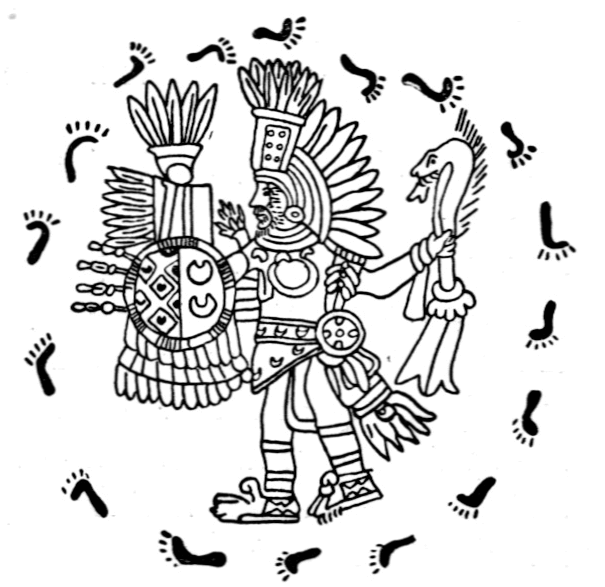
Figure 59.
In conclusion the exact meaning of the most important native symbols is here recapitulated so as to facilitate comparative research.
THE SWASTIKA OR CROSS
the most ancient of primitive symbols was primarily a graphic [pg 280] representation of the annual rotation of the Septentriones around Polaris. It thus constituted not only an image of the most impressive of celestial phenomena but also a year-symbol. The most highly-developed forms of the swastika found in Mexico are associated with calendar-signs. In Mexico and in the Ohio Valley it is linked with the serpent, to the symbolism of which reference should be made. In Copan the cross symbol is associated with the image of a figure in repose, occupying the Middle, and four puffs of breath or air, laden with life-seeds, emanating from this.
Considering that the cross ultimately became the symbol of the union of the four elements or two principles of nature in one and that the production of life-producing rain was attributed to the union of heaven and earth, it is evident why the Cozumel cross was described to its Spanish discoverers, by the natives, as a symbol of the “rain-god.”
THE SACRED FIRE
which was kept perpetually burning on the summit of the pyramid was the graphic and appropriate image of the central light of heaven that most naturally suggested itself to the native mind. Its origin was attributed to supernatural agency and it was under the special care of the priesthood. A deeply symbolical meaning was obviously attached to the ceremonial kindling of the sacred fire by means of the reed fire-drill which was held perpendicularly and inserted into a horizontally-placed piece of dry wood. A noteworthy resemblance to a tau-shaped figure was thus formed, which is interesting in connection with the fact that the ceremony of kindling the sacred fire was undoubtedly regarded by the ancient Mexicans as emblematical of the productive and life-giving union of the dual principles of nature. The acatl or reedstalk, inserted into the vase-like symbol of the earth, such as is carved on the centre of the upper edge of the calendar-stone, is but another hieratic form of the same symbolism.
The annual re-distribution of the sacred fire to the entire population, a fresh gift from heaven obtained by the mediation of the high-priest, was particularly impressive and emphasized the idea of all fire and light and life proceeding from a common centre.
It is noticeable that the reed or acatl is also intimately associated with the east, the masculine or life-giving region. The [pg 281] Maya name for tortoise=ac, is a curious homonym of the Nahuatl word ac-atl.
THE SERPENT
emblematizes and expresses the sound of quadruple power in Maya and duality in Nahuatl. It was employed as an image or embodiment in a single form of the two principles of nature or the four elements. It was usually accompanied by the adjective heavenly or divine and symbolized reproduction, being the union of the masculine or heavenly and feminine or earthly principles. In this connection it should be noted that the numeral two in Nahuatl is ome, and in Maya, ca. A native mode of expressing duality, by means of two horn-like projections on the heads of allegorical personages, is exemplified in fig. 29, p. 92.
THE TREE
was the emblem of life, of hidden and visible growth which extended downward into the earth and upward into heaven and sent forth its four branches towards the cardinal points. It typified tribal life because its various parts were identified with the different members of the community and, metaphorically, the lord was spoken of as the trunk or main stem; the minor chiefs as branches and twigs; the men or vassals as leaves; the maidens as flowers, and the women as fruit, etc. The name “atlapalli” was, for instance, the current Nahuatl appellation for vassals.
As the conventionalized trees in the native picture-writings are usually figured with four equal branches they formed an appropriate image of the living state, and of all directions in space. The “tree of life” thus formed a swastika or cross and both symbols were indissolubly linked together. The names of two trees, considered particularly sacred by the Mayas, were the ci-hom and the yax-ché, a sort of ceiba which was termed “the tree of celestial life” (Landa).
THE HUMAN FACE
was an image of the duality and unity of nature. The upper half of the face symbolized heaven with its two eyes, the sun and moon. The mouth and teeth, the Nahuatl name for which=tlan-tli was homonymous with the affix tlan=land or earth=tlalli, emblematized earth, darkness and the Below. The nose with its [pg 282] two nostrils emblematized inhalation and exhalation. The sanctity attached to this mystic union of two streams of breath led to the consecration of the nose by the wearing of a symbolical ornament attached to it.
THE HUMAN FORM
expressed “a complete count” and was employed as an image of the entire constitution, and of the calendar system; each part of the government administration and calendar sign being identified with one of the twenty digits, four limbs, body and head of the human form.
THE QUADRUPED
usually the ocelot, or puma, was the symbol of the government of the Below and nocturnal cult of the earth as opposed to
THE BIRD OR EAGLE
which typified the upper state and diurnal cult of Heaven. Chiefs, who united dual powers in their persons, wore, as an emblem, the serpent, or a combination of ocelot-skin and feather ornaments.
THE HAND
expressed per se, in Maya, the numeral ho=five, which was also the name of a state which invariably consisted of the central capital and four provinces. As such it was carried as an emblem of power by the central ruler, as may be seen in the native codices. The thumb being regarded as the principal or ruling finger, the chief lord was metaphorically spoken of as the thumb, whilst the minor lords were entitled fingers=pilli.
THE PYRAMID AND SACRED MOUNTAIN
was primarily an artificial elevation destined to be a place of refuge in times of inundation; the pyramid ultimately symbolized: (1) the sacred stable centre of the world and the Four Quarters; (2) central power and its four manifestations or elements. The great pyramid of the ancient City of Mexico which was crowned by two chapels, respectively containing symbolical images of the two principles of nature, is a striking illustration of the employment of the pyramid to express the dual centre (the Above and Below, etc.) and the quadruple organization of all things which was expressed not only by the four sides of the structure but by its four superposed terraces. The fact recorded by Friar Duran, that [pg 283] the flight of steps which led to the summit of the pyramid on its eastern side consisted of 365 steps, and that the annual ceremony of ascending these, performed by a consecrated individual, “signified the course of the sun in a year,” indicates that the pyramid was also associated with the idea of the quadruplicate division of time which pervaded the entire calendar system.
It should also be borne in mind that in ancient Mexico the summits of high mountains were regarded as sacred, “because it was there that Heaven and Earth met and generated fructifying showers.” As religious cult developed, the rites performed on the summit of the pyramid or artificial mound were for the purpose of evoking rain and the renewal of life upon earth, and symbolized the union of heaven and earth. To the native mind the pyramid thus represented the consecrated meeting-place of heaven and earth, the Above and Below, the masculine and feminine elements, the “divine twins,” as well as universal, all-pervading, quadruplicate organization. The massive pyramid likewise typified, in an impressive manner, the main idea connected with the Middle: that of stability, immutability, quietude and repose, combined with power.
In some localities a remarkable rock or massive block of stone was adopted as the mark of the sacred centre and became the altar on which offerings or sacrifices were made, or the throne on which the terrestrial central ruler seated himself on ceremonial occasions and assumed an attitude of absolute repose. It is interesting to collate the Nahuatl words Te-otl, divinity or divine lord, with te-tl=stone and the Maya te-m=stone seat or altar, of which many carved examples exist in the ruined Central American cities, and to observe that principal personages, such as are represented on the carved altars and in the middle of the Copan swastika, are represented as seated cross-legged, as though this attitude were specially indicative of repose on the stable centre of the four quarters. As the natives usually squat or sit on their heels, the cross-legged attitude is particularly noteworthy in connection with the omnipresent set of ideas.
THE BOWL OR VASE
was the emblem of earth, the receptacle of fructifying showers, and of the terrestrial centre. Filled with rain-water, on the surface of which the radiance of a star—the pole-star—reflected itself, the bowl was supposed to typify the union of heaven and earth by [pg 284] means of the divine essence of light and life, proceeding from the “Heart of Heaven.”
THE FLOWER
was another symbol of the earth and of the state and its divisions. It occurs as a composite flower consisting of a yellow centre surrounded by multicolored petals. The usual form is of a flower with four equal petals, bearing a circle or dot in the centre and one on each petal, the Middle and Four Quarters being thus expressed.
A closing allusion should be briefly made to the native association of the square with the earth and the circle with the heaven and to the influence exerted by these ideas combined with those of light and darkness upon primitive architecture and symbolical ornamental designs.
Pointing out that all of the above symbols are but variations on the fundamental theme of the “Middle, Four Quarters, Above and Below,” I also emphasize the fact that, in ancient America, language powerfully influenced the choice of symbols, as may be particularly seen in the case of the serpent, the Nahuatl and Maya names for which are homonymous with duality and quadruplicity.
The origin and meaning of the ancient American symbols of the cross, the serpent, the tree, etc., are clearly apparent. It remains to be seen how far this is the case in other countries where the identical symbols were or are employed, and it is to my fellow archæologists that I look for final authoritative statements on this important subject, in their special lines of research.
Meanwhile I shall present some facts which are accessible to the general reader and suffice for the purpose of my present investigation.
CHINA.
Pole-star worship and determination of time by Ursa Major existed in China from remote antiquity. The Chinese name for the pole-star is Teen-hwang-ta-tee, literally the great imperial ruler of the Heaven. In China “the pole-star, round which the entire firmament appears to turn, ought to be considered as the Sovereign of the Heavens, and as the most venerated divinity” (G. Schlegel, Uranographie Chinoise, p. 524). The sacred central forbidden enclosure, at Peking, contains a temple of the North Star God. In the description of the imperial worship held at the winter and summer [pg 285] solstices, in James Edkins' Religion in China (London, 1878, p. 24) it is stated: “On the second terrace of the east side, the tablet of the Sun is placed, and also that of the Great Bear, the five of the 28 constellations and one for all the other stars.” The following passage shows the origin of the Chinese year:
1. “The months and seasons are determined by the revolution of Ursa Major (the Chinese name for which is Pek-tao the ‘Seven Directors’). The tail of the constellation pointing to the east at nightfall announces the arrival of spring; pointing to the south the arrival of summer; pointing to the west the arrival of autumn and pointing to the north the arrival of winter. This means of calculating the seasons becomes more intelligible when it is remembered that in ancient times the Bear was much nearer the north pole than now and revolved around it like the hand of a clock” (Prof. Rob. K. Douglass, China. London, 1887, p. 418). The Chinese zodiac is represented with the pole-star and circumpolar constellations in the centre (Astronomy of the Chinese, Ancient China, W. H. Medhurst, Shanghae, 1846).
2. The determination and designation of six directions in space. In Chinese the six ho or ki designate the limits of space, the zenith, nadir and four quarters (Mayer's Manual, pp. 306, 312 and 321). “The term Liu-ho also applies to the six pairs of cyclical signs and means ‘Universe,’ that is, Heaven and Earth [being Above and Below] and the Four Quarters.”79
The syllable ho also occurs in the following words which deserve to be collated with the Maya list: Hô=river, hu=lake. C-hó-o=master, cf. Maya hol=head. Hó-o=resident, cf. Maya ho=capital. Shó-o=tree, cf. Maya ci-hom=tree. Pih-shó-o=cypress. Kwó=country, cf. mouth, symbol for land or below. Kòw=mouth, etc. Chow=name of ancient metropolis.
3. The conception of the Above and Below=duality. The zenith is naturally associated with heaven and the nadir with earth. Heaven is father and earth is mother. Heaven is figured by a circle and earth by a square. “The marriage of Heaven and Earth produces all things.” The association of heaven with the male and earth with the female principles is shown by (1) the injunction: “Thou shalt honor thy father as the heaven and thy mother as the earth.” (2) In Pekin, the Emperor, termed “the [pg 286] Son of Heaven,” inhabits the “Palace of Heaven” whilst the Empress inhabits the “Palace of Earth's repose.” The sun is male and the “Temple of the Sun” is situated to the east. The moon is female and the “Temple of the Moon” is situated to the west in the sacred enclosure at Pekin. The emblematic color of the heaven is naturally azure; of the sun, red; of the earth, yellow; and of the moon, white. It is thus evident that the cult of heaven and earth is indissolubly linked to that of the Yang and Yin, the male and the female principle, and that in China the following chains of association concerning duality were formed:
Zenith.Nadir.
Above.Below.
Tien=Heaven.Tec=Earth.
Father.Mother.
Yang.Yin.
Color: Azure.Yellow.
Emblem: Sun.Moon.
East=place of rising.West, place of setting.
Light.Darkness.
Day.Night.
Personification: the Shang-ti=The Earth-Mother.
Emperor=Above, The Lord of Heaven or Universe. The Empress=Below?
Earthly representative: the Light Emperor. The Empress? or Sombre Emperor?
An interesting addition to this dual list is the view of a modern Chinaman, that the Yang and Yin principles refer to positive and negative electricity! (Legge). A striking result of the association of woman with the nadir and earth is the fact that in Thibet, according to Rockhill, woman is designated as Smanba or Manba: “low creature.”
THE MIDDLE AND FOUR QUARTERS.
It is well known that the Chinese designate their empire as the “Middle Kingdom.” Another native name for China is “Chung-ho-a,” which I find translated as “the Flower of the Middle.” The empire is likewise designated as “the Four Seas”=ssu-hai and “the Four Mountains,” and it was actually divided by the emperor Yaou or Yāo (B.C. 2357) into four provinces converging at the capital, the central enclosure of which was considered as the centre of heaven and earth. It is extremely significant that, in this central enclosure there is a temple, consecrated to the god of the [pg 287] north star=The Imperial Ruler of Heaven, whereas altars only are dedicated to the sun and moon respectively. The existence in the central enclosure, or the “Carnation prohibited city,” of the Temple of Earth's Repose, reveals that the idea of stability was associated with this terrestrial centre. The fact that the Empress and the female portion of the Imperial family resided in the “Palace of Earth's Repose” affords an explanation of the possible origin of deforming the feet of noble women, this being a means of enforcing comparative repose upon them, in keeping with the symbolism of their surroundings.
The most striking structure in this sacred enclosure is “an artificial mound, nearly one hundred and fifty feet high, having five summits, crowned with as many temples. Its height allows the spectator to overlook the whole city, whilst, too, it is itself a conspicuous object from every direction.” This sacred mound or pyramid actually marks the centre of the empire. From the surrounding walls of the sacred city four roads diverge towards the cardinal points, dividing the capital into four quarters. Each province was ruled by an official and both province and ruler seem to have been anciently designated by the term Mountain=Yo or Kan. A superior official, entitled the “President of the Four Mountains” is mentioned as the counsellor of Emperor Yaou in the Shu King. One name for mountain is yo, another is kan, a word which resembles k'an=water and kwăn=earth, which forms the name of the earth mother=Kwan-yin. Without drawing any hasty conclusions, I merely note the curious fact that the title “the President of the Four Mountains,” must sometimes have been rendered as Kan and as Yo, and that a variant the name of “four seas” may well have been “four ho” or lakes or rivers. The title kan, meaning mountain or eminence, and the idea of four rivers flowing from a common centre or spring, may well have developed themselves among Chinese-speaking people. It may be an odd coincidence only that the word kan=mountain, should be so intimately connected with the numeral four in the Chinese title; while it is a synonym for four in the Maya, it is also found employed in the honorific Maya title Kukul-kan=the divine Kan, and as a synonym for mountain in certain names of localities in the valley of Mexico. An interesting but little known fact is that the peak of the mighty Kulkun mountain in China is designated as the “King of Mountains, the summit of the earth, the supporter of [pg 288] heaven and the axis which touches the pole” (Meyer's Conversations-Lexikon).
I should much like to know whether the name kul-kun is a variant of kul-kan, and literally signifies “divine mountain.” In this case it would strangely resemble the Maya Kukulkan and the Nahuatl Cul-hua-can, the name of the fabulous recurved mountain of Aztec tradition. Feeling that I am here treading upon extremely dangerous ground I shall abandon further comparisons and conclusions to philologists and Chinese scholars and merely conclude by stating the certain facts, that in Chinese and Maya alike the syllable ho seems to be associated with the Middle; while can is connected with four-fold division. I may perhaps venture to add that, in Chinese, Maya and Nahuatl alike, the particles te and ti seem closely connected with Heaven; while the Chinese kwan=earth, offers a certain resemblance to the Nahuatl affix tlan, meaning land, and kan, sometimes used for mountain.
Since the Chow Dynasty, the empire was spoken of as having five instead of four mountains, which leads to the inference that reference was thus made to the central metropolis also, the most sacred feature of which was its central artificial mountain or pyramid. It is obvious that the empire was governed from the central chief capital and from minor capitals situated in the four provinces and built on the pattern of Peking. In an extremely interesting and clever paper80 Mr. James Wickersham has recently remarked that “the arrangement of cities after the cardinal-points plan was the rule not only in America but in China” and gives the following quotations: “Mukden, the metropolis and ancient capital of Manchuria, was a walled city like Peking. Main streets ran across the city from gate to gate, with narrow roads, called Hu-ting, intersecting them. The palace of the early Manchu sovereigns occupies the centre” (The Middle Kingdom, Williams, vol. I, pp. 192-198). The Manchurian city of Kirin is also divided into four quarters: “Two great streets cross each [pg 289] other at right angles, one of them running far out into the river on the west supported by piles.” Peune, another large city, is similarly divided. “It consists of two main streets with the chief market [place] at their crossing. This plan is the rule in the cities of northern China; the large cities are walled and divided by cross streets emerging from the city gates at the cardinal points” (Coxe's Russia, pp. 316-17). The relation of the central seat of government to its provinces is thus recorded in the Canon of Shun.81 “In five years there was one tour of inspection (performed by the emperor) and four appearances at court of the nobles. They set forth a report of their government in words. This was clearly tested by their works. They received chariots and robes according to their services.”
The order of rotation in which the emperor visited in one year the capital of each quarter, returning after each absence to the metropolis, is given as follows: “In the second month the tour was to the east. In the fifth month ... to the south. In the eighth month ... to the west. In the eleventh month ... to the north.” During the next year the nobles of the eastern province made their appearance at court, and the south, west and north provinces followed in turn, it being noticeable that, in each case, the circle started at the east, the place of rising.
The institution of the calendar by the Emperor Yaou is described at length in the Shu King.82 Confucius said of this remarkable personage, “Heaven alone is great, but Yaou is able to imitate Heaven.”
The Emperor Yaou “... harmonized the various states of the empire and the black-haired people, oh! how they were reformed by this cordial agreement. He commanded He and Ho (officers superintending the calendar and astronomical instruments) in reverent accordance with the motions of the expansive heavens, to arrange by numbers and represent the revolutions of the sun and moon and stars with the lunar mansions and then respectfully communicate to the people the seasons adapted for labor. He then separately directed He's younger brother to reside at Yu-e (the modern Tang-chow in Shan-tung), called the Orient Valley, where [pg 290] he might respectfully hail the rising sun, adjust and arrange the eastern (and vernal) undertakings and notice the equalization of days and whether the star (culminating at nightfall) was the middle constellation of the bird, in order to hit the centre of mid-spring; he might also observe whether the people began to disperse abroad and whether birds and beasts were beginning to pair. He commanded He's third brother to reside at the southern border (the region of Cochin-China) and adjust and arrange the southern or summer transformation and respectfully notice the extreme limit of the shadow when the days attain their utmost length and the star in the zenith that is denominated Fire (heart of Scorpio, culminated on eve of summer solstice), in order to fix the exact period of mid-summer, when the people disperse themselves more widely and the birds and beasts begin to moult and cast their skins. He then distinctly commanded Ho's youngest brother to dwell in the west, at a place called the Dark Valley, where he might respectfully attend the setting sun and equalize and adjust the western (or autumnal) completions, notice the equalizations of the nights and see whether the culminating star was Emptiness (Beta in Aquarius, which culminated at autumnal equinox which was the period at the centre of the dark principle in nature) in order to adjust the mid-autumn, when the people would be more at ease and the birds and beasts would be sleek and plump. He further directed Ho's third brother to dwell at the northern region, called the dismal city, where he might properly examine the reiterations and alterations and see whether, when the days were shortest, the culminating star was Pleiades (this culminates in the evening at winter solstice, which is the extreme of dark principle in nature and midnight seat of that principle) in order to adjust midwinter, when the people would remain at home and the birds and beasts get their down and hair. Thus careful was the sage in reverently observing heaven and labouring diligently for the people, in order that his plans might not contradict the designs of heaven nor the government miss the proper season for human labour.” It is further said that “the bright influence (of Yaou's qualities) was felt through the four quarters (of the land) and reached to (heaven) above and (earth) beneath” (Shu King, book i, p. 32). Legge cites Pritchard's (Savilian Professor, Oxford University) chart as a proof of the correctness of the chronology which places Yâou in the 24th century B.C. The precession of the equinoxes [pg 291] was not known in China until more than 2,500 years after the time assigned to Yaou.
Pausing to renew the foregoing data, it is with particular satisfaction that I point out how clearly they reveal the basis and origin of the “Quadriform Constitution” and idea of central government. In China the pole star is designated as the Imperial Ruler of Heaven and a temple to the God of the North Star stands in the sacred enclosure which marks the centre of the empire. The opposite positions assumed by Ursa Major at nightfall divide the year into four quarters and this quadruplicate division caused by rotation, assuming absolute dominion over the native mind, is applied to heaven and earth and pervades every detail of civil and religious government, as in ancient America.
Forced to recognize that the primitive inhabitants of China and America derived their first principles of organization from the identical light-giving source, a fact which also indicates a community of race and of place of origin, let us now review some data which prove that the two civilizations must have been separated and isolated from each other at an extremely remote period of time.
Certain conceptions, common to all primitive people, were shared by the Chinese and Mexicans, one of these being the belief that the earth was flat and square. The name for a year in ancient Mexican was xiuitl, literally, grass, and this was represented in the picture writings by a bunch of young blades of some sort of grass, possibly maize-shoots. “The earliest written Chinese character for a year represented a stalk of wheat.... In the ancient work entitled the San Fun, part of which was probably written in the 23d century B.C., there is evidence that among some of the aboriginal tribes of China the year, as among the Egyptians and some of the people of India, was divided into three periods, known as the grass-springing, tree-reigning and tree-decaying periods. Under the higher culture of the Chinese these divisions disappeared and the twelve months became the recognized parts of the year” (Douglas, China, pp. 269 and 310). Amongst the Mexican month-names there are also some which allude to such regularly recurring and impressive natural phenomena as the sprouting of trees and the appearance of verdure or springing of the maize, etc.
An indication as to what was the most ancient and primitive method of rotation employed seems afforded by the Chinese description how, for governmental purposes, the five-year period was [pg 292] adopted, one year pertaining to the emperor or central ruler and the following four to the quarters of the empire. An analogous employment of a quinary period as a means of obtaining a rotation of contribution from the four quarters of the empire to its metropolis, identified with the first day, is discernible in the Mexican institution of the macuil-tianquiztli, or five-day market, by which means the entire year was divided into five-day groups.
A study of the ancient Chinese calendar furnishes, moreover, an indication of the way in which the numeral 12 came to be recognized and adopted by primitive people. It is obvious that the early astronomers, having determined the length of the year by observing Ursa Major at nightfall, recognized that, during the period required for its annual complete revolution around the pole star, there regularly appeared twelve new moons. In China, at a remote period, a division of the year into “months was adopted, the early names of which have, according to the author of the earliest Chinese dictionary, the Urhye, been lost.” “The modern Chinese year is lunar in its divisions, though regulated by the sun in so far that New Year's day is made to fall on the first new moon after the sun enters Aquarius and varies between 21st January and 19th of February” (Douglas, op. cit. p. 258). It would seem as though some fresh impulse, or institution of moon-cult, had influenced Shun, Yaou's successor, to reorganize the empire, which had been simply divided into quarters, and subdivide it into 4×3=12 districts.
Another interesting evolution of a numerical system, the origin of which can be traced to the four positions and seven stars of Ursa Major, is discernible in the Chinese zodiac. This, the earliest division of the ecliptic in China, consists of “28 lunar mansions, which are grouped together in four classes of seven each, assigned to the four quarters of heaven” (Legge, vol. iii, p. 24, Introduction to Shu-King). It is to the observation of precisely the same impressive phenomena that the universal adoption of the numbers 12, 4 and 7 may safely be attributed. The further division, by Emperor Yu, of the Chinese Empire into five domains or zones, finds an interesting parallelism in Mexico and Central America.
Mr. Wickersham describes Yu's division in the following concise manner: “The Imperial domain extended five hundred le in every direction from the capital, north, south, east and west, and was therefore one thousand le square, with its sides facing the cardinal [pg 293] points; the domain of the Nobles was an additional territory five hundred le broad on each of the four sides; the Peace-securing domain was then added, beyond which came the domain of Restraint, and at the greatest extremity the Wild domain. By this arrangement, the sacred center, the capital where the ‘Son of Heaven’ resided, was completely surrounded by loyal officials and subjects; the most loyal were nearest the center while at the farthest extremity were the wild and dangerous tribes and criminals undergoing the greater banishment. By this square method of disposing of the population, the quiet and orderly members of society were required to reside near the capital, while the turbulent were placed toward the outer limits, serving to free the center from turmoil and to act as a barrier to the inroads of outside barbarians.”
Among the Zuñis and Mexicans the spider's web is met with as an image of the division of their territory into quarters, half-quarters and concentric circles.
In Peru a record exists of a system of irrigation by which means the territory surrounding the capital was divided into alternate zones of land and water. Mexico and Central America furnish records too scattered to be compiled here, showing that somewhat as in China, the territory of the state was divided into the domains of the rulers, the lords, the people, and the territory of war.
After having duly considered some salient points of fundamental agreement which are to be found underlying the widely different later growths of the Chinese and ancient American systems, let us now examine and analyze some of the most remarkable points of divergence.
The following tables, placed in juxtaposition, afford an opportunity of recognizing the striking and significant fact that, whereas the Mexicans and Zuñis classified air, water, fire and earth as “elements,” the Chinese ignored air and identified wood and metal as their fourth and fifth elements.
Mexico.Zuni.China.
North.Red, Fire. Yellow, Air.Black, Water.
West.Yellow, Earth. Blue, Water.White, Metal.
South.Blue, Air. Red, Fire.Red, Fire.
East.Green, Water. White, Earth.Blue, Wood.
Middle.Many colors. Middle, All colors.Yellow, Earth.
[pg 294]
A deep-seated analogy may, however, be traced between the Chinese assignment of “wood” to the Middle and the Maya-Mexican employment of the tree as a symbol of life proceeding from the centre, stretching above and below and spreading its branches to the four quarters. It remains to be seen how far the Chinese assignment of “wood” to the Middle approached the American tree-symbolism.
The marked differentiation in the assignment of colors to the cardinal points in the above comparative table leads to the conclusion that their choice had been arbitrary and was possibly influenced by local environment, the possibility of obtaining certain pigments in given directions, or by language, the names of certain colors or elements resembling in sound those of the cardinal points, etc.83
After studying the above comparative lists it becomes clear that, whilst the fundamental principle of the system was identical, the mode of carrying it out was different in China and America, a fact which indicates independence and isolation at the period when elements and colors, etc., were chosen and assigned to the directions in space. An analogous instance of divergence is shown in the following assignment of parts of the body to the cardinal points:
CHINESE.
NorthKidneys.
WestLungs.
SouthHeart.
EastLiver.
MiddleStomach.
Zenith——
Nadir——
[pg 295]
Although it differs in detail, an analogous association of various parts of the body with the directions in space and the twenty calendar-signs, may be seen in a Mexican Codex. In this case, however, it is clear that the origin of this assignment was the natural association between the “complete finger-and-toe count=a complete man=20=with the 20 or complete count of the day signs.” I have already produced evidences showing that the human figure was employed in primitive times to represent “a complete count, or 20 years.” When chieftains were elected for a term of twenty years and their names were given to their period of office, the full-length portrait of the chief was sculptured on a stela and he thus represented, primarily, “a complete count,” an epoch (see p. 221). Portraiture and accompanying inscriptions were obviously later developments, but the primitive employment of the human form as a means of expressing a fixed number, is one that claims consideration and will undoubtedly lead to a wider comprehension of the significance of the human form in aboriginal archaic sculpture. The curious conventionalized representations of Mictlantecuhtli, in which the body and limbs almost simulate a swastika, have already been discussed, as well as the inference that they symbolized Polaris and the four positions of Ursa Major=the Middle and Four Quarters.
The most striking confirmation of this inference is furnished by Mr. Cushing's account that the Zuñis associated the directions in space with the imaginary form of a quadruped as follows:
ZUNI.
NorthRight fore foot.
WestLeft fore foot.
SouthRight hind leg.
EastLeft hind leg.
MiddleHeart.
ZenithHead.
NadirTail.
It is obvious from this that, to a Zuñi, the State and its subdivisions appear under the allegorical form of a quadruped and I have traced the identical mode of thought in Mexico and Central [pg 296] America84 where, owing to linguistic associations, an ocelot is in some instances employed as a symbol for a State whilst in others the form of an eagle was adopted for the same purpose (see Appendix I).
To sum up: in ancient America the human form was employed to represent quadripartite division and the complete finger-and-toe count=20, and as such became emblematic of the quadriform plan of universal application. Owing to a variety of circumstances and suggestions arising from language, the figure of a quadruped=ocelot was adopted as a symbol of the State by some tribes and the form of an eagle by others, the inference being that the ocelot was identified with the cult of the earth and night and the eagle with the cult of heaven and day. While the ocelot and eagle occur in the codices as representative of two distinct classes or divisions of the State, there are some interesting and suggestive representations, to which I shall revert, of figures combining the form and claws of an ocelot with the wings and head of a bird, evidently symbolical of a union of the Above and Below, or Heaven and Earth.
Having furnished the explanation that ancient America affords of the origin of the primitive employment of the human body, the quadruped and bird in allegory and the assignment of their various parts to points in space, it is to Chinese scholars that I appeal for enlightenment as to the origin and development of the same idea in China. To me one point of difference between the Chinese and American list is very striking. In America although the navel was also regarded as a symbol, the heart, associated with the Middle, had obviously been recognized as the centre or seat of life, and the tearing out of the heart had become the salient feature in human sacrifices. In China the stomach is assigned to the Middle, and death by disembowelling was customary.
An analysis of the Chinese and Mexican numerical systems likewise proves that their ultimate development was strikingly [pg 297] different, although it is easy to recognize how both might have arisen from the same source. Thus whilst the Mexican and Central American calendar (and social organization) is based on the combination of 20 characters with 13 numerals, the Chinese “took two sets of 12 and 10 characters respectively and combined them.” The outcome of the combination of 20 with 13 affords a marked contrast to that of 12 with 10. In the Mexican calendar, as I have shown, there were fixed periods of 5 days (associated with the Middle and Four Quarters) and of 20 days, the latter being “one complete count” of days, based on the primitive finger-and-toe count. In the Mexican social organization there were 4 principal and 16 minor clans of people, known by 20 signs. Each of these in turn was subdivided into 13 categories associated with the directions in space. By mentioning a sign and a numeral, up to 13, the exact subdivision of a clan was clearly designated while the direction of its residence, as regards the capital, was likewise conveyed. A day was associated with each of these 20 clans and their respective 13 subdivisions, and the unit of time produced by the combination of the 20 day-signs and 13 numerals was the period of 260 days, which held 4×65 days and was approximately equivalent to nine lunations and to the period of human gestation. The 260-day period, as will be more clearly shown in my monograph on the Mexican Calendar System, constituted the religious year of the “Sons or Lords of Night” in their cult of the Moon, the Nocturnal Heaven, Earth and the Female principle.
Simultaneously with this lunar calendar, in which each moon had a different name, a civil or solar calendar was employed consisting of 365 days, divided into 17 periods of 20 and 1 period of 25 days. These years bore the names of four different signs in rotation combined with 13 numerals.85 The cycles, thus produced, consisted of 4×13=52 years, 20, or a “complete count” of which, produced the great cycle of 1040 years.
Totally different from this numerical system is that of the Chinese, who “divided the year into 12 months of 29 and 30 days each and [pg 298] as these periods represent with sufficient exactness the lunar month, it follows that the new moon falls on the 1st of every month and that on the 15th the moon is at its full. The month is thus associated with the moon and is called by the same name and written with the same hieroglyphic.... The Chinese also divide the year by seasons and recognize 8 main divisions and 16 subsidiary ones, which correspond to the days on which the sun enters the 1st and 15th degrees of a zodiacal sign ...” (Douglas, China, p. 269). Whilst it is customary in China for years to be designated at times by the Neen-haou or title of an emperor and an event to be alluded to as having occurred in such or such a year of a certain ruler's reign, the mode of computing years is by reckoning by sexagenary cycles. According to native historians this system was introduced by the emperor Hwang-te in the year 2637 B.C. which was the first year of the first cycle, and it has continued in use until the present day. In this system a group of ten characters, termed the “celestial stems” and associated with the male principle, is combined with a group of twelve characters, named the “terrestrial branches” and associated with the female principle. An unbroken series of sixty-year cycles have thus been formed, in the seventy-sixth of which the Chinese are now living. According to Biot, the calendar instituted by Hwang-te was a day-count only, and year-cycles were not in use until after the Christian era, having been introduced from India.
There are indications which will be more fully discussed further on, showing that the primitive day-count consisted of the seven-day period, each day being consecrated to one of the seven bright stars of Ursa Major, called the “Seven Regulators.”
It is well known that Taouism was founded by Laou-tsze, who was a contemporary of Confucius and thus “lived in the sixth century before Christ, a hundred years later than Buddha and a hundred years earlier than Socrates. A mystery hangs over Laou-tsze's history ... and there is the possibility that he was a foreigner, or perhaps a member of an aboriginal frontier tribe” (Legge).
The Shoo-king, the national book of history edited by Confucius, enables us to follow the development of the state religion and government, the basis of which was Heaven and its imperial ruler, the pole-star. The almost mythical emperor Yaou, whose reign began in B.C. 2357, “imitated Heaven, harmonized the various states of [pg 299] the empire and divided it into four quarters.” His successor, Shun, extended its organization, but it was Yü, the third ruler, in the thirteenth year of his reign (B.C. 1121), who, acknowledging his ignorance of them “went to inquire of Kê-tsze” about “the great plan of the 9 classifications and the arrangement of the invariable principles.” It is also stated in the Shoo-King, that it was “Heaven [who] gave to Yü the great plan and the 9 classifications, so that the invariable principles were arranged, consisting of the 5 elements, the 8 regulations, and the 5 arrangers.”
In China the day is divided into periods equivalent to 120 minutes=2 hours. “In speaking of these periods, however, the practice which was originally introduced into China by the Mongols, of substituting for the twelve stems, the names of the twelve animals which are supposed to be symbolical of them, is commonly adopted. Thus the 1st period, that between 11 p. m. and 1 a. m., is known as the Rat, period 2 as the Ox, 3 Tiger, 4 Hare, 5 Dragon, 6 Serpent, 7 Horse, 8 Sheep, 9 Monkey, 10 Cock, 11 Dog, 12 Boar. The night is divided into five watches, each of two hours duration....” (Douglas, China, p. 296).
The ancient Mexican priest-astronomers marked three divisions of the night by burning incense in honor of certain stars, after dusk, at midnight and at break of day.
The mention of the introduction into China of the Mongolian hour-computation leads to a consideration of the origin of what is known as the Chinese civilization. It is, of course, impossible to do more here than touch upon the various and opposite views held on this important question by leading European and Chinese scholars. On the one hand, “the existence of the Chinese civilization in the east of Asia, separated from early centres by the whole width of Asia and intervening trackless deserts, has seemed a problem to many students and led to the conclusion of its sporadic growth, an idea which is fostered by Chinese historians.” (See Douglas on Chinese Culture and Civilization, 1890.) On the other hand, it is maintained that the Chinese entered China from Tartary and were emigrants from Babylonia who abandoned their country when Nakhunte, king of Susiana, conquered Babylon in 2295 B.C.
According to Legge, the Chinese came through central Asia about 2200 B.C. and founded colonies on the banks of the Yellow river and its tributaries. These colonists founded a Middle Kingdom in China, a federation of states with a chief supreme ruler, on the [pg 300] pattern of Babylonia. They introduced the art of writing and established a calendar with a year of 360 days and an intercalary month.
It is stated that the names of the five planets of the Chinese, besides the Sun and Moon, were called by the same names as in Babylon. (See Edkins op. cit., also The old Babylonian characters and their derivatives, Terrien de Lacouperie, Babylonian and Oriental Record, March, 1888.) Some authorities are inclined to consider Chinese astronomy as derived from the Chaldean; whilst others have instituted comparisons between it and the Hindoo system. The results of the latter line of investigation are set forth by J. F. Davis in the following passage of his work on the Chinese (London, 1836, vol. ii., p. 304): “A comparison between the ancient system of the Chinese and of Hindoo astronomy is rendered somewhat perplexing by the fact that, while there are some points of resemblance there are others in which they essentially differ. Both of them have twenty-eight lunar mansions and a cycle of sixty years, but a careful observation detects some important distinctions: the Hindoo cycle is a cycle of Jupiter while that of the Chinese is a solar cycle, and the twenty-eight constellations of the Hindoos are nearly all of them equal divisions of the great circle, consisting of about 13° each, while the Chinese constellations are extremely unequal, varying from 30° to less than 1°. The author's father, in conjunction with Sir William Jones and Messrs. Colebrook and Bentley, proved that the Hindoo astronomy did not go farther than the calculation of eclipses and some other changes with the rules and tables for performing the same. Besides their lunar zodiac of twenty-eight mansions, the Hindoos (unlike the Chinese) have the solar, including twelve signs perfectly identical with ours, and demonstrating, in that respect, a common origin.”
As we know from Herodotus, the Egyptians had a week of seven days and it is remarkable that the Hindoos had anciently the same, the planetary names being given to the days in exactly the same order as among ourselves, except that Friday was the first. The Chinese reckon five planets to the exclusion of the sun and moon, but they give the name of one of their twenty-eight lunar mansions successively to each day of the year in a perpetual rotation, without regard to the moon's changes; so that the same four out of the twenty-eight invariably fall on our Sundays and [pg 301] constitute, as it were, perpetual Sunday letters. A native Chinese first remarked this odd fact to the author, and on examination it proved perfectly correct.
To the above it may be well to add the following comparison between the Chinese, Tibetan and Indian systems: “The Tibetans received astronomical science from India and China ... the Chinese taught them the science of divination. Both systems are based upon a unit of sixty years, differing, however, in modes of denominating years. In these cycles of sixty years, when numbered according to the Indian principle, each year has a particular name; but in the Chinese method the names used in the Chinese duodecimal cycle are used five times, coupled with the five elements or their respective colors, each of the latter introduced in the series twice in immediate succession” (Schlagintweit, Buddhism in Thibet, p. 27). According to Humboldt, “the Tzihichen, or public calculators of Lhassa take pride in the fact that years of the same name only return about every two centuries. They combine 15 signs: five masculine, five feminine and five neuter, with twelve signs of the zodiac” (Monuments des peuples de l'Amérique i, p. 386).
With regard to the ancient connection between China and India it is well to recall the well-known fact that Buddhism did not enter China from India until the first century of the Christian era and had a prolonged struggle for existence and influence in the country during several centuries.
The Buddhist missionaries introduced the mode of calculating cycles of years into China, according to Biot, who states that the primitive calendar of the Chinese, instituted by Hwang-te, the first king of the “Flowery land,” was a day-count only.
Let us briefly enumerate some bare facts bearing upon the age and development of the state, religion and government of ancient China. In 2697 B.C. Hwang-te (the Babylonian?) erected a temple to the honor of Shang-te, the deity associated with the earliest traditions of the Chinese race. Upon the authority of a Chinaman of the present day it is stated that “the word Shang-te means supreme ruler; but, as it is not lawful to use this name lightly, Chinamen usually name the supreme ruler by his residence, which is Tien=heaven” (Edkins, op. cit. p. 71).
An extremely instructive light is thrown upon the Taouist conception of a supreme being or ruler, by the following episode [pg 302] related by Mr. Edkins in his “Religion in China” (p. 109). “I met [in 1872] on one occasion a schoolmaster from the neighborhood of Chapoo.... The inquiry was put to him, Who is the Lord of heaven and earth? He replied that he knew none but the pole-star, called in the Chinese language Teen-hwang-ta-te, the great imperial ruler of heaven. It was stated to him that it was a matter very much to be regretted that he should hold such views as this of the Supreme Being.”
In this connection and with special reference to the title Tien=heaven, employed by the Chinese in addressing the supreme ruler, I must quote T. de Lacouperie's opinion that the Akkadian name=Din-gira and symbol for God, the eight-pointed star, was the origin of Ti, a Chinese character with the same meaning and sound. Mr. C. J. Ball (The New Akkadian Proceedings of the Society of Biblical Archaeology) explains the Akkadian Din-gira as composed of di=to shine and gira=heaven and that thus the Accadian name for God is “the shining one of heaven,” which explains why the ideogram is a star. According to Mr. K. Douglas (p. 171) “Mr. Ball has practically demonstrated that the Chinese and Akkadian are the same tongue and that everywhere in China we are reminded of that great centre of civilization in Babylonia.”
An investigation of the Taouist religion reveals that it consists chiefly of star-worship, stars being deemed “divine.” “Among the liturgical works used by the priests of Taou, one of the commonest consists of prayers to Tow-moo, a female divinity supposed to reside in the Great Bear. A part of the same constellation is worshipped as a male spirit under the name of Kwei-sing” (Edkins).
A name closely resembling the latter in sound, Tseih-ching, and meaning the “Seven Regulators” is now applied to the Sun, Moon, Mercury, Venus, Mars, Jupiter and Saturn. In ancient times, however, according to native authorities, “this term was used to designate the seven bright stars of Ursa Major which subsequently, by an astrological device, were associated with the seven planets; so, that, by metonymy, the latter became the established meaning.”86
[pg 303]
The association of the term “Regulators” with Septentriones is particularly interesting because the seven-day period has been employed in China from time immemorial, the seventh day being invariably marked by the ancient character mih, which means “quiet, secret or silent.” In the modern Chinese almanacs and astrological works “the mih days are marked by the four constellations which correspond among the seven planets to the principal one among them, the Sun” (cf. Wylie, On the Knowledge of a weekly Sabbath in China, op. cit. p. 86). I am strongly tempted to refer the origin of the Chinese mih or quiet day, on which rest was generally observed, to that remote period of time when, to primitive observers, one of the stars in Ursa Major would have appeared more closely associated with immovability and nearer the polar axis than its companions (see pp. 20 and 21).
If we pause here to review the preceding data we are particularly struck at the unanimity of evidence establishing that even the most ancient form of civilization and religion was not indigenous to China, but was carried there by colonists from distant parts, presumably from Babylonia. The latter conclusion finds a strong support in the undeniable fact that during subsequent centuries a steady stream of emigration has carried colonists of different nationalities into the heart of China.
Buddhism entered China from India in the first century of the Christian era. Alexander Wylie tells us that “according to the testimony of one of the stone tablets in the synagogue at Kai-fung foo, the Israelites first entered China during the Han dynasty” and we are further told in the letters of the Jesuits that “they came during the reign of Ming-ti (A.D. 58-75) from Si-yih, i. e. the western regions. It appears by all that can be gathered from them that this western country is Persia and that they came by Khorasan and Samarcand. They have many Persian words in their language and they long preserved a great intercourse with that country” (The Israelites in China, Wylie's Chinese Researches, Shanghai, 1897).
Some other interesting facts related by Wylie deserve mention here. In translating the name of Jehovah into Chinese, the Israelites [pg 304] in China, to the present day, say Teen, “just as the scholars of China do when they explain their term Shang-te.” We thus observe a growing practice in western Asia, among the Hebrews, of designating Jehovah as the God of Heaven and sometimes as Heaven. In Chinese history distinct mention is made of a foreign sect distinguished as the “worshippers of Heaven,” spoken of as existing in China at the beginning of the sixth century. Wylie has surmised that the Hebrews were thus designated and remarks “that this name, as the designation of a foreign sect, is the more remarkable inasmuch as the state ritual of China has designated the Supreme by the name of Heaven, from the earliest times down to the present day.”
It is a curious reflection that it may possibly have been due to a gross misconception of the Hebrew religion on the part of the Chinese and a supposed identity of worship that caused the Israelites to be treated with such tolerance and hospitality in China that their colony situated in the heart of the country still exists to the present day. It is, in fact, related of the Dowager Empress Ling, in the first half of the sixth century, that she “abolished the various corrupt systems of religious worship, excepting that of the foreign tien-spirit.” A strange insight into the Chinese view of the Christian religion is likewise afforded by the following native documents cited by Wylie: “Now Jesus, the Lord of Heaven, is worshipped by the Europeans. They say that this is the ancient religion of Ta-tsin (Syria).”
The following remarkable passages occur on the famous Nestorian tablet, dated A.D. 781, which eulogizes the propagation of the “Illustrious [Christian] Religion” in China. This tablet was discovered by the Jesuit fathers in 1625 and, after its authenticity had been violently assailed, Wylie's painstaking researches have now vindicated its genuineness.87 The following extracts are from the preface engraved upon it and composed by King-tsing, a priest of the Syrian Church: “... Our eternal, true lord God.... He appointed the cross as the means of determining the four cardinal points, he moved the original spirit and produced the two principles of nature; the sombre void was changed and heaven and earth were opened out; the sun and moon revolved and day and night commenced; having perfected all inferior objects, he then made the first man ... the illustrious and honorable Messiah, [pg 305] veiling his true dignity, appeared in the world as a man ... a bright star announced the felicitous event [of his birth] ... he fixed the extent of the eight boundaries.... As a seal [his disciples] hold the cross, whose influence is reflected in every direction uniting all without distinction. As they strike the wood the fame of their benevolence is diffused abroad; worshipping towards the east they hasten on the way to life and glory ... they do not keep slaves, but put noble and mean all on an equality; they do not amass wealth but cast all their property into the common stock.”
Referring the matter to oriental scholars for further discussion I merely note here the astonishing fact that in China, in the seventh century of our era, the supreme God of the Hebrews and Christians was spoken of as the God of Heaven, or Heaven, that He is credited with having created the two principles of nature besides heaven and earth and instituted the cross as “a means of determining the cardinal points.”
It is likewise strange to find the “Heen or Toen foreigners” credited in a sixteenth-century native cyclopædia, with having introduced into China a system of astronomy denominated the “Four Heavens,” and obviously based on a quadruplicate division of the Heaven similar to the division of the empire instituted by Yaou (Wylie, Israelites in China, op. cit. p. 19).
The current Chinese name for Christians has been “Cross-worshippers,” and it is odd to note that the ancient Chinese seem to have regarded the symbolism of the Christian cross as closely identical with that of their swastika, and to have concluded that the foreign “Heaven” religion rested on the same basis as theirs.
Referring the reader to Wylie's valuable researches and Edkins' Religion in China for information concerning the establishment of colonies of Manicheans, Mohammedans and of successive Christian missions, etc., in China, I shall but quote the following passage from Marco Polo's travels (pp. 167 and 168) because it shows how the doctrine of the quadruplicate division of all things, celestial and terrestrial, led to a broad tolerance of opinion in the famous Tartar prince, Kubla Khan, who, in 1260, at Kanbalu=Peking, honored the Christian festivals. “And he observed the same at the festivals of the Saracens, Jews and idolaters. Upon being asked his motive for this conduct, he said: ‘There are four great Prophets who are reverenced and worshipped by the different [pg 306] classes of mankind. The Christians regard Jesus Christ as their divinity; the Saracens, Mahomet; the Jews, Moses; and the idolaters Sagomombarkan (Buddha) the most eminent amongst their idols. I do honor and show respect to all of the four, and invoke to my aid whichever of them is in truth supreme in heaven.’ ” This attitude of mind and that of the Chinese towards the Christian Cross can only be fully understood and appreciated when it is realized that their “imperial ruler of Heaven” was the pole-star and that the Ursa Major described each year the sign of a cross in the heaven which ever impressed upon them quadruplicate division and differentiation and the union of four in one. It is doubtlessly owing to the same reason that the Chinaman of today finds it possible to believe in, at once, the three great national religions which exist in China. Edkins has explained that, whereas “Confucianism speaks to the moral nature, Taouism is materialistic and Buddhism is metaphysical; thus, they are supplemental to each other and are able to co-exist without being mutually destructive” (op. cit. p. 60). Somewhat apart from these three state religions and embodying the most ancient ideas and traditions of the race, exists the elaborate and solemn “Imperial worship,” the study of which Edkins designates as “specially interesting because it takes us back to the early history of the Chinese people and introduces us to many striking points of comparison with the patriarchal religion of the Old Testament and with the worship of the kings of Nineveh, Babylon and Egypt.” The same authority states that “the account given by Herodotus of the religion of the ancient Persians shows that it consisted in much the same usages as those now found in Chinese Imperial worship” (op. cit. pp. 6, 22, 18 and 30). In the preceding pages it has been shown that the fundamental principles of the primitive religions of China and America were identical, but that their subsequent stages of development or evolution were strikingly divergent. The following study of certain details connected with the “Imperial worship” brings out a marked differentiation in the Chinese and Mexican cult of heaven and earth.
The altar of Heaven at Peking consists of three circular marble terraces, the uppermost of which is paved with eighty-one stones arranged in circles. It is on a round stone in the centre of these circles that the Emperor kneels and is considered to occupy the centre of the earth. In the worship of Heaven, offerings are made [pg 307] to the heavenly bodies, the Sun, Moon, the Pole-star, Great Bear, five planets and twenty-eight constellations. The worship at the altar of Earth consists of offerings to the mountains, rivers and seas.
This arrangement is strikingly unlike that of the ancient Mexicans, who associated the sun only with the Above, the male principle and the blue heaven, and worshipped the nocturnal heaven, the moon and stars, with the earth, darkness and the female principle.
It is interesting to note the marked effect, produced by the two different modes of classification, upon the subsequent development of the state religions of China and Mexico. In the latter country where the contrast of light and darkness and of the duality of nature seems to have been most powerfully felt, the gradual institution, on a footing of equality of a diurnal masculine and nocturnal feminine cult or of a separate sun and moon worship, led to the formation of two equally powerful castes of priest-astronomers who devised their respective calendars and cults and ultimately stood in open rivalry and antagonism towards each other, as children of heaven and light: sun worshippers; and children of earth and darkness: moon worshippers. In China, as the cult of earth was subordinate from the first and all heavenly bodies were included in the worship of Heaven, there was no opportunity for any rivalry to develop in the superior caste of astronomers who jointly ruled, instituted their calendar and altered it under influences emanating from India.
Heaven and Earth were jointly worshipped at the same altar until A.D. 1531, when it was decreed that there should be separate altars and that the worship of Earth should be separately conducted (Edkins). At the same time, while the Emperor acts as the high-priest of Heaven, we find associated with him, from remote antiquity, the Empress, the representative of the Earth-mother.
The fact that the roll of Chinese emperors records heavenly and earthly, light and sombre, emperors, and that empresses have repeatedly occupied the throne, seems to indicate that, in remote antiquity, a male and a female line of rulers, personifying the dual principles of nature, alternately assumed prominence in power. This natural outgrowth of the cult of heaven and earth, which has its parallel in Mexico, seems to afford an explanation of the usurpation and retention of power exercised by the present Empress [pg 308] of China, who is probably ruling in her own right, as the representative of the earth or dark principle. As such she is the exact equivalent to the ancient Mexican Cihua-coatl, or “Woman-serpent;” and modern China supplies us with an episode in the development of the fundamental set of ideas it holds in common with ancient America, closely resembling the historical dissension which led in ancient Mexico to a separation of the two cults and the establishment of two separate governments, under their respective male and female rulers.
Although the difference in primitive Chinese and Mexican definitions of heaven and earth worship is evidently accountable for this fact, it is nevertheless interesting to note that it was in A.D. 1531 only that the Chinese cult of heaven and earth separated and the process of disintegration began to be set into activity. From an evolutionary point of view, the imperial religion of China stands to-day at a far less advanced stage of development than the prehistoric Mexican state religion. This circumstance might be passed over without comment did it not strikingly coincide with the undeniable fact that the essentially inorganic and monosyllabic Chinese language stands far lower in the scale of linguistic development than the incorporative and polysynthetic American languages, the most perfected types of which are the Maya and the beautiful and refined Nahuatl which abounds in delicate metaphors and formulas of exquisite politeness, indicative of the high degree of culture and antiquity of the native race.
If the preceding comparative study of the Chinese and ancient Mexican civilizations be briefly summarized, the result is as follows: Both civilizations alike rest on a foundation of pole-star worship and the set of ideas which naturally proceed from this i. e., central impartial power extending in constant rotation to the four quarters, figured by the swastika, and the recognition of the all-pervading duality of nature. These primitive concepts and their inevitable outgrowths, which might naturally occur to human beings of the same grade of intellect in similar conditions and circumstances and be most powerfully impressed upon the mind of man in circumpolar latitudes beside a few resemblances in names, which I shall proceed to point out, are nearly all that the Chinese and ancient Mexicans may be safely said to have had in common. At a date obviously anterior to 2356 B.C., when they were formulated, the Chinese had made definitions [pg 309] of heaven and earth and of the five elements which radically differ from those of the ancient Mexicans and Mayas.
The Chinese numerical system or calendar, though equally based on rotation, and known to have been modified by contact with India, is essentially different from the American. When carefully compared it must be acknowledged that the Mexican is by far the more complex and highly developed, and the same may be said of the social organization, which was controlled by the calendar. A comparison between the Chinese and American languages in general proves, moreover, that they differ not only in sound, but in form and in grade of development, the Chinese being the lower in the scale. To the above divergences we must add the fact that each people evolved distinct national customs and costumes, foods and drinks, industries, arts and forms of architecture, so markedly characteristic as to be clearly distinguishable.
In conclusion a few words about the swastika in China (ouan). Its Chinese name is wan, which signifies “ten thousand,” or “all,” also “many,” a great number. At the time of the Empress Wu (A.D. 684-704) the swastika in a circle signified “the sun;” half a swastika in the circle “the moon,” and the plain circle “the star.” Deferring comment I emphasize here the fact that the word wan resembles kwan=equal earth or land, and that it signifies an entity composed of ten thousand parts. A proof that the wan was also associated with the idea of time is given by the modern use of the Chinese swastika to signify “long life,” “many years,” i. e., a complete life, a complete cycle of years.