The Fundamental Principles Of Old And New World Civilizations. (continued 4)
Reading edition
At the same time we find that clay or wooden figures continued to be employed evidently as a method of keeping an accurate register of the population. In the capital, one building held duplicates of all the huacas throughout the land. When a new province was conquered the Inca carried its principal huaca to Cuzco. One or more living representatives of the conquered tribe, wearing its characteristic dress, were obliged to reside in the capital. In ancient Mexico these “living images of the gods” are one of the most striking features of the native civilization and have been persistently misunderstood, especially by modern authorities. As these “living gods” are specially treated in the “Lyfe of the Indians,” I shall merely point out here that small clay portraits or effigies of persons were made in Mexico at certain stages of an [pg 140] individual's life and also after his death. These seem to have been employed for statistical purposes.
In Mexico and Peru large numbers of small images were preserved in each household and were under the charge of its chief or “older brother,” who was obliged to guard and render account of them. Of course the Spanish conquerors took it for granted that all of these were idols and, in their ignorance, destroyed them unmercifully. Once the native system of tribal organization is understood, it becomes evident that an accurate register of all members of a tribe was of utmost importance. By means of a group of more or less skillfully-modelled figures or heads the size of a family could be ascertained at a glance by the government recorder. In the light of this recognition it seems more than probable that the immense numbers of small clay heads of various kinds, found in the “street of the dead” at the base of the great pyramids of Teotihuacan, and elsewhere, indicate that, in these localities, a periodical and official registration of deaths was carefully carried on. This assumption is fully corroborated by the conclusions I reached, in 1886, after making a minute study of a large number of terra-cotta heads21 and ascertaining that numbers of them were portraits of dead persons. The above inference is, moreover, confirmed by the name of Teotihuacan, which means, literally, “the place of the lords or masters of the teotle.” The term teotl was given to the head of a tribe, who constituted the living image of the tribal ancestor. When he died he himself became one of the tribal ancestors and all dead lords were termed teotle.
The foregoing data enlighten us as to the practical value of a sternly enforced system of division and differentiation for the control of the population, and of clay images of persons for statistical purposes. We have seen that, during many centuries, the energy of the rulers was directed towards making groups of people as distinct and different from each other as possible. They were rigidly kept apart and, in all assemblages, they occupied separate positions, in a fixed order of relation to each other. “All the people of Cuzco came out according to their tribes and lineages ... and assembling in the great square ... sat down on their benches, each man according to the rank he held, the Hanan-Cuzco [pg 141] on one side and the Hurin-Cuzco on the other” (Molina ed. Hakluyt, p. 26). Beside this dual division of the entire population, under the separate rulerships of the Inca and Coya, who were linked together, however, in a sacred and indissoluble union and respectively represented Heaven and Earth, let us study the executive administration of the religious and civil governments.
Two sets, each consisting of four rulers, next in rank to the Inca and Coya, are described: Each quarter or Suyu was ruled over by a “viceroy,” or “Inca governor,” entitled tucuyricoc=“he who sees all,” or Capac. In the days of the Inca Huayna Capac the names of the four “viceroys” are recorded as having been Capac=Achachic, Capac=Larico, Capac=Yochi, Capac=Hualcaya. These were obviously members of the Inca family and next in rank to the Inca, who presided as supreme pontiff over the religious government. The civil and tribal administration was executed by four Curacas, each of which had charge of 10,000 persons belonging to the ayllus=tribes or lineages. The titles of these four Curacas are recorded as: Hunu-Camayu or Camayoc, Huaronca-Camayu or Camayoc, Pachaca-Camayu or Camayoc, Chunca-Camayu or Camayoc. As their titles show, they were the chief accountants or recorders of statistics, which were recorded by means of the quippus. Under them, in regular order there were officers, who respectively had charge of 500, 100, 50 or 10 individuals. In the latter instance it is expressly stated that it was always one man out of the ten who governed and rendered account of the remaining nine. The four chief recorders dwelt in Cuzco but “left it every year and returned in February to make their report ... bringing with them the tribute of the whole empire. They also reported upon the administration every year recording the births and deaths that had occurred among men and flocks, the yield of crops and all other details, with great minuteness” (Polo de Ondegardo).
From the recorded details of organization we learn that the governmental scheme introduced by the Incas was based on the assumption that the standard population of the empire should number 40,000 individuals under the civil rulership of 4 recorders, 40 first-grade officers, 400 second-grade officers, 4,000 third-grade officers—each of the last being responsible for nine individuals besides himself. It is noteworthy that the three grades of officers [pg 142] correspond to the threefold division of the entire produce of the land, between the Inca, the Huaca and the Ayllu, equivalent to the religious government, the civil government and the people—to the Above, Below and Middle. The minimal division of people into groups of ten of which one was the governmental representative corresponds, moreover, to the classification into the following ten categories, according to their ages:
1. Mosoc-aparic: baby, “newly begun,” “just born.” 2. Saya-huarma: child, “standing boy,” age 2-6. 3 Macta-puric: “child that can walk,” age 6-8. 4. Itanta-requisic: “bread-receiver,” boy about 8. 5. Pucllac-huarma: “playing boy,” age 8-16. 6. Cuca-pallac: “Coca pickers,” age 16-20. 7. Yma-huayna: “as a youth,” light service, age 20-25. 8. Puric: “able-bodied,” tribute and service, age 25-50. 9. Chaupi-rucca: elderly, light service, age 50-60. 10. Puñuc-rucca: dotage, no work, 60 upwards.22
Although for statistical purposes, exact registers of each of these groups were annually made by the recorders, it is evident that the purics or “able-bodied” men constituted the most important portion of the population. They naturally fell into two groups consisting of the nobility and commoners, but scattered evidence amply provides that they were strictly classified according to the special service or tribute they rendered to the government. The best produce of each province was brought to Cuzco.
The inhabitants of each region were specially trained to render certain services or to excel in particular industries—by this means each tribe gradually became identified with its special industry or aptitude. The necessity that the supply of their produce should be constant and regular, must have necessitated the permanent maintenance of a fixed number of workers at each branch of industry, a fact which would give rise to rigid laws controlling the liberty of the individual, forcing children to adopt their parents' avocations and forbidding intermarriages between persons of different provinces. As scattered mention is made of the following [pg 143] general classification of the male population, I venture to note them as follows, provisionally:
Nobility: Commoners. 1. lords: shepherds (of lamas), 2. priests: hunters, 3. warriors: farmers, 4. civil governors: artificers.
The female population was doubtlessly subdivided in an analogous manner, for it is expressly recorded that all marriageable girls were kept in four different houses. Those of the first class, qualified as “the white virgins,” were dedicated to the service of the Creator, the Sun and the Inca; the second were given in marriage to the nobility; the third class married the Curacas or civil governors, and the last were qualified as “black,” and pertained to the lower classes.
Caste division was never lost sight of—indeed one Inca went so far as to order that all the people of the Below “should flatten the heads of their children, so that they should be long and sloping from the front.” Thus they should ever be distinguishable from the nobility and “yield them obedience.” Although it is not expressly stated, it may be inferred from actual specimens of skulls which have been found that, in some localities, in order to differentiate the two classes still more, members of the nobility strove to mould the heads of their children in a high peak, so that they too should perpetually bear the mark of their rank. Whether such a procedure would exert a correspondingly elevating or abasing influence upon the intellectual development of the two classes is a problem for anthropologists.
A very simple explanation of the reason why artificial deformation of the skull was ever adopted, is obtainable when the all-powerful dominion of a certain set of ideas is recognized. Many other customs, still in practice amongst American tribes, are likewise explained by the arbitrary division of population into classes and categories. The Peruvian custom of bestowing one name upon a child when it was one year old and another when it attained maturity is the direct outcome of the classification of individuals by age. The ceremonial observances which accompanied the bestowal of these names were accompanied by a change of costume which constituted the official enrolment or advancement into another class. The existence of further systematic class-distinctions [pg 144] is proven by the description of the picturesque ceremony performed in the month of August at Cuzco and called “the driving out of sickness.” In the centre of the great square around the urn of gold which typified the “central fountain” (precisely the idea expressed by the name of Mexico), four hundred warriors assembled. One hundred, representing one of the four ayllus, faced towards each cardinal point and subsequently ran at full speed in its direction, crying “Go forth all evils!”
We have now traced the idea of the Above and Below, Centre and Four Quarters in Ancient Peru. It remains to be noted that the capital itself, which was to be the image of the whole empire, was primarily divided into two halves and four quarters, and subdivided into 4×3=12 wards the names of which doubtlessly corresponded with that of their inhabitants. When the sacred centre of the capital is added to these it is clear that the City of Cuzco was subdivided into as many parts as there were directions in space, i. e. 13. It exemplified, therefore, an association of 2×10=20 categories of people classified according to ages, with thirteen directions in space, and a general subdivision of all classes into four parts. The Inca with the four Capacs and the Coya with the four Camayocs formed two groups of five each, which could well have been represented by a large central figure surrounded by four smaller ones of equal size. By coloring these with red, yellow, black and white, their assignment to the cardinal point could have been expressed. The central figure could be painted in four colors, for only the Inca and his lineage could wear many-colored garments, these being indicative that they represented the centre or union of the four quarters.
Two important features of the system remain to be discussed: We have studied the minute and methodical classification of the entire population into distinct groups without touching upon the practical reasons why this was done. We have analyzed the great machinery of the Inca dominion as it lies broken and motionless. But endow the giant wheel with motion, introduce systematical rotation into its every part, regulate the occupations of the people by a fixed series of work-days and holidays. Send them forth to their work and collect the products of their labor at set intervals, institute a calendar, and you will have set the machinery of state in motion and realized how the classification of individuals according to rank, ages, and occupations was absolutely necessary in order to [pg 145] obtain a successful and harmonious result. It has already been shown that the institution of the calendar and establishment of twelve festival periods of thirty days each, in a year, succeeded the division of the people into groups and their assignment to fixed places of abode.
“They commenced to count the year in the middle of May, a few days more or less, on the first day of the Moon ... in this month they held the festivals of the Sun” (Molina ed. Hakluyt, p. 16). I direct particular attention to the fact that it was the new May moon which controlled the beginning of the religious calendar, although the Incas observed the equinoxes and solstices and the cult of the Sun was under their special care. The twelve divisions of the year accord with the twelve wards of Cuzco surrounding the central enclosure which was always the place where the festivals were held and the people congregated.
I have as yet found no account of the lesser divisions of time in Peru, but note that the period of thirty days consisted of six periods of five days each, a subdivision which would obviously accord with native habits of thought if associated with the six terrestrial directions in space and if a reunion of people and collection of produce from four quarters took place on every fifth day in the capital. In my special work on the Calendar systems of ancient America I shall be able to discuss more fully their intimate indissoluble relation to the regulation of labor and control of the food supply absolutely requisite for the great capital.
The idea of rotation was carried out in a ceremony described by Molina. When the December moon was full, after having ploughed their fields during twelve days, “all persons returned to Cuzco ... the people went to a house called moro-uco, near the houses of the Sun and took out a very long cable which was kept there, woven in four colors, black, white, red and yellow, at the end of which was a stout ball of red wool. Everyone took hold of it, the men on one side, the women on the other, performing the sacred dance called yaquayra. When they came to the square ... they went round and round until they were in the shape of a spiral shell. Then they dropped the cable on the ground and left it coiled up like a snake. The people returned to their places and those who had charge of the cable took it back to its house.” An extremely important instance of the application of the spiral is preserved in an illustration in the Account of the Antiquities of [pg 146] Peru by the native chronicler Salcamayhua (ed. Hakluyt, p. 109). He relates that the Inca Huayna-Capac, when he reached the town of Tumipampa, “ordered water to be brought from a river by boring through a mountain, and making the channel enter the city by curves in this way:”
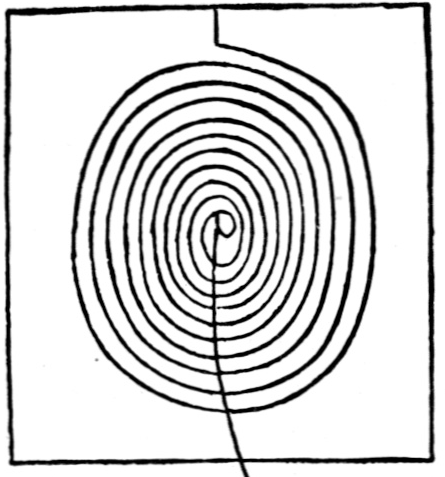
Figure 46.
The illustration, reproduced here (fig. 46), exhibits an extremely ingenious mode of irrigation which divided the country surrounding the town into nine zones of land lying between currents of water. These are cut through by an exit canal which, at the same time, presumably supplied a direct water-way for traffic to and from the town. The association of the spiral form with irrigation would not, perhaps, seem as important and significant did we not know that the ancient Peruvians, as proven by Wiener, habitually laid out the irrigation canals in their maize-fields so as to form regular designs, some of which resembled those illustrated on fig. 40, nos. 2, 4, 6, 7, which have been shown to signify the union of the Above and Below, or Heaven and Earth. In the Peruvian irrigation canals the water supplied the light lines and the earth the dark, and when the small canals were full and were observed in certain lights, they must have resembled light blue or white patterns running through the dark earth. That their inventors and makers actually associated them with profound meaning and laid them from superstitious as well as practical motives is obvious; for, in Peru, as in Mexico, we find the periodical union of the Heaven and Earth, of rain and earth celebrated with ceremonial drinking of chicha, specially brewed for this period which seems to have been the regularly appointed time for juvenile match-making, by order of the Inca.
“When the Inca gave women as wives they were received because it was the command of the Inca ... because of this it was considered that she was taken until death and she was received on this understanding and never deserted” (Molina). “When the Inca Rocca married his sister, six thousand people were married on the next day” (Montesinos). In the festival called Ccapac Raymi, maidens who had attained womanhood offered bowls of [pg 147] fermented chicha to the youths who had just been admitted to the ranks of the warriors.
“During this festival the Priests of the Sun and of the Creator brought a quantity of fuel, tied together in handfuls, and dressed as a man and a woman ... they were offered to the Creator, the Sun and the Inca and were burnt in their clothes together with a sheep” (Molina).
Towards the end of the same month (November), feasts were celebrated for the flocks of the huacas, that they might multiply; for which sacrifices were made throughout the kingdom. Ultimately “public solemn sacrifices were made to the Creator, the Sun, the Thunder and the Moon for all nations, that they might prosper and multiply” (Molina). A few weeks later, an exemption from ceremonial bondage, for three months, commenced. Throughout January, February and March no religious festival took place at Cuzco—the farmers attended to their land and the people were left at liberty to pursue their various avocations uninterruptedly (Molina ed. Hakluyt, pp. 51 and 52). I have already shown that the same exemption from ceremonial bondage during ninety to one hundred days of the year was customary in Mexico; and, in my note on the Ancient Mexican Calendar System, communicated to the Congress of Americanists at Stockholm in 1894 (p. 16), I explained the reasons which had led me to infer that “the religious festivals were concentrated in the ritual years of 260 days,” which indeed forms a unit, consisting of a complete set of combinations of the numbers 13 and 20.
In Dr. Franz Boas' admirable monograph on the Social Organization and secret societies of the Kwakiutl Indians (Washington, 1897, p. 418), it is shown that at the present day the clan system is only in force during one division of the year. “At the beginning of the winter ceremonial the social system is completely changed. The period when the class system is in force is called bā-xus. The period of the winter ceremonial is designated as ‘the secrets,’ ‘making the heart good,’ also ‘brought down from Above.’ The Indians express this alternating of seasons by saying that in summer the bā-xus is on top, the secrets below, and vice versa in winter. During this time the place of the clans is taken by a number of secret societies: the spirits who had appeared to mythical ancestors give new names to the men to whom they appear, but these names are only in use during the time when [pg 148] the spirits dwell amongst the Indians, i. e., in the winter.” Therefore from the moment when the spirits are supposed to be present, all the summer names are dropped and the members of the nobility take their winter names. The winter ceremonial societies are arranged in two principal groups; these are subdivided into 2×10=20 groups according to age and sex.
Dr. Boas distinguishes “three classes of tribal names and of clan names, viz., such as are collective forms of the names of the ancestors, names taken from the region inhabited by the tribe or clan and names of honour.... Each clan derives its origin from a mythical ancestor ... the present system of tribes and clans is of recent growth ... their numbers have undergone considerable changes in historical times.” A careful study of the material presented by Dr. Boas shows, however, that the ground-plans of the entire social fabric reared by the Kwakiutl Indians closely resembles that on which the stately Maya, Mexican and Peruvian civilizations were reared.
Returning to Peru, it is particularly noteworthy that the above mentioned solemn sacrifices to the Creator, the Sun and Thunder, and Moon and Earth, held in November, were thus offered to them jointly in one consecrated place, whereas, at other seasons, the cult was performed separately and on different days, before the emblems of the Above and Below.
Notwithstanding the moderation and tolerance which seem to have been characteristic of the Inca government, and the apparent equality and accord of the two cults, the heads of which were the Inca and Coya, we find evidences of discord in the historical records. The Inca empire had scarcely been established for more than a few centuries23 when we discern signs of a serious rebellion under the leadership of the Chuchi-capac, the chief of the Southern province or Colla-suyu, pertaining to the Below. From the taunts he uttered in the presence of the Inca on a festive occasion and which have been recorded verbally by Salcamayhua, it is clear that the chief of the Collas asserted that he (and the people of his province) actually practised sun-cult although “his throne was of [pg 149] silver;” that is to say, notwithstanding the fact that moon-cult pertained to the quarter to which he was assigned, namely, to the Below. He justifies his departure from moon-cult by taunting the Inca that he, in turn, did not adhere strictly to sun-cult but worshipped the impersonal Creator. This struggle between the ancient native sun-cult and star-cult and this religious dissension, the reason for which is apparent, initiated the long period of internal strife and warfare which ultimately made the Spanish Conquest such an easy matter.
During the course of these wars the Peruvian Inca, on one occasion, avenged himself for a supposed insult by having drums made of the skins of some of the enemies' messengers and by sending back others of these “dressed as women,” that is to say degraded from their positions as warriors or noblemen to the ranks of the commoners. A similar degradation, inflicted upon the Tlatelolcan rebels by the Mexicans has already been mentioned and can only be fully understood when the class-system is recognized.
From this and analogous instances it is evident that, admirable as the scheme of government seems to have been as a means of laying the foundations of civilization, and of teaching primitive people agriculture, stability, law and order, yet the very features which rendered it so efficient at first became, eventually, the cause of its gradual disintegration, as soon as a certain degree of culture prosperity was attained by the community. One mode of avoiding the evils of over-population and of ridding the capital of its restless, and enterprising or troublesome members, was the system of Mitimaes or colonists. This merits particular attention, because it formed an integral part of the marvellous and widespread scheme of organization we have been studying, and therefore helps to an understanding of the customary means by which civilization was spread in past ages throughout the American continent.
As the population of Cuzco increased and greater food supplies were found necessary, the Incas extended their dominions by a series of conquests. “As soon as they had made themselves lords of a province they left Mitimaes or settlers there, who caused the natives to live in communities” and established a small centre of local government on the pattern of Cuzco. Mitimaes or colonists were also sent, from different provinces, to live on the frontiers, bordering on hostile countries, so as to aid in defending them against the enemies. The establishment of colonies in distant districts [pg 150] was therefore a tried and familiar custom of those who possessed the wonderful governmental plan we have been studying.
I have shown that the greater the prosperity of a civilized community organized on this plan, the more imperative the necessity of founding new colonies would sometimes become. The urgent need of greater food supplies would lead to the sending out of expeditions for the purpose of surveying the surrounding country and ascertaining the quality of its produce. In his MS. Noticia, Padre Oliva speaks of an exploring party which was sent out by the ancestor of the Incas with the injunction to return in a year. After a few years had passed and none of the party returned, a second expedition was sent out in search of the first and this led to the final establishment of the Inca dominion in a promising region. Sahagun recounts how a Maya colony was established at Panuco; Montezuma himself related to Cortés that he and his lineage were descendants of colonists from distant parts; traditions of culture-heroes who established civilization amongst them abound amongst Central American tribes; finally, Peru is shown to have been civilized by rulers who carried out, systematically, a ready-made plan in a comparatively short time. Whence did all these culture-heroes emanate, carrying the identical method and system into widely separated districts and establishing centres of civilization in the richest and most fertile parts of the American Continent?
Documentary evidence certainly justifies the inference that the civilization of Peru itself was due to just such a deliberately executed plan of colonization, which gradually extended southwards and ultimately took root and flourished in the most favorably situated locality.
Leonce Angrand, who cites Acosta, Montesinos, Garcia, Boturini, Valera, Garcilaso de la Vega, Gomara, Balboa, Paz Soldan, d'Orbigny, Zarate, Cieza de Leon, Torquemada, Herrera, Velasco, Rivero and Tschudi, Gibbon, Stevenson, Castelnau, Desjardins, Villavicencio, Roman and others, unites their testimony in the following sentence: “It is therefore solely towards the North, in the elevated mountainous region, that researches should be directed [in order to ascertain the origin of the Peruvian civilization]. As soon as this is done innumerable proofs appear of the residence, in extremely ancient times, of people who can scarcely belong to other races than those who founded Cuzco and Tiahuanaco. It is therefore, from the North that these hardy pioneers of humanity [pg 151] came, from distant civilizations, and it is certainly by going northwards that one must look for traces of one or the other current of civilization. The inexhaustible force of expansion of the Inca Empire extended to the North as well as in other directions.”
Angrand also mentions a line “of prehistoric ruins which extend northwards from Peru and display the essentially characteristic outlines of the Mexican Teocallis or temples.”24
Garcilaso de la Vega, citing Padre Blas Valera, goes so far as to state that the race, which introduced human sacrifices and ritualistic cannibalism into Peru, “had come from the region of Mexico, peopled the regions of Panama and the Isthmus of Darien and all those great mountains which extend between Peru and the new kingdom of Granada” (the present Nicaragua).25
According to Padre Anello Oliva, whose manuscript notes on Peru are preserved in the British Museum Library, the immediate ancestors of the Incas were colonists who came from unknown parts either by land or by sea, and settled at Caracas (Atlantic coast), whence they gradually spread southwards. As his authority for this statement, he cites original manuscripts which had been placed in his hands by a Spanish missionary of high standing. Among these was a relation by a Quipucamayoc or “accountant by means of quippus,” named Catari, who had been a chronicler of the Incas. His forefathers had occupied the same post and had handed down the above record as having been related to them by their predecessors.
This account does not disagree with that of Salcamayhua who states that “all the nations of the empire had come from beyond Potosi, in four or five armies, arrayed for war and settled in the districts as they advanced.”
Whatever opinions may be held of the relative reliability of the Spanish chroniclers one thing is certain: that not one ventures the statement that the Inca civilization was gradually evolved by the native race of Peru and that all agree in assigning its introduction to an alien race of rulers who came from the North, and gradually united the scattered indigenous tribes together under a central government. Americanists will doubtless agree with me in stating that, until the past history, antiquities and languages of all tribes inhabiting South and Central America have been exhaustively [pg 152] studied, no absolutely satisfactory conclusion can be formed as to when and how civilization was carried to Peru.
On the other hand, even in the present preliminary stage of investigation, there are certain undeniable facts which, if brought to notice at this early date, may prove of inestimable value in directing future research. One of these facts will doubtless appear to many as strange and inexplicable but as noteworthy as it appears to me.
In Cristoval de Molina's account of the fables and rites of the Incas26 already cited, a fable is related concerning the Inca Yupanqui, the Conqueror, who extended the domain of the Peruvian empire and instituted the worship of a creator who, unlike the sun, could rest and light up the world from one spot.
“They say that, before he succeeded [to rulership], he went one day to visit his father Uiracocha Inca, who was at Sacsahuana, five leagues from Cuzco. As he came up to a fountain called Susur-puquio, he saw a piece of crystal fall into it, within which he beheld the figure of an Indian in the following shape:
“Out of the back of his head there issued three very brilliant rays like those of the Sun. Serpents were twined around his arms, and on his head there was the llautu or royal fringe worn across the forehead of the Inca. His ears were bored and he wore the same earpieces as the Inca, besides being dressed like him. The head of a lion came out from between his legs and on his shoulders was another lion whose legs appeared to join over the shoulders of the man. A sort of serpent also twined over the shoulders.
“On seeing this figure the Inca Yupanqui fled, but the figure of the apparition called him by his name from within the fountain saying, ‘Come hither, my son, and fear not, for I am the Sun, thy father. Thou shalt conquer many nations: therefore be careful to pay great reverence to me and remember me in thy sacrifices.’ The apparition then vanished, while the piece of crystal remained. The Inca took care of it and they say that he afterwards saw everything he wanted in it. As soon as he was Lord he ordered a statue of the Sun to be made as nearly as possible resembling the figure he had seen in the crystal. He gave orders to the heads of the provinces in all the lands he had conquered, that they should make grand temples, richly endowed, and he commanded [pg 153] all his subjects to adore and reverence the new Deity, as they had heretofore worshipped the Creator.... It is related that all his conquests were made in the name of the Sun, his Father, and of the Creator. This Inca also commanded all the nations they conquered to hold their huacas in great veneration....”
It is a startling but undeniable fact that one of the beautiful bas-reliefs found at Santa Lucia Cozumalhuapa near the western coast of Guatemala, about 1,200 miles to the north of the latitude of Cuzco, answers in a most striking manner to the description given of Inca Yupanqui's vision.27
Amongst the thirteen sculptured slabs discovered at Santa Lucia, there are six entire slabs and the fragment of another which are of almost uniform size and may be ranked among the finest examples of aboriginal art which have as yet been found on the American Continent. They represent seven different renderings of the same theme. On each slab an individual wearing elaborate insignia is represented as standing with one arm raised and his head thrown back in the act of gazing upwards towards a celestial figure which seems to be descending towards him. The arms and heads of these nobly conceived figures are visible, but in each case the faces seem to issue from a highly ornate symbol, which is different in each one, just as the insignia of each individual also varies in detail. At the same time it is obvious that the seven slabs commemorate as it were an identical circumstance,—the apparition of the same divinity to seven different individuals, six of which are represented with the sign of speech coming forth from their mouths in precisely the same manner. The general resemblance, notwithstanding the distinct individuality of each bas-relief, suggests that they commemorate the visions seen under [pg 154] similar circumstances by seven distinct personages of the same rank and position. Involuntarily one thinks of the period of enforced fast and vigil which marks the attainment of manhood and is still obligatory amongst North American tribes, amongst whom it only ends when they have entered into communion with their totemic ancestor. I am inclined to view these commemorative tablets as commemorating an analogous rite and perpetuating the visions of successive members of one ruling family, or clan. The divinity, invariably associated with serpent symbols, seems to be Quetzalcoatl, the divine twin or serpent, exhibiting in some cases the emblem of the Sun, but evidently revealing itself to each personage under a slightly different form.
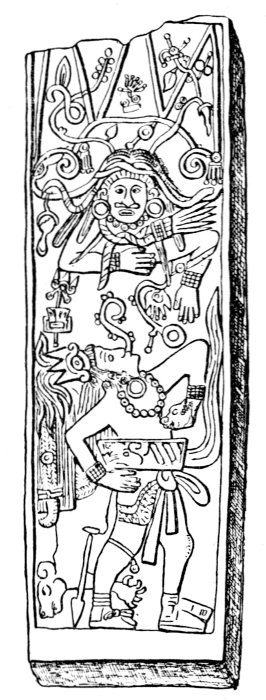
Figure 47.
The accompanying drawing (fig. 47) of one of the Santa Lucia bas-reliefs, reproduced from Dr. Habel's work, will suffice to establish its resemblance to Padre Oliva's description of the apparition seen by the youthful Inca Yupanqui. After a careful comparison of the text to the sculptured bas-relief, it must be admitted that a more graphic and impressive illustration of the episode can scarcely be imagined. Its lower portion displays a youthful figure, looking upwards and exhibiting a necklace, the circular ear-pieces and royal fringe or llautu of the Incas. From his shoulders hangs the skin of a puma or lion with its head downwards. Molina relates that lion-skins with the heads were specially prepared for the ceremonial when youths were admitted into the ranks of knighthood, the last rite of which was the piercing of their ears and the enlargement of the orifice made.28
[pg 155]
The youth wears a singular head-dress, or diadem, consisting of what appears to be an eye with conventionally drawn upper lid, surmounted by three pointed rays, behind which some long wavy feathers are visible.29
The celestial apparition to which the youthful figure is looking up, likewise exhibits the same necklace, pieces, and royal fringe of the Incas. Indistinctly though some of the details are given, it seems as though intertwined serpents encircled its head and possibly its neck. The head of the vision is surmounted by an enlarged rendering of the conventionally drawn eyelid and three pointed rays which form the diadem of the youthful knight. The face of the vision occupies, however, the place of the eye on the diadem. In this connection it is interesting to note that in the Nahuatl language, which, as (op. et loc. cit.) proven by Buschmann, was spoken in Guatemala where the bas-relief was found, the word ixtli designates face, whilst ixtololotli signifies eye. Situated between the right elbow of the celestial figure and the diadem of the youth, there is a diminutive reproduction of the eye, eyelid and three rays, with the addition that what appear like two (or three?) drops of water or two eyes descend from it towards a square symbol which resembles the Mexican sign for tlalli=earth, whilst the eye symbol is closely analogous to a well-known Mexican sign which has been interpreted as a star, and has, but not as yet satisfactorily, been identified with the planet Venus. Without pausing to study this sign as it appears in ancient Mexico I point out that the position and mode of representation of the upper figure in the bas-relief sufficiently show that it is an image of a celestial being or vision in the act of receiving the supplication of a youth who is wearing divine insignia. There being a possibility that some of these accessories may be somewhat indistinct in the original bas-relief now preserved at the Royal Ethnographical Museum at Berlin, I do not venture to draw special attention to the possibility of further points of resemblance between the Peruvian tradition and this Guatemalan sculpture.
[pg 156]
At the same time I shall not omit allusion to the wavy figure winding upwards from the waist of the supplicant, which recurs in four out of the seven slabs. It may yet prove to answer to the description of “a sort of serpent,” which is recorded as twining over the shoulders of the vision who was “dressed like the Inca.” The lion's head which appears in the drawing to cover the left hand of the supplicant and the fact that his left foot only, in some cases, wears a sandal, are important and interesting features to which I shall revert further on.
Without attempting to offer any explanation of the truly remarkable fact that a bas-relief exhumed in Guatemala should so strikingly agree with a description preserved in a Peruvian tradition, I shall merely point out a second similar though much less remarkable case of agreement.
Padre Oliva records two instances in which a “royal eagle” figures in connection with members of the Inca dynasty. One of these relates to the ancestors of Manco Capac, the reputed founder of Cuzco. His great-grandmother, being abandoned by her husband, attempted to sacrifice her young son to Pachacamac. A royal eagle descended, carried him away in his talons and set him down in an island off the Pacific coast, named Guayan, “because it was covered with willows.” Oliva explains this tradition as a fanciful way of recording the fact that the youth's life was probably endangered, and that he had fled and taken refuge on an island. At the age of twenty-one he made his way back to the continent on a raft, but was seized by hostile people. His life was, however, saved by the daughter of a chieftain who returned with him to the island. Her name is given as Ciguar, a word strangely like the Nahuatl Cihuatl=woman. She bore him a son who was named Atau (cf. Ahau and Ahua=Maya and Mexican words for lord or chief), who was, in time, the father of Manco Capac, the reputed founder of civilization in Peru. When the latter was a child “an eagle approached him and never left him.” In view of these traditions it is interesting to note that, on two of the Santa Lucia bas-reliefs figured by Habel and reproduced by Mr. Hermann Strebel in pl. ii, fig. 13, of his extremely useful and comprehensive monograph on the bas-reliefs of Santa Lucia, an eagle is represented in connection with a figure wearing divine insignia.
On one of the seven analogous slabs representing a personage [pg 157] addressing a supplication to a celestial apparition, a large eagle or vulture is actually sculptured behind the supplicant, being, as it were, his individual totem (Strebel, Pl. ii, fig. 5).
A drawing of a part of another slab (Strebel, Pl. ii, fig. 13) displays an eagle or vulture holding in his beak the body of a bearded personage who wears a neck ornament and circular ear pieces, and from whose head two serpents hang. This last detail associates him with the celestial figure which usually displays knotted serpents on or above its head, suggesting its connection with Quetzalcoatl, the divine title of the Supreme Being and also of the supreme rulers of the Mexicans. It is curious to find in Peru a tradition recording that, when “the Pachacuti Inca Yupanqui undertook the conquest of the Antisuyus with 100,000 men, their Huaca sent forth fire and stopped the passage with a fierce serpent which destroyed many people. The Inca raised his eyes to heaven and prayed for help with great sorrow, and a furious eagle descended, and seizing the head of the serpent raised it on high, and then hurled it to the ground. In memory of this miracle the Inca ordered a snake to be carved in stone on the wall of a terrace in this province, which was called Aucapirca.” When divested of all fanciful details, the foregoing Peruvian traditions seem to show that the eagle was the totem of one or more of the Incas and that the serpent was the totem of a tribe which was conquered by the Incas. It is likewise recorded by Padre Oliva that the Inca named Mayta Capac Amaru ordered his shield to be painted with weapons and a serpent=Amaru, “because he had killed one in the Andes and therefore took it for his surname.”
It is impossible for any Mexicanist to read the foregoing texts without recalling that, in the City of Mexico, there is an unexplained bas-relief which was put up by the Spaniards after the Conquest but evidently figures a native tradition. It represents an eagle bearing in his talons a personage, wearing a diadem, beneath whom is a group of native weapons.30 The arms of Mexico representing an eagle holding a serpent in its talons and resting on a cactus, is too well known to require comment and recalls the Peruvian tradition of the eagle of the Incas conquering the serpent-totem of a hostile people.
Striking as these undeniable resemblances undoubtedly are, they [pg 158] would not, by themselves, justify the immediate conclusion that an actual direct connection existed between the Peruvian traditions and the Guatemalan and Mexican bas-reliefs which almost seem to illustrate the same or analogous incidents. At the same time they prove that, besides their scheme of government, the Incas had certain myths or traditions in common with the civilized tribes inhabiting Central America.
It is well to bear in mind that the situations of Cuzco in Peru and Santa Lucia in Guatemala are both adjacent to the Pacific coast with an intervening distance of about 27-½ degrees of latitude. But 15 degrees, however, lie between the northern boundary of modern Peru and the southern boundary of Nicaragua where, as proven by Buschmann, innumerable names of localities in the Nahuatl language testify to its ancient occupation by a Nahuatl-speaking race.
It is noteworthy that this eminent philologist observed how the name employed to designate the bamboo bed of the Cacique Agateite, in Nicaragua, “barbacoa,” was the same as that of the wooden bed or litter used by the Inca in Peru (op. cit. p. 756). Buschmann likewise identified the word galpon=great hall or house. He also expressed the opinion that “the Quechua word pampa resembles the Mexican amilpampa ehecatl=the south wind, but the Mexican is formed by the affixes pan and pa and the Quechua substantive means an even, open plain. At the same time this meaning and form could be derived from the Mexican affixes” (Buschmann, Ueber Aztekische Ortsnamen iii, 7, p. 627).
Following this precedent I have ventured to search for further resemblances between Nahuatl and Quechua words, and one of the remarkable results I obtained was the discovery that the well-known Quechua name for colonists=Mitimaes, the meaning of which, in Quechua, is not forthcoming, seems to be connected in sound and meaning with the Nahuatl Ce-mitime=sons of one mother (Molina's dictionary). It is superfluous to point out how appropriate this designation would have been for the colonists who invariably founded fresh centres of civilization on the plan of the central metropolis. A brief comparative table, the result of an investigation which lays no claim to be more than a rudimentary attempt, is published as an appendix to this paper, with the hope that it may stimulate philologists to supersede it by exhaustive studies of the subject. A careful examination of the table tends [pg 159] to prove that certain Nahuatl, Quechua and Maya words had a common origin and shows that a closer connection existed between the Nahuatl and Quechua languages than between Nahuatl and Maya or the Quechua and Maya.
I shall have occasion to refer to several of the words I have tabulated. At present I would draw attention to an analogy which bears directly on the subject of this paper and is of utmost interest and importance. If carefully studied it will be seen that the title “Pacha Yachachic,” applied in Peru to the Creator, proves to be allied in sound and meaning to the Mexican title Yaca-tecuhtli, “the lord who guides or governs.” According to Sahagun, this was “the god of the traders or traveller-merchants.” He had five divine brothers and one sister, each of which was separately worshipped by some travellers, whilst others, on their safe return from distant and dangerous expeditions, offered sacrifices to the whole group collectively. I leave it to each reader to make his own inference as to whether this celestial “traveller's guide” with his six brethren can have been other than Polaris and Ursa Minor. The difference in the magnitudes of this constellation would naturally give rise to the idea of a group composed of individuals of different ages and sizes; the “little sister” probably being the smaller of the four intermediate stars of the constellation and suggesting tales of adventures relating to the mythical sister of six brothers.
It is superfluous to emphasize how natural it would have been to offer a thanksgiving to the “traveller's star” on returning from a distant voyage, but I will point out that for coast navigation between Guatemala and Nicaragua and Peru, the adoption of Polaris as a guide was and is a matter of course. It is well to bear in mind that we are dealing here with navigation north and south, along a sheltered coast, for a distance not exceeding that of the coast-line between Gibraltar and Hamburg. An instructive example of primitive navigation, under analogous circumstances, has been communicated to me, from personal observation, by Commander Barber of the United States Navy.
Native traders, who navigate north and south in small crafts along the coast between Ceylon and Karashee, still use, at the present day, an extremely primitive method of estimating latitude, which is entirely based upon observations of the pole-star. Their contrivance consists of a piece of wood four inches square, through [pg 160] which a hole is bored and a piece of cord, with knots at intervals, is passed. The square is held at arm's length and the end of the cord is held to the point of the navigator's nose in a horizontal line, the height being so adjusted that the pole-star is observed in contact with the upper edge of the piece of wood. There are as many knots in the cords as there are ports habitually visited, and according to the length of the cord required for the observation of Polaris in the said position, the mariner knows to which port he is opposite.
According to Sir Clements B. Markham,31 the original inhabitants of the Peruvian coast fished in boats made of inflated sealskins. It is well known that the coast-tribes of Mexico and Central America employed boats of various kinds and some of great size. The Mexican tradition relates that the culture hero Quetzalcoatl departed in a craft he had constructed and which is designated as a coatlapechtli=coa=coatl=serpent or twin, tlapechtli=raft. It is open to conjecture whether this construction, “in which he sat himself as in a boat,” may be regarded as a sort of double or twin raft, or a boat made of serpent or seal (?) skin. In order to form any opinion, the name for seal in the Nahuatl and other languages spoken by the coast tribes should first be ascertained and compared with the native names for serpent.
The Maya colonists who founded the colony on the Mexican coast, and are known as the Huaxtecans, are described as having transported themselves thither by boats from Yucatan. In the native Codices and in the sculptured bas-relief at Chichen-Itza, there are, moreover, illustrations of navigation by boats. As dependent upon Polaris as their East Indian colleagues of to-day, it is but natural that the ancient Mexican traders by land or sea expressed their gratitude by offerings to Polaris and Ursa Minor.
Let us now return to Peru and examine whether there is any proof that the “Teacher or Guide of the World,” the Supreme Being of the Incas, was identical with the “Lord who guides” revered by the Mexican navigators.
I have already demonstrated that in ancient America the native scheme of religion and government was but the natural outcome of certain ideas suggested by the observation of Polaris and the circumpolar constellations. I have likewise quoted the remarkable qualification of a supreme divinity made by Inca Yupanqui, who [pg 161] raised a temple in Cuzco to the Creator who, superior to the sun, could rest and light the world from one spot. It is an extremely important and significant fact that the principal doorway of this temple opened to the north,32 and that the “true Creator” is alluded to as an invisible power, the knowledge of which was transmitted by the Incas from father to son. Thus Salcamayhua records that on one occasion the young Inca Ccapac Yupanqui exclaimed “I now feel that there is another Creator of all things [than that worshipped in the Andes], as my father Mayta Ccapas Inca has indeed told me.”33 Considering that in the latitude of Cuzco, situated as it is 14° below the equator, Polaris is invisible, the conditions thus recorded as existing in Peru are exactly those which might be expected to exist if a religion founded on pole-star worship had been carried southward to a region in which the star itself was invisible. The orientation of the temple would designate the north as the sacred region and the star-god would become an invisible power whose very existence would have become traditional and necessarily be accepted on faith by native-born Peruvians and converted sun- and moon-worshippers.
It is a remarkable fact that a descendant of the Incas has furnished us with actual proof that the Supreme Creator revered at Cuzco was not only associated with a star, but also with the figure of a cross, each branch of which terminated in a star. We are indebted to the native chronicler Salcamayhua for some extremely curious drawings, which are reproduced here from his account of the Antiquities of Peru.34 In treating of the primitive astronomy in America in my special paper on the native calendar, I shall refer to these in greater detail. For my present purpose it suffices to designate the following figures.
Salcamayhua records that the founder of the Peruvian Empire, Manco Capac, ordered the smiths to make a flat plate of fine gold, of oval shape, which was set up as an image of the Creator (op. cit. p. 76). The Inca Mayta Ccapac, “who despised all created things, including the sun and moon,” and “ordered his people to pay no honour to them,” caused the plate to be renewed which his “great grandfather had put up, fixing it afresh in the place where [pg 162] it had been before. He rebuilt the ‘house of gold’ and they say that he caused things to be placed round the plate, which I have shown, that it may be seen what these heathens thought.” The central figure on this plate consists of the oval image of the Creator, fig. 48, c. Close to its right are images designated by the text as representing the sun and morning star. To the left are the moon and the evening star. Above the oval and touching it, is a group of five stars forming a cross, with one star in the centre. Below it is a cross figure formed by lines uniting four stars. In this case, instead of being in the middle, the fifth star is attached to the lower edge of the oval, which is designated as “the image of Uiracocha Pacha-Yachachic, the teacher of the World.” Outside of the plate is what appears to be an attempt to explain more clearly the relative positions of the group of five stars to the oval plate (fig. 48, a). It represents the oval and one star in the centre of a cross formed by four stars. The question naturally suggests itself whether the group of five stars forming a cross may not represent the Southern Cross, popularly called the pole-star of the south and which consists of four principal stars, one of which is of the first and two of the second magnitude. This possibility opens out a new field of inquiry, and calls for the statement of the following facts, which I quote from Amedée Guillemin's Handbook of Popular Astronomy, edited by J. Norman Lockyer and revised by Richard A. Proctor.35
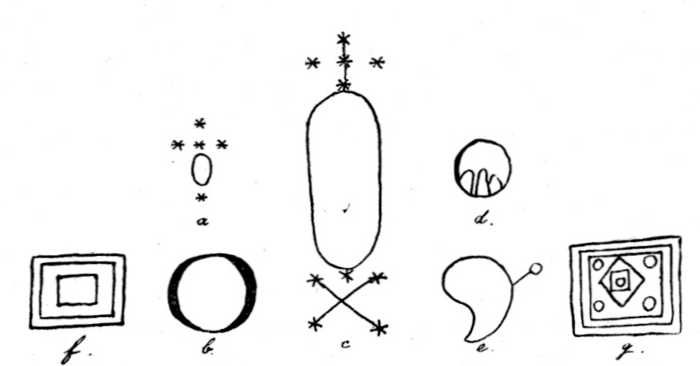
Figure 48.
“In [our] enumeration of the circumpolar constellations of the South, we have said nothing of the stars situated at the Pole itself. The reason is simple; there are none deserving mention, and with the exception of one star in Hydræ, none approach the third magnitude. [pg 163] There is not then, in the southern sky, any star analogous to Polaris in the northern heavens.” M. Guillemin proceeds to explain, however, that this poverty of the polar regions is singularly compensated for by the stars of the equatorial zone. It seems more than probable that primitive astronomers or their descendants, who had been reared in a knowledge of the northern Polaris and of the periodical motion of the circumpolar constellations, should continue their observations in whatever latitude they found themselves. It seems possible that they may have observed the Southern Cross and recognized its closeness to the pivot or centre of rotation; but from personal experience and observation I can vouch for the fact that this constellation could never have produced upon primitive man the powerful impression caused by Ursa Major and Cassiopeia revolving around Polaris. It is, of course, impossible to conclude to what extent the ancient Peruvians revered the Southern Cross. It suffices for the present to establish the incontrovertible facts that the image of the motionless Creator, set up by the Incas, was associated with stars and with the cross and that the door of the Cuzco Temple, where this image was kept, faced the north, the direction whence, according to native traditions, the culture-heroes had come to Peru.
The following data furnish further important proof that certain peculiar ideas, symbols and metaphors were held in common by the civilizations of Peru, Central America and Mexico. Returning to the bas-relief (fig. 47), I recur to an interesting feature, which I have already pointed out, namely, that the left arm of the personage terminates in a tiger's or puma's head. In connection with this peculiarity it is interesting to note that the native historian Ixtlilxochitl cites his illustrious ancestor and namesake, the Ome Tochtli Ixtlilxochitl of Texcoco, as addressing his young son Nezalhualcoyotl as “my dearly beloved son, tiger's arm.”36 As the young prince is referred to in the same chapter as “the boy Acolmiztli [=tiger's arm] Nezalhualcoyotl,” it is obvious that the metaphor constituted a title preceding the actual name. It was Nezalhual-coyotl who instituted the worship of Tloquenahuaque, the true Creator, and discountenanced human sacrifices.
If the other analogous Santa Lucia slabs be also examined it will be seen that although the positions of the bodies and arms vary, and the form of the head is different in each instance, it is [pg 164] invariably the left arm that terminates in the individual emblem. This sort of consecration of the left hand seems particularly significant for the following reason: Padre Anello Oliva records that the Inca Yupanqui, the founder of Cuzco and the same whose vision agrees so strangely with the bas-relief, was surnamed Lloque=the left-handed,37 and was noted for having visited the whole empire three times. His reign was long and prosperous, and he left a record as a conqueror and builder. He likewise sent his son Mayta-Capac to visit the whole empire, accompanied by sages and councillors. I recall here it was Yupanqui who proclaimed to the sun-worshippers of Peru, the existence and superiority of an immutable Creator.
I have already shown how, in Peru, it was a dictum that the upper division of the empire was to bear the same ideal relation to the lower as that of an elder brother to a younger or a right hand to the left. It is, therefore, possible to infer that, on ceremonial occasions when it is recorded that the Hanan Cuzco and Hurin Cuzco people were stationed at either side of the Inca, the Hanan or chieftains constituting the nobility were to his right and the Hurin people or lower class, to his left.
It is truly remarkable that it is a passage in the Annals of the Cakchiquels, the people now inhabiting the region of Guatemala where the Santa Lucia bas-reliefs were found, that contains the clearest statement regarding the division of a tribe into two classes and the relative positions assigned to each of these, according to ceremonial usage. The passage relates: “We, the 13 divisions of warriors, and the seven tribes ... we came to the enclosure of Tulan, and coming, gave our tribute. The seven tribes were drawn up in order on the left of Tulan. On the right hand, were arranged the warriors. Firstly, the tribute was taken from the seven tribes, next from the warriors.”38
[pg 165]
Buschmann has recorded the interesting fact that, in Nahuatl, the right hand is designated as “the good, clever or wise”=yec-maitl or mayectli, also ma-imatca or ma-nematca (from yectli=good and imati=to be clever or wise). Molina's dictionary furnishes us with the following Nahuatl names for the left hand, etc.
Opoch maitl, Opuch maitl, Opuch maye: left hand. Opochiuia=v. to do something with the left hand. Topuchcopa, the left, at the left hand, or side.
In Mexico the totemic lord of the chase was named Opochtli. The much-discussed name Huitzil-opochtli is considered by some to signify “the left-handed humming-bird.”
The foregoing proves that in Peru, Guatemala and Mexico a caste-division was associated with left-handedness and that the expression “left-handed” was employed as an honorific or distinctive title. It is obvious that before reaching the point when the left hand would be invested by a distinctive mark, as in the Santa Lucia bas-reliefs, the above ideas must have been prevalent for a very long time.
I have already pointed out that a striking similarity of ideas survives amongst the Zuñi Indians of to-day.
As to the native tiger's head (puma or ocelot?) we find that it is the chief symbol of the central human figure on the great monolithic doorway of Tiahuanaco, Peru, a fact which testifies to a further community of thought.
[pg 166]
This central figure exhibits two tigers' heads on each shoulder and six around its head, disposed as rays and interspersed with what resemble drops of water. The transverse ornament carved on the breast exhibits four divisions, each of which terminates with a tiger's head. Four similar heads, looking upwards, are on the central decoration beneath the figure and the broad band at the base terminates in two large tigers' heads. What is more, on the fragment of a finely carved hollow stone object, which is preserved at the British Museum and was found at Tiahuanaco by Mr. Richard Inwards, there are the finest representations of the swastika which have as yet been found on the American Continent, and each of its branches terminates in a tiger's head, resembling those sculptured on the monolithic doorway. The fragment consists of the half of what seems to me to have been the top or handle of a staff or sceptre. I am indebted to the kindness of Mr. C. H. Read of the British Museum, for a rubbing of the carved fragment and for the permission to reproduce it here (fig. 49). The central swastika is angular and its form recalls that of the Mexican Calendar swastika (fig. 9). At each side of it are portions of what originally were two rounded swastikas, which also terminate in tigers' heads. These and the size of the fragment seem to justify the inference that another square swastika was originally sculptured on the opposite side, making two rounded and two square swastikas in all.
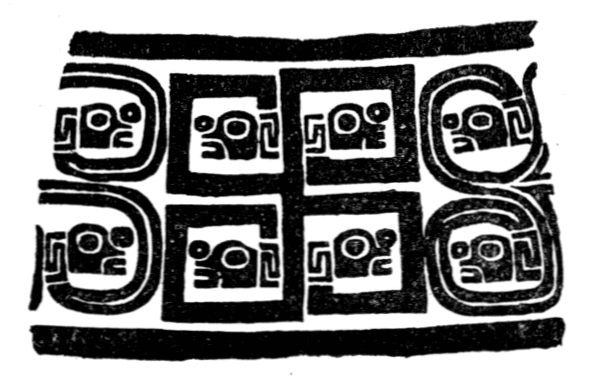
Figure 49.
It would be difficult to overestimate the importance of this fragment, for it proves to us that in Tiahuanaco, the swastika was a sacred symbol. Its association with the puma or ocelot, links it to the central figure on the monolithic doorway and, possibly, connects this with the Mexican identification of the ocelot with the Ursa Major, with “the lord who walks around,” or the lord of the underworld, Tezcatlipoca. The two forms of swastika seem to testify that, in Tiahuanaco also, the idea of the Above and Below prevailed and that the angular form symbolized the subdivision of the earth and the rounded one that of the heavens. The rows of personages sculptured on the doorway at each side [pg 167] of and facing the central figure seem to indicate that this commemorates an establishment of tribal organization.
The distribution of the sculptured figures is as follows:
8 figures=2×4 } Central { 8 figures
8 figures=2×4 } 6×4 { 8 figures
8 figures=2×4 } figure. { 8 figures.
The figures on the upper row to the right and left, making sixteen in all, are all alike—so are the sixteen figures on the second and the sixteen on the third rows.
Without attempting to describe all the insignia which characterize the figures on each of the three rows, I refer the reader to the magnificent plates contained in Drs. Stübel and Uhle's monumental work on the Ruins of Tiahuanaco, and merely note that each figure in the uppermost row exhibits a bird's head in front of its head-dress. All figures in the second row are completely masked as condors. In the third row a tiger's head decorates each head-dress. It is curious to find that whilst the birds' and tigers' heads designate their wearers as heads or chieftains, these emblems strikingly coincide with the classification of the highest Mexican warriors into two divisions, known as “the ocelots and the eagles.” If attention is bestowed upon the number of emblems or figures and their distribution it will be seen, in the first case, that the central figure exhibits on his person twelve tigers' heads in all, i. e., six on his head, two on each arm and two on his breast-plate. Sixteen chieftains exhibit the same emblem and the carved fragment with the swastika appears to have originally exhibited sixteen tigers' heads, distributed into homogeneous groups of four.
It cannot be denied that the forty-eight figures on the doorway are first divided into two groups of twenty-four by being placed to the right and left of the central figure. Each division of twenty-four is grouped as 3×8, which is also 6×4, and yielding a total of 12×4 or 4×12 figures.
Curiously enough the number 12 coincides not only with the number of heads exhibited by the central figure, but the entire bas-relief offers a certain agreement with the numerical divisions of Cuzco which I have summarized as having been divided into two halves and four quarters and subdivided into 12 wards, the names of which doubtlessly corresponded with those of their inhabitants. Personally I am inclined to consider that the purpose of the Tiahuanaco [pg 168] bas-relief was to establish a certain tribal organization and impose certain distinctive insignia upon each tribe. The inference that each sculptured figure was differentiated from the other by being painted in various colors is justified by Molina's account, already cited, that “in Tiahuanaco the ‘Creator’ had his chief abode, hence the superb edifices in that place, on which edifices were painted many dresses of Indians ... thus each nation uses the dress with which they invest their huaca and they say that the first that was born [in Tiahuanaco] was there turned into stones, others say that the first of their lineages were turned into falcons, condors and other animals and birds.”
It is with deference, however, that I submit my conclusion and refer the question to the supreme authority of Drs. Stübel and Uhle and Mr. Bandelier, whose attainments and exhaustive researches in the region of Tiahuanaco qualify them to utter a final judgment upon this interesting subject. According to Dr. Max Uhle the civilization established at Tiahuanaco antedates that of the Incas. It may yet be proven that whilst Tiahuanaco was settled in remote times by colonists from the North, the Inca civilization was due to a later migration. It certainly appears that, in Tiahuanaco and Cuzco, the identical fundamental scheme of government and organization prevailed.
I shall yet have occasion to point out that in Mexico and Yucatan and Central America there are also monuments exhibiting multiples of 12 and 4 and also 16 chieftains. Meanwhile it is worth while to note here briefly, some analogies to Mexican and Maya antiquities found in Peru.
I am much indebted to Sir Clements D. Markham, the President of the Royal Geographical Society, for the kind permission to reproduce here a hasty drawing he made, in 1853, of a gold plaque (size 5-8/10 inches) found in Cuzco (fig. 50). It was then in Lima, being the property of the President of Peru, General Echerrique. This curious relic exhibits the image of a monstrous face surrounded by a band with subdivisions containing various signs. The plaque was looked upon by its owner as a Calendar, but Sir Clements Markham, after studying its subdivisions with a view of ascertaining their agreement with the twelve divisions of the Peruvian year, preferred to let his notes on the subject remain unpublished, not having come to a satisfactory conclusion on the subject. I am permitted, however, to state that Sir Clements Markham specially [pg 169] noted the resemblance of a sign, which is represented on the cheeks of the central figure and recurs four times on the encircling band, to the well-known Maya glyph ahau=chief, lord.
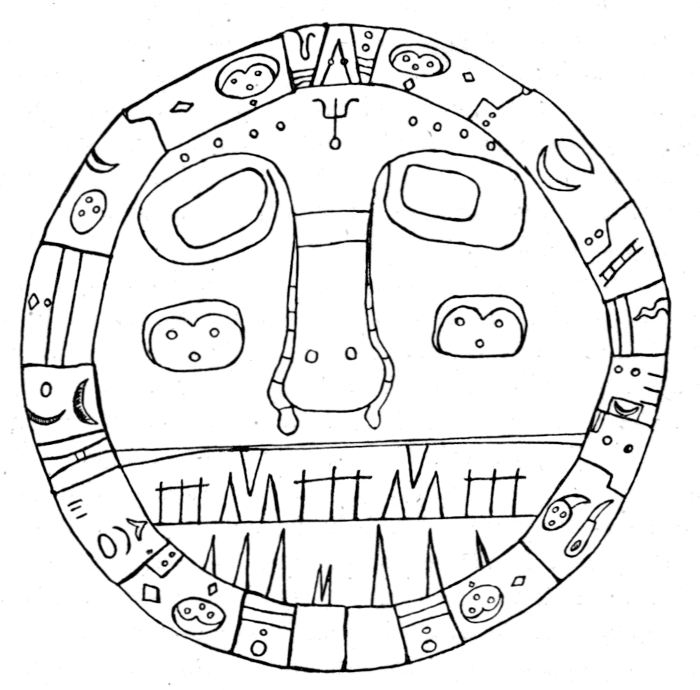
Figure 50.
It is, indeed, a cursive representation of a human head and moreover resembles those figured on the garment of a gigantic red sandstone statue found at Ak-Kapana and figured in Stübel and Uhle's Tiahuanaco. On this garment the heads alternate with squares and form a close design. This resemblance between the conventional faces on this archaic statue and those on the gold plaque has made me attach more importance to the latter and at all events regard it as preserving ancient native symbolism. In connection with these I wish to point out that the plaque itself offers a certain resemblance to well-known Mexican calendars, the centre of which usually exhibits a face which is surrounded by a band with day or month signs. It is remarkable that above each eye there are four dots, especially as the Quechua word for eye=naui is homonymous with the Nahuatl numeral four=nahui, and this is so constantly associated with an eye in the Mexican sign [pg 170] Nahui ollin=four movements (cf. fig. 2). As strange a coincidence as this is furnished by the mark on the forehead of the image, not because the latter resembles the sect mark of the Vishnu worshippers, but because it offers a marked analogy to the Mexican Acatl sign which is frequently carved or painted as a cane standing in a square receptacle with recurved ends. I am strongly tempted to interpret this symbol according to the native mode of thought, as signifying the centre, the union of the Above and Below and to regard the upper part of the face itself as a representation of the Above, the heaven, with its two eyes (the Moon and Sun), whilst the lower part and teeth, as in Mexico, signified the Below, the earth and underworld. By means of the head on each cheek and the number four over each eye, the dual and quadruple rulerships of the empire could well have been expressed. Postponing a more thorough study of the gold plaque, I merely note here that it exhibits curious analogies not only to Maya but also to Mexican symbolism.
Another instance of the same kind is furnished by a possibly modern but curious small silver pendant of unquestionably native workmanship. It is preserved at the Ethnographical Museum at Vienna and is figured in the Report of the International Congress of Americanists which was held at Berlin in 1888 (pl. 1, fig. 4, p. 96). Reputed to be from Cuzco, it represents a figure of the sun surrounded by eight straight and intermediate undulating rays. Two serpents are figured beneath the sun; their bodies extend across the pendant and their heads with open jaws almost meet in the centre. A figure, wearing a peculiar head-dress, is kneeling in worship beneath the symbols, which undoubtedly recall the Mexican mode of representing two serpents meeting, as on the Calendar Stone of Mexico, for instance.
As I am tracing analogies at present, I should like to ask the reader to compare the symbols figured and designated by Salcamayhua as that of the earth (see his fig. c, pl. lxvi) with the sacred vase from the Maya MS. (his fig. ii, pl. lix) and the form of the Peruvian symbol for the sea (his fig. e, pl. lxvi) with the peculiar Mexican shell ornament (fig. 1, no. 10). Insufficient though the above analogies may seem in themselves, they are valuable in conjunction with the other data presented and strengthen the conclusion that the same symbolism prevailed in Peru as in Central America, Yucatan and Mexico.
[pg 171]
Let us now rapidly journey northwards from Peru to these countries and briefly record the traces of the existence of the same ideas and quadruplicate form of government which we may encounter en route. In the elevated plains of Bogota we find positive proof that the Muyscas held the same ideas as their southern and northern neighbors. Their culture hero, Bochica or Ida-can-zas, was the personification of the Above and of its symbol, the Sun, whilst his wife was Chia, a name suspiciously like Quilla, the Quechua for moon. He was high-priest and ruler but counselled the Muyscas to elect one of themselves, a chief named Hunc-Ahua, to be their Za-que or civil ruler. Ida-can-zas instituted the Calendar and taught the Muyscas to appoint four chiefs of tribes whose names or titles are recorded as Gameza, Busbanca, Pesca and Toca. The institution of a dual government is indicated by the record that the high-priest dwelt at the sacred town Aura-ca and the Za-que at Tunja.
It is extremely curious to notice that Ida-can-zas, in Bogota, did precisely what Cortés found it expedient to do after the Conquest of Mexico. The latter assumed the supreme rulership over the nobility, became the “lord of Heaven” and instituted a native chieftain, bearing a female title, as his coadjutor, the lord of the earth, and the ruler of the people of the lower class.
It may be worth making the passing remark that the title of the Muysca culture-hero contains the word “can” and thus recalls the Maya Kukulcan and that the title Za-que offers a certain resemblance to the Maya title Chac, whilst the name Hunc-ahua seems strangely similar to Hun-ahau which in Maya would signify “one lord.” It is for Muysca scholars to enlighten us as to the derivation and meaning of the above titles and name.
Regretting the lack of time and documents which have prevented me from obtaining further data I now return to Guatemala and the vicinity of the Santa Lucia bas-reliefs. Referring to the introduction to their Annals39 we learn that the Cakchiquel tribe was but one of four allied nations, each of which had its capital, named Tecpan, as follows:
Nations: Capitals. Cakchiquel: Tecpan Quauhtemallan, Quiche: Utatlan, Tzutuhil: Atitlan, Akahal: Tezolotlan.
[pg 172]
According to Mr. A. P. Maudslay's authoritative statement, these nations were engaged in warfare against each other at the time of the Conquest. Tezolotlan was termed the “tierra de guerra” the land of war, and the precise locality of its tecpan or former capital has not been traced, although it seems to have been close to Rabinal or in the valley of that name.
It is well known that, under the rulership of Tizoc, the Mexicans extended their conquests into Guatemala. Buschmann has, moreover, proven that the foregoing names of the capitals, of what were at one time four provinces, are pure Nahuatl, which fact establishes the existence of Nahua supremacy in these regions.
It is curious to find that one of the Santa Lucia slabs seems to commemorate the existence of a central rulership and that of the four quarters. It is reproduced in Mr. Strebel's publication already cited and represents a central personage holding a head and a tecpatl, whilst four lesser personages, each carrying a head, are figured as walking away in four opposed directions. As, according to native symbolism, the head is the symbol for chieftain this slab seems to commemorate the establishment and at all events testifies to the existence in Guatemala of the scheme of government now so familiar.
In their Annals, the Cakchiquels record, as I have already shown, that they carried their tribute to “the enclosure of Tulan,” a designation which supports my inference, previously maintained, that Tulan was derived from the Maya tulum,=a fortification, an enclosed place or that which is entire, whole, etc., and applied always to the metropolis of a state.
An ancient Cakchiquel legend relates, moreover, that, according to the “ancient men,” there had been four Tulans: one in the east, one in the north, one in the west and one “where the god dwells.” This would obviously have been situated towards the south in order to accord with the general scheme. I cannot but think that this record testifies to the existence of an extremely ancient state which starting from one metropolis had gradually developed into four great Tullans, to one of which the four tecpans of Guatemala pertained. The fact that the Spaniards found the four nations living close together, with capitals or tecpans bearing Nahuatl names and in constant warfare with each other, seems to indicate the destruction of their own ancient metropolis or Tullan by their Mexican [pg 173] conquerors and the consequent disintegration of their former government.40
The Mendoza Codex teaches us that when the Mexicans conquered a land they first burnt and utterly destroyed the teocallis situated in the heart of its central capital. They razed this to the ground, and carried off to their own metropolis the totemic images of the rulers of the tribe. The barbarous institution of human sacrifice, which was only practised to a great extent by the Mexicans when the necessity to obtain more plentiful food supplies for their rapidly increasing population forced them to become a nation of warriors and conquerors, seems indeed to have been adopted as a fear-inspiring, symbolical rite commemorating the conquest and destruction of an integral government.
The victim, usually a chieftain taken prisoner in warfare and clad with his insignia and the raiment of his people, was stretched on the stone of sacrifice and, figuratively speaking, represented his country and its four quarters. The tearing out of his heart by the high-priest, armed with the tecpatl, the emblem of supreme authority, signified the destruction of the independent life of his tribe as much as did the burning of the teocalli, and of its capital. It would seem as though the horrible custom of annually sacrificing one or more representatives of each conquered tribe, had been adopted as a means of upholding the assumed authority, inspiring awe and terror and impressing the realization of conquest and utter subjection. It is known that sometimes a member of a conquered tribe voluntarily offered himself as a victim in order to release his people from their obligation, and thus earned for himself immortality.
An insight into the native association of ideas is afforded by Sahagun's note that the lord or chieftain was “the heart of his Pueblo,” which means town as well as population. The death of the sacrificed chief, therefore, actually conveyed the idea of the destruction of the tribal government to his vanquished subjects. It remains to be seen whether the subsequent partition of portions [pg 174] of his dead body amongst the priesthood and their ritual cannibalism did not signify the absorption of the conquered population into the communal life of their victors. The preservation of the victim's skull on the Tzompantli, as a register of the conquest of a chieftain, would also be the logical outcome of the native line of thought and symbolism.
At the risk of making a somewhat lengthy digression I will again refer here to a point I have already touched upon, namely, the Mexican employment of the human figure as an allegorical image of their Empire or State, the idea being that the four limbs represented its four governmental and territorial divisions and that these were governed by the head=the lord of the Above or heaven, and the heart=the lord of the Below or earth. A careful study of the native Codices has shown me that such was the native allegory which indeed can be further traced. The territory of a state reproduced the organization of the human body with its four limbs, each of these terminating in minor groups of five.
According to the same set of ideas the cursive image of a state could be conveyed by a main group of five dots, situated in the centre of four minor similar groups. Cross-lines expressing the partition into four quarters would complete such a graphic and cursive presentation of the scheme and not only signify its territorial but also its governmental features. It is noteworthy that, in Nahuatl as in the Quechua, the title for minor chief is homonymous with the word for fingers.
The Nahuatl pilli is a title for a chieftain or lord and also signifies child and fingers or toes. A finger is ma-pilli, the prefix ma, from maitl=hand, designating the fingers as the children of the hand. The thumb is qualified by the prefix uei=great.
Having gained a recognition of the above facts it is not difficult to understand the meaning of certain sceptres in the form of an open hand which occur as symbols of authority borne by chieftains in the native Codices.41 I know of one important instance, indeed, where an arm with an open hand is represented as standing upright in the centre of a circle divided into sections and zones (similar to fig. 28, nos. 1, 3, 5, and 6).
The above mentioned examples, which I shall illustrate later, [pg 175] have led me to infer that whilst the arm symbolized one of the four divisions of the State, the hand symbolized its capital, the thumb its central ruler and the fingers his four officers or pilli, the rulers of the four quarters of the minor seat of government. In another publication I shall produce illustrations showing that the foot was also employed as an emblem of rule and that Mexico, Yucatan and Central America furnish us with actual proofs that the hands and the feet respectively symbolized the upper and lower divisions of the State.
It is thus curious to compare the name for thumb=uei-ma-pilli and the name Uei-mac (literally, great hand) which Sahagun gives as that of the “temporal” coadjutor of the Mexican culture-hero Quetzalcoatl, as well as the term, our toe=totecxopilli with the well-known title Totec=our chief or lord. In Yucatan the word for hand=kab is, as I shall demonstrate further on, actually incorporated in the title of the lords of the four quarters=Bakab. I am almost inclined to find a trace of a similar association in the Quechua word for fingers=pallca and the title palla bestowed upon noble women.
I have already mentioned in the preceding pages that the natural basis of the all-pervading native numerical division into 4×5=20 was the finger and toe count. The following table exhibits the general custom to designate 20 as one man or one count.42
Word for Man. Word for 20.
Nahuatl. tlacatl. cem-poualli=one count.
Quiché }
and } uinay=one man. uinay= " "
Cakchiquel }
Tzendal. hun-uinic=one man. hun-uinic= " "
Maya. uinic. hun-kal= " "
In the latter case the affix kal seems to be derived from the same source as the verb kal=to close up or fasten something, and to signify something complete or finished. At the same time the Maya uinal is the Maya name for the twenty calendar-signs, and the same association is demonstrated as existing in Mexico by the well-known picture in the Vatican Codex i (p. 75), which represents a man surrounded by the twenty Mexican calendar-signs.
As I shall treat of the same subject more fully in another publication, [pg 176] I shall but briefly touch upon the intimate connection there existed between these calendar-signs and the twenty classes into which the population was strictly divided. It is known that an individual received the name of the day on which he was born and it is possible to prove that this determined his position in the commonwealth, his class and his future occupation. Each child was formally registered by the priestly statisticians at birth, and at about the age of six, when his name was sometimes changed, he entered one of the two educational establishments where he was brought up by the State, under the absolute control of the priesthood and rulers. It can be gleaned that one of the chief cares of the latter was to maintain the same average number of individuals in the distinct classes, to which the various forms of labor were allotted and who became in time identified with these. In order to keep the machinery of state in perfect adjustment, individuals had sometimes to be transferred from the class into which they were born, to another. In some cases this seems to have been arbitrarily ordered by the authorities, but the latter appear to have guided themselves by the position of the parents and to have established the custom that an individual might alternatively be transferred into the paternal or maternal class, but not into any other. As each class was, moreover, divided into an upper and lower one, it was possible for each person to elevate himself from the lower to the higher by individual merit or to incur abasement, for unworthy conduct, and being, as we have already seen, “reduced to the official rank of women.”
The direct outcome of such a form of organization was stringent laws governing marriage, it being expedient that certain classes only should intermarry, not only to avoid complications but also to ensure a certain degree of coöperation conducive to the prosperity of the State. In the tribal laws still existing amongst the native tribes of North America, I see the logical survivals of an ancient scheme of organization.
After gaining the above recognition of some of the actual duties of the priest-rulers of ancient Mexico, it is possible to understand the meaning of the native sentence, noted by Sahagun, that the native games of patolli and tlachtli constituted a practice in “the art of government.” From this it is clear that the former, played by two individuals with dice and markers upon a mat in the shape of a cross, and symbolical of the Four Quarters, was originally [pg 177] invented by the priest-rulers for an eminently practical purpose. The mat being an image of the quadruple state and its subdivisions, it was possible to make it serve as a register-board exhibiting the distribution of the population, the number of individuals in each class and its death and birth rates. We are informed that when parents, according to the inflexible law, carried their newborn child to the priest, he consulted his books full of day-signs and foretold what its future was to be.
A proof that it was the positions of the stars which determined the season and furnished the means of fixing a date, is furnished by the fact that the stars were also “consulted” and believed to exert an influence upon the destiny of the child.
The implicit faith in the predictions of the priests and in the absolute influence of the position of the heavenly bodies and the date of its birth upon the individual indicates that the parents were kept in ignorance as to the workings of the machinery of state and that the priesthood were reverenced for their power of prophecy. The belief that they could personally exercise a favorable influence over the destiny of the child seems also to have been encouraged in the parents, since an offering of gifts at the period of registration was customary. After the Conquest, when the native government had been completely broken up, and the enforced registration of birth and the prediction of the priest had utterly lost their original significance, native parents still consulted the surviving members of the priest-rulers; and these ancient statisticians, in order to gain a livelihood, continued to consult their books and uttered predictions as of yore, although their power to control their fulfilment had vanished forever. Ancient Mexico thus furnishes us with an interesting and instructive explanation of the origin of divinatory practices, prognostication at birth, etc. It shows us that, under the ancient form of established government, the sign of the date of a child's birth actually did control his future destiny, while it was unquestionably in the power of the priesthood, not only to predict his future, but also to exert a favorable or unfavorable influence upon it.
The above facts help us to understand the origin not only of divination, propitiation and the belief in the influence of day-signs, but also of the native games which became popular after the Conquest, when their original use and meaning had become obsolete.
Deferring further discussion of this interesting matter I will but [pg 178] draw attention to Mr. Stewart Culin's important study of “American Indian Games,”43 which clearly establishes their “interrelation” and at the same time proves that they were based, as first distinctly insisted upon by Dr. Daniel G. Brinton, on the central idea and that of the four quarters of the world. Mr. Culin has gone so far as to fix the place of origin of the “platter or dice class of games which he has found recorded as existing among some 61 American tribes, in the arid region of the southwestern United States and Northern or Central Mexico,” and to conceive that “in ancient Mexico we find traces of its highest development.”
I place the utmost value upon Mr. Culin's painstaking and conscientious researches and regard them as strongly corroborating my views exposed in the preceding pages. His identification of the pictured diagram in the Féjérvary Codex, as the counting circuit of the Four Quarters, with a presiding god in the middle, as in Zuñi, does credit to his perspicacity. I agree with him in considering that this chart could have been employed after the Conquest for a game or for divination, but trust that, upon perusal of this paper, he will admit that primarily the Féjérvary diagram expressed the native scheme of government and the calendar, which was no other than a means of ruling the classes by binding each of these to a special day and totemic sign. Each of the twenty classes or clans had its day, known by a particular sign which was also its totemic mark. As the day-signs recurred periodically, the chief or head of each clan became its living representative, assumed a totemistic costume and became the “living image of the ancestral teotl,” or god of his people, of whose activity he rendered account to the central government. It is significant that the common native title for lords or chieftains was “tlatoque,” literally, “the speakers,” and that they were closely designated as the spokesmen of his people, who habitually kept silence in his presence.
The fact that the names and signs of the days are identical with the totemic tribal distinctions imposed for governmental reasons, is one which I shall proceed to demonstrate more fully. Meanwhile attention is now drawn to the chapter on the 7-day period in Dr. Daniel G. Brinton's “Native Calendar of Central America and Mexico,” in which he surmises that the tribal divisions of the Cakchiquels “were drawn from the numbers of the Calendar.”
[pg 179]
According to the native records the institution of the Calendar was simultaneous with that of tribal organization and a minute study of both features reveals that it could not have been otherwise.
From the dawn of their history the Cakchiquels, as I have already shown, were divided into thirteen divisions of warriors (Khob, constituting the upper class) and seven tribes (Amag, constituting the lower class). A totem and a day being assigned to each division and tribe, they were, once and for all time, placed in a definite position towards each other and towards the state, and the order in which their chieftains were to sit in general council, and to assume or perform certain duties, was thus instituted. The 20-day period thus constituted a “complete count” and synopsis of the “thirteen divisions of warriors and seven tribes,” but it also fulfilled other not less important purposes.
The day-signs were so ordered that the first, eleventh and sixteenth were major signs employed to designate the years, and identified with the four quarters, elements and their respective colors. The 20-day period, consisting as it also did of 4 major signs and of 4×4=16 minor signs, was as closely linked to the idea of the Four Quarters as it was to the Above and Below, represented by the 13+7 division. It is therefore evident that a simultaneous reckoning of periods consisting of 5, 7, 13, and 20 days was ingeniously combined. I shall show in my special treatise how “the lords of the Night” employed in their astronomical calendar, 9-night and 9-moon periods for purposes of their own and how these also served to carry out certain ideas of organization, controlling persons. Although it embodied the results of long-standing primitive astronomical observation and accorded with the seasons and movements of the celestial bodies, the native Calendar was primarily a governmental institution, designed to control the actions of human beings and bring their communal life in accord with the periodical movements of the heavenly bodies.
In my Note on the Ancient Mexican Calendar System, communicated to the International Congress of Americanists at Stockholm, in 1894, I stated certain historical and astronomical facts which showed that the New Cycle, which began in 1507 with the year Acatl, had commenced on March 14th three days after the vernal equinox and that this delay had obviously been intentional, in order to wait for the new moon, which fell on March 13th at 11.40 a. m., and the planet Venus, “which was possibly visible both [pg 180] as morning and evening star between March 14th and 18th.” The above facts, which have remained unchallenged since their publication, afford an insight into the astronomical attainments of the sun-priests and moon and star-priests and show an evident desire to begin a new era at a favorable time, when there was a conjunction of the heavenly bodies. Thus the terms of office of the lords of the Above and Below were entered upon and the machinery of state set into motion, in unison with striking celestial phenomena. It is impossible not to realize how great must be the antiquity of a system which, evolving from the rudimentary, ceremonial division of a tribe into seven parts, as a consequence of its primitive observation of the Septentriones, developed into a great and complex government dominated and pervaded by the abstract conceptions of the seven-fold divisions of the Above, Below, Middle and Four Quarters.
Deferring further comment I will proceed to demonstrate the practical value, for governmental purposes, of the classification of a community into twenty divisions with as many representative heads, their localizations at given points of the compass, and association with a calendar-sign and day, and will only refer to what I have already published in my Note on the Calendar, namely, how, by means of the combination of 13 numerals with the 20 signs, a unit of 260 days was obtained, and how each sign was combined but once with the same number, and a perfect system of rotation of periods, regulating office, labor, etc., was instituted. It is not possible for me to enlarge here upon the features and merits of the system which I do not hesitate to term one of the most admirable and perfect achievements of the human intellect. My present purpose is to lay stress upon the fact that, in Mexico, the major calendar-signs were borne as titles by the rulers of the four quarters who presided in rotation over a year—the name of this and of their title being always in correspondence.
Nezahualcoyotl, the lord of Tezcoco, is recorded as possessing the title Ome Tochtli=2 Rabbit, and would obviously have presided over the calendar periods of that name. This inference is undoubtedly corroborated by Nuñez de la Vega's following statement, quoted by Boturini:44
“Instead of the Mexican signs Acatl, Tecpatl, Calli and Tochtli, the Tzendals, inhabiting Chiapas, employed in their Calendar [pg 181] the names of four of their chieftains: Votan, Lambat, Been and Chinax.... They also figured a man named Coslahuntax, as seated in a chair....” Boturini remarks that this person should more correctly be named Imos or Max and was “the head of the 20 lords who were the symbols of the 20 days of the Calendar. Being the principal and initial sign, Coslahuntax represented in himself the period of thirteen days.” As Dr. Brinton rightly notes45 the name of the personage should be Oxlaghun tax, literally signifying “the thirteen divisions or parts.”
We thus see that, whilst the names of the chiefs of the four quarters constituted the four major calendar-signs, one supreme lord embodied the attributes or “powers” of the 13 divisions of warriors and principal division. Thus the 13 divisions seem to have been regarded as 12 plus an all-embracing 1.
Nuñez de la Vega continues: “In the representations of their calendar they painted seven black persons, corresponding to the seven days of their reckoning.” Boturini adds: these seven black men were no other than the principal priest-rulers of this nation.... “They held in great veneration the ‘lord of the black men,’ who was entitled Yal-ahua.” Boturini comments on this utterance and explains that the latter was no other than the high-priest.
I point out the evident identity of Yal-ahua to the Mexican Yoal-tecuhtli=the lord of the Night, one of the titles given to Polaris and to his earthly representative, the high priest of the Earth and nocturnal cult. As already explained this personage bore in Mexico the female title, Cihuacoatl=Woman-serpent; but we also find this name for the earth-mother alternating with Chicome-coatl=literally, seven serpents. In Beltran de la Rosa's “Arte Maya” we find the word “Ahaucchapat,” translated as “Serpent with seven heads” and are thus led to infer that the Mexicans and Mayas had conceived the image of a “serpent with seven heads” as an allegory of the seven tribal divisions united in one body and bestowed this title to the representative of the Earth-cult, the high priest of the Below. It follows that, just as the number 13 resolves itself into 12+1, so the mystic number 7 proves to have been considered as 6+1, precisely what might be expected as the natural sequence of the derivation of the number from a circumpolar constellation, consisting of seven stars, [pg 182] one of which was Polaris. Nuñez de la Vega and Boturini's testimony teaches us that the Tzendals were organized into twenty divisions and that thirteen of these were embodied in one chief, while the seven others, associated with black, were personified by the high priest. The information that one individual was thus believed to unite in his person the attributes of several classes and that the lords of the four quarters and each of the twenty divisions bore names which were also calendar-signs, gain in value when it is realized that, in the opinion of Drs. Schellhas and Brinton, the invention of the native Calendar system may probably be assigned to the ancient inhabitants of Chiapas, where the Tzendals now dwell.46 In treating of the ruins of Palenque situated in this region, I shall again refer to the Tzendals.