The Fundamental Principles Of Old And New World Civilizations. (continued 3)
Reading edition
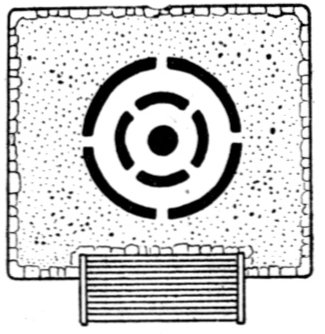
Figure 30.
The ground plan of the Caracol or Round Temple of Chichen-Itza, which was built, according to tradition, by the high priest Quetzalcoatl, carries out the idea of the middle and of the four quarters in so obvious a manner that it may safely be assumed that it represented the supposed centre of a dominion (fig. 30). Referring the reader to the interesting description of this remarkable edifice in Mr. William Holmes' valuable work already cited, I note that round temples, dedicated to Quetzalcoatl, are recorded to have also existed in Mexico. It seems probable that, at certain festivals, the living representatives of the Above and Below performed certain sacred rites on the summit of one of these circular edifices. It is obvious that such rites could only have been fitly performed by the coöperation of both twin rulers or Quequetzalcoas, each of whom personified two elements. The appropriate season for such rites would be that when the necessity of insuring a successful harvest would seem most urgent. It is a recorded fact that the most solemn festivals of the year were held between the vernal equinox, on which date the ritual year began, and the fall of the first rain which usually occurs about the middle of May. It is extremely significant that at this precise period the festival toxcatl took place (cf. Maya thoaxol or thoxol=distribution, giving each one a little, and o-och=food or maintenance) during which Tezcatlipoca and Huitzilopochtli were jointly honored. During this festival the “sacred dough,” named tzoalli, was a prominent feature of the ritual and it was undoubtedly associated with the idea of the life-giving union of the four elements, the Above and Below, or the male and female principles.
It can, moreover, be directly connected with the recumbent statues representing the centre; for, whilst Bernal Diaz recorded that the statue on the summit of the Great Temple held a collection of all the seeds of the land, Cortés, in his descriptive letter, gives us [pg 098] an important detail which evidently applied to the identical statue. He relates that “the bodies of the idols are made of a dough consisting of all the kinds of seeds and vegetables that these people ate. These are ground, mixed with each other and then moistened with the blood of the hearts of human victims ...” (op. cit. p. 105). Sahagun relates that an image of the earth goddess, under the title of Seven-serpents or twins, was made of this sacred dough and that offerings of all kinds of maize, beans, etc., were made before it “because she is the author and giver of all these things which sustain the life of the people” (book ii, 4). It is well known that the dough images were broken into small pieces and these were distributed to the priests and people, who partook of the substance after having prepared themselves by fasting, for the sacred rite. I draw attention to the fact that the above sacred substance is but the natural outcome of the primitive notion already mentioned, which led the hunters to spill blood upon the earth, to obtain its increased fruitfulness. An insight having been thus obtained of the origin of blood sacrifices in ancient America, it is possible to understand the meaning of certain representations showing the performance of ritual blood-offerings.
On the well-known bas-relief preserved in the National Museum of Mexico, and illustrated in the Anales (vol. i, p. 63), the two historical rulers of ancient Mexico, who figure as Quequetzalcoas, or divine twins, in exactly the same costume, are sculptured with blood flowing from their shins and in the act of piercing their ears with a sharp bone instrument. Two streams of blood descend from these and meet before falling into the open jaws figured beneath an altar, on which two conventionalized flowers appear. The two rows of teeth=tlantli, convey the sound of the affix tlan=land of, or tlalli=earth. But the most remarkable and striking instance of the group of ideas we have been studying is found on p. 62 of the Borgian Codex. On a background formed by a pool of water, there is a group which represents the “earth-mother” lying on a band of lizard-skin, with two maize plants issuing from her body and growing into a large two-branched tree, in the centre of which is a flint-knife or tecpatl. A bird stands on its summit and its branches terminate in maize plants. Its growth is being furthered by the two streams of blood which proceed from two human figures, standing at each side of the tree. One is painted black and evidently represents [pg 099] the Lord of the Below; the other is painted blue-green and represents the Lord of the Above. The blood-sacrifice they are jointly offering is that mentioned in the “Lyfe of the Indians,” as performed in order to obtain generation. Unquestionably this symbolical group would have been equally intelligible to Mayas or Mexicans, since the ideas it expressed were held in common by both people.
Before proceeding further it is necessary to state that after the native philosophers had, for an indefinite period of time, been satisfied with the artificial division of all things into four quarters, corresponding to the cardinal points and elements, the idea of the Above and Below gradually grew in importance, whilst prolonged thought and observation disclosed that the above classification demanded revision. On carefully investigating the attributes of the principal ancient Mexican deities or personifications of the elements we see that the native thinkers had found themselves obliged to make a distinction between the different forms of each element, having realized, for instance, that water not only fell to earth from the heaven, but also issued from the depths of the earth in the form of springs or fountains, and formed rivers and lakes. The final conclusions they reached in this instance are best explained by the fact that the name of the god Tlaloc means earth-wine or rain only, and that his sister “Chalchiuhtlycue” appears as the personification of wells, springs, rivers and lakes. It is evident that the classification of the ocean or sea must have given rise to much serious thought. We know how the problem was solved by the fact that the Nahuatl name for the ocean is “ilhuica-atl”=heaven-water. Accordingly, the rain and the ocean pertained to the heaven, the Above and male principle, whilst the wells, springs, rivers, etc., belonged to the earth, the Below, the female principle.
As in this case, so it was with the other elements, each of which was finally personified by a male deity and his female counterpart, which, in some cases, tended to represent its distinctive and beneficent properties. As these deities are separately treated in my commentary of the “Lyfe of the Indians” and lack of space forbids my discussing them here, I shall but mention that the ultimate native systematization of the elements, each of which was thought of as an attribute only of supreme and central divinity, corresponds exactly to that held by the Zuñis of to-day and set forth in the following account given by Mr. Frank H. Cushing and [pg 100] quoted in Dr. Brinton's “Native Calendar of Central America and Mexico” (p. 8). In quoting it I draw special attention to the numerical divisions given, as this is absolutely essential for the understanding of the statements I shall make, further on, concerning the origin of the native Calendar-systems.
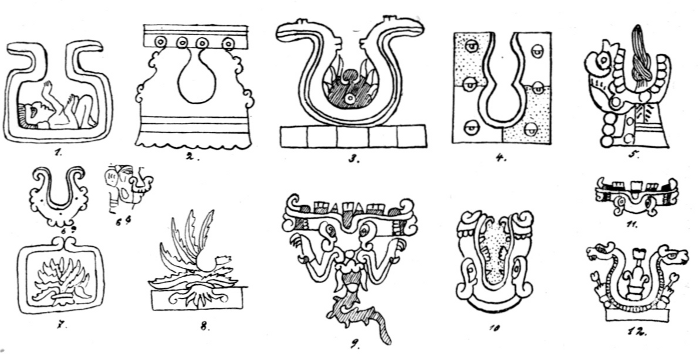
Figure 31.
“In the ceremonies of the Zuñis the complete terrestrial sphere is symbolized by pointing or blowing the smoke to the four cardinal points, to the zenith and nadir, the individual himself making the seventh number. When the celestial is also symbolized, only the six directions are added to this seven, because the individual remains the same, so that the number typifying the universe, terrestrial and celestial, becomes 13. When, on the other hand, in their ceremonies, the rite requires the officiant to typify the supra- and intra-terrestrial spheres, that is, the upper and lower worlds [the Above and the Below], the same number 13 results, as it is held that in each the sun stands for the individual, being in turn the day sun and night sun, the light and dark sun, but ever the same and therefore counts but once.”
After having gained this knowledge of native speculative philosophy, let us penetrate still further into their modes of thinking by studying, first of all, a series of symbols of the earth-mother taken from one of the most valuable of Mexican MSS., the Vienna Codex (fig. 31). In these the idea of the vase, bowl or receptacle and of the serpent predominates. It is instructive of native thought to find the vase represented as containing a child (no. 1), an agave plant (no. 7), a fire, denoting warmth (no. 3), a flower (no. 12), [pg 101] and a bunch of hair, the numerical symbol for multiplicity=the number 400 (no. 5). In no. 2, the hollow between two recurved peaks conveys the idea of a central vase; a band with eyes rests upon the peaks and denotes the heaven. No. 4 shows a double vase, enclosed in a similar representation of the nocturnal heaven—the idea to be conveyed being evidently that of a receptacle hidden in darkness. No. 9 displays an open jaw, two claws, a human heart and a stream of blood issuing from it. Nos. 10 and 11 present different shapes of the serpent's jaw, the symbol of the earth.
The double-headed serpent forming a vase containing a flower (no. 12) is particularly interesting because the flower=xoch-itl in Nahuatl, seems to suggest an intentional likeness to the Maya word for “vase, vessel or cup in general,” ho-och (Arte de la lengua Maya, Fray Pedro Beltran de Santa Rosa, ed. Espinosa, Mérida, 1859) as well as hoch or o-och=“food and maintenance.” The symbolical vase-like opening in the core of the agave plant, (no. 8) is such as is made to this day, in order to collect the juice, which, when fermented, constitutes the sacred wine of the ancient Mexicans, octli, now better known as pulque.8 As will be shown the Mexicans considered this as “the drink of life.” Its use was rigidly regulated and supervised by the “octli-lords” or “rain-priests” who distributed it at certain dances, in order to induce a state of mild intoxication amongst the participants.
As in the case of the Zuñis and Tarahumari Indians of the present day, referred to by W J McGee, in his valuable and instructive article on “The beginning of Marriage” (the American Anthropologist, vol. ix, no. 11, p. 371), “certain ceremonials typifying the fecundity of the earth and of the leading people thereof” were performed by the ancient Mexicans. These public ceremonials had also been “apparently developed to the end that the tribes and peoples might be encouraged to increase and multiply and possess the fecund earth.” They took place at the period of the year when the heaven and earth were also supposed to unite, i. e., at the beginning of the rainy season. During this the ordinary out-door occupations of the agriculturist and hunter were forcibly interrupted and the regular and periodical transportations of produce and tribute [pg 102] to the capital became impossible, owing to torrential rain, swollen rivers and impassable roads. This period of enforced shelter and confinement indoors seems to have become the definite mating season of the aborigines. At the same time the union of the sexes had obviously assumed a sort of consecration since it was intimately associated with the cosmical, philosophical and religious ideas and coincided with what was regarded as the annual union of the elements or of the Above and Below, the heaven and earth.
At that period of its history, when the Aztec race was jointly governed by a priest, personifying the heaven and a priestess, “his wife and sister,” who personified the earth, some form of sacred marriage rite must have been annually performed. The consecrated character of their union must have naturally caused their offspring to be regarded as of a holy and almost divine origin. It is easy to realize, therefore, how, in ancient Mexico, the artificial idea of “superior birth” came into existence, how a family or caste of rulers gradually developed, the members of which were entitled “teotl”=divine, whilst the men were regarded as “the sons of Heaven” and the women “the daughters of Earth.” It is obvious from this that the periodical union of the sexes, accompanied as it was, by sacred dances and the distribution of sacred wine, must have gradually assumed a semi-religious character, whilst the ritual nuptials of the “divine” rulers, typifying, as it obviously did, the grand and impressive phenomenon of the rainy season, must have caused this marriage to assume the character of a hallowed rite and surrounded it with the most elevated and intense religious sentiments of which the native mind was capable.
After this recognition of the diverging influences which guided the development of primitive marriage institutions, we will return to the rain-priests or “octli-lords,” of whom it is repeatedly stated that there were four hundred, a number corresponding to an assignment of 100 or 5×20 to each of the four provinces or divisions of the commonwealth. Their emblem was the sacred vase or receptacle and in the “Lyfe of the Indians” this will be seen figured on their mantas and shields (no. 6a). A small gold plate, of the same shape, is represented as worn by these “lords,” attached to the nose (no. 6b); and, in the same MS., the symbolical ornament is also carried by the “sister of Tlaloc.” It was evidently [pg 103] worn, like similar ornaments in other countries, hanging from the septum of the nose, and seems to have indicated a consecration of the breath as the substance of life. As an inference, merely based on an insight gained into the native modes of thought, I suggest that the explanation for the adoption of this ornament may have been the religious idea that the breath of life, dividing itself as it issues through the nostrils and uniting when inhaled, appeared to the native thinkers as a marvellous illustration of unity and duality, both ideas having constantly been present in their minds.
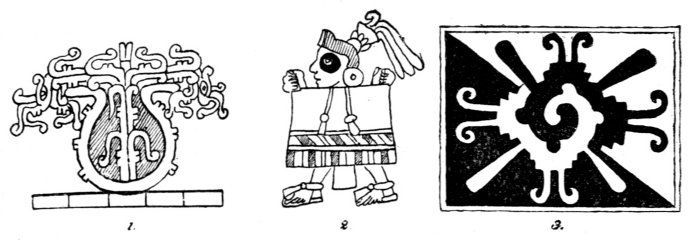
Figure 32.
In the Vienna Codex there is a remarkable picture of the earth-vase resting on a slab with five divisions. A profusion of puffs or breaths of air or vapor issue from it and, branching off in two directions, form what is like the conventional tree of life, also met with in Maya bas-reliefs and documents. At the extremities of the branches which turn downwards, a serpent's eye is visible and a forked-tongue issues above the middle (fig. 32, no. 1). The intention to express an exuberant vitality and growth issuing from the symbolical vase in the centre of the earth, seems obvious. This idea is still more clearly conveyed, however, in two symbolic pictures on pp. 21 and 29 of the Codex Borgia, which are reproduced as nos. 1 and 4 in fig. 1 of this publication. The first represents the vase overflowing with water and containing a flint-knife, the generator of the vital spark. The central group is surrounded by water and by sun-rays and obviously symbolizes the union of air, light and water, constituting the Above, with the flint the emblem of the earth-mother and of Tezcatlipoca, the lord of the Under-world. Fig. 1, no. 4, represents the vase overflowing with a liquid, which is designated as being the sacred octli or earth-wine by the presence of the rabbit, which expresses the sound of its [pg 104] name=tochtli. This rebus is surrounded by the nocturnal heaven strewn with stars and the reference to the union of rain or earth-wine with earth and darkness is evident. It has been generally assumed that these images of the vase, containing the rabbit or flint-knife, represented the moon. As the latter was intimately associated with the cult of night, of the earth-mother and ideas of growth, it is not impossible that by an extension of symbolism, this was the case, but only in the same way as the sun was the emblem of the cult of the Above. On the other hand the native drawings of the moon in Sahagun's Academia MS. represent it as a crescent with a human profile on the inner side, and in a specimen preserved at the Trocadéro Museum, Paris, it is similarly carved in rock crystal.
Before proceeding to investigate the symbol further, I would point out the general resemblance of the vase, especially as a conventionalized serpent's jaw, to the “horse-shoe” shape of the problematical stone “yokes” which have been so thoroughly studied by Dr. Hermann Strebel of Hamburg (Studien ueber Steinjoche aus Mexico and Mittel-Amerika. Internationales Archiv, bd. III, 1890). Mr. Francis Parry has advanced a view concerning the meaning of these curious “sacred stones.”9 This is somewhat corroborated, as will be shown, by my recent studies, which seem to indicate pretty clearly that these symbolical objects pertained to the cult of the earth-mother. A fact of unquestionable importance, cited by Mr. Parry, is the certified existence and use, amongst southern Californian Indians of the present day, of a rudely worked stone of the same shape, in a native religious rite. The owner of one of these stones, Mr. Horatio Rust, a pioneer resident of Pasadena, southern California, exhibited it in the Anthropological Section of the World's Columbian Exposition, at Chicago, 1893, and informed me how he had observed that, occasionally, a native assembly took place at a certain spot on a mountain side, during which invocations and offerings were made. He ascertained that the ceremony on one occasion was the equivalent of the puberty-dances of similar California tribes. Having visited and examined the spot after one of these celebrations, in which six young girls, decorated with garlands of flowers, were the chief participants, he found the “sacred stone,” concealed and surrounded [pg 105] by offerings of corn, meal and pieces of money. The version published by Mr. Parry is slightly different to this account, which was given me by Mr. Rust himself.
In order fully to appreciate the close analogy between the Californian ceremonial offering of maize and meal to the emblematic stone and the ancient Mexican ritual offerings of seeds to an idol, holding a bowl or vase, it is necessary to read the following data. At the same time I would like to mention here that amongst the Hupa Indians of California, who have been termed “the Romans of Northern California by reason of their valour and far reaching dominions,” we find that “flakes or knives of obsidian or jasper, sometimes measuring 15 inches or more in length, are employed for sacred purposes and are carried aloft in the hand in certain ceremonial dances, wrapped with skin or cloth. Such knives are esteemed so sacred that the Indians would on no account part with them, and Mr. Stephen Powers found that they could not be purchased at any price.”10
It is scarcely necessary to recall here that the flint-knife was a well-known ancient Mexican emblem, nor to point out the importance of the conclusion that two well-defined symbols which played an important rôle in the Mexican and Mayan cult of the Below and of the Earth-mother, are actually found in use amongst Californian Indians at the present day.
A whole flood of light is thrown upon native symbolism, however, by the information obtained from the Zuñi Indians by Mr. F. H. Cushing. The following passage, from their Creation myth, affords the most positive confirmation of the foregoing conclusion, that the bowl or vase was the native emblem of the earth-mother. The Zuñi speaker said: “Is not the bowl the emblem of the Earth, our Mother? For from her we draw both food and drink, just as the babe draws nourishment from the breast of its mother. And round, as is the rim of the bowl, so is the horizon....”11 Interesting as this explanation of the native symbolism undoubtedly is, it becomes most important when its full significance is realized and we recognize that originally earthenware bowls themselves were looked upon as sacred emblems formed indeed out of the material of the earth itself. This fact places the invention [pg 106] and manufacture of earthen vessels in an entirely new light and enables us to conjecture and understand why, quite apart from their utility, so much care and decoration were lavished upon them and why, indeed, they were constantly buried with the dead. They obviously served as sacred emblems of the earth-mother, to whose care the dead body was confided, and originally the intention probably was to propitiate her by the beauty of the sacred vessels, which, to be symbolical of her bounty, necessarily contained food and drink.
Without pausing to discuss how easily this custom would have gradually given birth to the belief that the food and drink thus offered were intended for the use of the dead body itself, or its soul, I would point out that, in the absence of clay vessels, a stone, rough or worked, would have also served as an appropriate emblem of the earth-mother, being as it were, of her own substance. It is well known that in ancient Mexico this custom prevailed. There we also find that the bowl- or vase-shaped grave was employed, with a deeply religious and symbolical meaning. This is clearly revealed by a native drawing in the “Lyfe of the Indians,” representing a native burial. The deceased, represented by his skull only, has been placed in a deep hole, figured as a large inverted horse-shoe, painted brown and covered with small “horse-shoe” marks. The same religious symbolism which led to the adoption of a definite form of sepulchre, typifying the element earth, would evidently account for the adoption for burial purposes, of large clay vessels into which the remains of the dead were placed. In some localities these clay burial urns were, as we know, made large enough to contain the dead body itself. The difficulty of manufacturing these would naturally have led to the general adoption of cremation, simply as a means of reducing the remains so that they could repose in the sacred image of the earth. Cremation would, moreover, be a rite full of meaning since, to the native mind, earth was inseparable from its twin element fire, and both together constituted the “Below.”
It is significant to find, however, that the ashes of Montezuma's predecessors had not been finally consigned to the earth. In strict accordance with their association with the Heaven and Above, their remains were never allowed to come in contact with the earth, but were usually preserved inside of a hollow wooden effigy of the deceased, which was dressed in his insignia and placed in a high [pg 107] tower, built for the express purpose. Cortés states that there were “forty very high towers” in the enclosure of the Great Temple of Mexico and that “all of these were sepulchres of the lords” (Historia de Nueva-España, ed. Lorenzana, pp. 105 and 106). Whilst it is evident that the remains of all lords and priests of heaven should thus be assigned a place of rest high above the earth, it is equally intelligible that the bodies of the lords and priests of the Below and all women should be consigned to the interior of the earth and by preference in caves. The Codex Féjérvary contains an interesting picture of the tied-up body of a woman, recognizable as such from the head-dress and her instrument of labor, the metlatl, on which the maize is ground. The mummy rests inside of a flat effigy of a serpent's head, which seems to be carved in wood or stone and closely resembles fig. 31, no. 11. It is worth considering whether the carved stone-yokes may not have served in connection with the funeral rites of the consorts of rulers or high priestesses or priests of the Below.
If investigations of the vase or earth symbols are extended to countries lying south of Mexico, traces of the existence of an analogous cult are observable. There undoubtedly exists a striking resemblance between the form of the characteristic and peculiar stone “seats” which have been found in such numbers in Ecuador, to the vase, fig. 31, no. 3, for instance. The employment of these symbolical stones as a consecrated central altar or, possibly, as the throne of the living representative of the earth-mother, would have harmonized with the native ideas which have been traced on the preceding pages.
It was also extremely interesting to me to find the identical symbol in the Maya day-sign Caban, which has been identified by Dr. Schellhas and Geheimrath Förstemann as a symbol of the earth and is figured on p. 99 of Dr. Brinton's Primer of Mayan Hieroglyphics. In the sign Caban, the horse-shoe mark is accompanied by a series of dots which seem to indicate liquid trickling from the receptacle and permeating the soil, an idea which is strictly analogous to the much more elaborate Mexican images of the vase full of rain or “earth-wine,” fig. 1, nos. 1 and 4, which, in cursive form, was employed as the emblem of the pulque, or octli lords, the priests of the earth. It is strikingly significant to find that in the Maya Codices the drops issuing from the horse-shoe are sometimes figured as trickling into the mouths of “divinities” whose [pg 108] faces also exhibit images of the sacred vase, analogous to that of the Mexican “octli-lords.”
These Maya divinities have been designated by Dr. Schellhas as god L, whose face is painted black and under whose eye a vase is painted, a peculiarity termed by Maya authorities “an ornamented eye” and which may be seen in fig. 33, iv; (2) as god M, “a second black god,” whose eye is likewise enclosed in a vase and whose hieroglyph is a vase on a black ground; and (3) as god C, of whom I shall subsequently speak in detail. (See Brinton's Primer, pp. 122 and 124.) In the case of god L, the two horse-shoe marks from which drops are falling into the mouth of the god, are surmounted by the glyph imix, to which I shall revert.
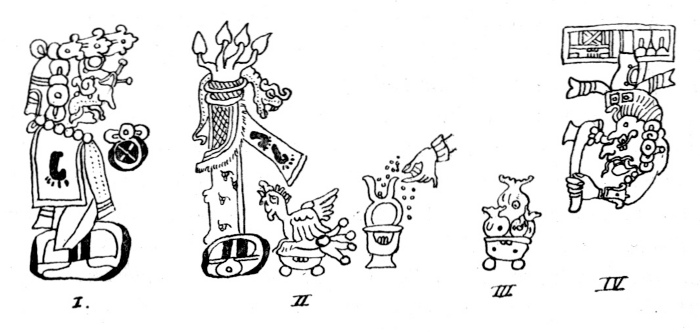
Figure 33.
The horse-shoe mark with drops likewise occurs in the design resembling the akbal glyph, which has been interpreted as connected with akab=night. It also occurs, in Maya Codices, on bands exhibiting cross-symbols, sometimes in an inverted position and hanging from above and sometimes standing on two of the three mounds which are a feature of these interesting glyphs. Postponing a detailed discussion of these, I will but emphasize here that, in the Maya Codices the vase, cursively drawn as a “horse-shoe” mark, is proved to be intimately connected with the ideas of liquid falling from above, and constituting the drink of divinities and symbols associated with the sacred vase, night and darkness, all attributes of the Below. We shall next demonstrate that it was alternately placed, on the Maya Caban glyph, with a curious sign consisting of a pea-shaped black dot, to which a curved and wavy line is attached. This is always figured as issuing [pg 109] from above the dot, then extending downwards and half around it and terminating in a descending, undulating line.
I submit the following to the consideration of Maya specialists: It seems to me that this sign presents an extremely realistic drawing of the seed of a monocotyledonous plant, such as the maize or Indian corn, in its first stage of germination, when the radicle, having issued from the apex, turns downwards in characteristic fashion and penetrates into the earth. Besides the realism of the native drawing there can be no doubt that the image of a sprouting maize-seed is the most expressive and appropriate accompaniment to the symbol of fertilizing rain, on an earth-symbol, and I am unable to understand how Drs. Cyrus Thomas, Seler, Schellhas and Brinton could have overlooked the realism in this image of a sprouting seed, and concluded that it was a portrayal of “fermented liquor trickling downward,” a “nose-ornament,” or a “twisted lock of hair,” “a cork-screw curl.” The latter interpretation was made by Dr. Schellhas because he found the sign in connection with female figures in the Codices, which undoubtedly is a fact of extreme interest, as it furnishes a valuable proof that the Mayas associated the earth with the female principle.
Dr. Schellhas, however, records his observation that the sign caban occurs as a symbol of fruit-bearing earth, in the Codex Troano, as it is figured with leaves of maize (p. 33) or with climbing plants issuing from it and winding themselves around a pole (p. 32). Geheimrath Förstemann connects the day-name caban with “cab” to which Perez, in his dictionary, attaches the meaning of “earth, world and soil” (Die Tages götter der Mayas. Globus, vol. lxxiii, no. 9) and adds that the hieroglyph decidedly designates the earth. At the same time he interprets what I regard as the maize-grain and its radicle, as possibly representing a bird in its flight upwards, and he merely describes the accompanying inverted horse-shoe with dots, without attaching any positive meaning to it. It must be added that Dr. Förstemann himself states that he is not satisfied with his own interpretation of these two symbols, the first of which, the seed and radicle, likewise occurs in the day-sign cib, to which I shall recur.
If any doubt remains as to the signification of the day-sign cab, I think it will be dispelled when it is shown that the name cab, or caban is obviously related to the adjective, adverb and preposition cabal or cablil, which signifies low, below, on the earth, in, beneath [pg 110] and under. The frequent association of the cab glyph with the image of a bee, as in the Codex Troano, is partially explained by the fact that the Maya word for honey is cab, for honey-bee is yikil-cab. It affords at all events, an instance, in Maya hieroglyphic writing, of a method of duplicating the sound of a word analogous to that which I detected in Mexican pictography, and named complementary signs in my communication on the subject, published as an appendix to my essay on Ancient Mexican Shields (Internationales Archiv für Ethnographie, Leyden, 1892). On the other hand the day name and sign cib, on which the sprouting grain is also figured, seems to be related to the verb cibah=to will, to occur, to happen, to take place. The allusion contained in both glyphs is obviously the same and signifies, in the first place, the hidden process of germination which takes place under the surface of the soil, and is associated with the idea of the female principle in Nature.
The seed and radicle, horse-shoe and rain-drops, are also distinguishable on a vessel on page 35 of the Dresden Codex and on a small three-legged vase, which is figured by Doctor Brinton (Primer, 118) as the day sign ch'en. This vase is surmounted by two in-curving projections and offers a close analogy to a sacred vase with superstructure (fig. 33, ii) from which projects a peculiar open and double receptacle, into which a priest is sowing small seeds. The interior of this bowl is represented as hollow, and containing what I shall show further on to be a native symbol for Earth: three little mounds. On another bowl, in front of this one, a bird is sitting and presumably hatching. In another portion of the same MS. a similar bowl is figured containing three seed fruits and capsules, resembling pomegranates or poppy-heads (fig. 33, iii).
The tree next to which the first two symbolical bowls are placed deserves to be carefully studied, for the trunk is crowned by four stems bearing single leaves and is encircled by a serpent, can, the homonym for the numeral four=kan. A fringed mantle and a scroll hang from the coils of the serpent's body, two footsteps are painted on the scroll and, pointing downwards, express “descent,” as do also the falling drops of liquid on the stems of the tree which grows from a peculiar glyph with subdivisions, which has points of resemblance with the glyph under the footless divinity (fig. 33, i). An obsidian mirror, with cross bars, is painted in front of the latter, which displays the same descending footsteps [pg 111] on its mantle. The head and eyes of a snail, the symbol of parturition, are above its face and a wreath of flowers crowns its head. Tedious as such a minute analysis may seem, it is nevertheless necessary, in order to gain a perception of the extent to which symbolism was practised in the picture writings found in the Maya MSS., accompanied by the cursive calculiform glyphs. It seems that, in no. ii, we have a presentation of the Maya “tree of life,” and that scrolls, on which descending footsteps are depicted, are intended to convey the meaning that life is descending from Above into the egg and seeds by virtue or decree of the celestial power. It should be noted here that the phenomenon of a living bird issuing from the hard and inanimate egg-shell had made as deep an impression upon the ancient philosophers in Mexico as elsewhere, and that the power “to form the chicken in the shell” was deemed one of the most marvellous attributes of “the divine Moulder or Former,” as is further set forth in the “Lyfe of the Indians.”
The foregoing illustrations establish, at all events, that the Mayas, like the Mexicans, associated the sacred vase with seeds and germination. The vase, illustrated by Doctor Brinton, exhibits the seed and radicle; and this is also found on the symbol for earth, which, in the Cortesian Codex, is associated with the image of a serpent, possibly the equivalent of the Mexican Cihuacoatl, or female serpent.
If, after mustering this close array of analogies, we next examine the glyph cib, we find that it exhibits the seed and radicle in the centre of a square, three sides of which are decorated with what Doctor Brinton has termed the “pottery decoration(?).” This consists of short lines, such as are employed in Mexican pictography, in the well-known sign for tlalli, or land, which is usually surrounded on three sides by a fringe, presumably symbolizing plants and grass, a “fringe” of vegetation and verdure. In the glyph cib, already referred to, I am inclined to see but a cursive rendering of the same idea, with the seed and radicle in the centre and the fringed border barely indicated by a few short lines. The same border is found repeated on three sides of the head of a frequently recurring personage whom Doctor Schellhas designates as “God C, of the Ornamented face.” In his extremely valuable work, Die Göttergestalten der Mayahandschriften, this careful investigator records the various combinations in which this God C occurs in the [pg 112] Codices and impartially weighs the possibilities of its meaning. Geheimrath Förstemann has made the important observation that the figure of God C occurs in combination with the day-sign, chuen, of the Maya calendar, which coincides with the Mexican day-sign azomatli=monkey.
I am unable to agree with my venerable friend in identifying God C, with Polaris. As Doctor Schellhas rightly observes, the fact that God C is found in combination with the signs of all the four quarters disproves an identification with Polaris. What is more, God C is frequently represented as receiving in his mouth drops of liquid falling from a cursive vase placed above his head—a detail which clearly connects him with earth and the “earth-wine.” In the Mexican MSS. we find the monkey intimately connected with the octli or earth-wine gods as, for instance, in the “Lyfe of the Indians.” I therefore reserve a more detailed discussion of this subject for my notes on this MS. and return to the glyphs caban and kan or can.
Just as it has been shown that the first may signify cabal=the Below, so it is evident that the second is connected with the preposition and adverb canal, signifying “above, on top of, on high.” Dr. Brinton sees in the kan symbol a presentation of a polished stone, or shell pendant, or bead, and cites the Maya dictionary of Motul which gives kan as the name for “beads or stones which served the Indians as money and neck ornaments.” In connection with this important statement I revert to the carved shell-gorgets which have been found in the mounds and ancient graves in the Mississippi valley and exhibit Maya influence. The greater number of these exhibit a carved serpent (which in Maya is kan) in their centres and this fact affords a clue to the possible origin of the Maya name for a neck ornament given in the Motul dictionary. It is undeniable that all evidence unites in proving that the ancient peoples of the Mississippi valley were in traffic, if not more intimately connected, with a Maya-speaking people and came under the influence of the ideas and symbolism current in Yucatan.
Returning to the employment of the glyph kan in Maya Codices, for more reasons than I am able to enumerate here, I conclude it served as an indicative of the Above or Heaven. It is a curious fact that the Maya word for cord is kaan, whilst the name for sky is caan. I cannot but think, therefore, that a carved pendant with a serpent effigy=a kan, worn on a cord=kaan, must have been associated [pg 113] by the Mayas with the Heaven or sky=caan, and that this linguistic coincidence must have been a strong factor in the development of the symbolism attached to the glyph can or kan.
An interesting fact, which I shall demonstrate by a large series of illustration from native Codices in a chapter of my forthcoming work on the ancient Calendar System, will show that in their hieratic writings, the ancient Mexican scribes represented the nocturnal heaven or sky as a circle composed of a cord, to which stars were attached, whilst the centre of the circle exhibited one or four stars. In my opinion the origin and explanation of the association of the cord with stars are clearly traceable to the above mentioned fact that in the Maya tongue the word for cord, kaan, closely resembles the sound of the word caan=sky. The presence of the cord in the Mexican symbols is, therefore, another indication of their Maya origin. A proof that the Mayas also employed the cord as a symbol of the sky, or heaven, is furnished by the much-discussed lentil-shaped stone altar found at Copan, a small outline of which is represented in fig. 21, no. 1. In order fully to understand the meaning expressed by this stone, it is necessary to bear in mind how indissolubly the idea of something circular was associated by the Mayas and Mexicans with their conception of the vault of heaven resting on the horizon, and of the Above, consisting of the two fluid elements, air and water.
It is scarcely necessary to refer again here to more than one authority for the statement that the temples of the air (of the Above) were circular, and the reason given by the natives for this was that “just as the air circulates around the vault of the heaven, so its temple had to be of a round shape.”12 As a contrast to this conception, the influence of which is also obvious in the form of the round temples and towers of the ruined cities of Central America, I would cite the allusions to the solid earth contained in the sacred books of the Mayas, the Popol Vuh, as being “the quadrated earth, four-cornered, four-sided, four-bordered.” These data establish the important fact, to which I shall recur, that the native philosophers associated the Above, composed of air and water, with the rounded, and the Below, composed of fire and water, with the angular form.
The Copan stone altar exhibits the circular form and is surrounded [pg 114] by a sculptured cord which conveys the sound of its name kaan or caan=heaven. On it a cup-shaped depression=ho-och, marks the sacred centre of the heaven, the counterpart to the terrestrial bowl whence all life-giving force proceeded. Two curved lines diverge from this and divide the vaulted circle into two parts. The curve in the lines may be interpreted as conveying motion or rotation whilst the division of the sky may have been intended to signify the eastern or male and the western or female portion of the heaven, the whole being an abstract image of central rulership and of a dual principle incorporating the four elements. It is obvious that the meaning intended to be conveyed might also include the duality of the Heaven or Above, composed of the union of the elements air and water. By painting the stone in two or four colors either of these meanings could have been expressed. In either case it will be recognized, however, that much as Dr. Ernest Hamy's deductions concerning this altar have been criticised, the learned director of the Trocadéro Museum, Paris, was undoubtedly right in recognizing that the stone is a cosmical symbol, intended to convey the idea of a two-fold division and analogous to the Chinese tae-keih which it resembles, with the difference that the Copan sign is more complex exhibiting, as it does, a central bowl-shaped depression. A glimpse at the other symbols in fig. 21 will show that the identical idea is expressed in the Mexican signs exhibiting a central circle, usually accompanied by a four-fold division.
An analogous attempt to express the same native idea is recognizable in the peculiar mushroom-shaped stone figures, represented by a number of examples at the Central American exposition recently held at Guatemala,13 and recently described by the distinguished geologist and ethnologist, Dr. Carl Sapper. The specimens had been collected in San Salvador and Guatemala and “resemble great stone mushrooms” inasmuch as each consists of three well-defined parts, a square pedestal from the midst of which rises an almost cylindrical “stem” supporting a large circular solid top, flat underneath and rounded above. The cylindrical support is carved in the rough semblance of a human form, which, in some instances, has rays issuing from its head.
An acquaintance with the fundamental ideas of native cosmogony [pg 115] enables us to recognize that the square stone base typifies the solid part of the universe, the Below, whilst the vaulted circle above typifies the heaven, the Above. The figure standing between both is evidently an image of a central lord and ruler, and the entire image is in accord with the native mode of thought as set forth in Mr. Frank H. Cushing's report already cited and in the symbols which have been figured.
After reading Mr. Cushing's account of the native American philosophy, preserved to the present day by the Zuñis, it is impossible not to realize how clearly the mushroom-images materialize the identical ideas which constitute, indeed, the keynote of native thought and can be traced in each centre of ancient American civilization. I am inclined to think that these stone images were, originally, painted with the colors assigned to the four quarters, which would render the symbolism more apparent. The existence of these images in a restricted area of territory, seems, moreover, to indicate that they had been invented there, possibly under the influence of a religious and political creed with particular reference to the union, in a single individual, of the power and attributes of the Above and Below—an idea which strongly contrasts with Mexico and Yucatan, where the idea of duality prevailed to such an extent that, by creating two distinct religions and governments, it ultimately led to the disintegration of the greatest of native empires and its fall, from which it was only rallying at the time of the Conquest. It is also possible that the Guatemala images are the expression of the reversion to a more ancient form of philosophy or government when it had been realized that dual government led to dissensions and disintegration. At all events the rude mushroom figures testify that the conception of a single celestial or terrestrial ruler of the Above and the Below filled the minds of their makers at a time, the exact date of which it would be of utmost importance to determine, if this were only possible. It is also interesting to note the curious analogy presented by these figures to the well-known statement by Confucius that, “the sage is united to Heaven and Earth so as to form a triad, consisting of Heaven, Earth and Man.”
The association of the round form and of the peak with the Above and of the square and bowl with the Below can be also detected in the form of native American architecture, as exemplified, for instance, by the contrasting shapes of two temples figured on [pg 116] page 75, of the Borgian Codex (fig. 34) which were obviously dedicated to the two prevailing cults. One of these is surmounted by a tau-shaped thatched roof with a flat top and turned-down ends. The dedication of this temple to Night or star-cult is conveyed in this case, by the sign for star on a black ground inserted in the roof.14
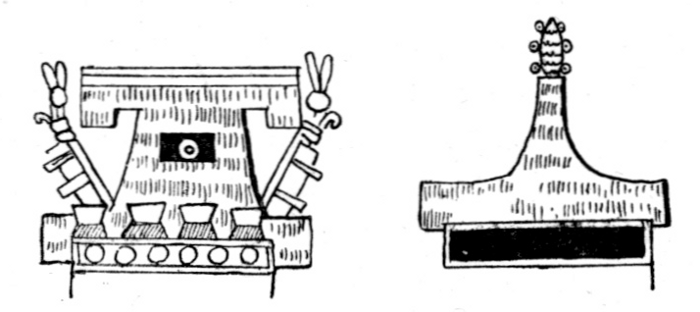
Figure 34.
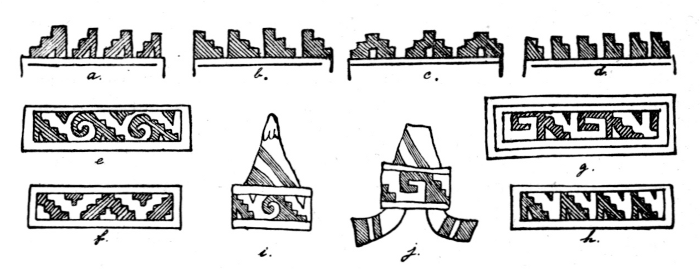
Figure 35.
The opposite temple exhibits a roof which rests on a black architrave and offers a general resemblance to an inverted tau. It rises in a tapering form and ends in a cone-shaped ornament. The existence and significance of these two forms of temple-roofs might escape notice did the same not recur in two high caps or mitres figured in the Vienna Codex and obviously intended for the respective use of the Lords of the Above and of the Below at a religious ceremonial (fig. 35). The first of these ends in a high peak, the extremity of which is represented as capped with snow, in the same conventional manner employed in figuring snow-mountains. An extremely significant feature of this cap is its exhibition of a curved and rounded pattern only on its border. The second mitre [pg 117] ends in a horizontal line; it exhibits an angular pattern and two flaps hang down from it, which, as they naturally concealed the ears of the wearer, seem to have been symbolical of something hidden, and, perhaps, of silence and secrecy. A third mitre is figured on the same page, which seems to unite the characteristics of both forms and is surmounted by a young maize-shoot, proceeding from a vase.
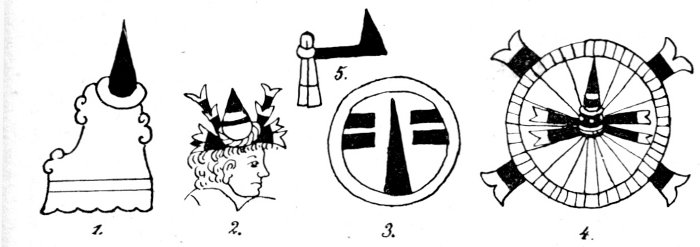
Figure 36.
The association of the Above with a peak or point is further illustrated by a well-known peaked diadem always painted blue which was the symbol of the visible ruler (fig. 36, no. 5). A peak also occurs on military shields accompanied by four bars (fig. 36, no. 3) and presents an analogy to no. 4 from the “Lyfe of the Indians.” The latter is given as the symbol of a sacred festival which I have demonstrated in a previous publication to have coincided with the vernal equinox.15 For further reasons which I shall present in my calendar monograph, I infer that we have in this drawing a most valuable image of the gnomon and dial employed by the Sun priests for the observation of the equinoxes and solstices. The human victim who was attached to the centre of the circular stone during the same festival is usually represented with the same cone or point and eight appendages on his head (fig. 36, no. 2). Owing to the circumstance that this peaked head-dress, or cone, was sometimes employed by the scribes for its phonetic value, as in fig. 36, no. 1, from the Codex Mendoza, in which instance it is figured on a mountain and is usually painted blue, we know positively that its name was Yope or Yopi—a valuable point since a temple and a sort of monastery in the courtyard [pg 118] of the Great Temple of Mexico were both named Yopico (Sahagun). At the same time it should be noted that the Maya name for “a mitre,” the symbol of a divine ruler, is Yop-at. In the Mexican ollin-signs a cone or ascending point is usually placed above and opposite to a symbol consisting of a ring or loop. These evidently signify the Above and Below, and in this connection it is worth noticing that archaeologists have long puzzled over the curious forms of the two kinds of prehistoric stone objects which have most frequently been found in the island of Porto Rico. The first of these consists of an elongated stone, the centre of which rises in the shape of a cone, whilst the ends are respectively carved in the rough semblance of a head and of feet. The second form, which has frequently been found in caves, consists of a large stone ring, and is popularly termed “a stone collar.” I am inclined to regard the latter as being analogous to the “stone yokes” of ancient Mexico and to infer that the aborigines of Porto Rico practised a form of the same cult. It should be borne in mind that the high conical stone, on which the human victims were sacrificed, was a salient feature in an ancient Mexican temple and that its form must have had some symbolical meaning. The foregoing data indicate that it probably was emblematic of the Above and Centre and was therefore regarded as the fitting place of sacrifice to the Sun and Heaven, whilst offerings to the Earth were most appropriately made in circular openings recalling the rim of the bowl and the round line of the horizon. It will be seen further on that the cone recurs in native architecture and that its use as a symbol, in the course of time, culminated in the pyramid.
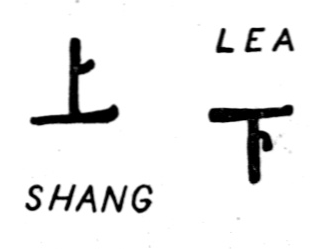
Figure 37.
Let us return to it in its rudimentary stage, as a perpendicular line arising from a medium level, forming an inverted tau. The widespread employment amongst American peoples of the inverted and upright tau-shape as emblems of the Above and Below is abundantly proven and doubtlessly arose as naturally as “the Chinese characters Shang=Above, employed as a symbol for Heaven, and Lea=Below or Beneath, employed as a symbol for Earth. These are formed, in the one case, by placing a man (represented by a vertical line) above the medium level (represented by a horizontal line) and in the other below it” (Encyclopedia Britannica, art. China) fig. 37. Another equally graphic presentation [pg 119] of the analogous thought is furnished by the familiar Egyptian sign which exhibits a loop or something rounded and hollow above and a perpendicular line beneath the medium level. It is well known that the tau occurs in Scandinavia and is popularly named Thor's hammer (fig. 38). Merely as a curious analogy I point out that in fig. 25, no. 2, from the Vienna Codex, we have an American instance of a tau-shaped object held in the hand in a ceremonial rite.
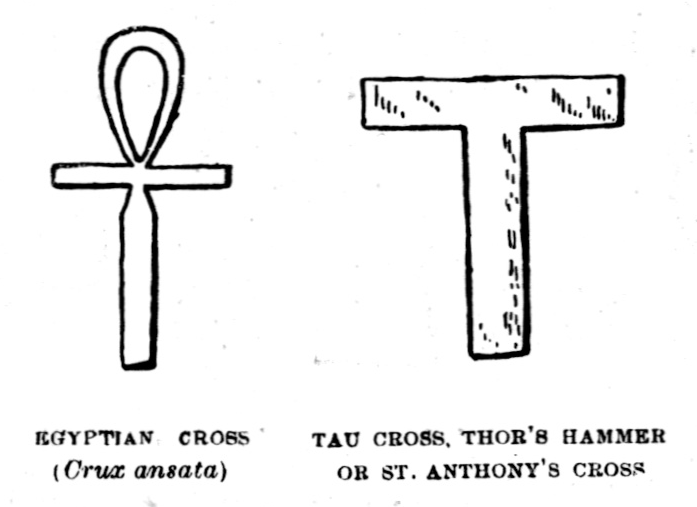
Figure 38.
The late and lamented Baron Gustav Nordenskjöld observed that the entrances to the ruined estufas of the ancient cliff-dwellers of Colorado were in the shape of an upright tau and it is well known that this is also the case amongst the Pueblo Indians of the present day. By means of a photograph taken by Dr. A. Warburg of Berlin, whilst witnessing the Humis-katshina dance of the Moqui Indians at Oraibi, in May, 1896, I am able to affirm that the native dancers wear masks and high head-ornaments, partly of wood, on which reversed and upright tau-symbols are painted, the first in a light and the second in a dark color. As the name of the ceremonial dance was explained to Dr. Warburg as signifying “helping the sprouting or growing maize,” and celebrated the advent of the rainy season, it is obvious that the two forms of tau which were displayed in alternate order on the heads of the dancers in the procession symbolized the juxtaposition of the Above and Below, of Heaven and Earth.
In the ruined temples of Central America, windows in the shape of upright and reversed taus also occur. The following series of [pg 120] architectural openings (fig. 39) are copied from Mr. Alfred P. Maudslay's invaluable and splendid work, which has not, as yet, met with the recognition it so richly deserves.16 They display besides the tau-shape (g and h) other forms, the symbolism of which has been discussed. There are cross-shaped (e), square, round and oval windows (d, j, b and i), the square obviously symbolical of the Earth and the round of the Heaven. Besides these there are openings in the form of a truncated cone (a and c) and others ending in a narrow point (k). A striking form which recalls the Moorish arch and is shown in f, may, perhaps, be looked upon as an attempt to express the idea of a union of the Above and Below.
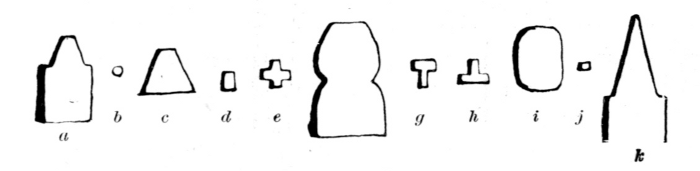
Figure 39.
In connection with these architectural features it is interesting to study their names in the native languages. The Nahuatl names for windows are singularly expressive of their uses: tlachialoyan=the watching place or look-out; puchquiauatl=the smoke opening; tlanexillotl=a word which literally means light and splendor, and to which the following words are related: tlanextia, verb=to shine, shed light and radiance; tlanextilla=something revealed, made manifest, found or discovered, newly invented or formed (brought to light); tlanexcayotiliztli=figure, signification or example; tlanexcayotilli=something figured or significative.
The meaning of the Maya name for window, ciznebna, is not clear, whilst that for door, chi, is the same as for mouth, opening or entrance. At the same time it is evident that, as in Mexico and elsewhere, the window openings in the Maya temples must have been associated with the idea of light, and the symbolical forms given to these besides their positions lead to the inference that they were actually regarded as mystic framed images, so to speak, of the supreme, invisible deity, through which, the light of day and the darkness of night alternately revealed themselves to those [pg 121] inside the sacred buildings. A careful study of the positions and orientations of these openings may yet prove that they also served for astronomical observation. The walls being usually pierced above reach, nothing but the sky could have been watched through them. But besides these, the interiors of Maya ruins contain interesting examples of mural openings and recesses which seem to have been carefully planned so that they should appear dark even in daytime and, in more than one case, these display the form of the upright tau, the symbol of darkness and the Below.17
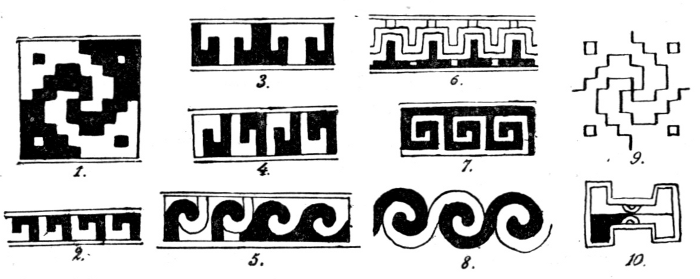
Figure 40.
It does not seem to have been generally recognized that the alternate contraposition of upright and reversed taus produces the best known and most widely spread primitive border-design, usually known as the Greek fret (fig. 40, no. 6). A plain demonstration of this is, oddly enough, visible on the two side-projections of the Scandinavian brooch (fig. 13) all symbols on which, I venture to assert, would have been perfectly intelligible and full of meaning to an ancient Mexican. The evolution of the fret, on the American continent, can be studied on the beautiful wooden clubs from Brazil and British Guiana, figured in Dr. Hjalmar Stolpes' valuable work already referred to. As striking instances his fig. 8, pl. 1, figs. 3a and 3c, pl. xiii, and figs. 1a and 1b, pl. v, should be examined. The latter instance is extremely instructive as it not only exhibits single taus of two forms, but the same in different positions, [pg 122] as well as two double-headed figures joined in one, which illustrate the native association already discussed, of duality and of the curved lines as the opposite of the rectangular and both respectively figuring the Above and Below.
It is impossible to study the decorations on these South American clubs without becoming convinced that their makers shared the same ideas as the ancient Mexicans. They offer, indeed, a whole set of variations on the native theme and idea of Heaven and Earth. Two instances (fig. 5a, pl. ix, and 6a, pl. xi) in which the union of two figures produces a third, or a single one produces two, elucidate the meaning sometimes expressed by the designs. In the round or spiral forms, which are most frequently accompanied by a zigzag border, I am inclined to see a presentation of air and water, corresponding to the Mexican symbols of the Above.
As lack of space forbids my making here a more extended comparison of the native symbols, I shall but point out how the tau, in juxtaposition and contraposition painted in two colors, produces fig. 40, no. 3. The picture from the Codex Mendoza of a native tlachtli, the form of which is represented by two taus in contraposition, is partly painted black. The same division of a single tau into two parts, colored differently, transforms no. 3 into no. 4 and shows that a single tau could have been employed cursively to symbolize union. 2 and 7 are but variants of 3 and 4. If, instead of angles, curved lines be given to the taus, the first half of fig. 5 is the result. When spaces between the incurving hooks and the border are filled out with color, the familiar design on the second half of 5 results. With exception of the latter, the South American clubs exhibit each of the above forms, as well as no. 8. It will be shown later that these also occur in ancient Peru.
The foregoing examples of the employment of taus in upright and reversed positions is, however, by no means exhaustive. Fig. 41 teaches that the familiar checker-board or tartan design, symbolically employed in ancient Mexico, was the simple result of taus in contraposition, the square spaces thus found being alternately filled with black and brown or gray. The symbolism of this design only becomes evident when all the combinations in which it occurs have been carefully studied. It is represented in the Codices in the doorways and arches of certain sacred edifices which are shown to be estufas or temaz-calli by further illustrations which I [pg 123] could not reproduce here, but which exhibit even the steam escaping from the building and other unmistakable features.
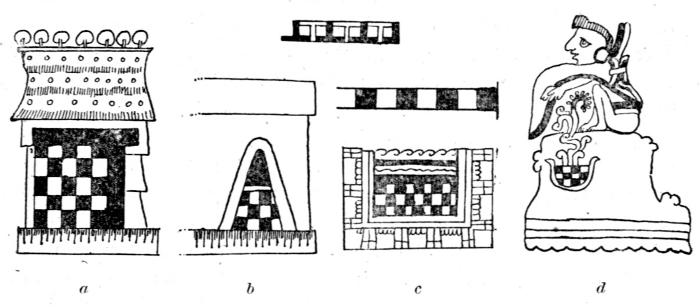
Figure 41.
Sahagun has recorded how these semi-sacred edifices were specially consecrated to the “Mother of the gods and of us all, whose curative and life-giving power was exerted in the temazcalli, also named xochicalli, the place where she sees secret things, rectifies what has been deranged in human bodies, fructifies young and tender things, ... and where she aids and cures....” It was customary for pregnant women to resort to these baths under the care of the medicine-woman who exhorted her patient on entering, with the words: “Enter into it, my daughter, enter into the bosom of our Mother whose name is Yoalticitl ... warm thyself in the bath, which is the house of flowers of our god ...” (Historia, book vi, chap. xxvii).
The Vienna Codex contains, besides pictures of temples (fig. 41, a and b), two instances which elucidate the meaning of the design; c of the same figure displays the conventional symbol for land, fringed on three sides. Enclosed in this and seen, in profile, is a stratum of checker-board design, above which is a sheet of water; d displays a conventionally drawn mountain, inside of which is the symbolical vase filled with the design. From this steam or smoke ascends through the soil of the mountain, and forces its way through the surface, above which we see two recurved puffs of smoke and a young blossoming maize shoot, conventionally drawn, such as may be seen worn by priestesses, as a symbolical head decoration, on page 11 of the Vienna Codex. The seated figure of a priest is represented as sheltering its growth with his outspread [pg 124] mantle. On his back he displays a symbol, composed of two rolls united by a crossband, which is met with in Maya and Mexican Codices. In the latter the four projecting ends are usually painted with the colors of the four quarters. As these are figured as united into a single sign, it seems evident that this symbolized a union of the four elements deemed necessary for the production of life by the ancient native philosophers.
The foregoing illustrations, to which more could be added, clearly establish that the checkered design was associated with the symbols of earth, heat and water. It obviously expressed the idea embodied in the Nahuatl word xotlac=the heated earth; literally, glowing embers, also budding and opening flowers. It was emblematic of the fall of the rain or earth-wine upon the heated soil. In the temazcalli the same life-producing union of the elements took place and aided human growth and health. It would seem as though the appellation xoch-i-calli, bestowed upon the sweat-house by the native medicine-woman, expressed the same train of thought. Moreover, it is noteworthy, that the sound of the first part of this name and of xo-tlac recurs in the Maya word for vase in general, ho-och. The checker-board design would naturally have been employed in connection with the festivals, associated with esoteric rites, which were held in celebration of the union of the Heaven and Earth at the commencement of the rainy season. It would, naturally, therefore, have been used as a decoration on the drinking vessels employed in the distribution of fermented drinks for vivifying and curative purposes. It is met with on Peruvian drinking bowls, as proven by several examples in the Royal Ethnographical Museum in Berlin, for instance.
It is curious to note as an interesting analogy that the same checkered design frequently adorns the ancient Egyptian drinking bowls represented in the hieroglyphic writings. I have also observed it in some ancient Greek drinking vessels, preserved at the Imperial Hermitage Museum at St. Petersburg, where it decorated the bowl itself or the garments of Bacchantes figured thereupon. It is also met with in ancient Peruvian textile fabrics, in black and white, as on one figure vase in the Berlin Museum, and, needless to remark, it is a Scotch clan tartan. Its adoption as the basis for chess-boards of ancient Egypt seems to indicate that there it also signified the Above and Below and that the game was thought of as an exemplification of the eternal contest between the powers [pg 125] of Heaven and Earth, light and darkness, etc. We look to specialists for information as to the origin, meaning and employment in Egypt and Greece of this primitive and almost universal design.
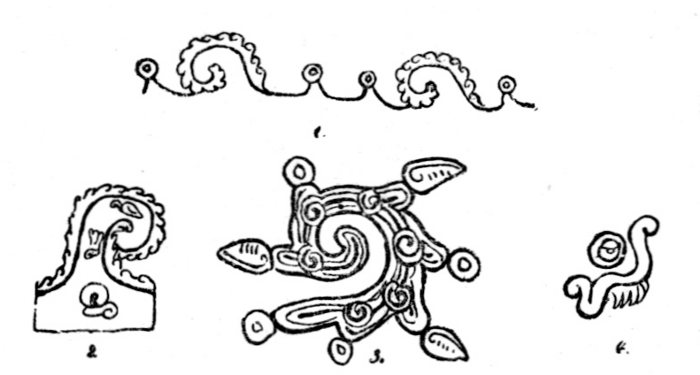
Figure 42.
In ancient Mexico and possibly Peru, it obviously pertained to a set of ideas which, in some communities, might easily have degenerated and led to the institution of rites and ideas such as were prevalent in the Maya colony which had established itself at the mouth of the Panuco river, on the coast of Mexico, north of Vera Cruz, and from which the Huaxtecans of the present day descend. It is interesting to note that the name of the capital founded by the colonists, who seem to have emigrated owing to well-founded religious persecution, was Tuch-pan, a word which signifies in the Maya tongue “the umbilicus,” qualified by pan, meaning “that which is above or excels,” etc., but which was expressed in Nahuatl picture-writings by a rabbit=tochtli and a banner=pantli.
The opposite of the checkered or xotlac design, was the native water and air pattern which has been pointed out as encircling the mitre of the Lord of the Above or Heaven. It likewise figures in native pictures on the mantles of some of Montezuma's predecessors. The history of its origin and development is best learned from the following native illustrations. Fig. 42, nos. 1 and 2, represents sea-waves, the Maya name for which, by the way, is kukul-yaam, which admits of the interpretation “divine-water” or, if we connect kukul with the Mexican coliuhqui, “twisted or bent water.” A representation of water, as figured on a mantle in the “Lyfe of the Indians,” conveys the idea of water moved by the action of the wind, the blank curve reminding one also of the curves [pg 126] so often associated by native artists with serpents' heads, and with the wind and rain-gods. The well-known symbol of the air-god is accompanied, as already shown (fig. 26), by an ornament which forms a solid frame for a hollow curve constituting an air-image. In the following image an analogous ear ornament is figured and it is surrounded by puffs of air or wind, conventionally drawn (fig. 43).
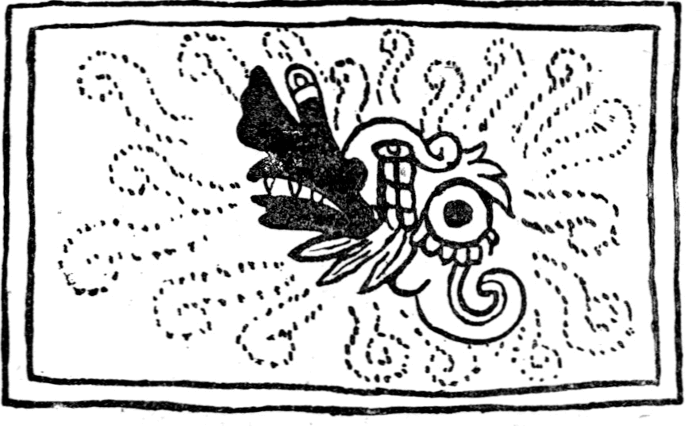
Figure 43.
Whilst the foregoing illustrations amply prove that the natives associated the curved and rounded form with water as moved by air, it must be noticed that in Mexico and Yucatan, as well as in Brazil and Guiana, plain water was figured by a series of parallel zigzag or undulated lines. For these reasons I infer that the symbolical design, representing actual waves, always expressed the union of air and water, and was therefore emblematic of the cult of the upper elements, or the Above. It is unfortunate that, in Mexico, no vestiges remain of the circular temples which were particularly dedicated to Quetzalcoatl=the divine twin or lord of the twin upper elements=air and water. Doubtlessly they were appropriately decorated with horizontal bands exhibiting the sacred design. The ruined condition of Central American round temples scarcely justifies the hope that such a verification can be made. At the same time the round temple on a square base, with its peculiar ground plan, was, of itself, an image of the Above and of central rule extending to the four quarters (fig. 30, p. 97). That the air and water design was actually employed in America as a frieze on sacred edifices is proven, however, by more than one illustration [pg 127] in the Vienna Codex and other native MSS. (fig. 35, c). We also see the design decorating the painted drinking bowls named xicalli which were employed in the distribution of the sacred pulque or octli at certain religious festivals. As the Mexican name given to the design itself is xical-coliuhqui, it seems as though it was most popularly known as the “twisted or winding pattern” of the sacred drinking vessels.
Having originated, as I have shown, from the simplest observation of the action of air upon a surface of water, it is but natural that the same design should have independently originated in several localities. It is, nevertheless, worth mentioning here that the dome of one of the most beautiful of ancient Greek remains, the choragic monument of Lysicrates, or lantern of Demosthenes at Athens, is surrounded by a band or fascia, cut into the water design. It is evident that, seen against the sky, this graphically represented the curling waves of water “on summer seas,” and this was evidently the most primitive method of employing this form of symbolical decoration which is more familiar when executed in solid masonry stucco, as a frieze.
The identical process of development may be observed in Mexican architecture. In the Vienna and other native Codices, countless temples are depicted as surmounted with fasciæ cut into rectangular designs in such a manner that the blank space left between each solid projection figures its inverted image in the air (fig. 35, a-d). In these open fasciæ an intention to symbolize the solid or Earth, and the fluid or Heaven, is discernible, whilst the step-like projections seem to express or convey the idea of ascent and descent, perhaps the ascent of human supplication and the descent of the much-prayed-for rain. From the other examples of temple decorations (fig. 35, f and h) it is evident that, in solid friezes, a light and a dark color were employed in the same designs, to convey the same idea.
Evidence proving that the emblems on the roofs of the temples were replete with meaning is furnished by several representations of roofs, on which rows of upstretched hands or of human hearts are depicted. My horror at these seemingly ghastly emblems vanished as soon as I ascertained their actual meaning from a passage in Sahagun's Historia. Describing a certain sacred dance he records that “on the white garments of the girls who took part in it, hands and hearts were painted, signifying that they lifted their [pg 128] hearts and hands to heaven, praying for rain.” Not only does this explain the symbolism of the hands on the temples but also the native custom observed, by modern pilgrims in Mexico and Yucatan, of painting uplifted hands on the outer walls of sanctuaries as an act of piety and devotion.
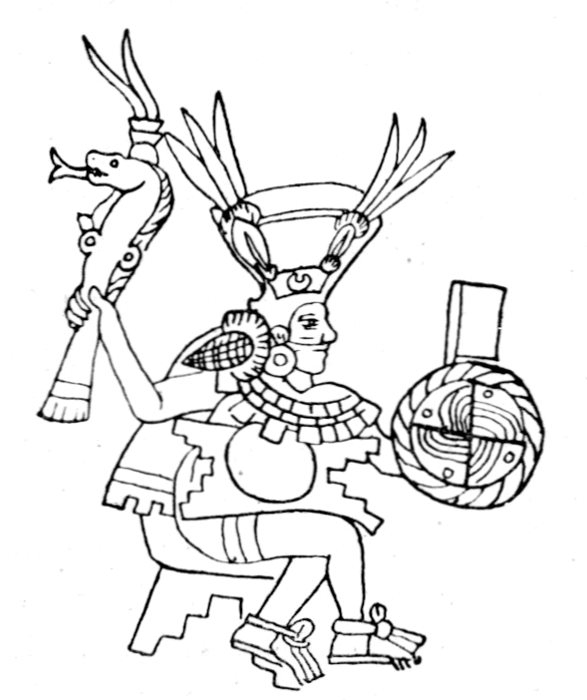
Figure 44.
The hideous necklaces of alternate hands and hearts which encircle the neck of a great monolithic idol in the city of Mexico and of an image in the “Lyfe of the Indians” are thus also proven to be the touching though uncouth and child-like expression of a devout prayer. Having gained this insight into the deep significance of native emblems it is interesting to study the peculiar breast-ornament which is the emblem of Xiuhtecuhtli, literally “the azure lord,” or the lord of the year or of fire and of the Cihuacoatl or woman-serpent. It consists of an oblong plaque, the narrow ends of which are cut out so as to simulate two air pyramids with steps. The name of this symbolical ornament is recorded by Sahagun as xiuh-tetelli, literally the turquoise or grass-green pyramid. It is invariably painted blue and displays a round plate of burnished gold in its centre. For more reasons than I can pause to relate here, it can be shown that the plaque probably symbolized the Above, the blue sky, water and air, whilst the gold plate was an image of the central divinity. The sides of the square stool on which the god is seated are also cut out so as to convey the idea that he is resting above terraced air-pyramids (fig. 44). His shield is surrounded by a cord and contains a cross-symbol with lines conveying the idea of rotation and four circles. The banner above the shield named pantli conveys the sound of the word pan=above, whilst his conical ear-ornament symbolizes the Centre and Above. These details are noteworthy because I am about to point out the striking analogy between a Zuñi idol or fetish and the ancient Mexican pictures of the lord of fire and the lord of the north or the underworld=Tezcatlipoca.
[pg 129]
This Zuñi idol was sent to the Royal Ethnographical Museum at Berlin as part of a representative collection by Mr. Frank H. Cushing and has been figured and described in the publications of the Museum, with notes by Dr. E. Seler.18 It represents the Zuñi god Ätchialätopa whose attributes are stone knives, who is the patron of the secret society, “Small fire” and who is identified with a great star. His fetish represents him as standing on the centre of a cross, formed of four beams placed vertically and perforated with step-like perforations. The ends are cut out like those of Xiuhtecuhtli's blue emblem. Two parallel bars, the upper one of which is painted blue, the color of heaven, and the lower painted green, the color of the earth, convey the ever-present native idea of the Above and Below. The arms of the cross are painted red with yellow ends which, according to Mr. Cushing, represent the light emanating, in four directions, from the star. The arms are distinctly associated with the cardinal points and each supports the effigies of a mountain lion and a bird—typifying, evidently, as in Mexico, the Above and Below. This cross, with the figure standing on its centre, is suspended from above and, during a certain ceremony, it is set into rapid gyratory motion, from left to right by the officiating high priest.
It is impossible not to see, in this fetish, a swastika in substantial form and in actual rotation; whilst the figure of the god, decorated with stone knives, moves as on a pivot in the centre, presenting exactly the same idea as in the Mexican image of the god held in the centre of a cross-symbol by the jaws of a tecpatl or flint knife. It is unnecessary to mention again here that the only star in the heaven, which could possibly have been regarded as a centre of rotation, is Polaris; but I should like to draw attention to the fact that bunches of feathers are attached to the extremities of the cross-beams and to the summit of the terraced head-dress of the fetish and recall the circumstance that, amongst the Mexicans and Mayas, the names for feather were almost identical with those for heaven or something celestial and divine.
As the Zuñi god is said to be standing on his red star (an mo-yätchun thlana) and figures as a centre of rotation, I look upon this fetish as affording most striking confirmation of my conclusions concerning the origin of the swastika and cross symbols. If [pg 130] it is certain that, at the present day, the Zuñis associate this star-god with Sirius and their cross symbol with the morning star, then it is quite obvious that they have lost the original meaning of the rotating-star fetish, which could never have been suggested by either of these or, indeed, by any other heavenly body but Polaris. I regret that space does not permit me to consider here, more fully, other close analogies between ancient Mexican and modern Zuñi religious ceremonies, etc., besides those which have been so well described by Dr. J. Walter Fewkes.
I cannot omit to note here for further reference that the national war gods of the Zuñis are the twin-brothers Ahaiiuta, the elder, whose altars were situated to the right or south and west of Zuñi, and Matsailéma, the younger, whose altars stood to the left or north and east of the village. The secret society of the warriors and priests of the bow dedicated their cult to these brothers, whose counterparts we have already studied in Mexico and Yucatan.
Returning to the primitive designs which expressed the union of the Above and Below, I point out an interesting example from the “Lyfe of the Indians,” which likewise symbolizes the four quarters, and their subdivision and their relation to the whole (fig. 32, no. 3). A somewhat analogous design, from Peru, presents an outline resembling a swastika (fig. 40, no. 9) which, when filled in with alternate colors, yields fig. 40, no. 1, in which the idea of the Above and Below preponderates. Another example of an analogous employment of a light and dark color is furnished by a shield in the Codex Mendoza, shown in fig. 1, no. 1, alongside of an interesting image which gives us an insight into the depths of meaning contained in the dualistic native designs. It consists of a disk, one-half of which represents the starry heaven and the other the sun, resting on a parti-colored support (no. 8). It is evident that day and night are thus symbolized, and it is reasonable to infer that in some centres of thought especially the ideas of light and darkness should have become associated with the two different forms of cult the followers of which would be respectively designated as the children of light and the children of darkness. By means of a light and a dark color numberless variations of the one theme were indeed obtained. In the native Codices, in textile fabrics and on pottery, there are also numerous examples of an extremely simple design consisting of a single zigzag line running between two parallel lines and dividing the intervening space into two fields, the lower [pg 131] of which is filled out with black and the other with some light color. The dark upright and light inverted peaks were evidently employed as familiar and favorite emblems of earth and heaven.
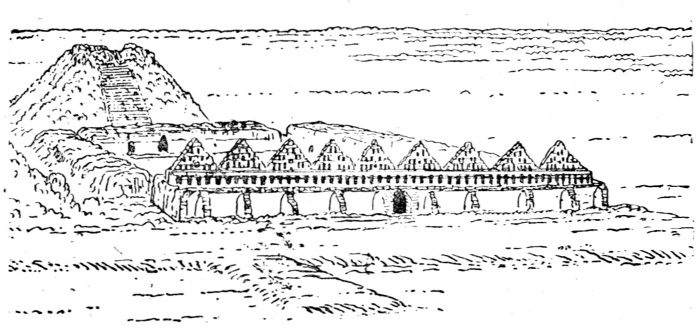
Figure 45.
I am inclined to see in the serrated summit of the remarkable edifice, known as the House of Doves at Uxmal, a rendering of the same symbolism on a gigantic scale (fig. 45). It cannot but be recognized, moreover, that a high edifice presenting a regular series of cones, and extending from east to west, would have afforded an excellent means of registering the varying positions of heavenly bodies. To observers looking towards it from the north or south, at judiciously chosen distances, the entire span of the sky would have seemed divided into eight equal parts, seen as inverted air pyramids between nine sections which rise in steps and terminate in points, each gable being perforated with thirty window-like openings, arranged in seven horizontal rows. The purpose of these gable-like piles has been a riddle to the archaeologists, who have visited Uxmal. Dr. Wm. H. Holmes, from whose valuable works I cite the above descriptions, expresses his wonder at “the great building, bearing upon its roof a colossal masonry comb, built at an enormous expenditure of time and labor ... which seemed to have been built exclusively for the purpose of embellishing the building and holding aloft its sculptured ornaments” (Ancient cities of Mexico, pl. i, p. 95).
I venture to maintain that this remarkable edifice not only afforded facilities for astronomical observation but constituted in itself a great prayer for rain wrought in stone and addressed to the Lord [pg 132] of Heaven by a devout people. In corroboration of this inference, besides the foregoing data, I point out that to this day the Pueblo Indians associate the step pyramid form with beneficent rain and even give this shape to the edges of the sacred bowls which are carried in the ceremonial dances by the “rain-makers.” According to Mr. Cushing the Zuñis compare the rim of such bowls to the line of the “horizon, terraced with mountains, whence rise the clouds.” He was likewise informed that the terrace form represents “the ancient sacred place of the spaces,” an expression which, though somewhat vague, seems to corroborate my view of the Uxmal building. The Zuñi statement that the terrace form figured mountains leads to the subject of so-called “mountain worship.” In ancient Mexico, at the approach of the rainy season, religious ceremonies are performed in honor of the mountains which were looked upon as active agents in the production of rain, because they attracted and gathered the clouds around their summits. The tops of mountains were thus regarded as the sacred place where the sky and heaven met and produced the showers which vivified the earth. Pilgrimages and offerings to mountain summits formed a part of the duties of the Mexican priesthood, but in the cities the pyramid temple served as a convenient substitute for the mountain.
The close association of the terrace form with rain and water symbolism is certainly exemplified in the Mexican design on a temple roof (fig. 35, e). The most remarkable application of the dualistic designs is, however, met with in Peru where, according to Wiener, the irrigation canals which carried water to the maize fields were laid out so as to form pattern bands like fig. 40, nos. 4 and 7, for instance. It is evident that this system of irrigation must have been an extremely effective and practical one, but that it had been probably adopted from superstitious motives as an illustration of the vivifying union of the celestial shower with the seed-laden soil. The assumption that the ancient Peruvians shared the same ideas as the Mexicans and Mayas will be found justified by the following data.
It is now my intention to give a brief and bare outline sketch of the Peruvian civilization, by means of a series of quotations from the best authorities.19 Incomplete though this must necessarily [pg 133] be, it will, nevertheless, establish, beyond a doubt, that the founders of the great Inca empire were under the dominion of the same set of ideas which I have been tracing throughout the American continent. The lucid records of the Peruvian chronicles and the purity with which the system had been maintained by the Incas, enable us to recognize and appreciate its manifold perfections as a mode of primitive government.
The best authorities agree that the inhabitants of the country, now known as Peru, lived in barbarism until civilization was introduced amongst them by the Incas. One tradition designates an island in the Titicaca lake, another Tiahuanaco, as the place where, “after the deluge,” a man or deity appeared, divided the land into four parts and distributed these to four brothers, amongst whom was Manco Capac, to whom was assigned the province to the north. Each brother had a sister who was also his wife. Manco Capac and his sister and wife Mama-Ocllo or, according to other authorities, the third Inca Lloque Yupanqui and his consort, founded Cuzco, also given as Kosko or Kuska, a name which, according to Garcilaso de la Vega signifies “navel of the earth” and was bestowed “because the newly-founded capital was to be the centre and point of all.” The city was divided into two parts: Hanan Cuzco=the Above, which was ruled over by the Inca, and Hurin Cuzco=the Below, which was governed by his wife and sister, who bore the honorific title of Coya=queen and Mamanchic=our mother. The inhabitants consequently became separated into two categories: the upper lineage and the lower lineage, Hanan-ayllu and Hurin-ayllo. At the same time this division was not made so “that those of one-half should have an advantage over the other ... the command was that only one difference and acknowledgment of superiority was to be conceded to the inhabitants of the upper town. They were to be respected and looked upon as the first born and elder brothers, whilst the dwellers in the lower town were to be regarded as younger or second brothers. They were to rank as the right arm and the left arm in all offices or places where precedence was necessary. The same division was subsequently carried out in all the towns, great or small, throughout the country, their inhabitants being constantly classed into upper and lower lineages or classes.” The empire itself was named Tauantin-suyu, signifying the four in one, or the empire, which was divided into four provinces: Anti-suyu=East; Cunti-suyu=West, [pg 134] on the road to which were two famous brooks of water named the silver serpents, Collquemachachuay; Chincha-suyu=North; Colla-suyu=South. It is recorded that the Coya or queen went to the Colla-suyu or South and taught the women the art of weaving, of planting maize and of preparing it for food. In connection with the name of female rule=Coya, and the South=Colla-suyu it is interesting to note that the name for granary was Coll-cana. Padre Arriaga (quoted by Rivero and Tschudi, p. 163) describes a remarkable monument which shows that the West was also associated with the female ruler. “The monolithic statue [magnificently sculptured and placed on a sepulchral eminence near Hilavi] represented two monstrous figures standing back to back. One, representing a man, faced to the East; the other, with a woman's face, looked towards the West.20 Serpents were represented as crawling up the figures and these stood on other reptiles resembling frogs. In front of each of these idols there was a square slab of stone which seemed to have served as an altar.”
With the dual division of the population the seeds of dissension were sown in Peru as elsewhere. At a certain festival the youths of the upper lineage encountered those of the lower lineage in trials of strength and prowess, which sometimes resulted in violence. A certain feeling of rivalry and opposition must have been thus fostered. Two forms of cult prevailed: the Inca lords and warriors were associated with the cult of the Above of which the emblems were golden images of the Creator and of the Sun, “the lord of day,” to whose power rain and thunder were attributed. The silver huaca or image of the moon, called Quilla in Quechua and Pacsa in the Colla dialect, was in the figure of a woman and was kept under the charge of women, the reason for this being “that the moon was a woman.” During the festival Situa, one day was dedicated to the Creator, the Sun and Thunder and another to “the Moon and Earth, when the accustomed sacrifices and prayers were offered up.” We thus clearly distinguish a cult of the Heaven and Day presided over by the Inca and a cult of Earth and Night, whose high priestess was the Coya. She, moreover, had charge of [pg 135] the embalmed bodies of her predecessors, which were regarded as sacred and were solemnly carried forth in certain festivals, whilst the bodies of the defunct Incas were guarded by their successor. The emblems of both cults were, however, preserved in a single Great Temple, whose principal doorway looked to the north, a fact of special importance in connection with what follows.
All authorities, indeed, designate the north as the quarter whence the foreign culture-heroes came to Peru. “The Incas had a knowledge of the Creator from the first,” but it was not until the time of the Inca Yupanqui that the ignorant sun-worship of the primitive inhabitants of the country was superseded by a firmly established new and superior religion.
“Inca Yupanqui appears to have been the first to order and settle ceremonies and religions. He it was who established the twelve months of the year, giving a name to each and ordaining the ceremonies that were to be observed in each. For although his ancestors used months and years counted by the quippus, yet they were never previously regulated until the time of this Lord. He was of such clear understanding that he reflected upon the respect and reverence shown by his ancestors to the Sun who worshipped it as a God. He observed that it never had any rest and that it daily journeyed round the earth; and he said to those of his council that it was not possible that the Sun could be the God who created all things, for if he was he would not permit a small cloud to obscure his splendour; and that if he was creator of all things he would sometimes rest and light up the whole world from one spot. Thus it cannot be otherwise but that there is someone who directs him and this is the Pacha-Yachachi, the Creator, literally, the Teacher of the World.” His predecessors had ordered an oval plate of fine gold which was to serve as an image of the Creator of heaven and earth, and, in order to convey this meaning it was placed between images of the sun and moon; a proof that the latter were employed as symbols of heaven and earth.
Inca Yupanqui, however, also caused a statue of the Creator to be made of fine gold and of the size of a boy of ten years of age in order to convey the idea of his eternal youth. “It was in the shape of a man standing up, the right arm raised and the hand almost closed, the fingers and thumb raised as one who was giving an order.” The second gold statue he had made, a personification [pg 136] of the sun “which was dressed like the Inca and wore all his insignia,” shows he claimed to be and constituted himself as the visible representative and Lord of the Above. The silver female statue of the Moon doubtlessly exhibited, in the same manner, the insignia of the Coya. Inca Yupanqui also ordered the houses and temple of Quisuar-cancha to be built and, at this spot, Sir Clements Markham observed an ancient wall, with serpents carved upon it. The name signifies, literally, “the place of the Quisuar tree,” and will be again referred to further on. Without pausing to discuss the subject at length let us examine further the scheme of government, etc., introduced by the Incas, the most striking feature of which was the systematical classification of the people, their assignment to specified dwelling places and the distribution of labor according to prescription.
The key to the entire gigantic system was the conception of a central immutable supreme power which directed all visible and invisible manifestations and which sent forth and re-absorbed all energy. In Cuzco and in the Inca Empire we have a minutely described instance of the application, to terrestrial government, of the laws of fixed order, harmony, periodicity and rotation learned by earnest and patient observers of the northern heaven, during countless centuries of time. The centre of Cuzco consisted of a great square whence four roads radiated to the cardinal points. In the centre of this stood a gold vase from which a fountain flowed. The Spaniards also found in Cuzco a large, beautifully-polished stone-cross which evidently symbolized, as in Mexico, the four quarters and must have been appropriately placed in the square. Garcilaso de la Vega states that the capital formed an actual image of the whole empire, “for it was divided into four quarters and an extremely ancient law rendered it obligatory that representatives of each province and of each class of population should reside there in homes, the location of which precisely corresponded to the geographical position of their respective provinces. Each lineage was thus represented and occupied separate dwellings, assigned to them by the governors of the quarters. All persons were obliged to adhere to the customs of their forefathers and also wear the costumes of their ayllus or tribes (Cieza de Leon, Cronica chap. xciii). For the Incas had decreed that the dresses worn by the members of each tribe should be different, so that the people [pg 137] might be distinguished from each other as, down to that time, there had been no means of knowing to what locality or tribe an Indian belonged.”... In order to avoid confusion the modes of wearing the hair were rigidly prescribed and the bands worn on the head by the vassals had to be black or of a single color only. The higher in rank a person was the more his costume resembled that of the Inca, without, however, approaching it in length and richness. “Thus, even in an assemblage of 100,000 persons it was easy to recognize individuals of each tribe and of each rank by the signs they wore on their heads.”...
“It was obligatory that each should permanently live in the province he belonged to. Each province, each tribe and, in many parts each village, had its own language which was different from that of its neighbors. Those who understood each other by speaking the same language considered themselves as related to each other and were friends and confederates.... The Incas employed a private language of their own which none but members of the royal lineage presumed or dared to learn.” Garcilaso de la Vega, who claimed royal descent, stated that unfortunately no records remained to enable one to form an idea of what the Inca language was like.
The autocratic, though peaceable way in which the novel scheme of government was imposed upon the inhabitants of Peru by the foreign chieftains is best proven by the following passages from the Rites and Laws of the Incas (p. 77) and Garcilaso de la Vega (pp. 9 and 10). “With a view that each tribe should be clearly distinguishable and after assigning a different costume to each they were ordered to choose their respective pacariscas, a word meaning, literally, their birth and origin. They were told to choose for themselves whence they were descended and whence they came, and as the Indians were generally very dull and stupid, some chose to assign their origin to a lake, others to a spring, others a rock, others a hill or ravine. But every lineage chose some object for its pacarisca. Some tribes [subsequently] adored eagles because they boasted to have descended from them ... others adored fountains, rivers, the earth, which they call Mother, or air, fire, ... snow-mountains, maize, the sea, named mother-sea.”
According to Garcilaso de la Vega “the Peruvian tribes subsequently invented an infinity of fables concerning the origin of their [pg 138] different ancestors.... An Indian does not consider himself honorable unless he can trace his descent from a river, fountain, lake or the sea, or from some wild beast like the bear, puma, ocelot, eagle, etc.” An example of a certain amount of vain-glory was indeed set by the diplomatic Inca himself who claimed, for himself and lineage, descent from the Sun and reserved burnished gold ornaments for his particular use. His successors subsequently built a temple of the Sun at Cuzco and set up its image made of gold and precious stones. Around this, the royal “pacarisca,” they placed the mummies of all the dead Incas. In another room there was an image of “the moon, with a woman's face,” and about it were the mummies of the royal women. From this we learn that the latter assigned their origin to the moon and that it was their pacarisca or huaca. As an illustration of the way in which creation-myths are sometimes evolved from actual occurrences, it is interesting to study another account of the mode in which tribal regulations were introduced into Peru. Owing, most probably, to the fact that one of the titles given to the Creator was “the Teacher,” we find Molina attributing to the Creator himself the establishment of the tribal system and the assignment of totems and different costumes to each group or family. If we read his account and, with Garcilaso de la Vega and others, attribute to the Incas the introduction of civilization into Peru, we recognize the practical good sense with which they accomplished the rather difficult task of obliging each tribe to wear a different costume. “In Tiahuanaco ... he made one of each nation of clay and painted [these] with the dresses that each one was to wear. Those who were to wear their hair, with hair; and those who were to be shorn, with hair cut ... when he had finished making the nations and painting the said figures of clay, he gave life and soul to each one, as well man as woman ... each nation then went to the place to which he ordered it to go.”
I confess that, until I studied the above record in full, I had very vague ideas about the huacas or “idols” of the Peruvians. But when I found it stated, further on, that “each tribe wore the dress with which their huaca is invested,” I began to realize what huacas might originally have been. It would seem that on assigning a different costume and distinctive name to each tribe, the founder of the new colony gave each chief as a model, a different clay doll, [pg 139] painted with the distinctive marks he and his people were to adopt. This figure would naturally have been kept for reference and treated as something sacred. On certain official occasions it would be produced as a means of identification or proof that the prescribed costumes had been strictly adhered to. To this practical and sensible plan the origin of the so-called tribal and household idols of the Peruvians and of the Mexicans can doubtlessly be assigned. Invented as an aid in the establishment of tribal-names and dress-regulations and intimately connected with the entire system of government, these huacas gradually became the representative of the ancestor of the clan, its “canting” arms and its sacred palladium. We are told that after the tribes had chosen their various ancestors or origins, such as caves, hills, fountains, etc., they settled in the land and multiplied. Then, on account of having “issued or descended from stated localities, the people made huacas and places of worship of these, in memory of the origin of their lineage.... The huacas they use are in different shapes.... Some say the first of their lineages were turned into falcons, condors and other animals or birds” (Molina ed. Hakluyt, p. 5). A certain form of ancestor-cult was thus evolved in a natural manner. “Idolatrous rites increased and people devoted themselves to the worship of huacas ... each village had its huaca. The cult assumed such proportions under Ccapac Yupanqui that he exclaimed: ‘How many false gods are there in the land, to my sorrow and the misfortune of my vassals! When shall we see these evils remedied?’ ”