The Fundamental Principles Of Old And New World Civilizations. (continued 10)
Reading edition
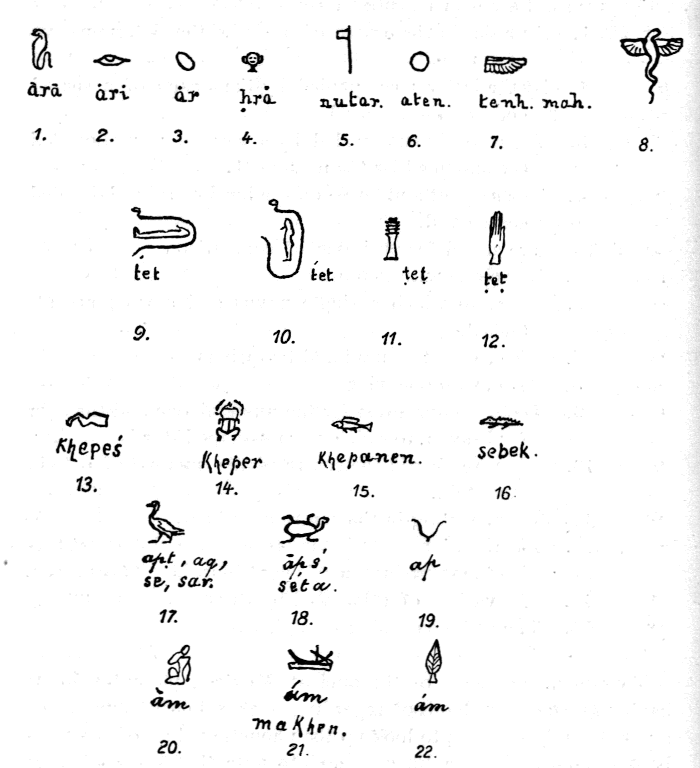
Figure 63.
Further glimpses of light seemed obtained when I found that, as written by German Egyptologists, the determinative for divinity, the banner=nutar, notar, netar, or neter, not only expressed the same sound as the word nut, but also contained the letters “r” and “a” (5). The disk=atun, aton or aten might also be regarded [pg 393] as an anagram, being the inverted form of nutar, minus the last letter (6). The names for wing (7) being tun, ton or ten, the wing attached to the disk constituted a complementary sign, duplicating the final syllable. At the same time, as a second name for wing was meh, or mah (cf. mat and its synonym su=feather), there seemed to be an explanation of the “serpent mehen” applied to Amen-Ra and the possibility that it signified the “winged serpent,” such as is frequently depicted in texts published by Brugsch (8). It was obvious that the uræus=ara and the wing meh, would form an ingenious anagram expressing, by means of the signs, a-meh-ra, the name Amen-Ra.
The constantly recurring form of the Ra sign, in which the serpent is represented as gliding around the circle, enclosing the central point of fixity, naturally suggests the inference that this variant must have been adopted at a time when the constellation Draco, the “Old serpent,” or “Nakkasch qodmun,” was circumpolar and was equally familiar, under this name, to the Egyptian and Euphratean astronomers. This inference seems to be confirmed by the fact that, in the hymn to Amen-Ra, cited above, the name Nak is given to “the serpent with knives stuck in his back,” who, according to the myth, was the demon of night and the enemy of the sun-god, the ruler of day. The fact that, in the temple of Amen-Ra at Thebes, a service was recited daily for the destruction of the serpent Nak by Horus, appears to indicate the growth of the idea of a combat between light and darkness and the dual forces of nature, which would naturally tend to create the thought of an antagonism existing not only between the sexes, but also between the two divisions of Egypt and the separate cults of the nocturnal heaven (Polaris and the moon) and the diurnal heaven (the sun).
In the list of festivals, dating from the Ptolemaic period and inscribed in the temple at Edfu, there are mentioned: “the festival of the end or point of the triangle,” simultaneous with that of “the serpent Nai or Na,” immediately followed by “the festivals of the ‘tena’=[aten?], and of the great serpent Na,” and “of the Ken=the festival of darkness, and of the red serpent Na” (Brugsch op. cit. i, p. 51). Commenting upon the above names I draw attention to the curious fact that in the above word ken, we seem to have the inversion of nak, the name of the “night-serpent” and that na is actually the inversion of the word an, which [pg 394] signifies “he who turns or winds himself around.” I shall show further on, in astronomical texts, that this name is actually identified with the pole.
When these facts are borne in mind the full import of the familiar Egyptian symbol for eternity=tet, becomes clear. It consists of the image of a mummy, symbolizing fixity, around which a great serpent is winding itself, conveying the idea of circling motion (fig. 63, 9 and 10). It is well known that this group symbolized eternity=tet and the sign is always interpreted as expressing the sound tet. If analyzed more closely, however, and interpreted as a rebus, it appears to yield a fund of deeper meaning.
The serpent Na furnishes the word An=the winder or he who moves around. Linked to one of the names for mummy=sah, the group might be read as An-sah, a name which invites comparison with Anshar, the Assyrian pole-star god who was said to shoot arrows in all directions, i. e. to turn around, and the Akkadian title for Ursa Major, Akanna=the Lord of Heaven. The second name for mummy, given in Mr. Wallis Budge's Nile, is tut, the exact word which signifies “to engender,” which explains why images of the creator should have been made in mummy form. The word tut directs attention to the name of the god Tehuti=Thoth, “the Measurer,” a name to be weighed in connection with the fact that time was measured by the circumpolar constellations. It does not appear impossible that the word khat=corpse may also have been brought into use in the rebus and furnished an anagram or allusion to the ak or centre.
The other well-known symbol for eternity, i. e. stability, is the column tet, representing a pillar usually consisting of four or five parts (fig. 63, 11). It appears hitherto to have escaped attention that the Egyptian for hand being tet, the hand, employed as a rebus, would actually express the name for eternity and may well have been employed as a secret sign for the divine centre, eternal stability and the sacred number five, consisting of the Middle and the Four Quarters, symbolized by the fingers and thumb (fig. 63, 12). To this must be added the interesting fact that, in hieratic script, the hand expressed the sound “a” which means “power” while aa=great, aat=great and mighty, aa=mighty one. To those initiated in the mysteries of hieroglyphic writing the hand thus clearly constituted a rebus, expressing the eternal, permanent, stable, [pg 395] great, mighty power, one yet double and fourfold, the sacred five in one, the Middle and Four Quarters.112
The following is a group of animal and other figures, which are repeated, with variations of form, combination and position, in the different zodiacs.
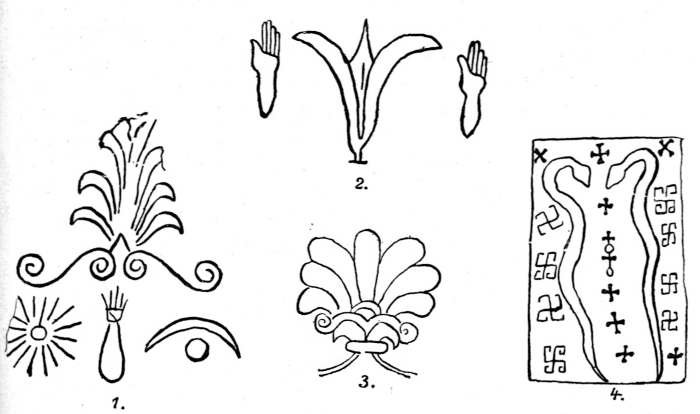
Figure 64.
The principal and the phonetic values of their names are figured as follows: the thigh=uart, khepes or maskhet; the bull, ox or cow=ka, ah, aua; the hawk=bak, designated as an, kher or heu=Horus; the cynocephalus ape and phallus=aaani and ka; the lion=mahes; the jackal (anubis) uher or sabi; the scorpion=tart or serkhet; the crocodile=sebek, also amsuk or emsuh, and seta; the vase or jar=nu (cf. nut); the female hippopotamus=tebt, shown by Dr. Gensler to have been associated with the name menat=nurse, she who nurses (see Brugsch I, p. 130).
[pg 396]
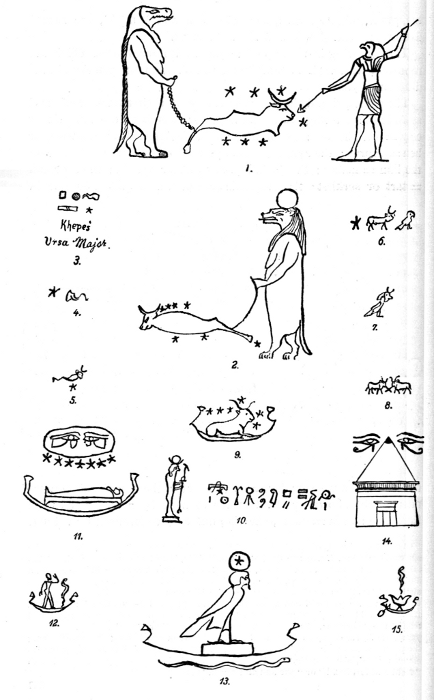
Plate V.
[pg 397]
In the Edfu zodiac, the latter, whose name furnishes an anagram of amen=hidden, is represented with the Ra sign on her head and holds a cord to which the constellation of Ursa Major is attached. This is figured, with its seven stars, as the thigh (pl. V, 2), with the head of a bull, elements which furnish the phonetic values of uart, khepes or maskhet and aua, ka or ah, to which should be added that the Egyptian mode of saying “a bull”=ua en ka, literally “one of bull,” the female form being “uat en ka” (see Wallis Budge, First steps in Egyptian).
After having studied the hymns and invocations to Amen-Ra we are aware, not only that the “hidden god” is named “the bull,” but that great stress is laid upon his being “One”=ua, yet double=ka. It therefore appears very significant to find these words incorporated in the name for Ursa Major=thigh, uart, and this combined with bull=ua or ka which furnishes the anagram ak=middle. What is more, the second name for thigh being khepes, this might form a rebus for the common name for (1) luminary or star in general=khebs or khabs, literally, lights, lamps, flames, cf. seb=star; (2) kheper=life, existence, to come into existence, cf. khepdes=uterus, kher khepd=the navel, khepesh=power.
The fact that one title of Amen-Ra was Khepera=the creator, lends additional interest to the association of his secret sign, the hippopotamus, with the constellation Ursa Major, which he apparently holds and guides and which emblematizes life, i. e. motion—The thigh=khepes, scarab=kheper, fish, khepanen, crocodile=seta or sebek, which, inverted, yields the word khebes=star, and royal sickle=khepes, thus appear to have been but different modes of expressing the same meaning and the title of Khepera (fig. 63, 13-16). It can be readily understood why the scarab beetle, which encloses its egg in a ball of mud and rolls this to a safe hatching place, became the favorite secret sign for the “hidden god,” since none but the initiated would see in the beetle, holding the ball of earth enclosing its egg, the actual rebus of Khepera, the creator, expressed by the kheper; and the circle or disk, the sign of Ra, containing the germ of life.
Returning to an examination of the signs for Ursa Major employed by the Egyptian astronomer scribes, we find, beside the more elaborate form given by Mr. Wallis Budge (pl. v, 3), the variants (4 and 5) which constantly recur in the texts published by Brugsch, and which reveal that the thigh, accompanied by a single [pg 398] star, constituted the essential elements of the sign. It is one of the curiosities of Egyptian hieroglyphics that the image of a star may express either seb=star, or the numeral five=tuau. This being the case, and the word for thigh being either khepes or uart, it is obvious that the thigh and star yield more than one interpretation from the rebus point of view, and may either be read as seb khepdes, seb-uart or tuau-uart—in one case containing the divine title “creator” and in the second a play upon the name ua=One, the favorite appellation given to Amen-Ra.
The following star names contained in the Brugsch texts, and which have avowedly not been satisfactorily identified, up to the present, will speak for themselves and will be found to be comprehensible and appropriate only when identified with Polaris: Seb-uati=the lone, single, only, or sole star (cf. title “One” given to Amen-Ra); Seb-seta=the hidden star, in Greek texts, sebkhes, sebkhe, the sebses, anagrams of khebs, or khepdes (cf. “hidden” god). This star is found pictured in the astronomical texts by a turtle, the name for which is seta, sita, sit or set; in Greek texts cit.
To me it seems clear that the turtle constituted a rebus sign for the “hidden star” and concealed god, and I find that another Egyptian word could have served equally well for the same purpose, viz., seta=the vulture. What is more, the following names, mentioned in the astronomical texts, yield the sound of the first vowel of the words seb=star and seta=hidden, and attention is drawn to the fact that, as the goose and egg, for instance, were known under several names, the secrecy of the true meaning of these sacred symbols was insured: goose=se, ser, sar, seb, smen, apt, aq; egg=se, sa, ser, sar, ar, suht; nest=ses; pool of water=se; heron=sent.
A curious double similarity of sound exists between the name for turtle and one of the names for goose, inasmuch as the turtle=seta is also called aps, and the goose=se is named apt (fig. 63, 17-18). Another name for goose being aq or ak, we find that its value as a rebus must have been supreme, since it so perfectly expressed the word ak=middle. A proof that its merits were duly appreciated by the ancient scribes, is its constant and widespread employment in decorative art as a so-called “solar symbol,” in association with the circle or disk and the swastika. Through its name se, the goose-symbol likewise expressed the [pg 399] same meaning as the egg and the first syllable of seta=hidden; perhaps also ne-se-r=flame, the synonym of khebs=luminary or star (Brugsch). Through its name ak, the goose symbol became the synonym of all ak or ka words. Finally, through its name apt, it became related to the whole series of anagrams of ptah and the synonym of the pair of horns which express ap in hieratic script.
The association of the syllable ap with the bull=uau and ka, is proven by the name Apis given to the living, sacred bull, under which form the supreme divinity was worshipped from earliest times, at or before the building of the pyramids at Memphis. The explanation that, just as sacred bull was merely a living rebus expressing by the sound of its names, the words “the one, the double, the middle of the central two-fold one,” or “divine twain,” fully explains why, in time, the bull itself came to be chosen, revered and worshipped as the living image of the “hidden god.”
The marks of the sacred calf Apis, described by Herodotus, appear to become intelligible, when translated as follows and then analyzed: “It is black (khem or kam) and has a square (ptah) spot of white (hetet) on the forehead (tehen). On the back (of the head) (makha or at) the figure of an eagle=vulture (seta). In the tail (peh?) double (ka) hairs (anem). On the tongue (nes) a beetle (kheper).”
Feeling convinced that Egyptologists could find further phonetic elements and hidden meaning in the above material, it is with diffidence that I point out some of the meaning I am able to discern with the simple aid of “First steps in Egyptian.” Besides being the image of Amen-Ra Polaris, the one and divine twain, the black (khem) skin (annu) of the sacred bull appears to contain an allusion to Egypt, known as “khem” and its central capital Annu, besides that to the nocturnal heaven and its shining city. The square ptah of white=hetet (cf. hetet, and chut=light) appears to symbolize the quadriform plan of the celestial and terrestrial kingdom and its position on the head (tep) between the two horns (ap) gains in significance when it is realized that, in astronomical texts, the square (designated above as hetet=white) is as frequently pictured between a pair of horns as the pillar=tet, that both square and pillar appear thus to have expressed the same sound=tet, which signifies eternity. The bird of prey=seta on the bull's back (makha) evidently signified the hidden=seta, centre, m-akh-a, further significance being lent to the syllable akh [pg 400] by the fact that it also means “to support,” and that “the support of heaven” was a divine title contained in the hieratic texts. The double hair=anem, ka, appears as another mode of expressing the “hidden” ka=double or ak=centre. The word for tongue (nes) being the reversal of sen=two, the kheper=life, on the tongue, appears as an allusion to dual principles or powers of nature. The giving forth and drawing in of breath by the living Apis bull must doubtlessly have seemed, to the Egyptian priesthood, emblematical of the giving and taking away of breath of life, by the creator, Khepera, over whose emblem, on the tongue of the animal, each breath necessarily passed.
An insight may thus be gained of the method by means of which primitive, naïve picture-writing could have become more ingenious and intricate until, as actually stated in the hymns, the name of the supreme divinity became “hidden from his children in the name Amen” [literally=hidden], and a “myriad of names, how many are they is not known” had been invented by the scribes, to designate the King (Hak), “one among gods, in form one, the lord of eternity, stability and law.”
Before making a cursory examination of the following lists of homonyms of the names for bull=ah, uau and ka, I must revert to astronomical pictures and signs and make some statements concerning the hawk-headed human form found represented in the zodiacs in close association with the image of Ursa Major, the bull; (see pl. v, 1, from Denderah). The presence of the hawk=bak in the centre of the polar region, with the bull ka, assumes significance in connection with the word ak=middle and the name for “the middle of the heavens,” cited by Sir Norman Lockyer; i. e., kabal sami, and all of these words are particularly interesting when it is remembered that the Babylonian name for north was akkad, the Akkadian title for Ursa Major was Akanna, while Ursa Minor was named Kakkabu in Babylonia and Assyria. The Arabian kaaba is recalled here.
The inscriptions accompanying the zodiacs published by Brugsch (op. cit. i, p. 127) designate this hawk-headed personage, who, in each case, holds either a spear or a plain staff, by the following names, of which I give Brugsch's translation, followed by my own commentary. An=he who turns or winds himself around. In this connection I point out that the name Na, given to the serpent, is the inversion of an. Kher-an=he who fights and turns or [pg 401] winds himself around. As kher is likewise the word for ring or circle (cf. Greek kirkos, Latin circus or circulus, Scand. kring), it is evident that the name Kher-an admits of being interpreted as “he who winds or turns around in a ring or circle,” kher=the fighter or combatant. At the same time, the word kher likewise signifies ring or circle; moreover ker=night and rek=time. Therefore the name Neb-kher, cited by Brugsch (op. cit. i, 176), as one of those given to the god of the city of At-Nebes, besides signifying, as he says, the “lord of strife or fighting,” clearly means “the lord of the circle or ring.” This is undoubtedly one of the most appropriate of names for the god of the pole star and Ursa Major and is, besides, the Egyptian equivalent for the Hindu “lord of the wheel,” the Persian “god of the ring,” and the Mexican “lord of the circle and of the night”=Yaual or Yohual-tecuhtli. The other titles of the same god recorded by Brugsch are “the flame or light”=Neser, and “the lord of life”=Neb-ankh.
I merely point out here what I shall discuss more fully later on, that, in the Egyptian An, “he who turns himself around,” we have the counterpart, not only of the Assyrian An-shar (fig. 65, 5) who shoots his darts in all directions, but also of the “North god” of the ancient Mexicans, who, fully armed is held by one foot, by the sign of the North, to the centre of the cross, the symbol of the Four Quarters, and like the Akkadian “lord of heaven,” Akanna, is identified with Ursa Major.
I note, moreover, that, whereas the common name for hawk is bak, that employed by Brugsch is hru (cf. inversion ur=the Egyptian name for cross symbol) which is sometimes transcribed as hur, her or heru, hor or har=and translated as Horus or Ra Harmachis. An interesting image of the hawk god is found in another inscription in the temple of Denderah containing the group (pl. V, 6) consisting of a single star, the bull and hawk, transcribed by Brugsch as “Hru-Ka” and translated as “the bull (of) Horus” (op. cit. i, p. 7). Another interesting case of the combination of the bull and hawk is the hawk with a bull's head also figured by Brugsch, and which is obviously a variant of “hru-ka.” A curious instance which seems to contain a reversal of these syllables is the bull, repeated in inverted positions, with the cross-sign=ur, a group which might well have been employed as a rebus expressing the sound ur-ak-ka, a combination which I shall discuss further on.
[pg 402]
The identity of Horus as a form of Polaris is hinted at in the following inscription in the temple at Denderah (pl. v, 10) which Brugsch translates: “Ra Horchuti (=hur-chuti) the shining Horus, the ray of light in the night” ... (op. cit. i, p. 16). The “god” is figured in mummy form, holding the sceptre tam (cf. mat=justice, truth) and the sign ankh (life), with the head of a hawk=bak or hru (cf. ur=four, and head=tep or tepet, also name for “chief”), the head conveying idea of four-fold chieftainship, surmounted by the horns=ap and circle or disk=ra.
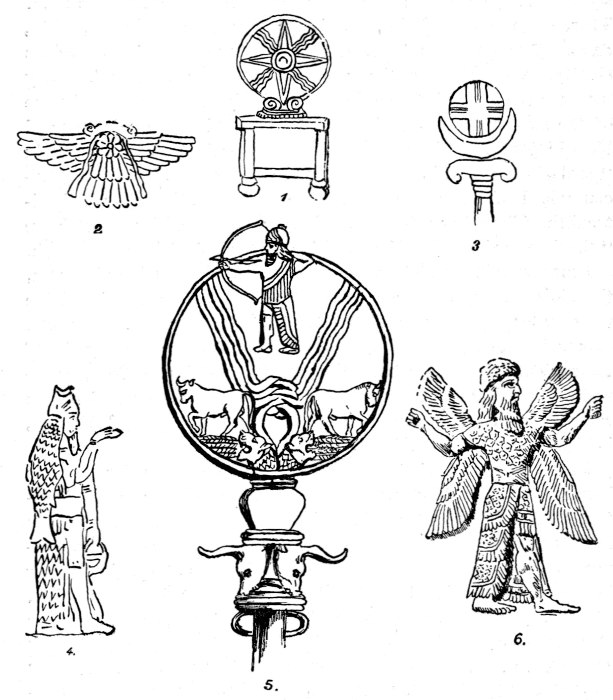
Figure 65.
An extremely suggestive astronomical picture (pl. v, 13) contains [pg 403] the combination of Horus, the An, in the form of the human-headed hawk, with a serpent Na, the boat (uaa, am or makhen) and the circle enclosing a single star, duat (cf. ua=one). The complete group thus conveys a wealth of hidden meaning which is perfectly intelligible when interpreted as pole-star symbolism.
The reader is now invited to take a preliminary look at the columns of signs included in figs. 66, 67, 68, some of which will be recognized as primitive pole-star symbols already discussed, and which will respectively be found to contain homonyms of ua=One and uahi=permanent; ak and kabal=centre, ka=double, an=he who turns and ankh=life, etc. Special attention is also drawn to the modes of expressing the syllable am by the homonyms boy or child, boat and tree (fig. 63, 20-22).
Different combinations of identical phonetic elements are found in the following groups which prove to be but different ingenious figures expressing the same sounds, with more or less the same meanings: pl. v, 15, represents the boat, whose phonetic values are given above, with a flower=ankh, the homonym of life, containing the names an and na, from which the uræus=ara, is rising. Later on the deeper symbolism of this and fig. 12, pl. v, will be further discussed. In the latter, instead of the flower the boat contains the ara and a boy=ah or aah, whose name is the homonym for great, mighty, powerful, etc. Assuming that the boat expressed its particular name uaa=ua=one, we thus have a rendering of the appellation so constantly given to Amen-Ra in the hymns and invocations: “One, great, powerful, mighty god,” accompanied by a whole series of secondary meaning and symbolism. In pl. v, 9, the boat containing the bull or cow, is accompanied by stars which reproduce Ursa Major exactly, minus one star, the head of the animal occupying the centre of the four stars forming the inverted square of “the dipper.” In this case the boat seems to express its name makhen, incorporating ak, the name for the sacred centre of the sky, which is repeated in the name ka=bull, whose image, like that of the boat, conveys the allusion to ua=one, by their respective double names, aua and uaa.
What appears to me to contain the most convincing proof of the identity of Amen-Ra with Polaris is 11, pl. v, which shows us a boat in which lies a mummy, above which is a row of seven stars under an oval, containing two eyes. The oval ring is evidently the image of Amen-Ra, who united in his person the dual principles [pg 404] of nature symbolized by sun and moon=his “two eyes.” The symbolism of the boat and mummy has already been sufficiently discussed to enable the reader to discern its association with the idea of oneness, of stability and centrality. Further light is thrown upon the connection of the two eyes with the sacred centre by pl. v, 14, from the Book of the Dead, where the chosen place of sepulchre for the dead person, mentioned in the text, is the temple pyramid, the apex of which is rendered prominent by being painted black and suggestively occupies a central position between two eyes. After the periods of Greek rule in Egypt, the point of the pyramid must have been associated with the Greek words, akra=hill-top and aku=point, which recurs in the Latin name acacia, by which the thorny tree, originally found in Egypt, is still known. It can readily be seen how this tree would have been chosen as a symbol of the ak=middle and it is possible that its name may originally have been that also given to the olive tree=bak. The inscription on the famous obelisks erected by queen Hat-shepsut contains a special mention of the point of the obelisk, as being made of precious material: “two great obelisks of hard granite of the south, the point of each is of electrum, the tribute of the best quality of all countries” (Flinders Petrie, History of Egypt, Vol. ii, p. 86).
The many variants of the constellation or star termed “the divine triangle” or “the triangle of the god” next claim attention. An extremely interesting variant of this constellation represents a hawk-headed sphinx, next to the triangle (pl. vi, 1); 2-4 represent the common form expressing the name Sopedet. As Brugsch informs us, the above name was changed at a more recent period into Satit (6-8), which he translates as “she who shoots, the archeress” or “she who causes the Nile to rise.” In these cases the written name either contains an arrow (6), the pyramid symbol for earth (7), or a seated figure above whose head is a single star (8). A rarer form of representing the same constellation is 9 and 10, the group being transcribed by “Satit Hont Khabsu” which Brugsch translates as “Sothis, the Queen of the ... stars.” From the feminine terminations employed in the text it is clear that it is a cow which figures here in the boat, with a single star between its horns and it appears to me to be obvious that we have to deal here with the feminine form of Polaris, with Auset=Isis, closely related to the Assyrian “goddess of battle,” Ishtar, the [pg 406] female counterpart of Ausar=Osiris, the Assyrian Anshar, or Ashur, the “god of battle.”
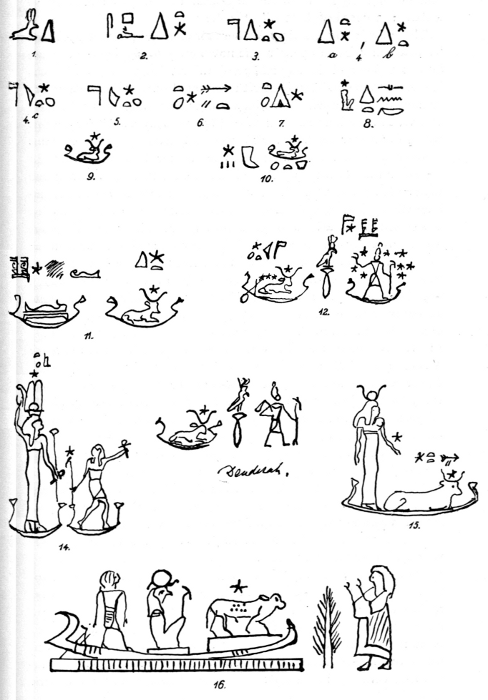
Plate VI.
This view is confirmed by further astronomical pictures published by Brugsch, which appear to me not merely to signify the constellations Orion and Sirius as Brugsch infers, but to be hieroglyphs intended to be understood by the initiated only, representing two or more of the forms under which Amen-Ra was figured. At Edfu (pl. vi, 11) the boat=au, uaa, and the mummy=sah form a fair rebus for Ausar=Osiris, while the boat alongside of it contains the cow, a form under which Isis=Hathor was worshipped in Egypt during centuries. At Denderah (12) there is a cow in one boat=Isis; and a man in another who holds the sceptre tam, emblematic of power, and turns his head around, an evident allusion to the action an=he who turns himself around, or to sah=one who turns away. Between both is the hawk=bak or Hur-chuti=Horus, standing on the sceptre named aut, composed of the lotus flower=ankh. A variant of the same group (13) also symbolizing the “Above, Below and Middle,” and from Denderah, represents Isis only in the celestial boat and Osiris standing (on earth) holding, beside the tam, the whip=nekhe khu, emblematic of rule. In 14, a female figure stands in the boat under the written name Auset=Isis and bears in her hand the ankh sign and the lotus flower=ankh sceptre. In the second boat the figure of a boy (ahi) turning (an or sah) his head, holds up the ankh. In 15, we seem to have an evidence of the ascendancy of Isis worship, for the boat contains not only the cow, under the name satit=she who shoots, or the archeress, but also the standing figure of the goddess, crowned by the disk or circle between two horns.
A striking proof that the knowledge of the true, hidden meaning of the signs just discussed was regarded by those who possessed it as an evidence of an advanced stage of initiation in the mysteries of the priesthood, is furnished by the following text, which accompanies pl. vi, 16:
In the Book of the Dead (Leyden, Papyrus, p. 16), in a chapter entitled: “Chapter of the knowledge of the eastern spirits, ro en rex biu abti,” the dead person utters the following words: “I know that eastern mountainous region of the heaven whose south is at the sea Kharo and the north at the river of Ro, at the place where the day-god Ra drives around amidst storm-winds. I am a welcome comrade in the boat and I row without tiring in the bark [pg 407] of Ra. I know that tree of emerald green brandies amongst which Ra shows himself when he goes over the layer of clouds of the god Su. I know that gate out of which Ra issues. I know the meadow of alo, whose wall is of iron.... I know the eastern spirits, namely the god Hur-Chuti, the calf next to this god and the god of the morning,” the original text of the latter sentence being: “au-a-rekh-ku-a biu abti Hur-chuti pu behsu kher nutar pen nutar duaut pu” (Brugsch, op. cit., i, p. 72).
The evasion and caution with which the speaker alludes to his knowledge of the meaning of the signs, without betraying the latter, sufficiently indicate the obligation of absolute secrecy which bound him, and it may be inferred that several of the words he employed were intended to be misleading to an outsider just as the astronomical pictures, exposed to public view, were purposely made to seem to relate to the more familiar sun, moon and constellations, the mind being thus led away from the hidden but true star-god=Polaris. The circumstance that, on the body of the young bull in the boat, there are seven dots and above it a single star and that the hawk-headed seated deity behind it is crowned by the serpent circle or disk of Amen-Ra, sufficiently enlightens us as to the true, veiled significance which represents different forms of the “hidden god,” of the group. A careful analysis of this and of the astronomical images suffices, however, to disclose the limited scope of the meaning of such groups, each one being but a different rebus containing the same phonetic elements. Let us now briefly indicate what appear to have been the essential components which all images contain and a few of the myriad of ways by which they were expressed.
Uahi=permanent, and Ua=One. Represented by
Fig. 66. 1. An arrow=au (cf. abau=to fight), an arm=a, and the numerical one=ua.
2. The cow=ah, aua, the latter name incorporating the adjective a=mighty, powerful, etc.
3. The thigh=uart.
4. The boat=uaa.
5. The numeral five=tuau.
6. The throne, seat or place=auset, which constitutes the name Auset=Isis, the consort of Ausar=Osiris.
[pg 408]
7. The bowl=au.
8 and 9. Two forms of sceptre or bent staff=au, uat, also aam.
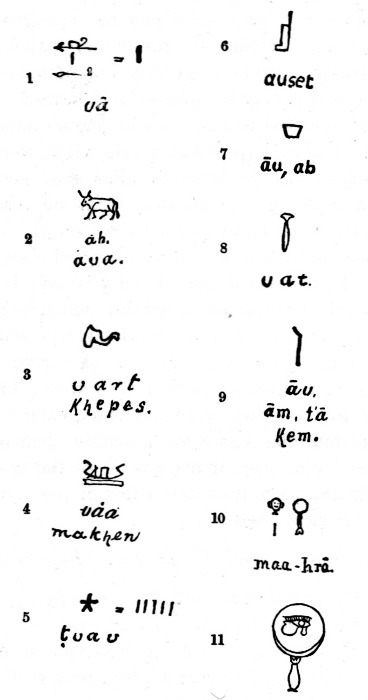
Figure 66.
Besides these signs, well known as sacred symbols, we find that the following names also contain the sacred title Ua: uatet=greenstone, emerald, aut=quadrupeds, au=heir, also dog, maau=rays of light, mau=lion, also cat. The reason why certain quadrupeds, and particularly the cow, lion, and the cat, should have become sacred animals in Egypt, seems to be satisfactorily explained by the fact that each constituted a rebus and could therefore be employed as an “image” of the One god. It is obvious that locality would necessarily influence the choice of the [pg 409] sacred animal and that while one city might adopt the cow, another would be obliged to adopt the cat, etc, as the living rebus. The adoption of “the heir,” or first-born of the sacramental union of king and queen, as the living image of the deity, throws an unexpected light on the reason why members of the royal line were treated with divine honors. While persons, animals and objects whose names contained the divine Ua=one, would thus be chosen, others containing the word Ra=god, would also be adopted.
Ra=god.
Of these I have already pointed out the uræus=ara, the eye=ari, face=hra and egg=ar, also se or sa and suht. To these may also be added the date palm or dates=ben-ra; grain=nepra; the vine=aarer and grapes=aarer, each of which is to be found associated with sacred symbolism.
The veneration accorded in different localities to the pig=re-ra and the horse, may thus be accounted for, especially as the name for the latter, het-ra, consists of het=light or fair, and ra=god, and the horse is actually found associated with the light-gods of antiquity and with so-called solar symbols and the swastika.
Food for reflection is afforded by the Egyptian name for mirror, which literally signifies to see, or the seer=maa, of the face=hra, but which furnishes, as a rebus, the word maat=law, which is usually expressed by the feather=mat, connected with hra=i. e. ra=god (fig. 66, 10). The employment of the mirror as an image of the god of law would thus naturally have been suggested by its name. The presence of the eye=ari (cf. ra) in the centre of a mirror which is being worshipped, also suggests that in ancient Egypt the mirror was employed in the temple to hold the reflection of Polaris=Amen-Ra, “the untiring watcher, the lord of eternity and the maker of law” (see fig. 66, 11). It is obvious that the habitual employment, by the astronomer priests, of a mirror so placed in the sanctuary as to catch the reflection of the pole-star through an open doorway, would lead to the discovery of the movements of the sun and the positions it assumes during the year. The flashing of a beam of sunlight once a year, at the period of the summer solstice, upon the mirror which constantly reflected the pole-star, would naturally suggest the idea of “the union of the day-sun with the night-sun” and seem particularly impressive as it was at this period that the Nile began to rise. In dealing [pg 410] with the religious festivals held at this period more will be said on this subject.
The word maat=law, besides being expressed by the feather=mat, could also have been indicated to those initiated in the mysteries of hieratic rebus-writing, by the lion=ma hes; the antelope=ma-het, which also contains the sacred attribute light=het, the synonym of khu, thus expresses the idea of the “light of the law.” The musical instrument named mat may also have originally been, like the tam sceptre, a symbol of lawful power and conveyed an allusion to meht or maht=north. To this series the word am should be added, signifying child, tree and boat, each of which has already been treated of in connection with pole-star symbolism and Amen-Ra (fig. 63, 20-22).
Duality=ka=double; and the Middle=ak.
The name for bull=ka (fig. 67, 1) incorporates, as has already been shown, not only duality and middle, but also, through its other names, the idea of oneness and of power. This appears to explain clearly why the bull was chosen as the image or rebus of Polaris and Ursa Major, which appear to have been regarded as a single combination of stars. The fact that in the hymns Amen-Ra is addressed as “the bull,” constitutes a convincing corroboration of the identification of the “hidden god” with Polaris. A line of connection seems, moreover, to exist between the Egyptian kabal sami=the middle of heaven, the image of a bull in the centre of the zodiacs, and the bull of Assyria, under which image Baal was worshipped.
Hieratic signs, expressing the word for middle and double appear to have been: the mummy which, although named sah or tut, also signified khat=corpse (2) and conveyed an allusion to mit=death, the homonym of met=north.
A certain form of fish expressed the syllable kha (3). A cone-shaped object named khaker appears to have served as a rebus for the middle and double as well as night=ker and time=rek (4). In pl. vii, 12, the khaker figures behind the seated image of a deity with the head of a ram=ser or sar, holding the ankh in his hand, the whole forming a rebus for Ansar, and containing much meaning besides.
Kha-ut (fig. 67, 5) is the name for the sacrificial offering laid on [pg 411] the utu=altar, which is shaped like the tau and symbolizes the above and below by its perpendicular and horizontal lines. In the centre of this is the bread=ta (the homonym of ta=earth, cf. neb-at=fire), which is remarkable on account of its division into four parts analogous to that of nut=city, a feature which justifies the inference that the word for cake=sen-nu made with honey=bat or net, is intended to be expressed here. A jar stands at each side of the cake, which is placed on edge so as to exhibit the sacred design upon it. It is significant that, if the jars contained wine=arp, milk=art, the name of the liquid constituted an anagram of ra, if perfume=anta was present, this furnished the syllables an and ta=earth. It is, of course, impossible to surmise how far such resemblances of sounds influenced the choice of sacred offerings.
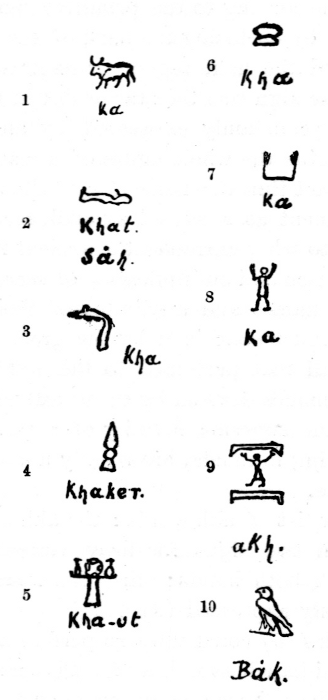
Figure 67.
[pg 412]
The kha (fig. 67, 6)=crown is particularly interesting as Amen-Ra is addressed as “crowned form,” the lord of the ureret crown, ... beautiful of tiara, exalted of the white crown ... on whose brow the double crown of Upper and Lower Egypt is established. It appears, therefore, evident that the crown=kha was but another mode of expressing ka=double. At the same time it likewise conveyed the idea of ak=the centre and the act of crowning a sovereign appears as vested with deep symbolical meaning when it is realized that, according to the primitive modes of thought I have been tracing, by enclosing the head of the king in a circlet he was constituted the hak, regent or central chief, the living image of Ra, whose sign was the star or dot in the circle or ring.
Ka (duality) is commonly expressed by an uplifted pair of arms; a variant being the whole figure of a man with raised arms (7 and 8). The fact that the name for phallus was also ka, explains its employment as a sacred symbol, recorded by Herodotus, which proves to what extremes the ancient rebus-writers went in their naïve invention and multiplication of secret signs and modes of expressing the names and attributes of their “hidden god.” The hatred and disgust conceived by the great reformer Amenophis IV, against all that pertained to the cult of Amen-Ra, his destruction of all images devised by the priesthood and adoption of a pure image of the supreme divinity of a plain disk or circle, with rays terminating in hands, are readily understood in connection with the above.
Returning to our list of akh words: the akh or centre is figured by a man between two signs for heaven=pet, supporting the upper heaven with both hands; the idea ka=double or dual, being simultaneously expressed (9).
The hawk=bak (10) constitutes so perfect a rebus or anagram of middle=ak and kabal, as well as for khab=star, that the reason why the hawk was chosen as an image or form of Amen-Ra is as reasonably accounted for as the choice of the bull. Before supporting this assertion by a series of convincing proofs, the following list must be studied:
An=he who turns himself around (i. e. who performs a circuit=the circuiteer) and ankh=life.
In the “First steps in Egyptian” I find the word “an” expressed by (fig. 68, 1) a man in the act of turning around, resembling the position [pg 413] of the male deity in the boat, already discussed and represented in the astronomical texts (fig. 68, 2) by an eye, the form of which differs from that of the eye=ari; (3) by a fish, also different in form from the fish=kha, and particularly interesting if compared to the fish khepanen, figured in the kheper series, which constitutes a rebus combining the titles khepera=creator and an=the circuiteer; (4) by a stone=aner, also by hair=anem; (5) by two arms spread outwards, recalling the position of the front legs of quadrupeds; (6) by a spear whose shaft is inserted in a double stand; which sign recurs in the name of the city Annu, expressed by the an=spear, the vase=nu and the nut determinative for city or capital (7). It is extremely interesting to compare, at this point, the Greek polus=a pole or axis, and polis=city or capital, and to realize that, in Egypt and Greece alike, the names for capital are associated with the idea of centrifugal power and rule.
The signification of all the above “an” signs becomes intensified when it is realized that they conveyed also the first two letters of the word ankh=life, which was usually expressed by the familiar symbol expressing the union of the dualities of nature (8).

Figure 68.
Amongst the many surprises received during the course of this investigation, few have given me as much satisfaction and light, as the observation of the fact that the Egyptian name for flower, ankh (9), was the same as that for “life.” The full significance of the lotus blossom as a symbol became clear to me, and my attention having been called by a friend to Mr. William H. Goodyear's admirable work “The Grammar of the Lotus,” London, 1891, I was able to obtain from it the series of Egyptian symbols which I now present and shall proceed to interpret according to the method set forth in the preceding pages. The interesting observation was by Mr. Goodyear that “the ankh was the exact counterpart [pg 414] of the lotus as regards solar association” and in his work, on pl. lxv and elsewhere, this close observer publishes several instances illustrating this view. Of these I reproduce but two, which suffice, feeling convinced that Mr. Goodyear will be as interested as I was to hear that the ankh and lotus were homonyms of ankh=life. This fact of itself fully explains why the lotus flower was employed by the ancient Egyptians, as Mr. Goodyear states, as the “symbol of life, immortality and of renaissance and resurrection and of fecundity.”
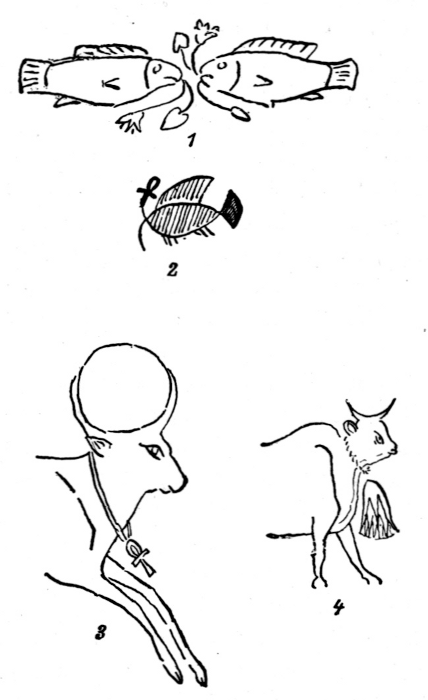
Figure 69.
In fig. 69, 1, two (ka) fishes (khepanen or an) hold the lotus, ankh, and thus constitute a sacred rebus, the profound meaning of which can be surmised by studying the preceding pages. In 2, one (ua) fish holds the ankh instead of the lotus. Both signs obviously express precisely the same meaning with the difference that, in one case duality is expressed by two fishes, and in the other by the ankh symbol which emblematizes the union of nature's dualities.
Fig. 69, 3, shows the bull, carrying the circle of Ra between its [pg 415] horns and wearing the ankh symbol hanging from its neck. The lotus replaces this in 4, where the circle is missing and one bull (ua en ka) expresses the mystic sacred words ua=One and ka=double or “the divine Twain.” It is evident that it is only when it is assumed that pole-star worship constituted the basis of the natural religion of the ancient Egyptians that their sacred symbols become intelligible.
Though a novice in Egyptology and with extremely limited works of reference at hand, which facts will, I trust, excuse faults and omissions, I perceive so much that is clear and simple in the following series of Egyptian sacred symbols, culled from Mr. Goodyear's work, that I am tempted to submit my interpretation of their meaning, thereby putting my view and method to a crucial test.
In pl. vii, 2, we have an interesting group uniting the boat, the meaning of which has been discussed, a seated figure on a square pedestal, a column, the upper portion of which is separate and simulates the bowl or cup=au, the dot and circle, the sign of Amen-Ra, and a single flower. As a rebus, some of the words expressed are am, uaa or makhen=boat, tet=column, Ra=dot and circle, also seated figure, determinative of god=Ra, and ua en ankh=one flower. While the rebus supplies the words ua=one, uahi=permanent, ra=god, an=the circuiteer, ankh=life, tet=eternal, it is only when identified as pole-star symbolism that the group becomes comprehensible.
Pointing out that, in the above, we have a clear case of the flower in association with the Ra sign and other symbols which have been discussed as pole-star signs, let us next examine 1, 3, 4, 6 and 8, in each of which one blossom=ua en ankh, constitutes the emblem for the sacred Middle, and openly conveys the idea of the verb an, to perform a circuit and ankh=life.
The fact that, in 6, the flower consists of five petals, on four of which the genii of the four quarters stand, sufficiently proves that the flower, like the five-dot group, constituted a symbol of the four quarters and centre, the latter being figured as a pyramid-shaped petal. Interesting variants of this group are 5, with the four genii standing on seven of the nine petals of the flower, which is placed between two buds, the idea of centrality being thus conveyed; and 7 where an inverted triangle replaces the flower and reveals some of the deeper meaning attached to this symbol. In 1 and 3 the flower is surmounted by the hawk crowned with [pg 417] the Ra sign which, as has already been stated, symbolizes circuition around a central point of fixity. The names for hawk=hak (cf. ak and cabal=middle, also hak=king) and her or hur (cf. hru=upper, the above, and ur=four=Horus) reveal its appropriate use as rebus and symbol of the central “sun” god. In 8, instead of the Ra sign, the hawk wears the peculiar double diadem with a circle at its base, which is the particular attribute of the images of the ram-headed god Amon who is represented in no. 12, holding the ankh sign and accompanied by the kheper sign, composed of a circle, surmounted by a cone and supported by a pedestal. It is well known that the ram=ser, sart or sar, was the form under which the supreme divinity was worshipped at Thebes, the real metropolis of the whole land of Egypt, during many centuries.113 The name Amon, also given as Ammon, Amoun, Hammon, resembles Amen closely enough to justify the identification of Amon as a form of Amen-Ra, the concealed god.
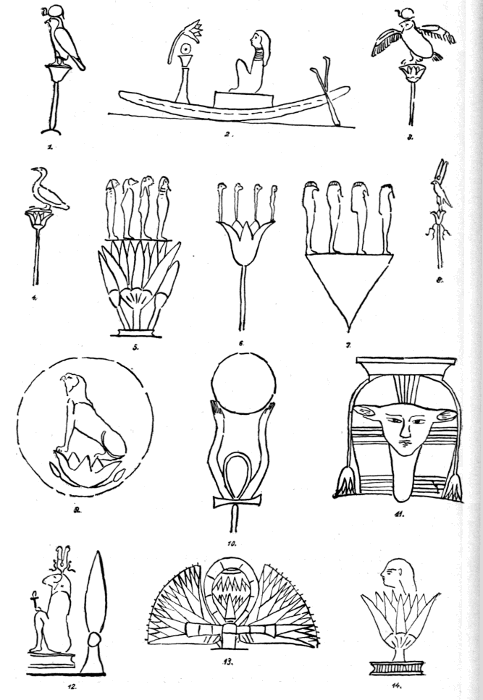
Plate VII.
In this connection it is noteworthy that the ram=sar or sart conveys the same sound as the goose=sar or sa, the employment of which, as a pole-star symbol, will be discussed further on, and that the king of Egypt was termed “the living ram (of Amon) on earth” and “the engendering ram.” From Mr. J. P. Mahaffy we learn that, under the Ptolemaic rule, “it seems likely that among the strict prescriptions for all the solemn acts of the king, it was directed that he should assume the insignia of the god Amon, his ram's horns, fleece, etc, when visiting the queen” (History of Egypt, London, 1899).
Under the Ptolemaic dynasty, the identification of Amon with Amen-Ra receives support from the magnificent monumental votive ram, preserved at the Berlin Museum, which was dedicated by king Amenophis III, which bears on his head, the disk with the uræus serpent, the familiar sign of the “hidden god.”114
[pg 418]
While the diadem of Amen-Ra sufficiently identifies the hawk on the lotus as a form of the “hidden god,” the following extracts from Mr. Goodyear's work will be found to confirm this and throw further light on the subject. “The hawk represented Ra, Horus and all solar gods....” A text at Denderah says: “The sun which was from the beginning rises (i. e. comes forth, appears, see Brugsch for meaning of Egyptian equivalent) like a hawk from the midst of its lotus bud....” At Denderah the king makes offering of the lotus to the sun-god Horus with the words: “I offer thee the flower which was in the beginning the glorious lily of the great water....” In the boat of the dead the soul says, “I am a pure lotus (i. e. life) issue of the field of the sun.”
The circumstance that, in 4, the flower is surmounted by a goose, one name for which being aq=ak, shows that, like the hawk, bak, it may well have served as a rebus for ak=the middle. An instance of the direct association of the sacred goose with the four quarters is given in the bas-relief at Medinet-Abu, described by Brugsch (op. cit. ii, p. 297). This represents “Ramses III ... offering sacrifice to the god ‘Khimti,’ i. e. Pan of Panopolis, the Theban form of which was Amon Generator.... A white bull (the symbol of Pan) and four geese, which are represented as flying towards the cardinal points, constitute the sacrifice.”
The striking association of the goose with the bull=Apis, the astronomical symbolism of which has been shown, gains in significance when it is realized that another name for goose is apt and that this also constitutes an anagram of pta=ptah, one form of Amen-Ra. It is a curious fact that the third name for goose, se or sa, combined with ankh=flower, as in pl. vii, 4, furnishes the word ankh-sa, which recalls the word An-sah obtained by the mummy and serpent rebus and the name of the god of Assyria, Anshar.
In connection with the above Egyptian rebus, expressing the syllables ankh and sa, it surprised me, to find that the Sanscrit name for goose is hangsa, while in ancient Hindu it is hamsa and in modern Hindu hanassa. It is well known that in Hindu mythology the goose was “the bird of Brahma,” the “supreme one who alone exists really and absolutely,” that the birth of Brahma from the lotus is frequently represented in Hindu religious art, and that the lotus is the attribute of the “sun-god” Surya, termed the “lord of the lotus, father, friend and king.” What is more, the goose, [pg 419] associated with “solar” symbolism, i. e. with the circle and central dot, with the swastika, four-petalled flower and the wheel, occurs on the oldest monuments of Greek art; on the prehistoric bronzes and pottery of Italy (where the sacred geese were kept on the Capitoline at Rome); on the bronzes of Hallstatt, of ancient Gaul and of prehistoric Sweden. Pointing out that we thus obtain a whole chain of associations which link the syllables am and an to deities and pole-star symbolism, I next present, for reference, the names for the bird given in Webster's dictionary.
Sanscrit, hangsa; Latin, anser, for hanser; German, gans (in Germany, according to Pliny, the small, white geese were called ganzoe al. gantoe lib. x, 22); Greek, khen; Danish, gaas; Swedish, gos; Welsh, gwydd; Anglo-Saxon, gos; Irish, geadh; Icelandic, gas; Slavonic, gusj and gonsj. Noting that in the Sanscrit, Latin, Greek and German alike, the syllable an or en is present in the name for goose, I return to the Egyptian symbols which express the words an and ankh, and, bearing the “birth of Brahma from a lotus” in mind, refer again to the Egyptian title Neb-ankh, “lord of life,” which, as I point out, also signified “the lord of the lotus flower.” Let us now briefly examine some Egyptian texts relating to pl. v, 12 and 15, which represent the boat (am and its synonyms) and the flower=ankh, associated with the boy and the serpent.
In an astronomical text from Edfu, published by Brugsch, New Year's day is mentioned in connection with the “coming forth of the great lotus blossom in the form of a bud in its symbolical interpretation as the god ahi (literally, boy).... The count of his rulership begins from the first day of his rising or birth....” In another text it is said: “New Year's day, the sun (Ra) comes forth from a lotus flower in the great sea,” and there are numerous allusions in other inscriptions to “the lotus blossom in the great waters, from which the sun-child arises in radiance towards heaven.” The text accompanying (pl. v, 15), where a serpent rises from the lotus in the boat, states “the sun, uniter of the world, in Tentyra”=the New Year.
In another inscription it is said: “thou risest like the sacred serpent, as a living spirit, in thy glorious form in the bark of the sunrise;” and this passage forms an interesting parallel to that already cited where the sun is said to rise “like a hawk from the midst of its lotus bud.” Pl. vii, 14, exhibits a nine-petalled lotus [pg 420] growing from a pedestal and a head issuing from it. As the name for head tep (also tap or tpa, and apt cf. pta), signifies chief, or beginning, we must accept this as another variant of the previous signs.
Deferring the discussion of the so-called “birth” and cult of the diurnal sun, as one form of Amen-Ra, let us now rapidly survey the following figures copied from Mr. Goodyear's work.
Pl. vii, 9. A circle encloses a group consisting of the five-petalled lotus between two buds and the hawk-headed sphinx, which has already been met with in the astronomical texts and, according to Egyptologists, represents Horus, the sun, “who lights the world with two eyes” and is addressed as “a powerful lion,” “the master of double force.”115 I need scarcely recall here that the combination of a bird and quadruped would naturally symbolize air and earth, the Above and Below and that the hawk-headed sphinx, seated on four petals, clearly expresses the idea of the “lord of Heaven and Earth, the father and mother of all, the ruler of the Four Quarters and lord of the circle.”
Pl. vii, 10. The plain circle or disk, supported by two uplifted arms=ka, arising from (akh) the ankh sign, is another ingenious mode of expressing the idea of the Middle, the circle, duality and life.
No. 13 constitutes as charming and ingenious a play upon the word ankh=life as can be imagined, and a close examination reveals its subtle, hidden and deep significance. It exhibits, in the first case, the ankh sign combined with the flower=ankh, which might, at a first glance, be taken as an example of purely decorative art. But the ever-present thought of the duality of nature manifests itself in the arrangement of the two flowers towards each other and enclosed in the open ring of the ankh sign, and it is evident that the artist took pains to draw the central petal of the lower blossom in the form of a triangle, below which an oblong square and a square may be distinguished.
After the foregoing attempt to show how, even with my rudimentary and limited knowledge of their language, the sacred symbols of the Egyptians become intelligible and full of significance [pg 421] when studied as examples of pole-star symbolism and primitive rebus writing, I draw attention to the limited number of syllables employed in the astronomical texts; to the ingenuity displayed in expressing the same sound over and over again by means of different words possessing the same sound and to the fact I shall hereafter set forth, that the syllables and rebus-figures employed are found indissolubly linked to pole-star and sacred symbolism. Referring a demonstration of these conclusions to the end of the present investigation, I shall next discuss the forms which the cult of the dualities of nature seemingly assumed in ancient Egypt.
As an introduction I present in fig. 70, the copy of the upper portion of a funeral stela preserved at Bûlâk and published by Perrot and Chipiez (Ægypten, Leipzig, 1884). It exhibits the head or face of Hathor surmounting the tet column and supporting, in turn, the image of a small house or temple, at each side of which is a peculiar projection recalling the circinate line issuing from the red crown of lower Egypt (see fig. 70, 9, 10). In another Hathor stela, figured in the same work (pp. 510 and 780), the same characteristic circinate projections recur. The image of the house, always represented with a single doorway, is obviously a rebus of the name Hathor, explained by Egyptologists as Het-heru, literally “the house of Horus.” “Athor or Hathor of Thebes, identified with Nut, the sky ... was the female power of nature and is often represented under the form of a cow, ... as a woman with a cow's head, with horns and the disk, or wearing a head-dress in the shape of a vulture and above it the disk and horns.” In the familiar representation of the mask of Hathor on columns, the association with the cow is conveyed by large cow's ears=setem, projecting at each side of the face=hra.
A feature generally present in the miniature doorway of the house, is a single erect head of a uræus, bearing the disk or circle on its head and usually exhibiting a distinctly cross-shaped mark on its neck. The latter peculiarity is clearly shown in fig. 70, 1, which exhibits moreover a seated divinity at each side of the doorway, each bearing the throne or seat (auset) on its head, and the ankh sign on its knee. Close examination reveals that one of these deities is Ausar=Osiris, whose name is generally written by means of the throne=auset, and the eye=ari, with or without the determinative for god, i. e., the seated figure (fig. 70, 1 a and 1 b). Opposite to Osiris is Auset=Isis, whose name is usually written as in [pg 422] fig. 70, 1 c, where the auset, the egg=se, and the seated image of a goddess bearing a bowl=neb, on her head, may be distinguished.
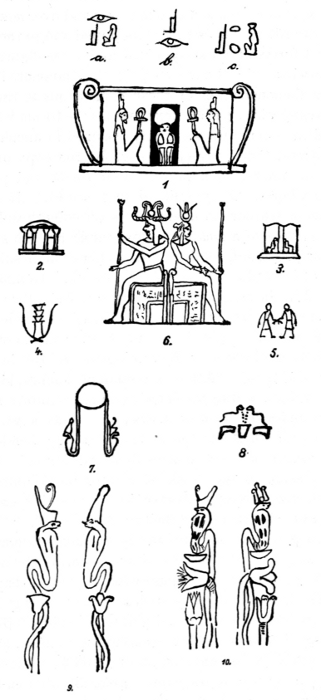
Figure 70.
An idea of the import of fig. 70, 1, seems gained when it is remembered that in Egyptian the word house=pi, pir or per, was [pg 423] associated with the title of ruler, the name Pharaoh being derived from per=āa=great house. What is more, the word house=pir or pi, is used in astronomical texts, like the Arabian beth, in relation to stars, it being said of a star that “it ever comes forth from its house”=appears (Brugsch).
The permanent image of the disk and serpent, a form of the Ra sign, in the doorway of the sculptured house, would thus convey the idea of the eternal presence of Amen-Ra, the pole-star god. The accentuation of the cross lines on the neck of the ara indicates, moreover, the intentional allusion to four-fold and two-fold force, the latter being expressed by the eyes of the serpent. The door=ptah, which is open, expresses the name Ptah=the Opener, well known as that of the “father of the gods” and a form of Amen-Ra.
The positions assigned to Osiris and Isis, at either side of the “hidden god,” sufficiently shows that they were intended to represent separate incorporations of the male and female principles which were united in Amen-Ra, the “divine Twain.” The association of both deities with the throne, the eternal seat of repose, identifies both alike with Polaris. A monument in the Berlin Museum (no. 261) which was found in the temple of Isis at Ben-naga, in Nubia, and was a votive offering made by the Ethiopian king Netek-Amen and his consort Amen-Tari, contains the following formula, translated by Lepsius, which associates Isis with eternal enthronement. “Thou remainest, thou remainest, on thy great throne, O Isis, queen of Au-ker, like the sun (Ra) that lives in the horizon ... and thou lettest thy son Netek-Amen flourish on his throne....”
The fact I am about to demonstrate, that the king and queen of Egypt were the respective, “the living images” of Osiris and Isis, proves that, as in ancient Peru and China, the sovereigns, who were at the same time high priest and priestess, were considered as the sacred embodiments of the dual principles of nature. As elsewhere also, a chain of associations became attached to each of the dualities; but in Egypt, as may be clearly discerned, during the lapse of centuries great transformations of thought took place and alternately the male and female elements seem to have been associated with the cults of heaven and earth, light and darkness, sun or moon, morning or evening stars, the southeast and the northwest.
[pg 424]
In the sacred writings the sun is usually termed “the right eye” and the moon “the left eye” of Ra (cf. hra=the (divine) face). Brugsch points out that, in certain inscriptions at Denderah translated by Mariette, “the Sothis star of Hathor-Isis is designated as ‘the right eye of Ra’ while the sun is termed the left eye.”
Brugsch states, moreover, that, according to Sextus Empiricus, “the Egyptians compared the king to the ‘right eye’ or the sun; while the queen was compared to the ‘left eye’ or the moon.” The two eyes, often with the designation of “right” or “left,” constitute a favorite decoration on funeral stelæ. In some instances the image of the solar disk, with one wing and one serpent only, is figured as a substitute for the right eye (op. cit. ii, 436, see fig. 62, 6). The established fact that the eyes of Ra were the equivalents of the uræi usually accompanying the circle of Ra, the so-called “solar disk,” is further explained by the following data.
It is well known that the two uræi on the royal diadem denote sovereignty over Upper and Lower Egypt. In the bas-relief published by Brugsch, the circle or Ra-sign is represented with two uræi, which respectively wear the crowns of Upper and Lower Egypt (fig. 70, 7). The crowned uræi recur in the emblems of Upper and Lower Egypt published by Mr. Goodyear, the first accompanied by the lotus flower and the second by what Egyptologists usually identify as the papyrus, but which appears to be the ripened pod of the lotus (fig. 70, 9 and 10). While the two uræi thus emblematized the two divisions of the land of Egypt they are found as distinctly associated with Osiris and Isis, and their living images the king and queen, or the high priest and high priestess of Amen-Ra. The Berlin Museum contains several representations of Isis under the form of a serpent with a woman's head (see official catalogue, nos. 7740, 870 and 2529). Osiris is also represented as a serpent with the head of a bearded man.
A small shrine in the form of a temple, and decorated with royal serpents, is preserved at the Berlin Museum (catalogue no. 8164) and contains the effigies of two uræi, one of which, to the left of the spectator, exhibits the head of Isis, the second, to the right, the features of Osiris. Between them stands the vase or bowl which was a constant feature of Isis cult.
In connection with this monument it is interesting to examine an inscription published by Brugsch (i, p. 108) in which occur two [pg 425] serpents who are pouring liquid into a bowl placed between them and the divided halves of the sky-sign (fig. 70, 8). The text connects this with the New Year festival when the Nile began to rise “from its two sources” and the “union of heaven and earth” took place, which will be discussed later. The following temporary list briefly presents a summary of the preceding data which is rendered more complete by the addition of the signs and emblems of the festivals, when the “conjunction of sun and moon took place,” figured by the picture of two persons united by their respective right and left hands (fig. 70, 5) or by the tet column placed between two horns (fig. 70, 4). As may be seen by numerous examples in Brugsch (vol. ii), the great Sed festival is figured by the image of the small sanctuary which existed on the flat roof of the great temple at Denderah, and resembled an open pavilion with four columns which is usually represented as containing two seats placed back to back (fig. 70, 2, 3). A small picture in Mr. Wallis Budge's Nile exhibits the king and queen occupying such a double throne, respectively, wearing the insignia and crowns of Osiris and Isis and holding their sceptres, as in the representations of the ceremony of laying the foundation of a temple, in their right and left hands (fig. 70, 6). The résumé of the preceding material produces the following list:
Right eye of Ra: Left eye of Ra. Sun: Moon. King: Queen. Osiris: Isis. High priest: High priestess. Right hand sceptre: Left hand sceptre. North: South. Red crown: White crown.
The following data, gleaned from the valuable works of Prof. A. H. Sayce and the serial History of Egypt, written by Prof. Flinders Petrie, J. P. Mahaffy and J. G. Milne, furnish strong indications that, in the remotest past, the two divisions of the land of Egypt were respectively governed by a male and female sovereign; a proof that, before the time of Menes, the ancient empire had become disintegrated, and undergone a long period of intense strife and warfare. We learn from Professor Sayce of the probability that “the city of Nek-hen was once the capital of the south and that the vulture, the symbol of the south, was also the emblem [pg 426] of Nekheb, the goddess of the great fortress, the ruins of which lie opposite to Nekhen on the eastern bank of the Nile” (Sayce, op. cit. pp. 152, 191).
While the capital and the emblem of southern or Upper Egypt are thus directly associated with a “goddess,” further data show us that the ancient queens of Egypt were termed “god-women or goddesses.” When the New Empire was founded (1600-1100 B.C.) with its capital at Thebes, King Ahmes assumed the sovereignty of the whole of Egypt, but seems to have shared supreme authority with his consort Ah-mes-nefretere=divine- or god-woman, also termed “the high priestess of Amen.” From the honors accorded to her and to her son Amen-hetep or Amenophis I, it must indeed be inferred that she possessed some inherited sovereign right to one of the ancient divisions of the empire.
During the period of the 26th dynasty, of Saïs, we find Upper Egypt governed by a “god-woman,” Shep-en-upet, who remained in power, even after the land had been conquered by Psammetichus I. The latter obtained, however, that his daughter Nitocris was adopted as the successor to the “divine-woman” ruler of Thebes, and she in turn adopted the daughter of Psammetichus II (B.C. 594-589), whose name was Anches-nefer-eb-re. A tablet from the temple of Karnak, preserved at the Berlin Museum (catalogue no. 2112) represents this female sovereign of Thebes accompanied by her prime minister, and standing in the presence of the gods Amen and Chon.
Another remarkable monument at the Berlin Museum (no. 7972) figures the “god-woman” Shep-en-upet, under the form of a sphinx holding a vase, and records that she had inherited the sovereignty of Thebes from her aunt, the consort of an Ethiopian king. An extremely interesting proof that the beard, per se, constituted an emblem of sovereignty, is furnished by a beautiful portrait statue of the “divine woman,” Hat-shepset (Berlin Museum, no. 2299). She is figured as a sphinx and wears a beard suspended from her head-dress.116 The serpent decorates her diadem. On other monuments this remarkable queen, who built the temple of Der-el-Bahari, is figured with the crown of Upper Egypt (cf. no. 2279, Berlin Museum). By good fortune the personal gold ornaments of a [pg 427] “divine woman,” an Ethiopian princess, were discovered by Ferlini in the pyramid of Begerauie, enclosed in a plain bronze vase. These precious objects are now exhibited in the Berlin Museum, where I have examined them and noted with interest that the central ornament of two finely worked, broad gold bracelets, is a female figure with the royal diadem and four outstretched arms, to which wings are attached. This furnishes us with an instance of a queen being represented with four wings, in exactly the same manner as the Assyrian king Sargon, on the seal from the time of Sennacherib (fig. 65, 6), namely, as a “ruler of the four quarters,” which indicates that she held the position of a “central ruler.” As might be expected in the case of a queen who personified Isis, frequently represented under the form of a “woman-serpent,” the uræus is a favorite motif on other gold ornaments belonging to the Ethiopian queen.
Certain passages in Prof. Flinders Petrie's History of Egypt afford a curious insight into the prerogatives of Egyptian queens as far back as about B.C. 2684. The consort of Usertesen II, the fourth king of the twelfth dynasty was named Nefert,of whom a grey granite statue is preserved at the Ghizeh Museum and represents her as seated on a throne. On this are the titles “The hereditary princess, the great favorite, the greatly praised, the beloved consort of the king, the ruler of all women, the king's daughter of his body, Nefert.” Prof. Flinders Petrie adds: “The title ruler or princess of all women is peculiar, and suggests that the queen had some prerogatives of government as regards the female half of the population.” The title in question reappears four centuries later in connection with Nubkhas, the queen of Sebek=Emsaup, of the 13th dynasty and her stele in the Louvre entitles her the “great heiress, the greatly favored, the ruler of all women, the great royal wife, united to the crown Nub-kha-s” (op. cit., vol. i, pp. 175 and 225).
Between B.C. 1423-1414 queen Mutemua-arat appears as “the goddess queen” and “great royal wife” (Flinders Petrie op. cit., ii, p. 174). The consort of Amenhotep III (B.C. 1414-1379) the celebrated Tyi, the daughter of Yuaa and Thuaa, is entitled “princess of both lands,” and “chief heiress, princess of all lands.” Her successor Nefertiti is called “princess of south and north, lady of both lands,” which titles, as Prof. Flinders Petrie comments, “like the titles of Tyi, imply a hereditary right to [pg 428] rule Egypt.” They undoubtedly place her on a footing of equality with the king, which is, however, comprehensible when it is explained that she was the ruler of all women, while he was the ruler of all men. The position of the Egyptian queen would thus prove to have been analogous to that of the ancient Mexican Quilaztli (see pp. 61-67).
The analogy is all the more striking when it is realized that the titles of the Mexican chieftainess were: “the Woman warrior, the Woman of the Underworld or Below, the Woman serpent or female twin and the Eagle woman,” while the emblem of the Egyptian goddess-queen of the south was the vulture and she was the personification of Isis, represented under the form of a serpent, the twin of the male serpent, Osiris.
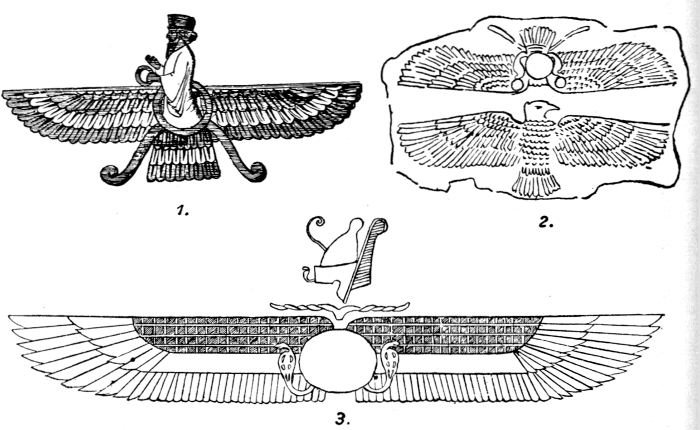
Figure 71.
Much food for thought is furnished by a Syrian relief sculpture from Amrit (published by Spamer, see fig. 71, 2), which exhibits a vulture or eagle with outstretched wings, in juxtaposition to a winged disk which appears to combine features of the Assyrian winged disk (the bird's tail and two appendages, see fig. 71,1) with the two uræi of the Egyptian form (fig. 71, 3). It is striking how clear the symbolism of the latter becomes when interpreted (1) as the symbol of the hidden god and his male and female form, Osiris and Isis, accompanied by the wings symbolizing air and the [pg 429] idea that the deity was invisible and immaterial; (2) as the symbol of Egypt itself—an entity, a complete circle, divided into two parts, under two rulers. The pair of antelope horns above emphasize the fact that the twain were as a single pair. The combined crowns of Upper and Lower Egypt, the latter exhibiting a serpent's head and the first, what appears to be its tail, constitute the symbol of joint rulership which, in this case, is accompanied by the feather, the rebus expressing the words “truth and justice.”
While the Syrian bas-relief conveys the idea of two separate kingdoms, one conveying the idea of single rulership, by the form of an eagle; the other of dual rulership, by the two uræi, each of which is crowned by a small disk; the Egyptian symbol distinctly conveys the idea of a close union of two distinct parts. The historical fact that Menes succeeded in uniting both lands under a single crown, indicates clearly enough that the ancient empire had become disintegrated and that by marrying the female ruler of the south he had reinstated the dual government on its original primitive basis. That, during the period of separation and independence, a powerful gynocracy had been formed seems more than probable. Just as evidences are met with in ancient Mexico of the existence of female communities, so the Old World furnishes accounts, deemed fabulous, of powerful gynocracies. Thus we have heard of the Amazons, the fabulous race of women warriors who are supposed to have founded a powerful empire on the coast of the Euxine.
A searching analysis of the texts translated by Brugsch, relating to the ceremonies performed at the New Year and famous Sed festivals, as well as historical facts gleaned from the works of living authorities, throw a light upon the position and sacred duties of the Egyptian queens during many centuries. The critical examination of a number of inscriptions, translated by Brugsch, is found to show that the queen was the high priestess and living image of Hathor-Isis and the personification of the female principle of nature, associated in Egypt with the nocturnal Heaven and the Above, and their symbols, the bird or vulture, the cow, the female serpent, the moon, the stars, and in particular Sirius-Sothis. In remotest historical times the goddess-queen seems to have resided in her own capital, a fortress. The universal necessity to insure the safety of women and children in times of warfare may well have originally led to the assignment of a separate, permanent [pg 430] place of residence, to the female portion of the population. The New Year festival, which coincided with the heliacal rising of Sirius (20th July, Jul. Cal.) and the overflow of the Nile, which suspended outdoor activity, was generally celebrated throughout the land as the “union of heaven and earth,” or the conjunction of “the sun and the moon, or Sirius.”
It was customary that, at this period, the queen, personifying the Sothis star, should come forth from her retirement and, surrounded by pomp and majesty, meet the king in solemn state, publicly occupy her place on the double throne, and share in the performance of sacred religious rites. It is easy to see that the idea underlying the entire ceremonial was the harmonizing of the actions of the sacred personifications of the dual principles of nature with the natural phenomena, from which arose a strange confusion of ideas concerning the relationship between these consecrated individuals and the powers of nature, which culminated in the artificial belief that they were divinely appointed mediators between humanity and the supreme power.
There are clear indications that the consecrated nuptials of king and queen marked the Sed festival which was celebrated, at the beginning of every fourth year, at Denderah. Brugsch tells us that the place on the roof of the Hathor temple, where the celebration of the Sed festival took place, is specially designated as “the place of the first feast” and in many cases this is shown to have been the small open temple, whose roof is supported by four columns (fig. 70, 2 and 3). In one passage it is expressly stated that “she, Isis-Sothis, consorts with her father, the sun, at ‘the place of the first feast,’ ” represented by a picture of the said temple (fig. 70, 6).
It is interesting to compare the following passage with the successive one, as they exhibit different phases of religious cult. “In solemn procession statues of the god Ra and of Hathor-Isis (Sothis-Sirius) were carried up the stairs from the interior of the temple to its roof (the tep-hat or head of the house) where, under the open sky or in the small open temple on the roof designated as Hait at Denderah, the idols were unveiled at a given time....” “On the morn of the New Year Isis-Sothis ‘beheld her father on the beautiful day of the birth of the disk’ (mas-aten) or ‘the birth of the sun’ (mas-ra).” It is described how “the goddess was led upon the roof so that she might behold the rays of her [pg 431] father on his rising.... She is sometimes addressed directly, being told ‘that thou shouldst see thy father on the day of the New Year.’ ” In other texts allusion is made to the approach of Sirius to the sun on New Year's day: “her rays join (heter) with those of the radiant god on that beautiful day of the birth of the sun's disk in the morning of New Year's day:” or “thou consortest with thy father Ra in thy open temple, thy beautiful face being turned towards the south;” and elsewhere, “she comes on her beautiful festival of the New Year, to unite her greatness in heaven with that of her father; the gods are festive and the goddesses are full of joy when the right eye (Sirius) unites itself with the left eye (the sun). She rests upon her throne in the place where the disk of the sun can be seen and the radiant one (Isis-Sothis) combines herself with the radiant one (the sun).”
On one of the columns of the roof-temple at Denderah, the following text is inscribed: “This temple of Rekhit flourishes in possession of a lion (mahes) and of his daughter ... of the Horus of the east and of the goddess Khont-abut. They assume her heavenly form on New Year's day and each one consorts with his neighbor.” Preceding inscriptions are made more clear by the following detached passages translated by Brugsch, which merit careful study. “An inscription at Abydos makes the goddess Safkhet say to the king: ‘thou didst appear as king upon thy throne on the feast hib-seb; like the god Ra at the beginning of the year.’ ” “The high-priest of Ptah at Memphis was charged with the celebration of the Sed festival, which was a general festival throughout the land.” “The annual going of the Hathor of Denderah to Edfu took place in the month Epiphi.” “The goddess Hathor-Isis of Denderah is frequently called the second female sun next to the sun's disk, the many colored, feathered goddess, and is identified with Isis-Sothis.”
According to an extremely ancient belief it was the goddess Hathor Isis-Sothis who caused the inundation of the Nile which, according to the inscriptions, coincided with the heliacal rising of Sirius. Owing to this circumstance she is called, “Isis the great, the mother of god, who causes the Nile to overflow when she shines at the commencement of the year,” or “the female sun who appears at the beginning of the year in the heaven as the divine Sothis star, the queen of the decan stars, whose rays illuminate the earth like those of the sun which appears in the morning. She is [pg 432] the mistress of the commencement of the year, who draws the Nile out of its source and thus confers life upon living human beings.” Elsewhere she is termed “the mistress of the commencement of the year, who makes the Nile rise at its period.” It is likewise said of her “on her beautiful feast of beholding her father, the heaven unites itself with the earth and the right eye unites itself with the left eye, at the beginning of the year.” She is described as Isis the great, the mother of god, the lady of Adut in Anet, the mistress of the beginning of the year, the monarch of the Sema? who appears on New Year's day to usher in the new year. (She is) the goddess Ament (the hidden one) in Thebes, Menat (the nurse) in Heliopolis, Renpit (i. e. the year) in Memphis, the divine star Sothis in Elephantine, the radiant one in Apollinopolis magna, etc.
In another passage Hathor-Isis is spoken of as “the goddess Mehen-net of the light-god and his Ar-hatef=(she who acts as pilot) in the boat sektet, which eternally passes through the heaven over the head of her father.” On the north wall of the Prondos of the Denderah temple Isis-Hathor is called “Hathor, the lady of Anet; Isis herself; the eye of Ra; the great one of Tentyra; the lady of heaven; the queen of gods and goddesses; the great Mat ... the female sun; the first in Tentyra; the true one amongst gods; the young; the daughter of a young ... [?] the beauty who appears in heaven; the truth which regulates the world at the prow of the bark of the sun; the queen and mistress of awe; the mistress of goddesses, Isis, the great, the mother of the god.”
The following texts from Brugsch are explicit enough: “The temple of Tentyra is fitted up for a bride, and is occupied by a bride.” “The temple of Tentyra is in bridal array and contains a bride on the beautiful festival of the birth of the sun.” “The temple of Tentyra is fitted up for a bridal and is in possession of a bride on her beautiful festival of the birth of the sun (mas-ra).”
The birth of a male or female Horus, of a young sun or moon, is alluded to in other texts as the “feast of the child in its cradle,” and coincided with New Year's day. According to Brugsch, the festival of the child in its ses=cradle, nest, or couch, undoubtedly coincided with New Year's day, as is proven by the following inscription: “The bringing of the band of stuff to the great Isis, the mother of the god, for the obtainment of a happy year. Receive, receive happy years on the day of the night of the child in [pg 433] its cradle!”... It is usual to interpret the birth of the young child, or sun of the New Year as a mere allegory of the astronomical fact and it may have been thus in later times. On the other hand, historical data prove that the actual birth of a “child,” the offspring of a royal sacramental marriage, did take place in the temple and that children, thus born, afterwards became the rulers of Egypt.
“At Luqsor, ... a great temple was built by Amenhotep III (B.C. 1414-1379) to ‘his father Amen,’ with special reference to the divine conception of the king.... His birth is the great subject of the temple ... and his mother Mut-em-ua is the prominent figure in those scenes, pointing to her being important as queen-mother....” Of the later king Hor-em-heb (B.C. 1332-1328) it is inscribed: “Amen, king of the gods, dandled him ... when he came forth from the womb he was enveloped in reverence, the aspect of a god was upon him; the arm was bowed to him as a child and great and small did obeisance before him ” (Flinders Petrie, op. cit. pp. 177, 190 and 248).
The small Isis temple to the east of the great temple of Hathor at Denderah is specially designated as the lying-in chamber, or sacred house of birth. An inscription dating from the Roman period, on the outer eastern wall of this building reads: “Life! the female Horus, the youthful, the daughter of a hak (regent, Brugsch), Isis, the great, the mother of the Ra=god, is born in Tentyra in the ‘night of the child in its cradle,’ at the west side of the temple of Hat-seses (the great temple of Hathor).” It is, moreover, stated that “Horus, in female form, is the princess, the powerful, the heiress to the throne and the daughter of an heir to the throne.”
In another inscription, on the south wall of the small temple of Isis, the birth of Isis is described thus: “On this beautiful day, ‘of the night of the child in its cradle,’ on the great festival during which the world is re-adjusted, or balanced (sekhek en ta), the bringing forth of Isis takes place in the interior or centre of Anet (Tentyra) by the goddess Ap, the great, in the chamber of Ap, in the form of a dark red female person, the Khnum ankh, the lovely. Her mother, Nut, exclaimed at the sight of her: behold, (As is) I have become a mother. Thence the origin of the name Isis.... The south, towards the place of rising of the sun's disk, has been given over to her, and the north, towards.... [pg 434] She is, namely, the mistress of both sides of Egypt, with her son Horus and her brother Osiris.”
On the east side of the wall of the terrace at Denderah a similar inscription reads: “Uar-kher-ta is the name of this locality. The name of the place of the cradle of Isis is named Adut, which is the house where the ‘accouchement’ of Nut, the goddess of heaven, takes place. It is here that, at the time of the ‘night of the child in its cradle,’ the god-mother is brought into the world, in the form of a dark female, named Khnum-ankhet, the lady of love and the queen of the gods and goddesses. On seeing her, her mother exclaimed: As, îs i. e. lo, or behold, I have become a mother! Thence the origin of her name Isis.... She is the lady of the temple of Egypt with her son Horus and brother Osiris, now and forever into eternity.” The most instructive account of the festival which has come under my notice is the following, contained in another inscription in the temple at Denderah.
“The fourth day, supplementary to the year (of 360 days, i. e. the 364th day) is the beautiful day of the ‘night of the child in its cradle’ and is a great festival of preparation. During the night preceding this day there takes place the procession of the goddess Hathor and the divinities with her. The circuit of her temple is made and all is duly fulfilled according to the custom. Upon this follows the return to their places (chambers in the temple). The golden one (Nubet, the ordinary appellation of Hathor-Isis as the star Sothis-Sirius, Brugsch) rises, shining, above the brow of her progenitor, and her mysterious (literally, full of secrets) form is at the prow of the boat of the sun. As soon as she reaches the āk (centre) of her city in the presence of her Nomos, she beholds her dwelling with the most joyful feelings. When she enters her house her body is full of delight. When she has taken possession of her exalted dwelling, surrounded by her fellow-gods, who stand at each side of her, her soul in her body is full of rejoicings. When they join the rays of her father (the sun god) and are united to the radiance of his disk, the city Anet (Tentyra) is happy. Adoration is made in Adut (the lying-in chamber) and Pi-anet is in festive state, when it beholds the great, the powerful leader, she who creates the festival in the holy city on that beautiful day of the New Year.”
Elsewhere we read: “The city of Anet is in a constant exaltation when the goddess Isis is born in it (in the small Isis temple) in the [pg 435] form of a dark red woman, whose name is Khnum-Ankhet, the lady of love, the queen of goddesses and women, the bride. It is beautiful to see the shining appearance of the ray of light in the heaven, in the dusk, at the time when she is born in this city.... A flying beetle (?) is born in the sky in the primæval city of Tentyra at the period of ‘the night of the child in its cradle.’ The sun shines in the heaven at dusk when her birth has taken place. Gods and goddesses praise the name of her majesty....” “Ra-Hur of Apollinopolis magna, god Sam-ta, comes forth, or arises, in the dawn (akhekh) when the birth takes place in ‘the night of the child in its cradle,’ on the great festival of the entire world (or the entire land). He shines for her majesty when she has brought forth (the child). Her child is in the form of a beautiful boy, who is the lord of Tentyra. The gods and goddesses came to her carrying the symbol of life (the ankh) and the sceptre of power (the tam) so as to fulfil their desire and her wish” (p. 103).
The following extract from a papyrus which belonged to a priest of Amon, named Horsiesis of Thebes, of the time of Augustus, affords an extremely interesting insight of the mysterious ceremonial which had gradually developed. It is evident that the text, though apparently clear, must have been intelligible to the initiated only, who alone were able to understand the allusions to secret, sacred rites and their symbolical meaning.
“Thou raisest thyself to heaven, in the region of the city Ka ... thou goest with the king when he goes to Thebes ... thou seest the Sktt bark on its arrival in the city of Thebes and the two sisters united in Pi-ubkt ... thou seest the goddess Hathor who becomes the mother of her own mother117 on the day ... of the Tx festival ... thy name is called amongst those of the judges on the great Hermopolis in the night of the festival of he who remains [pg 436] in the middle or centre of his city ... thou seest the immovable ones united into a quatuor, in form like a young bull ... thou seest their wives united together in the form of the goddess Anthat ... thou visitest the caves of Thebes when his majesty betakes himself to the zone of Smu.... The mistress of heaven comes to her house ... thou receivest a cloak from his hand ... the divine eye ... thou watchest at night in the chamber of birth on the day of the [lying in] birth of the goddess Mut....[Nut?] Thou goest in with those who go in and comest out with those who come out like the great Horus in his temple ... thou seest in her domain(?) mysterious actions performed by the Pastophores. No one sees, no one hears (of them) ... thou hearest the voice of the singer in the temple, in varied modulations ... thou ascendest the stairway of the eternal circle of light, thou seest the strong ram in its domain ... thou seest ... in his first form, Osiris, in the house of purification.” (Brugsch, op. cit. ii, pp. 518 and 520).
A careful perusal of the preceding texts conveys an idea of the immense lapse of time it must have required for the state religion of Egypt to have developed itself and crystallized into a complicated ritual, the true significance of which, doubtlessly, gradually receded from view. The naïve primitive symbolization of the union of heaven and earth by the actual marriage of king and queen, followed by general marriage festivities, had naturally created, in course of time, a distinct privileged caste rendered “divine” by the circumstances attending their conception and birth. Once in existence the maintenance and insurance of the divine line of descent would naturally enforce the intermarriage of its members and the sequestration and guarded seclusion of the royal women and the virgin priestesses from whose ranks the destined mothers of the divine children were selected.
A more ancient form of symbolizing the union of heaven and earth seems to have been the cult of Apis, which, according to Maspero, preceded the building of the pyramids and could scarcely have arisen before the adoption of the cow or bull, ua, as the rebus of Polaris, the One=ua. A survival of Apis cult seems to be the allegorical sacred title “bull” (Osiris-Apis) bestowed upon the king, of “cow” upon the queen and “calf” upon their offspring, the young Horus. In later times the king was entitled “the ram” and wore his fleece and horns on visiting the queen. As a natural [pg 437] sequence, the fruit of their union was spoken of as “the lamb.” According to Herodotus (ii, pp. 27-29, Cary's translation), “the sacred Apis, or Epaphus is the calf of a cow incapable of conceiving another offspring; and the Egyptians say that lightning descends upon the cow from heaven and that from thence it brings forth Apis.” “The Egyptian magistrates said ... the god [in the form of Apis] manifested himself at distant intervals ... and when this manifestation took place the Egyptians immediately put on their richest apparel and kept festive holiday.”
As stated by Mr. Wallis Budge, Apis worship was established at Memphis by Ka-kau, the second king of the second dynasty B.C. 4100. The veneration accorded to the bull, cow and calf, as embodiments of the dual principles of nature, in separate and in single form, seems to have been accorded in other localities to different animal forms and to have been replaced, in later times, by triads, composed of a god, goddess and their offspring, each great centre ultimately possessing their particular triad, the living images of which were the high-priest, high-priestess and their “divine” offspring. It should be noted that a group consisting of 8+1=nine gods, high priests or prophets, accompanied the triad, the result being twelve “deities” in all, of which one=the child, was an embodiment of two principles and was the ka=the divine twain.
The transition of Apis worship from the animal to the human form was accomplished during the reign of the Ptolemies (B.C. 305-42) when Serapis or Osiris-Apis was introduced into Egypt and represented as a man with the head of a bull, wearing a disk and uræus. Long before this, however, androsphinxes and other combinations of the human and animal form had existed in Egypt. At Thebes the divine triad was formed by Amen-Ra, Mut-Hathor and Chonsu; at Edfu and Denderah we find Osiris, Isis-Sothis-Hathor and Horus. On the other hand, a curious inscription in the temple at Denderah, translated by Brugsch (ii, p. 512), actually describes Amen-Ra as “the great god in Denderah, who periodically rejuvenates himself and becomes a beautiful boy, who is the concealed or hidden god, whose name is hidden; who is the Horus with colored wings, coming forth in the upper hemisphere of Edfu, the lord of the double heaven.”
The inference one might be tempted to make from this and other texts is that, at one period, a human babe, the fruit of a [pg 438] royal or sacerdotal union, was born in the temple on what constituted New Year's Day and was secretly worshipped there during the ensuing year, as the living image of Amen-Ra, the hidden god and “divine twain.” I venture to point out that the adoption of the child as the image of the divinity was the logical sequence to the preceding employment of the bull as a rebus for the words ua=one and ka=twain; that the consecration of the human form must, undoubtedly, have given a strong impulse to statuary, and that the sanctification of the child correspondingly exalted motherhood and lent a particular consecration to the marriage of its “divine parents.” The following facts, culled at random, afford a limit of the transitions and further developments which took place in Egypt in course of time.
Before proceeding, special mention must be made of one important point which throws a flood of light upon the extent of the development of separate cults of sun and moon and the institution of solar and lunar calendars which respectively governed the activities of the male and female populations. As this matter will be fully treated in my calendar monograph I shall merely note here that Brugsch cites texts proving the existence and simultaneous use of the two calendars, and the supreme importance accorded to the new moon of the month Epiphi on whose appearance the “goddess Isis-Hathor of Denderah embarked on her sacred barge and proceeded up the river, from her city to Edfu (Apollinopolis magna) where she joined his majesty ..., her father, ... the incomparable sun-god Ra, the first of Apollinopolis, the golden disk, whose children are numerous....” It is further stated that the god and goddess became inseparable like sun and moon. Brugsch states that the appearance of the said new moon, which was also associated with the heliacal rising of Sirius, would range from Aug. 18 to Sept. 16, Jul. Cal. (see op. cit. ii, pp. 282-1). The appearance of the goddess was the signal for the opening of a season of general “feasting and drinking, rejoicing, singing and dancing” throughout the land, to which the name Tekhu is given in some texts. This is translated by Brugsch as “the intoxication of gladness or joy;” it “coincided with the highest level attained by the overflow of the Nile,” and its modern survival is the annual “marriage of the Nile” which takes place on the 23d of August.