The Fundamental Principles Of Old And New World Civilizations. (continued 5)
Reading edition
Meanwhile, let us examine the Cakchiquel tradition about Cucumatz, the sorcerer chief of the Quichés, since it also treats of the 7-day period. We are told that he “ascended to heaven for seven days and descended into the under world for seven days and then assumed, in rotation, four different animal forms during as many periods of seven days.”
It is impossible not to recognize from this that, like the Zuñis of to-day, the Quichés “symbolized the terrestrial sphere by referring to the four cardinal points, to the zenith and nadir, the individual himself making the seventh number,” and that Cucumatz, who was evidently the high priest and head of the seven tribes, assumed the totemistic attributes of each of these, in rotation, for periods of seven days each. In this case we have an interesting and suggestive variant of the scheme and it suggests the possibility that, possibly actuated by ambition, Cucumatz had grasped and united in his person the prerogatives of the chiefs or heads of each tribe. On the other hand, it may be that it was the original custom for the high priest to be a sort of animated calendar sign in unison with the separate chiefs of each tribe, who represented, in rotation, the totemistic ancestors of their people.
Having shown how the lords of the Four Quarters were indissolubly linked to the four major calendar-signs which also symbolized the elements, let us examine the data establishing that the capital of each of the four provinces was named a tecpan. From Duran I have already quoted that in the Mexican metropolis there [pg 183] were two tecpans or official houses in which the affairs of the government were attended to and councils held. It is significant that one of these was named “the tecpan of men” and the other “the tecpan of women.” Whilst the metropolis, the seat of the dual government, thus had its two tecpans which were presided over by the two supreme rulers, we have learned from other sources of the four tecpans in Guatemala and that Texcoco, near the city of Mexico, was also termed a tecpan and that its ruler bore as a title one of the four major calendar-signs. These facts explain his position and the reason why the “lord of Texcoco” was one of four lords who supported Montezuma when he met Cortés in full state. A careful investigation of the derivation and true significance of the word tecpan yields interesting results. Cen-tecpan-tli means, a count of twenty persons; the verb tecpana signifies, “to establish something in concerted order; to establish order amongst people.” The verb tecpancapoa means, to count something in regular order.
The Maya verb tepal=to govern or reign, or to be “one who mediates,” appears to be allied to the above Nahuatl words and it is not unlikely that the employment of the flint-knife or tecpatl as an emblem of office had been suggested by the fact that its Nahuatl name resembles, in sound, the above words formed with tecpan, and also the Maya verb tepal. It thus constituted a bilingual rebus, expressing the sense=to govern, to rule, to regulate, etc., and, employed as the symbol of the North and Polaris, it conveyed the idea that the latter was not only the producer of life but the regulator of the Universe.
From the fact that a tecpan constituted a minor integral whole and comprised the rule over twenty classes of people, we see that whilst the four provincial tecpans were in themselves miniature reproductions of the metropolis, they but filled the same position in relation to this as the four limbs to the body of a man or quadruped. A final proof of how completely this analogy was recognized by the native rulers is furnished by the Maya titles which embody the word kab=arm and hand.
It has already been mentioned in the preceding pages that the rulers of the four quarters were entitled Ba-cab and that in the Dresden Codex an image of the four quarters was figured by four bones. The word for bone being bac and for arm being kab, it is obvious that the arm-bone or humerus would furnish a rebus, expressing [pg 184] the title of the four Bacabs—a conclusion which throws light upon the signification of the cross-bones of native pictography and also of the incised and decorated human arm and leg bones which have been found in Mexico and Yucatan.
At the same time the word kab also recurs in the title Ah-Cuch-Cab which signifies “the ruler or chief of a town or place,” Cuchil being the name of the latter. Both of these words so closely resemble cuxabal and cuxtal, the word for “life,” that it is not impossible that the native mind often associated the town as a centre of life, and thought of their chief as one whose symbol was a “life-dispensing hand.” In order to grasp the full significance of the symbol of the hand in Maya sculptured and written records it is necessary to bear these facts in mind.
In 1895 Mr. Teobert Maler unearthed in the centre of the public square at “El Seibal,” Guatemala, a sculptured stela exhibiting the figures of a chieftain over whose head an open hand was carved. It is impossible not to interpret this as a mark that the chieftain had once been the ruler of a town and that this, in turn, was one of four minor capitals belonging to a central metropolis. A hand, enclosed in quadrangular lines and represented on the garment of a chieftain, was found by Dr. Le Plongeon at Uxmal, and I believe that this should be interpreted in the same manner.
In my essay on Ancient Mexican Shields (Internationales Archiv für Ethnographie, band v, 1892) I reproduced two interesting instances of the employment, as the name-sign of a ruler in native pictography, of a hand on the palm of which an eye is depicted. The effigy of a hand, the sacred Kab-ul, which was kept in a place in Yucatan to which people from all quarters resorted regularly in great numbers, resolves itself into the symbol of an ancient capital to which great high-roads led from the cardinal points. But important as this capital may have been, its connection with the hand-symbol proves that it was originally one of four minor centres and formed but a part of a greater whole. It would correspond to the image, in one of the native Codices, of a subdivided circle with an arm and hand standing in its middle, and its Bacab would undoubtedly have carried a sceptre in the shape of an open hand, such as depicted in the Codices as a staff of office.
While we thus find the human figure distinctly associated with the lords of the four quarters of the Above we find the four lords of the Below, entitled Chac, symbolized by the quadruped figure [pg 185] of the native jaguar=chacoh, associated with the color red=chac and with rain, storms, thunder and lightning, all of which phenomena were, singly and collectively, termed Chác.
If ever there has been an instance where language or the resemblance in sound of certain words has caused certain symbols to amalgamate with a name or title, it is surely this, and light is thereby thrown upon the development of symbolism and associations of thought amongst primitive people.
The Chacs of Yucatan were identical with the Tlalocs, the octli or rain lords of Mexico, whose function, as votaries of earth-cult, was the regulation of agriculture, irrigation and the collection and distribution of all products of the soil. It is interesting to trace that, in other regions of Yucatan, presumably where no chacohs or jaguars existed, the minor rulers of provinces seem to have been termed ocelots=Balam, a title found associated with Maya rulership.
With the foregoing data in mind it is easy to grasp the meaning of the talon of a beast of prey, employed as an emblem of rank or office in the native Codices or bas-reliefs and to perceive that this was the symbol of a Chac or Balam, one of the four lords of the earth or Below, just as the hand was that of the lords of the Above. The complete image of the dual State is thus shown to have consisted at one time of an ideal group consisting of a man with a beast of prey, a jaguar or ocelot. In Mexico we have the man-bird and the man-ocelot respectively representing the rulers of the two great divisions of the State.
At Chichen-Itza and elsewhere in Yucatan sculptured figures of ocelots supporting circular vessels have been found and there are interesting instances of the combination of the human figure with ocelot=Balam attributes. One monolithic figure, discovered at Chichen-Itza by Mr. A. P. Maudslay, and belonging to the category of the recumbent statues bearing circular vase-like receptacles, already described, exhibits a human head and form, whilst the body is covered with a spotted skin. In the sculptured image of Mictlan-tecuhtli (fig. 19) a human head is accompanied by limbs of equal length-terminating in wild beasts' talons. The positions of the limbs are better understood when compared with the following illustration, to which I shall revert (fig. 51). Meanwhile, I shall merely remark that in both of these curious bas-reliefs we seem to have images of the quadruple terrestrial and celestial [pg 186] governments. Fig. 51, which is a corrected drawing of one of those contained in Leon y Gama's “Descripcion de las dos Piedras,” furnishes an interesting example, in accord with the image of Mictlantecuhtli, of the employment of the group of five as a symbol of the centre and four quarters, and exhibits four limbs associated with four heads (the quarters and their chiefs), while the hands hold two other heads, symbolical of the dual rulers of the State.
Two facts which throw an interesting light upon the growth of native symbolism are worth mentioning here. As a symbol on the head of Mictlan-tecuhtli, the lord of the North, two representations of a centipede are distinguishable. In Nahuatl the name of this is “centzonmaye,” literally, four hundred hands. It can thus be seen that the idea of one body with a multitude of hands had occurred to the native philosophers as a suitable allegory for their conception of a central celestial and terrestrial rule which guided the activity of innumerable appointed hands and dispensed, through these, not only life and favors but also death or chastisement.
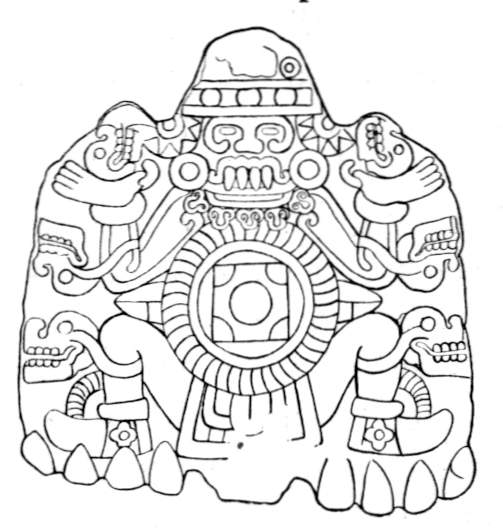
Figure 51.
Before proceeding farther we must consider tree-symbolism in ancient America. According to Molina the Inca Yupanqui (surnamed the left-handed) ordered the temple of Quisuar-cancha to be made: quisuar=a tree, the Buddleia Incana, cancha=place of. Salcamayhua (op. cit., p. 77), who attributes the building of this temple to Manco Capac, states that these two trees, which were in the temple, “typified his father and mother ... and he ordered that they should be adorned with roots of gold and silver and with golden fruit. Hence they were called Ccurichachac Collquechachac Tampu Yracan, which means that the two trees typified his parents, that the Incas proceeded from them like fruit from the trees, and that the two trees were as the roots and stems of the Incas. All these things were executed to record their greatness.” This passage is of utmost value, for it conveys to us not only that the Incas kept a record of their male and female ancestry and respectively associated the male [pg 187] and female elements with gold and silver, but also establishes the important point that the tree was employed as an emblem of the life and growth of a lineage or race.
This fact is particularly interesting if collated with the Mexican tree-symbols. In the Féjérvary diagram (fig. 52), we find a different kind of tree and two totemic figures assigned to each quarter, which indicates that the inhabitants of each of the four provinces were regarded as of a distinct race. The top of each tree spreads itself into two branches and, with one exception, each of these bears three blossoms or leaves denoting, it would seem, the division of a tribe into 2×3=6 parts.
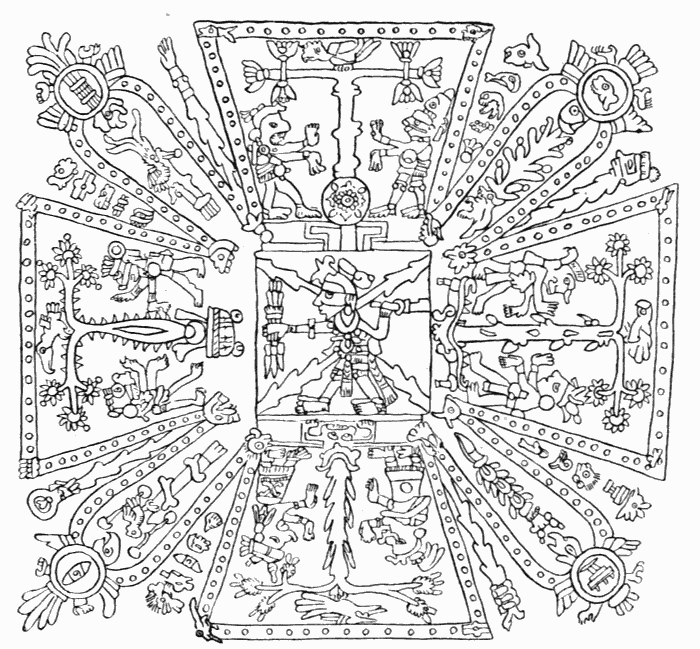
Figure 52. Copy of p. 44, Féjérvary Codex.
The majority of tree-symbols, however, exhibit a quadruplicate division as in fig. 53, nos. 1, 4 and 7. At the same time it is impossible not to recognize that each example renders in a graphic manner the organization of a tribe. In nos. 2 and 8, for instance, we find that each of the four branches was again subdivided, yielding eight subdivisions instead of four. In no. 3, we have quadruple branches, a pair of recurved spikes with buds and a [pg 188] central bud, the idea of duality repeating itself in the trunk of the tree, one-half of which above ground is white, whilst the other below ground is dark. The obvious allusion is to the Above and Below and this idea is further symbolized by the head of the coatl=serpent or twin. In this figure there is a hint of the existence of an idea I have found expressed in other cases, namely, that a mystic line of demarcation existed at the base of a tree, which separated its upward from its downward growth. This was the seat of the life of the tree, which sent its trunk and crown heavenwards and its roots and rootlets earthwards. The fact that the juice of the agave or maguey was collected from the core of the plant seems to be at the bottom of its adoption as the sacred and ceremonial “drink of life,” which was, subsequently, carefully prepared and fermented. The idea that a tree enclosed male and female elements seems to have been also a strong one and would, in course of time, doubtlessly have led to the conception of superhuman beings in human form, dwelling in trees. What is more, the adoption by each tribe of a particular sort of tree, a custom amply proven, would naturally lead to a species of tree-cult or veneration which, amongst the uninitiated, might lead to a form of worship of the tree itself.
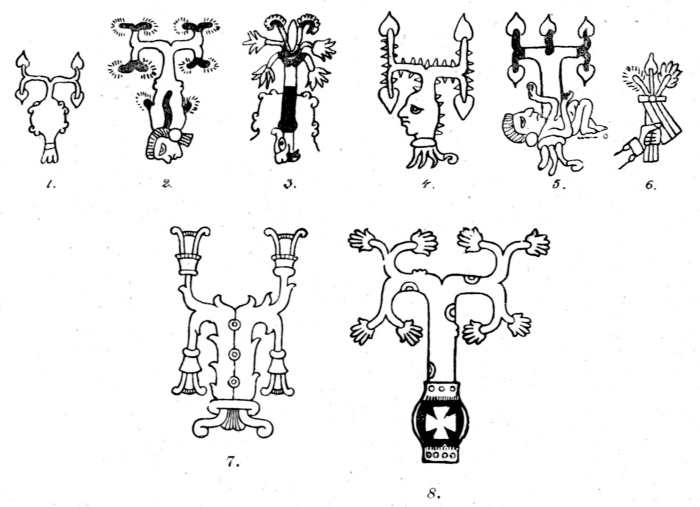
Figure 53.
[pg 189]
The ceremonial presentation of single leaves of the same kinds as those represented on the trees, as in fig. 53, no. 6, proves that underlying these picture-writings there is far more meaning than has heretofore been suspected or recognized. It is not possible for me to present here all the material I have collected on this subject which will be set forth in a future monograph. I will, however, direct attention to the peculiar treatment in fig. 53, no. 1, of the tree trunk which is enlarged and forms a quadriform figure. In no. 4, the trunk enlarges to the shape of a head; in no. 2 the tree grows from a human head and two young shoots issue from each side of the trunk, seemingly indicating a fresh growth in tribal life. In no. 5, we have an example of a human figure lying at the base of a tree and a fifth leaf growing in the centre of the treetop. Directing attention to the evident care taken in representing an equal number of branches pointing upwards and downwards I would cite here an extremely interesting representation of a tree in the Borgian Codex. In this case the trunk issues from a conventionally drawn heart, figured in the centre of the symbol for sky or heaven. As the Nahuatl for heart is yul-lotl, from the verb yuli=to live, to resuscitate, the idea is distinctly conveyed that the tree was that of life=yuli and proceeded from the celestial centre of life, Polaris or the Heart of Heaven, a native title for the Supreme Being.47
In the Telleriano-Remensis MS., a “tree of Paradise,” so termed in the text, is figured, and there are, in other Codices, various examples of trees encircled with serpents, where it is obvious that this combination was made in order to express, phonetically, that a celestial tree was intended, the word kan=serpent, being made to express kaan=heaven. A celestial tree, situated at the pole and bearing in some cases seven and in others five blossoms, was frequently depicted and its symbolism is obvious. In my commentary on the Hispano-Mexican MS. “The Lyfe of the Indians,” the “Gods,” “Five Flowers,” and “Seven Flowers,” will be treated in detail.
From Sahagun and Olmos we learn that the Mexicans employed the image of a tree, metaphorically, to signify a lord, governor, progenitor, first ancestor. Relations are designated as “issuing from one trunk.” A branch is literally termed “the arm of the [pg 190] tree,” kab-ché. Two kinds of trees, the Puchutl and Aueuetl, signified, metaphorically, “a father, mother, lord, captain or governor who were, or are, like shade-giving, sheltering trees” (Olmos).
The above metaphors explain the frequent association of a head, the symbol of a chief or lord, with the tree symbols. It is noteworthy that in Nahuatl, the name for head=quaitl, is singularly like quauitl=tree, and also recalls the word for serpent=coatl, facts which may have somewhat guided the choice and association of these symbols. The native metaphors recorded by Olmos, moquauhtia=an honored person or lord who has vassals or dependents, and atlapalli=literally, leaf=a person of the lower class, a worker, initiate us still further into the meaning of the native symbolism and prove the antiquity of this, since the designation of a chief as a tree and a vassal as a leaf was in current use. The presentation of the tree issuing from a heart=yul-lotl is moreover, in perfect keeping with native thought, since the chieftain or lord was entitled “the heart, or life of the town or population.”
The meaning of the bird, which is represented as perched on each of the four trees in the Féjérvary diagram, is likewise explained by the metaphors recorded by Olmos who states that, “a son or child or a much beloved lord or chieftain was compared to a beautiful and precious bird, such as the Quetzal, the Roseate Spoonbill, the Blue-bird, etc., etc.” Surmounting the tribal trees in the diagram, the birds therefore typify the lords of the four provinces and this is corroborated by the fact that each different bird is figured again in the corner-loops in combination with the symbols of the cardinal points. The association of the symbols for lord or chief=the head, and the precious bird with the tribal tree also explains the frequent representation, in the native Codices, of one or two serpents entwined around the tree, since the serpent was the symbol in Mexico of the dual rulers or high-priests of the Above and Below. There is ample proof, which shall be presented in full in my monograph on this subject, that the above metaphorical images were as intelligible to the Mayas and other tribes, as to the Mexicans themselves, for the identical metaphors and imagery were in widespread general use. The following data will corroborate this statement.
A Maya native drawing, copied by Cogolludo in 1640 from the MS. of the Chilan Balam or Sacred Book of Man, which relates the [pg 191] history of the Mayas, has been recently reproduced in Dr. Daniel G. Brinton's Primer of Maya Hieroglyphics, p. 47. It displays a rectangular stone slab like a table, on the centre of which rests a circular bowl, the symbol, as I have shown, of the earth and centre. Growing from this is a spreading tree.
It is a curious and undeniable fact that the Maya name for table is mayac, and that the dictionaries contain the words mayac-tun, stone-table, and mayac-ché, wooden, literally, tree-table. Familiarity with the native modes of rebus-writing leads to the inference that this picture of a tree and table, expressing the sounds mayac-ché, actually signified the tree of the Mayas and therefore figured in the book relating their history. Bishop Landa records that the Mayas believed in a beautiful celestial tree, resembling the ceiba and named yax-ché, literally, green tree, under whose shade they would repose in after-life. Abbé Brasseur de Bourbourg surmises that this tree was the same as the beautiful shade tree which grows in Yucatan and Mexico and is named, in the latter country, tonacaz-quahuital=tree of our subsistence, i. e., life.
A Maya name for the “tree of life,” ua-hom-ché, next claims our attention.48 A valuable old manuscript dictionary of the Maya language, quoted by Dr. Brinton, records that the word uah means “a certain kind of life.” The word hom is an ancient term for an artificial elevation, mound or pyramid, hence homul, the pyramid on which a temple was built. Combined with ché, tree, the word seems to signify “the elevated or high tree of life,” the idea of the celestial tree “on high,” being possibly intended. In connection with this it is interesting to reëxamine fig. 20, IV, which represents a flat pyramid from which grows a four-petalled flower on a stalk with two leaves, the symbolism of which is apparent.
I am inclined to connect another native name translated in the dictionaries by “cross”=zin-ché with zihil=to be born, to commence, zihnal=original, primitive, and zian=origin, generation, ancestry, and to interpret it “the tree of ancestral or tribal life.” On the other hand, there is the adjective zinil=mighty, great, and the meaning of zin-ché may merely mean “the mighty tree.” In treating of the “cross tablet” of Palenque in the following [pg 192] pages, reference will be made to Dr. Brinton's identification of the “cross” as a tree and tree symbolism referred to again. Although unable to produce here all the data I have collected on the subject, I think that the foregoing prove that the Peruvians, Mexicans and Mayas, employed the four-branched tree as an image of the organization and growth of their communal life, and utilized it in pictography as a means of recording changes of organization and statistics of increase or decrease of population. The Maya word for “one generation of men,” uinay, literally meaning “one growth,” seems to reveal that each generation was popularly thought of as one growth of leaves on the tree of state—a simile which is worthy of note.
One more point remains to be considered in reference to the organization of the population into four parts, each of which consisted of four minor parts and so on; namely, the employment of color as a means of differentiation.
In Peru each person wore on the head a twisted cord, of the color of its quarter, whilst the Inca alone wore these colors combined, in the band which encircled his brow, as a sign that, in his person he united the rulership over the four provinces. Molina records the colors of these as red, yellow, white and black. In the titles of the Maya Bacabs, or lords of the provinces, as given by Landa, the words for yellow, red, white and black, are found to be incorporated and prove to be identical with the arrangement in Peru. In Mexico, on the other hand, we find red, yellow, green and blue as the colors of the Four Quarters, white and black being assigned to the Above and Below. All colors combined are to be found united in symbols of the Centre and it is known that the use of centzon-tilmatli and quachtli=mantles of four hundred colors=multicolored were supplied as tributes to the capital, for the use of a privileged caste. A somewhat similar arrangement to the Mexican is that of the Zuñis at the present time. According to Mr. Cushing, they assign yellow, blue, red and white to the cardinal points, speckled and black to the Above=zenith and Below=nadir, and “all colours to the Middle or Centre.”
In Peru, Mexico and Yucatan I have found scattered notices proving that individuals habitually painted their bodies with their respective colors. The Mexican “lords of the night” smeared themselves with black. A passage in Sahagun (book i, chap. v) speaks of the whitening of the “face, arms, hands and legs with [pg 193] ‘tiçatl’ ”=chalk, as though this were a habit of the “noblewomen.” In the Codices some women are, in fact, represented with white faces, whilst those of the majority are painted yellow and it is known that yellow ochre was employed in reality. I have, in preparation, a brief, illustrated monograph showing the various modes of painting the face represented in the native pictorial records. In these, men painted red are of frequent occurrence, and it is known that the “red man” owed his appellation to the custom of using red pigment on his body.
Let us now briefly consider some of the results which inevitably followed the establishment of two diverging cults which were the outcome of the primitive recognition of duality and the artificial association of sex with Heaven and Earth, Day and Night, etc. On pp. 60-62 I have cited evidence showing that at one time in the past history of the Aztecs, serious differences arose between the male and female rulers, and led to a separation of the tribe and the establishment of two distinct centres of government.
The native languages furnish strong indications that, in ordinary tribal life, the separation of the sexes must have been generally enforced from remote antiquity and that male and female communities existed in various portions of the continent. It is well known that, to this day, the Nahuatl tongue spoken by the men is different from that spoken by the women, and that the same duality of language prevails among other American tribes. When the male and female portions of the native states separated and founded separate capitals it is obvious that each would have still further cultivated a separate language and that the institution of two distinct cults would have accentuated their differences and given a fresh impetus to their development. As will be shown, the Maya chronicles reveal that, in Yucatan, the nocturnal cult of the female principle degenerated into such abominations that the incensed population actually rose in revolt, murdered the high-priests and scattered their votaries.
It was obviously owing to a recognition of the degradation attendant upon the abuse of intoxicating drinks, which had played such a rôle in the cult of the earth-mother, that such stern laws were enforced in Mexico, at the time of the Conquest, restricting and regulating the use of pulque. This was distributed by the priests at certain festivals only. These and other rigid measures [pg 194] evidently dictated by a spirit of reform, as well as the close union of both cults, seem to have efficiently maintained a certain equilibrium. At the same time two different moral standards were thus inevitably evolved by the votaries of both cults and naturally profoundly affected the position of woman. The dangers and evils attendant upon the earth-cult became irretrievably associated with the female sex and the votaries of Heaven naturally came to regard woman as a source of temptation and degradation. In ancient Mexico and Peru the celibacy of the sun-priests and of a certain number of noblewomen, “the Virgins of the Sun,” was enforced; thus, whilst the position of woman was being lowered in one caste by an artificial set of ideas, it was raised in the other by an equally fictitious association with the Above, which led, however, to her real elevation of mind and character and finally enforced a recognition of her individuality. The consecration of her person, which caused her to assume a position commanding universal homage, relieved her from heavy labor but caused her to be guarded and protected. She was thus condemned to a still greater seclusion, the primary object of which was to remove her from possible contact with members of the lower earthly caste. For, whilst ceremonial usage even required that the male members of the upper caste should associate in certain symbolical rites with the chief women of the lower order, it was a crime and a desecration for a man of the latter caste to approach a woman of the nobility. These could only marry in their own caste or remain celibate and were kept aloof from all debasing influences, inside of protecting walls.
Reflection shows that such conditions would inevitably lead to the formation of a nobility whose ideal was celibacy and whose “Virgins of the Sun,” by virtue of their consecration, ranked highest amongst the women of the “celestial caste.” Those who married did so in their own caste, led a life of seclusion and always maintained a position of superiority over all women of the “earthly caste.” The latter, on the other hand, had the prerogative of being the representatives of their caste, since the cult of the earth-mother necessitated a female representative, high-priestesses and also female chiefs in their own rights. We know that, in ancient Mexico, an independent gynocracy had been founded at one time. From certain native manuscripts and monuments we have positive evidence that a number of independent female chieftains ruled over minor communities and represented them officially, [pg 195] their rank and insignia being equal to that of the chiefs of male communities. At the same time, from the standpoint of the “upper caste,” the position and moral code of these “votaries of the earth,” were always viewed as inferior.
Another factor also exerted a marked and growing influence upon the relative positions of the two classes of women. The enforced seclusion of the noblewomen rendering out-door occupations or work impossible, it became necessary to relegate such to members of the lower caste who gradually constituted a class of domestic slaves, dedicated to the service of the nobility. In ancient Mexico, as a punishment for various crimes, such as murder, theft, etc., an individual, even of the upper class, was reduced to slavery as a punishment for his crime. The ranks of slaves were also recruited from prisoners of war. On the other hand, the laws regulating slavery were just and mild, the children of slaves were born free and various modes of regaining freedom were afforded to those held in bondage as an expiation for crime. The introduction of slaves necessitating, as it did, their classification with the lower class, now associated servitude with the female division of the community, and the idea arose that women and the lower class existed for the benefit of the male element of the state and a favored minority of consecrated women.
If slavery and bondage came to be regarded on the one hand as a just punishment for crime, the idea of liberty shone as an incentive to good conduct. An eloquent proof of the high estimate in which personal freedom was regarded by the ancient Mexicans, is furnished by the Nahuatl word, recorded by Olmos, for “free man”=xoxouhqui-yollotl, literally, “fresh or green heart.” This expression is of particular interest because it explains a strange mortuary custom which consisted in placing a piece of jade, chal-chihuitl, or precious green stone, in the mouth of a noble person, after death, saying that it was “his heart.” In the case of the lower class a stone of little value, named texaxoctli, was employed. In ancient Mexico, therefore, the presence of jade or any green stone, in a grave, proved that the body was that of a free member of the upper caste. It is evident that the employment of this significant emblem was suggested by the Nahuatl word for “freeman,” and constituted a sort of rebus expressing this title or rank.
In the Peabody Museum there are several specimens of jade celts, collected by Dr. Earl Flint in Nicaragua, which had been cut into two [pg 196] or more pieces. Professor Putnam had the satisfaction of discovering that these pieces from different graves fitted together. His inference that the stone must have been rare and highly prized, probably from some motive connected with native ritual, is fully supported by the explanation afforded by the existence of the Nahuatl word. It is evident that, in order to provide a dead kinsman with the mark of his rank, a living chief would gladly have divided his own celt of jade, if, for some reason or other, no other green stone was forthcoming at the time of burial.
Let us now rapidly enumerate a few facts which prove that not only burial customs but also social organization and numerical divisions were carried northward from the southern cradle of ancient American civilization. I shall make two statements only, hoping that competent authorities on North American tribal organization, and amongst them, my esteemed friend and colleague, Miss Alice C. Fletcher, will supply a number of authoritative reports on these matters.
Referring to the writings of Horatio Hale, whose comparatively recent loss will long be deeply felt by all students of aboriginal history and languages, I quote the following sentences from his interesting pamphlet on “Four Huron Wampum records,” published, with notes and addenda by Prof. E. B. Tylor of Oxford, in 1897.
“The surviving members of the Huron nation, even in its present broken, dispersed and half extinct condition, still retain the memory of their ancient claim to the headship of all the aboriginal tribes of America north of Mexico.... The Hurons or Wendat, as they should be properly styled, belonged to the important group or linguistic stock, commonly known, from its principal branch, as the Iroquoian family and which includes, besides the Huron and Iroquois nations, the Attiwendaronks, the Eries, Andastes, Tuscaroras and Cherokees, all once independent and powerful nations.” (I draw attention to the detail that these nations were seven in number.) Gallatin, in his “Synopsis of the Indian tribes,” notices the remarkable fact that while the “Five Nations” or Iroquois proper were found by Champlain, on his arrival in Canada, to be engaged in deadly warfare with all the Algonquian tribes within their reach, the Hurons, another Iroquoian nation, were the head and principal support of the Algonquian confederacy. In the “Fall of Hochelaga,” Horatio Hale sets forth [pg 197] the reasons which led to the division of the Hurons and Iroquois, who had formerly dwelt together in friendly unison. The latter, retreating to the south and augmented by other refugees, became the “Five Confederate Nations.”
The “kingdom of Hochelaga,” as Cartier styles it, comprised, besides the fortified city of that name, the important town of Stadaconé (commonly known to its people as Canada or “the town”) and eight or nine other towns along the great river. According to their tradition the name of their leader, Sut-staw-ra-tse, had been kept up by descent for seven or eight hundred years.
“Towards the conclusion of a long and deadly warfare between the Iroquois confederates and Canada as well as the Hurons a remarkable change had taken place in their character; a change which recalls that which is believed to have been developed in the character of the Spartans under the institutions of Lycurgus, and the similar change which is known to have appeared in the character of the Arabians under the influence of Mohammedan precepts. A great reformer had arisen in the person of the Onondaga chief, Hiawatha, who, imbued with an overmastering idea, had inspired his people with a spirit of self-sacrifice, which stopped at no obstacle in the determination of carrying into effect their teacher's sublime purpose. This purpose was the establishment of universal peace.... The Tionontaté or Tobacco Nation seem to have made an alliance with the Huron nation....
“Eight clans or gentes composed the Huron people and were found in different proportions in all the tribes. These clans, called by the Algonquians ‘totems,’ all bore the names of certain animals, with which the Indians held themselves to be mythologically connected—the bear, wolf, deer, porcupine, snake, hawk, large tortoise and small tortoise. Each clan was more numerous in some towns than in others, as it was natural that near kindreds should cluster together.
“The five Iroquois nations also had eight clans.... The Iroquois league is spoken of in their Book of Rites as kanasta-tsi-koma, ‘the great framework’ and the large, bent frame-poles of their council-house, the exact original shape of which is not known, were named kan-asta.”
An examination of the signs woven in the famous wampum belts of the Hurons and Iroquois reveals some curious facts.
[pg 198]
One of these treaty belts, described by Horatio Hale, commemorates an alliance formed between four nations. It exhibits four squares (fig. 54, a) “which indicate, in the Indian hieroglyphic system, either towns or tribes with their territory.”49 This mode of representing a nation is of utmost interest, not only because it coincides with the Maya conception of “the quadrated” earth but because it also reveals that, in North America, the Indians associated a tribal organization with a quadriform. What is more, an older belt, which is unfortunately incomplete, exhibits a central oval (fig. 54, b) between a bird and a quadruped and three crosses with a circle uniting their branches. The cross and circle, being a native symbol for “an integral state,” as definitely proven by the Maya map, justifies the suggestion that this symbol on the wampum belt may have had the significance of “nation” and central government. It is remarkable that the Iroquois central capital, Ho-che-laga, can be analyzed in the Maya tongue, as meaning five=ho, tree=ché or hoch=vase (symbol of centre) whilst the terminal laga might possibly be a form of lacan=banner, an object so frequently associated with names of towns in Mexico, where it yields the sound pan and means on or above something.
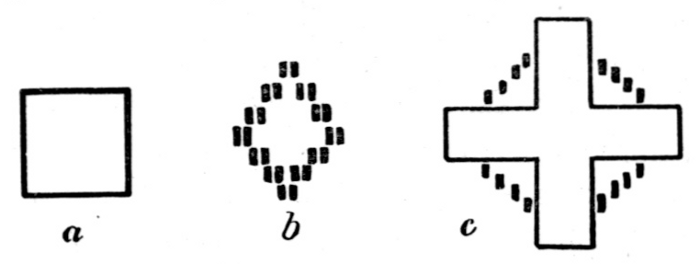
Figure 54.
It will be interesting and important to learn what “Hochelaga” means in the Iroquois language. The resemblance between the Maya and Iroquois symbols for nation and tribal territory and of the names for capital might even be overlooked and treated as a coincidence merely, if the Iroquois name for the confederacy, kan-asta-tsik-o-ma did not also begin with the word kan, the Maya for four and for serpent. The same particle recurs in the Iroquois name for the town=can-ada, a word which, in Maya, would describe a metropolis divided into four quarters.
The question naturally suggests itself whether the affix can, frequently met with in Mexico combined with names of localities, was not of Maya origin and expressed also a centre of quadruple [pg 199] government. It occurs in the Nahuatl name for metropolis to-tec-ua can and in Teoti-hua can, for instance. The Nahuatl scholars have rendered its meaning as “place of.”
Mr. Hale tells us that, amongst the “Five Nations,” the tradition exists that the confederacy was originally divided into “seven tribes,” each of which was composed of 2×4=8 gentes or clans. Another wampum belt he figures exhibits a heart between 2×2=4 squares, a symbol which would be interpreted by a Mexican or Maya as well as by a Huron or Iroquois, as meaning “four nations, one heart,” the latter being as common a symbol for union of rule or government or for chieftain, as a “head.”
Combined with other testimony it seems impossible to evade the question whether in remote times the Iroquois and Hurons had not shared in some way or other the civilization of the Mayas. If so the ancient earthwork-builders of the Ohio valley, who are authoritatively regarded as of southern origin by Professor Putnam, and whose art exhibits a strong resemblance to that of the Mayas, seem to constitute the missing link between the northeastern and the southeastern tribes. It is curious to find that the terminal ché, which occurs in the name Quiché and which signifies in Maya, tree, and, by extension, tribe, is preserved in the names of the Nat-ché-z tribe still inhabiting the Mississippi valley. It is also present in Coman-ché, Apa-che, etc.
It is to be hoped that, before long, authorities who have made special studies of the above tribes will make searching comparisons of their languages, social organization and symbolism with that of the Mayas, in particular, it seeming evident that the coast communication along the gulf of Mexico, from Yucatan to the mouth of the Mississippi river, was not only easy but was favored by sea-currents.
It is interesting to note that if we now proceed to the southwest of the United States and study the Pueblo people, we seem to find not only more distinctly marked affinities between their customs, etc., and those of the Mexicans, but also traces of similarity with certain Maya symbols.
In several important publications Dr. J. Walter Fewkes has made the valuable observation that there are marked “resemblances between a ceremony practised [at the time of the Conquest] in the heart of Mexico and one still kept up in Arizona,” and [pg 200] states that these “lead one to look for likenesses in symbolism, especially that pertaining to the mythological Snake among the two peoples.” He continues as follows: “From the speculative side it seems probable that there is an intimate resemblance between some of the ceremonials, the symbolism and mythological systems of the Indians of Tusayan and those of the more cultured stocks of Central America.... The facts here recorded look as if the Hopi practise a ceremonial form of worship with strong affinities to the Nahuatl and Maya.... I have not yet seen enough evidence to convince me that the Hopi derived their cult and ceremonials from the Zuñians or from any other single people. It is probably composite. I am not sure that portions of it were not brought up from the far south, perhaps from the Salado and Gila by the Bat-kin-ya-mûh=‘Water people,’ whose legendary history is quite strong that they came from the south.”50
Dr. Fewkes frankly states that he “knows next to nothing of the symbolic characters of the Mexican deities ...” and quotes Mr. Bandelier's opinion that “there are traces or tracks of the same mythological system and symbolism amongst the Indians of the southwestern United States and the aborigines of Central America.”
Under the leadership of Mr. Frank H. Cushing let us now enter into the life and thoughts of the modern Zuñis. After having traced certain ideas in Mexico and Peru, it is possible to recognize them again when we find them in Mr. Cushing's valuable work, from which I shall quote somewhat at length, referring the reader, however, to the original, for a fuller realization of existing resemblances.51
The Zuñi creation-myth relates how the light of the Sun-father and a foam-cap on the sea, caused the Earth-mother to give birth to twin-brothers, Uanam Achi Piah-koa, “the Beloved Twain who descended.” The first was Uanam Ehkona=the beloved Preceder, the second Uanam Yaluna, the beloved Follower; they were twin-brothers of light, yet elder and younger, the right and left, like to question and answer in deciding and doing.... The [pg 201] Sun-father gave them the thunderbolts of the four quarters, two apiece.... On their cloud-shield, even as a spider in her web descendeth, they descended into the underworld ... (p. 381).
Pausing here for a moment, we note the curious fact that in the Zuñi name for the twins we find koa, resembling the Nahuatl coatl=twin or serpent; that the name of one brother Ehk-ona recalls the Mexican ec-atl=air, wind or breath, and the Maya ik=air, wind, breath, courage, spirit. The allotment of two quarters to each and the image of a spider employed to express their descent from heaven have counterparts in Nahuatl lore.
The “Twain” ... guided men upwards to become the fathers of six kinds of men (yellow or tawny, grey, red, white, mingled and black).... The nation divided itself into the winter or Macaw and the summer or Raven people.... “The Twain beloved gathered in council for the naming and selection of man groups and creature kinds, spaces and things. They determined that the creatures and things of summer and the southern space pertained to the southern people or children of the producing Earth-mother; and those of the winter and northern space to the winter people or children of the Forcing or Quickening Sky-father.”
It is impossible to do more than refer the reader to Mr. Cushing's account of the origin of totem clans and creature-kinds which bears such an affinity to the Peruvian, and obviously arose for the same practical reason, to serve as distinction marks for identification and classification. “At first ... there were four bands of priest-keepers of the mysteries: the Shiwana-kwe=priesthood of the priest-people; Sa'niah'-ya-kwe=priesthood of the Hunt; Ach-iahya-kwe=great Knife people; Newe-kwe=keepers of the magic medicines.” Out of these four divisions “all societies were formed, both that of the Middle and the twain for each of all six regions, constituting the tabooed and sacred 13.” In another passage account is given of the marriage of a brother and sister, which produced twelve children, the first of which, Hlamon, was man and woman combined—the 12 thus constituting in reality 13.
One of the most interesting portions of the Zuñi narrative is one which elucidates the motive which led to the migration of peoples in ancient America. We are told how generations of the forefathers of the Zuñis wandered about in search of the stable middle [pg 202] of the earth, on which they wished to found their sacred city. The tribe divided; the winter-clan journeyed to the northeast and the summer-clan to the southwest, a reunion of the people took place, and a council was held for the determination of the true Middle.... According to a myth the Sun-father requested the water-skate to determine the Middle. This mythical monster lifted himself up, stretched out and then settled downward, calling out: “Where my heart and navel rest beneath them mark ye the spot and then build ye a town of the midmost, for there shall be the midmost of the Earth-mother, even the navel.... And when he descended squatting, his belly rested over the plain and valley of Zuñi and when he drew in his finger-legs, lo! there were the trail roads leading out and in like the stays of a spider's net, into and forth from the place he had covered.”
Pausing to point out that fig. 28, reproduced from Mexican Codices, shows curious topographical drawings resembling a spider's net, I will not recount the many disappointments of the wanderers, who were evidently driven away from several places of settlement by earthquakes, but will refer to the Zuñi custom of “annually testing the stability of the Middle in middle time ... when the sun reached the middle between winter and summer ... a shell was laid by the sacred fire of the north.... When during solemn chanting no trembling of the earth ensued, the priests cast new fire and ... dwelt happily feeling sure that their sacred things were resting in the stable middle of the world.”
At the beginning of this paper I referred to the powerful hold that the realization of the fixity of the pole star would naturally have exerted upon the mind of primitive man, and I can produce no more striking illustration of this and of my view that the idea of central government and organization had been suggested by Polaris, than this account of the earnest and prolonged search of these ancient people for the stable centre of the earth, on which to found a permanent centre of terrestrial rule or the plan of the celestial government. At the same time it seems to me that the longing for a stable and fixed residence would naturally have been most intense amongst people who had experienced terrible earthquakes and been driven out of their original abodes by their repeated destruction. It is unnecessary to mention the well-known fact that whilst earthquakes prevail throughout North and Central America, the most impressive trace of catastrophes of the kind [pg 203] are connected with the gigantic volcanoes of Central Mexico and Guatemala.
With a sympathetic insight into the disasters which seem to have driven the wandering tribes from one region to another and filled them with a passionate yearning for a centre of rest, let us now learn from Mr. Cushing how they planned their metropolis and organized themselves, when they had found the long-looked-for goal, in the Zuñi valley and “settling there, built seven great cities therein.
“All their subtribes and lesser tribes were distinctively related to and ruled from a central tribe and town through priest chiefs representatives of each of these, sitting under supreme council or septuarchy of the ‘Master priests of the house’ in the central town itself, much as were the divisions and cities of the great Inca dominion in South America represented at and ruled from Cuzco, the central city and power of them all.
“Zuñi is divided, not always clearly to the eye, but very clearly in the estimation of the people themselves, into seven parts, corresponding not perhaps in arrangement topographically, but in scheme to their subdivisions of the worlds or world-quarters of this world. Thus one division of the town is supposed to be related to the north and to be centred in its kiva or estufa which may or may not be at its centre; another division represents the west, another the south, another the east; yet another the upper world and another the lower world; while a final division represents the middle or mother and synthetic combination of the all in the world.
“By reference to the early Spanish history of the pueblos, it may be seen that when discovered the Ashiwis or Zuñis were living in seven quite widely separated towns the celebrated seven cities of Cibola and that this theoretic subdivision of the only one of these towns now remaining is in some manner a survival of the original subdivision of the tribes into seven into as many towns. It is evident that in both cases, however, the arrangement was and is, if we may call it such, a mythic organization; hence my use of the term of mytho-sociologic organization of the tribe. At all events this is the key to their sociology as well as to their mythic conception of space and universe.
“... There were nineteen clans, grouped in threes, to correspond to the mythic subdivision. Three to north, west, south, [pg 204] east, Upper, Lower. The single clan of Macaw is midmost or of middle and also as the all containing and mother clan of the entire tribe, for in it is ‘the seed of the priesthood of houses’ supposed to be preserved.52
“Finally, as produced from all the clans and as representative alike of all the clans and through a tribal septuarchy of all the regions and divisions of the midmost and, finally, as representative of all the cult societies above mentioned, is the Kaka or A'kâkâ-kwe or Mythic Dance drama people or organization.
“It may be seen of these mytho-sociologic organizations that they are a system within a system and that it contains systems within systems all founded on the classification according to the six-fold division of things and in turn the six-fold division of each of these divisions of things ... The tribal division made up of the clans of the north take precedence ceremonially, occupying the position of elder brother or the oldest ancestor. The west is the younger brother to this and the south of the west, the east of south, etc.... while the middle is supposed to be a representative being, the heart and name of all of the brothers of the regions, the first and last, as well as elder and younger.
“To such an extent indeed, is this tendency to classify according to the number of the six regions with its seventh synthesis of them all (the latter sometimes apparent, sometimes non-appearing) that not only are the subdivisions of the societies also again subdivided according to this arrangement, but each clan is subdivided, both according to the six-fold arrangement and according to the subsidiary relations of the six parts of its totem....
“In each clan is to be found a set of names, called the names of childhood. These names are more of titles than of cognomens. They are determined upon by sociological divinistic modes and are bestowed in childhood as the ‘verity names’ or titles of the children to whom given. But the body of names relating to any one totem, for instance, to one of the beast totems, will not be the name of the totem-beast itself but will be the names of both of the totems and its various conditions and of the various parts of the totem or of its functions, or of its attributes, actual or mythical.
[pg 205]
“Now these parts or functions, or attributes of the parts or functions, are subdivided also in a six-fold manner, so that the name relating to one member of the totem, for example, like the right leg or arm of the animal thereof, would correspond to the north and would be the first in honor in a clan (not itself of the northern group); then the name relating to another member, say the left leg and its powers, etc., would pertain to the west and would be second in honor, ... the right foot, pertaining to the south, would be third in honor, ... the tail to the lower regions and be sixth in honor; while the heart and navel and centre of the being would be first as well as last in honor.... In addressing each other the word symbol for elder or younger is always used.
“With such a system of arrangement as all this maybe seen to be, with such a facile device for symbolizing the arrangement (not only according to the number of regions, and their subdivisions in their relative succession and the succession of their elements and seasons, but also in the colors attributed to them) and, finally, with such an arrangement of names, correspondingly classified and of terms of relation significant of rank rather than of consanguineal connection, mistake in the order of a ceremonial, a procession or a council is simply impossible and the people employing these devices may be said to have written and to be writing their statutes and laws in all their daily relationship and utterances.”
If this precious exposition of the Zuñi social organization teaches us more about native method and system than all of the writings of the Spanish chroniclers put together, there is one important point which, strangely enough, is not touched upon, namely, the regulation of time. All information concerning native astronomy, and the subdivision of the years, the festival periods and the names of days, seems to have been withheld from Mr. Cushing by the Zuñi priesthood, if we are to assume that they possess a calendar.
In Mexico, as I have already set forth, the calendar system is bound up in the scheme of social organization and it is impossible to separate them. I cannot but think that it must be the same with the Zuñis but that, as in ancient Mexico, only the priesthood were acquainted with the existence of a systematic calendar, and kept it a profound secret from the multitude, although the entire communal life and activities of the people were guided accordingly [pg 206] by their rulers, who had arranged a suitable time for all things, at proper seasons.
Having obtained through Mr. Cushing invaluable material for the making of a composite image of the ancient American civilization let us now proceed to Yucatan, bearing in mind the native mode of thought and master-passion for systematization.
A careful perusal of Cogolludo and Landa's work affords such interesting glimpses into the past history of the inhabitants of the Yucatan peninsula, that they merit presentation in a separate publication. Suffice it for the present to refer more fully to a few leading facts which will be found to illustrate the development of the ancient civilization in the preceding pages.
The native opinion already cited was that a great chief or lord, named Kukulcan, reigned at Chichen-Itza, Yucatan, whilst this was occupied by the Itza tribe, which was driven from it in about 270 A.D. by the Tutul-xius who were entitled “holy men.” Their name justifies Brasseur de Bourbourg's inference that the conquerors may have been a Nahuatl tribe whose name was that of the much-prized blue-bird, Xiuh-tototl.
At the same time the fact that the Maya word for supreme lord and Master (also applied to the divinity) is Ciu-mil seems to indicate that there may be a deeper origin and that the Xiuh-tototl may have only been a rebus employed by the Mexicans to convey the sound of a Maya title, possibly “Kukul-Ciu,” if the above title “holy men” is to be regarded as a translation of Tutul-xiu.
“Kukulcan had no wife or children and was venerated in Yucatan as a god because he was a great republican, as was shown by the order he instituted in Yucatan after the death of the native rulers. He went to Mexico whence he returned. He was there named Quetzalcoatl and was venerated by the Mexicans as one of their gods.” When he had entered into treaty with the native chiefs inhabiting the country, they agreed to join him in founding and peopling a city which was named Mayapan, but was also known by the natives as Ichpa, meaning “inside of the circles.”53 “They proceeded, indeed, to build a circular walled enclosure with two entrances [pg 207] only. In its centre, the principal temple was erected and it was circular, with four doors opening to the cardinal points, like one which had been built by Kukulcan at Chichen-Itza. The walled circle also contained other sacred edifices and houses intended to be inhabited by the lords only, who divided up the entire land amongst themselves. Towns were assigned to each according to the antiquity of his lineage and personal distinction. Kukulcan lived in this town for some years with these lords and leaving them in amity and peace returned to Mexico by the same way as on his visit, lingering on the way in order to build a quadriform temple on an island off the coast.”
I know of no more instructive account of aboriginal history than this simple native record preserved by Landa, which so clearly reveals amongst other details that the Mexican culture-hero was an actual personage, a Maya high-priest who had been a ruler at Chichen-Itza. In this connection it is interesting to collate another chapter of Landa's work in which he reports what the oldest Indians narrated to him about Chichen-Itza, of which I give the following somewhat abbreviated translation: Three brothers came there in olden times from the west and having assembled together a large number of people, ruled them for some years with much justice and peace.54 They paid great honor to their god and built many beautiful edifices.... They lived without wives in purity and virtue and as long as they did this they were esteemed and obeyed by all. In course of time one of them possibly died, but is said by the Indians to have gone out of the country. Whatever may have been the cause of his absence the remaining rulers immediately began to show partiality and to institute such licentious and abominable customs that they were finally execrated by the people who rebelled and killed them, and then disbanded and abandoned the capital, “although this was most beautiful and was surrounded by fertile provinces.”55
The principal edifice at Chichen-Itza was a pyramid temple which [pg 208] had four stairways facing the cardinal points. It contained a circular temple which was named after the builder Kukulcan and had four doorways opening to the four quarters of heaven.
If I have dwelt again upon Kukulcan=Quetzalcoatl, it is because, between the writers who interpret the records concerning him as a sun or star-myth and those who identify him as the abstract deity whose name he bore as a title only, or as St. Thomas or a mythical Norseman, ancient America is being deprived of its most remarkable historical personage.
Collated with the Maya traditional records, the Mexican accounts agree and supply missing evidence. Whilst the Mayas state that their ruler and legislator went to Mexico and even record his Mexican name, Montezuma informs Cortés that “his ancestors had been conducted to Mexico by a ruler, Quetzalcoatl, whose vassals they were and who having established them in a colony returned to his native land. Later on he returned and wished them to leave with him but they chose to remain, having married women of the country, raised families and built towns. Nor would they institute him again as their lord, so he went away again toward the east, whence he had come.” It seems nearly proven that Kukulcan was one of the three rulers who came to Yucatan from the east. The Mexican tradition that he was driven into exile by his enemies, the followers of Tezcatlipoca, the lord of the Below, appears to be corroborated by the Maya record that, after his restraining presence had been removed, they committed such excesses that the indignant population arose and murdered their two rulers at Chichen-Itza. Quetzalcoatl's continued efforts to assemble scattered tribes, to organize them peacefully under central governments, to found capitals and erect in the centre of these quadriform pyramids and circular temples, prove how completely he was possessed by the idea of spreading the well-known scheme of civilization. His very name in Maya signified “the divine Four” and this more profound signification was hidden under the image of the “feathered serpent” employed as a rebus to express the title of the supreme Being and the high-priest, his earthly representative.
[pg 209]
The Mexican records state that the culture-hero's white robes were covered with red crosses, and that he set up cross-emblems. Evidence showing how completely this builder and founder of cities carried out the idea of the Four Quarters, in the temples he erected in Mexico, is preserved by the record that for prayer, penitence and fasting, he prepared four rooms which he occupied in rotation. These were respectively decorated in blue, green, red and yellow, by means of precious stones, feather-work and gold. As these were the colors assigned to the Four Quarters their symbolism and meaning are obvious, and it may be inferred that the same method of decorating the sides of buildings or doorways, with these four colors, may have been carried out in square sacred edifices oriented to the cardinal points.
It is curious to detect the quadruplicate idea in the title Holcan given to certain war-chiefs. This name signifies, literally, “the head of four,” but could be expressed by the rebus of a “serpent's head,” which would obviously have been employed in pictography to express the title and rank. The existence of the title “Four-head,” or “the head of four,” obviously relates to the rulership of the Four Quarters, united in one person; and in this connection the Tiahuanaco swastika (fig. 48), terminating in four pumas' heads, seems to gain in significance as the expressive symbol of a central ruler. The recorded custom to cover the body of the Mexican ruler with the raiment of the “four principal gods,” proves the prevalence of analogous symbolism.
From the following data we gain an interesting view of the events which transpired in former times in the Yucatan peninsula. Resuming Landa's account we see that, after Kuculcan had departed for Mexico, the lords of Mayapan decided to confer supreme rulership upon the Cocomes, this being the most ancient and the wealthiest lineage and its chief being distinguished for bravery. They then decided that the inner circle should hold only the temples and houses for the lords and high-priest. In connection with this it is well to insert here how Landa states, in another passage, that there were “twelve priests or lords at Mayapan,” which with the high-priest constituted the sacred 13. “Outside the wall they built houses where each lord kept some servitors and where his people or vassals could resort when they came on business to the town. Each of these houses had its steward, entitled Caluac, who bore a staff of office and he kept an account with the towns and with [pg 210] their local rulers. The Caluac always went to his lord's house, saw what he required and obtained from the vassals all he needed in the way of provisions, clothing, etc.” (op. cit., pp. 34-44).
The chronicle goes on to relate how the lords of the inner circle devoted their time to the affairs of government, the regulation of the calendar and the study of writing, medicine, and the sciences.56
It seems significant that, throughout Central America, two ruined cities of about equal size are usually found in comparatively close proximity to each other, and seemingly pertaining to the same culture. Thus we have Quirigua, in the valley of the Motagua river, and Copan its sister-city, situated at a distance of about twenty-five miles, but nearly 1,800 feet above it, in the wooded hills. Between Palenque and Menché (Lorillard City) there are about fifty miles, whilst Tikal and Ixkun are forty miles apart. In Yucatan, as we have learned from Bishop Landa's “Relacion,” there were Mayapan and Zilan, and as the latter name also signified “embroidery” it looks as though it had been a noted centre of female industry.
Then, after a lapse of years, “a large number of tribes, with their lords, came to Yucatan from the south.” Bishop Landa conjectures that, although his informants did not know this for certain, “these tribes must have come from Chiapas, many words and the conjugation of some verbs being the same in Yucatan as in Chiapas where there existed great signs showing that ancient capitals had been devastated and abandoned,” possibly by earthquakes, famine, disease or warfare. It has been surmised that the venerable Bishop alluded, in this sentence, to the ruins of Palenque in Chiapas.
Although not mentioned by Cogolludo or Lizana it is accepted that the new-comers were the Tutul-xius. According to an ancient Maya chronicle, “at a date corresponding to 401 A.D., the four Tutul-xius had fled from the house of Nonoual, to the west of Zuiva and came from the land of Tulapan. Four eras passed before they reached the peninsula of Yucatan named Chac-noui-tan under their chieftain, Holon-Chan-Tepeuh,” a name which is equally intelligible in Maya, Tzendal and Nahuatl and means Head-Serpent [pg 211] and “lord of the mountain,” according to Brasseur de Bourbourg, who states that the latter was a sovereign title amongst the Quichés.
Landa relates that, after wandering about Yucatan for forty years (possibly in search of the stable centre) these tribes settled near Mayapan, subjected themselves to its laws and lived in peaceful friendship with the Cocomes. The new-comers brought with them the atlatl or spear-thrower which is minutely described but is evidently regarded as a weapon of the chase.57 The chronicle goes on to narrate that the Cocom governor, having become ambitious for riches, entered into a treaty with Mexican warriors who were garrisoned at Tabasco and Xicalango by the Mexican ruler and induced them to come to Mayapan and to aid him in oppressing the native lords. The latter and the Tutul-xius rebelled against this action and, having observed the Mexicans and become experts in the art of using their bow and arrow, lance, hatchet, shield and other defensive armor, they “ceased to admire and fear the Mexicans and began to make little of them, and in this condition they remained for some years.”
A lapse of years passed and another Cocom chief formed a fresh league with the Tabasco people. More Mexican warriors came to Mayapan and supported him in tyrannizing and making slaves of the lower class. Then the Tutulxiu lords assembled and decided to murder the Cocom ruler. Having done so they also killed all his sons with the exception of one who was absent; burnt their houses and seized their plantations of cocoa and other fruits, saying that these compensated for what had been stolen from them. The differences which subsequently arose between the Cocome and the Xius people resulted in the final destruction and abandonment of Mayapan after an occupation of more than five hundred years, both tribes returning to their countries.
“The lords who destroyed Mayapan (about 120 years before the Conquest) carried away with them their books of science.... The son of the Cocom lord, who being absent had escaped death, returned and gathered his relations and vassals together and founded a capital.... Many towns were built by them in the hills and many families descended from these Cocomes. These lords of Mayapan did not revenge themselves upon the Mexican warriors [pg 212] but generously exonerated them from blame because they were strangers and had been persuaded to come into the land by its former ruler. They allowed them to remain unmolested in the country and to found a city on condition that they kept to themselves and married in their own tribe only. These Mexicans decided to settle in Yucatan and peopled the province of Can-ul which was assigned to them and they continued to live there until the second invasion of the Spaniards.”
At Chichen-Itza, situated at about twenty-three leagues from the ancient site of Mayapan, there exists substantial evidence of the existence of these Aztec warriors, with indications that they pertained to the Mexican warrior-caste of the ocelots or tigers. It is a recognized fact that the remarkable bas-reliefs, which still cover the walls of the “temple of the tigers” at Chichen-Itza, are strikingly Aztec in every detail. The exact counterparts of the Atlatls, they hold, are visible on the so-called “Stone of Tizoc” in the city of Mexico. Sculptured on the wall opposite the entrance of the temple there are about thirty-six war-chiefs grouped in three parallel rows of twelve each, the majority of whom are apparently rendering some form of homage to a seated personage surrounded by rays, while others are having an encounter with a monstrous serpent. On the side walls and slanting roofs more warriors are figured, many accompanied by a rebus or hieroglyph which evidently records, in Mexican style, individual names. The total number of sculptured warriors seems to have been about one hundred. If each of these represented, as may be supposed, a “count of men,” it is evident that a large force of Aztec soldiers must have lived in Yucatan at one time.
Other interesting monuments at Chichen-Itza deserve a passing mention. Mr. Teobert Maler (Yukatekische Forschungen, Globus, 1895, p. 284) relates that there are two pyramid-temples in the terraces of which the remains of great stone tables have been found. He states that one of these tables was originally supported by two rows of seven sculptured caryatids and by a central row of plain columns with flat, square tops. Traces of paint showed that the figures had been painted, that a yellow-brown color had predominated, but that all ornaments or accessories were either blue or green. The caryatids exhibited a variety of costume and of size and each showed a marked individuality. The second table standing in a larger temple, was originally painted red and supported [pg 213] by twenty-four caryatid figures which resemble each other closely, show no individuality and which seem to have been disposed in two rows of twelve each. Mr. Maler infers from this that, being more highly conventionalized, they were of a later date than the previous examples. If it were not for the circumstance that both tables had the same number of supports their numeral 24 might pass unobserved. As it is, I shall recur to it on mentioning other monuments with figures yielding the same number and disposed, in one case, as 6×4. In connection with these stone tables I recall the fact that, in the Maya language, they were called Mayac-tun.
Mr. W. H. Holmes (op. cit., p. 134) tells us that in one case the continuous table had been formed by a series of limestone tablets averaging three feet square and five or six inches thick, each slab having been supported by two of the dwarfish figures which stand with both hands aloft, giving a broad surface of support. He ascertained that “these slabs were wonderfully resonant and when struck lightly with a hammer or stone, give out tones closely resembling those of a deeply resonant bell, and the echoes awakened in the silent forest are exceedingly impressive.” Mr. Holmes' account of these resonant stone tables is of particular value to me because it throws an interesting light upon the following Maya words: I have already stated that the native name for table is Mayac, and that a stone table is Mayac-tun. The word tun, however, not only signifies stone, but also sound and noise. From this it would seem that stone tables such as Mr. Holmes describes were made expressly for the purpose of emitting sound and employed like the huehuetl or wooden drums of the ancient Mexicans to summon the people to the temple and to guide the sacred dances.
The existence of the word tun-kul, which is either “stone-bowl” or “sound-bowl,” seems likewise to indicate that hollow stone vessels were used at one time as gongs. At the present day the Mayas name the small wooden drum of the Mexicans a “tunkul,” whereas its Nahuatl name is “te-ponaxtli,” the prefix of which, curiously enough, seems also to be connected with tetl=stone. A curious light is shed upon the possible use of some of the many stone vessels found in Mexico and Yucatan by the above linguistic evidence.
In conclusion I quote Mr. Maler's authority for two points concerning [pg 214] Chichen-Itza which are not generally known. First, that its name should be pronounced “Tsitsen-itsa,” and, second, that he saw there no less than five recumbent statues, holding circular vessels. Each of these figures exhibits the same form of breast-plate as the Le Plongeon example now at the National Museum of Mexico (pl. iv, fig. 1). Mr. Maler states that it seems to have been the tribal mark of the Cocomes, the whilom rulers at Chichen-Itza; but it is interesting to note the general resemblance of this ornament to the blue plaque worn by the Mexican “Blue Lord,” the Lord of the Year and of Fire, “Xiuhtecuhtli,” who is also usually represented with a Xiuh-tototl or “blue-bird” on the front of his head-dress.
These facts seem to indicate that the characteristic breast-plate, instead of being a mark of the Cocomes, may have been that of the Tutul-Xius, and that this title has some connection with that of Xiuh-tecuhtli, the Mexican “Lord of Fire.” It has been already set forth in the preceding pages that the sacred fire was kindled in the stone vase held by the recumbent figures, a fact indicating that the identical form of cult was practised in Mexico and at Chichen-Itza. This identity is satisfactorily accounted for and explained if we accept the simple native records of the invitation extended to Mexican warriors by a Maya chieftain and their subsequent permanent residence in Yucatan.
The limitations of my subject do not allow me to do more than mention two other important ruined cities of Yucatan, Izamal and Uxmal. I will however note that, judging from the illustrations I have seen, Uxmal seems to be the “Serpent-city” of America, par excellence, its buildings exhibiting the most elaborate and profuse employment of the serpent for symbolical decoration. One inference from this might be that the serpent was the totemic animal of the ancient builders of this city. The foregoing rapid review of the native chronicles of Yucatan shows that even the foundation of Mayapan was comparatively recent; that the peninsula had, in turn, harbored powerful tribes who had drifted thence from the southwest and Mexican warriors whose aid had been sought by consecutive rulers of Chichen-Itza. We see that Yucatan was the meeting ground for Maya- and Nahuatl-speaking people and that the tendency was to leave the peninsula in search of a more favorable soil and climate as soon as opportunity was afforded.
Since the cradle of the Maya civilization is evidently not to be [pg 215] looked for in Yucatan, let us follow the clue afforded by the native traditions, transport ourselves to some of the most important ruined cities of Central America and endeavor to wrest from their monuments some knowledge of the social organization of their ancient inhabitants. In order to institute this search under the most favorable circumstances, I ventured to apply for guidance to Mr. A. P. Maudslay who has made a more thorough, prolonged and extensive study and exploration of these ruined cities than any other person. Upon my request to formulate his opinion as to the respective antiquity and chief characteristics of the most noted sites, this distinguished explorer has most kindly authorized me to publish the following note.
“But for a brief note in Nature (28th April, 1892), I have never classified the ruins or attempted to give proofs of differences in age of the monuments, but roughly you may safely class them as follows: I am inclined to look on the Motagua river group as the oldest. The Yucatan group is certainly the youngest. Of course there are many other smaller differences between the groups and much overlapping. Whichever group may be the oldest the art is there already advanced and the decoration has taken forms which must have occupied many kinds of workers to conventionalize from natural objects.”
1. On Motagua River, Quirigua, Copan. Large monolithic stelæ and altars with figures and inscriptions carved on all four sides in rather high relief, some groups pictographic. No weapons of war portrayed in the sculpture.
2. On Usumacinto River, Menché, Tinamit, Palenque, Ixkun. Stelæ are usually flat slabs carved with figures and inscriptions in low relief on one side only. External ornament of the buildings usually moulded in stucco. War-like weapons but very scarce.
3. Tikal. Intermediate between Nos. 2 and 4, but somewhat different and distinct from either.
[pg 216]
4. Yucatan. Chichen-Itza, Uxmal, etc. Stelæ very few in number and poorly carved. Inscriptions carved in stone are very scarce. Inscriptions were probably painted on the walls of the temples. External ornament of buildings formed by a mosaic of cut stones somewhat resembling Zapotec or Aztec style. Every man portrayed as a warrior [on the bas-reliefs].
By means of the magnificent set of casts which Mr. A. P. Maudslay has generously presented to the South Kensington Museum, London, and with the aid of his monumental and splendidly illustrated work on the Archaeology of Central America, which has been appearing as a part of the Biologia Centrali-Americana, edited by Messrs. Godman and Salvin, I have been able to verify the following facts which will be found to throw light on the purpose and meaning of some of the ancient monuments.
Before examining the great, elaborately carved stelæ which are characteristic of Quirigua and Copan, let us search the native chronicles for some clue explanatory of the purpose for which they were erected.
Bishop Landa has transmitted to us some details about the destroyed metropolis of Mayapan given to him by Yucatec informants who stated that “in the central square of that city there still were 7 or 8 stones, about ten feet high, rounded on one side and well sculptured, which exhibit several rows of the native characters, but were so worn that they had become illegible. It is supposed, however, that they are the record of the foundation and destruction of that capital. Similar, but higher monuments, are at Zilan, a town on the coast. Interrogated as to the meaning of these monoliths the natives answered: It had been or was customary to erect similar stones at intervals of 20 years which was the number by which they counted their eras.” Bishop Landa subsequently remarks that “this statement is not consistent,” for, according to this “there should be many more such stones in existence, and none exist in any other pueblo but Mayapan and Zilan.”58
[pg 217]
Disagreeing with the venerable Bishop, I find in the above statements the most valuable indications of the former existence of two centres of culture in Yucatan. There is a curious affinity between the name Zilan (pronounced Dzilan) and Chilan given as “the title of a priestly office which consisted of a juridistic astrology and divination,” by Landa. There may even be a connection between zilan and zian=origin, commencement; zihnal=original and primitive, which may be worthy of consideration in association with the well-known statement, quoted by Dr. Brinton, that “the most venerable traditions of the Maya race claimed for them a migration from Tollan in Zu-iva—thence we all came forth together, there was the common parent of our race; thence came we from amongst the Yagui men, whose god is Yolcuatl Quetzalcoatl.” Dr. Brinton adds that “this Tollan is certainly none other than the abode of Quetzalcoatl named in an Aztec manuscript as ‘Zivena Uitzcatl.’ ” Vague as any conjecture must necessarily be, I cannot but deem it of utmost importance that systematic excavations be made, some day, at Zilan, for the purpose of bringing to light the stelæ referred to by the native informants of Bishop Landa.
According to Brasseur de Bourbourg “Zilan, situated at about 20-½ leagues from Merida belonged to the Cheles people.59 It is the seaport of Izamal and contains the ruins of one of the greatest pyramids or artificial mounds (omul) in Yucatan,” a fact which corroborates the view that it was an ancient important capital. The northern coast of Yucatan is extremely remarkable for it is divided from the Gulf of Mexico by a continuous strip of land between which and the mainland there is a narrow channel of water. There are two openings only in this zone of land which afford a passage into the navigable channel. One of these openings is situated almost opposite to Zilan and is known as the Boca de Zilan. At a short distance to the east there is a second such “boca” opposite to the mouth of the Rio Lagartos, which is a [pg 218] large estuary and the only river on the northern coast of Yucatan.60
Let us now transport ourselves, mentally, south of the peninsula to Honduras and, leaving the coast, ascend the Motagua valley to the ruins of Quirigua and Copan,61 which have impressed Mr. Maudslay as being of great antiquity. Before examining such of these monuments as seem to yield the testimony we are seeking, let us again recall Landa's record that the Mayas erected stelæ as memorials of each 20-year period. To this statement should be added, at full length, Cogolludo's record that “the Mayas employed eras of 20 years and lesser periods of 4 years.62 The first of these four years was assigned to the east and was named Cuch-haab; the second, Hiix, to the west; the third, Cavac, to the south and the fourth Muluc, to the north, and this served as a ‘Dominical letter.’ When five of these four-year periods had passed, which form twenty years, they called it a Katun and placed one sculptured stone over another sculptured stone and fixed them with lime and sand [mortar] to the walls of their temples and houses of the priests.”63
The term katun is closely linked to the said employment of memorial stones, for tun is the Maya for stone and ka seems to stand for kal or kaal=20. The word hun-kaal=20, means literally, “one complete count,” or “a count which is closed,” since the verb kaal means to close, shut, or fasten something. According to the above a katun literally means “the 20 (year) stone;” but we know that, by extension, it designated the era itself as well as war and battle. Thus we find the verb katun-tal=to fight.
Cogolludo continues: “In a town named Tixuala-tun, which signifies ‘the place where they place one stone above another,’ [pg 219] they say that they kept their archive, containing records of all events.... In current speech katun signified era and when a person wished to say he was sixty years of age, he used the expression to have three eras of years or three stones. For seventy they said three and a half stones or four less one-half stone. From this it may be seen that they were not too barbarous, for it is said that [by this system] they were able to keep such exact records that they not only certified an event but also the month and day on which it took place.”
By referring to Maya and Spanish dictionaries we gain supplementary valuable information about native memorial stones. We find the name amaytun given as that of “a square stone on which the ancient Indians used to carve the 20 years of the period ahau-katun, because the four remaining years which completed the epoch, were placed underneath, so as to form a sort of pedestal which was called, for this reason, lath oc katun or chek oc katun. By extension, painted representations [of the epoch] were also named amaytun.” The dictionary further informs us that amayté was the name for the first twenty years of the ahau katun, which were carved on the square stone and we see that amayté also means “something square or with corners” and is formed of amay=corner.
Equipped with the foregoing knowledge of the sort of memorial it was customary for the Mayas to erect, let us now see whether the ruins of Copan furnish any monuments which would answer to the description and purpose of “amay-tés” and “ka-tuns.” Referring the reader to parts i-iii of Mr. A. P. Maudslay's work already cited, I draw special attention to the following stelæ and altars which are so admirably figured therein.
Stela F, which stands at the east side of the Great Plaza at Copan and faces west, is in a particularly bad state of preservation. It exhibits a standing figure on one side whose head is surmounted by an indescribable combination of a mask, a seated figure and much elaborate feather-work. A noteworthy feature, which recurs on other stelæ in Copan and Quirigua, is an appendage which appears like an artificial beard attached to the chin of the personage. At the sides of the stela serpents' heads alternate with diminutive grotesque figures. On the back, or east side of the stela, two cords are represented which appear to have been brought over from the front and which are tied together so as to form five open loops, [pg 220] in each of which, as in a frame, there is a group consisting of four calculiform glyphs. The cord, which is knotted together at the base of the stela, appears to pass around it. It is impossible not to recognize that this representation of twenty glyphs, as divided into five groups of four, exactly agrees with Cogolludo's records that the Mayas employed 20-year and 4-year eras and that when five of the 4-year periods had passed they called it a ka-tun, and made a carved memorial of it. As Landa tells us that they erected stelæ to commemorate the 20-year period, the inference to which the Copan Stela F leads us is that it is a katun and that the twenty glyphs carved on it are year-signs. Examination, however, shows that, whereas the Maya Calendar had but four year-signs which would naturally be bound to repeat themselves in each group of four years, no two glyphs on the Stela F are alike. It is obvious, therefore, that the glyphs are not the four calendar year-signs and reflection shows, indeed, that it would have been quite superfluous to carve these repeatedly on a stela. As each year-sign was identified with a cardinal point and an element and was permanently associated with a particular color, the mere employment of the latter would suffice to convey this association of ideas. What is more, the relative positions of the four glyphs composing each group would also indicate the four year-signs and thus the sculptor of the stela would have been at liberty to record by the shape of his glyphs any fact he chose to connect with each year of the era. A curious linguistic fact must also be taken into consideration: The Maya name for the four year-signs was Ah-cuch-haab and the title for a chief or ruler of a town was Ah-cuch-cab. The mere presence on the stela, of the figure of the ruler, would suffice to convey the certainty that the count of the four year-signs was understood to be present. On Stelæ F and M, each of which displays twenty glyphs and one sculptured personage, the latter is particularly characterized by being associated with head-dresses and emblems consisting of elaborate conventionalized plumed serpents' heads. The inference naturally is that the serpent symbolism, which recurs in some form or other on every stela effigy, expresses or conveys that the rank and title of the personage were that of a Kukul-can, the high-priest ruler who impersonated the “Divine Four,” or of some lord=Ahau, who was also “ruler of the four regions.”
It must be recognized that a stone stela, on which is sculptured [pg 221] the image of a lord and a count of 20, answers exactly to the memorial stone named Ahau-ka-tun, literally, lord, 20 stone, and it is easy to see how the period or era of twenty-four years should come to be called by the name of the stone which commemorated it, and each era to be differentiated by being designated by the personal name of the ruler who held office during its course. The result would be practically the same as the allusion to a particular reign in a nation's history, with the seeming difference that all ancient American rulers and their subordinates held fixed terms of office, coinciding with the various periods of the calendar.
The inscriptions on the foregoing stelæ are made of glyphs of a uniform character. Other stelæ at Copan display the interesting set of 6+1=7 signs which recur on so many Central American monuments and strikingly coincide in number with the all-pervading division into six parts plus the middle and synopsis of all. Of this “septenary set of signs,” six are uniform in size and character whilst the first is more elaborate and important in every respect and, as I shall set forth by a series of illustrations in another publication, actually does symbolize the union of the Above and Below. It is to Mr. Maudslay that we owe the recognition of the existence of this septenary set of glyphs, which he announced as follows to the Royal Geographical Society in 1886:
“A number of Central American inscriptions are headed by what I shall call an initial scroll (the style of which is permanent throughout many variations) and begin with the same formula, usually extending through six squares of hieroglyphic writing, the sixth square, or sometimes the latter half of the sixth square, being a human face, usually in profile, enclosed in a frame or cartouche” (Proceedings, p. 583).
The septenary group occurs on Stelæ A, B, C, E, I, P. It is curious to find that the initial sign is sometimes, as on two sides of Stela P, followed not by 6 glyphs only, but by 4×6=24 glyphs. On the east side of Stela P, it is succeeded by 22 glyphs and a carved design which seems to indicate the beginning or end of the count. On Stela I the initial is also followed by 4×6=24 glyphs, and on Stela A by 12 double (=24) glyphs on side 1, whilst side 2 displays 13 and side 3, 2×13=26. On Stela B two sides exhibit 13 glyphs each and the back 2+ the initial. On two sides of Stela C the initial is followed by 2×7=14 glyphs. It cannot be denied that the foregoing stelæ collectively yield counts [pg 222] of 4×5, 7, 13, 20 and 24, which undoubtedly coincide with the well-known numerical organization and prove that this dominated the people who erected them.
The certainty that the ancient inhabitants of Copan associated the idea of a central ruler with quadruple power is afforded by a remarkable bas-relief which Mr. Maudslay has kindly allowed me to reproduce here (fig. 55), from a drawing made by Miss Annie Hunter.64
This carved slab, the size of which is 5' by 4' 6", was found in four pieces in the western court of the main structure of Copan and according to Mr. Maudslay's opinion, “formed part of the exterior ornament of temple 11 or the slope on which it stood.” It undoubtedly claims a minute examination, as it strikingly illustrates how the native ideas, I have been setting forth in the preceding pages, were originally suggested by the observation of Polaris. Seated cross-legged, and resting on the centre of the foliated swastika, is the figure of a personage whose titles are clearly discernible.
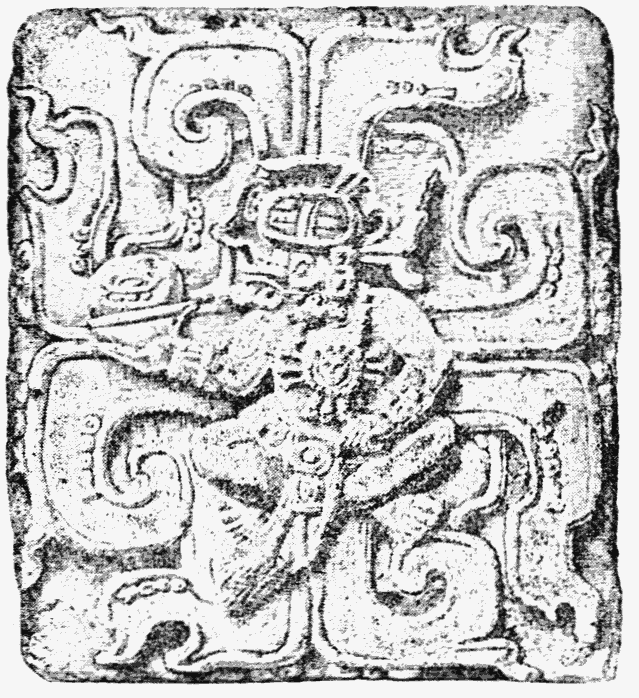
Figure 55.
He is designated as a ruler, not only by his attitude of repose, but by the fact that he wears a breast ornament in the form of a face or head (of the sun) and holds in his hand (i. e. governs) a vase or bowl (see p. 72). Those show him to be the chief or head of all and the Cum-ahau, or lord of the sacred vase or bowl (see p. 93). As the latter contains what appears to be a variant of the glyph ik and the word ik signifies breath, air and wind, by extension life, we realize that he is designated as the lord of breath and life. The glyph which covers his face bears a native cross-symbol and this, as well as the cruciform figure, the centre of [pg 223] which he occupies, conveys the idea of quadruplicate power. The double and bent arms of the cross-symbol strikingly resemble the conventionalized puffs of breath or air which are so frequently depicted in Mexican Codices, as issuing from the mouths of speakers. Almost identical representations of curved puffs are figured as issuing from open serpents' jaws in a bas-relief at Palenque, of which more anon.
Mr. Maudslay has pointed out that on stelæ from Copan and Quirigua a profusion of analogous curved signs occurs also in connection with serpents' heads. A special feature of the curved puffs of breath on the Copan “swastika,” as it has been named, are small seed-like balls which are distributed in detached groups of threes along their inner and outer edges, and are usually accompanied by what resembles the small calyx of a flower, making four small objects in all. These balls, which also recur in the Palenque symbol, forcibly recall a passage of the Zuñi creation myth recounted by Mr. Cushing.
It relates that, at a certain stage of the creation, “the most perfect of all priests and fathers named Yanáuluha ... brought up from the underworld, the water of the inner ocean and the seeds of life production” ... Subsequently, on a feathered staff he carried, “appeared 4 round things, seeds of moving beings, mere eggs they were; two blue like the sky and two red like the flesh of the earth-mother.”...
I cannot but think that these words from a purely native source explain the Copan sculpture more correctly than any inference that could be made, and authorize the explanation that the central figure represents the “four times lord,” or “lord of the four winds,” titles which were applied in Mexico to Quetzalcoatl and Xiuhtecuhtli. At the same time the bas-relief teaches us that “the four winds” had a deeper meaning than has been realized, for it represents life-giving breath carrying with it the seeds of the four vital elements, emanating from the central lord of life, spreading to the four quarters and dividing itself so as to disseminate vitality throughout the universe. The title Kukulcan=the Divine Four, also serpent, proves to be even more expressive of this conception of a central divinity than the Mexican Divine Twin, or serpent. I am therefore inclined to consider that it originated with a Maya-speaking people, to whom, more graphically than to any one else, this bas-relief would have served, as a [pg 224] joint image of the star-god, the heart of heaven, named Hura-kan; of the terrestrial lord Ah-cuch-cab, the heart or life of the State; of the State, with its hun-kaal or one count of twenty subdivisions of people and its quadruple head and body and, finally, of the native cosmology.