The Fundamental Principles Of Old And New World Civilizations. (continued 2)
Reading edition
In my opinion it is impossible to study the above and supplementary data without realizing that the native race assigned its origin to a dual star-divinity, associated with the Tecpatl, the symbol for the North and for Fire. The peculiarity that the divinity is designated as Seven-flowers, and that there were seven tribes, indicates that the native idea was that each tribe came from one of the seven stars in Ursa Major or Minor. The Aztecs seem to have claimed for themselves the descent from the superior star, the central one, and to have thus justified or supported their ultimate establishment of a central government which ruled over the other six tribes.
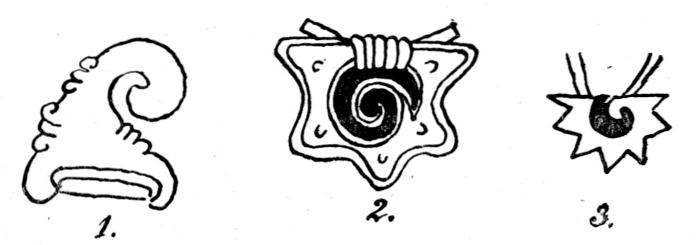
Figure 26.
The assumption that the native race claimed descent from the Ursa Major or Minor constellation is further supported by the fact that the shape of the mythical recurved mountain and the name Aztlan=land of light or brightness are simultaneously explained, as well as the number of caves and tribes. It does not seem to be a mere coincidence that in two totally different Codices (the Selden MS. p. 7, Kingsborough, vol. 1, and the B. N. MS., p. 70) a sacred dance is represented as executed by seven individuals who move around a central seated personage. In the latter MS. the seated figure wears a head-dress surmounted by flint knives and his face is painted red the color assigned to the North. Moreover the dance is taking place before an image of Mictlan-Tecuhtli, the lord of the North, whose raiment is strewn with cross-symbols. Referring to other native dances we find that the most sacred of all dances was performed at the festival of the god of fire by priests only, who, smeared with black paint to typify darkness and [pg 058] night, carried two torches in each hand and first sat, then slowly moved, in a circle, around the “divine brazier,” and finally cast their torches into it (Duran ii, p. 174). This, probably the most ancient of sacred dances, must have been extremely impressive and significative to those who witnessed it, at night-time, from the base of the pyramid and heard the distant solemn chant of the dancers. To watchers from afar, the fire and the lighted torches revolving around must have seemed like a great central star with other stars wheeling about it.
Further on, it will be shown that the earliest form under which the Deity was revered was that of fire and the foregoing description fully explains why it was first chosen as the most fitting image of the central immovable star. It has already been shown that, in the popular game of “the flyers,” a high pole surmounted by one man served as the pivot for the circumvolation of the four performers, who “acted” the “flight of time.” The idea of an extended rule, proceeding from a central dual force, was, however, carried out on a grand scale in the most solemn of all public dances named the Mitotiliztli. Duran (ii, p. 85) states that as many as “8,600 persons danced in a wheel in the courtyard of the Great Temple, which had four doorways, facing the cardinal points and opening out on to the four principal high roads leading to the capital. The doorways were respectively named after the four principal gods and were spoken of as ‘the doorway of such and such a god.’ ”
Clavigero, to whose work (Historia, ed. Mora, Mexico, 1844, p. 234) I refer the reader for further details, describes the dances at the time of the Conquest as having been most beautiful, and relates that the natives were exercised in these, from their childhood, by the priests. This authority also relates that the Mitotiliztli was performed by hundreds of dancers at certain solemn festivals, in the great central square of the city or in the courtyard of the temple, and gives the following description:
The centre of the space was occupied by two individuals (designated elsewhere as high priests) who beat measure on sacred drums of two kinds. One, the large huehuetl, emitted an extremely loud, deep tone, which could be heard for miles and was usually employed in the temples as a means of summoning to worship, etc. The second, the teponaztle, was a small portable wooden drum which was usually worn suspended from the neck by the [pg 059] leader in warfare and emitted the shrill piercing note he employed as a signal. The chieftains (each of which personified a god) surrounded the two musicians, forming several concentric circles, close to each other. At a certain distance from the outer one of these, the persons of an inferior class were placed in circles and these were separated by another interval of space, from the outermost circles, composed of young men and boys. The illustration given by Clavigero records the order and disposition of this sacred dance, which represented a kind of wheel, the centre of which was occupied by the instruments and their players. The spokes of the wheel were as many as there were chieftains in the innermost circle. All moved in a circle while dancing and strictly adhered to their respective positions. Those who were nearest the centre, the chieftains and elders, moved slowly, with gravity, having a smaller circle to perform. The dancers forming the outer circles were, however, forced to move with extreme rapidity, so as to preserve the straight line radiating from the centre and headed by the chieftains. The measure of the dance and of the chorus chanted by the participants was beaten by the drums and the musicians asserted their absolute control of the great moving wheel of human beings, by alternately quickening or slackening the measure. The perfect harmony of the dance, which successive sets of dancers kept going for eight or more hours, was only disturbed occasionally by certain individuals who pushed their way through the lines of dancers and amused these by indulging in all sorts of buffoonery. No one, on reading the above description of the most ancient and sacred of native dances can fail to recognize that it was an actual representation of axial rotation and that no more effective method of rendering the apparent differences in the degrees of velocity in the movements of the circumpolar and equatorial stars, could possibly have been devised. The fact that this dance was a most solemn and sacred rite, whose performance was obligatory to the entire population, indicates that it constituted an act of general obedience and homage and a public acknowledgment of the absolute dominion of a central dual, ruling power.
It is particularly interesting that, in this dance, the latter is represented by two individuals who respectively employ the sacred drum of the priesthood, and that used by war chieftains only (the one instrument emitting a low and the other a high tone); for the [pg 060] culture hero of the Tzendals, Votan, who, with the aid of his followers, taught this tribe the civil laws of government and the religious ceremonials, was entitled “the Master of the sacred Drum.” (See Brinton, American Hero-Myths, p. 214.)
Reverting to the organization of the native race into seven tribes and the wandering of the seventh and principal division, under the leadership of Huitzilopochtli: according to Tezozomoc (Cronica, p. 23), Huitzilopochtli was accompanied by “a woman who was called his sister and was carried by four men. She was a powerful sorceress, possessed the power of assuming the shape of an eagle, had made herself greatly feared and caused herself to be adored as a goddess.” Indignant at her arrogance the priests counselled a course which was adopted by the Mexicans. The woman and her family were left behind at Malinalco where they settled and populated a town, whilst the other portion of the tribe, under strictly masculine rule, advanced towards Tula where they established themselves. “This was the second division which had taken place, amongst the Mexicans or Aztecs ... and when they reached Tula they found their number greatly diminished.” This same incident is related with greater detail by Torquemada (vol. i, chap. ii) from which we learn what a great animosity was felt against the woman. On one occasion, which I shall not pause to describe, two war chiefs menaced her. The “talk” she gave them in return is so remarkable that it deserves to be quoted in full; for it affords a deep insight into the native mode of expression, teaches us the titles of the woman and shows that her position was undoubtedly one of powerful authority.
“I am Quilaztli, your sister and of your tribe ... you know this and yet you think that the dispute or difference you have with me is like an ordinary one, such as you might wage with any ordinary base woman, who possessed little spirit or courage. If you indulge in this thought you are deceiving yourselves, for I am valiant and manly and my titles will oblige you to acknowledge this. For besides the ordinary name of Quilaztli, by which you know me, I also possess four titles, by which I know myself: the first of these is Cihuacoatl=the Woman-serpent (or twin); the second is Quauh-Cihuatl=the Eagle-woman; the third is Yao-Cihuatl=the Woman-warrior and the fourth is Tzitzimi-Cihuatl, the Woman of the Underworld. From the properties [pg 061] or qualities conveyed by these titles you can appreciate who I am; what power I yield and what harm I can do you and if you want to test the truth of this, here is my challenge!”
“The two brave captains, undaunted by the arrogant words by which she attempted to terrify them, responded: 'If you are as valiant as you describe yourself to be, we are not less so; but you are a woman and it is not meet that it should be said of us that we took up arms against women;' and without speaking further they left her, much affronted that a woman should challenge and defy them. And they kept silence about this occurrence so that their people should not know of it.” Señor Alfredo Chavero (appendix, p. 125, to Duran's Historia, Mexico, 1880), commenting upon this passage, says: “It is impossible to doubt that this tradition refers to an important event in the history of the Aztec tribe.... I think it contains the record of a religious struggle.”
The full significance of the narrative will become clear, I think, when the following points are dwelt upon. One thing is certain: here is a historical personage, a woman, who was termed the sister of Huitzilopochtli, who evidently exerted a high authority and whose titles were actually the names of the highest female divinity. Sahagun (book vi, chap. 37) states that Quilaztli, a goddess, the same as Cihuacoatl, was the mother of all and was also named Tonant-zin=“our mother.” What is more significant still is that, in all historical records antedating the Conquest, a man bearing the feminine title of Cihuacoatl=serpent woman, is distinctly and repeatedly mentioned as the coadjutor of the Mexican ruler. Mr. Ad. Bandelier, in his careful study “On the social organization and mode of government of the Ancient Mexicans” (Twelfth Annual Report of the Peabody Museum of Am. Arch, and Ethn., Cambridge, 1879) to which I refer the reader, discusses the relative positions of Montezuma and the Cihuacoatl and states: “there is no doubt about their equality of rank though their duties were somewhat different” (p. 665). This equality is illustrated by the records that both rulers shared the same privileges regarding dress. Thus they alone wore sandals and the Cihuacoatl is termed “the second or double of the king, his coadjutor” (Duran, chap. xxxii, p. 255 and Tezozomoc, chap. xl, p. 66). The latter author, however, gives the full “sacred title” as Tlil-Potonqui Cihuacoatl, literally, “the black-powdered woman-serpent” and we thus [pg 062] learn that, whilst Montezuma's garments were habitually blue like Huitzilopochtli, his coadjutor, like Tezcatlipoca, was associated with black. It is well known that some of the Mexican priests always smeared their bodies with black, which was therefore their special mark.
To my idea the foregoing data, with circumstantial evidence too diffuse to be conveniently produced, clearly indicate that at one time, in the early history of the Aztec race, it had been governed jointly by a male and a female ruler on a footing of perfect equality, the one being the living representative of the Above or masculine elements and the other personifying the Below or feminine elements. The fact that Cihuacoatl is named “the sister” of Huitzilopochtli shows that the female ruler was not necessarily his wife, although she was his coadjutor in her own right. Both rulers were respectively served by four persons presumably of their respective sex. Besides these Duran (chap. 3) records that “there were also other seven teotls=lords, who were much reverenced on account of the seven caves out of which the seven tribes had come.”
We thus perceive that at one time the chief authority was vested in a man and a woman, his sister, who enjoyed a perfect equality. Four persons administered the government of each ruler and each of the seven tribes had “its honoured representative.” For how long this organization had existed it is impossible to tell. Dissension arose and division supervened, but to the time of the Conquest the identical form of government was in force with the remarkable difference that the title and office of the Cihuacoatl, originally held by a woman, were held by a man, whom I do not hesitate to identify as one of the two “supreme pontiffs,” whose emblem of office was the flint knife, the offspring of Cihuacoatl, the earth-mother.
Historical evidence shows that this alteration had not been made without bloodshed and renewed difficulties. Thus it is related that, long after the Mexicans had separated from the sister of Huitzilopochtli and her adherents, they were induced to “ask the daughter of the ruler of Culhuacan to become the Queen of the Mexicans and mother of their god. She conformed with their request but was subsequently killed by her subjects, who flayed her body and dressed a youth in her skin [a figure of native speech which symbolized his assumption of her office]. Under this form she was revered as a goddess, was named our grandmother and ‘the mother of the god,’ etc.” These and the following details, [pg 063] taken from well-known authentic native sources, are attractively rendered in the “Newe Welt und Amerikanische Historien” (Johann Ludwig Gottfriedt. Frankfurt-a.-M., 1613, pp. 54 and 55).
Again, after the Mexicans had been settled at Tenochtitlan for some time, they desired to make an alliance with the King of Culhuacan and therefore “chose to nominate, as their ruler, Acamapichtli, who was the son of a Mexican chieftain by a daughter of the Culhuacan ruler” and evidently lived with the latter. For it is related that, on giving his consent, the king of Culhuacan stated that if only a woman (of his family) had been nominated he would have refused (to trust her to the Mexicans). The farewell words he addressed to Acamapichtli are worthy of quotation: “Go my son, serve thy god, be his representative. Rule the creatures of the god by whom we live; the god of day, of the night and of the winds. Go and be the lord of the water and land owned by the Mexicans.”
As it is subsequently stated that Acamapichtli and his queen were received at Tenochtitlan with great honors, it would seem as though the Mexicans who, from some deeply-rooted religious idea, considered it essential to have a female ruler of the line of the king of Culhuacan, obtained their desire only by accepting a male member of her family as a protection and safeguard for her sacred person. It may be that for the reasons of safety and preservation the female ruler, who was the living representative of the Cihuacoatl, gradually retired into absolute seclusion whilst a man of her kin assumed, in public, her title and prerogatives.
Unless it is assumed that this was the case, it seems impossible to explain why Acamapichtli is designated in the Codex Mendoza (Kingsborough, vol. i, pl. ii) as having begun to rule in the year I Tecpatl or flint (approximately corresponding to A.D. 1364) with the title of “Woman-serpent”=Cihuacoatl. From this date the title seems always to have been borne by a man. When human sacrifices had become a prominent feature of the native cult and it became a duty of the Cihuacoatl to perform the bloody rite, it is obvious that it became impossible for a woman to fill the position.
We obtain, however, glimpses of the shadowy form of an invisible and venerable female ruler who is at the head of the “House of Women,” watches over the welfare of the women of the tribe and officiates as a priestess, with her assistants, at births, baptisms and marriages. In order to account for the obscurity which surrounds [pg 064] her, it should be noticed that the mere fact that the ideas of darkness and seclusion became indelibly associated with the female sex, would naturally and inevitably cause women to be housed up, veiled and condemned to comparative inaction and immobility. A primitive stage in the growth of the above idea is shown in the case of the Huaxtecas, the women of which tribe wore abundant covering whilst the men, on religious principle, wore none. A careful study of the conditions surrounding the Cihuacoatl or high priest shows that he also conformed to the exigencies of his position when he acted as the representative of the hidden forces of Nature, of the female principle. He and the entire priesthood smeared their bodies with black, cultivated long hair, and wore, during the performance of certain religious ceremonies, a wide and long garment reaching to the ground. It is noticeable that the designs on the garments of the priests, in the B. N. MS., are invariably executed in red and yellow, the symbolical colors of the north and west, combined with black the symbol of the union of both, the Below. In this connection it is noteworthy that in Mexican pictography the faces of women are usually painted yellow—the color of the West=the female region. The association of darkness, concealment and secrecy, with the female principle, is exemplified by the fact that a building in the enclosure of the Great Temple of Mexico, named the “house of darkness,” was dedicated to the earth-mother=Cihuacoatl (Sahagun, appendix to book II). Other temples of hers are described as being cave-like, underground, dark, with a single low entrance, the door of which was sometimes sculptured in the form of the great open jaws of a serpent. Only priests were allowed to penetrate into these mysterious chambers where sacred and secret rites were performed and a sacred fire was also kept burning in an adjoining chamber. Evidence, which I shall produce further on, establishes that the high-priest Cihuacoatl dwelt, at times, in a house named “place of darkness” and annually sacrificed a human victim in honor of the lord of the underworld, in an edifice called “the navel of the earth.”
The religious cult of one-half of the Mexican hierarchy was distinctly nocturnal. The chief duties of certain priests were astronomical observation and the supervision of the sacred fire, which was kept perpetually burning on the summit of each temple-crowned pyramid, in what was termed “the sacred or divine brazier” of [pg 065] sculptured stone. Two priests jointly watched by night and day and received and transmitted to the flames the incense offerings of the devout. The temple fires were extinguished only at the expiration of a cycle of fifty-two years and were then rekindled by the high priest at midnight precisely, with impressive solemnity.
In ancient Mexico, it should however be observed, although the logical association of women with the hidden forces of nature, the underworld and the Below, had exerted a certain influence over her practical existence, it had not yet given rise to the idea of her inferiority as compared to man, the associate of the Heaven, the Above, the visible and active forces of nature. The native sages did not identify her so intimately with the earth as to deny her the possession of a soul—the celestial spark. On the other hand it is curious to note that the Nahuatl word for wife is Cihua-tlan-tli and for husband is Te-o-quichtli. Is it possible that the particle tlan in the first and Teo in the second may have contributed to strengthen the association of the woman with earth=tlalli (tlan=land of) and the man with Teotl, the sun, something divine and celestial? In course of time it doubtlessly would have transpired, in Mexico as elsewhere, that the set of primitive ideas which, during untold centuries, imposed upon women seclusion, obscurity and inactivity and thus hindered her development of strength of body and mind, would have directly induced an inferiority. This has been subsequently proclaimed, as we know, in many countries, as a direct proof of her lower nature and of her affinity with the element earth. The assumed and actual inferiority of woman may therefore be regarded as the logical, inevitable but artificial result of primordial classification and association. Suggested by the same natural phenomena which were visible to all inhabitants of the same latitudes, these ideas occurred to all people at a certain stage of their development and exerted a dominating influence over the subsequent growth of their intelligence. It is but now, that, unconsciously, mankind is beginning to emerge from the leading strings of its infancy, which became an iron bondage to its prolonged childhood. In Mexico, at the period of the Conquest, the absolute equality of the male and female principles was theoretically maintained. At the same time it is possible to discern certain agencies at work which were tending to connect the Below, the female principle, with harm and evil. From time immemorial [pg 066] it had been the custom of the Chichimecs, who, according to Sahagun (book xii, chap. 12, par. 5), inhabited an extremely poor and barren region of Mexico, to sacrifice the first animal killed in a hunting expedition and to offer it to “the Sun whom they called father and to the earth their mother.” They severed its head and raised this as though offering it to the sun. They then tilled the earth where the blood had been spilt and left the animal which had been sacrificed, on the spot (Ixtlilxochitl, Historia Chichimeca chap. vi and Relaciones p. 335). This passage, establishing the cultivation of the soil where the blood had been spilt, sheds a flood of light on the origin of the offerings of human blood and the sacrifices of human life, which were such a prominent and hideous feature of the Aztec religion.
At the beginning of the sixteenth century, instead of the blood being spilt directly upon the earth, to insure and increase the fruitfulness of the soil, a human being was stretched across a conical stone which became thus the image of the earth-mother, his heart was extracted and offered to the sun, the Above, and his blood was then smeared on the mouth of certain idols representing the Below. In the B. N. MS. an interesting illustration and account are given of an idol of the earth-mother who is figured as standing on a pedestal adorned with skulls and cross-bones with outstretched tongue which signified, “that she always had great thirst for human blood” and “never refused sacrifices offered to her.”
Two priests are likewise pictured in the act of offering bowls containing human blood to the idol and a third, mounted on a ladder, is pouring the contents of another bowl over its head. It is obvious how the constant associations of the earth-mother with sanguinary sacrifices and bloodthirstiness would, in time, give rise to the idea of a hostile, maleficent power, linked with darkness and devouring fire, who, under the aspect of the serpent-woman, waged an eternal warfare on the human race and clamored for victims and bloody sacrifices. The natural sequence to the above associations is that in ancient Mexico the powers exerting fatal influence upon the human race are all represented as female, viz.: the Cihuacoatl or woman-serpent, the Ciuapipiltin and the Tzit-zime, etc. These and various other personifications of the female principle are described in detail in my notes and commentary to the B. N. MS.
After considering the foregoing data it seems impossible not to [pg 067] conclude that it must have taken centuries of time for the idea of duality, or of the Above and Below to have taken such a deep hold upon the native mind and to have produced such a growth of symbolism and association in so many ramifications of thought. Let us endeavor to obtain a further insight into the native mode of thought by carefully studying some significant details concerning the social organization of the Mexicans from the time of Acamapichtli to that of Montezuma and the influences it had been subjected to gradually. This, the first ruler, unquestionably ruled as the Cihuacoatl, a name which means either Woman-serpent or Female-twin. This fact in itself testifies to an epoch-making change in the organization of the Mexican government, in the making of which a concession was made to a previously existing order of things, by the retention of the female title by a male ruler.
Having carefully studied the question for many years, I have long considered it proven that when the Mexicans settled in the valley of Mexico they came under a series of influences emanating from an ancient and highly cultured centre of civilization situated in the south, which had followed, during untold centuries, the same lines of primitive thought which have been stated. This question of contact and influence from an older civilization is so important and the material I have collected on the subject is so extensive and complex, that it cannot be adequately treated here. Further on I shall discuss at length certain historical data throwing light on ancient contact and influences. Meanwhile I may as well state here that, having carefully weighed all testimony, I accept as amply proven and well supported, the testimony of Las Casas, Torquemada, Mendieta and others, who record that the Mexican culture-hero Quetzalcoatl was an actual person who had come to Mexico from Yucatan twice and had finally returned thither, leaving a small colony of his vassals behind him whose influence upon the religious and social organization and symbolism of the tribes, inhabiting the central plateau, can be plainly discerned. Montezuma himself, in his famous speech to Cortés, which the latter carefully reported to the Emperor Charles V, states that: “we [the Mexican rulers] were brought here by a lord, whose vassals all of our predecessors were, and who returned from here to his native land. He afterwards came here again, after a long time, during which many of his followers who had remained, had married native women of this land, raised large families and founded towns in [pg 068] which they dwelt. He wished to take them away from here with him, but they did not want to go, nor would they receive or adopt him as their ruler, and so he departed. Hut we have always thought that his descendants would surely come to subjugate this country and claim us as their vassals....” (Historia de Nueva España. Hernan Cortés, ed. Lorenzana, p. 81; see also p. 96). I do not see how it is possible to construe such plain, unadorned statements of simple, common-place facts into the assumption that Montezuma was recounting a mythical account of the disappearance of the Light-god from the sky, as upheld by some modern writers, who interpret the whole episode as a sun-myth or legend.
I have already shown that the meaning of the ocelot-skin and the spider, employed as symbols by the Mexicans, is apparent only when studied by means of the Maya language of Yucatan, the land whence the culture-hero is said to have come by the foregoing authorities. I will add here that in the Maya chronicles, it is stated that the culture-hero had ruled in Chichen-Itza, the first part of which name, Chichen, means red. In Mexican records it is described that he departed by water from the Mexican coast and travelled directly east, bound for Tlapallan—a name which means red-land. I draw attention to the fact that any one sailing from the mouth of the Panuco river, for instance, in a straight line towards the east, would inevitably land on the coast of Yucatan, not far from the modern Merida and the ancient ruins of Chichen-Itza.
I shall also produce evidence, further on, to show that the meaning of the much-discussed name of the culture-hero's home, Tullan, is also furnished by the Maya language. From more than one source, we learn, moreover, that there were several Tullans on the American continent. The conception of Twin-brothers as the personification of the Above and Below had been adopted in Yucatan and it is to the influence emanating from that source that I attribute the movement made in Mexico, to substitute male twin-rulers in the place of the man and woman, who had previously and jointly ruled the ancient Mexicans.
Let us now analyze the Maya title Kukulcan, of which Quetzalcoatl is the Mexican equivalent. As already stated, the word can means serpent and the numeral 4 and is almost homonymous with the word for sky or heaven=caan. The image of a serpent, therefore, directly suggested and expressed the idea of something quadruple incorporated in one celestial being and appropriately [pg 069] symbolized the divine ruler of the four quarters. In the word Kukulcan the noun can is qualified by the prefix kukul. In the compiled Maya dictionary published by Brasseur de Bourbourg (appendix to de Landa's Relacion) the adjective ku or kul is given as “divine or holy.” Kukulcan may therefore be analyzed as “the divine serpent” or the “Divine Four.” When Maya sculptors or scribes began to represent this symbol of the divinity they must have searched for some object, easy to depict, the sound of whose name resembled that of ku or kul. The Maya adjective “feathered” being kukum, the artists evidently devised the plan of representing, as an effigy of the divinity, a serpent decorated with feathers and to this simple attempt at representing the “divine serpent” in sculpture or pictography is due, in my opinion, the origin of the “feathered serpent” effigies found in Yucatan and Mexico, which have so puzzled archaeologists.
Of Kukulcan, the culture-hero of the Mayas, it is recounted that he had been one of four brothers who originally ruled at Chichen-Itza, over four tribes. “These brothers chose no wives but lived chastely and ruled righteously, until, at a certain time, one died or departed and two began to act unjustly and were put to death. The one remaining was Kukulcan. He appeased the strife which his brothers' acts had aroused, directed the minds of the people to the arts of peace and caused to be built various edifices. After he had completed his work at Chichen-Itza he founded the great city of Mayapan, destined to be the capital of the confederacy of the Mayas.” (See Brinton, Hero-myths, p. 162.) Friar Diego de Landa relates that the current opinion amongst the Indians of Yucatan was that this ruler had gone to Mexico where, after his return (departure?) he was named Cezalcouatl and revered as one of their gods (Relacion, ed. Brasseur de Bourbourg, p. 36). Before analyzing the Nahuatl rendering of Kukulcan's name I would point out the noteworthy coincidence that, during his reign at Chichen-Itza and Mayapan, he practically united in his person and assumed the offices formerly fulfilled by four rulers, of which he had been only one.
I would, moreover, draw attention to the remarkable, sculptured columns which support the main portal of the main pyramid-temple called El Castillo at Chichen-Itza. These represent gigantic feathered serpents and are figured on pl. xiv of Mr. Wm. Holmes' most instructive and useful “Archaeological Studies,” Part i, “Monuments [pg 070] of Yucatan.” The feathers carved on the massive columns are evidently the precious tail feathers of the quetzal, which have the peculiarity of exhibiting, according to the way the light falls upon them, blue, red, yellow and green colors—precisely those assigned to the four quarters by the Mexicans and for all we know to the contrary, by the Mayas. Whether this feather was chosen for this peculiarity or for its beauty only, as that with which to deck the effigy of the divinity, can, of course, only be conjectured. In Mexico numberless effigies of feathered serpents exist. The resemblance of the sound of the Nahuatl words: feather=ihuitl, and heaven or sky=ilhui-çatl, should be recorded here as a possible reason for the association of feathers with the serpent and as a means of conveying the idea of its divinity. It should also be noted that quetzal, the name of the most precious feathers the natives possessed, resembles in sound, the second part of the Nahuatl words for flame=tle-cueçal-lotl, or for “tongue of fire”=tle-cueçal-nenepilli. That the feathered serpent was an image of the divinity is finally proven, I think, by the following passage from Sahagun which establishes that the earliest form, under which the divinity was revered by the Mexicans, was that of fire: “Of all the gods the [most] ancient one is the God of Fire, who dwells in the midst of flowers, in an abode surrounded by four walls and is covered with shining feathers like wings” (op. cit. book vi, chap. iv). It is thus shown that whilst the word ihuitl=feather suggested something divine, the word quetzal, besides being the name of a particular kind of feather, conveyed the idea of something resplendent or shining [like fire]. The name for serpent, coatl, signified twin; thus there is a profound analogy between the Maya and Mexican symbol, pointing, however, to the Yucatan form as the most ancient.
Let us see how the name Quetzal-coatl occurs in Mexico. It is given as the name of the “supreme god whose substance was as invisible and intangible as air,” but who was also revered as the god of fire. The constant reference to air in connection with the supreme divinity caused him to be also adored as the god of air and of the four winds. On the other hand, the divine title of Quetzal-coatl was carried by the culture-hero whose personality has been discussed and who was a Yucatec ruler and high priest. Sahagun (op. cit. book iii, chap. ix) informs us that “Quequet-zalcoa,” the plural form of the word Quetzalcoatl, was employed [pg 071] to designate “the high priests (elsewhere designated as the ‘supreme pontiffs’) who were the successors of Quetzalcoatl.” He also states that “the high priest of the temple was [the representative of] the god Quetzalcoatl” (book i, chap. 5). “The priest who was most perfect in his conduct and in wisdom was elected to be high priest and assumed the name of Quetzalcoatl.... There were two such high priests equal in rank and honours.... One of these, the Quetzalcoatl Totec Tlamacazqui, was in the service of Huitzilopochtli.” Without pausing here to analyze this title since it will be discussed in detail in another publication I will only repeat that, after years of careful research, I have obtained the certainty that the foregoing title and office were those held by Montezuma at the time of the Conquest. What is more, I can produce ample evidence to prove that he was the living personification of Huitzilopochtli one of the “divine twins” and of the Above. He was not the first Mexican ruler who had filled this exalted rôle, for it is recorded that Axayacatl, one of Acamapichtli's successors, had represented, in life, “our god Huitzilopochtli.” After his death his effigy “was first covered with a fine robe representing Huitzilopochtli; over this was hung the dress of Tlaloc ... the next garment was that of Youalahua [=the lord of the wheel] and the fourth was that of Quetzalcoatl” (Duran, vol. i, chap. 39, pp. 304 and 306).
Let us now see how Montezuma's personification of Huitzilopochtli was carried out by his life and his surroundings. According to Bernal Diaz, an eye-witness, when the great Montezuma came forth in state to meet Cortés, he was conveyed on a sumptuous litter, being thus raised above the earth.6 When he descended from this and walked, the golden soles of his sandals prevented his feet from coming into direct contact with the ground; he was supported, i. e. partially held up, by his four principal [pg 072] lords, and a baldachin adorned with light greenish-blue feathers, gold, pearls and jade representing the xoxouhqui-ilhuicatl=“the verdant or blue sky” (which was, by the way, a title of Huitzilopochtli), was carried over his head. Other lords preceded him, “sweeping the ground and spreading blankets upon it so that he should not tread upon the earth. All of these lords did not dare to think of raising their eyes to look at his face—only the four lords, his cousins, who supported him, possessed this privilege” (Bernal Diaz, Historia Verdadera de la Conquista. Madrid, 1632, p. 65). A feature, the origin of which can be directly traced back to the association of the star-god, Polaris, with repose and immovability, was that Montezuma, like his predecessors, was the only person privileged to sit on state occasions, on a throne or raised seat with a high back and rest whilst all other individuals stood or moved about him.
From several sources we know that Montezuma habitually wore blue or white attire, which sometimes was of open network. He employed gold, precious blue and green feathers, turquoise, pearls and emeralds for his personal ornaments. His diadem with a high point in front, was incrusted with turquoise or was made of burnished gold. He sometimes wore a crown made of featherwork, with a bird's head of gold above his forehead. His emblem was the sun, the orb of day, and he presided over its cult which had developed itself simultaneously with the cult of the Above, a feature of which was the offering of “birds, butterflies and flowers.” Sometimes he wore, “attached to his sandals, small wings, named tzi-coyolli, resembling the wing of a bird. These produced a sound like that of tiny gold bells when he walked” (Tezozomoc, Cronica, p. 594).
It must be admitted, on reading the foregoing descriptions gleaned from Sahagun's Historia, that it would be impossible to carry out, more perfectly and completely, the idea that Montezuma was the earthly representative of the Upper regions, the blue heaven. By pushing symbolism so far that he actually wore wings on his [pg 073] feet and avoided contact with the ground, it is not surprising that Montezuma's adversaries, amongst neighboring tribes, should accuse him of exacting divine honors for his own person. At the same time there is no doubt that his own subjects revered him merely as a temporary representative and mouth-piece of the impersonal dual divinity. This idea is clearly conveyed by some native harangues, to which I refer the reader, and from which I extract the following passages:
After his election, the ruler is solemnly addressed by one of the chief lords who says to him: “Oh! our humane, pious and beloved lord, who deserves to be more highly esteemed than all precious stones and feathers, you are here present because our sovereign god has placed thee [above us] as our lord.... You possess the seat and throne which was given [to your predecessors] by our lord god” ... “you are the image of our lord god and represent his person. He reposes in you and he employs you like a flute through which he speaks and he hears with your ears.... Oh, lord king! God sees what the persons do who rule over his domains and when they err in their office he laughs at them, but in silence, for he is god, and is omnipotent and can mock at whom he will. For he holds all of us in the palm of his hand and rocks us about, and we are like balls or round globes in his hands and we go rolling from one side to the other and make him laugh, and he serves himself of us as we go moving about on the palm of his hand!”
“Although thou art our neighbour and friend and son and brother, we are no more thy equals, nor do we consider you as a man, for now you have the person, the image, the conversation and the communion of our lord god. He speaks inside of you and instructs you and lets himself be heard through your mouth—his tongue is your tongue, and your face is his face ... he has adorned you with his authority and has given you fangs and claws so that you should be feared and reverenced ...” (Sahagun, book vi, chap. 10).
The foregoing figure of speech in which fangs and claws are alluded to as symbols of fear-inspiring power affords as valuable an insight into the native modes of thought and expression as do the similes employed in the following address to the newly-elected ruler by the spokesman of his vassals.
[pg 074]
“Oh lord! may you live many years to fill your office prosperously; submit your shoulders to the very heavy and troublesome load; extend your wings and breast as a shelter to your subjects whom you have to carry as a load. Oh, lord! let your town and vassals enter under your shadow, for you are [unto them] like the tree named puchotl or aueuetl, which casts a great circle or wheel of shade, under which many are gathered in shelter” (op. cit. book vi, chap. ii).
The admonition also addressed to the ruler, “Never to laugh and joke again as he had done previously to his election, and to assume the heart of an old, grave and severe man,” explains the true significance of the name of Montezuma or Mo-tecuh-zoma; which was an honorific title literally meaning, “our angry or wrathy [looking] lord.”
Whilst the above data establish beyond a doubt that the Mexican Quetzalcoatl was regarded as the visible representative of the celestial ruler of the universe and that divine honors were voluntarily accorded to him, it is interesting to read Montezuma's explanation to Cortés concerning this question. The latter writes: “seated on a raised seat Montezuma discoursed as follows: ... ‘I know that you have been told by my enemies that I am, or have made myself a god.’... Raising his robes he showed me his body saying: ‘Here you see that I am made of flesh and bone, like yourself or like any one, and that I am mortal and tangible.’ Grasping his arms and his body with his hands he continued: ‘see how they have like to you.’ ”... (Historia, Hernan Cortés, ed. Lorenzana, p. 82). Better than all dissertations, the above words convey an idea of the naïf simplicity of the man who uttered them.
Referring the reader to Mr. Ad. Bandelier's study, “On the social organization and mode of government of the ancient Mexicans,” for further details concerning the duties respectively filled by Montezuma and his coadjutor, I shall only explain here the conclusion I have reached that the former was the high priest of the cult of the sun and heaven, the visible ruler, the war lord, and the administrator of justice. As stated in a native harangue: “the supreme lord is like unto the heart of the population ... he is aided by two senators in all concerning the administration of the government: one of these was a ‘pilli’ and was named [pg 075] tlaca-tecuhtli; the other was a warrior and was entitled tlacoch-tecuhtli. Two other chieftains aided the supreme lord in the militia: one, entitled tlaca-teccatl, was a ‘pilli’ and warrior; the other, named tlacoch-calcatl, was not a ‘pilli.’ Such is the government or administration of the republic ... and these four officers did not occupy these positions by inheritance but by election” (Sahagun, book vi, chap. 20).
The following account of the republic of Tlaxcalla throws further light upon the form of government which prevailed throughout Mexico and Central America at the period of the Conquest. “The Captains of Tlaxcalla, each of whom had his just portion or number of soldiers ... divided their soldiers into four Battails, the one to Tepeticpac, another to Oco-telulco, the third to Tizatlan and the fourth to Quiahuiztlan, that is to say, the men of the Mountains, the men of the Limepits, the men of the Pinetrees, and the Watermen; all these four sorts of men did make the body of the Commonwealth of Tlaxcallan, and commanded both in Peace and War ... The General of all the whole army was called Xico-tencatl, who was of the Limepits ... the Lieutenant General was Maxix-catzin....” (A new survey of the West-Indies ... Thomas Gage, London, 1655, p. 31). In Mexico we find that the four executive officers were the chiefs or representatives of the four quarters of the City of Mexico. In each of these quarters there was a place where periodical offerings were made in reverence of one of the signs: acatl, tecpatl, callii and tochtli, which were the symbols of the cardinal-points, the elements, and served as day and year signs in the calendar (Sahagun, book ii, chap. 26).
An interesting indication that the entire dominion of Mexico was also divided into four equal quarters, the rule administration of which was attended to by four lords, inhabiting towns situated within a comparatively short distance from the capital, is furnished by Bernal Diaz (op. cit. p. 65). He relates that the four lords who supported Montezuma when he walked in state to meet Cortés were the lords of Texcoco, Iztapalapa, Tacuba and Coyoacan. These towns, which were minor centres of government, were respectively situated at unequal distances to the northeast, southeast, northwest and southwest of the capital.
These facts and the knowledge that “all lords, in life, represented a god” justify the inference that, just as Montezuma represented [pg 076] the central power of the Above or Heaven, the four lords who accompanied him were the personified rulers of the four quarters, associated with the elements. In ancient Mexico and Maya records the gods of the four quarters, also named “the four principal and most ancient Gods” are designated as “the sustainers of the Heaven” and it cannot be denied that, on the solemn occasion described, the four lords actually fulfilled the symbolical office of supporting Montezuma, the personification of the Heaven. This striking illustration is but one of a number I could cite in proof of the deeply ingrained mental habit of the native sages to introduce, into every detail of their life, the symbolism of the Centre, the Above and Below and the Four Quarters. I shall but mention here that it can be proven how, in their respective cities the lords of the cardinal points were central rulers who, in turn, directed the administration of the government by means of four dignitaries. Each of these was also the embodiment of a divine attribute or principle, “All noblemen did represent idols and carried the name of one” (Acosta, Naturall and Morall Historie, lib. 5, p. 349).
Each wore a special kind of symbolical costume and was the ruler or “advocate,” as he is termed, of a distinct class of people. “For to each kind or class of persons they gave a Teotl [=God or Lord] as an advocate. When a person died and was about to be buried, they clothed him with the diverse Insignia of the god to whom he belonged” (Mendieta lib. ii, chap. 40). It being established that each of the four year-symbols, acatl, tecpatl, calli and tochtli, ruled four minor symbols, it seems evident that, just as the four lords of the cardinal-points would correspond to the above symbols, each of the minor lords and the category of people they represented would also be associated with the minor symbols. The obvious result of this classification would be the division of the entire population of the commonwealth into 4×5=20 categories of people, grouped under twenty local and four central governments, whose representatives in turn were under the rule of the supreme central dual powers. Having thus sketched, in a brief and preliminary way, the expansion of the idea of dividing all things into four parts, the bud of which was the swastika, let us examine the Mexican application of the idea of duality, pausing first to review the data relating to the Cihuacoatl, the personification of the Earth, the Below and the coadjutor of Montezuma.
Nothing has been definitely recorded about his personality, for [pg 077] he seems to have lived in absolute seclusion during the first occupation of Mexico by the Spaniards. He is frequently alluded to, however, and Cortés, Herrera, Torquemada and others, inform us that he had acted as Montezuma's substitute and led the native troops against the Spaniards. It is interesting to find that after the Conquest Cortés appointed him as governor of the City of Mexico. “I gave him the charge of re-peopling the capital and in order to invest him with greater authority, I reinstated him in the same position, that of Cihuacoatl, which he had held in the time of Montezuma” (Carta Cuarta, Veytia i, p. 110).
Quite indirectly, it is possible to learn what sort of military equipment had been adopted by the Cihuacoatl when he acted as war-chief. Amongst certain presents, which were sent by Cortés to Charles V and are minutely described in vol. xii of the “Documentas ineditas del Archivio de Indias,” p. 347, there are several suits of armor, which could only have been appropriately worn by the “woman serpent.” One suit consisted of a “corselet with plates of gold and with woman's breasts” and a skirt with blue bands. Another suit, instead of the breasts, exhibited a great wound in the chest, like that of a person who had been sacrificed. In another list (by Diego de Soto, p. 349) a shield is described “which displayed a sacrificed man, in gold, with a gaping wound in his breast, from which blood was streaming....” It is obvious that the first of these suits of armor conveyed figuratively the name and the second the office of the Cihuacoatl of whom Duran speaks as follows:
“He whose office it was to perform the rite of killing [the victim] was revered as the supreme pontiff and his name or title and pontifical robes varied according to the different periods [of the year] and the ceremonies which he had to perform. On the present occasion his title was Topiltzin, one of the names of the great lord ... (Quetzalcoatl) and he appeared carrying a large flint knife in his hand ...” (op. cit., chap. lxxxi). The following passage shows definitely that Montezuma's coadjutor, his Quetzalcoatl or divine twin, had an equal share of divine honors accorded to him. “The head priest of the temple, named Quetzalcoatl, never came out of the temple or entered into any house whatever, because he was very venerable and very grave and was esteemed as a god. He only went into the royal palace” (Sahagun, book vi, chap. 39). The same authority designates [pg 078] the second “divine twin” as the Tlalocan-tlamacazqui or, Tlalocan-tlenamacac and states that he served the Tlalocan-tecuhtli.
Before proceeding further, let us pause and inquire into the reason why the name Tlaloc, which is formed of tlalli=earth and is defined by Duran, for instance, as meaning “an underground passage or a great cave” (op. cit., chap. 84), should be the well-known title of the “god of rain.” The explanation is to be found in the text of the Vatican Codex, A. Kingsborough, v, p. 190. This teaches us that the last syllable of the name Tlaloc does not represent oc=inside of, but stands for octli, the name of the native wine now known as pulque, which is obtained from the agave plant. Tlaloc thus meant “earth-wine” and “by this metaphor they wanted to express that just as the fumes of wine make mankind gay and happy, so the earth when saturated with water, is gay and fresh and produces its fruits and cereals.” By the light of this explanation we see that the titles conferred upon Montezuma's coadjutor were literally “the priest or lord, or dealer-of-fire in the place of the earth-wine.” “The clouds, rain, thunder and lightning were attributed to the lord Tlaloc who had many tlalocs and priests under him, who cultivated all foods necessary for the body, such as maize, beans, etc., and sent the rains so that the earth should give birth to all of its products. During their festival in springtime the priests went through the streets dancing and singing and carrying a shoot of green maize in one hand and a pot with a handle in the other. In this way they went asking for the [ceremonial] boiled maize and all fanners gave them some” ... (Sahagun, book vi, chap. 5).
The above and many scattered allusions throw light upon the group of ideas associated with the Cihuacoatl and clearly indicate what were his duties. To him devolved the care of the earth and his one thought was to secure abundance of rain and of crops. In order to ensure the proper cultivation of the ground, he had, under him, innumerable agents, who strictly superintended the cultivation of all food-plants, the irrigation of barren lauds, etc. These agents, who also resorted to ceremonial usages in order to bring rain or avert hail-storms and other disasters, were collectively named “the 400 pulque or octli-gods”—an appellation which developed into tochtli-gods, when the rabbit (=tochtli) had become the pictograph habitually employed to convey the sound of the word octli, and had been adopted as the symbol of the earth [pg 079] and of prolific reproduction in connection with this. The latter idea is born out of the female title, that of the earth-mother, who “always brought forth twins.” The Cihuacoatl thus stands out as the representative of the bountiful mother-earth and as the lord of agriculture, one of whose duties was the careful collection, storage and distribution of all food products. He presided over the cult of the fertility of the earth, of the nocturnal heaven, of the stars and moon, which were associated with the female principle and with growth in general. The following record proves that amongst his other duties he offered sacrifices to the invisible hidden powers of darkness and earth. “During the night, in the feast Tititl, the high priest named Tlillan tlenamacac [=the dealer with fire in the land of darkness=tlilli=black, evidently a title analogous to that of Tlill-potonqui-cihuacoatl, given by Tezozomoc, in Cronica, chap. 33], sacrificed a victim in honour of the god of the Underworld” (Sahagun, book ii, appendix). In this, as on similar occasions, he was assisted by four priests who succeeded him in rank.
Mr. Bandelier has already recognized that judicial sentences were ultimately referred to the “woman-serpent,” who pronounced the “final sentence, which admitted of no appeal.” There are more reasons than can conveniently be presented here, proving that in Mexico, as in Guatemala, the priest of the Below, the personification of Tezcatli-poca=Shining Mirror, employed an actual mirror made of polished obsidian, as an aid in pronouncing final judgment on criminals.
The Cakchiquel procedure is described by Fuentes of Guzman, who is quoted by Dr. Otto Stoll in his most instructive and valuable work on the Ethnology of the Indian Tribes of Guatemala (Internationales Archiv für Ethnographie, band i, supplement i, 1888): “A road leads [from the ancient city of Guatemala] to a hill [figured with a large tree growing from it]; on its top there is a flat circular cement floor, enclosed by a low wall. In the centre is a pedestal, polished and shining like glass. No one knows of what substance it is made. This was the tribunal or court of the Cakchiquel Indians, where public trials were held and where the sentences were executed. The judges sat in a circle on the low wall. After the sentence had been pronounced, it had to be confirmed or vetoed by another authority. Three messengers, acting as deputies of the council, went to a deep ravine situated to the [pg 080] north of the palace, where, in a sort of hermitage or prayer-house, there was the oracle of the devil, which was a black, transparent stone, like glass, but more costly than [ordinary] obsidian. In this stone the devil revealed to the messengers, the sentence to be executed. If it agreed with the judgment pronounced, this was immediately executed upon the central pedestal [of the hill of justice] on which the criminal was also tortured, at times.” If nothing was seen in the mirror, and it gave no sign, the prisoner was pronounced free.
This oracle was also consulted before wars were undertaken ... “During the first years of the Spanish occupation, when the bishop Marroquin heard about this stone, he had it cut out and consecrated it as an altar, which is still in use in the convent of San Francisco in the capital. It is a precious stone of great beauty and is half a vara long.”
A picture in the Vatican Codex B (p. 48) represents a temple, on the summit of which a large obsidian mirror is standing on its edge. Inside the doorway there are many small black spots, which obviously represent small mirrors and convey the idea that the interior walls were incrusted with such. These illustrations would prove that sacred edifices were associated with obsidian mirrors even if Sahagun did not mention, as he does (book ii, appendix), no less than three sacred edifices in the great temple of Mexico, which were associated with obsidian mirrors. It is, moreover, stated by Duran that “in Mexico the image of the god Tezcatlipoca was a stone, which was very shining and black, like jet. It was of the same stone of which the natives make razors and knives,” i. e., obsidian (Duran ii, p. 98).
What is more, Bernal Diaz relates that the image of Tezcatlipoca, which he saw beside the idol of Huitzilopochtli in the hall of the great temple of Mexico, had shining eyes which were made of the native mirrors=tezcatl. “In connection with the shining eyes” of the god it is interesting to note that when, as Duran states, he was represented under another form, his idol “carried in its hand a sort of fan made of precious feathers. These surmounted a circular gold disc which was very brilliant and polished like a mirror. This meant that, in this mirror, he saw all that went on in the world. In the native language they named it ‘itlachiayan,’ which means, that in which he looks or sees” (Duran, op. cit., vol. ii, p. 99).
[pg 081]
Sahagun mentions an analogous sceptre which consisted of “a gold disc pierced in the centre, and surmounted by two balls, the upper and smaller of which supported a pointed object. This sceptre was called tlachieloni, which means ‘that through which one looks or observes;’ because with it one covered or hid one's face and looked through the hole in the middle of the gold plate.” This kind of sceptre is not exclusively associated with Tezcatlipoca in the native picture writings, for it figures in the hand of Chalchiuhtlycue “the sister” of Tlaloc and of Omacatl whose attributes, the reeds and chalchiuite or jade beads, prove him to be also associated with the water. On the other hand the same sceptre is also assigned by Sahagun to the god of fire.
A clue to the truth and significance of this emblematic sceptre is furnished by the fact that, in order to express the divine title Tlachiuale, meaning “the Maker or Lord of all creatures or of young life,” the native scribes were naturally obliged to employ the verb tlachia=to look or see, in order to convey its sound. It is obvious that they cleverly agreed to express this verb by picturing some object which could be or was looked through. They therefore adopted a sceptre with a hollow disc, as an emblem, which was carried by the living representative of certain divinities, whose entire costume was in reality a sort of rebus, and in the case of Tlaloc, the lord of earthwine and fertility and the Tlachiuale or “Creator of young life,” par excellence, they once and for all designated his title by surrounding his eyes with two blue rings, accentuating thereby the action of seeing or looking. But this probably conveyed even more than the above title, for there is a Nahuatl noun tlachiuhtli, which means, “something made or formed or engendered,” or “earth which is ploughed and sown.” Then there is the verb tlachipaua which means, “the smile of dawn, the break of day, the clearing up of the weather,” also the purification and cleansing, all of which were supposed to be under the dominion of the rain-god and of his living representatives on earth, the rain-priests. The seemingly conflicting fact that the tlachieloni sceptre was also assigned to the god of fire is explained by the existence of the verb tiachinoa=to burn up the fields or forests, and of the noun tlachi-noliztli=the act of burning up or scorching the fields or forests, and finally, metaphorically, tlachinoli-teuotl=war or battle=destruction. It is only when we thus realize all the natives could express by the image of an eye, looking through a [pg 082] circle, that we begin to grasp its full meaning when employed as a symbol in their picture writings.
As to the obsidian mirror, which undoubtedly was the symbol of Tezcatlipoca and, consequently, must have pertained to his representative, the priest of the Night, we find that it played a most prominent rôle in the cult he presided over. In the first case it appears as though it was resorted to in Mexico as in the conquered province of Guatemala, as the oracle which rendered final judgment. A series of illustrations, etc., to be published in my final work on the Calendar System, will prove satisfactorily that the Mexican astronomers extensively employed black obsidian mirrors as an aid to astronomical observations, by means of reflection. Besides mirrors on the summits of temples and mountains, certain square columns, placed on an elevation and faced with a broad band of polished obsidian, are pictured in some Codices. It is obvious that the latter in particular, if carefully oriented, would have served as an admirable means of registering the periodical return of planets, stars or constellations to certain positions; they would then be reflected on the polished surface, as in a frame. In certain Codices the double, tau-shaped courtyard or enclosure surrounded by a high wall with battlements, which was employed in the daytime for the national game of ball, figures in combination with obsidian mirrors. I draw attention to the fact that the name of these courtyards was tlach-tli, which literally means the looking place=the observatory and that, amongst the edifices of the great temple, a tezca-tlachtli=obsidian-mirror-observatory, is described. I shall demonstrate more fully, on another occasion, that the chief purpose of these enclosures was to serve as astronomical observatories. Dr. Brinton, Señor Troncoso and other authorities have already observed that the game of ball itself was intended to represent the idea of the perpetual motion of the heavenly bodies. (See American Hero-myths, p. 119.)
Returning to reëxamine the divine title Tezcatlipoca we see that, when interpreted as “the lord of the shining obsidian mirror,” it was the most appropriate title of the lord of the Nocturnal Heaven, which myriads of mirrors reflected each night, throughout the land. It is easy to see how the habit of referring to the Temple Minor, in order to ascertain the positions of the stars, would naturally lead to its being consulted more extensively as an oracle later on. We thus clearly perceive how the lord of the [pg 083] Night, whose priests called themselves “the sons of the Night,” became intimately associated with divination and how the idea of a definite connection between the movements of the stars or human destinies would, in the lapse of centuries, make a deep and indelible impression upon the minds of men.
If the obsidian mirror was the symbol, par excellence, of Mexican star cult, there are evidences that the small mirror of polished pyrites was that of the sun-cult. The latter seems to have been employed, in some way or other, for the concentration of the rays of the sun required for the lighting of the sacred fire, at noon, on the days of the vernal equinox and summer solstice. As in Peru, this duty devolved upon the high priest of the Above or the Son of the Sun, a title which undoubtedly pertained also to the Mexican ruler, though not employed so ostentatiously as in Peru. A keen emulation, which may almost be termed an intense rivalry, seems to have existed between the two cults, which Sahagun even goes so far as to designate as two religions. From a chapter of his Historia we even learn that the entire population of Mexico was divided into two halves who respectively belonged to one or the other religion, a fact which naturally affected the position of the two classes of people and had created the native ideas, of an upper and a lower class or caste which will be further discussed.
Sahagun's informants explained to him that, when a child was born, its parents, according to their class, registered it at one of the two educational establishments for the young and took vows to have it educated there as soon as it attained a suitable age. The lower class took their offspring to the Telpuchcalli, where they were dedicated to the service of the community and to warfare, i. e., the ruling class. “The ‘Lords, chieftains or elders,’ offered their sons to the Calmecac to be educated for the priesthood.”
It being impossible to present here in full the data showing how certain primitive conceptions had developed further and how some human occupations had become associated with the Above and others with the Below, I will but point out the important fact that the city of Mexico, divided into four quarters, each of which had five subdivisions (calpullis), actually consisted of two distinct parts. One of these was Mexico proper, where the Great Temple stood and where Montezuma and the lords resided; the other was Tlatelolco, where the lower classes dwelt and the merchant class prevailed. After a certain revolt the inhabitants of this portion [pg 084] of the city were, we are told, “degraded to the rank of women” (see Bandelier, op. et loc. cit.). From this it would seem evident that their affairs or lawsuits were settled in the official house named the Cihua-tecpaneca, whilst the affairs of the nobility, residing in Mexico proper, were disposed of in the Tlaca-tecpaneca (see Duran, chap. 3). Knowledge of the prevalence of the division of the population into two parts is gained through a passage of Ixtl-ilxo-chitl's Historia (chap. xxxv, p. 241): “To Quetzalmemalitzin was given the lordship of Teotihuacan ... with the title of Captain-general of the dominion of the noblemen. All affairs or lawsuits of the lords and the nobility belonging to the towns of the provinces situated in the plain, were to be attended to and settled in his town. The same title was bestowed upon Quechaltecpantzin of Otompan, with the difference that he was the captain-general of the commoners and attended to the affairs and claims of the commoners and populace of the provinces in the plains.”
A further detail concerning the position of the ancient capital of Mexico should not be omitted, for it is described as follows by the English friar Thomas Gage, who visited it in 1625: “The situation of this city is much like that of Venice, but only differs in this, that Venice is built upon the sea-water, and Mexico upon a lake, which seeming one is indeed two; one part whereof is standing water, the other ebbeth and floweth according to the wind that bloweth. That part which standeth is wholesome, good and sweet, and yieldeth store of small fish. That part which ebbeth and floweth is a saltish bitter and pestiferous water, yielding no kind of fish, small or great” (p. 43). Added to other data, this detail seems to indicate that the geographical position of the capital had been chosen with utmost care and profound thought, so that, built on a dual island on a dual lake, it should be in itself an image or illustration of the ideas of organization which I have shown to have dominated the entire native civilization. If it be admitted, as I think is evident, that the site of the capital was chosen and mapped out in accordance with these ideas, then we undoubtedly have, in ancient Mexico, not only one of the most remarkable “Holy Cities” ever built by mankind, but also the most convincing proof of the great antiquity and high development of the civilization under whose influence one of the greatest capitals of ancient America was founded.
It is impossible to read the following descriptions without recognizing [pg 085] that the identical fundamental ideas had undoubtedly determined the native topography of capitals situated in other parts of the continent. Beginning with Guatemala, which formed a part of ancient Mexico, I refer to the plan of the ancient capital and its description by Fuentes of Guzman, published by Dr. Otto Stoll in his work already cited: “A deep ditch, running from north to south, divided the town into two portions. One of these, situated to the east, was inhabited by the nobility; whilst the commoners (Macehuales) lived in the western division.” I pause here to call attention to the intentional coincidence that the association of the east with the Above, and the west with the Below, is exemplified here, topographically. The plan shows that the eastern half contained, in its centre, a great, oblong enclosure, surrounded by a high wall. A wall, running from east to west, divided this enclosure into two distinct courtyards with wide separate entrances from the west. The northern courtyard, designated as the “Place of the Palace,” contains several buildings. The southern one, named the “Place of the Temple,” contains an edifice on a terraced mound and several others. It is noticeable that, in the exact middle of the central wall, there is a seemingly double, unfortunately indistinguishable object, or building, which marks the exact middle of the entire dual enclosure. It is particularly interesting that the East City is divided into two portions by a wall running from the southeast angle of the wall of the Temple courtyard to the outer wall of the city. The southern half, in which the “Tribunal or hill of justice is to be seen, is designated as containing the houses of the Ahauas or heads of the Calpuls.” The northern half, containing many houses, lacks designation. The West city is likewise divided into two distinct portions by a broad street, enclosed by a hill wall and conducting from the western and only entrance to the city directly to the Place of the Temple. A deep trench or ditch encloses the entire city, whilst nine watch-towers, on small hills, are placed at equal distances around it.
If this precious document clearly reveals the ground plan on which the native capitals were built, in accordance with the dominant idea, the following native map shows that the ancient dominion of Yucatan, for instance, was figured as an integral whole with form of a flat disc divided into four quarters, Ho, the modern Merida, in its centre. This map, copied from the native Codex Chumazel, has been published by Señor Crescencio Carillo of Ancona [pg 086] in the Anales del Museo Nacional de Mexico, vol. ii, p. 43, as showing the territorial division of Yucatan before the Conquest (fig. 27). According to Herrera and Diego de Landa, the unity of the dominion was destroyed about two centuries before the Conquest by the destruction of the capital, Mayapan. The land then remained divided amongst many independent chiefs or Bacabs. Señor Carillo renders the Maya descriptive text written under the map, as follows: “Here is Mani. The beginning of the land, or its entrance, is Campeche. The extremity of the wing of the land is Calkini; the (chun) place where the wing grows or begins, is Izamal. The half of the wing is Zaci; the tip of the wing is Cumkal. The head of the land is the city, the capital Ho.”
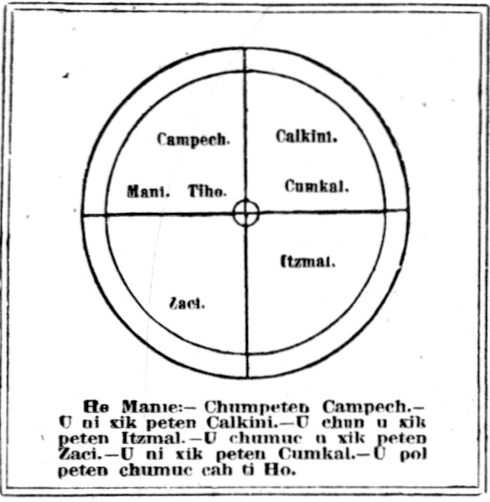
Figure 27.
The foregoing text shows that, notwithstanding the circular shape in which it is figured, the dominion was evidently thought of as in the form of a bird, the head of which was the capital.
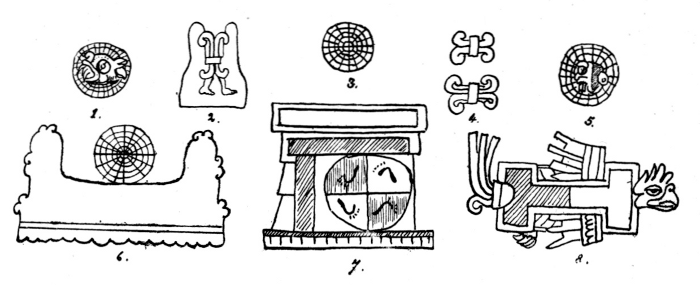
Figure 28.
This figure of speech seems to have been prevalent in Mexico also and to be conveyed by the representation, in the Vienna Codex, of a double tau-shape to which the head, wings and claw, and tail of a quetzal are attached (fig. 28, no. 8). As I shall have occasion to demonstrate further on, the double tau signifies the Above and the Below and their union forming an integral whole. The following Nahuatl terms explain by themselves the symbolism of [pg 087] the bird-figure: cuitlapilli=the tail of an animal or bird, atlapalli=the wings of a bird, or the leaves of a tree, cuitlapalli atlapalli=vassals, the populace or lower classes, the laborers.
These words furnish irrefutable evidence that the lower class was familiarly known in Mexico as “the wings and the tail” of the commonwealth or state, or the leaves “on the trees” of the tribe. Sahagun states, on the other hand, that the Mexicans employed the metaphor of “a bird with wings and a tail” to designate a lord, governor or ruler. He also records that the terms hair, nails, a thorn, a spine, beard and eyelashes, were used to signify “someone who was noble, generous or of the lineage of the lords.” Such metaphors as these may well cause us to despair at arriving at a complete understanding of the native imagery and symbolism. The symbolism of the bird's claw yet remains to be looked into. The Nahuatl for the same is xo-maxaltic, xo-tzayanqui or cho-cholli.
In one of the ancient Mexican harangues, previously quoted, it is said of the supreme ruler that he had been given “fangs and nails” in order to inspire fear and reverence. Scattered evidence and the fact that in the Codex Mendoza the decorated claws of an eagle, for instance, appear as a military device on the shields of certain war chiefs, seem to indicate that the warriors were spoken of, metaphorically, as “the claws or nails” of the state. The following passage finally proves that the tlachtli or courtyard the shape of which was a double tau, as in fig. 28, no. 8, was regarded by the Mexicans as an image of the state itself. In another native harangue it was said of the newly-elected ruler: “He is now placed or put into the Tlachtli, he has been invested with the leathern gloves, so that he can govern and throw back the ball to the one who throws it to him in the game. For the business of governing very much resembles this game and the game of dice” (Sahagun, book vi, chap. xiii). The latter game alluded to, the patolli, was played on a mat in the shape of a cross, marked off with divisions, with stone markers, the moves of which were decided by the numbers obtained on casting the dice, which consisted of beans with marks on them. It is interesting to find that the word pat-olli seems to be connected with the verb pat-cayotia=to be substituted in the place of another, or to succeed another in office or dignity. The above comparison of the game to the business of governing indicates that a feature of the government was a methodical [pg 088] succession or rotation in office or dignity, a point to which I draw special attention, as I shall refer to it later.
The evidence that the Mexicans regarded the form of the courtyard, named tlachtli, as that of the state itself is noteworthy. On the other hand, the native map contained in the Codex Mendoza, p. 1, shows us that they figured their territory as a square, surrounded by water and divided into four equal parts by diagonal cross-streams or canals. As in the Maya map the centre of this is occupied by the well-known hieroglyph or rebus of Te-noch-ti-tlan, the ancient capital, which consisted of Mexico and Tlatelolco. In three of the four triangular divisions, two chieftains are figured, whilst in one there are four, the complete number of chieftains thus being ten. The incontrovertible evidence that the dominion of the Mexicans, as well as that of the Mayas, was figured and regarded as an integral whole has seemed to me to be of extreme importance, because it points to a fresh interpretation of the much-discussed meaning of the name Tullan, “the glorious centre of culture where the high priest Quetzalcoatl, had dwelt and whence he had been driven by the wiles of his enemies. It is a place that we hear of in the oldest myths and legends of many and different races. Not only the Aztecs, but the Mayas of Yucatan and the Kiches and Cakchiquels of Guatemala, bewailed in woful songs, the loss of that beautiful land and counted its destruction as the common starting-point in their annals.... According to the ancient Cakchiquel legends, however, ... ‘there were four Tullans, as the ancient men have told us.’ The most venerable traditions of the Maya race claimed for them a migration from Tullan in Zuyva.”... “When it happened to me,” says Friar Duran, “to ask a [Mexican] Indian who cut this pass through the mountains or who opened that spring of water or who built that old ruin? the answer was: The Tultecs, the disciples of Papa,” i. e., Quetzalcoatl. (See Brinton, American Hero-Myths, p. 88.) Considering that the identity of Tullan has not yet been satisfactorily established, that several Tullans are said to have existed and that a small town, about a dozen leagues to the northeast of Mexico, is named Tullan-tzinco=little Tullan, I should like to direct the attention of Americanists to the following Maya words: Tul-um=fortification, edifice, wall and enclosure. Tula-cal, Tuliz, adjectives=whole, entire, undivided, integral. Tul-ul, adjective=general, universal. Tul-tic, verb=to belong, to correspond to something. Tul=all [pg 089] around or full. Tul=in composition, to have abundance. Tulnah=to be too full, to overflow, to proceed, to issue, abound, high-tide. Tulaan=past participle of tul.
I am of opinion that, after carefully examining the foregoing words and their meanings, we must admit that an intelligible and satisfactory derivation and signification of the much-discussed Tula of the Mexicans, which has been vainly sought in the Nahuatl language, are obtained if we connect it with the Maya words for fortress, or stronghold, an enclosed place, an integral whole, an overflowing source of abundance and plenty. If we do this, then the problematic term Tolteca, given by Mexicans to the superior people from whom they had derived their culture and knowledge, means nothing more than such persons who had belonged (Maya verb tultic) or were members of a highly cultured commonwealth or ancient centre of civilization, such as had flourished during countless centuries, in Yucatan and the present Chiapas, Honduras and Guatemala.
Reserving this subject for future, more detailed, discussion, I point out that the name Ho, given to the capital, which is designated in the map as the “head of the land,” is obviously derived from the Maya hol, hool, or hoot, which means not only head but also chieftain. The circumstance that a single word, Ho, conveyed the triple meaning of a capital, a chieftain and a head, is particularly noteworthy, as it affords not only important clues to native symbolism, which I shall trace later on, but also shows that the presence of the syllable Ho or O, in certain native names of localities, may possibly indicate that it was a capital, the residence of a chieftain. Further light is shed upon the following native association of ideas when the following words are studied. The ancient Maya name for a pyramid or artificial mound was ho-m and the pyramidal elevations on which temples or palaces were built were designated as ho-mul or o-mul (see Vocabulary, Brasseur de Bourbourg). The title Holpop was moreover that of the “chieftain of the mat,” whose prerogative it was to sit on a mat and to beat the sacred drum during the public dances or ritual performances (Cogolludo). The ancient word for vase, vessel or cup in general was ho-och, whilst o-och meant food or maintenance (Arte de la lengua Maya, Fray Beltram de Santa Rosa, ed. Espinosa, Merida, 1859). If the foregoing data be summarized we find that the word ho, the ancient name of the head of the land, which is [pg 090] figured in its centre, is not only homonymous with capital and chieftain, but also with pyramid, vase or receptacle and maintenance, and finally with the numeral 5, also “ho.” We shall see that the identical ideas were similarly associated in ancient Mexico.
Referring once more to the ancient map of Yucatan and to the peculiarity that the head of the figurative bird, the capital, Ho, is supposed to occupy the centre of the state, I point out nos. 1 and 5 (fig. 28) from the Bodleian and Selden MSS. as somewhat analogous representations of a central capital or chief, and nos. 3 and 6 as possibly being images of a territorial subdivision of the state, resembling a spider's web. In an unpublished Mexican MS., which has been recently brought to light, the middle of the concentric circles is painted blue and suggests the idea of a system of distribution or irrigation, proceeding from a central supply of water and radiating in all directions. An accentuation of centrality is brought into relief in fig. 28, no. 6, where the spider's web is placed in the middle, between the two peaks of a mountain. In no. 2 a small quadruple sign, which frequently occurs in the Vienna Codex, always painted in the colors of the four quarters and united by a cross-band across the centre (no. 4). also figures between two peaks, above two feet, the significance of which I do not venture to determine. A remarkable circular disc resembling the Maya map, and also divided into four parts by cross lines, but exhibiting footsteps denoting rotation, is represented in the entrance of a temple, in the Vienna Codex (fig. 28, no. 7). These figures will be referred to again further on.
Let us now bestow attention upon the names of the Mexican capital and first note that the edifice of the Great Temple, in which the Cihuacoatl performed an annual ceremony already mentioned, was called tlal-xic-co, literally “in the navel of the earth or land” (from tlalli=earth, land or country, xictli=navel and co=in) (Sahagun, book ii, appendix). Besides this edifice there was, in the middle of the lagoon of Chalco, an island, which, to this day, bears the name of Xico=in the navel or centre. This indicates the curious circumstance that the edifice and island had apparently been regarded as forming “ideal centres,” and shows that the name of Mexico itself may have been associated with the same conception being, as it was, the central seat of government. Gomara states that “the city was divided into two halves or parts, one named Tlal-telolco=small island (literally, ‘in the earth-mound’) [pg 091] and the other named Mexico, which means ‘something which flows,’ ” (Histoire Généralle des Indes, Paris, 1634, chap. 38). The Nahuatl word alluded to can be no other than the verb memeya which, according to Molina, signifies “water, or something liquid which issues or flows in many directions.” I have already pointed out that the Maya words to express water which rises and overflows, high tide and, by extension, abundance and plenty, are tul, tulnah and, finally, tulaan, past participle of tul. If the particle “me” conveyed the above idea, its combination with xico would cause the name Mexico to be replete with significance and to mean “the figurative centre whence all maintenance proceeded and flowed in all directions, throughout the land.”
The Borgian Codex furnishes representations of identical meaning. On page 4 a human body, the centre of which forms a large red disc, is stretched across the double tau-shaped tlachtli which obviously represents the four quarters, being painted with their four symbolic colors. It is particularly noteworthy that the limbs of the central figure are represented as wearing the green skin of a lizard, while its face is enclosed in the open jaws of the reptile. It should also be noted here that whilst the Nahuatl names are cuetz-palin and topitzin, the Maya term for lizard is mech or ix-mech. On the same page a similar, but smaller, figure is depicted on a background representing the nocturnal heaven. On the following page the figure of a dead woman is stretched on a red disc whilst a priest is drilling the fire-stick into a circular symbol, with four balls, which is the well-known symbol for chalchiuitl=jade. As the name of the female water goddess is Chalchiutlycue, this detail is significant and will be referred to later on. It is noteworthy that on both pages 5 and 6 the performance of the above rite is accompanied by the image of the goddess of the earth and underworld, represented with a death's head, and with her hair strewn with stars. Her body is that of a green lizard, and she carries ears and blossoms of maize and holds a blue garment on which the chalchihuitl symbol figures.
In connection with representatives of the human form outstretched in sacrifice, on whose body the rite of kindling the sacred fire or of extracting the heart is being performed, it seems evident that, under the dominion of the fundamental ideas I have been discussing, the native sages regarded and utilized the human form as an image of the Middle and Four Quarters. It is well known [pg 092] that the number 20 was termed “one count” and connected with the number of fingers and toes, distributed equally on his four extremities. The human victim thus formed a living swastika or cross and became not only the consecrated image of the supreme, creative, central divinity who controlled the Four Quarters, but also an image of the central government with its supreme ruler; whilst the four chiefs of the Quarters were symbolized by the four limbs. Each of these terminated in a symbolized group consisting of a hand, maitl, with a thumb (=touey mapilli or vei mapilli, literally, the great finger, or our great finger) and four fingers (mapilli); or of a great toe, touei xopil or topec-xopil (literally, our great toe, or our lord toe) and of four toes=xopilli.
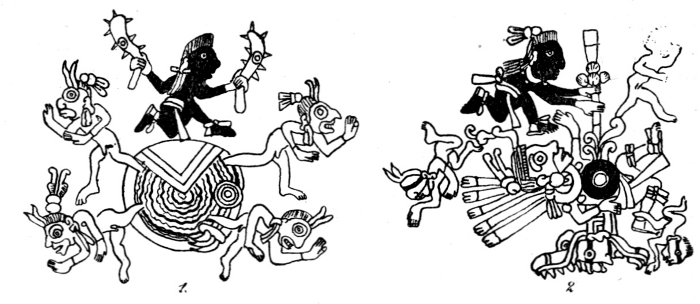
Figure 29.
The above association of ideas was doubtlessly accentuated by the fact that the word pilli means a nobleman, a chieftain; thence he terms pilconetl=the son of a nobleman and pilhua=he who has sons (pil in this case meaning son and hua=possessor of). This latter fact could have been very aptly conveyed in the picture-writings by employing fingers to express the sound “pilli.” The number of sons a chieftain had could thus be easily expressed by his exhibiting a corresponding number of fingers. I shall revert to this possibility presently, and now referring to fig. 29, no. 2, direct attention to the obvious intention to express the idea that the fire produced was distributed to the four quarters by means of the figures, painted in symbolical colors, three of which are visible. Another picture in the same Codex represents four similar figures springing towards the cardinal points from a source or fountain of [pg 093] water, whilst a priest above a triangular cloak7 holds a pair of weapons (?) in his hands (fig. 29, no. 1). If carefully studied, these groups seem to corroborate the derivation of the name Mexico, given above. What is more, the first group affords an explanation of the meaning and purpose of three strange recumbent stone figures bearing circular vessels, which have been respectively found in Mexico, Tlaxcala and Chichen-Itza and are now preserved at the National Museum in Mexico. They furnish the most convincing proof that an identical cult and symbolism had existed in these widely-separated localities. The conclusion I have previously expressed, that an actual connection had been established between Chichen-Itza and Mexico by the Maya high priest Kukulcan, or Quetzalcoatl, is thus corroborated by undeniable evidence, which will be supplemented later on.
The three monoliths have been described and illustrated in the Anales del Museo Nacional, Mexico, vol. 1, p. 270, by the late Señor Jesus Sanchez, and are here reproduced. The statue exhumed at Chichen-Itza by Dr. Le Plongeon (pl. iv, fig. 1) closely resembles that found at Tlaxcalla in Mexico (pl. iii, fig. 2). Dr. Brinton, who erroneously describes the Chichen-Itza statue as representing “a sleeping god,” points out the extremely important fact that there was a divinity worshipped in Yucatan called Cum-ahau, “the lord of the vase,” who is designated in a MS. dictionary as “Lucifer (the lord of the underworld) the principal native divinity.” He adds there is good ground to suppose that this lord of the vase ... was the god of fertility common to the Maya and Mexican cult (Hero-Myths, p. 165). Considering that the great market-place in the capital was actually the centre to which the entire product of the land was periodically carried from its remotest confines, was there classified, exchanged or distributed far and wide, the comparison to a central flowing source of maintenance was most appropriate.
That some particular spot in or near the city should have gradually assumed importance and sanctity as marking the exact centre of the metropolis, i. e., of the integral whole of the Mexican [pg 095] “empire” is but natural and it is not surprising to find that solemn rites were performed on this spot. In one of the chronicles to which I shall revert, it is stated that the New Fire was at times kindled on the prostrate body of a slave, and this curious statement is corroborated by a picture in the Borgian Codex, showing a priest producing fire from a circular vessel placed on the body of a victim beneath whom a face enclosed in the open jaws of a reptile, is visible (fig. 29).
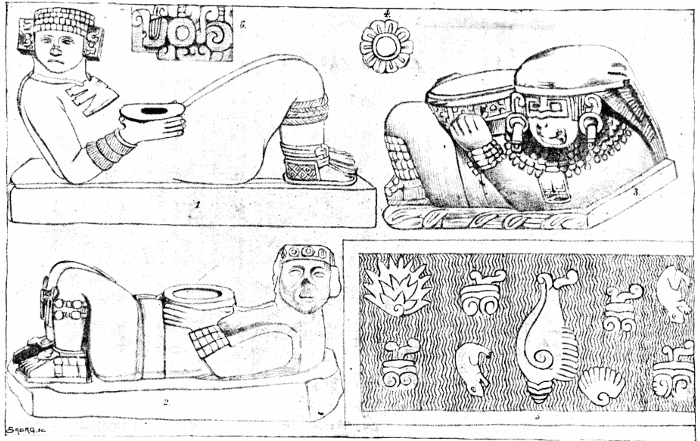
Plate IV.
Dr. Le Plongeon, to whom much credit is due for its discovery, identified the Chichen-Itza statue, for reasons not fully explained, as a portrait of Chac-Mool, or Lord Tiger, and relates that it was found at a depth of eight metres, not far from the base of the Great Pyramid Temple. A statue of a standing tiger, with a human head and a shallow depression in its back, was also found near the same spot. I have seen other sculptured figures of human beings holding a vase, as at the hacienda near Xochicalco, Mexico, and of tigers, with circular depressions on their backs, and hope to be able to reproduce their photographs on another occasion.
The most elaborately sculptured recumbent statue is undoubtedly that which was found in or near the city of Mexico (pl. iv, fig. 3). The under surface of its base (pl. iv, fig. 5) is entirely covered with zigzag water lines and representations of roots of plants, figured as in the Codices; shells, one kind of which is the well-known symbol of parturition, and frogs which are intimately associated with water symbolism. On the hair of the statue a flower-like ornament is carved (pl. iv, fig. 4) in connection with which it should be noted that the Nahuatl for flower is xochitl, pronounced hoochitl, resembling the Maya hooch=vase. The small groups of five dots forming a border around the circular vessel are noteworthy, as they are likewise sculptured on the calendar-stone. The characteristic scrolls about the eyes of the figure show that it personates tlaloc, or earth-wine. The fertility of the earth, caused by rain, is symbolized by the wreath of ears of corn and reeds (Nahuatl, tollin) which is sculptured around the base of this, one of the most remarkable of ancient American monuments.
Señor Sanchez cites Torquemada (Monarquia Indiana, vol. ii, p. 52) as the only authority who mentions a recumbent image or idol and relates that, “in the city of Tula, there was preserved in the great temple, an image of Quetzalcoatl ... he was figured as lying down, as though going to sleep.... Out of [pg 096] reverence the image was covered with mantles or cloths.... They said that when sterile women made offerings or sacrifices to the god Quetzalcoatl, he immediately caused them to become pregnant....” He was the god of the Winds which he sent to sweep or clear the way for the tlaloques=“the earth-wine” gods.
Señor Sanchez also quotes Gama, who, basing himself upon Torquemada's authority, maintains that Tezcatzon-catl, the principal rain or octli-god, was figured as lying in an intoxicated condition, holding a vase of pulque in his hands. To the above data I add the description by Bernal Diaz, of a “figure in sculpture” he saw on the summit of the great temple of Mexico: “It was half man and half lizard (lagarto), was encrusted with precious stones and one-half of it was covered with cloths. They said that half of it was full of all the kinds of seeds that were produced in the entire land, and told [me] that it was the god of sown land, of seeds and fruits. I do not remember his name....” (Historia Verdadera, p. 71). It may be as well to note, that the Nahuatl names for lizard, cuetz-palin and topitzin, approximately convey the sound of the first syllables of the name of the culture-hero Quetzalcoatl, and of the title “topiltzin” bestowed upon him. It must, of course, remain a matter of conjecture whether the lizard was possibly employed in the above case as a pictograph, to express the sound of its name. One thing seems certain, that the Tula image of Quetzalcoatl, to which divinity barren women directed their invocations, and the statue described by Bernal Diaz as that “of the god of seeds, fruits and cultivated land,” were undoubtedly analogous to the sculptured recumbent figure found in Mexico, and exhibiting the symbols of Tlaloc, or earth-wine, of maize, and of parturition. Bernal Diaz further relates that the said image was kept on the uppermost terrace of the Great Temple, in one of five “concavities surrounded by barbacans or low walls the wood-work of which was very richly carved” (op. et loc. cit.).
The inference to be drawn from the foregoing data is that the Mexicans and the Mayas habitually kept, on the summit of their principal temple, in their centres of government, a statue holding a circular vessel and figuratively representing the “navel or centre of the land.” The group of ideas already traced in the Maya ho=capital, hom=pyramid, ho-och=vessel, o-och=maintenance, [pg 097] ho=5, thus proves to be completely carried out, for, on this consecrated spot, which emblematized the source whence all life proceeded, sacred emblematic rites were performed, the purpose of which was to typify the union, in the centre, of the four elements requisite for the productiveness of the earth.