The Fundamental Principles Of Old And New World Civilizations. (continued 12)
Reading edition
ARABIA.
“In the land of Arabia, of the irrigating and building Minyans and star-worshipping Sabæans, the land of the Queen of Sheba, or the number seven (sheba) ... a fresh confederacy was formed, to rival that of the Kushite mountain of the East ...” (Hewitt, p. 291).
It is significant that among the Sabæans the seven-day period prevailed.
[pg 483]
ASSYRIA.
Seven directions of heaven and earth, seven territorial districts, seven mountains, seven kings, seven-staged towers, seven year and day periods, etc., pp. 328, 348 and 358.
Four-god cities, square cities, square four-storied towers, four cities, four regions or provinces, four-fold power embodied in king wearing cross, tetrarchies (?).
EGYPT.
Seven classes of people, seven districts, seven-day period, pp. 300 and 375.137
Quadruplicate division of capital and state, four fields of heaven, p. 372.
Sacerdotal group consisting of 12+1=13 individuals, p. 437.
Division of the country, at one time, into twelve parts (Ast).
CHINA.
Seven Manchurian tribes, p. 302.
Four provinces, four mountains, four seas, p. 286; four classes of seven each, p. 292.
At the summit of the present administration in Pekin, Four Grand Secretaries, two of whom are Manchus and two Chinese.138
Twelve districts, p. 292.
ANCIENT JAPAN.
The “Seven divine generations,” each consisting of a god and goddess.
Four classes of people, 2×4=8 holy quarters, eight great islands.
Imperial council of twelve divided into the higher council of five called Golosew=“Imperial Old Men” and the lower council of [pg 484] seven members termed Waka Tosiyori=“Junior Old Men” (Chambers' Encyclopædia). The imperial council, with the emperor, thus constituted the sacred thirteen.
PERSIA.
Seven divisions of Cosmos, seven regions, seven spirits personifying celestial bodies and moral qualities.
Ancient confederacy of Iran consisted of six kingdoms grouped around the central royal province, “situated under the pole-star,” and called Kwan-iras or Hvan-iratha, ruled by Susi-nag, the original father-god of the model state identified with the pole-star, Draconis, the serpent (Hewitt, op. cit. p. 253), see also Appendix III, list II.
Four-fold rule embodied in king, p. 325. Darius distributed Persian empire into 4×5=20 satrapies, each including a certain continuous territory (Grote).
GREECE.
Tenos divided into seven quarters, seven divisions of state.139
[pg 485]
Four tribes,140 four castes, territorial division of Attica into four parts, institution of tetrarchies. Thessaly anciently divided into four tetrarchies. Institution (between 600-560 B.C.) of cycle or period, marked by the four sacred Olympic games, one of which took place in one of four cities each year in rotation. Pisistratus added the quadrennial or greater Panathenæa to the ancient annual and lesser Panathenæa (Grote, History of Greece, vol. 4).
[pg 486]
Twelve tribes formed by Cecrops—represented by twelve chiefs, +Cecrops=thirteen.
It is most interesting to find this division adopted in Plato's de Legibus, in which it is imagined that three elderly statesmen come together, belonging respectively to Athens, Crete and Lacedæmon, to discuss the reëstablishment of the depopulated city of Magnesia in Crete. Aristotle has insinuated that the scheme proposed by Plato was not original and had been actually realized at Lacedæmon. Mr. George Burger, the able translator of Bohn's edition of Plato's Works, in his introduction to vol. V, remarks that, if that were the case, Plato would never have wasted his time in writing two elaborate treatises on matters already well known, when it [pg 487] would have been sufficient to point out ... the institutions of Lycurgus as the pattern, if not of a faultless government, at least of one, that approached the nearest to perfection. Plato might have replied to the charge made by Aristotle by saying that his notions were all the better for not being original, for it was thus shown that, as some of them were practicable, since they had already been put into practice—the rest, which were a reform rather of existing institutions than the construction of a code perfectly novel, would be equally practicable if they were submitted to the same test. In his Protagoras, Plato distinctly states that in Crete and Lacedæmon a most beautiful philosophy was to be found, which had been handed down from ancient times.... Let us now examine the plan discussed by the three statesmen and submitted [pg 488] to them by the anonymous Athenian who, according to Cicero, Plutarch and Boeckh, was Plato himself.
In the case of “the Magnesians, whom a god is again raising up and settling into a colony ... a divine polity....” Plato says: ... “It is meet, in the first place, to build the city as much as possible in the middle of the country.... After this to divide it into twelve parts141 and placing first the temple of Hestia, and Zeus and Athene, to call it the Acropolis and to throw around a circular enclosure and from it to cut the city and all the country into twelve parts. But the twelve parts ought to be equalized ... and the allotments to be five thousand and forty.... After this to assign the twelve allotments to the twelve gods and to call them by their names and to consecrate to each the portion attained by lot and to call it a phyle; and again to divide the twelve sections of the city in the same manner as they divided the rest of the country, and that each should possess two habitations, one near the centre and the other near the extremity, and thus let the method end ... (B. v, C. 14).... We ought, in the first place, to resume the number five thousand and forty because it had and has now convenient distributions, both the whole number and that which was assigned to the wards, which we laid down as the twelfth part of the whole, being exactly four hundred and twenty. And as the whole number has twelve divisions, so also has that of the wards. Now it is meet to consider each division as a sacred gift of a deity through its following both the months and revolutions of the universe. (By this is meant, says Ast, the twelve signs of the zodiac.) Hence that which is inherent leads every state, making them holy.... Some persons indeed have made a more correct distribution than others, and with [pg 489] better fortune have dedicated the distribution to the gods. But we now assert that the number five thousand and forty has been chosen most correctly, as it has all divisions as far as twelve, beginning from one, except that by eleven; ... let us distribute this number; and dedicating to a god ... each portion, and giving the altars ... let us institute monthly two meetings relating to sacrifices ... twelve according to the divisions of the wards and twelve to that of the city ... for the sake of every kind of intercourse.”
It should be noted here that, as in his Republic, Plato provides his ideal state with female as well as male guardians, and with priestesses as well as priests, whose duty it was to fulfil sacerdotal functions. Special attention is drawn to this point, as in practice, it naturally signifies a dual government, such as I have traced in ancient Egypt, Babylonia-Assyria, and also in Mexico and Peru.
“As regards the number of ... festivals ... let there be three hundred and sixty-five ... so that some one of the magistrates may always sacrifice ... there are to be twelve festivals to the twelve gods from whom each tribe has its name ... and twelve guardians of the law.... There ought to be twelve hamlets, one in the middle of each twelfth part, and in each hamlet to be selected first, a market place and temples ... prepare all the rest of the country by it into thirteen parts for the handicraftsmen and to cause one portion of these to reside in the city by distributing this portion among the twelve parts of the whole city ... to have other persons distributed out of the city, in a circle around it.”
The portions of Plato's work dealing with the appointment of the governors and guardians of the state and their rotations in office and imposed tours of inspection, are of such particular interest in connection with the present comparative research, that I am impelled to quote them here.
“Let each (of the twelve) phyles furnish for the year five Rural Stewards (in all sixty) ... each of whom is to choose twelve young men ... to the latter let there be allotted portions of the country during a month ... so that all of them may have a practical knowledge of every part of the country.... But let the governorship and guardianship continue to the guards and governors for two years, and let those who first obtain by lot their [pg 490] respective portions, the guard officers, lead out, changing the places of the country constantly by going to the place next in order towards the right in a circle, and let the right be that which is in the east. But as the years come around, in the second year, in order that the greatest portion of the guards may become acquainted with the country, not only at one season of the year, but that as many as possible may know thoroughly in addition to the country, at the same time what occurs relatively to each spot in the country at each season, let the officers lead them out again to the left, constantly changing the place until they go through the second year. In the third year it is meet to choose other rural stewards and guard officers as the five curators of the twelve young men.... There were to be three city stewards, dividing the twelve parts of the city into three ... and five Market-Stewards, to be chosen from ten elected”....142
It is deeply interesting to consider from the standpoint of comparative study the principal features of the perfected scheme proposed by Plato, in the fifth century B. C, for the establishment of an ideal colony, which is designated as a “divine polity” or a “holy land.” This is especially the case when we see that Plato himself states that it is the conformity of the states to the inherent laws of nature, that confers upon it divinity or holiness. It seems impossible not to recognize that both ideal republics of Plato were intended to be “celestial kingdoms” or “kingdoms of heaven” and that he expounded and doubtlessly perfected, an ancient ideal which had been more or less successfully carried out in different countries during many centuries before his time.
Having studied the proposed scheme for the foundation of a new colony of the Greeks, who proudly maintained that “it was meet that the Greeks should rule barbarians,” and pursued a regular [pg 491] system of colonization, let us now obtain an idea of the mode in which Greeks had previously founded colonies by reading the following passage from Grote's History of Greece, vol. iv, chap. xxvii:
“Under reign of Psammetichus, king of Egypt, about the middle of seventh century B.C., Grecian mercenaries were first established in Egypt and Grecian traders admitted ... into the Nile.143 The opening of this new market emboldened them to traverse the direct sea which separates Krête from Egypt—a dangerous voyage with vessels which rarely ventured to lose sight of land—and seems to have first made them acquainted with the neighboring coast of Libya ... hence arose the foundation of the important colony called Kyrênê” ... about 630 B.C.
“Thêra was the mother-city, herself a colony from Lacedæmon ... political dissension among its inhabitants ... bad seasons, distress and over-population led to the emigration that founded Kyrênê.... The oekist Battus was selected and consecrated to work of founding the colony.... From the seven districts into which Thêra was divided, emigrants were drafted for the colony, one brother being singled out by lot from the different families.... The band which accompanied Battus was generally supplied with provisions for one year and was all conveyed in two pentekonters—armed ships with fifty rowers each. Thus humble was the start of the mighty Kyrênê. After six years residence in one spot they abandoned it and were conducted to a better site by guides, saying: ‘Here, men of Hellas, is the place for you to dwell, for here the sky is perforated.’ ”144 The small force brought over by [pg 492] Battus was enabled at first to fraternize with the indigenous Libyans,—next, reinforced by additional colonists and availing themselves of the power of native chiefs, to overawe and subjugate them....
“The Theræan colonists seem to have married Libyan wives, whence Herodotus describes the women of Kyrênê and Barka as following, even in his time, religious observances indigenous and not Hellenic. Even the descendants of the primitive oekist Battus were semi-Libyan.... We must bear in mind that the population of the [Græco-Libyan] cities was not pure Greek, but more or less mixed, like that of the colonies in Italy, Sicily or Ionia.... Isokrates praises the well-chosen site of the colony of Kyrênê because it was planted in the midst of indigenous natives apt for subjection and far distant from any formidable enemies.... We are then to conceive the first Theræan colonists as established in their lofty fortified post Kyrênê, in the centre of Libyan Perioeki, till then strangers to walls, to arts and perhaps even to cultivated land.... To these rude men the Theræans communicated the elements of Hellenism and civilization, not without receiving themselves much that was non-Hellenic in return, and perhaps the reactionary influence of the Libyan element against the Hellenic might have proved the stronger of the two had they not been reinforced by new-comers from Greece.... About 543 B.C. owing to discontent, etc., the regal prerogative of the Battiad line was terminated and a republican government established; [pg 493] the dispossessed prince retaining both the landed domains and various sacerdotal functions which had belonged to his predecessors.”
ROME.
Seven hills, seven places of worship, septemvirate, seven ministers, Septizonium, p. 464.
Roman quadrata, Janus quadrifrontis, quadruplicate territorial division carried out. Palestine, for instance, divided into four tetrarchies under Roman rule.
Twelve gods, twelve months, etc.
New Rome divided into four parts, each consisting of thirteen prefectures i. e. fifty-two prefectures in all.
GAUL.
Seven provinces.
BRITAIN.
Seven kings=heptarchy.
Four kings of Kent=tetrarchy.
IRELAND.
Seven sanctuaries grouped around central tower.
Four associates of king of Erin.
Group consisting of 12+1=13 stone figures, p. 469.
SCANDINAVIA.
Four guardians of four quarters.
Thor, supreme divinity, pole-star god, seated and holding “seven stars,” the symbol of seven-fold power, in his hand.
Group consisting of royal throne surrounded by 12 stones. Odin associated with twelve “godes,” p. 472.
NORTH AMERICA.
Huron confederacy=seven tribes, quadriform city, 2×4=8 gentes, p. 198.
ZUNI.
Seven directions in space, seven quarters of city, seven tribes, seven towns.
Four bands of priests, p. 201.
Twelve, i. e., thirteen priesthoods, p. 201.
[pg 494]
MEXICO.
Seven tribes issued from seven caves, seven gods or chiefs, p. 62.
Four quarters of city, represented by four chieftains, four subrulers, four divisions of army, four year signs, four tribes, four tribal trees (fig. 52), four storied pyramids.
Thirteen divisions or parts, p. 181.
Calendar and state organized into 4×13=52 parts.
YUCATAN.
Title of ruler, “the divine Four,” four sub-rulers, four royal brothers, four-year periods, p. 218, four quarters, p. 223, four year signs.
Twelve i. e. thirteen priest-rulers of Mayapan, p. 209.
GUATEMALA.
Seven tribes, seven day period, p. 179.
Four nations, four provinces, four capitals, four Tullans, pp. 164, 171.
Thirteen divisions of warriors, p. 179.
PERU.
Empire named “Four in one,” Creator named “Earth, air, fire and water in One,” four provinces, four viceroys.
Twelve i. e. thirteen wards in Cuzco, twelve divisions of year, p. 144.
Before commenting upon the above summary, and as its necessary complement, a brief examination must be made of the various modes in which the phenomenon of celestial axial rotation figured in the rituals of primitive people.
OLD WORLD.
The lighting of “sacred fire,” by means of the wooden fire-drill and the wooden socket block, appears as the most ancient and widespread ritualistic performance.
To begin with, the reader is requested to read carefully the following detached extracts from Hewitt's work:
“In the Rig-Veda the Aryan invaders of Lydia are called the Tritsu, ‘the boring people,’ who used the fire-drill; also Arna, ‘sons [pg 495] of Arani,’ the fire-drill, whose sacred number is four”.... “In India, from time immemorial, by a process like churning, fire has been produced by the Arani, made of the Ashvattha (Ficus religiosa) wood, being twirled repeatedly round till the fire is lighted, by a string fixed in the cross-bar at its top,” a method, I may add, which is a later development of the more primitive mode of twirling the fire-drill by hand. “The Kushites ... believed that life was generated by the union of heat with water ... and that heat was, in the astronomical myth, engendered by the revolution of the Great Bear and the connection between it, the vital heat and the creating water is shown in one of its Akkadian names, Bel-a-sar-a, which means ‘the fire god who measures the water yoke’ (R. Brown and Sayce), or, in other words, Bel, the distributor of the water allotted to the earth. From this heavenly cistern and fire-drill, in which marichi, the fire-spark, is hidden, the water of life is distributed.”
Compare the preceding with the following statements: “According to the Arab doctrine of the pole, the seven stars of the Great Bear and the star Canopus [?] formed the fire-drill.” According to Hewitt “... It was the Ashvins, ... the twin brothers of day and night, ... identified with the twin stars in Gemini, who twirled round the fire drill of the northern pole ... or, according to a later hymn, drove through the seas with one of the wheels of their chariot in Ursa Major and one in heaven,—that is, to drive around the pole.” A deeper comprehension seems to be afforded by this association of the Ashvins with the axis, of the significance of the two figures (of a god and his consort) who, in the Sippar tablet, appear to be directing the wheel of Shamash—the world-axis and symbol of quadruplicate terrestrial government (see p. 365). Reference should also be repeated here, to Al-kuth and Al-fass, the Arabian names for Polaris, respectively signifying the axle and the hole of the axle, also to the pole star of Northern India—Grahadhara,—the “pivot of heaven,” and to the significant fact that in Egyptian hieratic script the word an=the Akkadian and Sumerian word for heaven, and Babylonian-Assyrian word for god, is found rendered by a man “turning around,” an action expressing the verb an.
It is interesting to collate these statements with the descriptions of Dhruva (see p. 448, note 1), the personification of centrifugal power, who, as he turns, causes the heaven to revolve around the fixed centre on which he stands, resting on one foot only, and to [pg 496] note how the two distinct ideas of central stability and rotation influenced the making of pagan divinities. The idea of stability was perpetuated in the house-pole which sustained Aman, the roof of primitive dwellings in the column an, which supported the temple roof and in time was transformed into a hermes, or, in Egypt, into a statue of Amen-ra, and in the mythical mountain of the North, Sama, which supported the heaven (Sama). Dhruva's turning round on one foot, which implies the use of the other, reappears in the Hephaistos of Greek mythology, who was, as Hewitt tells us (p. 504), “the fire-drill and its driver, and was called Amphi-Guēeis, or he who halts on both legs, ... was cast from heaven by Zeus, and was the husband of the fire-socket, the first form of the Greek goddess Aphrodite.”
For information regarding the cult of the fire-socket, the construction of the Hindu fire-altars in the form of a woman, representing “mother-earth” or “the primæval mother,” Aditi, I refer the reader to Hewitt's work, and also to p. 323 of the present publication, where the description of the Jiddah sanctuary proves the existence of the same ancient form of cult in Arabia. Hewitt relates on page 170 that, on the fire-altar, the central fire called Agni jatavedas is kindled when the officiating priest addresses in the words of Rig-Veda iii, 29, 4: “We place thee, O Jatavedas, in the place of Ida (the mountain daughter of Manu) in the navel (nabha) of the altar, to carry our offerings.” In Rig-Veda, x, 61, we are also told how Nabha-Nedishtha (that which is nearest to the navel) was born from the union of celestial lightning flash with the earth, and how, on his birth, he claimed to be the supreme god, saying: “This, our navel, is the highest. I am his son.... I am the twice-born son of the law (of nature)....” Hewitt (p. 171) regards, moreover, the image of the goddess of the earth altar found by Schliemann in the second city from the bottom of the six cities, built one over another on the site of Troy, a counterpart of the Hindu fire-altar. It is significant that the Trojan image exhibits a triangle surrounded by seven disks, and containing the swastika, which Hewitt designates as “the holy fire, the sun of the revolving year,” a view curiously, though indistinctly, analogous and parallel to that I have formulated in the present research.
“In the Brahmanas the Try-Ambika offering, a very ancient form of the rain festival, is described.... Its sanctity dated from the [pg 497] days of primeval theology, for the offerings were made on a spot outside and to the north of the consecrated area, and on one intersected by cross-roads, and thus marked by the cross sacred to the rain-god, which is said to be Rudra's favorite haunts, and the halting place of the Agnis.... Hence the festival is dedicated to Rud-ra, the red (rud) god, the father of the seven Marut stars.... He is called the red god from the spark of fire kindled by him in the fire socket when he was the fire-drill, and from being reddened by the blood of the victim slain in his sacrifices when he was the sacrificial stake to which the annual victims, whose blood fertilized the ground, were bound, and this name was continued to him when he became the red cloud of the thunderstorm which infused the soil of life into the earth by pouring on it the life-giving rain, the blood of the creating god....”
In the Rig-Veda the rain-god is termed Ushana, the “lord of fire,” who is made to exclaim: “It is I who pour down rain for the good of creatures.” It was he who was also known as Varuna, the Greek Ourauos, who ... became the god of the dark night.... The union [in India] of the patriarchal worshippers of the Northern father-god, with the matriarchal races of the south was followed by the miners, metal-workers and artisans of the early bronze age, who looked on fire and the life-giving heat as the author of life. These were the people (of Finnic origin) who employed the word ku for god, in Asia Minor became the worshippers of the mother goddess Magha, the socket block from which fire was generated by the fire-drill, and it was they, “the Sons of Magha” that became the Maghi of Persia and the Maghadas of Indian history.
In connection with the union of a northern patriarchal and a southern matriarchal race, an astronomical myth deserves particular attention, as it commemorates the combination of a feminine cult of the Pleiades, the “spinning stars,” with a masculine cult of Ursa Major. According to this myth, related by Hewitt, the “Spinners”=Krittakas (from krit, to spin) were “the mother-stars of the earth,” who were married to the seven stars of the Great “Bear, the father-stars of the North.”145 Remarking how [pg 498] curiously the assignment of the north to the male and the south to the female element coincides with what has been noted in Egypt, I note here the interesting detail recorded by Hewitt (p. 379) that to this day the Hindu bride and bridegroom respectively pay reverence to the Pleiades and Ursa Major, before worshipping the pole-star, “the spotted bull,” on entering their house. It would seem as though the fulfilment of this ritual might limit the Hindu marriage season to some particular time of the year, marked by the position of the Pleiades; in which connection it is interesting to remember that, in Mexico, the culmination of the Pleiades at midnight marked the New Year festival, when sacred fire was rekindled and the union of Heaven and Earth took place. On pp. 130-132 of Hewitt's work, vol. i, the reader will find instructive data regarding Pleiades festivals.
The preceding details appear to show that whereas a northern patriarchal race would naturally symbolize axial rotation by the fire-drill, a southern matriarchal race would adopt the spindle for the same purpose. Such a ritualistic use of the spindle would undoubtedly afford a very simple explanation for the presence of cross-symbols and swastikas and other designs of religious significance upon the terra-cotta spinning whorls found in such quantities in Troy, for instance, and the cited allusion on one of these, to the pole-star god, Tur, corroborates this view.146
It is instructive to trace how, amongst primitive agricultural races, the art of spinning, the employment of beasts of burden, the invention of the oil-press which “was used in Asia Minor as it has been used for time immemorial in India to extract the oil of the sesame seeds,” and of the wheel and cart, influenced their respective adoption of symbols of axial rotation. In turn, these symbols suggested and created divergent forms of ritual and religious cult. “The Turanians ... when they had evolved the idea of the god [pg 499] of heaven as the pole turned by the revolving days and weeks symbolized it as the pole of the threshing floors around which the oxen were driven.” The reader is referred here to the passages from the Bhagavata-purana quoted in the present work (note 1, p. 448), in which axial rotation is compared to “oxen turning around their stakes,” to which must be added the Vedic “one-wheeled car to which one horse named seven was yoked” (see p. 452, note 1), and the revolving wheel and the revolving measuring pole of the potter and builder castes, which united formed the Telis caste.
In the Vaya Purana, “the seven Maruts drive the stars which are bound to it by ties invisible to man, round the pole. They move round like the beam in the oil-press, for its bottom is, as it were, standing still, while its end moves round”.... In the ritual “the Sanscrit Isha or the beam which turns this pole of heavenly oil-pressing mill, is the husband and father.” A diverging view, which developed and combined the ideas of fixity and circular motion with the kindling of the vital spark by the wooden fire-drill, caused the living tree to become the emblem of the tribal father or mother. The custom, still in use among some primitive people, of drilling for fire in the dry, inflammable bark of dead trees of a particular species, may have forcibly directed the choice of tribal trees. At all events, in India, we find the mango or Am tree, which recurs in Egyptian script (see fig. 63, 22), the fig-tree, the udumbara, the date-palm and other trees established as the parent trees of different tribes, who made their respective house-poles and presumably their fire-drills and sockets, from their wood. The curious ritual of marrying men and women to their respective mother or father tribal trees, before they are wedded to their respective husbands and wives is mentioned by Hewitt on p. 237, etc. This close bond between some special kind of tree and a tribe is a point which I particularly emphasize on account of its analogy to ancient Mexican, Maya and Peruvian tribal trees.
Returning to a study of the pole and the beam of the oil-press we find that, in Essay ii, Hewitt traces the Greek myths of Ixion and Koronis to the Hindu comparison of the heavens to a revolving oil-press and, in the ritual of the Vajapeya sacrifice, refers the dawn of astronomy to the observation of the revolutions of the pole and the reckoning of the seven days of the week.... “Ixion, when raised to heaven, was the rain-god, who turned one wheel, to which his [pg 500] hands and feet were fixed by Hermes, the fire-god, continuously in the air, and this is merely a mythic way of saying that he was the fire-drill, made as the revolving pole to rotate perpetually, and by being turned to every side in his winged course, to produce life-giving heat, the generator of rain.... The Greek Ixion is the same word as the Sanscrit Akshivan, the driver of the axle (aksha).... Ixion is also, according to Bopp and Pott, connected with the root ik, pouring water, which appears in ichor, ‘the blood of the gods,’ the water of life.”
“Moreover, the Sanscrit aksha is a word of which the original is found in the Gond akkha, an axle. In the summer festival of the agricultural Gonds, called Akkhadi or Akhtuj, the worship of the cart axle or Akkha takes place and is associated with Nagur, the rain snake.... In the Vajapeya sacrifice ... the Soma priest consecrates two cups of the sacred drink Soma above the axle, at the same time as the Neskti priest consecrates two cups of Sura below it. In this ceremony we see a reminiscence of the days when the axle was the upright revolving pole pressing out the heavenly rain.... It also shows us how it was that the axle became the sacred part of the Soma cart ... and the revolving pole became the axle of the car of time and of the cart of the agricultural Gonds....”
It seems easy to trace from the rude one-wheeled cart, the evolution of the two-wheeled chariot, the prerogative of royalty in India and Assyria, employed simultaneously with the regal umbrella, which, when twirled, symbolized celestial axial rotation and suggested the idea of a protective deity. The transition from the “one-wheeled car” of the oldest Veda, to which “one horse named seven was yoked” to the chariot of Apollo=“Seven,” whose lyre, with seven chords, struck the divine heptachord of the Pythagoreans, and who drove seven horses, coincides with that of the umbrella which, in Greece, was borne at the period of the summer solstice in the Skirophoria or “festival of the umbrella,” in honor of Athene.
It is particularly gratifying to me, as it so forcibly substantiates the views I have been enlarging upon in this investigation, to refer here to Hewitt's quotations (p. 7, vol. ii) from the Rig-Veda, in which the wheeled chariot, closely identified with the year, is said to be drawn by the father-horse, with seven names, the seven days of the week, etc. Hewitt likewise cites passages of the Rig-Veda containing the conception of year wheels, the varying number of [pg 501] whose spokes agree with different divisions of the year. Thus one year-wheel exhibits twelve spokes, denoting months, another five spokes denoting five seasons. A chariot, with seven wheels with six spokes, is explained as meaning the seven days of the week and the six seasons of the southern year. “All living beings rest on the five-spoked wheel, ... the horses draw the never-aging wheel through space, whence the eye of the sun on which all life depends, looks down. The seventh of those born together they call ‘that born alone’: this is the self-created thirteenth or central month; the six twinned months are said to be those begotten of the gods. They are arranged in their order, six on each side of the central month, by the leader who dwells above.” A striking analogy to the ideas I detected, as associated with central rulership, in ancient America, is set forth in Hewitt's statement that, it was to the one wheel year “that the Hindus likened their universal monarch, the Chakravarta or king, who sits, like the Kushite monarch, as the father of his subject tribes, in the central province of his dominions, and directs his satellites, the rulers of the seasons, who became the ruling stars of the frontier provinces—the Nakshatra stars—to turn the wheel (chakra) of time in its yearly round” (op. cit. p. 31, vol. ii, see also p. 314.)147
The single wheel, without any indication of an utilitarian employment, is found directly associated with the pole-star in Japan, where, as in China, the use of the wheel has been known from earliest [pg 502] times. It will be for Scandinavian archaeologists to enlighten us as to the earliest traces of the use, by northern races, not only of the wheeled chariot, familiar to those who named Ursa Major, Thor's wagon, but also that of the mill-stone. The employment of the latter in the description of the “revolving world mill-stone through which the waters of the Universe fountain flowed,” is a proof that the Eddas were written by an agricultural people, possessing advanced methods of grinding or of extracting oil or juice from food stuffs. The association of the Norse mill-stone with the distribution of liquid, appearing to indicate that, like the oil-press of ancient India, the stone-mill of Scandinavia had been employed to extract fluids, challenges investigation as to the original home of the mill-stone and chariot of the Eddas.
Personally I am inclined to regard the term “world mill-stone” as a modernized transcription of the term “axle,” and the whole as a rendering of the archaic idea that “heat was engendered by the revolution of the Great Bear” and that the axle of heaven was the distribution of vital heat and vivifying water. I shall await enlightenment as to the relationship of the Norse tree of the pole and Thor, with the creating fire-drill of Tur, the father-god; and the connection of the Norse “mill-stone” and fountain, to the fire-socket and celestial cistern of the Kushites, said to be the “sons of the Finnic Ku, the begetter and rain-god,” who, having migrated to India and united with other races, founded a mighty confederacy, the plan of which is figured in Hewitt's work (p. 220), by “the union of four triangles, representing the southeastern and northwestern races, ... with spaces left open for the parent rivers,” which flow towards the cardinal points (see figure 73, c).
If we now revert to the first stages of the mental evolution, the outcome of which we have been reviewing, we cannot but recognize the curious, but perfectly natural chain of reasoning which led early man to explain natural phenomena in different ways by the results of his own immediate observation and experience. He had discovered that the rotation of the fire-drill generated fire; consequently the rotation of the circumpolar constellations must generate life-giving heat. The churning or twirling of liquid in a vessel, by means of the drill, caused an overflow; consequently the action of the fire-drill also caused an external flow of life-giving waters, which, after the invention of the oil or grape press, was compared to the flow of precious oil or wine from the receptacle.
[pg 503]
High mountains attracted lightning-clouds and when these collected around their summits whence rivers constantly flowed, life-giving rain descended; consequently the tops of cloud-capped mountains must reach to the axle of the heaven where fire, heat and rain were being generated and distributed by the rotation of celestial bodies. As Polaris the axle, pivot or fire socket, was immovable it could most appropriately be figured by a wooden or stone socket, from which fire and water flowed towards the four quarters. Such an image would also figure a year, and, by extension, time, since it marked the four annual positions of circumpolar star-groups. The adoption of a stone socket as an image of the “revolving heaven” could thus have long antedated, but have suggested the invention of the wheel, which was at first a religious and then became a royal symbol.
I venture to express the view that the archaic image of Shamash (fig. 73, a), the homonym of Heaven and the North, which was “an ancient model” at the time of Nabupaliddin (879-855 B.C.), could only have been invented by a race of pole-star worshippers who had long been acquainted with the uses of the fire drill and the oil-press. At the same time I point out how remarkably the combination of four rays and four streams in the image of Shamash (Shame=heaven) coincides with the explanation given by Hewitt (p. 9, vol. ii) of the Akkadian eight-rayed star of Anu (heaven), which, he asserts, is formed by the superposition of the fire-cross and rain cross. It is a most remarkable and undeniable fact that there is a striking analogy between the Anu sign as explained by Hewitt and the Shamash image. The eight-rayed or “spoked wheel” of Ishtar, which figures on the same tablet, also gains significance for the same reason, and particularly when collated with the hymn cited in note 1, p. 448, in which she is clearly designated as the “axis of the heavens,” i. e. the female Polaris.
Having indicated how the origin of the image of Shamash can be traced to conceptions arising from the use of the fire-drill and some primitive mode of extracting oil or of preparing a highly valued drink from seeds and plants, by centrifugal action, invented by a primitive agricultural people, I advance the suggestion that the celestial tree of the Norsemen and Semites, associated with the fountain and the four rivers of life, appears as a closely related symbol which, however, mainly expressed the idea of stability. In the Eddas the tree occurs as a complement to the world axle, the first as the [pg 504] emblem of stability and of a central power which dispensed shade and life-giving fruits in all directions; the second as the image of centrifugal power which caused the star-groups to assume opposite positions and which impartially distributed heat and water. It is curious to note how readily from the fire-drill and beam of the oil press as a starting point, not only all forms of tree and pole worship and the Chinese assignment of element wood to the Middle, but also all symbols of centrifugal motion, such as the axle, the pivot and the wheel, could have evolved on closely parallel lines.
Let us now transport ourselves to a land where, to this day, the Indian women grind maize on a flat stone, by means of a pestle, where the oil-press and the mill-stone, the pole of the threshing-floor, the potter's wheel and the cart wheel were unknown before the date of the Spanish Conquest and rotatory motion was associated with the fire-drill and spinning whorl only.
NEW WORLD.
The ancient Mexican name for the fire-drill = mamalhuaztli, and that for spinning-wheel=malacatl, are both derived from the verb malacachoa=to whirl, turn or drill. At the time of the Spanish invasion (A.D. 1519) the Mexican priesthood lit the sacred fire of the altar by an extremely primitive method of employing the fire-drill: by holding it tightly between the palms of both hands and rapidly rubbing them alternately forward and backward.
The Codices contain numberless pictures representing a priest, in the act of kindling fire by inserting the drill in a simple wooden beam, usually exhibiting several small holes or sockets. On the other hand the Borgian Codex, which has recently been placed within general reach by the generosity of the Duc de Loubat, shows us two elaborate representations of the great ceremony of kindling the holy fire in a large circular socket, on the body of a woman which, in all cases is combined with the image of an alligator (see p. 91). In another Codex the alligator alone supports the socket. The smaller of these representations is reproduced in fig. 29, and on pp. 93-97 this image is discussed as well as the remarkable stone fire altars in human form, of which one has been unearthed near the city of Mexico, while no less than six were found at Chichen-Itza. My informant on this point is Mr. Alfred P. Maudslay, who added that they seem to have been invariably placed at the bottom of the stairs leading up to the temple, the façade [pg 505] of which is always supported by two great columns, each sculptured in the form of a great serpent with open jaws, the symbol which, in the bas-reliefs at Chichen-Itza and on the Central American stelæ, recurs on the head-dresses of the rulers termed “Divine serpents,” or “divine four in One.”
Postponing comment upon the curious analogy between the stone fire altars in human form, of the Mayas and Mexicans, with those of the Maghadas of Northern India, who called themselves the Sons of Magha = the socket-block whence fire was generated by the fire-drill, or the mother Maga, the sacred alligator, let us examine the fire-drill god of ancient Mexico.
Reference to fig. 1 reveals that it is impossible to see these Mexican representations, which I could supplement by others, and not be struck by their agreement with the descriptions of the Hindu pole-star god Dhruva, who stands on one foot, of the lame Hephaistos of Greek mythology, to which I would add that Hewitt also mentions in his preface to vol. ii the Norse Völunde, the maimed, one-legged turner of the pole; the god called in the Rig-Veda the Aja ekapad, or one-footed goat, who watched the revolutions of the solar disk, and the one-legged bird of Russian mythology, associated with a revolving house and fire-drill. In the Mexican Codices the Mexican Tezcatlipoca, held by one foot to the centre of the north, describes a circle around this. His foot evidently constitutes the fire-drill, which, inserted in the socket, causes smoke, also rain and a serpent to issue from it (see 5 and 6). One figure, representing one leg only in the fire-socket, and a head, exhibiting a small, smoking fire-socket, appears, in the light of comparative research, as a cursive method of representing the fire-drill god, universally associated with Ursa Major.
It is remarkable that, in one case water and in another smoke, indicating fire, issues from the socket of Tezcatlipoca's fire-drill, and that, opposite to the picture in the Borgian Codex, representing the kindling of fire on the fire-altar, we have the image of a pool of water from which four figures spring toward the cardinal points (see fig. 29).
It is only after recognizing that, like the people of the Old World, the Mexicans associated with the fire-drill and socket not only the distribution of fire and heat, but also of water, that we also fully grasp the symbolism of the symbol of the “Black or Night Sun,” [pg 506] from the “Life of the Indians,” which is but one of many simple forms exhibiting main features which recur on the highly elaborated Mexican stone of the Great Plan (fig. 73b). When placed in juxtaposition the undoubted resemblance between the Babylonian image of Shamash and the Mexican image, as well as the deep-seated identity of these two quadruplicate symbols stands out clearly: in the Babylonian, wavy lines emanating from the centre convey the idea of some fluid essence. In the Mexican, instead of the wavy lines, the conventional representation of a drop of water is depicted—the idea in both cases being obviously identical and agreeing with the primeval universal conception of heat or fire, and water emanating from a common source, and flowing to the cardinal points. In both cases an axle or socket is represented, and it is instructive to study the different ways in which the symbol recurs in the Mexican Codices.
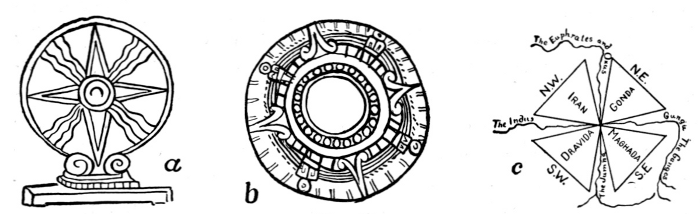
Figure 73.
Referring back to fig. 1, 1, reproduced from the Codex Borgia, we see the axle with rays issuing from a circular band of water. A receptacle filled with water occupies the centre and contains a tecpatl, the symbol of the north, the same associated with the fire-drill god in the next figure. In fig. 1, 4, the central fountain is surrounded, as in many instances, by stars which connect it with the nocturnal heaven, and it contains a rabbit=tochtli, the rebus figure employed to express the word octli, by which the rain was designated as “earth wine” (see pp. 95 and 185).
As I write, I have before me a whole series of painted representations from the Codices of what has heretofore been misinterpreted as images of the diurnal sun. In some of these the open centre is painted blue or green, in others it is filled by a heart from which flows, in some cases, a stream of blood, the essence of life. In several instances a tree with four main branches grows from the [pg 507] centre.148 In one case the tree grows from a pool and holds in its branches the image of the axle, in the centre of which, as in the Humboldt Tablet preserved at the Berlin Museum, a figure is seated. The centres of others exhibit the head of a divinity painted red, a single eye, or the ollin. All examples establish the fact that the Mexican “axle of the North” represented fire and water emanating from a single source. In notable examples, where the axle is carved in stone, the identical features are conventionally reproduced. Some exhibit a depression or deep hole in the centre. This is the case in the remarkable example at the museum in New Haven, Conn., where the axle is carved on the top of a square altar, the corners of which exhibit symbols of the four elements, each accompanied by the numeral 4. The centre of the figure exhibits a carved ollin, in the middle of which a deep hole is situated. An analogous but shallow depression occurs in the great circular monument, the Conquest Stone of Mexico (see p. 259), around which Tezcatlipoca, the one-footed fire-drill god, is represented sixteen times, each time in the act of receiving the enforced homage of the chief or chieftainess of a different locality.
The above monuments, as well as a rudely-carved representation of the “sun” recently discovered and unearthed by Dr. Ed. Seler, lying on a substructure of stones in the centre of an open space, presumably a market place, definitely proves that the design was intended to be placed in a horizontal position. This intention has already been noted in the case of the Great Cosmical Stone of Mexico (fig. 56), on which the rays and intermediate water drops recur, and are represented as emanating from the central Nahui Ollin, the Four in One, which encloses the masked face of the divine Twain.
A question naturally suggests itself at this juncture: How did the ancient Mexicans, who utilized the fire-drill in its most elementary form and as far as is known, employed no means of extracting [pg 508] oil or juice or of grinding food-stuff by a centrifugal process,149 come to employ as a sacred symbol, the axle or “mill-stone” which, in India, had been adopted as an image of central rotation, by people who constantly used the fire-drill and the oil-press?
The strongest proof that the idea of a circular disk was associated in Mexico with terra-cotta spinning whorls only, is the fact that, in the native description of the Great Temple recorded by Sahagun, a circular stone monument, employed in religious festivals, which the Spaniards described as a “stone wheel,” is termed in the Nahuatl text as a “te-malacatl” i. e. a “stone whorl.” Further evidence of the close association of such “stone whorls” with thread or cord, the product of spinning, is furnished by the way in the ritual, that the victim was attached by one foot to the open centre of the “stone whorl” and circulated around the stone which lay motionless. On the other hand, the sculptured zone on the Great Cosmical stone, enclosing the day signs placed in their fixed order of rotation, and the sculptured frieze on the Tribute Stone, furnish direct evidence that circular movement was associated with the cosmical axle, or disk.
It is obvious that the distribution of water combined with fire from a common central source, represented as a mill-stone, could not have been suggested to the native mind by the use of the fire-drill and socket and the spinning whorl only. Therefore we are obliged to face the question whether the cosmical figure may not have been introduced, as a religious symbol only, by a race of civilizers who, though acquainted not only with the oil press and chariot but also with the Akkadian star of Anu, the combination of the rain and fire crosses, and with the Assyrian-Babylonian image of Shamash (an elaboration of the same idea), but in the absence of beasts of burden and sesame seeds in Mexico, had no opportunity, or did not consider it feasible or necessary, to teach the use of the chariot, oil-press or circular mill stone to the natives. Before forming any conclusions or conjectures on this point, however, a number [pg 509] of other questions must be investigated. One fact, however, stands out quite clearly: Whereas in figure 73, b, we have the rudimentary form of the quadruplicate symbol, closely resembling that which was already ancient and almost obsolete in Babylonia in the ninth century B.C. and pertained to a cult of Shamash, the North and Heaven, which had flourished in that country about 1850 B.C., the Great Cosmical Stone of Mexico represents the highly advanced development and elaboration of the identical cult, as actually established there until the year 1519 of our era.
Pausing here and looking back upon the foregoing summary of the universal spread of identical forms of social organization and of rituals suggested by the use of the fire-drill, in association with a primitive pole-star cult, there are a few distinct and unrelated points which claim special attention: First of all, the identity in the form of the fire-altar and the cult of the fire-socket, among the Maghas and Nahushas of India and the Mayas and Nahuas of Yucatan and Mexico. Secondly, the striking resemblance of plan and numerical scheme which unquestionably existed between the ideal “divine polities,” recorded by Plato, and the states which actually existed, of ancient Peru and Mexico. It is impossible to read Plato's scheme of an all-pervading division into 12, and his plan for the laying out of the capital and state and not to recognize the fact that, in Peru, as set forth on pp. 133-149 of the present work, these identical principles were actually carried out by the alien Incas who, in comparatively modern times, collected the natives together and organized them into a settled community. Thirdly, the undeniable fact that the numerical scheme of the Maya and Mexican Calendar and state-organization is identical with that adopted by Constantine, in establishing New Rome.
Postponing a closer examination of these points until further on, let us now continue our comparative review.
The universal spread of the identical scheme of organization, vouched for by documentary evidence, is further demonstrated by the results of archaeological and historical research and a comparative study of ancient symbolism. Thus it is impossible not to admit the striking and deep-seated analogy between the Assyrian four-fold division of city and state, the title “lord of the four regions” and the image of Shamash, the “four-spoked wheel;” the Indian, Egyptian and Grecian philosophical conceptions of four elements, culminating in Plato's Cosmos and Theos (an entity, [pg 510] spherical in shape, incorporating four elements) and, for instance, the quadruplicate symbol carved in the centre of the Mexican Cosmical Tablet, which exhibits the symbols of the same four elements embodied in a single symbol, representing the supreme power, who is thus proven to have been conceived by the Mexicans, as well as by the Peruvians, as “the Air, Earth, Fire and Water in One,” or the source of the four elements.150
When it is likewise considered that the Mexicans employed the divine title, “four times lord,” that the Maya title “Kukulcan,” signifies the “Divine Four,” that the ancient map of Mayapan proves that, like the Kushite confederacy, and the kingdoms of Assyria, Egypt and Peru, it was a “Four provinces in One” or a “four-fold state,” the identity of the principles underlying the archaic civilizations of the Old and New World becomes more and more apparent. It likewise becomes evident that in each of these countries the significance and symbolism of the archaic cross-symbol and swastika must have been identical, and that, like the pyramid (the form of which, in the ancient Greek alphabet, is given [pg 511] to the letter delta which expresses, numerically, four, a quatuor, or 4,000) and the square stone altar or column, it figured the Four in One, the mystic Five or the Four and all-embracing One. The following array of facts demonstrates further the universal association of archaic cross-symbolism with the conception of an all-embracing, stable, central power.
A striking demonstration of this is furnished by the diagonal cross, employed as a Chinese character, to express the word wū=five, just as it is used, in Egyptian hieratic script, to express the syllables uu, un or ur (see fig. 60). Sometimes, in Chinese, a horizontal line is drawn above the cross and another beneath it, and John Chalmers informs us that, according to the Shoh Wan, this “full form means the five elements between heaven and earth, the upper line being heaven and the lower earth.” The sign thus obviously constituted an image of the Cosmos, the 5+2=heaven [pg 512] and earth, thus furnishing the familiar seven directions in space, the chief and synopsis of which is the sacred Centre.
The association, in ancient America, of the cross-shape with central stable power, has already been discussed in the case of the Copan swastika, p. 222. At the time when I wrote about this and carved stelæ found at Quirigua and Copan, I had not yet learned of the remarkable discovery made there, by Mr. George Byron Gordon of the Peabody Museum Honduras Expedition, which furnishes me with the most striking confirmation of the conclusion I expressed on p. 220, namely, that the personages, whose portraits are sculptured on the stelæ, were high-priest rulers, who bore the title “Divine Four,” and were “rulers of the four regions.”
Referring the reader to Mr. Gordon's report, published in vol. i, no. i, of the Peabody Museum Memoirs, I merely note his verification that, beneath several stelæ examined for this purpose, there exist subterraneous vaults, in the form of the so-called Greek cross, above the exact centre of which the stela stands, its base being inserted in the stones forming the ceiling of the chamber. In one case the length of the cruciform vault is over nine feet from eastern to western extremity, the width of the branches being one foot and their depth two feet. Over thirty vessels of pottery were found in this, amongst them large urns with covers. It would appear from this that, like the Egyptians, the ancient builders of Copan performed certain ceremonial rites in connection with the construction of these artificially cosmical centres.
What seems quite clear is that the subterraneous vault constituted a sacred cosmical chamber and that the stelæ were memorial stones, which probably represented the image of a lord, and the record of his fixed term of office which formed a period or era of the native calendar (see p. 221). The stela which formed the stable, visible centre of the hidden substructure may also have been employed as a gnomon during some period of time, and in the monument the initiated must undoubtedly have recognized the underlying cosmical conceptions, and regarded it as a highly developed form or variant of the archaic cross, the primitive record of a year. It is remarkable how closely analogous are the Central American stelæ with their hidden cruciform vaults, to the conception of the Egyptian “star of Horus” explained by Hewitt as the meridian pole raised in the centre of a cross denoting the four quarters.
[pg 513]
The most striking evidence of a close affinity between the ancient Central American ah-men, or master-masons, who built cruciform windows in the walls of temples and designed the cruciform vaults under the stelæ at Copan and Quirigua, and the amanteca or tolteca, the master-architects and builders of Mitla, Mexico, is furnished by Mr. M. H. Saville's recent excavation of three remarkable subterraneous, cruciform chambers, the largest of which is situated on the summit of a high hill near Mitla. The interior of the latter is elaborately decorated with geometrical designs, like those on the exterior of the Mitla palace. The extreme length from east to west is 9m. 71cm., from north to south 8m. 18cm., and its roof was composed of large flat stones. The entrance to this and the other cruciform vaults is situated at the extremity of the western arm, which in the case described was longer than the other arms.
The most remarkable example of such a cruciform crypt is, however, that situated beneath the palace of Mitla, which has been figured by Dupaix in Lord Kingsborough's Mexican Antiquities, vol. ix. This vault is also built of the shape of a so-called “Greek” cross, but in its centre stands a large circular stone column reaching from floor to ceiling. It is impossible not to recognize the symbolism of this pillar situated in the centre of a structure, the form of which symbolizes the Four Quarters and the fundamental identity of the column occupying the centre of the Mitla chamber and the Copan stelæ standing above the centre of the hidden cruciform vault. Details associated with the pillar which stood in the Great Temple of Mexico (p. 53), and the “pedestal” erected on the hill of justice at Guatemala (p. 79) definitely show that, in ancient America, the column was also associated with star-cult, with the administration of justice and central celestial and terrestrial government. Investigation has shown that precisely the same ideas were associated with the circular, square or octagonal columns of Egypt, Greece, Rome and Japan, where they either constituted the images of the central supreme divinity, formed the support for the statues of earthly “divine” rulers, or marked the centres of the cosmos or state, bearing inscriptions of the sacred laws as in Athens, or of the distances to all points of the empire, viz. the Roman Milliarum Aureum.
It is remarkable to find that, whereas in ancient Byzantium the centre of the city had been marked by a column surmounted by a colossal statue of Apollo, a pillar or pole god, Constantine erected [pg 514] a “spacious edifice, from the centre of which all roads of the empire were measured.” Considering that, at the time when this edifice was built, the ancient quadruplicate plan had been revised and the empire of New Rome had been divided into four parts by Constantine, it seems reasonable to infer that the form of the great edifice which marked the territorial centre of the new empire bore the impress of the cruciform plan, and that the shape of the cross should have been adopted throughout the empire, in edifices marking central consecrated places. How much of the true spirit of the Christian ideal of universal brotherhood entered into the constitution of Constantine's New Rome it is impossible to conjecture. Niebuhr denies that Constantine was a Christian, records that he was only baptized shortly before his death, and states that the religion of Constantine “must have been a strange compound indeed, something like the amulet recently discovered at Rome, which is an example of that curious mixture of Judaism, Christianity and Paganism which we so frequently meet with from about the beginning of the third century.”151
In an extremely interesting monograph “On the origin of the cruciform plan of the mediæval Cathedral,” by the distinguished architect, Mr. E. M. Wheelwright, published in the “Transactions of the Boston Society of Architects, 1891,” I find the significant fact that what is now the little church of S. Tiburce, Rome, in the form of a Greek cross, was built at the time of Constantine.
The same monograph teaches that “de Rossi discovered in the catacombs of Rome two scholia of a plan called specifically triclinium, of a date previous to Diocletian and probably of the third century. In such were celebrated, by the presbyters, the memorial feasts of martyrs, the congregation assembling outside. Tombs of a positive cruciform plan are also found in the catacombs. In [pg 515] the fifth or sixth century cruciform buildings became in the East, and wherever Byzantine influence was potent, the recognized form for tombs, mortuary chapels and buildings commemorative of holy places. These types seem to have been given, by Byzantine architects, special recognition of the purpose of their construction and to have appeared to them as monuments requiring a symbolical expression of plan, while they evidently did not consider such symbolical expressions requisite in buildings planned for general congregations, which, although of types without distinct association with the Christian faith, were held, for several centuries, to be sufficiently well adapted to purposes of Christian worship without material change from their ancient form [that of the Roman Basilica].”
Referring the reader to Mr. Wheelwright's monograph for interesting data concerning the Byzantine influence discernible in the early types of Christian churches of cruciform plan erected in northern Italy and Europe, I merely note here that in St. Sophia, founded by Constantine, and completed by Justinian, “the load of the dome is thrown on four great piers disposed at either corner of a square. These great piers, with the corresponding buttresses of the outer wall, suggest a possible symbolical intent in the arrangement ... otherwise the cruciform plan here suggested is expressed neither externally nor internally.” I venture to suggest that in St. Sophia, “Holy Eternal Wisdom,” as in the case of the Pantheon, the dominant idea may have been the all-embracing unity, but that, as the number four was identified with “wisdom and justice” by the widespread Pythagorean philosophy, that number must have seemed, to the initiated, to pervade the entire structure. In the case of the Church of the Nativity at Bethlehem, where it was Justinian's intention to mark a sacred locality, we find the cruciform plan clearly carried out. “The church of St. Simeon Stylite at Kelat Seman Syria, built about A.D. 500, is a most interesting example of a cruciform church, marking a sacred spot [and associated with a sacred column].”
“The church of the seventh century built at Sichem, over the well of the Samaritan, shows a distribution of plan similar to that of S. Simeon Stylite, the holy object being at the crossing.... There are existing at St. Wandrille and at Querqueville in Normandy, two (cruciform) triapsidal churches of a date prior [pg 516] to the Norman conquest ... a well preserved four-apsed tomb chapel exists at Montmajour near Arles, built in 1019; the detail and plan of which point to a Syrian prototype and resembles two buildings of an early date now existing in Dalmatia.” The use of the cruciform type of church, anterior to the great revival of purely Christian religious architecture in the thirteenth century, was confined to Picardy and the Rhenish provinces, fine churches of this type being at Cologne, Bonn, Marburg, etc.
It is interesting to recall that the building of sacred structures is attributed to “secret organizations of free or enfranchised operative masons which existed during the middle ages, and possessed grades of officers and secret signs by which, on coming to a strange place, they could be recognized as real craftsmen and not impostors.” To this day, in some parts of Germany and Bohemia, the swastika is the sign or mark of the stone-mason's guild which has survived from the mediæval times. In the organized bands of masons whose mark was the swastika and who introduced Eastern cosmical symbolism into Europe and gradually developed, upon this basis, a purely Christian form of architecture, we may perhaps see the descendants of those ancient builders who, filled with the conception of the sacred Central power, the Four Quarters, the Above and Below, planned the square, seven-stoned zikkurats of Babylonia-Assyria, the pyramids, obelisks and sphinxes of Egypt, the columns and cruciform tombs and sanctuaries of Greece, Asia Minor and Rome, the cruciform temples and the topes of India and the domes of the Pantheon and St. Sophia.152
It would appear that these ancient builders were also the designers and founders of cities and states. It is, for instance, known that Hippodamus, the son of Euryphon, a Milesian, and by profession an architect, gained celebrity in his own art by constructing the Piræus at Athens and by improving the method of distributing [pg 517] streets and planning cities ... and also wrote a treatise concerning the best form of government.
A kinship of thought undoubtedly exists between the trained builders of cosmical structures in the Old World and the ah-men, the amantecas and toltecas of Central America and Mexico, who also reared pyramids, cruciform vaults, circular temples, with openings to the four quarters (see fig. 30, p. 97), altars and pillars, and in their temples wrought, in stone, endless variations of the great human theme: the sacred central, stable power, the four quarters and elements, and the heaven and earth with the dualities of Nature, and likewise instituted an artificial scheme of social organization, a calendar and religious rites based on these same fundamental principles, which can be traced back to primitive pole-star worship. It has been of utmost interest to me, as I was approaching the end of the present investigation, to become acquainted with Hewitt's work and his view that it was the seafaring Turanians, originally a northern race, the worshippers of Tur=the pole, who claimed descent from the seven stars of Nāgash, the serpent=Ursa Major, and, from India, extended their trade and carried their form of social organization and religious cult first to the Euphratean kingdoms and afterwards to Egypt and Syria, where they were known by the Greeks as the Phœnicians.
The subjoined detached passages, which open out new fields of inquiry, not only appear to me to establish conclusively this view, but certainly afford most interesting information concerning the ancient race of pole-star worshippers, seafarers, builders and handicraftsmen who, according to Hewitt (p. 25), extended their emigrations not only to Europe but also to America.153 Hewitt bases [pg 518] the latter assertion upon the identity be perceived “between Akkadian and American mythological traditions.”
As the limit of the present inquiry excludes mythology, I cannot discuss here the evidences of similarity produced by Hewitt. I must express regret, however, that he designates a tribe of Pueblo Indians (the Sias, related to the Zuñis), as “Mexican” (see vol. ii, p. 243, etc.), a term which, in this case, is decidedly misleading. His identification of the truly Mexican, “teo-cipactli” as a “fish-god” is unfortunate, as numberless conventionalized drawings in the Codices prove that cipactli signifies alligator. If the somewhat limited and vague evidence, produced by Mr. Hewitt, appeared to justify his conclusion, how much more must an identity of social organization and cult such as I have traced, not only authorize but also render it imperative, that the possibility of pre-Columbian contact should be thoroughly looked into. Disclaiming any desire to formulate hasty conclusions, and merely for the sake [pg 519] of gaining information by looking squarely at facts, I shall now rapidly enumerate some of these which undoubtedly appear to corroborate Hewitt's further assertion that “the Mayas and Nahuas of Yucatan and Mexico were emigrants of the Magha and Nahusha tribes, who pertained to the race of navigators known by the Greeks as the Phœnicians ... and who continued in their new land, America, the worship of the rain god, to whom, as their fathers in central Asia, they dedicated the sign of the cross” (Hewitt, p. 492).
“The Maghas were the Finnic long-haired race of star- and fire-worshippers who, starting from Phrygia, as the Takkas conquered northern India ... who called themselves the sons of the Northern pine tree, called in Phrygia, as by the Northern Finns, Ma=the mother; also the sons of the mother-goddess Magha, the socket block whence fire was generated by the fire-drill; who is also worshipped as the mother Maga under the form of the alligator. Consequently the alligator was their totem.” In Essay viii [pg 520] Hewitt states that these “sons of the great witch-mother Maga” lived in Magnesia, whence they emigrated to Thessaly and that theirs was the “city of the Magnetes” referred to by Plato as “the mother of laws.” The word mag, however, meant great in Akkadian, hence according to Hewitt the name Makkhu, the high priests or Magi (vol. ii, p. 54).
The Maya and Mexican fire altars and sockets and their association with the earth-mother and alligator in the native Codices has been discussed. The Mexican day-sign cipactli figures an alligator and is associated with a female deity. The alligator altar at Copan, is described on p. 228. Were it not for limit of space additional testimony could be cited here, proving that in Mexico the alligator was associated with the mother of the race, the fire-socket, and was a tribal totem.
“As the mother Maga she is the maker or kneader, the mother of the building and constructing races ... they were the first builders of towns.... They adored the god of the twirling or churning fire-drill.... They employed the name Ku, Ukko, Pukka and Pukan to designate the rain and thunder god and star-god who guides the stars in their courses and rules the beginning of the year” (Hewitt, p 438). The Finnic and Esthonian “Ukko is also called Taivahan Napanen, meaning the navel of the heaven and this is called the place of the pole star, the star at the top of the heavenly mountain” (vol. ii, p. 155).
[pg 521]
Compare Ku in Maya list, appendix iii, also Tezcatli-poca or puca=Mexican fire-drill god, Ursa Major.
“They worshipped Nag or Nagash,=the serpent and fire-drill constellation of Ursa Major, and consequently called themselves also the sons of Naga=the Nahushas. They worshipped the Pleiades=the mother stars....”
The Nahuas traced ancestry to seven stars of Ursa Major and began their religious year at the culmination of the Pleiades at midnight.
“The Nagas united with the navigating Shus or Phœnicians ... the red men, who worshipped the ruler of heaven.... These Shus ... called in the North, Hus ... were the Sumerian trading races of the Euphratean delta and Western India, who traced their descent to Khu, the mother bird of the Akkadians, Egyptians and Kushites.... They reverenced the sacred ‘shu’ stone, the begetter of fire and of life fostered by heat,... designated as the precious stone, the strong stone, the snake stone, the mountain stone.... The pregnant mountain of the Shu stone was to the Akkadians the central point of the earth. The people who are said in the Rig-Veda to have first found fire by the help of Matarishoan, the fire-socket, and to have brought it to men, and are said to have placed it in the navel of the world ... as the sacred Shu stone.”
It should be added here that the Hittite sign for Ishtar was a triangle enclosing a stone: “the mountain enclosing the stone of life.”
About 270 A.D. the Tutul-xius=(cf. Kukul) under a great chief or lord Kukulcan reigned at Chichen-Itza ... (p. 206). In Mexico the name for turquoise is xiuitl and the god of fire is named Xiuh-tecuhtli. Jadeite is designated as chal-chiuitl and is associated with Chalchiuitlycue, the mother-goddess. The spark-producing, flint knife=tecpatl is also employed as a symbol of generation.
“Their kings, like those of Egypt, wore the uræus serpent as a sign of royal authority and made this the emblem of kingly rank in countries so widely distant from one another as India and Egypt....”
We learn from Prof. A. H. Sayce (Ancient Empires of the East, p. 200), that customs that had originated in a primitive period of Semitic belief survived in Phœnician religion and that clear traces of totemism are found amongst the Semites. “Tribes were named each after its peculiar totem, an animal, plant or [pg 522] heavenly body.... David, for instance, belonged to the serpent-family, as is shown by the name of his ancestor Nahshon, and Professor Smith suggests that the brazen serpent found by Hezekiah in the Solomonic Temple was the symbol of it. We find David and the family of Nahash, ‘or the serpent,’ the king of Ammon, on friendly terms even after the deadly war between Israel and Ammon, that had resulted in the conquest and decimation of the latter.”
The name of the culture hero Kukulcan or Quetzalcoatl incorporates the word serpent in Maya and Nahuatl. The conventionalized open serpent's jaw forms the usual head-dress of the lords sculptured on the Central American stelæ and bas-reliefs. The existence of totemism in America is too well known to require comment, and the arbitrary method by which it was established by the Incas of Peru, when they founded the new colony, has been described.
“... I have already shown that the snake-father of the snake races in Greece and Asia Minor and of the matriarchal races in India was the snake Echis, or Achis, the holding snake, the Vritra, or enclosing snake of the Rig-Veda, the cultivated land which girdled the Temenos. This was the Sanscrit and Egyptian snake Ahi.... But the Naga snake was not the encircling snake, but the offspring of the house-pole and in this form it was called by the Jews the offspring or Baal of the land. But as the heavenly snake it was the old village snake transferred to heaven, called the Nag-ksetra, or field of the Nags, and there it was the girdling air-god who encircled the cloud mothers, the Apsaras, the daughters of the Abyss, the Assyrian Apsa, and marked their boundaries as the village snake did those of the holy grove on earth. But on earth the water-snake was the magical rain-pole, called the god Darka, set up by the Dravidian Males in front of every house ...” (p. 194). “They are the Canaanites, or dwellers in the low country, and the Hivites or the villagers of the Bible and the race of Achæans of Greece. These are the sons of the Achis=the serpent, the having or holding snake, the girdling snake of cultivated land which surrounded the Temenos or inner shrine, the holy grove of the gods” (Hewitt, p. 175).
Attention is drawn here to the twin serpents which enclose the Mexican Cosmical Tablet (fig. 56), whose bodies may be seen to consist of a repetition of the conventional sign for tlalli=land, consisting of a fringed square. Each square in this case encloses a sign resembling that of fire=tletl and the numeral ten. These girdling serpents, whose heads unite, [pg 523] being directly associated with land, appear as the counterpart of the Old World Achis, a curious fact when it is considered that they are represented as springing from the sign Acatl (see p. 257).
On the other hand, the heavenly “feathered serpent” of Mexico and Yucatan is distinctly associated with the air and the circle; its conception curiously coinciding with that of the “girdling air-god” mentioned by Hewitt. It is well known that the walls enclosing the court of the Great Temple of Mexico, were covered with sculptured serpents, and at Xochicalco, Mexico, and in Central American ruins (Uxmal, for instance), great sculptured serpents surround the buildings. It is remarkable that the sign Acatl not only figures conspicuously on the Great American Tablet, but also on the allegorical figure of the “Divine Serpent,” which may well represent the totemic divinity and ancestor of a snake tribe, associated with the word Acatl, possibly conveying their name. The undeniable association, in Mexico, of the serpent with Acatl, curiously agrees with the name of the “sons of Achis, the serpent”=the Achaians: and deserves consideration.
In the Genesis genealogy of the kings of Edom, the land of the red man, the priest king of the Hus or Shus is mentioned “... his people had replaced the Tur, the stone pillar, the Egyptian obelisk by the temple, the home and symbol of the creating god, who had been the pillar of the house.... But in their eyes the father-god was not the central pillar but the two door-posts and thence they called the temple gates Babel or the gates of god.... This gate was guarded by the holy twins.... The doorposts, and night and morning are invoked in the Rig-Veda.... The Magas were the discoverers of magic, mining, metallurgy, handicrafts—the pioneers of scientific research and the first organizers of a ritual of religious festivals.”
Twin pillars, sculptured in the form of great serpents, whose names signify twinship, support the entrances to the ancient temples of Yucatan, Central America, and have been found on the site of the Great Temple of Mexico. The Mexican and Maya accounts of the culture hero Quetzalcoatl-Kukulcan state that he and his followers were “great necromancers” and magicians and that they taught handicrafts, metallurgy, and instituted calendar, social organization and ritual. A personal, close examination of a large number of old Peruvian and Mexican as well as Coptic textile fabrics, has convinced me moreover of their identity of technique.
“The Magas sacrificed dogs,.... They wore long hair,.... They made human sacrifices in order to obtain rain” (Hewitt).
“The Phœnician priests scourged themselves or gashed their arms and breasts to win divine favor.... Human sacrifices [pg 524] were made, to Moloch or Milkom ... the parent was required to offer his eldest or only son as a sacrifice and the victim's cries were drowned by the noise of drums and flutes” (Sayce).
The human sacrifices of Mexico are familiar to all. The native dog and various kinds of birds were sacrificed. The Mexican priests, named papas, wore long hair, practised asceticism, gashed their breasts, arms and legs and pierced their ears and tongues. On the Palenque bas-reliefs, priests with long hair are sculptured. The human sacrifices of Mexico and those of Egypt, Phœnicia and Assyria, described by Sayce and Hewitt (pp. 275 and 348), are closely alike. See also Hewitt's account of the blood brotherhood made between the sacrificer and the land on which the blood is poured (p. 196), and the Chichimec blood sacrifice described in the present work, p. 66.
The foregoing are a few noteworthy analogies which have impressed themselves upon me during the present course of investigation, in addition to the many undeniable and unsuspected evidences I have found, of an identity of star-cult, ritual and social organization in Old and New World civilizations.
It will be seen that the outcome of my researches corroborates the opinions differently expressed by a long line of eminent investigators, who have been constantly discovering and pointing out undeniable similarities and identities between the civilizations of both hemispheres.
It seems to me that an accumulation of evidence now forces us to face and thoroughly investigate the possibility that, from remote antiquity, our continent and its inhabitants were known to the seafarers of the Old World, to whose agency the spread of similar forms of cult and civilization in the New World is to be assigned.
While those who uphold the autochthony of the native civilization may regard such identities as accidental, those who are willing to admit the possibility that the Phœnicians, the red men of antiquity, whose land was Syria, navigating by the pole-star, may have reached America, will doubtlessly dwell upon the unquestionable fact that the most ancient traces of organized and settled communities actually exist along the coast swept by the equatorial currents. A glance at an ordinary chart exhibiting the ocean currents and trade winds shows that vessels sailing southward from the Canary Islands and caught in the north African current, might, at a certain point, enter the north equatorial current flowing towards the coast of America. Further southward still, off the coast of Guinea, the current bearing this name meets the main equatorial [pg 525] current which sweeps along the coast of Honduras and Yucatan into the Gulf of Mexico.
What is more, ancient well-known tradition asserts that the culture-hero Kukulcan-Quetzalcoatl, with his followers, came to Mexico from the East (via Yucatan) and told the natives of their distant home, named Tlapallan and Huehue tlapallan which, translated, mean “the red land” and “the great ancient red land.” Native American tradition unquestionably and unanimously ascribes to single individuals of aged and venerable aspect, or leaders of small bands of men and women of an alien race, the peaceable introduction of a definite plan of civilization, identical in its elements with that known to have existed in India, Egypt and Babylonia-Assyria from time immemorial, and said to have been spread to these countries by the Phœnicians.
Native tradition, therefore, is seen unanimously to controvert the independent development of the cosmical schemes of government and most advanced forms of civilization which prevailed in America at the Columbian period. This, of course, in no wise excludes the existence of purely native people, with a certain degree of civilization, more rudimentary in form, founded on impressive natural phenomena, which the natives had always been in a position to observe for themselves.
In order to obtain an insight into conditions which might have determined and affected maritime intercourse with distant America, let us now make a rapid survey of the history of the ancient civilizations of the Old World. This reveals, in the first case, the undeniable fact (one of deepest significance in the light of the present investigation) that the period of a general stirring of men's minds, in countries where pole-star worship had prevailed from time immemorial, exactly coincides with the period to which I alluded on p. 43, during which there ceased to be a brilliantly conspicuous and perfectly immovable pole-star in the northern heavens.
From Mr. Hinckley Allen's work (p. 454), I have since learned that astronomers have closely determined this period, and that Miss Clerke writes of this: “The entire millennium before the Christian era may count for an interregnum as regards pole-stars. Alpha Draconis had ceased to exercise that office; and Alruccabah had not yet assumed it.” Prof. A. H. Sayce tells us that the Phœnician pilots steered by the pole-star in remotest antiquity, and it is a matter of history that “Pytheas of Massilia, the bold navigator [pg 526] (died about 285 B.C.), showed the Greeks that the pole-star was not at the pole itself.” Previous to that date, however, the astronomer-priests must have noted the change in the heavens. On descendants of ancient pole-star worshippers, whose entire religion and civilization were based on the idea of fixity and rotation, the unaccountable change in the order of the universe must indeed have produced a deep impression. Under such conditions it seems but natural that a great awakening of doubt and speculation should take place, that worship should be transferred from stars known to be subject to change, to the unseen, incomprehensible but ever-present eternal power which ruled the universe.
Let us examine some of the records of the great intellectual movement that swept at one time, like a wave, over the ancient centres of civilization. The eighth, seventh and sixth centuries before our era are marked by the growth of the Ionian philosophy which, as Huxley tells us, “was but one of many results of the stirring of the moral and intellectual life of the Aryan-Semitic population of Western Asia. The conditions of the general awakening were doubtless manifold, but there is one which modern research has brought into great prominence. This is the existence of extremely ancient and highly advanced societies in the valleys of the Euphrates and the Nile.... The Ionian intellectual movement is only one of the several sporadic indications of some powerful mental ferment over the whole of the area comprised between the Ægean and Northern Hindustan....”154
Professor Schroeder's statement that, “in the seventh century B.C., the idea of four, i. e. five elements, spread in India,” is particularly interesting in connection with the date assigned to the birth of the Ionian intellectual movement. Of Pythagoras it is related that, like Solon, “he had visited Egypt, also Phœnicia and Babylon, then Chaldean and independent, and founded a brotherhood originally brought together by a religious influence, with observances approaching to monastic peculiarity, and working in a direction at once religious, political and scientific.” According to the learned translator of Cicero's first Tusculan disputation155 “it is generally accepted that Pherecydes of Syros (one of the Cyclades islands in the Ægean sea) was the teacher of Pythagoras. Pherecydes, [pg 527] who flourished about B.C. 544 is said to have derived his knowledge from the secret books of the Phœnicians and from travels of inquiry in Egypt.” Through Philolaus (see Grote IV, p. 395, note 2), Pythagorean science was made known to Plato, whose views are quoted on p. 449. Grote states that, about 300 B.C., the Pythagorean philosophy nearly died out. It is a curious fact that this date coincides, approximately, with the destruction of Tyre (Tsar, in Phœnician,=the rock), the last stronghold of the Phœnicians, “which had defied Assyrian, Babylonian and Persian but at last fell,” according to Prof. A. H. Sayce, “in July, B.C. 332, before the Greek conqueror Alexander. Thirty thousand of its citizens were sold in slavery, thousands of others massacred and crucified and the wealth of the richest and most luxurious city of the world became the prey of an exasperated army. Its trade was inherited by its neighbor Sidon” (op. cit. p. 194). It is obvious that, at this period, bands of fugitives may well have taken refuge in traders' ships and sought safety in flight to distant regions, where they might establish themselves and found colonies on the pattern of Tyre or of Carthage which, in ancient times had also been founded by fugitives and been named “the new city,” Karthakhadasha (Sayce). While the great historical events which marked the fourth century B.C. seem to have arrested the spread of Pythagorean philosophy, we find that, according to Grote, “in the time of Cicero, two centuries later, the orientalizing tendency, beginning to spread over the Grecian and Roman world, caused it to be again revived, with little or none of its scientific tendencies, but with more than its primitive religious and imaginative fanaticism.... It was taken up anew by the pagan world, along with the disfigured doctrines of Plato. Neo-Pythagorism, passing gradually into Neo-Platonism, outlasted other more positive and masculine systems of pagan philosophy, as the contemporary and revival of Christianity” (op. cit. iv, 398). Neo-Platonism reached its height under its chief Plotinus (A.D. 205-270) who sought to reconcile the Platonic and Aristotelian systems with Oriental theosophy. His pantheistic and eclectic school was the last product of the Greek philosophy.156
[pg 528]
It is, at all events, remarkable, that the date tradition assigns to the presence of Kukulcan in Yucatan and the foundation of the quadruplicate state of Mayapan coincides with the dying out, in Europe, of pagan philosophy, one of the features of which had been the elaboration of ideal forms of government based on a numerical and cosmical scheme, the elements of which had apparently been spread by the Phœnicians. In Copan and Quirigua we find remnants of long-established, peaceable communities revealing no trace of war-like weapons, and the memorial stelæ of whose rulers stand above hidden cruciform vaults, while carved personages are represented as seated in the centre of ornate crosses. In Yucatan, through which land the foreign civilization seems to have reached the plateau of Mexico, there are significant traces of an ancient city, named Zilan, situated on the Atlantic coast; proofs that buildings of cosmical forms were erected; that the state of Mayapan was laid out on the familiar cosmical plan; that repeated migrations took place, and that, from time immemorial, a calendar, on the same numerical basis as that of Mexico, had been in use. The great state of Mayapan, where a remarkable stone cross was found at Cozumel by the Spaniards, is shown to have been figured as a circle within a circle, the whole divided into four parts by cross-lines. Here, as in Chiapas and Mexico, all divisions of government, population and time are organized on a numerical scheme representing the combination of 4×5=20 i. e. an entire finger and toe count, “a whole man,” with the 13 directions in space. The multiplication of 13 and 20 results in a unit of 260 which, as a cycle of time, represents the complete set of all harmonious combinations of man the miniature image of the living state, with the thirteen directions of space in the all-embracing Cosmos, composed of four primary elements. In consonance with this we find the existence of 20 (or 4×5) lords, whose names correspond to those of the 4 chief and 16 minor day-signs of the calendar, and of a lord by election, whose name signifies the thirteen divisions or parts, and who constituted a microcosmos, a Four in One. In regular rotation the 20 lords, consisting of 4 chief and 4×4=16=minor rulers fulfilled duties towards the supreme representative who resided in the capital, while they respectively lived in four provinces, the population of which was subdivided into four tribes each of the 20 divisions of the state being again divided into 13 parts.
[pg 529]
In a cosmical state like this in which each individual not only felt himself to be a unit and a microcosmos, but also an indispensable part of a living organism, under the form of which the state was symbolized, its inhabitants, leading lives regulated by a calendar based on the phenomenon of circumpolar rotation, under a chief ruler entitled the “Four in One,” assisted by four sub-rulers, must indeed have felt that they “lived, moved and had their being” in the Teotl or Theos, imagined as the embodiment of the four elements. In this connection it is interesting to learn that “the animal” itself, of Plato, is considered by eminent authorities to have been the tetrad.
In Zuñi, where, at the present day, each individual feels himself identified with some part of the body of a quadruped, his clan totem, the conception of the state as “a living animal,” is an actual reality. Their pueblo moreover represents a 6+1=7, or a “seven in one,” the miniature counterpart of the far distant Ooraon village of Chota Nagpore and of the ancient archaic kingdoms of India, Persia, Babylonia, Egypt, Greece, Rome, etc. Anciently the Zuñis called themselves the Ashiwi, a name remarkably like that of the Ashvins, derived from the Akkadian ash=six.
I revert again here to the following landmarks, which may perhaps furnish a useful “working hypothesis” for future investigation. In Mexico the pyramids of Cholula and of Teotihuacan seem to render testimony of the, possibly consecutive, establishment of ideal states amongst tribes “capable of subjection” by Toltecas, or “Master-Builders,” who, according to their method, used the building of a great structure, requiring time and united labor, as a means of organizing a new community or colony. It may be that the period of their completion coincided with the establishment of the Calendar system, beginning with the number one.
In my Preliminary Note on the Ancient Mexican Calendar System (Stockholm 1894), I demonstrated how, by reconstructing the Calendar cycles, it was possible to determine exactly when the native system was adopted. According to my demonstration, which has now stood unchallenged for six years, a fresh year cycle began in 1507 A.D., with the year sign II Acatl and the day 2 cipactli. For a cycle to be associated with the number two it is obvious that it must have been preceded by a cycle ruled by number one, therefore it may be safely inferred that the cycle II Acatl that commenced in 1507 followed a cyclical period of 4×13=52×20=1840 [pg 530] years (p. 32). Accordingly the date when the Mexican system was instituted in the form which existed at the time of the Conquest, may be fixed as corresponding to the year 467 of our era.
Considering that the Calendar system was, however, but one part of the machinery of government, was inseparable from the organization of tribes, classes and individuals, and that its institution signified the foundation of a state, it is remarkable to ascertain that, but 137 years previously, Constantine, in A.D. 330, had instituted the empire of New Rome, on precisely the same numerical basis as that of the Mexican Calendar, and divided it into 4 parts or prefectures, each subdivided into 13, yielding a total of 52 prefectures. Moreover, as far back as the institution of the Kleisthenean democracy, the Greeks had been familiar with an extremely intricate and close union of calendar and government system, such as existed in Babylonia-Assyria and, as I have shown, in ancient Mexico.
It is certainly suggestive that the period of 137 years, which elapsed between the establishment of New Rome on a partly revived and partly amended or remodelled plan, and the foundation of the great democracy of ancient Mexico at the date inferred, is unparalleled in the history of mankind for religious persecutions, carried on in Egypt, Greece and Rome, following upon three centuries marked by the growth and spread of Christianity and the persecution of its followers, the destruction of Jerusalem and the persecution of the Jews. It was in A.D. 379 that Theodosius, the Greek, proclaimed Christianity the religion of his empire and instituted a relentless persecution of the Arians and followers of the ancient Egyptian religion.
Under Arcadius, Emperor of the East (A.D. 395), the Anthromorphites, who affirmed that God was of human form, destroyed the greater number of their opponents. Under Marcianus (A.D. 451), Silco invaded Egypt with his Nubian followers and the Council of Chalcedon condemned the Monophysite doctrine of Eutyches. Later, under Justinian (A.D. 527), the Monophysites separated from the Melchites and chose their own patriarch, being afterwards called Copts.
It is impossible to close one's eyes to the fact that, during this period of persecution and massacre, imminent peril of death must have forced many a band of the priests and followers of the ancient Egyptian and other religions to seek safety in flight. The [pg 531] events which took place in Egypt between A.D. 379 and 451, culminating in Silco's invasion, must unquestionably have been deeply felt by the descendants of the ancient Phœnician, Carthaginian and Grecian exiles, fugitives and mercenaries who, during countless centuries, had founded colonies along the Libyan coast, and pushed migration further westward along the coast line. Migrations from these regions would doubtless have resulted in the remarkable combination of archaic star, fire-drill and socket worship found in Yucatan and Mexico, existing alongside of a highly developed and perfected philosophical scheme of social organization identical, in principle, with that which, in the Old World, constituted an ideal which was the result of centuries of experience and active intellectual life.
The present investigation, in which I have collected more material than it has been possible to present in this publication, brings out facts tending to show that, originally, both hemispheres were peopled from the North, and that, in antiquity, at intervals, an extremely limited intercourse was kept up between the Old and New Worlds. The obvious fact that navigation must have been seriously impeded by the interregnum of Polaris, lasting for many centuries, would explain a prolonged isolation of America anterior to the Christian era. Whereas the equatorial currents facilitated the voyage to America, the same favorable conditions did not accompany navigation in the same latitudes in a reverse direction, and this suggests the probability that few who set out for “the hidden land,” ever returned to the port whence they sailed. Investigation seems to reveal that influences, emanating from the most ancient centres of Old World civilization, reached sundered regions of America at different times, and that they could have been carried there by a seafaring and building race such as the Minyans, the Magas, the Phœnicians or their descendants.