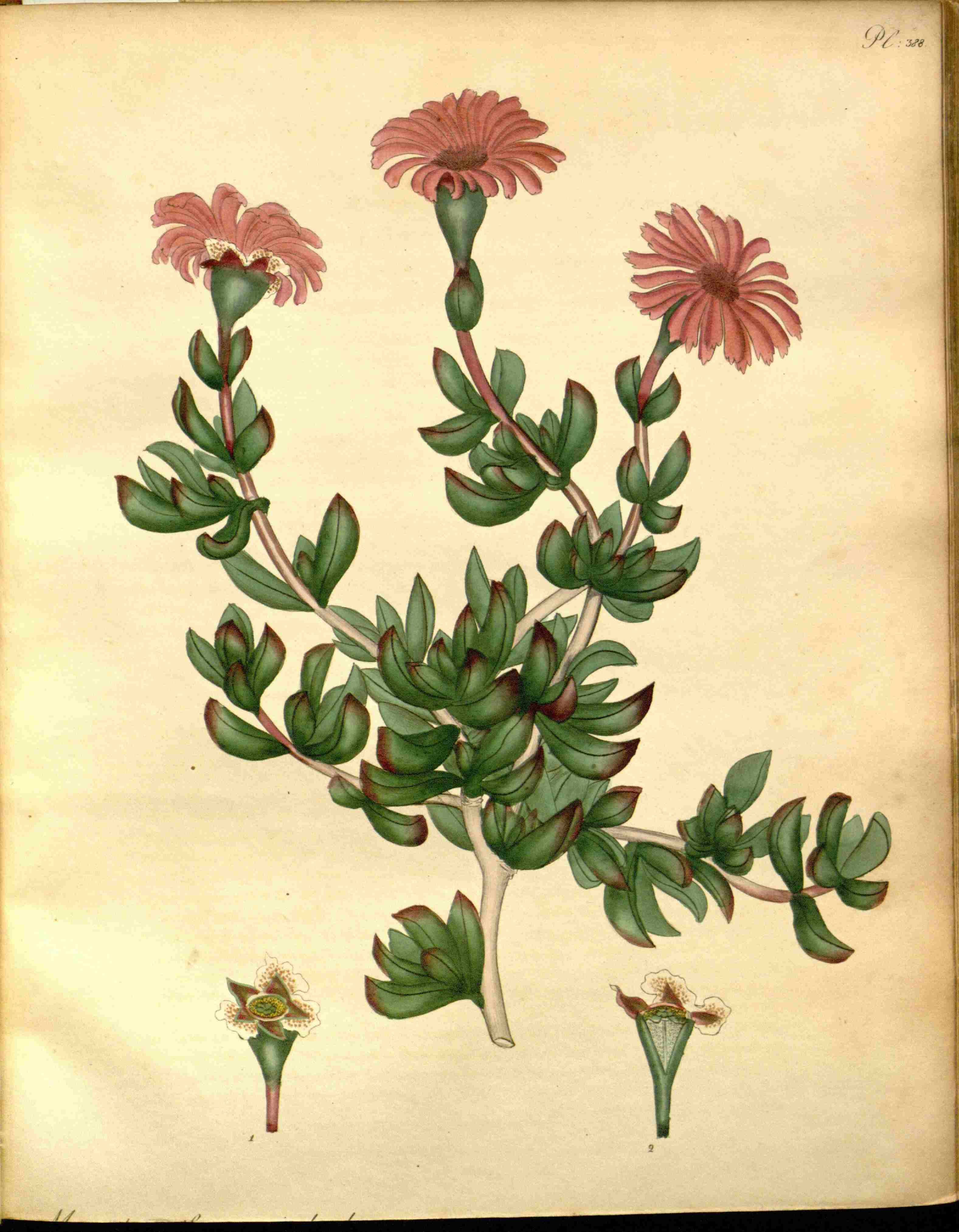
Volume 6 — PLATE CCCLXXXVIII.
Reading edition
MESEMBRYANTHEMUM INCLAUDENS.
Unclosing-flowered Fig-Marygold.
CLASS XII. ORDER IV.
ICOSANDRIA PENTAGYNIA. Twenty Chives. Five Pointals.
ESSENTIAL GENERIC CHARACTER.
Petala valde numerosa, linearia, basi cohærentia.
Petals very numerous, linear, cohering at the base.
SPECIFIC CHARACTER, &C.
Mesembryanthemum, foliis triquetris lævibus perviridibus, carinâ gibbosâ, corollis inclandentibus, petalis interioribus valde abbreviatis imbricatisque.
Fig-Marygold, with triquetrous smooth deep green leaves, with a gibbous keel, unclosing flowers, and interior petals extremely abbreviated and imbricated.
Descriptio. M. mutabili nobis affinis, sed species valde distincta: differt in his, foliis lævioribus, et longe viridioribus, minusque mucronatis, marginibus sæpius plus minusve purpureis: floribus speciosis semper apertis; nec inconspicuis, nocteque clausis; saturatissime et vivacissime rubicundis, petalis cuneato-linearibus, latis in hoc genere, apicibus erosis; interioribus (petalis) maxime abbreviatis, imbricatisque quasi in stellam. Calyx subanceps, 5-fidus, membranis rubro punctatis. Filamenta recondita, brevissima omnium (vix linearia), alba, basi purpurea. Antheræ albidæ, circiter longitudinem filamentorum. Styli 5, erecti, pergrossi, virides, altitudine antherarum. Capsulam non vidi. H.
REFERENCE TO THE PLATE.
1. The empalement, seed-bud, chives and pointals. 2. The same cut perpendicularly, to show the insertion of the chives and pointal
Our figure represents a perfectly new and nondescript, and at the same time very ornamental species of Mesembryanthemum: each flower possesses the valuable property of lasting about ten days in beauty, and never closes after being once expanded: a circumstance of exceeding rare occurrence in this very extensive genus; no fewer than 214 distinct species of which we have now a knowledge of[C].
M. inclaudens rises with a branched, shrubby stem, to the height of 10 or 12 inches, and is cultivated in the same manner, and propagated with the same facility, that is common and well known in this tribe: they are all very hardy green-house plants; require in winter as much air as possible, if frost is but avoided; strike freely from cuttings; are great lovers of hot, sunny and sheltered situations, when out for the summer; and are better not watered over their heads, but at the roots only.
The present species was raised from Cape seeds last season, in the collection of G. Hibbert, esq. where our drawing was made in July. Mr. Ross, Nurseryman at Stoke Newington, has also raised it from Cape seeds, and flowered it in July; and he likewise very fortunately flowered at the same time several fine specimens of M. rostratum; the fructifications of which have not been produced before in Europe, that we know of, although the plant has been common in the English gardens ever since the year 1732, and is one of the very few which Dillenius thought proper to figure without flowers, in his celebrated Hortus Elthamensis.