Volume 6 — PLATE CCCLXVII.
Reading edition
ANAGALLIS GRANDIFLORA.
Great-flowered Pimpernel.
CLASS V. ORDER I.
PENTANDRIA MONOGYNIA. Five Chives. One Pointal.
ESSENTIAL GENERIC CHARACTER.
Capsula 1-locularis, circumscissa. Corolla rotata. Stamina hirsuta. Stigma capitatum.
Capsule one-celled, cut round. Corolla wheel-shaped. Chives hairy. Summit headed.
SPECIFIC CHARACTER, &C.
Anagallis, foliis ternatis cordato-ovatis acuminatis.
Anagallis, with leaves in threes heart-egg-shaped acuminated.
Descriptio. Radix annua. Rami elongati, effusi, procumbentes, angulati, superne simplices. Folia ternatim verticillata, remota, elliptica, acuminata, amplexicaulia, utrinque 3-5-lineata. Pedunculi ternatim verticillati, axillares, filiformes, primo patuli, demum sæpe recurvi, foliis duplo longiores. Calyx 4-rarius 5-phyllus, foliolis lanceolatis, acuminatis, carinatis, marginibus membranaceis. Corolla 5-rarius 4-petala, petalis basi confluentibus, patulis, orbiculatis, coccineis, basi intus nigris. Filamenta 5 hirsuta, atro-purpurascentia, petalis multo breviora. Germen pallidum. Stylus pergracilis purpureus antheras luteas superans. Stigma simplex, capitulatum, viride.
REFERENCE TO THE PLATE.
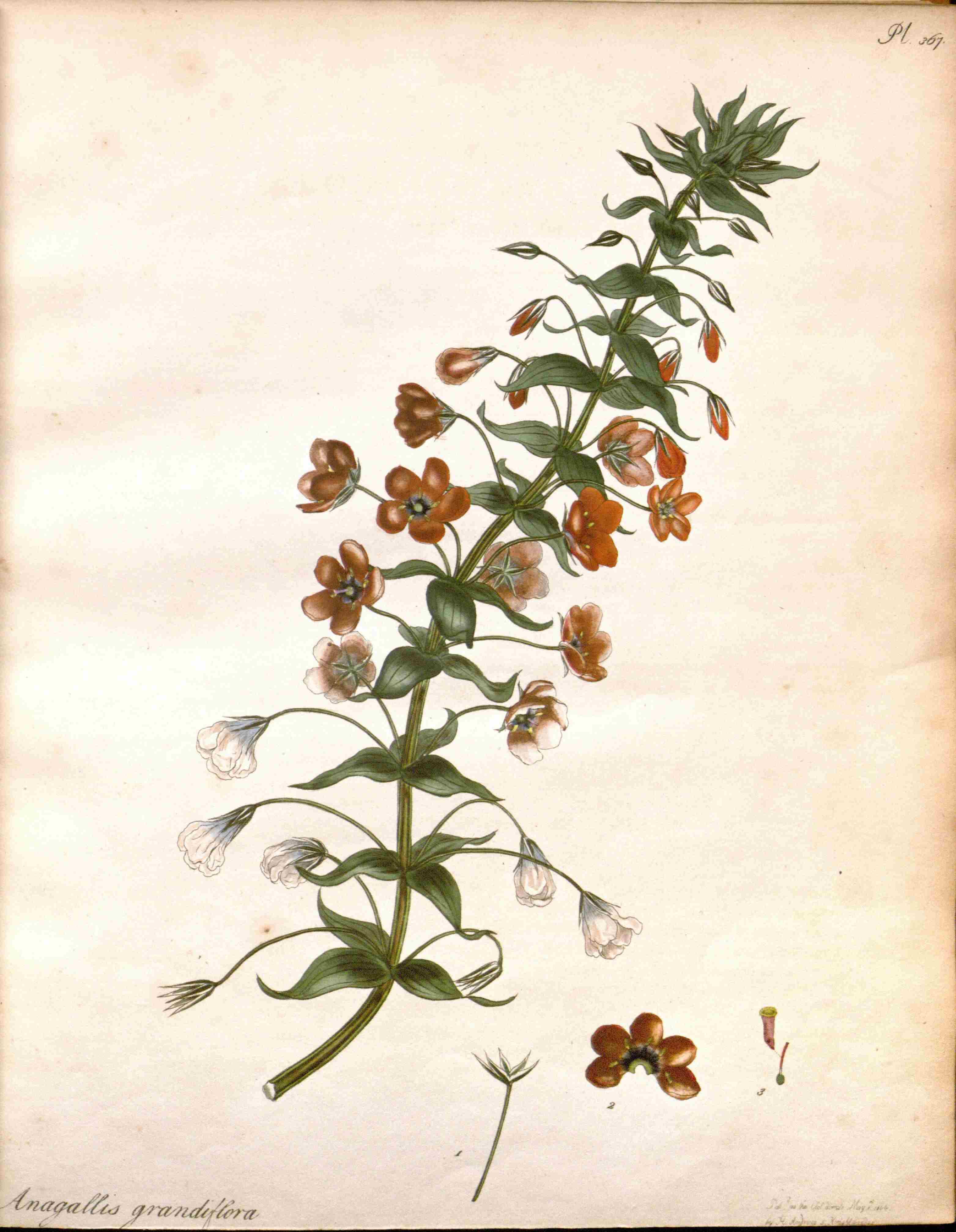
1. A peduncle and calyx. 2.The corolla spread open. 3. The seed-bud and pointal, and summit magnified
This new and elegant species of Anagallis, the largest and most showy of that genus hitherto discovered, was introduced into England, we believe, in the last year; but by whom, or from what country, we have not yet satisfactorily ascertained. It is reported to be of African origin, and to have come to England from the Paris garden. Our figure was made from a plant trained up near three feet high, in Lady De Clifford’s collection at Paddington, where it is treated as a green-house plant. We have not yet seen it produce good seeds, although apparently an annual plant; but it is easily increased by cuttings in the usual way. In every thing except size, and in having more entire petals, it very much resembles Anagallis arvensis; a plant truly remarkable for being the only one indigenous to Britain (the Poppies excepted) with scarlet flowers.