Volume 6 — PLATE CCCCX.
Reading edition
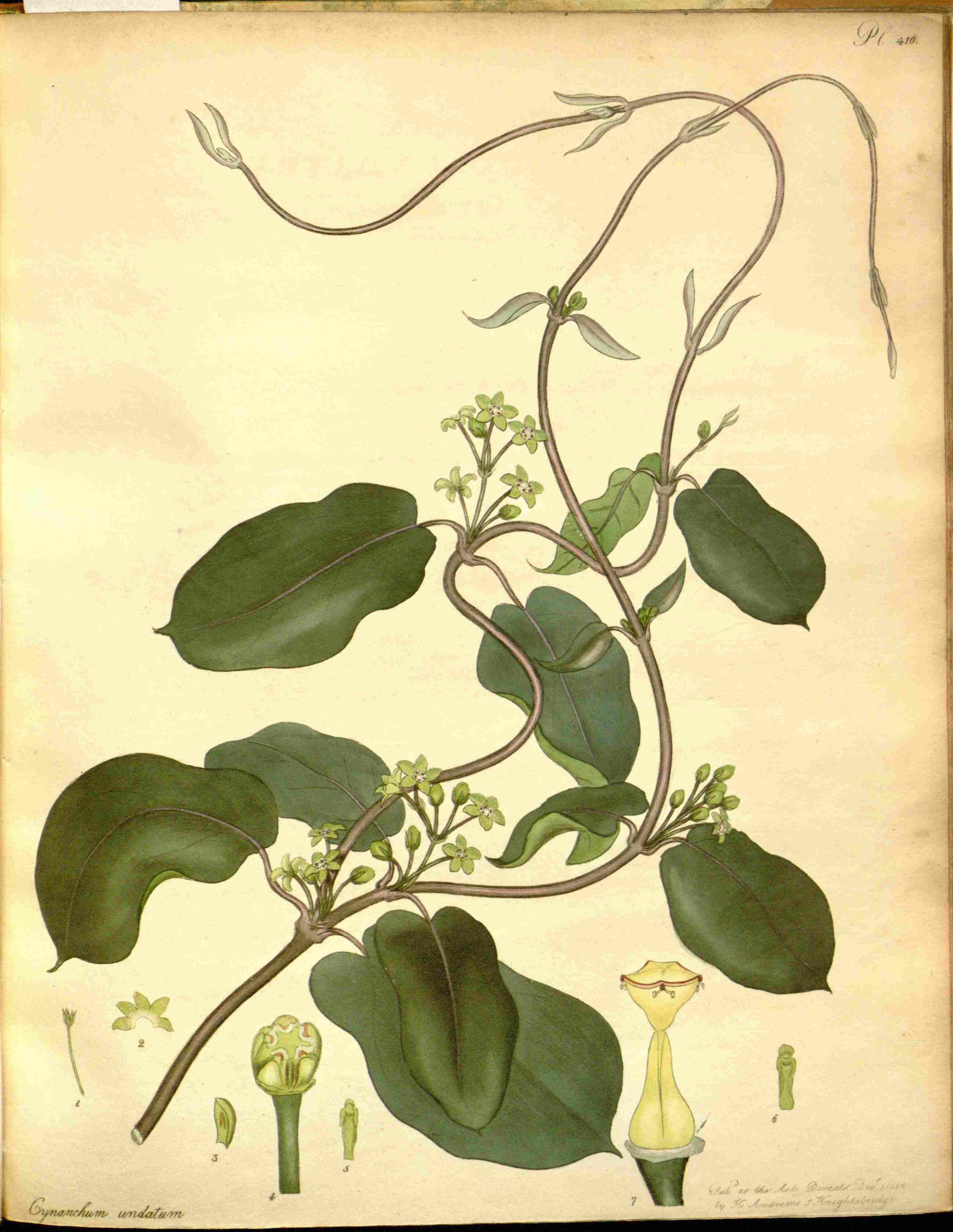
CYNANCHUM UNDATUM.
Waved Cynanchum.
CLASS V. ORDER I.
PENTANDRIA DIGYNIA. Five Chives. Two Pointals.
ESSENTIAL GENERIC CHARACTER.
Contorta. Nectarium cylindricum, quinquedentatum.
Contorted. Honey-cup cylindrical, five-toothed.
SPECIFIC CHARACTER.
Cynanchum, caule volubili, foliis cordatis oblongis obtusis cum acumine undatisque, umbellis axillaribus subproliferis.
Cynanchum, with a twining stem, heart-shaped oblong blunt leaves, but with a sudden point, and waved, axillary somewhat proliferous umbels.
REFERENCE TO THE PLATE.
1. The empalement. 2.The blossom spread open. 3.The outer scale of the honey-cup. 4.The parts of fructification magnified. 5.The inner scale of the honey-cup. 6.The outside of the same. 7. The seed-bud, shaft, summit and chives magnified
The Waved Cynanchum is more remarkable for novelty than beauty; yet, as an addition to our volubilous exotics, it possesses sufficient elegance to render it worthy our attention: especially as climbing plants have of late years become quite fashionable in most of the best conservatories in the vicinity of London.
As a species, we conceive it to be perfectly nondescript, although it should seem to possess several characters in common with Cynanchum reticulatum, and C. undulatum of Willdenow, &c.; both of which are known to us, but are described as having ovate, or oblong, not heart-shaped leaves. C. reticulatum is also a native of the same country, the East Indies; from whence seeds of the undatum were brought in the year 1803 by Captain Thomas Hardwicke; and were raised in the collection of the Marquis of Blandford, at White Knights, Berks, where they flowered last July; when that nobleman obligingly communicated to us the specimen from which the annexed figure was made.
The Waved Cynanchum is a hot-house plant, and requires nearly the same treatment as Pergularia minor of our 184th plate.