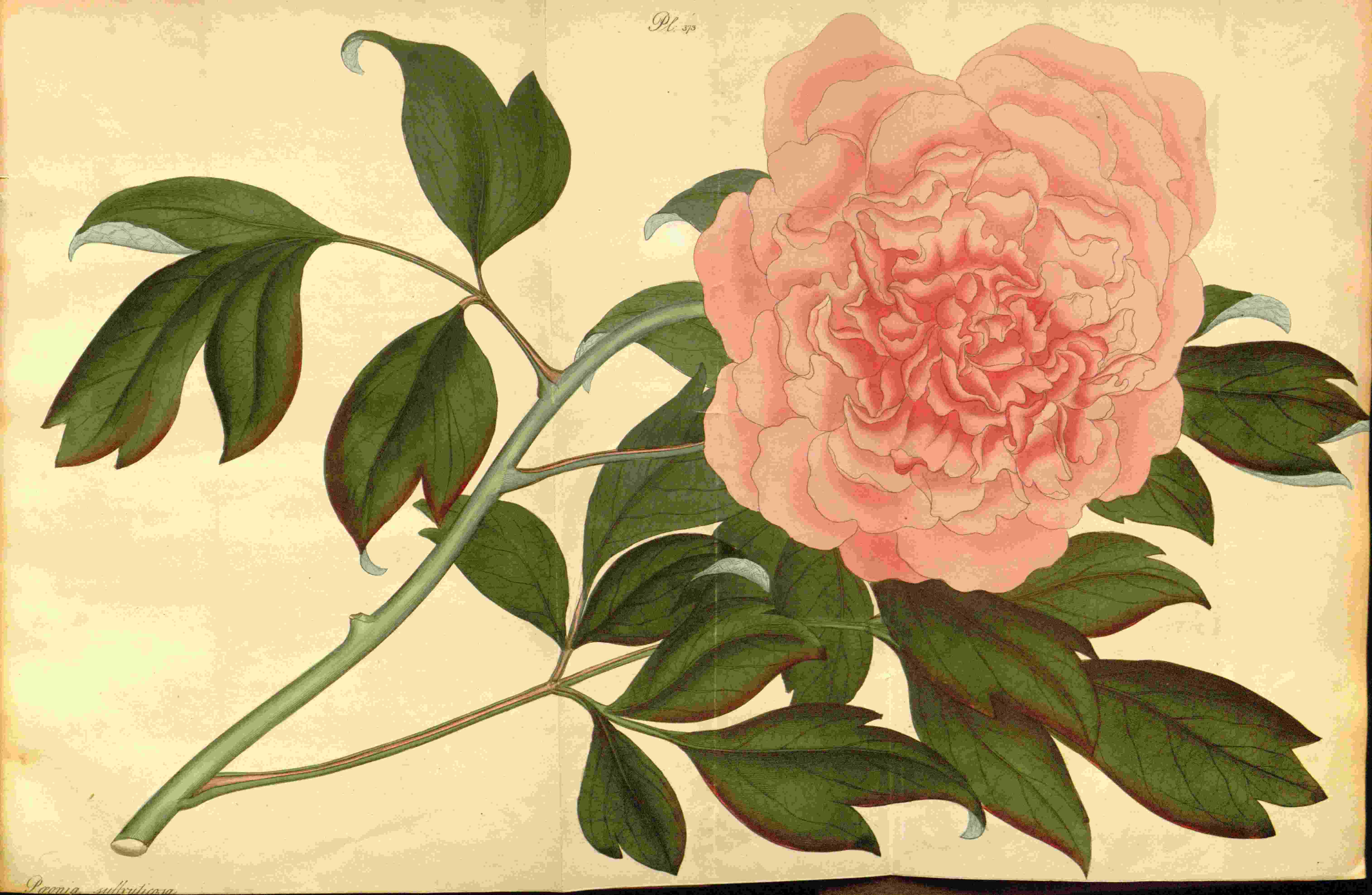
Volume 6 — PLATE CCCLXXIII.
Reading edition
PÆONIA SUFFRUTICOSA.
Shrubby Pæony.
CLASS XIII. ORDER V.
POLYANDRIA PENTAGYNIA. Many Chives. Five Pointals.
ESSENTIAL GENERIC CHARACTER.
Calyx 5-phyllus. Petala 5. Styli 0. Capsulæ polyspermæ.
Cup 5-leaved. Petals 5. Pointal none. Capsules many-seeded.
SPECIFIC CHARACTER, &C.
Pæonia, foliolis subtus glaucis et villosis, capsulis sericeis, caule suffruticoso.
Pæony, with leaflets glaucous and villose beneath, capsules silky, and shrubby stem.
Pæonia officinalis. Thunb. Fl. Jap. 230.—Loureir. Fl. Cochin. 1. 343.
Descriptio. Suffrutex 3-pedalis et ultra, ramosus. Rami erectiusculi, cortice subfusco; ramulis erectis lævibus, apicem versus viridibus, pauloque pubescentibus. Folia alterna, bipinnata, pedalia et ultra, horizontalia; superiora adscendentia; petiolis amplexicaulibus, canaliculatis, villis perpaucis sæpe instructis, canaliculâ, petiolorum semper lætissime roseâ; pinnæ 2-4, petiolatæ; pinnulæ sæpe 3, sessiles, infimæ oppositæ, tertia terminalis; omnes basi oblique cuneatæ, superne irregulariter inciso-dentatæ; supra virides, venosæ, nudæ, subtus glaucæ, nervosæ, villosæ. Flores speciosissimi ut in affinibus, sed in nostris exemplaribus pleni, rosei. Capsulæ sericeo-pubescentes.
The Pæonia suffruticosa is perhaps the most showy and desirable species, in this short but magnificent genus of plants. To the striking peculiarity of a shrubby stem, it unites the advantages of superior size; a profusion of very large flowers; and a facility of culture which ensures an annual succession of them: no wonder, therefore, that it is assiduously sought after by all who admire the beauties of Flora.
The shrubby Pæony was introduced into Britain in the year 1794, from China; where, as well as in Japan, many varieties of it are said to be common in almost every garden. We conceive it to be extremely distinct as a species, from the P. officinalis of all authors except Thunberg and Loureiro: yet Professor Willdenow has not enumerated it in his edition of Species Plantarum. Although introduced so long since, it is still rare; and must be treated as a very hardy green-house plant: indeed it succeeds best when planted in the earth and protected by a glass case; is propagated by slipping the roots, and by cuttings. All the plants hitherto received from China have double flowers; and among them there are two varieties; the rosy one here figured, from the Clapham collection; and another with purplish petals, the bases of which are of a still deeper colour. Flowers in April, making a very fine appearance; but is nearly scentless.