Volume 6 — PLATE CCCLXXXIX.
Reading edition
DOMBEYA ERYTHROXYLON.
Saint Helena Red-wood.
CLASS XVI. ORDER VII.
MONADELPHIA DODECANDRIA. Threads united. Twelve Chives.
ESSENTIAL GENERIC CHARACTER.
Calyx duplex, exterior 3-phyllus deciduus. Corolla 5-petala. Stamina 10-20, quorum 5 sterilia. Stylus 5-fidus. Capsulæ 5, coalitæ uniloculares, 1. s. polyspermæ.
Empalement double, outer 3-leaved deciduous. Corolla 5-petalled. Chives 10 to 20, of which 5 are sterile. Style 5-cleft. Capsules 5, conjoined one-celled, 1-or many-seeded.
SPECIFIC CHARACTER, &C.
Dombeya, foliis ovatis acuminatis cordatis, subtus tomentosis reticulatis, pedunculis subtrifloris, floribus pentandris.
Dombeya, with ovate acuminated heart-shaped leaves, downy and reticulated beneath, peduncles about 3-flowered, and pentandrous flowers.
Dombeya Erythroxylon. Willd. Sp. Pl. 3. 725.
Pentapetes Erythroxylon, foliis cordatis subcrenatis subtus tomentosis rugoso-reticulatis, floribus subumbellatis decandris. Ait. Hort. Kew. 2. 438.
Alcæa arborea, populi nigræ foliis, prona parte albicantibus, flore amplissimo rubicundo. Pluk. Mant. 6. t. 333. f. 1.
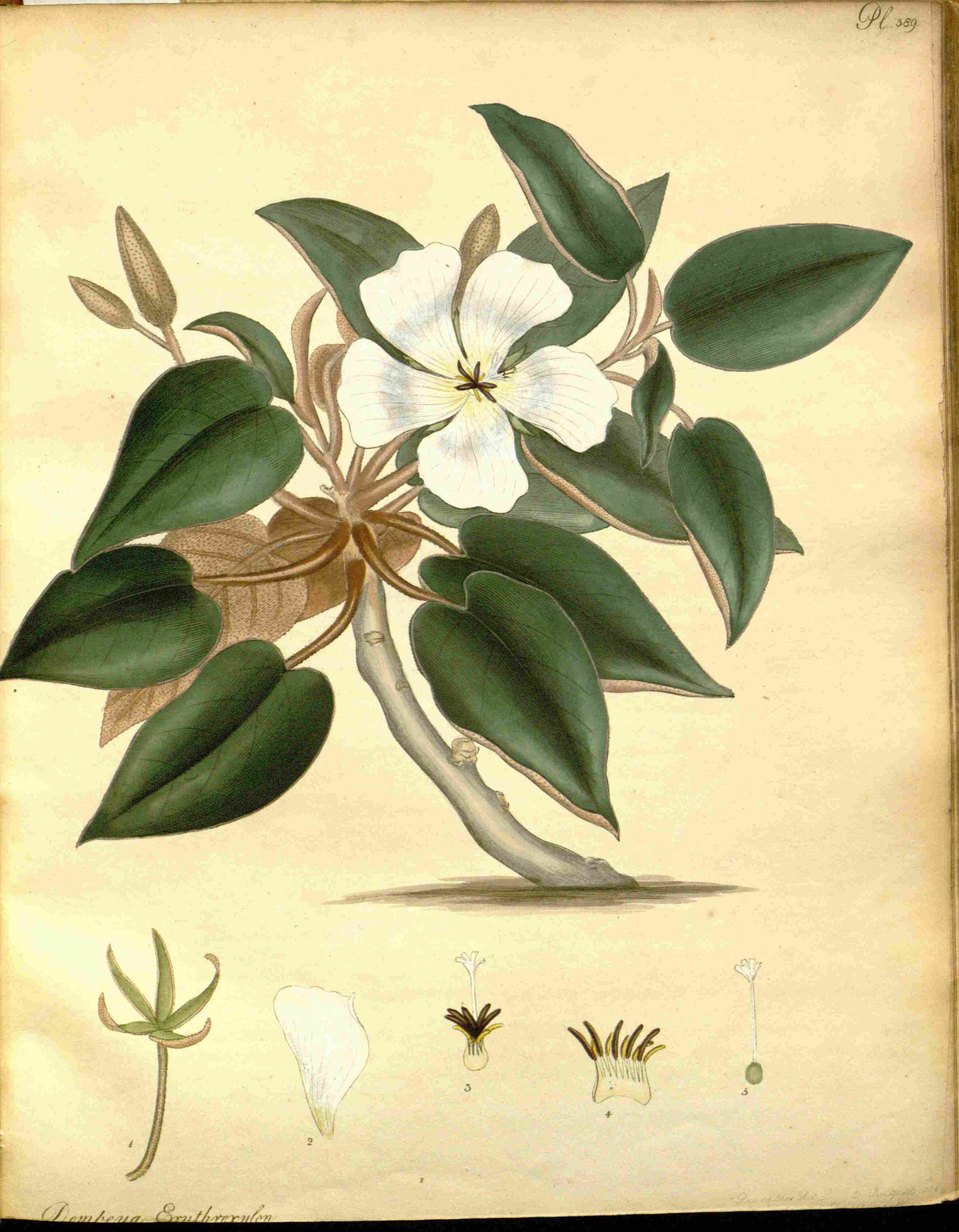
Descriptio. Frutex dumosus; ramulis, petiolis teretibus, paginis inferioribus foliorum, pedunculis calycibusque tomentoso-canis, et ferrugineo dense punctulatis. Folia alterna, petiolata, cordata, subintegra, supra perviridia, utraque venosa, subtus obsolete reticulata. Flores malvacei, speciosi. Calyx duplex, exterior minutus, 3-phyllus, foliolis subulatis, sesquilinearibus, superior 5-phyllus, foliolis lineari-lanceolatis, acuminatis. Petala 5, alba, retuse cuneata, venosa, basi uno latere, gibbosa, imbricata. Stamina, filamenta 10, atra, patula, quorum 5 sterilia, cæteris duplo longiora. Antheæ erectæ luteæ. Stylus teres, albus, 5-fidus, antheras superans.
REFERENCE TO THE PLATE.
1. The empalement. 2.One of the petals. 3.The chives and pointal. 4.The chives spread open. 5. The pointal and seed-bud
The handsome plant here represented is a native of Saint Helena, and is known by the name of Saint Helena Red-wood. Although introduced into this country by Sir Joseph Banks in the year 1772, it is at this time one of our very rarest and most desirable of hot-house plants. Mr. Aiton enumerates it in the Hortus Kewensis, but marks no time for its flowering; which therefore, we must suppose, but seldom occurs. Our specimen was obligingly sent us by T. Evans, esq. from his fine collection at Stepney in June 1803, and we last month saw it beautifully in bloom at the honourable Charles Greville’s, Paddington.
In the colour of its flowers, and in other particulars, it appears to vary. Plukenet calls them rubicund: ours were white: and in the extensive herbarium of A. B. Lambert, esq. we have examined a Saint Helena specimen with purple flowers, and less hoary but more reticulated leaves, which wanted the minute ferruginous spotting so abundant upon ours. It is propagated by cuttings in the usual way.