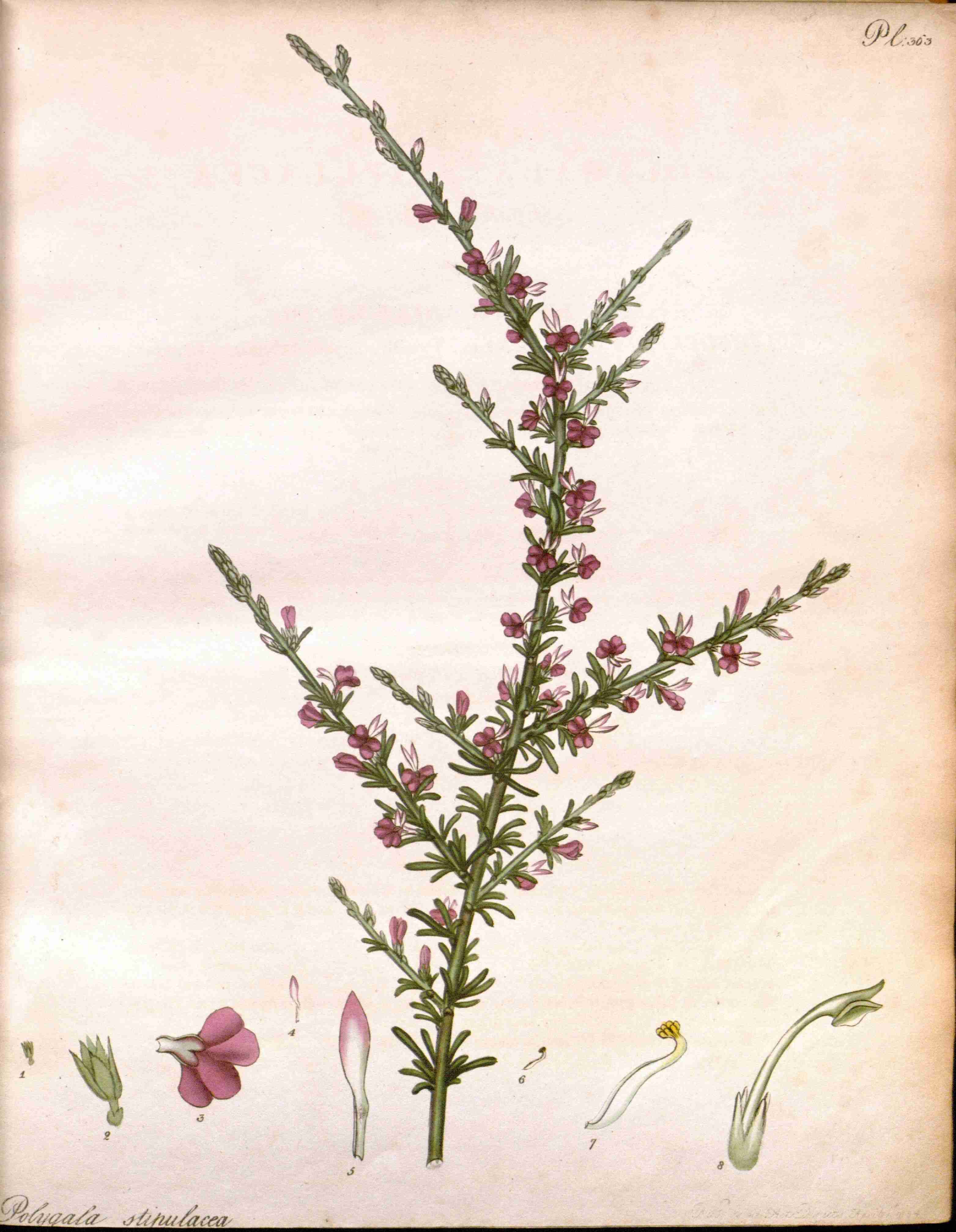
Volume 6 — PLATE CCCLXIII.
Reading edition
POLYGALA STIPULACEA.
Stipuled Milkwort.
CLASS XVII. ORDER III.
DIADELPHIA OCTANDRIA. Two Brotherhoods. Eight Chives.
ESSENTIAL GENERIC CHARACTER.
Calyx 5-phyllus: foliolis duobus alæformibus, coloratis. Legumen obcordatura, biloculare.
Cup 5-leaved, with two of the leaves like wings, coloured. Pod inverse heart-shaped, two-celled.
SPECIFIC CHARACTER, &C.
Polygala. Floribus imberbibus lateralibus, caule suffruticoso, foliis ternis linearibus acutis. Willd. Sp. pl. 892.
Polygala. With beardless lateral flowers, a shrubby stem, and ternate, linear, acute leaves.
Descriptio. Suffrutex, ramulis subdivaricatis, filiformibus, elongatis, pubescentibus. Folia fasciculata, linearia, obsolete mucronata, 3-6 in singulo fasciculo; infimo latiore, breviore, stipuliforme. Flores P. Heisteriæ, at minores, axillares, solitarii, vel subinde binati; sessiles.
REFERENCE TO THE PLATE.
1. The Empalement. 2.The same magnified. 3.The Keel magnified. 4.One of the wings. 5.The same magnified. 6.The Chives. 7.The same magnified. 8. The Pointal magnified
A rare Cape species recently introduced to the Hibbertian Collection, where our drawing was taken last summer. It is a greenhouse shrub of the more delicate kind; and is propagated, but not very readily, by cuttings.
In the structure of the flowers this species agrees exactly with the common Polygala Heisteria, which Linnæus originally made a distinct genus from Polygala; but afterwards united them. In keeping them distinct we think he did right; but wrong in uniting them. Our readers will have an opportunity of judging for themselves in our next number, in which will be figured a true Polygala, and another of the Heisteria family; with proper dissections of each.
Heisteria was named by Linnæus in honour of the celebrated German surgeon Heister.