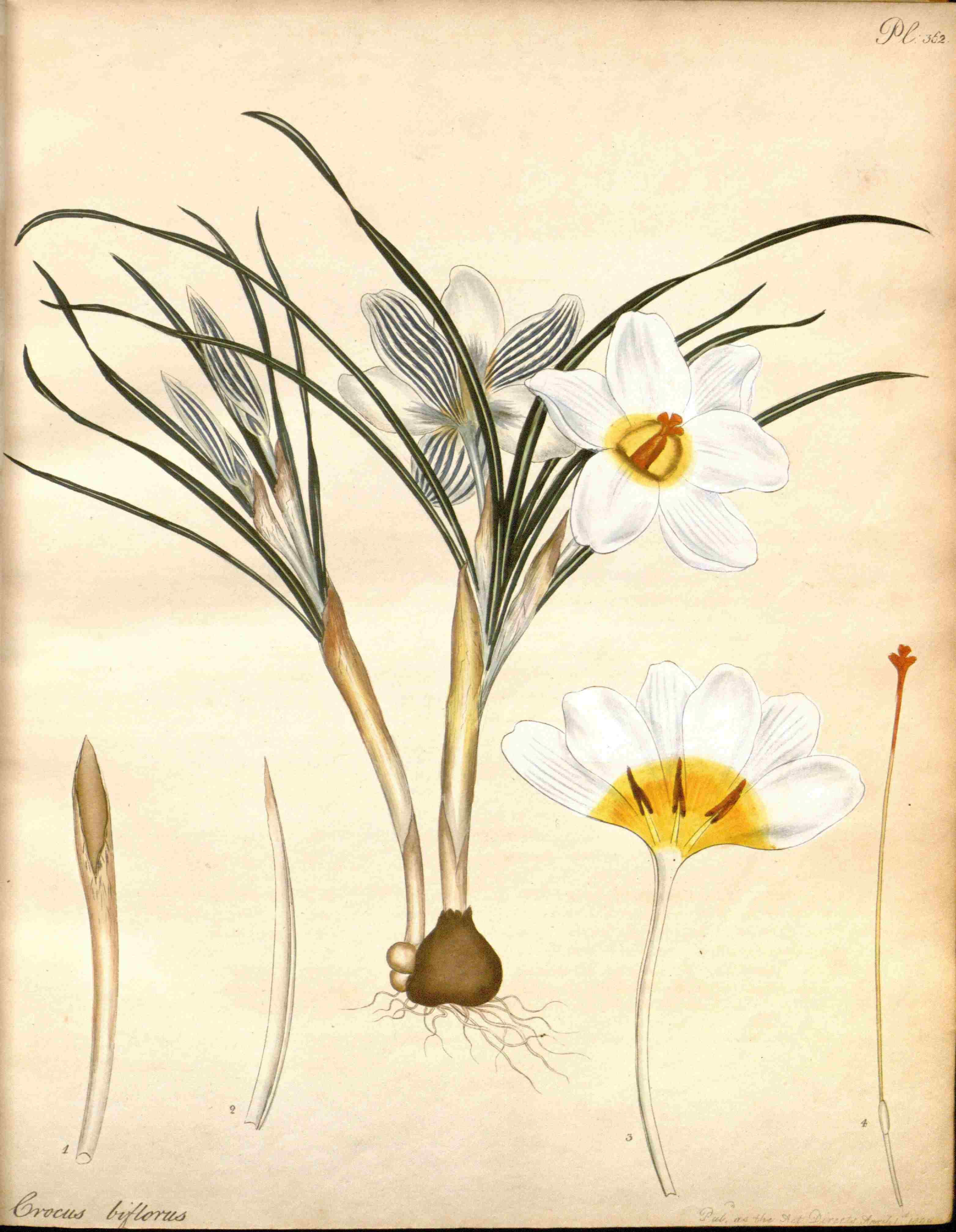
Volume 6 — PLATE CCCLXII.
Reading edition
CROCUS BIFLORUS.
Yellow-bottomed White Crocus.
CLASS III. ORDER I.
TRIANDRIA MONOGYNIA. Three Chives. One Pointal.
ESSENTIAL GENERIC CHARACTER.
Corolla, supera, 6-partita, subæqualis, erecto-patula, tubo longissimo subterraneo.
Corolla, above, 6-parted, nearly equal, erect-expanding, with a very long subterraneous tube.
SPECIFIC CHARACTER, &C.
Crocus, foliis angustissimis effusis floribus semper longe superantibus.
Crocus, with very narrow diffused leaves, which are always much higher than the flowers.
Descriptio. Radix tunicis glabris cochleariformibus. Folia, tempore florendi, longissima omnium, magisque effusa. Spathæ sæpe 2-floræ, ut in plurimis. Flores vernales, albæ, magnæ; fundo intus sordide flavo, extus aliquo olivaceo; tubo pergracili, depilato; petalis 3 exterioribus, extus tincturâ flavedinis, et purpureo elegantissime plumoso-striatis. Filamenta antheræque erectæ, luteæ. Stylus percroceus. Stigmata itidem percrocea, antheris vix superantia. Haworth’s Crocus inedit.
REFERENCE TO THE PLATE.
1. The outer sheath of the flower. 2.The inner. 3. The flower cut open
This beautiful Crocus is unquestionably distinct as a species, and has never been noticed by any systematic writer except Miller; who has described it accurately under the name of biflorus, in the 8th edition of his celebrated Dictionary. It is very hardy, flowers early in February, and may be readily distinguished from other Crocuses by its leaves being much longer than the flowers, at the time of flowering. When the sun shines strong, the flowers have a just perceptible fragrant scent; a circumstance very unusual in this genus; all the other species, (one we call fragrans excepted) having more or less of an unpleasant smell. It seldom produces seeds in this country, or varies in colour; but increases by the root.