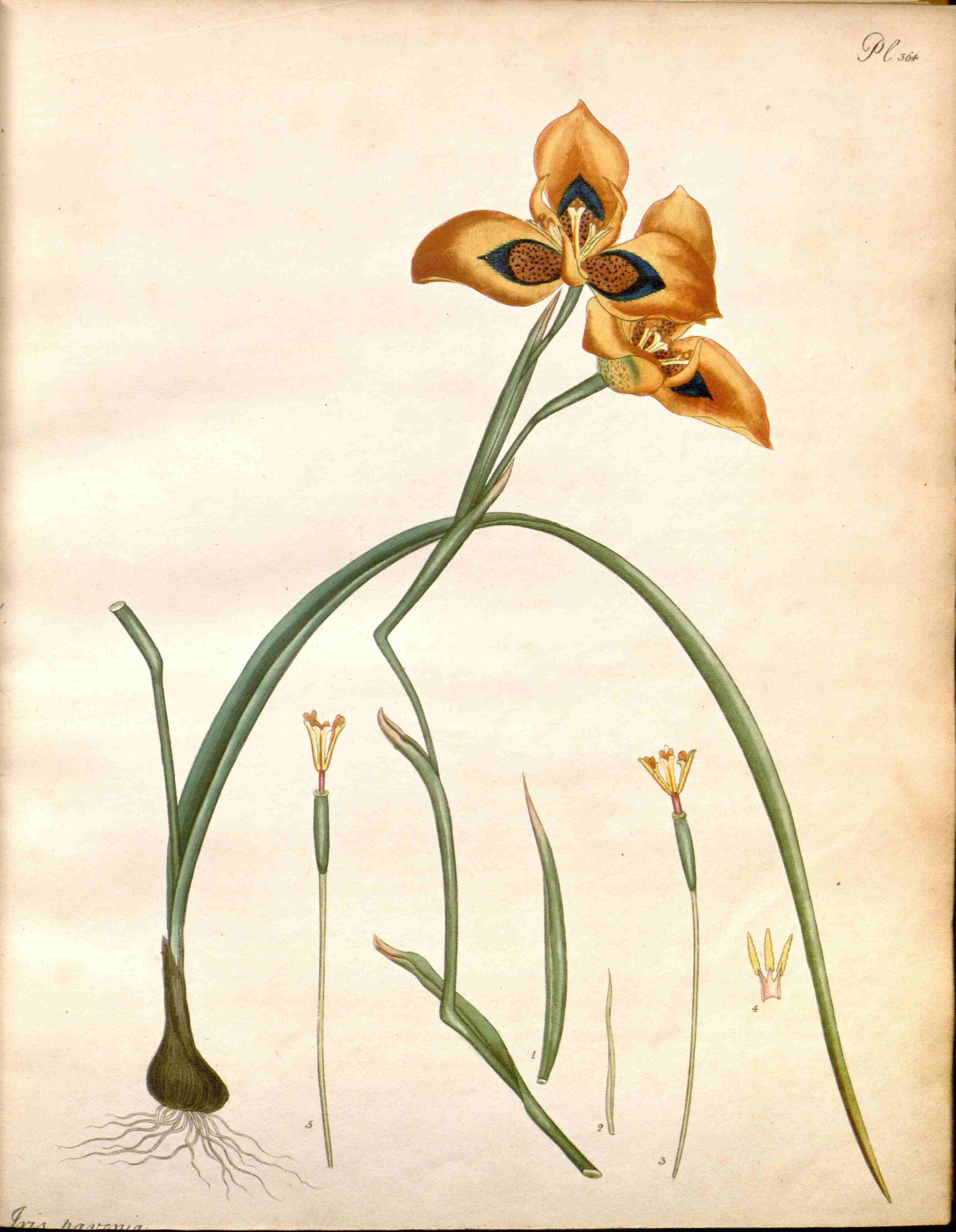
Volume 6 — PLATE CCCLXIV.
Reading edition
IRIS PAVONIA.
The Peacock-Iris.
CLASS III. ORDER I.
TRIANDRIA MONOGYNIA. Three Chives. One Pointal.
ESSENTIAL GENERIC CHARACTER.
Corolla 6-partita: laciniis alternis reflexis. Stigmata petaliformia.
Corolla 6-parted: with the alternate segments reflexed. The stigmas petal-shaped.
SPECIFIC CHARACTER, &C.
Iris. Imberbis, folio lineari glabro, scapo sub-unifloro.
Iris. Beardless, with a linear smooth leaf, and a usually one-flowered stem.
Iris Pavonia Willd. Sp. Pl. I. 238.
Jacq. Coll. Sup. p. 8, Descriptione optimâ.
REFERENCE TO THE PLATE.
1. The outer Sheath of the Flower. 2.The inner one. 3. The Seed-bud, Chives and Pointal as they stand in the Flower. 4.The Chives spread open. 5. The Pointal
This splendid but fugitive plant, is strikingly emblematic of the short duration of superior beauty: its flower is but the transient object of a day; and its whole life in Europe seldom exceeds a single year!
The Peacock-Iris, notwithstanding its attractions, is but imperfectly understood by the Botanists and Horticulturists of this country; for while the latter have been unsuccessful in cultivating it: some of the former have privately considered it as a new Genus: some have referred it to Iris, Morea, or Ferraria; others with more propriety to De la Roche’s Genus Vieusseuxia; and the usually accurate Curtis mistook and figured the widely-different Iris tricuspis for it.
The English Gardens have several times possessed this charming species, but we are afraid it is at present entirely lost to them. Our figure therefore, taken from the Hibbertian collection some time since, cannot fail to be highly acceptable to all lovers of plants.
In root Iris Pavonia resembles other Cape Irides; but the varying lustres of its brilliant flowers are seldom equalled; and not much excelled by any plant we ever saw. It is a native of the Cape, flowers early in Spring; and must be treated like the other bulbous species from that country.