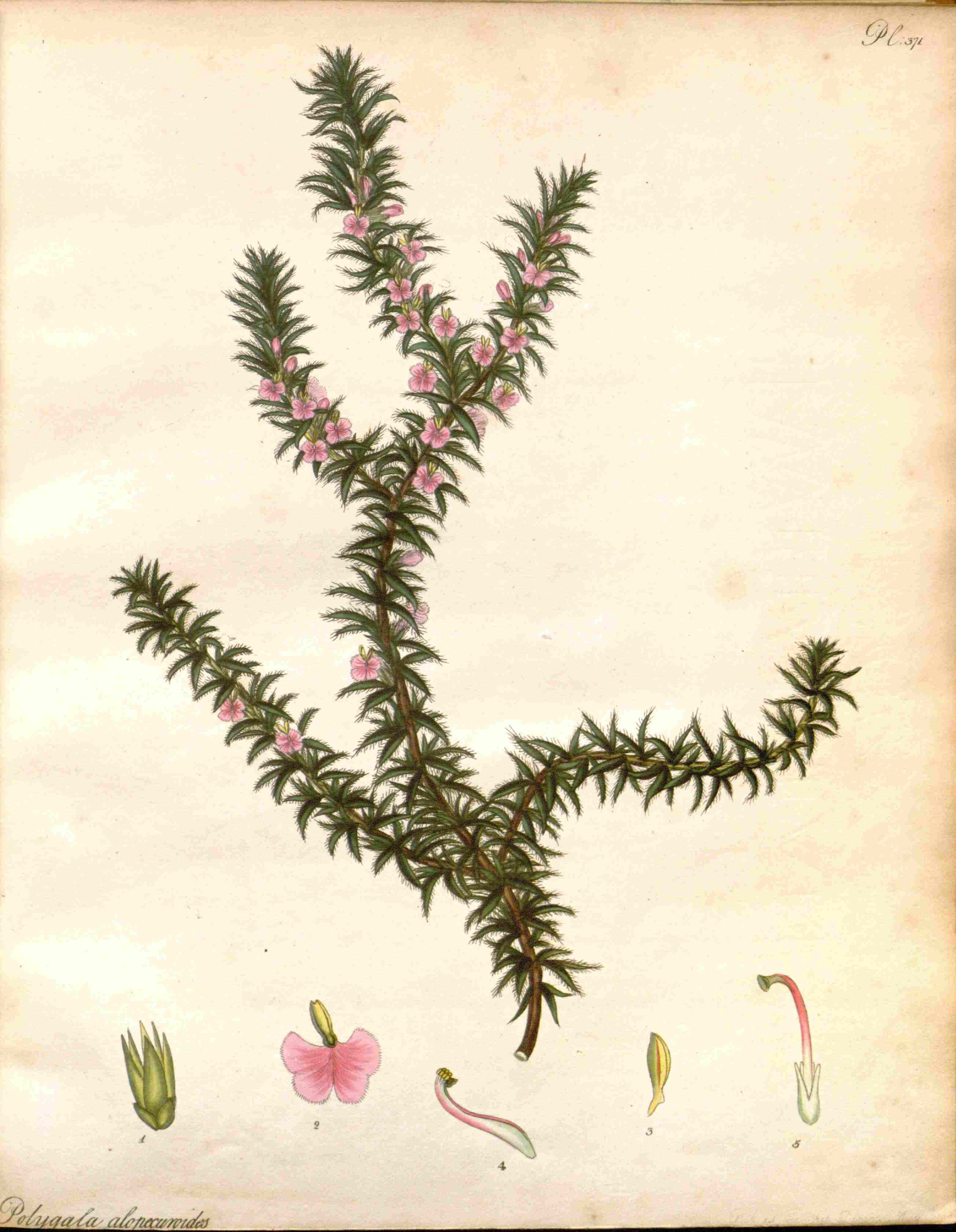
Volume 6 — PLATE CCCLXXI.
Reading edition
POLYGALA ALOPECUROIDES.
Fox-tail Milkwort.
CLASS XVII. ORDER III.
DIADELPHIA OCTANDRIA. Two Brotherhoods. Eight Chives.
ESSENTIAL GENERIC CHARACTER.
Calyx 5-phyllus, foliolis duobus alæformibus, coloratis. Legumen obcordatum, biloculare.
Cup 5-leaved, with two of the leaves like wings, coloured. Pod inverse heart-shaped, two-celled.
SPECIFIC CHARACTER, &C.
Polygala, floribus imberbibus, pedanculis solitariis axillaribus, foliis fasciculatis ovatis mucronatis margine ciliatis. Willd. Sp. Pl. 890.
P. floribus imberbibus lateralibus, foliis fasciculatis lanceolatis mucronatis villosis. Thunb. Prod. 121.
Polygala, with flowers beardless, peduncles solitary axillary, leaves fascicled egg-shaped mucronated and ciliated on the margin.
P. with flowers beardless lateral, leaves fasciculated lance-shaped mucronated and villose.
Descriptio. Suffrutex elegans, ramulis hirtis. Folia valde conferta, fasciculata, pone medium recurva, 5-6 in singulo fasciculo, infimo majore, latiore, stipuliforme; omnia lineari-lanceolata, mucronata, hirta, ad margines valde ciliata. Flores axillares, sessiles, solitarii, minuti, purpurascentes, serrulati.
REFERENCE TO THE PLATE.
1. The empalement magnified. 2.The keel magnified. 3.One of the wings magnified. 4.The chives and pointal magnified. 5. The pointal detached and magnified
This is the Polygala of the Heisteria family, which we last month engaged to lay before our readers. They will now have an opportunity, from our copious dissections of the flowers, of judging of the great and numerous generical differences which exist between a genuine Polygala and the discarded genus Heisteria. All the Heisteriæ we have yet had an opportunity of examining are heptandrous; all the true Polygalæ octandrous: but these are the least of their distinctions.
The Fox-tail Milkwort is a very elegant shrub of the green-house kind, and is often in flower. It was recently raised from Cape seeds in the Clapham collection, and is at present, we believe, in no other: thrives well in a mixture of bog earth and loam, and is capable of propagation by cuttings.