Volume 1 — THE PORTER AND THE THREE LADIES OF BAGHDAD. (continued 2)
Richard Francis Burton translation · Edition 2
Pardon my fault, for 'tis the wise man's wont ✿ All faults to pardon and revenge forgo:
In sooth all manner faults in me contain ✿ Then deign of goodness mercy-grace to show:
Whoso imploreth pardon from on High ✿ Should hold his hand from sinners here below.
Said the Ifrit, "Lengthen not thy words! As to my slaying thee fear it not, and as to my pardoning thee hope it not; but from my bewitching thee there is no escape." Then he tore me from the ground which closed under my feet and flew with me into the firmament till I saw the earth as a large white cloud or a saucer[225] in the midst of the waters. Presently he set me down on a mountain, and taking a little dust, over which he muttered some magical words, sprinkled me therewith, saying, "Quit that shape and take thou the shape of an ape!" And on the instant I became an ape, a tail-less baboon, the son of a century[226]. Now when he had left me and I saw myself in this ugly and hateful shape, I wept for myself, but resigned my soul to the tyranny of Time and Circumstance, well weeting that Fortune is fair and constant to no man. I 127descended the mountain and found at the foot a desert plain, long and broad, over which I travelled for the space of a month till my course brought me to the brink of the briny sea.[227] After standing there awhile, I was ware of a ship in the offing which ran before a fair wind making for the shore: I hid myself behind a rock on the beach and waited till the ship drew near, when I leaped on board. I found her full of merchants and passengers and one of them cried, "O Captain, this ill-omened brute will bring us ill-luck!" and another said, "Turn this ill-omened beast out from among us;" the Captain said, "Let us kill it!" another said, "Slay it with the sword;" a third, "Drown it;" and a fourth, "Shoot it with an arrow." But I sprang up and laid hold of the Rais's[228] skirt, and shed tears which poured down my chops. The Captain took pity on me, and said, "O merchants! this ape hath appealed to me for protection and I will protect him; henceforth he is under my charge: so let none do him aught hurt or harm, otherwise there will be bad blood between us." Then he entreated me kindly and whatsoever he said I understood and ministered to his every want and served him as a servant, albeit my tongue would not obey my wishes; so that he came to love me. The vessel sailed on, the wind being fair, for the space of fifty days; at the end of which we cast anchor under the walls of a great city wherein was a world of people, especially learned men, none could tell their number save Allah. No sooner had we arrived than we were visited by certain Mameluke-officials from the King of that city; who, after boarding us, greeted the merchants and giving them joy of safe arrival said, "Our King welcometh you, and sendeth you this roll of paper, whereupon each and every of you must write a line. For ye shall know that the King's Minister, a calligrapher of renown, is dead, and the King hath sworn a solemn oath that he will make none Wazir in his stead who cannot write as well as he could." He then gave us the scroll which measured ten cubits long by a breadth of one, and each of the merchants who knew how to write wrote a line thereon, even to the last of them; after which I stood up (still in the shape of an ape) and snatched the roll out of their hands. They feared lest I should tear it or throw it overboard; so they tried to stay me and scare me, but I signed to them that I could write, whereat all marvelled, saying, "We never yet saw an ape 128write." And the Captain cried, "Let him write; and if he scribble and scrabble we will kick him out and kill him; but if he write fair and scholarly I will adopt him as my son; for surely I never yet saw a more intelligent and well-mannered monkey than he. Would Heaven my real son were his match in morals and manners." I took the reed, and stretching out my paw, dipped it in ink and wrote, in the hand used for letters,[229] these two couplets:—
Time hath recorded gifts she gave the great; ✿ But none recorded thine which be far higher;
Allah ne'er orphan men by loss of thee ✿ Who be of Goodness mother, Bounty's sire.
And I wrote in Rayháni or larger letters elegantly curved:—[230]
Thou hast a reed[231] of rede to every land, ✿ Whose driving causeth all the world to thrive;
Nil is the Nile of Misraim by thy boons ✿ Who makest misery smile with fingers five.
Then I wrote in the Suls[232] character:—
There be no writer who from Death shall fleet, ✿ But what his hand hath writ men shall repeat:
Write, therefore, naught save what shall serve thee when ✿ Thou see't on Judgment-Day an so thou see't!
Then I wrote in the character Naskh:—[233]
129When to sore parting Fate our love shall doom, ✿ To distant life by Destiny decreed,
We cause the inkhorn's lips to 'plain our pains, ✿ And tongue our utterance with the talking reed.
And I wrote in the Túmár character[234]:—
Kingdom with none endures; if thou deny ✿ This truth, where be the Kings of earlier earth?
Set trees of goodliness while rule endures, ✿ And when thou art fallen they shall tell thy worth.
And I wrote in the character Muhakkak[235]:—
When oped the inkhorn of thy wealth and fame ✿ Take ink of generous heart and gracious hand;
Write brave and noble deeds while write thou can ✿ And win thee praise from point of pen and brand.
Then I gave the scroll to the officials and, after we all had written our line, they carried it before the King. When he saw the paper no writing pleased him save my writing; and he said to the assembled courtiers, "Go seek the writer of these lines and dress him in a splendid robe of honour; then mount him on a she-mule,[236] 130let a band of music precede him and bring him to the presence." At these words they smiled and the King was wroth with them and cried "O accursed! I give you an order and you laugh at me?" "O King," replied they, "if we laugh 'tis not at thee and not without a cause." "And what is it?" asked he; and they answered, "O King, thou orderest us to bring to thy presence the man who wrote these lines; now the truth is that he who wrote them is not of the sons of Adam,[237] but an ape, a tail-less baboon, belonging to the ship-Captain." Quoth he, "Is this true that you say?" Quoth they "Yea! by the rights of thy munificence!" The King marvelled at their words and shook with mirth and said, "I am minded to buy this ape of the Captain." Then he sent messengers to the ship with the mule, the dress, the guard and the state-drums, saying, "Not the less do you clothe him in the robe of honour and mount him on the mule and let him be surrounded by the guards and preceded by the band of music." They came to the ship and took me from the Captain and robed me in the robe of honour and, mounting me on the she-mule, carried me in state-procession through the streets; whilst the people were amazed and amused. And folk said to one another "Halloo! is our Sultan about to make an ape his Minister?"; and came all agog crowding to gaze at me, and the town was astir and turned topsy-turvy on my account. When they brought me up to the King and set me in his presence, I kissed the ground before him three times, and once before the High Chamberlain and great officers, and he bade me be seated, and I sat respectfully on shins and knees,[238] and all who were present marvelled at my fine manners, and the King most of all. Thereupon he ordered the lieges to retire; and, when none remained save the King's majesty, the Eunuch on duty and a little white slave, he bade them set before me the table of food, containing all manner of birds, whatever hoppeth and flieth and treadeth in nest, such as quail and sand-grouse. Then he signed to me to eat with him; so I rose and kissed ground before him, then sat me down and ate with him. And when the table was removed I washed my hands in seven 131waters and took the reed-case and reed; and wrote instead of speaking these couplets:—
Wail for the little partridges on porringer and plate; ✿ Cry for the ruin of the fries and stews well marinate:
Keen as I keen for loved, lost daughters of the Katá-grouse,[239] ✿ And omelette round the fair enbrownèd fowls agglomerate:
O fire in heart of me for fish, those deux poissons I saw, ✿ Bedded on new made scones[240] and cakes in piles to laniate.
For thee, O vermicelli! aches my very maw! I hold ✿ Without thee every taste and joy are clean annihilate.
Those eggs have rolled their yellow eyes in torturing pains of fire ✿ Ere served with hash and fritters hot, that delicatest cate,
Praisèd be Allah for His baked and roast and ah! how good ✿ This pulse, these pot-herbs steeped in oil with eysill combinate!
When hunger sated was, I elbow-propt fell back upon ✿ Meat-pudding[241] wherein gleamed the bangles that my wits amate.
Then woke I sleeping appetite to eat as though in sport ✿ Sweets from brocaded trays and kickshaws most elaborate.
Be patient, soul of me! Time is a haughty, jealous wight; ✿ To-day he seems dark-lowering and to-morrow fair to sight.[242]
Then I rose and seated myself at a respectful distance while the King read what I had written, and marvelled, exclaiming, "O the miracle, that an ape should be gifted with this graceful style and this power of penmanship! By Allah, 'tis a wonder of wonders!"
132Presently they set before the King choice wines in flagons of glass and he drank: then he passed on the cup to me; and I kissed the ground and drank and wrote on it:—
With fire they boilèd me to loose my tongue,[243] ✿ And pain and patience gave for fellowship:
Hence comes it hands of men upbear me high ✿ And honey-dew from lips of maid I sip!
And these also:—
Morn saith to Night, "withdraw and let me shine;" ✿ So drain we draughts that dull all pain and pine:[244]
I doubt, so fine the glass, the wine so clear, ✿ If 'tis the wine in glass or glass in wine.
The King read my verse and said with a sigh, "Were these gifts[245] in a man, he would excel all the folk of his time and age!" Then he called for the chess-board, and said, "Say, wilt thou play with me?"; and I signed with my head, "Yes." Then I came forward and ordered the pieces and played with him two games, both of which I won. He was speechless with surprise; so I took the pen-case and, drawing forth a reed, wrote on the board these two couplets:—
Two hosts fare fighting thro' the livelong day ✿ Nor is their battling ever finishèd,
Until, when darkness girdeth them about, ✿ The twain go sleeping in a single bed.[246]
The King read these lines with wonder and delight and said to his Eunuch,[247] "O Mukbil, go to thy mistress, Sitt al-Husn,[248] and say her, Come, speak the King who biddeth thee hither to take thy 133solace in seeing this right wondrous ape!" So the Eunuch went out and presently returned with the lady who, when she saw me veiled her face and said, "O my father! hast thou lost all sense of honour? How cometh it thou art pleased to send for me and show me to strange men?" "O Sitt al-Husn," said he, "no man is here save this little foot-page and the Eunuch who reared thee and I, thy father. From whom, then, dost thou veil thy face?" She answered, "This whom thou deemest an ape is a young man, a clever and polite, a wise and learned and the son of a King; but he is ensorcelled and the Ifrit Jirjaris, who is of the seed of Iblis, cast a spell upon him, after putting to death his own wife the daughter of King Ifitamus lord of the Islands of Abnus." The King marvelled at his daughter's words and, turning to me, said, "Is this true that she saith of thee?"; and I signed by a nod of my head the answer "Yea, verily;" and wept sore. Then he asked his daughter "Whence knewest thou that he is ensorcelled?"; and she answered "O my dear papa, there was with me in my childhood an old woman, a wily one and a wise and a witch to boot, and she taught me the theory of magic and its practice; and I took notes in writing and therein waxed perfect, and have committed to memory an hundred and seventy chapters of egromantic formulas, by the least of which I could transport the stones of thy city behind the Mountain Kaf and the Circumambient Main,[249] or make its site an abyss of the sea and its people fishes swimming in the midst of it." "O my daughter," said her father, "I conjure thee, by my life, disenchant this young man, that I may make him my Wazir and marry thee to him, for indeed he is an ingenious youth and a deeply learned." "With joy and goodly gree," she replied and, hending in hand an iron knife whereon was inscribed the name of Allah in Hebrew characters, she described a wide circle——And Shahrazad perceived the dawn of day and ceased saying her permitted say.
Now when it was the Fourteenth Night,
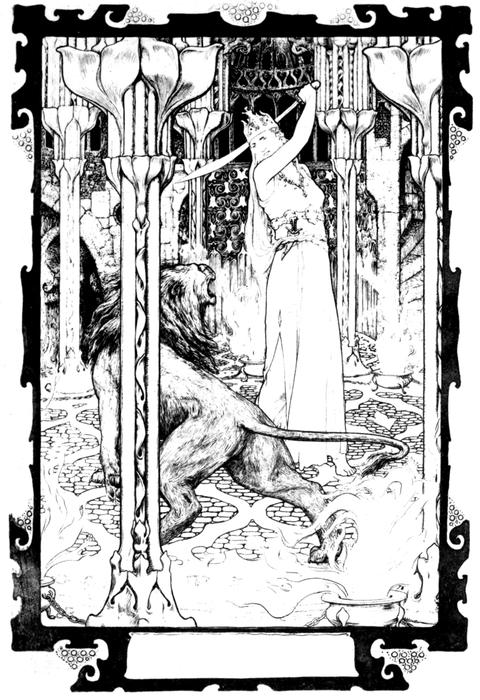
She said, It hath reached me, O auspicious King, that the Kalandar continued his tale thus:—O my lady, the King's daughter hent in 134hand a knife whereon were inscribed Hebrew characters and described a wide circle in the midst of the palace-hall, and therein wrote in Cufic letters mysterious names and talismans; and she uttered words and muttered charms, some of which we understood and others we understood not. Presently the world waxed dark before our sight till we thought that the sky was falling upon our heads, and lo! the Ifrit presented himself in his own shape and aspect. His hands were like many-pronged pitchforks, his legs like the masts of great ships, and his eyes like cressets of gleaming fire. We were in terrible fear of him but the King's daughter cried at him, "No welcome to thee and no greeting, O dog!" whereupon he changed to the form of a lion and said, "O traitress, how is it thou hast broken the oath we sware that neither should contraire other!" "O accursed one," answered she, "how could there be a compact between me and the like of thee?" Then said he, "Take what thou has brought on thyself;" and the lion opened his jaws and rushed upon her; but she was too quick for him; and, plucking a hair from her head, waved it in the air muttering over it the while; and the hair straightway became a trenchant sword-blade, wherewith she smote the lion and cut him in twain. Then the two halves flew away in air and the head changed to a scorpion and the Princess became a huge serpent and set upon the accursed scorpion, and the two fought, coiling and uncoiling, a stiff fight for an hour at least. Then the scorpion changed to a vulture and the serpent became an eagle which set upon the vulture, and hunted him for an hour's time, till he became a black tom-cat, which miauled and grinned and spat. Thereupon the eagle changed into a piebald wolf and these two battled in the palace for a long time, when the cat, seeing himself overcome, changed into a worm and crept into a huge red pomegranate,[250] which lay beside the jetting fountain in the midst of the palace hall. Whereupon the pomegranate swelled to the size of a water-melon in air; and, falling upon the marble pavement of the palace, broke to pieces, and all the grains fell out and were scattered about till they covered the whole floor. Then the wolf shook himself and became a snow-white cock, which fell to picking up the grains purposing not to leave 135one; but by doom of destiny one seed rolled to the fountain-edge and there lay hid. The cock fell to crowing and clapping his wings and signing to us with his beak as if to ask, "Are any grains left?" But we understood not what he meant, and he cried to us with so loud a cry that we thought the palace would fall upon us. Then he ran over all the floor till he saw the grain which had rolled to the fountain edge, and rushed eagerly to pick it up when behold, it sprang into the midst of the water and became a fish and dived to the bottom of the basin. Thereupon the cock changed to a big fish, and plunged in after the other, and the two disappeared for a while and lo! we heard loud shrieks and cries of pain which made us tremble. After this the Ifrit rose out of the water, and he was as a burning flame; casting fire and smoke from his mouth and eyes and nostrils. And immediately the Princess likewise came forth from the basin and she was one live coal of flaming lowe; and these two, she and he, battled for the space of an hour, until their fires entirely compassed them about and their thick smoke filled the palace. As for us we panted for breath, being well-nigh suffocated, and we longed to plunge into the water fearing lest we be burnt up and utterly destroyed; and the King said, "There is no Majesty and there is no Might save in Allah the Glorious, the Great! Verily we are Allah's and unto Him are we returning! Would Heaven I had not urged my daughter to attempt the disenchantment of this ape-fellow, whereby I have imposed upon her the terrible task of fighting yon accursed Ifrit against whom all the Ifrits in the world could not prevail. And would Heaven we had never seen this ape, Allah never assain nor bless the day of his coming! We thought to do a good deed by him before the face of Allah,[251] and to release him from enchantment, and now we have brought this trouble and travail upon our heart." But I, O my lady, was tongue-tied and powerless to say a word to him. Suddenly, ere we were ware of aught, the Ifrit yelled out from under the flames and, coming up to us as we stood on the estrade, blew fire in our faces. The damsel overtook him and breathed blasts of fire at his face and the sparks from her and from him rained down upon us, and her sparks did us no harm, but one of his sparks alighted upon my eye and destroyed it making me a monocular ape; and another fell on the King's face scorching the lower half, burning off his beard and mustachios and causing 136his under teeth to fall out; while a third alighted on the Castrato's breast, killing him on the spot. So we despaired of life and made sure of death when lo! a voice repeated the saying, "Allah is most Highest! Allah is most Highest! Aidance and victory to all who the Truth believe; and disappointment and disgrace to all who the religion of Mohammed, the Moon of Faith, unbelieve," The speaker was the Princess who had burnt the Ifrit, and he was become a heap of ashes. Then she came up to us and said, "Reach me a cup of water." They brought it to her and she spoke over it words we understood not, and sprinkling me with it cried, "By virtue of the Truth, and by the Most Great name of Allah, I charge thee return to thy former shape." And behold, I shook and became a man as before, save that I had utterly lost an eye. Then she cried out, "The fire! The fire! O my dear papa an arrow from the accursed hath wounded me to the death, for I am not used to fight with the Jann; had he been a man I had slain him in the beginning. I had no trouble till the time when the pomegranate burst and the grains scattered, but I overlooked the seed wherein was the very life of the Jinni. Had I picked it up he had died on the spot, but as Fate and Fortune decreed, I saw it not; so he came upon me all unawares and there befel between him and me a sore struggle under the earth and high in air and in the water; and, as often as I opened on him a gate,[252] he opened on me another gate and a stronger, till at last he opened on me the gate of fire, and few are saved upon whom the door of fire openeth. But Destiny willed that my cunning prevail over his cunning; and I burned him to death after I vainly exhorted him to embrace the religion of Al-Islam. As for me I am a dead woman; Allah supply my place to you!" Then she called upon Heaven for help and ceased not to implore relief from the fire; when lo! a black spark shot up from her robed feet to her thighs; then it flew to her bosom and thence to her face. When it reached her face she wept and said, "I testify that there is no god but the God and that Mahommed is the Apostle of God!" And we looked at her and saw naught but a heap of ashes by the side of the heap that had been the Ifrit. We mourned for her and I wished I had been in her place, so had I not seen her lovely face who had 137worked me such weal become ashes; but there is no gainsaying the will of Allah. When the King saw his daughter's terrible death, he plucked out what was left of his beard and beat his face and rent his raiment; and I did as he did and we both wept over her. Then came in the Chamberlains and Grandees and were amazed to find two heaps of ashes and the Sultan in a fainting fit; so they stood round him till he revived and told them what had befallen his daughter from the Ifrit; whereat their grief was right grievous and the women and the slave-girls shrieked and keened,[253] and they continued their lamentations for the space of seven days. Moreover the King bade build over his daughter's ashes a vast vaulted tomb, and burn therein wax tapers and sepulchral lamps: but as for the Ifrit's ashes they scattered them on the winds, speeding them to the curse of Allah. Then the Sultan fell sick of a sickness that well nigh brought him to his death for a month's space; and, when health returned to him and his beard grew again and he had been converted by the mercy of Allah to Al-Islam, he sent for me and said, "O youth, Fate had decreed for us the happiest of lives, safe from all the chances and changes of Time, till thou camest to us, when troubles fell upon us. Would to Heaven we had never seen thee and the foul face of thee! For we took pity on thee and thereby we have lost our all. I have on thy account first lost my daughter who to me was well worth an hundred men; secondly I have suffered that which befel me by reason of the fire and the loss of my teeth, and my Eunuch also was slain. I blame thee not, for it was out of thy power to prevent this: the doom of Allah was on thee as well as on us and thanks be to the Almighty for that my daughter delivered thee, albeit thereby she lost her own life! Go forth now, O my son, from this my city, and suffice thee what hath befallen us through thee, even although 'twas decreed for us. Go forth in peace; and if I ever see thee again I will surely slay thee." And he cried out at me. So I went forth from his presence, O my lady, weeping bitterly 138and hardly believing in my escape and knowing not whither I should wend. And I recalled all that had befallen me, my meeting the tailor, my love for the damsel in the palace beneath the earth, and my narrow escape from the Ifrit, even after he had determined to do me die; and how I had entered the city as an ape and was now leaving it a man once more. Then I gave thanks to Allah and said, "My eye and not my life!" and before leaving the place I entered the bath and shaved my poll and beard and mustachios and eyebrows; and cast ashes on my head and donned the coarse black woollen robe of a Kalandar. Then I fared forth, O my lady, and every day I pondered all the calamities which had betided me, and I wept and repeated these couplets:—
"I am distraught, yet verily His ruth abides with me, ✿ Tho' round me gather hosts of ills, whence come I cannot see:
Patient I'll be till Patience self with me impatient wax; ✿ Patient for ever till the Lord fulfil my destiny:
Patient I'll bide without complaint, a wronged and vanquisht man; ✿ Patient as sunparcht wight that spans the desert's sandy sea:
Patient I'll be till Aloe's[254] self unwittingly allow ✿ I'm patient under bitterer things than bitterest aloë:
No bitterer things than aloes or than patience for mankind; ✿ Yet bitterer than the twain to me were Patience' treachery:
My sere and seamed and seared brow would dragoman my sore ✿ If soul could search my sprite and there unsecret secrecy:
Were hills to bear the load I bear they'd crumble 'neath the weight; ✿ 'Twould still the roaring wind, 'twould quench the flame-tongue's flagrancy,
And whoso saith the world is sweet certès a day he'll see ✿ With more than aloes' bitterness and aloes' pungency."
Then I journeyed through many regions and saw many a city intending for Baghdad, that I might seek audience, in the House 139of Peace,[255] with the Commander of the Faithful and tell him all that had befallen me. I arrived here this very night and found my brother in Allah, this first Kalandar, standing about as one perplexed; so I saluted him with "Peace be upon thee," and entered into discourse with him. Presently up came our brother, this third Kalandar, and said to us, "Peace be with you! I am a stranger;" whereto we replied, "And we too be strangers, who have come hither this blessed night." So we all three walked on together, none of us knowing the other's history, till Destiny drave us to this door and we came in to you. Such then is my story and my reason for shaving my beard and mustachios, and this is what caused the loss of my eye. Said the house-mistress "Thy tale is indeed a rare; so rub thy head and wend thy ways;" but he replied, "I will not budge till I hear my companions' stories." Then came forward the third Kalandar, and said, "O illustrious lady! my history is not like that of these my comrades, but more wondrous and far more marvellous. In their case Fate and Fortune came down on them unawares; but I drew down destiny upon my own head and brought sorrow on mine own soul, and shaved my own beard and lost my own eye. Hear then"
THE THIRD KALANDAR'S TALE.
Know, O my lady, that I also am a King and the Son of a King and my name is Ajíb son of Khazíb. When my father died I succeeded him; and I ruled and did justice and dealt fairly by all my lieges. I delighted in sea trips, for my capital stood on the shore, before which the ocean stretched far and wide; and nearhand were many great islands with sconces and garrisons in the midst of the main. My fleet numbered fifty merchantmen, and as many yachts for pleasance, and an hundred and fifty sail ready fitted for holy war with the Unbelievers. It fortuned that I had a mind to enjoy myself on the islands aforesaid, so I took ship with my people in ten keel; and, carrying with me a month's victual, I set out on a twenty days voyage. But one night a head wind struck us, and the sea rose against us with huge waves; the billows sorely buffetted us and a dense darkness settled round us. We gave ourselves 140up for lost and I said, "Whoso endangereth his days, e'en an he 'scape deserveth no praise." Then we prayed to Allah and besought Him; but the storm-blasts ceased not to blow against us nor the surges to strike us till morning broke, when the gale fell, the seas sank to mirrory stillness and the sun shone upon us kindly clear. Presently we made an island where we landed and cooked somewhat of food, and ate heartily and took our rest for a couple of days. Then we set out again and sailed other twenty days, the seas broadening and the land shrinking. Presently the current ran counter to us, and we found ourselves in strange waters, where the Captain had lost his reckoning, and was wholly bewildered in this sea; so said we to the look-out man,[256] "Get thee to the mast-head and keep thine eyes open." He swarmed up the mast and looked out and cried aloud, "O Rais, I espy to starboard something dark, very like a fish floating on the face of the sea, and to larboard there is a loom in the midst of the main, now black and now bright." When the Captain heard the look-out's words he dashed his turband on the deck and plucked out his beard and beat his face saying, "Good news indeed! we be all dead men; not one of us can be saved." And he fell to weeping and all of us wept for his weeping and also for our lives; and I said, "O Captain, tell us what it is the look-out saw." "O my Prince," answered he, "know that we lost our course on the night of the storm, which was followed on the morrow by a two-days' calm during which we made no way; and we have gone astray eleven days reckoning from that night, with ne'er a wind to bring us back to our true course. To-morrow by the end of the day we shall come to a mountain of black stone, hight the Magnet Mountain;[257] for thither the currents carry us willy-nilly. 141As soon as we are under its lea, the ship's sides will open and every nail in plank will fly out and cleave fast to the mountain; for that Almighty Allah hath gifted the loadstone with a mysterious virtue and a love for iron, by reason whereof all which is iron travelleth towards it; and on this mountain is much iron, how much none knoweth save the Most High, from the many vessels which have been lost there since the days of yore. The bright spot upon its summit is a dome of yellow laton from Andalusia, vaulted upon ten columns; and on its crown is a horseman who rideth a horse of brass and holdeth in hand a lance of laton; and there hangeth on his bosom a tablet of lead graven with names and talismans." And he presently added, "And, O King, none destroyeth folk save the rider on that steed, nor will the egromancy be dispelled till he fall from his horse."[258] Then, O my lady, the Captain wept with exceeding weeping and we all made sure of death-doom and each and every one of us farewelled his friend and charged him with his last will and testament in case he might be saved. We slept not that night and in the morning we found ourselves much nearer the Loadstone Mountain, whither the waters drave us with a violent send. When the ships were close under its lea they opened and the nails flew out and all the iron in them sought the Magnet Mountain and clove to it like a network; so that by the end of the day we were all struggling in the waves round about the mountain. Some of us were saved, but more were drowned and even those who had escaped knew not one another, so stupefied were they by the beating of the billows and the raving of the winds. As for me, O my lady, Allah (be His name exalted!) preserved my life that I might suffer whatso He willed to me of hardship, misfortune and calamity; for I scrambled upon a plank from one of the ships, and the wind and waters threw it at the feet of the Mountain. There I found a 142practicable path leading by steps carven out of the rock to the summit, and I called on the name of Allah Almighty[259]——And Shahrazad perceived the dawn of day and ceased to say her permitted say.
Now when it was the Fifteenth Night,
She continued, It hath reached me, O auspicious King, that the third Kalandar said to the lady (the rest of the party sitting fast bound and the slaves standing with swords drawn over their heads):—And after calling on the name of Almighty Allah and passionately beseeching Him, I breasted the ascent, clinging to the steps and notches hewn in the stone, and mounted little by little. And the Lord stilled the wind and aided me in the ascent, so that I succeeded in reaching the summit. There I found no resting-place save the dome, which I entered, joying with exceeding joy at my escape; and made the Wuzu-ablution[260] and prayed a two-bow prayer[261] a thanksgiving to God for my preservation. Then I fell asleep under the dome, and heard in my dream a mysterious Voice[262] saying, "O son of Khazib! when thou wakest from thy sleep dig under thy feet and thou shalt find a bow of brass and three leaden arrows, inscribed with talismans and characts. Take the bow and shoot the arrows at the horseman on the dome-top and free mankind from this sore calamity. When thou hast shot him he shall fall into the sea, and the horse will also drop at thy feet: then bury it in the place of the bow. This done, the main will swell and rise till it is level with the mountain-head, and there will appear on it a skiff carrying a man of laton (other than he thou shalt have shot) holding in his hand a pair of paddles. He will come to thee and do thou embark with him but beware of saying Bismillah or of otherwise naming Allah Almighty. He will row thee for a space of ten days, till he bring thee to certain Islands called the Islands of Safety, and thence thou shalt easily reach a port and find those who will convey thee 143to thy native land; and all this shall be fulfilled to thee so thou call not on the name of Allah." Then I started up from my sleep in joy and gladness and, hastening to do the bidding of the mysterious Voice, found the bow and arrows and shot at the horseman and tumbled him into the main, whilst the horse dropped at my feet; so I took it and buried it. Presently the sea surged up and rose till it reached the top of the mountain; nor had I long to wait ere I saw a skiff in the offing coming towards me. I gave thanks to Allah; and, when the skiff came up to me, I saw therein a man of brass with a tablet of lead on his breast inscribed with talismans and characts; and I embarked without uttering a word. The boatman rowed on with me through the first day and the second and the third, in all ten whole days, till I caught sight of the Islands of Safety; whereat I joyed with exceeding joy and for stress of gladness exclaimed, "Allah! Allah! In the name of Allah! There is no god but the God and Allah is Almighty."[263] Thereupon the skiff forthwith upset and cast me upon the sea; then it righted and sank deep into the depths. Now I am a fair swimmer, so I swam the whole day till nightfall, when my forearms and shoulders were numbed with fatigue and I felt like to die; so I testified to my Faith, expecting naught but death. The sea was still surging under the violence of the winds, and presently there came a billow like a hillock; and, bearing me up high in air, threw me with a long cast on dry land, that His will might be fulfilled. I crawled up the beach and doffing my raiment wrung it out to dry and spread it in the sunshine: then I lay me down and slept the whole night. As soon as it was day, I donned my clothes and rose to look whither I should walk. Presently I came to a thicket of low trees; and, making a cast round it, found that the spot whereon I stood was an islet, a mere holm, girt on all sides by the ocean; whereupon I said to myself, "Whatso freeth me from one great calamity casteth me into a greater!" But while I was pondering my case and longing for death behold, I saw afar off a ship making for the island; so I clomb a tree and hid myself among the branches. Presently the ship anchored and landed ten slaves, blackamoors, bearing iron hoes and baskets, who walked on till they reached the middle of the island. Here they dug deep into the ground, until they uncovered a plate of metal 144which they lifted, thereby opening a trap-door. After this they returned to the ship and thence brought bread and flour, honey and fruits, clarified butter,[264] leather bottles containing liquors and many household stuffs; also furniture, table-service and mirrors; rugs, carpets and in fact all needed to furnish a dwelling; and they kept going to and fro, and descending by the trap-door, till they had transported into the dwelling all that was in the ship. After this the slaves again went on board and brought back with them garments as rich as may be, and in the midst of them came an old old man, of whom very little was left, for Time had dealt hardly and harshly with him, and all that remained of him was a bone wrapped in a rag of blue stuff, through which the winds whistled west and east. As saith the poet of him:—
Time gars me tremble Ah, how sore the baulk! ✿ While Time in pride of strength doth ever stalk:
Time was I walked nor ever felt I tired, ✿ Now am I tired albe I never walk!
And the Shaykh held by the hand a youth cast in beauty's mould, all elegance and perfect grace; so fair that his comeliness deserved to be proverbial; for he was as a green bough or the tender young of the roe, ravishing every heart with his loveliness and subduing every soul with his coquetry and amorous ways.[265] It was of him the poet spake when he said:—
Beauty they brought with him to make compare; ✿ But Beauty hung her head in shame and care:
Quoth they, "O Beauty, hast thou seen his like?" ✿ And Beauty cried, "His like? not anywhere!"
They stinted not their going, O my lady, till all went down by the trap-door and did not reappear for an hour, or rather more; at the end of which time the slaves and the old man came up without 145the youth and, replacing the iron plate and carefully closing the door-slab, as it was before, they returned to the ship and made sail and were lost to my sight. When they turned away to depart, I came down from the tree and, going to the place I had seen them fill up, scraped off and removed the earth; and in patience possessed my soul till I had cleared the whole of it away. Then appeared the trap-door which was of wood, in shape and size like a millstone; and when I lifted it up it disclosed a winding staircase of stone. At this I marvelled and, descending the steps till I reached the last, found a fair hall, spread with various kinds of carpets and silk stuffs, wherein was a youth sitting upon a raised couch and leaning back on a round cushion with a fan in his hand and nosegays and posies of sweet scented herbs and flowers before him;[266] but he was alone and not a soul near him in the great vault. When he saw me he turned pale; but I saluted him courteously and said, "Set thy mind at ease and calm thy fears; no harm shall come near thee; I am a man like thyself and the son of a King to boot; whom the decrees of Destiny have sent to bear thee company and cheer thee in thy loneliness. But now tell me, what is thy story and what causeth thee to dwell thus in solitude under the ground?" When he was assured that I was of his kind and no Jinni, he rejoiced and his fine colour returned; and, making me draw near to him he said, "O my brother, my story is a strange story and 'tis this. My father is a merchant-jeweller possessed of great wealth, who hath white and black slaves travelling and trading on his account in ships and on camels, and trafficking with the most distant cities; but he was not blessed with a child, not even one. Now on a certain night he dreamed a dream that 146he should be favoured with a son, who would be short lived; so the morning dawned on my father bringing him woe and weeping. On the following night my mother conceived and my father noted down the date of her becoming pregnant.[267] Her time being fulfilled she bare me; whereat my father rejoiced and made banquets and called together the neighbours and fed the Fakirs and the poor, for that he had been blessed with issue near the end of his days. Then he assembled the astrologers and astronomers who knew the places of the planets, and the wizards and wise ones of the time, and men learned in horoscopes and nativities;[268] and they drew out my birth scheme and said to my father:—Thy son shall live to fifteen years, but in his fifteenth there is a sinister aspect; an he safely tide it over he shall attain a great age. And the cause that threateneth him with death is this. In the Sea of Peril standeth the Mountain Magnet hight; on whose summit is a horseman of yellow laton seated on a horse also of brass and bearing on his breast a tablet of lead. Fifty days after this rider shall fall from his steed thy son will die and his slayer will be he who shoots down the horseman, a Prince named Ajib son of King Khazib. My father grieved with exceeding grief to hear these words; but reared me in tenderest fashion and educated me excellently well till my fifteenth year was told. Ten days ago news came to him that the horseman had fallen into the sea and he who shot him down was named Ajib son of King Khazib. My father thereupon wept bitter tears at the need of parting with me and became like one possessed of a Jinni. However, being in mortal fear for me, he built me this place under the earth; and, stocking it with all required for the few days still remaining, he brought me hither in a ship and left me here. Ten are already past and, when the forty shall have gone by without danger to me, he will come and take me away; for he hath done all this only in fear of Prince 147Ajib. Such, then, is my story and the cause of my loneliness." When I heard his history I marvelled and said in my mind, "I am the Prince Ajib who hath done all this; but as Allah is with me I will surely not slay him!" So said I to him, O my lord, far from thee be this hurt and harm and then, please Allah, thou shalt not suffer cark nor care nor aught disquietude, for I will tarry with thee and serve thee as a servant, and then wend my ways; and, after having borne thee company during the forty days, I will go with thee to thy home where thou shalt give me an escort of some of thy Mamelukes with whom I may journey back to my own city; and the Almighty shall requite thee for me. He was glad to hear these words, when I rose and lighted a large wax-candle and trimmed the lamps and the three lanterns; and I set on meat and drink and sweetmeats. We ate and drank and sat talking over various matters till the greater part of the night was gone; when he lay down to rest and I covered him up and went to sleep myself. Next morning I arose and warmed a little water, then lifted him gently so as to awake him and brought him the warm water wherewith he washed his face[269] and said to me, "Heaven requite thee for me with every blessing, O youth! By Allah, if I get quit of this danger and am saved from him whose name is Ajib bin Khazib, I will make my father reward thee and send thee home healthy and wealthy; and, if I die, then my blessing be upon thee." I answered, "May the day never dawn on which evil shall betide thee; and may Allah make my last day before thy last day!" Then I set before him somewhat of food and we ate; and I got ready perfumes for fumigating the hall, wherewith he was pleased. Moreover I made him a Mankalah-cloth;[270] and we played and ate sweetmeats and we played again and took our pleasure till nightfall, when I rose and lighted the lamps, and set before him somewhat to eat, and sat telling him stories till the hours of darkness were far spent. Then he lay down to rest and I covered him up and rested also. And thus I continued to do, O my lady for days and nights, and affection for him took root in my heart and my sorrow was 148eased, and I said to myself, The astrologers lied[271] when they predicted that he should be slain by Ajib bin Khazib: by Allah, I will not slay him. I ceased not ministering to him and conversing and carousing with him and telling him all manner tales for thirty-nine days. On the fortieth night[272] the youth rejoiced and said, "O my brother, Alhamdolillah!—praise be to Allah—who hath preserved me from death and this is by thy blessing and the blessing of thy coming to me; and I pray God that He restore thee to thy native land. But now, O my brother, I would thou warm me some water for the Ghusl-ablution and do thou kindly bathe me and change my clothes." I replied, "With love and gladness;" and I heated water in plenty and carrying it in to him washed his body all over, the washing of health,[273] with meal of lupins[274] and rubbed him well and changed his clothes and spread him a high bed whereon he lay down to rest, being drowsy after bathing. Then said he, "O my brother, cut me up a water-melon, and sweeten it with a little sugar-candy."[275] So I went to the store-room and bringing out a fine water-melon I found there, set it on a platter and laid it before him saying, "O my master hast thou not a knife?" "Here it is," answered he, "over my head upon the high shelf." So I got up in haste and taking the knife drew it from its sheath; but my foot slipped in stepping down and I fell heavily upon the youth holding in my hand the knife which hastened to fulfil what had been written on the Day that decided the destinies of man, and buried itself, as if planted, in the youth's heart. He died on the instant. When I saw that he was slain and knew that I had slain him, maugre myself, I cried out with an exceeding loud and bitter cry and beat my face and rent my raiment and said, "Verily we be Allah's and unto Him we be returning, O Moslems! O folk fain of Allah! there remained for this youth but one day of the forty dangerous days which the astrologers and the learned had foretold for him; and the predestined death of this beautiful one was to be at my hand. Would Heaven I had not tried to cut the water-melon. 149What dire misfortune is this I must bear lief or loath? What a disaster! What an affliction! O Allah mine, I implore thy pardon and declare to Thee my innocence of his death. But what God willeth let that come to pass."[276]——And Shahrazad perceived the dawn of day and ceased to say her permitted say.
Now when it was the Sixteenth Night,
She said, It hath reached me, O auspicious King, that Ajib thus continued his tale to the lady:—When I was certified that I had slain him, I arose and ascending the stairs replaced the trap-door and covered it with earth as before. Then I looked out seawards and saw the ship cleaving the waters and making for the island, wherefore I was afeard and said, "The moment they come and see the youth done to death, they will know 'twas I who slew him and will slay me without respite." So I climbed up into a high tree and concealed myself among its leaves; and hardly had I done so when the ship anchored and the slaves landed with the ancient man, the youth's father, and made direct for the place and when they removed the earth they were surprised to see it soft.[277] Then they raised the trap-door and went down and found the youth lying at full length, clothed in fair new garments with a face beaming after the bath, and the knife deep in his heart. At the sight they shrieked and wept and beat their faces, loudly cursing the murderer; whilst a swoon came over the Shaykh so that the slaves deemed him dead, unable to survive his son. At last they wrapped the slain youth in his clothes and carried him up and laid him on the ground covering him with a shroud of silk. Whilst they were making for the ship the old man revived; and, gazing on his son who was stretched out, fell on the ground and strewed dust over his head and smote his face and plucked out his beard; and his weeping redoubled as he thought of his murdered son and he swooned away once more. After awhile a slave went and fetched a strip of silk whereupon they lay the old man and sat down at his head. All this took place and I was on the tree above them 150watching everything that came to pass; and my heart became hoary before my head waxed grey, for the hard lot which was mine, and for the distress and anguish I had undergone, and I fell to reciting:—
"How many a joy by Allah's will hath fled ✿ With flight escaping sight of wisest head!
How many a sadness shall begin the day, ✿ Yet grow right gladsome ere the day is sped!
How many a weal trips on the heels of ill, ✿ Causing the mourner's heart with joy to thrill!"[278]
But the old man, O my lady, ceased not from his swoon till near sunset, when he came to himself and, looking upon his dead son, he recalled what had happened, and how what he had dreaded had come to pass; and he beat his face and head and recited these couplets:—
"Racked is my heart by parting fro' my friends ✿ And two rills ever fro' my eyelids flow:
With them[279] went forth my hopes, Ah, well away! ✿ What shift remaineth me to say or do?
Would I had never looked upon their sight, ✿ What shift, fair sirs, when paths e'er straiter grow?
What charm shall calm my pangs when this wise burn ✿ Longings of love which in my vitals glow?
Would I had trod with them the road of Death! ✿ Ne'er had befel us twain this parting-blow:
Allah: I pray the Ruthful show me ruth ✿ And mix our lives nor part them evermo'e!
How blest were we as 'neath one roof we dwelt ✿ Conjoined in joys nor recking aught of woe;
Till Fortune shot us with the severance shaft; ✿ Ah who shall patient bear such parting throe?
And dart of Death struck down amid the tribe ✿ The age's pearl that Morn saw brightest show:
I cried the while his case took speech and said:—✿ Would Heaven, my son, Death mote his doom foreslow!
Which be the readiest road wi' thee to meet ✿ My Son! for whom I would my soul bestow?
If sun I call him no! the sun doth set; ✿ If moon I call him, wane the moons; Ah no!
151O sad mischance o' thee, O doom of days, ✿ Thy place none other love shall ever know:
Thy sire distracted sees thee, but despairs ✿ By wit or wisdom Fate to overthrow:
Some evil eye this day hath cast its spell ✿ And foul befal him as it foul befel!"
Then he sobbed a single sob and his soul fled his flesh. The slaves shrieked aloud "Alas, our lord!" and showered dust on their heads and redoubled their weeping and wailing. Presently they carried their dead master to the ship side by side with his dead son and, having transported all the stuff from the dwelling to the vessel, set sail and disappeared from mine eyes. I descended from the tree and, raising the trap-door, went down into the underground dwelling where everything reminded me of the youth; and I looked upon the poor remains of him and began repeating these verses:—
Their tracks I see, and pine with pain and pang ✿ And on deserted hearths I weep and yearn:
And Him I pray who doomèd them depart ✿ Some day vouchsafe the boon of safe return.[280]
Then, O my lady, I went up again by the trap-door, and every day I used to wander round about the island and every night I returned to the underground hall. Thus I lived for a month, till at last, looking at the western side of the island, I observed that every day the tide ebbed, leaving shallow water for which the flow did not compensate; and by the end of the month the sea showed dry land in that direction. At this I rejoiced making certain of my safety; so I arose and fording what little was left of the water got me to the main land, where I fell in with great heaps of loose sand in which even a camel's hoof would sink up to the knee.[281] However I emboldened my soul and wading through the sand behold, a fire shone from afar burning with a blazing light.[282] So I made for it hoping haply to find succour and broke out into these verses:—
152"Belike my Fortune may her bridle turn ✿ And Time bring weal although he's jealous hight;
Forward my hopes, and further all my needs, ✿ And passèd ills with present weals requite."
And when I drew near the fire aforesaid lo! it was a palace with gates of copper burnished red which, when the rising sun shone thereon, gleamed and glistened from afar showing what had seemed to me a fire. I rejoiced in the sight, and sat down over against the gate, but I was hardly settled in my seat before there met me ten young men clothed in sumptuous gear and all were blind of the left eye which appeared as plucked out. They were accompanied by a Shaykh, an old, old man, and much I marvelled at their appearance, and their all being blind of the same eye. When they saw me, they saluted me with the Salam and asked me of my case and my history; whereupon I related to them all what had befallen me, and what full measure of misfortune was mine. Marvelling at my tale they took me to the mansion, where I saw ranged round the hall ten couches each with its blue bedding and coverlet of blue stuff[283] and amiddlemost stood a smaller couch furnished like them with blue and nothing else. As we entered each of the youths took his seat on his own couch and the old man seated himself upon the smaller one in the middle saying to me, "O youth, sit thee down on the floor and ask not of our case nor of the loss of our eyes." Presently he rose up and set before each young man some meat in a charger and drink in a large mazer, treating me in like manner; and after that they sat questioning me concerning my adventures and what had betided me: and I kept telling them my tale till the night was far spent. Then said the young men, "O our Shaykh, wilt not thou set before us our ordinary? The time is come." He replied, "With love and gladness," and rose and entering a closet disappeared, but presently returned bearing on his head ten trays each covered with a strip of blue stuff. He set a tray before each, youth and, lighting 153ten wax candles, he stuck one upon each tray, and drew off the covers and lo! under them was naught but ashes and powdered charcoal and kettle soot. Then all the young men tucked up their sleeves to the elbows and fell a-weeping and wailing and they blackened their faces and smeared their clothes and buffetted their brows and beat their breasts, continually exclaiming, "We were sitting at our ease but our frowardness brought us unease!" They ceased not to do thus till dawn drew nigh, when the old man rose and heated water for them; and they washed their faces, and donned other and clean clothes. Now when I saw this, O my lady, for very wonderment my senses left me and my wits went wild and heart and head were full of thought, till I forgot what had betided me and I could not keep silence feeling I fain must speak out and question them of these strangenesses; so I said to them, "How come ye to do this after we have been so open-hearted and frolicksome? Thanks be to Allah ye be all sound and sane, yet actions such as these befit none but mad men or those possessed of an evil spirit. I conjure you by all that is dearest to you, why stint ye to tell me your history, and the cause of your losing your eyes and your blackening your faces with ashes and soot?" Hereupon they turned to me and said, "O young man, hearken not to thy youthtide's suggestions and question us no questions." Then they slept and I with them and when they awoke the old man brought us somewhat of food; and, after we had eaten and the plates and goblets had been removed, they sat conversing till nightfall when the old man rose and lit the wax candles and lamps and set meat and drink before us. After we had eaten and drunken we sat conversing and carousing in companionage till the noon of night, when they said to the old man, "Bring us our ordinary, for the hour of sleep is at hand!" So he rose and brought them the trays of soot and ashes; and they did as they had done on the preceding night, nor more, nor less. I abode with them after this fashion for the space of a month during which time they used to blacken their faces with ashes every night, and to wash and change their raiment when the morn was young; and I but marvelled the more and my scruples and curiosity increased to such a point that I had to forego even food and drink. At last, I lost command of myself, for my heart was aflame with fire unquenchable and lowe unconcealable and I said, "O young men, will ye not relieve my trouble and acquaint me with the reason of thus blackening your faces and the meaning of your words:—We were sitting at our ease but our 154frowardness brought us unease?" Quoth they "'Twere better to keep these things secret." Still I was bewildered by their doings to the point of abstaining from eating and drinking and, at last wholly losing patience, quoth I to them, "There is no help for it: ye must acquaint me with what is the reason of these doings." They replied, "We kept our secret only for thy good: to gratify thee will bring down evil upon thee and thou wilt become a monocular even as we are." I repeated, "There is no help for it and, if ye will not, let me leave you and return to mine own people and be at rest from seeing these things, for the proverb saith:—
Better ye 'bide and I take my leave: ✿ For what eye sees not heart shall never grieve."
Thereupon they said to me, "Remember, O youth, that should ill befal thee we will not again harbour thee nor suffer thee to abide amongst us;" and bringing a ram they slaughtered it and skinned it. Lastly they gave me a knife saying, "Take this skin and stretch thyself upon it and we will sew it around thee; presently there shall come to thee a certain bird, hight Rukh,[284] that will catch thee up in his pounces and tower high in air and then set thee down on a mountain. When thou feelest he is no longer flying, rip open the pelt with this blade and come out of it; the bird will be scared and will fly away and leave thee free. After this fare for half a day, and the march will place thee at a palace wondrous fair to behold, towering high in air and builded of Khalanj,[285] lign-aloes and sandal-wood, plated with red gold, and studded with all manner emeralds and costly gems fit for seal-rings. Enter it and thou shalt win to thy wish for we have all entered that palace; and such is the cause of our losing our eyes and of our blackening our faces. Were we now to tell thee our stories it would take too long a time; for each and every of us lost his left eye by an adventure of his own." I rejoiced at their words and they did with me as they said; and the bird Rukh bore me off and set me down on the 155mountain. Then I came out of the skin and walked on till I reached the palace. The door stood open as I entered and found myself in a spacious and goodly hall, wide exceedingly, even as a horse-course; and around it were an hundred chambers with doors of sandal and aloes woods plated with red gold and furnished with silver rings by way of knockers.[286] At the head or upper end[287] of the hall I saw forty damsels, sumptuously dressed and ornamented and one and all bright as moons; none could ever tire of gazing upon them and all so lovely that the most ascetic devotee on seeing them would become their slave and obey their will. When they saw me the whole bevy came up to me and said "Welcome and well come and good cheer[288] to thee, O our lord! This whole month have we been expecting thee. Praised be Allah who hath sent us one who is worthy of us, even as we are worthy of him!" Then they made me sit down upon a high divan and said to me, "This day thou art our lord and master, and we are thy servants and thy handmaids, so order us as thou wilt." And I marvelled at their case. Presently one of them arose and set meat before me and I ate and they ate with me; whilst others warmed water and washed my hands and feet and changed my clothes, and others made ready sherbets and gave us to drink; and all gathered around me being full of joy and gladness at my coming. Then they sat down and conversed with me till nightfall, when five of them arose and laid the trays and spread them with flowers and fragrant herbs and fruits, fresh and dried, and confections in profusion. At last they brought out a fine wine-service with rich old wine; and we sat down to drink and some sang songs and others played the lute and psaltery and recorders and other instruments, and the bowl went merrily round. Hereupon such gladness possessed me that I forgot the sorrows of the world one and all and said, "This is indeed life; O sad that 'tis fleeting!" I enjoyed their company till the time came for rest; and our heads were all warm with wine, when they said, "O our lord, choose from amongst us her who shall be thy bed-fellow this night and not lie with thee again till forty days be past." So I chose a girl fair of face and perfect in shape, with eyes Kohl-edged 156by nature's hand;[289] hair long and jet black with slightly parted teeth[290] and joining brows: 'twas as if she were some limber graceful branchlet or the slender stalk of sweet basil to amaze and to bewilder man's fancy; even as the poet said of such an one:—
To even her with greeny bough were vain ✿ Fool he who finds her beauties in the roe:
When hath the roe those lively lovely limbs ✿ Or honey dews those lips alone bestow?
Those eyne, soul-piercing eyne, which slay with love, ✿ Which bind the victim by their shafts laid low?
My heart to second childhood they beguiled ✿ No wonder: love-sick man again is child!
And I repeated to her the maker's words who said:—
None other charms but thine shall greet mine eyes, ✿ Nor other image can my heart surprize:
Thy love, my lady, captives all my thoughts ✿ And on that love I'll die and I'll arise.
So I lay with her that night; none fairer I ever knew; and, when it was morning, the damsels carried me to the Hammam-bath and bathed me and robed me in fairest apparel. Then they served up food, and we ate and drank and the cup went round till nightfall when I chose from among them one fair of form and face, soft-sided and a model of grace, such an one as the poet described when he said:—
On her fair bosom caskets twain I scanned, ✿ Sealed fast with musk-seals lovers to withstand;
With arrowy glances stand on guard her eyes, ✿ Whose shafts would shoot who dares put forth a hand.
With her I spent a most goodly night; and, to be brief, O my mistress, I remained with them in all solace and delight of life, eating and drinking, conversing and carousing and every night 157lying with one or other of them. But at the head of the new year they came to me in tears and bade me farewell, weeping and crying out and clinging about me; whereat I wondered and said, "What may be the matter? verily you break my heart!" They exclaimed, "Would Heaven we had never known thee; for, though we have companied with many, yet never saw we a pleasanter than thou or a more courteous." And they wept again. "But tell me more clearly," asked I, "what causeth this weeping which maketh my gall-bladder[291] like to burst;" and they answered, "O our lord and master, it is severance which maketh us weep; and thou, and thou only, art the cause of our tears. If thou hearken to us we need never be parted and if thou hearken not we part for ever; but our hearts tell us that thou wilt not listen to our words and this is the cause of our tears and cries." "Tell me how the case standeth?" "Know, O our lord, that we are the daughters of Kings who have met here and have lived together for years; and once in every year we are perforce absent for forty days and afterwards we return and abide here for the rest of the twelvemonth eating and drinking and taking our pleasure and enjoying delights: we are about to depart according to our custom; and we fear lest after we be gone thou contraire our charge and disobey our injunctions. Here now we commit to thee the keys of the palace which containeth forty chambers and thou mayest open of these thirty and nine, but beware (and we conjure thee by Allah and by the lives of us!) lest thou open the fortieth door, for therein is that which shall separate us for ever."[292] Quoth I, "Assuredly I will not open it, if it contain the cause of severance from you." Then one among them came up to me and falling on my neck wept and recited these verses:—
"If Time unite us after absent-while, ✿ The world harsh frowning on our lot shall smile;
And if thy semblance deign adorn mine eyes,[293] ✿ I'll pardon Time past wrongs and by-gone guile."
158And I recited the following:—
"When drew she near to bid adieu with heart unstrung, ✿ While care and longing on that day her bosom wrung;
Wet pearls she wept and mine like red carnelians rolled ✿ And, joined in sad rivière, around her neck they hung."
When I saw her weeping I said, "By Allah I will never open that fortieth door, never and no wise!" and I bade her farewell. Thereupon all departed flying away like birds; signalling with their hands farewells as they went and leaving me alone in the palace. When evening drew near I opened the door of the first chamber and entering it found myself in a place like one of the pleasaunces of Paradise. It was a garden with trees of freshest green and ripe fruits of yellow sheen; and its birds were singing clear and keen and rills ran wimpling through the fair terrene. The sight and sounds brought solace to my sprite; and I walked among the trees, and I smelt the breath of the flowers on the breeze; and heard the birdies sing their melodies hymning the One, the Almighty in sweetest litanies; and I looked upon the apple whose hue is parcel red and parcel yellow; as said the poet:—
Apple whose hue combines in union mellow ✿ My fair's red cheek, her hapless lover's yellow.
Then I looked upon the quince, and inhaled its fragrance which putteth to shame musk and ambergris, even as the poet hath said:—
Quince every taste conjoins; in her are found ✿ Gifts which for queen of fruits the Quince have crowned;
Her taste is wine, her scent the waft of musk; ✿ Pure gold her hue, her shape the Moon's fair round.
Then I looked upon the pear whose taste surpasseth sherbet and sugar; and the apricot[294] whose beauty striketh the eye with admiration, as if she were a polished ruby. Then I went out of the place and locked the door as it was before. When it was the morrow I opened the second door; and entering found myself in a spacious 159plain set with tall date-palms and watered by a running stream whose banks were shrubbed with bushes of rose and jasmine, while privet and eglantine, oxe-eye, violet and lily, narcissus, origane and the winter gilliflower carpeted the borders; and the breath of the breeze swept over these sweet-smelling growths diffusing their delicious odours right and left, perfuming the world and filling my soul with delight. After taking my pleasure there awhile I went from it and, having closed the door as it was before, opened the third door wherein I saw a high open hall pargetted with particoloured marbles and pietra dura of price and other precious stones, and hung with cages of sandal-wood and eagle-wood; full of birds which made sweet music, such as the "Thousand-voiced,"[295] and the cushat, the merle, the turtle-dove and the Nubian ring-dove. My heart was filled with pleasure thereby; my grief was dispelled and I slept in that aviary till dawn. Then I unlocked the door of the fourth chamber and therein found a grand saloon with forty smaller chambers giving upon it. All their doors stood open: so I entered and found them full of pearls and jacinths and beryls and emeralds and corals and carbuncles, and all manner precious gems and jewels, such as tongue of man may not describe. My thought was stunned at the sight and I said to myself, "These be things methinks united which could not be found save in the treasuries of a King of Kings, nor could the monarchs of the world have collected the like of these!" And my heart dilated and my sorrows ceased, "For," quoth I, "now verily am I the monarch of the age, since by Allah's grace this enormous wealth is mine; and I have forty damsels under my hand nor is there any to claim them save myself." Then I gave not over opening place after place until nine and thirty days were passed and in that time I had entered every chamber except that one whose door the Princesses had charged me not to open. But my thoughts, O my mistress, ever ran on that forbidden fortieth[296] and Satan urged me to open it for my own undoing; nor had I patience to forbear, albeit there wanted of the trysting time but a single day. So I stood before the chamber aforesaid and, after a moment's hesitation, opened the door which was plated with red gold, and entered. I was met by a perfume whose like I 160had never before smelt; and so sharp and subtle was the odour that it made my senses drunken as with strong wine, and I fell to the ground in a fainting fit which lasted a full hour. When I came to myself I strengthened my heart and, entering, found myself in a chamber whose floor was bespread with saffron and blazing with light from branched candelabra of gold and lamps fed with costly oils, which diffused the scent of musk and ambergris. I saw there also two great censers each big as a mazer-bowl,[297] flaming with lign-aloes, nadd-perfume,[298] ambergris and honied scents; and the place was full of their fragrance. Presently, O my lady, I espied a noble steed, black as the murks of night when murkiest, standing, ready saddled and bridled (and his saddle was of red gold) before two mangers, one of clear crystal wherein was husked sesame, and the other also of crystal containing water of the rose scented with musk. When I saw this I marvelled and said to myself, "Doubtless in this animal must be some wondrous mystery;" and Satan cozened me, so I led him without the palace and mounted him; but he would not stir from his place. So I hammered his sides with my heels, but he moved not, and then I took the rein-whip[299] and struck him withal. When he felt the blow, he neighed a neigh with a sound like deafening thunder and, opening a pair of wings[300] flew up with me in the firmament of heaven far beyond the eyesight of man. After a full hour of flight he descended and alighted on a terrace roof and shaking me off his back lashed me on the face with his tail and gouged out my left eye causing it roll along my cheek. Then he flew away. I went down from the terrace and found myself again amongst the ten one-eyed youths sitting upon their ten couches with blue covers; and they cried out when they saw me, "No welcome to thee, nor aught of good cheer! We all lived of lives the happiest and we ate and drank of the best; upon brocades and cloths of gold we took our rest, and we slept with our heads on beauty's breast, but we could not await one day to gain the delights of a year!" Quoth I, "Behold I have become one like unto you and now I would have you bring me a tray full of blackness, wherewith to blacken my face, and receive me into 161your society." "No, by Allah," quoth they, "thou shalt not sojourn with us and now get thee hence!" So they drove me away. Finding them reject me thus I foresaw that matters would go hard with me, and I remembered the many miseries which Destiny had written upon my forehead; and I fared forth from among them heavy-hearted and tearful-eyed, repeating to myself these words, "I was sitting at mine ease but my frowardness brought me to unease." Then I shaved beard and mustachios and eyebrows, renouncing the world, and wandered in Kalandar-garb about Allah's earth; and the Almighty decreed safety for me till I arrived at Baghdad, which was on the evening of this very night. Here I met these two other Kalandars standing bewildered; so I saluted them saying, "I am a stranger!" and they answered, "And we likewise be strangers!" By the freak of Fortune we were like to like, three Kalandars and three monoculars all blind of the left eye. Such, O my lady, is the cause of the shearing of my beard and the manner of my losing an eye. Said the lady to him, "Rub thy head and wend thy ways;" but he answered, "By Allah, I will not go until I hear the stories of these others." Then the lady, turning towards the Caliph and Ja'afar and Masrur, said to them, "Do ye also give an account of yourselves, you men!" Whereupon Ja'afar stood forth and told her what he had told the portress as they were entering the house; and when she heard his story of their being merchants and Mosul-men who had outrun the watch, she said, "I grant you your lives each for each sake, and now away with you all." So they all went out and when they were in the street, quoth the Caliph to the Kalandars, "O company, whither go ye now, seeing that the morning hath not yet dawned?" Quoth they, "By Allah, O our lord, we know not where to go." "Come and pass the rest of the night with us," said the Caliph and, turning to Ja'afar, "Take them home with thee and to-morrow bring them to my presence that we may chronicle their adventures." Ja'afar did as the Caliph bade him and the Commander of the Faithful returned to his palace; but sleep gave no sign of visiting him that night and he lay awake pondering the mishaps of the three Kalandar-princes and impatient to know the history of the ladies and the two black bitches. No sooner had morning dawned than he went forth and sat upon the throne of his sovereignty; and, turning to Ja'afar, after all his Grandees and Officers of state were gathered together, he said, "Bring me the three ladies and the two bitches and the three Kalandars." So 162Ja'afar fared forth and brought them all before him (and the ladies were veiled); then the Minister turned to them and said in the Caliph's name, "We pardon you your maltreatment of us and your want of courtesy, in consideration of the kindness which forewent it, and for that ye knew us not: now however I would have you to know that ye stand in presence of the fifth[301] of the sons of Abbas, Harun al-Rashid, brother of Caliph Músá al-Hádi, son of Al-Mansúr; son of Mohammed the brother of Al-Saffáh bin Mohammed who was first of the royal house. Speak ye therefore before him the truth and the whole truth!" When the ladies heard Ja'afar's words touching the Commander of the Faithful, the eldest came forward and said, "O Prince of True Believers, my story is one which, were it graven with needle-gravers upon the eye-corners were a warner for whoso would be warned and an example for whoso can take profit from example."——And Shahrazad perceived the dawn of day and ceased to say her permitted say.
Now when it was the Seventeenth Night,
She said, It hath reached me, O auspicious King, that she stood forth before the Commander of the Faithful and began to tell
THE ELDEST LADY'S TALE.
Verily a strange tale is mine and 'tis this:—Yon two black bitches are my eldest sisters by one mother and father; and these two others, she who beareth upon her the signs of stripes and the third our procuratrix are my sisters by another mother. When my father died, each took her share of the heritage and, after a while my mother also deceased, leaving me and my sisters-german three thousand dinars; so each daughter received her portion of a thousand dinars and I the same, albe the youngest. In due course of time my sisters married with the usual festivities and lived with their husbands, who bought merchandise with their wives' monies and set out on their travels together. Thus they threw me off. My brothers-in-law were absent with their wives five years, during which period they spent all the money they had and, becoming bankrupt, deserted my sisters in foreign parts amid stranger folk. After five years my eldest sister returned to 163me in beggar's gear with her clothes in rags and tatters[302] and a dirty old mantilla;[303] and truly she was in the foulest and sorriest plight. At first sight I did not know my own sister; but presently I recognised her and said "What state is this?" "O our sister," she replied, "Words cannot undo the done; and the reed of Destiny hath run through what Allah decreed." Then I sent her to the bath and dressed her in a suit of mine own, and boiled for her a bouillon and brought her some good wine and said to her, "O my sister, thou art the eldest, who still standest to us in the stead of father and mother; and, as for the inheritance which came to me as to you twain, Allah hath blessed it and prospered it to me with increase; and my circumstances are easy, for I have made much money by spinning and cleaning silk; and I and you will share my wealth alike." I entreated her with all kindliness and she abode with me a whole year, during which our thoughts and fancies were always full of our other sister. Shortly after she too came home in yet fouler and sorrier plight than that of my eldest sister; and I dealt by her still more honorably than I had done by the first, and each of them had a share of my substance. After a time they said to me, "O our sister, we desire to marry again, for indeed we have not patience to drag on our days without husbands and to lead the lives of widows bewitched;" and I replied, "O eyes of me![304] ye have hitherto seen scanty weal in wedlock, for now-a-days good men and true are become rareties and curiosities; nor do I deem your projects advisable, as ye have already made trial of matrimony and have failed." But they would not accept my advice and married without my consent: nevertheless I gave them outfit and dowries out of my money; and they fared forth with their mates. In a mighty little time their husbands played them false and, taking whatever they could lay hands upon, levanted and left them in the lurch. Thereupon they came to me ashamed and in abject case and made their 164excuses to me, saying, "Pardon our fault and be not wroth with us;[305] for although thou art younger in years yet art thou older in wit; henceforth we will never make mention of marriage; so take us back as thy handmaidens that we may eat our mouthful." Quoth I, "Welcome to you, O my sisters, there is naught dearer to me than you." And I took them in and redoubled my kindness to them. We ceased not to live after this loving fashion for a full year, when I resolved to sell my wares abroad and first to fit me a conveyance for Bassorah; so I equipped a large ship, and loaded her with merchandise and valuable goods for traffic, and with provaunt and all needful for a voyage, and said to my sisters, "Will ye abide at home whilst I travel, or would ye prefer to accompany me on the voyage?" "We will travel with thee," answered they, "for we cannot bear to be parted from thee." So I divided my monies into two parts, one to accompany me and the other to be left in charge of a trusty person, for, as I said to myself, "Haply some accident may happen to the ship and yet we remain alive; in which case we shall find on our return what may stand us in good stead." I took my two sisters and we went a-voyaging some days and nights; but the master was careless enough to miss his course, and the ship went astray with us and entered a sea other than the sea we sought. For a time we knew naught of this; and the wind blew fair for us ten days, after which the look-out man went aloft to see about him and cried, "Good news!" Then he came down rejoicing and said, "I have seen what seemeth to be a city as 'twere a pigeon." Hereat we rejoiced and, ere an hour of the day had passed, the buildings showed plain in the offing and we asked the Captain, "What is the name of yonder city?" and he answered, "By Allah I wot not, for I never saw it before and never sailed these seas in my life: but, since our troubles have ended in safety, remains for you only to land there with your merchandise and, if you find selling profitable, sell and make your market of what is there; and if not, we will rest here two days and provision ourselves and fare away." So we entered the port and the Captain went up town and was absent awhile, after which he returned to us and said, "Arise; go up into the city and marvel at the works of Allah with His creatures and pray to be preserved from His righteous wrath!" So we landed and going up into the city, saw at the gate men hending staves in hand; but when we drew near them, 165behold, they had been translated[306] by the anger of Allah and had become stones. Then we entered the city and found all who therein woned into black stones enstoned: not an inhabited house appeared to the espier, nor was there a blower of fire.[307] We were awe struck at the sight and threaded the market streets where we found the goods and gold and silver left lying in their places; and we were glad and said, "Doubtless there is some mystery in all this." Then we dispersed about the thoroughfares and each busied himself with collecting the wealth and money and rich stuffs, taking scanty heed of friend or comrade. As for myself I went up to the castle which was strongly fortified; and, entering the King's palace by its gate of red gold, found all the vaiselle of gold and silver, and the King himself seated in the midst of his Chamberlains and Nabobs and Emirs and Wazirs; all clad in raiment which confounded man's art. I drew nearer and saw him sitting on a throne incrusted and inlaid with pearls and gems; and his robes were of gold-cloth adorned with jewels of every kind, each one flashing like a star. Around him stood fifty Mamelukes, white slaves, clothed in silks of divers sorts holding their drawn swords in their hands; but when I drew near to them lo! all were black stones. My understanding was confounded at the sight, but I walked on and entered the great hall of the Harím,[308] whose walls I found hung with tapestries of gold-striped silk and spread with silken carpets embroidered with golden flowers. Here I saw the Queen lying at full length arrayed in robes purfled with fresh young[309] pearls; on her head was a diadem set with many sorts of gems each fit for a ring[310] and around her neck hung collars and necklaces. All her raiment and her ornaments were in natural state but she had been turned into a black stone by Allah's wrath. Presently I espied an open door for which I made straight and found leading to it a flight of seven 166steps. So I walked up and came upon a place pargetted with marble and spread and hung with gold-worked carpets and tapestry, amiddlemost of which stood a throne of juniper-wood inlaid with pearls and precious stones and set with bosses of emeralds. In the further wall was an alcove whose curtains, bestrung with pearls, were let down and I saw a light issuing therefrom; so I drew near and perceived that the light came from a precious stone as big as an ostrich-egg, set at the upper end of the alcove upon a little chryselephantine couch of ivory and gold; and this jewel, blazing like the sun, cast its rays wide and side. The couch also was spread with all manner of silken stuffs amazing the gazer with their richness and beauty. I marvelled much at all this, especially when seeing in that place candles ready lighted; and I said in my mind, "Needs must some one have lighted these candles." Then I went forth and came to the kitchen and thence to the buttery and the King's treasure-chambers; and continued to explore the palace and to pace from place to place; I forgot myself in my awe and marvel at these matters and I was drowned in thought till the night came on. Then I would have gone forth, but knowing not the gate I lost my way, so I returned to the alcove whither the lighted candles directed me and sat down upon the couch; and wrapping myself in a coverlet, after I had repeated somewhat from the Koran, I would have slept but could not, for restlessness possessed me. When night was at its noon I heard a voice chanting the Koran in sweetest accents; but the tone thereof was weak; so I rose, glad to hear the silence broken, and followed the sound until I reached a closet whose door stood ajar. Then peeping through a chink I considered the place and lo! it was an oratory wherein was a prayer-niche[311] with two wax candles burning 167and lamps hanging from the ceiling. In it too was spread a prayer-carpet whereupon sat a youth fair to see; and before him on its stand[312] was a copy of the Koran, from which he was reading. I marvelled to see him alone alive amongst the people of the city and entering saluted him; whereupon he raised his eyes and returned my salam. Quoth I, "Now by the Truth of what thou readest in Allah's Holy Book, I conjure thee to answer my question." He looked upon me with a smile and said, "O handmaid of Allah, first tell me the cause of thy coming hither, and I in turn will tell what hath befallen both me and the people of this city, and what was the reason of my escaping their doom." So I told him my story whereat he wondered; and I questioned him of the people of the city, when he replied, "Have patience with me for awhile, O my sister!" and, reverently closing the Holy Book, he laid it up in a satin bag. Then he seated me by his side; and I looked at him and behold, he was as the moon at its full, fair of face and rare of form, soft-sided and slight, of well-proportioned height, and cheek smoothly bright and diffusing light; in brief a sweet, a sugar-stick,[313] even as saith the poet of the like of him in these couplets:—
That night th' astrologer a scheme of planets drew, ✿ And lo! a graceful shape of youth appeared in view:
Saturn had stained his locks with Saturninest jet, ✿ And spots of nut-brown musk on rosy side-face blew:[314]
Mars tinctured either cheek with tinct of martial red; ✿ Sagittal shots from eyelids Sagittarius threw:
Dowered him Mercury with bright mercurial wit; ✿ Bore off the Bear[315] what all man's evil glances grew:
Amazed stood Astrophil to sight the marvel-birth ✿ When louted low the Moon at full to buss the Earth.
And of a truth Allah the Most High had robed him in the raiment 168of perfect grace and had purfled and fringed it with a cheek all beauty and loveliness, even as the poet saith of such an one:—
By his eyelids shedding perfume and his fine slim waist I swear, ✿ By the shooting of his shafts barbed with sorcery passing rare;
By the softness of his sides,[316] and glances' lingering light; ✿ And brow of dazzling day-tide ray and night within his hair;
By his eyebrows which deny to who look upon them rest, ✿ Now bidding now forbidding, ever dealing joy and care;