Volume 1 — THE PORTER AND THE THREE LADIES OF BAGHDAD.
Richard Francis Burton translation · Edition 2
Once upon a time there was a Porter in Baghdad, who was a bachelor and who would remain unmarried. It came to pass on a certain day, as he stood about the street leaning idly upon his crate, behold, there stood before him an honourable woman in a mantilla of Mosul[138] silk, broidered with gold and bordered with brocade; her walking-shoes were also purfled with gold and her hair floated in long plaits. She raised her face-veil[139] and, showing two black eyes fringed with jetty lashes, whose glances were soft and languishing and whose perfect beauty was ever blandishing, she accosted the Porter and said in the suavest tones and choicest language, "Take up thy crate and follow me." The Porter was so dazzled he could hardly believe that he heard her aright, but he shouldered his basket in hot haste saying in himself, "O day of good luck! O day of Allah's grace!" and walked after her till she stopped at the door of a house. There she rapped, and presently came out to her an old man, a Nazarene, to whom she gave a gold piece, receiving from him in return what she required of strained wine clear as olive oil; and she set it safely in the hamper, saying, "Lift and follow." Quoth the Porter, "This, by Allah, is indeed an auspicious day, a day propitious for the granting of all a man wisheth." He again hoisted up the crate and followed her; till she 83stopped at a fruiterer's shop and bought from him Shámi[140] apples and Osmáni quinces and Omani[141] peaches, and cucumbers of Nile growth, and Egyptian limes and Sultáni oranges and citrons; besides Aleppine jasmine, scented myrtle berries, Damascene nenuphars, flower of privet[142] and camomile, blood-red anemones, violets, and pomegranate-bloom, eglantine and narcissus, and set the whole in the Porter's crate, saying, "Up with it." So he lifted and followed her till she stopped at a butcher's booth and said, "Cut me off ten pounds of mutton." She paid him his price and he wrapped it in a banana-leaf, whereupon she laid it in the crate and said "Hoist, O Porter." He hoisted accordingly, and followed her as she walked on till she stopped at a grocer's, where she bought dry fruits and pistachio-kernels, Tihámah raisins, shelled almonds and all wanted for dessert, and said to the Porter, "Lift and follow me." So he up with his hamper and after her till she stayed at the confectioner's, and she bought an earthen platter, and piled it with all kinds of sweetmeats in his shop, open-worked tarts and fritters scented with musk and "soap-cakes," and lemon-loaves and melon-preserves,[143] and "Zaynab's combs," and "ladies' fingers," and "Kazi's tit-bits" and goodies of every description; and placed the platter in the Porter's 84crate. Thereupon quoth he (being a merry man), "Thou shouldest have told me, and I would have brought with me a pony or a she-camel to carry all this market-stuff." She smiled and gave him a little cuff on the nape saying, "Step out and exceed not in words for (Allah willing!) thy wage will not be wanting." Then she stopped at a perfumer's and took from him ten sorts of waters, rose scented with musk, orange-flower, water-lily, willow flower, violet and five others; and she also bought two loaves of sugar, a bottle for perfume-spraying, a lump of male incense, aloe-wood, ambergris and musk, with candles of Alexandria wax; and she put the whole into the basket, saying, "Up with thy crate and after me." He did so and followed until she stood before the greengrocer's, of whom she bought pickled safflower and olives, in brine and in oil; with tarragon and cream-cheese and hard Syrian cheese; and she stowed them away in the crate saying to the Porter, "Take up thy basket and follow me." He did so and went after her till she came to a fair mansion fronted by a spacious court, a tall, fine place to which columns gave strength and grace: and the gate thereof had two leaves of ebony inlaid with plates of red gold. The lady stopped at the door and, turning her face-veil sideways, knocked softly with her knuckles whilst the Porter stood behind her, thinking of naught save her beauty and loveliness. Presently the door swung back and both leaves were opened, whereupon he looked to see who had opened it; and behold, it was a lady of tall figure, some five feet high; a model of beauty and loveliness, brilliance and symmetry and perfect grace. Her forehead was flower-white; her cheeks like the anemone ruddy bright; her eyes were those of the wild heifer or the gazelle, with eyebrows like the crescent-moon which ends Sha'abán and begins Ramazán;[144] her mouth was the ring of Sulayman,[145] her lips coral-red, and her teeth like a line of strung pearls or of camomile petals. Her throat recalled the antelope's, and her breasts, like two pomegranates of even size, stood at bay as it were;[146] her body rose and fell in waves below her dress like the rolls of a piece of brocade, and her navel[147] would hold an 85ounce of benzoin ointment. In fine she was like her of whom the poet said:—
On Sun and Moon of palace cast thy sight ✿ Enjoy her flower-like face, her fragrant light:
Thine eyes shall never see in hair so black ✿ Beauty encase a brow so purely white:
The ruddy rosy cheek proclaims her claim ✿ Though fail her name whose beauties we indite:
As sways her gait I smile at hips so big ✿ And weep to see the waist they bear so slight.
When the Porter looked upon her his wits were waylaid, and his senses were stormed so that his crate went nigh to fall from his head, and he said to himself, "Never have I in my life seen a day more blessed than this day!" Then quoth the lady-portress to the lady-cateress, "Come in from the gate and relieve this poor man of his load." So the provisioner went in followed by the portress and the Porter and went on till they reached a spacious ground-floor hall,[148] built with admirable skill and beautified with all manner colours and carvings; with upper balconies and groined arches and galleries and cupboards and recesses whose curtains hung before them. In the midst stood a great basin full of water surrounding a fine fountain, and at the upper end on the raised dais was a couch of juniper-wood set with gems and pearls, with a canopy like mosquito-curtains of red satin-silk looped up with pearls as big as filberts and bigger. Thereupon sat a lady bright of blee, with brow beaming brilliancy, the dream of philosophy, whose eyes were fraught with Babel's gramarye[149] and her eyebrows were arched as for archery; her breath breathed ambergris and perfumery and her lips were sugar to taste and carnelian to see. Her stature was straight as the letter ا[150] and her face shamed the noon-sun's radiancy; 86and she was even as a galaxy, or a dome with golden marquetry or a bride displayed in choicest finery or a noble maid of Araby.[151] Right well of her sang the bard when he said:—
Her smiles twin rows of pearls display ✿ Chamomile-buds or rimey spray
Her tresses stray as night let down ✿ And shames her light the dawn o' day.
[152] The third lady rising from the couch stepped forward with graceful swaying gait till she reached the middle of the saloon, when she said to her sisters, "Why stand ye here? take it down from this poor man's head!" Then the cateress went and stood before him, and the portress behind him while the third helped them, and they lifted the load from the Porter's head; and, emptying it of all that was therein, set everything in its place. Lastly they gave him two gold pieces, saying, "Wend thy ways, O Porter." But he went not, for he stood looking at the ladies and admiring what uncommon beauty was theirs, and their pleasant manners and kindly dispositions (never had he seen goodlier); and he gazed wistfully at that good store of wines and sweet-scented flowers and fruits and other matters. Also he marvelled with exceeding marvel, especially to see no man in the place and delayed his going; whereupon quoth the eldest lady, "What aileth thee that goest not; haply thy wage be too little?" And, turning to her sister the cateress, she said, "Give him another dinar!" But the Porter answered, "By Allah, my lady, it is not for the wage; my hire is never more than two dirhams; but in very sooth my heart and my soul are taken up with you and your condition. I wonder to see you single with ne'er a man about you and not a soul to bear you company; and well you wot that the minaret toppleth o'er unless it stand upon four, and you want this same fourth; and women's pleasure without man is short of measure, even as the poet said:—
Seest not we want for joy four things all told ✿ The harp and lute, the flute and flageolet;
And be they companied with scents four-fold ✿ Rose, myrtle, anemone and violet;
Nor please all eight an four thou wouldst withhold ✿ Good wine and youth and gold and pretty pet.
87You be three and want a fourth who shall be a person of good sense and prudence; smart witted, and one apt to keep careful counsel." His words pleased and amused them much; and they laughed at him and said, "And who is to assure us of that? We are maidens and we fear to entrust our secret where it may not be kept, for we have read in a certain chronicle the lines of one Ibn al-Sumam:—
Hold fast thy secret and to none unfold ✿ Lost is a secret when that secret's told:
An fail thy breast thy secret to conceal ✿ How canst thou hope another's breast shall hold?
And Abu Nowás[153] said well on the same subject:—
Who trusteth secret to another's hand ✿ Upon his brow deserveth burn of brand!"
When the Porter heard their words he rejoined, "By your lives! I am a man of sense and a discreet, who hath read books and perused chronicles; I reveal the fair and conceal the foul and I act as the poet adviseth:—
None but the good a secret keep ✿ And good men keep it unrevealed:
It is to me a well-shut house ✿ With keyless locks and door ensealed."[154]
When the maidens heard his verse and its poetical application addressed to them they said, "Thou knowest that we have laid out all our monies on this place. Now say, hast thou aught to offer us in return for entertainment? For surely we will not suffer thee to sit in our company and be our cup-companion, and gaze upon our faces so fair and so rare without paying a round sum.[155] Wottest thou not the saying:—
Sans hope of gain
Love's not worth a grain?"
Whereto the lady-portress added, "If thou bring anything thou art a something; if no thing, be off with thee, thou art a nothing;" but the procuratrix interposed, saying, "Nay, O my sisters, leave 88teasing him, for by Allah he hath not failed us this day, and had he been other he never had kept patience with me, so whatever be his shot and scot I will take it upon myself." The Porter, overjoyed, kissed the ground before her and thanked her saying, "By Allah, these monies are the first fruits this day hath given me." Hearing this they said, "Sit thee down and welcome to thee," and the eldest lady added, "By Allah, we may not suffer thee to join us save on one condition, and this it is, that no questions be asked as to what concerneth thee not, and frowardness shall be soundly flogged." Answered the Porter, "I agree to this, O my lady, on my head and my eyes be it! Lookye, I am dumb, I have no tongue." Then arose the provisioneress and tightening her girdle set the table by the fountain and put the flowers and sweet herbs in their jars, and strained the wine and ranged the flasks in row and made ready every requisite. Then sat she down, she and her sisters, placing amidst them the Porter who kept deeming himself in a dream; and she took up the wine flagon, and poured out the first cup and drank it off, and likewise a second and a third.[156] After this she filled a fourth cup which she handed to one of her sisters; and, lastly, she crowned a goblet and passed it to the Porter, saying:—
Drink the dear draught, drink free and fain ✿ What healeth every grief and pain.
He took the cup in his hand and, louting low, returned his best thanks and improvised:—
Drain not the bowl save with a trusty friend ✿ A man of worth whose good old blood all know:
For wine, like wind, sucks sweetness from the sweet ✿ And stinks when over stench it haply blow:
Adding:—
Drain not the bowl, save from dear hand like thine ✿ The cup recalls thy gifts; thou, gifts of wine.
89After repeating this couplet he kissed their hands and drank and was drunk and sat swaying from side to side and pursued:—
All drinks wherein is blood the Law unclean ✿ Doth hold save one, the bloodshed of the vine:
Fill! fill! take all my wealth bequeathed or won ✿ Thou fawn! a willing ransom for those eyne.
Then the cateress crowned a cup and gave it to the portress, who took it from her hand and thanked her and drank. Thereupon she poured again and passed to the eldest lady who sat on the couch, and filled yet another and handed it to the Porter. He kissed the ground before them; and, after drinking and thanking them, he again began to recite:—
Here! Here! by Allah, here! ✿ Cups of the sweet, the dear!
Fill me a brimming bowl ✿ The Fount o' Life I speer
Then the Porter stood up before the mistress of the house and said, "O lady, I am thy slave, thy Mameluke, thy white thrall, thy very bondsman;" and he began reciting:—
A slave of slaves there standeth at thy door ✿ Lauding thy generous boons and gifts galore:
Beauty! may he come in awhile to 'joy ✿ Thy charms? for Love and I part nevermore!
She said to him, "Drink; and health and happiness attend thy drink." So he took the cup and kissed her hand and recited these lines in sing-song:—
I gave her brave old wine that like her cheeks ✿ Blushed red or flame from furnace flaring up:
She bussed the brim and said with many a smile ✿ How durst thou deal folk's cheek for folk to sup?
"Drink!" (said I) "these are tears of mine whose tinct ✿ Is heart-blood sighs have boilèd in the cup."
She answered him in the following couplet:—
"An tears of blood for me, friend, thou hast shed ✿ Suffer me sup them, by thy head and eyes!"
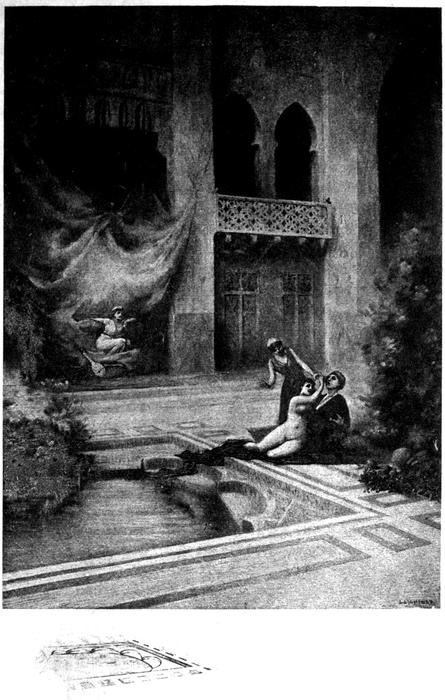
Then the lady took the cup, and drank it off to her sisters' health, 90and they ceased not drinking (the Porter being in the midst of them), and dancing and laughing and reciting verses and singing ballads and ritornellos. All this time the Porter was carrying on with them, kissing, toying, biting, handling, groping, fingering; whilst one thrust a dainty morsel in his mouth, and another slapped him; and this cuffed his cheeks, and that threw sweet flowers at him; and he was in the very paradise of pleasure, as though he were sitting in the seventh sphere among the Houris[157] of Heaven. They ceased not doing after this fashion until the wine played tricks in their heads and worsted their wits; and, when the drink got the better of them, the portress stood up and doffed her clothes till she was mother-naked. However, she let down her hair about her body by way of shift, and throwing herself into the basin disported herself and dived like a duck and swam up and down, and took water in her mouth, and spurted it all over the Porter, and washed her limbs, and between her breasts, and inside her thighs and all around her navel. Then she came up out of the cistern and throwing herself on the Porter's lap said, "O my lord, O my love, what callest thou this article?" pointing to her slit, her solution of continuity. "I call that thy cleft," quoth the Porter, and she rejoined, "Wah! wah! art thou not ashamed to use such a word?" and she caught him by the collar and soundly cuffed him. Said he again, "Thy womb, thy vulva;" and she struck him a second slap crying, "O fie, O fie, this is another ugly word; is there no shame in thee?" Quoth he, "Thy coynte;" and she cried, "O thou! art wholly destitute of modesty?" and thumped him and bashed him. Then cried the Porter, "Thy clitoris,"[158] whereat the eldest lady came down upon him with a yet sorer beating, and said, "No;" and he said, "'Tis so," and the Porter went on calling the same commodity by sundry other names, but whatever he said they beat him more and more till his neck ached and swelled with the blows he had gotten; and on this wise they made him a butt and a laughing-stock. At last he turned upon them asking, "And what do you women call this article?" Whereto 91the damsel made answer, "The basil of the bridges."[159] Cried the Porter, "Thank Allah for my safety: aid me and be thou propitious, O basil of the bridges!" They passed round the cup and tossed off the bowl again, when the second lady stood up; and, stripping off all her clothes, cast herself into the cistern and did as the first had done; then she came out of the water and throwing her naked form on the Porter's lap pointed to her machine and said, "O light of mine eyes, do tell me what is the name of this concern?" He replied as before, "Thy slit;" and she rejoined, "Hath such term no shame for thee?" and cuffed him and buffeted him till the saloon rang with the blows. Then quoth she, "O fie! O fie! how canst thou say this without blushing?" He suggested, "The basil of the bridges;" but she would not have it and she said, "No! no!" and struck him and slapped him on the back of the neck. Then he began calling out all the names he knew, "Thy slit, thy womb, thy coynte, thy clitoris;" and the girls kept on saying, "No! no!" So he said, "I stick to the basil of the bridges;" and all the three laughed till they fell on their backs and laid slaps on his neck and said, "No! no! that's not its proper name." Thereupon he cried, "O my sisters, what is its name?" and they replied, "What sayest thou to the husked sesame-seed?" Then the cateress donned her clothes and they fell again to carousing, but the Porter kept moaning, "Oh! and Oh!" for his neck and shoulders, and the cup passed merrily round and round again for a full hour. After that time the eldest and handsomest lady stood up and stripped off her garments, whereupon the Porter took his neck in hand, and rubbed and shampoo'd it, saying, "My neck and shoulders are on the way of Allah!"[160] Then she threw herself into the basin, and swam and dived, sported and washed; and the Porter looked at her naked figure as though she had been a slice of the moon[161] and at her face with the sheen of Luna when at full, or like the dawn when it brighteneth, and he noted her noble stature and shape, and those 92glorious forms that quivered as she went; for she was naked as the Lord made her. Then he cried "Alack! Alack!" and began to address her, versifying in these couplets:—
"If I liken thy shape to the bough when green ✿ My likeness errs and I sore mistake it;
For the bough is fairest when clad the most ✿ And thou art fairest when mother-naked."
When the lady heard his verses she came up out of the basin and, seating herself upon his lap and knees, pointed to her genitory and said, "O my lordling, what be the name of this?" Quoth he, "The basil of the bridges;" but she said, "Bah, bah!" Quoth he, "The husked sesame;" quoth she, "Pooh, pooh!" Then said he, "Thy womb;" and she cried, "Fie, Fie! art thou not ashamed of thyself?" and cuffed him on the nape of the neck. And whatever name he gave declaring "'Tis so," she beat him and cried "No! no!" till at last he said, "O my sisters, and what is its name?" She replied, "It is entitled the Khan[162] of Abu Mansur;" whereupon the Porter replied, "Ha! ha! O Allah be praised for safe deliverance! O Khan of Abu Mansur!" Then she came forth and dressed and the cup went round a full hour. At last the Porter rose up, and stripping off all his clothes, jumped into the tank and swam about and washed under his bearded chin and armpits, even as they had done. Then he came out and threw himself into the first lady's lap and rested his arms upon the lap of the portress, and reposed his legs in the lap of the cateress and pointed to his prickle[163] and said, "O my mistresses, what is the name of this article?" All laughed at his words till they fell on their backs, and one said, "Thy pintle!" But he replied, "No!" and gave each one of them a bite by way of forfeit. Then said they, "Thy pizzle!" but he cried "No," and gave each of them a hug;——And Shahrazad perceived the dawn of day and ceased saying her permitted say.
93Now when it was the Tenth Night,
Quoth her sister Dunyazad, "Finish for us thy story;" and she answered, "With joy and goodly gree." It hath reached me, O auspicious King, that the damsels stinted not saying to the Porter "Thy prickle, thy pintle, thy pizzle," and he ceased not kissing and biting and hugging until his heart was satisfied, and they laughed on till they could no more. At last one said, "O our brother, what, then, is it called?" Quoth he, "Know ye not?" Quoth they, "No!" "Its veritable name," said he, "is mule Burst-all, which browseth on the basil of the bridges, and muncheth the husked sesame, and nighteth in the Khan of Abu Mansur." Then laughed they till they fell on their backs, and returned to their carousal, and ceased not to be after this fashion till night began to fall. Thereupon said they to the Porter, "Bismillah,[164] O our master, up and on with those sorry old shoes of thine and turn thy face and show us the breadth of thy shoulders!" Said he, "By Allah, to part with my soul would be easier for me than departing from you: come let us join night to day, and to-morrow morning we will each wend our own way." "My life on you," said the procuratrix, "suffer him to tarry with us, that we may laugh at him: we may live out our lives and never meet with his like, for surely he is a right merry rogue and a witty."[165] So they said, "Thou must not remain with us this night save on condition that thou submit to our commands, and that whatso thou seest, thou ask no questions thereanent, nor enquire of its cause." "All right," rejoined he, and they said, "Go read the writing over the door." So he rose and went to the entrance and there found written in letters of gold wash; "WHOSO SPEAKETH OF WHAT CONCERNETH HIM NOT, SHALL HEAR WHAT PLEASETH HIM NOT!"[166] The Porter said, "Be ye witnesses against me that I 94will not speak on whatso concerneth me not." Then the cateress arose, and set food before them and they ate; after which they changed their drinking-place for another, and she lighted the lamps and candles and burned ambergris and aloes-wood, and set on fresh fruit and the wine service, when they fell to carousing and talking of their lovers. And they ceased not to eat and drink and chat, nibbling dry fruits and laughing and playing tricks for the space of a full hour when lo! a knock was heard at the gate. The knocking in no wise disturbed the seance, but one of them rose and went to see what it was and presently returned, saying, "Truly our pleasure for this night is to be perfect." "How is that?" asked they; and she answered, "At the gate be three Persian Kalandars[167] with their beards and heads and eyebrows shaven; and all three blind of the left eye—which is surely a strange chance. They are foreigners from Roum-land with the mark of travel plain upon them; they have just entered Baghdad, this being their first visit to our city; and the cause of their knocking at our door is simply because they cannot find a lodging. Indeed one of them said to me:—Haply the owner of this mansion will let us have the key of his stable or some old outhouse wherein we may pass this night; for evening had surprised them and, being strangers in the land, they knew none who would give them shelter. And, O my sisters, each of them is a figure o' fun after his own fashion; and if we let them in we shall have matter to make sport of." She gave not over persuading them till they said to her, "Let them in, and make thou the usual condition with them that they speak not of what concerneth them not, lest they hear what pleaseth them not." So she rejoiced and going to the door presently returned with the three monoculars 95whose beards and mustachios were clean shaven.[168] They salam'd and stood afar off by way of respect; but the three ladies rose up to them and welcomed them and wished them joy of their safe arrival and made them sit down. The Kalandars looked at the room and saw that it was a pleasant place, clean swept and garnished with flowers; and the lamps were burning and the smoke of perfumes was spiring in air; and beside the dessert and fruits and wine, there were three fair girls who might be maidens; so they exclaimed with one voice, "By Allah, 'tis good!" Then they turned to the Porter and saw that he was a merry-faced wight, albeit he was by no means sober and was sore after his slappings. So they thought that he was one of themselves and said, "A mendicant like us! whether Arab or foreigner."[169] But when the Porter heard these words, he rose up, and fixing his eyes fiercely upon them, said, "Sit ye here without exceeding in talk! Have you not read what is writ over the door? surely it befitteth not fellows who come to us like paupers to wag your tongues at us." "We crave thy pardon, O Fakír,"[170] rejoined they, "and our heads are between thy hands." The ladies laughed consumedly at the squabble; and, making peace between the Kalandars and the Porter, seated the new guests before meat and they ate. Then they sat together, and the portress served them with drink; and, as the cup went round merrily, quoth the Porter to the askers, "And you, O brothers mine, have ye no story or rare adventure to amuse us withal?" Now the warmth of wine having mounted to their heads they called for musical instruments; and the portress brought them a tambourine of Mosul, and a lute of Irák, and a Persian harp; and each mendicant took one and tuned it; this the tambourine and those the lute and the harp, and struck up a merry tune while the ladies sang so lustily that there was a great noise.[171] And whilst they were carrying on, behold, some one knocked at the gate, and the portress went to see what was the matter there. Now the cause of that knocking, O King (quoth Shahrazad) was this, the Caliph, Hárún al-Rashíd, had gone forth from the palace, as was his wont 96now and then, to solace himself in the city that night, and to see and hear what new thing was stirring; he was in merchant's gear, and he was attended by Ja'afar, his Wazir, and by Masrúr his Sworder of Vengeance.[172] As they walked about the city, their way led them towards the house of the three ladies; where they heard the loud noise of musical instruments and singing and merriment; so quoth the Caliph to Ja'afar, "I long to enter this house and hear those songs and see who sing them." Quoth Ja'afar, "O Prince of the Faithful; these folk are surely drunken with wine, and I fear some mischief betide us if we get amongst them." "There is no help but that I go in there," replied the Caliph, "and I desire thee to contrive some pretext for our appearing among them." Ja'afar replied, "I hear and I obey;"[173] and knocked at the door, whereupon the portress came out and opened. Then Ja'afar came forward and kissing the ground before her said, "O my lady, we be merchants from Tiberias-town: we arrived at Baghdad ten days ago; and, alighting at the merchants' caravanserai, we sold all our merchandise. Now a certain trader invited us to an entertainment this night; so we went to his house and he set food before us and we ate: then we sat at wine and wassail with him for an hour or so when he gave us leave to depart; and we went out from him in the shadow of the night and, being strangers, we could not find our way back to our Khan. So haply of your kindness and courtesy you will suffer us to tarry with you this night, and Heaven will reward you!"[174] The portress looked upon them and seeing them dressed like merchants and men of grave looks and solid, she returned to her sisters and repeated to them Ja'afar's story; and they took compassion upon the strangers and said to her, "Let them enter." She opened the door to them, when said they to her, "Have we thy leave to come in?" "Come in," quoth she; and the Caliph entered followed by Ja'afar and Masrur; and when the girls saw them they stood up to them in respect and made them sit down and looked to their wants, saying, "Welcome, and well come and good cheer to the guests, but with 97one condition!" "What is that?" asked they, and one of the ladies answered, "Speak not of what concerneth you not, lest ye hear what pleaseth you not." "Even so," said they; and sat down to their wine and drank deep. Presently the Caliph looked on the three Kalandars and, seeing them each and every blind of the left eye, wondered at the sight; then he gazed upon the girls and he was startled and he marvelled with exceeding marvel at their beauty and loveliness. They continued to carouse and to converse and said to the Caliph, "Drink!" but he replied, "I am vowed to Pilgrimage;"[175] and drew back from the wine. Thereupon the portress rose and spreading before him a table-cloth worked with gold, set thereon a porcelain bowl into which she poured willow flower water with a lump of snow and a spoonful of sugar-candy. The Caliph thanked her and said in himself, "By Allah, I will recompense her to-morrow for the kind deed she hath done." The others again addressed themselves to conversing and carousing; and, when the wine gat the better of them, the eldest lady who ruled the house rose and making obeisance to them took the cateress by the hand, and said, "Rise, O my sister and let us do what is our devoir." Both answered "Even so!" Then the portress stood up and proceeded to remove the table-service and the remnants of the banquet; and renewed the pastiles and cleared the middle of the saloon. Then she made the Kalandars sit upon a sofa at the side of the estrade, and seated the Caliph and Ja'afar and Masrur on the other side of the saloon; after which she called the Porter, and said, "How scant is thy courtesy! now thou art no stranger; nay, thou art one of the household." So he stood up and, tightening his waist-cloth, asked, "What would ye I do?" and she answered, "Stand in thy place." Then the procuratrix rose and set in the midst of the saloon a low chair and, opening a closet, cried to the Porter, "Come help me," So he went to help her and saw two black bitches with chains round their necks; and she said to him, "Take hold of them;" and he took them and led them into the middle of the saloon. Then the lady of the house arose and tucked up her sleeves above her wrists and, seizing a scourge, said to the Porter, "Bring forward one of the bitches." He brought, her forward, dragging her by the chain, while the bitch wept, and shook 98her head at the lady who, however, came down upon her with blows on the sconce; and the bitch howled and the lady ceased not beating her till her forearm failed her. Then, casting the scourge from her hand, she pressed the bitch to her bosom and, wiping away her tears with her hands, kissed her head. Then said she to the Porter, "Take her away and bring the second;" and, when he brought her, she did with her as she had done with the first. Now the heart of the Caliph was touched at these cruel doings; his chest straitened and he lost all patience in his desire to know why the two bitches were so beaten. He threw a wink at Ja'afar wishing him to ask, but the Minister turning towards him said by signs, "Be silent!" Then quoth the portress to the mistress of the house, "O my lady, arise and go to thy place that I in turn may do my devoir."[176] She answered, "Even so"; and, taking her seat upon the couch of juniper-wood, pargetted with, gold and silver, said to the portress and cateress, "Now do ye what ye have to do." Thereupon the portress sat upon a low seat by the couch side; but the procuratrix, entering a closet, brought out of it a bag of satin with green fringes and two tassels of gold. She stood up before the lady of the house and shaking the bag drew out from it a lute which she tuned by tightening its pegs; and when it was in perfect order, she began to sing these quatrains:—
Ye are the wish, the aim of me ✿ And when, O love, thy sight I see[177]
The heavenly mansion openeth;[178] ✿ But Hell I see when lost thy sight.
From thee comes madness; nor the less ✿ Comes highest joy, comes ecstasy:
Nor in my love for thee I fear ✿ Or shame and blame, or hate and spite.
When Love was throned within my heart ✿ I rent the veil of modesty;
And stints not Love to rend that veil ✿ Garring disgrace on grace to alight;
The robe of sickness then I donned ✿ But rent to rags was secrecy:
Wherefore my love and longing heart ✿ Proclaim your high supremest might;
The tear-drop railing adown my cheek ✿ Telleth my tale of ignomy:
And all the hid was seen by all ✿ And all my riddle ree'd aright.
99Heal then my malady, for thou ✿ Art malady and remedy!
But she whose cure is in thy hand ✿ Shall ne'er be free of bane and blight;
Burn me those eyne that radiance rain ✿ Slay me the swords of phantasy;
How many hath the sword of Love ✿ Laid low, their high degree despite?
Yet will I never cease to pine ✿ Nor to oblivion will I flee.
Love is my health, my faith, my joy ✿ Public and private, wrong or right.
O happy eyes that sight thy charms ✿ That gaze upon thee at their gree!
Yea, of my purest wish and will ✿ The slave of Love I'll aye be hight.
When the damsel heard this elegy in quatrains she cried out "Alas! Alas!" and rent her raiment, and fell to the ground fainting; and the Caliph saw scars of the palm-rod[179] on her back and welts of the whip; and marvelled with exceeding wonder. Then the portress arose and sprinkled water on her and brought her a fresh and very fine dress and put it on her. But when the company beheld these doings their minds were troubled, for they had no inkling of the case nor knew the story thereof; so the Caliph said to Ja'afar, "Didst thou not see the scars upon the damsel's body? I cannot keep silence or be at rest till I learn the truth of her condition and the story of this other maiden and the secret of the two black bitches." But Ja'afar answered, "O our lord, they made it a condition with us that we speak not of what concerneth us not, lest we come to hear what pleaseth us not." Then said the portress, "By Allah, O my sister, come to me and complete this service for me." Replied the procuratrix, "With joy and goodly gree;" so she took the lute; and leaned it against her breasts and swept the strings with her finger-tips, and began singing:—
Give back mine eyes their sleep long ravishèd ✿ And say me whither be my reason fled:
I learnt that lending to thy love a place ✿ Sleep to mine eyelids mortal foe was made.
They said, "We held thee righteous, who waylaid ✿ Thy soul?" "Go ask his glorious eyes," I said.
I pardon all my blood he pleased to spill ✿ Owning his troubles drove him blood to shed.
On my mind's mirror sun-like sheen he cast ✿ Whose keen reflection fire in vitals bred
Waters of Life let Allah waste at will ✿ Suffice my wage those lips of dewy red:
100An thou address my love thou'lt find a cause ✿ For plaint and tears or ruth or lustihed.
In water pure his form shall greet your eyne ✿ When fails the bowl nor need ye drink of wine.[180]
Then she quoted from the same ode:—
I drank, but the draught of his glance, not wine; ✿ And his swaying gait swayed to sleep these eyne:
'Twas not grape-juice gript me but grasp of Past ✿ 'Twas not bowl o'erbowled me but gifts divine:
His coiling curl-lets my soul ennetted ✿ And his cruel will all my wits outwitted.[181]
After a pause she resumed:—
If we 'plain of absence what shall we say? ✿ Or if pain afflict us where wend our way?
An I hire a truchman[182] to tell my tale ✿ The lovers' plaint is not told for pay:
If I put on patience, a lover's life ✿ After loss of love will not last a day:
Naught is left me now but regret, repine ✿ And tears flooding cheeks for ever and aye:
O thou who the babes of these eyes[183] hast fled ✿ Thou art homed in heart that shall never stray;
Would heaven I wot hast thou kept our pact ✿ Long as stream shall flow, to have firmest fay?
Or hast forgotten the weeping slave ✿ Whom groans afflict and whom griefs waylay?
Ah, when severance ends and we side by side ✿ Couch, I'll blame thy rigours and chide thy pride!
Now when the portress heard her second ode she shrieked aloud and said, "By Allah! 'tis right good!"; and laying hands on her garments tore them, as she did the first time, and fell to the ground fainting. Thereupon the procuratrix rose and brought her a second change of clothes after she had sprinkled water on her. She recovered and sat upright and said to her sister the cateress, 101"Onwards, and help me in my duty, for there remains but this one song." So the provisioneress again brought out the lute and began to sing these verses:—
How long shall last, how long this rigour rife of woe ✿ May not suffice thee all these tears thou seest flow?
Our parting thus with purpose fell thou dost prolong ✿ Is't not enough to glad the heart of envious foe?
Were but this lying world once true to lover-heart ✿ He had not watched the weary night in tears of woe:
Oh pity me whom overwhelmed thy cruel will ✿ My lord, my king, 'tis time some ruth to me thou show:
To whom reveal my wrongs, O thou who murdered me? ✿ Sad, who of broken troth the pangs must undergo!
Increase wild love for thee and phrenzy hour by hour ✿ And days of exile minute by so long, so slow;
O Moslems, claim vendetta[184] for this slave of Love ✿ Whose sleep Love ever wastes, whose patience Love lays low:
Doth law of Love allow thee, O my wish! to lie ✿ Lapt in another's arms and unto me cry "Go!"?
Yet in thy presence, say, what joys shall I enjoy ✿ When he I love but works my love to overthrow?
When the portress heard the third song she cried aloud; and, laying hands on her garments, rent them down to the very skirt and fell to the ground fainting a third time, again showing the scars of the scourge. Then said the three Kalandars, "Would Heaven we had never entered this house, but had rather nighted on the mounds and heaps outside the city! for verily our visit hath been troubled by sights which cut to the heart." The Caliph turned to them and asked, "Why so?" and they made answer, "Our minds are sore troubled by this matter." Quoth the Caliph, "Are ye not of the household?" and quoth they, "No; nor indeed did we ever set eyes on the place till within this hour." Hereat the Caliph marvelled and rejoined, "This man who sitteth by you, would he not know the secret of the matter?" and so saying he winked and made signs at the Porter. So they questioned the man but he replied, "By the All-might of Allah, in love all are alike![185] I am the growth of Baghdad, yet never in my born days did I darken these doors till to-day and my companying with 102them was a curious matter." "By Allah," they rejoined, "we took thee for one of them and now we see thou art one like ourselves." Then said the Caliph, "We be seven men, and they only three women without even a fourth to help them; so let us question them of their case; and, if they answer us not, fain we will be answered by force." All of them agreed to this except Ja'afar who said,[186] "This is not my recking; let them be; for we are their guests and, as ye know, they made a compact and condition with us which we accepted and promised to keep: wherefore it is better that we be silent concerning this matter; and, as but little of the night remaineth, let each and every of us gang his own gait." Then he winked at the Caliph and whispered to him, "There is but one hour of darkness left and I can bring them before thee to-morrow, when thou canst freely question them all concerning their story." But the Caliph raised his head haughtily and cried out at him in wrath, saying, "I have no patience left for my longing to hear of them: let the Kalandars question them forthright." Quoth Ja'afar, "This is not my rede." Then words ran high and talk answered talk; and they disputed as to who should first put the question, but at last all fixed upon the Porter. And as the jangle increased the house-mistress could not but notice it and asked them, "O ye folk! on what matter are ye talking so loudly?" Then the Porter stood up respectfully before her and said, "O my lady, this company earnestly desire that thou acquaint them with the story of the two bitches and what maketh thee punish them so cruelly; and then thou fallest to weeping over them and kissing them; and lastly they want to hear the tale of thy sister and why she hath been bastinado'd with palm-sticks like a man. These are the questions they charge me to put, and peace be with thee."[187] Thereupon quoth she who was the lady of the house to the guests, "Is this true that he saith on your part?" and all replied, "Yes!" save Ja'afar who kept silence. When she heard these words she cried, "By Allah, ye have wronged us, O our guests, with grievous wronging; for when you came before us we made compact and condition with you, that whoso should 103speak of what concerneth him not should hear what pleaseth him not. Sufficeth ye not that we took you into our house and fed you with our best food? But the fault is not so much yours as hers who let you in." Then she tucked up her sleeves from her wrists and struck the floor thrice with her hand crying, "Come ye quickly;" and lo! a closet door opened and out of it came seven negro slaves with drawn swords in hand to whom she said, "Pinion me those praters' elbows and bind them each to each." They did her bidding and asked her, "O veiled and virtuous! is it thy high command that we strike off their heads?"; but she answered, "Leave them awhile that I question them of their condition, before their necks feel the sword." "By Allah, O my lady!" cried the Porter, "slay me not for other's sin; all these men offended and deserve the penalty of crime save myself. Now by Allah, our night had been charming had we escaped the mortification of those monocular Kalandars whose entrance into a populous city would convert it into a howling wilderness." Then he repeated these verses:—
How fair is ruth the strong man deigns not smother! ✿ And fairest fair when shown to weakest brother:
By Love's own holy tie between us twain, ✿ Let one not suffer for the sin of other.
When the Porter ended his verse the lady laughed——And Shahrazad perceived the dawn of day and ceased to say her permitted say.
Now when it was the Eleventh Night,
She said, It hath reached me, O auspicious King, that the lady, after laughing at the Porter despite her wrath, came up to the party and spake thus, "Tell me who ye be, for ye have but an hour of life; and were ye not men of rank and, perhaps, notables of your tribes, you had not been so froward and I had hastened your doom." Then said the Caliph, "Woe to thee, O Ja'afar, tell her who we are lest we be slain by mistake; and speak her fair before some horror befal us." "'Tis part of thy deserts," replied he; whereupon the Caliph cried out at him saying, "There is a time for witty words and there is a time for serious work." Then the lady accosted the three Kalandars and asked them, "Are ye 104brothers?"; when they answered, "No, by Allah, we be naught but Fakirs and foreigners." Then quoth she to one among them, "Wast thou born blind of one eye?"; and quoth he, "No, by Allah, 'twas a marvellous matter and a wondrous mischance which caused my eye to be torn out, and mine is a tale which, if it were written upon the eye-corners with needle-gravers, were a warner to whoso would be warned."[188] She questioned the second and third Kalandar; but all replied like the first, "By Allah, O our mistress, each one of us cometh from a different country, and we are all three the sons of Kings, sovereign Princes ruling over suzerains and capital cities." Thereupon she turned towards them and said, "Let each and every of you tell me his tale in due order and explain the cause of his coming to our place; and if his story please us let him stroke his head[189] and wend his way." The first to come forward was the Hammál, the Porter, who said, "O my lady, I am a man and a porter. This dame, the cateress, hired me to carry a load and took me first to the shop of a vintner; then to the booth of a butcher; thence to the stall of a fruiterer; thence to a grocer who also sold dry fruits; thence to a confectioner and a perfumer-cum-druggist and from him to this place where there happened to me with you what happened. Such is my story and peace be on us all!" At this the lady laughed and said, "Rub thy head and wend thy ways!"; but he cried, "By Allah, I will not stump it till I hear the stories of my companions." Then came forward one of the Monoculars and began to tell her
THE FIRST KALANDAR'S TALE.
Know, O my lady, that the cause of my beard being shorn and my eye being out-torn was as follows. My father was a King and he had a brother who was a King over another city; and it came to pass that I and my cousin, the son of my paternal uncle, were· 105both born on one and the same day. And years and days rolled on; and, as we grew up, I used to visit my uncle every now and then and to spend a certain number of months with him. Now my cousin and I were sworn friends; for he ever entreated me with exceeding kindness; he killed for me the fattest sheep and strained the best of his wines, and we enjoyed long conversing and carousing. One day when the wine had gotten the better of us, the son of my uncle said to me, "O my cousin, I have a great service to ask of thee; and I desire that thou stay me not in whatso I desire to do!" And I replied, "With joy and goodly will." Then he made me swear the most binding oaths and left me; but after a little while he returned leading a lady veiled and richly apparelled with ornaments worth a large sum of money. Presently he turned to me (the woman being still behind him) and said, "Take this lady with thee and go before me to such a burial ground" (describing it, so that I knew the place), "and enter with her into such a sepulchre[190] and there await my coming." The oaths I swore to him made me keep silence and suffered me not to oppose him; so I led the woman to the cemetery and both I and she took our seats in the sepulchre; and hardly had we sat down when in came my uncle's son, with a bowl of water, a bag of mortar and an adze somewhat like a hoe. He went straight to the tomb in the midst of the sepulchre and, breaking it open with the adze set the stones on one side; then he fell to digging into the earth of the tomb till he came upon a large iron plate, the size of a wicket-door; and on raising it there appeared below it a staircase vaulted and winding. Then he turned to the lady and said to her, "Come now and take thy final choice!" She at once went down by the staircase and disappeared; then quoth he to me, "O son of my uncle, by way of completing thy kindness, when I shall have descended into this place, restore the trap-door to where it was, and heap back the earth upon it as it lay before; and then of thy great goodness mix this unslaked lime which is in the bag with this water which is in the bowl and, after building up the stones, plaster the outside so that none looking upon it shall say:—This is 106a new opening in an old tomb. For a whole year have I worked at this place whereof none knoweth but Allah, and this is the need I have of thee;" presently adding, "May Allah never bereave thy friends of thee nor make them desolate by thine absence, O son of my uncle, O my dear cousin!" And he went down the stairs and disappeared for ever. When he was lost to sight I replaced the iron plate and did all his bidding till the tomb became as it was before; and I worked almost unconsciously for my head was heated with wine. Returning to the palace of my uncle, I was told that he had gone forth a-sporting and hunting; so I slept that night without seeing him; and, when the morning dawned, I remembered the scenes of the past evening and what happened between me and my cousin; I repented of having obeyed him when penitence was of no avail, I still thought, however, that it was a dream. So I fell to asking for the son of my uncle; but there was none to answer me concerning him; and I went out to the grave-yard and the sepulchres, and sought for the tomb under which he was, but could not find it; and I ceased not wandering about from sepulchre to sepulchre, and tomb to tomb, all without success, till night set in. So I returned to the city, yet I could neither eat nor drink; my thoughts being engrossed with my cousin, for that I knew not what was become of him; and I grieved with exceeding grief and passed another sorrowful night, watching until the morning. Then went I a second time to the cemetery, pondering over what the son of mine uncle had done; and, sorely repenting my hearkening to him, went round among all the tombs, but could not find the tomb I sought. I mourned over the past, and remained in my mourning seven days, seeking the place and ever missing the path. Then my torture of scruples[191] grew upon me till I well nigh went mad, and I found no way to dispel my grief save travel and return to my father. So I set out and journeyed homeward; but as I was entering my father's capital a crowd of rioters sprang upon me and pinioned me.[192] I wondered thereat with all wonderment, seeing that I was the son of the Sultan, and these men were my father's subjects and amongst them were some of my own slaves. A great fear fell 107upon me, and I said to my soul,[193] "Would heaven I knew what hath happened to my father!" I questioned those that bound me of the cause of their so doing, but they returned me no answer. However, after a while one of them said to me (and he had been a hired servant of our house), "Fortune hath been false to thy father; his troops betrayed him and the Wazir who slew him now reigneth in his stead and we lay in wait to seize thee by the bidding of him." I was well-nigh distraught and felt ready to faint on hearing of my father's death; when they carried me off and placed me in presence of the usurper. Now between me and him there was an olden grudge, the cause of which was this. I was fond of shooting with the stone-bow,[194] and it befel one day, as I was standing on the terrace-roof of the palace, that a bird lighted on the top of the Wazir's house when he happened to be there. I shot at the bird and missed the mark; but I hit the Wazir's eye and knocked it out as fate and fortune decreed. Even so saith the poet:—
We tread the path where Fate hath led ✿ The path Fate writ we fain must tread:
And man in one land doomed to die ✿ Death no where else shall do him dead.
And on like wise saith another:—
Let Fortune have her wanton way ✿ Take heart and all her words obey:
Nor joy nor mourn at anything ✿ For all things pass and no things stay.
Now when I knocked out the Wazir's eye he could not say a single word, for that my father was King of the city; but he hated me ever after and dire was the grudge thus caused between us twain. So when I was set before him hand-bound and pinioned, he straightway gave orders for me to be beheaded. I asked, "For what crime wilt thou put me to death?"; whereupon he answered, "What crime is greater than this?" pointing the while to the place 108where his eye had been. Quoth I, "This I did by accident not of malice prepense;" and quoth he, "If thou didst it by accident, I will do the like by thee with intention."[195] Then cried he, "Bring him forward," and they brought me up to him, when he thrust his finger into my left eye and gouged it out; whereupon I became one-eyed as ye see me. Then he bade bind me hand and foot, and put me into a chest and said to the sworder, "Take charge of this fellow, and go off with him to the waste lands about the city; then draw thy scymitar and slay him, and leave him to feed the beasts and birds." So the headsman fared forth with me and when he was in the midst of the desert, he took me out of the chest (and I with both hands pinioned and both feet fettered) and was about to bandage my eyes before striking off my head. But I wept with exceeding weeping until I made him weep with me and, looking at him I began to recite these couplets:—
I deemed you coat-o'-mail that should withstand ✿ The foeman's shafts; and you proved foeman's brand;
I hoped your aidance in mine every chance ✿ Though fail my left to aid my dexter hand:
Aloof you stand and hear the railer's gibe ✿ While rain their shafts on me the giber-band:
But an ye will not guard me from my foes ✿ Stand clear, and succour neither these nor those!
And I also quoted:—
I deemed my brethren mail of strongest steel ✿ And so they were—from foes to fend my dart!
I deemed their arrows surest of their aim; ✿ And so they were—when aiming at my heart!
When the headsman heard my lines (he had been sworder to my sire and he owed me a debt of gratitude) he cried, "O my lord, what can I do, being but a slave under orders?" presently adding, 109"Fly for thy life and nevermore return to this land, or they will slay thee and slay me with thee, even as the poet said:—
Take thy life and fly whenas evils threat; ✿ Let the ruined house tell its owner's fate:
New land for the old thou shalt seek and find ✿ But to find new life thou must not await.
Strange that men should sit in the stead of shame, ✿ When Allah's world is so wide and great!
And trust not other, in matters grave ✿ Life itself must act for a life beset:
Ne'er would prowl the lion with maned neck, ✿ Did he reckon on aid or of others reck."
Hardly believing in my escape, I kissed his hand and thought the loss of my eye a light matter in consideration of my escaping from being slain. I arrived at my uncle's capital; and, going in to him, told him of what had befallen my father and myself; whereat he wept with sore weeping and said, "Verily thou addest grief to my grief, and woe to my woe; for thy cousin hath been missing these many days; I wot not what hath happened to him, and none can give me news of him." And he wept till he fainted. I sorrowed and condoled with him; and he would have applied certain medicaments to my eye, but he saw that it was become as a walnut with the shell empty. Then said he, "O my son, better to lose eye and keep life!" After that I could no longer remain silent about my cousin, who was his only son and one dearly loved, so I told him all that had happened. He rejoiced with extreme joyance to hear news of his son and said, "Come now and show me the tomb;" but I replied, "By Allah, O my uncle, I know not its place, though I sought it carefully full many times, yet could not find the site." However, I and my uncle went to the grave-yard and looked right and left, till at last I recognised the tomb and we both rejoiced with exceeding joy. We entered the sepulchre and loosened the earth about the grave; then, upraising the trap-door, descended some fifty steps till we came to the foot of the staircase when lo! we were stopped by a blinding smoke. Thereupon said my uncle that saying whose sayer shall never come to shame, "There is no Majesty and there is no Might, save in Allah, the Glorious, the Great!" and we advanced till we suddenly came upon a saloon, whose floor was strewed with flour and grain and provisions and all manner necessaries; and in the midst of it stood a canopy sheltering a couch. Thereupon my uncle went up to the couch and inspecting it found 110his son and the lady who had gone down with him into the tomb, lying in each other's embrace; but the twain had become black as charred wood; it was as if they had been cast into a pit of fire. When my uncle saw this spectacle, he spat in his son's face and said, "Thou hast thy deserts, O thou hog![196] this is thy judgment in the transitory world, and yet remaineth the judgment in the world to come, a durer and a more enduring."——And Shahrazad perceived the dawn of day and ceased saying her permitted say.
Now when it was the Twelfth Night,
She continued, It hath reached me, O auspicious King, that the Kalandar thus went on with his story before the lady and the Caliph and Ja'afar:—My uncle struck his son with his slipper[197] as he lay there a black heap of coal. I marvelled at his hardness of heart, and grieving for my cousin and the lady, said, "By Allah, O my uncle, calm thy wrath: dost thou not see that all my thoughts are occupied with this misfortune, and how sorrowful I am for what hath befallen thy son, and how horrible it is that naught of him remaineth but a black heap of charcoal? And is not that enough, but thou must smite him with thy slipper?" Answered he, "O son of my brother, this youth from his boyhood was madly in love with his own sister;[198] and often and often I forbade him 111from her, saying to myself:—They are but little ones. However, when they grew up sin befel between them; and, although I could hardly believe it, I confined him and chided him and threatened him with the severest threats; and the eunuchs and servants said to him:—Beware of so foul a thing which none before thee ever did, and which none after thee will ever do; and have a care lest thou be dishonoured and disgraced among the Kings of the day, even to the end of time. And I added:—Such a report as this will be spread abroad by caravans, and take heed not to give them cause to talk or I will assuredly curse thee and do thee to death. After that I lodged them apart and shut her up; but the accursed girl loved him with passionate love, for Satan had got the mastery of her as well as of him and made their foul sin seem fair in their sight. Now when my son saw that I separated them, he secretly built this souterrain and furnished it and transported to it victuals, even as thou seest; and, when I had gone out a-sporting, came here with his sister and hid from me. Then His righteous judgment fell upon the twain and consumed them with fire from Heaven; and verily the last judgment will deal them durer pains and more enduring!" Then he wept and I wept with him; and he looked at me and said, "Thou art my son in his stead." And I bethought me awhile of the world and of its chances, how the Wazir had slain my father and had taken his place and had put out my eye; and how my cousin had come to his death by the strangest chance: and I wept again and my uncle wept with me. Then we mounted the steps and let down the iron plate and heaped up the earth over it; and, after restoring the tomb to its former condition, we returned to the palace. But hardly had we sat down ere we heard the tom-toming of the kettle-drum and tantara of trumpets and clash of cymbals; and the rattling of war-men's lances; and the clamours of assailants and the clanking of bits and the neighing of steeds; while the world was canopied with dense dust and sand-clouds raised by the horses' hoofs.[199] We were amazed at sight and sound, knowing not what could be the matter; so we asked and were told us that the Wazir who had usurped my father's kingdom had marched his men; and that after levying his soldiery and 112taking a host of wild Arabs[200] into service, he had come down upon us with armies like the sands of the sea; their number none could tell and against them none could prevail. They attacked the city unawares; and the citizens, being powerless to oppose them, surrendered the place: my uncle was slain and I made for the suburbs saying to myself, "If thou fall into this villain's hands he will assuredly kill thee." On this wise all my troubles were renewed; and I pondered all that had betided my father and my uncle and I knew not what to do; for if the city people or my father's troops had recognised me they would have done their best to win favour by destroying me; and I could think of no way to escape save by shaving off my beard and my eyebrows. So I shore them off and, changing my fine clothes for a Kalandar's rags, I fared forth from my uncle's capital and made for this city; hoping that peradventure some one would assist me to the presence of the Prince of the Faithful,[201] and the Caliph who is the Viceregent of Allah upon 113earth. Thus have I come hither that I might tell him my tale and lay my case before him. I arrived here this very night, and was standing in doubt whither I should go, when suddenly I saw this second Kalandar; so I salam'd to him, saying:—I am a stranger! and he answered:—I too am a stranger! And as we were conversing behold, up came our companion, this third Kalandar, and saluted us saying:—I am a stranger! And we answered:—We too be strangers! Then we three walked on and together till darkness overtook us and Destiny drave us to your house. Such, then, is the cause of the shaving of my beard and mustachios and eyebrows; and the manner of my losing my right eye. They marvelled much at this tale and the Caliph said to Ja'afar, "By Allah, I have not seen nor have I heard the like of what hath happened to this Kalandar!" Quoth the lady of the house, "Rub thy head and wend thy ways;" but he replied, "I will not go, till I hear the history of the two others." Thereupon the second Kalandar came forward; and, kissing the ground, began to tell
THE SECOND KALANDAR'S TALE.
Know, O my lady, that I was not born one-eyed and mine is a strange story; an it were graven with needle-graver on the eye-corners, it were a warner to whoso would be warned. I am a King, son of a King, and was brought up like a Prince. I learned intoning the Koran according the seven schools;[202] and I read all manner books, and held disputations on their contents with the doctors and men of science; moreover I studied star-lore and the fair sayings of poets and I exercised myself in all branches of learning until I surpassed the people of my time; my skill in calligraphy exceeded that of all the scribes; and my fame was bruited abroad over all climes and cities, and all the kings learned to know my name. Amongst others the King of Hind heard of me and sent to my father to invite me to his court, with offerings and presents and rarities such as befit royalties. So my father fitted out six ships for me and my people; and we put to sea and sailed 114for the space of a full month till we made the land. Then we brought out the horses that were with us in the ships; and, after loading the camels with our presents for the Prince, we set forth inland. But we had marched only a little way, when behold, a dust-cloud up-flew, and grew until it walled[203] the horizon from view. After an hour or so the veil lifted and discovered beneath it fifty horsemen, ravening lions to the sight, in steel armour dight. We observed them straightly and lo! they were cutters-off of the highway, wild as wild Arabs. When they saw that we were only four and had with us but the ten camels carrying the presents, they dashed down upon us with lances at rest. We signed to them, with our fingers, as it were saying, "We be messengers of the great King of Hind, so harm us not!" but they answered on like wise, "We are not in his dominions to obey nor are we subject to his sway." Then they set upon us and slew some of my slaves and put the lave to flight; and I also fled after I had gotten a wound, a grievous hurt, whilst the Arabs were taken up with the money and the presents which were with us. I went forth unknowing whither I went, having become mean as I was mighty; and I fared on until I came to the crest of a mountain where I took shelter for the night in a cave. When day arose I set out again, nor ceased after this fashion till I arrived at a fair city and a well-filled. Now it was the season when Winter was turning away with his rime and to greet the world with his flowers came Prime, and the young blooms were springing and the streams flowed ringing, and the birds were sweetly singing, as saith the poet concerning a certain city when describing it:—
A place secure from every thought of fear ✿ Safety and peace for ever lord it here:
Its beauties seem to beautify its sons ✿ And as in Heaven its happy folk appear.
115I was glad of my arrival for I was wearied with the way, and yellow of face for weakness and want; but my plight was pitiable and I knew not whither to betake me. So I accosted a Tailor sitting in his little shop and saluted him; he returned my salam, and bade me kindly welcome and wished me well and entreated me gently and asked me of the cause of my strangerhood. I told him all my past from first to last; and he was concerned on my account and said, "O youth, disclose not thy secret to any: the King of this city is the greatest enemy thy father hath, and there is blood-wit[204] between them and thou hast cause to fear for thy life." Then he set meat and drink before me; and I ate and drank and he with me; and we conversed freely till nightfall, when he cleared me a place in a corner of his shop and brought me a carpet and a coverlet. I tarried with him three days; at the end of which time he said to me, "Knowest thou no calling whereby to win thy living, O my son?" "I am learned in the law," I replied, "and a doctor of doctrine; an adept in art and science, a mathematician and a notable penman." He rejoined, "Thy calling is of no account in our city, where not a soul understandeth science or even writing or aught save money-making." Then said I, "By Allah, I know nothing but what I have mentioned;" and he answered, "Gird thy middle and take thee a hatchet and a cord, and go and hew wood in the wold for thy daily bread, till Allah send thee relief; and tell none who thou art lest they slay thee." Then he bought me an axe and a rope and gave me in charge to certain woodcutters; and with these guardians I went forth into the forest, where I cut fuel-wood the whole of my day and came back in the evening bearing my bundle on my head. I sold it for half a dinar, with part of which I bought provision and laid by the rest. In such work I spent a whole year and when this was ended I went out one day, as was my wont, into the wilderness; and, wandering away from my companions, I chanced on a thickly grown lowland[205] 116in which there was an abundance of wood. So I entered and I found the gnarled stump of a great tree and loosened the ground about it and shovelled away the earth. Presently my hatchet rang upon a copper ring; so I cleared away the soil and behold, the ring was attached to a wooden trap-door. This I raised and there appeared beneath it a staircase. I descended the steps to the bottom and came to a door, which I opened and found myself in a noble hall strong of structure and beautifully built, where was a damsel like a pearl of great price, whose favour banished from my heart all grief and cark and care; and whose soft speech healed the soul in despair and captivated the wise and ware. Her figure measured five feet in height; her breasts were firm and upright; her cheek a very garden of delight; her colour lively bright; her face gleamed like dawn through curly tresses which gloomed like night, and above the snows of her bosom glittered teeth of a pearly white.[206] As the poet said of one like her:—
Slim-waisted loveling, jetty hair-encrowned ✿ A wand of willow on a sandy mound:
And as saith another:—
Four things that meet not, save they here unite ✿ To shed my heart-blood and to rape my sprite:
Brilliantest forehead; tresses jetty bright; ✿ Cheeks rosy red and stature beauty-dight.
When I looked upon her I prostrated myself before Him who had created her, for the beauty and loveliness He had shaped in her, and she looked at me and said, "Art thou man or Jinni?" "I am a man," answered I, and she, "Now who brought thee to this place where I have abided five-and-twenty years without even yet seeing man in it." Quoth I (and indeed I found her words wonder-sweet, and my heart was melted to the core by them), "O my lady, my good fortune led me hither for the dispelling of my cark and care." Then I related to her all my mishap from first to last, and my case appeared to her exceeding grievous; so she wept and said, "I will tell thee my story in my turn. I am the daughter of the King Ifitamus, lord of the Islands of Abnús,[207] who married me to my cousin, the son of my paternal uncle; but on my wedding 117night an Ifrit named Jirjís[208] bin Rajmús, first cousin that is, mother's sister's son, of Iblís, the Foul Fiend, snatched me up and, flying away with me like a bird, set me down in this place, whither he conveyed all I needed of fine stuffs, raiment and jewels and furniture, and meat and drink and other else. Once in every ten days he comes here and lies a single night with me, and then wends his way, for he took me without the consent of his family; and he hath agreed with me that if ever I need him by night or by day, I have only to pass my hand over yonder two lines engraved upon the alcove, and he will appear to me before my fingers cease touching. Four days have now passed since he was here; and, as there remain six days before he come again, say me, wilt thou abide with me five days, and go hence the day before his coming?" I replied "Yes, and yes again! O rare, if all this be not a dream!" Hereat she was glad and, springing to her feet, seized my hand and carried me through an arched doorway to a Hammam-bath, a fair hall and richly decorate. I doffed my clothes, and she doffed hers; then we bathed and she washed me; and when this was done we left the bath, and she seated me by her side upon a high divan, and brought me sherbet scented with musk. When we felt cool after the bath, she set food before me and we ate and fell to talking; but presently she said to me, "Lay thee down and take thy rest, for surely thou must be weary." So I thanked her, my lady, and lay down and slept soundly, forgetting all that had happened to me. When I awoke I found her rubbing and shampooing my feet;[209] so I again thanked her and blessed her and we sat for a while talking. Said she, "By Allah, I was sad at heart, for that I have dwelt alone underground for these five-and-twenty years; and praise be to Allah, who hath sent me some one with whom I can converse!" Then she asked, "O youth, what sayest thou to wine?" and I answered, "Do as thou wilt." Whereupon she went to a cupboard and took out a sealed flask of right old wine and set off the table with flowers and scented herbs and began to sing these lines:—
Had we known of thy coming we fain had dispread ✿ The cores of our hearts or the balls of our eyes;
Our cheeks as a carpet to greet thee had thrown ✿ And our eyelids had strown for thy feet to betread.
118Now when she finished her verse I thanked her, for indeed love of her had gotten hold of my heart and my grief and anguish were gone. We sat at converse and carousal till nightfall, and with her I spent the night—such night never spent I in all my life! On the morrow delight followed delight till midday, by which time I had drunken wine so freely that I had lost my wits, and stood up, staggering to the right and to the left, and said "Come, O my charmer, and I will carry thee up from this underground vault and deliver thee from the spell of thy Jinni." She laughed and replied "Content thee and hold thy peace: of every ten days one is for the Ifrit and the other nine are thine." Quoth I (and in good sooth drink had got the better of me), "This very instant will I break down the alcove whereon is graven the talisman and summon the Ifrit that I may slay him, for it is a practise of mine to slay Ifrits!" When she heard my words her colour waxed wan and she said, "By Allah, do not!" and she began repeating:—
This is a thing wherein destruction lies ✿ I rede thee shun it an thy wits be wise.
And these also:—
O thou who seekest severance, draw the rein ✿ Of thy swift steed nor seek o'ermuch t' advance;
Ah stay! for treachery is the rule of life, ✿ And sweets of meeting end in severance.
I heard her verse but paid no heed to her words, nay, I raised my foot and administered to the alcove a mighty kick——And Shahrazad perceived the dawn of day and ceased to say her permitted say.
Now when it was the Thirteenth Night,
She said, It hath reached me, O auspicious King, that the second Kalandar thus continued his tale to the lady:—But when, O my mistress, I kicked that alcove with a mighty kick, behold, the air starkened and darkened and thundered and lightened; the earth trembled and quaked and the world became invisible. At once the fumes of wine left my head: I cried to her, "What is the matter?" and she replied, "The Ifrit is upon us! did I not warn thee of this? By Allah, thou hast brought ruin upon me; but fly for thy 119life and go up by the way thou camest down!" So I fled up the staircase; but, in the excess of my fear, I forgot sandals and hatchet. And when I had mounted two steps I turned to look for them, and lo! I saw the earth cleave asunder, and there arose from it an Ifrit, a monster of hideousness, who said to the damsel, "What trouble and pother be this wherewith thou disturbest me? What mishap hath betided thee?" "No mishap hath befallen me" she answered, "save that my breast was straitened[210] and my heart heavy with sadness: so I drank a little wine to broaden it and to hearten myself; then I rose to obey a call of Nature, but the wine had gotten into my head and I fell against the alcove." "Thou liest, like the whore thou art!" shrieked the Ifrit; and he looked around the hall right and left till he caught sight of my axe and sandals and said to her, "What be these but the belongings of some mortal who hath been in thy society?" She answered, "I never set eyes upon them till this moment: they must have been brought by thee hither cleaving to thy garments." Quoth the Ifrit, "These words are absurd; thou harlot! thou strumpet!" Then he stripped her stark naked and, stretching her upon the floor, bound her hands and feet to four stakes, like one crucified;[211] and set about torturing and trying to make her confess. I could not bear to stand listening to her cries and groans; so I climbed the stair on the quake with fear; and when I reached the top I replaced the trap-door and covered it with earth. Then repented I of what I had done with penitence exceeding; and thought of the lady and her beauty and loveliness, and the tortures she was suffering at the hands of the accursed Ifrit, after her quiet life of five-and-twenty years; and how all that had happened to her was for cause of me. I bethought me of my father and his kingly estate and how I had become a woodcutter; and how, after my time had been awhile serene, the world had again waxed turbid and troubled to me. So I wept bitterly and repeated this couplet:—
What time Fate's tyranny shall most oppress thee ✿ Perpend! one day shall joy thee, one distress thee!
Then I walked till I reached the home of my friend, the Tailor, 120whom I found most anxiously expecting me; indeed he was, as the saying goes, on coals of fire for my account. And when he saw me he said, "All night long my heart hath been heavy, fearing for thee from wild beasts or other mischances. Now praise be to Allah for thy safety!" I thanked him for his friendly solicitude and, retiring to my corner, sat pondering and musing on what had befallen me; and I blamed and chided myself for my meddlesome folly and my frowardness in kicking the alcove. I was calling myself to account when behold, my friend, the Tailor, came to me and said, "O youth, in the shop there is an old man, a Persian,[212] who seeketh thee: he hath thy hatchet and thy sandals which he had taken to the woodcutters,[213] saying, I was going out at what time the Mu'azzin began the call to dawn-prayer, when I chanced upon these things and know not whose they are; so direct me to their owner. The woodcutters recognised thy hatchet and directed him to thee: he is sitting in my shop, so fare forth to him and thank him and take thine axe and sandals." When I heard these words I turned yellow with fear and felt stunned as by a blow; and, before I could recover myself, lo! the floor of my private room clove asunder, and out of it rose the Persian who was the Ifrit. He had tortured the lady with exceeding tortures, natheless she would not confess to him aught; so he took the hatchet and sandals and said to her, "As surely as I am Jirjis of the seed of Iblis, I will bring thee back the owner of this and these!"[214] Then he went to the woodcutters with the pretence aforesaid and, being directed to me, after waiting a while in the shop till the fact was confirmed, he suddenly snatched me up as a hawk snatcheth a mouse and flew high in air; but presently descended and plunged with me under the earth (I being aswoon the while), and lastly set me down in the subterranean palace wherein I had passed that blissful night. And there I saw the lady stripped to the skin, her limbs bound to four stakes and blood welling from her sides. At the sight my eyes ran over with tears; but the Ifrit covered her person and said, "O wanton, is 121not this man thy lover?" She looked upon me and replied, "I wot him not nor have I ever seen him before this hour!" Quoth the Ifrit, "What! this torture and yet no confessing;" and quoth she, "I never saw this man in my born days, and it is not lawful in Allah's sight to tell lies on him." "If thou know him not," said the Ifrit to her, "take this sword and strike off his head."[215] She hent the sword in hand and came close up to me; and I signalled to her with my eyebrows, my tears the while flowing adown my cheeks. She understood me and made answer, also by signs, "How couldest thou bring all this evil upon me?" and I rejoined after the same fashion, "This is the time for mercy and forgiveness." And the mute tongue of my case[216] spake aloud saying:—
Mine eyes were dragomans for my tongue betied ✿ And told full clear the love I fain would hide:
When last we met and tears in torrents railed ✿ For tongue struck dumb my glances testified:
She signed with eye-glance while her lips were mute ✿ I signed with fingers and she kenned th' implied:
Our eyebrows did all duty 'twixt us twain; ✿ And we being speechless Love spake loud and plain.
Then, O my mistress, the lady threw away the sword and said, "How shall I strike the neck of one I wot not, and who hath done me no evil? Such deed were not lawful in my law!" and she held her hand. Said the Ifrit, "'Tis grievous to thee to slay thy lover; and, because he hath lain with thee, thou endurest these torments and obstinately refusest to confess. After this it is clear to me that only like loveth and pitieth like." Then he turned to me and asked me, "O man, haply thou also dost not know this woman;" whereto I answered, "And pray who may she be? assuredly I never saw her till this instant." "Then take the sword," said he "and strike off her head and I will believe that, thou wottest her not and will leave thee free to go, and will not deal hardly with thee." I replied, "That will I do;" and, taking the sword went forward sharply and raised my hand to smite. But she signed to me with her eyebrows, "Have I failed thee in aught of love; and is it thus that thou requitest me?" I understood what her looks implied and answered 122her with an eye-glance, "I will sacrifice my soul for thee." And the tongue of the case wrote in our hearts these lines:—
How many a lover with his eyebrows speaketh ✿ To his beloved, as his passion pleadeth:
With flashing eyne his passion he inspireth ✿ And well she seeth what his pleading needeth.
How sweet the look when each on other gazeth; ✿ And with what swiftness and how sure it speedeth:
And this with eyebrows all his passion writeth; ✿ And that with eyeballs all his passion readeth.
Then my eyes filled with tears to overflowing and I cast the sword from my hand saying, "O mighty Ifrit and hero, if a woman lacking wits and faith deem it unlawful to strike off my head, how can it be lawful for me, a man, to smite her neck whom I never saw in my whole life. I cannot do such misdeed though thou cause me drink the cup of death and perdition." Then said the Ifrit, "Ye twain show the good understanding between you; but I will let you see how such doings end." He took the sword, and struck off the lady's hands first, with four strokes, and then her feet; whilst I looked on and made sure of death and she farewelled me with her dying eyes. So the Ifrit cried at her, "Thou whorest and makest me a wittol with thine eyes;" and struck her so that her head went flying. Then turned he to me and said, "O mortal, we have it in our law that, when the wife committeth advowtry it is lawful for us to slay her. As for this damsel I snatched her away on her bride-night when she was a girl of twelve and she knew no one but myself. I used to come to her once in every ten days and lie with her the night, under the semblance of a man, a Persian; and when I was well assured that she had cuckolded me, I slew her. But as for thee I am not well satisfied that thou hast wronged me in her; nevertheless I must not let thee go unharmed; so ask a boon of me and I will grant it." Then I rejoiced, O my lady, with exceeding joy and said, "What boon shall I crave of thee?" He replied, "Ask me this boon; into what shape I shall bewitch thee; wilt thou be a dog, or an ass or an ape?" I rejoined (and indeed I had hoped that mercy might be shown me), "By Allah, spare me, that Allah spare thee for sparing a Moslem and a man who never wronged thee." And I humbled myself before him with exceeding humility, and remained standing in his presence, saying, "I am sore oppressed by 123circumstance." He replied "Talk me no long talk, it is in my power to slay thee; but I give thee instead thy choice." Quoth I, "O thou Ifrit, it would besit thee to pardon me even as the Envied pardoned the Envier." Quoth he, "And how was that?" and I began to tell him
THE TALE OF THE ENVIER AND THE ENVIED.
They relate, O Ifrit, that in a certain city were two men who dwelt in adjoining houses, having a common party-wall; and one of them envied the other and looked on him with an evil eye,[217] and did his utmost endeavour to injure him; and, albeit at all times he was jealous of his neighbour, his malice at last grew on him till he could hardly eat or enjoy the sweet pleasures of sleep. But the Envied did nothing save prosper; and the more the other strove to injure him, the more he got and gained and throve. At last the malice of his neighbour and the man's constant endeavour to work him a harm came to his knowledge; so he said, "By Allah! God's earth is wide enough for its people;" and, leaving the neighbourhood, he repaired to another city where he bought himself a piece of land in which was a dried up draw-well,[218] old and in ruinous condition. Here he built him an oratory and, furnishing it with a few necessaries, took up his abode therein, and devoted himself to prayer and worshipping Allah Almighty; and Fakirs and holy mendicants flocked to him from all quarters; and his fame went abroad through the city and that country side. Presently the news reached his envious neighbour, of what good fortune had befallen him and how the city notables had become his disciples; so he travelled to the place and presented himself at the holy man's hermitage, and was met by the Envied with welcome and greeting and all honour. Then quoth the Envier, "I have a word to say to thee; and this is the cause of my faring hither, and I wish to give thee a piece of good news; so come with me to thy 124cell." Thereupon the Envied arose and took the Envier by the hand, and they went in to the inmost part of the hermitage; but the Envier said, "Bid thy Fakirs retire to their cells, for I will not tell thee what I have to say, save in secret where none may hear us." Accordingly the Envied said to his Fakirs, "Retire to your private cells;" and, when all had done as he bade them, he set out with his visitor and walked a little way until the twain reached the ruinous old well. And as they stood upon the brink the Envier gave the Envied a push which tumbled him headlong into it, unseen of any; whereupon he fared forth, and went his ways, thinking to have had slain him. Now this well happened to be haunted by the Jann who, seeing the case, bore him up and let him down little by little, till he reached the bottom, when they seated him upon a large stone. Then one of them asked his fellows, "Wot ye who be this man?" and they answered, "Nay." "This man," continued the speaker, "is the Envied hight who, flying from the Envier, came to dwell in our city, and here founded this holy house, and he hath edified us by his litanies[219] and his lections of the Koran; but the Envier set out and journeyed till he rejoined him, and cunningly contrived to deceive him and cast him into the well where we now are. But the fame of this good man hath this very night come to the Sultan of our city who designeth to visit him on the morrow on account of his daughter." "What aileth his daughter?" asked one, and another answered "She is possessed of a spirit; for Maymun, son of Damdam, is madly in love with her; but, if this pious man knew the remedy, her cure would be as easy as could be." Hereupon one of them inquired, "And what is the medicine?" and he replied, "The black tom-cat which is with him in the oratory hath, on the end of his tail, a white spot, the size of a dirham; let him pluck seven white hairs from the spot, then let him fumigate her therewith and the Marid will flee from her and not return; so she shall be sane for the rest of her 125life. All this took place, O Ifrit, within earshot of the Envied who listened readily. When dawn broke and morn arose in sheen and shone, the Fakirs went to seek the Shaykh and found him climbing up the wall of the well; whereby he was magnified in their eyes.[220] Then, knowing that naught save the black tom-cat could supply him with the remedy required, he plucked the seven tail-hairs from the white spot and laid them by him; and hardly had the sun risen ere the Sultan entered the hermitage, with the great lords of his estate, bidding the rest of his retinue to remain standing outside. The Envied gave him a hearty welcome, and seating him by his side asked him, "Shall I tell thee the cause of thy coming?" The King answered "Yes." He continued, "Thou hast come upon pretext of a visitation;[221] but it is in thy heart to question me of thy daughter." Replied the King, "'Tis even so, O thou holy Shaykh;" and the Envied continued, "Send and fetch her, and I trust to heal her forthright (an such it be the will of Allah!). The King in great joy sent for his daughter, and they brought her pinioned and fettered. The Envied made her sit down behind a curtain and taking out the hairs fumigated her therewith; whereupon that which was in her head cried out and departed from her. The girl was at once restored to her right mind and veiling her face, said, "What hath happened and who brought me hither?" The Sultan rejoiced with a joy which nothing could exceed, and kissed his daughter's eyes,[222] and the holy man's hand; then, turning to his great lords, he asked, "How say ye! What fee deserveth he who hath made my daughter whole?" and all answered "He deserveth her to wife;" and the King said, "Ye speak sooth!" So he married him to her and the Envied thus became son-in-law to the King. And after a little the Wazir died and the King said, "Whom can I make Minister in his stead?" "Thy son-in-law," replied the courtiers. So the Envied became a Wazir; and after a while the Sultan also died and the lieges said, "Whom shall we make King?" and all cried, "The Wazir." So the Wazir was forthright made Sultan, and he became King regnant, a true ruler of men. One day as he had mounted his horse; and, in the eminence 126of his kinglihood, was riding amidst his Emirs and Wazirs and the Grandees of his realm his eye fell upon his old neighbour, the Envier, who stood afoot on his path; so he turned to one of his Ministers, and said, "Bring hither that man and cause him no affright." The Wazir brought him and the King said, "Give him a thousand miskáls[223] of gold from the treasury, and load him ten camels with goods for trade, and send him under escort to his own town." Then he bade his enemy farewell and sent him away and forbore to punish him for the many and great evils he had done. See, O Ifrit, the mercy of the Envied to the Envier, who had hated him from the beginning and had borne him such bitter malice and never met him without causing him trouble; and had driven him from house and home, and then had journeyed for the sole purpose of taking his life by throwing him into the well. Yet he did not requite his injurious dealing, but forgave him and was bountiful to him.[224] Then I wept before him, O my lady, with sore weeping, never was there sorer, and I recited:—