Volume 2 — TURTON TOWER, LANCASHIRE.
Reading edition
his venerable and highly picturesque edifice is situated about four miles from Bolton, in a district singularly at war with relics of antiquity, and at variance with associations awakened by remains of time-honoured mansions of the ancient lords of the soil. From an adjacent hill may be seen a thousand tall chimneys, of red brick; while the surrounding atmosphere is dense and heavy with the smoke arising from factories and coal-pits, so numerous, that the eye labours in vain to count them.
In the time of King John, the Township of Turton was held by Roger Fitz Robert (De Holland); it became part of the property of Henry, “the good Duke of Lancaster,” from whom the manor passed into the knightly family of the Orrels, whom Camden styles “Illustrious.” From them it was purchased, for £3,000, by Humphrey Chetham, Esq., a manufacturer of fustians; of whom, about the middle of the 17th century, Fuller speaks, as “a public benefactor.” From him it passed successively to his descendants, Humphrey, Samuel, and Edward Chetham; by Anne, one of the co-heiresses of Edward Chetham, it was conveyed by marriage to —— Bland, Esq., whose sole heiress married Mordecai Green, Esq., whose daughters, the issue of his son, James Green, inherited, and now possess, the estate. That portion of it, consisting of 365 acres, which contains Turton Tower, is in the occupation of James Kay, Esq., a gentleman who deserves the high praise of all, and the fervent gratitude of the antiquary, for the care he has taken, not only to protect from further injury the venerable relic of a remote age, but for the taste and judgment he exhibits in keeping all things in harmony with the character of the honoured and interesting edifice. The dwelling has received various additions from time to time; but none of them are of very recent date. They are principally of a class common in Lancashire, in houses of the better order, as well as in cottages of the labourer and artisan, being constructed of wood and plaster. “The Tower” is of stone, and much older than other parts of the structure. It is square, and was evidently constructed for defence. It has a hall, of small size, but richly decorated with wood carvings; a quaint staircase conducts to the upper apartments, the principal of which is the drawing-room, panelled with oak from the floor nearly to the ceiling—the ceiling being highly enriched.
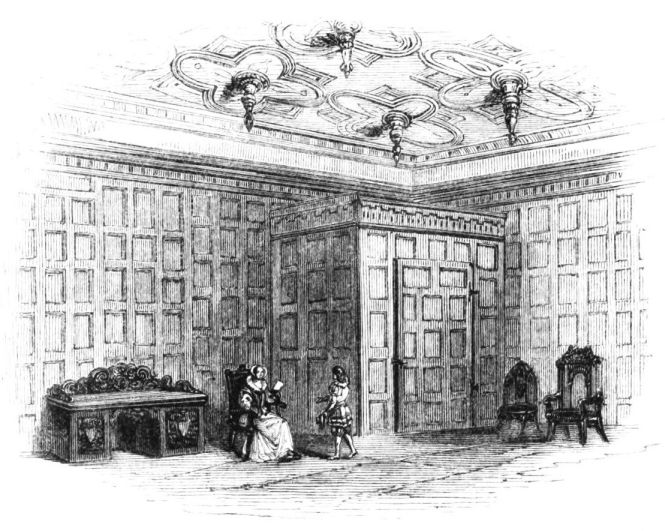
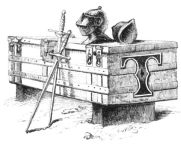
It receives light from two mullioned windows. This room is in the Tower—the whole length and breadth of which it occupies. Every chamber throughout the mansion has been fitly furnished by Mr. Kay. The ancient coffer, bound with iron—(it supplies our initial letter)—concerning which tradition has been always busy—is one of the few heirlooms of the House.
We believe, with this exception, the whole of its picturesque contents, from attic to cellar, have been the introductions of Mr. Kay; and we cannot sufficiently praise the sound taste and judicious feeling by which that gentleman has been actuated in his efforts at restoration both within and without.
At a short distance from the mansion is a singularly picturesque turret—an
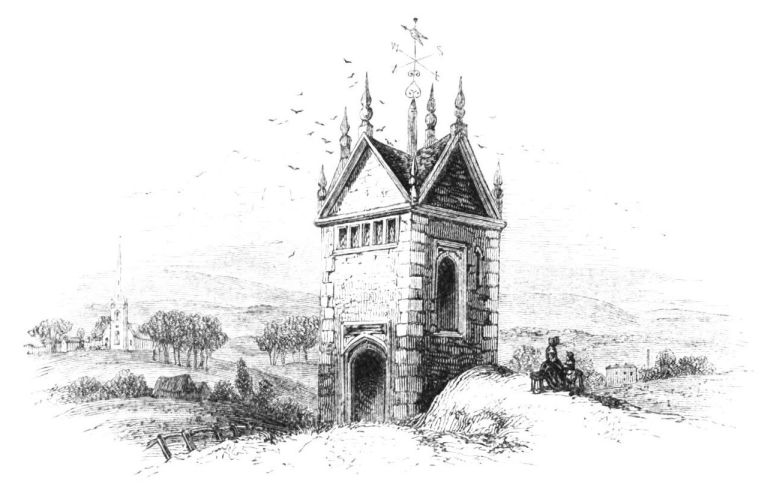
engraving of which we annex. Through the township of Turton passed the ancient Roman road; and in the immediate neighbourhood may be traced many relics of remote antiquity.
From “the Height” a most extensive view is obtained—a view unsurpassed in England for singularity and deep interest,—taking in Bolton and Warrington and other towns and villages full of factories; from hence also are seen Billinge Hill and Beacon, the far-famed Pike and Beacon of Rivington; while a deep shadow that hangs over an enormous space, points attention to busy and prosperous Manchester, buried with its prodigious wealth in the centre of a valley some fifteen miles away.
FOOTNOTES: