Volume 2 — MORETON HALL, CHESHIRE.
Reading edition
subject of our present delineation—Moreton Hall, is situated amidst the sandy plain of Cheshire, on the Staffordshire border of the county. Its eastern aspect is bounded by that range of hills which extends from Scotland southwards into the centre of England, and which here presents some of its most remarkable features in the high hills called “Mow Cop” and “Cloud,” both being upwards of 1000 feet above the sea-level. The former is surmounted by a ruined tower, and by a singular isolated rock called “The Old Man of Mow.” The latter is an abrupt and dome-shaped termination of a portion of the range to the northward. From the Hall, these hills present objects of interest not devoid of richness, as on this side they are clothed with the dark verdure of the Scotch fir. Moreton Hall—or, “Little Moreton Hall,” as it has been denominated to distinguish it from the residence of the Bellots in the immediate neighbourhood, seated on the plain below—is an ancient timbered house, partly embosomed in trees, but attracting the eye from a distance by the interrupted outline of its numerous roofs, its strange columnar chimneys,—in form resembling rows of prismatic crystals, some of them being rendered more picturesque by the o’er-covering
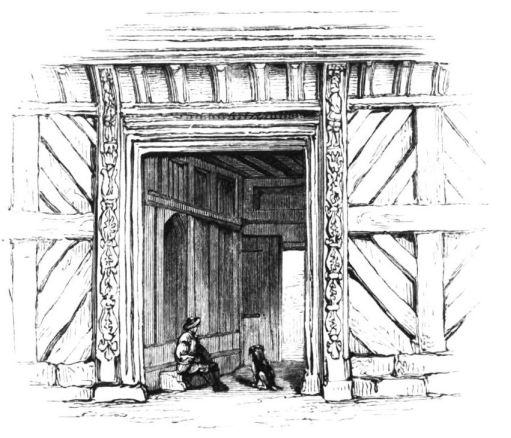
ivy,—and its black beams and diaper-like patterns distinctly traced on the white ground of the intervening plaster. On a nearer approach we discover the house to be encompassed by a narrow moat, beyond which, and at its south-western corner, is a small conical mound, prettily surmounted by a sycamore tree. The house is approached from the south over a stone arch of antique form, and bearing the Moreton arms on either side. The square Portal, with a sun-dial over it, is adorned with some bold carvings of foliage in oak on the top and sides. These are repeated on the inner opening at the entrance into the Court; each door-post here being crowned by a halbert-bearer in high relief. Over this portal is a lofty range of building, consisting of a number of small wainscotted rooms, and an oaken staircase, which ascends to the long room or gallery, 68 feet in length, running over the top of the whole. This room is lighted from the south by a window its entire length. Like all the other apartments, its walls are lined with wainscot, except the ends, where, at the upper part, are figures and tablets, bearing inscriptions, in stucco. That at the western end represents blind Fortune with her wheel, bearing this motto on the rim: “Qui modo scandit corruet statim.” The inscription is:
“The wheel of Fortune, Whose rule is ignoraunce.”
That at the opposite extremity, Fate supporting a globe with one hand, and holding a pair of compasses in the other. The inscription:
“The speare of Destiny, Whose rule is knowledge.”
This apartment has a pitched roof, and an oaken ceiling, open to the rafters. Tradition relates that Queen Elizabeth, while on a progress through Cheshire, danced here, and that Oliver Cromwell made use of it as a council chamber during the Civil Wars.
Having passed through the portal and under the building surmounted by the long room, we enter a small Court, which is one of the most curious parts of this ancient residence. There are seven doors opening
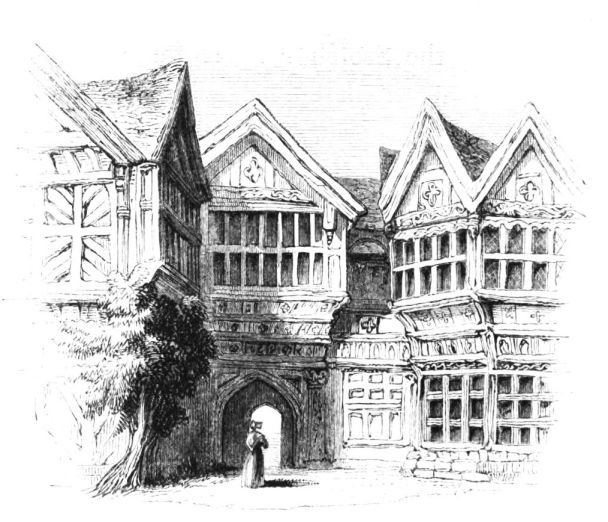
into it; the principal entrance, (that which leads into the hall,) being nearly opposite to the portal. Besides other windows, there are two large gabled bow-windows, which light the Banquetting Hall, the antique form and curious glazing of which excite immediate attention. Indeed, the glazing of most of the windows of the house is very remarkable; the panes being small, and joined by slips of lead, so as to represent many pretty patterns. Upon bands around these windows are the following inscriptions:—“God is al in al thing. This window where made by William Moreton, in the yeare of oure Lorde MDLII.” “Rycharde Dale, Carpēder made theis windows, by the grace of God.”[5]
One of the entrances from the court, on the right, leads into a small chapel, which, by the lapse of time and disuse, has lost much of its sacred character. Almost the only indication of its former purpose is a series of tablets suspended on the walls and bearing inscribed on them, in old English characters, numerous texts of Scripture.
The principal entrance leading into the house is closed by an antique oaken door, having a small wicket in it fastened with a ponderous bolt. This door is rendered still more impregnable by many a coat of whitewash. On passing through it we are ushered into a large wainscotted apartment, having seats attached to the wainscot all round,—the ancient Banquetting Hall. In it we observed a fine old long table of oak. This apartment is lighted by the large windows already described, which contain, like some other windows of the house, small portions of stained glass, consisting of the Moreton and other arms. An inner door in the wainscot leads from the Banquetting Hall into the family apartment, which likewise looks into the court. This room has an ornamented chimney-piece, which is surmounted by arms in stucco, bearing the motto “Honi soit qui mal y pense,” and a large A on each side.
Many of the rooms have floors made of plaster. The fastenings of some of the doors of the upper rooms are curious; they consist of a large iron ring standing out from the middle of the door, through which is passed a bar of wood. This reaches across, and rests on the jambs on either side; a very secure mode of fastening to those who happen to be on the right side.
In the fine old parish church of Astbury, within two miles of Moreton Hall, there is a side chapel, at the east end of the north aisle, of great antiquity, divided between the two manorial proprietors of Little Moreton-cum-Rode. In the east window, which formerly contained some splendid stained glass, there now only remains the arms of one of the Blundevilles, the famous Earls of Chester. The three wide steps which led to the altar, a piscina, on one side, and a closet for relics, on the other, are almost the only remnants of its ancient purposes. At the Moreton end of this side chapel there are three large plain marble slabs over altar tombs, bearing the following inscriptions:—
Dame Mary Jones, died the 19th of April, 1743, aged 85. Sir William Moreton, Knt., Recorder of the City of London, died the 14th of March, 1763, aged 67. Dame Jane Moreton, died the 10th of Feb., 1758, aged 61.
There is a fine oaken cabinet in Moreton Hall, which, from the labels in old law-hand, has most likely belonged to the above-named Sir William Moreton.
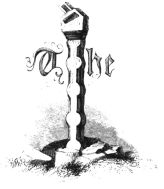
The house belongs to a lady of the Moreton family,—in whose possession it is said to have remained since the 13th century. An adjacent meadow was formerly the mill-pool of the Hall. In front of the house there formerly stood the steps of an old cross, which have been removed. It is probable that they now surround the cross piled up in the garden, and upon which is placed an old sun-dial. Of this cross, or rather, the remains, Mr. Pratt (the artist to whom we are indebted for the illustrations of this subject) made a drawing, which forms our initial letter.
Odd Rode, or Little Moreton-cum-Rode, are noticed as two manors in “The Survey,” and were subsequently granted to Hugh de Mara and Wm. Fitz Nigel. They are described in Domesday, as having inclosures for taking wild deer, and an aerie for hawks. The present divisions of the township are distinguished by the names of Little Moreton and Rode. A branch of the Grahams of Lostock settled in Little Moreton early in the thirteenth century, the third of whom assumed the name of Moreton, and his descendants in the male line continued till the death of Sir W. Moreton in 1763, when his nephew, the Rev. Richard Taylor, took the local name.
In the 12th Henry VIII. Sir W. Brereton made an award between Mr. Wm. Moreton and Mr. Thos. Rode, of Rode, in a dispute “which should sit highest in the churche, and foremost goo in procession:” when he very judiciously awarded between these two sticklers for precedence “That whyther of the said gentylmen may dispende in landes by title of enheritaunce 10 marks or above more than the other, that he shall have the pre-eminence in sitting in the churche, and in gooing in procession, with all other lyke causes in that behalf.”
We fear we must ascribe the rumoured subterranean passages of Moreton Hall, running under the moat to chambers hid in the mound, to no higher authority than that wild fancy which thus gilds, to its own delight, antique and curious buildings in all parts of our country—that native spirit of poetry,—
“One with our feelings and our powers, And rather part of us, than ours,”
without a sprinkling of which, this world in all its teeming beauty might be too much of a dull reality.
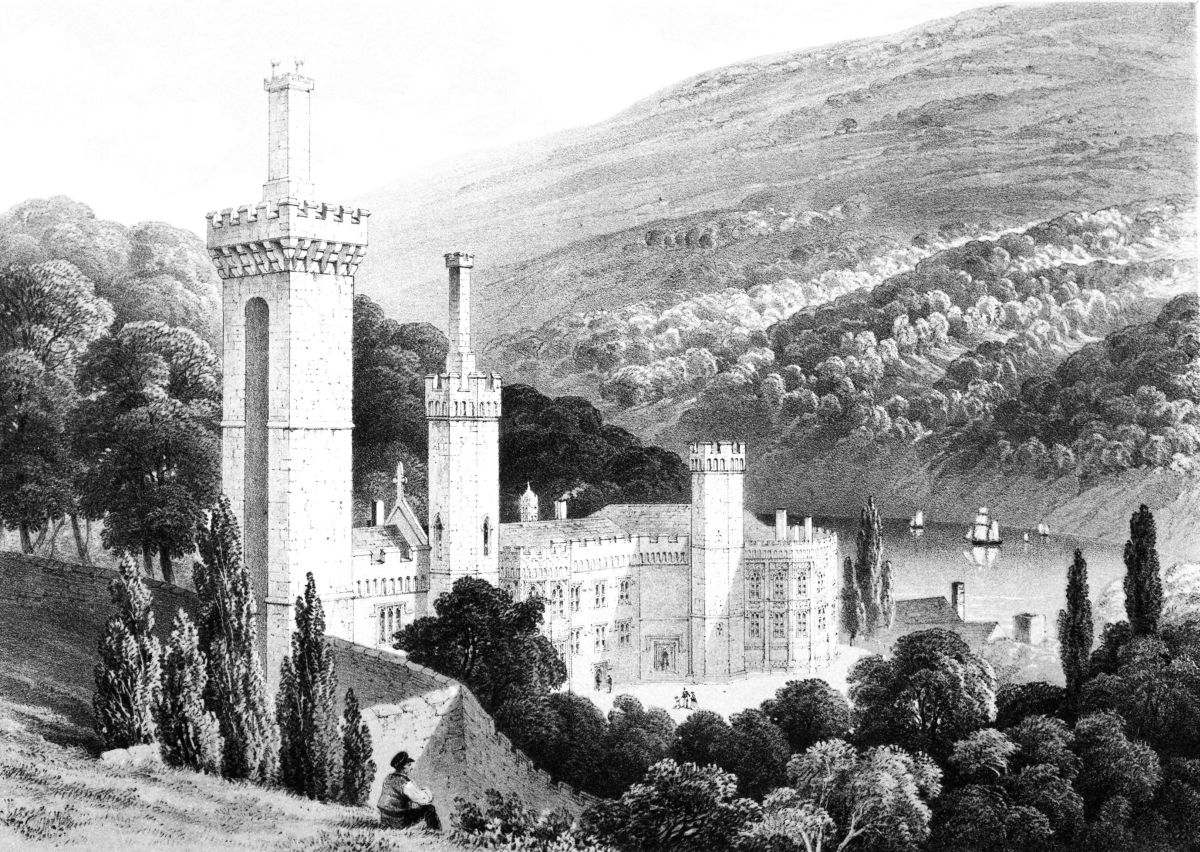
F W Hulme Delᵗ. on Stone by W Walton M & N Hanhart Lithogʳˢ