Volume 2 — DORFOLD HALL, CHESHIRE.
Reading edition
orfold Hall, now the seat of Mrs. Tomkinson, was built by Ralph Wilbraham, Esq. in the reign of James I.—according to Lysons, in the year 1616—on the site of a still older mansion. It is situated about one mile from Nantwich; it is a brick building with stone dressings. The staircase and the great chamber are still perfect. The ceiling of the latter room is an extraordinary specimen of decorative plaster-work; the form is of the kind called “waggon-headed.” It is completely covered with a pattern, in bold relief, of the most complicated description, ornamented with shields of arms and various Tudor emblems. Few
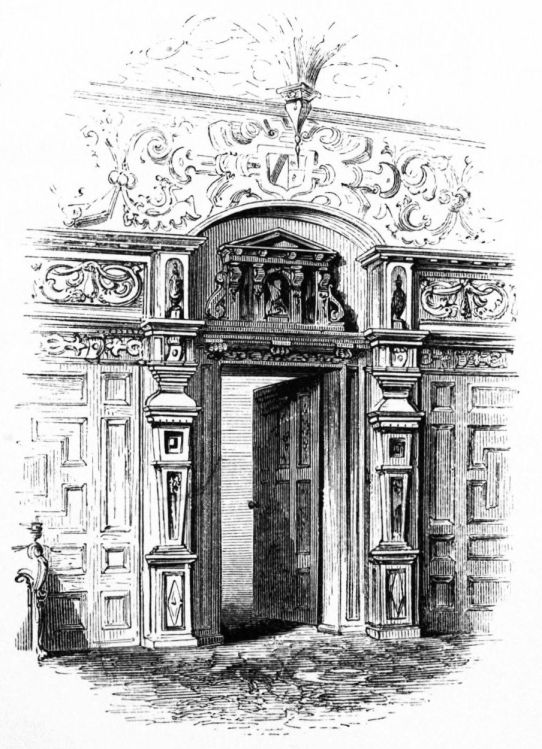
such curious specimens of the intricate design of the period can now be found. Over the doorway in the great chamber is a shield of the arms of the Wilton family. Mr. Richardson, in his observations on old English mansions, observes there is every reason to suppose that Dorfold Hall, Crewe Hall, and Aston Hall, near Birmingham, were built in successive order by the same architect; many of the ceilings, fireplaces, staircases, &c. are nearly the same in all the three houses. The early rudeness of the style is seen at Dorfold Hall, its purity in Crewe Hall, and the commencement of its deterioration in Aston Hall.
The front of Dorfold is highly picturesque. The two small lodges seen in front belong to the original construction; but modern domestic arrangements requiring more room than was afforded by the old building, the small offices between the house and the old lodges have been added. If the reader can suppose these away, and a formal balustrade or wall, with gates in the centre, connecting the old lodges in front, he will have the exact appearance of the house in the olden time. All the old buildings were then supplied in front by great courtyards, into which carriages never entered, either from their being of too lumbersome a construction, or with a view to state. It may be hinted that the buildings of the reign of Elizabeth exhibited a considerable portion of the proud, haughty character of the sovereign.
Dorfold, like many of its neighbours in Cheshire, was besieged by the army of the Parliament during the Civil Wars.
The interior of the Hall bears many unequivocal proofs that refined taste prevails over all its arrangements. The new furniture is in keeping with the old carvings; illustrated books, and prints in harmony with the impressive character of the time-honoured structure, are profusely scattered upon the tables and along the walls. Dorfold has fallen into “good hands;” its peculiar beauties and its interesting associations are appreciated and valued; and the spirits of its ancient owners may contemplate with approval the efforts of its existing proprietors—shoots from a noble and honourable stock.
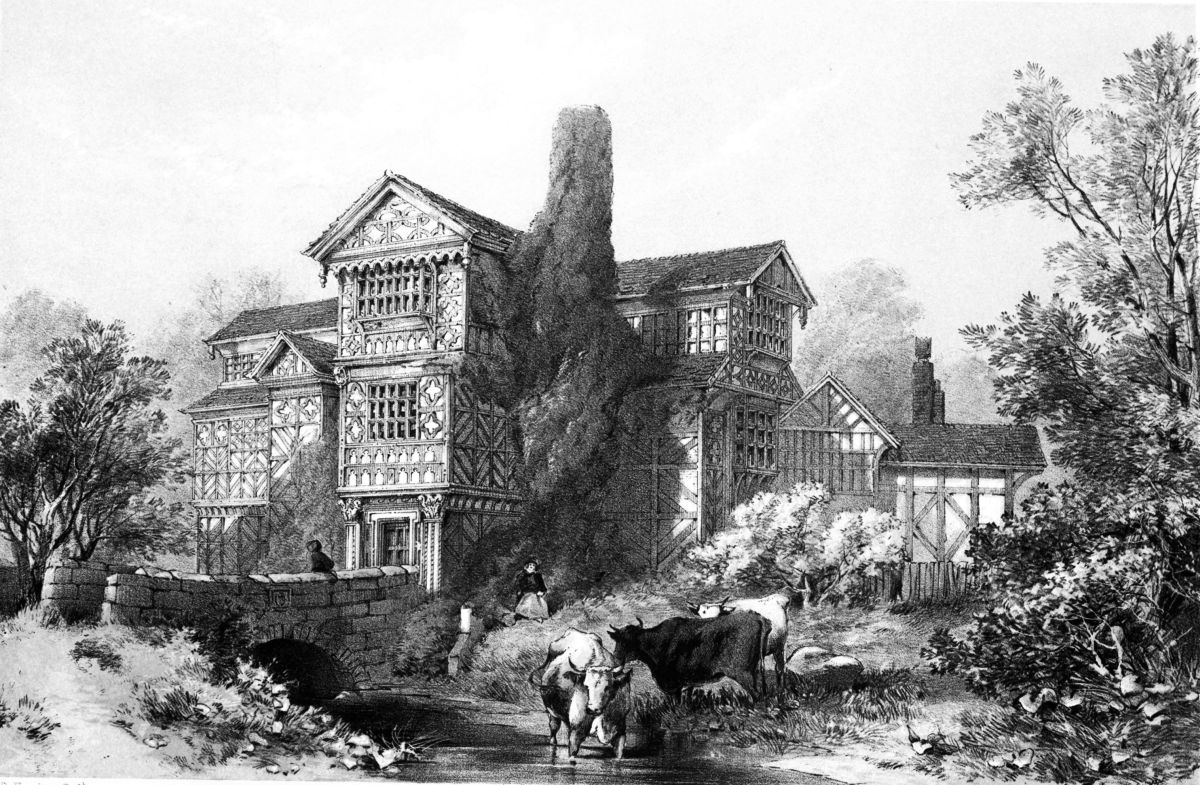
J. D. Harding, Delᵗ M & N Hanhart, Lithogʳˢ.
MORETON HALL, CHESHIRE.