Volume 2 — PLACE HOUSE, CORNWALL.
Reading edition
lace House, formerly called the “Plâs” (a corruption of “Palace”), from its having the reputation of being once the residence of the Earls of Cornwall, stands on elevated ground in the centre of Fowey, a seaport-town on the southern coast of Cornwall. It is a fine pile of building, a large portion being very ancient, though the exact date cannot be ascertained with certainty; there is, however, abundant evidence to prove that many parts of it existed so far back as 1455,[6] and were probably built about that time; a period to which also is assigned the re-erection of the church close by, a handsome and lofty fabric of the perpendicular English style of architecture: the two buildings are composed of similar materials.
The ancestors of its present possessor, J. T. Treffry, Esq., have occupied Place House, without intermission, as we believe, for many centuries past, and exercised considerable influence in Fowey, which was formerly a place of far greater importance than it is now. The townsmen acquired wealth and fame by deeds of war during the reigns of Edward I., Edward III., and Henry V., and they furnished more ships to the fleet of Edward III. before Calais than any other port in England. Among the gallant men who fought and won at Cressy, we find Sir John Treffry, to whom, chroniclers say, the French king surrendered himself on the field. His heroism at Poictiers is commemorated on a stately monument in Fowey Church, which bears the following inscription:—“The atchievements of John Treffry, who, at the battle of Poictiers, fought under Edward the Black Prince, and took the French royal standard; for it he was made a Knight-Banneret by King Edward III. on the field of battle.” In addition to this title, Sir John was rewarded for his valour with an honourable augmentation to his arms; viz. supporters, and as a quartering, the fleur-de-lis from the arms of France, which are still to be seen painted on the windows of Place House.
The French frequently attacked Fowey, and, according to Leland, “most notably about 1457, when the wife of Thomas Treffry, with her servants, repelled their enemies
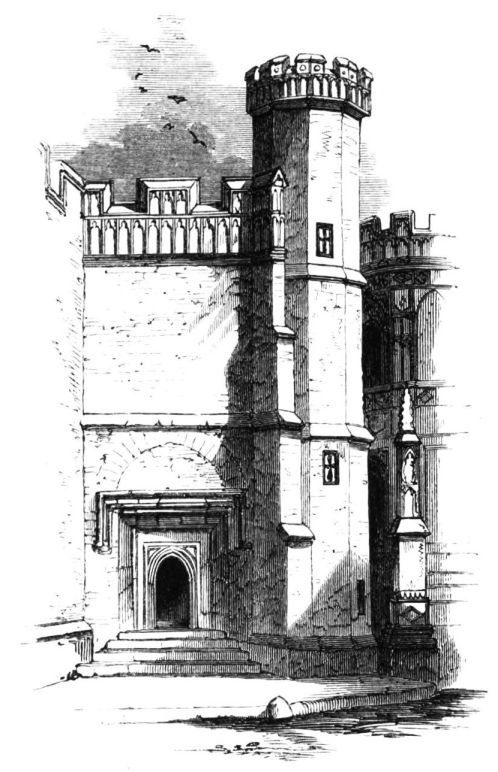
out of the house, in her husband’s absence; whereupon he builded a right faire and strong embateled tower in his house, and embateled it to the walls of his house,—in a manner made it a castle, and unto this day it is the glorie of the towne building of Foey.” This tower we have engraved. John Treffry, most probably a son of the aforesaid Thomas, was high-sheriff of Cornwall in 1482; he left issue several sons, of whom three are portrayed on a large tomb in the adjoining church: one of these, Sir John, was a person of considerable eminence, and, with his brother William, was attainted by Richard III., but afterwards restored by act of parliament to their estates, in the reign of Henry VII. Thomas Treffry, member for the county during the first two parliaments of Philip and Mary, was compelled to leave the country for having opposed the marriage of Mary with the Spanish monarch.
From this last period to the present time we find no names of note in the genealogy of the family; but the estate appears to have been handed down, from one generation to another, in almost unbroken succession; the various members in possession holding a
distinguished position among the old county gentry.
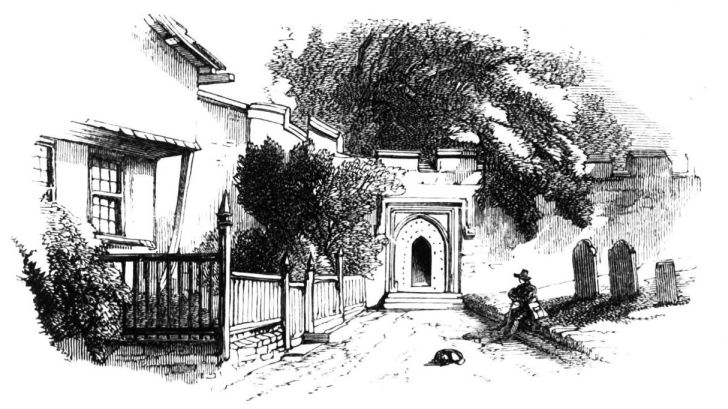
Place House contains numerous apartments, many of which are highly interesting. In the hall is a richly carved ceiling of oak, and on the walls are emblazoned the arms of Edward VI. and the first Earl of Bedford, with quarterings, all well executed; also the arms of Treffry and Tresilhneys, quartered in Queen Elizabeth’s time. In several other parts are likewise the family arms, quartered according to the various periods to which each is assigned. One of the ancient gateways is indicated in the appended cut.
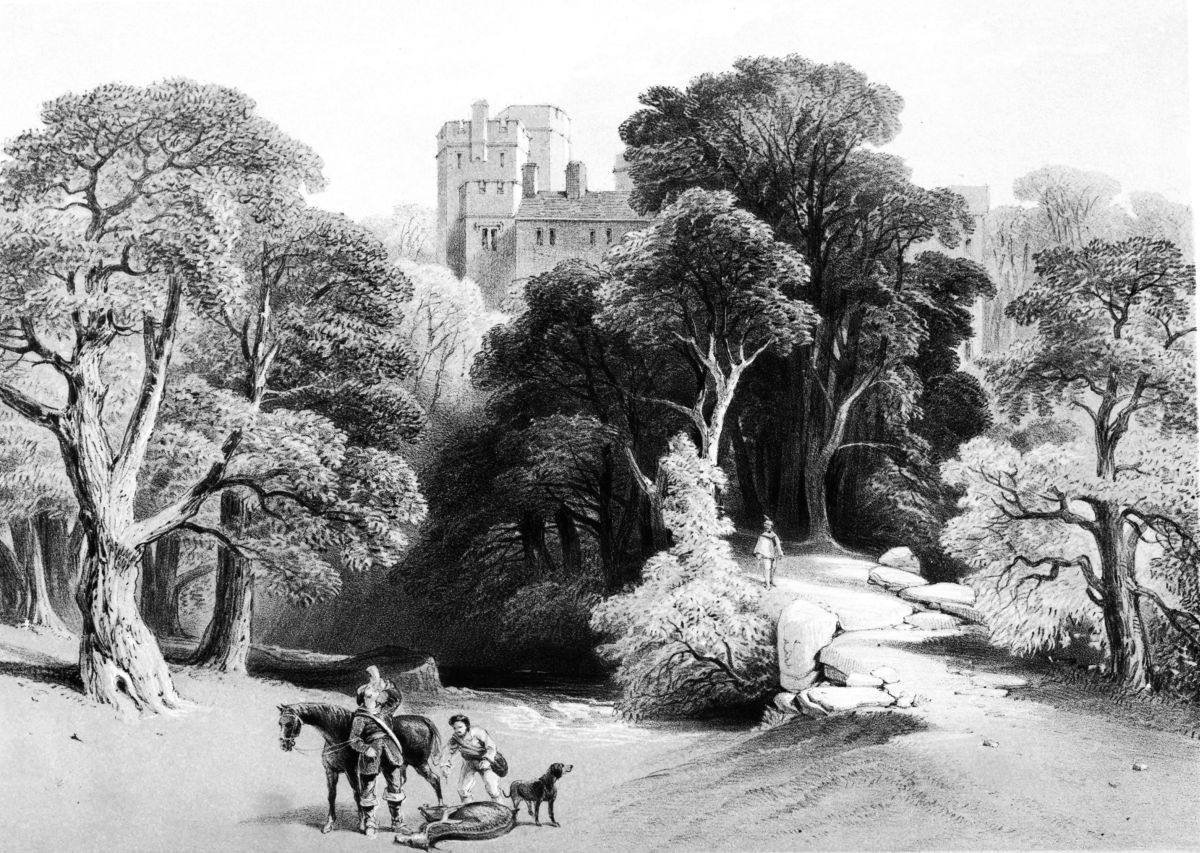
G Cattermole, Delᵗ on Stone by W Walton M & N Hanhart, Lithogʳˢ