Volume 2 — HOREHAM HALL, ESSEX.
Reading edition
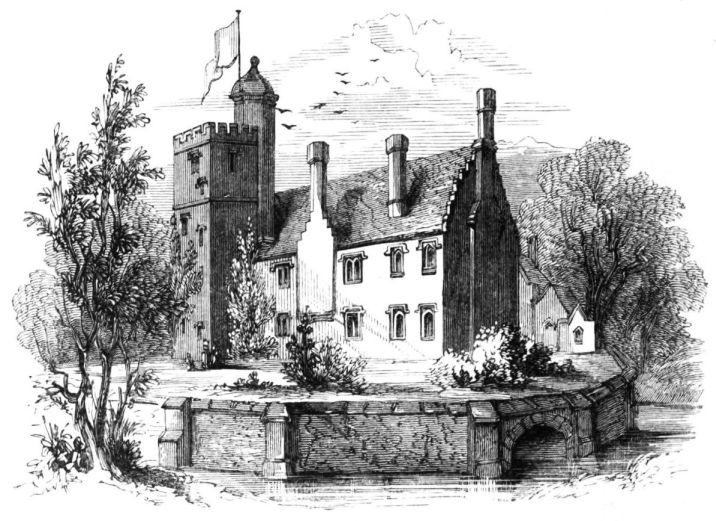
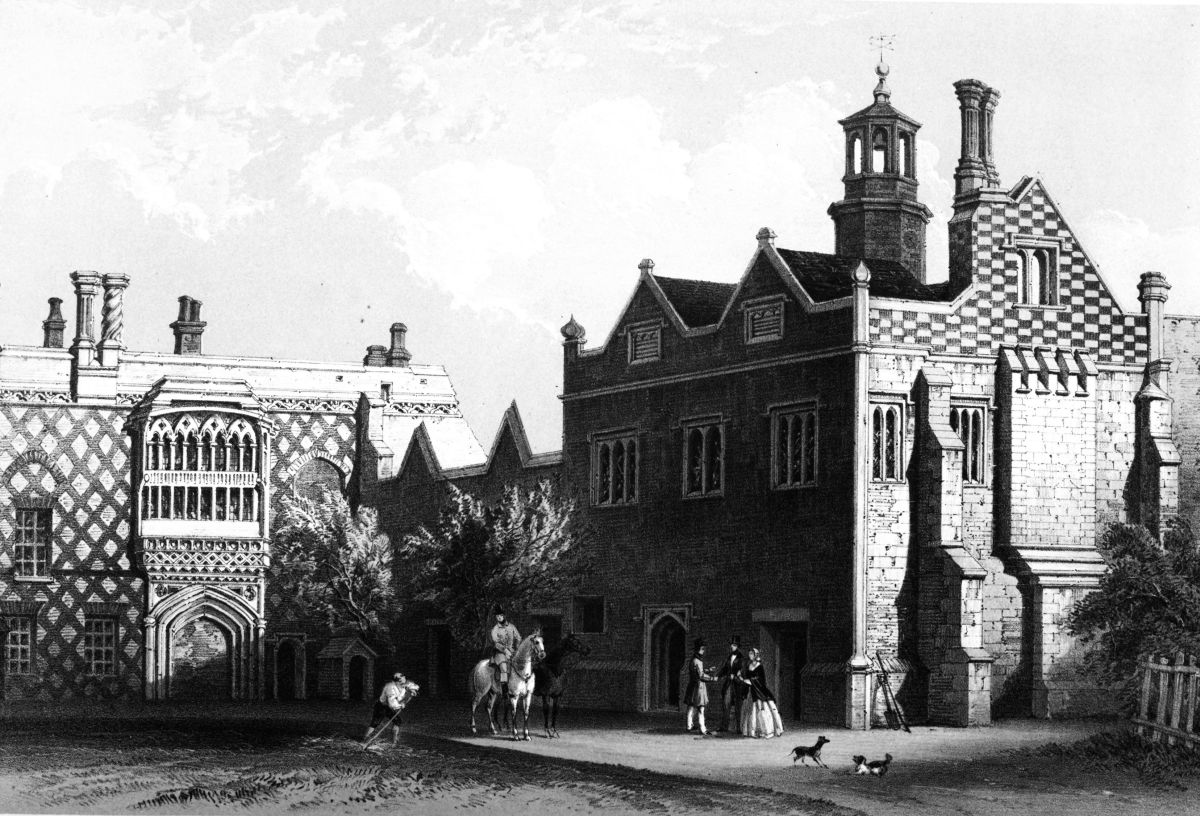
n a retired part of the county of Essex, at a short distance from the road, in a secluded and lonely spot, stands the picturesque Hall which forms the subject of our plate. The mansion is in the parish of Thaxted, and is about two miles south-west of the church. This manor is supposed to be part of the two fees and a half which the heirs of Walter de Acre held in Thaxted, Chaure, and Brokesheued, under Richard de Clare, who died in 1262. It was afterwards in the possession of the important family surnamed de Wauton; for William de Wanton or Wauton, who died in 1347, held the manors of Chaureth and Horam of the Lady Elizabeth de Burgh and her ancestors, by the service of three fees, as of the Honour of Clare. The next possessor upon record was Sir John Cutt or Cutts, who erected the mansion immediately preceding or early in the reign of Elizabeth; he was a man of great wealth, and built at Salisbury Park near St. Alban’s, and at Childerley in Cambridgeshire, according to Leland, who tells us concerning the present building in his “Itinerary,” (vol. i. p. 30, pt. 1), that “Old Cutte builded Horeham Hall, a very sumptuous house in Est Sax, by Thoxtede, and there is a goodly pond, or lake, by it, and faire parkes there about.”
Thaxted eventually became the property of Sir William Smijth of Hill Hall, in whose family it has remained to the present time.
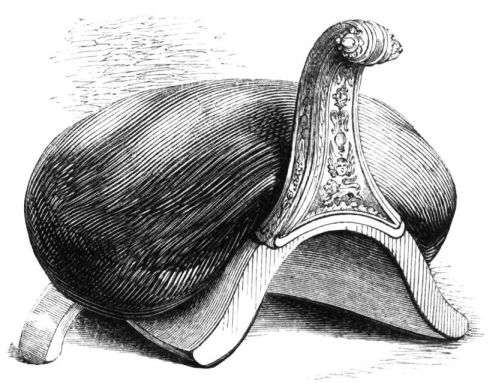
Of the learned Sir Thomas Smijth, the secretary to King Edward VI. and Queen Elizabeth, there is still preserved an ancient portrait on panel, which is let into a circle over the carved fireplace of one of the parlours. It is remarkable as being one of the very few portraits painted by Titian. Another interesting relic preserved in the Great Hall is the side-saddle of Queen Elizabeth; the pommel is of wrought metal and has been gilt, the ornament upon it is in the then fashionable style of the Renaissance; the seat, of velvet, is now in a very ruinous condition; but it is
carefully kept beneath a glass case, as a memento of the queen’s visits to this place. When princess, Elizabeth retired to Horeham as a place of refuge during the reign of her sister Mary; the loneliness of the situation, and its distance from the metropolis, rendered it a seclusion befitting the quietude of one anxious to remain unnoticed in troublous times. A room on the first floor in the square tower, seen to the right in our view, is shewn as that in which Elizabeth resided. She found the retirement of Horeham so agreeable, that often after she had succeeded to the crown she took a pleasure in revisiting the place.
The exterior features of the building are characteristic of that period when strength and security began to give way to domestic comfort and elegance; there is a mixture of the
castle and the mansion in Horeham that marks a transition period in architecture. One great feature of an earlier style of defence still remains in the moat which originally surrounded the building, but which is now partly filled up: at the back of the mansion, as shewn in our cut, it seems still to encircle the building. The old walls which form the boundary of the garden, and are washed by the water, are stone, and antique. Some fine cedars of ancient growth still flourish by its side, to add a sombre, dignified beauty to the scene. There is a grandeur about old trees which cannot be imparted to a mansion by artificial aid, and which tell forcibly its antiquity. Modern antiques may easily be called into existence by the builder, but the “ancestral trees” are as proud a memento of the early date of an ancient mansion as the coat-armour sculptured on its front.
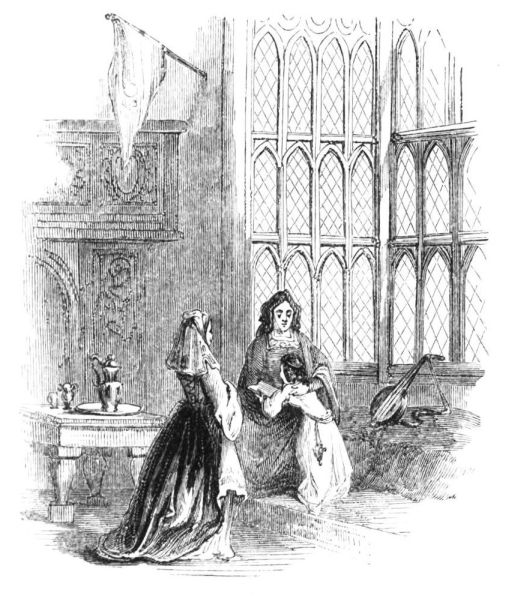
The Hall is small; it has a minstrel’s gallery, and the dais opposite is still preserved. It is lighted by a magnificent oriel window, and has a greater air of comfort than is found in those of grander proportions. The other rooms have been so much modernised, to suit the habits and tastes of the present age, that scarcely a relic remains to shew their original state.
W. L. Walton, Del et lith. M & N. Hanhart, Lithogʳˢ.
ST. OSYTH’S PRIORY.