Volume 2 — HALL I’ THE WOOD, LANCASHIRE.
Reading edition
all i’ the Wood.—This very ancient and venerable edifice—with which, far more than with many of greater magnitude and higher state among the old mansions of England, are associated ideas of permanent utility and universal good—is situate about a mile from Bolton, close to one of the admirably-managed cotton-mills of the Messrs. Ashworth. It is surrounded by indications of commerce; the smoke of many hundred factories impregnates the air, and renders even the herbage stunted and dark; while numerous steam-engines are busily at work drawing to the surface the coal, without which industry could avail little in a locality so far inland, and where the water barely suffices to aid the mighty machinery which supplies the world with the most essential article of dress. Yet the neighbourhood is full also of tokens of early Baronial splendour; and the “Halls” scattered in various directions afford unequivocal proofs of its former dignity and importance, ere the “‘Squirearchy” gave place to the “Manufacturers,” who now fill every part of Lancashire with long, tall, and broad houses, abounding in windows—grievously diminishing the picturesque, but cheering and animating to those who know that in the nineteenth century the pre-eminence of Great Britain must be secured by commerce and manufacture. Close at hand are “Smithells,” formerly a seat of the Ratcliffes, now the property of the Ainsworths; “Peel Hall,” still the inheritance of the Kenyons; “Turton Tower,” once the seat of Humphry Chetham; and “Worsley Old Hall,” the present residence of Lord Francis Egerton. The greater number of these old houses, however, have altogether changed owners;—many of them, as in the case of Hall i’ the Wood, having been deserted, or left to humbler occupants, who care only to keep the roofs above their heads, and attach small import to the interest they derive from antiquity.

The house under especial notice at one time belonged to “the Norrises;” from them, it passed to “the Starkies;” and towards the close of the last century it obtained a celebrity—which must for ever render the neighbourhood famous—as the humble dwelling of a humble artisan, who largely contributed to the prosperity of his country. From him, indeed, Hall i’ the Wood derives historic interest; the old and somewhat dilapidated mansion, although divided and subdivided into tenements for “working men,” should be as a place of pilgrimage to those who date the modern supremacy of Great Britain from the improvements in manufactures, which have upheld the State and sustained her power during peace, as the courage, fortitude, and endurance of her sons had done during a protracted war. In no part of England does the memorable line receive stronger emphasis than in the small room of this comparatively deserted house:—
“Peace hath her victories as well as War!”
The father of Samuel Crompton was a small farmer, residing at Firwood, near Bolton, who, as was the custom in those days, mingled with the business of a farmer the occupations of weaving, carding, and spinning. Samuel was born in 1753; and while an infant, was removed with his family to the scene of his after triumph, Hall i’ the Wood; which even then must have been consigned by its earlier owners to the chances of preservation from needy inmates. We borrow from various sources some particulars concerning the eventful life and important labours of this remarkable man—chiefly from a paper by John Kennedy, Esq., the generous and consistent friend of Crompton.
At the age of sixteen, he learned to spin upon “a Jenny” (of Hargreave’s make), and occasionally wove the yarn he had spun. His work, however, being but indifferent, he was led to consider how it could be improved; and the result was, ultimately, though at a far-off distance of time, the construction of “the mule”—a machine which it is foreign to our purpose to describe, but which gave to the cotton manufacture a degree of perfection to which, without it, it could never have attained.
Crompton was only twenty-one years old when he commenced the undertaking, which took him five years to effect—at least, before he could bring his improvements to maturity. He experienced much difficulty in consequence of being unable to procure proper tools with his limited earnings, acquired by labour at the loom or jenny. Not being a regular mechanic, and having to learn the use of the few he could purchase, it is matter of surprise that even in five years he succeeded in making his machine practically useful. His greatest trouble appears to have been his inability to enjoy his little invention to himself, in his own room; for the product of his machine obtaining a better price than other yarns of those times, a report was circulated that he had devised some novel mode of improved spinning: people, for miles round the country, gathered about his dwelling; and, in many instances, actually obtained ladders, and climbed up to his window to see him work. To avoid this intrusion, he formed a screen; but the annoyance becoming so great, that he could not proceed with his work to advantage, he at length laid the whole plan before a number of gentlemen, who gave him one guinea each to look at it. These sums amounted to about 50l., which enabled him to construct another machine, still farther improved, and of larger dimensions (the first machine consisted of not more than thirty or forty spindles). When relating this little history to Mr. G. A. Lee and Mr. John Kennedy, Mr. Lee having observed, “It was a pity he had not kept the secret to himself,” he replied, “that a man had a very insecure tenure of property, which another could carry away with his eyes.”
Unfortunately, therefore, Crompton never secured his invention by patent; and the consequence was, that while hundreds of manufacturers were making immense fortunes by the result of his ingenuity, he himself lived in poverty, and died little better than a pauper. He was left a widower when his children were very young, and his only daughter kept his little cottage in King-street, Bolton, where he died. He erected several looms for the fancy-work of that town, in which he displayed great ingenuity. He was fond of music, and built for himself an organ, which he had in his little cottage. In 1812 he made a survey of all the cotton districts in England, Scotland, and Ireland, and obtained an estimate of the number of spindles then at work on his principle, which amounted to between four and five millions (in 1829, the number was seven millions). On his return, he laid the result of his inquiries before Mr. Lee and Mr. Kennedy, with a suggestion that Parliament might “grant him something.”
With these data before him, Mr. Lee entered fully into the case, and made an appointment with the late George Duckworth, Esq., of Manchester, who drew up a memorial to Parliament in his behalf. This was signed by most of the principal manufacturers in the kingdom, who were acquainted with his merits. He went to London himself with the memorial, and obtained an interview with one of the members for the county of Lancaster. He remained there during the session, and was in the House on the evening that Mr. Perceval was shot, and witnessed the catastrophe. A short time before this disastrous occurrence, Mr. Perceval had given him a promise to interest himself in his behalf; and, in accordance with this assurance, had brought in a bill, which was passed, for a grant of 5000l. in full, without fees or charges.
Mr. Crompton was now anxious to place his sons in some business, and fixed on that of bleaching; but the unfavourable state of the times, the inexperience and mismanagement of his sons, a bad situation, and a misunderstanding with his landlord, which occasioned a tedious lawsuit, conspired, in a very short time, to put an end to this establishment. His sons were dispersed, and he and his daughter reduced to poverty. Messrs. Hicks and Rothwell, of Bolton, Mr. Kennedy, and some others in that neighbourhood and in Manchester, made, in 1824, a second subscription, to purchase a life annuity for him, which produced 63l. per annum. The amount was raised in small sums from one to ten pounds, some of which were contributed by the Swiss and French spinners, who acknowledged his merits, and pitied his misfortunes. He died January 26, 1827, having enjoyed his annuity only two years, leaving his daughter, his affectionate housekeeper, in absolute poverty. Such, unhappily, has been the fate of many public benefactors. They have tilled the ground and sown the seed, but others have gathered in the harvest.
“Hall i’ the Wood,” as we have intimated—the preservation of which as a monument to the memory of useful industry, and its prodigious practical results, may be regarded as a public duty—is falling gradually into decay; but its condition is such, that a very trifling degree of labour may effectually restore it. Its present occupants work at the neighbouring factories: and although we found them taking some pride in the aged walls
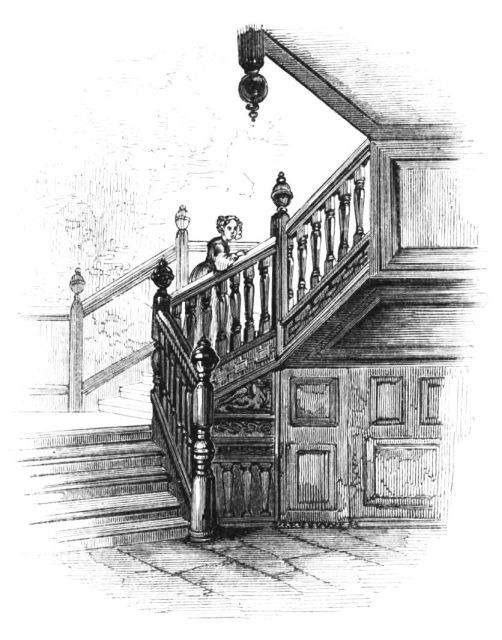
they inhabit, from them we can expect nothing in the way of its preservation. Surely it ought not to be left to the common fate of common things! The accompanying print—from an excellent drawing by Mr. J. J. Dodd, a most intelligent artist, by whom we were accompanied to this “shrine” of manufacturing devotees—exhibits the principal front, “Crompton’s Room” being indicated by the open window. The house is built in the usual style of old dwellings of a better class in Lancashire, being composed of “wood and plaster.” It has no projecting windows or carved doors; the chief entrance, at the south gable, appears to have been a later addition. It is of stone; and above it, in a square panel, is the date 1648, with the initials A.N.A. Within, a staircase of massive oak leads to the upper chambers; of which, one only—“Crompton’s Room”—seems to have been treated with respect; but this also has been doomed to periodical “whitewashings,” which, however, have failed to efface a deeply-cut panel (given as our initial letter), interesting as that upon which the eyes of “the Discoverer” must have often looked.
Seen from a distance, the house is highly picturesque; it stands on high, rocky ground, which on one side is almost perpendicular to a great depth, broken into masses, covered with moss and lichens, among which, here and there, shoot out the branches of the oak and ash, which have found places for their roots in the crevices of the rocks. Some of these trees have been partially hurled down by frequent storms, and their gnarled branches form singular contrasts with the silvery stems of a few slender birch-trees, which flourish in young vigour by their sides. At the foot of the precipitous descent, a broad and somewhat clear stream winds its way over large stones, forming tiny waterfalls; passing under a rustic wooden bridge, it makes its way through the adjacent valley to supply many scores of mills and factories, creating wealth.
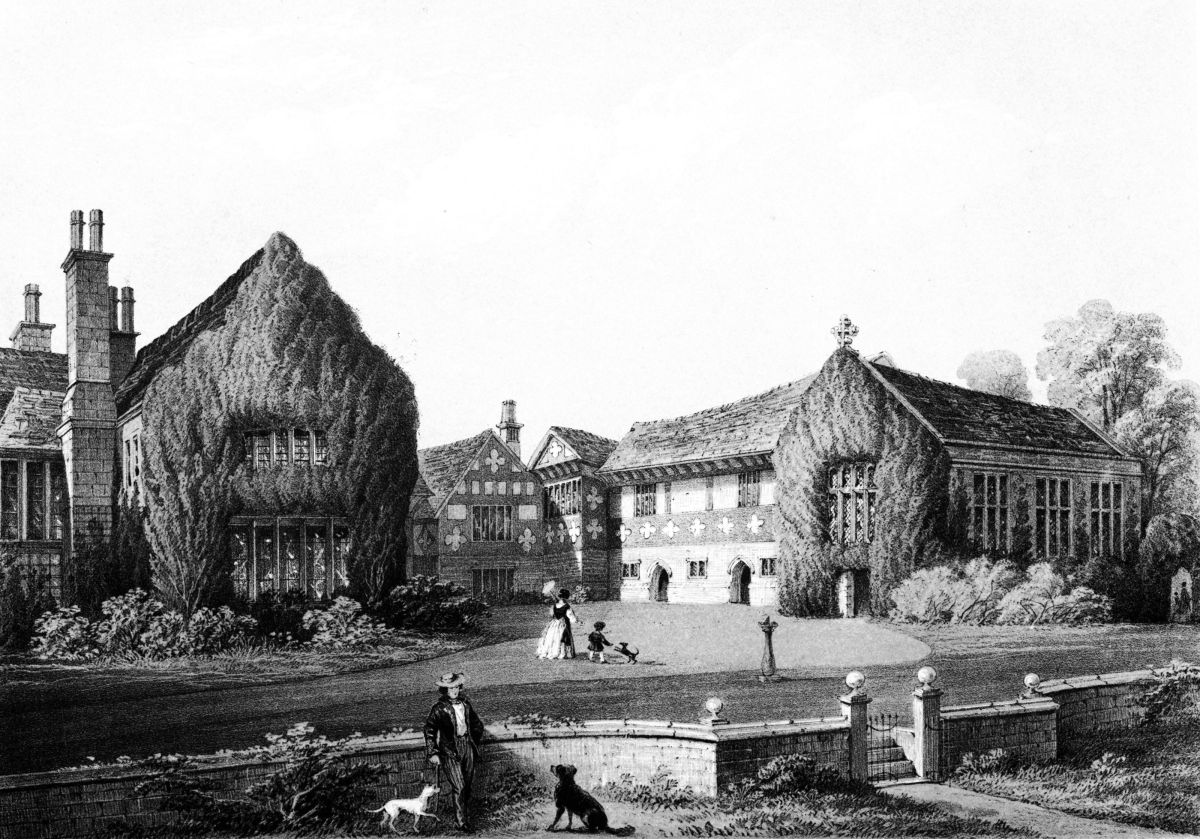
J. S. Dodd, Delᵗ. on Stone by W. Walton. M. & N. Hanhart, Lithogʳˢ.
SMITHELL’S HALL, LANCASHIRE.