Volume 2 — SHERBORNE LODGE, DORSETSHIRE.
Reading edition
herborne Lodge, now the seat of Earl Digby, stands upon a rising ground, at a little distance from the ancient castle. It is surrounded by a large park, which, according to Leland, was in his time “inclosed with a stone waulle.” The Lodge is built on a singular plan, in the form of the letter H, with hexagonal towers at the four corners, and two others on each side of the centre of the principal front. The general appearance of the building is peculiar rather than picturesque; but, notwithstanding, it offers much that is interesting and worthy of admiration. The centre part is said to have been built by Sir Walter Raleigh, who, “by his merit and the royal favour,” obtained a grant of the Manor and Castle of Sherbourne, and many other lands belonging to the See of Sarum. He is said to have spent much time here, beginning “very fairly to repair the castle” (the ruins of which still remain); but, altering his purpose, “he built in the park adjoining to it, from the ground, a most fine house, which he beautified with orchards, gardens, and groves of much variety and delight,” so that for the “pleasantness of the seat and the delicacies belonging to it, it is unparalleled by any in these parts.” Notwithstanding these laudations of what Sir Walter had done, he appears to have left much of his plan incomplete.[18] Two wings were added soon after the Restoration, by the Earl of Bristol, who appears to have drawn freely on the ruins of the castle for the required materials.

The house contains many interesting and valuable pictures, chiefly portraits of remarkable historical personages. Among them is a good specimen of Cornelius Jansen; a portrait of Elizabeth, Countess of Southampton; also a portrait of Henry, first Earl Digby, by Sir Joshua Reynolds. But the most remarkable is a picture of the famous procession of Queen Elizabeth to visit Lord Hunsdon, at Hunsdon House, in Hertfordshire; she is carried in an open sedan by eight of her principal noblemen. Vertue ascribes this picture to Gerard, her majesty’s painter.
Sir Walter is said to have used unfair means to gain possession of this property, “being
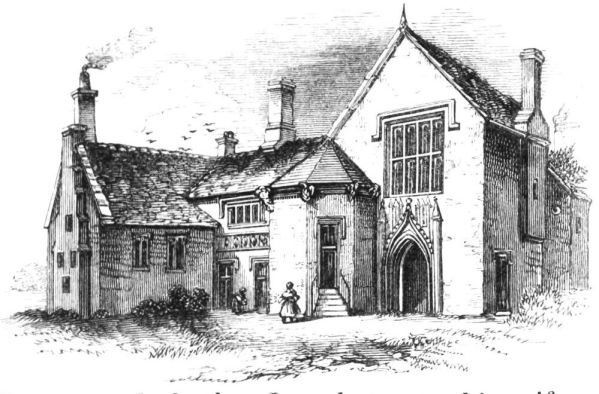
charged with having persuaded Bishop Coldwell to pass it to the Crown, on his election to the See of Salisbury, after which Sir Walter obtained a grant of it;” which, however, in the end proved a snare to himself, for it excited envious and malignant feelings in his fellow-courtiers, whose machinations were not without influence in promoting his subsequent disgrace and death. In a letter to his wife, written after his condemnation, he desires her to procure his dead body, and lay it either at Sherborne or in Exeter church, by his father and mother. It does not appear that he was buried at either place.
The grounds around the Lodge and Castle ruins were laid out and “improved” by Brown, of whose skill in landscape gardening they present a fair example; of which one of the most noticeable features is a large artificial lake, formed by confining within the grounds what was formerly an inconsiderable stream, but which is now considered one of the most beautiful and extensive pieces of water in the west of England.
Sherborne contains several interesting remains, of which we have given two,—the Abbey
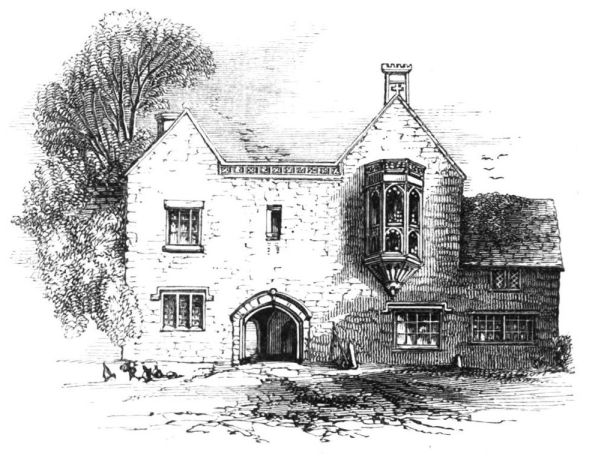
House (introduced above) and an old mansion in St. Swithin’s Street; the latter conspicuous for a beautiful oriel window. The whole neighbourhood is, indeed, rich in antiquities, of a rare and curious order; not the less valuable because of their association with the romantic history of one of the most remarkable men of a remarkable age; in particular we may make reference to an ancient dwelling, now a country inn, which supplies abundant evidence of former state and splendour; although now applied to “base uses” of which its founders must have had little apprehension.
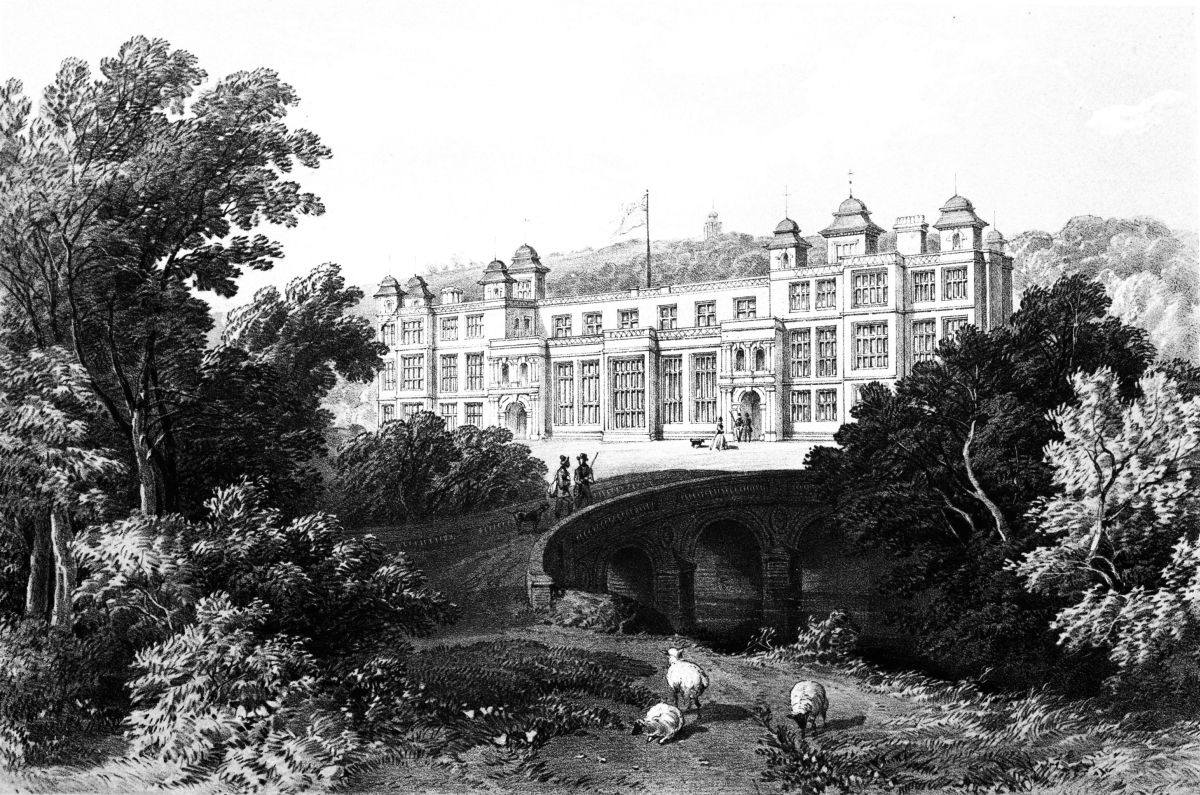
J.D. Harding, Delᵗ. on Stone by W. Walton. M & N. Hanhart, Lithog{rs}.
AUDLEY END, ESSEX.