THE FORMAL TACTICS OF INFANTRY. (continued 7)
Walter Krueger translation
The conduct of the attack was, of course, considerably influenced by the character of the terrain. The 1st Army, fighting in hilly country, perhaps remained true longer to regulation formations and long rushes than the other Japanese forces, but was finally obliged to resort to a wide extension of closed bodies. The IInd and IVth Armies were differently situated, as the attack over open plains fell to their lot.
Speaking generally, the following details may be given in regard to the method of attack of the Ist Japanese Army:[351] Units were pushed into action abreast; objective points were assigned to each; and certain lines or points, according to which they had to maintain touch, were indicated to subordinate units. To avoid a surprise, if for no other reason, thin firing lines were formed at the outset, and in a serious attack whole companies, in dense firing lines capable of developing a strong fire, were at once thrown in; these advanced to mid ranges in order to open fire, as a rule, under 1000 m. The Ist army had a special penchant for making rushes of 80-100 m.,[352] usually by entire companies; the assault was, in many instances, begun as far as 300 m. from the hostile position, and then pushed home; supports and reserves followed in extended formation, but assembled promptly on reaching cover. The infantry was disinclined to intrench during an advance, but never neglected to fortify quickly a captured position. In the combats of the Ist Army we will find the best lessons applicable to our conditions.
Examples.
1. The engagement of the Guard Division at Yangtsuling on July 31st, 1904.[353]
2. The attack made on October 11th, 1904, by the 15th Infantry Brigade (2nd Infantry Division) against Temple Hill (Terrayama), which was held by 4-6 companies.[354]
Fire was opened at 900 m.; long rushes were used and firing line and supports were deployed; after a brief but violent fire action at 500 m., the hostile position was reached in a single rush and carried.
The artillery, to be sure, supported this attack with accelerated fire.
3. The attack made by the 4th Guard Regiment on October 12th, 1904, against a height south of Huaku (battle on the Shaho).[355]
4. The attack made by the 3rd Brigade (2nd Infantry Division) under General Matsanuga, on October 12th, 1904 (long rushes), against the heights south of Shotasko (battle on the Shaho).
Outline Sketch of the Formation of the 3rd Brigade.
Frontage about 2000 m.
4. Infantry:
5. and 6. 4. and 2. 12. and 11. Cos.
7. and 8. 1. and 3. Cos.
29. Infantry:
10. and 2. Cos.
9. and 3. Cos.
Brigade Reserve:
9. and 10. Cos. 4. Infantry.
11. and 12. Cos. 29. Infantry.
Troops in the act of coming up, but not employed:
1. and 4. Cos. 29. Infantry. and II. Bn. 29. Infantry.
First line: Eight companies (apparently entirely deployed). Interval between skirmishers 3 paces; between companies 40 paces.
The first halt (lasting seven minutes) was made at 1500 m. and the distance to 800 m. was then covered at a rapid run. The men that could not keep up, halted to recover their breath and then followed independently. At 800 m., the line opened a lively fire at will, which lasted for two minutes, and then advanced by rushes by companies (first the right, then the left companies of the battalions). During this advance the supports (2 battalions) were absorbed by the firing line. At the same time the brigade reserve approached closer to the firing line (the original distance between reserve and firing line, before the advance began, was 300 m.). The last halt for firing was made at 250 m., from the enemy’s position, and the latter was then carried in one rush. The losses amounted only to 235 men.[356]
In the IInd and IVth Armies, who fought, as a rule, on terrain devoid of cover, a far more cautious method of attack was produced. The distinguishing features of this mode of attack were thin firing lines (skirmishers at intervals of 5-10 paces) increasing only very gradually in density, and great frontage (a company 250, a battalion 800, and a brigade 2000-3000 m.).[357] This caused the attack to falter in many instances as soon as it had come within 400 m. of the hostile position, whereupon nothing remained but for the line to intrench and to work forward slowly from one position to another.
Examples.
1. The engagement of the 3rd Infantry Division on October 12th, 1904, at Shiliho (battle on the Shaho).[358]
2. The engagement of the 5th Infantry Division, from March 6th to 9th, north of Madiapu (battle of Mukden). This division required three days to work forward from 1100 m. to within assaulting distance of the enemy’s position. Cover for men standing upright was constructed at 1100, 950, 530, 390, 300, 200, 160 and 125 m., that under 300 m. being built of sand bags.[359]
3. The combats of the 10th Division on March 3rd and 10th, 1904 (battle of Mukden).[360]
Confidential British instructions dealing with the tactical lessons of the Russo-Japanese war, make the following deductions: “* * * * The above shows the great importance of local reconnaissance by infantry, of which considerably more must be demanded than has been done up to the present time in European armies. It shows, moreover, the advantages of thin firing lines during the preparatory stage of the action, and the insignificant effect produced by shrapnel and long range fire on such lines in which it is desirable to advance, without halting on the way, to within 1000 yards of the enemy. The necessity of gaining a superiority of fire before advancing to the assault, and the necessity of an increased supply of ammunition, are confirmed anew. It is further demonstrated that the bayonet of the infantryman is still capable of playing an important role in battle.”
2. THE CONDITIONS UPON WHICH SUCCESS DEPENDS.
The Russo-Japanese war confirms the opinion that the issue of combat is but little influenced by the formations taken up; that esprit and the determination to conquer are of far greater importance than any formation. The most difficult task that infantry can be called upon to perform consists of successfully pushing home an attack over open ground commanded by hostile fire. “It would be wrong,” said Fieldmarshal Moltke, “were one to attempt to lay down in regulations that a force should not advance over a plain against an enemy under cover. But every superior commander ought to consider what such an operation portends.” Heavy losses are unavoidable in a destructive fire fight lasting for hours.[361] The attack will not succeed so long as the enemy commands the plain with his fire. The commander of the attacking force must find ways and means to wrest this command from the enemy. All of the battles of recent campaigns have demonstrated that an attack is bound to succeed if it is thoroughly prepared by infantry and artillery fire, is undertaken by adequate forces, and is pushed with determination close to the enemy; and that such an attack is, in fact, superior to the defensive. The success of an attack on a position prepared for defense might depend upon the following preliminary conditions:
(a) Careful reconnaissance, for the purpose of determining the most favorable direction for the attack.
(b) Occupation of the foreground of the hostile position. When the foreground is entirely open, an advance must be made under cover of darkness up to the medium ranges.
(c) Preparation of the infantry attack by the closest coöperation of infantry and artillery.
(d) Timely determination of the point at which the decisive attack is to be made.
(e) Careful utilization of the terrain during the advance, so as to allow of delaying the opening of fire until the force is as close as possible to the enemy.
(f) Suitable disposition, distribution in depth, and deployment of a strong force for the purpose of bringing about a superiority of infantry fire. The organization detailed to make the attack must have its entire effective strength available for accomplishing its proper task, and not be compelled to detach parts for guarding its flanks.
(g) Ensuring concerted and simultaneous action on the part of the attacking forces. As the enemy has given up any idea of assuming the offensive, at least for the time being, the attacker should not allow the advantage to escape him of choosing time and direction of the attack.
3. PREPARATION OF THE ATTACK.
Reconnaissance. Preparatory Position.
“If the enemy decides to stand on the defensive, he renounces the initiative for the time being. The attacker will then have time to reconnoiter the hostile position and to weigh all the circumstances that favor the attack. He should not limit himself to reconnaissance by the cavalry and to observation through field glasses. Mounted officers’ and infantry officers’ patrols should supplement this reconnaissance, and complete the information gained as the enemy is approached.” (Pars. 362 and 363 German I. D. R.).
The local reconnaissance (see p. 248 supra) should be conducted with all possible care; timely directions should be given in regard to it during the approach to the battlefield;[362] the activity of the reconnoitering bodies should continually increase as the enemy is approached; and the work itself should be divided in a systematic manner. Excessive thoroughness may retard reconnaissance work to such an extent, on short winter days especially, that success may be jeopardized. (Par. 305 German I. D. R.). As a result freedom of action will be lost and the energy of the attack weakened. It would be wholly wrong to postpone the decision for making the attack until something definite is known of the strength and dispositions of the enemy. These matters are almost never cleared up until after the battle. The decision as to whether or not an attack should be made is determined primarily by the general situation. (Par. 355 German I. D. R.). The latter may force a commander to advance promptly without permitting him to await the results of the reconnaissance. The character of the terrain and the preparation the enemy is known to have made, determine whether the commander ought to attack at once, whether he ought to utilize the cover of darkness for the advance of the attacking troops, or whether he ought to attempt to maneuver the defender out of his position.
The information required as a basis for this decision will, as a rule, not be obtainable without a fight. In spite of all the objections arrayed against reconnaissances in force, they cannot be avoided, if it is desired to gain prompt and certain insight into the enemy’s situation. It cannot be expected that the defender will passively permit the assailant to gain an insight into his dispositions. A feint will accomplish nothing; the enemy must be seriously engaged, so that he will show his hand.[363] Yet in spite of these combats, misapprehensions are not precluded.
It is quite natural that isolated detachments, in their endeavor to gain an insight into the hostile dispositions, may find themselves suddenly within short range of the enemy. In such a situation, the detachment should maintain its position, as its fire will frequently facilitate the approach of the other attacking troops. Almost every one of the more serious engagements furnishes examples illustrating this feature.[364]
In order to guard the reconnoitering troops from being driven back, if for no other reason, it is advisable to place in readiness an adequate force of artillery. As the artillery is protected by shields, it can take up the fight even against superior artillery with better chances of succeeding than in the past.
If the commander has decided to attack and has determined against what part of the hostile position the main attack is to be made, the foreground of the hostile position is at once occupied, and the enemy’s advanced troops forced back, so as to prevent the defender from gaining an insight into the dispositions of the assailant.
The assailant should launch as few troops as possible for initiating the action. They should avoid engaging prematurely in a fire fight with the infantry of the hostile main position, even if the terrain would permit a covered approach to short range. If the advanced troops allow themselves to be enticed into doing this, they expose themselves to the danger of suffering a defeat, and oblige the commander of the whole force to launch for their relief troops that were intended for the main attack.[365]
Insufficient information in regard to the enemy and undue precipitation in issuing orders may place advanced troops in such an unfavorable situation. If the defender allows himself to be tricked into assuming the offensive for the purpose of driving off harassing detachments, so much the better for the assailant, for the latter’s artillery will then find an opportunity to fire on the enemy.[366]
Austria. “Under certain circumstances, the covering troops will have to be reinforced at an early moment in order that a strong line may be formed opposite the enemy, but, in many cases, they will nevertheless still abstain from advancing into the zone of effective fire.” The Austrians usually employ strong covering bodies. The Germans desire to ensure simultaneous action on the part of all the troops in opening the combat.
At Spicheren the commander of the 14th Infantry Division, under the erroneous assumption that the heights of Spicheren were only occupied by troops covering the entraining at Forbach, issued orders to General von François to drive away the hostile artillery. All of Frossard’s Corps, however, was in position on the heights on which the artillery was posted.[367]
At 10 A. M., on August 6th, 1870, the commanding general of the Vth Army Corps issued orders to the advance guard to cross the Sauer with four battalions at Wörth and Spachbach (1500 m. apart) and to occupy Wörth and the heights beyond, where the entire corps of Mac Mahon was in position.[368]
The advance of the attacking troops, under cover of the advance guard, into a preparatory position, is made in such a manner that units are opposite their objectives when the subsequent forward movement against the enemy is begun.[369] This frequently requires a rearrangement of the forces so that even an assailant who is numerically inferior may be superior at the decisive point. A simultaneous attack from the front and flanks requires reserves everywhere and is opposed to the economical employment of the forces; it may easily lead to failure, and is justifiable only when the assailant is greatly superior in numbers or morale.
A premature deployment impairs the leader’s influence on the course of the combat and makes it difficult to change the direction of the attack. Route columns, taking advantage of all available cover, will, therefore, be retained as long as possible, and only subordinate units permitted to march directly toward their proper objectives, until the hostile fire compels a more extended deployment (development). The preparatory position is taken up in the last sheltered area in front of the hostile position, provided that that area is large enough to accommodate the attacking force when deployed for action, and to shield it from the observation and the fire of the enemy.
In country generally devoid of cover, infantry will have to be placed in a preparatory position when three kilometers or more from the enemy, even when the latter’s artillery will in all probability be neutralized by our own.
“In order to ensure the concerted advance of the various units into the preparatory position, it is advisable, especially in close country, to have them move from one covered position to another. If this is done, units whose march was favored by the nature of the ground, will not arrive prematurely within dangerous proximity of the enemy, while others who had farther to go, or whose advance was difficult, are still a considerable distance to the rear. The leader should make his dispositions so that no loss of time will result from this advance from one covered position to another.” (Par. 369 German I. D. R.).
Where large forces are concerned, the attack on a position carefully prepared for defense will consume several days, the assailant placing his artillery in position on the first day and reconnoitering under cover of infantry, which is pushed to the front.[370] The troops of the first line are pushed forward far enough before daylight so that they can intrench under cover of darkness and open fire at dawn. This will be more difficult to accomplish when covering troops or advanced positions are located in front of the hostile position. If the assailant has succeeded, on the previous day, in driving these troops back upon the main position, an advance to within effective range may be made during the night in order that the fire fight may be opened on the succeeding day. Although the chance of taking the enemy by surprise is eliminated in such a case, the advantage of having diminished the distance that will have to be crossed under fire remains.[371]
It is difficult to find shelter for the rearward echelons, which must be kept in readiness in very close proximity to the leading line. These rear echelons must either be intrenched or at least sheltered by masks. General actions should be avoided at night.
4. THE COÖPERATION OF INFANTRY AND ARTILLERY IN BATTLE.
Upon completion of the concentration for action (development), the infantry has to advance within the zone of effective infantry fire. In doing this the infantry must either pass by or through the artillery which is already engaged.[372]
During the Russo-Japanese war, the effect of shrapnel, in spite of the mediocre matériel and the lack of shields, forced the artillery of both belligerents to seek shelter on the reverse slope of heights. When this was neglected and when batteries went into position in the open, within effective range, they were quickly silenced. The fear of shrapnel caused both sides to advance cautiously, to relinquish all close order formations at an early moment, and to employ the spade extensively. This alone was evidence of the fact that the artillery had accomplished a good deal. Moreover, it was not altogether accident that the first few of the larger Japanese night attacks occurred coincidentally with the appearance of Russian artillery matériel, which was superior both as regards numbers and power. The new German I. D. R. (par. 444), in contrast with the previous edition (II, par. 82). prescribe that the infantry attack should not be postponed until a superiority of fire has been gained. Thus, the regulations draw logical conclusions from the modern armament and seek to avoid useless bombardments of hostile positions (such, for instance, as the Russians indulged in at Plevna and the British in South Africa).
“The principal duty of field artillery is to support the infantry in the most effective manner. Its duties are inseparably connected with those of the infantry. It should, on principle, always fight the targets that are most dangerous for its infantry.” (Par. 364 German F. A. D. R.).
The German Field Artillery Drill Regulations prescribe that the guns should fire over the heads of the advancing infantry (par. 375), and that single batteries should accompany the infantry attack to within close range of the enemy (par. 471). When an assault is to be made, the infantry expects the artillery to direct its fire against the point of attack until immediately before the assault begins.
“But our infantry should never be obliged to dispense with the support of artillery. The gun shields afford considerable protection, even at the short ranges. At the decisive moment the artillery should not shrink even from the heaviest infantry fire.” (Par. 369 German F. A. D. R.).
“In selecting an objective, it is essential for the artillery to consider whether, by fighting it, the infantry will be effectively supported. Whether the hostile infantry or artillery is chosen as an objective will depend upon the situation. As a rule, the hostile artillery will be the proper objective for our artillery during the preparatory stage of the action. As the distance between the opposing infantry forces decreases, it will become more and more necessary for the artillery to devote itself to the hostile infantry.” (Par. 432 German F. A. D. R.).
If the artillery is equipped with shielded guns, it can devote itself for some time to the most important target without regard to the hostile artillery, contenting itself with merely occupying the latter’s attention. (Par. 469 German F. A. D. R.). To silence artillery in a concealed position requires curved fire and a good deal of ammunition; but, on the other hand, artillery so posted cannot fire upon advancing skirmishers.[373] Therefore, the advancing skirmishers of the assailant should force the hostile artillery to leave its cover and to expose itself to the attacker’s artillery. (Pars. 330 and 496 German F. A. D. R.).
The result of this procedure will be that the artillery of both sides will engage each other’s attention with only a small part of their guns, and concentrate the remainder on the hostile infantry. It is obvious that the infantry will very soon demand of its artillery in definite terms that it should first annihilate the hostile artillery before the infantry can think of continuing the attack.
The provisions of the German regulations in regard to the fusion of activities of infantry and artillery mark an entirely new departure. The commencement of the infantry attack is accordingly no longer dependent upon the result of the artillery combat; on the contrary, both combats are of equal importance and proceed along parallel lines; the only danger is that the infantry may make a headlong rush to the front before a superiority of fire has been gained.
Confidential British instructions, dealing with the lessons learned by the Japanese in Manchuria, contain the following: “Intrenched artillery can be permanently silenced only under very exceptional circumstances, as it will withdraw its personnel temporarily, as soon as the hostile fire becomes too hot, and resume its fire again when that of the enemy abates. The infantry attack should therefore be launched without awaiting the result of the artillery combat, but the infantry must insist upon the artillery completely engaging the attention of the hostile guns during the advance. Another reason for not awaiting the outcome of the artillery combat, lies in the great frontage of battle lines. The unsuccessful attack made by a division will then frequently cause the neighboring unit to make an immediate attack.”
Austria (1904). “The artillery must be given an opportunity and the necessary time for effectively preparing the infantry attack. So long as the artillery engaged with the hostile batteries has not achieved a noticeable success, or is not at least neutralizing the hostile artillery, the infantry attack remains a difficult undertaking.”
France. The artillery during the preparatory stage of an action: The artillery should endeavor to silence the hostile artillery as quickly as possible, without employing more guns than are absolutely necessary. The commander should give the order for the attack only when the preparation is considered sufficient.
England. The regulations emphasize the necessity of pushing infantry forward, and of supporting that infantry energetically, so as to compel the defender to expose himself. “As soon as the hostile batteries have been sufficiently silenced, or the infantry advances to the attack, the fire is directed upon the point of attack in order to prepare and to cover the assault.”
Italy. The regulations state that artillery is a supporting arm for infantry. “If the hostile artillery discloses its position from the start by employing direct fire against the assailant’s artillery or infantry, the attacker’s batteries endeavor to silence it or to draw its fire upon themselves, in order to facilitate the deployment of their own infantry. If, on the other hand, the hostile artillery remains concealed for the purpose of saving its fire for the infantry when the latter offers a favorable target upon arriving within effective range, then it would seem advisable for the artillery of the assailant not to open fire at all, or to open fire only with enough guns to cope with the available targets. The assailant’s artillery brings the fire of all its batteries into play when the defender’s artillery is compelled to come into action in order to support its own infantry against the advance of the attacker’s infantry.”
The difficulties of providing for coöperation between infantry and artillery are due to the impossibility of distinguishing at all times with certainty between friend and foe (assaulting guidons),[374] since the elimination of powder smoke and the adoption of neutral tinted uniforms; and, further, to the circumstance that, while we have a signal for increasing the range of the artillery (g.g.g.), we have none for indicating that the fire is to be concentrated upon certain points. “Uninterrupted communication with the fighting line in front must be provided for. For this purpose officers, who report by signal or by telephone, should be sent forward. These officers are primarily to ascertain how close their own firing line is to the enemy, in order that the artillery may keep up its fire as long as possible.” (Par. 376 German F. A. D. R.). In England, it has been suggested to indicate the point upon which fire is to be concentrated, by the colored ball of smoke of a special projectile. It requires strict attention on the part of the infantry to make its work harmonize with that of the artillery. Every opportunity, for example, when the hostile infantry is forced under cover by a burst of fire, should be utilized for advancing. This is particularly emphasized in France. The defender is to be blinded by a hailstorm of fragments. “Every rafale of the artillery will either cause the most advanced line to make a rush, or the troops of the rear line to come up to the firing line in order to reinforce it or to carry it forward as much as possible. Thus the rafale becomes a veritable shield for the infantry (véritable bouclier de l’infanterie).” Langlois.
5. THE POINT OF ATTACK.[375]
The reconnoitering troops are charged with the duty of ascertaining the parts of the hostile position which can be approached under cover, which are weaker than the others (frequently true of the flanks),[376] or which can be enfiladed. The attack will usually be directed against the weakest point in the hostile position, or that on which the greatest volume of fire can be concentrated from enfilading or commanding positions. At all other points of the battlefield, the assailant will endeavor to deceive the opponent, with weak forces, as to his true intentions, but, at the decisive point, he should launch superior numbers. The French regulations contend that such weak points will only become apparent during the course of the fight, and therefore separate the troops into a preparatory and a decisive combat group.
The desire to strike the weakest point in the enemy’s line causes the decisive blow to be directed against a flank, and the numerical superiority requisite for gaining the superiority of fire, leads to
6. ENVELOPMENT. (Pars. 392-396 German I. D. R.).
The desire of the attacker to put a superior number of rifles into the fight, in order to gain a superiority of fire more quickly, naturally leads to an extension of the firing line and to an overlapping of the defender’s line. The advantage of overlapping the enemy’s line lies in the fact that part of the line attacked is exposed to both frontal and oblique fire. The effect of this oblique fire is increased by bending the wing of the attacking line toward the enemy. If the attacking line succeeds in pushing its firing line so far forward that not only the hostile wing but also the hostile flank is struck, an envelopment is brought about with the result that the lines of fire of the assailant cross each other within the hostile position. If the defender refuses a wing, portions of his line may be enfiladed. This will cause such heavy losses that the defender will begin to succumb first at the salient point of his line. A further advantage is gained by a pressure on the enemy’s line of retreat.
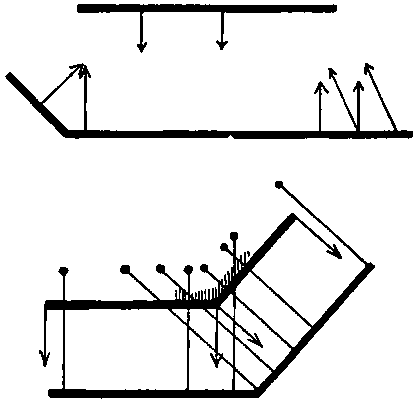
Pure frontal attacks offer little prospect of success;[377] they may perhaps force the enemy back, but they cannot annihilate him.
For carrying out the attack itself, it is immaterial whether the commander launches it against the hostile front or a hostile flank; individual companies, battalions, and, in large units, regiments, finally make a frontal attack anyway. The fear of the front of the enemy should not lead the enveloping force to attempt to execute another enveloping movement when it encounters a newly formed front. Surprise is, to a certain extent, essential to the success of a flank attack.[378] The troops holding the enemy in front [secondary attack] must, therefore, hold him in such a manner as to keep him in ignorance about the true point of attack, must so engage his attention that he will finally place the bulk of his force into the frontal action. If this does not occur, the opponent will soon distinguish sham from reality and will not oppose a weak, inactive containing force with more troops than are absolutely necessary. In this connection, compare the conduct of the 1st Army at Königgrätz and of the Prussian Vth Army Corps at Wörth with the vacillating action of the Russian IIIrd and Ist Armies at Sandepu.[379] So long as the enemy is not firmly held in front, he will be able to evade an envelopment by withdrawing. The combats of the Boers in the Orange Free State furnish numerous examples of this fact. The Austrian regulations have very properly coined the term “attack on two fronts”, which better indicates the task of both parts of an attacking force.
Whether the decisive blow is directed against the front or a flank, depends upon the result of the fire. The advantages offered by an enveloping movement must not lead to holding the enemy once and for all in front, while the main attack is directed against his flank. A frontal attack made in conjunction with a threatening demonstration against the hostile flank frequently offers far greater prospects of success.[380] If a superiority is to be employed to advantage, an envelopment must be made; all objections advanced against the “enveloping craze” are disposed of by this statement.[381] “A condition precedent to an envelopment is that the enemy be held in front. For this purpose a determined demonstration is most effective.” (Par. 392 German I. D. R.).
The risks involved in an envelopment must not be overlooked—overextension and dispersion of the troops;[382] the possibility that the troops fighting in front and those fighting on the flank, separated from each other, may be defeated in detail, whether this be brought about by the defender assuming the offensive, or by the force holding the enemy in front allowing itself to be enticed into making a premature advance and suffering a defeat before the envelopment has a chance to become effective.
“The envelopment is effected in the simplest manner if the forces designated for this task, when still at a distance from the enemy, are given a march direction that will bring them against the hostile flank.
“When initiated during the development for action or when carried out by retained reserves, the envelopment is much more difficult.” (Par. 393 German I. D. R.).
In the last-mentioned case it may happen that the force detailed to make the flank attack strikes the enemy’s front instead of his flank. The same is true of attempts to envelop with parts of the infantry of the first line that are already deployed, perhaps already engaged, when the terrain is not specially favorable for such a movement. Such movements may, in special cases, be carried out at night. (Enveloping movements of the divisions of the Japanese IIIrd Army at Mukden). As a rule, this brings about only an overlapping and flanking of the parts of the hostile position next adjacent to the wing making the movement, but does not produce a concentric effect on the hostile flank. Yet, even weak detachments that reach positions from which they are able to enfilade the enemy, facilitate the advance to the front.
In starting an enveloping movement when at a considerable distance from the enemy, the force which is to make it, is directed upon a point located in rear of the hostile position, approximately where his reserves are presumed to be. If then the fighting line is further extended toward the outer flank, the assailant avoids facing the hostile front directly, and will almost invariably have a start over the defender in extending the threatened wing. The troops still in the act of withdrawing from the route column naturally take charge of the protection of the flanks.[383]
If a flank march in front of the enemy should become necessary, it can be undertaken with sufficient safety only when proper preparations have been made—distribution in depth, shortening of route columns, due regard being had to protection of the front and flanks—to permit a deployment of the force at the right moment and in a suitable formation toward the hostile side.[384] Within effective range of the enemy, such a movement by the flank can be carried out only when cover is available, otherwise the hostile fire will very quickly force the troops making the flank march to face to the front.[385]
The attempt of the 16th Infantry Division to envelop the French position on the Hallue[386]: The 30th Brigade used the road leading along the hostile front from Querrieux to Frechencourt, for its movement. The leading regiment of the brigade, the 28th Infantry, on debouching from Querrieux, immediately faced toward the annoying flanking fire and endeavored to advance in the face of it, while the brigade commander, energetically carrying out the orders given him, led the 68th Infantry toward Frechencourt, thus forestalling several French battalions that were hurrying up from the east. The village was occupied and held by the 68th Infantry, but a frontal offensive movement against the hostile main position could not be carried out from here either, in spite of the inferiority of the French troops.
Whether an enveloping force can be sent into action at once without being first placed in a preparatory position[387] or whether it should first be concentrated, depends upon the situation of the troops engaged in front with the enemy (the necessity of relieving the pressure on the Ist Army engaged in front with the enemy at Königgrätz), and upon the counter-measures taken by the enemy. If the assailant encounters a newly formed front, it would be a mistake for him to attack successively with the different units.
Whether the troops holding the enemy in front participate in the assault during an enveloping movement, depends upon circumstances. They may frequently better ensure the success of the attack by delivering an enfilading fire than by advancing. The commander should, at any rate, not lose sight of this advantage. If both groups (the enveloping and the holding group) advance to the decisive attack, they should do so simultaneously. The group holding the enemy in front must resist the temptation of moving to the front before the envelopment can become effective.[388]
The attack on Ste. Marie aux Chênes, on August 18th, 1870,[389] and that made by the 37th Infantry Brigade on Ladon[390] are models worthy of imitation. “The brigade commander personally directed Lieutenant-Colonel v. Hagen (commanding the troops holding the enemy in front) to have the signal ‘forward double time’ sounded as soon as he could see the skirmishers of the 78th Infantry coming over the heights to the right front.”
At Gorni Dubniac, on October 30th, 1877, the scheme of designating the moment for attack by means of artillery salvos, failed. During the attack on Scheinovo, on January 9th, 1878, the simultaneous advance of Prince Mirski’s troops was regulated by the clock.
If the attacker desires to deliver an effective blow against the enemy’s flank, a considerable interval must be left between the troops charged with the holding attack [secondary attack] and those detailed to make the flank attack, when the envelopment is initiated. (Par. 393 German I. D. R.). The width of this gap is increased to a seemingly dangerous degree by the range of modern weapons, but real danger is not to be apprehended as a counter-attack of the defender exposes both of his flanks to an enveloping attack. If the enveloping group continues to advance, that advance in itself will very soon set a limit to the enemy’s counter-attack. The seemingly dangerous gap in the line, at the commencement of an action, is closed more and more as the enemy is approached. Nevertheless, this gap may induce a cautious leader to draw the enveloping group closer to the frontal group, thereby impairing the effectiveness of the envelopment. The flanking groups accomplish the best results, but in following up tactical objectives, they should never lose sight of the annihilation of the enemy. The difficulty of coördinating the action of the separated parts of the line is greater than the danger to be apprehended from a hostile counter-attack against the frontal group. As a rule, the entry of the enveloping group into action will be the signal for a general attack. The effectiveness of the enveloping attack is proportional to the energy with which it is made, but the danger to be apprehended from a hostile counter-attack increases in the same ratio.
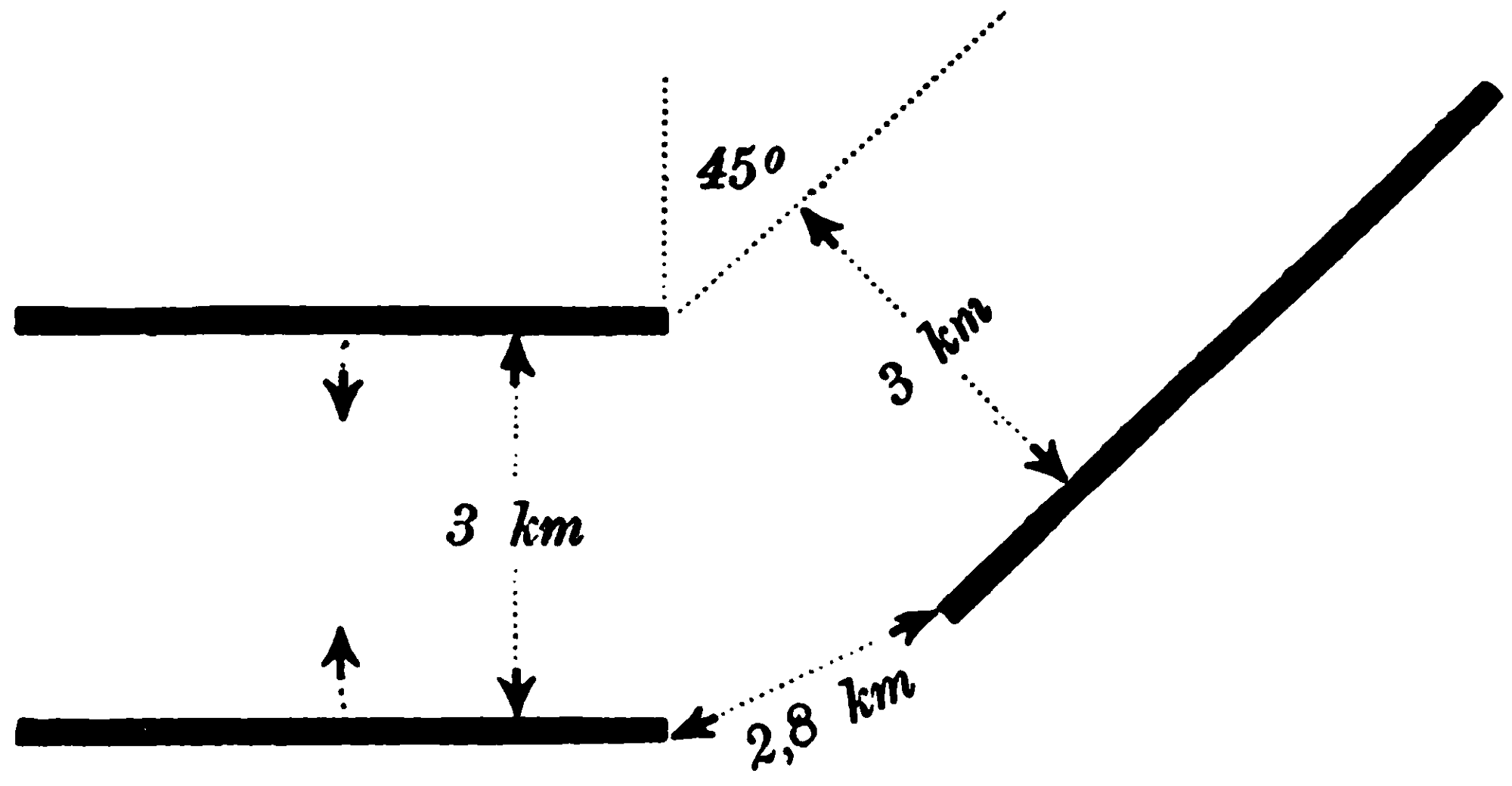
Provisions of Various Regulations.
Austria. When possible, the reserve is to be designated to make the enveloping movement. (Par. 407 Austrian I. D. R.). When practicable, a part of the reserve is employed from the start for the envelopment, and, under certain circumstances, also for the purpose of gaining positions from which an enfilade fire can be delivered, and for supporting the advance of the frontal attack. The group holding the enemy in front may at first fight a purely defensive action to prevent a hostile counter-attack, to screen our own dispositions, and finally, by means of a fire fight at effective ranges, to hold the hostile troops in their position.
France. The envelopment is occasionally mentioned in the regulations (for example in pars. 290, 301 and 302). The Field Service Regulations, in discussing the attack, whose different stages may vary in length depending upon the intentions of the commander, state, however, that the attacker “may assail a wing or a flank of the enemy, with superior forces, for the purpose of annihilating him.”
England. The importance of flank attacks, even those in which the defender is subdued by the flanking fire of mounted troops, is specially mentioned, but, in this connection, it is emphasized that it is immaterial whether the attack is finally directed against the front or a flank of the enemy. The holding attack is to be carried out with energy in front to prevent the enemy from drawing reinforcements to other points.
Italy. While the regulations of 1891 still unqualifiedly acknowledged that any frontal attack might succeed, the regulations of 1903 called attention to the importance of the envelopment, without denying “that the frontal attack might be the decisive one.” Surprise is an advantageous factor for success, and for this reason, even covering troops, for example, may have to be dispensed with on the march.
If a force desires to take the enemy by surprise, it must carefully take advantage of the ground. The surprise may be made more complete, if the accompanying frontal attack is energetically pushed. On the other hand, considerations for the troops in the holding attack, set a limit to the extension of the flanking movement. The fire power of the troops in the holding attack must not be exhausted, or the troops themselves defeated by a hostile counter-attack, before the moment of the general advance arrives. They must pay the strictest attention to the course of events on the opponent’s side; if the enemy retires, or shifts parts of his force in order to meet a flank attack, the troops in the holding attack must act with energy. If such signs are not apparent, a frontal advance will, as a rule, be proper only when the pressure of the flank attack makes itself felt on the enemy’s line. This is the only way in which “simultaneous action by both attacks may be ensured, and this is of decisive importance to the successful issue of the combat.”
7. REMOVAL OF PACKS.
It is advisable for infantry to remove packs for an attack; such tremendous physical exertions await the troops that everything ought to be done to reduce the load carried by the individual man.[391] “As soon as it becomes doubtful whether the troops will be able to perform the task assigned them in action without such relief, all independent commanders, and, in organizations larger than a regiment, commanders of regiments and of higher units, have authority to order the men to remove their packs. In issuing such an order they should bear in mind the disadvantages which may result from leaving the packs behind. When knapsacks are removed, the ammunition and iron rations should be taken from them. Overcoats, cooking utensils, canteens, bread bags, and intrenching tools remain on the men.” (Par. 301 German I. D. R.).
According to the French Manual of Field Engineering, the skirmishers, especially when intrenching, may utilize the knapsack as cover.
In a defeat knapsacks will frequently be lost. Thus the Russians, after the second battle of Plevna, and Frossard’s Corps, after the battle of Spicheren, lost their knapsacks with camp equipment and iron rations, and, in consequence thereof, suffered great hardships during the succeeding days. On the other hand, during their retreat, the 43rd, 44th and 45th Infantry Regiments of the Ist Army Corps managed to recover without trouble the packs which they had removed before entering the battle of Trautenau.
The infantry of the Xth Army Corps had left its knapsacks behind on August 8th, 1870, and did not get them again until the early part of September. The knapsacks were not hauled on wagons after the organizations, but were left at the railroad station of St. Ingbert. On August 6th, 1870, the Würtemberg Field Brigade had left its knapsacks in a bivouac near Reimersweiler at the risk of never seeing them again. Among other reasons, General v. d. Tann considered it impossible for the 2nd Bavarian Division to advance beyond Wörth, because the organizations might perhaps thereby have been separated for several days from their baggage, which they had left behind between Preuschdorf and Görsdorf.
When knapsacks are removed, a detachment will have to be left behind to guard them, otherwise they may be robbed of their contents.[392] The troops always consider the trip to the rear to get the baggage a special hardship; wagons will very rarely be available for this purpose, as after great battles all the wagons in the entire neighborhood will be requisitioned for transporting the wounded, and as supply wagons will, as a rule, not be at hand.
8. THE EMPLOYMENT OF MACHINE GUNS.
In an attack upon a defensive position which is held in force, machine gun batteries will generally be held in rear for the time being. They form a mobile reserve in the hands of the commander-in-chief, who may employ it for quickly reinforcing threatened points, for exerting a pressure upon the wings and flanks of the enemy, and for preparing the assault. Machine gun companies, either broken up into platoons or not, as the case may be, endeavor to reach positions from which they can facilitate the advance of their infantry.
It is especially advantageous if the fire that is directed upon the point where the hostile position is to be penetrated, comes from a position permitting a good view, or from an oblique direction, because the fire will not have to be discontinued even when the infantry continues its advance or moves to the assault. If such a position, permitting the greatest fire effect, is reached (at about 800 m. or less from the hostile position) any further advance of the machine guns is faulty, because it interrupts the fire and necessitates fresh laying and adjustment.
Upon the victorious termination of a fight, the machine guns should participate in the first stages of the pursuit by making an extended use of their fire. They hurry forward into the captured position, as soon as it is apparent that the victory has been gained, in order to support the infantry in holding the position, to cover the infantry while it is re-forming, and to reduce the last vestige of the enemy’s resistance. If the attack fails the machine guns cover the retiring troops.
9. THE CONDUCT OF THE ATTACK.
In an infantry attack, the art of minor troop leading consists of pushing a firing line, superior to the enemy, to the strip of ground from which the power of our rifle can be utilized to the best advantage for vanquishing the enemy; secondly, of bringing up supports, without exposing them to unnecessary losses, so that they will be promptly available in case of need. The preparations which the enemy has made for attaining the maximum fire power (by intrenching, placing ammunition in readiness, and by ascertaining ranges) must be offset by employing a superior number of rifles. The commander who brings a greater number of rifles into action than his opponent, may count on gaining a superiority of fire quickly and with certainty.
The task of higher troop leading consists of simultaneously launching the troops against the common objective.
The effect of modern projectiles requires that, on open ground, the first deployment be made when 4000-5000 m. from the enemy. The best scheme would be to advance, without halting, to within decisive short range of the defender, and then to open fire, but, as previously stated, the defender should endeavor to prevent the assailant from ever reaching these ranges. This design of the defender must be frustrated; if artillery is unable to accomplish this, machine guns or a part of the infantry must enter the fight; but all parts of the force not required for this fire fight at medium ranges should continue their movement without interruption.
The most difficult task that infantry may be called upon to perform consists of advancing over an open plain, in the face of unsubdued artillery, when the situation does not permit night or the effect of an envelopment to be awaited.
The first deployment as skirmishers is made for the purpose of protecting the advancing troops against surprise. Frequently, a squad or a section per company will suffice for this purpose, but these units should cover the entire front available for the organization to which they belong. A uniform and simultaneous advance along the whole line is impossible however, on account of the diversity of the ground at various points. When cover is available, skirmish lines may be formed quickly and pushed forward as entities, but when cover is lacking, firing lines may have to be deployed slowly and piecemeal. The unit that has pushed farthest to the front must facilitate with its fire the advance of those who have encountered greater obstacles in advancing.
Long, dense firing lines and the supports following them are exposed to such heavy losses in open country, even at long ranges, that their advance will soon hesitate. Moreover, the defender will only fire on targets whose size and density promise a great number of hits. Therefore, the assailant should endeavor to lead his infantry forward in loose, disconnected skirmish lines, which are difficult for the enemy to hit. As a rule, the assailant should not open fire until after he has been reinforced and has sufficient fire power available. (Par. 334 German I. D. R.). The situation in which these thin firing lines are placed is by no means a favorable one, as the defender will concentrate his fire on the points where the assailant seems to be filling up his line “for the purpose of overwhelming the defender permanently by a superiority of fire.” (Par. 413 German I. D. R.). The skirmishers will then quite naturally open fire for the purpose of interfering with the cool delivery of the defender’s fire.
Such a piecemeal, almost independent advance, during which the effect of the accustomed word of command is considerably reduced and control and supervision of the individual skirmisher is impossible, presupposes that the troops are well-drilled, individually trained, and, above all, intelligent. Attention must also be called to the fact that the firing line can offer but a weak resistance to an enemy advancing unexpectedly in force. But, in spite of these drawbacks, this mode of advance has its advantages for crossing a plain devoid of cover. It permits favorable fire positions to be reached with greater safety, especially if these positions can be picked out with the aid of field glasses, than would be the case if dense skirmish lines were led forward simultaneously.
The advance of the infantry under hostile fire, over open ground, may accordingly be conducted—
1. At a walk, by long rushes made by strong units (by platoons at least), supported by powerful artillery fire or by the fire of a machine gun battery or a detachment of skirmishers posted in a favorable position;
2. By shorter rushes made by smaller units (“proper only when conditions demand it”);
3. By crawling, or, in exceptional cases (for example in passing through fields of standing grain), by employing
4. Fire while in motion.
The fire fight at long ranges and near the extreme limit of mid ranges is only a means for the purpose of reaching the decisive battle ranges, and of interfering with the undisturbed delivery of the enemy’s fire. Fire must be opened at as late a moment as possible. Our firing line should in any case be strong enough, upon entering the zone of mid ranges, to reply effectively to the enemy’s fire. Experience has shown that an assailant who opens fire at “long” ranges rarely reaches short ranges. (See p. 149 supra).
The distances at which the echelons in rear follow the firing line should be less (as laid down in the Italian and Russian regulations) than the distance which separates the firing line of the attacker from that of the defender. The distances may be increased without danger at this stage of the combat, as the decision is not imminent, but on the flanks the supports will have to be brought up closer in order that an unexpected flank attack may be effectively opposed. All parts of the attacking force move—as long as possible at a walk—straight to the front. Subordinate leaders, taking advantage of all available cover, should endeavor to lead the supports skillfully after the firing line. This requires that the ground to be crossed be reconnoitered. As a rule, a movement by the flank upon leaving cover is costlier than an advance by squads or sections over open ground. Long lines make it easier for the hostile artillery to adjust and observe its fire, while, when a greater number of targets of smaller frontage is exposed, this is made more difficult. For this reason, supports are not led forward as entire units, but, on the contrary, they are broken up, and, under certain circumstances, even disintegrated into smaller units. The units following in rear remain as long as possible in close order formations, preferably in route columns. “Man is by nature exceedingly timid. Soldiers, even those drawn from the educated classes, who were fully aware of the supreme importance of gaining the victory, broke down on coming under fire. In close order the moral encouragement due to the proximity of superiors and comrades kept up their courage.” (Hessert).[393] Where cover is lacking, the supports will also have to be deployed. Large units are broken up into platoons, which deploy and follow each other at considerable distances.[394]
As soon as the enemy opens fire, platoon commanders must decide whether or not it ought to be returned; but the closer one can get to the enemy without firing a shot, the better. According to the German F. S. R. (par. 296), a prolonged, uninterrupted forward movement of skirmish lines in the open, at less than 1000 m. from the enemy, is possible only when supported by adequate fire. On the other hand, even skirmishers lying down suffer serious losses when 600 m. from the enemy.
Thus, at mid ranges, begins the actual, protracted fire fight, which, in the first place, is to make a further advance possible, and which, subsequently, is to produce a superiority of fire. As taught by experience, this cannot be accomplished from a single position, if the enemy is efficient.
A so-called “main firing position”, which was to be located 400-600 m. from the enemy, was frequently used during peace maneuvers for the purpose of bringing cohesion and harmony into the attack. In making use of such a position, the principal difficulty of every serious infantry attack, that of crossing the space lying between the first firing position and the assaulting position, was not appreciated.
Austria. (Par. 589 I. D. R.). “When conditions are very favorable, it might be possible to choose the firing position in which the decisive fire fight is to be begun, so close to the enemy that the decision can be gained from it.”
The fire fight must be taken up by enough troops to make it impossible for the defender, who holds his position strongly, to gain a superiority of fire over some parts of the attacking force. The supports will now move closer to the firing line, in order to fill every gap in that line and to meet every attempt of the defender to gain the upper hand. The echelons of the second line which have not as yet been absorbed by the firing line, move up in a similar manner. If the hostile fire abates, parts of the firing line should endeavor to get closer to the enemy; they are followed by the next adjoining units. At this stage of the action the attacker will have to give up, to some extent, his distribution in depth.
Superiority of fire is an essential condition to victory. It is attained by better marksmanship, fire control and fire direction, by taking advantage of cover, and by concentrating a powerful fire against the decisive point. When the attacker’s troops are not well trained, a greater number of rifles and more ammunition will be required to gain this superiority. Accordingly, the attacker will either make an envelopment or employ fire of position. The attacker possesses a great advantage, in that he does not need to gain a superiority of fire along the whole front, but only at a single point. It suffices for him to contain weak portions of the hostile front with suitable, well concealed combat groups capable of quickly developing a powerful fire, while he masses the bulk of his forces against the decisive point. The defender, who never knows where the decisive blow is going to fall, ought not to allow himself to be enticed into occupying portions of his line more weakly than the rest.
The attainment of the superiority of fire requires time, and, in addition, coolness and patience on the part of the leaders. All the ammunition that is expended in gaining this superiority is later compensated for by fewer losses. The heavy losses sustained by the Prussian troops on the slopes of Point du Jour, on August 18th, 1870, may be traced directly to the fact that the leaders did not know how to wait.
Superiority of fire[395] is absolutely essential to the success of the attack. Any failure to appreciate this principle will lead to such heavy losses that even if the assailant were to reach the enemy’s position, he would be too weak to gain the victory.[396]
During the fluctuating fire fight, which lasts for hours, the attacker will have succeeded in working forward little by little until he is close to the enemy’s position. His superiority will now make itself felt; the fire from the part of the hostile line that is to be penetrated will begin to abate; and, at first, single groups, then several, and finally, whole units of the enemy’s line will commence to crumble away. The attacker should wait until this effect is produced before he begins the assault; if he does not do this, the attack is sure to fail.
Austria. (Par. 590 I. D. R.). “The close approach of a long firing line to an enemy who occupies a good position, may well pass as a proof of the assailant’s superiority. Nevertheless, this does not, under all circumstances, furnish assurance that a forward movement for the purpose of penetrating the hostile position will now succeed; a premature assault may still result in disaster. As long as the conduct of the opponent does not show clear indications that his fire power is crippled, nothing remains for the attacker but to continue the fight for the superiority of fire.”
Even in this, mistakes are not precluded. It is far from easy to recognize when the defender of a position has been sufficiently subdued by fire to make an assault feasible, and when the proper moment has arrived for launching the reserves. It is only necessary to recall the premature advance of the artillery and cavalry over the ravine of the Mance brook, on August 18th, 1870.
The cessation of the defender’s fire, in itself, is not a sure sign that his firing line is shaken, as the attacker is unable to distinguish between a fire pause ordered by the commander on the defensive and the forced discontinuance of the fight. Sure indications are not available until men actually leave the defender’s fighting line here and there, and attempts of the leaders to hold the wavering ones are clearly apparent.
At this moment, a leader who has resolved to assault, should order bayonets fixed.
The temporary interruption of the fire occasioned by fixing bayonets is of no importance, as the superiority of fire has already been gained. If bayonets are prematurely ordered to be fixed, the accuracy of the fire will soon be impaired, as the firing of rifles, weighted down by the attached bayonets, increases the fatigue of the men. When the troops are excited, the downward deflection of the bullets caused by fixing the bayonet can, however, only produce a good effect. It is best to fix bayonets at the signal “Fix bayonet”. In the excitement prevailing at the moment, it will be impossible to execute the order with any uniformity, but it is a good plan, in time of peace, to require one man of each file to fire while the other one fixes his bayonet. The approaching reserves fix bayonets while on the march.
10. THE ASSAULT.
“The assault does not, strictly speaking, belong to the domain of tactics. Rules, showing in what formations and under what conditions the assault should be made in war, cannot be formulated. At any rate, fire tactics are not only an essential factor but also the crowning act of combat; the assault is nothing but the postlude. All modern combats show that the morale of the men suffers most, and that, in consequence thereof, troops deteriorate quickly when they are exposed to the annihilating effect of fire. This lesson was thoroughly learned by the Austrians in 1866, and by the Russians in front of Plevna. Of what avail were ‘self-sacrifice’, the ‘unconquerable determination to gain the victory’, the ‘desire for hand to hand conflict’, and all the other terms that are employed to prove that the moral factors are the decisive ones in war? That they are the decisive factors needs no proof whatever; it follows, as a matter of course, from uniform training, uniform leadership, and uniform arms. But tactics fit for use in war, are to furnish, above all else, ways and means, showing how and by what methods the fighting energy of troops may be preserved most effectively, and thus contribute directly toward preventing the premature deterioration of the morale of the troops.”[397]
“The defeat of the opponent is consummated by the assault with fixed bayonets.” (Par. 324 German I. D. R.). A premature advance to the assault, with all the peculiar features attending it, produces an aversion against the attack, an undue extension of battle lines, and makes it impossible for reinforcements to come up, except under cover of darkness.
The decision for making the assault emanates either from the subordinate leaders in the firing line or from the commander of the whole force. The latter may give the impulse for the assault by launching the reserve. This is undoubtedly the safer procedure. “When the decision to assault emanates from the commanders in rear, notice thereof is given by sounding the signal ‘fix bayonet’, which must be repeated by all the units that are to take part in the assault. At this signal the skirmishers increase their fire to the utmost. The parts of the firing line which are still in rear, move forward, as quickly as possible, to a position close to the enemy. All reinforcements in rear hasten straight to the front. As soon as the leading line is to form for the assault, all the trumpeters sound the signal ‘forward, double time’, all the drummers beat their drums, and all parts of the force throw themselves with the greatest determination upon the enemy. It should be a point of honor with skirmishers not to allow the supports to overtake them earlier than the moment of penetrating the enemy’s position. When immediately in front of the enemy, the men should charge bayonet and, with a cheer, penetrate the position.” (Pars. 346-348 German I. D. R.).
It is very difficult for a superior commander to perceive when the proper moment for making the assault has arrived, as he is compelled to remain so far in rear of the fighting line, especially where large forces are concerned, that he can only follow the general course of the attack. The first indication which he receives as to whether the enemy’s fire power has been broken all along the line, is the advance of his own firing line. He will still more rarely be able to see in time when the resistance of the enemy abates at some one point, and it will be quite impossible for him to issue orders with sufficient promptness to turn such an advantage quickly to good account.[398]
The firing line will, therefore, frequently have to take the initiative in bringing about the assault. It is absolutely necessary, especially if the enemy evacuates the position, that the firing line, quickly taking advantage of this moment, pass over to the bayonet attack. If the firing line were to wait until the reserves are up, valuable time would be lost, under certain circumstances; the enemy might recover from his temporary bewilderment and re-form, or might even receive reinforcements. In addition, hesitation on the part of the attacker would enable the enemy to gain time, evacuate the position unmolested, retire in good order, and perhaps take up a new position, or at least evade quickly the pursuing fire of the assailant. The firing line would be the first, in such a case, to perceive when and where the resistance of the enemy abates; it should therefore make the most of this knowledge and throw itself upon the part of the defender’s force that is in the act of withdrawing.
When the impulse for the assault emanates from the firing line, there is danger that instead of a general attack only a local one will result. It is impossible to conceive that the whole firing line will simultaneously consider that the moment for the assault has arrived; in general, only a part of that line at a time will come to this conclusion. Such local attacks are hazardous, however, and have some chance of succeeding only in covered terrain. A local assault made by a single battalion or company will usually attract the fire of a considerable portion of the hostile line and quite naturally dash itself to pieces against it. Even assuming that a gallantly charging unit succeeds in unexpectedly penetrating the hostile line at some one point, the defender will at once attack it in vastly superior force and compel it to retire with heavy loss. Furthermore, the failure is usually not confined to the one unit. The troops on the right and left of it, although they are perhaps farther from the enemy, and have not yet shaken him sufficiently by their fire, nevertheless join in the assault, as soon as they see the first unit rush forward. As a rule, when the decision to assault emanates from the firing line, a series of unsuccessful assaults will result. These will, however, bring good troops closer and closer to the enemy, until the great moment of definitely gained superiority finally arrives.
The General Staff account of the Franco-German war[399] very aptly describes the decisive moment for the assault: “The tension of the tactical situation was increased to the highest pitch by the prolonged fight at close range; the time was now ripe for the decision and the German corps commanders issued orders for the assault. Before this order reached the leading line, however, the German general officers on the spot had decided, at about 7:30 P. M., to undertake the assault on their own responsibility, as they considered the attack sufficiently prepared. On the signal given by them, and in many instances of their own accord, the Prussian and Saxon battalions hurled themselves, just as the sun was setting, on the position which had been so long and so tenaciously defended by the enemy.” (St. Privat). Consult, Der 18. August, pp. 525 and 571.
“When the XIth Army Corps issued from the Niederwald (near Wörth), the infantry encountered such a heavy fire from the direction of Elsaszhausen that the troops had to choose between either advancing farther or giving up the advantages that had been gained at such great sacrifices. The former course was indeed open to objection, as the troops were exhausted, as organizations were in confusion from the fighting they had just gone through, and as only three formed and fresh battalions were available.”—“General von Bose now ordered a general attack. At the signal ‘the whole force will advance’, the firing lines rushed from the Niederwald and, with loud cheers, threw themselves upon the enemy.”[400]
The assault was thus not a result of the superiority that had been gained, but an act of desperation in a situation that had become unbearable. Moreover, the success of the assault was not due to any numerical superiority of the attacker, but to the lack of initiative of the defender, and to the fact that he confined himself to purely defensive action.
It is, therefore, after all, an open question whether the initiative of parts of the line should govern the conduct of the entire force. In some instances, it certainly ought not to govern, if disaster is to be avoided. When a portion of the firing line advances, however, and the tactical situation in any way permits, neighboring units should at once conform to the movement. The units in rear, in particular, should, in this case, promptly hurry forward by the shortest route without regard to losses, support the firing line, and prevent it being repulsed. (Par. 345, German I. D. R.).
This brings up the question, as to whether the trumpeters of the assaulting units should sound the signal “fix bayonet,” in this assault, and thus bring about a prompt general assault by the entire line. This might obviously cause the troops to advance prematurely to the assault, a danger which might be brought about by the junior platoon commander. No one but the supreme commander, therefore, has the right to order this signal to be sounded when he wishes a general assault to be made. This is prescribed in the German Infantry Drill Regulations (par. 347). If the commander of the firing line decides to assault, he transmits his decision to the rear by means of signals (s. s. s.). The supreme commander can still restrain the skirmishers by the signal h. h. h., or bring about a general assault all along the line by giving the signal “fix bayonet”. If a unit moves to the assault contrary to the wishes of the supreme commander, he should possess enough nerve to look on calmly while it is being defeated. It is much better for him to allow a single unit to be defeated than to cause the failure of the general attack by a premature advance.
“Although the assault should be made as nearly simultaneously as possible, this is not to be understood as meaning that all the units should penetrate the hostile position at one and the same time. Such simultaneous action is immaterial, and might, indeed, cause parts of the line who had a chance of successfully carrying out the assault, to hesitate because others are still in rear. The power of the attack would accordingly be impaired. All units that have once started must continue to advance uninterruptedly.” (Par. 349 German I. D. R.).
It depends upon the situation whether the troops intended for the holding attack finally participate in the assault itself. If they can bring an effective fire to bear upon the point of attack from an oblique direction and thereby ensure the success of the attack, they should make the most of this advantage. (Par. 340 German I. D. R.).
When the enemy advances to the frontal counter-attack, as laid down in the Russian and British regulations, the skirmishers throw themselves down for the purpose of firing. The supports in the act of moving up continue their march. If the enemy faces about, all the troops press after him.
The French regulations (par. 270) also consider such a counter-attack:
“If the attacker presses forward too hastily and if he threatens to carry the defender’s position, fresh troops, which have been assembled in a place sheltered from view, attack him energetically, while the troops already engaged increase the intensity of their fire. This powerful and energetic counter-attack produces confusion in the enemy’s ranks and compels him to retire, or at least to discontinue his forward movement until he has had time to recover.... The troops in the counter-attack should move forward without hesitation and regardless of the cost. When such a forward movement has to be discontinued, the commander must decide where it shall cease. The efforts of all should be directed toward one object, that of tiring and demoralizing the enemy by constant counter-attacks, until the moment arrives when the commander must order the offensive to be assumed.”
The German Infantry Drill Regulations contain no further rules for the conduct of the assault. If the physical and moral power of the enemy is so broken by the preceding fire fight that he commences to evacuate his position, it is quite immaterial what sort of an assault is made; the men simply fire and rush quickly after the retiring enemy. In this case the assault is nothing but a postlude of the fire fight.
A brave and well disciplined opponent who is energetically led, will not allow himself to be forced to evacuate his position by fire alone; to compel him to evacuate his position will at the very least require that an assault be threatened.
Before the Boer war, the British held the view that the effect of the fire fight alone was so great that the assault would strike nothing but an evacuated or, at most, a feebly defended position. The assault was to commence after the enemy had ceased firing and had sought protection in his trenches. The following statement is made by one who fought on the Boer side:
“The artillery supported the advance until the latter had arrived within 300 or 400 m. of the enemy; then it ceased firing. After a brief period of preparation by fire, the British infantry began the assault simultaneously in one long line. This assault, made without fire support, was repulsed without trouble by the Boer fire. On several occasions, short lines of our opponent had begun to advance, but these were in every instance forced to throw themselves down after a few moments had elapsed. Thereupon the whole British line, in my estimation at least 300-400 men strong, began to advance. One could clearly hear the British leaders call to their men to cease firing, could clearly hear the command ‘fix bayonet’, and the cheer ‘God save the Queen’! run along the British line. Then the whole hostile line rose. As they rushed toward us, they looked to me like a grayish yellow swarm, the men being almost shoulder to shoulder and the line being in places three to four men deep, just as frequently happens in charges made during our own peace maneuvers. At the same moment, we began firing. Our fire was at first somewhat wild, but was soon better controlled by our more experienced fighters calling, ‘Steady boys, steady, then none of them will reach us’. More and more men fell in the British line, and, when it had arrived within 100 or 80 paces of our position, its energy had spent itself. A part of the men threw themselves down behind boulders and fired, while the majority rushed back to the shelter of some bushes; but even there it was for the most part impossible to hold them. An assaulting enemy who does not fire, is not dangerous, even if he is numerically superior. In this case, the defender can fire a number of times, and the closer the assailant is to the defender’s position the more quickly and certainly will his force dwindle away. No one will, however, be able to induce the same men to advance again under hostile fire over an open field, that is, to expose themselves without shelter to the hostile fire.”[401]
The same lesson was learned long ago at Gorni Dubniac and at Plevna.
It is obvious that fire support is essential to the success of such an assault. This should be furnished in the first place by the artillery. In furnishing this support, artillery can employ time fire only until the infantry arrives within 300 m. of the enemy, while percussion fire may be continued until the infantry arrives within 150 m. of the enemy. During the attack on Pieters Hill (1900), Colonel Kitchener is said to have told his artillerymen that he would not censure them if two or three of their shrapnel burst in the ranks of his infantry. The following statement appears in a British memorial on the lessons of the war in the Far East: “The moral effect produced by artillery fire, which forced the defenders to take to cover and did not even permit them to raise their heads above the parapet, was so highly esteemed by the Japanese infantry that it requested the batteries to continue firing, without regard to the losses thereby inflicted in its own ranks, until it had taken the position or unfurled small national flags as an indication that fire support was no longer necessary. According to the opinion of the Japanese themselves, the losses inflicted in their infantry by their own guns were insignificant in comparison to the losses which the defender could inflict by delivering his fire undisturbed at a range of a few hundred meters, when not kept down by the attacking artillery.” According to the Austrian regulations, one unit is to remain halted for the purpose of directing its fire upon the point of attack or upon any reserves that might appear. This provision involves a grave danger, in that it may induce the leader to retain a considerable number of troops in rallying positions, instead of launching his whole force in the assault.
When fire support is deemed necessary in an attack, the artillery will perhaps be best able to furnish it until the infantry has reached a certain point. Then a moment will arrive, however, when the guns will have to cease firing, and when even the infantry units which have been left behind to support the attack, will no longer be able to direct their fire upon the enemy on account of the wide frontage of the assaulting force. The defender’s troops would have to be poor indeed, if they would not at this moment, when the assailant’s fire has practically ceased, raise their heads above the parapet for the purpose of emptying their magazines once more at the assailant, even though the fire be unaimed.
If the assault is to succeed, it is essential however, that, while the attacker covers the last 100-150 m., the defender be compelled to keep under cover. This can only be accomplished by employing fire while in motion.
This fire is practicable because the defender, who has been overwhelmed in the fire fight, has sought shelter in his works; it is advantageous, as it is only to compel the enemy to keep under cover. It would unquestionably be a mistake, and not justifiable in any case, to employ fire while in motion, when these conditions are not fulfilled, when the enemy is not completely subdued and is perhaps waiting under cover, ready to meet the assailant’s assault. Supporting the infantry assault with fire has, moreover, the additional advantage of preventing the defender from bringing up his reserves.
The following is taken from a private letter of Sir Ian Hamilton, perhaps the foremost British infantry tactician, who had the good fortune, at Elandslaagte and Doornkop, of leading his command close up to the enemy: “It is my opinion that no matter what regulations are promulgated in time of peace, the men will fire during the assault. You may rest assured that nothing will prevent their doing this. One would do well, therefore, to reckon with this factor from the very start. The greatest danger is always that the men will throw themselves down instead of continuing the advance. And, if the men have once thrown themselves down during the assault, they will rise only for the purpose of retreating.”[402]
Russia. The attacking force approaches the enemy so close (35 m.) that the troops are enabled to throw themselves upon him. The point at which the hostile position is to be penetrated is designated and the men form in rear of their platoon leader. The reserves move at a run or by crawling close up to the firing line. If the assault is begun at a greater distance than 35 m. from the hostile position, fire while in motion is employed, “in order that the enemy may not regain his senses and may be prevented from rising above his parapet.”
During an unexpected encounter at night, on unfavorable terrain (Swiep-Wald at Königgrätz), as well as during obstinate fights for the possession of fortifications (the Grivica Work at Plevna, Scheinovo), bayonet combats are unavoidable, provided both forces are equally determined. During the fight for the possession of Servigny, on the evening of August 31st, 1870, serious hand to hand fighting occurred in the narrow village streets.[403] The Russo-Japanese war also proved beyond the shadow of a doubt that determined troops will maintain their positions until they are thrown out of them by cold steel.[404]
The defender will never retire simultaneously all along the line; frequently isolated groups and then entire units will leave his line when the superiority of the attacker’s fire becomes effective. Officers, non-commissioned officers and capable privates will endeavor to keep the weak-kneed from running away.[405]
If the assault is not made at this moment, the crisis may pass, but a determined rush by the attacker will, as a rule, bring about the decision. The threat of a bayonet attack usually decides those who have remained in the position, to make no further resistance. The attacker must make use of the moral factors in an assault, hence the importance of running, cheering, and accompanying the advance of all bodies in close order by the beating of drums and the sounding of trumpets.[406]
“The French were unable to withstand an energetic attack, when undertaken in anything like sufficient strength and accompanied by cheers and beating drums.” Boguslawski.
“Suddenly some soldier shouted: ‘Columns! Columns!’ Captain von Wobeser rose to see what was going on, but at the same moment his men rushed back and made straight for the Bois.”—“The mere launching of the attack from the direction of Point du Jour sufficed to induce the well concealed force of about 400 men, which held the gravel pits, likewise to beat a retreat that very much resembled a rout.” Hönig.
In time of peace there should be instilled in the soldier the conviction that, with the bayonet, he is a match for any opponent; that, in bayonet fighting, no other infantry is the equal of his own. The soldier should not be taught to shrink from the bayonet attack, but to seek it. If the infantry is deprived of the arme blanche, if the impossibility of bayonet fighting is preached, and the soldier is never given an opportunity in time of peace of defending himself, man to man, with his weapon in bayonet fencing, an infantry will be developed, which is unsuitable for attack and which, moreover, lacks a most essential quality, viz., the moral power to reach the enemy’s position.
“The rarity of bayonet fights does not prove the uselessness of the bayonet, but shows that opponents will rarely be found who are equally capable of making use of it. Indeed, the bayonet cannot be abolished for the reason, if for no other, that it is the sole and exclusive embodiment of that will power which alone, both in war and in every-day life, attains its object, whereas reason only tends to facilitate the attainment of the object.
“Let us assume that there exists an army which bases success in battle on fire action, and takes for granted that the enemy will not be able to get near enough to make a bayonet attack. If this army were to encounter another army which, without undervaluing the effect of fire, remembers the bayonet at the proper time, it would be filled with the most dreadful dismay when the enemy actually assails it with the bayonet. With modern rifles, bullets are unquestionably a good substitute for the bayonet at close quarters, but this is true only of troops who do not fear annihilation, i.e., troops trained to use the bayonet and capable of closing with the enemy after firing. If this is not the case, such firing at close quarters is a pure waste of ammunition, since men who are afraid to close with the enemy, if necessary at such a moment, will usually fire into the air.
“If the soldier has been taught, however, to annihilate the enemy from a distance and from behind cover, he will naturally prefer this mode of inflicting losses, since he runs very little risk of getting hurt, and will, moreover, acquire an aversion for exposing himself to danger, i.e., he will shrink from bayonet work. Hence, if we attach too much importance to marksmanship, we produce a more or less trained soldier, who may possibly be a very good shot at long ranges, but who is not especially inclined to take his chances in a bayonet fight. Incidentally, target practice develops the mentality of the man, but does not improve his morale.” Dragomirov.
Of every 100 wounds, the following percentages were produced by cutting weapons:
Campaign of 1859 1.67%
Campaign of 1864 4.0 %
Campaign of 1866 (Prussians) 5.4 %
St. Privat (Germans) 1.0 %
Russo-Turkish war 0.9 %
In time of peace the assaulting distance is to be about 150 m. During the Franco-German war, the assault against Elsaszhausen (battle of Wörth) was launched at about 300 m.[407] and that against St. Hubert at 100-200 m. from the enemy.[408] The 107th Infantry, after charging over a distance of more than 500 paces, captured a hedge which was held by the French north of St. Privat, and, in the assault against the northern outskirts of the village, a distance of 300 paces had to be covered.[409] In the attack on Le Bourget, on October 30th, 1870, the center column halted when 600 m. from the village; “then began a wild, headlong assault against its outskirts.”[410] The Japanese frequently had occasion to cross similar stretches at a run, but there were also instances where their assaulting troops had only to cover a few meters (1st Division at Kinchau, 20 m.).
If the attacker succeeds in carrying the position, he will be at a disadvantage for the moment; his troops will be in confusion and exhausted, and a large number of officers will be gone. If the defender, reinforced by fresh reserves, takes advantage of this moment, he may be able to turn the tide of the battle. The inclination of the men to pursue the enemy with the bayonet, instead of halting and making the most of the fire power of their rifles, is noticeable in all battles. The attacker will have to take steps to restrain his victorious infantry, and, as soon as opportunity offers, to pursue the enemy with fire. Under cover of this fire fresh troops or quickly assembled detachments should advance on the flanks in pursuit of the enemy. There is a wide difference between a wild, headlong rush after the enemy and a systematic pursuit. Infantry that rushes headlong to the front after penetrating a position must be brought back at any cost, unless it can enter a second position simultaneously with the enemy.[411]
In addition to pursuing the enemy with fire, the attacker should re-form his troops without regard to their original arrangement (if the enemy gives him time enough, the original organizations should be re-formed), occupy the position, replenish ammunition, and remove the prisoners. It is a mistake to mass more rifles in the captured position than can be employed to advantage, as the enemy will in all probability direct a heavy fire upon it. As soon as the fight has been decided, the echelons in rear should be halted, so that they can be employed as occasion demands. The leaders of these units will often have to act independently in such a case. (Par. 350 German I. D. R.). Preparations should be made to the end that hostile counter-attacks may be at once repulsed. These rules are particularly important when the position that has been carried is not the main position but only an advanced post.[412] These measures must be taken independently by all leaders who participated in the assault, without waiting for orders from superior authority. The pursuit should be begun as soon as possible with formed bodies of troops (if practicable, while the enemy is being pursued by fire), in order to interfere with his re-forming, to prevent his taking up route column, and to overrun his rallying positions. The battle of Beaumont consisted of a whole series of such pursuing actions. The arrival of night should by no means be used as an excuse for discontinuing the pursuit, for night above all else is the mightiest ally of a bold victor.[413]
If the attack fails, it will be the duty of the commander to arrest the flight of the skirmishers who are rushing to the rear under hostile fire. It will be impossible, however, to halt these men while they are exposed to the most effective fire of the enemy. Only when the nearest cover is reached can there be any question of halting. (Par. 327 German I. D. R.). When cover is not available near at hand, the exhaustion of the troops will soon stop the flight, or the leaders may be able to face them again to the front, as soon as the hostile fire abates. However, the retreating troops will have placed quite a distance between themselves and the enemy before this can be done, and the latter, unmolested by fire from the attacker, will be able to take full advantage of the technical qualities of his rifle, unless the attacker’s artillery or cavalry prevent his doing so. No matter where the retreating troops come to a halt and face to the front, there they must stay, and, if the hostile fire permits, intrench.
The perseverance of the Prussian Guard 600-800 m. in front of St. Privat,[414] and of the British Brigade of Highlanders at Magersfontain, immediately in front of the Boer position, on December 11th, 1899, is worthy of imitation.
The assault on Gorni Dubniac came to a standstill at very short range, and a part of the skirmishers of the Moscow and Pavlov Regiments maintained their positions 50 m., the remaining Russian skirmishers 320 m., from the trench.[415]
11. THE USE OF THE SPADE IN ATTACK. (Pars. 157, 313, 339, 380 and 381 German I. D. R.).
In every attack there are situations in which it may be advantageous to use intrenching tools—
1. In fortifying rallying positions.
The Japanese, whose mode of waging war was very cautious, fortified the initial positions from which their attacks were made, in order that they might have rallying positions in case of defeat.[416]
2. In intrenching after making an advance under cover of darkness to within effective range of the enemy for the purpose of opening fire at daybreak. In this case, the advancing force is, as a rule, instructed to advance until it comes under hostile fire and then to intrench.[417]
3. In intrenching an echelon posted to cover advancing infantry.
4. In fortifying a captured position. The want of intrenching tools in quickly putting captured positions in a state of defense, so often felt during the Franco-German war and the Russo-Turkish war, has now been removed by the introduction of portable tools.[418] The necessity of quickly preparing captured positions for defense presented itself in a number of instances.
5. In holding ground that has been gained in an attack when further advance is impossible, that is, in situations such as confronted the infantry of the Guard on August 18th when its first attack came to a standstill. During the attack on Gorni Dubniac, in the Russo-Turkish war, the Russian Guard intrenched when a further advance became impossible. During the attack on Telish, which occurred a few days later, specific orders were issued for the troops to intrench when 1000-2000 m. from the Turkish works.[419]
As a result of the lessons gained in the Russo-Turkish war, general instructions were issued to the Russian infantry on the subject of intrenching in attack. According to these instructions, the spade was to be used in attack in the following cases: In fortifying a captured position, as a protection against a possible offensive return of the defender; in holding supporting points necessary to a continuation of the attack; and in placing rallying positions in a state of defense. The order directing troops to intrench was to be given, in all cases, by the supreme commander. The following procedure was to be observed: “Every man equipped with a spade and who is not sheltered by some feature of the terrain, places his rifle on the ground and, lying on his left side, begins to excavate a hole parallel to his body. This hole should be as long as the distance from his left elbow to his knee, as wide as the length of the spade-handle, and as deep as the width of the blade of the spade. The excavated earth and sod he places in front of his head, which he endeavors to protect as quickly as possible. When this work is completed, he rolls over into the excavated hole, and, lying on his right side, repeats the operation. When he has obtained sufficient cover, he hands his spade to the other man of the file, who proceeds in a similar fashion.”
The Japanese, on account of their numerical inferiority, found it necessary to get along with few supports and reserves, and therefore made use of the spade in terrain devoid of cover, or utilized sand bags,[420] which were carried along. In this manner, they laboriously worked their way to within assaulting distance of the enemy. In many instances, this necessitated whole days of fighting when an envelopment was impossible. Sand bags were an advantage when the ground was frozen or when the sod was not thick.
Results of Russian experiments. The sand bag employed was made of coarse linen of grayish green color and when filled and tied, was approximately 50 cm. long (width of a man’s shoulders), 30-35 cm. wide, and 30-35 cm. high. The filled sand bag weighed 14-20 kg., depending upon the filling material (sand or broken stone). When filled with sand or broken stone, the sand bag stopped all projectiles, while, when filled with earth, even two bags placed in rear of each other did not afford sufficient protection. The sand bags were scarcely discernible with the naked eye at 400 m. They were not an easy target to hit, and, even at 300 m., it was difficult to aim at them.
The men had a distinct aversion against constructing shelter trenches while lying down. During the war they could be made to intrench only by great exertions on the part of the officers. The reason for this is obvious; digging with the small spade while in a prone position is uncomfortable. The skirmisher considers it much more profitable to fire than to puzzle out how he can best stir up the soil with the small spade while in a prone position. Moreover, he knows that at any moment he may have to make a rush to the front.
The beautiful idea that these trenches were to be used and widened by the reserves, was usually not carried out. The reserves preferred to make longer rushes and to take advantage of folds of the ground rather than occupy themselves with intrenching under hostile fire.
At ranges from 2000-1000 m., single men made short rushes, only 30-40 m. long, as the filled sand bag constituted a considerable load. Before a man ran forward, he slung his rifle, grasped the sand bag with one hand at the tied end, with the other at a loop specially provided for that purpose; then he jumped up, ran forward 30-40 m., as rapidly as he could in a crouching position, placed the sand bag on the ground, and threw himself down behind it. Under effective hostile fire, at 1000-550 m. (during our peace maneuvers at 420-280 m.), the men then crawl forward, utilizing the sand bag as cover. The men would rather crawl a greater distance with the sand bag than intrench while lying down.
From the position of the enemy, the skirmishers lying behind grayish green sand bags could not be recognized with the naked eye at 2000-1000 m. It is reported that both officers and men were at first very much disinclined toward making these experiments, but that they changed their views after one or two exercises, and the principal apprehension, that of increasing the weight of the field equipment, disappeared because of the undeniable advantages of the sand bag.
Such cover constructed by the assailant has no greater value than natural cover found on the ground over which the attack is made; it affords protection during halts and induces retreating skirmishers to face to the front again at an earlier moment than would otherwise be the case.