THE FORMAL TACTICS OF INFANTRY. (continued 3)
Walter Krueger translation
Moreover, the wounded man is cured so quickly that in a short time he can again participate in action. The British report of losses for the battle of Paardeberg, on February 18th, 1900, contains the names of a great many men who were wounded at Magersfontain on December 11th, 1899. According to British statements, 40 men out of every 100, seriously wounded by steel jacketed bullets, could be returned to duty after 36 days of surgical treatment. Dr. Küttner estimates that of 154 men hit in the chest, 73 were able to return to duty with their organizations; while, out of 92 men wounded in the knee, only 28 could be sent back to duty. Wounds produced by the small caliber Arisaka rifle during the Russo-Japanese war healed more rapidly than those caused by the Russian weapon. Flesh wounds of Japanese soldiers, for example, healed in ten days, those of Russian soldiers in four. The following observations were made on wounds produced by the Russian rifle: Within a week slight wounds were covered by a scab; after three weeks they were covered by fresh skin and a part of the wounded were then able to return to the front. The remainder, irrespective of the number of wounds received by any one individual, were ready for duty in seven months. Wounds in which bones were perforated without splintering, healed in four to six weeks, so that the men could return to duty within four or five months after receiving the wound. When bones were splintered the cure was, of course, considerably retarded.
The ballistic advantages of a small-caliber projectile (undesirable from the military surgeon’s point of view) have been obtained by the adoption of a pointed-nose bullet (called the “S” bullet in Germany and the “D” bullet in France).[128]
A further advantage of these bullets is that they produce serious wounds on account of their tendency to tumble. These wounds, while not inhuman, instantly disable the man struck, or, at any rate, postpone his recovery indefinitely.
The Effect of “S” Bullets on Corpses.
Of the Total Number of Men Hit in Each Case. THERE WOULD HAVE BEEN
Fatally injured. Instantly disabled. Incapacitated for some time.
% % %
Flesh wounds produced at 800 m —— 36 .4 27 .3
1350 m —— 43 .8 37 .3
Bones struck at 800 m 20 .3 79 .2 75 .0
1350 m 11 .1 88 .9 88 .9
Average 7 .97 62 .07 57 .12
2. THE EFFECT OF “S” BULLETS ON MATERIALS.
The following thicknesses of dry pine are pierced by the “S” bullet (rifle model ’98) at the ranges given:
60 cm at 100 m.
80 cm at 400 m.
35 cm at 800 m.
10 cm at 1800 m.
In sand and earth the penetration of the “S” bullet amounts to 90 cm. According to experiments, 3 mm. steel plates were pierced at 350 m., while hay stacks afforded protection when 4 m. thick; when of less thickness, the latter caused bullets to tumble. Embankments of frozen snow 1 m. thick, of packed snow 2 m. thick, and of loose snow 3 m. thick, were not pierced even at 250 m.
IV. THE EMPLOYMENT OF INFANTRY FIRE.
Infantry fire may produce either a stunning and paralyzing effect on the hostile forces, or it may gradually exhaust, wear out, and consume them. The fire will have a stunning and paralyzing effect when it is suddenly concentrated upon a narrow front, thereby producing fear and terror, provided actual losses are added to this moral effect.
On the other hand, the fire will gradually exhaust, wear out, and destroy the hostile forces when it is distributed for a prolonged period over an extended front. In this case the material losses suffered and the exhaustion of his physical energies may force the conviction on the enemy that he has no longer a chance to gain the victory. This conviction will cause a suspension of all his energies and consequently of his determination to fight.
At Modder River (28th November, 1899) the Boers opened fire on the British at 1000 m., although they had intended to hold their fire until the British arrived within 300 m. of the position.[129]
The miscarriage of the contemplated sudden burst of fire resulted in a fire fight, which tended to destroy gradually the physical and moral powers of the British. The Boers, however, gave this gradually destroying fire a paralyzing effect by concentrating it suddenly and continuously on tactically important targets that were comparatively easy to hit. Minarelli makes the following comments on the attack made by the British 9th Brigade and Brigade of Guards at Modder River: “All further attempts to induce the Guards to advance had to be abandoned. For hours they lay on the dearly bought ground under a blistering African sun, utilizing as cover every ant hill, every tuft of grass, on the apparently deserted battlefield, and being morally certain that to get up would draw a deadly hail of shot.” In regard to the fight of the 9th Brigade, the same author states: “Meantime the 9th Brigade fared no better. It had in part been able to get a little closer to the enemy (550 to 900 m.), but was then unable to advance farther. The actual losses were very small in the ten-hour fight, amounting only to seven per cent. The Highland Brigade, surprised at Magersfontain, fared still worse. The fight growing out of the surprise lasted almost ten hours. At the short range at which this action was fought, the Boer method of fire (i.e., to fire only when an enemy raised himself to get better aim, and then to employ only an effective concentrated fire) necessarily produced a depressing effect.”
In order that such a fire effect may be obtained, it is necessary that the individual soldier combine coolness and presence of mind with good marksmanship, and that company, platoon and squad leaders maintain fire control and fire direction.
1. FIRE DISCIPLINE.
Fire discipline is indispensable to fire control and fire direction. It embraces the conscientious execution of all orders and signals, as well as the scrupulous observation of all regulations bearing on the handling of the rifle and on combat in general. Fire discipline must be maintained even though the fire control and fire direction exercised by the leaders is imperfect or ceases entirely in the course of the action.
Fire discipline requires:
Perseverance under hostile fire, even when that fire cannot be returned; constant attention to the orders of the leaders, and careful observation of the enemy. It requires further, taking advantage of the ground; care in setting the sight and in delivery of fire; an increase of fire by individuals whenever the targets become more favorable, and a cessation of fire when the enemy disappears; finally, economy of ammunition.
The decision is prepared by the fire of infantry, supported by machine guns, field, and heavy artillery. The fire of troops pushed to within short range of the hostile position will in many cases suffice to induce the enemy to give way, so that the assault encounters nothing but evacuated or feebly defended works. The Boer war and the Russo-Japanese war demonstrate that determined troops will hold a position until the attacker has massed sufficient troops to charge, or at least until he threatens to attack with the bayonet. Examples: Terrayama, on October 11th, 1904. Assault made by the 2nd Division on March 1st, 1905, at Mukden, on Redouts 17 and 18.
Training in bayonet fencing has by no means lost importance, irrespective of the fact as to whether or not bayonets will ever be crossed in future. “Bayonet fencing is one of the most important means of strengthening the moral force of the individual soldier; of developing in him energy, initiative, and courage for making a dashing advance.”[130]
Since the armament of the different armies is almost the same, good individual marksmanship, coolness, fire control and fire direction, and firmly rooted fire discipline, are the deciding factors in an action in which two equal skirmish lines contend for the superiority of fire.
2. FIRE CONTROL AND FIRE DIRECTION.
The principal object of fire control and fire direction is to bring about a superiority of fire at the decisive point by suddenly concentrating the fire of a large number of rifles upon it. This is the only way in which a moral effect may be produced on the troops against whom the fire is directed, while, at the same time, their losses attain such proportions as to become unbearable. At mid and long ranges, the efficacy of fire depends more on fire control and fire direction than upon good individual marksmanship.[131] Whenever the appropriate rear sight elevation is not used, the densest portion of the cone of dispersion will not strike the target, and the chances of its hitting the target diminish as the error in estimating the range and the standard of excellence of the marksmanship increase.
Fire control and fire direction lie in the hands of platoon commanders,[132] who regulate the fire as their judgment dictates. Fire control and direction embrace: the opening and cessation of fire; the designation of a target and of the elevation to be used; the kind of fire and its distribution; the number of rounds to be fired, and the observation of the effect of the fire. As a rule, the fire will be distributed over the whole front, but portions of the hostile line that are not clearly visible should by no means be neglected (distribution of fire). Regulations prescribing the scope of authority of individual leaders are not considered desirable. The platoon commander possesses in his squad leaders a medium for communicating with his platoon. (Pars. 162-165 German I. D. R.). The movements of the skirmishers, the correct comprehension of the target, the distribution of fire, the rate of fire, and the employment of the terrain to the best advantage, are regulated through the squad leaders. The lack of thoroughly drilled coöperation on the part of squad leaders inevitably results, as might be expected, in a so-called “skirmish mob.” The platoon commander cannot communicate directly with every individual man of his platoon, but he can control his platoon through his eight squad leaders, who, by reason of their position in the line, can exert the proper influence on their skirmishers.[133]
The squad leaders are charged with constantly supervising the setting of sights; the distribution, the careful delivery, and the rate of fire; and the expenditure of ammunition.
The squad leaders participate in the firing only when their duties as leaders permit; and this will frequently be the case in a prolonged engagement in the same position, especially at short ranges. These remarks apply also to the range finders.
In Italy and Switzerland the squad leaders participate in the firing when the whole platoon is engaged in a fire fight. The advantage of thus gaining a few better shots for the firing line is more than offset by the more careful supervision of the skirmishers as is required in Germany, France and Austria. The platoon leader unaided is in no position to supervise the proper use of the rifle and the expenditure of ammunition; his subordinates must assist him. It is also desirable to relieve the company commander from the actual duty of fire direction and fire control. The company commander is responsible for leading the company on the battlefield; this does not preclude his thoroughly supervising his platoons and observing the effect of their fire.
“Whenever the company commander is in the firing line, he selects and designates the target and gives orders for opening fire. He announces the range found by the range finders and observes the effect of the fire. Aside from this, he leaves fire control and fire direction to his platoon commanders, and interferes only when he desires to concentrate the fire of several platoons, or of the whole company, on a certain target, or when he observes something that has escaped the notice of the platoon commanders.” (Par. 216 German I. D. R.).
In the course of an action, fire control and fire direction will frequently be imperfect, whether this be due to the loss of the leaders, or to the difficulty of hearing commands in the noise of the combat. To provide for such contingencies, the skirmishers must be taught that, in the absence of fire control and fire direction, they may fire (not that they must fire) at all targets within 600 m.; that between 600 and 1200 m., they should fire at tall and wide targets only; and that, at ranges over 1000 m., as a rule, they should not fire at all.
In the pamphlet entitled, Actual Experiences in the Russo-Japanese War, p. 11, et seq., Captain Soloviev, 34th East Siberian Rifle Regiment, 1st Siberian Corps, states: “* * * There was an almost ungovernable tendency among the men, as soon as they had thrown themselves down, to open fire without orders; paying attention neither to the target designated, nor to setting their sights.
“This haste is, first of all, brought about by the desire of drowning the consciousness of danger by means of increased activity. * * * It is simply impossible to control and direct the fire when the men have not been carefully trained. The din of battle, the explosion of hostile projectiles, and the thunder of our own artillery make such a deafening roar that one can scarcely hear one’s own voice. The long firing lines make it extraordinarily difficult to transmit orders; even squad commanders can not make themselves understood. Volley firing must therefore be dispensed with.
“Only whistle signals, if repeated by all non-commissioned officers, can be heard; but the men must be trained to obey the whistle signal. With strictness and application much can be accomplished in this direction; it may even be possible to stop the firing along the whole length of the deployed company in the hottest phases of the fight.
“The difficulties of fire control and fire direction increase in proportion to the intensity of the hostile fire and the proximity of the enemy, especially on the defensive. The men get more and more restless, their nervous tension increases, the danger seems nearer and greater. In such a moment the leader must make every effort to keep his men in hand, and prevent the firing from degenerating into a wild blazing away at nothing. This is always a sign that the leader has lost control of his troops.
“The greatest obstacle to good fire control and fire direction is the nervousness that usually pervades troops which are not accustomed to active service. Only thorough peace training and strict fire discipline ensure the maintenance of order in battle and give the fire the necessary efficacy. * * * The more laborious the struggle, the more embittered the fight, the greater the losses, the more fatigue and nervous strain gain the upper hand, the greater and more important the role which the officer has to play. The success of the 200 men under his command depends entirely upon the company commander. The war in the Far East might well be called the war of company commanders. The soldiers watch their leader constantly and attentively. Two hundred lives depend upon his bearing, his determination, firmness, and personal bravery. The men judge the situation, the imminence of danger, success and failure, by the conduct of their leader. The authority of an officer may rise to great heights, but it may also sink very low. To show depression or faint-heartedness is fatal; the feeling of despondency is at once communicated to the men, the leader loses control of his command, and the mischief is done.
“In battle, more than anywhere else, the officer must be a commander and rule with an iron hand. Nowhere does discipline play as great a role as in action. Woe to the troops who have not in time of peace become thoroughly disciplined, to whom discipline has not become second nature! They will pay dearly for this deficiency in war.
“I have observed that in the most critical situations a resolute shout, in a correspondingly imperious tone, had a marvelously quieting effect upon the men. It is likewise advisable to make, here and there, a remark concerning routine duty. For example: ‘Why have the sights not been set in that platoon? Platoon commander, see at once that it is done.’ Because the commander is angry, and notices neglect, everything goes well, so the men reason, and no danger need be apprehended. The men quiet down, forget the whistling of the bullets, set their sights carefully, point their pieces properly, and aim again.”
3. SELECTION OF THE LINE TO BE OCCUPIED.
While a good field of fire is indispensable for reaping the maximum benefit from the power of our rifles, the tactical situation is the determining factor in the choice of a position. The requirements as to a field of fire and the use to be made of it will vary, depending upon whether it is desired to avoid an engagement at short range (delaying action) or whether a decision is to be sought (decisive action). In the first case a free field of fire at short ranges may be dispensed with.
Cover may be used only to the extent that it does not interfere with constant observation of the enemy. It is not permissible to hide entirely behind cover, unless expressly ordered in each case. To rise from behind cover, for the purpose of firing, and to disappear subsequently behind that cover for loading, is out of the question in the firing line. This is physically impossible and much less attainable for psychological reasons; in addition, the skirmisher will present a much larger target than when lying down. When portions of the firing line cannot see the target during an attack, the platoon commander should consider this a hint, either to gain a better position farther to the front, or to suspend his fire temporarily. (Par. 190 German I. D. R.). In defense, in a similar case, cross fire would frequently be the proper expedient. The attacker will often see nothing except the heads of the skirmishers who must fire kneeling in order to sweep the foreground, while these men will present targets of half a man’s height to his bullets. Since smokeless powder is employed, it is important to select positions that cannot easily be found by the enemy. Positions in which the skirmishers are silhouetted against the sky line should be avoided whenever possible. Faintly illuminated targets, or those lying in the shade, are not fired on at all, according to all experience, while the fire is above all else directed against sharply outlined targets. The leaders must take to cover also, for in many cases single officers standing upright draw attention to the position. The extent of the position must be commensurate with the strength of the force; too dense a line reduces the efficacy of fire and increases the losses, while, on the other hand, too dispersed a force increases the difficulties of fire control and fire direction.
4. THE STRENGTH OF THE FIRING LINE.
This depends upon the purpose of the action. Although a thin firing line may be employed when the situation is still in doubt (protection against surprise), it must be strong when the superiority of fire is to be attained. If the firing line is made too weak, we are condemned to fight a superior force continuously with an inferior one because we have voluntarily sacrificed the advantage of our numerical superiority. On the defensive, as soon as the direction of the hostile attack develops, the firing line is made as strong as seems necessary for holding the position. In a delaying action, however, we should endeavor to place as few men in action as possible; and to compensate for the lack of rifles by an increased expenditure of ammunition. All firing is done from the prone position, in so far as the ground permits. The French attempt to regulate the volume of fire by prescribing the number of rifles to be employed instead of designating the kind of fire to be used.
In Switzerland and England,[134] it is recommended that supports use “Fire of position” where the terrain is suitable (hilly country). The German Infantry Drill Regulations (par. 340) contain a similar provision. When the supports cannot see the firing line on account of the conformation of the ground, this fire is not likely to endanger the latter.
5. ASCERTAINING RANGES. (Pars. 78-98, 190 and 191 German I. F. R.).
Efficacy of fire depends upon a knowledge of the range. An imperfect knowledge of the range may be compensated for by the flatness of the trajectory of the individual rifle and by the favorable conformation of the ground in respect to the cone of dispersion. In collective fire, at mid and long ranges, each rear sight graduation commands a beaten zone approximately 100 m. deep—good aim, proper elevation, and careful firing being presupposed. The nearer the target is to the densest portion of the cone of dispersion, the greater the efficacy of the fire.
The following results were obtained in Italian firing tests in which 100 skirmishers fired at a plate 1 m. high and 30 m. wide with the 6.5 mm. rifle:
MEASURED RANGE. ESTIMATED RANGE.
Percentage of hits. Percentage of hits. Percentage of hits. Percentage of hits.
At 500 m. 21.5 15.8 14.8 11.3
At 1000 m. 11.1 8.1 6.5 5.3
At 1500 m. 5. 3.4 2.6 2.2
Average results at—
Ranges under 1000 m. 18.2 13.6 12.1 9.3
Ranges over 1000 m. 7.1 5.1 3.2 3.2
Beyond 600 m., an error in the range exerts a greater influence upon the efficacy of fire than does the marksmanship of the skirmishers.[136] When an improper elevation has been selected, the efficacy of the fire decreases as the compactness of the “cone of dispersion” increases; in other words, the efficacy of the fire decreases as the excellence of the marksmanship of the men and their coolness in the face of the enemy increase. (See pp. 170 and 171, infra).
The following expedients for ascertaining ranges may be mentioned:
(a) Pacing and galloping;
(b) Estimating distances on the ground by eye (by comparison with known distances; by estimating part of the distance);
(c) Firing trial volleys (ranging);
(d) Taking the range from a map of large scale or obtaining it directly from infantry or artillery already engaged;
(e) Measuring the range directly on the ground.
Pacing (employed in Russia, France, and Austria) gives inaccurate results. There is a difference between the number of paces a man takes per 100 m., on a chaussee and in a ploughed field. Length of pace depends upon the character and slope of the ground.[137] In pacing over varied ground, a man follows the slope line while the projectile follows an airline. Therefore it would seem that pacing is only practicable at short ranges when the enemy is not near. The same is true of galloping over the distance. (The length of a horse’s jump at a gallop is on an average 3 m.).
In estimates made by individual men, the error amounts approximately to one-eighth (12.5%) of the range;[138] this may be corrected by taking the mean of a considerable number of estimates, or by employing combined sights at ranges over 1000 m. (the difference between rear sight elevations being 100 to 200 m.), thus increasing the depth of the beaten zone. The accuracy of the resulting fire is influenced by local and atmospheric conditions. (Par. 80 German I. F. R.). Estimates usually fall short of the correct distance when made in bright sunlight; in clear atmosphere; when the sun is in rear of the man estimating; when made over uniform surfaces; over water; when the target is set off by a bright background; when made over rolling ground, especially when the several depressions cannot be seen. On the other hand, estimates frequently exceed the correct range when made in a flickering light; against a dark background; against the sun; when the sky is overcast; during foggy weather; in the dusk; in woods; and against an enemy who is only partially visible. According to the Swiss Firing Regulations (1906) estimates made from a height downward are usually too short, and those made from low ground up, too great.
In action, under the influence of danger, estimates are usually short.[139] Peace training proves that the skill of the majority of soldiers in estimating distances can be improved only up to a certain point.
Germany. All the men are practiced in estimating distances up to 800 m. Officers, non-commissioned officers and suitable men (range finders) are to be trained in quickly and accurately estimating mid ranges, and practiced in ascertaining long ranges. (Par. 78 German I. F. R.).
“Even a skillful range finder, if he is conscientious, can do no more than give a minimum and a maximum estimate of what he considers the range to be. The ranges must be communicated to the men accordingly. The differences between maximum and minimum estimates should be as follows: At ranges up to and including 500 m., 100 m. (for example: 350-450, or 500-600 m.); between 500 and including 1000 m., 200 m.; over 1000 m., 300 m.”
Italy. Subalterns are, as a general rule, charged with estimating the ranges. Non-commissioned officers must be able to estimate ranges up to 1000 m. All non-commissioned officers as well as suitable privates participate in estimating distance drill, which is conducted by an officer in each battalion. The results are recorded in a book. The following is the classification:
Excellent range finders: Those whose error rarely exceeds 50 and never 100 m.
Good range finders: Those whose error does not exceed 100 m., and in exceptional cases 150 m.
Fair range finders: Those whose normal error does not exceed 150 and never 200 m.
Poor range finders: Those whose error exceeds 200 m.
The Russians estimate only short ranges, as a rule; the longer ranges are determined by means of range finding instruments. In the first year of their service all the men are drilled in estimating ranges from 400 to 800 paces; officers and twenty specially selected men from each company up to 3000 paces. The latter (both officers and men) are to make at least 36 estimates in nine days. (Par. 190 Russian I. F. R.). The result is considered good when the error in the estimate does not exceed the figure given below at the ranges named:
Range in paces. Error in paces. Percentage of error.
400 to 1000 paces 50 or 12 .5 to 5 %
1000 „ 2000 „ 100 „ 10 „ 5 „
2000 „ 3000 „ 200 „ 10 „ 6 .6 „
The Russian range finding instrument (Souchier) is used by officers and specially trained non-commissioned officers; errors in determining ranges are not to exceed a maximum of 2-3 per cent.
In Switzerland recruits are trained to estimate distances up to 600 m. and specially skilled men up to 1500 m.; all non-commissioned officers estimate ranges up to 1000 m. and officers up to 1500 m. Three weeks after the recruits join, those of the most skilled in estimating distances—about an eighth of the total number—are selected to undergo further instruction. For this purpose they are placed under the orders of an officer charged with this instruction, who trains them for at least three hours, every other day, in estimating distances on varied ground. The better half of these men, regardless of the company to which they may belong, receive further instruction. Exercises on wholly unknown terrain are to be had with these men and not only extended marches but even railway journeys not exceeding 30 km. are authorized for this purpose.
In Austria the men are required to estimate distances up to 800 paces (600 m.), i.e., up to the range within which they might frequently have to choose their target independently. Only officers, non-commissioned officers, and specially skilled men are required to estimate ranges up to 2000 paces (1500 m.). The mean error of twenty determinations at short, mid, and long ranges, of a “reliable range finder,” is not to exceed 12 per cent. The Roksandic range finding apparatus is said to give errors not exceeding 2-3 per cent when skillfully used.
To memorize distinguishing marks on the enemy as an aid in arriving at a correct estimate of the range, is not considered as simulating actual service conditions, since the power of vision of the men differs. Furthermore, one sees the enemy mostly in a prone position in action, and it is not to be expected that the men will remember the various rules for determining the range by the appearance of the enemy’s skirmishers. The same is true of the regulation which prescribes that the soldier estimating the range is to judge the effect which the target makes upon him. (England and Austria).
It will rarely be practicable for infantry to scale the range directly from a map. Infantry ranges are usually so short, in comparison to the scale of most of the maps, especially those available in the field, that it is difficult to take them between the points of a pair of dividers. Moreover, in an infantry action conspicuous objects are not likely to be located often enough near the position of the skirmishers to make it practicable to find them quickly even on the most accurate maps. The artillery is much better off in this direction; its ranges are longer and therefore more easily scaled from a map. Moreover, artillery is generally posted on or near prominent points, which may be found on almost any map. It should be remembered that a map is a horizontal projection, that any range scaled from a map is the base of a right triangle, and that the line of sight of a rifle, when firing uphill, follows the hypotenuse of that triangle.
An accurate knowledge of the range to within a meter is not necessary, as meteorological conditions,[140] especially temperature and illumination (degree of humidity of the atmosphere) affect the range of the projectile. Meteorological conditions may necessitate sight corrections amounting to 100 m. at mid ranges and to 150 m. at long ranges. According to the French Firing Regulations a difference of temperature of ±10 degrees C., changes the range of the Lebel rifle by 18 m. at 1000 m. The altitude of the terrain increases the range on account of reduced barometric pressure; this becomes a factor in the selection of a rear sight elevation at an altitude of approximately 1000 m. According to the French Firing Regulations, the range of their rifle at 1000 m. is increased as follows: At an altitude of 500 m. by 18; at 1000 m. by 42; at 1500 m. by 63; and at 2100 m. by 89 m.
These meteorological influences can be eliminated by obtaining the range from troops already engaged (artillery) or by determining the proper rear sight elevation (not the range) by trial volleys (pars. 190 and 191 German I. F. R.) or by an animated fire at will (Switzerland: fire at will, one round).
To ascertain the range by firing trial volleys is, however, practicable only when the terrain near the target is visible; when the target itself is stationary; when the ground is such that the strike of the bullets can be observed; when the firing party is not under fire; and, finally, when the necessary time is available. Since all of these preliminary conditions will rarely be fulfilled, it will only in exceptional cases be possible to determine the proper elevation by this method.
When this method is employed, volleys are fired either by sections or by platoons, with the same sight, at some one point of the target. For the first volley a rear sight elevation sufficiently below the proper one should be selected, so that hits on or in front of the target can be expected with certainty. This procedure is then repeated, as often as necessary, with correspondingly raised or lowered rear sight leaves, until the correct elevation is obtained.
This “ranging” by trial volleys promises no result, however, if any one of the above-mentioned preliminary conditions is not fulfilled. It is advantageous to establish a bracket by firing volleys, as is done by artillery, but even with a good glass it is very difficult to observe the strike of small caliber bullets. Whether it would be advisable to adopt for this ranging a specially designed weapon, firing thin-walled shell weighing about 400 g., is a question.[141]
The older range finding instruments depend upon angle measurements at both ends of a line (up to 25 m. long). The large range finder (Hahn) has been adopted in the German army. (Pars. 88-98 German I. F. R.). This apparatus permits a range to be measured from one point, up to 1200 m. on low targets, and on taller targets, such as skirmishers standing, up to 1600 m. Measurements are considered sufficiently accurate when the error amounts to
2 - 3% up to a range of 1000 m.
31⁄2 - 5% „ „ „ „ 2000 „
3 - 31⁄2% „ „ „ „ 1500 „
On the defensive the large range finders will find employment before and during the action. The men charged with the measurement of the range should be careful not to betray the position by their activity, before fire is opened. The utility of these instruments is much more restricted in an attack. However, it will often be possible, before the fire fight begins, to ascertain the range from the point selected for the first firing position, to the position to be attacked. According to Soloviev range finders failed completely in action in Manchuria. (See p. 137 supra).
6. SELECTION OF A TARGET AND TIME FOR OPENING FIRE.
In selecting a target and opening fire it must be remembered that the fire cannot have a decisive effect unless the target is well within effective range. The leader should ask himself whether the result to be expected is properly commensurate with the probable expenditure of ammunition entailed, and whether this expenditure is warranted in view of the total amount available. But the decision to fire upon a target once made, the ammunition necessary for the attainment of the object of the fight must be expended without stinting, since all experience teaches us that an ineffective fire impairs the morale of one’s own troops, while it raises that of the enemy.
In the selection of a target, its tactical importance is the principal determining factor. The fire is first directed upon the most dangerous, generally the nearest target, or the one which is soon to become the most dangerous. Subsequently the fire should be directed upon targets which, owing to their height, width, depth, and density, promise the greatest number of effective hits.
Infantry will, as a rule, offer the most important and promising target, and the fire should be directed against the firing line, since the troops following it in close order will in any event come within range during their advance. In Italy, when two targets are available, the fire is to be directed on the one promising the best results.
Ballistic and tactical considerations determine whether fire should be opened at long or at short ranges.
Adequate results may be expected when the fire is directed against low targets at ranges of 800-1200 m., but at ranges over 1200 m. a decisive effect is only attainable by the expenditure of a large amount of ammunition. Skirmishers standing may be fired on with good effect even at ranges over 1200 m. (long ranges).
When the fire is properly controlled and directed, it will be effective against tall and deep targets within ranges corresponding to the highest graduations of the rear sight leaves. However, when the targets are narrow, a side wind is very apt to throw the cone of dispersion off the target.
The idea of using our accurate, long range rifle at long ranges in defense, thus bringing it into effective play, at a time when the danger to our own troops is still very small, is, at first glance, very tempting. Military history shows that such fire was successful here and there, especially where one of the contending parties was armed with a much superior weapon, or where the enemy failed to apply the proper remedy. But even in these cases it was successful only up to a certain point. There is this to be said against employing long range fire: Its effect is insignificant when compared with the expenditure of ammunition entailed; it is difficult to replenish ammunition and it tires the eye and the arm of the skirmisher. Poorly trained troops finally do not raise their rifles at all, but blaze away without aiming. To be sure, fire opened at an early moment annoys the advance of the enemy, but it cannot seriously retard it. Once the fire is opened, we want it to be effective; we don’t want to injure the enemy—we want to annihilate him.
Although we fully appreciate the good results obtained at long ranges on the target range, we prefer to utilize the entire staggering fire effect of our weapons at short and mid ranges, wholly for the purpose of annihilating the enemy.
Since only small targets, often scarcely discernible by the naked eye, present themselves to the attacker, the fire of the defender should not be returned at once. The forward movement should be continued by utilizing every expedient (rushes with breathing spells, and cover) until serious losses are sustained and the leader has reason to fear that his men will lose their morale and throw themselves down without orders. Frequently several groups will open fire while the others continue to advance. The endeavor should be to open fire only when the attacking force has gotten as close as possible to the lower limit of mid combat range (800-1200 m.).[142]
Errors in estimating the range are offset by the flat trajectory of the rifle only at short ranges, and only at these ranges can there be any question of an effective preparation of the attack by fire. These views are expressed in the German regulations.
Recent wars demonstrate that, whenever the attacker opened fire at long ranges, the attack finally came to a standstill, that the troops in many cases fired away all their ammunition, and that the whole attack failed.
“Whenever the attacking regiment opened fire this was unfortunately a sign that the attack had been repulsed.” This remark made by Kuropatkin in regard to the fight of the Russian infantry (center group) on Sept. 11th, 1877, at Plevna, is characteristic of the Russian ideas. On the occasion referred to, the Russians advanced on the Turkish works without fire preparation; the firing lines halted 400 to 600 m. from the Turkish position and commenced firing. They succumbed because it never occurred to the leaders to reinforce them and attempt to gain a superiority of fire. Even in Skobeleff’s attack there was no sign of actual fire preparation, but, as soon as the line halted, strong reinforcements were pushed in to carry it forward. The attack, made on a front of about 800 m., suffered heavy losses, but succeeded, although all organizations were in complete disorder. After advancing 1000 m., the decimated first line (8 battalions) halted; fifteen fresh companies carried it forward some 150 m.; then Skobeleff threw in twenty companies in one body, which carried the line forward to within approximately 100 to 150 m. of the work. At this moment Skobeleff threw himself into the fight and succeeded in taking the Turkish position with his badly cut up troops. Doubtless an act of undeniable gallantry, but not one worthy of imitation.
The war between Servia and Bulgaria (1885) is very instructive in this connection. As in 1859, 1870 and 1877, that force was defeated, which, trusting to the superiority of its rifles, opened fire at long ranges. The Servian skirmishers often did not even get within decisive range of the position of their opponents.
The British infantry, armed with a long range rifle equipped with an excellent rear sight arrangement, allowed itself to be enticed, by the long range fire of the Boers, into opening fire at 1200 and 1300 m. (Guard at Modder River) and even at 1600 and 1700 m. (6th Division at Paardeberg) against an enemy whose position was not discernible even through the most powerful glasses. The losses were small and not to be compared with those which our Guard suffered without firing, during their advance on St. Privat. The advance of the Gordon Highlanders at Doornkop (29th May, 1900) to within short range of the hostile position, without firing a shot, although they themselves were under fire from 2000 m. on, was splendid.[143]
Since the assailant presents larger targets than the defender, and the latter can make preparations for firing, ascertain ranges, construct rifle-rests, and replenish ammunition without difficulty, it is proper in defense to open fire at long ranges, especially in delaying actions, for then fighting at short ranges is to be avoided in any case. It is absolutely correct for the defender to make the most of the advantages above mentioned. While everything is orderly and in readiness in the defender’s firing line, the attacker’s line is still in the process of forming. Should the defender wait until the hostile firing line has systematically deployed and has made a lodgment within short range of his position, or should he produce losses and create confusion in its ranks by suddenly opening fire?
The employment of long range fire on the defensive is justified when sufficient ammunition is available, when artillery is not present, and when the hostile infantry pursues the tactics of advancing to short range without firing. “Infantry should never attempt to take the place of artillery at long ranges or compete with the fire of that arm.” If it is important for the attacker to reach the extreme limit of mid ranges with as little firing as possible, the defender should in the first place fire on him with artillery, and, when this does not suffice or is not available, with infantry, so as to prevent him from accomplishing his object.
At mid ranges the efficacy of the defender’s fire is so great, when directed upon an infantry line advancing without fire support, that it becomes an important factor. At ranges from 1000 to 600 m., 8 to 25% hits can be counted on when the fire is directed against advancing skirmishers; and even assuming an error of 1⁄8 in the estimated range, 3 to 12% hits may still be expected. (Par. 623, p. 196, German I. F. R.).
If the attacker is unable to hide from the defender’s fire by using cover, his losses will increase until they become unbearable; his attack will hesitate, and he will commence firing. Fresh troops are necessary to carry the attacking line forward anew. The success of the defense is assured, if the defender is able to prevent the attacking force from getting within short range of the position. The defender’s chance of making a successful counter-attack disappears, however, as soon as the attacking force makes a lodgment within short range of the position; for the closer the defender is pressed, the closer will he be tied to his position. While the superiority of fire enjoyed by the defender at mid ranges allows him perfect freedom of action, at short ranges the attacker’s fire imposes conditions upon the defense which make the growing power of the attack sensibly felt. The moment the defender begins firing, however, he becomes at once a favorable target for the artillery of the attacking force. The defender frequently betrays his position prematurely by opening fire.
The moral effect of withholding the fire (fire surprise) is very great.[144] A strong fire will be actually annihilating if suddenly directed upon the enemy at short ranges, especially if he is still in unsuitable formations, owing to his ignorance of the defender’s position. (Example: The British brigade under Hart at Colenso, 15th Dec., 1899, and the Highland Brigade at Magersfontain, 11th Dec., 1899) or if the morale of his troops is questionable.[145] What good troops should do in such a situation (employ rapid fire and then advance to the assault) is shown by the conduct of the IInd Battalion of the 20th Infantry at Coulomiers.[146] Steady nerves and iron discipline are, however, prerequisites for the execution of a fire surprise by the defender.
Long range fire was employed with success on the defensive by the French at St. Privat (the Germans suffered the most serious losses at ranges from 1200 to 1000 m.) and by the Turks at Plevna. At 1500 m. the Russian losses were such that they were obliged to begin advancing by rushes. The losses decreased as the enemy’s position was approached. The long range fire had produced a retarding but by no means an annihilating effect. On the other hand, the fire of the defender, at extremely short ranges, had a telling effect at Beaune la Rolande; in the defense of Chagey on the Lisaine;[147] in the defense of Shipka Pass (200 to 300 paces) by the Russians, and in the engagement at Gorni Bugarov (1st Jan., 1878). Whenever the attacker enters the short range zone while still in unsuitable formations, his losses increase until they become annihilating. (Example: The bayonet attacks made by the Austrians at Nachod and Trautenau).[148]
Provisions of Various Regulations.
Austria. “In attack, everything must be done to get as close as possible to the enemy before fire is opened.” In each fire position the fire should be delivered with steadiness and without haste.
In defense, fire is to be opened as soon as appropriate targets appear within effective range. Sometimes—especially in minor operations—it may be advantageous to let the enemy come up close and then open fire on him suddenly.
A decisive fire effect can only be counted on when the targets are situated within effective range. Ineffective fire is a waste of ammunition which impairs the morale of one’s own troops and raises that of the enemy. For firing at long ranges it is necessary to consider whether a sufficient amount of ammunition is available. Long range fire should, in any case, be used only when the size of the target makes an adequate fire effect probable, and when the range is known, or can be ascertained with accuracy. In long range fire the use of small units, each expending a large amount of ammunition, is as a rule to be recommended. The distribution and concentration of fire should be regulated by the officer charged with fire direction.
“Effective fire, delivered suddenly, especially when taking an enemy in flank or in reverse, even when delivered only by relatively small forces, shakes the morale of the enemy in the most effective manner.” (Fire surprise). “Under certain circumstances, but especially when the enemy has used up all, or nearly all, of his reserves, comparatively small detachments, skillfully led, can contribute materially to success, or even bring about the decision, if they are able to get on the enemy’s flank or rear and open fire on him suddenly at short range.” Such fire surprises should be attempted when the conditions essential for their success are present.[149]
France. In attack, fire is opened as late as possible, at any rate not until the losses make it necessary to discontinue the forward movement. Fire is the only means which makes a further advance possible.
In defense, long range fire may be used under certain circumstances. “Sudden and violent rafales delivered at short range take the attacker by surprise if, all at once, he loses a great many men.”
England (1905). Attack. Infantry is to advance as close as possible to the enemy before opening fire; small losses must be endured. Fire is decisive under 540 m. (600 yds.). Artillery and infantry should support each other. Attention is called to the support afforded advancing skirmishers by the fire of infantry units and machine guns held in rear. The British are thus the first to prescribe “fire of position.” Their Firing Regulations require that “fire of position” be practiced by company at a range of 900 m. The company forms line of skirmishers (2-pace intervals) while movable disappearing targets are placed opposite it. The fire is to increase in intensity when the attacking infantry advances over level ground or finds obstacles; it is discontinued when cover is reached. “Fire of position” is not without danger, but seems to be practicable occasionally. Aside from its employment in “fire of position,” long range fire is to be used in attack in the following cases: In enveloping movements for the purpose of enfilading the enemy’s line; when favorable targets present themselves; in containing actions or in feints; in concentrated collective fire; and finally in pursuit. Defense: Fire is to be opened at 1000 m. on skirmishers, but it may be advantageous to withhold it until the hostile line comes within short range. This will give good results when the enemy is in ignorance of the defender’s position, or when the attack is made by poorly disciplined troops. Continued long range fire tires the eye and the hand.
Italy. In attack, the firing line is to reach the extreme limit of short range (500 m.) with as little firing as possible; to open fire before this with a part of the advancing force is only permissible when necessary to carry the line forward. Defense. As soon as the defender has a chance of obtaining some fire effect, he should open fire to prevent the attacking infantry from getting within short range. Fire at long (up to 1800 m.) and at mid ranges (up to 1000 m.) may also be used for this purpose. The battalion commander determines when fire is to be opened.
From what has been said in the preceding pages as to the time when infantry should open fire, we may deduce the following General Rules:—
It is permissible to open fire at an early moment only in exceptional cases when the situation requires it; good preparation, which assures the efficacy of fire and a high moral effect from the very beginning, is of greater importance.
(a) IN ATTACK.
The attacker should advance without firing to ranges at which an adequate fire effect against the low targets presented by the defender may be expected. To open fire at an earlier moment is permissible only when the defender’s fire is so strong that effective ranges cannot be reached without firing. Long range fire is only a means to an end. In a pursuit long range fire will, however, be employed for the purpose of annoying the enemy.
(b) IN DEFENSE.[150]
Fire may be opened at long ranges when sufficient ammunition is available, only when the object is to gain time, and in decisive actions, when the enemy presents favorable targets and we have no artillery. Unless other reasons prevent, fire is opened as soon as targets are clearly discernible and easily brought into line with the sights. It is advisable to withhold the fire when the hostile artillery is superior, when the opponent’s troops are of poor quality, and when it is impossible to surprise the enemy with our fire while he is in unsuitable formations. In defense, as in attack, the decision must be sought by the employment of rapid fire at short range.
7. PAUSES IN THE FIRE.[151]
Swiss. Firing Regulations p. 44: “It may be advantageous in defense to fire on the attacker only until he himself opens fire, and then to remain under cover until he resumes his forward movement. A prompt resumption of the fire by the defender must, however, be assured.”
France. “The fire should cease when the hostile infantry halts and takes to cover; its volume is increased as soon as the assailant resumes his forward movement, or when he shows himself in dense formations on open ground.”
The efficacy of fire depends upon its accuracy, its direction with reference to the target, and its volume. In the past, pauses in the fire were necessary to allow the powder smoke to clear away; at present they are of advantage because they give the men a breathing spell; rest eyes and nerves; enable ammunition to be distributed, and allow preparations to be made for concerted action. In making use of such pauses good cover, good observation of the enemy and instant readiness for resuming the fire are essential. In a serious engagement the men either maintain a vigorous, animated fire or they rest. If the advancing enemy takes to cover, the fire must cease, only to be resumed with full vigor when favorable targets appear. The attacker (like the British in South Africa advancing against the Boers) will in many cases—especially at the beginning of a campaign—be deceived into believing that the defender has withdrawn; should the attacker now advance, the defender, by suddenly resuming his fire, will surprise him to such an extent that he may be repulsed.[152] Pauses in the fire are a practical expedient for maintaining fire discipline and enable the leader to keep his troops in hand. An organization is capable of performing its duty well, so long as it obeys the command “cease firing.” It might be well at this point to determine when the defender should change his rear sight elevations if the attacker advances by rushes. At mid ranges it might be advisable to stop firing, so as to present no target to the enemy when his line throws itself down after a rush, and to utilize this interruption for changing the rear sight elevation. When this is done during a forward rush of the enemy, the rapidity of fire will suffer at the most favorable moment for bringing an effective fire to bear upon the enemy.
8. KINDS OF FIRE.
In the days of slow loading rifles of limited range, the importance of the volley was due to the fact that it enabled the leader to develop the greatest volume of fire in tactically favorable moments, or, in other words, when large targets were visible for a short time. Modern combat is conducted under different conditions. When black powder was used the volley had the advantage of permitting the powder smoke to clear away during the pauses. This advantage has now also disappeared.
In the Russo-Japanese war, the Japanese used “fire at will” almost exclusively. Volleys were used by them only at long ranges; by troops held in rear and, after an assault, to get the men in hand. These views are not changed in the new regulations, but immediately after firing a volley the men are to re-load without command. Rapid fire is retained. The Russians placed their faith principally in volley fire,[153] but were soon forced to resort to fire at will. The Russian regulations recommended volley fire up to the decisive firing position, not so much because of a belief in the superior efficacy of this kind of fire, but out of distrust of the individual training of their men; certainly an admission of the deficiency of that kind of training in their army. It was feared that fire at will would impair fire discipline and cause waste of ammunition, and it was believed that the immediate influence of superiors could not be dispensed with. Even the new provisional regulations have not discarded volley fire, which may be employed by section or by platoon. Fire at will may be divided into slow fire (one shot from each squad) and lively fire with counted cartridges.
Germany. Volleys (pars. 106-108 German I. F. R.) are to be employed by platoons or companies when in close order; in skirmish line (par. 193 German I. F. R.) only when the enemy is surprised or the organization is to be kept firmly in hand. Volleys, however, can be used only when the troops themselves are not exposed to an effective fire. An organization will be able to ascertain the range by means of trial volleys only in exceptional cases.
“The highest attainable rate of fire—the word rapid fire has been elided—is to be used in attack during the preparation for the assault; in defense to repulse a hostile assault; in warding off a cavalry charge; in all combat situations in which a sudden or immediate collision with the enemy occurs; and, finally, in pursuit.” (Par. 208 German I. F. R.).
Fire at will is used both in extended and close order.
Volley Fire and Fire at Will. Bursts of Fire (Rafales).
“Il n’y a de feu practicable devant l’ennemi que celui à volonté.” Napoleon.[154]
“It may be objected that one frequently reads in military history of effective volleys. The explanation of this is that many of the so-called volleys mentioned in accounts were volleys only in name. In a few instances the defender endeavored to fire volleys, but usually their effect was insignificant.” v. Boguslawski.
“Fire at will was forbidden. Volley fire was used only by direction of the commanders of the battalion sections of the line. The order to fire volleys quickly ran along the trenches. For a few minutes a certain amount of unrest was noticeable among the men, which, if allowed to continue, might have degenerated into confusion and later perhaps into disorderly flight.
“The first volley was not quite successful. It was ragged—some men even firing a second time without waiting for the command, an example likely to be followed by the others. The force was on the point of getting out of hand. Volleys fired by neighboring sections drowned the voice of the commander. In such situations only personal experience and resourcefulness can tell a company commander what to do. We recommend a course which has always been attended with success in practice. Let the officer commanding a section jump upon the parapet and from there give the order ‘cease firing.’ Then, if the enemy’s fire permits, and his own heart is stout enough, let him order the next volley from his position on the parapet. When once the force is again under control, the volleys will be as good as if the enemy were not so close.” Kuropatkin-Krahmer Kritische Rückblicke auf den Russisch-Türkischen Krieg, II, pp. 304 and 310.
In his Comments on Drill Regulations (16th Nov., 1840) Prince William, subsequently Emperor William I. of Germany, says:
“I am personally opposed to volleys by battalion. I am of the opinion that in war volleys and file fire will seldom be used. Should this fire be used, however, no one will be able to stop file firing after volley firing, even though not ordered, because in my opinion it is impossible to combat human nature, which finds more security in rapid loading and firing than in awaiting the commands....”
Russian experiences in Manchuria. “At first volleys by formed bodies of troops were attempted, but later fire at will was used. In the latter, the men were forbidden to hurry, were instructed to bring their pieces down to the ‘ready,’ and, whenever it was possible to see the enemy—who was advancing by rushes—to change their rear sight elevations at the whistle signal of their commander.... When at a distance from the enemy the men remained cool and fired faultless volleys. When the enemy came closer the volleys deteriorated. The Russians used only fire at will at ranges under 800 paces. This enabled the men to fire on individual hostile skirmishers and to place the boldest out of action.” Soloviev.
Austria. Volleys are employed, as a rule, only by bodies in close order, for the purpose of finding the range, and for firing upon targets which appear suddenly at long range and which will probably be visible for only a short time. Fire at will is the principal kind of fire used, the rate of fire being increased or decreased by the men according to the existing situation. When necessary, the leaders should regulate the fire; but this should only be done in exceptional cases as the men are apt to increase rather than diminish the rate of fire (“Rapid fire”).
The maximum rate of fire is to be employed: “In attack, for the purpose of gaining a superiority of fire at short range; in defense, for the purpose of warding off an impending assault. It is moreover to be used to inflict the greatest possible losses on a defeated enemy as long as he is within effective range; and, finally, in fire surprises, repulse of cavalry attacks, and in rencontres with the enemy.”
France. The French Lebel rifle has a cylindrical magazine situated under the stock and has a capacity of eight cartridges which have to be loaded singly. As a rule, fire with counted cartridges is employed (feu à cartouches comptées) for the purpose of obtaining a “burst of fire” (rafale). The rafale consists of firmly controlled, concentrated, collective fire. Fire at will (feu à volonté) is also used, eight rounds per minute being fired at the short ranges. The rapidity of this fire at will may be increased up to 12 rounds per minute by employing the cartridges in the magazine (feu à répétition). One minute is required to fill the magazine. Volleys are to be employed in night combats and when it becomes necessary to control the men. In exceptional cases individual men are directed to fire.
England and Switzerland. The only fire employed is fire at will. The rapidity of this fire varies according to the nature of the target and the range.
Italy. Fire at will (in close order in two or four ranks).
Japan and Russia. (See p. 157, supra).
The Rate of Fire.
As regards its rate, fire may be divided into three classes, viz., slow fire, accelerated fire, and rapid fire. The command “fire more slowly” (or more rapidly) serves only the purpose of diminishing (or increasing) the rate of fire.
The rate of fire depends upon the purpose of action, the character of the target, and the available ammunition. Unfavorable illumination and the difficulty of clearly distinguishing the target at long ranges will reduce the rate of fire. The aiming position (i.e., whether the rifle is fired from a prone position or from a rest) also affects the rate of fire. A well trained company at peace strength will, moreover, be able to fire more rapidly than one on a war footing.
Hurried firing should unquestionably be condemned. The rapidity with which our rifles can be loaded enables us to produce the maximum fire effect in the minimum time against narrow targets. The desire of the soldier to make every shot a hit, carefully inculcated in time of peace, will of itself regulate the rate of fire. As the rate of fire depends upon the distinctness with which the target can be seen, it will naturally increase as the range decreases, thus generally corresponding to the requirements of the tactical situation. Moreover, as it is easier to aim at tall targets than at head targets, this also exercises either an accelerating or a retarding effect, as the case may be. Lieutenant-General Rohne has done a great deal to bring about a correct appreciation of the rate of fire. He states: “The opposition to an increased rate of fire is perhaps due to the belief that it is invariably coupled with a reduction in accuracy. This is not the case, however, and even if it were true to a certain extent, it need not necessarily be harmful. To be sure, when a high rate of fire is solely due to the excitement of the skirmishers, it is unquestionably to be condemned because no attempt is made at aiming; but when it is the product of systematic peace training, it need not necessarily preclude good aiming. It is entirely consistent with a high rate of fire to load and point quickly, to keep the target constantly in view, and, at the same time, to aim accurately and to pull the trigger without flinching.
“The leader who reduces the rapidity of fire in battle in order to save ammunition, wastes lives and time, both more valuable than ammunition. Disabled soldiers are more difficult to replace than ammunition, and lost time cannot be replaced at all.”[155]
A high rate of fire need by no means be synonymous with waste of ammunition. Ammunition would unquestionably be wasted if fire were delivered for hours at the same high rate. It is very probable, however, that in the battles of the future the fire will be moderate for some time, or, better still, cease entirely, only to break forth like a thunderstorm over the enemy when opportunity offers or necessity demands. The slower the troops fire the longer they will present a target to the enemy. The coolness shown in firing individual shots at the commencement of an action will disappear owing to the impression produced by losses. This is apparent even in field firing. Lieutenant-General Rohne arrives at the following average results:
Ranges up to 400 m. 5 rounds per minute;
„ from 400 - 700 „ 4 - 5 „ „ „
„ „ 700 - 1000 „ 3 - 4 „ „ „
„ „ 1000 - 1300 „ 2 - 3 „ „ „
„ „ 1300 - 1500 „ 1 - 4 „ „ „
„ over 1500 „ 1 „ „ „
Troops going into action for the first time are inclined to fire entirely too fast, due to their desire to overcome their nervousness. Veteran troops seek to attain the same result, not through rapidity of fire, but through accuracy. Only the determination to make hits is calculated to overcome nervousness. Wherever this determination is lacking, wild firing (fire panic), which is in any case difficult to prevent, will surely result. Fire delivered hurriedly during unexpected rencontres is almost invariably ineffective.[156] For this reason most of the firing regulations have eliminated the command “Rapid Fire,” which is only calculated to produce confusion.
The Italian Firing Regulations contain the following statement in regard to the effect of accelerated fire (see p. 140 supra).[157]
1. When the appropriate elevation is used, two-thirds of the percentage of hits obtained by firing 5-6 rounds from each rifle per minute, may be expected when firing at the rate of 12-14 rounds per minute.
2. When the elevation selected is too great or too small by 100 m., rapid fire produces almost the same percentage of hits as ordinary fire at will.
3. When the elevation selected is in error by 200 m., rapid fire produces almost twice as great a percentage of hits as fire at will.
From the above it follows that, when the appropriate elevation is not used, accelerated fire will inflict greater losses upon the enemy than ordinary fire at will in the same length of time. Within equal periods of time the actual number of hits will be greater in animated fire at will than in slow fire; but in the latter the percentage of hits will be higher.
Of all the different kinds of fire, the volley is best adapted to meet the requirement of keeping the troops in hand, of concentrating the fire, and thereby producing great moral effect. Volleys are of value to troops in ambush, in repulsing cavalry attacks, and in preventing premature firing against the wishes of the commander. They should be used against staffs which would be able to seek cover or spread out when exposed to fire at will.
As the men are, however, not equally skilled in loading their pieces, the rate of fire is very little increased by the use of volleys. The command “Fire” can only be given when the pieces of the entire unit are directed upon the target. The length of the pause between preliminary command and command of execution varies, depending upon the distinctness with which the target can be seen, the range, and the aiming position. When the fire is delivered from a prone position it will be difficult to determine when the command of execution should properly be given. Moreover, as fire from a standing or kneeling position will be the exception, this has contributed to eliminate volley firing on the battlefield, because the troops lack coolness—mental as well as physical—which is indispensable in every volley.
The material and moral effect of a volley is doubtless very considerable, but who could possibly make his voice heard when a deployed platoon of sixty men is firing? How about the efficacy of the fire when the men revert of their own accord from volleys to fire at will, which they will do when their officers are either killed or wounded and they themselves are exposed to fire?[158]
If we use squad volleys (Russia), we approximate fire at will without any of its advantages, besides which, commands, given by so many leaders, tend to confuse the men. Moreover, it is very difficult to handle the platoon, to stop firing, to change target, and to initiate movements. Volley firing is therefore confined to the preparatory stage of combat and to rare moments in which the troops firing are not themselves under effective fire. In the defense of fortified positions many opportunities will be found for the employment of volley fire. The use of trial volleys for the purpose of testing the rear sight elevation will be confined to a few favorable cases, and it may be remarked that animated fire at will concentrated on some definite point produces the same results.
The French, who retained volleys longer than the other powers (to keep the men in hand, to regulate the expenditure of ammunition, and to direct a concentrated collective fire upon the most important target according to the will of the leader), found a substitute in the fire with counted cartridges,[159] the “burst of fire” (rafale).[160] This was also adopted by their artillery. In Germany, the importance of the sudden effect produced by these “bursts of fire” is recognized, but the same object is sought to be attained by training alone; while in Russia, fire with counted cartridges has been adopted, not for the purpose of obtaining rafale fire effect, but for keeping the men in hand. Rafale fire has the disadvantage that pauses in the fire are regulated formally, and that these pauses occur frequently at the very moment when a favorable target is still visible. Will the individual soldier remain cool in the excitement of battle and carefully count the three or five cartridges which he is to fire? In defense, rafale fire is proper, because the skirmisher in the defensive line is completely hidden during the pauses, while the attacker presents favorable targets only temporarily, thus justifying an increased expenditure of ammunition. In attack, suitable targets are rarely available for rafale fire, and a substitute for this fire must be sought in well directed, steadily delivered fire at will, interrupted by rushes to the front. During an attack, rafale fire might degenerate into wild, uncontrolled fire at will, the rapidity of which decreases only when the ammunition runs short. The employment of this class of fire might sometimes be advisable in action when it becomes necessary to hold the enemy, that is, in defensive situations. In this connection, one who is thoroughly familiar with the French army aptly says: “Rafale fire may be likened to the wild passes made by a man, backed up against a wall, for the purpose of warding off an adversary who is able to decide the controversy with one well-aimed blow.”
9. REAR SIGHT ELEVATIONS AND POINTS OF AIM.
In Switzerland and Italy the employment of a single rear sight elevation, less than the actual range, is preferred, even when the range is not accurately known. The French regulations are silent on this subject. In Germany one rear sight elevation is used, as a general rule, up to 1,000 m.; beyond that range combined sights may be used in which the two rear sight elevations differ from each other by 100 or 50 m.[161]
“Rapidly approaching or receding targets are followed by making proper sight corrections, rear sight elevations being less than the range when the fire is delivered against advancing targets and greater than the range when the fire is delivered against receding targets. At short ranges the same result may be obtained by aiming lower or higher. It should be noted that, when firing on cavalry making a mounted attack, the danger space is continuous when the sights are raised to 700 m.” (Par. 192 German I. F. R.). As a general rule, the proper aiming point is the lowest line of the target. When it becomes necessary to aim at the center, to one side of or below a target, its dimensions will serve as a guide. A change in the rear sight elevation is necessary at medium and long ranges to raise or lower the sheaf of fire; at short ranges it is practicable to point higher only when the target is tall. When the velocity of a side wind cannot be estimated, it is advisable to distribute the fire over a broader front. At short ranges the selection of an aiming point may, under favorable circumstances, be left to the discretion of the individual skirmishers.
10. COMMANDS.
In recounting the several commands to be given for firing, the regulations take into consideration the logical sequence of the tasks devolving upon the skirmisher. Thus the first command draws the skirmisher’s attention to the target; the second indicates the range; the third directs him to open fire.
11. THE OBSERVATION OF THE FIRE.
The actions of the enemy are usually the only reliable indication of the location of the sheaf of fire directed against him; the observed strike of bullets is seldom so good an indication. It is especially difficult to judge of the distribution of projectiles from their strike in front and in rear of the target. Suggestions from the subordinate leaders, whose view of the target is generally restricted, are often more confusing than valuable.
12. THE EFFECT OF FIRE.
COMPARISON BETWEEN LOSSES PRODUCED BY INFANTRY AND ARTILLERY FIRE.
In 1866 the Austrian artillery inflicted 16% of our losses. In 1870-71 the French artillery inflicted 8% of our losses. Up to the battle of Liao Yang the 1st Japanese Army suffered the following losses:
PERCENTAGES. WOUNDS.
Small arms fire. Art’y fire. Cutting weapons. Serious. Slight. Very slight.
Guard Div. 88.42 11.50 0.08 32.17 62.49 5.34
2d Div. 89.43 7.91 2.30 44.05 54.89 1.06
12th Div. 80.52 14.48 2.09 39.12 46.36 14.52
Average 86.12 11.30 2.09 38.45 54.58 6.97
The figures given above under the captions “serious” (including killed), “slight,” and “very slight” wounds have, of course, only a relative value. The following figures express the average losses of Russians and Japanese:
Losses through rifle fire 85.9%
Losses through artillery fire 11.4%
Losses through cutting weapons 3.2%
Modern fire tactics count upon a prolonged fire for the purpose of gradually exhausting the enemy, and upon rapid fire, suddenly delivered, for annihilating him.
While a statement of the percentage of hits[162] throws some light upon the effect of the fire of an organization, under normal conditions, the number of figures placed out of action affords a standard of comparison by means of which tactical success may be measured, and aids in deciding how to distribute the fire. Differences in fire effect on like targets are best determined by comparing the number of figures hit per minute by 100 marksmen, as a great number of hits is presupposed, which is not the case when the percentage of hits is taken.
(a) Influence of Training.
Individual skill in marksmanship is of decisive importance when firing at targets of appropriate size at the short ranges. A good marksman, firing at will, may (not must) expect a hit from each round fired, at any target within 250 m., at a single kneeling opponent within 350 m., at a kneeling file within 500 m., and at a standing file within 600 m. At ranges beyond this, influences, due to the imperfections of the rifle, make themselves felt; and these influences grow to such an extent that the best marksmanship training is unable to eliminate them. A considerable number of rifles must fire in order to produce an effect; for, as some of the pieces fire short and others over, the hits are thus distributed over a greater area. But even here skill in marksmanship is apparent in that the cone of dispersion of the excellent shots produces a shot group of small diameter, that of the poorer shots one of very large diameter. Lieutenant-General Rohne computed (Schieszlehre für die Infanterie, p. 84) that when firing rifle model ’98 with the appropriate elevation at a target 1 m. high, the marksmen named in the following table would obtain the number of hits given at the ranges indicated:
Range. Number of Hits Obtained by
Excellent shots Fair shots Poor shots
Out of 100 rounds fired.
1000 m. 27. 17.6 8.9
1500 m. 14.2 9.7 4.8
This ratio changes, however, very seriously to the disadvantage of the excellent marksmen when the appropriate elevation is not used. The figure given below, in which the curves of hits are traced, shows that even poor shots may obtain better results in this case.
From this may be deduced the great importance of quickly and accurately ascertaining the range. The excellent ballistic qualities of our rifle and our thorough marksmanship training can assert themselves fully only when the range has been accurately determined. At ranges over 800 m. too great an accuracy in collective fire may be actually detrimental. In this case individual accuracy matters little; the important thing is to direct the densest portion of the sheaf of fire, with some degree of accuracy, on a target the range to which is known only in a general way. The importance of training soldiers in precise marksmanship is ethical rather than practical, for a good target shot need not necessarily be a battle marksman. For the latter a cool head is of more value than all the marksmanship skill of the target range.
(b) Influence of the Error in Estimating the Range.
At short ranges an error of estimation is offset by the flatness of the trajectory. Lieutenant-General Rohne used a probable error in estimation of 1⁄8 (12.5%) of the range in his computations. The Swiss Firing Regulations of 1905 count on an error of 100 m. at 500 m., 200 m. at 500 to 1,000 m., 300 m. at ranges over 1,000 m., and the average is taken to be 1⁄5 of the range, or 20%. For measurements with range finding instruments see p. 146, supra.
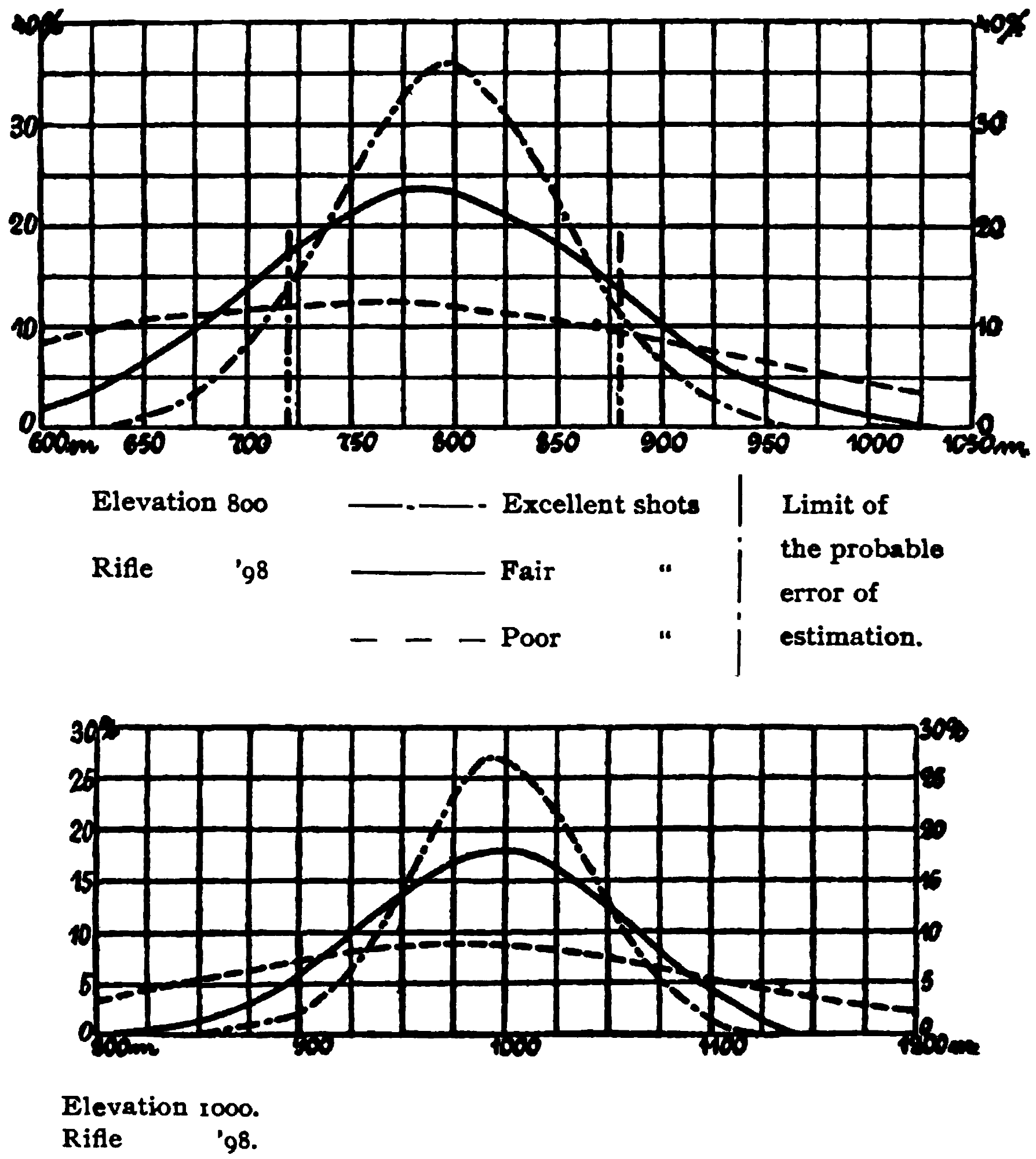
In the following table, the number of hits per 100 rounds fired, at a target 1 m. high, by the marksmen named, is shown under—
“a” When the fire is controlled and the appropriate elevation is used;
“b” When each skirmisher has selected the elevation corresponding to his estimate of the range. In this case it is presumed, however, that the ranges are generally estimated correctly. (Rohne, Schieszlehre für die Infanterie, 2nd Edition, p. 102).
Range. Excellent shots. Fair shots. Poor shots.
m. a b a b a b
400 65.1 58.5 50.4 47.8 26.6 26.4
600 46.6 32.9 32.9 26.6 16.9 15.8
800 35.2 15.5 23.3 13.9 11.8 9.7
1000 27. 7.5 17.6 7. 8.9 5.9
1200 20.5 4. 13.6 3.9 6.8 3.5
1400 16.1 2.4 10.8 2.4 5.4 2.2
1600 12.5 1.5 8.7 1.5 4.4 1.4
The above table shows that when the elevation selected is in error, the number of hits decreases more rapidly the greater the skill of the marksman; and that an error in estimation is of less importance than marksmanship only at ranges under 800 m.
DIFFERENCE BETWEEN “a” AND “b.”
Range. Excel- lent shots. Fair shots. Poor shots.
m.
400 6.6 2.6 0.4
600 13.7 6.3 1.1
800 19.8 9.4 2.1
1000 19.5 10.6 3.0
1200 16.4 9.7 3.3
1400 13.3 8.4 3.2
1600 11. 7.2 2.
(c) Fire Effect as Regards Time. Number of Rounds to be Expended.
The greater the losses inflicted within a short period of time in a limited space, the greater the moral effect of the fire. It should therefore be the aim of the officer charged with fire direction to bring about a decisive effect within the shortest possible time. The leaders must bear in mind from the beginning of the fire fight that the ammunition carried is limited and that the expenditure of a certain amount is equivalent to a loss of power, and this is permissible only where commensurate results would be achieved. When once a decision has been formed to fire on a target, the ammunition necessary to accomplish the object of the fight must be expended without stinting, since ineffective fire impairs the morale of one’s own troops and raises that of the enemy.
When the enemy is approximately equal to us in numbers, and is deployed in line at one man per meter of front, presenting breast targets only, the number of rounds per rifle, given in round figures in the following table, will be required to place about one-third of the enemy’s force out of action:[163]
At a range of 300 m. 3 rounds,
„ „ „ „ 400 „ 5 „
„ „ „ „ 500 „ 6 „
„ „ „ „ 600 „ 7.5 „
„ „ „ „ 700 „ 10 „
„ „ „ „ 800 „ 13 „
„ „ „ „ 900 „ 16 „
„ „ „ „ 1000 „ 25 „
„ „ „ „ 1100 „ 45 „
„ „ „ „ 1200 „ 50 „
„ „ „ „ 1300 „ 57 „
„ „ „ „ 1400 „ 63 „
„ „ „ „ 1500 „ 72 „
„ „ „ „ 1600 „ 80 „
In the above table it is assumed that an error of estimation of 7.5% was made and that at ranges over 1000 m. two elevations were used. Against head targets, approximately twice the number of rounds indicated above must be expended; and against exposed skirmishers, visible at full height, about half of the number of rounds given. The efficacy is increased when the fire comes from a flank. The following data are taken from an extended firing test: At 600-700 m., 200 skirmishers, firing 5000 rounds against 200 body targets, obtained 4.3% hits and placed 43% of the figures out of action; under the enfilading fire delivered by one platoon, the percentage of hits rose to 10.5%, and the number of incapacitated figures to 80%.
(d) Additional Influences Affecting Accuracy of Fire.
Errors in setting the sight, in pointing, aiming, and pulling the trigger, increase the area of the beaten zone at the expense of fire effect on the actual target selected. When we consider the excitement of men in action, and the numerous sources of error in setting the sights, in pointing and firing, it is clear that we have to reckon with the effect of misses on the field of battle more than with the really well aimed and well delivered collective fire of a considerable number of marksmen. Lieutenant Colonel Wolozkoi, late of the Russian Army,[164] attempted to obtain an approximate standard of measurement for the errors in firing made by marksmen. He bases his deductions upon the opinion that the efficacy of rifle fire in action depends entirely upon the mental and physical condition of the individual soldier at the moment; that in serious engagements this condition is such that accurate aiming cannot be expected; and finally that every skirmisher, according to the degree of his excitement or fatigue, will fire his piece at varying angles of elevation. He argues that this produces a rigid cone of dispersion, whose limits correspond to certain extreme angles of error, and whose axis (center trajectory) corresponds to a mean angle of error; that, for each class of rifles, the depth of the resulting beaten zone is constant; and that the depth of this zone increases with the range corresponding to the angles of error. It follows that the depth of this beaten zone is greater in modern rifles than in those of older pattern.
He believes that peace training will have fulfilled its mission if the skirmisher, while firing, holds his piece in the position to which he has become habituated through years of practice. This position can be none other than that in which the piece is horizontal.
Although the theory of the Rigid, Constant Cone of Misses, is not tenable in this form, because there will always be a reasonably compact core of hits (the dimensions of which depend upon the conditions indicated in the firing regulations) at the center of the cone of fire, the views of Colonel Wolozkoi have, nevertheless, a certain value for us, and find application in large, hotly contested battles, especially when the firing line has been exposed to the material and moral influences of hostile fire for a considerable length of time. At the commencement of every combat we can, at any rate, count on “aimed fire”; but instead of reckoning at all times with a 75% core of hits, 100 m. in diameter, we must become used to reckoning with a 30 and 40% core of hits, of the same diameter, produced by greater dispersion of the bullets.
According to experiments made by Colonel Wolozkoi, a good shot makes a mean angular error of ±8 minutes, when using the horizontal aiming position; a poor shot, one of ±40 minutes; the average error being ±25 minutes. In this, however, the sources of error, due to excitement on the part of the marksmen, are not considered. “The principal angular errors can be traced to the nervousness of the marksmen; and this is directly proportional to the magnitude of the danger and the suddenness of its appearance. The soldier judges the magnitude of danger by the number of hostile projectiles and by their effect. Therefore, the livelier the hostile fire, and the longer it continues, the greater the danger appears to him; while the less the effect of that fire, and the better he is sheltered from it, the less he will think himself endangered. On this account, the nervous tension of the individual soldier will reach different degrees of intensity according to the magnitude of the danger.
“Now there are combat situations where the danger is insignificant, and entire engagements in which the impression produced by danger may be called moderate; moreover, even in lively actions phases may occur in which this is equally true. The circumstances of each particular case will, therefore, determine how long it is possible to fire as prescribed in the firing regulations, and from what moment a reduction of efficacy, according to Colonel Wolozkoi’s theory, is unavoidable.
“The arrival of this moment will be postponed more or less by better discipline and training; and, in addition, at the commencement of an action, we may count on the men putting into practice, to a certain extent, what they have been taught in time of peace. However, the efficacy of rifle fire will deteriorate gradually, as the danger and the intensity of the fight increase, until it reaches the stage which Wolozkoi considers peculiar to all of the more serious actions.
“When discipline is still further reduced, the efforts of the men to keep under cover may lead them to duck even their heads and to fire their rifles at high angles. In this case the decisive short ranges would not be swept by fire, making it possible for the more determined of the two opponents to advance to the assault.
“This reduction of the efficacy of fire (i.e., the delivery of fire at high angles) may also take place when troops are surprised and, in consequence thereof, fire hurriedly. This explains why the enemy’s fire passes entirely over a body of troops which has gotten quite close to his position—by no means an unusual phenomenon in surprises.”[165]
Wolozkoi assumes that the core of hits of his constant cone is formed by projectiles fired at a mean angle of departure of less than 4 degrees, while the lower trajectories of the whole cone of fire correspond to an angle of 1 degree and 30 minutes, and the upper trajectories to one of 14 degrees and 30 minutes. If we apply these figures to a particular rifle we obtain a beaten zone containing 50% of the hits (central zone) at 560-1500 m. for the Chassepot rifle; at 1000-2000 m. for the 8 mm. rifle, and at 1200-3000 m. for the 6.5 mm. rifle. It should once more be emphasized that these figures are applicable in combat phases in which the men themselves are under fire, while firing, or deliver their fire hurriedly or with bad aim.
During the Franco-German war the German troops learned by experience that the defender’s fire inflicted serious losses on the attacker at long ranges, but that the efficacy of his fire did not increase as the skirmishers came closer to his position; that, on the contrary, the intensity of the hostile fire effect fell off noticeably at ranges below 600 m.
During the attack made by the Prussian Guard against St. Privat, the greatest number of dead and wounded were counted at ranges from 1200-1500 m., and the fewest losses were sustained at ranges from 500-600 m. from the enemy’s position, where it had to remain stationary on the slope for about an hour awaiting the effect of the enveloping movement made by the Saxon Army Corps. A range of 1500 m. corresponds approximately to an angle of departure of 5 degrees for the Chassepot rifle. The 20th Infantry Division was molested by rifle fire from St. Privat, during its march from St. Ail to St. Privat (the range in this case was 2200 m., which corresponds to an angle of departure of 15 degrees 30 minutes for the Chassepot rifle) although the skirmishers of the Guard, against whom this fire was directed, were only from 400 to 500 m. from the French position.
In the Russo-Turkish war of 1877-78, the same thing occurred. Infantry projectiles reached the Russian reserves while they were still 2500 m. from the enemy (this range corresponds to an angle of departure of 14 degrees 30 minutes).
Kuropatkin corroborates the statement that at 1500 m. and beyond (5 degrees 50 minutes), the losses produced by the Turkish rifle fire were very serious; that at 400 m. (1 degree 8 minutes) from the hostile position, on the other hand, the losses were remarkably small, sometimes even ceasing entirely. The Turks finally kept their heads under cover altogether.
A correspondent writes the following in regard to the engagement at Slivnica on November 17th to 19th, 1885: “When at 400 m. from the enemy, the firing lines suffered scarcely any losses, while the reserves, stationed far to the rear, suffered severely from stray shots.”
It must be the endeavor of peace training to prevent the occurrence of unaimed firing in battle. This necessitates careful supervision by squad and platoon leaders over the individual soldier in the firing line, and the severe punishment of every act of carelessness in pointing, aiming, and setting of the sight, in peace time. In war one must constantly endeavor to avoid opening fire prematurely, as it tires the eye and the arm of the soldier, to check any unjustifiable rapidity of fire, and to hold the men down to a steady and slow fire. This includes, in addition, the avoidance, by the leader, of haste in giving directions for firing. In defense, one will have to make every effort to withdraw one’s men from the moral effect of the attacker’s fire preparation, and to keep them in proper condition to repulse the assault. This requires the construction of splinter proofs, head cover, and, in case the hostile fire becomes too deadly, a cessation of fire, which is again resumed when the enemy attempts to advance. To carry this out properly, covered observation stations should be built, and the men instructed to line the parapet and to open fire at a signal previously agreed upon, sights having been set and ammunition replenished before they leave cover. A body of troops is not unfit to resist an assault simply because it has suffered a certain percentage of losses, but because each individual soldier is so mastered by the feeling that he is in danger of losing his life that he fires his piece without raising his head above the parapet. A body of troops in such a state will fire its projectiles in Wolozkoi’s “constant cone.”
A mobilized organization, thoroughly trained in time of peace, will still fire a by no means inconsiderable fraction of its projectiles with good aim and with the proper rear sight elevation, provided its officers are equal to their task.
(e) The Influence of Rifle-Rests in Firing.
Freehand firing increases the rate of fire. Whether the skirmisher fires freehand or from a rest is of influence on the accuracy of the single shot at short ranges. The Belgian, Dutch, and Italian regulations authorize the bayonet, in the absence of other expedients, to be stuck into the ground as a rifle-rest, while this is forbidden in Germany. Collective fire of short duration delivered at mid ranges has not been found superior because of the use of rifle-rests. Fire delivered from a rest is undoubtedly superior, however, when the barrel of the piece is heated by continued firing (position of the left hand supporting the piece when firing standing, prone, or kneeling) and when the arm of the skirmisher gets tired. When firing from a rest, high shots result from vibrations of the barrel;[166] and there is also danger, when under fire, that the men will not raise their heads over the parapet, but will fire their pieces into the air. This, as corroborated by the more recent campaigns, is why a fire fight at short range is by no means decided in so short a time as the peace performances of modern rifles lead one to suppose, for great losses do not take place until skirmishers, who have heretofore hugged the ground, rise. At Spionskop, the two opposing firing lines remained stationary for hours at 250 m. from each other.[167] The Japanese found in their attacks that at ranges from 150 to 75 paces the hostile fire had no effect.
(f) Influence of the Ground.[168]
So far we have considered only the effect of infantry fire on level ground. The efficacy of fire is, however, greatly influenced by the inclination of the ground upon which the cone of dispersion falls. Where the ground rises in respect to the line of sight, the depth of the beaten zone is decreased; where it falls in respect to the line of sight, the depth of the beaten zone is increased.[169]
The importance of this circumstance is frequently so magnified in the French infantry that sight is lost of tactical requirements. For example, they employ formulae to ascertain the point from which a height can be covered with grazing fire, or propose to defend the ascent to a plateau by evacuating the military crest and occupying the reverse slope, keeping the slope facing the enemy under a grazing fire with the tail ends of the trajectories.
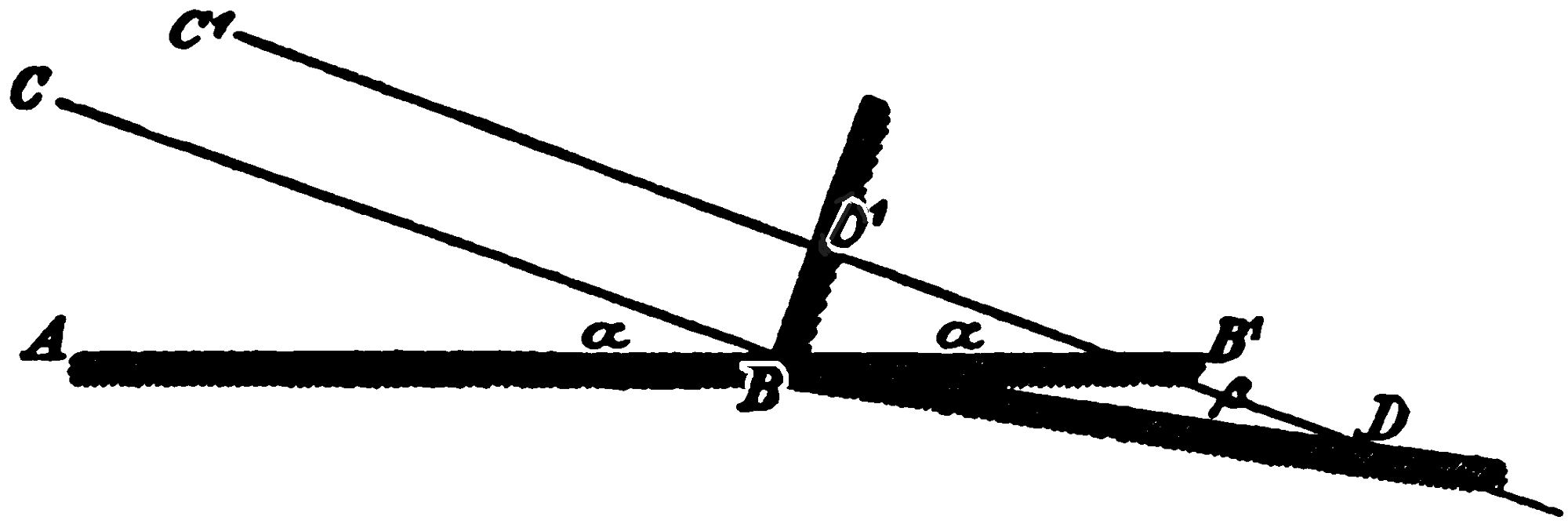
Let A B B¹, in the accompanying figure, represent a horizontal plane pierced by trajectories C B and C¹ B¹, at an angle α, forming the beaten zone B B¹. If now the ground falls from B in the direction B D, it is obvious from the figure, that the angle of fall β decreases and the beaten zone B D increases. The limit of this increase is reached when the angle of slope is greater than the angle of fall of the projectile. In this case there is a dead angle beyond B and toward D. If, on the other hand, the ground be rising, the angle of fall will be C¹ D¹ B and the beaten zone[170] decreases to B D¹. The smaller the angle of fall of the projectile the greater the influence of the ground.