THE FORMAL TACTICS OF INFANTRY. (continued 4)
Walter Krueger translation
From this it follows that when fire direction is in competent hands the appearance of the enemy on the terrain as at B D will be fully taken advantage of, while firing on slope like B D¹ should be avoided. Troops will, however, rarely be in a position from which they can see a target on the slope B D. The efficacy of the fire will in such a case be more or less a matter of accident. A body of troops in broad formation will in this case receive a greater number of hits than a column, since each meter of front of the crest line receives a certain number of projectiles. It is otherwise, however, where the slope rises in respect to the line of sight. A line is more easily missed than a column of considerable depth on the march.
The following data in regard to the increase (diminution) of the depth of the beaten zones is taken from the work of Lieutenant-General Rohne on Das gefechtsmäszige Abteilungsschieszen der Infanterie, p. 44:
Range. Rising Slope. Falling Slope.
m. 1° 2° 1° 2°
800 1⁄2 1⁄3 ∞ ∞
1000 2⁄3 3⁄4 2 ∞
1200 3⁄4 3⁄5 3⁄2 3
1400 4⁄5 4⁄6 4⁄3 2
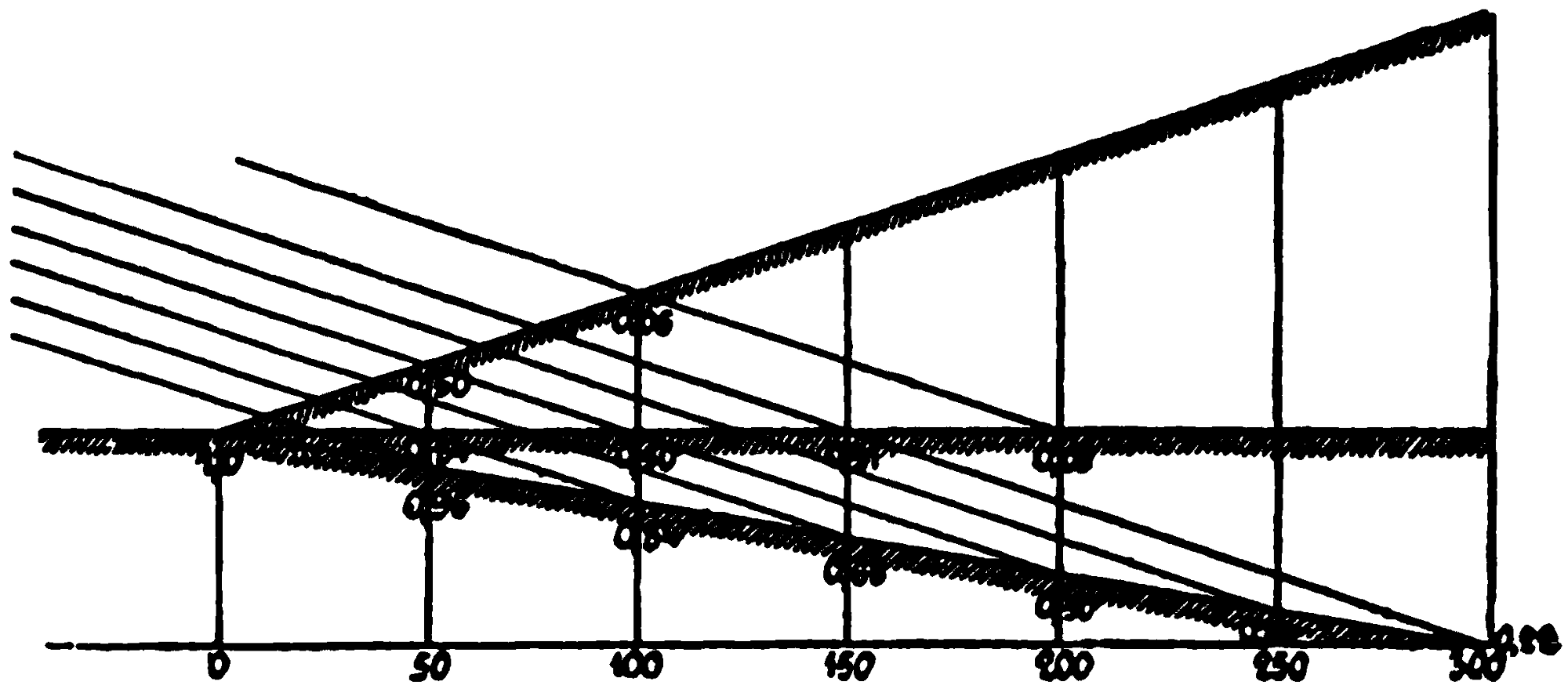
The above figure, taken from Lieutenant-General Rohne’s work, Schieszlehre für die Infanterie, p. 128, shows the influence of the ground on the efficacy of fire when “poor” shots are firing at a target, 100, 200 m. etc., in rear of which are other targets of the same dimensions but situated either on level ground, on a 2-degree rising slope, or a 1-degree falling slope. On a rising slope of 2 degrees the depth of the beaten zone is decreased by half, and on a downward slope of 1 degree increased by half.
“The knowledge of this influence of the ground is of great importance to the tactician. For this reason I have selected ‘poor’ shots for the above example because the efficacy of infantry fire in battle will approximate theirs more nearly than any other. From this we may deduce that where the ground slopes upward in rear of a firing line, less distance will suffice to withdraw supports from the fire directed at the firing line than on level ground; and that, if the ground in rear of the firing line slopes downward, the distances must be increased unless the slope is so great or the hostile trajectories so flat that bullets pass over the crest, forming a ‘defiladed space,’ into which no projectiles strike.”
On ground rising in respect to the line of sight (i.e., on the slope of heights facing the enemy, or opposite to commanding ground, the slope facing the plain) columns suffer the greatest losses; on ground falling in respect to the line of sight (on the reverse slope of hills and on plateaus) line targets suffer the greatest losses.
Where the ground falls at a greater angle than the angle of fall of the projectiles (about 5 degrees at 1500 m., and 1 degree at 800 m.) a defiladed space is formed, which makes it possible to bring supports nearer to the firing line than would be practicable on level ground. If we assume that each graduation of the rear sight over 600 m. commands a space 100 m. deep with the normal core of hits, we obtain the following depths of the beaten zones at a range of 1500 m., with rifle model ’98 (angle of fall 5 degrees and 22 minutes):
Ground rising 1 in 10 = 6° = 50 m.
„ „ 1 in 20 = 3° = 64 m.
„ „ 1 in 50 = 1° = 81 m.
Ground falling 1 in 10 = 6° = 360 m.
„ „ 1 in 20 = 3° = 180 m.
„ „ 1 in 50 = 1° = 113 m.
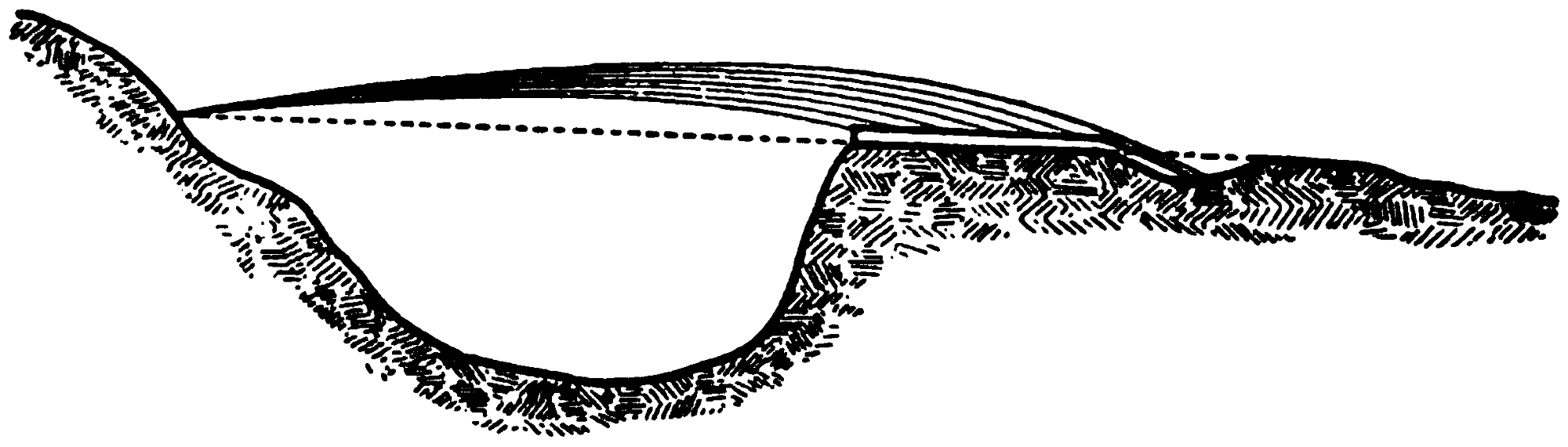
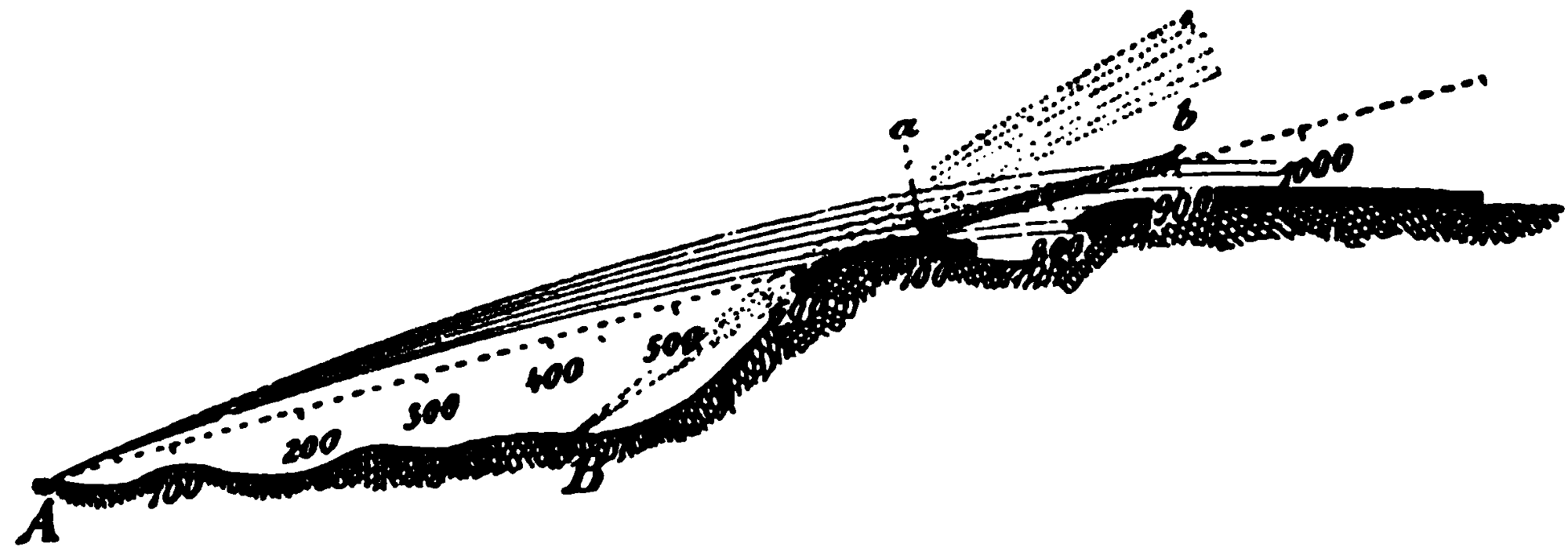
The figures on pages 181 and 182 show to what extent the ground is capable of increasing or diminishing the efficacy of fire. The French assert that the Würtembergers deliberately applied these principles in the defense of the park wall at Villiers. It was, at any rate, only an accident that the masses of troops on the west side of the gently sloping Mamelon de Villiers suffered heavy losses on November 30th, 1870.
General Paquié of the French Army[171] lays down the following rule: “When the angle of slope of falling ground corresponds to the angle of fall of the lowest trajectory of a cone of dispersion, the depth of the beaten zone will be 21⁄4 times greater than on level ground. When the angle of slope of falling ground is equal to the angle of fall of the mean trajectory of a cone of dispersion, the depth of the beaten zone will be 21⁄2 times greater than on level ground. When the lowest trajectory of a cone of dispersion passes over the crest of a hill at the height of a man, and when the reverse slope of that hill is equal to 1⁄100 of the range, the depth of the beaten zone will be five times as great as on level ground.”
These data are of no practical value in war. They serve only to increase the appreciation of fire effect when examining the terrain, and train the eye in judging such situations.
The character of the ground may exert great influence when firing on intrenchments. Fire delivered from low ground against an enemy in shelter-trenches is absolutely ineffective—as shown in the action against the French IInd Corps at Point du Jour and by the experiences of the Russians at Plevna and Gorni Dubniac. This condition becomes aggravated the smaller the angles of fall of the projectiles, and the higher the target is situated relative to the firing position of the attacking party.
Attacks on hill positions show that there is a range at which the greatest efficacy may be obtained from fire directed against the top of the height itself. This maximum efficacy gradually dwindles as the position is approached. This fact has led the Swiss to retain a Main Firing Position. (See Figure, p. 182. Fire effect from A and from B). For the purpose of determining the favorable range, “D,” corresponding to a certain height (of the enemy’s position) “H,” Lieutenant-General Rohne has deduced the following formula for rifle model ’88:[172]
D = 15.H + 500.
It is only in fortress warfare that it might occasionally be possible to apply this formula. To determine at what distance the defender must take position in rear of a crest, in order to sweep the slope facing the enemy with his fire (aiming points being resorted to) without being himself exposed to view, is of still less value for use in the field. According to General Warnet of the French Army, if “p” is the degree of slope expressed in centimeters, the defender should choose between two points which lie between (p + 5) 1000 and (p + 3) 1000. When the degree of slope is 1 cm. in 10 cm., the defender should take up his position either 600 or 300 m. in rear of the main crest. In such a position the defender will, it is true, be protected to a certain extent from the enemy’s fire, but can only very inadequately defend the slope facing the enemy. A concentration of fire on certain targets is impossible and the attacker is given an opportunity to reach the crest, here and there, without coming under fire. Thus ballistic advantages must be given up in the face of the numerous tactical disadvantages. We have mentioned this subject here, to show the strange excrescenses which an undeniably sound basic principle may develop in the hands of theorists, who have entirely forgotten that in war only that which is simple succeeds.
“Indirect Rifle Fire” is to be used in firing on a target not visible from the firing position. In this connection, the following is taken from the report of Captain Knobloch, Austrian Army,[173] on Schieszaufgaben unter feldmäszigen Verhältnissen:
“Indirect rifle fire is infantry fire in which aiming points are used. These should lie above and beyond the target and in line with it. It goes without saying that an aiming point fulfilling all these conditions will rarely be found. Moreover, the aiming point must not be selected at random at some particular elevation, because the angle between target and aiming point, expressed by graduations on the rear sight leaf, might possibly lead to a negative sight setting.
“In the practical tests made on varied ground against targets of appropriate height, splendid results were obtained as regards effect; but the aiming point had to be indicated by means of a flag. Despite the fact that the terrain was covered with numerous objects, such as trees, woods, factory chimneys, etc., no suitable aiming point could be found on the terrain itself. This largely determines the value of indirect rifle fire in the field.”
This class of fire is, however, worth a trial at any rate. Moreover, its tactical, combined with its moral, advantages are so great that we could afford to accept calmly a fire effect poorer by comparison. Indirect rifle fire will, at times, give troops an opportunity to do damage to the enemy without being themselves seen or fired upon.
It remains to mention briefly the effect of ricochets which, as a rule, tumble[174] after striking. Their range upon rebounding is short. Bullets ricochet most frequently on water, on rocky and hard ground, more rarely on wet meadows, and on tilled soil, but they do not ricochet at all on sandy soil. Ploughed fields, in which the furrows run obliquely to the line of fire, eliminate the effect of ricochets almost entirely. When jacketed bullets (but not the massive French “D” projectiles) strike upon rocky ground, they have a tendency to alter their form materially, or to tear the jacket, thereby considerably increasing the severity of the wound which is produced. The range of ricochets upon rebounding depends mainly upon the angle at which they are deflected. When the lateral deflection is 30 degrees their range may amount to about 1300 m. The nearer a bullet strikes to the skirmisher firing it, and the smaller the angle of deflection of the consequent ricochet, the greater its range; under favorable conditions this may amount to 2500 m. According to French experiments, in firing at a range of 800 m., 4% ricochet hits struck a target, the height of a man, at 1400 m., and 1% ricochet hits a similar target at 1850 m. from the skirmisher who did the firing.
13. LOSSES IN ACTION.[175]
An attempt to move troops in close order formations within the zone of uninterrupted infantry fire at ranges under 1500 m. when the enemy is still in condition to direct his fire on them, is bound to lead to losses which make the further tactical employment of these troops impossible.
Bodies of troops following the firing lines will also have to deploy when the hostile fire reaches them, unless they can find cover. It is a disadvantage for them to deploy, and every opportunity to return to close order formation must be utilized.
Troops in rear, not directly fired upon and exposed only to accidental shots, should employ narrow rather than broad formations. It might therefore seem advisable to remain in route column so long as no flanking fire is received. The Italian Firing Regulations contain the following figure showing the effect of fire directed on troops in the formations indicated.
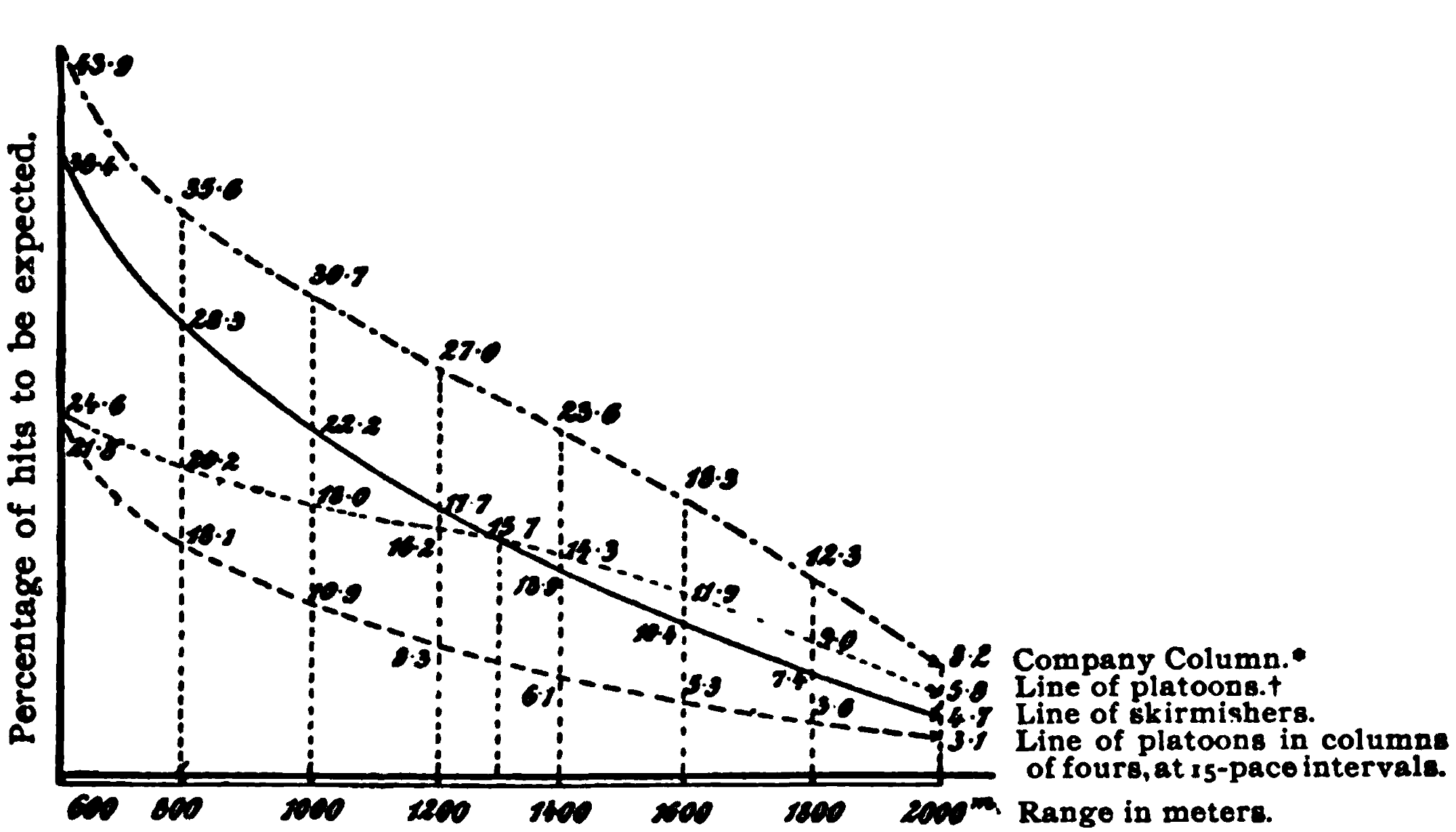
Vertical axis: Percentage of hits to be expected. Horizontal axis: Range in meters.
Dash-dot curve: Company Column.[176] Dotted curve: Line of platoons.[177] Solid curve: Line of skirmishers. Dashed curve: Line of platoons in columns of fours, at 15-pace intervals.
According to the figure, the Italian Company Column (German Column of Platoons) suffers the greatest losses; the least losses are sustained by the company formed in line of platoons, each in route column, at intervals of 15 paces. According to French experiments, this formation is said to be no longer suitable when subjected to infantry fire at ranges under 1300 m.
According to French firing tests made in Châlons,[178] the following percentages of hits may be expected when using the Lebel rifle firing old model steel jacketed bullets:
At a range of
1200 m. 1400 m. 1600 m. 1800 m.
Platoon (one rank) 4.4 3.4 2.2 1.4
Skirmish line, men at 3-pace intervals 1.2 —— —— ——
Platoon in column of fours 6.6 3.8 2.2 1.3
Platoon in column of twos 5.6 3.2 1.9 1.1
Company column (German column of platoons) 22.0 18.0 14.0 10.0
Lieutenant-General Rohne, in his work, Schieszlehre für die Infanterie, p. 117, computes values for the relative vulnerability of the several formations. At a range of 1200 m., purely frontal fire only being considered, we obtain with every 1000 rounds fired with the appropriate elevation, the following number of hits against—
Line. Column of platoons. Infantry in route column.
Standing 116 160 98
Prone 20 65 72
And against a company deployed in line of platoons:
3 platoons, each in route column. 3 platoons, each in column of twos. 6 sections, each in column of twos.
Standing 57 39 29
Prone 28 25 14
The company deployed in line of sections in columns of twos would thus seem to be the most favorable formation for movements, and the line lying prone is especially well suited for halts. For movements under purely frontal, concentrated fire, the line is the least favorable formation, while the route column offers the narrowest target. In this, the character of the terrain plays a decisive role. In firing on targets consisting of columns, it has been assumed that a single projectile will place only one man out of action. Under shrapnel fire the formations are similarly arranged as regards their vulnerability, the line formation being less favorable than the column of platoons, since the former receives all bullets deflected laterally.
The total losses in battles and more serious engagements amount to from 10 to 20% of the participating troops. In some organizations the losses in killed and wounded may amount to as much as 50-60%. The loss that an organization will endure is directly proportional to its efficiency. Good troops, which unexpectedly get into a difficult situation (as, for example, the British Brigade of Highlanders at Magersfontain), and which have been trained to look upon heavy losses as unavoidable, will be capable of enduring a loss of 25% in the course of a battle without going to pieces and without discontinuing the attack.[179]
At the battle of Gravelotte, in which 166,400 rifles, 21,200 sabres, and 732 guns, extending over a front of 19 km., participated on the German side, only 109,200 rifles and 628 guns fought the decisive action. The losses amounted to 9.51%, distributed as follows: 899 officers and 19,260 men; according to arms: infantry, 10.96%; cavalry, 0.66%, and artillery, 5.74%. On the decisive flank, the infantry of the Guard suffered a loss of almost 30%. On this flank, the Rifles of the Guard (Gardeschützen) lost 44%, the 1st Battalion of the 2nd Regiment of the Guard, 55.5% of their enlisted strength, the 6th Company of the latter regiment losing even 141 men.
Although losses are, generally speaking, smaller than during the 18th Century, and at the opening of the 19th Century, nevertheless they may amount to a considerable figure in a brief space of time in single bodies of troops which suddenly encounter a heavy fire.
At Magersfontain, (December 11th, 1899) the British lost 13% of their total strength; the Brigade of Highlanders, 23% (39% of the officers; i.e., 1 officer for every 14.9 men); the IInd Battalion of the Black Watch, 42%, and the IInd Battalion of the Seaforth Highlanders, 23.9%. At Colenso (Dec. 15th, 1899) the British lost 6.4% of their total strength; the IInd Battalion of the Royal Dublin Fusiliers, 23.9%.
Spionskop (Jan. 24th, 1900):
Attacking troops 2,694 men in 181⁄2 hrs. 40 officers, 721 men = 28.2%
Supports 1,600 „ „ 101⁄2 „ 8 „ 95 „ = 6.4%
Reserves 1,500 „ „ 41⁄2 „ 15 „ 170 „ = 12.3%
Staffs —— —— 5 „ —— ——
5,794 men 68 officers, 986 men = 17.5%
This action illustrates strikingly how rapidly the officers directing the fire were shot down.
Attacking troops 1 officer for every 18 men
Supports 1 „ „ „ 12 „
Reserves 1 „ „ „ 11 „
1 officer for every 14 men
For the purpose of comparison, we should like to mention that the Prussian Grenadier Battalion “von Wedel,” consisting of 12 officers and 390 men, lost 10 officers and 301 men (77%) in about one hour during the battle of Soor (Sept. 30th, 1745). The losses suffered by the Grenadier Battalion “von Münchow” at Kesselsdorf are possibly not much lower. The effective strength of the last named battalion is not given; it lost 5 officers and 371 men.[180]
At Kolin, the Grenadier Battalion “Nymschöfsky” lost 652 men, and six infantry regiments lost between 900 and 1188 men, i.e., considerably more than 50% of their strength. Two days after the battle, the Grenadier Battalion “Nymschöfsky” numbered only 24 men and the enlisted strength of six infantry regiments was 233, 296, 602, 651 and 711 men respectively. The number of stragglers was undoubtedly very great.[181] At Kolin, the infantry lost in all 12,307 men out of 19,000, i.e., 65%.
The losses among officers are especially heavy. This is by no means due to the attempt of the hostile skirmishers to pick off the leaders in the combat at short range, but to the fact that, in order to lead their men, officers must expose themselves. This becomes more and more necessary the greater the moral effect of the combat on the nervous systems of the men, and the poorer the troops. According to past experience, the casualties among officers are especially heavy in the early stages of a war.[182]
The relative losses of officers and men in the battles named are given, in round figures, in the following table:
At Weiszenburg (Vth Army Corps) 1 officer for every 14 men ;
„ Wörth (Vth Army Corps) 1 „ „ „ 20 „ ;
„ Wörth (XIth Army Corps) 1 „ „ „ 15 „ ;
„ Vionville (IIIrd Army Corps) 1 „ „ „ 21 „ ;
„ Vionville (Xth Army Corps) 1 „ „ „ 24 „ ;
„ Gravelotte (Guard Corps) 1 „ „ „ 22.5 „ ;
„ Gravelotte (XIIth Army Corps) 1 „ „ „ 20 „ ;
„ Colenso 1 „ „ „ 15 „ ;
„ Magersfontain 1 „ „ „ 11.8 „ ;
Colonel Hessert[183] writes the following in regard to the losses among the officers of the 25th Division on August 18th, 1870: “Eight of the 16 field officers and 6 of the 14 adjutants present with the regiments and battalions were either wounded or killed. Almost all of these officers were mounted. Seventeen of the 40 company commanders—almost all of them dismounted—and 43 of the 151 company officers were placed out of action. This would be a loss of 50% in field officers, 42% in adjutants, 37% in company commanders, and 29% in company officers.”
On this day the Rifle Battalion of the Guard lost 100% of its officers and 44% of its men—19 officers and 431 men, in about three-quarters of an hour.
On Sept. 11th, 1877, at Plevna, the Ugla Regiment lost 20 of its officers, i.e., 40%; the Jaroslaw Regiment, 25 officers, i.e., 64%; the total loss of the first named regiment amounted to 42%, that of the last named to 49%. Of the 15 company commanders of the Vladimir Regiment, 14 were placed out of action.
After the assault on the Tuminling Pass on Oct. 12th, 1905, the East Siberian Rifle Regiment had only 2 officers with its firing line, and after the battle of Sandepu only 5. These examples are not isolated ones. After the battle on the Yalu, the 11th Rifle Regiment had present for duty only one field officer, and the 12th only 3 captains. On March 7th, 1905, the Yoshihoka Regiment (3rd Japanese Division) had present for duty only 3 lieutenants; one battalion was commanded by a first sergeant and one company by a private.
14. THE MORAL EFFECT OF FIRE.
The moral effect may make itself felt in a two-fold way: as the sum of the impressions influencing the soldier at all times in action, and as the momentary general impression produced by a sudden considerable increase in the losses. The great material effect of fire creates such a consciousness of danger in men’s minds that in a defeated force more than half of its numbers succumb to this moral effect of the fire.
“Troops do not retreat because they are unable to maintain themselves owing to their numerical inferiority, but because they fear the losses which they would suffer if they advanced further. The determination to conquer has been overcome by the desire to live. The confusion of impressions increases with the size of the force. Taken individually, the men might behave quite sensibly, but in a crowd they are claimed either by insanity or lethargy. The activity of the mind is completely replaced by imagination; everything is believed; nothing is appraised; exaggeration prevails everywhere; and precipitation produces unthought of results. When the men come to their senses, it is as if they were awakened from a stupor; they are unable to understand how fear could have induced them to do the very opposite from that which would, most surely, have saved them from destruction.”[184]
In the midst of the impressions of the battle of St. Privat, General von Kessel wrote: “The men appear to be either extraordinarily excited or stupefied. Their faces are distorted and only a few still retain firm will power.”
General Bonnal describes his first impressions at the battle of Wörth as follows: “Since half-past seven our battalion was lying, facing eastward, in the neighborhood of the wood of Fröschweiler. The shrieking of the Prussian shells, but especially the noise of the shells bursting in the midst of the batteries of the 3rd Division in position in our rear, made a considerable impression on our men. Their joking ceased, and nervousness was plainly visible in their pale faces. Men to whom tobacco was offered declined it; they had no desire to smoke. All eyes were focused upon the officers. The latter were congregated here and there in small groups; a few were trying hard to joke, others were walking up and down, with a cigarette between their lips, making convulsive efforts to appear at ease; a small number were entirely calm as if no danger was present.... The first batch of wounded made a strong impression. The battalion was to reinforce the Turcos in the edge of the wood of Fröschweiler. The fire of the Turcos drowned all other sounds. There was nothing to indicate that the enemy was also concentrating a heavy fire upon the wood. We deployed into line to the right. The deployment began, but scarcely ten men had reached the edge of the wood when a terrible cracking and rattling commenced. It was a mitrailleuse battery which fired a volley directly under our very noses. At this moment our men lost their heads. They blazed away like mad, crowded in three, four, and five ranks at the foot of the downward slope. The men in front had thrown themselves to the ground, the others fired kneeling or standing, leaning against trees. Since all of the men fired without aiming, enveloped moreover by a dense, impenetrable cloud of smoke, the advanced lines were in greater danger of being hit by French bullets than by those of the enemy. We had to throw ourselves to the ground to avoid being shot down by the lines in rear. On the hill opposite to us, at a range of 300 to 400 m., there rested a white smoke cloud, and we could indistinctly discern the enemy, who was keeping up a lively fire. The powder smoke enveloping us was so dense that we literally could not breathe.” This excitement gradually subsided and the leaders were able to get the troops again under control.
The numerous surrenders of British troops in the engagements of the Boer War were due to the peculiar conditions existing in the theater of war. Besides, Boer and Briton spoke the same language. During the first few days of the campaign, surrenders of detachments of considerable strength took place. These were not punished with sufficient severity. One almost gains the impression that the men considered the surrenders justifiable in order to escape from a difficult situation.
On the South African battlefields, devoid of cover and swept for great distances by the hostile fire, it was indeed very difficult to penetrate the hostile position, and retrograde movements were undoubtedly attended with heavy losses. To this may be added the fact that it was easy for the Boers, who were mounted, to bar the way to isolated British forces. It must be remembered, moreover, that the operations took place during the hottest season and in a country where water is scarce; and that the men felt they had arrived at the limit of their powers of physical endurance at an earlier moment than would have been the case under different conditions. Thus, the surrender at Stromberg of troops exhausted from a night march, is perhaps excusable; not so, however, the surrender of Colonel Carleton’s detachment, which laid down its arms at Nicholson’s Neck after offering a feeble resistance. In the last-mentioned case, it is true, several Englishmen, who had already laid down their arms, stood among the Boers so that the commander of the British force did not really know just what action to take in this situation. His hesitation decided his fate. The demand must unquestionably be made in future also,[185] that troops surrounded in the field make a serious attempt to cut their way out before permitting thoughts of surrender to enter their minds.
It is impossible to determine theoretically what losses troops are able to endure. After the Franco-German War it was believed that troops had reached the limit of endurance after losing one-third to one-fourth of their strength. Nowadays this limit would appear to be reached much sooner. It may be pointed out, however, that the neglect of continuing the attack at Colenso (loss 5.8%), and at Spionskop (loss 7.2%), may, in part, be charged to lack of energy in the commander; and that the Brigade of Highlanders, consisting of 2000 rifles and deployed on a front of about 4000 m., in the engagement at Paardeberg (loss 13.4%), lacked the necessary depth to continue the attack. The greater the degree of efficiency and freshness of troops, and the less the degree of suddenness with which they enter a difficult situation, the greater the losses which they will be capable of enduring. Furthermore, we should not forget that our modern personnel has become much more susceptible to the impressions of battle. The steadily improving standards of living tend to increase the instinct of self-preservation and to diminish the spirit of self-sacrifice. The spirit of the times looks upon war as an avoidable evil, and this militates directly against that courage which has a contempt for death. The fast manner of living at the present day undermines the nervous system,[186] the fanaticism and the religious and national enthusiasm of a bygone age are lacking, and, finally, the physical powers of the human species are also partly diminishing. The influence exerted by officers on the firing line is nowadays, however, considerably smaller than in the past, so much so that they can actually control only the nearest skirmishers. In addition, the nerve-racking impressions on the battlefield are much greater at present than in the past. The “void of the battlefield”[187] has become especially pronounced since the introduction of smokeless powder. “The invisibility of the enemy directly affects the morale of the soldier, the sources of his energy and his courage. The soldier who cannot see his enemy, is inclined to see him everywhere. It is but a step from this impression to hesitancy and then to fear. The inertia of the troops for whole days at Magersfontain, Colenso, and Paardeberg, frequently more than 800 m. from the enemy, was not produced by their losses, but by the moral depression which is caused within the effective zone of rifle fire.” (General Négrier.)[188]
The effect of danger on the battlefield is indicated by—
1. Derangement of tactical units;
2. The mixing of men of the different units during the action; and
3. The dissolution of units into disorderly masses.
According to the History of the Kaiser Franz Regiment (p. 113) immediately after the battle of St. Privat, most of the companies numbered only 30 men, and the whole regiment only 340 men, although, allowing for losses, there should have been 1922 men. The three companies of the 39th Füsilier Regiment which had fought in the Stiring Wald at Spicheren, numbered only 6 officers and 150 men at the close of the fight in the evening,[189] which means that, allowing for losses, 350 men were missing. After the battle of Colombey, when the Füsilier Battalion of the 55th Regiment was assembled, three companies numbered only 120, 60 and 40 men, respectively. This battalion had lost about 300 men.[190]
The plan of the battle of Colombey given in the General Staff Account (Gt. St. W.) shows at 7 P. M. 17 companies belonging to 5 different infantry regiments, and to two different infantry brigades, occupying a front of 1200 paces, in the following order:
7.Jägers., 1.55., 4.15., 8.15., 4.53., 6.15., 12.15., 7.15., 10.11.12.13., 1.13., 1.73., 9.10.15., 4.3.73., Cos.Inf.
At Wörth 17 different regiments were represented on a front of 5700 paces.
“The assault on Elsaszhausen (Wörth), after preliminary forest fighting, mixed up the troops of the different brigades and in some cases caused the dissolution of battalions.... The 44th Brigade was the only one that remained in fairly good order. Abreast and in rear of it were portions of all the other regiments (of the XIth Army Corps) which, at the moment, however, represented no actual reserves. Even the battalions in the first line hardly appeared to be tactical entities.”[191]
At several points it was possible to assemble the stragglers into formed bodies; but the men in these, commanded by strange officers, easily succumbed to the influences of the combat, and the units disintegrated rather quickly as soon as they came under fire.[192]
In the Giefert Wald (Spicheren) out of 32 companies (4 brigades) only four companies fought together as a battalion. In the little Wenzelberg Wood (at Nachod) there were engaged 71⁄2 Austrian battalions (belonging to four different regiments) and 2 Jäger-Battalions, all of these troops belonging to three different brigades.[193] No attempt was made to lead these troops as one body.
In the oak wood at Dubno (Skalitz), there were engaged 121⁄2 and 81⁄2 battalions belonging to four different regiments and to two different army corps. “The Prussian orders led to a breaking up of the order of battle and to a considerable mixing of brigades, regiments and battalions. In consequence of this, control was lost to a certain extent by the commander-in-chief, and the result achieved was mainly due to the skill and intelligence of the subordinate leaders—especially that of the commanders of battalions and half battalions.”[194]
“The wooded region in rear of St. Hubert was thickly infested with stragglers of all arms. White, red, and blue shoulder straps were to be seen in profusion; men with and without rifles; some with helmets, some with caps, some bareheaded. There were no officers present except those stretched wounded upon the ground. The superior officers riding through the valley assembled the men they found, but it proved only a small force that they gathered, for the greater portion of the men were safely ensconced to one side of the bottom of the valley.”[195] “At 5 P. M., the garrison of St. Hubert had increased to 43 companies, belonging to seven different regiments, and the result was utterly hopeless confusion.”[196]
“At 10 P. M., 48 battalions of the VIIth, VIIIth and IInd Corps occupied a space of barely 1500 m. front and a depth of 1000 m., east of the Mance ravine opposite the French position. Fortunately the enemy was so exhausted that we were able to commit the most serious mistakes with impunity under the very muzzles of his rifles.”[197]
“At Sedan bodies of infantry of the XIth Corps, as well as of the 46th Infantry and of the 5th Jäger-Battalion, had gotten mixed up with the 43rd Brigade during the course of the battle. The regiments of the 43rd Brigade had likewise been so disorganized that after the capture of Cazal the brigade commander had nothing at his disposal but the most heterogeneous mass of troops consisting of about a battalion.”[198]
“In penetrating into Lovtcha (1877) the foremost battalions became disorganized. The companies, and even single soldiers, stood around in irregular groups on the streets, crowded into the houses and sought cover in drainage ditches.”[199] “In one battalion of the Kasan Regiment, which was to move through the town from the left flank, officers and men threw themselves down when the enemy’s fire became effective and only with difficulty could they be induced to rise. When the regimental commander fell, everybody fled, carrying along those in rear. Only two company columns, composed of stragglers of different organizations, resisted, deployed into a dense skirmish line and, encouraged by their officers, rushed forward cheering.”[200]
This fighting power of improvised units, when there were officers left to lead them, was displayed on several occasions at Plevna.
The IInd and IIIrd Battalions of the Kaluga Regiment (in the third battle of Plevna) after taking the second crest, thoughtlessly continued the advance in complete disorder.
“Skobeleff foresaw the coming reverse and attempted to form a reserve, but only by dint of the greatest exertions on the part of the officers was it possible to collect about 100 men belonging to various companies. The men of the IInd and IIIrd Battalions of the Kaluga Regiment were scattered all over the battlefield, the companies had become completely mixed up, and it was a matter of the greatest difficulty to re-form them.”[201]
“Dense firing lines, composed of men of all the regiments, attempted to climb the opposite slope but they got only half way; 400 paces from the Turkish works they halted. The survivors of the organizations participating in the action gradually assembled in Work No. 1, which had been taken. While only a couple of hundred men had taken the work, thousands were now assembled there. Not a single company or battalion was intact, every vestige of organization had disappeared; the commanders, and officers generally, had become separated from their units.”[202]
“Prince Imeretinski succeeded in forming stragglers into the following improvised units:
3 provisional companies of the Libau Regiment.
2 „ „ „ „ Susdal „
2 1⁄2 „ „ „ „ Vladimir „
1 detachment of 100 men of the Reval Regiment.
“These re-formed stragglers were despatched to Skobeleff’s assistance and made a successful assault on Work No. 2 from Work No. 1.”[203]
“These stragglers subsequently formed the nucleus of the garrison of Work No. 2. During the night of the 11/12 September, the Russians succeeded in gathering 1000 more men, which were assembled in companies irrespective of the regiments to which they originally belonged. This gathering of stragglers lasted, by the way, up to the afternoon of the 12th of September. The continuance of the fight was made possible only by constantly re-forming the remnants into new organizations and then sending these forward into the fight.”[204]
The remedies provided by the regulations against these evils are, above all else: Restriction of the front of the several units, the deployment of tactical units side by side in action (instead of in rear of each other) and the use of every opportunity for re-establishing the original organizations. Other suggestions for stemming the tide of disorder as made by the author of Summer Nights Dream (1888) (platoons formed in single rank, volley firing, and constant closing toward the center) are impracticable in a serious action. The disintegrating effect of a battle is stronger than tactical cohesion. It is better to recognize this fact than to face the enemy with illusory ideas.
It is necessary to train the men in peace time to follow willingly any officer, whether he belong to their own or to another organization; and, for that reason, exercises in provisional organizations are requisite for tactical training—a large number of officers being told to fall out at these exercises to assimilate losses which would occur in action. The control of mixed firing lines by word of command of an officer is the foundation of order and troop leading, and thus a prerequisite of success in the battles of the future. In a successful engagement, the evils above mentioned are less evident than during a reverse when troops unexpectedly suffer heavy losses or receive fire from the flank or rear. Troops formed into well-organized units can well stand such a test, but in an improvised organization, composed of fractions and men of different units, especially when their own officers are absent, such a crisis may lead to panic.
The following battle episode is very instructive: The 1st Battalion, 4th Infantry, deployed in line of company columns, advanced at Colombey (14th August, 1870) under French shell and Chassepot fire. The morale of the 3rd Company was visibly impaired by two shells which burst, one after the other, in its ranks, placing 15-20 men out of action. “The men began to hesitate; their steps grew shorter; and, as if impelled by an invisible power, the company executed a half right turn, another half right turn, then another and another. One would have thought the movement was being executed at command. The column was now facing to the rear, and although not running, not fleeing, it was moving back to the Brasserie with suspiciously lengthening steps. The drummer, one Borchert, did everything to bring the men to their senses; the non-commissioned officers assisted bravely, but in vain; the column continued its movement to the rear. Filled with shame and indignation, the perspiration pouring out of every pore, I shouted to the men, repeatedly commanding: ‘Company ... Forward!’ But all in vain. At that moment the battalion commander—he was called the ‘marble statue’ on account of his coolness—galloped up on his bay, shouting: ‘Look at the 5th Company over yonder; see how far it has advanced.’ Then another superior officer jumped in front of the men with the words: ‘Is there no officer here at all?’ At this instant I yelled again as if my life depended upon it: ‘You men belong to the color company; Company ... Forward!’ and the spell was broken. As if on the parade ground the Grenadiers faced to the front; obediently they executed my command: ‘To the attack! Carry arms ... Forward!’ and soon thereafter we again occupied our position between the 2nd and 4th Companies.”
The company lost many men as soon as it entered the fight, among them its company commander; then the two shells burst in rapid succession within its ranks, and this explains the temporary panic. The company lost a total of 86 men (including officers).[205]
Nothing is more contagious in the zone of danger than the example of fear or cowardice.[206] Appeals, threats, and intimidation are of little avail. The most effective remedy lies in developing the individual soldier’s initiative, in training him to act with common sense even when his officers are absent. We should send our soldiers into battle with a reserve of moral courage great enough to prevent the premature moral and mental depreciation of the individual.
V. DEPLOYMENTS FOR ACTION.
1. NORMAL PROCEDURE.
The characteristic tendency of modern times is the liberation of the individual from antiquated ideas and from the restraint exercised by ostensibly reactionary governmental power. The key-note of this tendency, which places individualism above collectivism, is absolute independence of the individual in municipal and national affairs, in science and art. Even tactics has been influenced to a certain extent by this tendency. Success in battle, however, will not be assured by the sum-total of a number of negative or positive individual efforts, but only by the simultaneous launching of masses controlled by a single will. Within these limits the independence of the individual is permissible, for a commander does not exact apathetic obedience, but, on the contrary, intelligent coöperation on the part of everyone, and this cannot be regulated by hard and fast rules.
Instead of laying down rules to cover all cases, the German Drill Regulations leave the leader free to dispose of his troops according to the purpose of the combat and the nature of the ground. In this he is assisted by the initiative and independent action of his subordinate leaders. Normal formations for attack and defense are requisite however, in armies in which the tactical training of commanders and subordinate leaders is deficient and where it is feared that the latter will abuse the latitude allowed them. Where such normal formations are prescribed, it is assumed that hard and fast rules are requisite for training; that the average officer cannot be expected to estimate a situation correctly and arrive at proper decisions; and that the majority of them must be given definite rules for combat if they are to render any service at all.
Drill regulations should facilitate quick mutual understanding between leader and organization and lay down general principles for ordinary situations, for combat tasks, and for formations, but should not, by their rules, direct the actions of a leader from the very beginning into definite grooves. If the regulations contain a normal procedure, there is danger that it will be employed where inappropriate, and that the mental alertness of the leaders will relax and fail in war at the very moment when its presence is most vitally necessary.[207]
“Tactics will always vary according to the nature of the ground, therefore it is impossible to tell beforehand what might happen in each particular case.” (Frederick the Great). Whether or not a particular normal procedure is appropriate does not depend upon the terrain but solely upon the tactical situation.[208]
While there is considerable unanimity of opinion as to the general manner of carrying out an attack, opinions differ radically as to details. “If all the advocates of a normal attack had to describe it in words, there would be about as many suggestions as there are advocates. Which of the many normal attack schemes is the most suitable for average troops? A conference called for the purpose of investigating this point would probably have the strange result that each representative would concede that what the others desire is practicable but need not be done.”[209] Anyone who thinks himself capable of evolving a normal procedure, should bear in mind that all such systems have invariably failed to fulfill the expectations entertained for them because of obstacles which could not have been foreseen during their preparation. Regulations that prescribe too many details are very apt to lead to stereotyped forms and to that which cannot stand the test of actual war. So far every war has had surprises in store for the troops and this will be equally true in the future. Troops will be able to find a way out of such situations only if they have been taught to follow the spirit rather than the letter of their regulations, if they have been individually trained and accustomed to strict discipline, and if their leaders have been taught to reflect on tactics. It is better to send troops into battle with the order, “Help yourselves as best you can,” than to encumber them with combat rules of doubtful value which leave them in the lurch at the first opportunity, because the troops have not been taught to depend upon their own initiative. The consequent indecision is increased in the same proportion as the faith the troops and their leaders had in the lauded universal remedy, the normal procedure. In spite of the excellence of our regulations, we should accustom ourselves to the idea that a future war may correct their provisions.[210]
The enunciation of certain technical combat principles as a guide in the training of the troops is, however, far removed from laying down a stereotyped form for attack (normal attack). Every thinking officer will anyhow, consciously or unconsciously, formulate in his own mind some sort of a “normal attack”, which is nothing but a firm opinion of how he thinks an attack ought to be carried out. If such combat regulations are called “drill attack” (Schulangriff), many of the objections advanced against the normal attack are eliminated. Such definite provisions facilitate in a great measure the intercourse between leader and troops.
“Instructions as to what to do in battle,” says Clausewitz (On War, II), “must not be taken for more than they are; they should not be regarded as hard and fast rules or systems, but merely as good general forms which individual judgment can utilize as is most suitable.... By means of a uniform method, commanders attain skill, precision, and confidence, the possession of which qualities on their part will make the whole machine run easier....
“The drawback is that the habit of acting in a certain groove tends to become fixed and thus antiquated while the attendant circumstances imperceptibly change, and this should be prevented by enlightened and thorough criticism. When, in the year 1806, the Prussian generals (Prince Louis at Saalfeld; Tauenzien on the Dornberg at Jena; Grawert in front of and Rüchel in rear of Kapellendorf) without exception came to grief by employing Frederick the Great’s system of tactics, it was due not merely to the fact that they had gotten into a certain groove of acting which was out of date, but to the most dire poverty of resource to which a fixed system of tactics has ever led. Owing to this incapacity of thinking for themselves, they involved Hohenlohe’s army in such ruin as has never before or since overtaken any army on the battlefield.”
General von Boguslawski[211] demands that the conduct of the attack be regulated by precise instructions both on the drill-ground and in action. He states: “The many different methods of dealing with even the simplest cases, unquestionably evident in the army at the present time, are an evil calculated not only to train but also to confuse the soldier and the subordinate leader. Precise regulations are by no means incompatible with adaptation to the varying features of the terrain in a given case, and will infuse unity and certainty into offensive movements. A normal formation must be prescribed, but it should be flexible.”
Elsewhere he makes the following statement in regard to a normal attack: “I believe that the normal attack should be regarded as the basis of troop training—a solid foundation for further development. In carrying out the spirit of this procedure, further work should be done on varied ground. This spirit aims at the unity of the attack. The formations taught on the drill-ground should be retained as long as possible. The training of officers and men must be such, however, that they will deviate, whenever necessary, from these normal formations. But if the formations, as well as the training and drill, are truly practical and adapted for war, departures from the scheme laid down in the regulations will be insignificant. This, briefly, is my idea of the normal attack or uniform procedure, which not only does not have a detrimental effect, but, on the contrary, is absolutely necessary in order to facilitate the work of the higher leader.”
General von Scherff states:[212]
“It would contribute to clearness and to proper division of responsibility if the regulations would definitely prescribe:—
“1. That only the superior commander who makes dispositions for battle according to his own judgment, be charged with assigning appropriate missions;
“2. That the subordinate leader, charged with the execution of a mission, determine, by an independent choice of any expedient provided by the regulations, the formation in which his organization is to carry out the task assigned; and, finally,
“3. That the subsequent conduct of such an organization be governed by a definite normal procedure, familiar to the men from the drill-ground, so as to ensure mutual coöperation of its component parts.”
2. CONCENTRATION, DEVELOPMENT, AND DEPLOYMENT FOR ACTION.[213]
Column tactics, which influenced us even after the Franco-German war, required that troops be concentrated, prior to an action, from the narrow route column into a broad combat formation. This tedious systematic concentration[214] was invariably employed before entering an action, except when, in critical situations, companies and battalions had to be launched into the fight directly from route column. The commander of a force could reduce the time required for going into action only by approaching the field of battle in assembly formation.[215]
Valuable time was thus lost. Even when the situation was not pressing, the leader was obliged, for example, to allow a regiment having a depth of 1200 m. to close up to a depth of 100 paces. When this had been done, he was forced to wait until thin skirmish lines gained a proper distance to the front. The rear elements were able to follow only when the skirmishers had gained a distance approximately equal to the former depth of the entire column. Such a concentration is only proper however, when the commander wishes to launch his troops subsequently in several directions. Advantage should be taken of every opportunity for decreasing the depth of the column (by forming column of sections).
The advance of large bodies of troops presents no difficulties even in close country, if, as recommended by the author,[216] the battalions in route column are placed abreast of each other and are permitted to go around obstacles and take advantage of the cover available. However, even at long ranges, troops in such formations present favorable targets to hostile machine guns and artillery.
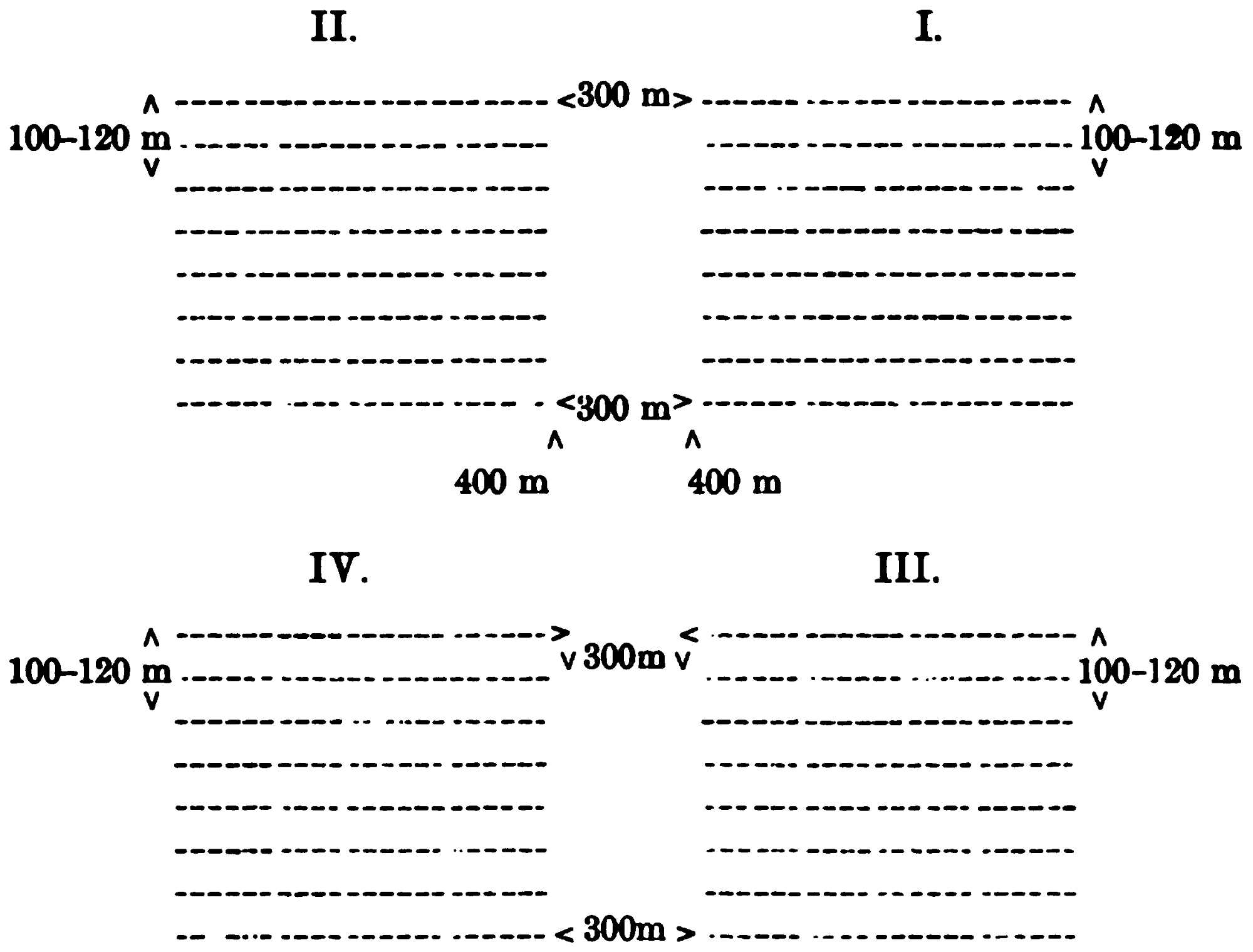
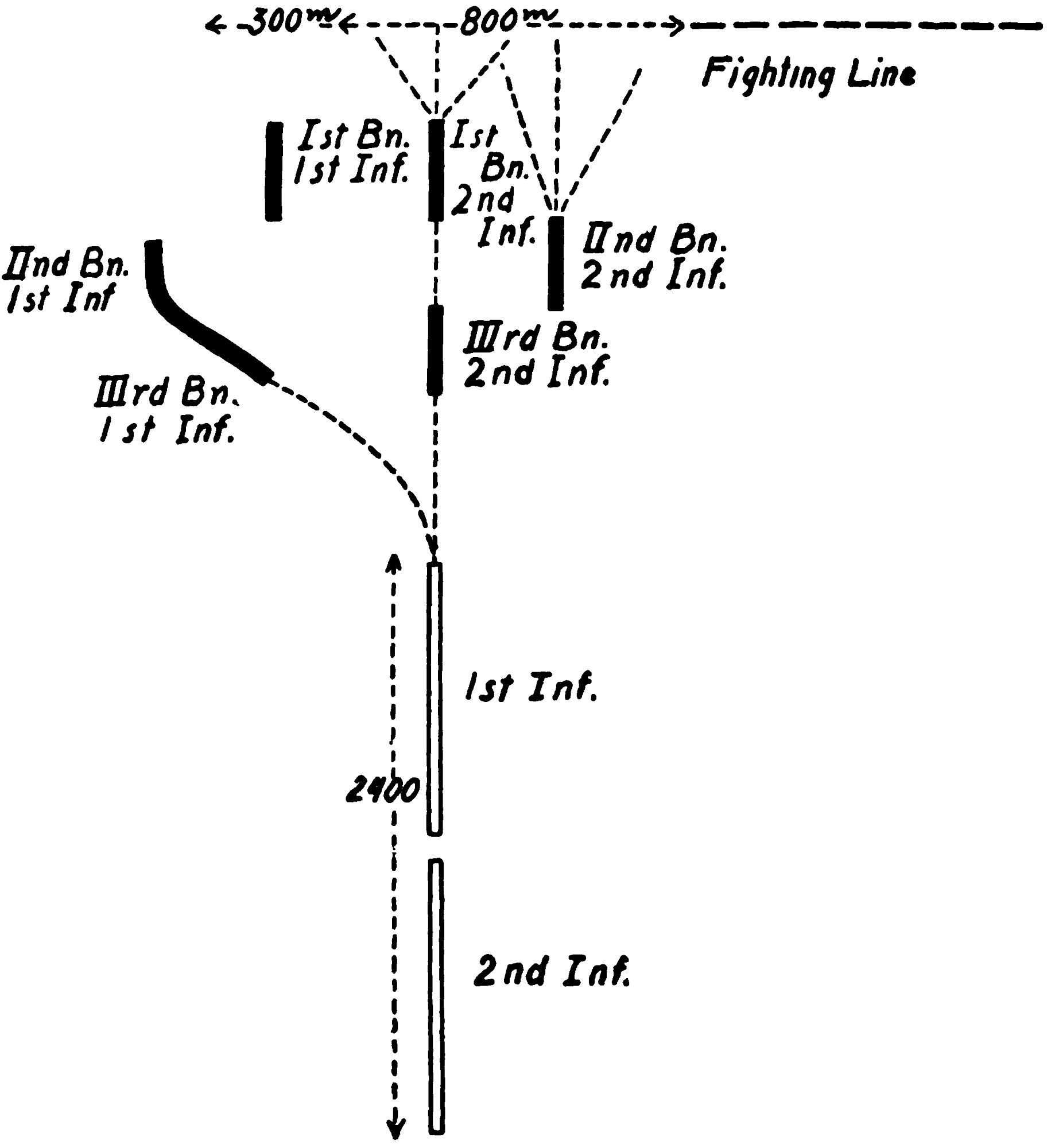
The British were surprised in close order formations at Magersfontain and Colenso. In subsequent engagements, in order to avoid this, their infantry, when still a great distance away from the enemy, took up an attack formation which permitted only movements directly to the front (at Poplar Grove, for example, this was done when 10 km. from the enemy). An advance in such a formation was possible only because the plains of South Africa presented no obstacles, and because the British had only to hold the enemy who stood passively on the defensive. Each brigade formed its four battalions into an open double column with a front of 2000 and a depth of 800 m., the distances and intervals between battalions being 300-400 m. Each battalion deployed from this column so that its eight companies, each in a thin line (with 2 and finally 20 pace intervals between the men), followed each other at a distance of 100-120 paces. The advantage of having troops in hand so that they can be used in other directions than straight to the front, had disappeared.
The Formation of a Brigade of Four Battalions of the 6th Infantry Division during the advance on Poplar Grove on March 7th, 1900. Front about 800 m., depth, 1800-2000 m.
When an engagement is expected, the different elements, each in route column, are directed upon their several objectives, i.e., the column is developed for action. This is done because it is necessary to gain a start over the enemy in deployment and advantageous to move in route column. Thus a development for action (Entfaltung)[217] is nothing but an extension of front accomplished by breaking up the original route column into a number of separate columns. The latter march on diverging lines and can generally remain in route column. Deep column should not be formed unless an immediate extension is not anticipated. During the development for action, preparations should be made providing for the necessary depth of the combat formation.
When the necessity for engaging can be foreseen, the concentration into an assembly formation should be avoided, since it generally entails a loss of time and energy, and the development for action chosen instead. (Par. 315 German I. D. R.). The latter has the additional advantage of affording a higher degree of readiness for action without letting the troops get out of hand. It should be practiced not only from route column but also from assembly formation.[218]
The development for action should begin as soon as there is danger of getting under effective artillery fire. The length of time required for going into action may be reduced by shortening the route column (by concentrating the troops into deep column); by forming several route columns abreast, unless column of sections has already been formed; by clearing the roads of troops; by marching across country; by indicating beforehand on which side of the infantry the artillery is to be brought up (pars. 315-323 German I. D. R.); and, finally, by directing the heads of the various elements upon their respective objectives. (Development for action).
In the Austrian regulations, the development for action is not so clearly emphasized: “A concentration preceding the attack in rencontres is permissible in only those exceptional cases when it becomes apparent, during the preparatory stage of the action, that the enemy has a visible start in deployment.” When time is not pressing, the regulations prescribe a concentration for action and, simultaneously therewith, such a grouping of the principal units (if possible out of range of the effective fire of hostile guns, and well concealed) that the attacking troops need move only straight to the front. A more extended formation is taken up when the zone of hostile artillery fire is reached. The march to the battlefield is discussed in detail by the French regulations: In the first place, in order to take advantage of cover and to keep the roads clear for artillery, it will be necessary to leave the road and to advance across country. This will, as a rule, result in widening the front of the advancing force, even though this be only to the extent of placing columns abreast of each other. Hourly halts are to be made, so as to give an opportunity for replenishing ammunition and time for reconnaissance. Small columns are preferred in woods and in close country and larger columns on passable ground. Attention is specially called to the danger to which troops are exposed when surprised in defiles by hostile fire. This march to the battlefield is followed by a concentration of the troops in concealed and protected positions.
The deployment for action (Entwicklung) consists of forming the troops for battle and includes the extension into line of skirmishers. As a rule, the deployment follows the development for action, but may be made directly from route column or from an assembly formation.
It is impossible to define clearly where the development for action ceases and where the deployment begins. The formation of a line of skirmishers to cover a route column does not constitute a deployment. There is no room for doubt that the regulations have in mind the rencontre, in which the passage from route column to skirmish line proceeds naturally and smoothly. In attacking an enemy prepared to defend a position, the procedure is much more cautious. In this case the force which has been developed for action is withdrawn as much as possible from the view and the fire of the enemy (par. 367 German I. D. R.), and led forward from cover to cover. (Par. 369 German I. D. R.). Even in situations in which haste is required, it is a good plan to follow the procedure laid down by the regulations, viz: “First direct the troops upon the proper objective, then give them a suitable formation.”
An analysis of the question as to whether an immediate launching of troops into action is necessary (5th Infantry Division at Vionville) or whether they should first be regularly concentrated (6th Infantry Division at Vionville) is of special interest. The concentration of the 1st Prussian Army Corps at Waterloo, and of the 5th Bavarian Infantry Brigade at Nehweiler (Wörth), almost in rear of the French, is justly criticised. At Nachod, the Austrian brigades, owing to their time-consuming concentration, lost an opportunity of throwing the weak Prussian advanced troops from the heights south of Wysokow, while the latter were reinforced by parts of the main body which arrived by half-battalions. This reinforcement, while made in driblets, was, however, sufficient.
During its march to the battlefield of Gravelotte, the 3rd Infantry Division concentrated at Buxieres for the purpose of cooking. Then it formed again in route column, concentrated once more south of Rezonville, and from there moved on in echelon formation. The concentration of the 28th Infantry Brigade on August 6th, 1870 (Spicheren), was still less justifiable. About noon, when the head of the brigade reached the exit of the Kollertal Wood at Raschpfuhl, it received orders to cross the Saar. Upon receiving this order, the five battalions present concentrated, unfurled their flags and then marched across country to the railroad bridge of Mattstall. In order to effect a crossing, route column had to be formed again. The delays which occurred here led the parts of the force which had crossed first, to throw themselves into the fight.[219]
3. THE BATTALION, THE REGIMENT, AND THE BRIGADE.
When part of a larger force, the battalion may be broken up into companies either by directing the latter upon their respective objectives, or by forming for attack by command.
When forming for attack by command, the front, the base company, intervals, distances, and the relation of the companies to each other must be indicated. The intervals should be sufficiently large to permit the companies to move unhampered, and so maintained that irregularities of marching will not be communicated from one to the other.
A space approximately equal to the front of a platoon will suffice for this purpose. Thus the interval between companies at war strength would be 150 paces, and between companies at peace strength 100 paces. Intervals may be increased or diminished when necessary so as to enable the troops to take the fullest advantage of cover. The same holds true for distances. For rules in regard to the distance between the second and first line, see p. 121, supra. When a battalion has formed line of companies at long range from the enemy for the purpose of reducing the effect of the hostile fire, distances should be diminished to facilitate the transmission of orders.
When the battalion is acting alone, the intervals depend upon the purpose of the combat. In the fights around Mukden, some of the Japanese battalions, stationed at points where the decision was not sought, were each assigned a front of 800 m. In these cases the four companies of each battalion had to be deployed abreast of each other at large intervals.
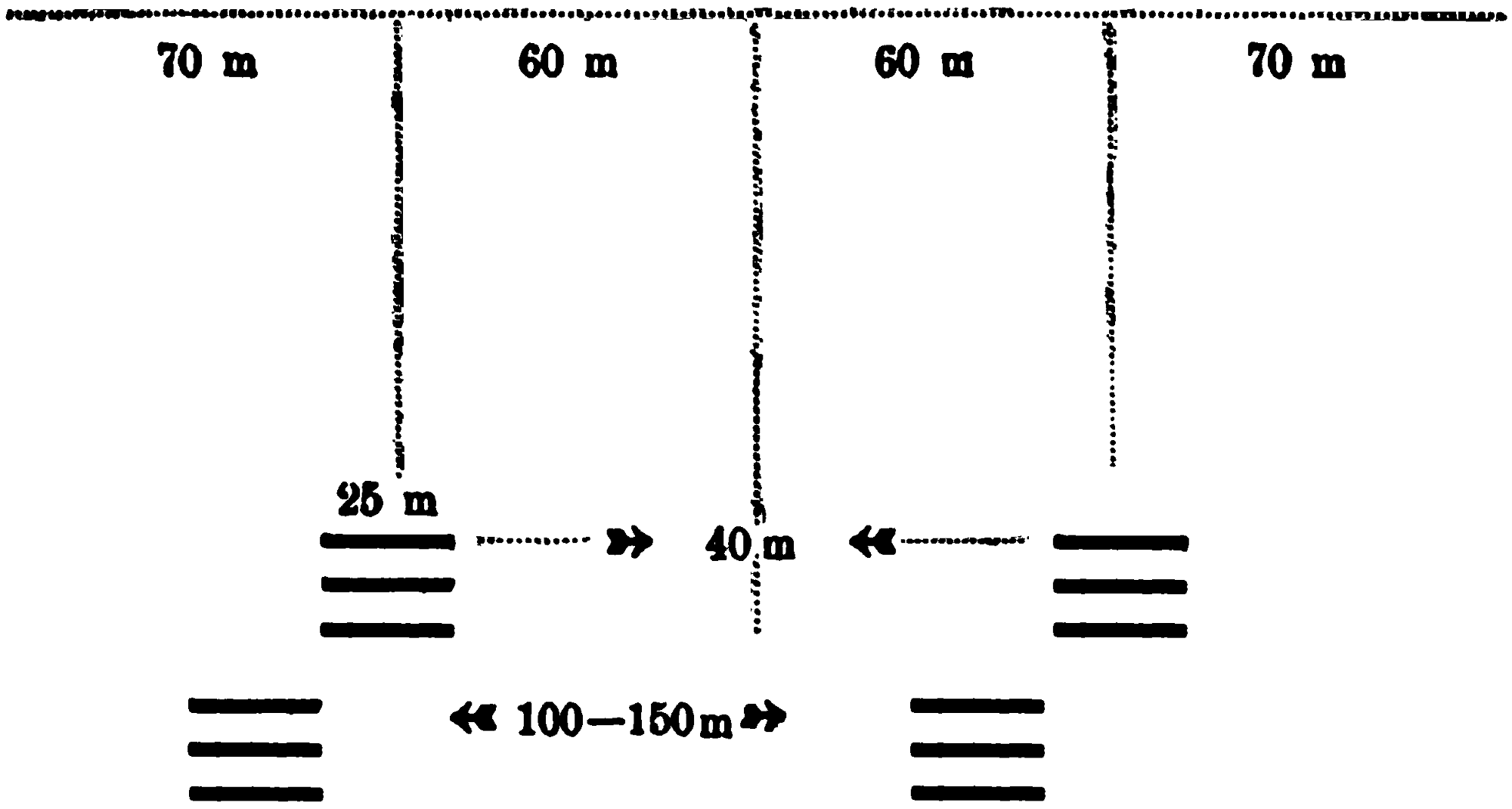
It is impossible to prescribe fixed forms of deployment for particular situations. In each case the formation of the battalion depends upon the situation, the purpose of the combat, and the nature of the ground, the battalion commander having the option of going into action in one, two, or three lines.
Moreover, the formation depends upon whether—
1. The battalion is acting alone or as part of a larger force; and whether one or both of its flanks are resting on impassable obstacles;
2. Whether it is fighting a decisive or a containing action; whether it is to attack or to stand on the defensive;
3. Whether it is to prepare the attack by its own fire or is to take advantage of the preparation effected by other troops; and, finally,
4. Whether or not it has to fight at night.
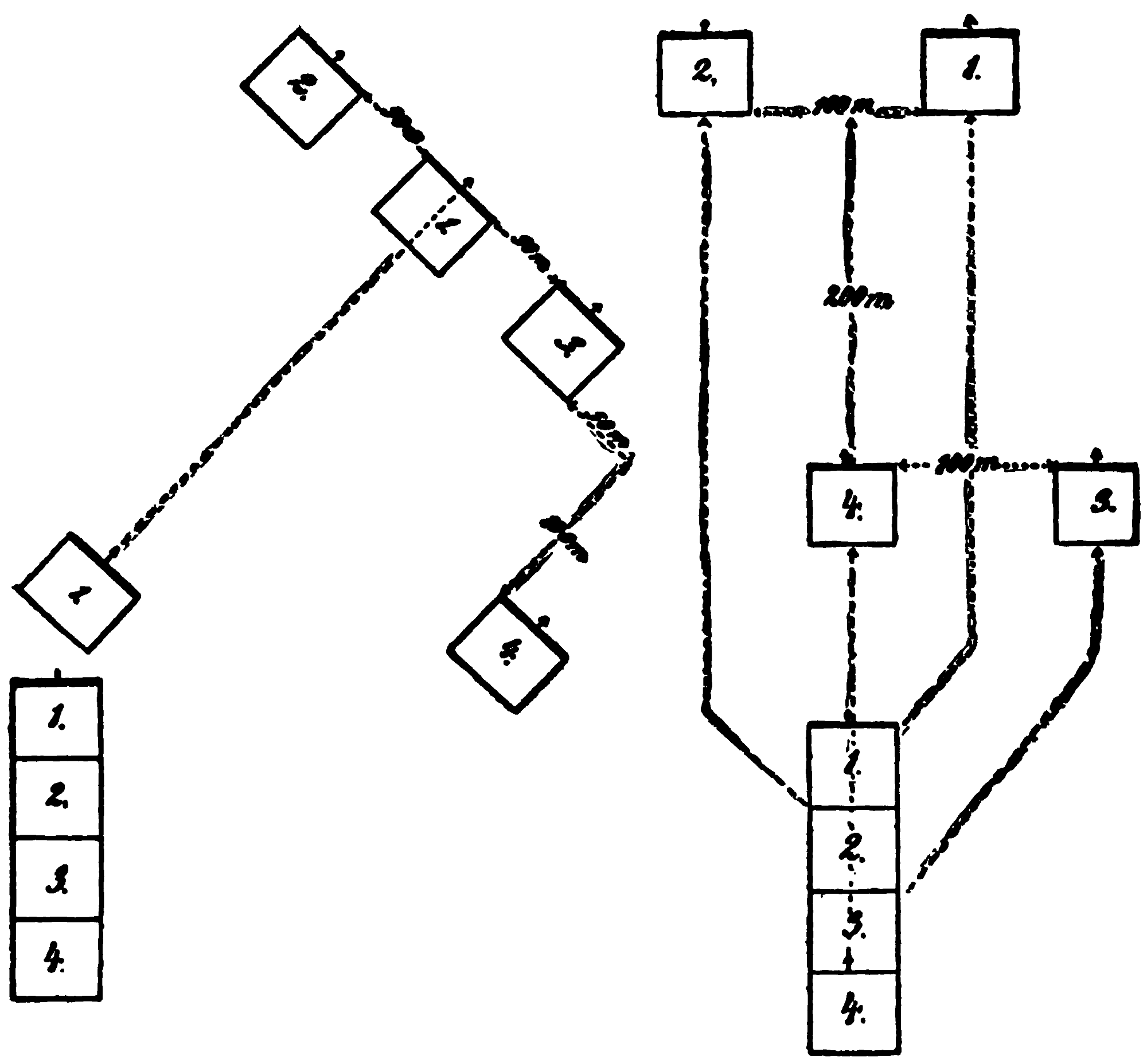
A battalion acting alone, whose flanks are not resting on natural obstacles, will, as a rule, place entire companies successively into action so as to retain complete organizations for other purposes. It will seldom be proper for the battalion to form for attack in the regular manner. When this can be done the battalion should form in three lines in conformity with its task of initiating, carrying out, and deciding the fight. In this case the leading company is reinforced by the second company as soon as the situation has become sufficiently clear. More frequently, the battalion commander will send only a single company into action, retaining the others for the time being under cover.
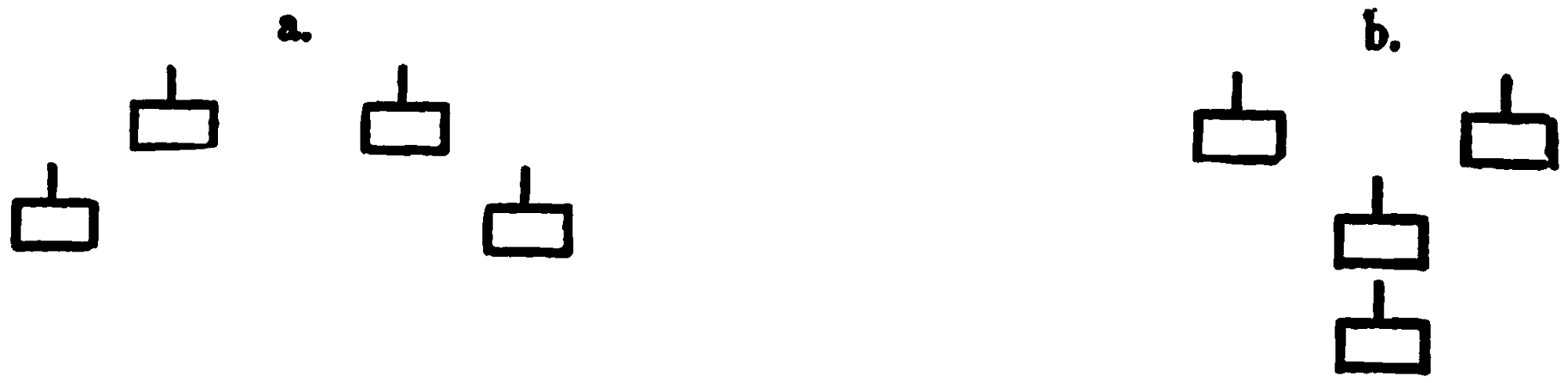
The advance guard battalion of a regiment will, as a rule, be compelled to develop considerable fire in a rencontre (par. 357 German I. D. R.), in order to check the advance of the enemy, and for this purpose it will frequently place two companies into action at once. But since the battalion commander cannot count upon reinforcements and, moreover, as he does not know on which flank the combat is subsequently going to develop, he will provisionally retain the other two companies in rear of the center, or echelon them in rear of both flanks. (See “a” and “b” above figure).

In a containing action one should endeavor to employ few rifles but, on the other hand, expend much ammunition, and keep supports and reserves far in rear so as to minimize the losses. If the force is to deploy first of all only for fire action, but is later to participate in the decisive attack, it will be advisable to place two companies in the first line, one in the second, and one in the third. The companies in the second and third lines will then be less exposed to hostile fire, and the battalion commander will be able, by first launching one and then the other company, to exercise an influence on the course of the action during a longer period than would otherwise be possible. (See “b”).
When a battalion is fighting as part of a larger force, and when both its flanks are secure, it will need only supports for feeding the frontal attack (par. 289 German I. D. R.) and can cover a greater front. A reserve may either be entirely dispensed with, or made very weak.
When only one flank of the battalion is secure, the threatened flank should be protected by echeloning the supports and the reserve in rear of it. In this position, these echelons are not so apt to be bullet-stops as when they are placed in rear of the center. Besides, they can more easily execute enveloping movements and can take a hostile flank attack in flank. When both flanks are in the air, only the most essential precautions should be taken on the one flank, while on the other everything available is united for the decisive attack.
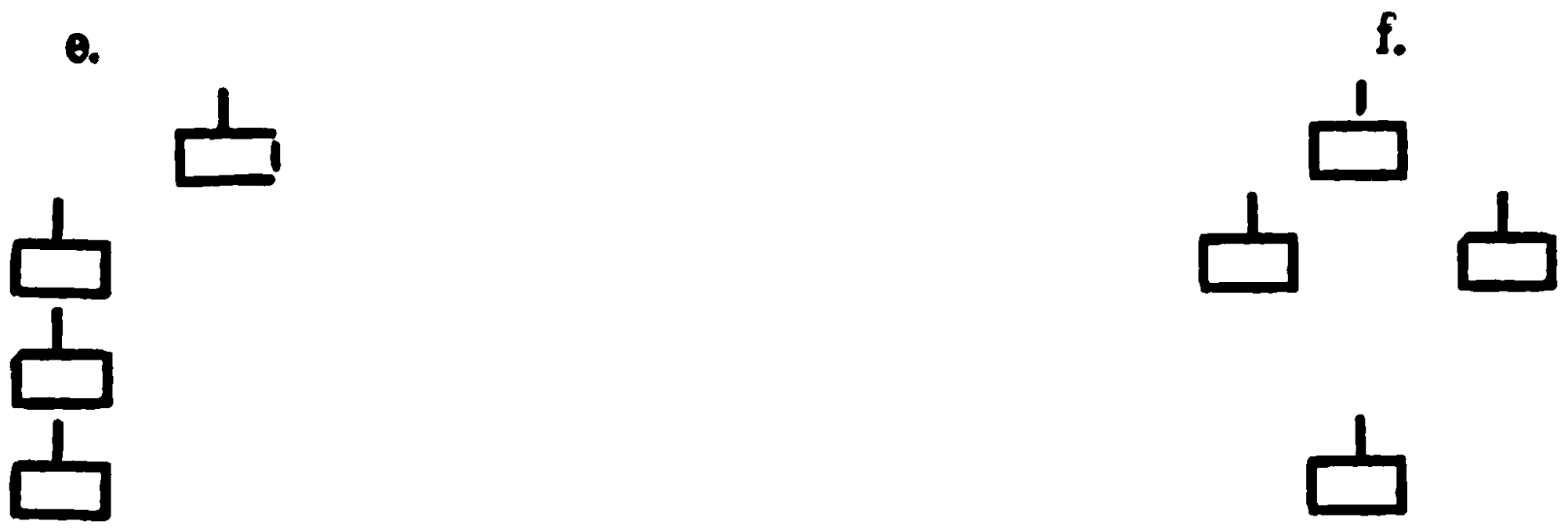
In defense, three companies can sometimes be taken into the first line for the purpose of developing a strong fire, while the fourth company is held in rear of a threatened flank or in rear of the center. (See “d”). When it is desired to employ the reserve offensively, only one or two companies are placed in the first line, the others being held in reserve in rear of the flank which is to take the offensive. Interval and distance increase with the size of this reserve.
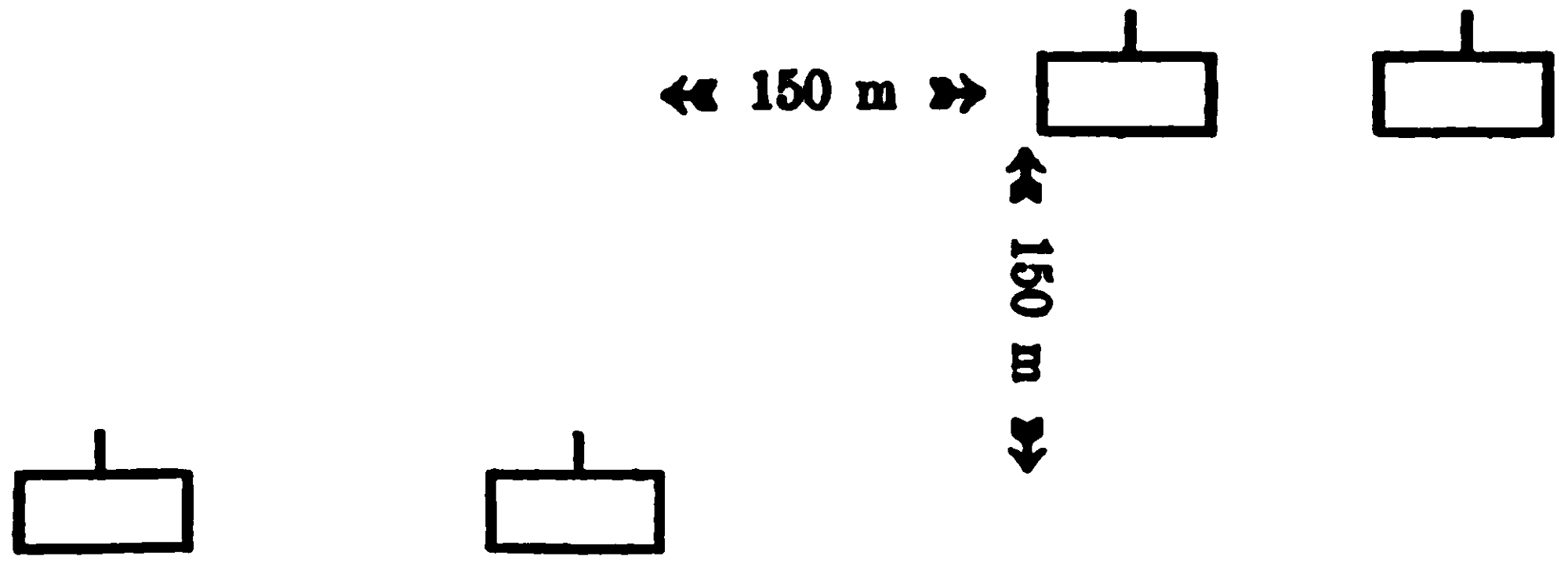
When a battalion from the reserve is called upon to make an immediate attack which has been prepared by the fire of other troops, all its companies may be taken at once into the first line. In this case the battalion may be formed for attack with its companies at close intervals. This might also be a suitable combat formation for night operations. All these formations are subject to change however, as soon as the proper utilization of cover makes it necessary.
The general principles stated for a battalion are also applicable to a regiment. The regiment may either be directly formed for attack, or the heads of the battalions may be deflected toward the points where the deployment is to take place. An interval of 300-400 m. between heads of battalions is best calculated to facilitate the subsequent deployment. The distances depend upon the nature of the ground and the purpose of the combat.
The regimental commander assigns tasks to his battalion commanders, but leaves the latter entire freedom of action in regard to the formation to be taken up and the manner of deploying. He should interfere with companies only in exceptional cases. Such interference is justified only when the conduct of subordinate leaders threatens to impair unity of action in the combat and when time is lacking to observe the proper channels in communicating an order.
Methods of Forming a Battalion for Attack.
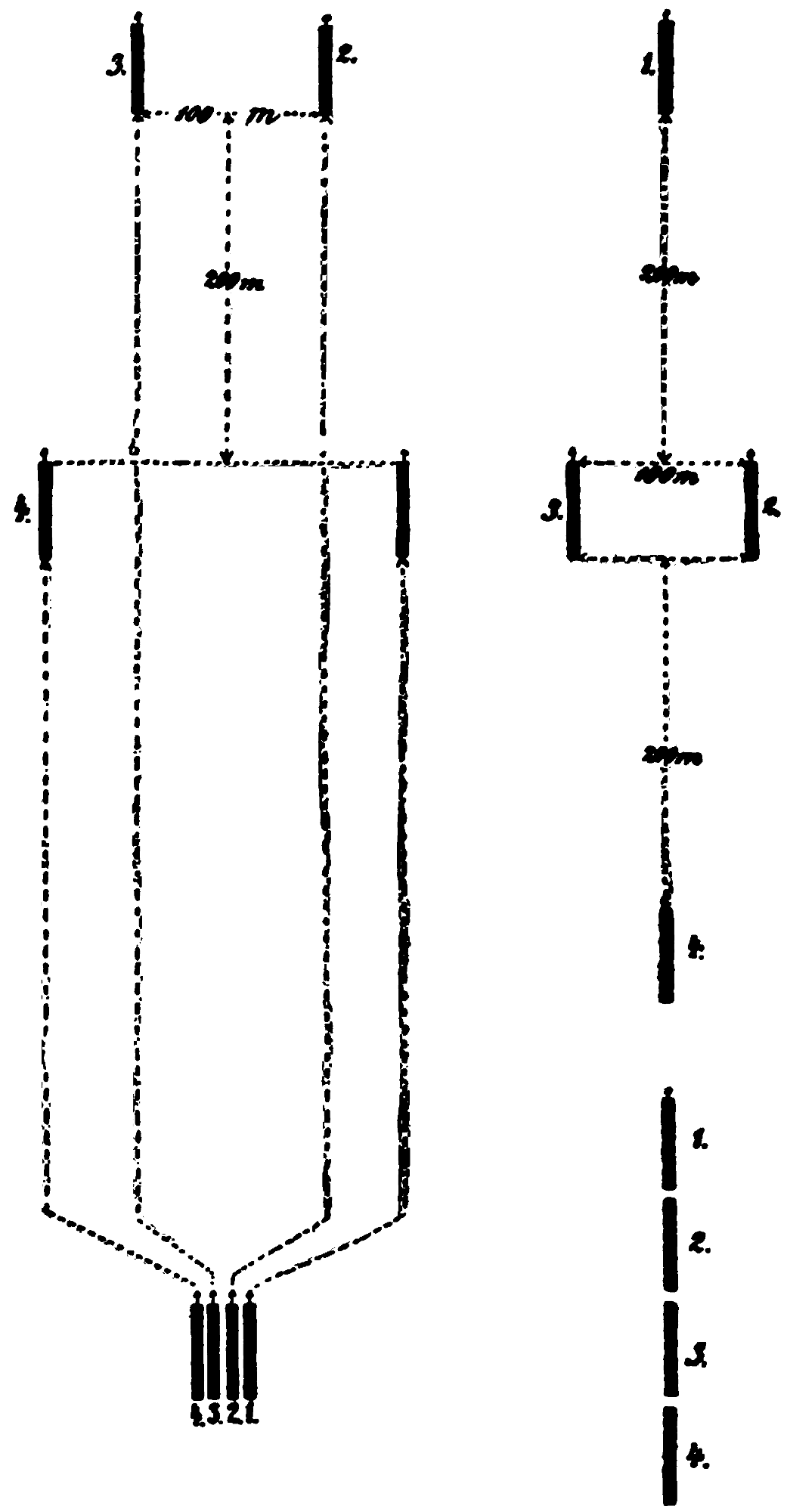
In developing the brigade[220] for action, the depth of column begins to exert an influence. Every concentration of the brigade retards its entry into action. If the longest distance to be covered in developing the brigade is assigned to the leading element of the column, the march into action will be accelerated.
When an infantry brigade approaching the battlefield is to prolong the flank of the fighting line, its entry into action might be hastened, perhaps, by letting the rear regiment continue the march in the original direction while the leading regiment takes the longer route. The rear regiment would then be abreast of the leading one after about 15 minutes. If the battalions are subsequently developed on radiating lines, the development of the whole force will, after a few minutes, have progressed far enough to permit a deployment of skirmishers.
When the brigade takes up a combat formation, each regiment is assigned a separate task (attack of a point, or defense of a section). If the tasks assigned are definite and harmonize with each other, mutual coöperation will be assured. The brigade commander ordinarily sends his orders to the regimental commanders, but, when circumstances (haste, correction of errors) compel him to depart from this rule, he should inform those officers of the action taken. In a brigade consisting of two regiments, its commander, in order to be able to influence the action, will be compelled to retain at least one battalion as a reserve.
Brigades of three regiments[221] (each of three battalions) have an advantage in this respect. But if such an increase in infantry units were contemplated, it would be better, for reasons that will be given later on,[222] to form the additional troops into a third division in each army corps.
Base Units.
The possibility of regulating the movements of a body of troops by means of a base unit, depends upon a number of preliminary conditions which will seldom be fulfilled in war:
1. The leader of the base unit would have to remain unharmed to the very last. If he were disabled the command of the unit would devolve upon the next in rank who would perhaps not join it in every case.
2. The fresh organisation which imparts the impetus necessary for a further advance, would have to maintain the direction after the original base unit had ceased to exist on account of the mixing of organizations.
3. The base unit would have to encounter less difficulties during its advance than the other units of the force. If the base unit were to encounter greater difficulties than the other units, this might serve as an excuse for reducing the rate of advance. In attack, the organization nearest the enemy, in other words, the one that is led better and more energetically than the others, is quite naturally charged with maintaining the direction. Moreover, this organization will be able to facilitate by its fire the advance of the elements in rear.
The designation of a base unit[223] or unit of direction on the battlefield cripples the energy of an entire line and the initiative of the individual in favor of uniformity of movement. A base unit is only profitable in night operations, in crossing unfavorable ground (woods), and in bringing the fighting line up to the effective zone of hostile fire. “With the entry into action, the importance of the base company gradually decreases as the demands made by the combat increase”. (Par. 242 German I. D. R.). In all other cases, it is better to indicate either the objective on which the troops are to march, or the flank toward which they are to maintain connection.
A change of direction of march is executed by wheeling or turning with the subordinate units toward the new front. (Par. 185 German I. D. R.). A change of front is effected in the same manner. With long lines, echeloning and movements by the flank will result, which can only be rectified gradually by issuing appropriate orders. When skirmishers have been deployed in a wrong direction, or when a deployment in another direction becomes necessary after the conclusion of a combat, it is advisable to deploy a new line in the desired direction, from the closed bodies still available, and to withdraw, at the same time, those parts of the former skirmish line which are no longer necessary.
Examples of Changes of Front.
1. Engagement at Helmstedt, on July 25th, 1866. The 20th Infantry had to deploy to its left rear after its successful attack on the Ütting Hill.[224]
2. The battalions of the XIth Army Corps wheeling toward the Niederwald after crossing the Sauer (battle of Wörth).[225]
3. The wheel executed by Kottwitz’ Brigade during the battle of Loigny-Poupry (2nd Dec., 1870). (This is also cited as an example of the conduct of a counter-attack made by the defender). Toward noon the advance guard of the 17th Infantry Division held Lumeau. The 33rd Brigade, its battalions in double column, was concentrated south of Champdoux. The division commander retained two battalions as a reserve and ordered Major-General von Kottwitz “to execute a quarter wheel to the right and to form his command for attack in the general direction of Loigny,” for the purpose of relieving the pressure on the Bavarians defending Schlosz Goury. The attack was directed against the French Division Jauréguiberry, which was attacking Schlosz Goury. This division first came under fire at 3-400 m. and then approached to within about 150 m. of the defenders’ position; strong reserves followed in rear of its right flank, but otherwise nothing was done to protect the right.
By wheeling at once to the right, the right wing of Kottwitz’ Brigade would still have struck the eastern garden wall of Schlosz Goury, and, as Loigny had been indicated to the general as the objective, a fan-shaped extension of the brigade, precluding mutual coöperation, would have been unavoidable. The general had fourteen companies at his disposal and decided to advance in a southerly direction until his second line overlapped the most advanced hostile line, so that the attack as planned would have struck simultaneously both the first and second lines of the enemy. The slight loss of time involved caused the general no uneasiness, as he could carry out his intentions without interference beyond range of the fire of the enemy, whom he could observe during the entire movement. The brigade formed for attack, during its movement to the south, when about 1200 m. from Goury. The general, who was on the right flank, halted the brigade after it had advanced far enough, and wheeled it to the right.
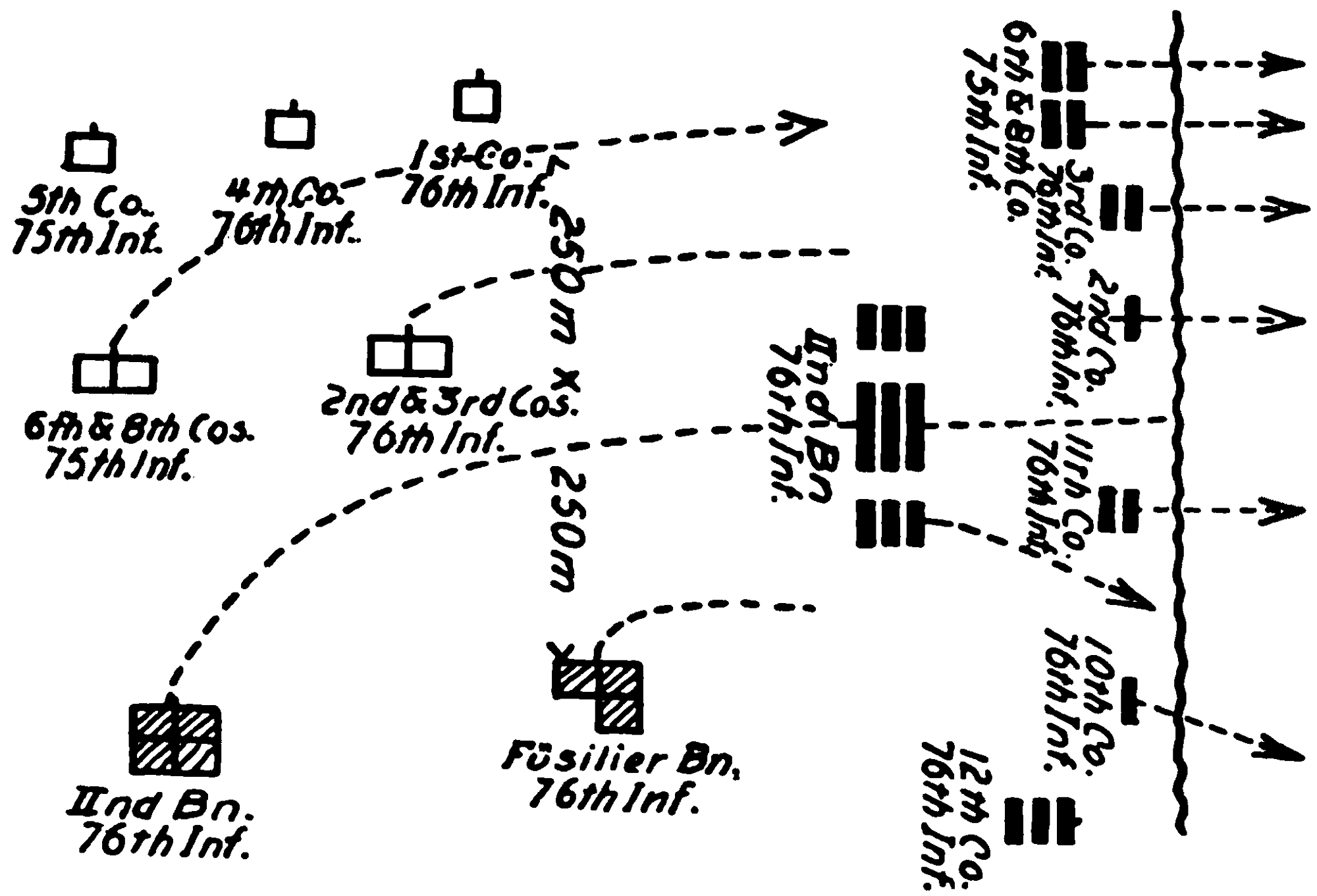
As the second line overlapped the first, the Füsilier Battalion of the 76th Infantry had to shorten its step until the 2nd and 3rd Companies of the same regiment had come abreast and until the 6th and 8th Companies of the 75th Infantry had also joined the line. The center half-battalion, (2nd and 3rd Companies of the 76th Infantry), the unit of direction, was ordered to march on the church spire of Loigny. All the units of the force, with the exception of the IInd Battalion, 76th Infantry, at once deployed lines of skirmishers. The 1st and 4th Companies, 76th Infantry, and 5th Company, 75th Infantry, covered the left flank and turned toward Ecuillon. Of the eleven companies launched in this flank attack, six were in the first line (approximately 1100 rifles on a front of 800 m.), and five in the second.
The bulk of the second line, in an endeavor to close with the enemy quickly, joined the firing line when 400 m. from the enemy. The attack came as a complete surprise to the French; their lines were taken in flank, and all their attempts to form new defensive lines to oppose the onslaught of the Hansards proved unavailing. The dense, unwieldy masses of the French were more and more crowded together by the uninterrupted advance of the Hansards and offered good objectives to the German marksmen. The advance of the brigade was supported by the artillery in position near Lumeau. This artillery followed the brigade to Ecuillon.
The Hansards traversed a distance of 3500 m. during this attack. The right wing and the bulk of the 2nd and 3rd Companies, 76th Infantry, which had been detailed as the unit of direction, with orders to march on the church spire of Loigny, strayed to Fougon; the left wing penetrated into Loigny.[226]
4. The advance of six battalions of the IIIrd Army Corps against the Forbach Hill (Spicheren).[227]
4. DISTRIBUTION IN DEPTH AND FRONTAGE OF COMBAT FORMATIONS.[228]
The infantry combat is decided by the combined action of long firing lines. Retained forces, not launched against the enemy for the purpose of crushing him, exert no influence whatever on the decision, since they only increase losses without contributing to the fire effect. In the battles of the past, distribution in depth at the decisive stage of the combat (unless necessary as a measure of precaution, in securing the flanks, for example), was only permissible so long as the short range of the weapons allowed reserves to be kept in readiness so close to the firing line that they could assault en masse at once and without any diminution of their strength. The deciding factor, which rested in retained reserves during the Napoleonic era, lies at present in the firing line.[229]
Distribution in depth is, therefore, only a means to an end; an expedient made use of to maintain a dense firing line permanently at a constant strength; to give the firing line the impetus for the assault; to protect it against a reverse; and to secure its flanks. Victory is assured only by the simultaneous employment of superior fighting forces. A force should go into action in a deep combat formation, but it must extend its front during the fight. To launch an insufficient number of troops for combat and to reinforce them gradually is a fatal error, as we are thereby compelled to fight a superior force continually with an inferior one, without being able to take advantage of the superiority which we may actually possess.
The Russian attacks in the battles around Plevna are very instructive in this respect. On July 30th, 1877, the Grivica intrenchments were attacked by two columns consisting of nine battalions. The Ist and IInd Battalions of the 121st Infantry succeeded in reaching the trench, but then the attack failed. The IIIrd Battalion then attacked, with a similar result Thereupon the IInd and IIIrd Battalions of the 123rd Infantry were launched, but these also only succeeded in reaching the edge of the ditch of the trench. The attack of the left column proceeded in a similar manner, likewise that made by the reserves. An attack made simultaneously by the entire force undoubtedly would have been successful.[230]
On September 11th, 1877, after the attack made by the 63rd and 117th Infantry Regiments on the Omar Bey Tabia had been repulsed, the 64th and 118th Infantry Regiments of the IVth Army Corps, and the 31st Infantry Division of the IXth Army Corps (the last mentioned force was not under the orders of the commander of the IVth Army Corps) were placed in readiness for a renewed attack at 3 P. M. In spite of the heavy losses (42 and 49%) and the fact that the failure of the first attack had demonstrated that such a small force was insufficient for taking the Turkish work, only two regiments were again sent forward to the attack (in other words, 6 battalions instead of 18). When this assault had also been repulsed, and one regiment from the reserve had in addition been thrown in, 6 battalions of the 15 still intact, were again sent forward, but they likewise failed to take the work. A regiment began its attack only when the preceding one had been repulsed with loss. The 24 battalions lost 115 officers and 4319 men. A timely reinforcement by troops in reserve would have averted a reverse at any rate, and a simultaneous employment of adequate forces would have assured the success of the Russian infantry.[231]
The same thing occurred at Gorni-Dubniac. As the Russians, who advanced on a broad front, did not attack simultaneously, the weak garrison of the trenches was able to concentrate its fire on the isolated attacking groups which followed each other.
The same peculiar feature, namely, small frontage with insufficient fire power and strong reserves, was frequently observed during the battles in the Russo-Japanese war. On the left flank, at Wafangu (15th June, 1904), the 1st East Siberian Rifle Division advanced with one battalion of the 2nd Regiment and one of the 3rd in the first line, with four battalions in the second line, and with three battalions of the 1st Regiment in the third line. A full development of the fire power of the division did not take place at all.[232] The 2nd and 3rd Regiments, in all about 6000 men, lost 49 officers and 1464 men. The 11⁄2 batteries attached to the division were shot to pieces in a short time and fell into the hands of the Japanese.
Distribution in depth is necessary during the preparatory stage of the fight, as it enables the commander to meet unexpected developments in the situation. Moreover, it is justifiable so long as the information in regard to the strength and intentions of the enemy is insufficient. When reconnaissance work is not thoroughly performed, the force may be obliged to deploy in a direction other than the one originally chosen. This will be difficult to do as changes of front and movements by the flank can only be made when the front is narrow. Moreover, after a force is once deployed within the zone of hostile fire, it is committed to the direction chosen and can only move straight to the front. Considerable changes of front can only be executed by the lines in rear. The troops held in rear are to reinforce the firing line and to increase its density to the maximum at the decisive moment. As the losses are smaller in defense than in attack, a force can cover a broader front and keep its supports in closer proximity to the firing line in the former than in the latter case, especially if it was able to strengthen its position. The reserve, however, should be kept at a greater distance from the firing line than in attack, in order that it may retain complete freedom of movement—in covering the retreat, or in making a counter-attack—and may not be involved in the fire fight.
The reserves of the attacker are to protect the flanks, give the impetus for the assault, serve as a force upon which the attacking line can rally, and cover the re-forming of the troops after a successful attack. The several echelons of the attack formation, except the small fractions immediately supporting the firing line[233] and covering its flanks, should have become merged with that line by the time the decisive moment of the combat arrives. The commander who takes up an unnecessarily deep attack formation dispenses with an advantage; on the other hand, the one who prematurely deploys in force, exposes himself to grave danger. The troops should be sent into action in a deep combat formation, since the firing line is to be fed from the rear until the decisive moment arrives, but every available man should be thrown in for the assault.
Distribution in depth and frontage are interdependent; the greater the frontage, the less the distribution in depth, and vice versa. In every deployment for action the following question awaits solution by the troop leader: “How deep ought the formation to be and how great an extension of front is allowable.” The result of the combat depends in many cases upon a happy answer to this question. Broad combat formations have great initial energy, facilitate turning and flank movements, but their energy is not constant when the means are not available to replace casualties. In addition, the difficulty of leading, the danger of the line being penetrated, and the weakness of the flanks grow apace with the extension of front. Distribution in depth makes it possible to initiate the combat with a part of the force and to get information of the situation; to fight the action with another part of the force in accordance with this information; and, finally, to bring about the decision and reap the fruits of that decision with the third part. A deep combat formation enables the leader to exercise a constant influence on the course of action; it gives him the means with which to execute turning movements or to repulse them—something which would be entirely impossible, or, at any rate, only possible under great difficulties, with troops deployed in the first line. As only a limited number of rifles can be brought into play in a deep combat formation, it is obvious that this is an element of weakness of which an opponent deployed on a broader front, may take advantage.
Although the danger of going too far in distributing a force in depth is not inconsiderable, this is, at any rate, a smaller error than the opposite extreme, that of deploying troops, from the very start, on too broad a front.
At noon on August 6th, 1870, General von François received an order for his brigade to dislodge the hostile artillery posted on the Roten Berg of the Spicheren Heights,[234] it being assumed that only insignificant hostile forces were in front. The other brigade of the 14th Division was expected to be able to take part in the action in about three hours. When the attacking force was 2000 m. from its objective, the IInd Battalion, 74th Infantry, and the IIIrd Battalion, 39th Infantry, were set in motion against the French right flank, while the Ist Battalion and the Füsilier Battalion of the 74th Infantry were retained as a reserve. The brigade accordingly covered a front of about 4000 m. While the frontal attack on the Roten Berg was undoubtedly difficult,[235] this wide extension, which made all leading impossible, increased the difficulties still further. In the first place, the brigade commander led his two reserve battalions against the Roten Berg and fell finally while leading a company. The brigade was too weak to carry out the task imposed upon it. The 28th Brigade, which followed, came into action at various points of the battlefield, so that the two brigades became mixed, thus considerably increasing the difficulties of leading. At 3 P. M., the following troops were in the first line on the right wing:[236]
I. Bn.53. Inf. II. Bn.74. Inf. 1. 2. and 1⁄23. Cos.74. Inf. 4. and 1. Cos.77. Inf. 10. 11. and 12. Cos.39. Inf. 1⁄23. Co.74. Inf.
The following troops were in the second line:
Füsilier Bn.53. Inf. 2. and 3. Cos.[237]77. Inf. II. Bn. and Füsilier Bn.77. Inf.
This admixture of organizations along a front of about 1.5 km. might have been prevented by the commander. Toward 6 P. M., a similar situation existed on the Roten Berg and at the south end of the Giefert Wald—392⁄3 companies belonging to the 12th, 39th, 40th, 48th and 74th Infantry Regiments were scattered along a front of 1600 m. It is true, the peculiar situation existing on the German side, operated against a simultaneous employment of the several bodies and a mixing of units was unavoidable, but it would undoubtedly have been possible to prevent such a complete dissolution of all units, by François’ Brigade taking up a more suitable formation before the action commenced. The mistake made here was repeated over and over again in the other preliminary combats of the campaign, and invariably led to the same result.[238]
The failure of the attacks made by the British brigades at Magersfontain and Paardeberg may be traced to the lack of sufficient reinforcements. At Magersfontain, the four battalions of the Highland Brigade were deployed on a front of 3000 m. and at Paardeberg on a front of 4000 m.
In deciding how many men are required to occupy or attack a position, the principal point to be considered is the effect of fire. The modern long range magazine rifle will, no doubt, enable us to defend a position with a smaller force than was possible in the past with the older less improved weapons. However, combats last longer nowadays, and the shock action of Frederick the Great’s tactics is no longer practicable. The fight is carried on at longer ranges, and the tremendously costly decisive moments of the past are of rarer occurrence. As a consequence, the casualties of the whole force engaged are smaller, although, owing to unfavorable conditions, certain organizations may suffer losses quite as great as those incurred in the battles of Frederick the Great and Napoleon.[239] Instead of the sanguinary hand-to-hand fight with cold steel, we now have a prolonged fire fight carried on by a firing line which requires to be constantly fed by troops held in rear, who have to be sheltered as much as possible from hostile fire until the moment of their employment. This fire fight is frequently decided by psychological factors and without the troops suffering material losses.
“The duration of the combat under modern conditions,” writes General Négrier,[240] “leads to a considerable mental exhaustion of the troops which is apparent in nervous lassitude. This explains the impotency of leader and troops the day after a defeat and even after a victory. This lassitude is still greater on the day of the battle. While it is true that this has always been the case, the nervous exhaustion has grown in an inconceivable manner, its intensity increasing at the same rate as the invisibility of the opponent. The invisibility of the enemy directly affects the morale of the soldier, the sources of his energy and courage. The soldier who cannot see his enemy is inclined to see him everywhere. It is but a step from this impression to hesitancy and then to fear. The inertia of the troops for whole days at Magersfontain, Colenso, and Paardeberg, frequently more than 800 m. from the enemy, was not caused by their losses, but by the moral depression produced within the effective zone of rifle fire. Another factor, which governs the modern combat at short ranges, the impossibility of the commander making his influence felt in lines which are seriously engaged, is of still greater importance. The influence of the officers who lead these lines is also limited. They are scarcely able to direct the three or four men nearest them. The combat depends upon the individual fighters, and there never has been a time when the personal efficiency of the individual soldier has had a greater significance.” We should not forget that this change occurred during a period in which we no longer fight our battles with professional soldiers of long service, but, on the contrary, with peace cadres of our conscript armies raised to war strength by Reservists.
Another factor to be considered is the fighting quality of the opponent. In an action against an enemy who is a match for us, the necessity for distribution in depth is, of course, greater than when fighting against poor troops.
General v. Werder could with impunity oppose the newly raised levies of the French Republic on the Lisaine with 1.12 men per meter of front. The victory was won by this very extraordinary extension of front, which, if employed in the face of the Imperial army, would have led to defeat.[241]
Considerations of importance in deciding upon the extent of front to be covered by a force, similar conditions on both sides being presumed, are—
1. Whether it is compelled to fight an independent action alone;
2. Whether it is fighting, from the preparatory to the decisive stage of the combat, as part of a larger body, with at least one, or perhaps both flanks secured;
3. Whether it has been selected to make the decisive attack against an enemy already shaken by other troops.
In the last mentioned case a sudden effect, a short, powerful blow, is required, and the maximum frontage of all the units employed on the same line is admissible. But even a force advancing to the final assault can by no means dispense with distribution in depth; supports and reserves are needed to carry forward the firing line when it has been checked, to cover its flanks, and to carry on the pursuit (second line).
The frontage of an organization whose flanks are secure and which is acting as a part of a larger force, depends upon other troops; considerable extension of front is admissible provided the firing line is constantly maintained at a strength which will enable it to gain a superiority of fire over the enemy. “While an organization which has only one flank protected, is less restricted as regards frontage, it will have to provide for distribution in depth on the exposed flank. In this case, it is a good plan to move the units held in rear toward the particular flank (echeloning). Interval and distance increase with the size of this echelon.” (Par. 290 German I. D. R.). The German Infantry Drill Regulations (par. 397) further emphasize the fact that, when well-trained infantry employs its rifles to good advantage in defense, it is very strong in front; that it can hold a position with a comparatively small force; and that, in this case, it has only one weak spot, the flank, which it must seek to protect by distribution in depth. This view is fully borne out by the recent events in South Africa and in Manchuria. Under favorable conditions (deliberate defense), a battalion fighting as part of a larger force may put all of its companies into the first line, a front of 200 m. being assigned to each. The battalion can thus defend a front of 800 m. The only restriction is the requirement that the battalion commander must be able, at all times, to direct the course of the combat.
An organization acting alone which has to fight an action independently from beginning to end under varying conditions, cannot employ all of its available strength in the first line at one time. A distribution into three parts, viz., firing line, supports, and reserve, is therefore required. During the preparatory stage, the firing line should be as weak as possible, while, for sustaining and deciding the action, the reserve should be as strong as possible. As a rule, this distribution will not come into existence until the combat has begun; it must disappear again, during the subsequent course of the fight, through reinforcement of the troops that initiated the action, thus resulting in an increase of the combat front.
While the frontage is thus increased, an equal density along the entire attacking line is not produced. This is due to the fact that one will endeavor to increase the distribution in depth only at the point where the decision is sought (offensive wings), while one will seek to obtain results by a generous expenditure of ammunition at points where the enemy is only to be contained. When a broad front has to be held with a weak force, it is a good plan to post the troops in groups. Of the attack as well as of the defense it may be said, that the skillful combination of the offensive and defensive advantages of a piece of ground is a sign of good leadership. (Austerlitz). Frequently, however, after an action is over, the assault that penetrated a line is called the main attack, and the one that failed, a demonstration. An organization fighting alone will generally begin an action by deploying on a narrow front; it will protect its flanks by distribution in depth; and, finally, mass troops at the decisive point in readiness to make the assault. The force making an assault in attack or a counter-attack in defense cannot be strong enough.
Another factor that must be considered in deciding upon the frontage is the task which a force is to perform, i.e., whether it is to make an attack or to stand on the defensive; whether it is to fight a delaying action or is to withdraw. The object of distribution in depth is to keep the firing line constantly at the same strength; this requires stronger reinforcements in attack (owing to the greater losses), than in defense, and leads, consequently, to a contraction of the front.
The number of troops which will be required to hold a given piece of ground must be determined separately in each case. The strength of the fighting line depends upon the effect of the hostile fire. Military history tells us how many troops the leader sent into action in order to gain the victory, but it seldom gives us a clue as to the number of troops that might have sufficed in the particular case.
In deploying from route column in a rencontre, the leading battalion may be fully engaged by the time the next one arrives on the battlefield. In such cases, the tactical situation may require the employment of longer firing lines than would be deemed proper for the size of the command when making a more serious attack. (Par. 357 German I. D. R.). The assailant should then endeavor to throw the enemy, who is likewise advancing, on the defensive. The situation is similar to that in which an advance guard has to cover the main body’s debouchment from a defile.
At Nachod, five Prussian battalions, which had only two companies in reserve, fought on a front of 2500 m. from 8 A. M. until noon.
The conduct of the advance guard of the 8th Infantry Division at Beaumont is worthy of imitation. In this case, the support battalion was deployed and the artillery went into position; strong detachments were retained in rear of the left wing until the main body had arrived. Likewise, a proper relation existed between frontage (4 battalions on a front of 1400 m.) and distribution in depth. According to the General Staff Account of the Franco-German war (II, p. 1045), the distribution was as follows:
First line: 4th Jäger-Battalion, which was subsequently reinforced by the IInd Battalion, 96th Infantry and the Ist and IInd Battalions, 86th Infantry.
Support for the Artillery: Füsilier Battalion, 96th Infantry.
Reserve: IIIrd Battalion, 86th Infantry.
We have already mentioned the deployment of the advance guard at Spicheren (p. 226 supra). In that instance the whole force was thrown in at once, whereas at Beaumont the deployment of the different units was coördinated and proceeded systematically. An advance guard should be able to repulse an attack and then assume the offensive without outside assistance. An example which is not worthy of imitation is the engagement of the 29th Infantry Brigade at the Hallue. The brigade began the fight, without being compelled to do so, and deployed its 4530 men on a front of 5000 m. The 30th Infantry Brigade (4070 men) then entered the fight and deployed on a front of 3000 m. in prolongation of the line of the 29th Brigade. If the French had made a decisive attack at this point, the 15th Infantry Division would not have been able to repulse it.