THE FORMAL TACTICS OF INFANTRY. (continued 5)
Walter Krueger translation
Distribution in depth, for the purpose of warding off an enveloping movement and for making a counter-attack, is more necessary in defense than in attack; besides, a greater front may be covered in the former case on account of the smaller losses. The following factors in part determine the extent of front to be occupied and the number of troops required to defend it: (1) the strength, natural or artificial, of the position; (2) obstacles in its front; (3) salient angles which can be easily enveloped; (4) the intentions of the commander (i.e., whether he contemplates fighting a purely defensive combat or one including offensive action).
Delaying actions are usually fought at long and medium ranges as purely passive defensive combats and no provision is made for replacing casualties, the object of the fight being to avoid a decision. Few men should, therefore, be placed in the firing line, but these should be supplied with abundant ammunition. However, as the force desires to avoid a decisive engagement by withdrawing, distribution in depth should be provided to protect the flanks and to facilitate breaking off the action. (Par. 419 German I. D. R.). This requires that distances be great.
Night attacks, on account of the element of surprise involved, do not require great distribution in depth; as a rule, the fight is decided in a very short time by the collision of the opposing forces. However, measures must be taken to protect the flanks, to ensure victory, and to give the first line the impetus necessary to carry it forward in case it is checked.
The British attack on the Egyptian position at Tel el Kebir (1882) was made by only 11,000 men on a front of about 6 km. After a short fight the works were taken.
An attempt will now be made to give some approximate figures for the extent of front that may be occupied in various situations.
Assuming one rifle for every three meters of front occupied, the following might suffice for temporarily defending a line 1000 m. long:
Firing line 300 rifles
Supports (one platoon in rear of each wing) 120 „
Reserve (two companies) 400 „
Total 820 rifles
Thus 0.8 men per meter would be sufficient. This is borne out by the Boer War. With a good field of fire, even a thin firing line, provided with plenty of ammunition, is capable of bringing any attack to a standstill, at least for the time being.
A defense seeking a decision requires fighting at short ranges; the firing line must be kept constantly at the same strength; losses of about one-fifth (killed, wounded, and missing) must be reckoned with; and, finally, a reserve, consisting of about a third of the effective strength of the force, is required for making the counter-attack. The firing line is, from the outset, made as dense as possible, and echelons posted on the flanks must oppose any advance against the flanks.
The following would thus suffice for defending a front of 1000 m.:
Firing line 1000 men
Replacement of casualties 200 „
Flank protection (2 companies) 400 „
Reserve 800 „
Total 2400 men
Hence, 2.4 rifles per meter of front would be available for defense.
The defense is decided by a successful counter-attack made by the reserve, whereas the attack requires an additional force to cover and assure the assembling and re-forming of the troops. The greater force is naturally required by the attacker, who must be stronger than the defender at the moment when the assault is made. The following would be required for making an attack on a front of 1000 m.:
Firing line 1200 rifles
Replacement of casualties (1⁄2) 600 „
Flank protection 400 „
Reserve 2000 „
Total 4200 rifles
This would be equivalent to 4.2 rifles per meter of front.
These figures can only serve as a very general guide, of course, and should be considered minima.
The number of troops required for attack or defense must be determined separately for each individual case. At Lovtcha, 25 battalions, 92 guns, and 15 sotnias were not considered too large a force for attacking 8000 Turks with only 6 guns. At Gorni Dubniac, 3 infantry divisions of the Guard, with 90 guns, attacked 6 weak Turkish battalions having only 4 guns. After the first two unsuccessful assaults on Plevna, the Russians overestimated the strength of the enemy. Osman Pasha’s force was estimated at 80,000 men, and, consequently, during the September assaults, 90,000 men and 400 guns were deemed necessary to attack barely 40,000 Turks and 60 guns.
From a consideration of the foregoing, it appears that the maximum frontage is justifiable, when a force whose flanks are secure, occupies a position prepared for defense, or acts as a reserve and is to bring about a decision which has been prepared by other troops. On the other hand, the maximum distribution in depth is necessary for a force acting alone in attack with both flanks exposed. Between these two extremes lie many intermediate degrees, and it is therefore impossible to lay down hard and fast rules for the frontage of an attacking force. The German Infantry Drill Regulations (par. 373) accordingly fix the frontage of a company in attack at 150 m. and that of a brigade of six battalions at 1500 m. It is impossible to give a definite ratio of effective strength to combat frontage. Thus, while in attack a company puts into the line about 1.3 rifles per meter of its front, the brigade employs 4 rifles per meter, and the larger units a proportionally greater number. The necessity for distribution in depth increases with the size of the force and with the number of units composing it.
In a company, for example, a platoon is sufficient to fulfill, within certain limits, all the functions of a reserve, while in a larger force the duties of a reserve are so complex that each task (protecting the flanks, reinforcing the firing line, giving the impetus for the assault, and covering the assembling and re-forming of the attacking force) must be assigned to a separate unit. Moreover, the duration of a combat, and, in conjunction therewith, the necessity of reinforcing the firing line and covering the flanks, increases with the size of the force. During protracted periods of peace, one is too much inclined to underestimate the wastefulness of a battle and the necessity for reinforcing the fighting line; one cannot understand why 5 to 6 men will not suffice, during the course of a combat, for a front wherein only one man can use his rifle. From the foregoing it follows that the frontage does not increase in proportion to the number of men. Thus, an army corps would not occupy a front four times that of a brigade, or twice that of a division. This is best illustrated by doubling or trebling a plane area when both length and breadth have to be equally increased.[242]
The maximum frontage to be covered in attack by the firing line of a company is fixed at 150 m., in order that the density and fire power of that line may be constantly maintained during a prolonged and costly action. During shorter (i.e., rear guard actions), or less costly actions (defense), it is, however, permissible to exceed this limit. The regulations by no means insist upon a literal interpretation of this paragraph, since they mention the deployment of the entire company, when it would certainly occupy a front of about 200 m. There is no disguising the fact, however, that, when extended on a front of 200 m., it is out of the question for the company commander to lead his men.
The regulations do not fix the combat frontage of a battalion, as it depends upon the tactical situation, and the battalion commander is at liberty to place one, two, three, or four companies into the first line. The frontage of a battalion would thus be 300 meters when making an independent attack, and not exceeding 600 meters when fighting a purely defensive action as part of a larger force, in other words, a mean frontage of 400 meters.
This is also true of the regiment. The combat frontage of a regiment acting alone, will, at the start, seldom exceed that of two battalions deployed abreast. From this we obtain a frontage of 600-800 m. for the regiment when it is acting independently, and a frontage of about 1200 m. when it is fighting a purely defensive action as part of a larger force.
Military history tells us that an army corps consisting of 25 battalions, acting as a part of a larger force in a deliberately planned attack, occupies an average front of 2.5 to 5 km. According to this, the frontage of a brigade would amount to about 800-1000 m., i.e., to 6-7.5 rifles per meter of front.
This limit was frequently exceeded during the Franco-German war according to the circumstances under which the brigade went into action and the commander’s estimate of the situation. If the brigades had to cover the concentration of the columns in rear, and if the battalions came into action successively, both brigade and battalion frontages were frequently very great. The endeavor to close with the enemy as soon as possible and the desire to bring a large number of rifles into action, led to enormously increased frontages at the expense of depth. The brigades which arrived later, entered the line where other brigades were already engaged, and the result was a dissolution and admixture of all tactical organizations.
At Colombey, the 25th Brigade covered a front of nearly 3 km. with 28 companies, only four or five companies remaining in close order. Connecting with this brigade on the north, 22 companies, belonging to two different divisions of the 1st Army Corps, covered a front of 4 km., supported by three or four companies in close order. With such an overextension of front the offensive or defensive power of a force is, of course, crippled.
During the battle of Amiens, the 3rd Prussian Brigade advanced in three columns against the heights north of the Luce. On the left, six companies of the 4th Infantry advanced from Domart, in the center, four companies from Hangard, and on the right, two companies from Demnin. A battery and a troop (Eskadron) were attached to each column, and the right column was followed by the 44th Infantry.
The French advanced troops were pushed back without special difficulty, but at the northern edge of the timber, the brigade now found itself opposite the French main position Cachy—Villers-Bretonneux. The attack on this position began at once, and in a short time the 4th Infantry and two batteries were in action on the line East corner of the Bois de Hangard—Gentelles (5 km. long). At the same time, the 44th Infantry with one battery deployed on a front of about 2000 m. to the right of this line. The right wing of the 44th Infantry subsequently advanced to attack the trenches southeast of Villers-Bretonneux and captured them. The enveloped French left wing withdrew to the village named, and rallied on strong reserves.
This was the situation when the fight came to a standstill toward 1 o’clock P. M. The brigade fought in a thin line over a mile (four English miles) long. The reserve only consisted of three companies of the 4th Infantry, at Gentelles, and four companies of the 44th Infantry, in rear of the right flank.
A defeat was averted only by the timely interference of other troops, especially of strong artillery (76 Prussian guns against 24 French).[243]
The frontage of a company is definitely fixed, so as to make it easier for battalion and regimental commanders to designate combat sections; the higher leaders reckon with regimental and brigade fronts. In war, however, the numerical strength varies constantly, and it is therefore advisable not to reckon with companies, but with a corresponding number of rifles (200 on an average). The combat frontages mentioned in drill regulations only give an approximate idea of the extent of front to be covered by organizations which act as part of a larger force in an attack seeking a decision. The extent of front to be covered in other situations, under favorable or unfavorable attack conditions, requires in each case a separate estimate.
In the Boer war, we notice for the first time overextensions of front, which were undoubtedly caused by a desire to avoid the costly frontal attack.
At Magersfontain, on December 11th, 1899, the British division under Lord Methuen (7300 men) covered a front of 12 km.; and during the attack on Pieters Hill, on February 27th, 1900, the troops under General Buller (30,000 men) extended over a front of 11 km.
At Poplar Grove, 7000 Boers with 7 guns fought on a front of 17 km. (0.4 men per meter), while the British deployed 25,000 rifles, 5000 troopers, and 116 guns on a front of 32 km. (0.8 men per meter). In the engagement at Diamond Hill, on June 11th, 1900, the army under Lord Roberts (40,000 men) advanced on a front of 37 km. Such liberties could be taken only in the face of a shaken enemy who had given up all thoughts of the offensive. At Paardeberg, February 18th, 1900, the 6th Division and the Brigade of Highlanders succeeded in getting close to the enemy, but there the attack failed on account of the lack of an impetus from the rear. Even in the Russo-Japanese war the frontages were greater than those to which we are accustomed. The reason for this overextension lies in the fact that a numerically inferior assailant was desirous of vanquishing the defender, and in order to accomplish this purpose, he was obliged to make an extensive use of the spade and to put all rifles into the first line.
Jap. Russ. Front- age. Per 10,000 men.[244] Per m.
Jap. Russ. Jap. Russ.
km. m. men.
Liao Yang (West and South front) 106,700 150,000 26 2600 1750 3.9 5.9
Shaho 148,000 257,000 48 3330 1980 3. 5.
Mukden (exclusive of Yalu Army) 247,000 336,000 96 3960 2970 2.6 3.4
The realization that troops in fortified positions only require small reinforcements or none at all, very naturally caused frontages to be increased and depth of combat formations to be decreased. Gaps in the attacking line, provided they were kept under observation, proved by no means a disadvantage.[245]
During attacks it frequently appeared that the Japanese lacked the necessary reinforcements.
INFLUENCE OF VARIOUS RIFLES ON THE DENSITY OF BATTLE FORMATIONS.[246]
Rifle. Year of the Cam- paign. Battle. Belligerents. Per km. of the combat frontage. Remarks.
Bat- talions @ 900 rifles. Es- cadrons @ 150 troopers. Field guns.
Muzzle loaders. 1815 Waterloo French 12 19 46 After Napoleon’s concentration for battle toward noon.
British 10 15 25
1859 Solferino French and Sardinians 7 5 19 After the victorious advance of the Austrian VIIIth Corps to S. Martino.
Austrians 7 2.5 21
1866 Custozza Austrians 8 2. 17
Breech loaders large caliber. Königgrätz Prussians 9.5 10 39 Situation at noon.
Austrians & Saxons 10 8.5 43
1870 Wörth Germans 9 5 37
Gravelotte St. Privat Germans 11.5 9 46
French 8 6.5 32
Mag. rifles of small caliber. 1899 Colenso 1st battle, Dec. 15th British 1.5 4 Including 11⁄2 heavy guns.
1900 Colenso, 2d battle, February 27th 2.5 1.5 7.5 Including 11⁄2 heavy guns.
7.6 mm. against 6.5 mm. Mag. rifles. M u k d e n 1 9 0 5 . February 20th Russians 1 0.4 *5 Total extension from the Liao to Tung-wha-sien. *Incl. 1 heavy gun.
3 0.7 *5.5 Excl. East and West Det. *Incl. 3 heavy guns.
Japanese 3.5 0.8 *15.5 Exclusive of the approaching Vth army. *Incl. 2 heavy guns.
March 3d West front. Russians 5 0.8 †18 †Ex- clu- sive of heavy guns. Excl. of Trans-Baikal Cossack Div.
Japanese 3.5 1 †11.6 Excl. of 2d Cav. Brigade.
South front. Russians 1.7 0.5 †6
Japanese 2.2 0.3 †5.6
March 7th West front. Russians 4.6 0.7 †15.6 Excl. of Trans-Baikal Cossack Div.
Japanese 4 0.6 †10.5 Excl. of Cav. Div.
Let us now recapitulate the most important points which have a bearing on combat frontage:
1. The frontage of individual units cannot be definitely fixed, as it depends upon the situation and the purpose of an action.
2. Favorable terrain, cover, and intrenchments permit an extended front to be obstinately defended with a weak force.
3. The frontage does not increase in proportion to the size of the force.
4. An organization (company, battalion, or regiment) fighting as part of a larger force is justified in deploying on a wider front than when acting alone.
The necessity for distribution in depth increases with the size of the force and with the number of units composing it Only the result can decide whether a narrow or a wide frontage was justified in a given case. A commander will endeavor to hold certain parts of the line with a weak force, posted in groups, while, at the decisive point, he will throw in every available man in order to gain the victory.
Provisions of Various Regulations.
Austria-Hungary. Frontage depends upon the tactical situation and the terrain. The frontage of a company acting as part of a larger force in attack is fixed at about 130-150 paces (97-112 m.). “In other situations, a greater frontage is, as a rule, permissible.” The battalion acting as part of a larger force in attack, “is, as a rule, not to cover a frontage exceeding its own front when in line”—in peace exercises, 300-400 paces (225-300 m.). With companies of 200 men, 2 rifles, and in the battalion 2.6 rifles are reckoned per meter of front. “The increased fighting power of infantry, due to better fire effect, in general permits a greater frontage to be covered. This will often be taken advantage of, in order to make as many troops as possible available for the decisive stage of the combat. But this frontage should not be so great, that the requisite power of resistance is weakened, or that tactical coöperation or the attainment of the object of the combat are impaired.” Further than this nothing is prescribed.
France. Nothing definite is prescribed. The combat is carried on by groups separated by intervals.
“When an organisation is acting as part of a larger force and has to advance directly to the front against a well-defined objective, its commander may from the outset push a strong force into action, retaining a reserve only in exceptional cases. If one of the flanks of this force is in the air, it will be advisable to echelon units in rear of the flank which may be threatened. When an organisation is acting alone, and when both flanks are in the air, a weaker line is pushed forward and a reserve is retained....”
The enhanced power of firearms permits an extended front to be held, especially at the commencement of an action. The only restrictions are those dictated by necessity—always to assure effective control by the leader and mutual coöperation between the various tactical units.
This mode of fighting does away with continuous firing lines which no longer fulfill the requirements of modern battle.
Belgium. The frontage of a battalion acting as part of a larger force in attack is fixed at 300 m.; in defense this is increased.
Japan. The provisions of the Japanese regulations are identical with those of the German regulations of 1889. The frontage of a company is not given. A battalion may cover a frontage not exceeding that of three companies. The frontage of a brigade, as a rule, does not exceed 1500 m. at the initial deployment.
Russia. The frontage of a company, unless otherwise specified, is governed by the object of the action, the terrain, and the effective strength, and, as a rule, does not exceed 250 paces (180 m.). No figures are given for the larger units.
England. While great stress was laid upon narrow fronts and thin firing lines prior to the Boer war, opinions swung to the opposite extreme after that war. During a decisive attack, a battalion in the first line may employ 125 rifles per 100 yards of front (i.e., 90 m.), distributed as firing line, supports, and battalion reserve; the latter may consist either of one company or of parts of several. Entire companies are deployed only in exceptional cases, for instance in terrain devoid of cover where it is difficult to bring up reinforcements. The size of the reserve depends upon the losses likely to be suffered by the fighting line. When these losses will be small in all probability, the reserve may be as strong as the firing line and the supports combined. In accordance with these general principles, a battalion may deploy for attack on a front not exceeding 800 yds. = 720 m. (Formerly 540 m. was prescribed). A brigade consisting of four battalions will thus be able to cover either a front of 1400 or one of 2100 m., depending upon the number of battalions put into the line.
Italy. Only general principles are prescribed. “Skill in judging the proper frontage to be covered by a force is attained in time of peace by exercises on varied ground and under different situations, especially when organizations approximately at war strength are used.”
5. COMBAT ORDERS.[247]
Modern fire effect does not permit a commander to direct the course of an action by despatching adjutants from time to time. This must be borne in mind when issuing a combat order. Such an order can only regulate the launching of the troops into action and prescribe a task as a guide for their subsequent conduct. Since leaders change during the course of the combat, the order must ensure coöperation of the component parts of the force by thoroughly explaining the purpose of the fight. The troops have a right to know what the commander expects of them; it is not sufficient to order them to occupy a certain point—they must be told whether or not they are to defend it. An order which directs troops “to oppose” the enemy, conveys an extremely vague meaning; it should specify instead whether they are “to attack” the enemy, or whether they are “to defend” a position. The subordinate leader’s pertinent question, as to the purpose of the combat, forces the commander to indicate clearly whether he intends to attack, or to stand on the defensive; whether he will fight a delaying action, or avoid a decision by withdrawing. Even the lowest grades must be informed of this decision of the commander. The troops will perform anything that is demanded of them in definite terms. On the other hand, the commander must demand that no subordinate “hide” behind an order and that, on the contrary, he act on his own initiative when an order is not received or the situation changes.
Clearly defined sections of the battlefield (par. 475 German I. D. R.) and definite combat tasks, each complete in itself (par. 293 German I. D. R.), are assigned to the tactical units to be employed in the first line (battalions in case of a regiment; regiments, as a rule, in case of a division). In attack, the order indicates the front upon which each one of the larger units is to deploy and what portion of the hostile position it is to attack. This demarcation defines the extent of the combat sections (par. 371 German I. D. R.), within the limits of which the particular unit must make the most of the accidents of the ground. In carrying out these combat tasks, unity of action is ensured by the mutual coöperation of the tactical units fighting abreast of each other (par. 475 German I. D. R.), and by the designation of a unit upon which the others regulate their movements, without, however, thereby being hampered in their endeavor to advance. (Base unit of combat). Moreover, by employing his reserves, the commander “can shift the decisive point of the action to any place desired, reinforce where he deems it advisable, equalize fluctuations of the combat, and, finally, bring about the decision.”
The first orders—those for putting the troops in motion in the desired direction—are usually verbal; more detailed orders, which are the rule from the brigade on up, are issued subsequently. (Par. 274 German I. D. R.). In most cases, the commander knows quite well what he wants, but only the effort required in expressing in writing what he desires to say, enables him to reproduce his thoughts with the necessary clearness. Even in peace maneuvers, the officer who issued an order and its recipients quite frequently disagree as to its interpretation; the superior remembers only what he desired to say at the particular moment, but not the language in which the order was couched. Written orders minimize the possibility of a misunderstanding. They have the further advantage that the recipient has in his possession a document to which he can always refer in case of doubt.
Orders should not provide for maintaining communication, for protecting flanks, and for keeping up local reconnaissance, since these matters are attended to as a matter of course, every leader being held responsible for making proper dispositions, within the limits of his command, for the performance of these duties. The higher the rank of the commander, the farther he should stay away from the scene of battle. As the commander can exercise an influence on the course of the action only by employing his reserves, he should remain near them, or, at any rate, retain their leader on his staff. If the commander selects a position too close to the point where the first line is engaged, he loses sight of the action in its entirety, and allows himself to be influenced too much by events within his immediate range of vision.[248] The subordinate commander, in selecting his position, has to consider only good observation of the enemy, communication with neighboring units, with the next higher commander, and with his subordinates.
At headquarters, the work to be performed must be carefully apportioned among the different members of the staff.
The commander, assisted by an officer of his staff, observes the enemy and his own force, while another officer maintains communication with the neighboring force and with the next higher headquarters (signal flag squads, telephone), and receives and prepares reports. (The scheme described would be appropriate for a brigade staff, for example). It is furthermore desirable to despatch information officers to neighboring troops, and to detail officers from subordinate units to receive orders.
The detailing of adjutants from subordinate units for the purpose of facilitating the issue and despatch of orders of higher headquarters is very properly prohibited by par. 83 German F. S. R.; on the march, this is permissible temporarily only. The battalion supply officers will, however, frequently be utilized as information officers, for, on the day of battle, they would thus be most profitably employed.
In France this is regulated by Agents de liaison. These are to keep the commander informed in regard to the special situation, the action of subordinate units, and the intentions of their commanders. “The importance of permanent communication between leader and subordinate increases with the distances separating troops in action; the leader’s influence on the course of the combat can be ensured only by these agents.
As a general rule, one mounted officer from every infantry unit, from the battalion up, reports to the next higher commander for the purpose of maintaining communication. This officer may detail a cyclist or trooper to accompany him. He is to be prepared to give all necessary information in regard to his unit, and to keep in touch with the general situation in order to inform his immediate superior in regard to it. He communicates with his own unit either by sending orderlies with messages, or by carrying the orders of the commander in person.”
6. COMMUNICATION ON THE BATTLEFIELD.
Cyclists and mounted messengers can be employed on the battlefield only when the conditions are exceptionally favorable; even intrenched connecting posts communicating with one another by means of shouts or signals do not absolutely ensure communication in a protracted engagement. Heliographs or signal lamps are valuable only during the approach to the battlefield and in large battles.[249] The same is true of the field telegraph, by means of which, for example, division headquarters may be connected with the headquarters of the corps. In an infantry combat, only the field telephone, wig-wag flags,[250] and signal flags can be used. The employment of telephone and telegraph has the advantage of ensuring greater quiet at headquarters, since the coming and going of messengers is eliminated; on the other hand, the commander is at once informed of every reverse (which may perhaps be only temporary) and will not always be able to resist the temptation of leading subordinate commanders by apron strings. The Japanese made a very extensive use of the various means of communication, but neglected to guard against an interruption of their lines of information by installing signal flag stations. This cannot be dispensed with. In the Japanese army visual signals[251] were not used, and in the Russian army they were not adopted until October 4th, 1904. Thus means of communication did not develop beyond the rudimentary stage in both armies. According to all previous experience, telephone lines, as now operated, are practicable in attack only for the purpose of establishing communication down to brigade headquarters.[252]
Until recently, both signal and wig-wag flags were used in Germany.[253] The signal motions are made in an upright position, the Morse code, which is rather difficult to learn, being used. This method of signaling permits communication to be kept up within a radius of 7 km.; moreover, it can be used at night and in combined land and naval operations. The wig-wag signals are easily learned and entirely sufficient for communicating over distances within 3 km.; they also permit information to be despatched rapidly, as abbreviations are employed for certain frequently recurring movements. These signals possess the additional advantage that they can be made by a man while in a prone position.[254] Wig-wag signals are a very effective means of communication and will rarely fail.[255]
A commander should not exercise a constant influence on his subordinates just because modern means of communication permit him to do so, as this would destroy all initiative and independence. The permanent communication to which we are accustomed in time of peace, and the method of leading produced thereby, do not allow real qualities of leadership and initiative to develop. It is unquestionably not easy for a commander to refrain from interfering when a deployment does not progress with sufficient rapidity or not in accordance with his wishes.[256]
Austria-Hungary. “Infantry telegraph detachments” are assigned to every infantry division and brigade of mountain troops.[257] These detachments are charged with the duty of keeping up the visual signal and telegraph service in field and mountain warfare. The Morse alphabet is used in visual signaling and in telegraphic communication. In this the Austrian regulations differ from the German. The infantry telegraph detachment attached to an infantry division is divided into three sections, and is equipped with telephones, wire, heliographs, and signal flags. Each section consists of 15 men (6 of whom are telegraphers), and is equipped with 24 km. of wire.
France. Provisional signal detachments have been formed in some of the infantry organizations. These detachments are to take care of visual signal and telephone communication. The telephone sections are expected to maintain two stations (12 km. wire).
England. Each brigade (4 battalions) has one telephone detachment. Wire (9.6 km.) is carried along on two pack animals.
7. LOCAL RECONNAISSANCE OF THE INFANTRY. (Pars. 305, 319, 355, 363 and 376 German I. D. R.).
It is a strange fact that, while splendid work was done in strategic reconnaissance in the large maneuvers of recent years, not only in Germany but also in France, the local, tactical reconnaissance was less good and often deficient, so that in consequence thereof surprises were not rare. Frequently a gap occurred in the reconnoitering line when the cavalry in front of the various parts of the army was brushed aside and the stronger cavalry force deprived the weaker of the freedom of choosing its line of retreat. Occasionally, when this happened, cavalry patrols were sent out with orders to report directly to the infantry, or, at any rate, to find the hostile route columns, but this expedient was only partially successful. It must be remembered that troopers cannot ride close enough to the enemy to see anything of importance, and that they frequently are in ignorance of the very things which are of value for the infantry. In addition, the divisional cavalry is entirely too weak to perform all the tasks assigned to it. Therefore infantry and artillery should not rely upon cavalry reconnaissance. The mere fact that infantry has sent out cavalry patrols in a certain direction does not relieve it from the duty of providing for its own reconnaissance.
The greatest obstacle to infantry reconnaissance lies in the fact that its cyclists are confined to good roads; that its mounted officers cannot be withdrawn from their appropriate duties except for short periods; that, as a rule, orderlies are not available for carrying messages; and that, if officers carry messages in person, the reconnaissance is interrupted. Infantry patrols, on account of the slowness of their movements, cannot transmit messages quickly, and, as a result, such messages frequently arrive too late to be of any value. On the other hand, infantry patrols possess an advantage in that, by utilizing cover, they can get close to the enemy without being observed. The need of local reconnaissance is greater now than it was in the past, because troops can no longer change front when deployed, and because those which come under hostile fire while in close order formations may, in a short time, suffer well-nigh annihilating losses.
In the South African war the British infantry was frequently placed in difficult situations by the suddenly delivered fire of the Boers (Magersfontain, Colenso), which induced it to deploy all of its lines on a wide front at an early moment.
The Japanese attached much importance to local reconnaissance, whereas the Russian leaders considered it as something unusual, so that Kuropatkin was finally obliged to prescribe it in army orders. “Local reconnaissance was performed by 20 to 30 infantrymen. These carefully approached our positions in small groups. One man of each group laid his rifle aside and crawled close up to our trenches, raised his head and observed, while three or four of his companions, whom he had left farther in rear, opened fire on the trenches. Occasionally all of these men threw themselves flat on the ground for protection. This mode of procedure continued for seven hours.”
The thoroughness of the reconnaissance generally made a timely deployment possible, even when the enemy was well concealed, but that neglects occurred nevertheless is borne out by the advance of the Japanese 2nd Division at Fuchau and Kapukai on March 10th, 1905. This division advanced without reconnoitering, struck the fortified Russian position, was unable to move forward or to the rear, and had to fight under unfavorable conditions, and while suffering heavy losses, from early morning until 4 P. M., when the general situation compelled the enemy to evacuate the position. The advance of the Russian 54th Division (Orlof) during the battle of Liao Yang (2nd Sept.) is a similar example of disproportionately greater importance and with a tragic ending. The noise of the battle at Sykwantun caused the commander of the 54th Division to leave the position assigned him on the heights of the Yentai mines and to march toward the sound of the cannonading. The division, advancing over covered terrain without adequate reconnaissance, was taken in flank and rear by the Japanese 12th Brigade (Sasaki),[258] and thrown back in utter rout upon its former position, carrying with it the troops which had been left there. Thus the Yentai heights fell into the possession of the Japanese.
The primary object of local reconnaissance is to protect a force from surprise. This may be accomplished by sending out combat patrols, and by company commanders riding ahead in time. (Par. 457 German I. D. R.). The latter are likewise charged with picking out avenues of approach to selected fire positions, and the sooner they begin the reconnaissance the better, for the accidents of the ground can then be utilized to the best advantage.
The difficulties of the reconnaissance are increased when we have to reckon with the measures taken by the enemy to screen his force.[259]
Weak infantry patrols can neither break down this resistance nor create the necessary opening through which the leaders can reconnoiter in person. Stronger forces are requisite, and “reconnaissance companies” may have to be sent out toward the enemy to serve as a support for the patrols, to reinforce them when necessary, and to constitute natural collecting stations for messages. “Reconnaissances in force” are the result of these endeavors to obtain information,[260] for the defender will not reveal his dispositions unless the attacker threatens an attack. Reconnaissances in force are especially appropriate in this case, since the information obtained in regard to the position and strength of the enemy can be utilized at once. (Par. 134 German F. S. R.).
In France great importance is attached to forcibly gaining information by means of detachments of all arms which also prevent hostile reconnaissance. In minor operations the French send out infantry detachments, which, from secure hiding places, pick off observers, screen the position of their own force, and prevent the enemy from using covered avenues of approach. However, these very patrol combats may cause the commander to come to a false conclusion in regard to the hostile position. If the cavalry reconnaissance has determined that the enemy intends to accept battle within a particular area, the details of his intentions must be obtained by local reconnaissance. Then the commander will wish to know whether or not an immediate attack is feasible, or whether it is advisable to wait until nightfall for bringing up the infantry. The local reconnaissance determines where the flanks of the enemy are located; whether the position in front is the hostile main position or only an advanced post; whether the enemy has made preparations for defense; and where the hostile artillery is posted. As a rule, it will be impossible, until after the engagement has begun, to recognize a skillfully located fortified position,[261] to distinguish between the real and dummy trenches, determine the position of obstacles and estimate whether they can be surmounted with or without adequate apparatus. Then it likewise becomes necessary to find and mark covered avenues of approach.[262] In moving to new firing positions, it is important that advanced positions, masks, and dummy trenches be recognized in time. The commander of a unit on a flank should make dispositions for observation on his flank, and for permanent communication with neighboring units, even though no specific orders have been received by him to that effect. Strange as it may seem, the troops deployed on the road Gorze—Rezonville (battle of Vionville), by their failure to get into early communication with the troops which had been on the ground for some time, neglected to take advantage of the information gained by those troops.[263]
The enumeration of these tasks shows that local reconnaissance should not be restricted to the preparatory stage of the combat alone, but that it must be kept up during the whole course of the action. To the duties enumerated, we may add, occasional tasks, such as picking off staffs and signal men; sneaking up on artillery that has been incautiously pushed forward; and annoying the enemy by flanking fire. For such tasks, so-called “scouting detachments,”[264] after the Russian pattern, have frequently been recommended. Their usefulness in difficult country and in operations against the enemy’s flank and rear cannot be denied. In minor operations, if provided with ample ammunition and advancing on side roads, they can hamper the reconnaissance of the enemy, secure the flanks of their own force, ascertain the probable extent of the prospective battlefield, and finally, having made a skillful lodgment, they can become very annoying to the hostile artillery. In a large battle the necessary elbow room for such employment is lacking. To form picked men into special organizations, as is done in Russia, is always of doubtful value. The constant transfer of their best men to the mounted infantry during the second part of the South African war was fatal to the British infantry battalions. An organization cannot dispense with its good men; it needs them to replace wounded non-commissioned officers. While everything goes without a hitch, the withdrawal of good men from an organization is of little importance; the drawbacks to this procedure become apparent, however, when the line begins to waver, when, in the absence of officers, only the example of the courageous men prevents the weak-kneed from running away. Our regulations properly appreciate the importance of psychological impressions during critical combat situations; they state: “The man who feels his courage and coolness going, in the excitement of battle, should look toward his officers. Should they have fallen, he will find plenty of non-commissioned officers and brave privates, whose example will revive his courage.” (Par. 268 German I. D. R.).
If it becomes necessary to despatch a stronger infantry force on a mission of minor importance, it will usually be better to detail an entire company than to improvise a detachment whose leader would know his men only imperfectly.
Before the 95th Infantry (French) made its attack on the brewery of l’Amitié (south of Noisseville), on August 31st, 1870, a reconnoitering detachment had ascertained the strength of the position and the manner in which it was held by the defender.[265]
Examples of the successful employment of flanking fire by small forces:
The flanking fire, delivered from the Bois des Ognons by about 30 men of the 12th Company, 72nd Infantry, compelled the French to withdraw their left flank. (Combat on the Gorze—Rezonville road, 16th August, 1870).[266]
At Gravelotte-St. Privat, flanking fire is said to have caused the withdrawal of nine French battalions which had until then delivered an effective fire upon the Prussian Guard Artillery.[267]
8. THE IMPORTANCE OF THE TERRAIN.
The defense requires extensive, open terrain, permitting unobstructed view, while the attack requires stretches of ground hidden from the observation of the enemy and sheltered from his fire, in order that the troops may be deployed for action at the decisive ranges. A piece of ground will rarely possess all these advantages, but, nevertheless, well-trained infantry will be able to defend successfully a piece of ground that has a poor field of fire, and infantry which is energetically and skillfully led will be able to cross even an open plain.
At the longer ranges, a force will, in the first place, endeavor to keep concealed. While advancing, troops will rarely be able to take advantage of available cover, but at a halt and while firing they will be able to do so. Their taking advantage of the ground should not lead to a diminution of the energy of the advance, and should not cause parts of the force to fall behind.[268] “The terrain exerts considerable influence on the formation of troops. Open country requires that distances be increased so that the losses may be minimized, while close country permits distances to be reduced. The commander should take particular care not to let this advantage escape him, since it is often necessary in this case to reinforce the first line promptly. Close order formations may be retained longest on covered terrain.” (Par. 307 German I. D. R.).
An attack over a plain devoid of cover “should be avoided as far as possible, or weak, widely extended detachments only should be ordered to advance over it, while the bulk of the force is launched at a point where an approach under cover is practicable. If suitable terrain is lacking to permit this, then the decisive attack must be led over the open plain.” (Par. 325 German I. D. R.). In contrast with the continuous skirmish lines of the past, which are still favored by the Austrians, the German regulations permit a gap to be left in the line where an open plain devoid of cover exists, without thereby implying that it cannot be crossed. The French regulations (par. 257), contrary to the German, contemplate that “only weak detachments be left in the open, fire swept spaces,” and that the troops intended for the fire fight be pushed forward under available cover, separate groups being thus formed.[269]
“This mode of fighting in groups does away with the continuous firing lines of the past which no longer fulfill the requirements of modern battle.
“The rearmost fractions of the force endeavor to avoid open spaces, or such as are swept by hostile fire, by moving, sometimes in a close order formation and again widely extended, toward the lines of cover, without regard to the direction in which the enemy may happen to be. The unit that finds the advance easiest takes the lead, and all the others, supported by the fire of their immediate neighbors, endeavor to follow it.
“Depending upon the character of the terrain and available cover, the forces deployed for the fire fight will, therefore, advance in a rather dense formation in the areas favorable for such a procedure, while weak forces only will be found on open and fire swept ground. The advance is regulated by designating the objective of the attack and by stipulating the necessity of mutual coöperation.”
This French group attack owes its existence to the silently accepted fact that an open plain cannot be crossed when swept by unsubdued hostile fire; it reckons with an unfavorable terrain such as an attacker will only find in exceptional cases. We by no means fail to recognize the fact that individual portions of the attacker’s force, when favored by the terrain, will be able to advance more quickly than others, and that other portions may even be compelled to discontinue their advance for a time; but it seems a precarious proceeding to lay down this result of the hostile fire effect as a guide in the training of troops. The group tactics of the Boers stood the test only on the defensive; they could not prevent individual groups from being attacked by far superior forces. In an attack, the units favored by the terrain will constitute the framework upon which the units which are compelled to advance more slowly, will form. There is, however, danger that these leading groups will succumb to the superior fire of a defender who is deployed on a broader front. Although this may not happen, the spirit of the regulations tempts leaders to drive everything forward, to rush ahead with isolated parts of the force. An additional drawback of these systematic group tactics lies in the difficulty of deploying the troops moving in the narrow avenue of approach. If the French infantry really desires to avoid the plain and wants to stick principally to cover, who will guarantee that the great freedom allowed it, will not cause it to crowd together under cover, lose the direction to its objective, and become completely mixed up?[270] This danger is the more imminent since no importance is attached to a more definite limitation of the frontage to be covered, while wide extension is, on the contrary, actually preached. The fear of losses will gain the upper hand and the attack will lose its energy. “It is easy to teach troops to be over-cautious, but it is a precarious undertaking to lead such troops against the enemy.” (Sir Ian Hamilton).
Whither such an endeavor to utilize cover must lead, is shown by the advance of the 35th Füsilier Regiment past Vionville on Flavigny and the group of trees north of that village. The violent fire directed upon these companies caused them to deviate to right and left, to leave their battalions, and to lose the march direction designated by the regimental commander.[271] One company of the IInd Battalion 35th Füsilier Regiment, which formed the center (march direction, a point north of Flavigny), participated in the assault made on Flavigny by the IIIrd Battalion; the other companies moved to the left against Vionville and were joined by a company of the IIIrd Battalion.—“A peculiar feature of this fight was the fire directed from the group of trees on the attacking force which advanced against the center of the hostile position. Ten of the twelve companies of the attacking force (3rd, 4th, 5th, 6th, 7th, 8th and 11th of the 35th Füsilier Regiment, and 9th, 10th and 12th of the 20th Infantry) were scattered to right and left by this fire, and forced to move in a totally different direction than was originally intended. The direction was maintained to a certain extent only by two companies (the 3rd and 11th of the 20th Infantry).”[272]
While the new German Infantry Drill Regulations do not underestimate the difficulties of an advance over open ground, they require that the march direction be maintained and that cover be utilized only within the assigned “combat section”; they leave it to subordinate commanders to choose suitable expedients for crossing such unfavorable ground. “Within the limits of the section assigned to an organization for an attack, the plain devoid of cover should be avoided as far as possible, or weak, widely extended detachments only should be ordered to advance over it, while the bulk of the force is launched at a point where an approach under cover is practicable. If suitable terrain is lacking to permit this, then the decisive attack must be led over the open plain.” (Par. 325 German I. D. R.). For purposes of instruction, it is entirely correct to require “that even on terrain devoid of cover, well-trained infantry should not open fire until the medium ranges are reached.” (Par. 326 German I. D. R.). The necessity, when under hostile fire, of adapting movements to the accidents of the ground, should not impair the energy of the advance and cause portions of the attacking force to lag behind, thereby disintegrating it. On the other hand, we should not be afraid to leave gaps in our attacking line, as the enemy would, in any case, not be able to use them for his own advance.
Thus we have here the German united attack, on the one hand, and the French group attack, on the other. Since group tactics no doubt diminish losses, they should be used in delaying actions, in holding attacks, and in defense; they should unquestionably not be employed when a concerted, rapid movement of skirmishers to the front becomes necessary. How should the Vth Corps at Wörth and the Guard at St. Privat, for instance, have attacked, according to the French regulations?
VI. MACHINE GUNS.[273]
1. DEVELOPMENT OF THE ARM.
The effect of canister had decreased considerably with the introduction of rifled guns, and this was the more noticeable, because, simultaneously therewith, the accuracy and rate of fire of the infantry rifle was greatly increased. The attempts to re-invest the artillery with its one-time superiority were directed in two channels: one aimed at perfecting shrapnel, which had been rather neglected up to this time (England, Prussia, Austria), while the other resurrected the mediaeval idea of the “barrel-organ gun,” with a view of assembling a number of rifle barrels and of combining thereby the accuracy of the small arm with the moral effect of canister. Thus, among others, the 4-10 barreled Gatling gun was invented in America in 1861, it being the oldest representative of this type of weapon. In order to obtain a weapon matching the Prussian needle gun, Bavaria adopted the 4 barreled Feldl gun and France the 25 barreled mitrailleuse.[274] The name canon à balles, which was given the gun, sufficed to indicate the manner in which it was intended to be used. As these guns frequently failed in action, offered the same target and required the same equipment and approximately the same road space as field guns, the states who had first adopted them, finally decided to dispense with them on European theaters of war. The further development of machine guns was not especially accelerated by the fact that the French mitrailleuses had not fulfilled the expectations entertained for them during the Franco-German war, isolated cases excepted,[275] and that they were quickly silenced by the German artillery, which was equipped only with percussion shell, as soon as their position was ascertained. Thus, these guns seemed useful only in colonial wars and on board war ships for warding off torpedo boats. Although they took up very little room when in position, they were not considered useful for flank defense in fortresses, on account of the frequent breakdowns. In addition to their height, other defects developed; for example, they could obtain only a very insignificant rate of fire, betrayed their position by the powder smoke, and lacked the means for ascertaining ranges.
The situation changed entirely when a practicable, smokeless powder was invented, and Hiram Maxim, an American, succeeded in utilizing the energy of the recoil (a factor neglected up to that time, although annoying to the marksman) for opening the breech, inserting a fresh cartridge into the chamber, closing the breech, and automatically firing the piece.[276] Through this invention it became possible to fire a maximum of 900 and an average of 500 rounds per minute, from a single barrel moving laterally back and forth. The desire to obtain a still greater rate of fire was checked effectively, because of the fact that with such an increase the danger of jamming increased and the use of infantry ammunition was precluded. The water in the jacket continues to be a decided drawback to this type of gun, for it is not always easily procured, impairs the mechanism by freezing, makes it difficult to change barrels, and constitutes a considerable weight. If cooling the barrel by means of water were to be dispensed with, the accuracy of the piece would rapidly diminish, and, after 1000 rounds of continuous fire, bullets would tumble even at short ranges. At the present time water is still the most effective means of cooling the barrel.[277]
Machine guns fire ordinary small arms ammunition carried in loops on a canvass belt (weighing 1 kg. when empty), which is generally capable of holding 250 rounds of 8 mm. cartridges weighing 8.315 kg. These belts are very carefully manufactured, the material being shrunk, so as to prevent their shrinking when in use. Two men can refill an empty belt with 8 mm. cartridges in seven minutes, according to Swedish experiments, while a belt filling machine can refill one in a still shorter time. The rate of fire of machine guns is approximately 500 rounds per minute. They are variously mounted,[278] according to circumstances, on sleds (in which the gun rests on a frame similar to that of a wheelbarrow), on tripods, or, for mountain warfare, on basket frames. Although the greatest readiness for firing was obtained with guns mounted on cavalry carriages (two-wheeled carts, similar to limbers, and equipped with shafts), which also permitted the greatest amount of ammunition to be carried along, these guns offered such a high target that their use, in an infantry action, was entirely out of the question, leading only to their being quickly silenced. Another defect was that the guns were unable to follow immediately upon the heels of the organization to which they were attached. Guns mounted on light tripods possess the least readiness for firing, as the gun must be dismounted during each change of position; but tripods are indispensable in mountain warfare. In India a tripod frame on wheels is employed. The basket frame, which is very light and is carried on the back of a soldier, affords nothing but a rest for the gun. This type of mount has the disadvantage of necessitating, in reality, freehand firing when the barrel is supported near the muzzle; that the operator, when firing continuously, becomes greatly fatigued, and that the accuracy suffers in consequence thereof. The advantages of the tripod and the wheeled carriage have been skillfully combined in the carriage adopted in Germany. In this the gun rests on a sled; this is in turn supported by the carriage proper, which is wheeled. In exceptional cases the gun may be fired from the carriage, but ordinarily it is fired from the sled, which is detached from the carriage for that purpose. This sled permits the gun to be laid at any desired height and enables it to follow the infantry anywhere during an action.[279]
Machine guns can be transported upon larger vehicles capable of being unlimbered; they can also be carried on pack horses or other pack animals, and for short distances by men. Although pack animal transportation enables the guns to follow the troops anywhere, the amount of ammunition that can be carried along is limited, and the opening of fire is retarded, since gun and tripod must first be assembled; the opening of fire may even be delayed when a pack animal falls; ammunition cannot be carried on the gun; and the animals get sore backs even if pack saddles are carefully adjusted.
2. THE POWER OF MACHINE GUNS.
The machine gun is noted for its adaptability to any terrain, and the constancy of its high rate of fire as compared with that of a body of infantry, which decreases with the range, the diminishing visibility of the target, and prolonged fire. On the other hand, a single jamming can make a machine gun valueless, at least for the time being. For this reason, the Germans employ machine guns only in platoons, as a rule, and the Swiss let both guns of a platoon fire simultaneously only in exceptional cases. Theoretically, the maximum rate of fire of 600 rounds per minute will rarely be attained; and 200-300 rounds per minute will usually suffice against prone targets. In Germany volley and continuous fire are employed; fire by a single piece is used only to ward off patrols when the machine guns do not want to betray their position.[280]
A volley consists of about 25 rounds and is followed by a pause for observing the effect of the fire. It is employed in adjusting the fire upon difficult targets in rolling country. Fire for effect consists, as a general rule, of “continuous fire,” and is interrupted only when the tactical situation requires it. The water in the jacket should be renewed and oiling attended to during the pauses in the fire, whether these grow out of the tactical situation, or are made necessary by technical considerations.
The fire is either directed upon a point (concentrated fire), the elevation and direction of the piece being fixed, or it is distributed over the entire target or over a designated part of the same (sweeping, and progressive fire).[281]
The ballistic properties of the gun are the same as those of the infantry rifle.[282]
In the machine gun an important factor in the dispersion of infantry fire—flinching and errors in aiming—is eliminated, while the heating of its barrel and the vibrations of its carriage in continuous fire do not produce a corresponding increase in dispersion. On this account the cone of dispersion of the machine gun is more compact than that of the infantry rifle and its accuracy at long ranges is therefore considerably greater than that of the latter.[283] Firing tests indicate that the accuracy of machine gun fire diminishes only very slightly with increasing range, provided the appropriate elevation is used.[284]
In war the influence of the compact cone of dispersion will be still more potent, for we will then have to reckon with a single, specially selected machine gun marksman who is well protected, while the excitement of battle will produce a far different impression upon an organization composed of men differing materially from each other. The compactness of the cone of dispersion of the machine gun requires that the appropriate elevation be used if the fire is to be effective against well concealed prone skirmishers. This can be accomplished only in part by employing range finders. Since the probable error of these instruments is ±5% of the range, this determination is so inaccurate for machine gun fire that nothing remains but to increase the dispersion artificially. When it is impossible to observe the strike of the bullets, the dispersion may be artificially increased by employing combined sights, two in a single platoon and three in a machine gun battery (company), and above all by sweeping. The employment of combined sights would appear to be too rigid a method; sweeping fire is at any rate better.[285]
From general ballistic data, Lieutenant-General Rohne[286] computes that the following results would be obtained by a machine gun and a detachment of skirmishers when firing with the appropriate elevation at a broad target 1 m. high:—
Machine gun Detachment of skirmishers
At 500 m. 32.4 16.8% hits
„ 1000 „ 15.3 8.1% „
„ 1500 „ 10.2 5.1% „
„ 2000 „ 6.4 3.2% „
This nearly double superiority is reversed, however, when the appropriate elevation is not used:
Range. m. Firing on a target 1 m. high, the following percentages of hits may be expected when the error in estimating the range is—
50 m. 100 m. 150 m. 200 m.
Machine guns. Skir- mishers. Machine guns. Skir- mishers. Machine guns. Skir- mishers. Machine guns. Skir- mishers.
500 27.5 16.0 19.0 13.8 7.0 11.7 1.3 7.3
1000 9.2 6.8 2.0 4.8 0.2 2.7 — 1.0
1500 3.6 3.9 0.2 1.8 — 0.5 — 0.1
2000 1.7 2.2 — 0.8 — 0.2 — —
From this it follows that the good qualities of the machine gun can be utilized to the fullest advantage only when the appropriate elevation is used. When this is not accurately known, the fire effect of the machine gun drops down to zero more quickly than that of a skirmish line. Where local conditions are at all favorable, the determination of the appropriate elevation is facilitated by observing the strike of the projectiles in “volley fire.”
According to British firing tests, at ranges from 500-1000 yards an error of estimation of 100 yards, reduces the effect of the fire 50 per cent. According to firing tests 75% of all shots fired by a machine gun and body of infantry are distributed as follows:
At Machine gun. Detachment of infantry. Errors of estimation permissible for the machine gun.
Depth of 75% strip Depth of 75% strip
m. m. m. m.
450 112 192 54 = 12 %
900 63 108 31 = 3.5 %
1350 54 90 27 = 2 %
1800 67 140 31 = 1.8 %
It is clearly apparent that the permissible error of the range finder is smaller than the depth of the vertical dispersion strip covered by 75% of the bullets.
The difficulty of hitting a target lodged in some feature of the terrain requires that the machine gun be used first of all against large targets that are visible for a short time only. When the appropriate elevation is used, a decisive effect may be confidently counted on within a short space of time; when an inappropriate elevation is used and the fire is not properly observed, only accidental hits can, as a rule, be expected, even when the fire is directed on tall, dense targets. When the fire is directed on skirmishers lying down, the effect produced is not commensurate with the amount of ammunition expended, and a slight error in the elevation used may nullify the effect entirely. A straight line of trenches, which is plainly visible, is, on the other hand, an eminently favorable target. The heating of the barrel, and the difficulty of replenishing ammunition and renewing the water in the jacket, tend to work against a participation of machine guns in a protracted fire fight. The machine gun is not at all suited for carrying on a prolonged fire action.
It is very difficult to determine the relative combat value of a body of infantry as compared with that of a machine gun. One will not be far wrong in placing this value between 50 and 60 men.
In experimental field firing at the Swiss Infantry Musketry School, it was demonstrated that 30-40 skirmishers almost in every case rapidly gained the upper hand over a machine gun in the open, at 900 m., but that the infantrymen had small chances of success when the position of the machine gun could not be accurately determined. In Switzerland a machine gun is considered equivalent to 50 infantrymen. Skirmishers are the most difficult target for machine guns to fight, and, at the same time, they are the most dangerous. When the fire is well observed, a good effect can, indeed, still be counted on, when the fire is directed at prone skirmishers at ranges up to 1000 m., but this is not true when the fire cannot be observed; in the last mentioned case, no effect worth mentioning is produced.
Austria. In a field firing test (which was repeated four times) between a machine gun (gun pointer covered by a shield) and 30 infantrymen, the following results were obtained at 600 m. in 11⁄2 minutes:
Infantrymen 120 rounds 10 hits (9%)
Machine gun 215 „ 14 „ (7%) [287]
England. At the Infantry School at Hythe, in a firing test at 300 yards, lasting 5 minutes—perhaps the longest period during which continuous fire is possible—the power of a Maxim gun was found to be equivalent to 60 rifles. In field firing this comparative power dropped down to 25-35 rifles. In this connection, it should be borne in mind that moral influences do not make themselves felt in firing under peace conditions, and that, on the other hand, a single favorable hit can place the machine gun out of action for a long period, while the skirmishers can keep up the fire.
3. INFANTRY VERSUS MACHINE GUNS.
It will rarely be possible to concentrate upon a machine gun battery of six guns a fire equivalent to its own. Because of the small target offered by machine guns, it is necessary for a firing line to concentrate its fire upon one machine gun at a time, thus gradually silencing the battery in detail. This procedure is feasible because it is very difficult for the machine guns to reach with their fire all parts of a well concealed skirmish line. The normal relation, unfavorable for the infantry, changes in its favor, however, as machine guns cannot keep up a high rate of fire for a prolonged period, even when nothing is considered but ammunition supply; as serious breaks are especially apt to occur when the gun is worked to its maximum capacity; and as the ammunition expended in one minute (3600 rounds) cannot produce an effect unless not only the correct range but also the proper elevation is accurately known.
The fight against machine guns may be advantageously conducted according to the following principles:[288]
1. Infantry skirmishers should conceal themselves so well that it will be difficult for the hostile machine gun battery to find them. Color of immediate vicinity (shade) and background should be considered; platoon and other leaders must not stand upright; objects that are clearly visible should be avoided.
2. It should be made difficult for the hostile machine guns to observe their fire (ricochets) and to measure the range. (No prominent features that would facilitate such measurements should be located near the infantry position).
3. The firing line, as far as this is possible, should not be continuous; the several parts of the line should be posted in echelon.
4. Kinds of fire: Lively fire at will should be used.
5. Expenditure of ammunition: At least 600 rounds should be expended against each machine gun.
6. At the outset a single company should concentrate its fire upon a single machine gun, picking out the one that is most clearly visible. Machine guns on the flanks are not good targets, as a strong wind may deflect the fire directed upon them.
The following rules, governing the conduct of infantry when exposed to machine gun fire, may be deduced from the above:
Even skirmish lines cannot continue their advance over terrain devoid of cover, when exposed within a range of 1500 m. to the unsubdued fire of machine guns; nothing remains but for them to lie down, and to gain ground to the front in groups, or one by one.
The same is true of route columns. They can only deploy to the right and left front at double time, and take cover.
The most unsuitable formation under machine gun fire is the column of platoons, whether lying down or in motion.[289]
If the column of platoons is reached by effective machine gun fire, when lying down, line must be formed. The men must not rise, however, to execute this movement, but the platoons should crawl forward into line. For the men to rise would mean annihilation.
The low target offered by machine guns makes them a difficult target for field artillery to hit, in spite of the accuracy with which the latter can adjust its fire.
4. MACHINE GUNS IN GERMANY.
The German machine gun (drawn by 4 horses driven from the saddle) is mounted upon a sled which forms the firing frame. On the march, this sled is placed on a wheeled carriage, from which it must first be detached (10-15 seconds) before the gun is used; in exceptional cases, the gun can be fired from the wheeled carriage.
The gun commander is mounted. Two of the gunners are seated on the axle chest of the carriage, their carbines buckled to the gun carriage; two are seated on the limber chest, their carbines slung over their backs. When surprised by a direct attack, all the men that can be spared form as skirmishers in the intervals between the guns of the machine gun battery. The machine gun can be served by a single man. The water in the jacket need not necessarily be renewed when the gun is fired for a short time only.
The machine guns can be used on any terrain passable for infantry. When detached from the wheeled carriage they can even surmount considerable obstacles. In action, they present no larger target than skirmishers fighting under similar conditions, and are capable of offering more resistance than infantry.
The sled can be carried or drawn by the men for short distances. The ammunition, placed in belts holding 250 rounds each, and packed in six boxes, is similarly drawn on an ammunition sled. If the conditions permit, the guns may be drawn by horses.
The “fighting battery” consists of six guns, formed into three platoons, and an ammunition platoon (three ammunition wagons and one store wagon); the combat train consists of officers’ and other led horses. The field train consists of one baggage wagon, one ration (commissary) wagon, one forage wagon, and a second store wagon.
Machine Guns in Germany.
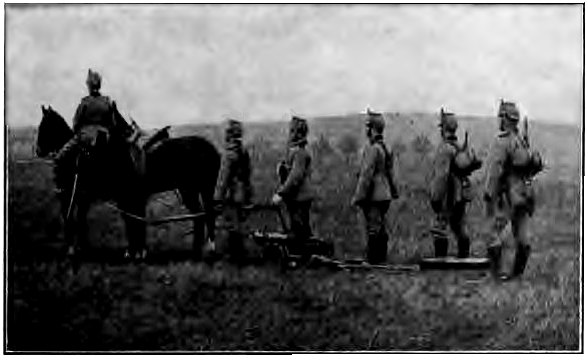
Lead Team Hitched to Gun.
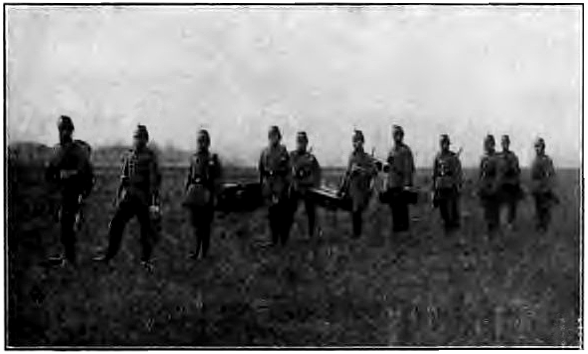
Carrying the Machine Guns.
The movements and gaits of a machine gun battery are the same as those of a field battery: the order in line, at close or extended intervals, in which the guns are abreast, the intervals between them, measured from center to center, being 5 and 17 paces, respectively. The order in line, at extended intervals, is used in moving to the front or rear; the order in line, at close intervals, for assembly, for movements in that formation, for parking, and for parade. The section column[290] is the principal maneuver formation on the battlefield; it is employed as an assembly formation on a road, and as route column. (Par. 320 German F. S. R.). In section column the guns follow each other at a distance of four paces. In addition to this column, a column of platoons is used, in which the platoons follow each other at a distance of 22 paces. (This may be reduced to 6 paces).
A machine gun battery has available 87,300 rounds of ammunition (10,500 rounds with each gun and 8100 rounds in each ammunition wagon, or a total of 14,550 rounds per gun), which may be drawn forward to the firing position upon sleds, in boxes holding 250 rounds each. The ammunition wagons are refilled from the ammunition wagons of the light ammunition columns of the cavalry division and from the wagons of the infantry ammunition columns marked with a red stripe, which carry ammunition for machine gun units. A reserve machine gun is carried with the ammunition column.
The machine gun battery combines high infantry fire power (approximately equivalent to that of the skirmishers of a German cavalry regiment, armed with carbines, or to that of 4-6 platoons of infantry)[291] with instant readiness for firing, and a mobility which enables it to follow the mounted arms anywhere. The chance of producing a sudden fire effect within a short space of time must be especially utilized, and, therefore, an endeavor should be made to put entire machine gun batteries into the first line. The employment of single guns is precluded owing to the danger of breakdowns, and the employment of platoons is especially proper on the defensive as well as in action at short range.
Order in Line (extended intervals).
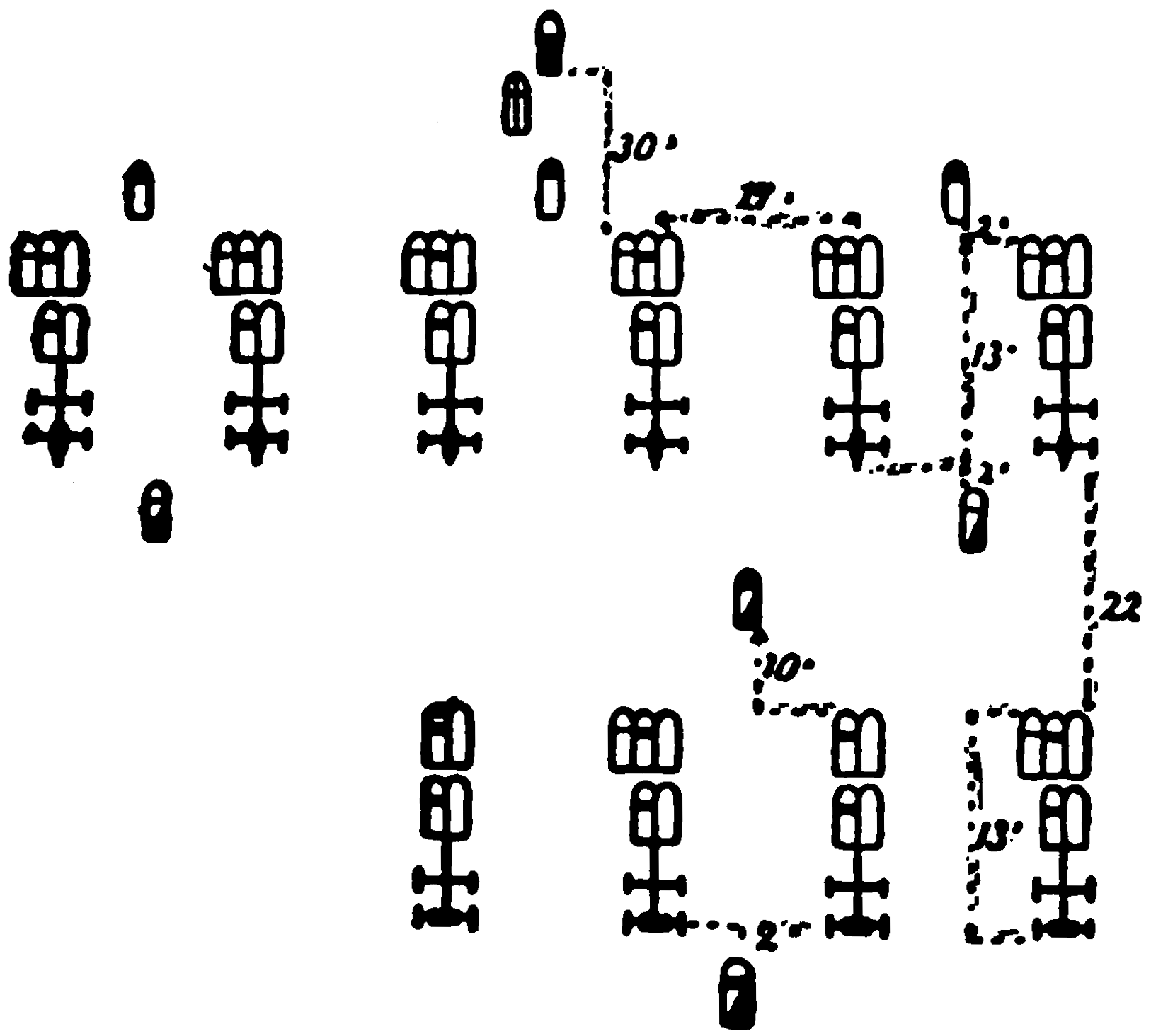
Order in Line (close intervals).
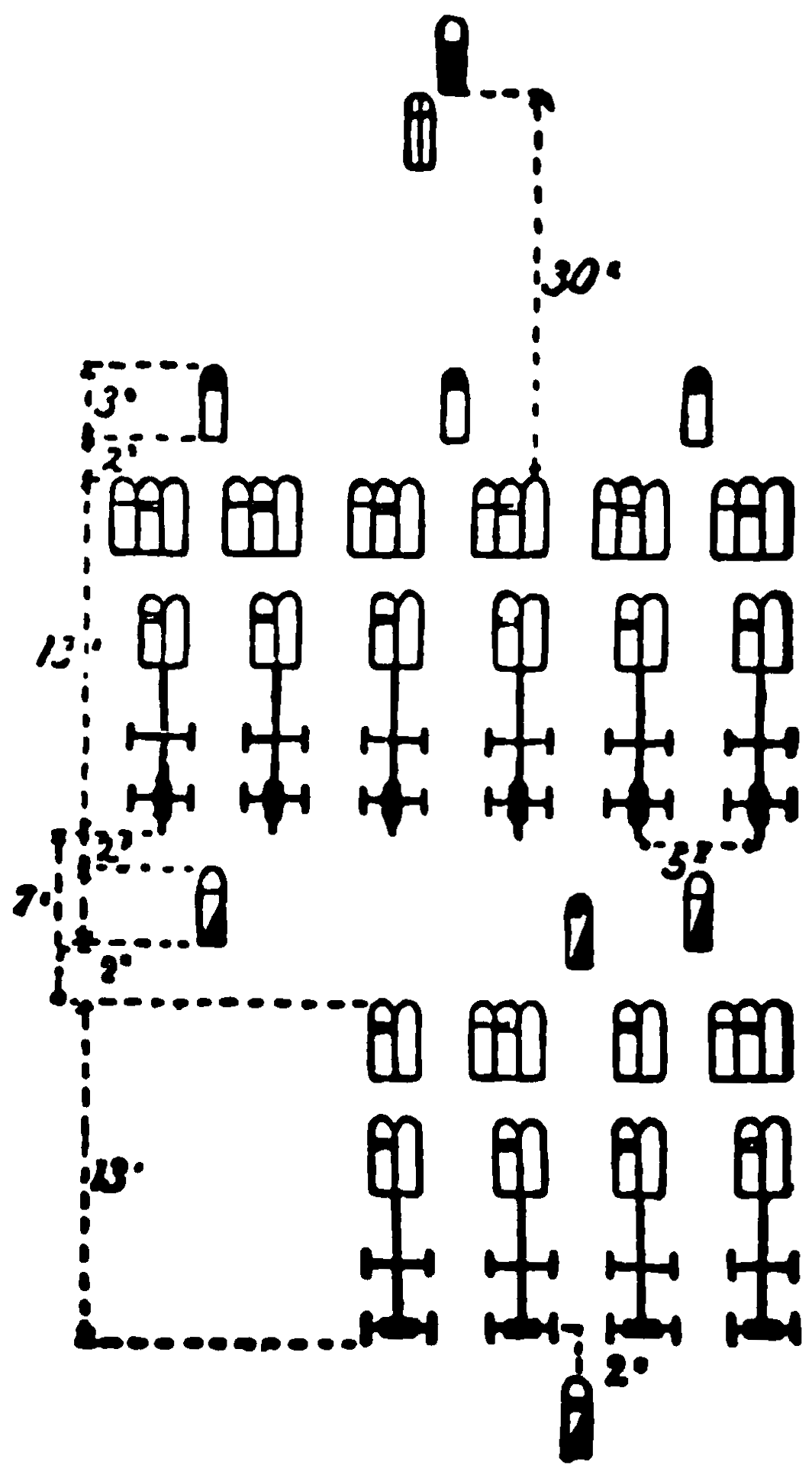
Explanation of Symbols used:
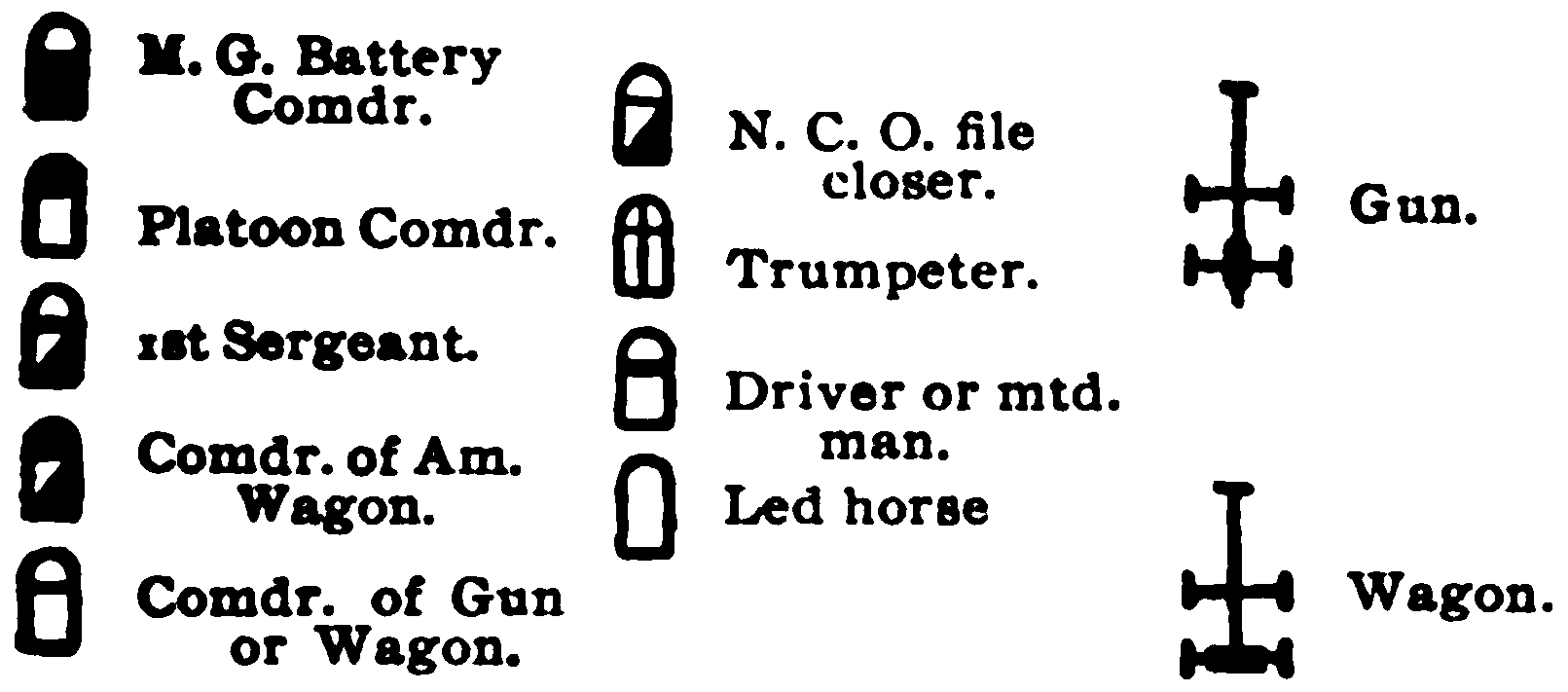
Column of Platoons (closed up).
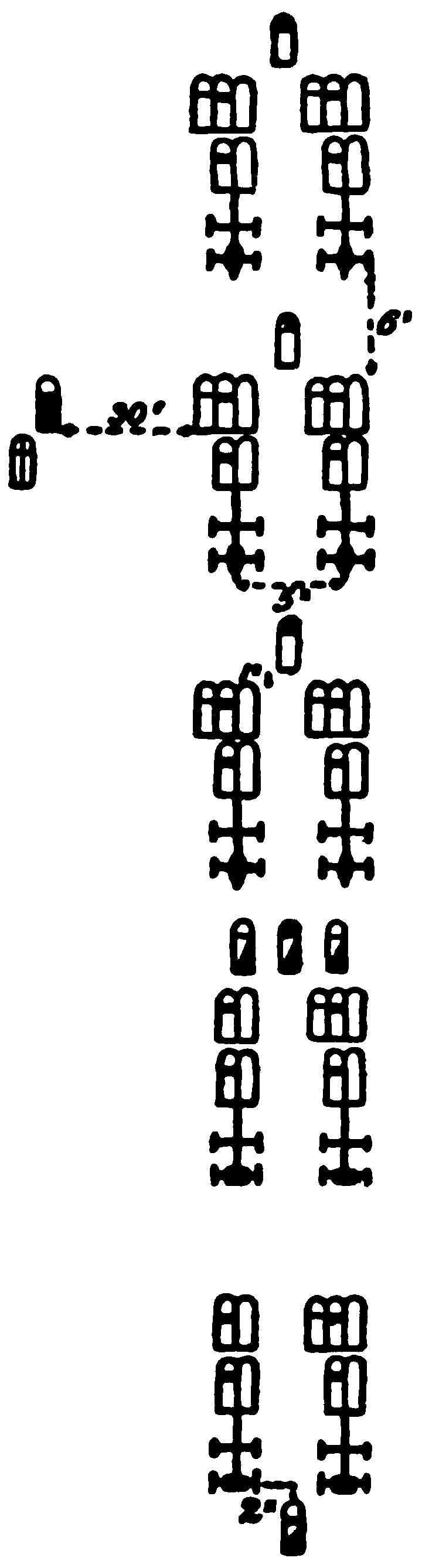
Section Column. (Route Column).

The duties of machine guns naturally grow out of their tactical advantages. Their fire power should be saved for decisive moments, when the development of strong fire power at short ranges is requisite, and when the available time and the situation do not permit of pushing infantry into action. The machine gun batteries, which constitute an independent arm, and which are assigned to cavalry and infantry divisions, are best adapted for these duties.
The heavy matériel and the teams designed for rapid movements make the machine gun battery less suited for employment in infantry combat, where such a high degree of mobility is not so necessary. In the battle on the Shaho an employment of machine guns by platoons in the first line, came about quite naturally. The guns prepared the assault, reinforced weak points, and supported the advance. In Germany, provisional machine gun companies consisting of six two-horse machine guns, driven from the carriage (these guns cannot be fired from their carriages), have been adopted for this purpose. These machine gun companies are principally an auxiliary weapon of the infantry, and, distributed by platoons to the battalions, or sent into action as a single unit by the regimental commander, they serve the purpose of augmenting the fire of the infantry.
Movements at increased gaits are possible in exceptional cases only; as a rule, the guns follow the infantry at a walk, and in combats terminating in a defeat, it may frequently be impossible to keep them from falling into the hands of the enemy. The permanent assignment of machine guns to battalions does not seem to be advisable.
5. GOING INTO POSITION.
The principles which govern the reconnaissance and occupation of a position by field artillery are applicable also to machine guns. The tactical situation determines whether the guns should move into position under cover or in the open. As a rule, the interval between two adjacent machine guns in line is 17 paces; but the proper utilization of favorable cover does not preclude posting the guns close together. It may likewise be advantageous to post the guns in echelon on the flanks.
In action the carriages remain, as a rule, in the nearest cover in rear of the line. The advance from this point is effected by the men carrying or dragging the detached guns and ammunition sleds; under certain circumstances, it may also be advisable to have the guns or ammunition sleds drawn forward by single horses (mounts of gun commanders). On level ground the ammunition platoon and the wheeled carriages of the machine guns take post in rear of and as close as possible to the guns. Whether the two groups are combined, or whether the machine gun carriages should occupy the nearest, and the ammunition wagons the more distant cover, depends upon the available cover. The commander of the machine gun carriages sends full ammunition sleds to the firing line at an early moment and has empty boxes and belts brought back.
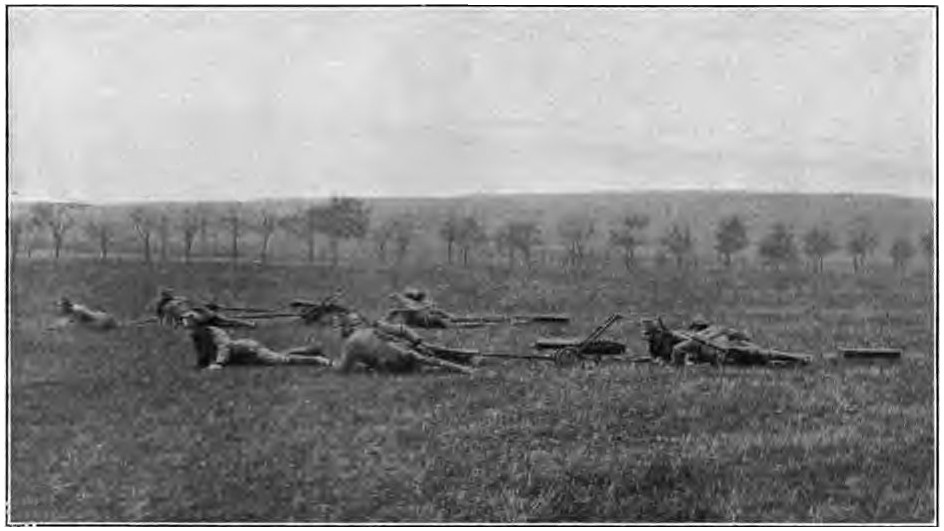
A Machine Gun Platoon Crawling Into Position.
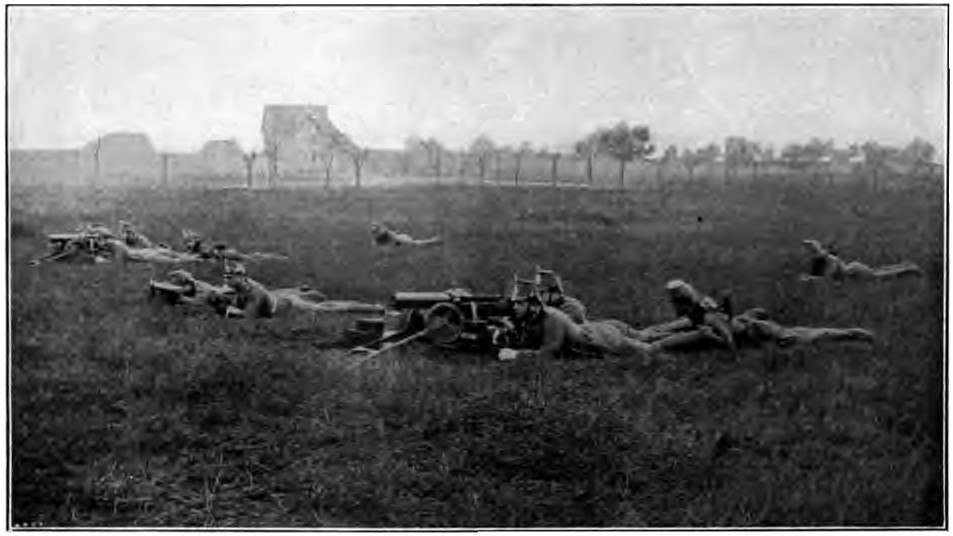
Range Finder.
A Machine Gun Platoon in Position.
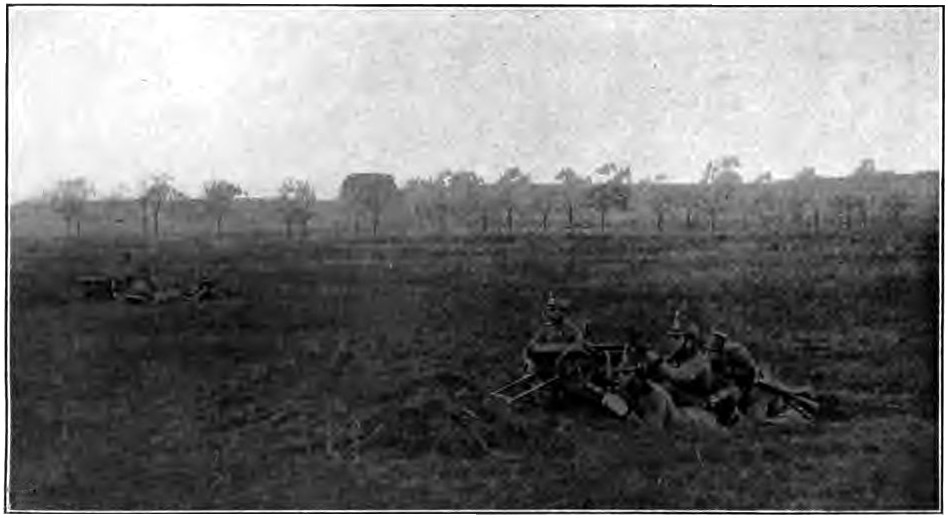
A Machine Gun Platoon Intrenched.
6. THE FIRE FIGHT.
The machine gun. squad consists of one gun commander and four gunners, numbers 1-4; number 2 is the gun pointer. The gun commander sees that the gun is set up for the prone, sitting, or kneeling fire position, according to the terrain, supervises the service of the gun, which can be served in any position of the body, and removes all obstructions that interfere with its effective use. The gun pointer handles the gun, i.e., he loads it, sets the sight, aims and fires it. No. 3, who lies to the right of the gun pointer, assists the latter in these duties, places a box of ammunition on the right of the gun, and feeds the ammunition belt into the slot. When necessary, he takes the place of the gun pointer. No. 1 lies in rear of the gun pointer, keeps his eye on the battery and platoon commanders, and transmits their orders to the gun commander and gun pointer. No. 4 has charge of the replenishment of ammunition; he takes cover or lies down 20 paces in rear of, or on a flank of the gun.
The range finders, without special orders to that effect, measure the range to targets as they appear, or to fixed points, and call it out to the battery commander. The battery commander designates the target, the range, and the kind of fire to be used. The platoon commanders assign a section of the target to each of their guns, designate the elevation that is to be used, and supervise the service of the guns; they are especially held responsible that the fire is directed upon the proper target. Platoon commanders constantly observe through their field glasses the strike of the bullets and the enemy. The commander of the gun carriages is charged with their supervision; he constantly sends forward ammunition, and, when necessary, men and matériel, into the firing position. When the detached guns change position, he follows the movement under cover with the gun carriages, bringing them as close to the firing position as possible.
After machine gun batteries had been employed at maneuvers as an auxiliary arm of the cavalry, they did especially good work in the fights in Southwest Africa,[292] where they were not opposed by artillery.
Through their ability to follow a skirmish line into the densest thickets, they were a valuable support to the infantry in the close country in which the African fights took place, where artillery of necessity had to fail owing to absence of a clear field of view. It was demonstrated, however, that the machine gun squads became so engrossed in the work of serving their guns that supporting troops had to guard them against surprise.
In the engagement at the Waterberg, the machine guns did splendid work in meeting, with an effective volley fire, the sudden, energetic attacks made by the Hereros against the flank and rear of the Germans. In two critical moments, during the attack against the left flank of the advance guard, and during the attack made with a yell against the right and rear of headquarters, it was principally due to the machine guns that the enemy, who had come within short range, was repulsed. Participants of this fight believed that the Hereros did not dare to make a real attack when machine guns went into action against them. It had been impossible to avoid using single machine guns. Just as the enemy was making an attack upon the 11th Company, machine gun No. 3 (2nd Machine Gun Battery), which had done splendid work, broke down. This was the only case of jamming that occurred. Although exposed to a galling hostile fire, the gun commander managed to change barrels in 30 seconds, and then to resume the firing. The 2nd Machine Gun Battery expended 20,775 rounds of ammunition; the expenditure of the different guns varied between 7350 and 120 rounds, according to the part taken by them in the action. The ammunition supply was certain and steady; no shortage of ammunition, not even a temporary one, occurred anywhere.
7. MACHINE GUNS IN OTHER COUNTRIES.
Switzerland. In 1892 Switzerland began to organize four mounted Maxim machine gun companies, which were assigned to the weak cavalry brigades (consisting of six troops[293]) on account of the defensive role of the Swiss cavalry and the lack of batteries of horse artillery. Three machine gun companies were assigned to the fortifications on the St. Gotthard and one to St. Moritz for the purpose of augmenting the fire of the advanced positions belonging to those fortifications, and to cover the approaches thereto.
A Maxim machine gun company consists of 6 officers, 105 non-commissioned officers and privates, 99 horses (24 pack horses and 24 draft horses), 8 guns mounted on tripods, and 7 vehicles (two of these are two-horse supply and baggage wagons, one four-horse field forge with field kitchen, 4 two-horse ammunition wagons, each carrying 15,520 rounds of ammunition). The guns and the ammunition are carried on pack animals. A packed gun horse carries a load of 108 kg. inclusive of 5 kg. of oats. An ammunition horse carries a load of 123 kg. inclusive of 5 kg. of oats and 8 ammunition boxes (each holding 250 rounds, or a total of 2000 rounds weighing 90.5 kg.). A machine gun company of eight guns is divided into four platoons, each consisting of two guns and four ammunition horses, and the combat train, consisting of four ammunition wagons and the field kitchen. Every gun is commanded by a “gun chief,” and two of the five men belonging to the gun squad are horse holders. After the command “halt” has been given, 1-11⁄2 minutes are required to get the gun ready for firing. The company carries 5940 rounds of ammunition for each gun.
Switzerland.
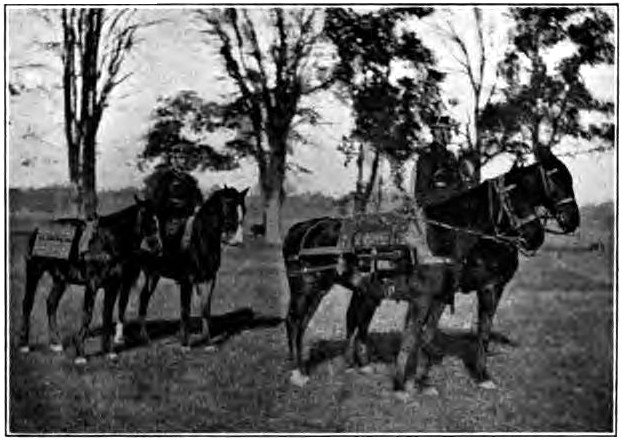
Machine Gun and Ammunition Horse.
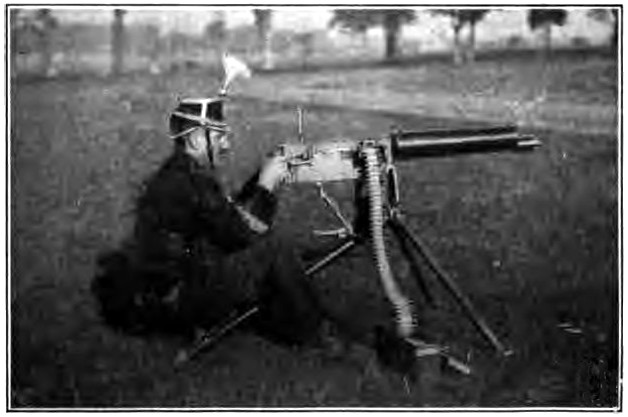
Gun Commander and Gun Ready to Fire.
Route column from line is formed by the guns moving successively in the proper direction, the two ammunition pack animals following directly in rear of the gun to which they belong. The company takes up a road space of 150 m. For movements off the road the company may move in “mass,” or with the platoons in “combat formation.” When in “mass” the platoons, each in route column, are abreast, with intervals of 10-20 paces between them. When the platoons are in “combat formation,” the two guns of each are placed abreast at equal intervals.
Platoon In Route Column.
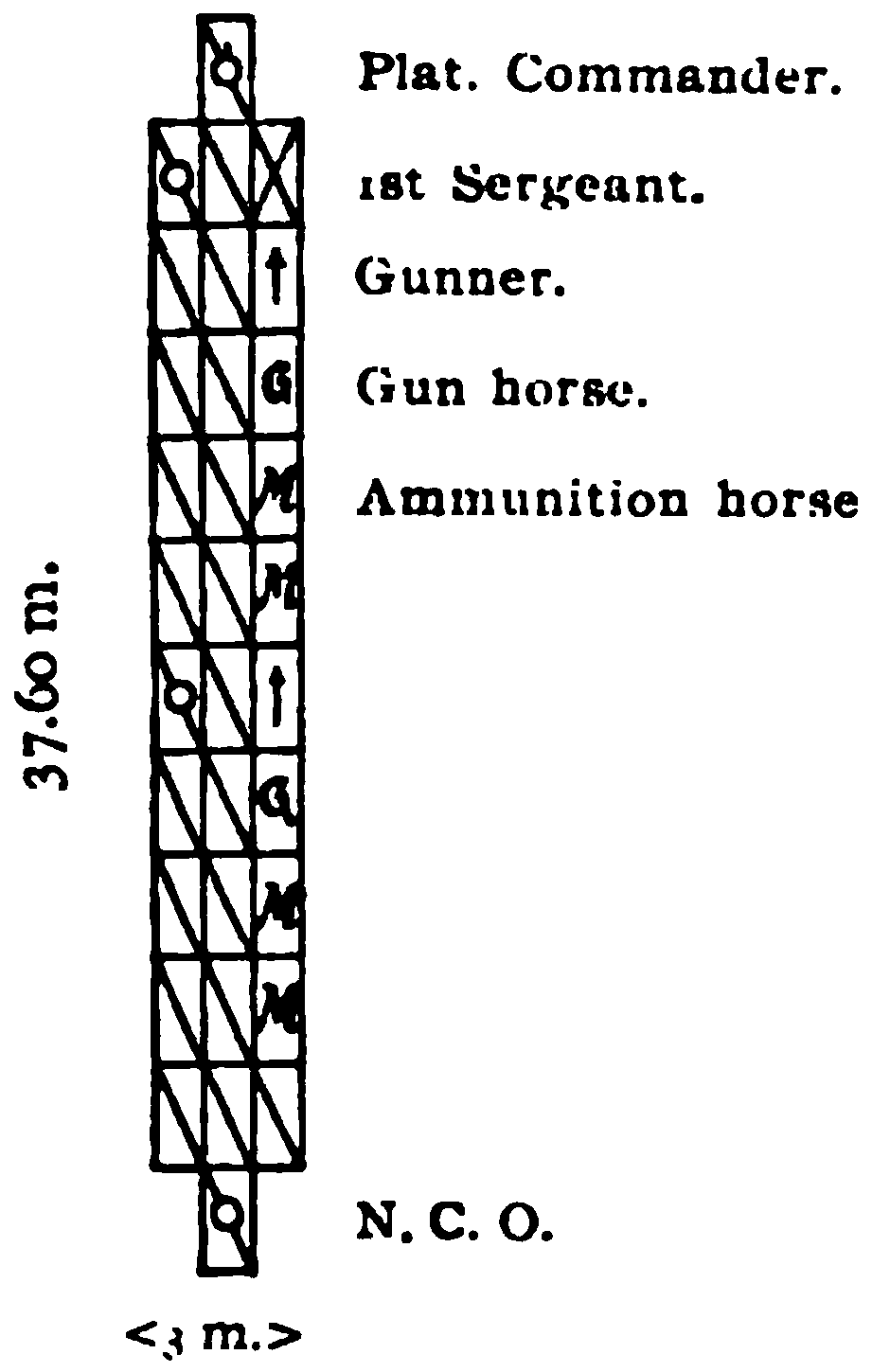
The three machine gun companies assigned to the line of fortifications consist of two to three platoons, each of four guns. A platoon consists of 2 officers and 60 non-commissioned officers and privates. The men are armed with rifles and equipped with alpine sticks. “Gun carriers” (Waffenwarte) carry the gun basket, which weighs 33 kg. The weight of the water in the jacket is only 1 kg. “Ammunition carriers” (Munitionswarte) carry the ammunition in specially constructed frames, each man carrying 500 rounds.
Kinds of fire: “Fire by a single gun” is employed at the opening of an action to drive away patrols and reconnoitering officers, when it is not desired to betray the presence of machine guns to the enemy.
“Volley fire” is the usual fire employed by machine guns and corresponds to the volley fire of infantry. After the target and the elevation have been designated, the platoon commander directs that fire he opened by calling the name of the gun pointer who is to fire. A pause is made after every series of 20-30 shots, which is used to make necessary corrections.
As soon as the proper elevation has been determined, “rapid fire” is opened. In this the guns of a platoon fire alternately. The fire is delivered in series of 100 rounds, and the time during which one of the guns is not firing is utilized by the non-commissioned officer with it to examine and oil the mechanism.
The “fire at will” (continuous fire) of the machine guns corresponds to the magazine fire of the infantry. All the guns fire simultaneously series of 50 to 100 rounds, interrupting the fire for a moment at the end of each series for the purpose of examining and oiling the mechanism; then they resume the fire with a new series of 50 to 100 rounds. On account of the great expenditure of ammunition entailed, and also in order to prevent the premature deterioration of the matériel, fire at will is used in exceptional cases only, for example, when danger is imminent, or when favorable opportunities offer.
“Progressive fire” may be employed against narrow, deep targets, when the range could not be accurately determined. It may also be employed for searching an area 100-200 m. deep.
Austria has begun to organize cavalry and mountain machine gun batteries consisting of four guns each. The machine gun Model 7 (Schwarzlose), with pack animal equipment, has been adopted. The gun horse carries 500, and each of the two ammunition horses, 1500 rounds of ammunition. During mobilization two ammunition horses are to be added for each gun. Mountain machine gun batteries are similarly organized; each ammunition horse carries 2000 rounds of ammunition. On the gun itself, and on the gun frame, 44 belts, each holding 250 rounds, or a total of 11,000 rounds, are carried.[294]
The formations employed by the cavalry machine gun batteries are the order in line (at close intervals), the combat order, and the route column.
The mountain machine gun batteries, carrying guns and ammunition upon pack horses, are equipped with tripod and basket mounts. These machine gun batteries combine the system of mounting and carrying employed by the Swiss cavalry and mountain machine gun companies. Three pack animals are employed to transport each gun with its ammunition. The gun squad consists of three men. Officers and non-commissioned officers are mounted; the other men of the battery are not. Unpacking the guns, posting them, and getting them in readiness for firing, is managed in a similar manner as in the Swiss machine gun companies.
The gun adopted for infantry machine gun batteries is the light and simple Schwarzlose machine gun, Model 7.
Springs Parts of breech Screws & Pins Weights
Maxim 14 35 52 27.5 kg.
Schwarzlose 1 11 13 17.5 „
Tripod mounts and pack animal transportation are necessary in view of Austrian theaters of war. The batteries consist of four machine guns.
“The great length of modern battle fronts, and the gaps and local combats along the latter, would seem to make a distribution of machine guns along the entire front desirable. Attention is thereby directed to organizing the machine guns to be employed with the infantry as ‘Regimental Machine Guns.’ Such an organization would best ensure the training of this new arm for the infantry combat and the prompt attainment of an understanding of its employment.
“In the cavalry, the difficulties of organizing, training, and employing machine guns are considerably greater than in the infantry. These difficulties are best overcome by organizing the machine guns assigned to cavalry into independent batteries, and placing them at the disposal of the higher cavalry commanders.
“In determining upon the size of the machine gun batteries attached to infantry, an attempt should be made to combine minimum size with adequate fire effect and maximum mobility. Two machine guns would seem to be almost the maximum number that should be posted at one point in an infantry action. From a tactical point of view, it is, moreover, undesirable to post a greater number at one point, because gun shields, steam, etc. would frequently form too prominent a target, for the hostile artillery to forego firing on it promptly and with telling effect.
“In connection with the desire for more than two machine guns in each infantry and Jäger organization—about two guns per battalion—the tremendous increase in ammunition trains should be considered. It would also be well to bear in mind that we have, as a matter of fact, not even become accustomed to the numerous ammunition columns of our rapid fire artillery.
“In the cavalry, the necessity of dividing a machine gun battery for the purpose of assigning the parts thereof to brigades, and of assigning machine guns to reconnaissance and other independent detachments, must be reckoned with. When we bear in mind that single machine guns are to be used only in exceptional cases, the machine gun battery intended for the cavalry cannot well be made smaller than four guns.”[295]
England. During the Boer war 1-2 machine guns mounted on a high carriage were assigned to each of the British battalions. These guns were unsuited to employment in an infantry combat and were quickly silenced. The campaign demonstrated that these guns could frequently not be used, and that they stood idle in rear of the line. They were not combined into detachments for the purpose of supporting the attack, as should have been done, until the engagement at Pieters Hill (27th Febr., 1900). On account of the long range at which these guns came into action, the effect of their fire was indeed very small, but, nevertheless, its moral effect impaired the steadiness of the Boer aim. Since the great fire power of these guns can be brought into play only when several of them are employed together, it is not a good plan to assign single guns to cavalry regiments for the purpose of supporting the dismounted line in action. Only the commander of the entire force, and not each battalion commander, is able to judge where the employment of machine guns would be advantageous. The proposal to assign machine guns to the artillery was not followed, as it was justly feared that the machine guns would then be assigned tasks to which they were not adapted.
At the present time, each battalion has a machine gun platoon consisting of two guns. Both guns with their tripods, and a portion of the ammunition, are transported on one wagon drawn by two horses. They are in addition equipped with a two-horse ammunition cart. The complement consists of 1 non-commissioned officer, 15 privates, 1 saddle horse, and 4 draft horses.
Each battalion of mounted infantry has a machine gun platoon which is similarly organized. Each of the four vehicles of this platoon is, however, drawn by four horses. In addition, this platoon is equipped with six machine gun pack saddles for transporting the guns on pack animals. The complement consists of 1 officer, 1 first sergeant, 23 privates, 16 saddle horses, and 16 draft animals.
The machine gun platoon of a cavalry regiment consists of only one gun, which is carried on a four-horse wagon, and a four-horse ammunition wagon. The platoon is equipped with three pack saddles. The complement consists of 1 officer, 1 non-commissioned officer, 13 privates, 11 saddle horses, and 8 draft horses.
The following ammunition is carried by the British machine gun platoons:
With the organiza- tion. In the ammunition column of the F. A. Bns. In the Division ammunition column. Total No. rounds.
Infantry M. G. P. 11,500 10,000 10,000 31,500
Mtd. Infantry M. G. P. 19,500 10,000 10,000 39,500
Cavalry M. G. P 19,500 10,000 10,000 39,500
Japan and France seem to have decided to follow the British in assigning machine gun platoons to regiments. In Japan, soon after the outbreak of the Russo-Japanese war, the Guard, the 1st, 2nd, 3rd, 4th and 6th Divisions, and the two independent cavalry brigades, had machine gun batteries consisting of 6 guns each. During the winter 1904-5, 320 machine guns were gradually placed in position, singly and by platoons, in the fortifications on the Shaho.
Russia. At the outbreak of the Russo-Japanese war, a machine gun company was assigned to the 1st, 3rd and 5th East Siberian Rifle Brigades. This company consisted of 5 officers, 85 combatants, 13 non-combatants, 10 saddle horses, 29 draft horses, and eight guns. The latter were mounted on high carriages, and were protected by steel shields. Of the ammunition, 1350 rounds, in belts holding 450 rounds each, were carried on each gun carriage, and 4500 rounds on each of the six two-wheeled ammunition carts. The field train consisted of nine one-horse carts. The loss of the machine gun company at the Yalu was probably due to the fact that the guns, mounted on high carriages, were quickly deprived of their mobility in their second position, after they had, from their first position, effectively flanked the advance of the Japanese infantry. Immediately after this first lesson, the high wheeled carriage was apparently abolished, and the tripod adopted. On September 26th, 1904, the machine gun companies were reorganized. There were (old) wheeled, and (newly-organized) so-called “mountain machine gun companies,” the latter having pack animal transportation. These companies were assigned to infantry and Rifle divisions and were designated by the numbers of their divisions.
On December 12th, 1906, the machine gun organization was again changed, because it was asserted that the assignment of machine gun companies to divisions hampered the division commander; that the employment of 8 guns at one point was injudicious; and that so large a machine gun battery actually induced a scattering of the guns. Infantry, Reserve, and Rifle regiments are each assigned a machine gun organization consisting of 4 guns, mounted on tripods, equipped with 6 mm. steel shields, with pack animal transportation.
Complement: 3 officers, 7 non-commissioned officers, 46 privates, 7 non-combatants, 10 saddle horses, 21 pack and draft horses (8 of these for carrying ammunition), 4 ammunition carts, and 5 train wagons. The personnel is drawn from a regiment in which the men to be detailed for machine gun duty are trained.
According to an officer who commanded a machine gun company in the battle of Liao Yang[296], his company went into position on August 30th, on the right flank of its division behind an earth embankment at the south edge of the village of Gutsealing, and 300 m. from the railroad running in a southwesterly direction. This position was taken up with the object of preventing the envelopment of the right flank of the division. Sufficient time was available for cutting down the kaoliang crop for 650 m. Beyond this range the kaoliang fields continued for several hundred meters. Directly in front of the position of the company there was a hill, upon which several mounted men showed themselves toward 10 A. M. As soon as fire was opened on them, they threw themselves down in a field covered with tall kaoliang. When these mounted men had reached a fairly open space, about 900 m. from the machine gun company, they could be clearly seen. In rear of them was observed a mountain battery of artillery, which endeavored to go into position on the hill mentioned, apparently with a view of directing a flanking fire on the Russian skirmishers farther to the front than the machine guns. Fire was opened at once, without first bracketing the target, the first gun firing at 1200 paces (about 850 m.), and each succeeding gun increasing the range by 25 paces, thus covering with fire a space 150 m. deep. Immediately after fire was opened on it, the mountain battery attempted to escape to the right, but succumbed to the fire of the machine guns. The latter had fired about 11⁄2 minutes, and had expended 6000 rounds of ammunition. About noon, hostile (Japanese) skirmishers attempted to cross the railroad embankment, one by one, apparently with a view of flanking the machine guns. The latter opened fire on the Japanese, combined sights, and, for a short period, rapid fire with sweeping being resorted to. The movement made by the Japanese was discontinued; an advance made by groups against the front of the machine guns got only as far as the edge of the cleared kaoliang field. In the open, the skirmishers were unable to advance a single step; every attempt, on their part, to rise, was prevented. Whether it would have been possible to advance by crawling, while keeping up a constant fire, can, of course, not be determined now.