THE FORMAL TACTICS OF INFANTRY. (continued 6)
Walter Krueger translation
At nightfall the Japanese again advanced in the kaoliang field and annoyed the machine gun company throughout the night with rifle fire. At daybreak they were again driven back by a continued fire from the machine guns. The Japanese skirmishers remained in readiness, however, in the kaoliang field, and fired on any target that offered. When their fire became more and more galling, the machine gun commander decided to send forward a non-commissioned officer and 15 men (Reservists and horse holders, armed with rifle and bayonet) to drive them out. The undertaking was successful. It was found that this continuous annoying fire had been kept up by only 1 officer and 24 men.
At 3 P. M., several Japanese assembled at the railway bridge; a signal detachment also appeared. The fire at will of the infantry, directed on this body of men, had no effect whatever; but after two machine guns, one using an elevation of 1025, the other one of 1075 m., had fired on that point for a short time, the Japanese disappeared. At 5 P. M., the machine guns succeeded in repulsing an enveloping movement made against their right flank. This movement was betrayed only by the motion of the kaoliang stalks. Toward 7 P. M., the Japanese directed artillery fire upon the machine guns, which suffered considerable losses, although the personnel was protected by an earth parapet and had ceased to work the guns. This fire did not cease until nightfall, and, at 9 P. M., the position was evacuated by order. An attack made by the Japanese during the night found the machine guns gone. During the two days of the fight the company had lost 30% of its personnel, and had fired 26,000 rounds of ammunition, or only about 3200 rounds per gun during two days. The superiority of the fire of these machine guns over that of the Japanese skirmish line can perhaps only be explained by the small numbers of the latter.
In the defensive position on the Shaho and at Mukden, machine guns were employed in favorable positions, behind sandbag parapets and under splinter proof roofs. According to Lieutenant-Colonel Anisinow, good results were obtained against skirmishers up to 1050 m., against closed bodies of infantry and against troops of cavalry (Eskadrons) up to 1400 m.; against batteries of artillery, halted in the open, staffs, and columns, the fire was sufficiently effective up to 1960 m.
8. THE EMPLOYMENT OF MACHINE GUN BATTERIES.
Machine guns will never be able to replace artillery at long ranges; on the other hand, they will often find an opportunity to support other arms with their fire at medium and short ranges.
It has been asserted that machine guns do not always follow the movements of the firing lines in action, that the commander of a force is not always able to find a good position for them; and the question raised whether the space taken up by the machine guns and their ammunition wagons in a column could not be more profitably filled by companies of infantry or by a portion of an ammunition column of corresponding length. To be sure, machine guns are a special arm; the justification of their existence lies in the combination of constant readiness for firing with highly developed mobility, so that, held back under direct control of the commander of a force, they give him the means wherewith to produce within a short time a sudden effect, in the nature of a surprise. This is the very purpose for which machine guns were created. They are not intended for prolonged fire action, not for accompanying an infantry skirmish line in an advance by rushes, and, least of all, for fighting well covered firing lines. In addition, the fact that machine guns make it possible to concentrate fire quickly on any space, whereby the moral effect is considerably increased, ought not to be underestimated. It would seem to be advisable to employ machine guns in conjunction with infantry when it is impossible to develop a powerful fire on account of the conformation of the ground, but when such fire is desirable for commanding approaches or defiles; further, when fire alone suffices for delaying the enemy (for example, in rear guard actions). In this case the guns may either be pushed far to the front, or may be used in defensive positions, which can then be held by a few men during the pauses in the fight.[297] Although machine gun fire may perhaps be relatively less accurate than that of a body of infantry, the value of pouring a large mass of projectiles on the enemy within a brief space of time should not be underestimated.[298]
Whether machine guns are distributed by platoons, or are employed as a unit under control of superior leaders, will depend upon whether it is contemplated to employ them in a purely defensive way for the purpose of reinforcing the several weak points, or offensively in fire surprises or in covering the flanks. The distribution by platoons has the undeniable disadvantage that single guns will frequently not find an opportunity to fire; that the difficulty of ammunition supply is increased; and that the combined employment of the several platoons will produce friction that cannot be easily avoided. On the other hand, in machine gun batteries of three platoons each, an employment by platoons is easy. Although a distribution by platoons is permissible in a passive defense, the employment of the guns by battery (company) against the flanks of the attacker permits the mobility and fire power of the arm to be utilized to better advantage. While a distribution of machine guns by platoons—if we except colonial and mountain warfare—is, indeed, cheaper, it generally leads to a useless frittering away of fighting units.[299]
Machine guns will be able to bring all their powers into play to the best advantage at the beginning of a rencontre, when, from their position as far forward as possible in the column, they are pushed to the front to occupy important points and to compel the enemy to deploy his infantry. The commander should, however, endeavor to withdraw the machine guns from the fight as soon as his own infantry has deployed, in order to avoid involving the guns in a protracted fire fight necessitating an expenditure of a great amount of ammunition and in which the accuracy of their fire would gradually suffer.[300] The proper sphere of machine guns lies in their employment as a separate arm, whether they are posted so as to flank an enemy, or are kept at the disposal of the commander as an ever ready reserve, which is pushed forward to keep the point to be attacked under fire, to meet a counter-attack, or—and to this use they are best adapted—to participate in the pursuit. Their employment is also proper in rear guard actions, since they are able to remain in position longer, for example, than rear guard infantry, whose energies are paralyzed by the thought of getting away from the enemy in time. Machine guns are much more independent than infantry on account of their ability to withdraw at an increased gait. On account of their greater staying power and the greater intensity of their fire, they increase the delay which the enemy suffers, as well as the start gained by their own force; they moreover enable their own force to get away from the enemy and to escape pursuit.
In employing machine guns in defense, it must be borne in mind that the guns are not adapted to carry on protracted fire actions; and that the advantage of the mobility of machine gun batteries cannot be properly utilized if they have been assigned, from the outset, a definite section to defend. As a rule, it will be advisable, in defense, to keep the machine guns at first with the reserve, and to employ them later, as necessity requires, even by platoons, to reinforce the defensive line at threatened points, or, by battery (company), to prevent an envelopment, or to participate in offensive movements. This does not preclude the employment of machine guns during the preparatory stage of the engagement, for example, to command important approaches. When a covered withdrawal of the guns is assured, it will also be possible to post machine gun batteries in such a manner in front of, or to a flank of the main defensive position, that they can suddenly sweep with their fire the ground on which the opponent will probably place his artillery. Flanking machine gun fire can sometimes be employed for sweeping dead angles.
The provisions of the Austrian machine gun regulations correspond in the main to those of the German Army. In Austria special stress is laid upon the use of machine guns with cavalry, while in Germany they are in addition a mobile reserve. Machine gun batteries accomplish the principal objects which cavalry expects to attain by the assignment of infantry,[301] viz., relief from fighting on foot, great fire power, and mobility. Even in reconnaissance duty, machine guns will be employed to break down the resistance of the enemy in occupied localities and to augment the resistance of their own force in such places. During an advance, machine guns should go into position at an early moment in order to cover as effectively as possible the approach and the deployment for attack. It is advisable to post the guns of a machine gun battery together, so as not to have numerous lines of fire interfere with the movements of the cavalry; this is especially emphasized by the Austrian regulations. Machine gun batteries, like horse batteries (artillery), remain with the cavalry divisions during a battle.
German machine guns are especially adapted for resisting cavalry, while guns transported upon pack animals are entirely helpless on the march and when going into position, and require the support of the other arms. German machine guns, whether on their wheeled carriages or on their sleds, are capable of warding off cavalry. The fire of the guns should be distributed over the entire front of the mounted attacking line. Special attention should be paid to lines following the first attacking line, to the flanks of the guns themselves, and to covering the carriages when they are not with the guns. Machine guns are able to advance on open ground without regard to cavalry, so long as the latter is not supported by artillery or infantry, or is not so superior in force that it can attack simultaneously from several directions, or in several lines.
In action against artillery it should be borne in mind that artillery possesses an unquestioned superiority of fire at the longer ranges; at ranges at which machine guns are able to fire at all, they must seek to find protection under cover, or by distributing the guns. Artillery is very susceptible to flanking fire. When that arm is to be engaged, the machine gun sleds should be brought as close as possible to the hostile batteries. In this case it is, moreover, advisable to have large intervals between the machine gun platoons. The great mobility of the machine gun battery, when limbered, will sometimes enable it to take up a position from which it can flank the enemy. In distributing machine gun fire it would be well always to assign the same task to two guns. It is not a good plan to have all the machine guns sweep the entire front of a firing battery (artillery).
The opinions in regard to machine gun employment in field warfare—mountain and fortress warfare are not considered here—differ considerably. In England machine guns are attached to battalions, and Japan of late leans toward this mode of employment. In Switzerland machine guns serve in addition as a substitute for horse batteries, which their army lacks.
The English view is obviously affected by their experience in colonial wars.
The following are given as the duties of machine guns in attack:
1. The machine gun is above all to be employed at long ranges. In open country it will seldom be possible for the gun to reach a position in the first line, where, moreover, the gun would offer too good a target. Covered terrain should be taken advantage of to get the gun close to the enemy. The advance of infantry may be supported at long ranges by machine gun fire (fire of position).
2. The delivery of volley fire against any point of the hostile position.
3. The warding off of counter-attacks or attacks made by cavalry.
4. The utilization of flanking positions.
5. The support of cavalry during delaying actions (ammunition being in this case a substitute for men) although the fire effect against low targets is very small.
6. The holding of captured positions.
In defense the isolated employment of machine guns at a distance from the organization is prohibited and their use against extended skirmish lines cautioned against. Machine guns are well adapted for protecting flanks and can be kept back as a reserve to prevent the advance of hostile reinforcements, to support counter-attacks, to direct fire against deep and dense targets, and, finally, to support the firing line in action at short range.
In defense the principal duties of machine guns will consist of—
1. Sweeping obstacles and commanding terrain which is specially favorable for the attack; flanking of salients.
2. Reinforcing weak points.
3. Firing on advancing hostile reinforcements.
The cavalry regulations, contrary to those of the infantry, also permit a massed employment of machine guns when ordered by brigade or division commanders.
“As a rule, it will not be advisable to open fire on isolated mounted men or small groups of approximately platoon strength, as this would betray the position prematurely. In action, machine guns may be employed in conjunction with dismounted skirmishers for the purpose of forming a supporting point for movements, a rallying position, or for protecting a flank. Finally, during an attack, machine guns may support the fire of the horse battery, on the outer flank of which they go into position, to serve as support, or to facilitate by their fire a withdrawal.”
These official regulations are not entirely in accord with the views entertained in the army. The combined use of the machine guns of a brigade, such as quite naturally resulted in the engagement at Pieters Hill, is advocated by many. At the longer ranges, machine gun companies are to fire on favorable targets, discontinuing their fire when their object has been accomplished. In addition they are to cover the advance or withdrawal of the infantry; to fire on certain points of the hostile position; to act against the enemy’s flanks in pursuit; and, in defense, posted in pairs, they are to flank salient angles and make it difficult for the enemy to approach the obstacles.
In Switzerland machine guns are considered an auxiliary arm. “Our field army should be capable of accepting and sustaining battle in the mountains and on highland plateaus without necessitating the creation of numerous special detachments for that purpose. Machine gun companies should be a tool which can be used in the mountains and on highland plateaus, and which can be turned over for use to any organization.”
The platoon is the firing unit; the company commander posts his platoons at large intervals and regulates their mutual coöperation. Fire, suddenly delivered from various points, frequently rather far distant from each other, is considered to have a particularly demoralizing effect; the scattered posting of the platoons makes it difficult for the enemy to combat effectively the individual platoons which are skillfully concealed on the terrain. “The indefinable, uncanny and confusing aspect of their appearance enhances the effect of the fire surprise.” The defensive character is here especially clearly marked, for cavalry which counts in the first place on the offensive will prefer a combined employment of machine guns, so as not to be hampered in its movements by the various lines of fire. On the march, machine guns are posted as far forward as possible in the column; single platoons may also be attached to troops (Eskadrons) of advance guard cavalry, and, in exceptional cases only, to troops (Eskadrons) of reconnoitering cavalry. Machine guns, supported by weak cavalry detachments, may be pushed forward to occupy defiles; moreover, the machine gun company assigned to a cavalry brigade may be sent into action either as a whole unit, or it may be divided from the start or during the course of the fight. This machine gun company may also be attached to regiments, troops (Eskadrons) or platoons of cavalry charged with special missions, in which case it is, as a rule, broken up into platoons. The premature detaching of machine gun units is especially cautioned against. “The mobility of the machine gun unit is such that it is not at all dangerous to hold them back until the last moment before sending them to the actually threatened point.”
The regulations deem a special support necessary for the machine gun batteries when they are sent on independent missions. Single guns are not to be so used. Machine guns, distributed by platoons, invest cavalry dismounted for fire action with a special power of resistance. It will frequently be advantageous to occupy the enemy in front with weakly supported machine gun batteries, while maneuvering with the main body of the mounted force so as to gain the enemy’s weak point, and attacking him there with fire or a charge. In a cavalry fight Maxim machine gun marksmen, by timely, hold, and energetic action, will very often be able to create favorable conditions for their own troops, facilitate the selection of a point of attack, and retard and interfere with the hostile deployment.
The following statements taken from the regulations for the Service and Training of Swiss cavalry (1904) are of interest:
“Machine guns invest pursuing cavalry with tremendous power.—Their violent fire, suddenly breaking forth, especially when quickly delivered at the flanks of the retreating mass, must have an annihilating effect and convert the retreat into a rout.
“In a retreat, Maxim gun marksmen with their guns can quickly occupy rallying positions (when possible, flanking), which, thanks to their mobility, they are capable of holding longer than other arms. Thereby they facilitate for the other troops the critical breaking off of the engagement.
“The retreat will proceed with greater steadiness and time will be gained for organizing resistance and for making that resistance more obstinate.
“When, during the crisis of battle, every available man joins in the fight, machine guns may take a hand in it, even when the terrain is unfavorable for the employment of cavalry, by gaining the flanks at a rapid gait, turning and firing upon the hostile flank or the hostile masses launched for the counter-attack.
“It would be incorrect, however, at such a moment, simply to throw the machine guns into the fighting line or to a flank. By doing this the mobility of the guns would not be utilized, and they would lose their character of a mounted arm.
“The assignment of machine guns to cavalry augments the fighting power and independence of the latter and increases to the utmost its desire to go ahead, its enterprise and bold initiative. With the aid of machine guns, our militia cavalry, even when opposed by better drilled cavalry, can go into battle calmly on our terrain, with the firm conviction of defeating it.
“But a cavalry leader should never shrink from sacrificing his machine guns when the object to be attained requires it, and when no other means remain to save the force. These weapons should never be more to him than a welcome and powerful aid toward the fulfillment of his mission. Cavalry which degenerates into a mere support for its machine guns has ceased to be cavalry.”
VII. INFANTRY VERSUS CAVALRY.[302] (Par. 451 German I. D. R.).
The individual infantryman whose rifle is loaded and who knows how to use his bayonet is more than a match for the individual mounted man even on open ground; and, if he remains cool, retains his presence of mind, and uses his rifle properly while keeping the opponent constantly in view, he is even superior to several mounted men. Infantry which retains its steadiness has nothing to fear even when outnumbered by cavalry. Its main strength lies in steadily delivered fire, while cavalry relies on the possibility of making an unexpected rapid charge, on quickly covering great distances, and on the moral effect which its irresistible onslaught undoubtedly produces upon infantry. So long as there is a possibility of surprise and misunderstanding, of infantry allowing itself to become discouraged, and of the individual soldier being exposed to hunger and hardships, so long will cavalry that is energetically led be able to gain brilliant victories. Tactics would look differently upon the possibility of making a mounted charge during a battle if one or two German cavalry divisions had been on the Japanese side during the pursuit after Mukden. “If we demand of infantry that it close with the enemy after it has suffered tremendous losses, why should we not demand the same of cavalry whose mobility is disproportionately greater.” (Skobeleff’s Order for the Day, June 15th, 1882). The less the world believes in a victory of cavalry, the greater the certainty of such success. The troops should be accustomed in time of peace to the sight of charging cavalry. The recommendation made by the late General Dragomirov of the Russian army is, at any rate, worthy of consideration.[303] He proposed that cavalry ride at full speed through infantry lines deployed with three paces between files. Some infantrymen are, indeed, bound to be injured in such charges, but the wounds produced are not likely to be serious. Infantry accustomed to such charges will not lose its steadiness so easily in action as when it comes in contact with cavalry for the first time on the battlefield.
The success of the charge made by Captain Bechtoltsheim of the Austrian army at Custozza with three platoons of Sicilian Uhlans, may be ascribed principally to the fact that the Italian infantry was not accustomed to field service and lacked training. This small force of cavalry broke entirely through Pisa’s deployed Brigade (Italian) and struck the route column of Forli’s Brigade, throwing it into complete panic, so that of five battalions only one remained intact. The three platoons of cavalry, which numbered about 100 sabers, lost 2 officers, 84 men, and 73 horses killed and wounded. The charge made by three troops (Eskadrons) of the Dragoons of the Guard at Mars-la-Tour, to facilitate the retreat of the defeated 38th Brigade, and that made by two platoons of the 7th Hussars at Sapignies were likewise successful.
Any formation that permits effective firing is suitable for warding off cavalry. Skirmish lines through which a cavalry charge passes suffer losses that scarcely deserve mention. The fight is not hopeless even when the hostile troopers halt within the ranks of the infantry. When cavalry has charged through a skirmish line, the latter should be careful not to face about to fire at the troopers,[304] as that would give a second cavalry line an opportunity to approach and strike it unawares.
The supports in rear of the first line form the objective of the cavalry after it has charged through the firing line. These supports must therefore open fire on the cavalry regardless of the skirmishers in front.
The flanks of a firing line can be bent back only when that line is not exposed to hostile infantry fire. The threatened wing should never be bent forward since that interferes with the fire of adjacent units. The task of repulsing an attack directed against a flank had best be left to the supports in rear of the flanks. The German Cavalry Drill Regulations (par. 349) state, that toward the end of a fight the bulk of the supports and reserves will have been absorbed by the firing line; that the fire that such a line could direct toward a flank would be insignificant; and that at any rate a new firing line could not be formed within a short time; and, therefore, that a charge against its flank would be advantageous. This statement should be a warning for us always to retain echelons or machine guns in rear of the flanks. The most critical situation for infantry is that in which it is charged by cavalry while retiring defeated under hostile fire with no supports available to repulse the attack. A halt means annihilation; it must be left to each individual to save himself as best he can.
During the battle of Scheinovo, three companies of the 11th Russian Rifle Regiment made an unsuccessful attack and had to retreat under the pursuing fire of the Turks, while Turkish cavalry began to charge their left flank. When only 200-300 m. from the Turks, the 4th Company, which was most seriously threatened, halted and formed square as if on the parade ground. During this maneuver, all the officers and many non-commissioned officers were either killed or wounded. The heavy losses of the battalion (50%) may, in the main, be ascribed to this halt under the most violent fire of the enemy.[305]
When the cavalry charge comes more from the front, however, the hostile infantry and artillery will have to stop firing, and it may then be possible to rally or re-form the defeated force, provided the men will heed their leaders.
Units in close order can deploy quickly toward the front or flank for the purpose of firing. However, they will be able to fire in close order only when not themselves subjected to hostile fire. The front and flanks of a body of infantry in proper formation are equally strong, but, in this connection, it should be borne in mind that a deployment toward a flank, for the purpose of firing, always takes time and is apt to impair the steadiness of the men.[306]
If time admits, a position may be looked for near obstacles, such as ditches, hedges, swampy ground, etc., which impede the hostile cavalry. It is not necessary, however, for the infantry to occupy the obstacle itself; in fact, it is better to take up a position some distance away. The shortness of our rifles obliges us to form the firing unit at right angles to the line of advance of the approaching cavalry, and to avoid aiming obliquely. The provision contained in a number of drill regulations, including the French, that the bodies in close order (supports, reserves) should be formed in echelon, is objectionable, as this is apt to lead to their firing on one another (as the French infantry did in repulsing the charge made by Bredow’s Brigade and the Dragoons of the Guard at Vionville). The deployment from “broad” and “deep” column to meet a sudden cavalry charge can, as a rule, be ordered directly by company commanders on the caution of the battalion commander, the method of meeting the attack being promptly decided upon. The main thing is to be in instant readiness for firing and to protect the flanks by means of echelons.
In a deployment from “deep column,” the measures taken by the commanders of the rear companies must conform to those of the leading companies. To meet a cavalry charge coming from the right front, for example, the following scheme would be appropriate:
The 1st Company forms left front into line so that its front is at right angles to the line of advance of the cavalry;
The 2nd Company forms as a support in rear of the left flank of the first company;
The 3rd Company forms right front into line, and prolongs the line of the first company;
The 4th Company also forms right front into line, or is held in readiness as a support in rear of the right flank. In this way the approaching cavalry can be met by the fire of from six to eight platoons.
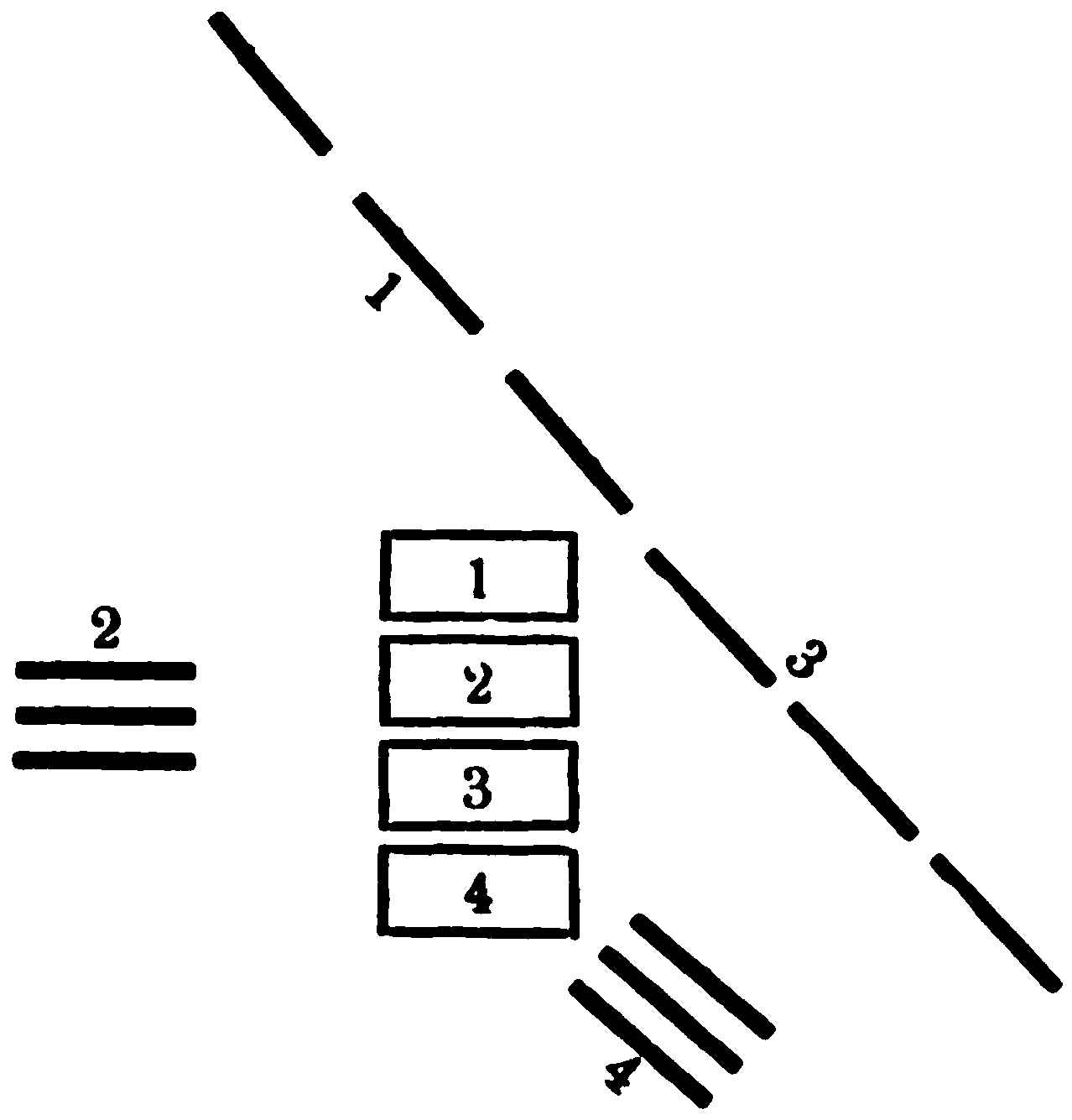
It is a very simple matter to ward off a cavalry charge directed against the flank of a marching column (form line by wheeling by squads). When the cavalry charge is directed against the head or the tail of a column, as recommended by the German Cavalry Drill Regulations (par. 350), there will not be time enough, as a rule, for the entire company or battalion to form line. It will suffice to let the leading elements form line, the rear elements moving out of the column and forming in rear of the flanks as supports.
Successful resistance does not depend upon the formation taken up; in fact the latter is of importance only when it increases the feeling of security. The morale of an organization is of more importance than the formation taken up. A proud confidence in victory and morale are the only factors which decide success, and the training of infantry should be such as to develop these qualities.
Cavalry will in many cases consider that it has gained a success if it causes infantry to discontinue a movement, or to take up formations which interfere with the highest development of its fire, or which offer favorable targets to the hostile infantry and artillery. This is especially the case where infantry is in the act of beginning an assault, when the slightest hesitation may jeopardize success. If cavalry actually begins to charge at this moment, only the bodies immediately threatened halt at the signal “attention,”[307] and face the cavalry; the remainder continue the march.
The sudden appearance of a line of charging cavalry produces such a tremendous psychological effect on troops not immediately threatened, that they either watch the attack passively, or else too many of them take a hand in repulsing it. This moment, in which the attention of the troops is so completely riveted on the cavalry, is seldom utilized for the purpose of gaining ground to the front, or for effecting a withdrawal.[308] It needs but little imagination to picture to one’s self the success which the French army could have gained at Waterloo if infantry masses had followed on the heels of Ney’s cavalry squadrons. In the battle of Vionville the German infantry fired at the most incredible angles at the charging French Guard cavalry. While Bredow’s Brigade was making its charge during the same battle, part of the infantry of the 6th Division stopped firing on the French skirmishers, to follow with intense interest the cavalry charge that was taking place on a totally different part of the battlefield. This conduct, as natural as incorrect, suggests the advisability of profiting by such moments of the enemy’s inattention for the purpose of executing a movement or holding him with our own fire. It also seems absolutely necessary to support with rifle fire the charge made by one’s own cavalry, or at any rate to prevent the hostile infantry from firing undisturbed on our troopers.
There are other reasons, however, why a sharp lookout should be kept during a hostile cavalry charge. All cavalry drill regulations recognize that a charge has greater chances of succeeding when it is made in deep formation, in successive lines, or simultaneously from several directions. The fire of the infantry is distributed, and, unless a good lookout is kept, a part of the cavalry, scarcely or not at all molested by fire, may perhaps succeed in driving the attack home. This will be the case when infantry allows itself to be enticed into developing a heavy fire in a direction from which only a feint is made, while the main attack comes from another, or from several other directions. Well led infantry will, therefore, never employ more rifles in repulsing cavalry than are absolutely necessary, while the mere threat of a cavalry charge will induce badly led infantry to develop an excessive volume of fire.
On open terrain, when the approaching cavalry is visible at a considerable distance, and when the infantry itself is exposed to effective fire, the prone aiming position is to be preferred. The men lying flat on the ground are not so easily wounded by the hostile troopers, and the horses will generally avoid stepping on them, besides which, the danger space is greater than when the men fire standing. In rolling or close country, where cavalry cannot be seen by men lying down, the aiming position kneeling or standing should properly be assumed. The losses inflicted by hostile fire must then be endured. Horses and riders are more apt to lose dash when charging an upright human wall that is spouting fire, than when charging a kneeling or prone opponent who scarcely offers an obstacle to the charge. What is of greater importance, however, is that men standing upright can more easily execute a change of front, fire on passing cavalry, and use their bayonets in case the cavalry actually penetrates their line. The British and Italian regulations very properly prescribe that the front rank of a body of infantry in close order should kneel in such cases.
As the success of infantry depends to a great extent upon the steadiness with which it receives the cavalry, it would seem to be advantageous to withhold the fire until the cavalry gets within short range.[309] General Dragomirov says in his forcible manner, “It is not the bullet which has been fired, but the bullet which is still in the rifle-barrel, and reserved for short range, that harms charging cavalry.” If infantry in line was able to repulse a cavalry charge in the past at 40 paces, with smoothbore muskets and at the first volley,[310] the chances of doing this with modern rifles would be still greater, if the “stopping power” of the 8 mm. projectiles were absolutely certain at short ranges. As this is not the case, it is necessary to open fire at an earlier moment.[311] If infantry does not fire until cavalry gets within very short range, it will have to reckon with the fact that even wounded horses will still be able to carry their riders into its ranks. However, for purposes of instruction in time of peace, it is proper to open fire late. If an infantry unit is trained in time of peace always to open fire at the medium ranges on charging cavalry, the unexpected appearance of hostile cavalry at short ranges in actual war, is more likely to bring disorder into the ranks of such a unit, than if it is trained in time of peace to reserve its fire until the cavalry has come within short range.
At Garcia Hernandez (1812), a French square was broken by a wounded horse falling down within the ranks of the infantry. This is, however, only true of closed bodies of infantry formed in two ranks. Horses will frequently break through a skirmish line—whether or not the horses are wounded is immaterial. Men are wounded in such an event in exceptional cases only, and the wounds produced are generally insignificant.
The following episode shows the effect produced on cavalry when it attacks unshaken infantry which is in good formation and reserves its fire. During the retreat after the battle of Jena, on October 28th, 1806, the Grenadier Battalion Prinz August, threatened by hostile cavalry, did not feel equal to continue its march to Prenzlau and attempted to cross the Ucker farther down. In the expectation that a cavalry charge would be made, square was formed and the officers were told not to fire until the cavalry had approached to within 20 paces. “Meantime, the French cavalry—the brigade which had crossed at Golmitz as well as the remainder of Beaumont’s Division, under its commander, in all nine regiments—approached. The first charge was made by nine troops (Eskadrons) under the division commander. They approached at a gallop. When the expected fire did not come, the dragoons gradually reined in their horses, so that finally they were going no faster than a slow trot. At 30 paces the command “Fire” was given in the infantry and quite a number of troopers fell, the rest galloping by the square on both sides. Eight subsequent charges were repulsed in a similar manner.”[312]
We have moreover to consider, in this connection, the strength of the infantry, the formation of the cavalry, and whether the latter charges from several directions or in several successive lines. A small force of infantry, especially when it may anticipate attacks from several directions, must open fire sooner than a strong infantry force which has to contend with an attack coming from one direction only. In the first mentioned case, an attempt must be made to meet quickly, one by one, the attacks which follow each other at intervals.
It is quite a different matter when the infantry itself is not directly threatened, but can take a hand in repulsing a cavalry charge made on another unit; then it is advisable to open fire at an early moment in order to break the momentum of the charge at long range. (11th Jäger-Battalion at Wörth; 8th Company of the 46th Infantry at Sedan).
This in part determines the rear sight elevation that should be used. The sights should not be changed on the battlefield, although this has been done on the drill ground by well trained soldiers without impairing the continuity or accuracy of the fire. According to the table of ordinates of the trajectory (par. 23 German I. F. R.), a bullet fired when the sight is set at 700 m. and aim is taken at the feet of the horse, does not rise above the height of a mounted trooper throughout that entire distance. The bullets may pass entirely over the target however, when the men take too full a sight in the excitement of battle, or when, in rolling country or terrain covered with grass or crops, they cannot see the bottom of the target and aim above that line. It is better, therefore, to aim at the breast of the horse, with sights set at 600 m., and to fire as soon as the target gets within 800 m. On account of the excitement attending every cavalry charge, it is not advisable to change sights.
It is a good plan to fire one volley first and then to employ fire at will. It is not easy for infantry, while awaiting the onrushing mass of cavalry, to reserve its fire until, in the opinion of the leader, the first shot may be fired. But this waiting is of great importance to prevent the fire from becoming wild and ineffective. Since the elimination of powder smoke, there is no reason why other volleys should be fired after the first, for in the excitement of the fight the volley cannot produce a moral effect. The horses certainly find the rattling of fire at will more unpleasant than the sudden crack of a volley. The advantage of the volley, of permitting a unit to be kept better in hand, may be an important factor under certain circumstances however. The volley should, as a rule, be used by supports that are not exposed to fire. (8th Company of the 32nd Infantry at Wörth; the 1st and 2nd Companies of the 83rd Infantry, and the 5th Company of Jägers at Sedan).
Since the principal object of the fire is to destroy the cohesion of the charge, and as cavalry always closes toward the center while charging, no special importance need be attached to the distribution of the fire.
As regards relative numerical strength, a platoon of infantry consisting of 60 rifles (firing 360-500 rounds per minute), should be a match for 1-3 troops (Eskadrons), and a company of infantry, under favorable conditions, may be able to deal with a cavalry brigade.[313] Cavalry can become dangerous for infantry only when the infantry is surprised, finds no opportunity to fire, loses its steadiness and morale, or attempts to reach cover by running.
The Charge of the French Cuirassiers of the Guard at Vionville.
At half past 12 on the afternoon of August 16th, 1870, the companies of the 10th Prussian Infantry Brigade were advancing east of Flavigny towards the Metz—Mars-la-Tour chaussee. As French infantry was not on the spot to put a stop to this movement, the 3rd Lancers and the Guard Cuirassier Regiment received orders to attack. The former regiment went to the rear, as no definite objective (?) had been assigned to it.
The Guard Cuirassier Regiment was formed in two lines, 150 m. distance between them, with two troops (Eskadrons) in each line, a fifth troop (Eskadron) following as a reserve. Although hampered in its movements and thrown into disorder by abandoned baggage wagons and other camp litter that covered the ground, the regiment nevertheless made the charge with superb gallantry.
The charge struck the 6th and 7th Companies of the 52nd Infantry, under Captain Hildebrand. These companies, rifles in hand and their leader in front, awaited the French cavalry, which came into view at a distance of 1200 m. The first echelon (6th and 4th Troops) was received with rapid fire at 250 paces. On the right, the 6th Troop (Eskadron) approached to within 60-80 paces of the Prussians, but a part then turned to the rear while a few troopers turned to the left. It is said, that of the leaders only one officer and one non-commissioned officer remained in the saddle, and that only twenty cuirassiers were rallied after the charge. The left troop (Eskadron) missed its objective completely. The Prussian rear rank faced about and fired on some French troopers who attempted to make an attack from the rear and who now also received fire from other units of Prussian infantry.
During the charge, the distance between the first and second lines had become greater than at first ordered. When the first line broke in two, the second was still some 300 m. distant from the Prussian infantry and suffered some losses, probably from stray shots, which did not stop the movement however, as the fire soon ceased. German accounts, to be sure, do not mention that the second line could not be seen on account of the powder smoke, and that the fire was discontinued to let the smoke clear away. When the French line was 100 m. away it received the command chargez and the Prussian infantry again resumed its rapid fire, which shattered the attack, the leading troopers breaking down in a ditch about 10 paces in front of the Prussian line. The third line, its cohesion impaired and its advance hampered by fallen horses and riders, was just as little able to reach the Prussian companies. The right wing of the Cuirassiers raced around the left flank of the companies of the 52nd Infantry and encountered the Füsilier Battalion of the 12th Infantry, deployed in a single firing line, dense in the center. Some parts of this battalion formed squares. The charge was definitely stopped by the fire of this battalion. An attempt to rally the Cuirassiers was prevented by Prussian cavalry which now moved out. The French regiment, which had begun its attack with 575 sabers, had lost 22 officers, 208 men (36.2% of its strength), and 243 horses. According to Dick de Lonlay,[314] after this charge, the regiment was able to form only 4 troops (Eskadrons) of 62 troopers each, instead of 5 troops (Eskadrons) of 115 troopers each, which would mean a loss of 248 men. The first line had suffered the heaviest losses; in the 4th troop (Eskadron), which had lost all of its officers and non-commissioned officers, only 18 men were left.
A charge has a better chance of succeeding if it is prepared by artillery fire.
During the attack made by two troops (Eskadrons) of Landwehr Hussars against the 1st Battalion Gyulai at Tobitschau, an Austrian square was broken by shells before the cavalry penetrated it. During the attack of Bredow’s Brigade at Vionville, the artillery was able to send its last shells against the enemy immediately past the right flank of the cavalry brigade.
The employment of cavalry in masses, contemplated in all armies, compels us to consider the case when infantry must advance over open ground in the face of hostile cavalry. Special units must then be designated, who, by means of long range fire, repulse the cavalry or keep it at a distance. At Minden (1759), Anglo-Hanoverian infantry succeeded in driving the hostile cavalry from the field, and at Vauxchamps and Etoges (14th February, 1814), Prussian infantry succeeded in breaking through the French cavalry. It will be easy to do the same thing with modern weapons, so long as cavalry is not very superior in numbers, and is not supported by infantry, machine guns, or artillery.
Infantry attacking dismounted cavalry should endeavor to bring long range fire to bear on the led horses or threaten them by a flank attack. For infantry to prolong the action at long and medium ranges is only playing into the hands of the cavalry, and besides, the better marksmanship of the infantry is bound to make itself felt at short ranges. When the infantry has once gotten to within 700 paces (560 m.) of the dismounted cavalry, it is very doubtful whether the latter will still be able to mount; at the very least, it will be difficult for it to do so (par. 362 German C. D. R.), even though the withdrawal can be effected under cover, or when fresh troops take a hand in the fight.
Provisions of Various Regulations.
England. The possibility of a successful cavalry charge is almost universally contested. When necessary, the skirmishers that are immediately threatened close in toward the center. Bayonets are to be fixed. An opportunity for successful employment of cavalry is offered when infantry has fired away all of its ammunition; when it is forced to retire; and when the approach of the cavalry is facilitated by dust, fog, or heavy rain.
Austria. Brave and steady infantry has nothing to fear from cavalry charges, so long as it retains its steadiness, presence of mind, and morale, and delivers its fire steadily and with good aim at short range.
When fighting cavalry, movements and changes of formation should be ordered only when sufficient time is available, and then only for the purpose of bringing a sufficient number of rifles into action and for better utilizing the terrain. When a cavalry charge is suddenly made from a short distance, it is better to remain in a narrow formation than to deploy hastily, provided the fire is delivered with steadiness. As cavalry frequently attacks only for the purpose of forcing the infantry to discontinue its advance, or to induce it to take up a close order formation, all units not immediately threatened by the attack should continue their movement or remain in their positions.
When a force has to cover long stretches under conditions which make it probable that a cavalry attack will be made, the battalions, companies, or platoons should be so grouped that they can quickly meet the cavalry attack in any direction, and can mutually support each other in warding it off. Staffs and vehicles should place themselves within the protected area thus formed.
The threatened units turn in the appropriate direction, properly utilizing cover and obstacles while so doing, and, when necessary, fix bayonets. Only such a part of the force is designated to fire as seems necessary for warding off the attack; the other parts continue to carry out the task assigned them. The commander retains a part of his force in readiness for warding off unexpected attacks.
“When exposed to hostile fire while warding off a cavalry charge, the men should assume the position offering the smallest target.
“If a platoon is directly attacked by cavalry, it will only in rare cases be advisable to open fire at ranges beyond 600 paces (450 m.); frequently it will be a good plan, however, to let the cavalry come up close. When the platoon participates in warding off a cavalry attack made against another unit, it may open fire at longer ranges.
“Fire at will is the principal kind of fire to be used in warding off cavalry.”
France. Infantry, no matter in what formation it may happen to be, has nothing to fear from hostile cavalry, even if the latter is in superior numbers, provided the infantry remains cool, well in hand, and makes good use of its fire.
When cavalry surprises infantry, the effect is as great as of old. Infantry should therefore carefully protect itself in all situations of combat, especially during critical moments.
If cavalry is reported, infantry can guard against all contingencies by echeloning. It should not allow itself to be diverted from its task so long as the cavalry does not begin an attack.
Any disposition that enables infantry to change front quickly to meet a charge, and to deliver a strong fire, is calculated to stop even the boldest cavalry.
When fighting dismounted cavalry, it is considered desirable for the infantry to advance quickly to medium and short ranges for the purpose of firing upon the cavalry as it mounts.
Russia. Nothing prescribed.
Japan. Infantry which, while engaged with the enemy, is forced to discontinue its movement or to change its formation for the purpose of warding off hostile cavalry, has already suffered a partial defeat. Only those fractions that are absolutely necessary for repulsing the cavalry should take up the fight against it.
VIII. INFANTRY VERSUS ARTILLERY.
1. THE PASSAGE OF INFANTRY THROUGH ARTILLERY LINES.
The artillery of a mobilized German army corps with its twenty-four batteries takes up approximately 2500 m. of the front of about 4000 m. available for the corps. When the ground is unfavorable, the front available for the other arms may be still further reduced. All remedies suggested for reducing the frontage required by artillery offer no real solution of the difficulty; in fact, they have resulting drawbacks, such as the reduction to ten paces of the interval between guns, and the posting of artillery in two lines, one in rear of the other. On account of these drawbacks, a commander will avail himself of these remedies only in case of the most urgent necessity. The question as to how infantry can best pass through these long artillery lines is therefore of especial interest. While artillery will generally seek commanding positions and avoid covered terrain, infantry will make use of depressions and cover as the natural routes of advance for passing by batteries in action and for deploying subsequently in front of them. In this case the solution of the problem is simple. The difficulties are disproportionately greater when terrain impassable for artillery is lacking. Nothing could be more desirable for hostile artillery which has adjusted its fire upon our batteries, than for the intervals between our guns to become suddenly filled with infantry, whereupon our artillery, until now under fire, would have to cease firing so as not to endanger our infantry. This pause in the fire will be more noticeable, when our artillery has not yet succeeded in gaining a superiority of fire over the hostile guns; and its length will depend upon the depth of the infantry formation. In this case the infantry cannot avoid heavy losses as it must cross the fire-swept space in rear of the guns, and soon thereafter must enter the zone of the opponent’s actual “fire for effect,” besides losing for the time being the support of its own artillery fire. It is obvious that for infantry to advance in deployed lines through artillery in action, condemns the latter to long silence, and even exposes it to the danger of being placed altogether out of action. Infantry can pass through artillery lines at certain points only, its passage being subject to an agreement between the infantry and artillery commanders. It is advisable to have those batteries cease firing whose fire has the least influence on the course of the artillery combat. It is, however, of the utmost importance that the fire of all hostile batteries which possibly could fire on our infantry, be kept down by the increased fire of our artillery. In this manner, we may perhaps be able to draw the fire of the hostile artillery away from those points at which our infantry is to pass through our artillery line. This is especially important. It will also be advantageous to designate successively, different points in the artillery line for the passage of infantry. This should be done for two reasons: first, in order that a favorable target whose re-appearance the hostile batteries could await with loaded guns, may not be presented to the enemy at one point for a prolonged period; second, in order that movements by the flank on the part of the infantry may be obviated. The column of squads would be a suitable formation in which two battalions of infantry could simultaneously pass through the line of guns approximately within the space occupied by one battery. These battalions should then at once deploy, executing front into line toward their respective outer flanks. The guns can resume firing only when their infantry has reached a point 3-400 m. in front of them. The artillery will be able to resume its fire earlier when it is posted in rear of a crest, and for this reason such points should be selected for the passage of infantry.
2. THE ADVANCE UNDER ARTILLERY FIRE.[315]
In almost every attack, infantry will be obliged to advance for considerable distances under artillery fire without being able to take advantage of cover. It should guard against being surprised by artillery fire while in an unsuitable formation.
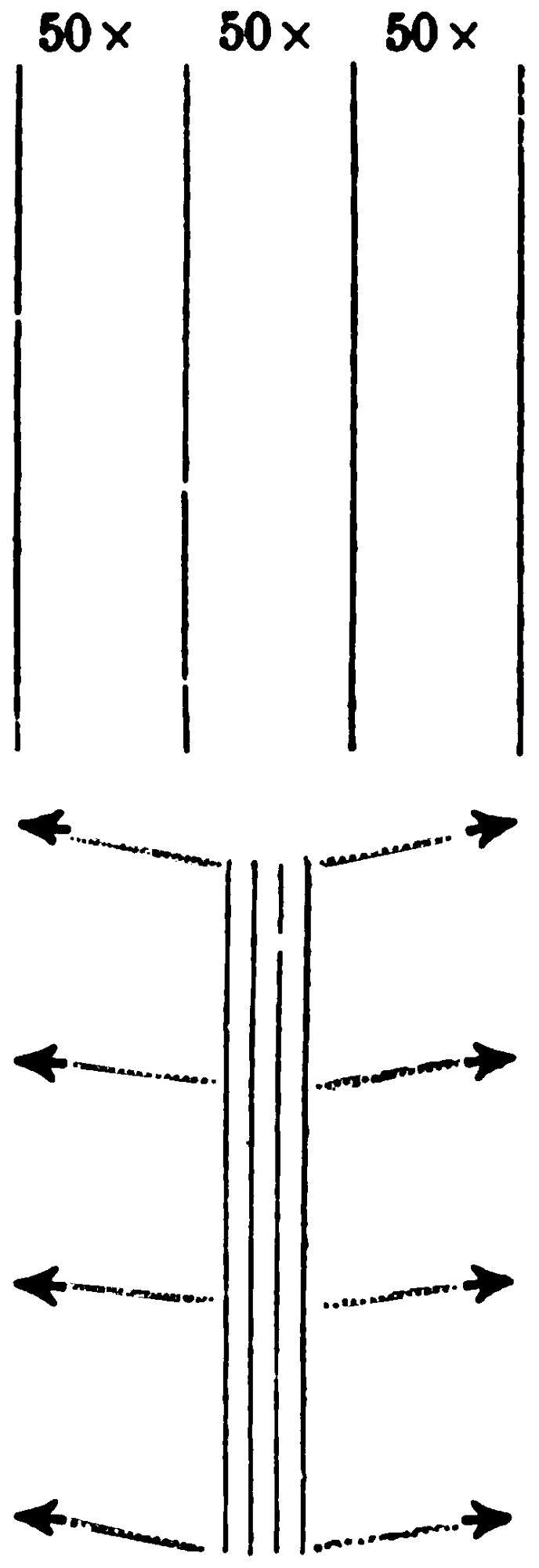
In the first place, everything that facilitates the enemy’s adjustment and observation of fire should be avoided. (See p. 119 supra). To this end, infantry should not remain unnecessarily long near objects that are clearly visible at a great distance. If it is noticed that the enemy is beginning to adjust his fire on some prominent feature of the terrain, that point should be passed as quickly as possible; the same is true of a plain in the enemy’s zone of fire. Narrow columns, separated by intervals of 50 m., their heads not on the same line, are advantageous. This formation prevents shrapnel from simultaneously striking two columns, and makes it difficult for the enemy to judge the relative position of the smoke from the burst of his shrapnel with respect to the target. This increases the difficulties of the enemy’s observation of fire, as it is not easy for him to determine whether his shots go over or fall short. A shallow echelon formation (about 50 m. deep, as used in Russia, for example) is valueless for reducing losses, owing to the depth of the beaten zone of modern projectiles.
The narrowest possible front should be presented to the enemy when within his zone of fire.
It is moreover desirable to make the further observation of fire difficult for the hostile artillery, and to diminish the effect of his projectiles at the target (see p. 120 supra) by taking up suitable formations. Broad, shallow formations were suitable against the shell fire of the past. However, they had the great drawback of considerably facilitating the observation of shots falling short or going over, as the smoke from the burst hid the target in the first case, and as the target appeared silhouetted against the smoke from the burst in the second. The cone of dispersion of the modern base charge shrapnel combines comparatively small lateral spread with great effect in depth. The effect of a well-placed shrapnel may be confined to one target, and that of projectiles bursting in the intervals reduced by taking up a formation in which narrow columns (columns of squads) are separated by wide intervals (up to 50 m.).
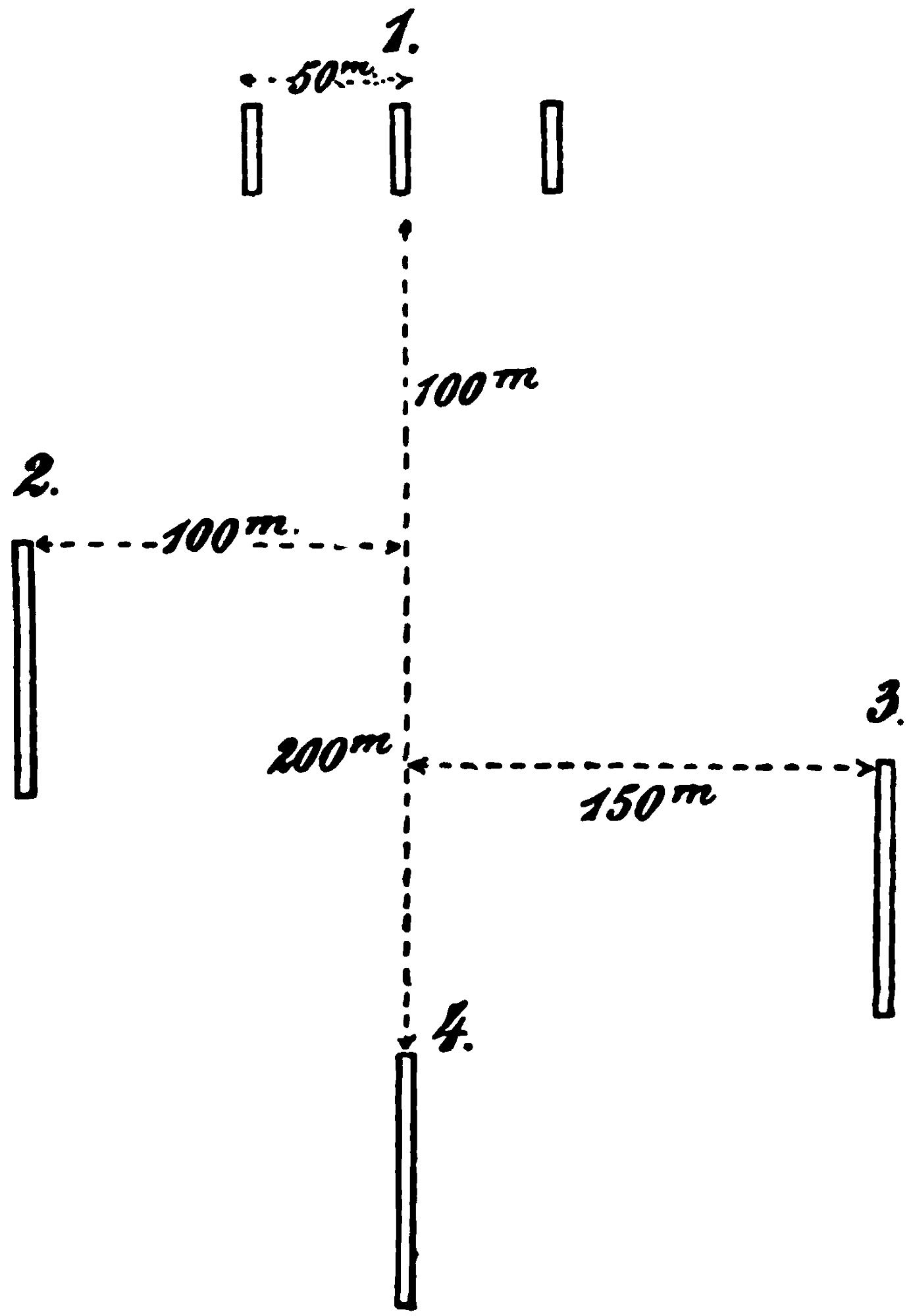
The range is determined or verified by bracketing; that is, by enclosing the target between shots which, fired at a known difference of range, strike respectively, short of and beyond the target. In France this is done either by battery salvo or by piece. In the former case, the French distribute the fire equally over the entire space which they wish to cover with fire; hence, they do not direct it upon the individual columns, especially when they employ indirect laying, their favorite mode of procedure. It is in this kind of fire especially that narrow columns, separated by wide intervals, are a great advantage, because it is pure accident if a projectile falls so that its burst can be observed. Moreover, when the columns are not abreast of each other, the observations of bursts may be contradictory. Thus, in one salvo, “over” and “short” bursts may be obtained, especially if several bursts could not be reliably observed, and the salvo will have to be repeated. When a projectile bursts “short,” immediately in front of the 1st company, for example, it may be assumed that the next projectile will be fired at a range increased by 100-200 m. The 1st company should therefore move to the front at double time, the 2nd and 3rd likewise, while the 4th executes platoons front into line and takes to cover in anticipation of an “over” shot. The “over” meant for the 1st company will then be the signal for the 4th company to rush forward. The following general rule may be given: A projectile bursting “over” or just “short” of the target requires that the force fired upon move quickly; a projectile bursting far “short” of the target requires that cover be taken. The platoon and squad leaders of the attacking force should not betray its presence by standing upright; the force should disappear absolutely without leaving a trace.
A force cannot, in the long run, prevent artillery from effecting an adjustment of fire upon it; all it can do is to postpone the beginning of the fire for effect.
Fire for effect is of three kinds:
1. “Progressive fire” (tir progressif).[316] In this fire, after establishing a bracket (as a rule, one of 200 m.), every piece fires two rounds at each of four ranges, viz., at a range 100 m. less than the short limit of the bracket, at both ranges of the bracket, and at a range 100 m. greater than the long limit of the bracket. For example, if a bracket has been established for the target at 3000 and 3200 m., the battery would fire at 2900, 3000, 3200, and 3300 m.
2. “Sweeping” (fauchage) is employed when it is desired to cover a broader zone. In this every gun fires three rounds at each of the ranges designated. The first round is fired with the line of sight directed on the right portion of the target (or on the aiming point). Before firing each of the succeeding rounds, the direction of the piece is changed to the left by three turns of the traversing handwheel. At the next range this process is reversed, the direction of the piece being changed to the right by three turns of the traversing handwheel after each round. At 2500 m., for example, a battery can cover, in this manner, a space twice the width of its own front.
3. “Fire at successive ranges” (searching fire). In this fire salvos or volleys are delivered at the target at a number of ranges to be designated by the battery commander.[317]
During the Russo-Japanese war, all close order formations proved unsuitable under artillery fire, except when the terrain afforded cover. The Japanese infantry recognized very soon that the best protection against artillery fire lay in constant motion (irregular rushes made by small units) and in wide extension. The following procedure, employed at Yoshirei on July 31st, 1904, seems worthy of imitation:[318] The several platoons of the companies followed each other in deployed lines at distances of 200-300 m. When they had to cross open ground in order to reach a designated line, the platoons sought to advance by squads, whose men were deployed at intervals of 5-10 paces and who moved at a rapid gait interrupted by breathing spells. The men invariably assembled when cover was reached. The losses were insignificant. The Russians also made use of a similar procedure after their first disastrous experiences. In many instances the platoons ran forward in single rank. “Change of gait and direction, as well as the use of loose irregular skirmish lines make it difficult for the artillery to hit anything.” (Par. 450 German I. D. R.).
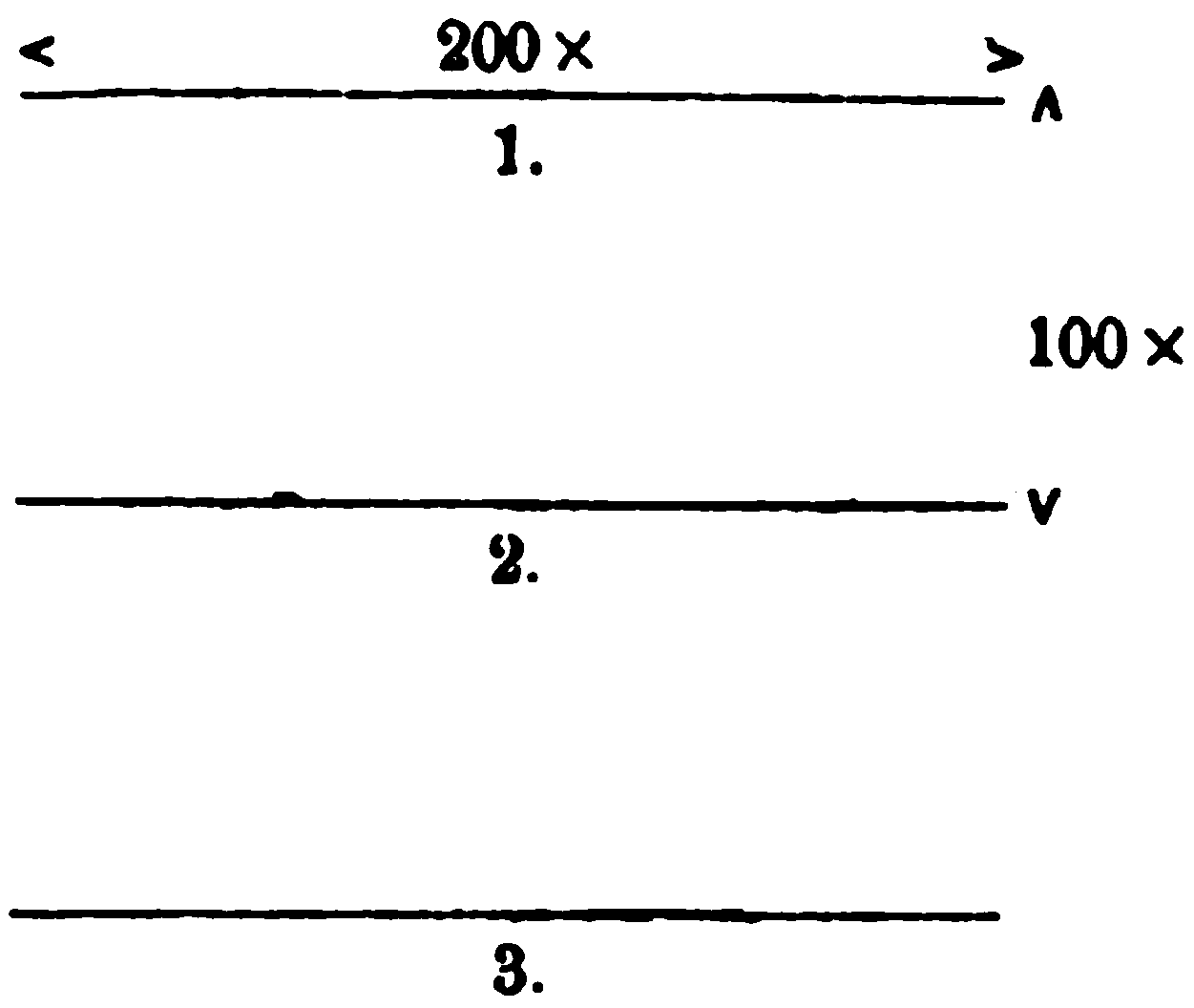
Formations used by Infantry during the Russo-Japanese War when under Artillery Fire.
a.
A platoon in route column forms four columns of files.
b.
A company in column of platoons, each in line of skirmishers with the men 2-4 m. apart.
(It would be better to use sections instead of platoons).
c.
The ranks of the sections in each platoon of the company following each other at a distance of 100 m.
This formation was taken up from company column (German).
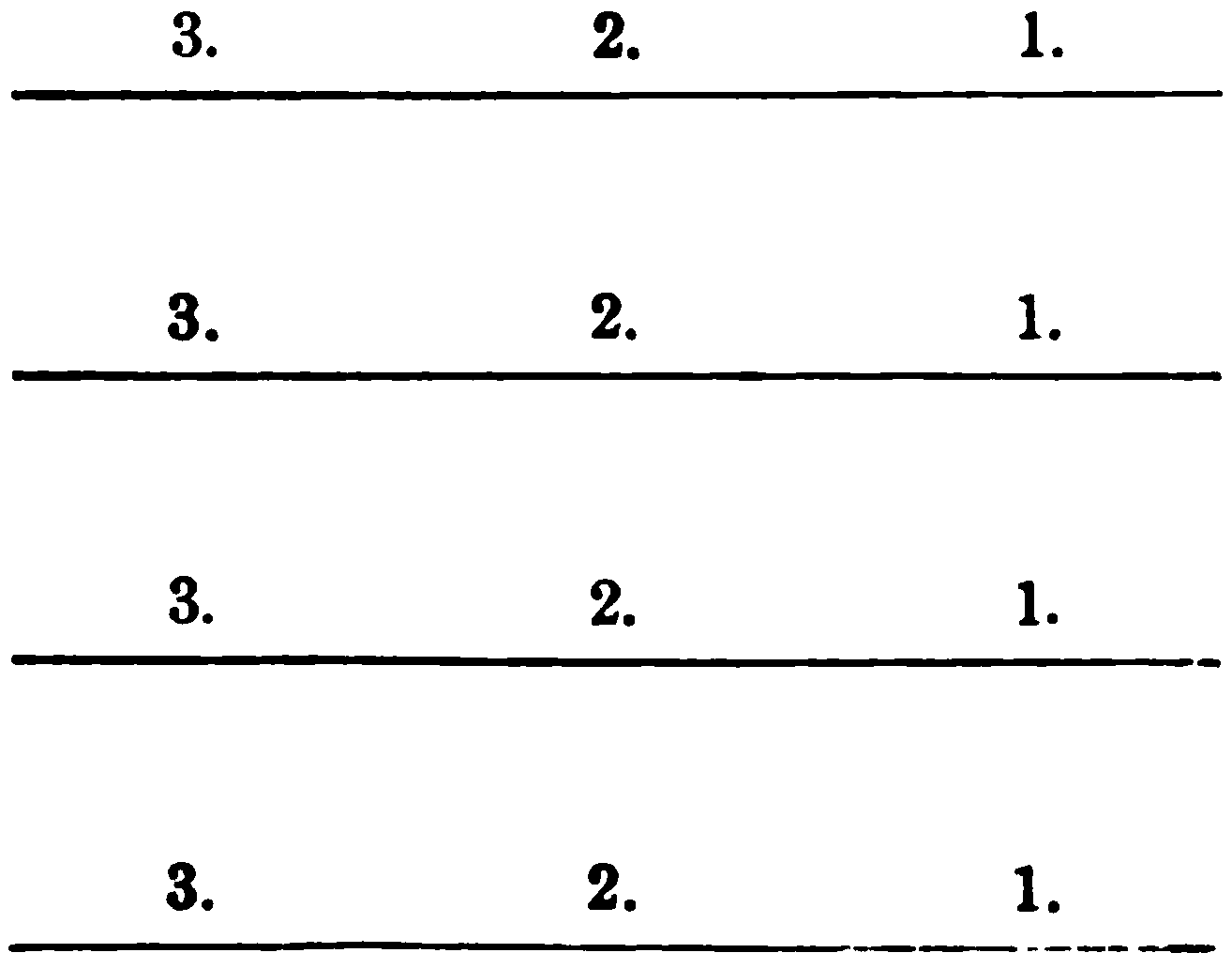
These formations made it possible to advance at a walk to within 3000 m. of a hostile position; beyond that an advance by rushes had to be resorted to, in which the attacking force avoided showing itself simultaneously in long lines. The simplest scheme might be to move forward in column of sections, each section in skirmish line. Formation “a” is well adapted for quickly crossing fire swept places, and when there is hope of re-forming the column subsequently. Formation “c” is suitable for quickly deploying from company column. However, the last-named formation no longer guarantees a proper leading of the company, and quite naturally does not absolutely prevent losses. After the Japanese 5th Brigade (Nambu) had taken possession of Yuhuntun[319] and the three houses during the night of March 6/7, 1905, the following dispositions for attack were made by the Russians about noon on the 7th: On the right, the 5th and 10th Rifle Regiments, in five lines, each consisting of one battalion (total depth of the formation 600 m.); in the center, the 123rd Infantry (Koslov) of which the companies of three battalions were deployed in single rank lines, each consisting of one company, with the men at intervals of from 3 to 5 paces, the companies in rear of each other at distances of 100 paces; the IVth Battalion, similarly formed, was posted in echelon to the left rear. The 124th Infantry advanced on the left flank. The Koslov Regiment, advancing without hesitation in quick time and at attention, was fired on by three Japanese batteries while it was moving from 4000 to 2000 m. The regiment lost about 600 men. This loss is insignificant when the size of the target (about 600 m. wide and 1000 m. deep) is considered. The Japanese did not care to become involved in a serious infantry action and therefore evacuated the place. It would have been better to advance by rushes with smaller units, as the terrain afforded no cover whatever. Whenever the Japanese had sufficient time, they crossed such plains singly, one by one, and then assembled under cover for the attack.
3. FIRING ON ARTILLERY IN POSITION
was in the past a pet fire problem. The effect of frontal fire on artillery whose guns are protected by shields is so small that the expenditure of ammunition is not justifiable.[320] The gap between the steel shields of the French field gun is not large enough to exert a noticeable influence. Steel shields, 3 mm. thick, afford protection against steel jacketed bullets fired at or beyond 300 m.; against “S” and “D” projectiles they afford protection, it is said, beyond 500 m. only. Machine guns directing continuous fire on a point may obtain better results. According to firing tests 3 mm. armor plate can be pierced up to 1000 m. only by special projectiles (solid steel projectiles and those having a steel core), the adoption of which is precluded on practical grounds (variations in sectional density, and difficulty of manufacture).[321] For this reason, it is better to leave the task of destroying shielded batteries, even when they are in the open, to one’s own artillery, than to attack them with infantry. The fire effect of the infantry is not noticeably increased when delivered obliquely against the front of the battery. (Par. 184 German I. D. R.). In Germany the gun commander and cannoneer No. 3, who is posted at the trail, are then especially endangered; but in order to flank the guns effectively and to reach in rear of the shields with its fire, the infantry must move to a flank a distance at least equal to 1⁄3 of the range, and even then the fire effect is very small. The effect may even be entirely nullified when the flanking fire is delivered from the side on which the caisson bodies are posted. In this case it suffices to push forward the caisson body to protect the personnel. It is a good plan for infantry to direct its fire on the limbers and the reserve. And again, infantry should not let any opportunity pass to fire on artillery in motion or in the act of limbering or unlimbering within effective range. Guns moved by hand into positions from which direct laying can be employed for the purpose of warding off the infantry attack, offer particularly favorable targets. Infantry that is to capture artillery must approach its objective by means of irregular rushes made by small groups, and increase its fire to the utmost intensity when the limbers are brought up to the guns. The effect of artillery fire is small under 200 m., in the absence of canister.[322]
Germany.
Field Howitzer.
Field Gun.
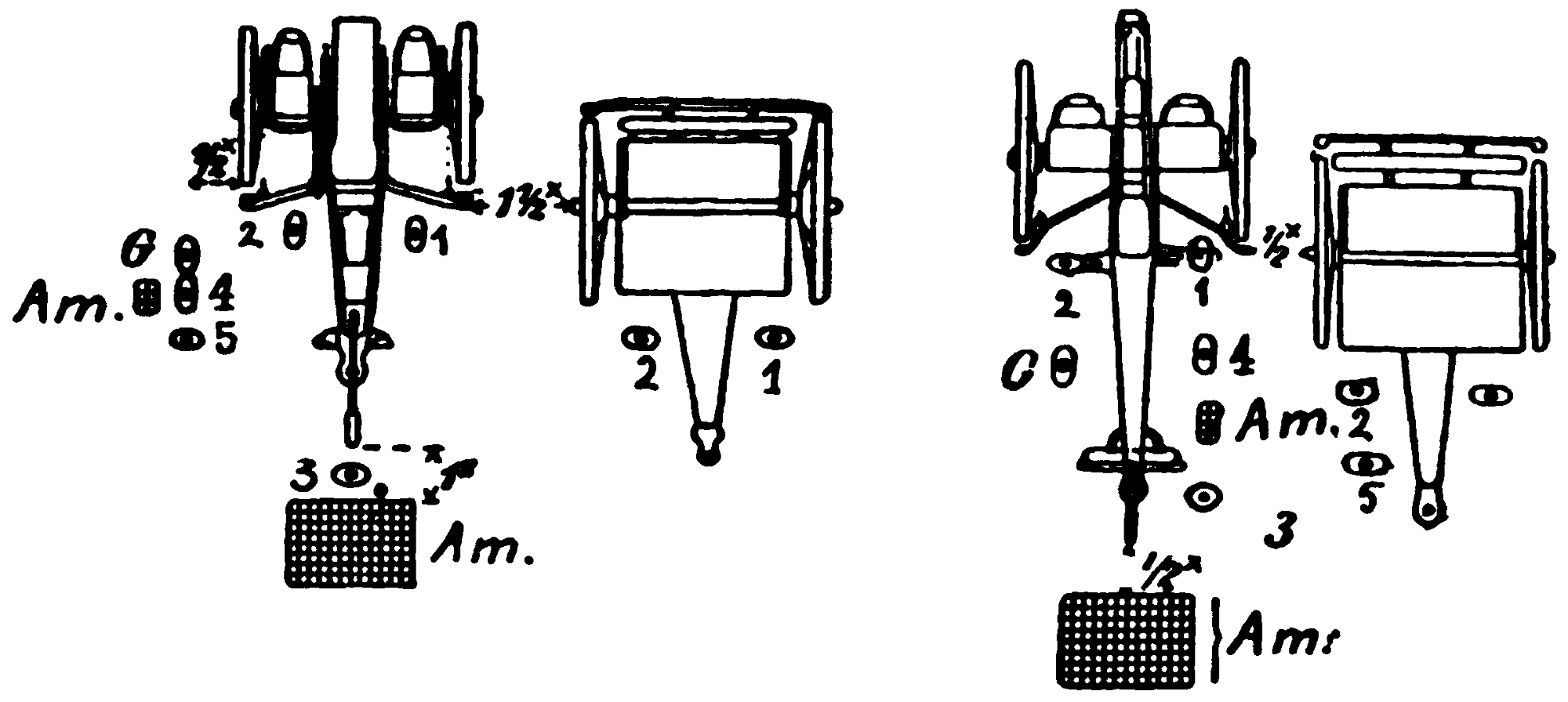
France.
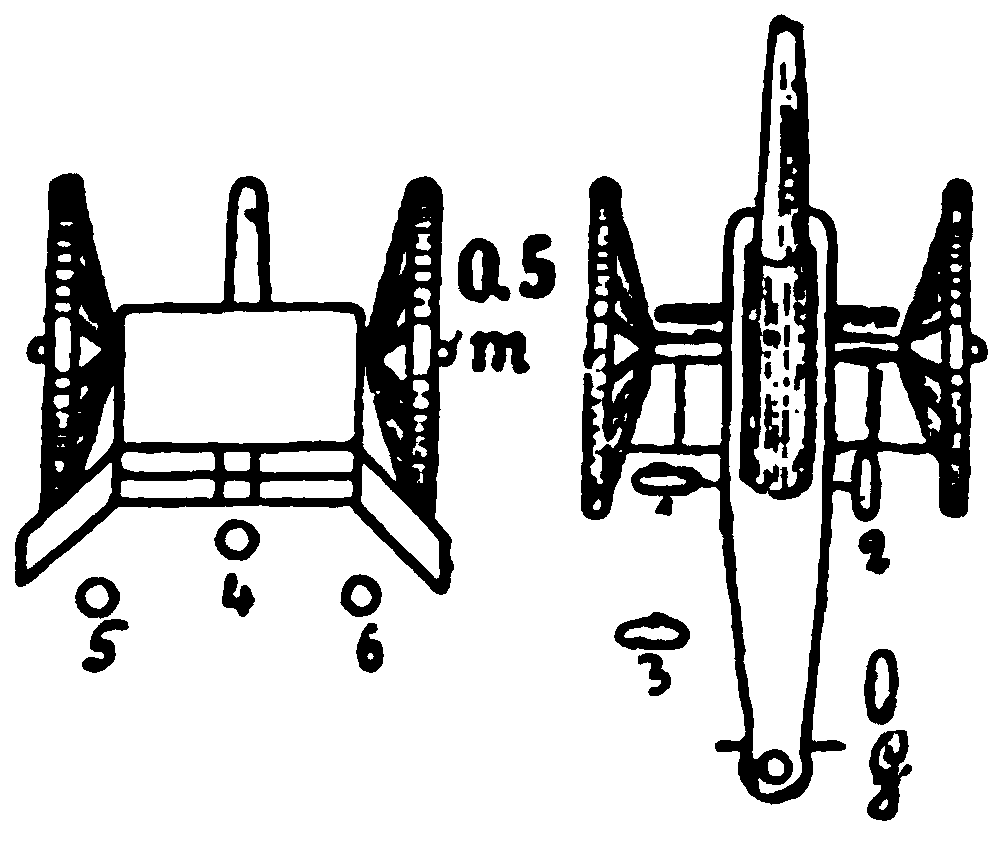
The disaster which overtook Trautmann’s Battery at St. Hubert, during the battle of Gravelotte, demonstrates how difficult it is to unlimber on open ground when under effective infantry and artillery fire; but, if five limbers with their teams had not stampeded, perhaps it might have been possible after a while, for the battery to reopen fire. Hasse’s Battery, also at St. Hubert, was rendered incapable of moving in a short time, but, in spite of the greatest difficulties, managed to continue its fire for about two hours, though with only a part of the guns. Gnügge’s Battery managed to unlimber under cover of a garden wall at St. Hubert and to maintain itself there under enfilading infantry fire till the end of the battle. Trautmann’s Battery lost 17 men and 37 horses; Hasse’s Battery, 38 men and 77 horses; and Gnügge’s Battery, 15 men and 40 horses.[323]
Unlimbering under uninterrupted hostile fire at short range will always produce conditions similar to those in Trautmann’s Battery, and in the two British batteries of Colonel Long at Colenso.[324] These two batteries did not cease firing because they had suffered too heavily, but only because they had expended all their limber ammunition and the caissons were unable to come up. It was impossible for these batteries to limber up under the hostile fire. It was likewise impossible to destroy a battery, though without protecting shields, even when great quantities of ammunition were expended.
At the battle of Beaumont, the artillery of the 7th Infantry Division suffered heavy losses. “Although the first caisson sections were up and the men with them were detailed to assist in working the guns, the gun squads in both batteries had dwindled down to 2 or 3 men each by 1 P. M., i.e., within half an hour.” Immediately after the French attack had been repulsed, one of these batteries was able to accompany the advancing infantry, however, while the other (the 4th Light Battery) could not move its guns until an hour later, as it had lost 29 men and 34 horses.[325] This example proves again that when artillery has once managed to go into position and to open fire, it cannot be annihilated by infantry alone, and therefore need not fear to take up a more than temporary position in the first line.
The best way for artillery to protect itself against annoyance from hostile infantry fire is to push forward an infantry screen, even if only a weak one. In the days when batteries had no shields, this screen enabled artillery to devote its entire attention to the principal target without regard to hostile infantry. At the present time, especially in positions in rear of a crest and in long artillery lines, the principal object of such a screen is to prevent hostile patrols from molesting the artillery. Small detachments posted at wide intervals are sufficient for this purpose. The flanks and rear are now as in the past the vulnerable points and are most exposed to daring, sudden attacks, even if only made by weak hostile detachments. (Par. 448 German I. D. R.).
At the battle of Vionville,[326] about 5 P. M., four horse and seven field batteries of the IIIrd Army Corps were engaged near Flavigny with ten French batteries. After this artillery duel had lasted half an hour, French Guard Infantry advanced to the attack. This was repulsed by artillery fire at a range of 800 m., but the fire of the artillery was diverted from its proper objective by the advance of this infantry. Similarly, at St. Privat, two batteries of the Guard Artillery had to direct their fire on French skirmishers.
IX. THE ATTACK.
The defense may repulse the enemy, but only the attack can annihilate him. The decision as to whether the force is to attack or stand on the defensive depends upon the tactical situation and the will of the commander, and not upon numerical superiority, of which one is not aware, as a rule, until after the battle.[327] Determined attacks, again and again repeated, in spite of all failures, are the surest means of gaining victory and of preventing the enemy from becoming aware of his superiority. Only pressing reasons (marked hostile superiority, necessity for awaiting approaching reinforcements, or the failure of an attack), and never favorable terrain conditions, should determine a commander to stand on the defensive. In defense the eventual assumption of the offensive is kept constantly in view. A commander who voluntarily stands on the defensive for the purpose of letting the opponent attack, and then attacks him in turn, reaps only the disadvantages and never the advantages of both the offensive and the defensive.
The attack may take various forms, depending upon whether the dispositions have to be made under hostile fire (surprise and rencontre), or whether the enemy has renounced the initiative and awaits the attack in a deployed formation, or in a position prepared for defense (deliberately planned attack). In the last case the attack requires more careful preparation and in many instances even necessitates the employment of special auxiliaries (such as guns capable of high angle fire, and engineer trains). However, the advance of a strong firing line to within assaulting distance of the enemy, and the uninterrupted fight for the superiority of fire, are common to all attacks.
Aside from the attack against an enemy in position and the rencontre there is an attack formation more closely resembling the rencontre in character, which may be called the abridged attack.[328] This attack formation is used in forestalling the enemy in occupying important points, in preventing enveloping movements, in carrying out flank attacks, in surprising the enemy, in warding off a hostile surprise, in relieving the pressure on a neighboring force, etc. It is moreover appropriate where the conformation of the ground or the time of day prohibit a use of the rifle.
The first stages of the fight of the 6th Infantry Division at Vionville are of this character. The fire fight was relegated to the background in view of the constant movement to the front. The situation prohibited our properly taking advantage of our superior marksmanship.—The attack on the railroad cut of Nuits, during the late afternoon of December 18th, 1870, progressed similarly.[329]
1. THE SURPRISE.[330]
Insufficient reconnaissance may place a force in a situation where it will be obliged to go into action directly from route column or from a formation unsuitable for combat, against an enemy who unexpectedly opens a lively fire at short range, thus increasing the moral effect of the surprise by actually inflicting losses. The force which is taken by surprise will without doubt overrate the seriousness of the situation and will be inclined to overestimate the strength and morale of the opposing force. This must be taken into account in coming to a decision.
Above all else, it is important to develop, as promptly as possible, a fire effect at least equivalent to that of the enemy, to let the troops regain confidence, and to secure the initiative. A bold decision is best calculated to extricate a force from such a critical situation.[331] It is of little use to deploy, take cover, and open fire, when the enemy is well concealed; a decision to retire is still less to be approved, because at short ranges it is bound to lead to a complete annihilation of the force. As a rule, a defeat can only be averted, in such a case, by assuming the offensive and thus repulsing the enemy. The decision for attacking directly from route column (or, when the enemy is still at a distance, at least for deploying toward the front) is the more justifiable, since an enemy who prepares an ambuscade for us is, as a rule, conscious of his inferiority in numbers, morale, and training, and resorts to deceit because he does not dare to meet us in the open. Therefore, overwhelm the enemy with fire and then charge him with the bayonet. An impetuous advance may perhaps intimidate him, and our losses will be less, at any rate, than if we turn our backs on him and await our fate in what is at best but a poor position, as it is taken up, as a rule, during the first moment of panic. However, even if a force that is taken by surprise cannot avert disaster by making a determined counter-attack, it can at least save its honor and morale. This is equally true of the rencontre on the battlefield.
Examples of Surprises.
The surprise at Baalon on September 17th, 1870.[332] The surprise at Vouziers on December 15th, 1870.[333] The conduct of the French infantry when surprised in its camp at Beaumont.
During the battle of Noisseville there occurred an unusually instructive episode, the disastrous results of which could have been easily avoided if the mounted officers on duty with the force had been sent out to reconnoiter. Six companies of the 44th Infantry (Prussian) were advancing from Flanville against Montoy. On the French side, the 62nd Infantry was likewise advancing against Flanville and had arrived at Montoy when the 44th Infantry (Prussian) very unexpectedly appeared on its left flank. The French regimental commander decided to attack at once. “The Prussian detachments advancing south of Montoy were about to scale the west slope of the ravine near there, when, at very short range, they suddenly encountered the rapid fire of a dense French skirmish line, which was immediately followed by the counter-attack, consisting of columns in close order. At the same moment, the left flank of the Prussians was attacked from the south, and other hostile columns advanced from the park through the west entrance of the village. The Prussian skirmish lines were repulsed in an instant, and thrown into complete confusion. The hostile fire had an annihilating effect on account of the short range, and the situation was at once completely reversed. The Prussians sought in vain to gain a firm foothold in the eastern outskirts of the village of Montoy. Their losses were heavy. The four companies (3rd, 9th, 11th and 12th) of the 44th Infantry numbered in all 18 officers and 840 men; they lost 7 officers and 480 men, of which number 1 officer and 82 men (all unharmed) were taken prisoners. The 9th Company suffered least; but the 3rd, 11th and 12th Companies (44th Infantry) lost in all 55.5% of their effective strength, the 3rd Company even losing 67%.”[334]
This surprise could without doubt have been avoided. If the 44th Infantry had sent mounted men ahead, it would have been in a position to let the French walk into its fire. Soon after this occurrence, the French infantry also unexpectedly received flanking fire from Flanville, which forced it to abandon the pursuit after suffering some losses.
When two forces unexpectedly collide in close country, the advantage rests decidedly with the one that opens fire and advances to the charge first. This onslaught with cold steel should become second nature to the troops. In traversing close country, a force should be in a formation that enables it to develop an adequate fire and to make a charge in compact formation. A line formation is entirely unsuitable, as a rule, on account of the difficulties of the terrain to be overcome, and in a skirmish line the officers cannot properly control the men.
For passing through thinly scattered timber without underbrush,[335] company column is a suitable formation, and for dense woods platoons advancing either abreast or echeloned, each platoon in line of squads in columns of files. If the platoons or sections were to advance in single file, the columns would be too long, and it would be next to impossible to maintain the intervals. The six or eight small columns of files of a platoon are, on the other hand, close enough together to keep each other in view; besides, they are easily and quickly deployed for firing and charging, and can meander through the woods more readily than an organization in close order. Moreover, the leaders can exercise better control over the men than in skirmish line, which invariably bunches up at the places that are most easily passed, while connection is not maintained at all at other points and march direction and cohesion is lost. (See the passage of the Bois de Givodeau during the battle of Beaumont).[336]
2. THE RENCONTRE.[337] (Pars. 315-317 and 352-361 German I. D. R.).
“Uncertainty and haziness of the situation are the rule in war. During marches in campaign the opponents will frequently not gain detailed information of each other until they come into actual contact. Thus the rencontre develops out of a collision of route columns.” (Par. 352 German I. D. R.).
Both forces are marching toward each other, and the collision occurs frequently at a point not intended by either; as every minute brings the heads of the two columns closer together no time is to be lost. The commander who desires to wait until he can come to a decision consonant with the results of the reconnaissance will arrive too late. The tactical situation in its entirety determines whether or not an attack should be made. If we do not take advantage of the fleeting moment the enemy will surely do so, and, as a rule, he will not be any better prepared for action than we are. Frequently the deployment from route column is not made because the commander desires it, but because it is necessary in order to avert a crisis in the leading line. The commander who is acting under hostile pressure should endeavor to regain the upper hand as quickly as possible so that he can dispose of the troops of the main body with a definite object in view. In a rencontre, the advantage rests almost invariably with the commander who quickly sizes up the situation, attacks promptly, and succeeds in throwing the opponent on the defensive. A bold, impetuous attack, which would lead to disaster in the presence of an opponent already deployed, may, in this case, be productive of victory. The direction in which the attack is made is of less importance than a prompt decision on the part of the commander and the simultaneous launching of the whole force in a definite direction. We must take the terrain as we find it. In covered terrain, the effect of the surprise will be increased still more, while in open country, the preparatory stage of the combat will soon lose that character, because the side which has an advantage as regards terrain will make use of it, and the conviction will force itself upon the opponent that victory cannot be gained by an impetuous attack alone. It will be easy for a commander to come to a decision as to the action to be taken if he is conscious of his own strength or fears that the enemy desires to avoid an attack. (The commanders of the advanced troops of the IIIrd Army Corps at Vionville). The rencontre increases the difficulties of troop leading, but makes the attack easier for the troops.
The difference between a deliberately planned attack and a rencontre is most clearly apparent in the conduct of the advance guard. Its task is to secure the prospective artillery position and to create favorable conditions for the combat of the main body. This requires that ground be gained to the front so as to enable the main body to deploy while moving forward. In addition, the advance guard should seize and hold important points, without, however, anticipating the intentions of the commander of the whole force. It is moreover desirable for the advance guard to interfere with the hostile deployment. Points lying on the flanks or in advance of the artillery position, especially if they command the latter, should be quickly seized; when necessary, the advance guard must fight for their possession. Its commander should quickly pick out the points that are important for this purpose; he should, by no means, be satisfied always to begin the fight where the point of the advance guard happens to be. Under certain circumstances the main body will have to concentrate for action farther to the rear so as to hasten the deployment and to take advantage of favorable terrain. When the enemy has an undeniable start in deployment, the commander may decide to let the opponent advance to the attack, and then bring about the decision by simultaneously launching his main body. Only thus can one in the long run avoid fighting superior numbers with an inferior force. (Par. 360 German I. D. R.). It is much easier to decide whether this or that point is of importance, than to answer the question as to whether the strength of the advance guard will suffice for the task of taking it. The reports of the cavalry in regard to the enemy’s strength and the composition and formation of his columns, will scarcely furnish an adequate basis for a pertinent answer to this question. Moreover, one will usually not be able to tell, until after the action has commenced, how far the hostile deployment has progressed. But, in any case, long hostile firing lines demand caution. However, a start in deployment is not indicated by the combat frontage alone. A factor of far greater importance is which force has been most successful in making preparations for going into action by developing its main body and by having artillery near at hand. It is artillery that clears up the situation. When an infantry division encounters a hostile force deployed on a front of 400-600 m., this does not necessarily mean that the entire division must systematically concentrate for action, as this would cause a considerable loss of time, thus giving the enemy a great advantage. The general situation and the mission of a force are of greater importance for the commander’s decision, than the state of readiness for action of the opposing forces.
Issue of orders. See Taktik, V, p. 197.
The advance guard must be promptly informed of the intentions of the commander (i.e., whether he intends to attack, to concentrate for attack farther to the rear, or to let the enemy attack[338]) and of the location of the prospective artillery position. The attack order should be withheld until the combat of the advance guard has sufficiently cleared the situation, but a development of the force should be ordered at once.
The advanced detachments should endeavor to gain a start in deployment over the enemy and cover the advancing artillery in front and flank, by quickly deploying strong firing lines and pushing machine guns to the front. After they have done this, they should promptly advance to the attack. Through this, our firing line, while in the act of deploying, runs the serious risk of suddenly encountering, at short range, the fire of superior hostile troops, at a time when all the troops approaching the field are still too far distant to increase its fire power.[339] Whether the quickly formed firing lines should at once move forward to the attack in a rencontre, depends upon the impressions received by the commander. His dispositions should be such as to compel the enemy to disclose his available forces at an early moment. Every fighting line is so sensitive to fire simultaneously delivered against its front and flank, that an attempt to turn the hostile position will instantly force the enemy to take counter-measures. If the enemy is unable to keep pace with us in deploying a firing line, if he is unable to deploy skirmish lines as dense as ours, this state of affairs should induce our commander to proceed to the attack; if the reverse state of affairs exists, he should await the arrival of reinforcements. But in order to obtain this insight into the existing situation the troops must get close to the enemy. Such an insight into the hostile dispositions cannot be gained at long range. The extent of a hostile position may perhaps be determined at long range with the best field glasses, but the strength and power of resistance of the enemy can never be gauged in this manner. If one threatens to push an attack home, however, the enemy will be compelled to show his hand. When opposed by an enemy whose strength is unknown, it will unquestionably be necessary to approach to the extreme limit of short ranges. From here the dispositions of the enemy may be clearly recognized, and, in addition, at 600-800 m., a firing line that has made a lodgment in some feature of the terrain will not as yet be exposed to annihilating losses. Misconceptions are scarcely to be avoided in such a situation. One must trust to luck and take some risks. On the other hand, the training of the infantry should afford the assurance that it will not give up the position it has once reached; it should firmly hold the ground gained, and persevere.[340]
When infantry is compelled to go into action, the necessity of occupying important supporting points and of gaining ground for the concentration for action, requires a broad front to be covered. (Par. 357 German I. D. R.). The artillery, which will arrive soon thereafter, will then bring relief to the infantry in critical situations.
In every rencontre there comes a moment when the fight is at a standstill. At this moment an attentive observer may notice that, although it is impossible to push the attack home without further reinforcements, the space in which the concentration for action is to take place, is secured against a hostile attack, or that the enemy has been deprived of the initiative and has been thrown on the defensive. This is the moment in which the commander regains the initiative and in which, by means of an attack order, he can dispose of the troops of the main body as he sees fit. The “rencontre” differs from the “deliberately planned attack,” in that, in the latter, the concentration for action can proceed smoothly as desired by the commander, while in a rencontre the opponent, for the time being, dictates the course of action. Therefore the commander should make efforts to free himself from this restraint, i.e., he should endeavor to launch his troops in a manner not influenced by the dispositions of the enemy.
The degree of control which a commander retains over the course of the combat depends upon the promptness with which he gains a general idea of the situation. For this, if for no other reason, he should be as near the head of the column as possible while on the march. The troops sent first into action, supported by the artillery, must put every available man into the fight, in order to repulse attacks made by the enemy and to enable the commander to launch the main body as an entity. In any case, the battalions of the main body should not be successively thrown into the fight as soon as they arrive, for the purpose of overcoming a temporary crisis, or for relieving the advance guard from a dilemma. The machine gun batteries, whose employment was particularly important during the preparatory stage of the fight, should be withdrawn as early as possible so as to be available as a reserve in the hands of the commander.
In bringing the main body into action, deployments by the flank should be avoided. The deployment should be initiated by subordinate units (in an infantry division, by regiments) moving out of the route column and toward the objective points determined by the purpose of the combat.[341]
Provisions of Various Regulations.
In all the regulations, those of Germany excepted, the rencontre is treated with marked reserve.
Austria. “When a collision occurs with an opponent who is likewise in the act of advancing—rencontre—the different parts of the force and their subdivisions must make strenuous efforts to advance in the designated direction. In a rencontre, it will be proper to concentrate the main forces, prior to making the attack, only in case it becomes apparent during the preparatory stage of the action that the enemy has gained a visible start in deployment. The endeavor to forestall the enemy, and the necessity of promptly reinforcing the troops already engaged, will often curtail or preclude the preparatory concentration of the main body in a rencontre, and force the commander to permit at least parts of his approaching troops to go directly into action.” If conditions are eminently favorable for the enemy at the point where the collision occurs, it may sometimes be more desirable to stand provisionally on the defensive with the advance guard until other troops come up.
“Under such circumstances, it may even be advisable to withdraw the troops covering the march; but in that event, the relation of the force to neighboring columns should be considered.”
France. The commander should decide promptly whether to attack, to stand on the defensive, or to avoid an engagement for the time being. The regulations do not provide for employing the troops directly from route column. The advance guard is frequently thrown on its own resources; it is often forced to fight on a very broad front, and to place all of its troops into action at the very beginning of an engagement for the purpose of seizing and holding supporting points necessary for the subsequent deployment.
Examples.
1. The deployment for action of the 5th Infantry Division from the defile of Gorze, against the French Division Vergé, at the battle of Vionville (16th August, 1870), is especially instructive.[342]
2. The engagement of the 2nd Bavarian Division at La Thibaudine (Beaumont). The French concentration for action had progressed farther than that of the Bavarians. The reconnaissance by the cavalry was insufficient.[343]
3. The fight of Mondel’s Brigade at Trautenau.[344] Likewise the fight of the Vth Army Corps at Nachod on June 27th, 1866.
X. THE ATTACK ON AN ENEMY DEPLOYED FOR DEFENSE.
1. LESSONS OF WAR.
During the Boer War (1899-1902), the British infantry always attacked positions prepared for defense. Aside from the superannuated fire tactics and deficient marksmanship training of the British, their failures in the early engagements of the war may generally be traced to the following causes:—
1. Insufficient reconnaissance. This caused British detachments to be surprised, in a number of cases, by fire at short range. (Brigade of the Guards at Modder River). In many instances, the British forces were even surprised by fire while in close order formations. (Hart’s Brigade at Colenso).
2. Pure frontal attacks, in which equal forces were frequently pitted against each other. (Modder River, Magersfontain, Colenso).
3. Insufficient protection of the flanks by echelons against fire surprises carried out by small detachments.
4. Insufficient coöperation of the artillery and infantry.
5. Isolated attacks made by brigades (consisting of 4 battalions). The employment of several brigades simultaneously for concerted action was a rare exception.
6. Insufficient support of the firing line. A timely reinforcement of an organization that had already been shaken never did occur.
7. Hesitating use of reserves in the crisis of the fight. At Magersfontain only 81⁄2 battalions out of 13, and at Colenso only 6 battalions out of 161⁄2, had been seriously engaged. When Spionskop was evacuated, 11 battalions had not as yet been engaged. The attacks were begun, but not pushed home.
The Infantry Attack in the Russo-Japanese War.
The combat tactics of the Russian infantry[345] (Russian I. D. R. of 1903) were based on shock action, narrow frontage, and deep formations. The bayonet training preached by Dragomirov was the result of the belief in decisive psychological impressions and the consciousness that the Russian fire tactics, based upon volley fire, were inadequate to annihilate a well concealed defender. Thus, the endeavor to cross blades with the opponent as quickly as possible, led to a headlong rush to the front, without creating the preliminary conditions necessary for pushing the attack home. The hesitation of the higher commanders to throw in every available man at the decisive stage, and the tendency, reaching down to the lowest grades, of creating detachments and separate missions, contrasted unfavorably with this splendid offensive spirit.
The Japanese infantry was trained according to the letter and spirit of the German regulations of 1889. It had fought shy of unhealthy tendencies after the Boer war, cultivated the independence and initiative of all leaders, and recognized the necessity of night combats and of using the spade. In addition, the way for success was carefully, almost cautiously, prepared by the commander-in-chief, who left nothing to chance. It is easy for subordinate leaders to be bold and daring, when they know that the commander-in-chief has neglected nothing to ensure victory. The principal characteristics of the Japanese combats were—
1. The cautious advance, frequently under cover of darkness;
2. The systematic preparation of the attack by the coöperation of infantry and artillery, and the determined advance along the whole front;
3. The attempt to induce the enemy to launch infantry at a point where the decisive attack was not to take place;[346]
4. The sudden launching of the decisive attack;
5. The prompt preparation of every captured position for defense;
6. The absence of pursuit.
The fights at Wafangu,[347] as well as the attack made by the Guard and the 12th Division at the Yalu[348] proceeded entirely according to German pattern.
A change took place in the tactical methods of the Japanese when the Russian artillery—whose ballistic properties were superior to those of its antagonist—brought a greater number of guns into the field, and when, in addition, the Japanese infantry became numerically inferior in the battles after Liao Yang.[349]
The task set commanders of armies and leaders of troops by the government, had to be met by a continuance of the offensive.[350] The peculiar character of the theater of war made it difficult to maneuver the enemy out of his strong positions; so at best nothing remained for the Japanese—unless they wished to renounce the offensive entirely—but to conquer the enemy by attacking him in front. Since the advantages of the attack—superior numbers and the freedom of choosing the point of attack—were thus dissipated, the victory had to be gained by making use of defensive expedients. As the demoralizing and retarding effect produced by fire increased more rapidly than the morale of the assailant, nothing remained but to intrench and to take advantage of the cover afforded by darkness as in fortress warfare. Moreover, the inferior forces available precluded deep formations and necessitated an immediate development of the entire force in one line. Thus the desire to push forward resolved itself into an advance along a broad front. Favored by the purely passive conduct of the Russians, this led to an envelopment of their flanks and a pressure on their line of retreat. The Japanese were able to overcome the constantly growing power of resistance of the Russian defense, because, while strictly adhering to the offensive, they availed themselves of defensive expedients although their movements were retarded thereby.