THE FORMAL TACTICS OF INFANTRY. (continued 8)
Walter Krueger translation
“It should not be forgotten, however, that time gained is of greater benefit to the defender than to the assailant. Moreover, the great difficulty of inducing a firing line which has made a lodgment under hostile fire, to advance from its laboriously constructed cover, admonishes us to be cautious in employing the spade during an attack. The construction of cover ought never to impair the desire for making an impetuous attack, or destroy the offensive spirit.” (Par. 313 German I. D. R.).
When a body of troops intrenches during an attack, it must detach half of its force to keep up the attack; this cannot be offset by an increased rate of fire, even if squad leaders, range finders, and musicians, take part in the fight, as the men offer a taller target while intrenching, and as the newly turned earth facilitates the enemy’s aim. A superiority of fire that has been gained may thereby be lost. However, when the defender’s troops have been so shaken that the assailant can detach half of his rifles with impunity, the latter need not remain lying on the ground, but can advance, in most cases, closer to the enemy’s position. The use of the spade is, therefore, proper only when ground that has been gained is to be held, and when the enemy’s fire permits intrenching.
Russia. In instructions issued by General Kuropatkin, the following statement in regard to the Japanese infantry appears: “It advances in widely deployed lines. The firing line advances by short, alternating rushes, the men then throwing themselves down and intrenching. In spite of our extraordinarily violent fire, the firing line continues to advance by alternate rushes, leaves its half completed shelter trenches and begins to dig new ones. The supports then advance by alternate rushes, occupy the first line of trenches and complete them. When the firing line advances from the second line of trenches, they are occupied by the supports, while the reserves move up into the first line of trenches. In this manner, the advance is continued by successive rushes. From this, it is apparent that the infantryman in the firing line must act on his own initiative in selecting a point for intrenching.”
Japan. In a number of cases, the Japanese conducted an attack in the manner described. At Liao Yang, on September 1st, 1904, shelter trenches were dug at 750 and at 530 m. from the Russian position. The advance beyond this was so managed that the men intrenched after every rush, finally arriving, in the course of the day, within 300 m. of the enemy. An assault made from this position on the afternoon of the 2nd was repulsed. The whole Japanese line again faced to the front on arriving in the shelter trenches which they had dug 300 m. from the hostile position. The Japanese now perfected their weak intrenchments and were even able to repulse two counter-attacks made by the Russians. This was certainly an exceptional case, and, besides, it involved an attack on a fortified position.
The German Manual of Field Engineering (No. 46) recommends that the man, when lying on his left side, construct in the first place a parapet 30 cm. high, as head cover and rifle rest. This produces pits 50 cm. wide, 60 cm. long, and 40 cm. deep, usually deeper in front than in rear, which makes aiming uncomfortable.
France. According to the Instruction pratique sur les travaux de campagne (24th October, 1906), the men are to improve available cover; where natural cover is wanting, artificial cover is to be constructed when the hostile fire compels a halt or the men are forced to halt to regain their breath. At short ranges, the skirmishers dig individual pits. It is desirable for the soldier to use his knapsack as cover while working, and to leave it in position later also, to get better head cover.
England. Although the troops are not equipped with portable intrenching tools, it is prescribed that captured positions be fortified; in open country, when the hostile fire is too hot, this is to be done at night.
The suggestion of creating cover for skirmishers by using the pits produced by short shell salvos, is a singular one. Detailed experiments have been made in Austria.[421] In instructions issued by the commander of the XIth Corps, it was recommended that, when exposed to moderate hostile fire, the soldier should hug the ground as closely as possible while at work. The intrenching proceeded most rapidly when the soldier first excavated the ground in front and threw it forward. But in order to do this, the man has to push himself backward during the work and must throw the earth some distance. The parapet is low, but affords sufficient protection.
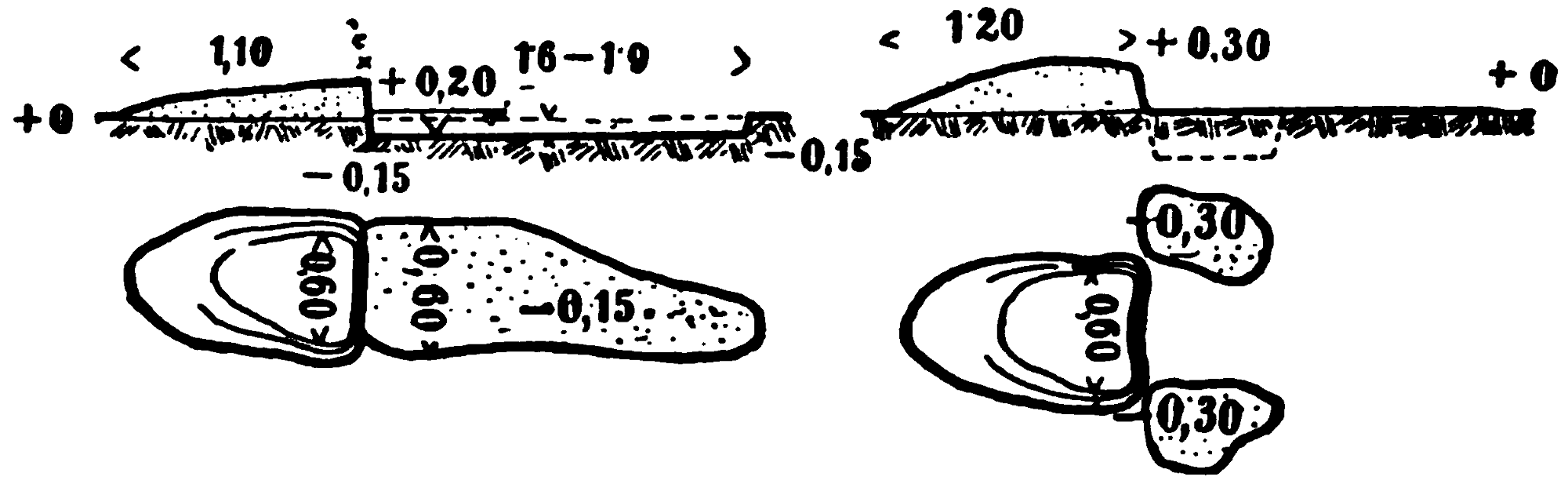
The task is greater when the soldier lies first on his left, then on his right side, removes earth from a borrow pit at his right and then from one on his left, and piles it up in front. As the skirmisher lies on the natural surface of the ground during this operation, he naturally constructs a higher parapet.
The following general rules governing the use of the spade in attack may be laid down:
1. An invariable use of the spade in attack must be unhesitatingly condemned. The best means of gaining the superiority of fire, and the best protection against hostile fire, is our own fire.
2. It must not be left to the soldier’s discretion, as to whether or not he shall intrench. The order for intrenching should in every case emanate from the supreme commander.
3. As a rule, the spade should be used in those phases of combat that partake more of a defensive character, in particular—
(a) To protect artillery and prepare rallying positions during the preparatory stage of the action;
(b) To shelter troops detailed to contain the enemy while enveloping movements are in progress;
(c) To shelter troops that are to keep down the hostile fire by their own delivered from enfilading or commanding positions;
(d) To maintain a strip of ground or a supporting point that has just been gained, whether this has been captured from the enemy or whether the attack has come to a standstill at that point and a pause in the fighting occurs.
4. An attack with the aid of the spade from trench to trench is advisable only in exceptional cases, when the attack is a purely frontal one and is made over ground devoid of cover.
12. THE EMPLOYMENT OF RESERVES.[422] (Pars. 294, 295, 366, 388, 393, 427 and 436 German I. D. R.).
The infantry attack may be characterized as a fire fight. It would seem desirable to surround the enemy’s zone of approach, or the position one wishes to attack, from the very outset with a dense, continuous line of rifles, and to overcome the resistance of the enemy in the earliest phases of the combat by means of an overwhelming volume of fire from as many rifles as possible. The impediments that stand in the way of carrying out this idea lie in the terrain, the ignorance of the enemy’s position, and in human nature. The defender can be driven from his position only by an attack; the impulse for an advance must be given by fresh troops; and the success gained by the firing line must be clinched by a retained assaulting force. The necessity of having a formed body of troops available, until the fight is in full swing, to meet unforeseen contingencies, further requires that a reserve be provided. Organizations should not be broken up any more than is absolutely necessary. The number of troops which the commander will retain for the time being, will depend upon the amount of information he has in regard to the situation. During an attack the reserve is frequently not designated until a preparatory position is taken up. In attack about 1⁄4-1⁄3, and in defense 1⁄6-1⁄2 of the whole force is put in the reserve, depending upon whether the ensuing action is to be a purely defensive one or the decision is sought.
The reserve enables the commander to “shift the center of gravity of the fight to the point desired by him, to reinforce his line where he considers proper, to equalize fluctuations of the combat, and, finally, to bring about the decision.” (Par. 294 German I. D. R.). As the combat progresses, the commander must decide whether the situation is such as to compel him to employ the reserves to cover his retreat,[423] or whether it is proper for him to put in his last troops for the purpose of gaining the victory. If the reserve has been put in and the attack fails (or, as at Wörth, the defender succumbs after putting in all the reserves) defeat is certain; but it would be a mistake not to employ the reserve, to keep it in readiness to cover a possible retreat, if its intervention can yet bring about a favorable termination of the combat.
The employment of the reserves by the Russians at Plevna, on September 11th, 1877: The general reserve consisted of nine battalions and was too weak to make an impression at one point; fifteen battalions were detailed to cover the lines of communication and the artillery (which was not at all in danger). Forty battalions that did not enter the fight were scattered all over the battlefield, no one being able to account for their presence.[424] When Skobeleff had effected a lodgment in the Turkish position, every available man should have been sent to this point. Although there were 9 battalions, 30 guns, and 4 troops (Eskadrons) available, only the Schuja Regiment (1300 men), which had suffered heavy losses in previous actions, was despatched to the point in question, and that more for the purpose of covering the retreat than to make the most of the success that had been gained.
In contrast to the Japanese commanders, who promptly launched all their troops, the Russian commanders were inclined to despatch numerous detachments, to organize provisional units, while completely ignoring existing organizations (this had, indeed, also the advantage that a suitable leader could be found for carrying a special mission into execution), and to form strong reserves by details from any and all imaginable units. These reserves were frequently not used at all.[425]
On March 5th, 1905, the commanding general of the Xth Army Corps (Zerpitzki) had available one brigade of his 31st Division, one regiment of his 9th Division, one regiment of the VIIIth Corps, three Rifle regiments of the mixed Rifle Corps, the 5th Rifle Brigade, and one regiment of the Vth Siberian Army Corps.[426]
On October 15th, in the battle on the Shaho, the general reserve of the army consisted of 32 battalions belonging to five different divisions and five different army corps. In his order for the battle, Kuropatkin laid particular stress on the necessity of forming reserves (Army Orders dated August 15th, 1904): “Keeping back more than half of the force in reserve is the best guarantee for success.” On December 27th, 1904, he made a similar statement.
The reserves are created to be used; every available man must participate in the decisive stage of the combat. If the enemy yields before the reserve is launched, so much the better; if he does not give way, all the troops that are at hand must be put in. The main thing is to gain the victory; scruples may be indulged in afterwards. A defeated commander who leaves the battlefield with troops that are still partially intact, has not made the most of the means at his disposal for combat, provided the situation was such that the launching of the reserves could have secured the victory. As shown by Hastenbeck (1757), by Idstedt (1850), and by Bapaume, at the moment of the crisis there is no sharp dividing line between victory and defeat, and the reserves may decide the fate of the day. The decision of Archduke Albrecht, during the battle of Custozza (1866), to push his last reserves into the fight was worthy of a great commander.
In contrast with this, Russia (1904): “In employing the general reserve, the commander-in-chief must be even more economical than the troop leader; he should, when necessary, detail single units to support this or that section, but he should in no case use up his whole reserve before the decision has occurred.” The failures of the British in the South African war may likewise be traced in part to a faulty use of the reserves. Thus, we read in the regulations of 1896: “The reserve should occupy a favorable defensive position in order to check the enemy in case of defeat; if the attack succeeds, the reserve should move up into the position and take charge of the pursuit.”
“Troops that give up a fight are like the swimmer who, after having made the most inconceivable exertions to swim across a broad, deep river, shrinks from the last spurt and drowns, although he need only stretch out his arm to reach the opposite shore.” (Dragomirov).
In employing the reserve, it should be remembered that the whole available force must be launched at the decisive moment at the decisive point, and that the commander ought not to detach portions of the force intended for the decisive blow for tasks of secondary importance.
The launching of L’Estocq’s Corps at Preussisch-Eylau, is still a model worthy of imitation.[427]
In the battle of Vionville, three battalions and four batteries were detached from the 20th Infantry Division, which had arrived during the afternoon, and sent to the right flank to take part in the action of the 5th Infantry Division, as infantry support seemed necessary on the right flank. When the head of the division reached Tronville, the question was discussed, as to whether it was desirable first to concentrate the division for action, or to throw the leading battalions into the Tronville forest, where portions of Lehman’s Brigade were still holding their ground. As an advance of the French out of the woods would have endangered the left flank of the Prussian artillery line, three battalions were at once thrown into the forest, while the six remaining battalions were kept in reserve for the time being. Subsequently, three more battalions were sent forward to reinforce the infantry engaged in the forest
“What a decisive blow the 20th Division could have struck, if it had been employed in one body!” (v. Liebert).[428]
The decision is usually brought about by pressure on a flank, but it might become necessary to accomplish this result by launching large masses against some point of the hostile front.[429]
The difficulties of accomplishing this are best illustrated by the situation of the IIIrd Army Corps on the afternoon of August 18th, 1870, when Prince Frederick Charles yielded to the entreaties of General von Alvensleben and permitted him to advance south of the Bois de la Cusse.[430] Similar situations resulted in the case of the Austrian 1st and VIth Army Corps at Königgrätz, the French IIIrd and IVth Army Corps, on a front of 2.75 km., with the Guards in rear, between Noisseville and Failly, and, finally, the advance of the 1st East Siberian Rifle Division at Wafangu. The French regulations likewise contemplate a decisive attack made by large masses on a narrow front. If these troops which are to clinch the success gained by the fighting line, are deployed on the front laid down in regulations, they will be unable to use their weapons. It isn’t mechanical shock action, but fire effect that decides the battle. In such a mass of troops, only fractional parts will be able to fire, the major portion is crowded together and becomes a dense, defenseless target, exposed to all the psychological impressions produced by crowding human beings into a narrow space.[431]
A brigade, therefore, should not deploy on a front of 1500 m., i.e., put only about 1⁄4 of its men in the first line; but no objection can be made if the brigade, in moving to the final decisive assault, at once advances on a front of 2500-3000 m.
13. THE CONDUCT OF THE LEADERS IN ACTION.
The difficulties of troop leading increase as the power of the commander to control and direct all ranks in action by words of command diminishes. In action, therefore, those means must be adopted that will facilitate the transmission of orders. This requires first of all the choice of an appropriate position for the leader.
The beginning of an action should find the leader as far forward as possible; during the advance to the battlefield, with the advance guard (par. 277 German I. D. R.), for neither messages nor reports, nor a map can adequately take the place of personal inspection of the situation of the enemy, of neighboring units, and of the ground. So placed, he can best direct the first deployment, upon which the future course of the action so largely depends, secure advantages by making prompt decisions in face of the enemy, save his own troops from making detours, handle them in accordance with a definite plan, and preclude arbitrary action on the part of the commander of the leading unit.
During the action, the superior commander can influence the course of the fight, his personal example excepted, only by employing his reserves. His place is, therefore, near the reserves, at a point that can be readily found, and never in the firing line.
A company commander should remain where he believes he can best control his company, as a rule, perhaps in the firing line. He provides for the supply and distribution of ammunition that is brought up from the rear, and regulates the coöperation of the platoons. (Pars. 216, 457 and 458 German I. D. R.).
A battalion commander should only in very exceptional cases take post in the firing line; he should nearly always remain with parts of the force that are held back for the time being, but, in any case, where he can effectively supervise his battalion. The choice of a regimental commander’s position is influenced by the same considerations; when his regiment is acting as part of a brigade, he must select his position so as to facilitate the transmission of orders from brigade headquarters. The brigade commander will, as a rule, remain near his reserves, at a point from which he can best overlook the deployment of his brigade.
On account of the fact that extended order fighting predominates, leaders of all grades must be particularly careful to maintain connection between the several parts of their command, with each other, and with adjoining units, and to preserve their influence over their firing lines. Superior commanders should, in addition, see that their troops do not get out of hand, and all subordinate leaders, after carrying out a task assigned them, should endeavor promptly to rejoin their proper commands, or place themselves at the disposal of the commander of troops still engaged with the enemy.
These requirements will be fulfilled, if superior commanders order nothing that they should not and cannot order, and if the officers charged with the execution of the orders coöperate to attain the desired end, and do not abuse the freedom of action allowed them.
While subordinate leaders, up to and including company commanders, are mainly occupied with fire control and fire direction, and should influence the men by their personal example, superior commanders have other tasks, which they must not neglect for the purpose of interfering in the sphere of action of their subordinates. They can influence the fire action only by sending the necessary forces to those portions of the firing line whose fire they wish to augment. An interference on their part with the action of subordinates is permissible only in case of obvious misunderstandings or mistakes, which would cause the combat to take a course other than that intended. The larger the unit commanded by an officer, the greater the latitude that must be allowed him. The leaders should concentrate their attention upon the general execution of their special tasks as part of the whole scheme, rather than upon supervision of details. It is by no means essential for all parts of the force to employ identical means to attain one and the same object. Every leader should bear in mind that omission or neglect are greater crimes than a mistake made in the choice of means.
The initiative of leaders of all grades is the foundation of great victories in war, but this initiative must neither jeopardize unity of action nor direct the course of events into channels not intended by the commander.[432]
The best safeguard against the results of an act of unjustifiable initiative is to ask oneself: “What orders would my superior have to give me, if he were in my place and knew what I know?”
14. UNITED ACTION VERSUS TACTICAL MISSIONS.
Although no one disputes that victory depends upon a superiority of fire at the decisive point, yet there is a great diversity of opinion as to how this superiority is to be attained.
General Bronsart von Schellendorff states:[433] “Every battle seeks to bring about a decisive victory, but this is, after all, invariably the sum of local victories. Successful battle-tactics consist of correctly estimating the tactical value of these local successes and of contriving to gain a victory at the decisive point; in other words, to manage so that the sum-total of positive factors will be greater than that of the negative factors.”
In the opinion of the advocates of this course,[434] unity of action is attainable by practice and study, but not by set formations. If unity of action could be ensured in all bodies of troops by means of study and practice, there would seem to be no reason why the regulations should lay down still more definite rules to govern the manner in which an attack should be conducted. The matter is not so simple, however. Bearing in mind the great latitude that the regulations allow each individual in choosing the formation which he deems proper in a given case, it is obvious that many very different procedures may result. This in itself is no drawback, and to a certain extent this condition must exist, as the task in hand, the nature of the country, and the existing situation vary. But, if a given problem can be correctly solved in several ways, it will also admit of a decidedly incorrect solution; and it is the more likely to be solved incorrectly, the less study and practice is indulged in by a large part of the corps of officers, and the less this class of officers finds in existing regulations as a guide to conduct. When, in spite of undeniable progress, we see dispersed attacks and an unquestionably incorrect conduct in every maneuver, and this with a corps of officers nearly all of whom are professional soldiers, who have had the advantage of study and practice, what may we expect in war, where the corps of officers will be very largely composed of officers of the Reserve and Landwehr, who have but very limited opportunities for study and practice, but who, after the very first battle, may have to command companies.
General von Scherff,[435] the chief advocate of “united action,” is opposed to the “combat with units of command” (Kommandoeinheiten) briefly sketched above. He makes a distinction between battle-tactics and the tactics of detachment warfare. In his opinion, the sum of the local successes can by no means gain the victory; that can only be done by the united launching of adequate forces at the decisive point. “No weapon in the world will ever alter the fact that five battalions united in one body have a greater inherent fighting power than five separate battalions—not to mention twenty separate companies—always provided that a united body of troops is also launched as one body.”
Examples Illustrating the Necessity of a United Attack.
1. The 26th Infantry Brigade was alarmed and put in march toward the battlefield to support the advance guard brigade of the VIIth Army Corps, engaged at Colombey. The commander of the 26th Infantry Brigade received orders from the commanding general to engage. It was not necessary for the brigade to provide its own reserve as the 25th Brigade had been directed to concentrate between Marsilly and Colligny, and to be at the disposal of the corps commander. The troops already engaged were in a critical situation; their moral and physical energy was exhausted. It is only too patent that the first battalion (1st Battalion, 13th Infantry) appearing on the scene was thrown into the fight to afford at least temporary relief, but this insufficient reinforcement was involved in the general failure. After about a quarter of an hour, the 25th Brigade (the IIIrd Battallion, 73rd Infantry had remained in bivouac at Pange) was concentrating for action at Coincy, but, instead of its making a united attack, only the 1st Battalion of the 73rd Infantry was launched. This battalion did, indeed, penetrate into the “Tannenwäldchen” at the “Todten-Allee”, but was then surrounded on three sides, had to fall back with considerable losses, prevented the further advance of the IInd Battallion of the 73rd Infantry, and rallied on the Füsilier Battalion of the 13th Infantry, on the bank of the Vallières brook. “Although the General Staff account of the war is silent on this subject, we are justified in assuming that only the presence of the brigade commander, who had learned a lesson from the second local assault, prevented the Füsilier Battalion of the 13th Infantry from making a fourth isolated effort. After re-forming the organizations, the new attack, which was made with indomitable spirit, proceeded more in connection with that of three other battalions advancing on the same line, and this united advance was closely followed by a second echelon consisting of the last battalion of the brigade (the IInd Battalion of the 13th Infantry), which had arrived just in time. The result was that the enemy was completely routed.”[436]
2. At the Gorze-Rezonville road, on August 16th, 1870, the isolated attacks made against Hill 970 by eight battalions, belonging to three different brigades, likewise accomplished nothing, whereas, had a higher commander been present, a united attack launched by him would undoubtedly have been successful.[437]
3. The well executed attack made against the hill west of the suburb of St. Martin, on January 19th, 1871, by six battalions of the 29th Infantry Brigade shows the importance of the united launching of a large body of massed infantry. The engagement of the 16th Infantry Division, in particular the attack made on Grugies (battle of St. Quentin) is the antithesis of the above-mentioned attack. Although the situation did not necessitate the simultaneous launching of the available forces, the brigade attacked in driblets. The attack made by these fractions, launched one after another, was not able to bring about a decision. In the first place, at about 11 A. M., three companies (5th, 6th, and 7th of the 69th Infantry), soon afterwards supported by the 8th Company of the 29th Infantry, and the 8th Company of the 69th Infantry, attacked the French position at the railway embankment and cut. The Prussian troops fought with great gallantry, the 5th, 6th and 7th Companies of the 69th Infantry making four attacks, and the other two companies, three. Although these five companies succeeded in gaining temporary successes, they lacked a common commander, and were supported from the rear only when they were thrown back after fighting for three-quarters of an hour.
About noon, the four companies of the Ist Battalion, 29th Infantry, were brought up, but did not engage until the first line had been forced back and the 5th, 6th, and 7th Companies of the 69th Infantry, at any rate, were out of action for the time being. Incidentally, it may be mentioned that the Ist Battalion of the 29th Infantry attacked in three groups, the strongest of which consisted of 2-l/2 companies, the weakest of only half a company. Only the strongest of these groups scored a success, and the Ist Battalion of the 29th Infantry was completely routed after a bloody fight. The 9th and 10th Companies, 29th Infantry, did not arrive on the battlefield until after the companies of the Ist Battalion of this regiment, whose heroic fight cannot be sufficiently praised, had ceased to exist as tactical units.
At 12:30 P. M., the 3rd and 4th Companies of the 70th Infantry were brought up and threw back the French, but were in their turn defeated. At this moment the 10th and 11th Companies of the 40th Infantry arrived; these companies were also able to advance, but their success was a temporary one only.
At 1:30 P. M., the IInd Battalion of the 40th Infantry appeared, threw the French back, but was soon attacked by superior forces and suffered the same fate as its predecessors.
At 2:30 P. M., the Füsilier Battalion of the 70th Infantry and the 9th and 12th Companies of the 40th Infantry were brought forward, but only the former engaged seriously at once—again without success. A little while later, the 9th and 12th Companies, 40th Infantry, advanced energetically. At about 3:30 P. M., the French made a very strong counter-attack; all that had been gained seemed about to be lost again, when the decision was finally brought about by the vigorous action of the 41st Infantry and a charge made by Reserve Dragoons.
The capture of Grugies, of the sugar mill, and, a little later, of Gauchy, now followed.
The resistance of the French was broken. General von Barnekow had thus, apparently, gained his object; but at what a price? In this engagement, the launching of troops in driblets may be very accurately followed:
1. At 11 A. M., five companies were launched in two separate groups (5th, 6th, and 7th Companies, 69th Infantry—8th Company, 29th Infantry and 8th Company, 69th Infantry);
2. Toward noon, four fresh companies (1st Battalion, 29th Infantry) were also launched in separate groups;
3. A little later, two fresh companies were put in (9th and 10th Companies, 29th Infantry);
4. At 12:30 P. M., two fresh companies were launched (3rd and 4th Companies, 70th Infantry);
5. A little later, the 10th and 11th Companies, 40th Infantry, were pushed in;
6. About 1:30 P. M., the IInd Battalion, 40th Infantry, was brought up;
7. About 2:30 P. M., the Füsilier Battalion, 70th Infantry, and the 9th and 12th Companies, 40th Infantry, advanced.
Thus, between 11 A. M. and 2:30 P. M., General von Barnekow gradually drew into the fight twenty-five companies, in seven different detachments, from the reserve formed by the 16th Infantry Division at Essigny le Grand. Besides, the troops generally did not appear on the battlefield until the energy of the troops already engaged was exhausted.[438]
Moreover, the retreat of the several detachments was not a voluntary one, for the French, thanks to their great superiority, generally forced them to retire. This engagement thus presents a series of partial successes, which became reverses, however, in a very short time.
Launching reinforcements in driblets increased the numbers required beyond all reasonable bounds, produced heavy losses, and involved the weak reinforcements, which arrived successively, in disaster, without turning the tide of the battle. Decisive victories can only be brought about by simultaneously launching masses.
“The system of close order battalion tactics was no longer practicable under Chassepot fire, and everyone promptly went to the opposite extreme of extended order, company column tactics, with which all were sufficiently familiar, since it had been carefully practiced in minor field exercises in time of peace.” (The attack made by the 26th Infantry Brigade against Schlosz Aubigny, August 14th, 1870[439])
There is always danger that unity of action will be sacrificed by the continued assignment of individual tasks; that the leader will not be able to count with confidence on the initiative of subordinate leaders restoring this unity, and “that, in the end, no higher commander will any longer have the assurance that his wishes will be carried out.” The battles around Metz during August, 1870, show a tendency on the part of the infantry to leave behind, in reserve and in rallying positions, parts of the troops launched to perform a certain combat task, “to detach parts to maintain communication (very often not at all endangered) with neighboring detachments”, and to despatch others to a distance to cover a flank, or to make a wide turning movement for the purpose of enveloping the enemy’s flank.
To prevent a battle from degenerating into a number of disconnected, local combats, and to ensure that the enemy will be actually subjected to the fire of as many rifles as the supreme commander intended, General von Scherff proposes that the battle formation, consisting of several echelons separated by fixed distances, be taken up outside of the zone of hostile fire, and that these echelons then advance simultaneously and as uninterruptedly as possible upon the enemy. In this movement the terrain is to be taken advantage of only so far as the orders permit. In view of the flat trajectory of the modern rifle, he concedes that fire while in motion, formerly considered permissible by him at long and medium ranges, may be replaced by an advance by rushes of the firing line, alternating with firing in a prone position, the ammunition to be expended at each halt being fixed by the officer charged with fire direction. He moreover considers it necessary to have a main firing position, located approximately at the outer limit of short ranges, for the purpose of gaining the superiority of fire. Base units must be designated in order to prevent weak detachments from encountering the enemy single-handed. Moreover, he intends to keep the advance going by increasing the fire, and by detailed and definite orders providing for the constant reinforcement of the firing line by men of the steadily following supports and reserves. Further, since according to his proposal, a halt by the rear echelons of an attack that has once been launched, is excluded on principle, it follows of necessity, that, for the fire effect of the firing line at the really decisive ranges, there can remain only a very brief period of time, measurable in minutes, which is amply sufficient, in his opinion, for the object to be accomplished.
It is charged that General von Scherff’s proposal[440] (see p. 205 supra) favors a set scheme for conducting every fight. This is not true; there is quite a difference between “more definitely regulating the conduct of an attack”, aimed at by the author of Kriegslehren, and the formulation of a normal procedure.
“Where a number of individuals are to coöperate for the purpose of performing a certain task, the nature of the case requires that each one be able to picture to himself beforehand the nature of the task, so that his share in it will appear clear and definite. Each one must know what he is to do, when and where he should engage, what his role is to be, etc. etc., or the result will be hopeless confusion.”—“The drill regulations must supply this picture and the drill-ground is the place where its general forms should be impressed upon every individual participating in the performance of a task.” Experience has taught us that this image of the drill-ground becomes distorted in war through influences which have almost never permitted it to appear on the battlefield in its true form. The initiative of subordinate leaders should overcome the obstacles which stand in the way of a realization of this ideal image.
The system of tactical missions reckons with the sum-total of local successes, assigns tasks to the different units of command, and leaves to the latter the choice of the means, without restricting their independence. The course of the combat can be influenced only by the action of retained forces, and it is sought to produce united action by acquainting all leaders with the object of the combat, they in turn endeavoring to attain this object even though they do so in different ways.
The system of united action seeks to ensure victory by simultaneously placing in readiness all the forces intended for the general combat, by an orderly concentration for action, and by launching the troops at one and the same time, without, however, requiring all parts of the force to employ the same formations. This system dictates to the leader the number of troops he should launch. Since in action everything is ordered as necessity therefor arises, the result is that the leader loses sight of the general action in view of the great number of separate orders that must be issued.
In the system of tactical missions, there is danger of arbitrary action on the part of subordinates, and of dispersion; moreover, it is not always easy to deploy strong firing lines, and there is an increased tendency to overestimate the value of cover and, in consequence, to overstep the assigned frontage.
The system of united action is open to the objection that initiative of the individual disappears and that the rules laid down in drill regulations degenerate into a pattern devoid of all spirit.
In Austria (1906), Captain Wachtel[441] suggests that, when a decision is not sought, an attack in groups be made, and that, when a decision is sought, a united attack be made. In Switzerland, Major Sonderegger[442] advocates a procedure based on that of General von Scherff.
The initiative of the individual should carry the troops over difficulties occasioned by the terrain or the enemy. Such checks occur most frequently from the time a force enters the zone of effective hostile fire until the assault has been decided upon. In the author’s opinion, the individualized attack is a concession made, at the expense of united action, for the purpose of making the attack succeed at all.
XI. THE DEFENSE.[443]
The invariable guiding principle in defense is to make the most profitable use of fire. This principle governs in the selection of a position and in strengthening it artificially.
The defender’s object may be—
1. Temporary occupation of a piece of ground;
2. Purely passive defense, outpost, rear guard, and delaying actions;
3. Offensive-defensive action, i.e., to bring about a decision by combining the offensive with the defensive.
In fortress warfare, situations may arise which may make it necessary to hold a piece of ground obstinately, without it being possible to assume the offensive. In the French, Russian, and Italian regulations, only the offensive-defensive is considered. The Italians see in the defensive nothing but a preparation for the offensive; the Russians seek to shake the enemy with fire in defense, so that they can subsequently assume the offensive.
The defensive is dependent upon the terrain, and is subject to the condition that the locality where the tactical situation requires a stand to be made offers a position favorable for employing fire to good advantage, and that the opponent actually attacks where the defender expects him. The employment of the defensive is restricted by its dependence on the ground and on the measures of the enemy. Its employment may frequently be explained by the fact that one of the contending parties allows itself to be checked to such an extent by the initiative of the other that it can only offer a passive resistance. Such passive resistance may here and there score a success by chance (Plevna, St. Privat), but, as a rule, only the assailant reaps a benefit from such situations.
1. THE PASSIVE DEFENSE
seeks to avoid a decision, and must therefore endeavor, by opening fire at an early moment, to prevent the enemy from reaching short ranges. (See p. 147 supra). It is not absolutely necessary to have a clear field of fire or strong reserves, but the latter, kept a considerable distance in rear, must be strong enough to enable the force to disengage itself from the enemy.
Since only a temporary resistance is to be made, it is permissible for the force to cover a greater front. The defender should endeavor to compensate for his numerical inferiority by expending a large amount of ammunition and by employing machine guns. It is an advantage to have obstacles in front of the position and cover in rear of it, because the former retard the enemy’s advance and the latter shelters the troops from his fire in case of a retreat.
2. THE DEFENSE SEEKING A DECISION.[444]
Decisive results can only be obtained at short and medium ranges. Long range fire may, indeed, inflict losses on the enemy and delay his advance, but it cannot repulse him. (See p. 148 supra).
It is not sufficient merely to ward off the attack with fire; the offensive must be assumed. When this is not done, the assailant can repair his losses and try another attack. When the defender has repulsed the enemy, he should follow up this success with an attack. However, as he will rarely be able to do this with the force at his disposal, fresh troops will be required. (Beaune la Rolande, Lisaine). The change from the tactical defensive to the offensive offers the same difficulties as the corresponding strategical move; but, in the former case, there is present, in addition, the element of danger and the difficulty of perceiving the right moment.[445]
A position is of value only when it compels the enemy to attack, directs his movements into definite channels, and induces him to make wide turning movements, which cause him to lose time and produce favorable conditions for the assumption of the offensive on the part of the defender. Every position that enables the defender to use all his weapons, and does not deter the enemy from making an attack, is suitable for this purpose.
“By placing our troops in an unassailable position, we actually refuse battle and force the enemy to seek the decision in another manner. * * * A defensive position approaches its ideal to the extent that its strength is hidden and opportunity is offered of surprising the enemy by our tactical combinations. One should endeavor to conceal the advantages which one intends to derive from the formation of the ground, just as one hides from the enemy the bulk of one’s troops and their actual position. This is, indeed, only practicable to a certain extent, and requires perhaps a peculiar and little used method of treatment.”[446]
Modern firearms make the defense so strong in front that it suffices to hold this part of the position with a weak force supplied with plenty of ammunition, and provided with weak supports, at a few points, to replace losses. As these supports have a definite task to perform, they are posted as near the first line as the available cover permits, in order to cut down the distance to be traversed by them under fire. When practicable, they are intrenched within the firing line itself. As it is advisable to supply these troops with a great deal of ammunition, some of the ammunition wagons belonging to the battalions held in reserve may be turned over to them. The general reserve intended for offensive action should be kept far in rear of the line. When kept too close to the first line, the defender will be unable to move it to any point desired, after the direction of the attack becomes apparent. The defender should examine his position from the point of view of the attacker, and ask himself, “With how weak a force may I occupy the position and still obtain the frontal strength described in the regulations, and how strong can I make the general reserve so as to bring about a decision?”
At some parts of the position, an attack will have good prospects of succeeding, at others it would encounter difficulties, and, finally, at others it could not possibly succeed. While many troops are needed in the first-mentioned portions (sections), comparatively few troops will suffice to hold those sections which are less favorable for the attacker (on account of their free field of fire, obstacles, and the absence of artillery positions in which the attacker can place his guns). This leads to a division of the defensive position into sections, each forming a separate unit of command (battalion or company) and, when necessary, detailing its own reserve (section reserve). When the frontage of the sections, as determined by the above-mentioned examination of the position, is considerable, or when obstacles lie within the position, a further subdivision may become necessary. This does not imply that the position must be held in equal strength all along the line; portions of the line that are very difficult to attack need only be kept under observation. Gaps in the defensive line are, as a rule, of very little value to the assailant, as the defender will frequently be able to sweep the space in front of them from a flank. “In order to keep all parts of the foreground under observation, and to prevent portions of the hostile force from escaping the defender’s fire, a division of the foreground corresponding to the division into sections must be made when necessary.” (Par. 403 German I. D. R.).
Weak points, i.e., points against which the assailant can suddenly mass superior forces at short range, or in the defense of which a coöperation of infantry and artillery is impossible, must be specially strengthened: by obstacles; provision for flanking the hostile advance; and preparation of supporting points in rear of the position. In addition, such weak points must be occupied with a strong garrison, by employing two firing lines, one above the other; reserves; and machine guns.
Enclosed farm yards (Point du Jour, on August 18th, 1870), and small patches of timber, are best not occupied at all; they are far more valuable as sham defenses in that they draw the fire of the assailant. At any rate, it is a question whether, at the last moment, when the hostile assault must be warded off, it will be possible to occupy such points.
As a general rule, only a single defensive position, consisting of an infantry and an artillery line, is selected.
The Russians invariably posted strong advanced detachments in front of their main defensive positions. As a result, the most serious fights usually occurred in the positions taken up by these advanced troops.[447] At Haicheng, for example, a strong main position had been prepared, in which a stand was to be made. In spite of this, the IInd Siberian Corps was left in a strongly fortified advanced position west of Simutcheng. This corps, in its turn, fortified two lines of advanced positions far in its front.
“Thus, on July 31, 1904, only seven battalions of this corps finally fought at Daputsi and Liadapu. When they were thrown back by superior forces, the mistake was made of bringing up fresh troops to regain the position captured by the enemy. These troops arrived too late and had to make a difficult attack on the Japanese, who had already occupied the captured position. Naturally their frontal attack accomplished nothing.
“The force thus suffered a defeat needlessly, and, although the defensive had been decided upon, a lot of men were sacrificed in an attempt to retake an advanced position that had been captured by the enemy. The corps evacuated its strong position without a fight when its line of retreat was endangered by Mistshenko’s being forced back. The Russians likewise evacuated their main position at Haicheng when news was received that strong hostile forces were advancing against the left flank of the position.”[448]
As a rule, it is not advisable to occupy advanced positions,[449] i.e., positions lying within effective range of the main position. Supporting points immediately in front of the main position, projecting from it like caponiers, and flanking the ground over which the assailant will have to make his attack, must not be confounded with these advanced positions. St. Hubert and St. Marie aux Chênes, on the battlefield of Gravelotte are good examples of both classes of positions. In order to gain time, a commander may sometimes find it advantageous to occupy and temporarily defend advanced positions lying still farther to the front. (Lisaine, and Shaho). In doing this, favorable terrain (Chavannes on the Lisaine) and skillful leadership are essential.
In France and Russia much is expected of advanced positions. In England particular importance is attached to them when they draw the enemy in a direction facilitating the conduct of a counter-attack. The British consider that supporting points lying in front of the position had best be left unoccupied, unless they can be supported by artillery fire from the main position.
“Smokeless powder and the great range of modern firearms will frequently make reconnaissance so difficult that it will be possible to gain an approximate idea of the enemy’s strength only by a fight. For this reason, in situations similar to that existing west of Belfort, in January 1871, advanced detachments, whose mission it is to deceive the enemy as to the defender’s strength, and to compel him to deploy, will have a greater justification now than at that time. Nowadays, such detachments may cover a considerable front without danger, especially when they are plentifully supplied with ammunition. This will make it still more easy to deceive the enemy, and a skillful defender will know how to make the most of it.”[450]
Advanced positions[451] are apt to mask the fire from the main position, and fights for their possession may easily lead to the defeat of the troops holding them. The danger of the fight taking place and being decided in the advanced position must be reckoned with. (Battles of Ligny and on the Hallue). On the other hand, it may be advantageous to employ scouting detachments, cyclists, and machine guns, and to construct dummy intrenchments in front of the main position. (Par. 407 German I. D. R.). The French, more than anyone else, are convinced of the advantages to be derived from an employment of advanced positions (for example in deceiving the enemy as to the location of the main position). In a deliberately planned concentration and advance into action, such positions are, however, so effectively enveloped that they do not come into play at all and fall an easy prey to the enemy. However, we do not wish to deny their occasional usefulness in cases where it is necessary to gain time for concentration and for strengthening the main position. In fights for their possession, an idea may frequently be gained of the intentions and dispositions of the assailant. Moreover, they offer opportunities for surprising the enemy with fire, and induce him to make premature attacks and to mass his troops in the ones he has captured.
Next to a free field of fire (clearing the foreground, and ascertaining ranges), the determining factors in selecting a position are elbow room in and in rear of the position, supporting points for the flanks, and cover. The natural cover available on the ground is made use of as best suits the purpose of the action.
The line in which the artillery intends to fight the decisive action constitutes the “framework” of the position. Although artillery will rarely be able to perform all its tasks in a single position, its first position is selected with due regard to the position of the hostile artillery. The most important position is that from which the hostile infantry attack is to be repulsed. This should be selected far enough in front of the artillery to enable the latter to fire over it, and to deprive the assailant’s artillery of the opportunity of hitting the defender’s infantry and artillery at one and the same time. (Par. 401 German I. D. R.). A distance of 600 m. between infantry and artillery is considered sufficient for this purpose. In view of the protection afforded by gun shields against infantry fire, it is scarcely necessary to post skirmish lines in advance of the artillery. But, where the infantry line is not continuous in front of the artillery, troops should be posted, so as to protect the artillery personnel from being annoyed by hostile patrols. It will seldom be possible for a commander to do justice to the requirements of both arms; in every compromise, one or the other arm is only too apt to be placed at a disadvantage. The needs of the infantry, whose choice of a position is more restricted, take precedence. While infantry can govern its action by that of the artillery during the preparatory stage of an attack, this is impossible in defense, as the infantry is obliged to carry the fight through to its logical conclusion in the position in which it is begun.[452]
3. FORTIFYING THE POSITION.[453]
The apprehensions formerly entertained in regard to prematurely fortifying a position, and which are still shared by the French regulations, are no longer to be found in the new regulations. The construction of field fortifications requires time, if they are to be of value, and if they are to give leaders and troops the assurance that they can be defended by the minimum number of men.[454] Even intrenchments that have been constructed in vain will frequently prove useful in deceiving the enemy. In many cases, it will be necessary to be prepared to meet a hostile attack made from several directions. This contingency should be taken into account by at least preparing for the work beforehand.
“If the situation turns out to be different than was expected, the intrenchments already constructed should not influence the decisions of the commander. On the other hand, the consideration that the works might be built unnecessarily must not cause their construction to be omitted altogether.” (Par. 311 German I. D. R.).
In the preface to the French regulations, it is emphasized that intrenching a position ought neither to impair the spirit of the offensive nor hamper the movement to the front. “Intrenchments are a means to an end, but not the end itself. They should only be used when no violence is done thereby to the tactical situation, and one should never hesitate, for a single moment, to abandon them, if the situation requires, or to construct others, at another place, if it becomes necessary.” The men should therefore be trained in handling the portable intrenching tools, until they can use them skillfully in any position of the body.
“The use of intrenchments may also be abused. To remain inertly in a place is just as fatal as to advance without making use of cover. When temporary halts are made, the commander for the time being, often placed in that position by chance (chef du moment, chef d’unité ou chef de groupe éventuel), indicates whether or not intrenchments are to be constructed.”
Battle intrenchments are to protect the soldier against hostile fire, without hampering him in using his rifle. “They are one of the factors which ensure economy in men, in that they save a body of troops from suffering unnecessary losses. But their importance always recedes before the general requirements of an action, and they should never in any way interfere with the advance of troops; on the contrary, intrenchments are to make it possible to bring troops within effective range of the enemy, without impairing their physical condition or their morale.”
Intrenchments enable a commander to save troops, which he can use offensively at the decisive point. They do not fulfill the object for which they were intended, when they make it easier for the enemy to pick out the position. “Works which cannot be perceived from the foreground even through powerful field glasses, afford the most effective protection against artillery fire.” Trenches should therefore be deep, have a low parapet, and be properly masked.
The commander indicates when work is to begin. Every unit must intrench the portion of the defensive line which it is to defend; working parties, specially detailed from troops not intended for the immediate defense of the position, can be counted on only when extensive works are to be constructed.
Continuous lines of trenches are seldom built; it suffices to construct a line of works with intervals, i.e., battalion groups, the intervals being simply held by a weak force.
These battalion groups (par. 24 German Manual of Field Engineering) are constructed without regard to any fixed form, as the tactical employment of the companies requires. They consist of firing trenches (flanks refused and echelons in rear of the wings), provided with splinter proofs, and adequate cover trenches, so that all the men, if possible, will be sheltered from artillery fire.
The aim is, first of all, to construct inconspicuous standing firing trenches. These should have low parapets and be provided with numerous traverses to restrict the effect of high explosive shell. In order that these traverses may not betray the location of the position, they should not rise above the parapet.[455]
Deep, narrow trenches afford the best protection against artillery fire (the trench should be about 0.60 m. wide at the bottom). Narrow trenches are especially difficult to pick out from a balloon. In constructing trenches having no parapet at all, special precautions must be taken in order that their location may not be betrayed by the scattered earth or by their rear wall, which will be visible when they are located on the slope facing the enemy. When the trenches are to be held for some time, provision must be made for the construction of splinter proofs,[456] other overhead cover, and loopholes of observation.
Numerous light splinter proofs are generally to be preferred to a few larger and stronger ones, as they afford sufficient protection against shrapnel bullets and fragments. They may be protected against direct hits from field guns, or other guns having a flat trajectory, by sloping their roofs to the rear at an angle as nearly as possible coincident with the angle of fall of those projectiles.
Since field intrenchments are incapable of furnishing protection against direct hits from guns having a curved trajectory, this object must be attained by skillfully distributing splinter proofs along the front. These should be inconspicuous and should not take up too much room. The comfort of the troops in the trenches should also be provided for by constructing kitchens, latrines, drainage ditches, and dressing stations.
In addition, field magazines for storing ammunition should be built, and alarm arrangements made. Moreover, covered communication should be provided along the line and to the rear. The front and gaps in the line may be very effectively flanked by fire from skillfully constructed refused wings.
In constructing a battalion group of intrenchments, provision will have to be made, in addition, for the following:
Intrenchments for a Battalion.
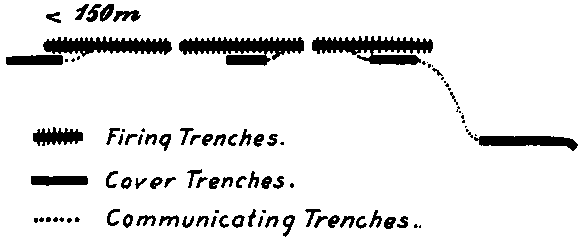
Firing Trench with Cover Trench.
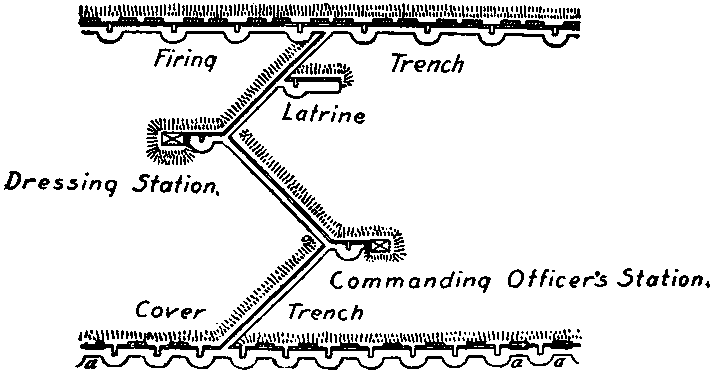
Firing Trench with Splinter Proofs.
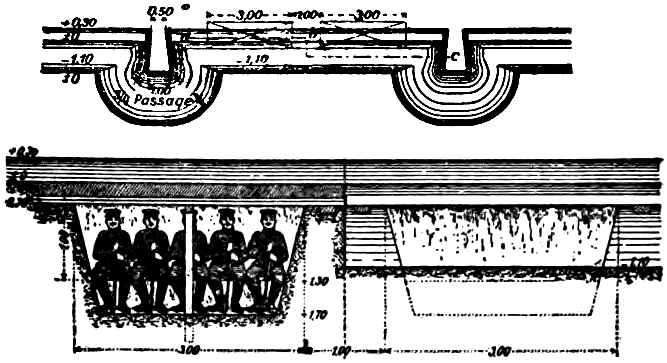
Profiles.
Firing Trench in ordinary soil.
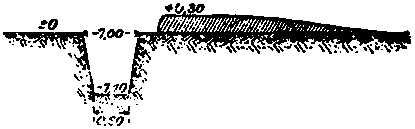
Splinter Proof.
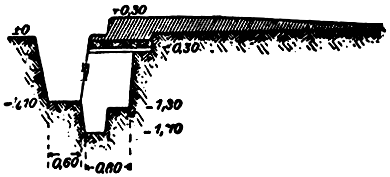
Communicating Trench.
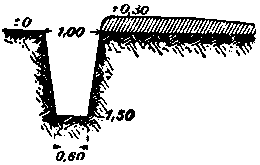
Communicating Trench without Parapet.
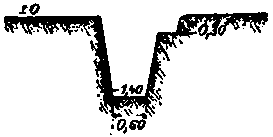
Machine Gun Pit.
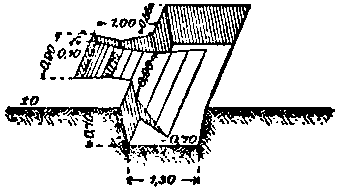
1. Observation of the foreground, “for the purpose of reconnaissance and security, as well as for noting the effect of one’s own fire.” In order that observers may not betray the location of the position, it is recommended that they be posted at inconspicuous points affording a sufficiently extended view, and screened from the observation of the enemy. When they have to be posted in the defensive line, the terreplein is either lowered in places, so that they can just look over the parapet, or special observation stations are constructed. Provision must be made for communication between the several parts of the line and with the next higher headquarters.
2. Clearing the foreground. As a rule, it will be practicable to employ for this work troops not needed in digging trenches. As time is lacking in field warfare for extensive work, such as cutting down embankments and removing dead angles, one will have to be content with trampling down or burning standing grain, removing objects which the enemy might use as aiming points, and cutting clearings through woods. It is not advisable to demolish stone walls and houses, as the debris is difficult to remove and affords cover to the enemy.
3. Dummy intrenchments and masks.[457] These are to deceive the assailant as to the position and extent of the defensive works. They should not be located in the same fire swept zone as the defensive works themselves, and at a distance should look like real fortifications. Masks are to screen defensive works or troops, without restricting the fire of the latter. Natural features are best suited for this purpose, but may be replaced or supplemented by artificial masks.
In many cases, it will suffice to place a few skirmishers behind a parapet that has been hastily thrown up with a plow.
4. Cover trenches and communicating trenches. These constitute a considerable portion of the defensive works. Communicating trenches may be either covered ways or zigzags, and connect the cover trenches with the firing trenches. Sortie steps should be provided in order to facilitate a prompt advance from the trenches. In many cases, it is impossible to avoid placing firing and cover trenches so close to each other that the enemy’s shells can strike both simultaneously.
5. Obstacles. These need only be constructed when two forces confront each other for a protracted period. The purpose of obstacles is to hold the enemy where he will be exposed to the most deadly fire; retard his advance; compel him to confine his movements to certain avenues of approach (this is especially valuable in night combats); and eliminate dead angles in front of the position. The presence of extensive obstacles forces the enemy to advance systematically. As a rule, they can only be removed by pioneers. They should not be located too near the position, as they are apt to be damaged by artillery fire directed at the position, and interfere with the defender’s fire. When they are too far in front of the position, the defender will not be able to guard them and prevent their destruction. In general, they should not be more than 200 m. from the position. It is better to construct several lines of small obstacles than a single line of large ones. The requirement that obstacles must not interfere with the defender’s fire, must not afford the enemy an opportunity to approach under cover, and must remain intact under hostile artillery fire, is best met by marshy ground and by wire entanglements. Obstacles should be provided with a slight glacis in order to prevent artillery fire from destroying them prematurely. When wire entanglements are too high, they are easily seen at a distance, and, although they are little damaged by artillery fire, the attacker can make preparations to remove them.
Russian Views.
A defensive position consists of an advanced position, a fighting line with firing trenches and batteries, supporting points in rear, and, finally, a fourth line, which serves as a rallying position. The key to a position, which lay formerly in the line of supporting points, lies at present in the firing trenches in which supporting points must be provided. (Colonel Golenkin advocates the use of semi-circular works as supporting points, and Lieutenant-Colonel Mordovin large closed works). “These semi-circular works are in a sense the anchors by means of which the firing line clings to the position which it has occupied.” It does not matter if the enemy penetrates the first line and captures one or two of these supporting points, for others remain on either side; the latter and the second line of supporting points then form a new though somewhat indented defensive line. As the attacking force which has penetrated into the position, is hemmed in on both sides, it will hardly be able to sustain the counter-attack made by the defender’s reserves, and its temporary success will turn into defeat. But, in order that this may be accomplished, a second line of supporting points is absolutely essential. Large closed works of high command, but a smaller number than is employed in the first line, are recommended for this purpose. According to Russian opinions, several lines of fortifications are essential in order to check an enemy who has penetrated the first line, and to facilitate the defender’s final retreat in case of necessity.
Particular importance is attached to advanced positions, to positions for the reserves, echeloned to the right and left rear of the flanks, and, finally, to rallying positions. Advanced positions are either to serve “reconnaissance purposes,” by forcing the enemy to an early deployment, or to do duty as “caponiers” from which a flanking fire may be brought to bear on the foreground.
Advanced positions, doing duty as “caponiers,” are invariably to consist of closed works, those serving “reconnaissance purposes” of open works. The latter are to be defended “to the last ditch,” and are not to be evacuated until the enemy approaches to about 400 m. or less, but the garrison is not to allow itself to become involved in a bayonet fight.
In contrast with this distribution in depth—2 km., in the model given—Lieutenant-Colonel Jabel, whose views are based on the same experiences, advocates the use of only one line of fortifications. He states: “The length of the battles, which sometimes lasted two weeks, as well as the terrible intensity of fire in general and artillery fire in particular, produced such an absolute nervous exhaustion that the decisive action could be fought only in a single line. With its capture, further fighting had only small prospects of success * * *” “When firing trenches have been constructed at the points where the best effect can be obtained from long and short range fire, they should not be evacuated prematurely, but held, in order to make the most of this fire effect, until the enemy arrives close enough to use his bayonets. If the troops holding the trenches retire immediately before the bayonet fight, their retreat invariably becomes a rout, and, in any case, entails tremendous losses, for, after leaving their trenches, they will be helpless and exposed in the open to the hostile fire.”
4. THE CONDUCT OF THE DEFENSE.
In his Tactical Handbook, Major Hoppenstedt suggests a method, well meriting attention, for decreasing the effect of artillery fire on a defensive position. He believes that dummy intrenchments, not too conspicuously located, partially, but not skillfully masked and occupied, will deceive the attacker’s artillery for some time, at any rate, until the advanced troops of the attacker induce the defenders to man their parapet and expose themselves to shrapnel fire. The “defense should be conducted in such a manner that the garrison of the main position will not need to expose itself to the enemy’s artillery fire as soon as his advanced troops appear.” Major Hoppenstedt believes that this can be attained, in hill positions, by conducting the fire fight, at long and medium ranges, from positions in rear, the defender moving up into the main position, specially prepared for this purpose, when the attacker disappears in the defiladed spaces in front of it. The objection to this method is that it necessitates too large a force to hold the position.
“In a protracted, obstinate fight, the defender’s trenches, exposed to the combined hostile infantry and artillery fire, will finally become filled with dead and wounded, and it will rarely be practicable to remove them. The arrival of reinforcements will increase the confusion and the losses, and the fighting energy of the troops will decrease with tremendous rapidity. This is one of the greatest disadvantages of the defense as compared with the attack and its constantly moving lines.
“In such cases, which will be typical at points where the attacker intends to penetrate the line, it may be a real act of salvation for the defender’s firing line to rush to the front.
“In fighting at short ranges, especially just before the assailant makes his assault, such a rush to the front on the part of the defender’s line, may be a good move for another reason. As is well known, the attacker’s artillery must change targets when its infantry arrives within a certain distance of the defender’s position. The Germans (par. 446 I. D. R.) fix this point at 300 m. from the enemy, and the French, whose guns have a flatter trajectory, fix it at 500 m. In attacking a hill position, when the fire is well observed, the distance of this point from the position will be considerably greater.
“But, no matter where the actual location of this point may be, skillful infantry will start its assault very close to the point fixed by the regulations, and never beyond it, so as to avoid interfering with the fire of its artillery. Under such circumstances, it may be a skillful move for a defender who is still full of fight, to decrease the distance which separates him from the hostile infantry, in order that, by so doing, he may escape from the hostile artillery fire and from the smoke which obscures his vision. If he finds cover farther to the front, so much the better, for he will then have that much of an advantage over the attacker.”
The weakness of most defensive positions lies in the danger of a sudden attack being directed against a flank. The assailant will endeavor to avoid making an attack against the front of a position prepared for defense, when such an attack has small chances of succeeding, and seek the decision by attacking a flank, where conditions are, to a certain extent at least, equalized. The danger of a flank attack increases with the length of the defensive line. It is by no means a good move to prolong the threatened wing (French VIth Army Corps at St. Privat) for the purpose of warding off an envelopment. The power of extension is bound to reach a limit sooner or later, and the wing attacked will then be so weak and attenuated that it will not be capable of offering serious resistance.
To ward off an employment by refusing a flank likewise promises little success. The enemy’s superiority of fire will make itself felt, first of all, at the salient thus formed (see p. 357 supra), and his convergent artillery and infantry fire, which may even enfilade parts of the line, will paralyze all tactical movements of the defender at this point.
By prolonging the line and by refusing a flank, we only postpone the decision a little while, but cannot effectively cope with an envelopment. This must be accomplished in a different manner.
The best scheme would be to flank the enemy’s enveloping force by posting an echelon in a suitable position, or to bring about a decision by employing the reserve offensively. However, for carrying out these measures, more time is required than for merely refusing a flank. Time may be gained by making an extensive reconnaissance on the flanks with strong detachments, and by occupying supporting points lying on the flanks, which the enemy would have to take before he could think of attacking the main position.
In employing machine guns in defense, it should be borne in mind that they are unsuited for carrying on protracted fire fights, and that the mobility of the machine gun batteries cannot be utilized when, from the very start, they are assigned a section to defend.
In general, it will be advisable in defense to keep the machine guns at first with the reserve, and to employ them, when necessary, to reinforce the defensive line at threatened points, to prevent envelopment, to repulse an assault, or to participate in an offensive movement.
This does not preclude their coming into action at the very opening of an engagement, for instance, where it is necessary to command important avenues of approach.
When a withdrawal under cover is assured, it will also be possible to post machine gun batteries in such a manner, in front or on a flank of the main position, that they can bring a sudden fire to bear on the area in which the opponent will in all probability post his artillery.
Machine gun fire may sometimes be employed to sweep defiladed spaces in front of the defensive line.
If the direction of the hostile attack is known, the occupation of the position should not be longer deferred. It is always risky to occupy the position in the face of hostile batteries, especially as the fire of the defender’s guns is masked by the skirmishers moving forward. If the defender can manage to give the attacker the impression that the position is still unoccupied, perhaps thereby inducing him to advance less cautiously, and then surprise him with fire, a depressing moral effect far exceeding the material success may be counted upon.[458] The firing line should be made so strong that the fire fight will have a chance of succeeding. A gradual launching of the troops should not be decided upon, as the losses are comparatively insignificant in defense, and as it is important to develop a heavy fire so as to make it difficult for the enemy to gain the fire superiority. The principles governing the moment for opening fire have already been discussed (pp. 147 and 154 supra).
The enemy must be prevented from gaining the superiority of fire. This should be accomplished by concentrating the fire from a large number of rifles upon the parts of the enemy’s force in motion. The defender should make the most of the advantage which his preparedness gives him. The attacker’s firing line with its supports forms the target. A departure from this rule is in order, in the case of a French assailant, as the latter places the bulk of his force in the reserves and not in the firing line. It will frequently be practicable for the defender to discontinue his fire and to take cover when the assailant lies down and fires; but, while under cover, everything should be prepared for resuming the fire when the enemy rises to continue his advance (p. 156 supra).
If it has been found impossible to prevent the enemy from reaching the extreme limit of short ranges, the commander must decide whether to continue the fight until a decision is reached, or whether to break off the action.
When the opponent has entered the zone of short ranges, it will be too late for the defender to retire, unless the terrain in rear of the position is especially favorable, or other troops can take a hand in the fight to cover the withdrawal. The onrushing assailant is received with accelerated fire; the defender fixes bayonets, determined to risk a fight at close quarters. “The defender who does not fix bayonets is already casting furtive glances towards the best line of retreat.”
While repulsing an assault, it would be a good plan for the defender to step upon the rear wall of the trench so that the latter would become an obstacle for the attacker. But this scheme can only be employed when the troops are completely in hand.
While the fire of the defender is increased to the utmost intensity by the entrance into the fight of all the supports, the general reserve, which now takes a hand in the fight, seeks to bring about the decision by advancing to attack. On arriving close enough to assault, the attack reaches its most critical stage, and even a counter-attack made by a comparatively small force may turn the scale in favor of the defense.
5. THE COUNTER-ATTACK.[459]
In large engagements, the great power of resistance possessed by well posted bodies of troops will often determine the commander of the force on the defensive to contain the enemy at one point with a strong defensive position, while at the same time assuming the offensive at another. (This was planned, but not carried out, at Dresden, in 1813, and at Troyes, early in February, 1814; carried out with success, in Lee’s operations around Richmond, during the latter part of June, 1862, and on the Lisaine in 1871; and miscarried on the Shaho, because Kuropatkin made his decision dependent upon reports in regard to the position of hostile reserves, which were non-existent in reality). Whether the offensive should be assumed while the enemy is still in the act of deploying,[460] or whether one must be satisfied with assuming the offensive at the last moment, is best determined by the relative strength of the opposing forces. When battle-fronts are short this may still be advantageous, but when the lines are long, a counter-attack can affect only a small part of the assailant’s line, while the major portion thereof successfully pushes the attack home. Then the position and the day will be lost anyway, in spite of a local success.
The initial measures taken assure freedom of action to the defense, but the commander must not await exhaustive messages. Prompt action is necessary, either for throwing back the advanced troops of the assailant, or for striking a blow at the hostile flank. In the latter case, it is an advantage if only weak reserves are struck, but hostile forces making a turning movement may also be encountered, and the commander will have to decide whether to deploy quickly and assail the enemy, or whether to take his chances in a rencontre.[461]
Even a success gained at a tactically unfavorable point will make itself felt, if it is won early enough and if the most is made of it. As a rule, tactical considerations determine where the commander should launch his reserves for the counter-attack.
The counter-attack here meant is an act of the commander of the whole force; in bodies of troops acting as part of a larger force and in numerically inferior forces, the warding off of the flank attack remains almost always the only remedy.
“The general reserve should be posted at the point from which it can best move forward, counter to the probable direction of the hostile attack, while, at the same time, making the most of the features of the ground. When only one flank is secure, the general reserve is, as a rule, placed in echelon in rear of the unprotected wing. When both flanks are in the air, nothing remains but to place sufficient reserves in readiness in rear of one flank to ward off a hostile envelopment, while retaining as strong a force as possible in rear of the other for the purpose of bringing about the decision. The echeloned general reserve must have room for development, whether this be for warding off a hostile envelopment or for making a counter-attack.” (Par. 410 German I. D. R.).
The general reserve should be posted in rear of the center of the position only when the front is short and the situation is not as yet cleared up. In this position it will frequently be exposed to the fire directed against the first line, and its entry into action will usually involve a loss of time. When adequate information is available of the measures taken by the opponent, or the nature of the ground compels him to direct his decisive attack against a wing, this alone determines the position of the general reserve.
Since the counter-attack is to take the enemy by surprise, the position of the general reserve must be concealed, and precautions must be taken to keep hostile patrols in the dark, as long as possible, in regard to its actual location. The ground over which the general reserve is to advance should be free from obstacles, so that the counter-attack can be made rapidly and with uniformity.
Since the assailant will almost invariably endeavor to direct his attack against a flank, the general reserve of the defender should be posted at such a distance in rear of the threatened wing that the troops composing it will be sheltered to some extent from hostile fire. In order that the fully deployed general reserve, when making a counter-attack, may clear with its inner flank the outer flank of the line holding the position, and not get into the latter’s zone of fire, a sufficient interval must be left between the two. This interval should increase with the size of the reserve. As a rule, the counter-attack should be launched so as to produce the decision when the assailant has arrived within assaulting distance of the defender. This requires that the general reserve and the line holding the position be separated by an interval of at least 200 m. In addition, the counter-attack must be so made that it will actually strike the assailant in flank; and this it cannot do unless the general reserve is posted sufficiently far to a flank. The center of the reserve should be launched so as to strike not only the flank of the enemy’s firing line, but that of his supports as well. If the general reserve is posted too near the first line, there is danger of it being enveloped together with the first line, and committed to purely defensive action (refusing a flank). On the other hand, if it is posted too far to a flank, its timely entry into action is not absolutely assured; the assailant may turn against it, cut it off from the defensive position, and defeat it in detail. The farther the general reserve is off to a flank, the more effectively will it strike the enemy in flank, but it will be correspondingly more difficult to conceal it. The necessity of pushing the general reserve far to a flank decreases, as the scope of the attacker’s envelopment of the defensive line increases. It may frequently be to the defender’s advantage to induce the assailant to make a far-reaching envelopment, provided the line defending the position is not placed in an unfavorable tactical situation by so doing. Since the attacker will probably have detachments echeloned in rear of his flank, the troops entrusted with the counter-attack must similarly have an echelon in rear of their exposed flank in order to protect themselves against a flank attack.
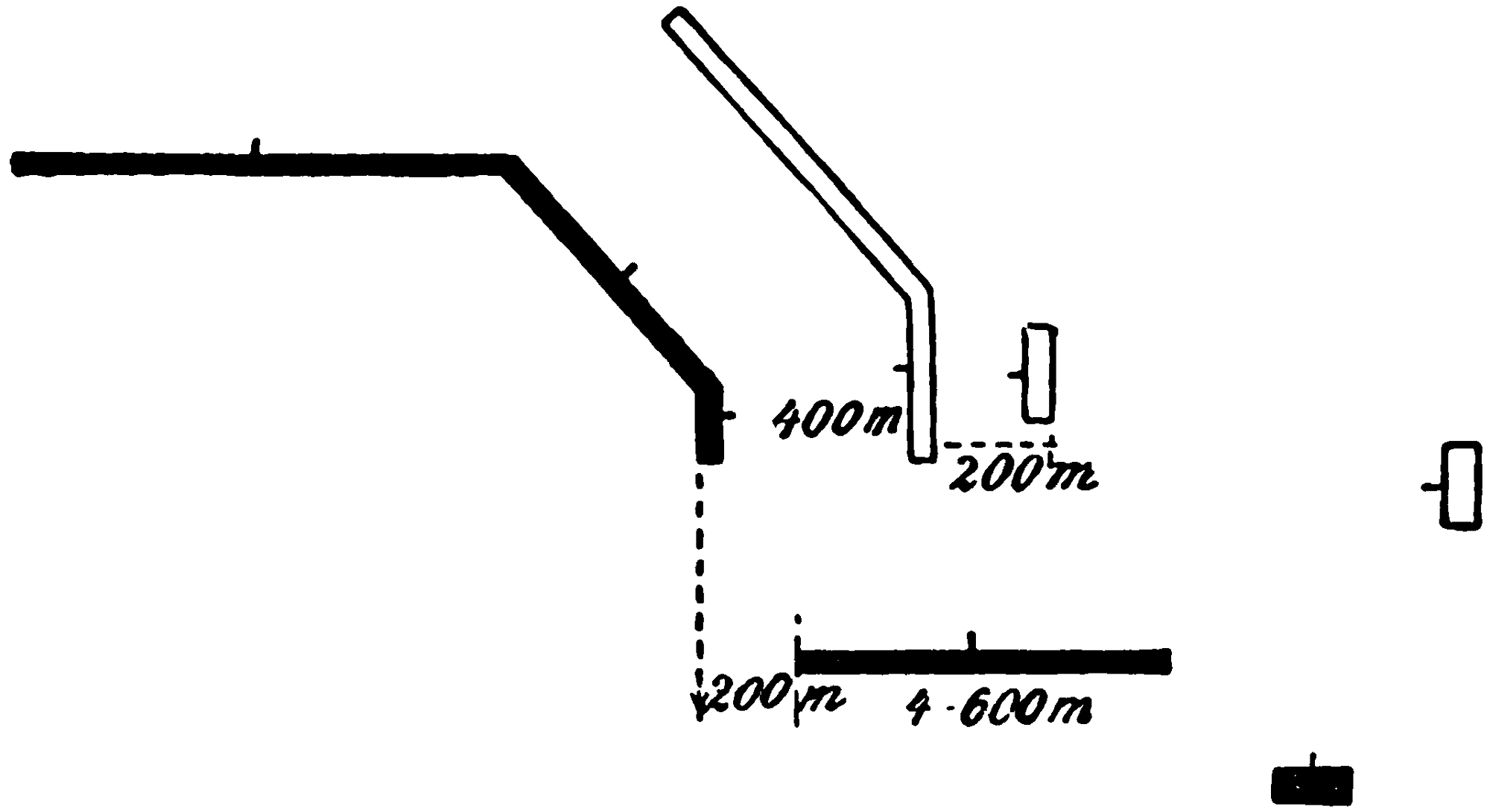
It is impossible to lay down a fixed, normal strength for the reserve. This depends upon the strength of the position, and the degree of resistance the intrenchments are capable of rendering; but, in any case, the force intended for local defense should be strong enough to compel the enemy to deploy completely, and prevent his carrying the defenses before the counter-attack is made. Large quantities of ammunition and intrenchments capable of rendering effective resistance must compensate for the shortage of men in warding off the enemy, in order that the general reserve may be made as strong as possible. The question, as to how thinly the position must be occupied, and how strong the general reserve may be made, can only be answered in each particular case. If the attack made by the general reserve is to produce any effect, it must not be undertaken with too small a force, as it could then be checked by weak detachments.
While the general reserve lies in waiting for the enemy, it may either—
1. Remain in a preparatory position, in one or more groups, and deploy during its forward movement; or
2. Take up the attack formation from the start.
The first method has the advantage, when the space required is small, of permitting the general reserve to be concealed, and allows changes to be made in the direction of march and in the dispositions.
The second, although it enables the reserve to advance promptly to the counter-attack, is rarely suitable, as the reserve in combat formation is not so easily concealed, as it is more difficult to make changes in the dispositions and the direction of march, and as this formation seems only practicable for making an advance in one direction—straight to the front.
It is of the utmost importance to know when the counter-attack should be launched. In warding off the enemy by purely frontal action, no special disadvantages result from prematurely launching the general reserve; if it enters the action too late, it will still be able to throw back the assailant who has penetrated into the position. With the counter-attack it is different; it must take place when the opponent is under the most effective fire at short range. If the counter-attack is made prematurely, especially when the reserves and flank echelons of the attacker have not as yet been used up, the latter, while, indeed, exposed to the most violent fire of the defender, will be able to take counter-measures. In that case, two entirely independent actions may result, and the counter-attack made by the general reserve may be checked by the retained echelons of the attacker and repulsed by their fire. When launched prematurely, the counter-attack will not always repulse the hostile attack; and when launched too late, it may perhaps still bring about the decision, or avert a defeat, but it will never produce decisive results.
A counter-attack made after the attacker has penetrated into the position, and while he is endeavoring to dislodge the garrisons of such supporting points as still offer resistance, reckons with the fact that the hitherto victorious assailant, exhausted and in confusion, will not be a match for a well aimed blow delivered by a considerable number of troops. However, a defender will scarcely contemplate such an employment of his general reserve; for him the important thing is to repulse the attack in front of and not within the position. Although military history presents comparatively numerous instances of such retours offensifs, this may be explained by the fact that the counter-attack was launched too late. The weakness of the assailant is but momentary, and the most must be made of this by advancing against him promptly by the shortest line. But if the assailant has had time to re-form and to bring up his batteries, it will usually be too late to make a counter-attack.
Aymard’s Division (French), which had penetrated into Servigny under cover of darkness, but had made no attempt to occupy the town systematically or to re-form the disordered troops, was driven out again by a counter-attack made by only eleven Prussian companies.[462]
The numerous counter-attacks made by the French during the battle of Wörth (for example the counter-attack made by Maire’s Brigade) pushed too far forward into the zone of the German artillery fire, and did not have the expected success. The well-led French counter-attack made by about 1200 men from the south edge of the Niederwald, was discontinued at a timely moment.[463] The well-directed counter-attack made by the 1st Turco Regiment at Wörth, after the capture of Elsaszhausen, was successful and is especially instructive.[464] The attack made by General de Sonis for the purpose of retaking Loigny was undertaken too late and with inadequate forces.[465] The same is true of the counter-attack made by the 3rd Bavarian Division on Zella (4th July, 1866).
The French regulations recommend a unique procedure, which may be successful when employed against an opponent not prepared to meet it. “Under certain circumstances, counter-attacks may be combined with retreat maneuvers. The advanced troops should bring the enemy to a standstill with their fire and compel him to deploy. Then they should break off the action without becoming involved in a fight at close quarters. In this manner, the attacker is drawn onto terrain reconnoitered beforehand, where fresh troops, hidden up to the last moment, attack him impetuously under favorable conditions at a time when he is tired and worn out by a long movement.”
The most difficult thing about a counter-attack is to seize the right moment for launching it. As it is impossible to foretell how long it will take the enemy to arrive within assaulting distance, no rule can be laid down as to the proper moment for launching the counter-attack. The best plan would be to screen the movements of the reserve, and, as the attacking troops approach, to bring it gradually up to the point from which it is to move forward. A commander requires wide practical experience and great force of character to judge the situation calmly and dispassionately, while fully aware that launching the counter-attack either too soon or too late may prejudice the result. There is always danger that the suggestions which reach him from various quarters may cause him to take half-measures. The stronger the general reserve and the weaker the force holding the defenses, the more numerous and urgent will be the requests for support; and he will not find it easy to resist the temptation to grant these requests and accordingly weaken the general reserve, which is intended for offensive action.
We must now consider the question as to whether the counter-attack should rely on fire action alone, or should resort to the bayonet as well. The unexpected advance of a large body of troops against a flank of the enemy will rarely fail to produce an effect. If the enemy does not yield to fire, it is obvious that an assault will have to be made. A counter-attack made unexpectedly is, as a rule, successful at the start; but, if its commander follows up this initial success when not supported by strong reserves, a reverse may take place resulting in the defeat of the defender’s entire force.
A counter-attack made by three companies (9th, 10th, and 11th) of the 3rd Bavarian Infantry Regiment brought relief to the two batteries which had gone into action near Goury (battle of Loigny). The Ist and IInd Battalions, 3rd Infantry, the Ist and IInd Battalions, 12th Infantry, and the 7th Jäger-Battalion joined in this attack, and when the batteries finally followed, the force succeeded in throwing back the French battalions immediately opposing it. The twenty-one companies now made the mistake of attacking Ecuillon, which they occupied. The attacking force had traversed about 2000 m., and as there were no reserves and flank echelons, the Bavarians were obliged to give way before an assault made by seven fresh battalions against their unprotected left flank. The mistake of pushing forward too far, and the lack of supports in rear of the exposed flank, was bound to exact a penalty, as soon as the French were in a position to advance on their own account.[466]
A very instructive episode occurred on August 26th, 1904, near Tsinortun. Toward noon the Japanese Guard and the 10th Division advanced through fields of tall kaoliang for the purpose of enveloping the right wing of the IIIrd Siberian Army Corps. The commanding general, Lieutenant-General Iwanov, directed the reserve (apparently parts of the 3rd East-Siberian Rifle Division) to make a counter-attack against the left flank of the Japanese. The Russian counter-attack was taken in flank by a brigade of the Guard, which followed in rear of the Japanese attacking force, and had to retire. The decision was then brought about by the counter-attack made by the 140th Infantry, which unexpectedly appeared on the left flank of the Japanese. The engagement at Tsinortun is moreover of special interest as regards the Japanese method of attack.[467]
So far we have only considered the counter-attack made against the flank of an attacker, and against the front of an enemy who has victoriously penetrated into a position. The success of a counter-attack against the enemy’s flank depends primarily on moral factors; besides, after protracted fighting, supports and reserves in rear of the flank are frequently lacking, so that the attacker cannot quickly form an adequate firing front towards a flank.[468]
Theoretically, a frontal counter-attack, i.e., one made straight to the front from a position, while the assailant is advancing to the assault on a broad front, ought to offer the least chances of success, but military history proves the contrary in those cases where the defender awaited the proper moment. This moment arrives when the defender clearly perceives that the enormous losses suffered by the attacker begin to impair the morale of his remaining men. This becomes apparent through a slackening in the attack, through an uncertainty of movement, and, finally, through hesitation, the latter being usually preceded by wavering.[469]
The moral effect of a determined counter-attack with cold steel during the closing moments of an attack will undoubtedly be great. Meckel says[470]: “Here likewise, it is of the greatest importance to bring up the supports promptly, so as to increase the volume of fire to the utmost and to produce that superiority which quite naturally resolves itself into an offensive movement. The defender who does not fix bayonets is already casting furtive glances towards the best line of retreat.”
This “superiority” caused the French to advance from the wood of Elsaszhausen against the skirmishers of the XIth Army Corps appearing at the northern edge of the Niederwald. The success they met with at the start induced the French to continue their advance, and when a reverse occurred subsequently, the wood of Elsaszhausen was taken by the Hessians without difficulty.[471]
Although such counter-attacks, directed against the strong firing line of the attacker and unsupported by the defender’s fire, were frequently successful in war, this was due to the moral effect produced on the attacker by the sudden and unexpected onset of a long line of infantry. Troops thus unexpectedly attacked, and, in addition, deprived of the support of their own artillery, almost invariably lost their heads. However, if the attacker is prepared for such an event, remains cool, meets the counter-attack of the defender with a powerful fire at short ranges, and brings up his supports, in order to follow up the effect of his fire with an offensive movement, there can be no doubt as to the result.[472]
Such a counter-attack, however, is only possible when the defender still has strong, intact reserves at his disposal, which he has kept in readiness in the closest proximity to the firing line until the decisive moment. An organization acting as part of a larger force, and whose flanks are secure, as a rule has no choice but to make a frontal counter-attack, unless offensive action is to be dispensed with altogether.
Short frontal counter-attacks from a position were made successfully by the British in the battles at the opening of the 19th Century. (In these counter-attacks, the British fired a volley and then advanced to the assault). Such successful counter-attacks were made during the battles of Vimiero, Maida, Busaco, and especially Waterloo.[473]
At Beaumont, the 66th Infantry made a counter-attack when the French had approached within 40 m. The 66th had already begun to waver, here and there, when its energetic and unexpected advance caused the French to retire.[474]
In the battles of the Russo-Turkish war of 1877-78, frontal counter-attacks were successfully made in several instances.
In the engagement at Kazeljevo (5th September, 1877), the frontal counter-attack made by the Russians, who were numerically far inferior, saved them from defeat, as all their lines of retreat were obstructed by their trains, which had gone astray.[475]
The most instructive fight in this connection is the engagement of Gorni Bugarov (1st January, 1878). General Weljaminov’s detachment, which consisted of the Pensa and the Tambov Infantry Regiments, occupied a flank position on the southern foothills of the Balkans, on the road leading from Orchanie to Sofia. The Russians allowed the Turks to approach to very short range before they opened fire, which was immediately followed by a counter-attack all along the line. This seems to have been the result of the initiative of the several battalion commanders. The Turks (15 battalions) faced about and retired on Sofia. The Russian infantry was led back to its first position.[476]
On the same day, the attack made by the Preobrajenski Regiment of the Russian Guard at Tashkessen was repulsed by the frontal counter-attack made by a weak force of Turkish infantry.[477]