THE FORMAL TACTICS OF INFANTRY. (continued 2)
Walter Krueger translation
RESULTS OF A FIRING TEST AGAINST THIN AND DENSE SKIRMISH LINES.
FIRE AT WILL, FREEHAND FROM A PRONE POSITION.
Target. Range & Elevation: No. of rifles. No. of shots. Time min. Hits. Figures hit. Figures missed.
m. % %
180 head targets placed at intervals of 1-2 paces. 680 166 1268 5 54 4 49 27 131
Elevation used: first 600 then 700 m.
90 head targets placed at intervals of 3-4 paces. 680 166 850 5 35 4 27 30 63
Elevation used: first 600 then 700 m.
The superior effect of fire on the dense skirmish line, as expressed by the greater number of hits, and in consequence thereof, by the gradually growing number of figures hit, is apparent. It is worthy of note and at first glance strange that, presupposing the two lines considered occupy an equal front, the percentage of figures hit is the same. The explanation of this lies in the fact that in correctly distributed fire any specified front space is equally covered with hits so that it is immaterial for the relative proportion of figures hit whether an equal number of figures is removed or added. While, however, the dense skirmish line still has 131 effectives, the weaker line has only 63 left. The casualties are therefore far more perceptible in the smaller force.
(a) The Formation of the Skirmish Line.
Skirmish line with intervals of two paces between the men is formed at the command, “As Skirmishers.” (Pars. 142 and 174-180 German I. D. R.). The skirmish line may be deployed from any formation, in any direction, either with or without first changing front. (Par. 177 German I. D. R.). A greater interval than two paces must be specifically ordered. Squad leaders hasten in front of their squads and form the framework of the skirmish line. The men follow their squad leaders absolutely. When the terrain requires it, squad leaders may increase or diminish intervals without command. In other armies (for instance, in those of Italy, France, and England) the desire to keep the skirmishers under control as long as possible, has led to advancing the platoons designated for the firing line at first in close order, the deployment being made only when the state of the action requires it. In France, the intervals between files may be increased, or a single rank line may be formed before the force is deployed as skirmishers. During an advance it will often happen that intervals are increased or diminished in accordance with the peculiarities of the terrain. The advance is continued until the command or signal “Halt” is given. If line of skirmishers is to be formed when marching to the rear, the command is first faced to the front and then deployed on the line then occupied. (Rallying position, par. 180 German I. D. R.). On varied ground, deployments will be made under cover whenever possible in order to allow of an immediate advance in skirmish line from that point. The number of platoons to be deployed depends upon the tactical situation. When three deployed platoons are formed abreast, it is difficult for the company commander to control them; but this formation is an appropriate one if a company is surprised or enters immediately into decisive action, or in cases where the battalion acting alone requires complete units in reserve for additional tasks. (Pars. 462, 463 and 469 German I. D. R.). When the battalion is engaged as part of a larger force, it is a good plan to occupy all the available front space at once with skirmishers and to maintain the intensity of fire of the firing line by constantly reinforcing it. The losses are less in this case than when the men crowd together in groups. (Italy).
Platoon and squad leaders are posted on the side of their commands facing the enemy while advancing; in moving to the rear, squad leaders are posted on the side away from the enemy, their duty being to maintain the march direction, and the platoon commanders remain in rear of their platoons (i.e., on the side toward the enemy). Russia is the only country where the leaders of a firing line are posted in the rear. In Austria one non-commissioned officer in each platoon is designated to march in rear of the advancing firing line for the purpose of supervising the skirmishers. As this non-commissioned officer is to prevent straggling, he should be selected with great care.
The platoon commander indicates the march direction to the leader of the base squad, and, accompanied by the range finders and the musicians, moves to a point at least ten paces in front of the line of his squad leaders, as a rule, opposite the center of his platoon; but he is not restricted to this position. He must possess mobility if he desires to lead his platoon skillfully on varied ground, if he expects to avoid interfering with neighboring platoons, and if he wishes to observe the enemy at the same time. The musician keeps the company commander constantly in view. (Par. 221 German I. D. R.). The range finders observe the battlefield, estimate the range to any targets appearing in view, without being specifically told to do so, communicate the range found to the platoon commander (this should not be done by shouting, as misunderstandings might result therefrom), and observe the effect of the fire. (Par. 173 German I. D. R.).
Whenever the flanks of a skirmish line are not protected by other troops or by natural obstacles, a few men under a prudent leader should always be sent out as combat patrols to the flank, or better still, to the right or left front. The patrol should under no circumstances lose connection with the command which it is to protect, but, on the other hand, should not stick so close to it that the file on the exposed flank is in a position to see as much as the combat patrol itself. As a report from a combat patrol frequently arrives too late, or cannot be made at all on account of hostile fire, signals should be agreed upon and the leader of the squad on the exposed flank of the line should keep the combat patrol constantly in view. Signal flags may also be employed advantageously in such cases.
The Austrian deployment is similar to the German, the intervals between skirmishers being about two paces. In Italy the skirmishers are posted at intervals of 1.5 m. (catena ordinaria), but this interval may be increased by order up to three paces (catena rada). The interval between squads in extended order is 4-5 paces to facilitate volley fire by squad. The French deployment is similar to the German. An intermediate extended order formation is that in which an advance is made in line, the files at extended intervals. In England skirmishers are placed at intervals of 5-15 paces during the initial deployment. At short ranges where the decision is sought, one rifle per 2-3 yards of front (1.8-2.7 m.) is the rule, one rifle per yard of front (0.90 m.) being the maximum. In Russia and Japan the intervals are as ordered. In Switzerland skirmishers are posted at intervals of 1-2 paces; when a greater front is to be covered the intervals between squads are increased. The length of the rushes depends on the ground, the effect of fire, and the endurance of the men. In exceptional cases an advance by rushes, by squads or single men, is authorized.
(b) Movements in Skirmish Line.
Fire action requires steady breathing, and, on this account, all movements to the position at which the fire fight is to be taken up, should be made, as long as possible, in a free swinging stride. A careful observation of alignment or of intervals cannot be insisted upon. Cover found within the allotted front should be utilized by ploying, but this must neither interfere with the harmonious advance of the entire force nor cause a loss of the march direction. Considerations of cover for individual men should not interfere with the spontaneous progress of the movement. Orderly movements in long skirmish lines are best made by designating a certain element as the base, whose leader is far in advance of it; all neighboring leaders maintain their intervals from, and endeavor to remain approximately on line with him. This has the advantage of relieving the commander of the whole line from looking after these details and leaves him free to concentrate all his attention on the enemy. Minor changes of the march direction are executed by inclining to the right or left or by designating a new objective. More extended movements by the flank, within range of hostile fire, are possible only under cover. Changes of direction are executed like a gradual front into line, in which a temporary echeloning of the elements, or one which can be adjusted by degrees, is unavoidable. (Par. 185 German I. D. R.).
In the absence of cover, an advance in quick time will be possible only at long ranges unless the hostile fire can be kept down by fire from enfilading or commanding positions. Skirmish lines advancing without fire support over ground devoid of cover, begin to suffer appreciable losses at 1000 m. The more effective the hostile fire, the more pressing the necessity of diminishing, as far as this is possible, the periods of time during which the skirmishers present their whole bodies as targets to the enemy. This leads in itself[88] to an advance by rushes, since the whole distance separating the advancing line from the enemy cannot be covered in one rush. Double time may be employed by a skirmish line when it becomes necessary to reinforce an advancing firing line quickly, to forestall the enemy in reaching a certain point, or in moving under fire, from the covered fire position occupied, to another position. It is impossible to prescribe definitely and for all cases at what ranges the advance by rushes should be taken up and when fire should be opened in advancing by rushes, since it depends upon the intensity of the hostile fire.
The assailant will, in the first place, endeavor to advance without firing, in order to reach those ranges quickly at which his fire will begin to be effective against the well-covered targets of the defender. The skirmishers advance in strong detachments, by rushes of the greatest possible length, taking short breathing spells at each halt. Very soon, however, the hostile fire makes this advance impossible. A fire fight of variable duration must first make a further advance possible by silencing the fire of the defender. In a serious infantry engagement every step forward must be purchased by the fire of the attacking infantry. The attacker will, in exceptional cases only, continue his advance in long lines, although this must appear desirable to him, for almost invariably only a part of his force will still be able to gain ground to the front when supported by the fire of neighboring detachments. Favorable local conditions, insignificant losses, and, above all, the personality of the commander will embue a force with the determination to advance.
Time Required for Making a Rush. Strength of the Force Making the Rush.
The squad requires 5-6, the platoon at war strength about 10-15 seconds preparation for making a rush.
To cover 80 m., requires 26-30 seconds;
„ „ 40 „ „ 17-20 „
„ „ 25 „ „ 10-15 „
While the attacker covers a distance of 80 m., the defender, if in readiness, can fire 4-5 shots. This proves very clearly that, in order to be able to make such a rush, a certain superiority of fire is absolutely essential. These figures change radically as soon as the troops are seriously engaged with the enemy and come under his fire at short ranges. At short ranges, aside from the size of the target offered, attempts to advance by rushes with entire companies must very soon cease of their own accord.
The character of the terrain and the fire of the enemy play a decisive role here.
The strength of the force making the rush is intimately connected with the length of the rushes. A small, isolated force would run the risk of being fired on by its own neighboring detachments. Besides, confidence and moral courage are difficult to find in a small force. It is difficult to carry forward long lines as units. The use of long lines necessitates, as a rule, an almost complete cessation of fire, and, in addition, mutual fire support suffers. Long lines should therefore be employed only when the attacker possesses a very marked superiority of fire. In practice it has been found advantageous to make the rush with the smallest fraction led by an officer, i.e., with a platoon.
The following appropriate statement appears in Taktische Rückblicke auf 1866: “In the danger zone which suddenly surrounds and startles him in war, the soldier feels, in the first place, a desire to have someone assure him that the seemingly critical situation in which he finds himself, is as it should be. His eye is naturally directed upon his officers. If the officer’s quiet glance reminds him that here, as in peace time, the first duty is obedience, and if he sees the officer subsequently advance fearlessly and vigorously, he will, as a rule, not worry about the why and wherefor. It is this faithful attachment to the person of his officer, rather than ambition and patriotism, which inspires the soldier to highest efforts. Those who suppose that all our soldiers are heroes simply because they are products of a courageous race, are very much mistaken. This would indeed be an invincible army, requiring no tactical advice, if its soldiers would do nothing in action but their simple duty voluntarily.”
The severest test of discipline is for a skirmish line to rise and rush forward under an effective hostile fire. This movement had best be executed with precision and energy even during peace exercises. The formation and manner of execution must become second nature to the soldier, like a movement of the manual of arms, which he retains during his entire military service, and a knowledge of which he brings with him when called to the colors during mobilization. The example set by advancing leaders and the arrival of reinforcements, which move forward through the firing line, have been found to be the most effective means of carrying a skirmish line forward.
The critical moment occurs when the men rise and prepare to rush forward, for an unsubdued enemy will be desirous to prevent, by increasing his fire, any attempt to advance. The fire support afforded by neighboring detachments would seem to have a conditional value only; for, being themselves under fire, the skirmishers of these detachments cannot be expected to divert their fire from the opponent previously fired upon, to an enemy by whom they themselves are not threatened. In oblique fire, the rifles, on account of their short barrel, interfere with neighboring ones, and, in addition, expose the men advancing on the flanks to the danger of being hit by the fire of their comrades. The fire support is, therefore, restricted to hindering the hostile skirmishers directly opposite from firing on the advancing unit. When the terrain is favorable, infantry and machine guns should not hesitate to fire over the heads of their own skirmishers. The coöperation of artillery will, in any case, be of great value, and infantry will have to select those moments for advancing when the defender is driven under cover by the hail of shot.
The advance by rushes, consuming time and energy, is an expedient to which the enemy compels us to resort as the only means of gaining ground to the front. The firm determination to close with the enemy and the ever-increasing difficulty of inducing the men to advance from cover, require that long rushes be made. Short rushes are neither consonant with the nature of the attack, nor with the desire to close with the enemy. “Many halts during an advance are fatal to the offensive.” (Hönig). The powers of endurance of the men, the character of the ground, and the hostile fire, as well as the support afforded by infantry and artillery fire, influence the length of the rush. If the leader has already caused the skirmishers to rise, it is best to let them run forward so long as the physical powers of the men and the hostile fire permit. The only danger is that the men will throw themselves down prematurely, and without orders. It is rather an advantage that during the rapid advance, increasing both muscular and nervous activity, the men do not think of danger and have no time to pay attention to their fallen comrades. One fact is, however, worthy of special attention: If we train a soldier to make long rushes in time of peace, he will be able to make them in time of war, and it is easier for a leader to decrease than to increase the length of rushes in the field.
The short rushes are considered advantageous because they take the enemy by surprise, in consequence of which he is not in a condition to direct his fire on the advancing unit. Rushes should be made with startling suddenness. They should not be made in step at double time, but, on the contrary, as rapidly as possible (by rushing); by the time the enemy directs his fire on them, the skirmishers should already have thrown themselves down. Stragglers should also throw themselves down, when the men in the lead drop down behind cover, and should then endeavor to reach the firing line by crawling.
The enemy will concentrate his fire on the unit which advanced first. The fire of this unit will at the start be rather weak, getting stronger gradually. If this unit is left in its advanced position for some time there is danger of its being thrown back; all neighboring units must therefore endeavor to rejoin it as soon as possible.
The greater the superiority of our fire, i.e., the marksmanship which compels the enemy to keep under cover, the greater the length of the rushes and the rapidity with which they follow upon each other.
Short rushes with small units occur quite naturally, because the platoon leader no longer succeeds in inducing his whole platoon to rise, since his influence extends only to the men nearest him, and because the flank squads at first remain behind and only gradually try to rejoin the leading skirmishers. If only a part of the skirmishers have jumped up, it is quite natural for them not to make a long rush, but to throw themselves down before reaching the new position, because of the feeling that they have been abandoned by their comrades and the fear of running into their field of fire. Thus, in spite of the best intentions of the leader, the short rush by small units occurs. In time of peace, however, we should retain the long rush by platoons and not endeavor to give human weaknesses the force of regulations.
When once compelled to employ short rushes the following question presents itself: Is the advantage of such a small gain of ground worth the trouble of inducing the soldier to rise for making an advance by rushes? Would it, therefore, not be more profitable to crawl forward? A man crawling on his belly presents a vulnerable surface of approximately the size of a breast plate 50 cm. high. In an advance made by a large unit, or over covered terrain (fields of standing grain) crawling would be difficult (difficulty of maintaining the direction of march and reduction of the rate of advance); it would also be difficult to get men to advance to the charge after they have crawled along in this fashion for some time. The supervision of a unit crawling forward would also be exceedingly difficult. The following results were obtained in experiments made under favorable conditions: A distance of 500 m. was covered by crawling in about 10 minutes; crawling tired the men, increased the activity of the lungs to such an extent that deliberate aiming and firing was out of the question and the motion produced a noticeable swelling of arms, hands and knees.[89] The Boers occasionally used the following method: One man crept forward once or twice his own length, raising his body slightly, while the man next to him fired; then they exchanged roles and this procedure was repeated uninterruptedly. In any case, troops ought to be able to execute both the advance by rushes and the advance by crawling with or without firing. On terrain devoid of cover a skirmish line will frequently be able to advance only by crawling.
Procedure: The man throws himself on the ground at full length, head resting upon the bent left arm, right hand grasping the small of the rifle-stock. The man moves forward by alternately bending and straightening the right leg. When the right leg is straightened the body slides forward without rising in the least from the ground, and the head also remains in position resting on the left arm. The head is raised only when the man fires his piece, the butt of which is placed against the shoulder. Crawling on all fours is very tiring, the man offers a larger target, and, in addition, is not immediately ready for firing.
In this manner the Boers succeeded in shooting the enemy out of his position. The firing line, while keeping up an incessant fire, slowly but steadily advanced. The advance of this uncanny crawling line is said to have produced an especially disquieting and paralyzing impression on the immovable defender, who was tied to his position, because of his inability to inflict perceptible losses on these small, prone targets, and because, moreover, he himself was continually under a galling fire. As no assault was made, no opportunity was offered the defender for using his rifles against targets the height of a man. The British infantrymen were, however, insufficiently trained in handling their weapons independently. As to rise and to retreat meant annihilation, the determination to resist weakened gradually during the long fire fight, and, in order to escape from this seemingly unendurable situation, which grew more and more acute with every minute, and which paralyzed every energetic decision, one avenue of escape only seemed open, that of surrender.[90]
One who fought on the Boer side writes as follows: “After we had crept up, in this manner, constantly firing and crawling, to within about 300 m. of the enemy, we saw many white handkerchiefs waving over in his lines, as a signal of surrender. As we placed little credence in these signs of surrender, however, on account of many a bad experience, we continued the advance by crawling. But, as soon as we saw that most of the men in the enemy’s ranks were throwing away their weapons, we rose to make the British prisoners. When we came up with them, I noticed that a great many of the men were weeping like children. Later, when I voiced my astonishment over the morale of their troops to some English officers, they stated that it was due to the uncanny manner of our advance.
“These officers stated, moreover, that the sight of danger approaching ever closer without their being able to ward it off effectively, caused great depression and alarm among their troops; for the Boers, utilizing every available rock in crawling over the plain, presented such an unfavorable target that the British fire had had very little effect, while they themselves had been constantly exposed to the Boer fire. All this, they claimed, had contributed to unnerve their troops.”[91]
Lessons of the Boer War
: “The rushes * * * were of variable length, according to the intensity of the hostile fire; they varied from 30 to 80 m. According to the opinion of many British officers it was exceedingly difficult to induce skirmishers to rise and rush forward under hostile fire; but that once upon their feet, it became necessary to push the attack forward as far as possible regardless of the increased losses entailed by the longer rushes.”[92]
One who fought on the Boer side reports as follows in regard to the British advance by rushes: “The men rose gradually and hesitatingly. This gave the attentively watching enemy time to pour a well directed fire upon the last men who arose. Thus even short rushes made by long lines became generally too costly to be executed. Smaller groups, on the other hand, were able to move with startling rapidity. * * * Every sudden interruption of the firing that might attract the enemy’s attention should therefore be carefully avoided, but, as a rule, this is possible only when the advancing units are small.”
The British Regulations of 1896 prescribe rushes of 30-40 m., and those published immediately after the war (1902) prescribe rushes of 70-90 m., but the rush is to continue only while the surprise of the enemy lasts.
Russo-Japanese War.
In the Japanese army, the 5th Infantry Division employed short, and very short, rushes by preference, while other divisions of the 1st Army as a rule preferred long rushes. From an English work we obtain the following data in regard to the length of rushes and the expenditure of ammunition per rifle during halts between consecutive rushes in the engagement on the Shiliho on October 12th, 1904, at ranges beginning with 1,000 m.
From the table it appears that after gaining the superiority of fire, beginning with the fifth rush, at about 625 m. from the enemy, the length of the rushes increased; the last 400 m. were covered in one rush as the enemy withdrew from his position.
1st rush 132 m., about 30 rounds of ammunition per rifle
2nd „ 58 „ „ 15 „ „ „ „ „
3rd „ 63 „ „ 15 „ „ „ „ „
4th „ 61 „ „ 15 „ „ „ „ „
5th „ 75 „ „ 15 „ „ „ „ „
6th „ 151 „ „ 5 „ „ „ „ „
7th „ 400 „
940 m., about 95 rounds of ammunition per rifle
If we assume that three shots per minute were fired from each rifle, it follows that the attack consumed approximately 40-45 minutes.
Provisions of the Various Regulations Relative to the Advance by Rushes.
Germany. (Pars. 188, 189 and 337 I. D. R.). To advance by rushes, the following commands are given: (Such) Platoon (section, squad) Rush!... Rise!... March! March! At the command Rush! the skirmishers finish loading, lock pieces, close cartridge boxes, and prepare to rise. Skirmishers lying prone take the piece in the left hand, lean on the right, and draw the right knee as close to the body as possible without thereby raising the body from the ground. After a brief pause, during which these preparations are made, the platoon commander jumps up and at the same time commands: Rise!... March! March! At this command the skirmishers jump up and rush forward. The length of the rush will rarely exceed 80 m. (Par. 337 German I. D. R.). While rushes should, as a rule, be as long as possible, short rushes, which are designed to leave the enemy no time for firing, should also be practiced. The principal thing is that skirmishers rise promptly and simultaneously and that they rush forward rapidly. The rush is terminated by the command “Position”; the sight setting is changed when necessary and fire opened without further preliminaries. Frequently the new firing position may be indicated before the rush is made.
Austria. Rushes are as a rule made by platoons. “The length of the rushes depends upon the character of the ground and the tactical situation, as well as upon the physical condition of the men. They serve as an expedient for reaching the next firing position.”
France. Rushes are made, without fixed rules, from cover to cover (par bonds successifs).
England. (Regulations dated 1896): Originally the regulations prescribed rushes 30-40 m. long, but, as a matter of fact, their length was actually increased to 60 and 100 m. during the first engagements of the South African war, in cases where the fire of the enemy was not especially heavy. The regulations of 1905, recently published, state: “Rushes over open ground should not exceed 80-100 yards (i.e., 70-90 m.) and will, in fact, rarely reach this length. At decisive ranges, i.e., under 540 m., they should be short enough to afford the enemy no opportunity to pour a well-directed fire on the skirmishers. When cover is available the advance is made from cover to cover.” At another place the regulations state: “On open ground and within effective range, long lines of skirmishers, rising simultaneously, will suffer heavy losses even when making short rushes; the sudden movement of smaller units may take the enemy unawares, so that for a time at least well aimed fire is avoided. The rush is continued only while the surprise of the enemy lasts. The shorter the range, the smaller the advancing units will have to be, and the shorter the length of the rushes.”
All preparations for a rush must be made as unostentatiously as possible. The units following in rear should, whenever possible, advance beyond the leading unit which is lying down and firing. When an advance by rushes in units is impossible, individuals may run or crawl forward.
Italy. Long rushes, at least with platoons, otherwise with companies, are used as a rule, so long as the hostile fire permits. When the intensity of the hostile fire increases, or after the organizations have become mixed, rushes can no longer be made by entire units but only by squads or like fractions. These leave the main line and endeavor to reach the next cover at a rapid run, or if cover be lacking, throw themselves down in order to open fire again at the shorter range thus gained. As a rule, the leading echelons open fire at once from their new positions so as to facilitate the advance of the others, unless special circumstances make it advisable to delay the firing until all the other units have reached a good position and are able to direct an effective fire upon the enemy.
Japan. Rushes are made according to German pattern, their maximum length being 100, their minimum 30-40 m. Rushes are not made by units smaller than a platoon.
Russia. Rushes are made by individual men, by groups, by sections, and by platoons. The length of the rushes is not indicated. When sections advance by rushes the platoon commander indicates the section which is to advance first, and also the order in which the others are to follow. The Russian regulations are the only ones which prescribe a “movement to the rear by rushes,” at a run.
Frequently, when the men are very much fatigued, when advancing over plowed ground and through extensive grain fields, an advance by rushes will be impossible. Whether fire while in motion ought to be employed in this case should be determined. A preliminary condition for its employment is, however, that the enemy’s fire has been subdued or that he has been forced under cover. To advance against an unshaken enemy with fire while in motion must lead to the annihilation of the attacking force. While the defender scores only 12.8% hits against advancing skirmishers at 700 m., the attacker scores only 1.6% to 3.5% hits against head and breast targets. With such a discrepancy in fire effect, the attack, if employing fire while in motion, is bound to collapse, unless it has already gained a superiority of fire prior to the advance. It is unfortunate that fire while in motion is frequently employed when inappropriate during drills. The danger of men wounding each other and of the advance hesitating because the officers are not in front of the line is not to be underestimated. On the other hand, the advantages of eliminating the difficulties of inducing the men to rise, of the troops leaving their losses behind, of stragglers being more easily detected, and of keeping the entire hostile line under fire, cannot be denied. In war this method of advance will frequently result without orders while advancing to the charge after the defender has been driven under cover. (In Russia this mode of advance is prescribed).
During experiments in field firing, held in Austria by a force advancing from 1,400 to 600 paces, with an expenditure of an equal number of rounds of ammunition in each experiment, the following results were obtained:
Regulation attack: Fire while in motion:
Time 26 min. 28 seconds 18 min. 40 seconds
Fire pauses 12 „ 18 „ 7 „ 40 „
Attacker against the defender:
Percentage of hits 7 16 .7
Defender against the attacker:
Percentage of hits 9 .2 33 .
Percentage of hits obtained during the execution of the attack from 1,400 to 100 paces:
Attacker 22 .7 20 .
Defender 32 .2 51 .2
There is no model advance within the zone of effective infantry fire. All expedients, whether they be sneaking or crawling, long or short rushes, or fire while in motion, are of equal value, if the force, kept well in hand by the leader, is thereby brought closer to the enemy. Every opportunity to gain a foot of ground to the front, offered by flanking fire or fire directed at the enemy over the heads of the advancing force, must be utilized. The effect of our own artillery fire should also be attentively followed with a view to advancing when the hostile skirmishers have sought refuge under cover to escape our shrapnel.
Examples of the Employment of Fire While in Motion.
The successful attack made by the 1st Turco Regiment at Wörth.[93]
This attack was made against disordered and exhausted troops which lacked officers and reserves. The attack was finally repulsed by Prussian artillery and the IInd Battalion of the 58th Infantry.
The attempted sortie of the Turks on December 10th, 1877.[94]
The attack, made in superior force and supported by artillery, was successful in that the Russian intrenchments and rifle pits were taken. With the arrival of Russian reinforcements, which advanced against front and flank of the Turks, the situation was reversed.
The attack made by Vinoy’s Corps on September 30th, 1870, against the VIth Army Corps in l’Hay and Chevilly: “The defender’s coolness and confidence in victory grew with this ineffective fire of the attack, and finally the dead were piled up in heaps by the steady volleys delivered by him at short ranges (300-400 paces).”[95]
Examples of the Employment of Rushes.
1. Attack on Le Bourget, on October 30th, 1870.[96]
Two battalions of the Kaiser Franz Guard Grenadier Regiment had to advance from Dugny against the enemy in the northwest edge of Le Bourget over 1,500 m. of very open terrain, covered only with high potato crops. The battalions were formed in two lines with two companies entirely deployed in the first line, and the battalion reserves in rear of the center of the line with files at extended intervals. The second line was formed similarly. The two companies in the firing line advanced at first without firing, by rushes of about 300 m. each, made by alternate companies, each moving forward beyond the point where the other had halted. When effective range was reached one company opened rapid fire while the other moved forward by long rushes. The companies in rear followed in a similar manner. The tall potato bushes partly concealed the lines while lying down. In this manner the two battalions reached the outskirts of the village almost without being checked, the defender having withdrawn to the interior of the village.
The losses of the two battalions, while advancing by rushes, were insignificant.
The regimental commander, bearing in mind the lessons gained at St. Privat, had drilled the regiment beforehand in this mode of attack.
2. Attack on Redout No. 2, at Scheinovo, on January 9th, 1878.
The attack by Skobeleff’s Division, consisting of four battalions (Drushines) of Bulgarians, and the Ugla, Vladimir, and Kasan Regiments, was to be made under cover of the fire of two rifle battalions armed with Berdan rifles, and of a provisional battalion of the Ugla Regiment armed with captured Turkish rifles. The only artillery available consisted of a mountain battery, while the Turks were able to bring twenty guns into action.
The Turkish rifle fire began at about 1,000-1,200 m., but the Russian firing lines continued the advance with shouldered arms. Only when the losses increased noticeably did they advance by rushes, without firing, from 750 to about 500 m. where they opened fire. The rushes were made by the entire firing line; the supports, with files at extended intervals, did not follow until the firing line had thrown itself down.
After the firing had lasted for some time, the Ugla Regiment, from the reserve, was formed in three lines, each consisting of one battalion, each battalion again into two lines with 350 m. distance between lines (total depth of the column about 1,800 m.). From 900 m. on, the advance was made by rushes, the entire force inclining to the right front. While covered by the fire of the skirmishers of the firing line in front, the length of the rushes was 100-150 m. At 250 m. from the enemy, the leading line, extending the line of the Bulgarian and Rifle Battalions, was able to open fire and, after about thirty minutes, when it was clearly apparent that the Turks were evacuating the work, the regiment began the assault, which was successful.
Of the troops in the first line, the 11th Rifle Battalion lost 11 officers and 422 men; the 9th Rifle Battalion, 5 officers and 269 men; the original strength of each being about 800 men. Expenditure of ammunition: 11th Rifle Battalion, 120 rounds per rifle.
The Ugla Regiment, which advanced in close order after the defender’s fire had been silenced, lost only nine officers and 391 men. The Kasan Regiment, which followed the Ugla Regiment, participated in the assault on the second Turkish position. The Turkish fire had abated to such an extent that the battalions were able to advance in rear of one another, each in two lines with distances of only 35 m. between lines; the intervals between companies were 15 m., and those between files were extended. Losses: four officers and 76 men. Expenditure of ammunition: 12 rounds per rifle.[97]
In contrast with these examples of long rushes, almost every obstinate engagement with an unshaken enemy showed that “every step forward” had to be literally gained by the impulse imparted by the arrival of small, fresh detachments, that the rushes often faltered after only 20-30 paces, and that frequently nothing remained but to work forward individually. (See pp. 76 and 87 supra.)
The frontal attacks made at Wörth, at the Roten Berg at Spicheren, opposite Flavigny, on August 16th, 1870, and opposite the gravel pits of Point du Jour, on August 18th, 1870, etc.
In the Russo-Turkish war, the engagement at the mills north of Lovtcha, the fight for the possession of the Green Hill ridges south of Plevna, and the fight during the advance from the west and southwest against the large work of Gorni Dubniac, show how rushes, repeatedly attempted at short ranges, faltered after only a few paces. “On a signal given by Ljapunov, which was to be repeated by all the officers, the men were to rush forward immediately. Just before the movement began, the Turks opened the usual incessant fire, and the simultaneous advance of so many squads was of course absolutely impossible. The rushes were, therefore, always made by groups of 2-3 men. These groups would rise, one in this company, one in that, run forward a few steps, and then throw themselves down again.”[98]
The attacks on Railway Hill and on Hart’s Hill (February 1900), on the Tugela, show an endeavor to advance at first by long rushes, then by rushes gradually diminishing in length, the infantry finally working itself forward by twos and threes for the purpose of reaching the last firing position from which the final assault could be made.[99]
(c) Reinforcing the Firing Line.
If the fire power of the firing line is to be maintained after heavy losses, or the intensity of its fire is to be augmented, or when it finally is to receive the impulse for making a further advance, it must be reinforced. (Pars. 226, 227 and 341 German I. D. R.). This may be done by prolonging the line (platoons abreast at well defined intervals), or, when space is lacking and after losses have occurred, by putting men in the intervals (i.e., increasing the density of the line and filling it up). When the firing line is prolonged, tactical units are not broken up, and this facilitates fire control. Whenever practicable, the firing line should be reinforced by prolonging it, although the other method, that of placing men in the intervals and gaps of the firing line, is more frequently used and more practical because the arrival of fresh men and the replacement of incapacitated officers occasioned thereby renews the strength of the firing line (replenishment of ammunition). The breaking up of platoons is unavoidable, and on that account platoon and squad leaders should be trained in time of peace to form new units at once so that control is not lost. In order to prevent the mixing of units, so far as this is possible, and to keep the firing line filled up with skirmishers, even during an engagement entailing heavy losses, it is indispensable that the fighting front should be limited, that of a company in attack to 150, in defense to about 200 m. The unit designated to reinforce the firing line endeavors to approach that line under cover, forms skirmish line at any rate before leaving the last cover and advances by rushes, or, if directly in rear of the firing line and under a heavy fire, even by crawling.
Austria. Both modes of reinforcing the firing line, that of prolonging it, and that of filling the intervals and gaps, are used. When prolonging the line the reinforcement may remain abreast of the firing line. During an attack efforts should, however, be made to advance beyond the firing line—“to overreach it.” The other method, that of filling up the line, is in attack, as a rule, to be used for the purpose of carrying the line forward, the rush to be made as soon as the reinforcement reaches the firing line. Signals are prescribed for prolonging the line without advancing beyond it, for reinforcing that line and advancing beyond it, and for filling it up and carrying it forward in a rush.
(d) Closing Up. Assembling. Re-Forming. (Pars. 211-214 and 230-232 German I. D. R.).
The most effective method of preventing a mixing of organizations in action is for all units constantly to endeavor to close in toward their leaders, filling gaps as soon as casualties have occurred. Squads which have sustained heavy losses unite with adjoining ones under a common leader. This closing in can, as a rule, be executed only while in motion. It must be effected gradually and the intervals ordered should be maintained. Crowding of every description increases losses and causes dangerous gaps along the entire front.
If in the course of an engagement, the purpose of the action and the situation make it no longer desirable to retain an extended order formation, each leader, from the squad leader upward, must assemble his unit at once and place himself and it at the disposal of the commander of the next higher unit. Formed bodies must be created quickly and held well in hand by their leaders, without awaiting specific orders to that effect.
The troops must be assembled very quietly and always facing the enemy.
The original organizations are not re-formed until the command “Fall in” is given. (Pars. 214 and 232 German I. D. R.).
10. SUPPORTS. (Pars. 222-228 and 341 German I. D. R.).
The limited front assigned to an organization necessitates, in the first place, a division into firing line and retained fractions. At the decisive stage of a fight every available man must, without question, be in the first line.
Italy. Supports are not to be used when they cannot be maintained at a less distance from the firing line than that separating the latter from the enemy.
It is the duty of supports to reinforce and extend the firing line, to cover the flanks (par. 222 German I. D. R.), to act as a reserve, and, in case of necessity, as a rallying force upon which the firing line can fall back. The presence of supports increases confidence in attack, and the power of resistance in defense. Supports enable a leader to influence the action, to give a firing line that has been checked the impetus necessary to carry it forward, and to affect the action by sending reinforcements to points where he wishes to gain an advantage. The support follows that part of the firing line which, in all probability, will need its assistance; if part of the same organization as the firing line, it follows in rear of the center, otherwise in rear of a wing. In a company advancing alone over covered terrain, it will sometimes be necessary to place small supports in rear of both flanks. Firing lines can perhaps advance for some time under hostile fire, whether they move by twos, by squads, or by platoons, but the power necessary for pushing home the attack must be imparted to them from the rear; otherwise the energy of the attack will spend itself. The necessity of having supports in rear of the firing line is clearly illustrated in the very instructive engagement at Wagon Hill in front of Ladysmith (6th January 1900). In this fight all attempts to push the firing line forward failed, and the necessary impetus for the decisive advance was not given until fresh supports were fed into the firing line.[100]
In hilly country the supports can fire over the heads of the skirmishers in front of them without neglecting their proper functions. (Switzerland and England). Such opportunities should not be overlooked, as they increase the volume of fire.
Distances depend upon the object to be attained by the action and upon the terrain.
When a decision is sought, distances should be decreased in the course of the action. When this is the case, the leaders of all grades should be animated by but one desire, that of being in front in order to participate in gaining the victory. The duration of the crisis of an action is usually brief, and in a very few rapidly passing moments the leader must decide what to do with the troops remaining available.
When an immediate decision is not sought, it is advisable to increase distances in order to keep the echelons held back in rear from coming under fire. In any case, the distance between supports and firing line should be less than the distance between firing line and enemy. In an attack, supports should be close enough to the firing line to prevent, by timely interference, a retrograde movement of the latter. On the defensive, on account of the difficulty of bringing up supports for the purpose of repulsing an assault, they will usually be placed a short distance immediately in rear of or within the firing line (intrenched) at the points where they are to be employed.
During an attack, whenever the lines in rear cannot be kept out of hostile fire, care must nevertheless be taken that two echelons be not simultaneously struck by a cone of infantry fire or by one and the same shrapnel. The distance between echelons is therefore increased to more than 300 m., and should not be reduced until the decisive stage of the combat approaches.
In open country, supports held too close to the firing line will soon cease to exist as such. When kept in close order, their losses would be so great that the boldest men would join the firing line and the less courageous would hunt cover. Everything depends upon the manner in which supports are led forward, especially during that part of the advance immediately preceding their junction with the firing line. In this lies the whole art of fighting in deep formations. Covered terrain permits distances to be reduced. The commander should be particularly careful not to let this advantage escape him, since on such terrain it is more frequently necessary promptly to reinforce the firing line.
The commander of the support must constantly observe the movements and successes of the firing line in order that he may be able to reinforce it in the most advantageous manner. Whenever he is obliged to split up his command during a movement to the front, he should endeavor to reunite it at the first opportunity.
The support should closely adapt its movements to those of the firing line. When a part of the firing line makes a rush, the support halts for the moment, and then runs forward to the next cover, simultaneously with the next advancing unit of the firing line, and covered by the fire of the skirmishers in front. “To make a rush at the same time as the firing line was impossible, because, as soon as the latter rose, the Turks opened a murderous fire. Whenever the firing line threw itself down and returned the fire, that of the enemy became noticeably weaker.”[101]
The supports follow the firing line in single or double rank, in column of twos or squads, in skirmish line or in line of squads, in quick time or by rushes; it may also be advisable to deviate temporarily from the direction of advance. Columns having a narrow front, so long as they are not open to attack from a flank, are able to withstand long range infantry fire. (Par. 224 German I. D. R.). On coming to a halt, it is advisable to return to close order formation; at any rate, the leader must get his command again entirely under control.
Supports in Rear of the Firing Line or Not?
Up to a few years ago (1894), the French battalion was divided into firing line and companies of the second line. The Japanese, also, often placed entire companies in the firing line, which could not be quickly enough reinforced by the companies of the second line, because these were held too far in rear. At any rate, supports are of advantage during the first deployment before the situation is clear.
The following arguments are advanced against the employment of supports:
1. The supports following the firing line suffer losses, without, as a rule, being able to participate in the action. This argument is not well founded, since the criticism made with reference to supports is equally applicable to companies in the second line. That supports threw themselves into the firing line in the Franco-German war, in the belief that they were needlessly suffering losses, was due to the fact that they followed the firing line too closely.
Supports following the firing line closely (250-300 m.) can reach the firing line quickly and can easily find cover on account of the small angle of fall of modern bullets. Besides, the knowledge that supports are immediately in rear, the moral factor, should not be underestimated.
2. The supports may be commanded by inexperienced leaders, who will not always act with the good judgment the situation demands and will fail to seize the right moment for advancing. (This can perhaps never be avoided).
3. Pushing the supports into the firing line tends to mix units, makes control more difficult, and impairs the efficacy of fire. These criticisms are not applicable to a company, for it is in any case impossible for the company commander to control the fire; this is the business of platoon commanders.
The advantages of supports are, that they increase the number of targets offered the hostile artillery; that, by reason of their small size, they can utilize every accident of the ground; that they can be kept close enough to the firing line to reinforce it in case of sudden emergency; and that they allow companies in the second line to be kept farther to the rear. A battalion, when part of a larger force, need not keep formed bodies as supports; but a few platoons, following the firing line in close order on the flanks, are an advantage. The drawbacks of the petits paquets would appear only if every company were to preserve a support up to the decisive stage of the action.
11. COMPARISON BETWEEN CLOSE AND EXTENDED ORDER.
In close order the men are placed so close together that they can be led by word of command and directly influenced by their officers. The position of the individual soldier is fixed; the men on either side of him interfere with his utilizing cover or his weapon. On terrain devoid of cover, close order formations present such large targets to infantry fire, that their employment, when exposed to the unsubdued fire of the enemy, is impossible and must lead to annihilation. Thus the hostile fire compels the most extended deployment.[102]
In extended order the soldier’s position is not definitely fixed; he is not required to keep his body in a prescribed position, nor is he expected to handle his rifle by the numbers as in the manual. Instead, judgment, agility, courage, confidence in himself, skill in handling his weapon and in taking full advantage of the accidents of the ground, as well as unremitting attention to his leader, are demanded of the skirmisher.
The difficulties of troop leading are, moreover, increased by the noise and other disorganizing influences of the fight, especially in broken or wooded country. Whether an organization is thoroughly trained and disciplined is best shown in extended order fighting, for, as the direct control of the leader on his command decreases, the demands made on the initiative of the individual soldier increase out of all proportion. It is at any rate more practical to develop this initiative than to try to prevent the disorganizing effect of combat by restricting the personal freedom of the individual soldier.
In order to keep troops well in hand and to deploy them quickly in any direction, it is requisite that close order formations be retained as long as the terrain and the hostile fire permit. After an action, in order to make a renewed employment of the troops possible, they must be assembled in close order without regard to the previously existing organization.
In night combats, in actions against cavalry not supported by other arms, in putting down rebellions, and frequently in colonial wars[103] as well, the importance of close order formations increases when the troops show a disposition to get out of hand.
In extended order, infantry can most easily surmount obstacles, cross difficult terrain, and take the fullest advantage of the accidents of the ground, as cover against hostile fire and as rifle rests. In extended order, infantry is, moreover, able to develop its fire power most effectively, while at the same time offering the smallest possible targets to the hostile projectiles. Thus the skirmish line is the principal combat formation of infantry; by means of it a combat is initiated and carried through to the end.
Close order is best adapted for establishing discipline in the simplest and most rapid manner by means of drill. At Jena the Prussian battalions were not defeated because of their drill, but because they were poorly led. What function drill had fulfilled at that time is pretty well illustrated by the heavy losses sustained by the Prussian infantry and by the fact that, although placed in a situation to which they were entirely unaccustomed, the troops retained their steadiness. No properly led army has been able to dispense with drill in developing its discipline. In the days of linear and column tactics the ultimate object of training was the leading of battalions in close order, in magnificent array, against the enemy. By means of drill a passive discipline was to be created in which intelligence played no part whatever. We know with what energy the army of the First Napoleon was drilled according to the wholly superannuated regulations of linear tactics in the camp at Boulogne and during the brief pauses between campaigns. A well drilled organization has ever, when well led, proved equal to the occasion.[104] The electrifying word of command is an important factor in assisting an organization accustomed to it to overcome difficult situations. No leader will voluntarily dispense with this aid. When Austrian shells struck the company of Count Finkenstein during the advance against the Shipwald, that officer halted his command, brought it to shoulder arms and did not continue the movement until order had been completely restored.
General v. Blume considers drill and skirmish training two distinct methods by means of which efficient soldiers may be created. To quote: “In this connection the most perfect results would undoubtedly be attained by efficient drill and thorough skirmish training.” Where both these methods cannot be coördinated, training in extended order fighting should take precedence. General v. d. Goltz raises the objection that this might perhaps produce skirmishers, but not soldiers, i.e., men whose devotion to duty surpasses their fear of death. General v. d. Goltz is right in demanding combat drill. In this term he includes the painstaking execution of all those accomplishments which the skirmisher needs in action and which he should be able to use correctly and quickly without lengthy deliberation. To this category belong rapid loading and setting of the sight, good pointing in any position, accurate aiming, cool firing, quick locking of the piece, prompt jumping up for the advance, taking advantage of accidents of the ground in lying down for the purpose of heightening the fire effect, crawling forward with or without firing, etc., etc. Since all these things must be practiced individually, and since many of them do not permit of simultaneous execution by an entire unit, we usually speak of combat training instead of combat drill, without, however, intending any other meaning.
“Drill is always mechanical. The instructor can make the skirmisher load quickly and carefully, can cause him to take the position of aim, just as he drills the correct execution of present arms and the rise preparatory to advancing by rushes. Training is directed at the mentality of the man, it makes him independent and allows him to exercise initiative, even when he is no longer directly under his superior officers’ influence, and when, in a critical hour, he is no longer able to follow their example.
“Drill and training are both justified, each in its appropriate sphere; the scope of both is closely defined and neither one could be dispensed with. ‘Drill’ assists in creating the ‘soldier,’ because it develops the characteristics which must be required of a ‘soldier’: Endurance in surmounting hardships and dangers, unquestioning subordination of his will to that of the leader, tenacity and trustworthiness, skill in handling his weapon and in utilizing the ground. The addition of training will, of course, increase the value of this ‘soldier’ very considerably.
“Training alone will never attain this object. To arouse and develop the man’s intellect may make him a good skirmisher, a skillful member of a patrol, but for battle he remains incomplete, since his awakened mental powers have not been made available by the disciplining drill. His energies are not governed by a higher will. Nothing can give us the assurance that he may not fail at the most decisive moment. He is no soldier.”[105]
The French, for reasons inherent in their character, discard this drill and seek to replace it by developing the moral factors: “Moral powers are the mightiest pillars of success. Honor and patriotism fill troops with the noblest devotion. The spirit of self-sacrifice and the determination to win ensure success; discipline and steadiness guarantee the influence of the leaders and the coöperation of all the elements.”[106]
“However, when necessity demands the creation of new organizations—whether militia, volunteers, or gardes mobiles,—it is a great mistake to expect everything from moral factors; even though hatred of the enemy, enthusiasm for the fatherland, the republic or for glory, rise to the highest pitch. ‘Victory or death’ is the watchword when marching out—but neither is quickly attainable; weeks and months of the severest hardships, exhausting marches, wet and hungry bivouacs must first be endured. Very soon the intoxication of enthusiasm is gone and reality weighs heavily on the sobered men. Finally the enemy is confronted. But he is not to be annihilated at once by a rapid assault—not at all; the advance is made very slowly and the highest enthusiasm is given ample time to evaporate during the many hours in which death is constantly faced.” Layman.
For enthusiasm, we would substitute faithful, unselfish performance of duty, and unquestioning subordination of the will of the individual to that of the leader. To be sure, on days of success enthusiasm will suffice, but not when everything around us begins to waver and to yield. The importance of drill, which cannot be replaced by anything else, does not become apparent until all enthusiasm disappears, until the leader becomes conscious of the specter of panic which stalks by the side of enthusiasm.
“Discipline,” says Archduke John in his well-known work Drill or Training, “must not be confounded with the snappy drill of troops, and can, moreover, not be attained by means of it. The straightjacket has never yet cured one insane person; the soul cannot be disciplined through the body. One must work from the inside and not from the outside. It is of little value if the outer annular rings of a tree are beautiful and regular; it will rot and die in spite of its deceptive appearance; if its heart is not healthy, the first storm may bring it down. The inner man must look beautiful; firmness and steadiness are needed within; the marching tread of feet on the drill ground plain are of no moment; the beat of the heart filled with the spirit of self-sacrifice is the important factor.”
It is well known that Emperor William I. changed the title of the brochure Drill or Training, written by Archduke John, to Drill and Training. Training necessitates a good corps of instructors and a great deal of time, whereas drill will accomplish in a shorter time results which are not so enduring. It is again presupposed that the recruits are willing to be trained, otherwise all efforts are unavailing. The question whether the individual man can be influenced sufficiently in a two years’ service period to overcome even sentiments inimical to the state, instilled in him by friends or relatives, can only be answered by the next war. To answer this question at the present time would be premature; but one thing is certain: the sharp word of command, the whole influence of a well-organized body of troops, will sweep along even the reluctant in the hour of danger.
The importance of the tactical formations which at one time constituted minor tactics has doubtlessly decreased; unfavorable formations, in so far as they increase or reduce losses, increase or restrict one’s fire effect, can be offset by the fighting efficiency of the soldier and by proper leading. The unfortunate termination of the battle of Jena for the Prussian arms, as already mentioned, bears no relation to drill as such. The formations in themselves were not at fault, for linear tactics scored the greatest successes in the Peninsular war and at Waterloo; and at the Katzbach, Prussian battalions of Borke’s Brigade in line overran the French columns. Within certain limits, numerical inferiority and lack of fighting efficiency can be offset by leadership. But numbers and fighting efficiency will always remain the decisive factors for success.
The victory of Spicheren was due primarily to the troops and not to leadership. This is likewise true of Wörth. The lion’s share in the victory of Vionville is certainly due to the fighting efficiency of the gallant Brandenburgers. Finally, at St. Privat, the crisis produced by the commanders was successfully overcome only by the tenacity of the troops, who maintained their positions for hours under the most destructive hostile fire.
Increased demands must at present be made upon the combat training of the soldier. The combat requires enterprising, self-sacrificing, cold-blooded men who are imbued with the spirit of the reckless offensive. “The combat requires thinking leaders, trained to rely upon themselves, and skirmishers having initiative.” (Par. 2 German I. D. R.). “Judgment, self-confidence and boldness must be aroused and continually developed in the young soldier.” (Par. 144 German I. D. R.). “The aim of all exercises should be to develop the soldier into a self-thinking and conscientiously working skirmisher.” (Par. 158 German I. D. R.). “All training should be directed toward producing self-reliance in leaders and in the individual skirmisher.” (Par. 251 German I. D. R.). “The infantry must nourish the desire for taking the offensive; its actions must be guided by the one thought, forward, at the enemy, no matter what the cost.” (Par. 265 German I. D. R.). “The continuous desire to press forward and the endeavor to surpass all other units must animate all parts of the attacking force.” (Par. 327 German I. D. R.). “It should be a point of honor with skirmishers not to allow the supports to overtake them earlier than the moment of penetrating the enemy’s position.” (Par. 348 German I. D. R.). “Those who fall must be left behind. These sacrifices should not lead to an abatement of the pursuit any more than the losses sustained in the previous fight caused the renunciation of the purpose of the combat.” (Par. 424 German I. D. R.). “A commander who is ever willing to shoulder responsibility will not shrink from throwing troops into the fight regardless of consequences even when the outcome of the battle is doubtful.” (Par. 304 German I. D. R.).
If love of life and fear of death are overcome in a soldier by discipline, in an officer this must be brought about by a higher sense of duty and honor. On the battlefield the desire to live does not appear in a cultured person, as a rule, in its ordinary, undisguised form; it makes itself felt rather in the shape of tactical scruples, whether the leader would be justified in leading his subordinates to certain death, whether it would not be his duty to preserve the force entrusted to him for more important duty in the service of the fatherland, instead of sacrificing it uselessly. If, in addition, an officer has been allowed, in time of peace, to criticise, from the start, an order of his superior with reference to its feasibility, it may easily happen in the stern reality of actual war that a subordinate leader, neither especially courageous nor ambitious, succumbs to the seductive whisperings of his senses on the approach of danger and sees in caution the better part of valor. It is always suspicious if troops have become accustomed to consider insignificant losses, common to colonial wars, accompanied by great physical exertions, as indications of good leadership.[107] Great victories are, as a rule, invariably accompanied by great losses.
III. THE POWER OF FIREARMS AND EXPEDIENTS FOR MINIMIZING LOSSES.
A. THE POWER OF FIELD ARTILLERY.
1. THE FIELD GUN.
The field artillery of all the states that need be considered is armed with a rapid-fire gun provided with shields and capable under peace conditions of firing as many as twenty shots per minute. Its caliber varies from 7.5 to 8.38 cm. (Germany, 7.7; France, 7.5; Russia, 7.62, and England, 8.38 cm., the last-named being an 18 pdr.). The German gun fires shrapnel weighing 6.85 kg. (the Russian, 6.5, and the French 7.25 kg.) and high explosive shell of approximately the same weight, with an initial velocity of 465 m. (the Russian 588 and the French 530 m.). The projectiles are burst through the action of combination fuzes (in Germany graduated to 5000, in France and Russia to 5500 m.). The projectiles have a maximum range of 8000 m., when percussion fuze is used. Canister has been replaced by shrapnel, which bursts approximately 200 m. in front of the gun when the fuze is set at zero. The German field artillery is also equipped with a light field howitzer, cal. 10.5 cm., which fires shrapnel weighing 12.8 kg. (time fuze ranging from 300 to 5600 m.) and shell weighing 15.7 kg. (time fuze ranging from 500 to 5600 m.). The Germans use heavy field howitzers (cal. 14.91 cm., firing shell that has an extreme range of 6870 m.) in the heavy artillery of the field army. France uses the 15.5 cm. Rimailho howitzer, England a 12.7 cm. howitzer and another long piece of 12 cm. caliber.
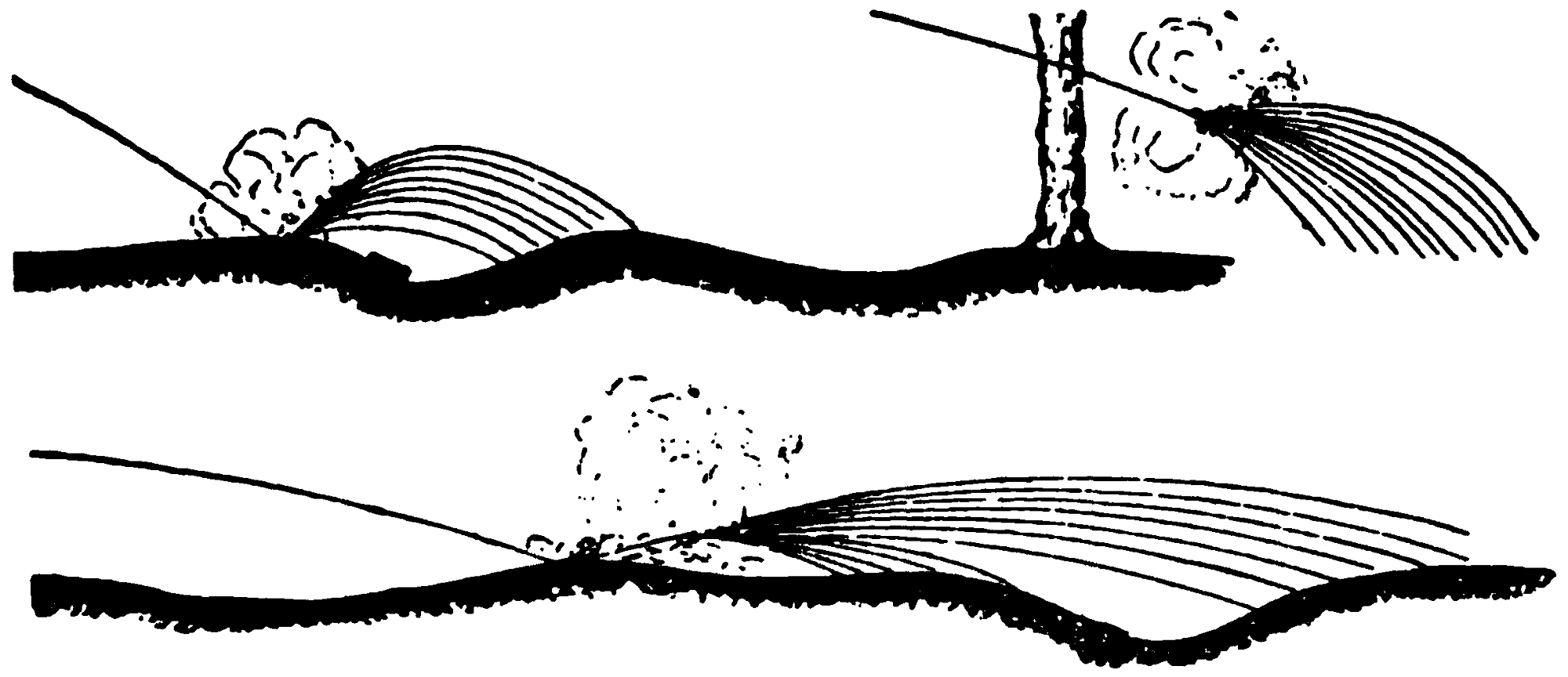
Percussion shrapnel
is used for defense at short range, and in fire for adjustment; its effect depends upon the range and the nature of the ground. It is effective against troops lodged in tall timber. Masks, branches of trees, etc., frequently cause the premature burst of the projectiles.[108]
Percussion shrapnel is effective only when bursting immediately in front of the target (5-25 m. in front of it, depending upon the range). However, even in this case, the bullets often pass over low targets, such as skirmishers lying down, and low parapets afford sufficient protection. An adequate effect can be obtained only when the fire is directed on vertical targets. Soft ground, newly ploughed fields, terrain covered with snow or underbrush, small folds of the ground, or a rising slope, diminish the fire effect. When the angle of fall is 10 degrees or more (with the German piece at ranges of 3300 m. and over) half of the bullets penetrate the ground, the remainder ricochet and pass on at a greatly reduced velocity. The explosive or incendiary effect of shrapnel is insignificant owing to the smallness of the bursting charge. However, some incendiary effect is possible if the projectile strikes an easily inflammable target.[109]
Percussion Shrapnel.
Time shrapnel
(used in Germany up to 5000 m.) is fairly independent of the terrain, the burst being easily observed since the bullets are embedded in a “smoke-producing composition.” The extreme range at which this projectile can be employed is fixed by the facility of observing the fire and by the remaining velocity of the shrapnel bullets, both of which diminish as the range increases. Field guns, model ’96, may be effectively employed up to a range of 4000 m.; under 3000 m. their fire is so annihilating that decisive results are produced in a short time. (Par. 630 German F. S. R.). The use of the combination fuze, on account of its certainty of burst, either by time or percussion, permits the trajectory to be accurately determined in every case. This fuze also makes it possible to employ shrapnel against rapidly advancing targets, and in warding off a sudden attack at short range. The French Regulations give the width of the beaten zone of a single shrapnel as 20, that of two from the same piece as 25 m. The maximum depth of the beaten zone is 300 m. The angle of the cone of dispersion of the German shrapnel, model ’96, is 16 degrees at 2000 m. German shrapnel (model ’91) fired at a line of infantry did not strike lines following 250 m. in rear of the first, whereas in case of base charge shrapnel these lines would be safe only at 350-400 m. from the first line. The German shrapnel gives very good results when set to burst 30 to 150 m. in front of the target, the height of burst being regulated accordingly (approximately 1⁄3 of the whole number of hundreds of meters of the range). At ranges under 1500 m., an adequate fire effect may, however, be expected even when the fuze is set to burst the projectile 300 m. in front of the target. (Par. 30 German F. A. F. R.).
Shrapnel is most effective against skirmishers lying down from 1000 to 3000 m. when burst 28 to 22 m. short, and against standing skirmishers at the same ranges when burst 56 to 45 m. short. The two tables given below, borrowed from the work of Lieutenant-General Rohne on artillery tactics,[110] give an idea of the effect of a single time shrapnel, and of the effect per minute of shrapnel fire after adjusting upon the target:
TARGETS. When firing at the targets named (1 skirmisher per m.) with time shrapnel, mod. ’96, set to burst 50 m. short, the following hits per shrapnel may be expected after the adjustment has been effected:
500 m. 1000 m. 2000 m. 3000 m. 4000 m.
Skirmishers standing 18.4 14.2 12.0 11.0 10.4
Skirmishers kneeling 10.6 8.2 6.9 6.3 5.8
Skirmishers lying down 6.4 4.9 4.1 3.8 3.5
Head targets 3.5 2.7 2.3 2.1 1.9
TARGETS. When firing at the targets named (skirmish line with 1 skirmisher per m.), under service conditions, with time shrapnel, mod. ’96, set to burst 50-100 m. short, the following hits per minute may be expected on an average:
500 m. 1000 m. 2000 m. 3000 m. 4000 m.
Skirmishers standing 364 202 109 46 14
Skirmishers kneeling 210 117 63 27 8
Skirmishers lying down 126 70 38 16 5
Head targets 70 39 21 9 3
More than 80% of the men struck by fragments and bullets from shrapnel bursting within 100 m. are disabled. The penetration of shrapnel bullets is so great, at ranges under 2000 m., that when they strike bones or vital organs of horses, they produce instant incapacity for action. This is especially true when the interval of burst is less than 100 m. The effect of shrapnel directed against batteries provided with shields is insignificant. Time shrapnel is the principal projectile employed by artillery against animate objects, provided these are not located immediately in rear of parapets, within tall timber, or under bomb-proofs. This projectile is ineffective against such cover on account of the flatness of the trajectory and the sensitiveness of the fuze.
Shrapnel is to be supplemented by shell filled with explosive charge, model ’88, which has a great explosive effect at extreme ranges and in tall timber. (See pars. 159-160 German F. A. F. R., in regard to action against shielded batteries).
Percussion shell, on account of its very sensitive fuze, bursts on penetrating the shield, while percussion shrapnel goes entirely through the shield and bursts about 1⁄2 m. in rear of it.
Percussion Shell, Model ’96.
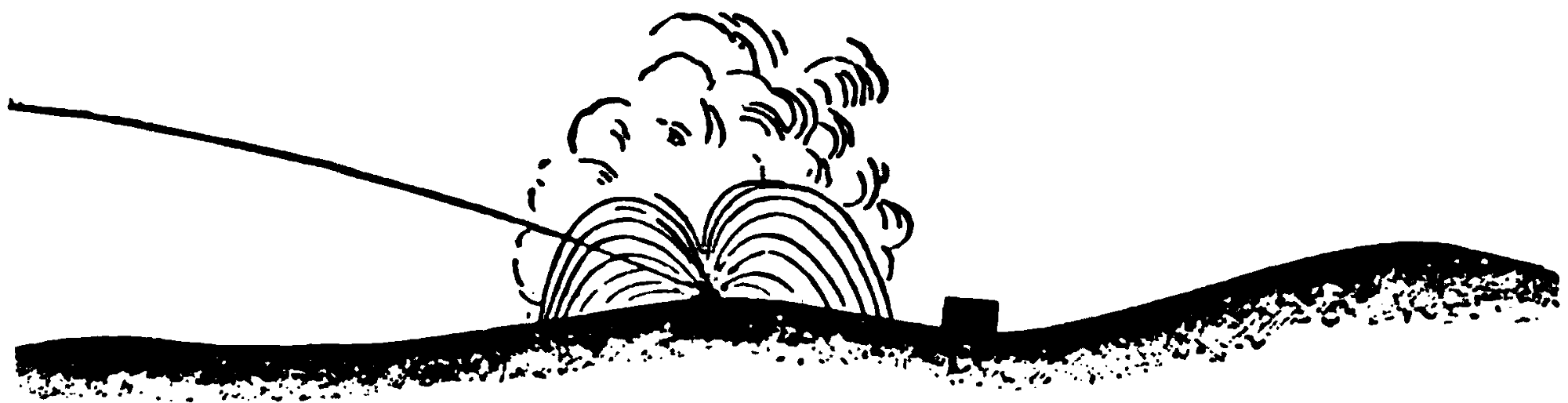
Targets located immediately in rear of parapets or under light splinter proofs may be reached with time shell burst directly over or close in front of them. The depth of the beaten zone of this projectile is small, seldom exceeding 50 m., even when the fire is directed against targets in the open. About 75% of all the fragments are capable of inflicting disabling wounds when the interval of burst is short. The peculiar character of the projectile necessitates a very careful adjustment in range and in height of burst. The French obus allongé, a high explosive percussion shell (melinite charge; angle of the cone of dispersion exceeds 100 degrees) is employed only for the destruction of material objects.[111]
The French projectile, on account of the fuze used, bursts only after it has pierced thin walls or shields.
Time Shell, Model ’96.
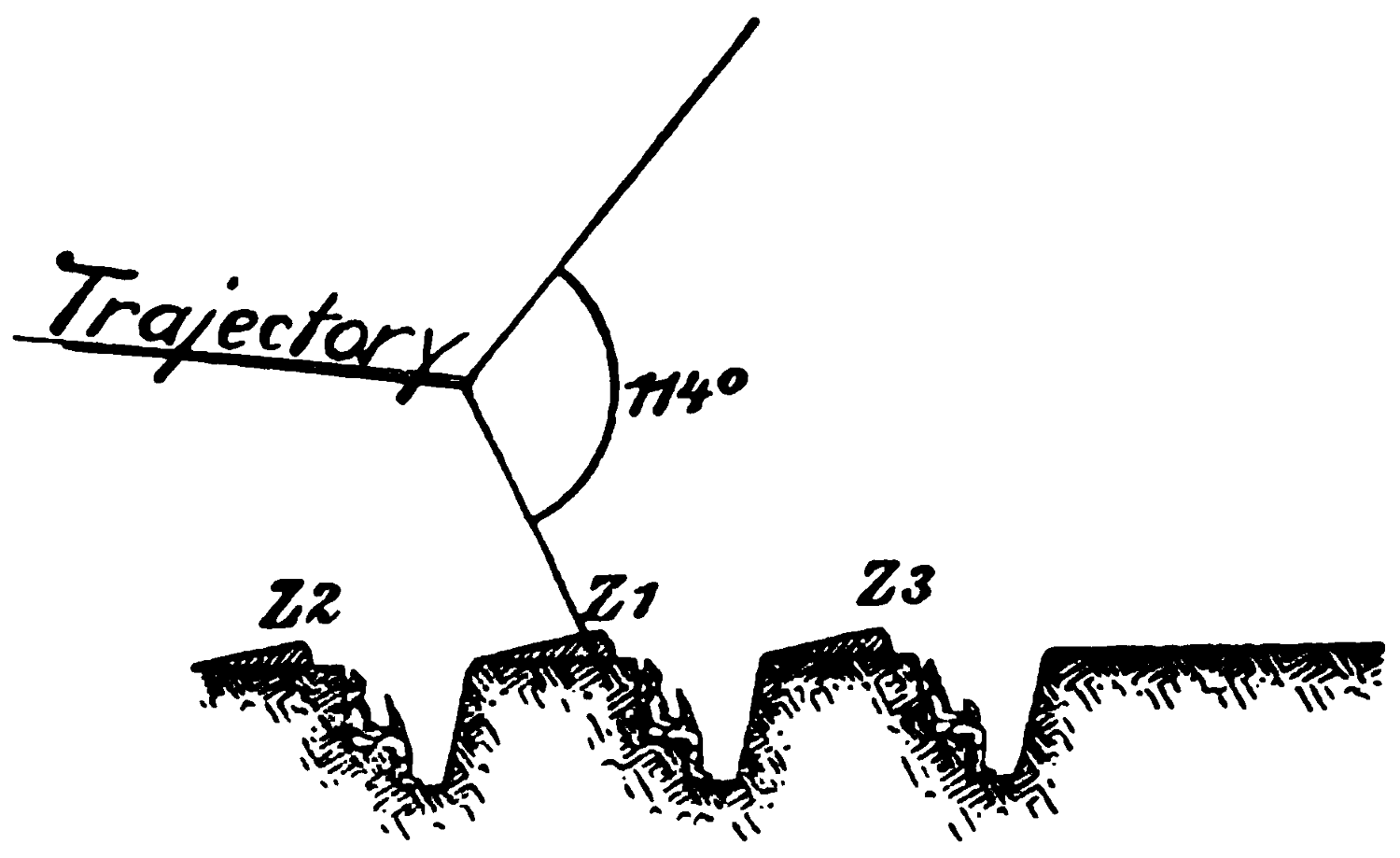
2. THE LIGHT FIELD HOWITZER.
The realization that the power of resistance of a defender lodged in deep trenches, could not be broken by the fire of guns having a flat trajectory, led to the re-adoption of a gun capable of high angle fire, which had been eliminated from the field artillery upon the advent of rifled cannon.[112]
For both flat trajectory and high angle fire, the light field howitzer, model ’98, employs shrapnel weighing 12.8 kg. (500 jacketed bullets, @ 10 g.; time fuze graduated from 300 to 5600 m.) and shell weighing 15.7 kg. (0.37 kg. explosive charge, model ’88; time fuze graduated from 500 to 5600 m.). As delay action fuzes are used, it is possible to utilize to the fullest extent the power of penetration of the projectile before it bursts.
A single shrapnel from a light field howitzer produces a greater number of hits, when the point of burst is favorably situated, than one fired from a field gun. However, the projectiles fired from the latter have a deeper beaten zone on account of the flatter trajectory of the piece, and a greater penetration owing to their greater remaining velocity. The German Artillery Firing Regulations (par. 30) consider the effect of both projectiles “very good” and of equal value at the principal ranges, when burst at a moderate distance (30 to 150 m.) from the target. The effect of shrapnel from the field gun and from the light field howitzer is considered adequate at ranges under 1500 m., when bursts are regulated to occur within 300 and 200 m., respectively, in front of the target. The superiority of the shrapnel fired from a field gun is due to the greater penetration of the jacketed bullets (a result of greater velocity of the projectile itself at the point of burst). But in this connection it is to be borne in mind that the effect of single shots only is here considered. The shrapnel fire of the field gun is considerably superior to that of the howitzer. This is due to the fact that the howitzer fires more slowly than the field gun and must expend twice the weight of ammunition to produce the same results. If, in addition, it is remembered that the field battery carries approximately 21⁄2 times as many shrapnel as the light field howitzer battery, it is obvious that the fire of the former will be 21⁄2 times as effective, against targets in the open, as that of the latter.
The superiority of the heavier projectile asserts itself when it becomes necessary to destroy material objects.
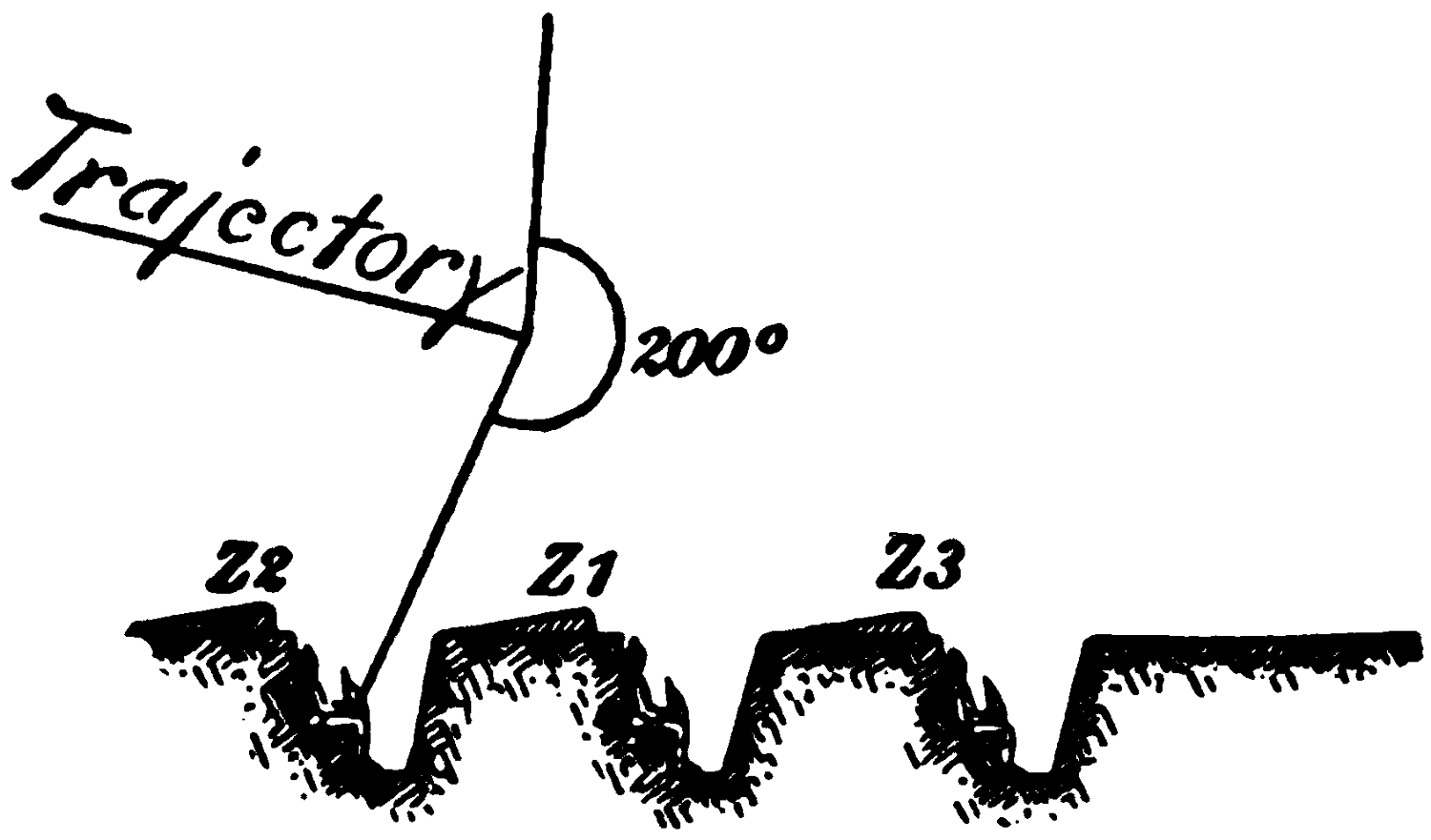
The shell fired from pieces having a flat trajectory is employed against troops immediately behind cover. The shell is burst immediately in front of, over, or in rear of the target, which is thus struck by splinters from above. The more nearly perpendicular the splinters strike the target, and the greater their number and weight, the greater will be the effect produced. The angle of the cone of dispersion is about 200 degrees; with appropriate points of burst, fragments weighing 15 g. (80%) incapacitate for action. In curved fire, at ranges beyond 2100 m., shell with delay action fuze is capable of penetrating the splinter proof cover usually employed in the field. At ranges under 2100 m. its angle of fall is too small to make an adequate effect certain.
Time Shell, Model ’98.
3. THE HEAVY FIELD HOWITZER.
The heavy field howitzer employs shell weighing 39.5 kg., containing an explosive charge of 0.85 g., and fitted with a percussion fuze either with or without delay action. This shell is designed to penetrate the roofs of splinter proofs. An earth covering 5-6 m. thick is necessary to afford protection against these projectiles. At 3000 m. a 15 cm. shell produces a crater 1 m. deep and 2.4 to 3.6 m. in diameter, i.e., 2 cu. m. (in made ground this crater is three times this size). The heavy field howitzer is a very effective weapon against shielded batteries. A single shell, owing to its lateral explosive effect, is capable of placing a whole battery temporarily out of action.
4. EXPEDIENTS FOR MINIMIZING THE EFFECT OF FIRE.
Movements of infantry under artillery fire are unavoidable when firing lines are to be reinforced and when troops intended for the decisive attack are to be pushed closer to the enemy. Formations calculated to minimize the effect of the hostile fire must be taken up in time, since it is not always possible to make use of cover. The efficacy of the fire depends upon the accurate determination of the range and height of burst (fire for adjustment) and upon the careful observation of the subsequent fire (fire for effect).[113] The effect of this fire is considerably increased when the opponent’s infantry, against whom the fire is directed, takes up unsuitable formations (particularly broad line formations). Infantry has frequently found it advantageous to advance in small detachments moving rapidly at irregular intervals in extended order.
(a) Increasing the Difficulties in the Adjustment of the Hostile Fire.
A battery requires about 0.8 minutes (5 to 6 rounds with percussion fuze) to secure adjustment at ranges up to 750 m. The time required for securing adjustment at the longer ranges is as follows:
At 800-1500 m., on low infantry targets , 1.5 min. , 6-9 rounds with perc. fuze ;
„ 1700-2250 m., „ „ „ „ , 3.7 „ , 11 „ „ „ „ ;
„ 2000-3000 m., on artillery targets, 4.6 „ , 11 „ „ „ „ ;
Narrow columns moving to their right or left front are very unfavorable targets for artillery, as it is very difficult for a battery commander to determine the relative position of bursts on the flank of a column with respect to the leading element thereof. Such shots are frequently considered as over. Numerous small columns, which make it difficult to designate a target, increase the time required by the hostile artillery to secure adjustment.
Troops should not be posted in the vicinity of conspicuous objects, as, for example, trees, visible at a great distance.[114] Intrenchments that have just been thrown up should be made to look as nearly as possible like the surrounding country by covering them with snow, sod, or brush. It is made more difficult for the hostile artillery to secure adjustment, if our infantry changes position to the front or to a flank, if it moves rapidly or advances by rushes.
It is easy, as a rule, for the artillery to adjust its fire upon masks, but difficult to determine the distance between mask and target. It is an advantage when masks are situated obliquely to a position. As masks (rows of trees) may cause the premature burst of projectiles having percussion fuzes, they should be at least 200 m. from the troops they are to screen.[115] When so situated they frequently afford better protection than actual intrenchments.
(b) Minimizing the Effect of Fire.
Formations that increase the effect of artillery fire, as for example lines and columns, and positions in which a flank is refused, should be avoided. It is a good plan to increase the number of targets and to employ narrow columns (column of twos) that are not too deep. Supports must be far enough in rear (300-400 m.) to prevent two targets being struck by one and the same shrapnel.
Of the close order formations used in the Russo-Japanese war, platoons or sections in columns of squads or twos,[116] separated by a maximum interval of 50 paces, were indeed found more suitable under fire than line formations, but the losses were nevertheless very serious except where cover screened the advancing troops from view or afforded them actual protection.
During the Franco-German war, line of platoons in columns of twos was found advantageous on several occasions.[117] This formation has the following disadvantages, however: it is very susceptible to flanking fire; the influence of the officers is principally restricted to the leading elements; intervals are easily lost and on that account it becomes more difficult to form line. It would seem to be better, therefore, to advance in line of platoons (or sections) in columns of squads, or, under flanking fire, in line of squads in columns of twos or files. In the last-named formation the intervals between squads are easily lost, however, and the company then becomes a dense skirmish line of from four to six ranks. To echelon the platoons slightly has very little value on account of the depth of the beaten zone of modern shrapnel.
In attacks made during the latter part of the Russo-Japanese war, both belligerents finally made use of thin successive skirmish lines for advancing; these lines followed each other at 200-300 m. and united again on reaching cover.
5. THE RESULTS OBTAINED BY ARTILLERY AGAINST VARIOUS TARGETS.
Germany. According to computations made by Lieutenant-General Rohne,[118] the following hits may be expected from every time shrapnel, model ’96, when burst an average of 50 m. short of the targets named:
Range m. Standing. Kneeling. Prone. Intrenched Skirmishers. [119]
500 18.4 10.6 6.4 3.5
1000 14.2 8.2 4.9 2.4
2000 12. 6.9 4.1 2.3
3000 11. 6.3 3.8 2.1
4000 10. 5.8 3.5 1.9
The number of hits per minute obtained by a battery firing 50 shots at 500 m., 30 at 1000 m., 20 at 2000 m., 10 at 3000 m., and 4 at 4000 m., is as follows:
Range m. Standing. Kneeling. Prone. Intrenched Skirmishers. [120]
500 364 210 126 70
1000 202 117 70 39
2000 109 63 38 21
3000 46 27 16 9
4000 14 8 5 3
France.[121] According to the French Field Artillery Regulations (footnote to par. 277), a gun firing time shrapnel covers effectively a front of 25 m., and a battery of four pieces, a front of 100 m. This intensity of fire, which is obtained when each piece fires one shot with proper corrector and range settings (the battery four shots) Aubrat calls “Density 4.” When rafale fire (two shots per piece) is employed against a front of 100 m., with proper corrector setting, density 8 is obtained. When the front exceeds 100 m., the deflection of the pieces must be changed between successive shots (tir avec fauchage). To obtain density 8 against a front of 150 m., each piece must fire three shots, as prescribed in the regulations. When progressive fire (tir progressif) is employed, four different ranges are given, of which only one can be considered effective. When not sweeping, in this fire, each piece fires two shots, thus also obtaining a density of 8. A density of 1 always corresponds, therefore, to one round, fired, with proper corrector and range settings, against a front of 100 m. When a battery (four pieces) fires one salvo against a target having a front of 50 m., density 8 is obtained; by firing two salvos, density 16 is obtained.
The Commission d’études pratiques du tir has made a thorough investigation into the effect produced by shrapnel fire. The following table gives a general idea of the effect to be expected when firing against service targets (i.e., the percentage of figures one may expect to hit when employing fire of varying density):
TARGETS. DENSITY.
4 8 16 32
% % % %
Infantry skirmishers standing in the open, or a single rank line 25 40 65 ——
Skirmishers lying down; gun crews under fire but protected by shields of the French type. Space between shields and ground not closed 7.5 15 25 40
Infantry lying down behind knapsacks; gun crews protected by shields. Space between shields and ground not closed —— 7.5 15 25
Infantry lying down behind their knapsacks, but not firing; gun crews protected by shields. Space between shields and ground closed so that bullets cannot pass through —— 0-2 —— ——
A skirmish line 100 m. long, and lying down, would suffer a loss of 15% irrespective of its strength, from progressive fire (tir progressif; 32 rounds, density 8). If the interval between skirmishers in the open amounts to 11⁄2 paces, for instance, the front would contain 62 skirmishers, and the resulting loss would amount to 9 men. If the men have placed their knapsacks in front of them, the loss would be reduced by half. A line of skirmishers of the same length and strength as the one considered above, would suffer a loss of 40%, or 25 men, when standing up or advancing. About 11⁄2 minutes are required to fire one tir progressif, after adjustment has been secured. The same effect could be obtained in about 20 seconds by firing a rafale of eight rounds, provided the battery has accurately adjusted its fire.
6. THE EFFECT OF SHRAPNEL BULLETS ON ANIMATE TARGETS.[122]
The wounds produced by shrapnel bullets are similar to those caused by the lead bullets of the infantry weapons of the past. When the bullet strikes normally to the surface, it produces a wound circular at the point of impact and considerably enlarged at the point of exit; bones are frequently shattered; and the most serious effect is the introduction of foreign substances, such as pieces of cloth, particles of earth or sand, or of the material in which the bullet is embedded.
The effect of shrapnel bullets on animate targets depends upon the striking energy of the bullets (expressed by kgm.) and on their density, those of smaller cross-section having the greater penetration. The closer the point of burst is to the target, the greater the velocity, and, naturally, the effect.
Opinions differ as to the amount of “striking energy” necessary to put animate targets out of action. In France, an energy of at least 4.8 kgm. is considered necessary to disable human beings, and for horses an average of 19 kgm., while in Germany, an average energy of 8 kgm. is deemed sufficient. The 10 g. hardened lead bullet, having a diameter of 12.3 mm., retains this energy until its remaining velocity is only 120 m. At ranges up to 1500 m., over 80% of the men struck by fragments and bullets from shrapnel, bursting within 300 m. (and beyond this range from shrapnel bursting within 150 m.) are put out of action. (Par. 30 German F. A. F. R.). In comparison, artillery projectiles produce a greater number of fatal wounds than infantry projectiles.
It is worthy of note that the packed knapsack affords protection against all shrapnel bullets having a velocity of 100 m. and against half of those having a velocity of 200 m. The overcoat roll stops shrapnel bullets having a velocity of less than 250 m. The penetration of these bullets is so great, at ranges under 2000 m., that when they strike bones or vital organs of horses, they produce instant incapacity for action. This is especially true when the interval of burst is less than 100 m.
B. INFANTRY FIRE.[123]
The modern infantry rifle, cal. 6.5 to 8. mm., is a magazine arm employing steel jacketed, pointed bullets, arranged in clips. The adoption of automatic rifles is contemplated. In these rifles the recoil energy is utilized for throwing out empty shells and for placing a fresh cartridge into the chamber at the same time. The objections made to the adoption of such a rifle (complexity of the mechanism, danger of wasting ammunition) are similar to the reasons advanced against the adoption of breech-loading and magazine rifles. In addition to the increased rate of fire, the advantage of eliminating the effect of the recoil on the skirmisher must not be underestimated. Moreover, the elimination of the recoil makes a further increase in the initial velocity of the projectile possible.
The effect of infantry fire may be considered from two points of view, viz.: the effect on the enemy of a single projectile, and the effective hit in itself.
1. THE EFFECT OF A SINGLE PROJECTILE ON ANIMATE TARGETS.[124]
During the Russo-Japanese war the contending parties used the following small arms and projectiles:
Rifle. Model (year). Cal. PROJECTILE. Initial Velocity.
Description. Weight.
mm. g. m.
Japan - Arisaka ’97 6.5 Hardened lead core with copper-nickel jacket. 10.5 715
Murata ’94 8.0 15.42 564
Russia —— ’91 7.62 13.7 615
The ballistic qualities of the Arisaka rifle were superior to those of the Russian arm, but the maiming effect of the two rifles was about equal. The striking energy of the projectiles was not sufficient in every case, however, to put a man out of action. The explosive effect produced by bullets striking interior organs and bones at short ranges (within 500 m.) was more evident in wounds made by the 8. mm. than by the Arisaka rifle.[125]
At mid ranges the wounds were generally of a mild character, unless produced by tumbling bullets.[126]
Experiments prove that a projectile will tumble if it encounters varying resistance (for example, if the projectile strikes an obstacle, even if that be only a twig) or if it penetrates materials of different density (for instance, if, in penetrating a body, it strikes first upon a fleshy part, then upon bones). In the last mentioned case the bullet will frequently tumble in the body. If a projectile be fired through a series of boards, placed at intervals, it will tumble in the second board, or if not there, then certainly in the third board. Projectiles which ricochet on the ground before penetrating a human body change their form more or less, according to the character of the ground on which they ricochet. As the jacket is frequently torn, thus exposing the leaden kernel, wounds may be produced which will equal those made by explosive bullets.
The striking energy of the projectile is sufficient to perforate two men at 1200 m. From experiments made with the Lebel rifle on corpses, it appeared that the projectile passed clear through 5 bodies at 100 m., through 4 bodies at 400 m. (even when large bones were struck) and through 2 bodies at 1200 m.
In the Russo-Japanese war wounds were distributed as follows, on a basis of 100 hits: lower limbs, 39.5; upper limbs, 25.4; abdominal region, 16.5; chest, 15.5; spinal column, 15, and head, 11. Flesh wounds are generally slight. This is due to the fact that the hole made by the bullet is small, that the exterior flow of blood is insignificant, and that the wound rarely becomes infected. Projectiles remain in the body now much more rarely than in the past.
The central portion of marrow bones is frequently splintered by projectiles, while thicker flat bones (shoulder blades) are cleanly perforated.
Unless a tumbling bullet or a splinter of a bone penetrates the lungs, chest wounds appear in much more favorable forms than in past wars.[127]
According to observations made in the Russo-Japanese war, wounds in joints healed without suppuration, the joint and its mobility being saved. Amputations were extremely rare, and the surgeon’s skill was, as a rule, seldom necessary in the treatment of shot wounds. Chest wounds were slight, and often many men walked a few versts to the dressing station, some of them complaining of difficulty in breathing. As a rule, such wounds healed in fourteen days. Chest wounds were more serious when the heart or the large blood vessels were injured; but even in these cases cures were effected. Abdominal wounds were not so serious as in the past. Contrary to past experience, skull wounds, in which the projectile had passed entirely through the brain, were treated with fair success.
The campaigns in South Africa and Manchuria have amply demonstrated that wounds produced by jacketed bullets of small caliber are not so serious as those caused by 11 mm. projectiles. In addition, these campaigns have shown that a further decrease in caliber is undesirable from the tactician’s point of view, for a hit by no means affords the certainty, in every case, of putting a man, much less a horse, out of action.