THE SICKROOM. (continued 2)
Reading edition
Icelandic Moss Chocolate (a very nutritious drink, suitable for use when abundant nourishment is required).—Wash 1 oz. moss thoroughly in cold water; then put it over the fire to boil in 1 pint water. Grate 1 oz. chocolate fine, mix it with ½ cupful cold milk, stir it into 1 pint boiling milk, and boil it for 5 minutes; then add it to the boiling moss, strain them together, sweeten them to suit the taste of the patient, and use the beverage warm.
Imitation Kumys (Koumiss).—(a) Fill into a strong champagne bottle, good, fresh, unboiled cow’s milk to such a height that after the addition of 1 oz. granulated or powdered sugar, and after corking, there would still be left at least 1 in. of empty space below the cork. Before corking, add a piece of fresh compressed yeast, about the size of 2 peas, then cork and tie the cork firmly down. In place of compressed yeast, 1 teaspoonful good beer yeast may be taken. The contents of the bottle are well shaken, repeatedly, then the bottles are placed in the cellar, where they are turned up and down a few times during the day. From and after the fifth day the mixture is ready and may be drunk to about the twentieth day. It is best to prepare about 6 bottles full at a time, refilling each after it has been emptied and cleaned, so that the treatment, after being begun, may not be interrupted. On opening the bottles, the contents are very apt to foam over, hence the bottle should be opened while being held over a plate. It should never be opened where there may be any furniture or dresses about, which might be soiled by spattering. A good milk-wine or kumys should have a homogeneous appearance of the consistence of thin cream, should be effervescent when poured out, of an acidulous, agreeably vinous odour and taste, and should not be full of lumps, or taste like butter-milk. On first using kumys it produces loose bowels, but this effect soon passes off.
(b) 200 parts condensed milk, 2000 parts water, 2 parts lactic acid, 1 part citric acid, and 30 parts brandy are mixed and carbonated. Cork well and let it stand for 2 days in a warm room till it froths.
Administering Physic
Administering Physic.—Never allow a bottle of lotion for external use to stand beside a bottle of medicine to be taken internally. Keep them entirely separate, and keep all medicines in a place where children cannot by any possibility reach them. One further piece of advice, which is unfortunately but seldom attended to, is deserving of attention, namely, after an illness has terminated either in recovery or death, empty out all the medicine bottles, and on no account retain any of them for future use. Spoons differ very much in size, and it is not wise to trust to them in measuring medicines. It is best to get a medicine glass or spoon, either of which can be got at a chemist’s for a few pence. In giving sick people medicine there are 3 points which ought carefully to be remembered—namely, regularity, punctuality, and exactitude. Those intrusted with the administration of medicine to sick persons should always read the label of the bottle before administering the medicine. By doing so they will probably save themselves a lifelong reproach. An inhaler for taking medicated vapours in bronchial and catarrhal affections may be extemporised out of a pickle bottle fitted with a perforated cork and a bit of tube. A special apparatus (Dr. Felton’s) is sold at 7s. 6d. by Savory and Moore.
To mask the taste of cod-liver oil:—(a) Use Allan and Hanbury’s “perfected” oil. (b) Put a little salt in the mouth before taking the oil. (c) Add 30 drops sulphuric ether to the dose and take it quite cold. (d) Add a little iodoform and essence of anise; say 96 grm. oil, 20 c. grm. iodoform, 4 drops essence.
Quinine may be enclosed in gelatine capsules when otherwise refused. If in powder it is best mixed with a little milk.
Keep a separate measure and separate glass for administering such drugs as castor-oil, cod-liver oil, asafœtida, valerian, &c.
Pills should be placed well towards the gullet and washed down with a drink. Or they may be hidden in jam, or wrapped in rice paper, and then washed down. Powders may be mixed in jam, treacle, honey, milk, or water.
To remove the taste of nauseous medicines from the mouth chew a small piece of bread and spit it out.
The best times for administering medicines, according to the frequency with which they are ordered, are as follows:—
“Daily.”—At 9 A.M. or at bedtime.
“Night and morning.”—9 A.M. and bedtime.
“Twice-a-day.”—10 A.M. and 6 P.M.
“Three times a day.”—10 A.M., 2 P.M., 6 P.M.
“Every 4 hours.”—10 A.M., 2 P.M., 6 P.M., 10 P.M., 2 A.M., 6 A.M.
Never wake a patient to administer medicine or food unless ordered to do so.
To apportion doses according to age, reckon 21 years and upwards as adults requiring full dose; then 17 will take ¾, 14 will take ½, 7 will take ⅓, 4 will take ¼, 3 will take ⅙, and 2 years or under will take ⅛ of the full dose.
Medicines are classified according to their general properties, the following being the chief:—
Anæsthetics—produce insensibility to pain. Anodynes—procure relief from pain. Antiseptics—prevent putrefaction. Antispasmodics—check spasms and cramps. Caustics—destroy animal tissues by a kind of burning. Collyrium—an eyewash. Diaphoretics—induce perspiration. Diuretics—increase the flow of urine. Emetics—cause sickness (vomiting). Expectorants—favour spitting. Liniments—for rubbing in. Narcotics—induce sleep. Purgatives—cause very loose bowels. Refrigerants—cooling. Sedatives—calm the nerves. Soporifics—induce sleep. Styptics—arrest bleeding. Tonics—increase the appetite and give a stimulus to the system.
The principal domestic remedies, with their doses (m. means minims, gr. grains, table. tablespoonful, tea. teaspoonful, dr. drams, oz. ounces, dess. dessertspoonful) and properties, are as follows:—
Aloes (compound decoction): 1-3 tablespoonfuls; pleasant purgative, useful in habitual constipation, and will often relieve headache.
Alum: 10-20 gr. in whooping cough and internal bleeding; 1 tea. (in treacle) as an emetic; 15 gr. in 10 oz. water as a collyrium; 60 gr. in 10 oz. water for gargles and injections; astringent (coddling the mouth) and styptic.
Ammonio-citrate of iron: 5-10 gr. in water; tonic.
Antimonial wine: 5-15 m. 3 times a day in bronchitis and fever, diaphoretic; 1 table. (for adults), emetic.
Aromatic chalk: 20 gr. in water checks diarrhœa.
Belladonna liniment (compound): externally applied on rag covered with waterproof for 12 hours as local remedy for rheumatism and lumbago; anodyne.
Bicarbonate of potash: 15-20 gr.; antacid; taken with lemon juice or citric acid as a cooling drink.
Bicarbonate of soda: 10-20 gr.; antacid; checks heartburn and stops diarrhœa.
Blue pill: 3-5 gr.; alterative; cures bilious attacks.
Borax: 1 in 24 parts water as a gargle for sore throat.
Calomel: 1-3 gr.; powerful purgative and alterative; taken for biliousness.
Camphor liniment (compound): stimulant liniment.
Carbonate magnesia: 5-30 gr. in milk; antacid, gentle aperient; useful for children.
Castor oil: ½ tea. (infants), 2 table. (adults), on milk, wine, or orange juice, or blended with glycerine or egg-yolk; most reliable aperient.
Chlorate potash: 10-20 gr., stimulant; 1 dr. with 4 dr. honey and 8 oz. water, gargle for sore throat; lozenges, overcomes effect of high altitudes on the respiratory system.
Chloric ether: 20-30 m. in water, cordial and antispasmodic; relieves cramp, violent cough, spasms, &c.
Chloroform: not to be inhaled or taken except in a doctor’s presence; sedative; applied to rheumatism, stings, and toothache as an anodyne.
Citrate of iron and quinine: 3-5 gr. in water; tonic and binding.
Citrate of magnesia (granular effervescent): 1 dess. in tumbler cold water; cooling aperient.
Cream of tartar: 20-60 gr., diuretic and cooling; ½ oz. in 1 qt. of water, fever drink.
Dover’s power: unfit for children; 5 gr. in wineglassful water, diaphoretic, checks diarrhœa and cures fresh colds; 3 gr. after meals prevents chest-ache.
Epsom salts: 1-4 dr. in water; purgative.
Essence of camphor: 30 m. in wineglassful water; exhilarating.
Essence of ginger: ½ tea. in wineglassful water; cordial stimulant, useful in chest-ache.
Essence of peppermint: 10-15 m. on sugar; exhilarating, warming and antispasmodic.
Extract of bark: 10-30 m. in wineglassful water; valuable tonic in neuralgia and fever.
Friar’s balsam: ½-1 dr. with sugar and egg-yolk, stimulating expectorant; applied on cuts.
Glycerine: may replace sugar for sweetening drinks and medicines; much used for softening the skin.
Goulard’s extract: 5 m. in wineglassful water as an eyewash; 1 in 40 of water, astringent, applied to bruises and sprains as a wash.
Gregory’s powder: 1 tea. in wineglassful water, cooling mild aperient.
Grey powder: 3-5 gr. (adult); aperient, acting on the liver.
Ipecacuanha powder: 15 gr. emetic.
Ditto wine: 10-20 m., expectorant for coughs; 1 table. (adults), repeated at 10 minutes intervals, emetic.
Jalapine: 2-6 gr., aperient for children.
Laudanum: 10-20 m., anodyne and soporific; with equal quantity opodeldoc, applied as an anodyne.
Lime-water: antacid; checks infantile diarrhœa; mixed with sweet oil affords great relief when applied to burns.
Liquorice powder (compound): 1 tea., mild aperient, best for piles.
Milk of sulphur: 1 tea. rubbed up with milk, gentle aperient and cooling, useful in rheumatism and piles.
Morphia bimeconate: 5 m. increasing every 3 hours; most valuable sedative and soporific; applied as an anodyne after the part has been reddened by compound camphor liniment.
Muriate (chloride) of ammonia: 10 gr. in wineglassful water, good expectorant in bronchitis; 1 oz. with 1 oz. alcohol and 10 oz. water; stimulant lotion for sprains.
Nitrate of silver: 2-4 gr. in 1 oz. water, lotion for sore nipples; 20 gr. in 1 oz. water, throat wash in diphtheria.
Nitre (saltpetre): 5 gr. in saline draught, cooling and diuretic for fever; ¼ oz. in ½ pint barley water, gargle for inflamed sore throat.
Nitric acid (dilute): 10 m. with 5 m. tincture of chiretta, 15 m. tincture of orange and 10 m. syrup in 1 wineglassful water, excellent between meal-times for convalescents.
Opodeldoc (soap liniment): excellent applied to bruises, stops swelling and discoloration.
Paregoric: 30-60 m., checks coughing.
Prepared chalk: 15-30 gr. repeated, with cinnamon and tincture of catechu, antacid and astringent for diarrhœa and cholera; made into a cream with water, cooling shield for burns.
Rhubarb: 1-5 gr., tonic to bowels; 10-20 gr., aperient followed by astringent.
Sal volatile: 30-60 m. in wineglassful camphor julep; antacid, antispasmodic, and exhilarating.
Santonine: 2-3 gr. on 3 alternate nights, followed by castor oil in the morning, expels threadworms from children.
Spirit of minderus: 15-20 m. in gruel at bedtime, excellent diaphoretic and cure for coryza (cold in the head); 20 m. in wineglassful water, eyewash; 1 table. in tumbler water, cooling lotion.
Spirit of nitre: 20-30 drops in wineglassful water, or 1 tea. in hot gruel at bedtime, diuretic and diaphoretic, for colds.
Sulphate of copper: 10-15 gr. in wineglassful water, rapid emetic in poisoning.
Sulphate of potash: 10-20 gr. with 10 gr. rhubarb and 15 gr. sugar in peppermint-water, mild aperient.
Sulphate of quinine: 1-5 gr. 2 or 3 times a day, tonic, useful in neuralgia, dyspepsia, weakness and fever.
Sulphate of zinc: 20 gr. in wineglassful water, emetic; 1 gr. in 1 oz. water, eyewash, astringent.
Sulphuric ether: ½-1 tea. in camphor julep, exhilarant.
Syrup of senna: 1 tea. (adults), mild aperient.
Tincture of arnica: with 4 times its bulk in hot water for fomenting bruises.
Tincture of chiretta: 10-30 m., tonic, useful in dyspepsia.
Tincture of colchicum: 10-20 m. at night after a light meal, diaphoretic, valuable in gout, rheumatism, and dropsy.
Tincture of henbane: 15-60 m., narcotic and anodyne.
Tincture of lavender (compound): 1 tea. with ½ tea. sal volatile in water, stimulant, antispasmodic, and exhilarant.
Tincture of quinine: 1-2 tea. in wineglassful water 2 or 3 times a day, tonic.
Tincture of rhubarb: 2-4 tea., cordial and purgative.
Tincture of squills: 1 tea. with wineglassful water, expectorant; take 1 dess. at short intervals to check coughing.
Tincture of steel: 5-15 m. in wineglassful water, tonic, astringent, and diuretic, good in weakness and dyspepsia.
Tincture of valerian: 1 tea. in camphor water, antispasmodic and stimulant, valuable in nervous headache.
Common Complaints.—Without making the least pretence to give such information as will enable the sick man to dispense with the services of the physician or surgeon, whose aid should be promptly sought, there are many matters which by careful study may enable the threatened attack to be warded off, and there are a variety of ailments and troubles which are not generally deemed of sufficient importance to be worth troubling a doctor about. It is these subjects which claim treatment here, and with which the following paragraphs will deal, leaving all special and serious diseases in hands which have been trained to the work.
Accidents and Emergencies
Accidents and Emergencies.—The first piece of advice to every one is to attend a series of lectures given every winter by the St. John’s Ambulance Association at very numerous centres all over the kingdom. This will convey an amount of knowledge and practical experience such as can never be attained by reading alone. Even Volunteers, who have gone through a course for the Army Hospital Corps, will do well to supplement it for every-day life with a course of St. John’s Ambulance lectures.
When you have not witnessed the occurrence of an accident, make some inquiry of the bystanders or patient as to its cause before taking any other steps, as this will often indicate what kind of injury is to be looked for. Never proceed to lift or remove a patient with broken limbs or bleeding wounds till the necessary bandaging and staunching have been done: let traffic be interrupted, if need be, rather than risk converting a simple hurt into a fatal one.
The ordinary accidents and emergencies of every-day life will now be dealt with in alphabetic order.
Bites and Stings.—These may be divided into two classes—those of insects and those of poisonous or rabid animals.
Of Insects.—First remove the sting (of a bee or wasp) by pressing a small key on the spot, whereby the sting is forced into the hollow barrel; then apply any of the following lotions:—(a) Rub the bite of mosquitoes with a solution of borax in ammonia. (b) When bitten by midges, the best applications are oil of camphor and laudanum, equal parts, applied on lint; or (c) 6 oz. Goulard water, ½ oz. laudanum, applied on lint. (d) ½ dr. extract of belladonna; ½ oz. glycerine; 3½ oz. water; to be well mixed, and made into a lotion. The parts to be washed with a small quantity—about a teaspoonful or two at a time. (e) Goulard water mixed with a little Eau de Cologne makes an excellent wash for the skin in case of gnat bites. (f) Keep an onion always at hand, and instantly when bitten squeeze or cut it, so that the juice should flow into the puncture, rubbing it gently over the place; its effects are equally efficacious in the sting of a wasp or bee, always provided the sting does not remain in the wound. (g) Ipecacuanha powder is very effective in allaying the pain caused by the sting of scorpion, hornet, and wasp, also mosquito and midge bites. For scorpion stings, &c., make a paste of the powder with a little water, and apply it to the wound in a patch about the size and thickness of a shilling. (h) In bee sting, first remove the sting as quickly as possible with a forceps or by scratching with a finger, but never with the thumb and forefinger, because this squeezes more of the poison into the wound. Next squeeze the wound until a drop of blood comes out, and rub the place as large as a florin with an aqueous or dilute alcoholic solution of salicylic acid. The effect is still better by injecting the salicylic acid into the wound with the hypodermic syringe. After this the spot is painted with collodion, to keep out the air. (i) Gnat bites, stings of wasps, bees, &c., may be cured by applying a tincture of minderus, laudanum, and Goulard water in equal parts. (j) Sweet oil, or camphorated spirit of wine, is a good thing to apply to bite of the mosquito. (k) One raw egg well beaten, ½ pint vinegar, ½ oz. spirit of turpentine, ¼ oz. spirit wine, ¼ oz. camphor; these ingredients to be well beaten together, then put in a bottle and shaken for 10 minutes, after which to be corked down tightly to exclude the air. In ½ hour it is fit for use. To be well rubbed in 2, 3, or 4 times a day. (l) The leaves of the common dock, bruised and well rubbed on the part affected, alleviate the pain. (m) For bee stings: after pulling out the stings, break some lettuce leaves close to the stalk, and apply the milk afterward. (n) Anything “strong,” in a popular sense, will generally suffice to decompose and destroy an organic poison if instantly applied. This is why the juice of an onion answers the purpose. Anything equally pungent would do as well. (Lancet.)
Poisonous bites.—There is great similarity in the immediate treatment desirable in the bite of snakes and mad dogs, the object being to prevent, as far as possible, the absorption of the poison by the blood. In the same category come any poisonous wound, as from arrows, &c. (a) Buckland recommends the following outlines:—(1) Suck the wound, if possible, most vigorously, taking care that there be no sores on the lips or in the mouth. In all cases before sucking fill the mouth with oil or salt and water if possible. (2) Apply, if you can, a cupping glass, or cut off the tip of a cow-horn, cut the bottom level, apply it over the wound, and exhaust the air by the mouth; when exhausted fill up the hole by means of a bit of wax or other material placed into the mouth before the operation of sucking is commenced. This is the mode adopted by the Kaffirs. (3) Wash the parts with hartshorn (ammonia). (4) Tie a ligature tightly above the wounded part. (5) Give doses of hartshorn and water as strong and as frequently repeated as the patient can bear them. (6) Send for the doctor as quickly as you can.
(b) Favourable results have followed using chloride of lime, a filtered solution of which was injected into the same place where the fatal virus (snakes’) had previously been introduced. In 17 trials made in succession, the poisoned animal survived without the slightest disturbance of its healthy condition.
(c) First tie a ligature above the part bitten. Then slightly cauterise with a lucifer match. Next swallow tumbler of raw brandy, to be repeated whenever the feeling of sinking comes on, till the liquor (which goes down like water) is tasted, and begins to affect the head. Meanwhile the patient is to be walked about by two men by force if he cannot do so alone or wants to lie down, which would be fatal. (Sir R. Burton.)
(d) Permanganate of potash may be added to the list of antidotes, as it is said to counteract very effectively the poison of serpents, when an equal quantity of filtered (1 per cent.) solution of permanganate of potash is injected 1-2 minutes after the poison.
(e) Probably a vapour bath immediately after being bitten by a venomous reptile or rabid dog will be found to prove one of the best remedies, the intense perspiration induced carrying off the poison. Excessive exercise following a poisonous bite generally effects a cure for this reason.
Bleeding.—Bleeding may result from a wound or from the bursting of a blood vessel, and may occur outwardly or inwardly. Bleeding from a wound may be arterial (coming from the arteries which carry the blood from the heart to the body and limbs), venous (coming from the veins which take the blood back to the heart), or capillary (coming from the capillaries which convey the blood to the extremities and surface of the body). In arterial bleeding, the blood is bright scarlet, and escapes in jerks, as if from a pump; this is highly dangerous. In venous bleeding, the blood is dark coloured, and flows away in an uninterrupted stream. In capillary bleeding, the blood leaks or oozes out. In some wounds all three kinds of bleeding will occur simultaneously. The foremost method of arresting external bleeding is by pressure, either on the wound itself or on the blood vessels feeding it, and in the case of a limb, it should be elevated above the body to retard the flow of blood towards the part. As the pressure is to be made on the vessels leading to the wound, it is obvious that in arterial bleeding the pressure must be between the heart and the wound, while in venous bleeding it must be beyond the wound.
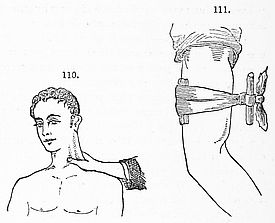
110. Head bleeding. 111. Arm bleeding.
The simplest and readiest way to apply pressure is by the fingers. But first of all some knowledge of anatomy and physiology is necessary to guide the operator where to press. Bleeding from the head and upper neck requires pressure to be exerted on the large artery which passes up beside the windpipe and just above the collar-bone, as in Fig. 110. The artery supplying the arm and hand runs down the inside of the upper arm almost in line with the coat seam, and should be pressed, as shown in Fig. 111. The artery feeding the leg and foot can be felt in the crease of the groin, just where the flesh of the thigh seems to meet the flesh of the abdomen, and this is the best spot to select in the case of a male patient; but in the case of a female, unless the injury were very high up the thigh, it would be more judicious perhaps to apply increased pressure around the leg about half-way between the hip and the knee. Pressure with the hands will not suffice to restrain severe bleeding for any length of time, and recourse must be had to a ligature.
The simplest and most available form of ligature is a pocket-handkerchief or neck-wrap, or any other article of attire long and strong enough to bind the limb. Fold the article necktie fashion, then place a smooth stone or anything serving as a firm pad on the artery, tie the handkerchief loosely, insert any available stick in the loop, and proceed to twist it as if wringing a towel until tight enough to stop the flow of blood, as in Fig. 111.
In the case of bleeding from an external wound or sore on the body, employ direct pressure over the bleeding point. If the bleeding is from the interior of the nose or other cavity, apply cold water or ice over the bleeding part or near it, and keep the patient perfectly quiet on the back, or let the patient stand erect with head well thrown back. Injection of hot water into the nostrils is very effective. When the bleeding is from a diseased surface or ulcer, and direct pressure does not stay it, a compress should be soaked in a strong solution of alum, or in steel-drops, and again applied over the point which is bleeding. Should the wound from which the blood is coming be large and gaping, you may stuff firmly into it a compress of some soft material large enough to fill the cavity; but this should always be avoided if possible, as it prevents the natural junction of the sides of the wound, and is very likely to introduce the germs of poison. In any case of bleeding the patient may become weak or may faint, but unless the blood is flowing actively, this is not necessarily a serious sign, and the quiet condition of the circulation during the faint often assists nature in staying the bleeding, by allowing the blood to clot, and so block up any wound in a blood-vessel. Unless the faint is prolonged, or the patient is losing much blood, it is better not to hasten to relieve the faint condition.
When blood is being coughed or vomited up in considerable quantities, ice or iced water or milk should be given, and the patient be allowed to breathe cool fresh air freely. If the blood is coming from the lungs, inhaling steam of turpentine and hot water mixed (2 tablespoonfuls turpentine to 1 qt. hot water) will often reduce the evil; apply cold wet cloths to the chest.
Broken bones.—Never move a patient with a broken bone till it has been suitably bandaged. Broken bones (fractured) are of three kinds—(a) simple fracture, when the bone is simply broken in one place; (b) compound fracture, when there is a wound in the flesh communicating with the broken ends of the bone; (c) comminuted fracture, when the bone is broken into pieces. The occurrence of a fracture may almost always be learned from the history of the accident, the patient having generally felt or heard the bone snap; other indications are deformity of the limb, such as shortening or bending, and on taking hold of the limb, you will find there is increased movability, and will hear and feel a peculiar grating caused by the broken ends of the bone rubbing against each other, called “crepitus”; also pain and loss of power in the limbs.
It is not imperatively necessary to do anything to a broken limb before the arrival of a doctor, except to keep it perfectly at rest, unless the patient must be moved; then, to prevent further mischief, the broken ends of the bone must be put in position and kept there. The first step is to pull the limb till the sinews and muscles stretch sufficiently to let the two ends of the bone meet each other. When this has been done, splints and bandages must be applied to keep the ends from shifting again.
The treatment of a broken bone then consists of (1) carefully removing or cutting away, if more convenient, any of the clothes which are compressing or hurting the injured parts; (2) very gently replacing the bones in their natural position and shape, as nearly as possible, and putting the part in a position which gives most ease to the patient; (3) applying some temporary splint or appliance, which will keep the broken bones from moving about and tearing the flesh, for which purpose you may use pieces of wood, stick, tin, pasteboard, wire, straw, or firmly folded cloth, taking care to pad the splints with some soft material, and not to apply them too tightly, while the splints may be tied by loops of rope, string, pockethandkerchiefs, pieces of cloth, or any kind of cord; (4) conveying the patient home or to a hospital, meanwhile examining the loops to see that they do not become too tight by rapid swelling of the part.
To get at a broken limb or rib, the clothing must be removed, and it is essential that this be done without injury to the patient. The simplest plan is to rip up the seams of such garments as are in the way. Boots must be cut off.
In a fracture of a leg bone, after setting the broken limb and putting it in splints, it should be bound to the sound leg at the knee and ankle, with rolled up coat for the sides and a piece of thin board or other substance for the front of the thigh. A broken arm, when in splints, requires the support of a sling, which may be made of a handkerchief fastened round the neck.
Bandaging can hardly be learned from a book—some practice is essential. Bandages are made of unbleached calico, flannel, linen, &c., and are used as supports to the different parts of the body, as means of applying pressure, for fixing splints, dressing, &c., and for allaying muscular action. The chief kinds are the roller and the triangular bandages.
Roller bandages commonly have the following dimensions: Finger, 1 yd. by ¾ in.; arm, 3-6 yd. by 2½ in.; leg, 6-8 yd. by 3 in.; chest, 8-12 yd. by 4-5 in.; head, 4-6 yd. by 2½ in. To roll one of these bandages, first fold one end 2 or 3 times, as tightly as you can, making it into a small roll; take hold of this by the fingers of both hands, both thumbs being placed on the top of it, the rest of the bandage being held by another person, who keeps it moderately strained; by alternate movement of the thumbs make the roll revolve on its own axis, the fingers at the same time holding it in position between the hands; fasten the end by a stitch or pin, to prevent unrolling.
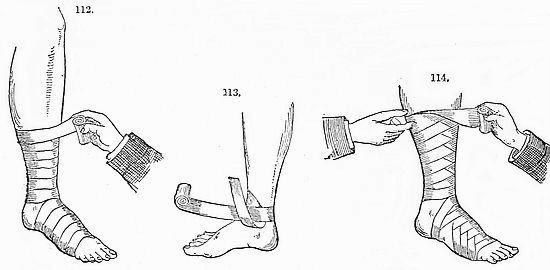
112. 113. Simple Spiral Bandage. 114. Reversed Spiral Bandage.
Roller bandages are applied in 3 different ways: (1) simple spiral, (2) reverse or recurrent, (3) crucial or figure-of-8. When first applying the bandage, leave the end a little long, so that when the first turn is made, by laying this end under, and bandaging over it again, it is prevented from slipping. The application of the simple spiral is shown in Figs. 112, 113, each turn overlapping the preceding one to the extent of about ⅔rds the width of the bandage. This simple spiral is generally replaced by the reverse spiral, Fig. 114, which differs from it in that the bandage is turned back upon itself each time it is carried round the limb; it is not easily learnt, and requires practice before it can be done well; the thumb or forefinger of the hand not holding the bandage should be laid upon the limb at the point where the turn of the bandage is to be commenced, the other hand turning the bandage back upon itself. The crucial or figure-of-8 form is generally used at the joints, and always when going over the ankle-joint in bandaging from the foot up the leg. Carry the bandage over the upper part of the joint, then down, under, and across the lower part, and then up over the upper part again. Remember always to bandage from within outwards; commence from below and work upwards; let the pressure be evenly and uniformly applied, but not too lightly; avoid all wrinkles in your bandage; reverse or turn a bandage over always on the fleshy side, and not over a bone; fasten it with a few stitches.
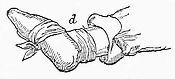
d Triangular Bandage on Foot.
The triangular bandage may well be represented in every-day life by an ordinary large pockethandkerchief folded from corner to corner. Its application is almost endless and simplicity itself. A few examples of the manner in which it may be used are shown in Figs. 115, a, b, c, d; it is fastened merely by tying the ends in a double knot.
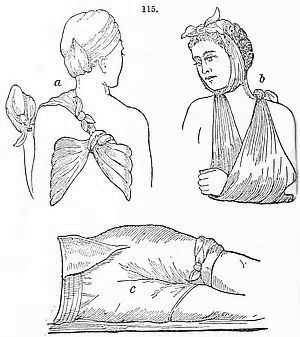
115. a b c Application of Triangular Bandage.
Broken ribs are of common occurrence, and give rise to great pain, because every time the injured person breathes, the ribs, rising and falling, allow the broken ends to grate against each other. A temporary method of relieving this pain and keeping the broken ends in apposition, is to roll a wide flannel or calico bandage tightly round the chest 3 or 4 times.
Burns and Scalds.—(a) In all but very slight cases of burns and scalds, the patient should be seen by a doctor at once, as the constitutional symptoms consequent upon these accidents require skilled attention. With regard to the immediate local applications. The clothes having been most gently and cautiously removed (being cut in all places where they adhere to the burnt and scalded skin) and any blisters having been simply pricked, the surface should at once be covered with some unirritating substance which excludes the air and keeps up a good heat. For this purpose many things are advocated, such as flour, starch, a mixture of collodion and castor oil, and “carron oil” (equal parts lime-water and linseed oil). A smooth, thick layer of cotton wool should be laid over this, or failing that a blanket, but do not let the blanket touch any raw place without the intervention of a piece of fine linen rag soaked in oil, or it would stick, causing great pain when removed.
(b) Linen dipped in a solution of carbonate of soda or potash relieves the pain sooner than anything. The best form is a saturated solution of bicarbonated soda in either plain water or camphorated water; if applied speedily it is most effectual in immediately relieving the acute burning pain; and when the burn is only superficial, or not severe, removing all pain in the course of a very short time, and preventing the usual consequences—a painful blistering of the skin, separation of the epidermis, and perhaps more or less of suppuration. For this purpose, all that is necessary is to cut a piece of lint, or old soft rag, or even thick blotting-paper, of a size sufficient to cover the burned or scalded parts, and to keep it constantly well wetted with the soda lotion so as to prevent its drying. By this means, it usually happens that all pain ceases in ¼-½ hour. Where the main part of a limb, such as the hand and fore-arm or the foot and leg have been burned, it is best to plunge the part at once into a vessel filled with the soda lotion, and keep it there until the pain subsides.
(c) The matter given off from burnt surfaces soon emits a very offensive odour. Therefore it is wise to mix an antiseptic substance with the remedies—e.g. carbolic acid or thymol, which not only prevent the bad odour from the suppuration, but also tend to alleviate the suffering. It would be well to always keep ready mixed an ointment for burns containing 1 per cent. thymol.
(d) The free use of soft soap upon a fresh burn will remove the fire from the flesh in very little time. If the burn be severe, after relief from the pain, use linseed oil, and then sift upon it wheat flour. When this is dried hard, repeat the oil and flour until a complete covering is obtained. Let this dry until it falls off, and a new skin will be formed without a scar.
(e) Take ice well crushed or scraped, as dry as possible, into the finest division; then mix it with fresh lard until a broken paste is formed. The mass is put into a thin cambric bag, laid upon the burn or scald, and replaced as required. So long as the ice and lard are melting there is no pain from the burn; return of pain calls for the repetition of the remedy.
(f) Whether the skin is broken or not, apply soft cotton or linen rags, dipped in a solution of Epsom salts, 1 oz. to the pint of cold water, and lightly bound over the burnt part or parts, the bandages to be kept constantly moist with the solution, and never removed till a cure is effected, which will be in 2-3 hours to 2-3 days, according to the severity and extent of the burning. While this application in all cases gives instant relief from pain, it is especially useful in removing the tendency to collapse and nervous dread.
(g) Cover the place over at once with the preparation of chalk, called common kitchen whiting, mixed, either with sweet oil or water—oil is preferable—into a thick paste. Plaster it gently on with a brush or a feather about ⅛ in., or more, thick; taking care, if possible, not to break the blister, or blisters. Then cover the part affected with a piece of flannel, to keep the moisture in, and damp the layer of whiting from time to time with oil or water. If kitchen whiting cannot be procured, use flour instead; and if neither can be had, then cover the scalds or burns with bits of rag dipped in sweet oil, and lay plenty of cotton wool outside them. Change the dressings only often enough to keep the places clean, and then wash them off with a weak solution of carbolic acid.
(h) A method in use in the public hospitals of the city of New York, known as “glue burn mixture” is composed as follows 7½ troy oz. white glue, 16 fl. oz. water, 1 fl. oz. glycerine, 2 fl. dr. carbolic acid. Soak the glue in the water until it is soft; then heat on a water-bath until melted; add the glycerine and carbolic acid, and continue heating until, in the intervals of stirring, a glossy, strong skin begins to form over the surface. When wanted for use, heat on a water-bath, and apply with a flat brush over the burned part. Pour the melted mass into small delf extract jars, cover with paraffin-paper and tin-foil before the lid is put on, and afterwards protect by paper pasted around the edge of the lid. In this manner, the mass may be preserved indefinitely.
(i) Saturate a soft piece of fabric with alcohol, lay it over the burn, then cover it with cotton or finely picked oakum: it will allay the pain. Subsequently disturb the dressing as little as possible; wet the dressing occasionally with alcohol. In burns from strong nitric acid, copious application of cold water, and even of such powerful bases as ammonia, potash, and lime in water, have no perceptible effect, except perhaps to increase the violence of the inflammation. But the effect of a dilute solution of sulphurous acid is astounding. In a very few minutes the blister will be reduced; the oxidising process of the acid will be completely arrested, the painful irritation removed, and in a short space of time the wound will heal. (A. Irving.)
In bad burns with lime, soap lye, or any caustic alkali, wash abundantly with water (do not rub), and then with weak vinegar or water containing a little sulphuric acid; finally apply oil as in ordinary burns.
(j) To recover a person in a state of insensibility from the effect of smoke, dash cold water in the face, or cold and hot water alternately. Should this fail, turn him on his face, with the arms folded under his forehead. Apply pressure along the back and ribs, and turn the body gradually on the side; then again slowly on the face, repeating the pressure on the back. Persevere with these alternate rolling movements about 16 times in a minute, until respiration is restored, A warm bath will now complete the recovery.
(k) In scalding by boiling water or steam, cold water should be plentifully poured over the person and cloths, and the patient then be carried carefully to a warm room, laid on the floor or carpet, or on a table, but not put into bed (as there it becomes difficult to attend further to the injuries), to await the doctor. If the patient complains of thirst, a warm, stimulating drink (such as tea) should be given, as after severe burning the temperature of the body is sure to fall. Children sometimes receive serious scalds of the mouth and throat by swallowing hot fluid or steam from a spout. Medical assistance should be obtained without delay, as an immediate operation may be required to prevent death from suffocation. Until the arrival of the doctor the patient should inhale warm vapour, to relieve the fits of choking; the best way to make a person inhale vapour is to construct a kind of tent of blankets around the patient, and allow the steam from a kettle, to puff into it.
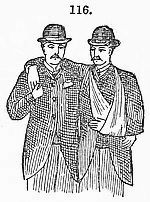
116. Supporting patient.
Carrying injured persons. (a) By Bearers.—If no conveyance can be procured or improvised, you can transport an injured person a short distance by human bearers. If only one is available, and if the patient can stand up, let him place one arm round the neck of the bearer, bringing his hand on and in front of the opposite shoulder of the bearer. The bearer then places his arm behind the back of the patient and grasps his opposite hip, at the same time catching firmly hold of the hand of the patient placed on his shoulder with his other hand. Then by putting his hip behind the near hip of the patient much support is given, and, if necessary, the bearer can in this way lift him off the ground, and, as it were, carry him along. This is an admirable way of helping an invalid to walk up stairs. If the patient cannot stand, the only way in which one person can remove him is by getting him on his back; this is not practicable in a case of broken thigh (Fig. 116).
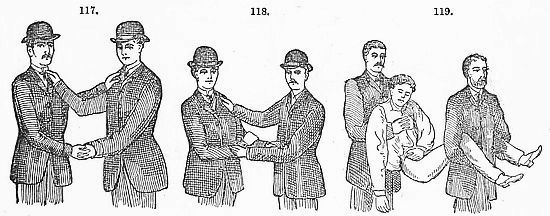
117. 118. 119. Methods of carrying a helpless patient.
When 2 bearers are available, the patient may be carried several different ways:—(1) In a sitting position, by the bearers joining two of their hands underneath his thighs, close to the buttocks, while their other two hands are placed round his loins and clasped together. The patient, if able, can help to support himself by clasping the bearers round their necks. (2) By 2 of the bearers’ hands forming a seat and the other 2 arms a back support (Fig. 117). (3) By 3 of their hands forming a seat, while a back support is made by the remaining arm (Fig. 118). (4) A seat may be made with all 4 hands, and especially if the patient is able to sit up and help support himself by placing his arm over the shoulders of the bearers, he may be carried a long distance by this method. Fig. 119 shows another plan, and Fig. 120 indicates how the hands should grasp each other.
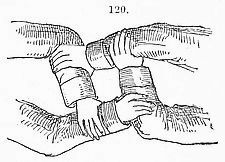
120. Forming a seat.
(b) By Stretcher.—To place an injured person on a stretcher and convey him properly requires 3 bearers, unless the distance be very great; 2 carry the stretcher, and a third attends to the patient, and changes place with one of the bearers if necessary. To lay a patient on it, put the foot of the stretcher at his head in a line with his body; 2 bearers then place themselves one at either side, join hands underneath the back and hips of the patient, raise him up, lift him backwards over the stretcher, and lower him on to it. The third bearer takes charge of the injured portion (limb or head), and steadies it with a hand on either side. The two bearers now take their places at the head and foot of the stretcher, lift it up, and carry it off; while the third walks at the side of it, as a safeguard to the patient. Observe the following rules in carrying a stretcher: (1) Carry it with the hands, or suspended by straps over the bearers’ shoulders, never place it on the shoulders, because the patient might fall off, or even die, without the bearer observing it. (2) Do not keep step, i.e. do not put the same foot forward, then the motion of the stretcher remains even. The pace must be short (about 20 in.) and without a spring; the knees must be rather bent, and the hips moved as little as possible. Jolting, hurrying, crossing ditches, &c., are to be avoided. Choose bearers of the same height, arrange the shoulder-straps so that the head may be carried a little higher than the feet.
Convulsions.—Till medical aid can be procured, put the child into a warm bath, in which you can bear your elbow. Sponge him well over, and put a sponge of cold water on his head.
Cuts and Wounds.—Wounds may be “incised” (made by a clean-cutting instrument), “punctured” (when the depth exceeds the breadth, as in stabs), “lacerated” (torn, and the lips of the wound irregular), and “contused” (effected by bruising). The chief points to be attended to are:—(a) Arrest the bleeding. (b) Remove all foreign bodies as soon as possible. (c) Bring the wounded parts in apposition, and keep them so, best done by means of strips of adhesive plaister, first applied to one side of the wound, and then secured to the other; these strips should not be too broad, and space must be left between the strips to allow any matter to escape; wounds too extensive to be kept together by plaister, must be stitched by a surgeon. For punctured and severely lacerated or contused wounds a surgeon should be sent for.
For washing a wound, to every pint of water add either 5 gr. corrosive sublimate or 2½ teaspoonfuls carbolic acid. If the acid is used, add 2 tablespoonfuls glycerine, to prevent its irritating the wound. If there is neither of these articles in the house, add 4 tablespoonfuls borax to the water. Wash the wound, close it, and apply a compress of a folded square of cotton or linen. Wet it in the solution used for washing the wound, and bandage down quickly and firmly. If the bleeding is profuse, a sponge dipped in very hot water and wrung out in cloth should be applied as quickly as possible. If this is not available, use ice, or cloths wrung out in ice water.
Wounds heal in two ways.—(a) Rapidly, by primary union without suppuration, and leaving only a very fine scar; this only when the sides of wound can be accurately brought together, are not displaced by bleeding or exudation of matter, and when the wound is left quiet, protected from outward injury, and kept perfectly free from impurity. (b) Slowly, with suppuration, and the formation of granulations, and leaving a large red scar, as when so much skin has been destroyed that the edges of the wound cannot be brought together, or so lacerated and bruised that life is destroyed in them, or separated by blood or exudation of matter, or if the injured parts have been disturbed, or the wound has not been properly cleaned and disinfected. Want of cleanliness leads to putrefaction and the formation of matter, which separates the sides of the wound.
Drowning, Choking, and Suffocation.—The fatal termination to be avoided in all these cases is suspension of breathing, hence they may be classed under one head.
Drowning.—This is perhaps the most common, and embraces in great measure the remedies adapted to the other forms of suffocation. The first step is to send immediately for medical assistance, blankets, and dry clothing; but proceed to treat the patient instantly on the spot, in the open air, with the face downward, whether on shore or afloat; exposing the face, neck, and chest to the wind, except in severe weather, and removing all tight clothing from the neck and chest, especially the braces.
The points to be aimed at are—immediately the restoration of breathing; and, after breathing is restored, promotion of warmth and circulation. Efforts to restore breathing must be commenced immediately and energetically, and persevered in for 1-2 hours, or until a doctor has pronounced life extinct. Efforts to promote warmth and circulation, beyond removing wet clothes and drying the skin, must not be made until the first appearance of natural breathing; for if circulation of the blood be induced before breathing has recommenced, the restoration to life will be endangered.
To restore breathing, place the patient on the floor or ground with the face downwards, and one of the arms under the forehead, in which position fluids can more readily escape at the mouth, and the tongue will loll out, leaving the entrance to the windpipe free. The tongue may be easily kept extended by simply passing a small rubber band round it and the chin. The mouth and nose must be thoroughly wiped and cleaned from obstructions.
If breathing has quite or almost failed, means must be used to restore it; if not, proceed at once to promote warmth. There are several ways of inciting suspended respiration. The best, as requiring only one person, is Silvester’s method, as follows: Place the apparently dead person flat on his back, raising his head and shoulders slightly by means of a folded article of dress. Standing behind him, grasp his arms just above the elbow, and draw them gently and steadily upwards over the head, keeping them in that position for 2 seconds; by this means the chest expands and air is drawn into the lungs (Fig. 121). Then carry the arms back again in the same way and press them gently and firmly against the sides of the chest for 2 seconds; by this means the air is pressed out of the lungs again (Fig. 122). These movements are repeated carefully and perseveringly, about 15 times in a minute, till natural respiration begins. The first evidence of this is a sudden flush of colour in the face.
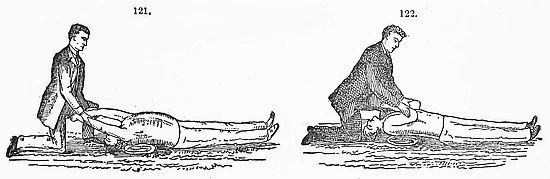
121. Inspiration (Silvester). 122. Expiration (Silvester).
When 2 persons are present, Francis’s plan may be adopted, thus: The body of the patient is laid on the back, with clothes loosened, and the mouth and nose wiped; 2 bystanders pass their right hands under the body at the level of the waist, and grasp each other’s hands, then raise the body until the tips of the fingers and the toes of the patient alone touch the ground; count 15 rapidly; then lower the body flat to the ground, and press the elbows to the side hard; count 15 again; then raise the body again for the same length of time, and so on, alternately raising and lowering. The head, arms, and legs are to be allowed to dangle down quite freely when the body is raised.
When 3 or more persons can assist, Marshall Hall’s method is available. To excite breathing, turn the patient quite on the side, supporting the head, and induce inspiration and expiration by alternately rolling the body over on its face, and back again, at 15 seconds intervals, as shown in Figs. 123 and 124.
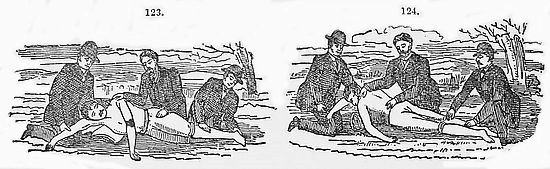
123. Inspiration (Marshall Hall). 124. Expiration (Marshall Hall).
As soon as a natural effort to breathe is produced, endeavour to restore circulation and warmth. Wrap the body in dry blankets and commence rubbing the limbs upwards firmly and energetically under the blanket or over warm clothing, which can generally be got from bystanders. Then put the patient into a warm bed, and cover over with hot flannels, applying bottles or bladders of hot water, or heated bricks, to the pit of the stomach, the armpits, between the thighs, and to the soles of the feet. When the patient is able to swallow, give him warm fluids by spoonfuls—coffee, tea, brandy and water, wine—but not in too great quantities. Warm baths should never be used but when ordered by the doctor.
Choking.—When a person gets a fish-bone or other substance in the throat, at once insert a finger into the mouth and press upon the root of the tongue, so as to induce vomiting. If this fails, let the patient swallow a piece of soft bread. If the substance can be felt by the finger, insert 2 fingers into the mouth and bring it away, using the safeguard of putting some hard substance between the teeth. A medical man should at once be sent for. Repeatedly sucking lemons will help to dissolve the bone. A marble or similar article in a child’s throat may be dislodged by turning him heels upwards and shaking.
Suffocation.—Remove the patient immediately to the fresh air; dash cold water in the face and on the chest; keep up the warmth of the body, and apply mustard plaisters over the heart and round the ankles. If these means fail, without loss of time try artificial respiration, as already described.
Before entering a suffocating atmosphere to rescue persons, tie a towel soaked in vinegar and water over the mouth. Admit fresh air to the room if possible.
Fits, Fainting, and Unconsciousness.—These bear a strong outward resemblance to each other while due to very different causes. The latter are principally: (a) injuries to the brain, with or without fractures of the skull; (b) diseases of the brain (including fits), apoplexy, epilepsy, &c.; (c) poisoning by narcotics and by retention of urine (in kidney disease); (d) fainting (paralysis of the heart through fright, exhaustion, loss of blood, &c.).
In such cases gather a history of the occurrence, and note the position of the body and its surroundings; also whether the breath smells of spirits, which shows there has been drinking, but remember that other and more serious conditions (paralysis, injury to the brain, &c.) may co-exist with intoxication. Lay the body on the back, with the head low if the face is pale, as in faintness after great loss of blood. If the face is red, the head must be raised. If sickness sets in, incline the head at once, so that the vomited matters may not be drawn into the lungs. Undo all clothing round the neck. Allow free circulation of air round the patient. Remove the patient as quickly as possible to the nearest hospital or doctor on a stretcher.
In epileptic fits, recognised by convulsive spasms of the limbs and body, contorted and congested face, foaming at the mouth, and bitten tongue, act on the rules just mentioned, and do all in your power to prevent the patient injuring himself, without attempting to restrain his movements. Lay something soft under his head, put something between the teeth, watch till the fit is over, and then remove him. In cases of fainting at once lay the patient flat, with the head brought to the same level as the body, to enable the blood more easily to circulate through the brain, for it is want of power in the heart to propel the blood to the brain that has caused the insensibility. If bleeding is going on, it must at once be arrested. As stimulants, eau de Cologne, sal volatile, ammonia, &c., may be used, but the important thing to remember is the position of head and body. Stimulation is apt to start afresh the bleeding arrested by fainting. In cases of snoring, with face flushed (apoplexy), undo clothing round the neck, keep the head raised, dash cold water on the top of the head, and apply hot-water bottles to the feet; send for doctor; do not give brandy.
Frostbite.—In serious frostbite or cases of exposure to intense cold, endeavours to restore life should be made with the greatest care. If you bring the patient suddenly into a warm room, death will follow certainly. Carry him carefully into a closed but cold room, and undress him with care for fear of breaking the stiffened limbs. If snow is to be had, cover and vigorously rub the whole body with it. If not, cover and rub with cold wet cloths or cold sand, or put him into a cold bath. Alternately with this try artificial means to restore breathing (as in drowning). When the patient begins to breathe naturally, and the limbs become less stiff, he should be carried into a moderately warm room and covered lightly with cold coverings and sheets. After this, he may be rubbed by degrees with warm cloths, and the warmth of the room gradually increased. Then try by means of smelling-salts, ammonia, or ether, and slightly stimulating drinks, such as light cold wine, cold coffee or soup, to recall consciousness. Should any part of the body remain without sensation, blue, swollen, or blistered, there is great danger of mortification setting in.
For after consequences, which recur most frequently in cold weather, apply balsam of copaiba, spread thickly on a piece of linen or muslin, the affected parts being covered with the application, which is allowed to remain over the night. By day, some of the balsam is to be spread over the affected parts. After one or two applications the pains cease and the redness disappears; whilst a few additional applications seem to give to the parts a power of resistance to frostbite.
Dr. Lapatin advises that fingers and toes which have been slightly frost-bitten, and which subsequently suffer from burning, itching, and pricking sensations, should be painted, at first once, and afterwards twice a day, with a mixture of dilute nitric acid, and peppermint water in equal proportions. After this application has been made for 3-4 days, the skin becomes darkened and the epidermis is shed, healthy skin appearing under it. The cure is effected in 10-14 days.
The members of the Austro-Hungarian Polar Expedition found most benefit from a mixture of iodine and collodion.
Lightning Stroke.—Apply cold to the head, and, if necessary, warmth to the extremities; rub the limbs well, and give stimulants as soon as the patient can swallow.
Poisons.—In all cases of poisoning, at once note the position and surroundings of the patient, and whether bottles likely to have contained poison are at hand. Send for the nearest doctor, and proceed immediately to get the poison out of the stomach by encouraging vomiting. Vomiting is often one of the first and most important signs of poisoning, and then only requires fostering by large draughts of warm water. If vomiting is not present, at once administer an emetic, such as sulphate of zinc in 20-30 gr. doses, 2 tablespoonfuls ipecacuanha wine mixed with warm water. In the absence of these, resort to mustard and water, a teaspoonful or two in warm water frequently repeated, or common salt and water may be used; vomiting may also be excited by tickling the back of the throat, and by freely drinking hot greasy water. A stomach pump must only be used by a surgeon; but a safe substitute, if the patient is conscious, is a piece of rubber tubing, about 3 yd. long and ½ in. diameter. Let the patient swallow about 2 ft. of this, then hold the free end of the tube above his head (Fig. 125) and pour down through a funnel 1-2 pints warm water, which will go direct into the stomach. By lowering the free end (Fig. 126) the stomach empties itself readily. By frequent repetition the cavity of the stomach is completely washed out.
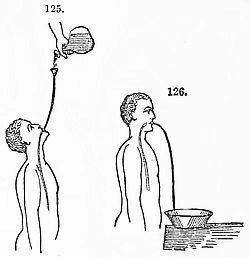
125. 126. Stomach-tube.
Try to ascertain what the poison is, and proceed to administer antidotes. Most poisons may be grouped under two classes—narcotic and irritant; the former being mainly organic (vegetable) substances, and the latter chiefly minerals. In narcotic poisoning, vomiting must be induced or the stomach emptied in some other way, and means must be taken to prevent sleep ensuing, by walking the patient about, slapping with wet towels, dashing cold water in the face, &c.; give strong black coffee to drink (or with an enema); put icy cold compresses on the head, and mustard plaisters on the stomach and calves of the legs. In irritant poisoning, the poison itself is pretty sure to cause vomiting, which then need not be encouraged. To protect the stomach and gullet from the corrosive action of irritant poisons, bland and oily fluids, such as salad oil, egg-white, milk, flour and water, should be freely administered.
The following summary of poisons and antidotes will be found useful:—
Narcotic Poisons.
Poison.Antidote.
Aconite, monkshoodemetics; warmth; rub the skin.
Alcohol, alcoholic drinksemetics; cold douche; keep awake.
Belladonna, deadly nightshadeemetics; strong coffee; hot and cold douches alternately; artificial respiration.
Chloral hydrateemetics; strong coffee enema; hot blankets, and water bottle to feet; artificial respiration; keep awake.
Chloroformfresh air and artificial respiration; hot and cold douche.
Cyanide of potassium, prussic acid, laurel water, essential oil of almonds, benzol.emetics; stimulants; cold and hot douche; artificial respiration.
Etheras chloroform.
Fool’s parsleybrandy; strong tea; warm applications to extremities.
Foxgloveemetics; stimulants; prolonged recumbence.
Hemlockemetics; strong tea; warmth and rubbing; artificial respiration.
Henbanea large spoonful of animal charcoal, emetics 10 minutes later, then brandy or coffee; keep awake.
Laburnum pods or seeds5-6 gr. zinc sulphate as an emetic.
Meadow saffronbrandy; strong tea; warm mucilaginous drinks.
Mushroomsemetics; stimulants; warmth and rubbing.
Opium, chlorodyne, Godfrey’s cordial, poppies, soothing syrups.emetics; hot coffee; cold douche; keep awake; artificial respiration.
Poison ivy {on the body}apply a weak solution of sugar of lead.
Poison dogwood {on the body}
Spurge laurel, mezereumbrandy and warm mucilaginous drinks.
Strychnine, vermin-killersemetics; chloroform in an inhaler.
Yew berriesemetics; brandy; warmth to extremities recumbent position.
Irritant Poisons.
Acid—carbolic, creosote.emetics; lime-water; salad oil; coffee.
Acid—oxalic, potassium oxalate, salt of sorrel, salt of lemon.water containing chalk or whiting, but not ammonia, potash, or soda.
Acids—acetic, hydrochloric, nitric, sulphuric; spirit of salt.abundance of water containing chalk, magnesia, sal-volatile, washing soda, or whiting; egg-white, milk, thick gruel.
Alkalies—ammonia, potash, soda.water containing lemon-juice or vinegar; salad oil, milk, egg-white, gruel.
Antimony, tartar emeticemetic if needed; plenty of strong coffee; egg-white, milk.
Arsenic, emerald green, fly paperemetics; magnesia; warmth and friction; strong coffee; best antidote is moist peroxide of iron, which can be made by dissolving ½ oz. iron sulphate and ½ oz. potash carbonate (or ¾ oz. soda carbonate) separately in warm water and mixing, adding ¼ oz. magnesia— calcined if handy—dilute with ½ pint hot water, and drink very hot.
Bichromate of potashemetics; magnesia, chalk, or whiting.
Blistering fluidemetics; egg-white, barley water, gruel; not oil.
Bluestoneemetic if needed; milk, eggs, barley water, gruel.
Caustic, nitrate of silverabundance of salt in water or milk, egg-white, barley water.
Chloride of mercury, corrosive sublimateemetic if needed; raw egg beaten up in milk, gruel, arrowroot; strong coffee.
Iodineemetics; plenty of gruel, arrowroot or starch.
Phosphorus, matches, rat poisonemetics; 10 drops oil of turpentine, every ¼ hour in gruel or milk with a little magnesia; egg-white, barley water.
Pyrogallolemetics.
Sugar of lead, paintemetics, zinc sulphate best; ½ oz. Epsom salts in water; egg-white, milk, barley water.
Turpentine, furniture polishemetics; milk, egg-white, barley water.
White precipitateemetics; coffee; egg-white beaten up in water, barley water, arrowroot.
Sprains.—A sprain is a sudden forcible stretching of the tendons or ligaments, or both combined, of a joint, and is always accompanied by most acute pain, and generally followed by rapid swelling. It is always tedious and troublesome, and hence often leads to more serious results; in all but very slight cases, a surgeon should be seen. Meantime give the injured part perfect rest, keep it in an elevated position, and apply cold water continuously, or immerse in water as hot as can be possibly borne, and after keeping it there for ¼ hour, frequently apply hot bran (or oatmeal and vinegar) poultices. As an embrocation, put ¼ lb. camphor in ½ lb. methylated spirits of wine; when dissolved, add 1 oz. oil of origanum, and rub the place night and morning, or use Elliman’s embrocation. In many cases of supposed severe sprain, some of the bones forming the injured joint are broken, therefore it is wise to treat these cases by the rules for broken bones before removing the patient.
Sunstroke.—In cases of simple exhaustion, ordinary treatment is all that is needed. Removal to a cooler locality, the cold douche (but not too much prolonged), or the administration of stimulants, may be beneficial. Tight or oppressive clothing should be removed, and the patient treated as in syncope from other causes. Rest and freedom from exposure to over-exertion, fatigue, or great heat, should be enjoined. In that form of sunstroke where the person is struck down suddenly by a hot sun, the patient should be removed into the shade, and the douche of cold water being allowed to fall in a stream on the head and body from a pump (or, as in India from the mussuck, or other similar contrivance), should be freely resorted to, the object being twofold—to reduce the temperature of the over-heated centres, and to rouse them into action. Mustard-plaisters and purgative enemata may be useful. If recovery be imperfect, and followed by any indication of injury to the nerve-centres, or by the supervention of meningitis, other treatment may be necessary according to the indications. Much exposure to the sun should be carefully guarded against; and, unless recovery be complete and rapid, the sufferer should be removed to a cooler climate, the most perfect rest and tranquillity of mind and body enjoined, and the greatest care be observed in regard to extreme moderation in the use of stimulants. (Dr. Fayrer.) For prevention, wear light head-gear with good protection to the nape of the neck; let the lining be double, one of green and the other of yellow material, and have ventilation holes at the sides and top.
Common Complaints
Common Complaints:—
Brain worries.—To the broad question, Are people suffering from overwork? Dr. Samuel Wilks, Physician to Guy’s Hospital, would have no hesitation in saying “No.” His remarks on the subject are worth repeating. He proceeds:—“On the contrary, if both sexes be taken, I should say the opposite is nearer the truth, and that more persons are suffering from idleness than from excessive work. Medically speaking, I see half a dozen persons suffering from want of occupation to one who is crippled by his labours. I have, therefore, very little sympathy with the prevalent notion that nervous and other diseases are due to overwork. As regards the community generally, or at least those of its number who come before the medical man on account of their ailments, my belief is that the explanation they offer arises from a delusion; and amongst girls, so far from any studies or other work being injurious, I could instance numerous cases of restoration to health on the discovery of an occupation. Very often, when a business man complains of being overdone, it may be found that his meals are very irregular and hurried, that he takes no exercise, is rather partial to brandy and soda, and thinks it not improper to half poison himself with nicotine every night and morning. The lady in the same way eats no breakfast, takes a glass of sherry at 11 o’clock, and drinks tea all the afternoon; when night arrives she has become ready to engage in any performance to which she may have been invited. When the man of business presents himself, with his nerves really overstrained, he is found to be a man of delicate or actually insane temperament. The rule, however, is that when a patient comes before me with his nerves unstrung, hypochondriacal, and goes through the whole machinery of his body to inform me of its working, previously committing all the facts to paper lest an important one should be forgotten, that man is getting rusty from having no occupation.... We forget sometimes what a formidable machine is the animal body, with its force-producing nervous system. The brain is an engine of many horse power; its energy must be accounted for in some way; if not used for good purposes, it will be for bad, and ‘mischief will be found for idle hands to do.’ It is fortunate that, with many girls, the frivolities of life keep them idly busy, and so, having a safety valve, they are harmless to others and themselves; but let a girl occupy herself neither with what is useful nor with amusement, she falls into bad health, she becomes a prey to her own internal fires or forces, and every function of her body is deranged, as well as her moral nature perverted. Cases of this kind appear to me of the commonest order, and at the same time very difficult of cure, because the mother’s aid can rarely be gained to assist the doctor; but, on the other hand, her sympathies too often only foster her daughter’s morbid proclivities by insisting on her delicacy and the necessity of various artificial methods for her restoration, as well as her resistance to the doctor’s advice for a more natural life, since she is sure it cannot be undertaken. Her daughter is too delicate for any of the occupations or modes of exercise proposed. What she requires is medical attendance, and to be alcoholised and physicked. It is remarkable, however, what a young lady can do under the power of a stimulus—as, for example, a gentleman lately expressed his surprise to me how his daughter, who could not walk many yards for a long time, owing to a pain in her back, was soon able to walk many miles a day when she procured the support of her lover’s arm. It is from considerations of this kind that, when the superfluity of women, amounting to half a million, doomed to be unmated, ask for employment, I cannot deny it to them. The human body is made for work, physical and mental. The amount it can do is of course proportionate to the power of the machine; but, unlike all other machines, its strength is only maintained by use, as assuredly it rusts and decays by disuse. Just as the muscles are better prepared for work by previous training, so the nervous system, whether it be the brain or spinal cord, becomes more energised by use. If healthy and vigorous persons be taken, there appears no absolute necessity for rest at all in the popular sense of the term. The rest required is gained during sleep, during meals, and necessary healthful exercise. It is only during sleep that the brain is actually inactive, although even then not absolutely, for at meals cheerful conversation keeps the mind employed, and even in our walks the attention is fixed on objects around. In times so occupied there are many persons whose minds are never idle, and who yet live to a good old age. Practically they have no rest, for when one object of study is complete, they commence to pursue another. It is by the happy faculty of diverting the powers into different channels that this is accomplished. Instances might easily be quoted of statesmen, judges, and members of our own profession who know no absolute rest, and who would smile at the suspicion of hard work injuring any man. I make it a custom to ask young men what their second occupation is—what pursuit have they besides their bread-earning employment. Those are happiest who possess some object of interest, but I am sorry to say there are few who find delight in any branch of science. The purely scientific man finds his best recreation in literature or art, but even in intellectual work so many different faculties are employed that a pleasant diversion is found in simply changing the kind of labour. For example, a judge after sitting all day, and giving his closest attention to the details of the cases before him, may yet find relief in his evenings by solving problems in mathematics. The subject of overwork, then, is one of the greatest importance to study, and has to be discussed daily by all of us. My own opinion has already been expressed, that the evils attending it on the community at large are vastly over-estimated; and, judging from my own experience, the persons with unstrung nerves who apply to the doctor are, not the Prime Minister, the bishops, judges, and hard-working professional men, but merchants and stock-brokers retired from business, Government clerks who work from 10 to 4, women whose domestic duties and bad servants are driving them to the grave, young ladies whose visits to the village school or Sunday performance on the organ is undermining their health, and so on. In short, and this is the object of my remarks, I see more ailments arise from want of occupation than from overwork, and, taking the various kinds of nervous and dyspeptic ailments which we are constantly treating, I find at least six due to idleness to one from overwork.”
For a long time it has been well known to the medical profession that in various critical states of the human system absolute silence, or the nearest possible approach to it, is not the least important condition to be secured. Accordingly muffled knockers, streets covered with straw or spent tan, and attendants moving about with noiseless step, are universally recognised as the signs and the requirements of severe disease. But the truth that noise is a contributor to the wear and tear of modern city life has scarcely yet been realised by the faculty, not to speak of the outside public. Consequently, while a zealous war is being urged against other anti-sanitary agencies, no general attempts for the abolition of superfluous noise have yet been made. We cannot, perhaps, give anything approaching to a scientific explanation why sound in excess should have an injurious effect upon our nervous system. We feel that noise is distressing, exhaustive. The strongest man after days spent amidst noise and clatter, longs for relief, though he may not know from what. It may even be suggested that the comparative silence of the sea-side, the country, or the mountains, is the main charm of our summer and autumn holidays, and contributes much more than does ozone to restore a healthy tone to the brains of our wearied men of business. Indeed, if we consider, we shall find that this is the most unnatural feature of modern life. In our cities and commercial towns the ear is never at rest, and is continually conveying to the brain impressions rarely pleasant, still more rarely useful or instructive, but always perturbing, always savouring of unrest. In addition to the indistinct but never-ceasing sea of sound made up of the rolling of vehicles, the hum of voices, and the clatter of feet, there are the more positively annoying and distracting elements, such as German bands, organ grinders, church bells, railway whistles, and the like. In simpler and more primitive times, and to some extent even yet in the country, the normal condition of things is silence, and the auditory nerves are only occasionally excited. It is scarcely to be expected that such a change can be undergone without unpleasant consequences.
The question has been raised, why should some noises interfere with brain work by day and disturb our rest at night so much more than other? A strange explanation has been proposed. We are told that sound made incidentally and unintentionally—such as the rolling of wheels, the clatter of machinery (except very close at hand), the sound of footsteps, and, in short, all noises not made for the sake of noise—distress us little. We may become as completely habituated to them as to the sound of the wind, the rustling of trees, or the murmur of a river. On the other hand, all sounds into which human or animal will enters as a necessary element are in the highest degree distressing. Thus it is, to any ordinary man, impossible to become habituated to the screaming of a child, the barking and yelping of dogs, the strains of a piano, a harmonium, or a fiddle on the other side of a thin party-wall, or the clangour of bells. These noises, the more frequently we hear them, seem to grow more irritating and thought-dispelling.
But while admitting a very wide distinction between these two classes of sounds, we must pause before ascribing these differences to the intervention or non-intervention of will. We shall find certain very obvious distinctions between the two kinds of sound. The promiscuous din of movement, voice, and traffic, even in the busiest city, has in it nothing sharp or accentuated; it forms a continuous whole, in which each individual variation is averaged and toned down. The distressing sounds, on the other hand, are often shrill, abrupt, distinctly accentuated and discrete rather than continuous. Take, for instance, the ringing of bells: it is monotonous in the extreme, but it recurs at regular intervals. Hence its action upon the brain is intensified, just as in the march of troops over a suspension bridge, each step increases the vibration. The pain to the listener is the greater because he knows that the shock will come, and awaits it. Very similar is the case with another gratuitous noise, the barking of dogs. Each bark, be it acute or grave, is in the highest degree abrupt, sharply marked, or staccato, as we believe a musician would term it. Though the intervals are less regularly marked than in the case of church bells, we still have a prolonged series of distinct shocks communicated to the brain. All the other more distressing kinds of noise possess the characters or shrillness, loudness, and of recurrent beats or blasts.
As an instance of an undesigned, unintentional noise being distressing to those within ear-shot, we may mention the dripping of water. A single drop, whether penetrating through a defective roof, falling from the arch of a cavern, or issuing from a leaky pipe, and repeated at regular intervals, is as annoying as the tolling of a bell, the barking of a dog, or the short, sharp screams of a fretful infant. The only difference is that the noise is not heard as far. We may hence dismiss the “will” theory, and refer the effects of noises of this class to regularity, accentuation, and sharpness.
It is particularly unfortunate that the multiplication of sound should accompany, almost hand in hand, that increase of nervous irritability and that tendency to cerebral disease which rank among the saddest features of modern life. A people worn out with overwork, worry, and competitive examinations might at least be spared all unnecessary noise. Many persons cannot or will not understand how necessary silence is to the thinker. A friend of the writer’s, engaged in investigating certain very abstruse questions in physics, is often compelled to throw aside his work when an organ grinder enters the street, and suffers with acute pain in the head if he attempts to go on with his researches.
We should therefore propose, as measures of sanitary reform, the absolute prohibition of street music, which is more rampant in London than in any other capital in Europe. The present law, which throws upon the sufferer the burden of moving in the matter, is a mere mockery. Another necessary point is the abolition of church bells. In these days of innumerable clocks and watches every one can tell when it is the time for divine service without an entire neighbourhood being disturbed for some 20 minutes at a time. Nonconformist places of worship collect their congregations without this nuisance. Further, all dogs convicted of persistent barking should be disestablished. And lastly, harmoniums, American organs, and wind instruments in general should be prohibited, except in detached houses. (Journal of Science.)
Chapped Hands.—(a) Some persons are sadly troubled with their hands cracking. It sometimes comes from a persons health; but there is one great thing to keep in mind—that is, every time you wash or wet your hands, be sure and dry them well. Always, after wiping them, hold them to the fire till quite dry. This is very important. As an outward application, spermaceti ointment, with a small quantity of lead acetate and some camphor well mixed is a good thing. Rub some well in at night on going to bed, and do not use strong soap.
(b) A mixture of 1-2 dr. hydrochloric acid to 4 oz. water for use in case of chapped hands, and even when the skin is cracked and bleeding, relieves the complaint at once, and if persevered in effects a cure.
(c) Into a 3 oz. glass-stoppered bottle pour ½ oz. pure glycerine; fill up with distilled water and shake. A few drops in the palm rubbed and distributed over the hands when nearly dry, after washing, will in a short time render the skin like satin. It is well to scald the bottle before filling, to check the development of vegetable organisms (“ropiness”). Do not increase this quantity of glycerine, or it will make your hands sticky.
(d) One part (say 1 oz.) pure glycerine, 1 of Eau-de-Cologne, 2 of water; mix them in a bottle and use a few drops well rubbed in after every washing of the hands, and as frequently in the day as can conveniently be done.
(e) Mix equal quantities pure glycerine and pure water together, and add as much common salt as the liquid will dissolve. Rub this frequently on the cracked portions of the hands, giving an extra quantity just before going to bed.
(f) Salicylic acid and borax, each 1½ dr., glycerine up to 2 oz.
(g) Equal quantities carbolic acid and glycerine.
Chilblains.—(a) Chilblains are likely to be caused by sudden change from cold to heat or vice versâ. This will explain why the hands and feet, nose and ears, are mostly the parts affected, because they are the parts most prominently exposed to such changes. Invalids and scrofulous persons are more likely to suffer than the robust and healthy. As prevention is better than cure, care should be taken to protect the parts by substances which are non-conductors of heat. Woollen socks, stout boots, and warm gloves are safe preventives, and especially taking care not to warm the parts affected by cold by any other means than friction, and in case of persons predisposed to chilblains, the frequent ablution of the extremities in tepid water and the use of good yellow soap is advisable, bathing the feet and hands in tepid water slightly salted, every night, is a good antiphlogistic. Should these means fail, where the skin is not broken, use a liniment of 1 oz. camphorated spirits of wine mixed with ½ oz. Goulard’s extract; but the best remedy is a lotion composed of 1 dr. iodine in 3 oz. rectified spirits of wine, to be applied with a brush not more than once a day. Should the chilblain be broken or ulcerated a different treatment must be adopted—warm poultices ought to be applied, and discontinued after about 3 days; the sores must then be touched with the tincture of iodine once a day, and then dressed with basilicon ointment; when they begin to granulate freely, a simple dressing of the above ointment is sufficient to complete a cure. Care ought always to be taken not to let chilblains break through the skin, as they are very liable to mortify.
(b) Copper sulphate in solution is about the best thing to allay the itching before they break. Also is used with very good effect an embrocation composed of 1 dr. tincture of capsicum and 7 dr. soap liniment. After they have broken, the best application will be carbolic acid and linseed oil—1 part of the former to 5 of the latter, to be applied with a feather (the pure acid should be used for this). This is the most useful application for any open sore.
(c) 1 dr. sugar of lead, 2 dr. white vitriol, then add 4 oz. water; shake well before using. Rub well on the affected parts with the hand before a good fire; the best time is in the evening. Do not use this on those that are broken. This scarcely ever fails to cure the most inveterate chilblains by once or twice using.
(d) Quite effective for unbroken chilblains, but it might be poisonous to broken ones, so be very careful:—A small quantity of yellow soap is dissolved in very little water, then methylated spirit is added to just thin it a little, then add, while hot, tincture of iodine drop by drop, stirring it the while; when it begins to change colour there is enough; let get cold, and apply night and morning, letting it dry on. It is only good while the spirit is in it.
(e) Take some precipitated chalk, and mix it in a mortar (or with a knife in a plate, but the first way is best) with some salad oil to something thicker than cream—about the thickness of Devonshire cream. At night apply it thoroughly over all the fingers, rubbing it in, and smearing it thickly on them, putting a pair of gloves on. Persevere every night.
(f) 6 gr. copper sulphate, ½ oz. Eau-de-Cologne, ½ oz. distilled water. To be applied twice a day with camel-hair brush. A capital remedy to arrest inflammation in chilblains.
(g) 2 oz. black bryony root, 10 oz. spirit of wine, 2 oz. water. Macerate 7 days and filter. Apply night and morning with a camel-hair pencil.
Cold Feet.—(a) There are two remedies—the hot bottle and lamb’s-wool socks, either or both of which may be used. When we consider that during the day, whilst we are active, we wear stockings and shoes, does it not seem strange that at night, when the temperature of the air is lower, and when we are inactive, that our feet should have less covering than during the day? The reasonable plan is to have a special pair of socks for night use, putting them on when going to bed, and change them when getting up; the result will be better and more serene sleep, consequently we shall be more able to undergo our daily exertions. A good walk for ½ hour before retiring warms the feet, and sends a nice glow all through the body, and disposes to sleep. (b) Wear horse-hair soles winter and summer, as a remedy for cold and damp feet.
Coughs and Colds.—The British Medical Journal remarks that there are several well-known processes by which a cold may be caught. As a disease, there is nothing so common; and yet it is only very recently that anything like an approach to a knowledge of its pathology has been attained. There is now, however, a large accumulation of evidence which points very strongly in the direction that “taking cold” is actually “being cold.” Colds are most frequently caught from a wetting. The clothes we wear are good non-conductors of heat, and so prevent the loss of body-heat which would occur without them. But let them become moist or saturated with water, and then they become heat-conductors of a much more active character, and a rapid and excessive loss of body-heat follows. Nothing is more certain, however, than that prolonged exposure in wet clothes is commonly followed by no evil results; that is, so long as there is also active exercise. The loss of heat is then met by increased production of heat, and no harm results. But let the urchin who has been drenched on his way to school sit in his wet clothes during school-hours, and a cold follows. No matter how inured to exposure the person may be who, when drenched, remains quiet and inert in his wet clothes, he takes a cold. Here there is an increased loss without a corresponding production of heat, and the temperature of the body is lowered, or the person “catches cold.”
The effect of exercise in producing heat is well known. Unless the surrounding air be of a low temperature and the clothes light, the skin soon glows with the warm blood circulating in it, and then comes perspiration with its cooling action. Here there is a direct loss of heat induced to meet the increased production of heat. Exercise, then, in wet clothes, produces more or less a new balance, and obviates the evil consequences which would otherwise result.
The loss of heat is more certainly induced if the skin be previously glowing and the circulation through the skin, the cooling area, be active. Thus, a person leaves a ballroom with his cutaneous vessels (pores of the skin) dilated, and a rapid loss of body-heat follows, unless there be a thick great-coat or a brisk walk; if the clothes become moistened by rain, or be saturated with perspiration, the radiation of heat is still more marked. Such is the causation of the cold commonly caught after leaving a heated ballroom. It is probable that exhaustion is not without its effect in lowering the tonicity of the vessels, and so those of the skin do not readily contract and arrest the loss of heat.
A damp bed gives a cold, because the moist bedclothes are much better conductors of heat than are the same clothes when dry. The temperature of the body is lowered, and a cold results. Long exposure in bathing leads to similar consequences. The second feeling of cold in bathing tells that the body is becoming chilled, and that the production of heat is insufficient to meet the loss. A run on the river-bank, or a brisk walk after dressing, commonly restores the lost balance.
The plan of permitting the wet clothes to dry on the wearer is very objectionable. The abstraction of heat from the body by the evaporation of moisture in the clothes produces a marked depression of the body-temperature, and a severe cold. This is most strikingly seen in the effects of a wetting in the Tropics. The smart shower or downpour is quickly followed by a hot sun and a breeze, and the loss of heat under these circumstances is considerable. The person is “chilled to the bone,” and the effects are felt for a long time afterwards.
Alcohol has been abandoned in Arctic regions. It dilates the cutaneous vessels and increases the loss of body-heat. The drunken man perishes of cold when the abstainer survives.
When the exposure follows a long continued warmth, the cutaneous vessels do not contract, but become dilated or paralysed, and then a large bulk of warm blood courses through the cooling surface, and a great loss of body-heat is entailed. Not only so, but the current of chilled blood passes inwards to the right heart and the lungs. Inflammations of the lungs are common along with severe colds; and this is possibly the explanation. Such inflammation is specially liable to occur if at the same time cold air be inspired. The cold respired air and the currents of chilled blood together, produce those vaso-motor disturbances in the lungs which, in their graver aspects, are known as pneumonia.
The practical considerations which are the outcome of this review of the pathology of cold are these. Never wear wet clothes after active muscular exertion has ceased, but change them at once; meet the loss of the body-heat by warm fluids and dry clothes; avoid long-sustained loss of heat which is not met by increased production of heat; increase the tonicity of the vessels of the skin by cold baths, &c., so educating them to contract readily on exposure—by a partial adoption, indeed, of the “hardening” plan; avoid too warm and debilitating rooms and temperatures; take especial care against too great a loss of heat when the skin is glowing; and prevent the inspiration of cold air by the mouth by some protecting agent, as a respirator. We can readily understand how a respirator should be an effective protection against winter bronchitis in those so disposed. Of course, no one should, even in summer, dispense with the use of flannel next the skin, or some substitute, such as merino. It is as important at that period of the year, as in winter.
Dr. Graham gives the following advice: “When you come out of a cold atmosphere you should not at first go into a room that has a fire in it, or if you cannot avoid that, you should keep for a considerable time at as great a distance as possible, and, above all, refrain from taking warm or strong liquors when you are cold. This rule is founded on the same principle as the treatment of any part of the body when frost-bitten. If it were brought to a fire it would soon mortify, whereas, if rubbed with snow, no bad consequences follow from it. Hence, if the following rule were strictly observed—when the whole body, or any part of it, is chilled, bring it to its natural feeling and warmth by degrees—the frequent colds we experience in winter would in a great measure be prevented.”
To neglect the conditions upon which strength of constitution and purity of blood depend, and then strive to avoid in a sedulously careful manner the evil influence of colds upon the body, is like neglecting the substance for the shadow of health; or more properly, it is like one who starves his body, and then strives to keep quiet in order that his strength shall not be exhausted. Let food be taken, and the exhaustion from exercise will not ensue; let all the conditions of health be observed, and then the natural changes of the weather will fall harmlessly on the healthy functions of the body.
Occasionally a cold may be arrested, in the first stage, by taking at the very outset, a hot bath on retiring to rest, with 10 gr. Dover’s powder at bedtime, followed by a hot drink, such as a basin of hot gruel or a tumbler of hot toddy, with a dose of castor-oil in the early morning about 6 o’clock. It is well to remain indoors for the day. Should, however, these means fail, or the ailment have progressed too far before the remedy is applied, and the patient complains of soreness of chest, with cough and feverishness, then he should keep bed for 3 days. Mustard and linseed poultices are to be applied to the chest, warm diluent drinks are to be given, such as gruel, with honey and vinegar in it, to promote gentle perspiration, and to relieve the severity of the cough. Ipecacuanha wine, 10-15 drop doses in water every 4 hours, will be found useful in promoting expectoration. Laxative medicine will probably be necessary, and the diet should be light.
The Continental remedy, lime-flower tea or tisane de tilleul is made in a teapot in the same way that tea is made, substituting lime blossoms for tea leaves, and using about 4 times the quantity to make it. It is taken hot, and used for colds, coughs, &c., much in the same way that gruel, wheys, and possets are taken in England.
Dr. Ferrier, of King’s College, communicates a remedy for cold in the head, which has been found effectual. It is a white powder used as snuff, and composed as follows:—2 gr. hydrochlorate morphia, 2 dr. acacia powder, 6 dr. bismuth trisnitrate. The whole makes up a quantity of powder, ¼-½ of which may be safely taken in 24 hours. Dr. Ferrier has twice cured himself of very severe colds by this means, once by the use of bismuth trisnitrate alone, which is a very powerful remedy for catarrh of the mucous membrane, and is the most important ingredient in the above mixture. Others have used the snuff with perfect success. Instead of increasing the tendency to sneeze, it almost immediately begins to diminish it. (Lancet.)
Prof. Strambio, in a note to an Italian medical journal, says that, notwithstanding the failure of all remedies hitherto recommended for the immediate cure of a cold, he wishes to communicate to the profession the great success he has found attending a new one in his own person, and to ask them to test its efficiency. He found prolonged mastication and swallowing of a dried leaf or two of the Eucalyptus Globulus (Blue gum) almost immediately liberated him from all the effects of a severe cold.
In the treatment of persistent cold in the head, or nasal catarrh, when there is much discharge from the nasal passages, we are advised to use a spray-producer with the following solution:—1 gr. carbolic acid, 2 dr. glycerine, 2 oz. water. After the passages are clean, a small quantity of vaseline is melted in the bowl of the spray-producer, and 2-5 drops pinus canadensis mixture are added. This mixture consists of:—15 gr. pinus canadensis, ½ oz. glycerine, ½ gr. carbolic acid, 1½ oz. water. This is to be applied by the spray to every part.
Dr. Sheppard says, in respect to the use of hot water as a remedial agent in the treatment of inflammation of the mucous membranes:—“I have used hot water as a gargle for the past 6-8 years. In throat and tonsil inflammation, and in coryza (cold in the head), if properly used in the commencement of the attack, it constitutes one of our most effective remedies, being frequently promptly curative. To be of service, it should be used in considerable quantity (½-1 pint at a time), and just as hot as the throat will tolerate.”