THE DWELLING. (continued 4)
Reading edition
Moisture, too, is an important consideration. The atmosphere, whether within doors or without, can only contain a certain proportion of moisture to each cub. ft., and no more, according to temperature. At 80° F. it is capable of containing 5 times as much as at 32° F. Hence, an atmosphere at 32° F., with its requisite supply of moisture, introduced into a confined space and heated up to 80° F., has its capacity for moisture so increased as to dry and wither everything with which it comes in contact; furniture cracks and warps, seams open in the moulding, wainscoting, and doors; plants die; ophthalmia, catarrh, and bronchitis are common family complaints, and consumption is not infrequent. But this condition of house air is not peculiar to stove-heat. It is equally true of any overheated and confined atmosphere. The chief difference is, that warming the air by means of a close stove is more quickly accomplished and more easily kept up than by any other means. Sometimes, by the scorching of dust afloat in the atmosphere, an unpleasant odour is evolved which is erroneously supposed to be a special indication of impurity, caused by the burning air. It is an indication of excessive heat of the stove. But the air cannot be said to burn in any true sense of the word, for it continues to possess its due proportion of elementary constituents. Such is the close stove and its dangers, under the most unfavourable circumstances.
The essentials for healthy stove-heat are brick-lined fire-chamber, ventilating or exhaust-flue for foul air, means for supplying moisture, and provision for fresh-air supply. A brick lining is requisite for the double purpose of preventing overheating, and for retaining heat in the stove. For the supply of moisture the means are simple and easy of control, but often inadequate. An efficient foul-air shaft may be fitted to the commonest of close stoves by simply enclosing the smoke-pipe in a jacket—that is, in a pipe of 2 or 3 in. greater diameter. This should be braced round the smoke-pipe, and left open at the end next the stove. At its entry into the chimney, or in its passage through the roof of a car, as the case may be, a perforated collar should separate it from the smoke-pipe. For stoves with a short horizontal smoke-pipe, passing through a fire-board, the latter should always be raised about 3 in. from the floor. A smoke-pipe thus jacketed, or fire-board so raised at the bottom, affords ample provision for the escape of foul air.
Hot-air furnaces are simply enclosed stoves placed outside the apartments to be warmed, and usually in cellars or basements of the buildings in which they are used. The manner of warming is virtually the same as by indirect steam heat—by the passage of air over the surface of the heated furnace or steam-heated pipes, as the case may be, through flues or pipes provided with registers. The most essential condition of satisfactory warming by a hot-air furnace is a good chimney-draught, which should always be stronger than that of the hot-air pipes through which the warmed air is conveyed into the rooms, and this can be measured by the force with which it passes through the registers. A chimney-draught thus regulated effectively removes all emanations; for, if the chimney-draught exceeds that of the hot-air pipes, all the gaseous emanations from the inside of the furnace, and if it have crevices, or is of cast iron and overheated, all around it on the outside will be drawn into the chimney. Closely connected with this requirement for the chimney-draught is the regulating apparatus for governing the combustion of fuel—the draught of the furnace. This should all be below the grate; there should be no dampers in the smoke-pipe or chimney, and all joints below and about the grate should be air-tight. The fire-pot should be lined with brick and entirely within the surface, but separate from it, so that the fresh air to be warmed cannot come in contact with the fuel-chamber.
An excellent plan for economising a good portion of the waste heat from a kitchen range is to have (previous to the range being fixed, or after, in some instances) a sheet-iron box or chamber made to fit at the back of the oven flues or wherever the most intense heat is felt. This box, which we may call an air-chamber, should be connected with the outer air, and a pipe for the warm air carried from the top of the box to the part where warmth is required; the heat from the range warms the air in the box and it ascends in exactly the same manner and upon the same principle as a hot-air furnace, but great care must be exercised to see that this box and all connections are made air-tight, or this plan will prove an unusually speedy means of indicating what is being cooked for dinner.
The Americans adopt what is called the “drum” principle of heating by means of a furnace; they not only encase the stove with an air-chamber, but the smoke-pipe is surrounded with a larger pipe encasing it all the way up; the space between the smoke-pipe and the outer pipe is thus an air-chamber and has free connection with the furnace air-chamber, but of course is closed at top; from the chamber surrounding the smoke-pipe, branch pipes are taken to the apartments, terminating in perforated cylindrical “drums,” from which the heated air is emitted.
It should go without saying that the air which passes from furnaces into living-rooms should always be taken from out of doors, and be conveyed in perfectly clean air-tight shafts to and around the base of the furnace. Preferably, the inlet of the shaft, or cold-air box, should be carried down and curved at a level (of its upper surface) with the bottom, and full width of the furnace. Thus applied, the air is equally distributed for warming and ascent through the hot-air pipes to the apartments to be warmed. On the outside the cold-air shaft should be turned up several feet from the surface of the ground, and its mouth protected from dust by an air-strainer. A simple but effectual way is to cover the mouth with wire cloth, and over this to lay a piece of loose cotton wadding. This may be kept in place with a weight made of a few crossings of heavy wire, and it should be changed every few months. And here, too, outside the house, should be placed the diaphragm for regulating the amount of cold-air supply, and not, as commonly, in the cellar.
As the best means of regulating the temperature and purity of the atmosphere from hot-air furnaces, it is necessary to provide sufficiently large channels for both the inlet of fresh air and its distribution through the hot-air pipes. The area of the smallest part of the inlet (or inlets, for it is sometimes better to have more than one) should be about ⅙ sq. ft. for every lb. of coal estimated to be burnt hourly in cold weather; and to prevent, in a measure, the inconvenience of one hot-air pipe drawing from another, the collective area of the hot-air pipes should not be more than ⅙ greater than the area of the cold-air inlet. These proportions will admit the hot air at a temperature of about 120° F. when at zero outside, and the velocity through the register will not exceed 5 ft. per second.
A large heating surface of the furnace is a well-recognised condition of both economy and efficiency. As a rule, there should be 10 sq. ft. of heating surface to every lb. of coal consumed per hour, when in active combustion; and the grate area should be about 1/50 of that of the heating surface. For the deficiency of heat, or the failure of some of the hot-air pipes of hot-air furnaces in certain winds and weathers in large houses or specially exposed rooms, the best addendum is an open fire-grate. With this provision in northerly rooms, to be used occasionally, hot-air furnaces may be made to produce all the advantages of steam heat in even the largest dwelling-houses.
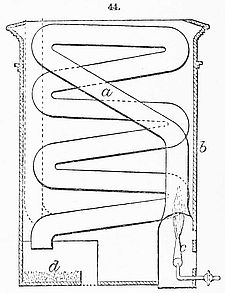
44. Boyle’s Warm-air Stove.
Boyle’s system of warming fresh air is suitable where hot air, water, or steam pipes are not available. The arrangement (Fig. 44) consists of a copper or iron pipe a about 1½ in. diam. placed in an inlet tube b, preferably of the form of a bracket. This pipe is not vertical, as in the so-called Tobin’s shafts, but of zigzag shape, crossing and recrossing the tube from top to bottom, and so causing the incoming air to repeatedly impinge in its passage through the tube. At the bottom of the tube an air-tight chamber, so far as the interior of the tube is concerned, is fixed, in which a Bunsen gas-burner c is placed, the flame of which plays up into one of the lower ends of the pipe, the upper portion being about 5 ft. 9 in. from the floor. The other lower end of the pipe either dips into a condensation box d in the bottom of the tube or is continued into an existing flue or extraction shaft. If the pipe terminates in a box, the vapour is condensed there and carried off through the outside wall by means of a small pipe. At the bottom of the box is placed some loose charcoal, which needs renewing at intervals. This charcoal absorbs any products of combustion which have a tendency to rise. The heat thus passes through the entire length of the pipe, and warms the air as it travels through the tube to the room or hall as required.
Heating by gas is now growing in favour, and under favourable circumstances is to be recommended. There are two general methods adopted; firstly, by gas fires, which are asbestos or metal made incandescent by gas heat; these are made either portable, or by fitting a specially made burner to an existing fireplace, and filling the grate with Lumb asbestos (which is made for the purpose, and when heated has the appearance of glowing coals); and secondly, by gas stoves acting upon a similar principle to a hot-air coal stove. The former are now made in great variety; they chiefly take the form of an ornamental iron frame, in the centre of which is fitted a fire-brick thickly imbedded in front with asbestos fibre; the burner beneath comes immediately under the front of the fire-brick, and when the gas is ignited, the asbestos at once becomes incandescent, making it of cheerful and fire-like appearance, and the fire-brick in a few minutes becomes highly heated, radiating its warmth into the room. This description of stove and also the burner for existing fireplaces can be obtained at any ironmongers or gas-fitters.
In nearly all gas fires and stoves the gas is burnt with an admixture of air (atmospheric gas, 1 of gas and 2 of air), by means of an atmospheric burner; this is not only a source of economy, but atmospheric gas has the very great advantage of being smokeless; but for this, a gas fire would be an impossibility; it must, however, be borne in mind that although smokeless this gas gives off products of combustion (carbonic acid, watery vapour, &c.), which must be carried away by a flue or other means. The portable stoves are always provided with a nozzle for attaching a smoke-pipe. There is still a doubt as to which is most economical, coal or gas: we cannot do better than quote the words of a well-known gas-stove maker, Chas. Wilson, of Leeds. He says, speaking of heating by gas: “It is not cheaper than coal, taking fuel for fuel and continually used, unless, as in the case of offices where labour has to be employed to light fires, clean grates, &c.; but it is cheaper than coal if occasionally used, as in the case of bedrooms, or sitting-rooms used by visitors, or rooms used by children for music, &c.; for bedrooms it is especially adapted for use for an hour or two at night or in the morning or for giving an unvarying heat all night. It is preferable in the matter of cleanliness, and a true solution of the smoke-abatement problem” (probably a coal-stove manufacturer would speak as much in favour of fire-grates).
It should be seen when purchasing gas fires that they have silent burners, as some make an objectionable hissing noise when in use.
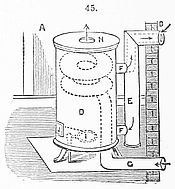
45. Calorigen Stove.
“The Calorigen” Gas Hot-air Stove, Fig. 45 (Farwig & Co., 36 Queen Street, Cheapside, London), consists of an outer sheet-iron casing with a burner at the base inside, and proper accommodation for exit of products of combustion. A coil of good-sized sheet-iron pipe is affixed within the stove; the lower end of the coil is connected with the outer air and the upper end opens into the apartment, thus producing a free inflow of fresh air at any temperature desired, from 60° to 200° F. or higher at will. The chief advantage of a gas stove is the immediate lighting and extinguishing, and needing no attention.
Another modern and very useful application of gas as a heating medium is the “Geyser” or rapid water heater for the supply of hot or boiling water to baths, lavatories, &c., or for business purposes where it is not convenient or desirable to fit up a circulating boiler (see hot-water apparatus). These heaters can be obtained from any ironmonger’s or gasfitter’s. The principle is somewhat different in the various makes, but it all results in the same thing, which is to bring a small volume of water in contact with a large heating surface. The apparatus is generally cylindrical in form. A cock is at one side for attaching the cold supply, and the heated water flows out from a spout at the other side; there is also a cock for attaching the gas supply; they are made in various sizes to supply and fill a bath three parts full of water at 100° F. in 5, 10 or 15 minutes, or to boil water at the rate of ½, 1 or 2 gal. per minute. These are extremely useful appliances where gas is available, being ready for use at a moment’s notice, and the water can be had at any temperature at will; with a modern and properly constructed “Geyser” the water is quite suitable for drinking purposes.
The Marsh-Greenall Gas Heating Stove, Fig. 46 (makers, Greenall and Company, 120 Portland Street, Manchester), is both regenerative and radiating, the heat developed and utilised per foot of gas by this system being far greater than by the ordinary atmospheric stoves. Ordinary luminous flames are used, these being fed by superheated air. There is no smell and no danger “of lighting back.” The great heat obtained by this system is radiated from a polished reflector. The consumption of gas is only 12 ft. per hour. See Gas Heating also, p. 994.
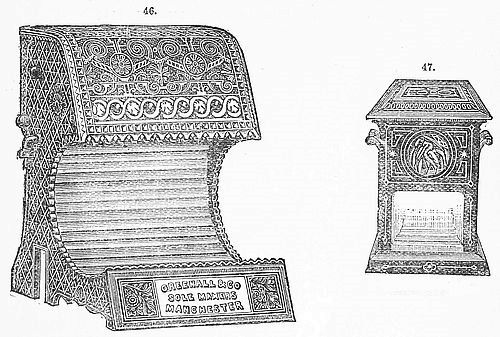
46. Marsh-Greenall Gas Stove. 47. Eureka Oil Stove.
Oil Stoves.—Warming stoves which burn oil fuel are to be commended for many purposes, but are not generally considered suitable for living rooms—bedrooms, for instance—unless the air is continually changed by open doors, &c., as there is a noticeable odour from the burning oil. Rippengille’s are considered the best, and are obtainable at almost any oil, lamp, or ironmonger’s store, or at the chief retail agents, the Holborn Lamp Co., 118 Holborn, London. Fig. 47 is their “Eureka” cheerful reflector stove, suitable for office or shop use. These stoves are adapted for warming conservatories where a high temperature is not required, as a very small stove will suffice to keep the frost out; they are also suitable for servants’ bedrooms and attics where no fireplaces exist. They are made with metal (unbreakable) oil containers, which slide out for lighting, trimming, &c., and they burn the ordinary petroleum oil; it naturally follows that the better and more refined oils give the best results with these stoves, with less liability of smell.
Flues.—It will not be out of place to give a short treatise upon flues, as the flues in a residence govern the efficiency of the stoves and the comfort of the whole household.
There is a common error in blaming the flue for all faults. It can be asserted that half the smoky chimneys are in no way the fault of the flue at all, and when a smoky chimney does exist, nearly every one flies to the chimney top with some device to govern the wind, and this in very many cases is a total failure.
Flues are now generally constructed of two sizes, 9 in. and 14 in. A 7 in. flue would be sufficient for most warming stoves, but it has to be borne in mind that the accumulation of soot quickly diminishes the size internally, so that they are now never built less than 9 in. internal diameter. In building a residence, the following plan is often adopted when cheapness is not the primary object, that is, to build the usual square brick chimney, and within this to carry up a 9 in. flue of glazed earthenware pipe (drain pipe), and the space outside this pipe filled with concrete: this pipe flue is so easily cleaned and is much less quickly fouled, and improves the draught.
The very general cause of smoky chimneys is that the chimney top is below the level of some adjacent building, tree, or other object that obstructs the free passage of the wind. In this instance the trouble is only experienced when the wind is in certain quarters, and sometimes this can be cured by a wind-guard or cowl (no particular make can be recommended, as their efficiency differs under different circumstances); but the only reliable remedy is to raise the chimney either by pipe or brickwork to the required height. The manner in which the annoyance is brought about is, that when the wind passes over the chimney top its progress is arrested by the higher object, and it may be said to rebound (the action is rarely quite alike in any two instances), causing either a portion of the gust to pass a short way down the chimney or to momentarily stop the up draught; this will be noticed by the gusts of smoke that come from the stove into the room.
When the smoke slowly oozes into the room, it is caused by sluggish draught, or often by the construction of the grate. If the grate has considerable distance between the fire-bars and the opening into the chimney above, it permits the heavy cold air to accumulate and obstruct the heated up-flow from the fire; this generally is only noticeable when the fire is first lighted or heavily fed. It is exactly the same result as is experienced with the old-fashioned open kitchen ranges, which nearly always require a sheet of metal or “blower” across the opening to prevent their smoking. The above-mentioned grates require a strong draught to work them perfectly; or if a strong draught does not exist, a small piece of sheet-metal should be provided to fit over the open space above the front bars when necessary to establish the fire, as explained with the “Eagle” grate.
Sluggish draughts are from a variety of causes, among which might be named, insufficient height of chimney; chimneys which by any cause may become damp or cold, or lose their heat rapidly; leakages, holes or fissures, and a variety of causes too numerous to mention here. The interior surface of a chimney should be as smooth as possible, and should be swept at regular and moderately frequent intervals, otherwise the draught will be reduced.
Every fireplace should have a distinct and separate flue; sometimes two fireplaces can be successfully worked into one chimney, but provision must be made for tightly closing off either one when not in use.
Hot Water.—Heating by means of the circulation of hot water has been in vogue many years, but has not found favour for warming living-rooms and apartments, owing chiefly to the want of the air of comfort, and the warmth is not quite so agreeable as that radiated from an open fire; but this mode of heating is especially well adapted for conservatories, cold halls, public buildings, &c., as the heat-giving surface can be extended wherever desired, and so heat the place equally throughout; and upon the low-pressure system there is no danger, as the water cannot heat higher than boiling-point, 212° F., an advantage that the hot-air system does not possess. The principle and cause of hot-water circulation will be found fully described under hot-water apparatus; but in this arrangement there are no draw-off taps, the services being for circulating only. For small purposes the apparatus can be attached to the ordinary bath boiler of the kitchen range; but there is a serious disadvantage in this when the heat is for conservatories or where warmth is particularly required at night, as that is the time when the kitchen fire is not in use. For larger purposes, independent boilers are used, varying in size according to the requirements. Portable boilers with fire-box, &c., complete, can be obtained almost anywhere, and most slow-combustion stoves (the “Tortoise,” for instance) can be fitted with boilers for this purpose. It will be understood that these boilers do not require cleaning out like kitchen-range boilers, as there is no appreciable deposit, the same water being heated day after day and only losing say a quart per month by evaporation.
The arrangement for a hall with an independent boiler is to have several horizontal pipes suitably fixed one above the other and known as a “coil,” from which the heat is radiated, and this coil is connected by a “flow” and “return” pipe with the boiler: a small cistern of about 2 gallons capacity is connected with, and fixed a little above the level of the highest part of the coil in some convenient place. The apparatus is charged through this cistern, and a small quantity of water is added thereto periodically to make good loss by evaporation and to keep the coil full; these coils are usually covered with an iron grated casing, with a metal, slate, or marble top, which is both a useful and ornamental adjunct to the hall.
For conservatories the coil is not used, the radiating pipes being run along the wall near the ground; a portion of the pipe has a shallow open trough cast upon it, and this is filled with water. As the apparatus becomes heated, evaporation takes place, and this saturates the air, moisture being essential for this purpose.
For public buildings, &c., coils are sometimes used; but more often the pipes are run in grated-topped channels just beneath the floor, the grating being level with the floor-boards; they are taken around or across the building, as is most desirable to obtain an equable heat.
The radiating pipes, whether single or forming coils, are generally 4 in. diameter, of cast iron (cast iron being a better conductor or dissipator than wrought), and at the highest point m the apparatus a hole is drilled and a small cock is inserted; this cock is opened when charging, to allow of the free escape of the air in the pipes, and it is sometimes of service to discharge any steam that is generated. The pipes are made with a socket at one end, into which the plain end of the next pipe is inserted and packed with yarn, &c.; but a modern and rapid method of joining the pipes is that patented and manufactured by Jones and Attwood, of Stourbridge; this joint consists of two flanges with indiarubber packing between, which makes a perfectly secure joint by tightening the flanges together; in this method the ends of the pipes are of equal size.
As explained, the principle of circulation is exactly the same in this as in a domestic hot-water supply apparatus. The most popular form is that known as the Desideratum. The makers have also introduced a singularly useful tool for cutting all pipes from 2 to 13 in. diameter.
High-pressure Heating, or which might be correctly termed steam heating, consists of piping wholly, the pipe is smaller and of wrought iron unusually strong, and a coil of it placed within the fire-box fulfils the duty of a boiler (no boiler or large container can be used on account of high pressure); from the furnace coil the pipe is carried wherever required, a small quantity of water is put within the apparatus and the air is driven out, after which the apparatus is sealed or closed air and steam tight. When the heat is applied, the water quickly forms steam, which at once finds its way throughout the apparatus and heats it to a much higher temperature than boiling water; and there is comparatively no danger whatever pressure is exerted, as at the worst the pipe only splits, and no disastrous explosion can occur; but this mode of heating cannot be recommended, as it rarely works for any length of time without requiring attention or repairs.
Bacon’s system of heating by water under pressure (J. L. Bacon & Co., 34 Upper Gloucester Place, London, N.W.) is very good, as the pressure is regulated by a valve, and the temperature and pressure never become excessive. This system is worked by small, strong wrought-iron pipes, and the apparatus is wholly filled with water. The great convenience of the small-pipe system recommends it for all purposes, as it can be carried into almost inaccessible places, and can be utilised for warming air, as it passes through inlet ventilators, and for small drying and airing closets, towel dryers, and for numberless small but exceedingly convenient purposes which large cast-iron pipes would be very unsuited for; and the advocates of this system contend that as much heat is radiated from their small pipes as from the ordinary large ones, as the former are heated to a much higher temperature than the latter: in Bacon’s system the highest limit is about 300° F.
The subject of a supply of hot water for baths and other purposes will be discussed in the chapter dealing with the Bath-room. See also p. 995.
Steam Heat.—Steam heat may well be compared with stove and furnace heat. Stove heat corresponds to direct radiation by steam, and furnace heat to indirect. The supply of fresh air from the outside to and over the hot-air furnace, and through hot-air flue into the rooms through registers, is virtually the same as when it is conveyed by means of steam-heated flues in the walls. Exhaust flues, for getting rid of foul air, are equally essential. The stove, as representing direct radiation in the same manner as the steam coil, or plate, in the room, has the advantage over the latter of some exhaust of foul air, however little, even when the smoke-pipe is not jacketed, for the steam heat has none. In comparison with open-stove heat, steam heat is at still greater disadvantage; for open stoves supply all the qualities of complete radiation—the introduction of fresh air and the escape of foul—to a degree wholly unattainable by steam heat, whether direct or indirect, or by hot-air furnaces, which always require special provision for the escape of foul air.
The advantage of stove and furnace heat over steam may be summed up thus:—It is more economical, more uniform, more easy of management, more suitable for small areas to be warmed, and is free from the noises and dangers of steam. Irregularities of the fire in steam heating are a constant source of inconvenience, and sometimes of danger. The going down of the fire during the night-time, or its neglect for a few hours at any time, is followed by condensation of the steam. On the addition of fuel and increase of heat, steam again flows quickly into the pipes where a partial vacuum has formed, and here, on coming in contact with the condensed water, it drives the water violently, and creates such shocks as sometimes occasion explosions; or, at least, produces very disagreeable noises and general uneasiness, and frequently causes cracks and leaks. Hence direct steam heat, which for warming purposes alone is altogether superior to indirect, has been well-nigh abandoned. Indirect steam heat places the leaks out of sight, but they commonly lead to mischief, and require special and expensive provision for access and repair.
Chemical Heaters.—Many salts in solution are capable of absorbing a considerable amount of heat and slowly giving it off as they resume a crystalline state. That most generally used is soda acetate, but an improvement consists in mixing 1 lb. of soda acetate with 10 lb. of soda hyposulphite, the latter assisting the melting of the mass and retarding crystallisation. The mode of applying this principle is to nearly fill a sheet copper or other metallic vessel, such as a foot-warmer, with the solution, and seal it up. When required for warming purposes, the vessel is placed in boiling or hot water till the contents are quite fluid, after which it may be used as a source of heat for 12-15 hours. Obviously the vessel may be placed in an ornamental structure resembling a stove, or used as a foot-warmer, or a muff-warmer, and in many other ways where fire is inadmissible.
Hints on Fuel, &c.—Suggestions for materials which may be used to eke out a scanty supply of coal cannot fail to be useful. One plan consists in well bedding lumps of chalk under small coal. This gives a long-lasting fire, but is apt to emit an unpleasant odour. Another plan is to make clay fire-balls, using common clay, coal dust and cinders with sand, in about the following proportions:—1 cwt. coal dust, 2 cwt. sand, 1½ cwt. clay, well mixing the ingredients, shaping into fist-like lumps, and drying over night before the fire; to be put on when the surface of the fire is clear.
Some further hints for reviving fires will be found under the Sick-room.
Lighting
Lighting.—The illumination of a dwelling is a most important consideration, as regards comfort and health.
Daylight.—Natural lighting is provided for by windows. The window area of a room should be well proportioned. In dwelling-rooms, it may amount to half the area of the external wall containing the windows; in churches, &c., ⅓ will suffice. Too great a window area is objectionable, as it considerably lowers the interior temperature in winter, unless very thick glass and double windows are provided. When windows become steamed or covered with condensed moisture in frosty weather, this can be cured by applying a very thin coat of glycerine on both sides of the glass. When direct daylight cannot be got, great advantage may be derived from using polished metallic reflectors.
Luminous Paints.—Several bodies possess the property of absorbing a certain amount of light and emitting it slowly. The most important of these is calcium sulphide. This property has been utilised by mixing the mineral with paint as a covering for surfaces where the light is required. The illumination, however, is very feeble.
Candles.—Candles will long retain a place in domestic lighting from their safety and convenience for carrying about. At the same time they are an expensive source of light, and not very powerful. It may here be mentioned that there is a right and a wrong way of blowing out a candle. If the candle is held on a level with the blower’s mouth, or blown down upon, as usual, as it stands on a shelf or table, the wick will smoulder and smoke till the room is filled with its disagreeable smell, and the wick burned away so that it can be lit next time with difficulty. If the candlestick is held well above the blower’s head, and the flame blown out from below, the ignited wick will almost immediately be extinguished, and no trouble will be found in re-lighting the candle. Avoid cheap candles; they burn rapidly to waste and play havoc with clothes and furniture by “dropping.” The best form of candlestick yet introduced is the “silver torch,” made by Wm. Nunn & Co., 204 St. George Street, London, E. By this the candle is converted into a lamp, with or without a globe as desired; the candle is completely consumed, leaving no ends, and guttering and dropping are quite prevented. Nightlights should always be burned under a glass shade, such as Clarke’s.
Oil Lamps.—All lamps intended for burning animal, vegetable, or mineral oils as illuminants should have the following objects in view:—To supply oil regularly to the wick; to apportion the supply of air to the description and quantity of oil to be burnt; to provide simple means for regulating the height of the wick, and consequently, the flame; and finally, to place the burning portion of the lamp in such a position as not to be obscured by the reservoir and other portions. The oldest lamps, as the antique Etruscan, and the cruisie of Scotland, were on the suction principle, and the wick depended for its supply upon its own capillary action. As the level of the oil was constantly varying, so the light varied also, and the first attempts of inventors were directed to maintaining an equal level of oil. The bird-fountain and hydrostatic reservoirs partly attained this end, and the Carcel and Moderator systems were perfect of their class, mechanical or pressure lamps. It is evident that suction lamps depend for their efficacy upon the gravity of the combustible. A spirit lamp, with a good wick, will burn very well, though the wick be several inches above the liquid. With liquids volatilising at low temperatures, there is always a danger of the formation of explosive mixtures.
In the Silber lamp the burner is a simple aggregation of concentric tubes. The use of these, especially of the innermost, bell-mouthed pipes, becomes very apparent in the lighted lamp. Remove the interior tube, and immediately the flame lengthens and darkens, wavers and smokes. The current of air which is, by this internal conduit, directed into the interior flame surface, is the essential principle of Silber’s invention. The wick is contained in a metal case, surrounded by an air-jacket, which passes down the entire length of the lamp, leaving a small aperture at the base, through which the oil flows from the outer reservoir to the wick chamber. Thus, by the interposition of an atmospheric medium, the bulk of the oil is maintained throughout at a low temperature; 2 concentric bell-mouthed tubes pass down the interior of the wick case, and communicate with the air at the base of the lamp, which is perforated for the purpose; 2 cones, perforated, the inner and smaller throughout, the largest only at the base, surround the wick, and heat the air in its passage through the holes to the flame. The effect of these appliances is, firstly, by the insulation of the outer reservoir, to avoid all danger of vaporisation of the oil, till actually in contact with the wick. As it is drawn nearer and nearer the seat of combustion, the hot metal wick-holder heats, and ultimately vaporises the luminant, so that at the opening of the wick tube concentrically with the air conduits—all of which are exceedingly hot—a perfect mixture of vapour and hot air is formed, and burned. An all-important feature is the shape and position of the chimney, which influences the flame to the extent of quadrupling its brilliancy if properly adjusted. (Field, Cantor Lecture.)
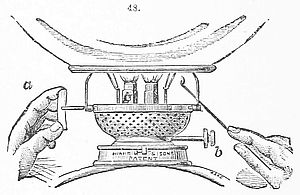
48. Hinks’s Safety Lamp.
The many fires and fatal accidents arising from explosions of mineral oil lamps has drawn official attention to the subject of rendering them safe. Sir F. Abel has stated that all channels of communication between the burner and the reservoir of mineral oil lamps should be protected on the principle of the miners’ safety lamp; he added that a simple arrangement which effected the desired object “with perfect safety” was to attach to the bottom of the burner a cylinder of wire gauze of the requisite fineness, which prevented the transmission of fire from the lamp flame to the air-space of the reservoir. Acting upon this suggestion, Hinks and Son, 60 Holborn Viaduct, have introduced a wire-gauze cylinder for use with their duplex lamps, which renders them absolutely safe. Another advantage with their lamps is the ease with which they are lit and extinguished, as shown in Fig. 48: for lighting, a turn of the thumb-key a gently raises the cone, globe, and chimney, giving free access to the wicks; to extinguish them, it is only necessary to press the lever b.
The Defries safety lamp (Defries Safety Lamp and Oil Co., 43 Holborn Viaduct) is attracting much notice, on account of economy, safety, and illuminating power. The construction of the lamp is such that neither ignition of the vapour, nor outflow of the oil in the event of the lamp being overturned, can occur. Moreover, the oil reservoir, being of metal, is not liable to fracture. It therefore follows that the risks attaching to the employment of mineral oils as illuminating agents in lamps of the ordinary description are non-existent in this lamp. The light emitted is remarkably white, the flame is perfectly steady, and the combustion is effected without the production of the slightest odour or smoke. Results of photometric tests by Prof. Boverton Redwood were more favourable than any he had hitherto obtained with mineral oil lamps of other forms. The illuminating power is, for the size of the burner, in each case very high, while the consumption of oil per candle light per hour is remarkably small. The products of combustion are odourless, even when the normal size of the flame is much reduced by lowering the wick. Any mineral oil, as well as the Defries safety oil, can be used in these lamps. This is quite odourless when spilled or heated, requires a temperature of 308° F. (or 96° F. above the boiling point of water) for its ignition, and does not vaporise below 270° F. Such oil is no more inflammable than colza oil, and is moreover free from the risk of spontaneous combustion. Its price is 1s. 6d. per gal. The absolute necessity for using, in any and every lamp, the most refined and safest grades of mineral oil cannot be too seriously insisted upon, Cheap low oils mean personal risk.
Gas.—Though gas is long since established as one of the most successful and general illuminants, it is surprising what ignorance exists as to the simple rules which should govern its use.
This section is not intended for the guidance of the professional gasfitter, yet some of the points to be noticed are really within his province, and are mentioned because the householder should be in possession of such knowledge as will enable him to discover or prevent faulty work.
Coal gas, being much lighter than air, flows with greatest velocity in the upper floors of houses; hence the supply pipe may diminish in size as it rises, say from 1¼ in. at the basement to ¾ in. on the 3rd floor. At a point near the commencement of the supply pipe it should be provided with a “siphon,” which is simply a short length of pipe joined at right angles in a perpendicular position and closed at the lower end by a plug screwed in. As all gas-tubes should be fixed with a small rise, this siphon will collect the condensed liquids, which may be drawn off occasionally by unscrewing the plug end. When the lights flicker, it shows there is water in the pipes: the siphon prevents this. The number of gas-burners requisite for lighting a church or other large building may be computed thus. Take the area of the floor in ft. and divide by 40, will give the number of fish-tail burners to be distributed according to circumstances. Example: a church 120 ft. long by 60 ft. wide, contains 7200 ft. area; divided by 40, gives 180 burners required for the same. Burning gas without a ventilator or pipe to carry off the effluvia, is as barbarous as making a fire in a room without a chimney to carry off the smoke. If a pipe of 2 in. diameter were fixed between the joists, with a funnel elbow over the gaselier, and the other end carried into the chimney, it would be a general ventilator. Of course, an open ornamental rosette covers the mouth of the tube; or an Arnott valve ventilator over the mantelpiece would answer the same purpose. In turning off the gas-lights at night, it is usual, first, to turn off all the lights, except one, and then turn off the meter main cock, and allow the one light to burn itself out, and then turn it off. The evil of this system is this,—by allowing the one light to burn itself out, you exhaust the pipes and make a vacuum, and of course the atmospheric air will rush in. The proper way is to turn off all lights first, and finally the meter, thus leaving the pipes full of gas and ready for re-lighting. These few remarks have been derived from Eldridge’s ‘Gas-Fitter’s Guide,’ an eminently useful and practical handbook.
It was formerly the practice to make all gas-burners of metal; the openings, whether slits or holes, from which the gas issued to be burned being small, in order to check the rate of flow. This was an error, for heat and light go together, and the metal, being a good conductor of heat, kept the lower part of the flame cold. The part of burners actually in contact with the flame is now invariably of some non-conducting material, such as steatite; and the effect of this simple improvement is most noteworthy. Bad burners show a great proportion of blue at the lower part of the flame, and the upper or luminous portion is small and irregular in shape, and dull in colour. These effects are due to gas issuing at too great velocity from small holes in burners, as well as to improper material in the latter. The illuminating power of coal gas depends upon the incandescence, at the greatest possible heat, of infinitesimal particles of carbon which it contains, invisible until heated. In the lower, or blue portion of the flame, the heat is not sufficient to render these particles incandescent; and it is necessary that this effect should be secured at the nearest point to the burner. Unless this is done, the light is not only lessened, but the unconsumed carbon passes off and is deposited as soot on ceilings and furniture. Blackened ceilings are a measure of the badness of the burners. It will now be seen why a material which cools the flame should not be used for a burner, for the hotter the flame, the more perfect is the incandescence of the carbon for which in reality the consumer pays, and the less danger there is of blackened ceilings. But in addition to the better material, the construction of even the cheapest modern burners is very greatly improved; although even a good burner may be subjected to such conditions—e.g. allowing gas to be driven through it at a high velocity, a condition usually accompanied by a hissing or roaring sound—as to give a bad result. The capacity of burners should moreover bear a reasonable proportion to the quality of the gas for which they are required to be used. Thus with rich Scotch gas, burners with very small holes, consuming only about 1½ cub. ft. hourly, are sometimes adopted for economical reasons. Occasionally these burners find their way South, but their use for the ordinary qualities of English gas is the worst possible economy. It is difficult to lay down hard and fast rules for the sizes of burners, the purposes for which gas-light is required being so various. For an ordinary apartment, however, wherein distributed lights are adopted, 5 ft. burners with 14 or 15 candle gas, 4 ft. burners with 16 or 17 candle gas, 3 or 3½ ft. burners with 18 or 20 candle gas, and 2½ ft. burners with richer gas will be found to give satisfactory results. It may be remarked that these figures apply to burners regulated in some way to the given rates of consumption, and not to those merely reputed to be of the stated sizes. Various means are adopted for checking the flow of gas, not at the point of ignition, but at some prior point of its course; because it has been found that the slower the rate of flow at the commencement of combustion, the better the result obtained.
Clustering of gas-lights is bad. All parts of a room should be as nearly as possible equally lighted, the only noteworthy exception to this rule being in the case of a dining-room, where concentration of light upon the table is not only permissible but is even demanded. Hence in most cases wall brackets give the best effect, and such masses of light as are afforded by pendants of many arms are to be avoided, or are only required in very large rooms where portions of the floor area would otherwise be insufficiently lighted. When it is desired to light a drawing-room with wax candles—than which nothing is more beautiful—they are distributed wherever support can be found for them. As every gas flame may be considered equal to 12 or 15 candles, with all their wicks together, the inadvisability of further concentration is evident. In fact, gas is if anything too brilliant for living-rooms, and if it were always properly distributed, many a dimly-lighted apartment would be perfectly illumined with the same number of burners which, when massed, appear insufficient. Where concentrated ceiling lights are needed for dining-rooms, many-armed pendants are seldom satisfactory, owing to the shadows which most of them cast. In these cases a single powerful argand light in a suitable reflecting pendant, or a cluster of flat flames similarly provided, will give a better result than the usual branched chandelier, and with a material saving in gas. For it is a curious and valuable property of gas, that large burners can be rendered much more economical in proportion than smaller ones. Thus, if the 4 burners of a branched chandelier give altogether the light of (say) 50 candles, the same illuminating power may be obtained from a greatly reduced quantity of gas when concentrated in a single burner of the most improved kind.
With regard to the smaller flat flames, which are the most general for ordinary lighting, the selection of glass globes is a very important matter. It may be said at once that all the old-fashioned style of glasses, with holes in the bottom about 2½ in. diam., for fitting into the brass galleries of the older pattern pendants and brackets, are objectionable. The reasons for this condemnation are few and simple. It seems never to have occurred to the makers of these things that the gas flames inside the globes are always wider than the openings beneath them, through which the air required for combustion passes; and that, as a rule, the light of the flame is required to be cast downward. Gas flames always flicker in these old-fashioned glasses, because the sharp current of entering air blows them about. And the light cannot come downward because of the metal ring and its arms, and the glass, which is always thicker and generally dingier at this part of the globe. Perfectly plain and clean glass absorbs at least 1/10 of the light that passes through it; ground glass absorbs ⅓; and the ordinary opal obstructs at least ½, and generally more. Only those globes should be chosen therefore which have a very large opening at the bottom, at least 4 in. wide, through which the air can pass without disturbing the flame. The glass then fulfils its proper duty, screening the flame from side draughts, and not causing mischief by a perpetual up-current of its own. Good opal or figured globes of this pattern may be used without disadvantage, because the light is reflected down through the bottom opening more brightly than if there were no globe, while the flame is shaded and the light diffused over other parts of the room.
The degree to which the luminosity of gas is utilised depends very largely upon the burner, people too often setting down as the fault of the gas, defects which should really be ascribed to the burner. In 1871, the Commission appointed by the Board of Trade to watch over the London gas supply, and whose prescriptions in these matters are more or less recognised by the whole country, made an examination of a collection of gas-burners from a large number of sources, and including those in general use. The greater portion of these gave only ½, some even only ¼ of the light that the gas was actually capable of affording. Two points very often neglected are: (1) that the size of the burner should be proportionate to the quantity of gas required to be consumed by it, and (2) that the gas should issue at a very low velocity. In good argands, the pressure at the point of ignition is almost nil; and in flat-flame burners, the pressure should be only just sufficient to blow the flame out into the form of a fan. It is also very necessary that the body of the chamber below the point of ignition should be of material with low heat-conducting power, so that the gas may undergo no increase in volume which would occasion a proportionate increase of velocity, and that the heat may not be conducted away from the flame. To establish this, Evans had 2 argand burners made, differing only in that one had the combustion chamber of brass, and the other of steatite. The latter gave more light than the former in the proportion of 15 to 13 for the same quantity of gas. As another example a No. 8 metal flat-flame burner, consuming 5 cub. ft. of gas per hour, gave a light equal to 11·5 candles, while a steatite burner of corresponding size, with non-conducting combustion chamber, gave 14·6 candles. Another metal burner of a description somewhat generally used, gave about ⅜ of the light that the gas was capable of yielding. Worn-out metal burners generally give the best results, as the velocity of the issuing gas is lower than when the burners are new. A much better result is obtained by burning, say 20 cub. ft. of gas from one burner, than by using 5 burners, each of which consumes 4 cub. ft. This is the reason why the modern argands give so much more light than the older ones, which were drilled with a very large number of holes, and were more suitable for boiling water than for illuminating. If the air which is to support the combustion be heated before it reaches the flame, especially in the case of flat-flame burners, better results are produced, as was pointed out by Prof. Frankland more than 10 years ago, and this principle is now being carried out by some Continental burner makers. Of modern argands there are many excellent varieties, which can evolve 15-30 per cent. more light for the same quantity of gas than the best flat-flame burners. One kind consisting of 3 concentric rings of flame with steatite gas chambers was first used in the public lighting of Waterloo Road in 1879. In another the products of combustion are brought down in a flue fastened round the burner, so as to heat the air which supports the combustion as it passes in pipes through the flue above mentioned to the flame; while a third kind has an arrangement for admitting separate currents of cold air to keep the chimney cool. There seems little doubt that the argand lamp will play a leading part in the gas lighting of the future. An important point connected with the use of gas is that the heat generated by combustion, may be made to do the work of ventilation, as in the fish-gill ventilator invented by the late Goldsworthy Gurney. In this strips of calico are nailed, by the two upper corners, across an opening in the wall, in such a way that each strip laps over the strip next below it. This contrivance, opening and closing like the gills of a fish, is self-acting, as the heated air passes away through the porous material, and cold air is admitted without draught.
Gas is often accused of heating the rooms; but if persons, when burning candles would increase the number of the candles so as to equal the light of the gas-flame, the heat given out would be found to be less when burning gas than when burning lamps or candles.
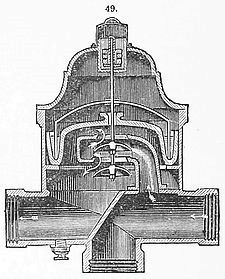
49. Stott’s Governor.
It is very beneficial to regulate the pressure at which gas reaches the burners, and many complaints of impurity of the air of a room, caused by gas, arise from this want of regulation of pressure. It can be attained by the use of a governor, placed either at the meter or in proximity to the light itself. These are of many forms. Those adapted for placing near the meter are Stott’s, Fig. 49 (174 Fleet Street, E.C.), Parkinson’s, Fig. 50 (Cottage Lane Works, City Road), Strode’s, Fig. 51 (67 St. Paul’s Churchyard), Hargreaves and Bardsley’s (Hobson Street, Oldham), Hulett’s, Fig. 52 (55 High Holborn), Peebles’ (Tay Works, Edinburgh), and Smith’s (130 Fleet Street). Self-regulating burners are the “Christianson,” made by Sugg (Grand Hotel Buildings, Charing Cross), and those made by Bolding—Heran’s patent—(South Molton Street, Oxford Street), Milne, Sons, and Macfie (2 King Edward Street, E.C.), Parkinson (Fig. 53), Peebles, and Kinnear (91 Finsbury Pavement). A little steel blade, costing only a penny, is made by W. H. Howorth, Cleckheaton, Yorkshire, for use on 2-holed burners, which has the effect of silencing a roaring flame and increasing the luminosity. Another contrivance having some of the effects of a regulator, augmenting the light and consuming the smoke (therefore lessening the contamination of the air), is the Spencer Corona, Fig. 54 (3 Hyde Street, New Oxford Street), fitting closely on the top of ordinary gas globes.
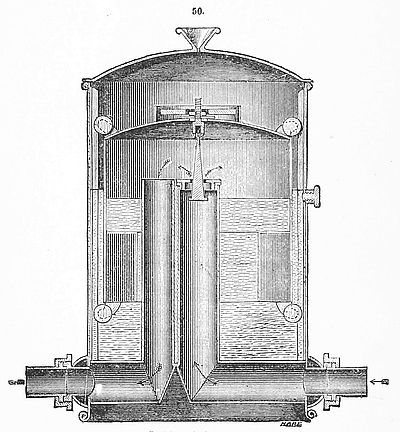
50. Parkinson’s Governor.
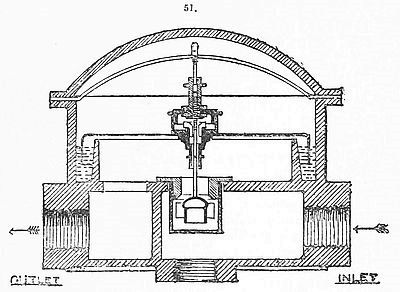
51. Strode’s Governor.
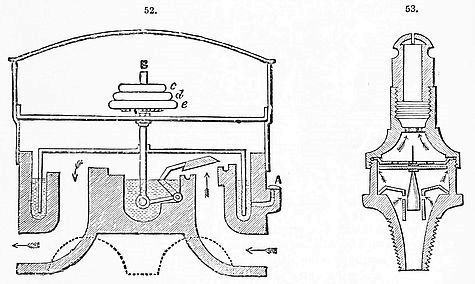
52. Hulett’s Governor. 53. Parkinson’s Burner.
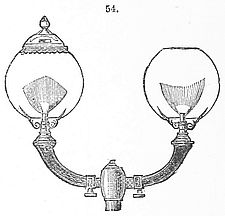
54. Spencer Corona.
The most practical methods which have been devised for combining the purity of air in a room with artificial light produced from ordinary coal gas, may be classed under four heads:—
(1) The sun burner, in which the products of combustion are removed rapidly from contact with the air of the room.
(2) The globe light, in which the fresh air is supplied and the products of combustion are removed to the outside without any contact with the air of the room.
(3) The regenerative gas light.
(4) The incandescent gas light.
Their several merits are thus discussed in one of the Health Exhibition Handbooks.
The sun burner is practically a powerful ventilator, which, by means of the great heat generated, draws a large volume of air away with the fumes of the gas; it thus relieves the air of the room of the impurities caused by combustion, and at the same time removes impurities generated from other causes. This burner is indeed a sufficiently powerful ventilator to continue acting even in the face of the counteracting draught of an open fireplace; and is consequently much used for crowded rooms. For this dual purpose, it requires to have its fumes carried up through a straight vertical tube direct to the open air. This burner is made by Strode & Co., 67 St. Paul’s Churchyard, and shown in Fig. 55.
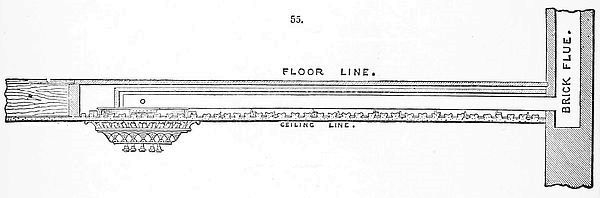
55. The Sun Burner.
The globe light has been designed to prevent the products of combustion from mingling at all with the air of a room, but it does not provide for the ventilation of the room at the same time. The principle of the best form is that it should be burned in a glass globe separated from the air of the room; that is to say, the air required for supporting combustion is brought into the globe from the outer air, and the products of combustion are carried away into the outer air without mixing with the air of the room. This light, like the sunlight, is limited in its application. It can be placed near an outside wall, or in a room directly under a roof. If fed with fresh air from the room itself, and if a fire-proof flue be constructed in the ceiling leading into a vertical flue, this light can be put in any part of a room; but the draught from the open fire would be very likely to draw the products of combustion back into the room. This is also made by Strode & Co.
The Grimston regenerative burner looks like an inverted argand burner. The gas is brought down a central tube, and the products of combustion are carried away through a tube which lies round it, and the air required to feed the burner is brought through passages in this latter tube which are heated by the products of combustion in their course. The light is enclosed in a half globe, and the products may be carried away into the outer air, so that the light need not injure the air of the room in which it is burned. A very remarkable feature about these regenerative arrangements is that the temperature of the outflowing products of combustion at the top of the tube is so low that the hand can be held over the top of the tube without any unpleasant sensation of heat; and the combustion appears to be so perfect that even if the products are not removed from the room, there is much less unpleasantness than with ordinary gas-burners. Other very important regenerative burners are that bearing the name of F. Siemens, the Fourness (S. Gratrix, jun., and Bro., Alport Town, Manchester), and the well-known Wenham (Wenham Co., 12 Rathbone Place, W., and Milne, Sons, and Macfie, 2 King Edward Street, E.C.), two forms of which are shown in Figs. 56 and 57. Sugg’s “London Argand” and “Cromartie” burners are sufficiently familiar to need no description, and are made in a great variety of designs. The “Osborne” pattern is shown in Fig. 58.
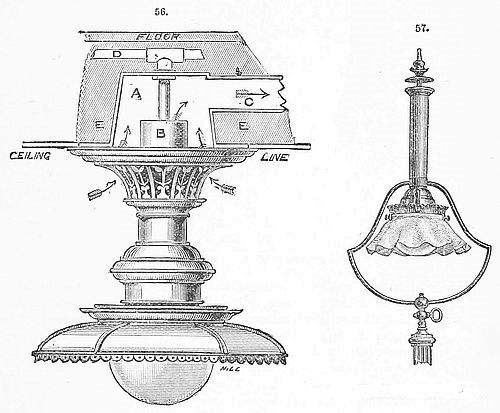
56. Wenham Pendant Light. 57. Wenham Standard Light.
Incandescent gas lamps, even if burned in contact with the air of a room, present certain hygienic advantages. In the first place, the air required for combustion is brought into the room from the outside, in the proportion of six volumes of air to one of gas, and therefore the oxygen in the air of the room is not consumed for combustion. In the second place, the gas is consumed in a very perfect manner, so that the injury to the air of a room produced by the combustion is reduced to a minimum. These lights can be placed wherever ordinary gas-lights can, and it is probable that from the hygienic and photometric value of this class of light it is destined at no distant date to replace ordinary gas-burners. The principle of construction is as follows. In the flame of a Bunsen burner is placed a hood of cotton webbing, previously steeped in a solution containing oxides of zirconium, lanthanum, &c. The average consumption in each burner is 2 ft. gas per hour at 9/10 in. pressure, with an illuminating power of 17 candles.
The Albo-carbon light, Fig. 59, (74 James Street, Westminster), consists in superheating ordinary gas and carburetting it by admixture of the vapour generated from the albo-carbon material, which is stored in a reservoir that can be attached to any existing fittings. By its means, the light is very much intensified, steadied, and purified, at very small cost for albo-carbon with a reduced consumption of gas.
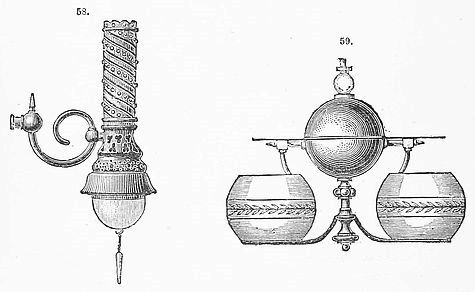
58. Sugg’s “Osborne” Burner. 59. Albo-carbon Light.
When gas has been laid on to a house, and the main connected with the meter or even before the latter has been done, it is extremely important to have all the gas-pipes tested, in order to ascertain whether any leakage exists. A very good method is as follows:—All the brackets and pendants, with one exception, are first stopped up with plugs or screwed caps, and the meter is turned off or disconnected. Upon the one outlet not stopped up a force-pump is attached, into the interstices of which have been poured a few drops of sulphuric ether. The force-pump is then connected with a gauge, and is worked until a high pressure has been registered upon it, in order that should the pipes have any latent weaknesses, the pressure exerted will develop and discover them. When the gauge indicates a certain figure, the pumping is stopped, and if the mercury is noticed to fall, it is evident that there are palpable leaks, which are at once searched for. The escaped ether will guide the operator to the whereabouts of these leaks, and the defaulting pipes are at once replaced by others. The pumping is then continued, and the same routine recommences. If the mercury still descends in the gauge glass, and the sense of smell cannot detect where the leak exists, the joints and portions of the pipes are lathered over with soap, whereupon the weak places will be found indicated by bubbles. These parts where the bubbles escape are then marked, heated by means of a portable spirit lamp made for the purpose, and covered over with a durable cement. After a short time, the pump is once more set in action, and if the pipes are tight, and the column of mercury in the gauge maintains itself at the same figure, the soundness of the pipes is assured.
An excellent portable gas-making apparatus is made by H. L. Müller, 22 Mary Ann Street, Birmingham. See also p. 998.
Matches.—An American writer, speaking of the defacement of paint by the inadvertent or heedless scratching of matches, says that he has observed that when one mark has been made others follow rapidly. To effectually prevent this, rub the spot with flannel saturated with any liquid vaseline. “After that, people may try to strike their matches there as much as they like, they will neither get a light nor injure the paint,” and, most singular, the petroleum causes the existing mark to soon disappear, at least when it occurs on dark paint. Matches should always be kept in metallic boxes, and out of the way of children and mice.
Countless accidents, as every one knows, arise from the use of matches. To obtain light without employing them, and so without the danger of setting things on fire, an ingenious contrivance is now used by the watchmen of Paris in all magazines where explosive or inflammable materials are kept. Any one may easily make trial of it. Take an oblong vial of the whitest and clearest glass, and put into it a piece of phosphorus about the size of a pea. Pour some olive oil heated to the boiling point upon the phosphorus; fill the vial about one-third full, and then cork it tightly. To use this novel light, remove the cork, allow the air to enter the vial, and then re-cork it. The empty space in the vial will become luminous, and the light obtained will be equal to that of a lamp. When the light grows dim, its power can be increased by taking out the cork and allowing a fresh supply of air to enter the vial. In winter it is sometimes necessary to heat the vial between the hands in order to increase the fluidity of the oil. The apparatus thus made may be used for six months. (Chicago Times.)
Electric Lighting.—This must not be undertaken without due knowledge or the assistance of skilled workmen. The subject is altogether too large for discussion here with any chance of making it clear and simple. The reader should refer to the works of Hospitalier and others who have made it a study. Allusion may here be made, however, to an essentially domestic system recently introduced by Hospitalier. His object is to provide 10 volt and 1½ ampère lamps operating 3 or 4 hours daily. The result aimed at is that the pile shall daily furnish a quantity of electric energy equal to that expended, and keep the accumulators continually charged. The accumulators form a reservoir, and compensate for the differences between the daily production (which is sensibly continuous) and the irregular production according to needs. This demands a continuous pile of slow discharge, in which the products consumed can be easily renewed, while repairs and supervision are minimised. The choice is a potash bichromate battery.
In a single liquid potash bichromate pile, the elements to be renewed are the zinc and the liquid which contains at once the excitant (sulphuric acid) and the depolariser (potash or soda bichromate). In order to obtain an easy renewal of the zinc, Hospitalier employs the metal in the form of a rod 18 in. in length that dips for about 3 in. only into the liquid, and that is placed in a perforated porous vessel which supports it and prevents all contact with the carbon. A certain mobility is secured to it by means of flexible attachments, so that as it wears away it descends into the liquid. Its lower extremity dips into a mass of mercury, and this keeps it amalgamated. When one rod is used up, another may be substituted for it in a few seconds. The remaining portion of the old zinc is thrown into the porous vessel. The mercury suffices to set up a perfect electric communication with the new rod that has just been introduced. The zincs are thus entirely utilised. The flow secures the continuous renewal of the exciting and depolarising liquid. The precaution to be taken is to cause the liquid to enter at the upper part, and to remove it from the lower. This prevents the elements from getting choked up, and so they may remain mounted several months, operating day and night, without any attention having to be paid to them.
The positive pole consists of three or four carbon plates which surround the porous vessel that contains the zinc, and which are connected with each other by a strip of copper and screw clamps. The connection of a zinc with the following carbon is made by means of flexible wires, in order to permit the zinc to descend into the liquid as it wears away, as has already been seen.
The four elements are mounted one above another. The liquid enters them from an earthenware reservoir of 5-6 gal. capacity, through a rubber tube. The discharge is regulated by means of a pinch-cock.
Practice has shown that it is useless to make the solution of bichromate. It is only necessary to throw some crystals into the upper reservoir and to pour into the latter some water, acidulated with a tenth of its volume of sulphuric acid. A sufficient quantity of the salt dissolves every time to assure depolarisation. The same liquid may serve 10-12 times before renewal.
There are no precise directions to be given as to the velocity of the discharge, since this must vary according to the needs of consumption. A good average is 1-1½ gal. per day. When the liquid is nearly exhausted, it is well to cause it to circulate a little more quickly. The regulation of the velocity of the flow by the Mohr pinch-cock is one of the simplest operations. After traversing the four pile elements in succession, the liquid enters glass bottles of 2 gal. capacity provided beneath with a pipe to which is affixed a rubber tube.
It is only necessary to take a full bottle, place it over the reservoir, and put the pipe into the reservoir, in order to empty it in a few minutes.
An inspection of the piles is advisable every two days. Were a larger reservoir employed and the velocity of flow moderated, the interval might be still longer.
The four elements in tension alternately charge two series of accumulators each containing three elements. This arrangement allows the use of two kinds of lamps, 6 volt ones in the cellar and small rooms, and 10 volt ones in the dining-room and office.
The cellar lamp is so arranged that it is lighted by opening the door, and extinguished by closing it. Aside from the lamps just mentioned, another is arranged for lighting a dark ante-room, and which lights up for three minutes, only, whenever a button near the door is pressed.
The use of accumulators and flowing piles presents the following advantages: (1) Convenience, the apparatus being always ready to furnish light upon turning a tap; (2) Ease of keeping in repair and of supervision, the flow and the dimensions being capable of regulation so that the consumer need look after the piles only at irregular intervals. (3) Better utilisation of the products as a result of the use of a pencil of zinc instead of wide plates. The surface attacked is reduced to the dimensions that are strictly necessary for the production of a current, and local action is thus diminished. On the other hand, the active liquor is not thrown away until completely exhausted. (4) Quality of the light. This remains steady during the entire time of the lighting, without any manipulation of the pile or any special appliance.
A few hints may be culled from Preece’s lecture on Domestic Electric Lighting, read before the Society of Arts last session.
Makers of lamps seem to consider that there is great credit in securing long life. Unfortunately, glow lamps deteriorate sadly with age. The carbon wastes imperceptibly away, and we are scarcely conscious of the fact that, after 200 or 300 hours, the lamp gives only half the light it did at first. The fact is lamps last too long. The price of a lamp should be such that we could afford to give them a short and merry life. Long life is therefore an objection.
Lamps fail in giving their light occasionally from having an imperfect vacuum. This is very easily detected by feeling the globe. If the vacuum is bad it gets quite hot. Occasionally, but very rarely, lamps explode with a loud report when the current is first put on. This is, perhaps, due to a slight leakage of air making an explosive mixture with the residual gas.
At the present moment, both the nomenclature and the efficiency of glow lamps are in a very unsatisfactory state, and we are buying pigs in a poke at a very high price.
Considerable difference of opinion exists as to the character of the globe enveloping the carbon filament. Some like them clear, some like them ground; others envelope them in shades, or make the globe of a beautiful opal glass. It is very objectionable to have the optic nerve irritated by a brilliant glowing filament; but it is equally absurd to produce a good thing and then strangle it. Grounding and shading mean loss of light. Lamps can be placed so high that they need not affect the eye, and if they do, the light can be so reflected as to be useful elsewhere. The art of lighting a room is to flood it with light without the delicate eye being offended with the direct rays from the source of light.
Switches to turn the lamps on and off are a source of great trouble in a house. As a rule, they are cheap and nasty. When fixed away from the lamps, they introduce into the circuit additional resistance, and therefore waste energy, but they are distinctly serviceable when they are fixed outside the door of a room, so that you can light it before you enter it.
In many cases the lamp is its own switch, but it is objectionable to handle a lamp, and attempts have been made to utilise the weight of the lamp itself when suspended from the ceiling to maintain contact, and to break that contact when the weight is released.
Cuts-out or safety-valves are essential to the security of a house. Short circuiting ought not to occur, but it does, and generally when showing off. It may occur when cleaning. The cut-out is so cheap and so effective that there is no excuse for its neglect. They should be fixed on every circuit.
No one must imagine that electric lighting is absolutely safe from fire. It certainly possesses elements of danger, but elements that are perfectly under control. It is very simple to secure safety if the rules and regulations to avoid fire risks be carefully followed. The simplest rule is to use nothing but the best insulated wire, and to employ none but experienced men to put it up. All accidents that have occurred have arisen from careless wiring and ignorant handling.
The design of the circuits of a house, the dimensions of conductors, the quality of the materials used, the provision against fire risks, the testing of the work done, the adaptability of means to an end, should come within the province of the professional adviser, and not be left to the successful competing contractor, however eminent the firm may be.
Estimates for furnishing electric light installations, ranging from about 3l. upwards, can be had from Messrs. Woodhouse and Rawson United, Limited, 88 Queen Victoria Street, London, E.C., and of Messrs. Appleton, Burbey, and Williamson, of 91 Queen Victoria Street, London, E.C. See also p. 1001.
Furniture and Decoration
Furniture and Decoration.—Obviously half the benefit to be derived from good sanitary arrangement of the house itself will be lost if the internal fittings are not arranged with similar regard to healthy conditions. Good drainage and ventilation are thrown away if every corner is to be a receptacle for accumulated dirt and every carpet and curtain a resting-place for dust. Yet that is just the condition of ninety-nine houses out of every hundred. Existing systems of furnishing and decorating are faulty to a degree in this respect, and have called down the strictures of many sanitary reformers. Foremost among them is Edis, who has made this branch of sanitary science a special study. His suggestions for improvements in furnishing and decorating our homes are worthy the attention of every housewife. The following remarks are mainly culled from his paper in one of the Health Exhibition handbooks, and deserves to be more generally known.
Kitchen Walls.—Commencing at the bottom of the house, Edis advises lining the whole of the scullery walls, and, as far as possible, those of the kitchen also, with glazed tiles, so that there be no absorption and retention of the smells, which must necessarily accrue with the ordinary work of this portion of the house. For a large house, he strongly advocates finishing all the walls in a London basement, so far as the working portion of it, together with the passages, are concerned, with glazed tiles; they are cleanly, absolutely non-absorbent, reflect and give light, are easily washed, and tend to make the house sweet and healthy. The pantries and larders should be so arranged that they have continual ingress of fresh air, and should in all cases be lined with glazed tiles or bricks, so that the smells arising from the contents should not be allowed to be absorbed in the distempered walls, and to render them stuffy and unhealthy. The shelves should be of slate, or better still, of polished marble, so as to be absolutely non-absorbent and easily cleaned.
In every basement a comfortable room for servants should be provided: some small sitting-room fitted up with book-shelves and cupboards, and, if possible, facing the street, so that the workers of the house may have some sort of spare room, in which they may be at rest from their ordinary duties; for, if we want good servants, we must treat them as ordinary beings like ourselves.
Floors.—It is particularly desirable to counteract as far as possible the deleterious influences which are brought about by the absorption of offensive odours in the common deal floors of the various rooms, by having all the joints carefully stopped in, and the whole surface painted over with three or four coats, so that the pores of the wood may be effectually closed, and the crevices, through which dirt and filth of all kinds can enter, and lodge in the spaces between floor and ceiling, practically sealed up. Or the floors may be stained and varnished all over, for varnish of the cheapest kind, whether made with resin in place of hard gums, or petroleum in place of turps, is not only healthy in its application, but cleanly and economical, as it can be readily cleaned of all impurities by a wet cloth, and lasts longer than a mere painted surface, if done properly at the onset, and every coat left to dry and become thoroughly hard before a second coat is put on. Good varnish will dry and be free from all stickiness in one or two days, if the general atmosphere is free from damp. (Edis.)
Boarded floors are at present much more fashionable than carpeted. Whether they are stained or not is a secondary consideration. In hospital wards it is, no doubt, desirable that the boards should be as closely laid as possible, and well waxed, to obviate the necessity of scrubbing, and the possibility of any organic matter sinking into the floor. But in private houses, so long as the carpets are loose and can be taken up, and the boards either scrubbed, dry rubbed, or waxed, we have all that health demands. Were it practised by some Continental nation, and not by ourselves, we should be horrified at the custom of keeping carpets nailed down for a year or more to collect all the dirt that falls throughout that time. Of course, a stained floor looks better than plain deal boards, and oak parquet looks better than either. But in a bedroom the appearance is of secondary importance, and staining, however it is put on, does not last long in a room where there are children or schoolboys. A strip of carpet by the side of the bed, and a square of matting or linoleum before the washing-stand, is sufficient for health. All carpets, of whatever kind, wear better if the boards are perfectly even, and if they are laid down over “carpet lining,” brown paper, or coarse canvas; but this plan is not feasible unless the carpet is fastened down, and a much better plan than nailing is to have loops on the carpet and nails in grooves on the floor, when it can so easily be unhooked, that there is no excuse for not taking it up frequently. Very often carpets and heavy furniture are left untouched because of the difficulty of getting a man in to help where a man-servant is not kept. Of the different sorts of carpeting, those that cost most to start with are certainly not the dearest in the end. Compare, for instance, a good Brussels with a tapestry of about half the first cost, and probably not a sixth part of the durability. The only rooms where tapestry carpets are admissible are where there is little or no traffic, and where the mistress desires much appearance for little money. Inferior floor coverings of whatever kind are dear. A small pattern cuts to greater advantage, usually looks better, and always shows dirt less than a large one,—looks better because the floor is not the part of the room where we wish all eyes to be at first directed; and, therefore, though a light ground often wears better than a dark, we cannot venture to recommend it. Kidderminster is now fashionable; it wears well and can be turned. Small patterns in Kidderminster, as in all double wool fabrics, wear best, because the threads decussate more frequently. Felt carpets wear much better if the colour runs through; if it is only stamped on the top, white patches appear long before the carpet is in holes, which, however, are not long in coming with even a moderate amount of wear. The cheapest carpets have cotton or jute woven in them, and very quickly fade. As to matting, it, too, is of many kinds. The coconut matting, with a coloured pattern or border, looks well on dark wood stairs, and wears better than any other, but it is too rough for most sitting-rooms, even if we do not experience its rapid fraying of skirts and wearing out of thin house shoes that walk over it. India matting of good quality wears a long time, especially if it is kept damp. It is made of grass fibre, and if it gets too dry it quickly splits. In hot weather it must be washed over with water once or twice a week and left wet, and the fibre will absorb enough moisture to keep it fairly tough. Oilcloth, kamptulicon, linoleum, and similar floor coverings, are made of canvas with layers of oil paint. It must be kept for some time after it is made, to harden the paint; if this is not done it splits, and soon wears out. The quality can be judged by the weight, and the heaviest is generally the best. It can be scrubbed with soap and water, and then polished with a dry cloth and a little oil; as little water as possible should be used, or it runs underneath, and causes the cloth to rot. In the country it is a good plan to wash oilcloth with a little skim milk, thus cleaning and polishing it at the same time. (E. A. B., in the Queen.)
Furniture.—It must be evident to common-sense people, that all furniture which collects and holds dust and dirt, which cannot be easily detected and cleaned; that all window valances and heavy stuff curtains with heavy fringes, which cannot be constantly shaken; and that all floor coverings which are fastened down, so that it is impossible to clear away the dust, that gradually, but surely, finds its way under them, and prevents the coverings themselves from being constantly shaken, are objectionable and unhealthy. Such people will therefore avoid all wall coverings which offer resting-places for dirt—such as the high-relief flock patterns, which, however good artistically, are certainly to be avoided on sanitary grounds; will not cover the whole of the floor surfaces with thick carpets, which absorb and retain dust and disease germs, and which cannot be easily removed and cleaned, or shaken, at least once a month; will do away with all heavy window-curtains and valances, which, in small rooms, add so materially to their stuffiness and unhealthiness; and will, as far as practicable, avoid filling their rooms with heavy lumbering furniture, which cannot easily be moved for cleaning purposes, and under and above which dust and other impurities may collect and remain. (Edis.)
Second-hand furniture is often preferable to new. The warps and started joints are plainly visible if bad wood has been some time in use; no more warping will take place, and the price, in comparison with that of new, is often much less than the amount of wear and tear would indicate. There are circumstances that give to old furniture a distinct excellence, quite apart from the existence of a fashion for buying it. It was made by hand; generally the same man worked on each piece throughout, acquiring a special interest in every detail, and thinking no trouble too great to make it more perfect. (E. A. B.)
In choosing chairs and tables for the drawing-room, the more varied they are in size and shape the better. Let the wood be all fairly similar, but the materials may be as widely different as possible, and a judicious blending of several colours is the one thing aimed at by those who have good taste. Let me warn my readers against cheap cretonnes; they wear atrociously, and only look well for the first few months. Plush and Utrecht velvet last for ever, but, as they are rather expensive, less costly material can be used for the sofa and a few of the chairs. Do not get one of those dreadful curved sofas that only admit of being sat on, for the primary object of a sofa is to allow of your reclining at full length when fatigued or ill. In a good-sized drawing-room a centre ottoman is allowable, but never in a small room, as it would take up too much space; it is a good plan to have the ottoman made to come to pieces, it will then form several small couches in the event of a large “at home” or dance being given.
With regard to dining-room furniture, get a suite of some light wood—ash or oak—and leather seats to the chairs, or American leather. Sideboards of the present day are very handsome and rather elaborate. You can sometimes pick up very good second-hand dining-room suites, upholstered in the best style, for half their original price. If you intend to have a mirror over your dining-room mantelpiece, see that it is framed in wood similar to your chairs and table, and eschew gilt mirrors in any form, as they are the very acme of bad taste and vulgarity. In choosing the dining-room curtains, bear in mind the colour of the wall paper, or they may clash most inharmoniously. The cheapest way of getting these curtains would be to buy some tapestry stuff by the yard, and make them up at home. Everything in a dining-room should match, see therefore that the curtain pole, bell handles, and coal scuttle are all of the same wood as the rest of the furniture.
If the drawing-room is on the first floor, with a small landing outside, cover the latter entirely with carpet, do not simply continue the stair carpet across it, it will look as well again covered. Should it be a good sized landing, put a square carpet down and stain the edges of the floor. By way of keeping out draughts, and making the hall and staircase look less bare than is usually the case, get some curtains and hang them outside the dining-room and drawing-room doors. Indian dhurries are useful, as they are so cheap, but the objection to them is that there are none made between 6 ft. 6 in. and 11 ft. in length.
There are no special rules to be laid down about furnishing a morning room or boudoir: the remarks made on drawing-rooms would apply to a great extent; the furniture should be suitably small, and only very cosy and comfortable chairs and couches allowed, and no great expense should be incurred. If the lady of the house cannot afford to have more than one bedroom handsomely furnished, it should be the one occupied by herself. Many advocate most strongly a “half tester” bedstead, as in the event of sickness, the hangings and curtains keep away draughts and shade the eyes from any strong light. Brass and black bedsteads look best, with some pretty coloured dimity hangings, and of course a spring mattress. Be particular about the stuffing of the pillows, and if you decide on feathers, have them of the very best, as the inferior ones are apt to have a slight smell, besides being hard and uncomfortable to sleep on. Choose a suite of some light wood, consisting of a wardrobe with a plate-glass door, a washstand with tiled back, and a toilet table with a fixed glass and with plenty of small drawers, the latter being invaluable for keeping light easily crushed articles, such as feathers, flowers, &c., which otherwise are apt to litter about the room in cardboard boxes. For the windows, Syrian curtains are the cheapest, and have the extra advantages of being fashionable and pretty, but coloured dimity to match the bed look the nicest, though of course they would never do in London. Buy (second-hand) a comfortable, old-fashioned armchair, covering it with some serviceable material; and a small table, the height of the bed. It is a good thing to have a small cupboard under lock and key, to hold medicine bottles, &c. You can get very artistic-looking oak ones, quite small, with a shelf above for books, and they form a handsome ornament to the walls.
The spare room or rooms need never necessarily have the “half tester” bedsteads, and so you are saved the expense of buying a quantity of bedhangings and what follows in their train—a heavy washing or cleaning bill. In the event of your not wanting to spend much money on the furnishing of your spare bedroom, remember that at sales very often good things can be picked up at a low price. If you will have a charming bedroom suite at a low rate, be on the look-out for some common deal furniture—never mind its being second-hand and the paint dirty, so long as the wood is whole. Perhaps a friend has an old toilet table or a chest of drawers that she wants to get rid of, or you come across a cheap lot at a broker’s; do not be dismayed at the paint being gaudy, perhaps, or dirty, for this is the secret—have them all painted some uniform neutral colour (grey, picked out with dark mouldings, looks well), and then varnished, and you will be delighted with the result. In conclusion, a good substitute for a wardrobe may be made in this way. If there is a small recess in the room (there very often is one by the chimney), put across it a deal board, stained or painted, and varnished, about 6 ft. from the ground, with an ornamental moulding depending from the front edge, and hang curtains in front, putting up underneath as many dress pegs as the width of the recess will allow. (C. H. D., in the Queen.)
Ceilings.—If the cornices of the rooms be deeply recessed and filled with heavy plaster ornaments, they must of necessity hold dust and other impurities, which are increased by the action of damp air causing decomposition, and by mixing with the air in the room, when stirred or blown away from their resting places by draught from opened door or window, must render it impure and unhealthy. In addition to this, they are more or less choked up by every coat of so-called distemper decoration, and this again, by absorbing damp and obnoxious exhalations, adds materially to the sense of stuffiness and foulness which can be appreciably felt on first opening up the room after it has been closed for some hours. It is better, if possible, to paint all ceilings and cornices than to distemper them, so as to render them as non-absorbent as possible; by painting, the plaster-work is covered with a non-absorbent coating, on which if desired a coat of distemper may afterwards be added.
Walls.—As a rule it is desirable as far as possible not to disturb the general flatness of wall surfaces, and to avoid all patterns which obtrude themselves too prominently upon the eye, or cause the space, whether covered with paper or painted decoration, to be broken into groups of ornament, or into distinct lines cutting it transversely or horizontally. The wall surface may be divided either by a chair or frieze rail and be treated in different shades of colour with good effect; or the upper portion may be covered with good artistic painting, which will add to the beauty and picturesqueness of the room. Where the upper space is covered with paper or distemper, the pattern or colouring should offer no startling contrasts, and the lower portion may be painted and varnished, so as to be readily cleaned. The colour of the wall surfaces of the different rooms must naturally depend upon the purposes for which the rooms are used, as the apparent warmth and pleasurable appearance of the room is materially enhanced or detracted from by the treatment of the wall-colouring; and while it is necessary to treat the surface of one room as a background for pictures, it may be desired to have another brighter and more decorative; but wherever possible, in passages, halls and staircases, it is desirable to varnish as much of the wall surface as possible, so as to render it non-absorbent and readily cleaned.
In the selection of paper or other hangings, and in the arrangement of all ornament in wall or panel decoration, it becomes a matter of importance to select none which shall have distinct and strongly marked patterns, in which the ornament stands out and repeats itself in endless multiplication and monotony. All staring patterns should be avoided. Almost all papers may now be considered practically free from arsenic; the largest printers of machine-printed papers now use little or no arsenical colours; the principal manufacturers of block-printed papers allow on colours with a known trace of arsenic to enter their factories; and, as the colours of this class of paper-hangings are more thoroughly bound with size than those which are machine-made, they are to be recommended for house decoration in preference to the cheaper kinds, as being to a certain extent more lasting.
Paper-hangings must enter largely into the decoration of all the wall surfaces of our houses; but, on sanitary grounds, all flock papers, however beautiful in design, are especially to be avoided, for, from the very nature of their design and treatment, they are detrimental to the healthy condition of the room. The patterns stand out in relief, and offer innumerable spaces for dust and dirt, while the generally fluffy nature of the material, practically powdered wool, renders it more absorbent and therefore more unhealthy; and the surface holds dust and dirt to a much larger degree than the ordinary printed papers, thus tending to a stuffy and unwholesome feeling, which is essentially at variance with all laws of health and comfort.
Stamped papers, in which the pattern is raised in relief, offer the same objections in a minor degree, as the surface is smooth and can be readily cleansed; and in the case of the imitation leather papers, the surface is varnished, and can be readily gone over with a damp cloth without injury. These papers can be well used for the dados of rooms or frieze decoration, and as such are exceedingly effective, although, of course, from the very nature of the manufacture, much more expensive than plain painting and varnishing. A good deal of illness often arises from the bad nature of the size and paste with which the ordinary wall-papers are hung, and great care should be taken that no such inferior, and practically stinking materials are allowed.
Cupboards.—In most houses it is common to have the store places for clothes and other household goods, practically self-contained in every room, and therefore we put therein furniture sufficient for our requirements; but we all know how soon our drawers and wardrobes get overcrowded, and the nuisance and annoyance it often is to have to take out coat after coat, or dress after dress, until we reach the particular one we want, which may be stowed away at the bottom of the drawers or chest, and it surely must appeal to ordinary common sense, to utilise in every way, with constructional fittings as far as possible, all spaces which, as a rule, are practically useless. If the cupboards are taken up to the ceiling line, that is to say an extra tier added to the ordinary wardrobe fitting, increased storeroom would be provided for clothing not immediately required. There would be less crowding up of the existing cupboards and drawers, and the ills of the flat exposed tops of the ordinary fittings, to which Edis before referred, would be done away with. Why not, in the window recesses of every bedroom, provide fixed ottoman boxes which can be used as seats, as well as store places, and if covered with stuffed tops, may thus not only be made useful, but comfortable; while in the sitting-rooms they might be used for store places for papers and magazines until bound up, and thus help to do away with the littering of our rooms, or the storing away of all such things in inaccessible places, where they are seldom dusted, and only help to breed dirt and disease.