THE CELLAR.
Reading edition
THE CELLAR.
A great mistake is sometimes made in ventilating cellars. The object of ventilation is to keep the cellar cool and dry; but this object often fails of being accomplished by a common mistake, and instead the cellar is made both warm and damp. A cool place should never be ventilated, unless the air admitted is cooler than the air within, or is at least as cool as that, or a very little warmer. The warmer the air, the more moisture it holds in suspension. Necessarily, the cooler the air, the more this moisture is condensed and precipitated. When a cool cellar is aired on a warm day, the entering air being in motion appears cool, but as it fills the cellar the cooler air with which it becomes mixed chills it, the moisture is condensed, and dew is deposited on the cold walls, and may often be seen running down them in streams. Then the cellar is damp, and soon becomes mouldy. To avoid this, the windows should only be opened at night, and late—the last thing before retiring. There is no need to fear that the night air is unhealthful—it is as pure as the air of midday, and is really drier. The cool air enters the apartment during the night, and circulates through it. The windows should be closed before sunrise in the morning, and kept closed and shaded through the day. If the air of the cellar is damp, it may be thoroughly dried by placing in it a peck of fresh lime in an open box. A peck of lime will absorb about 7 lb. or more than 3 qt. of water, and in this way a cellar may soon be dried, even in the hottest weather.
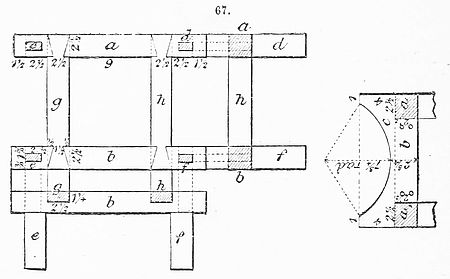
67. Barrel Stand.
Barrel Stand.—A simple and effective barrel stand may be made in the manner described below. It consists of a stout frame on 4 legs 9-12 in. high, made of quartering which may vary from 2 in. sq. for small casks to 3 in. sq. for larger ones. The proportions given in the annexed illustration (Fig. 67) are suited to a 9 gal. cask. This should be 22 in. long, 15 in. wide, 9 in. high, and made of 2½ in. stuff, of which it will consume about 9½ ft. run. It will be seen that the sides a, b are joined to the legs c, d, e, f by mortice and tenon joints, while the ends g, h are dovetailed into the sides a, b. The joints are secured by pins of oak or red deal driven into holes bored by a gimlet. The stand thus made is only adapted to carry casks stood on end. For holding them steadily on their side, and at the same time giving them a tilt forward to allow all the clear contents lying above the sediment to be drawn out without disturbing the barrel, use is made of 2 pieces of board hollowed out to receive the barrel. For the sized cask mentioned (9 gal.), 15 in. will suffice in length and 1 in. in thickness for each piece. Both are prepared for letting down into the frame by cutting out a piece 2½ in. sq. from each of the 2 bottom corners as at a, and can then be screwed to the cross piece b of the frame. Previously the cradle is formed by describing on the piece of wood an arc of a circle corresponding to the size of the cask at the point where it is to be supported. Supposing the diameter of the cask to be 15½ in., the radius of the circle to be described will be 7¾ in., as shown. This gives the correct arc, but as the cask will lie sloping and not flat, the foremost edge of the arc must be shaved away till the cask will rest on the entire breadth of the edges of the cradle c. For the front cradle the board may be 6½ in. wide, and for the back 8½ in.
Cleaning Casks.—(1) The acid smell very often found in casks may be attributed to absorption in the pores of the wood of acetic and lactic acids—a very small quantity of either of them having power to communicate their principle to any fermenting liquid with which they may be brought in contact, and increasing very fast at the expense of the alcohol in the liquid, while at the same time causing unsoundness to a greater or less extent, according as the temperature of the atmosphere may be high or low. Bearing this in mind, it is of the utmost importance that all free acid which the cask may contain should be carefully neutralised before filling with a liquid so liable to change as fermenting wort. Casks before filling, after being well washed with boiling water, should be allowed to cool, and then examined by some responsible person as to their cleanliness, acidity, and probable mustiness; the cask is well smelt, and usually a light is passed through the tap-hole, so that the examiner may view the interior. Any cask that may smell sour (especially in summer weather, or when required for stock or pale ales) should be rejected, and be well treated with lime. This should be put into the casks dry, small lumps of the lime being broken, so that they can be easily inserted in the bung-holes, and when sufficient has been put in (say, about 4 lb. to a barrel), then about 4 gal. of boiling water must be added, the casks bunged up, and kept so for a few hours, occasionally rolling about. The lime should then be well washed out, and the casks steamed, and allowed to cool, when they will be in a fit condition for containing the most delicate liquid without any injury. The hard brown substance, which on being scraped with a nail leaves a white mark, so often found in casks, is a deposit that forms from the constituents of the liquid contained in them, and is often carbonate of lime, or yeast dried, or both. When this is formed, the only effectual method of cleansing is to take out the head, and put it into the cooper’s hands to be well scraped, until every particle of the fur is removed. Cask-washing machines never remove fur or thick dry deposit properly; they are very convenient in a general way for the usual run of casks, but any exceptionally bad must be unheaded, and cleaned by hand. For stock ales it is a good plan to rinse with solution of bisulphite of lime just before filling trade casks. (2) With regard to the coating spoken of in (1), it not only preserves the wood but keeps it clean and sweet, and does no harm at all to the beer. It takes some considerable time before the wood is coated with such a protecting enamel. It occurs alike in rounds, puncheons, and stone squares. Formerly it was customary to have all vessels that were furred over thoroughly dressed by the cooper, but now intelligent coopers advise brewers to keep it on. (3) Blow sulphur fumes into foul casks by fumigating bellows, such as gardeners use when fumigating conservatories. The sulphurous acid formed by burning brimstone is a powerful purifier, and will not leave an unpleasant taste, being easily washed away. (4) Cider casks.—Half fill each cask with boiling water, and add ¼ lb. of pearlash, then bung it up, and turn over occasionally for 2 days, then empty, and wash with boiling water. (5) Scald out with boiling water; if the heads are out, put them over a straw fire for a few minutes, so as to slightly char the inside. If you have a steam boiler, partially fill with water, and admit steam through the bung-hole by a pipe down into the water, and so boil. (6) Vinegar casks.—Old vinegar barrels become impregnated to such an extent with acetous substances that it is next to impossible to render them fit for the storage of any other liquid. Fill the barrels with milk of lime, and let this remain in them for several months, then rinse out well with plenty of warm water, and steam them inside for ½ hour.
Cleaning Bottles.—(1) The commonest plan is by means of water and small shot. But lead shot, where so used, often leaves lead carbonate on the internal surface, and this is apt to be dissolved in the wine and other liquids afterwards introduced, with poisonous results; and particles of the shot are sometimes inadvertently left in the bottle. Fordos states that clippings of iron wire are a better means of rinsing. They are easily had, and the cleaning is rapid and complete. The iron is attacked by the oxygen of the air, but the ferruginous compound does not attach to the side of the bottle, and is easily removed in washing. Besides, a little oxidised iron is not injurious to health. Fordos found that the small traces of iron left had no apparent effect on the colour of red wines; it had on white wines, but very little; but he thinks it might be better to use clippings of tin for the latter. (2) Take a handful of common quicklime, such as bricklayers use, and a handful of common washing soda; boil them in a large kitchen iron saucepan (which will only be cleaned, not damaged, by the process). When cold, the fluid will be lye; put this into the vessel you want to clean with some small pebbles; make it warm if you can, and shake up or let it soak according to the nature of the vessel. (3) Gypsum, free from silicate, marble, or bruised bones, is preferable to shot or sand. Sulphuric acid and bichromate mixed, are best to free porcelain and glass from organic matter.
Drying Bottles.—After washing, bottles and decanters should be thoroughly dried inside. Let them first drain completely, then warm them slightly and blow in fresh air by means of a pair of bellows; this will absorb the moisture and leave the interior quite dry.
Corks and Corking.—Cheap bad corks are always dear; the best corks are soft, velvety, and free from large pores; if squeezed, they become more elastic and fit more closely. If good corks are used, of sufficiently large size to be extracted without the corkscrew, they may be employed many times in succession, especially if they are soaked in boiling water after, which restores them to their original shape, and renews their elasticity.
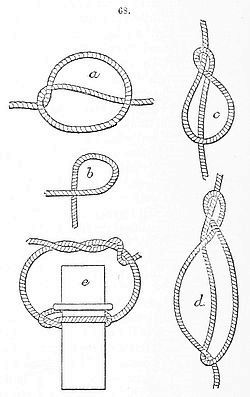
68. Corking Bottles.
The most common mode of fastening down corks, is with the ginger-beer knot, which is thus made:—First the loop is formed as at a Fig. 68, then that part of the string which passes across the loop is placed on the top of the cork, and the loop itself is passed down around the neck of the bottle, and by pulling the ends of the cord it is made tight beneath the rim; the ends of the string are finally brought up, and tied either in a double knot, or in a bow on the top of the cork.
For effervescing drinks, such as champagne, which require to be kept a longer time and are more valuable, a securer knot is desirable, which may be made thus:—A loop as at b is first formed, and the lower end is then turned upwards and carried behind the loop, as shown at c; it is then pulled through the loop as at d, and in this state is put over the neck of the bottle; the part a being on one side, and the two parts of the loop on the other; on pulling the two ends, the whole becomes tight round the neck, and the ends, which should be quite opposite, are to be brought up over the cork, twice twisted, as at e, and then tied in a single knot.
Insects are often troublesome in devouring corks. This evil may be prevented by the following remedies. (1) Smear petroleum over the corks and bottle-necks, (2) Dip the cork and neck into a paste of quicklime which has just been slaked, and let it concrete on the bottle.
Aerated Drinks
Aerated Drinks.—These may be divided into two classes, alkaline and saccharine. The alkaline, usually called mineral waters, are such as soda, seltzer, potass, &c.; while the saccharine are those which contain a portion of sugar, such as ginger beer, lemonade, and the various drinks made from the syrups. The alkaline mixtures after settling in the tanks, are usually passed through a lawn sieve, and then pumped through the machine, which impregnates them with carbonic acid gas. Saccharine drinks do not undergo this process, but a given quantity is put into each bottle or siphon, and the aerated water is forced into the bottle on it.
Either hard or soft water may be used for aerated drinks, so long as it is pure; when any doubt exists, it is always best to have it filtered. When a choice of water can be had, use hard or spring water for saccharine drinks.
The following recipes may be varied considerably. Some of the best beverages have been produced by mixing several of the essences together, and altering the colour. In all these drinks it is the essence that is used, as the fresh fruit will not do for bottle goods; while for the fountain drinks, the fresh fruit, being consumed as soon as mixed, forms a creamy beverage much in demand.
In all cases, in warm weather, it is advisable to have the factory as cool as possible, and more particularly the water. It is a good system and is employed in many factories, to have the pump of the machine surrounded with ice, the refrigerator being external; any kind of ice may be used.
In regard to the machinery, fountains, &c., used in the manufacture and dispensing of aerated beverages the reader is referred to the catalogues of the various manufacturers of the same.
Saccharine drinks are never pumped through a machine, but a given quantity of the syrup is put into each bottle by means of a syrup measure-tap, or better still, a syrup pump attached to the filling machine, and the aerated water is bottled on it.
Following are the principal saccharine aerated beverages:—
Champagne Cider.—This is lemonade syrup flavoured with pear essence, and coloured with the sugar colouring.
Gingerade.—(1) Mix 5 oz. essence of cayenne, 5 oz. essence of ginger, and 5 oz. water; (2) dissolve 3 lb. citric acid in ½ gal. hot water; (3) dissolve 4 oz. magnesia and 20 lb. fine loaf sugar in 3¼ gal. pure water. Filter the first compound and add 7 oz., also 14 oz. of the second, to the third; there will be no cloudiness; bottle at a pressure of 70 to 80 lb., using 1 oz. syrup to a bottle.
Ginger Ale.—This is ginger-beer syrup coloured slightly with sugar or saffron colouring. An addition of pineapple will also greatly improve the flavour. Bottle as for lemonade. Add albumen compound, q.s.
Ginger Beer.—This is lemonade syrup flavoured with essence of ginger and capsicine. The soluble essence of ginger is added to the syrup by dropping the quantity required on to pieces of sugar, when the syrup is lukewarm; the palate will be the best guide for quantity, as the essences vary much in strength. The albumen compound is to be added at the same time as the essence; bottle as for lemonade, using ¾ oz. to a bottle.
(a) A strong ginger beer is made by boiling with every gallon of water, 2 lb. loaf sugar, and 1 oz. bruised ginger, 1 oz. cream of tartar, and one small lemon, sliced. To the cooled mixture some yeast is added, and the whole is set aside for fermentation. When the tumultuous fermentation is over, the liquid is bottled. Ginger beer thus made is, when properly fermented, of considerable alcoholic strength, equal at least to the strongest Scotch ale.
(b) Keeps for many months. Take white sugar, 20 lb.; lime juice, 18 (fluid) oz.; honey, 1 lb.; bruised ginger, 22 oz.; water, 18 gal. Of course the quantities can be modified. Boil the ginger in 3 gal. water for ½ hour, the sugar, the lime juice, and the honey with the remainder of the water, and strain through a cloth. When cold, add the white of one egg and ½ oz. (fluid) essence of lemon. After standing four days, bottle.
(c) Boil a sliced lemon with 1 oz. ground ginger in ½ pint water for ½ hour; stand to settle, and pour off clear part into a vessel containing 5 qt. cold water; add 1 lb. lump sugar and 1 oz. cream of tartar; ferment with 2 oz. German or other yeast spread on toast or plain bread; stand to ferment in warm place; cover from dust; bottle soon as fermented; drink in three days.
(d) White sugar, 1 lb.; cream of tartar and ginger, each 1 oz.; honey, 2 oz.; lemons, 2; water, 2 gal.; tartaric acid, 40 gr.; white of an egg. Bruise the ginger, and let the water boil for 10 minutes; pour it on the cream of tartar, sugar, and lemons. Let it stand till cold, then add white of an egg and a tablespoonful of yeast; let it work 6 hours, then add tartaric acid and bottle directly.
(e) Put into a 30 gallon brew 2 lb. of good fresh brewer’s yeast, and stir it up well. Now allow it to ferment, taking care that there shall be a gradual rise in temperature during fermentation. Skim the yeast off carefully until the beer is ready for bottling (which will not be under 24 hours), then add your eggs, and bottle quickly. After bottling lay the bottles down, as they will mature better than if standing up. The eggs have no effect on the strength of the beer. The barm should not be skimmed off too often; it is necessary to allow a good head to form before skimming. About three times should be sufficient. 70° F. is too high a temperature to commence a fermentation; better commence at 63° or 64° F. Beat up the eggs with a birch rod, mixing well with 2 or 3 pints of beer; add it to the beer after the fermentation is finished, then well mix the whole together and bottle. If the fermentation has been conducted properly, it will not be necessary to rack into a clean cask before fining and bottling. Use sufficient yeast (2 lb.), avoid skimming too often, and do not have the liquor too hot.
Ginger Champagne.—This refreshing and agreeable beverage is, according to a French recipe, made as follows:—Take 60 gal. water; add 40 lb. ginger cut in small pieces, and gently boil for ½ hour, carefully removing any froth that may arise. Cool the liquor as quickly as possible, and when at a blood-heat (100° F.) add 9 lb. raisins chopped fine, and the juice of 6 doz. oranges and 6 doz. lemons. Allow the liquid to ferment, and after standing a month it may be bottled in the usual manner. If desired, the ginger may be omitted, and the number of oranges increased to 18 doz.
Lemonade.—(a) A difference of opinion exists as to whether this syrup is best by simmering over a slow fire, or by merely pouring boiling water on the ingredients; but this is greatly influenced by the quality of the water used. The quantity of sugar and citric acid used to a gallon of syrup is also subject to variation, as some like it more acidulated than others. The usual proportions are 27 lb. loaf sugar and 12 oz. citric acid, previously dissolved, to 3 gal. water. Simmer over a slow fire for 5 minutes; carefully skim it and strain through a felt bag while hot; when cooled down to the warmth of new milk, add about ½ oz. oil of lemon. A slight head is considered an improvement, to produce which add about ½ oz. of the French gum extract to 1 gal. syrup; 1 oz. of syrup is to be put into the bottle, and the aerated water bottled on it at a pressure of 90 to 100 lb.
(b) Rinse out with boiling water an earthen glazed vessel, to warm it; put into it about 27 lb. loaf sugar and 12 oz. citric acid, previously dissolved in a small quantity of boiling water; stir occasionally, and when properly dissolved, strain it through a felt bag. Drop oil of lemon on some large lumps of sugar till they have taken up ½ oz.; when the mixture has cooled down to the warmth of new milk, drop in the lumps of sugar, and see that they are dissolved before proceeding to use it. Tartaric acid may be used in place of citric acid, but it is not so good. Use 1 oz. to each bottle, and bottle as for (a).
As lemonade syrup forms the basis for so many of the saccharine drinks, it may be as well to state that some makers prefer to use less water, as well as to vary the proportions of citric acid and sugar; it is also considered an improvement to add a drop or two of otto of roses to each gallon of syrup; this, without adding at all to the quality of the drink, throws off a pleasant aroma on the opening of a bottle. Caramel is used for a strong colour.
Nectar.—This is lemonade syrup, flavoured with the essence of pineapple.
Orange Champagne.—Take 7 gal. water, 20 oz. citric acid, 54 lb. sugar. When cold add to each gallon 3½ oz. orange tincture; colour to fancy (sugar colouring), add ¼ oz. albumen compound at the rate of 1½ oz. to a ½ pint bottle. This is a very delicious drink, and should be put up in champagne bottles; a special corking machine is required, and also a better cork than the one used for lemonade.
Pepper Punch.—Take 1¼ oz. concentrated punch to 1 gal. plain syrup; mix well; add a few drops essence of capsicine. About 1½ oz. of the syrup for each bottle, filling up with aerated water.
Tonic Lemonade.—Lemonade syrup flavoured with quinine, using the same quantity as for tonic water; or to suit the palate.
The chief ingredient in all saccharine aerated drinks is the syrup. This is formed by making concentrated solutions of sugar in pure water, or in water containing the principles of various flavouring substances; the former are called simple, and the latter compound syrups.
There are many precautions to be taken in order to ensure the production of good syrups, the most important being, perhaps, the selection of the sugar. Cane-sugar only should be used, and that should be perfectly refined. The least shade of colour in the sugar is due to the presence of impurities, and syrup prepared from such sugar not only has an unpleasant flavour, but is also very difficult to keep. The use of common or brown sugar may be regarded, in many cases, as an adulteration.
Syrups are very easily prepared. A hemispherical copper basin, not tinned, but well polished, and kept scrupulously clean, is the apparatus employed. This basin stands on three legs, and is furnished with a false bottom, which is also hemispherical. The two hemispheres are surrounded by a copper cylinder, fitted with a lid; the three parts of the apparatus are fixed together by means of two circular iron rings, which are fitted to the circumference of the hemispheres and to the bottom of the cylinder, the whole being well pinned or bolted together. A stop-cock in the outer hemisphere communicates by means of a short pipe with the inner one, and serves to withdraw the contents. Another cock, placed almost at the top, serves for the admission of steam between the two bottoms; and the condensed water is drawn off by means of a third cock communicating only with the outer bottom, and placed at a short distance from the first. The whole apparatus may be of any convenient size. Its chief advantage is that the syrup can be heated to the required degree with the utmost nicety; the steam is admitted until this degree is reached, and the supply may then be stopped in a moment, thus ensuring perfect regularity of working.
There are many circumstances which tend to produce changes in syrups when made, and to cause them to degenerate and become worthless; these must be carefully guarded against. The most common is fermentation; this may be either the result of too short or too long-continued boiling; or of the presence of an excess of mucilaginous substances; or an imperfect clarification of the syrup will also produce it in the course of time. But the most frequent cause of fermentation is found in leaving the syrup in a warm place, or in vessels which are not completely filled, and especially if they happen to have been wet when the syrup was introduced. In order to guard against under or over-boiling of simple syrups, it should be laid down as a rule that they stand at 32° B. when boiling, and when cold at 34° B. in winter, and 35° B. in summer. They should then be bottled, and stored in a cool cellar.
In the preparation of syrups, which are solutions of sugar, more or less strong according to the object for which they are used, care should be taken to employ only the best refined sugar, and either distilled or filtered rain-water, as they will be rendered much less liable to spontaneous decomposition, and become perfectly transparent without the trouble of clarifying. When, however, impure sugar is employed, clarification is always necessary. This is best done by dissolving the sugar in the water or fruit juices cold, and then beating up a little of the cold syrup with some white of egg and 1 or 2 oz. cold water, until the mixture froths well; this must be added to the syrup in the boiler, and when the whole is frisked up to a good froth, heat should be applied, and the scum which forms removed from time to time with a clean skimmer. As soon as the syrup begins to simmer it must be removed from the fire and allowed to stand until it has cooled a little, when it should again be skimmed, if necessary, and then passed through a clean flannel. By using refined sugar, however, all this trouble of clarification can be avoided.
When vegetable infusions or solutions enter into the compositions of syrups, they should be rendered perfectly transparent by filtration or clarification, before being added to the sugar.
The proper quantity of sugar for syrups will, in general, be found to be 2 lb. to every pint of water or thin aqueous fluid. These proportions allow for the water that is lost by evaporation during the process, and are those best calculated to produce syrup of proper consistence and possessing good keeping qualities. They closely correspond to those recommended by Guibourt for the production of a perfect syrup, which, he says, consists of 30 parts of sugar to 16 parts of water.
In the preparation of syrup it is of great importance to employ as little heat as possible, as a solution of sugar, even when kept at a temperature of boiling water, undergoes slow decomposition. The best plan is to pour the water (cold) over the sugar, and to allow the two to lie together for a few hours in a covered vessel, occasionally stirring, and to apply a gentle heat, preferably that of steam or of a water-bath, to finish the solution. Syrups are sufficiently boiled when some taken up in a spoon pours out like oil, or a drop cooled on the thumb nail gives a proper thread when touched. When a thin skin appears on blowing the syrup, it is judged to be completely saturated. These rude tests, however, often lead to errors, which might be easily prevented by employing the proper proportions, or determining the specific gravity by immersing in the syrup one of Baumé’s saccharometers or syrup gauges, as indicated in the following table:—
Sugar in 100 parts.Sp. Gr.Deg. Baumé.
01·0000
51·0203
101·0406
151·0628
201·08111
251·10413·5
301·12816·3
351·15219
401·17721·6
451·20424·5
501·23027
551·25729·5
601·28432
671·32135
A fluid ounce of saturated syrup weighs 577½ gr.; a gallon weighs 13½ lb.; its specific gravity is 1·319 to 1·321 or 35° Baumé; its boiling point is 221° F., and its density at the temperature of 212° is 1·260 to 1·261, or 30° Baumé. The syrups prepared with the juices of fruits mark about 2° or 3° more on Baumé’s scale than the other syrups. According to Ure, the decimal part of the number denoting the specific gravity of a syrup multiplied by 26 gives very nearly the number of pounds of sugar it contains per gallon.
The preservation of syrups, as well as of all saccharine solutions, is best promoted by keeping them in a moderately cool, but not a very cold place. Let syrups be kept in vessels well closed, and in a situation where the temperature never rises above 55° F. They are kept better in small than in large vessels, as the longer the bottle lasts the more frequently will it be opened, and the syrup consequently exposed to the air. By bottling syrups while boiling hot, and immediately corking down and tying the bottles over with a bladder, perfectly air-tight, they may be preserved even at a summer heat for years, without fermenting or losing their transparency.
The candying of syrups may be prevented (unless the syrup be over-saturated with sugar) by the addition of acetic or citric acid, 2 or 3 dr. per gallon. Confectioners add a little cream of tartar to prevent granulation. Syrups may be effectually prevented from fermenting by the addition of a little sulphite of potash or lime; also by the use of salicylic acid in small quantities. Fermenting syrups may be immediately restored by exposing the vessel containing them to the temperature of boiling water. The addition of a little spirit is also good, say about 10 per cent.
A solution of sugar prepared by dissolving 2 parts of double refined sugar in one of water, and boiling this a little, affords a syrup which neither ferments nor crystallises.
The basis of most mineral water syrups is simple syrup, which is prepared by adding 16 lb. of finest white sugar and the whites of 4 eggs to 1 gal. water; stir until all the sugar is dissolved; simmer over a gentle heat for 2 or 3 minutes; skim well and strain through a fine flannel bag.
The best way to keep fruit syrups from fermenting is by bottling while hot, into suitable bottles or larger vessels, and to prevent access of air. This is the principle, and it may be carried out in various ways. For instance, fill the syrup while hot in quart bottles, previously warmed, and fill them almost full. Cover or cork the bottles temporarily until the syrup cools a little and contracts in volume; then, having heated a small quantity of the syrup, refill the bottles, cork them securely and wax them.
A great variety of syrups are made by the addition of proper flavouring ingredients to simple syrup; but in other cases, especially when the juices of fruits are employed, the syrup is not first prepared and then flavoured, but the processes go hand-in-hand. In such instances specific instructions will be given. It is always advisable, when fresh fruit can be obtained, to use it in preference to the essence. One general recipe, which answers for nearly all fresh fruit, is as follows: Use nothing but the very best fresh fruit, which must be freed from stocks, &c., and crushed with a wooden instrument (not metal); when well mashed, let it stand in a room of even temperature (about 68° F.) for 4 days, which will give sufficient time for fermentation to take place; press out the juice from the fruit and let it settle in a cool cellar for 2 days, after which 5 lb. of the clear juice is to be simmered with 9 lb. loaf sugar; while warm, strain through flannel. The colour may be improved by a solution of some colouring agent.
It is advisable to add to the fresh fruit before setting it for fermentation, about 2 lb. powdered loaf sugar for every 100 lb. fruit. When cold, it is ready for bottling. Cleanliness should be strictly observed in all the utensils used. When bottling for storing, skim the top off any floating matter from the syrups in the large pan, and see that no residue at the bottom goes into the bottles. Most of the syrups not made of fruit, may have a little mucilage of gum arabic added, in order to produce a rich froth. The following recipes comprise syrups made from the fruit, and also from essences. These may be varied to suit taste and requirements. A variety of syrups have been brought into use by adding the various wines, such as claret, hock, sherry, &c., to simple syrup; others, by the addition of spirits, as milk punch, by adding to vanilla cream Jamaica rum and nutmeg. Almost any syrup may be made by the addition of a sufficient quantity of flavouring essence to simple syrup; but these artificially prepared syrups are inferior to those made from fresh fruits.
Red Colouring for Soda-Water Syrups.—The most convenient is probably tincture of cudbear, as it affords a good, substantial, and natural-looking colour miscible with syrups without cloudiness. It may be made as follows:—2 to 4 oz. powdered cudbear, 1 pint diluted alcohol. Exhaust by maceration or displacement. Used alone, the tincture gives a shade of red closely imitating the colour of raspberries or currants. For deeper red, like blackberries, the addition of some caramel is all that is necessary. The strawberry colour is best imitated with tincture of cochineal. Aniline red, owing to its cheapness, is often used for colouring syrups, but it produces a glaring, artificial-looking bluish-red, and is liable to the objection that it sometimes contains arsenic.
Ambrosia Syrup.—A mixture of equal parts of vanilla and strawberry syrups.
Apple Syrup.—As for pineapple syrups.
Banana Syrup.—As for pineapple syrups.
Blackberry Syrup.—Prepared from ripe fruit the same as raspberry syrups. Improved by adding 1 oz. best French brandy to each quart.
Capillaire Syrup.—9 lb. loaf sugar, 5 lb. orange-flower water. Boil till the sugar is dissolved and the syrup is clear; while hot, strain through flannel; add to the cool syrup 2 dr. tartaric acid, previously dissolved in 8 oz. strongest orange-flower water; lastly add 4 oz. best Rhine wine.
Cream Syrup.—(a) 1 pint condensed milk, 1 pint water, 1¼ lb. sugar. Heat to boiling and strain. This will keep for over a week in a cool place.
(b) Imitation.—Make an emulsion with 3 oz. fresh oil of sweet almonds, 2 oz. powdered gum arabic, and 2 oz. water; then dissolve 1 lb. white sugar by gentle heat, strain, and when cool, add the whites of two eggs. It should be put up in small bottles, well corked, in a cool place. This is not only an excellent imitation and substitute for cream syrup, but will keep for a considerable time.
Currant Syrup.—(a) 6 pints simple syrup, 2 pints water, 2 oz. tartaric acid, 3 dr. fruit essence. Mix; colour with liquid carmine for red currants, and with burnt sugar, for black.
(b) 1 pint red currant juice, 1 gal. simple syrup.
Ginger Syrup.—(a) 6 pints simple syrup, 2 pints water, 1 oz. tartaric acid, 2 oz. ginger. Burnt sugar to colour.
(b) 4 oz. extract Jamaica ginger, 1 gal. syrup. Shake well. A few drops of tincture curcuma to colour.
(c) 9 lb. loaf sugar, 5 lb. water, 12 oz. essence of ginger, 4 oz. Rhine wine. Boil sugar and water until dissolved and clear; when cool, add ginger and wine. Mix well and let settle.
Grape Syrup.-½ pint brandy, 1 oz. tincture of lemon, 1 gal. simple syrup, 1 qt. tincture red saunders.
Imperial Syrup.—Equal parts of raspberry and orange syrups.
Lemon Syrup.—(a) Grate off the yellow rinds of lemons, and beat it up with a sufficient quantity of granulated sugar; express the lemon juice; add to each pint of juice 1 pint of water, 3½ lb. granulated sugar, including that rubbed up with the rind; warm until the sugar is dissolved and strain. Under no circumstances must the syrup be allowed to boil, and the less heat that can be used to effect the complete solution of the sugar the better will be the syrup.
(b) Add to 1 gal. simple syrup when cold, 20 drops fresh oil lemon and ½ oz. citric acid, previously dissolved in 3 oz. water; mix by shaking well in a bottle; add 4 oz. gum solution, made by dissolving 2 oz. fine white gum arabic in 2 oz. warm water.
(c) 6 pints simple syrup, 2 pints distilled water, 2 oz. essence of lemon, 2 oz. citric acid, dissolved in boiling water. Mix, and, if required, colour with saffron.
Maple Syrup.—3½ lb. maple sugar, 1 qt. water. Dissolve, and, if desired, add a small proportion of gum solution to produce a rich froth.
Milk-Punch Syrup.—To 1 pint heavy syrup add ½ pint each brandy and Jamaica rum; flavour with 2 teaspoonfuls of an extract prepared by macerating 2 oz. ground nutmegs in 8 oz. alcohol. The syrup is first to be poured into the glass in the proper quantity, and ordinary cream syrup added before drawing the soda water.
Mulberry Syrup.—Made from the fruit, the same as strawberry, and acidulated slightly with a solution of citric acid. It may also be made from the fruit essence in the same manner as for strawberry, using about half the quantity of tartaric acid.
Nectar Syrup.—(a) 1 oz. extract of vanilla, 1 oz. extract of rose, 1 oz. extract of lemon, 1 oz. extract of bitter almonds. Mix and add 1 gal. of simple syrup; colour pink with cochineal.
(b) Mix 3 parts vanilla syrup with 1 each of pineapple and lemon syrups.
Orange Syrups.—These may be made from the fresh fruit or from the essence in a similar manner as for lemon syrups. Orange syrups may be coloured slightly with tincture of saffron or of turmeric.
Orgeat Syrup.—(a) ½ pint cream syrup, ½ pint simple syrup, 1 pint vanilla syrup, 5 drops oil bitter almonds.
(b) Beat to an emulsion in a mortar 8 oz. blanched sweet almonds and 4 oz. bitter ones, adding a little water; when smooth, add 3 pints water; mix and strain; dissolve in this without heat 6 lb. sifted white sugar, and 4 oz. fresh orange-flower water.
(c) An excellent imitation of orgeat syrup is made by flavouring cream syrup, made with eggs and milk, with a few drops of oil of bitter almonds.
Pear Syrup.—As for pineapple syrups.
Pineapple Syrup.—(a) Take a convenient number of the fruit; pare and mash them in a marble or porcelain mortar, with a small quantity of sugar; express the juice; for each quart of juice take 1½ pint water, and 6 lb. sugar; boil the sugar and water, and add the juice; remove from the fire; skim and strain.
(b) 6 pints simple syrup, 2 pints distilled water, 1 oz. tartaric acid, 1 dr. essence of pineapple. Saffron to colour.
(c) Proceed as for raspberry (d); but the hard nature of this fruit requires pounding with a heavy chump of wood (not metal) in a tub with a strong bottom; when well mashed, it will require great pressure to extract all the juice from this fruit; a cider press will answer the purpose; add 14 lb. sugar to 1 gal. juice and a little pure acetic acid; put it on a slow fire, and stir until the sugar dissolves; when cold, bottle and tie down.
Raspberry Syrup.—(a) Take fresh berries and enclose them in a coarse bag; press out the juice, and to each quart add 6 lb. white sugar and 1 pint water; dissolve, raising it to the boiling point; strain; bottle and cork hot, and keep in a cool place. Raspberry syrup is improved by adding 1 part of currants to 4 parts of raspberries.
(b) 5 qt. raspberries, 12 lb. white sugar, 1 pint water. Sprinkle some of the sugar over the fruit in layers, allowing the whole to stand for several hours; express the juice and strain, washing out the pulp with the water, add the remainder of the sugar and water; bring the fluid to the boiling point, and then strain. This will keep for a long time.
(c) 6 pints simple syrup, 2 pints water, 2 oz. tartaric acid, 2 oz. essence of raspberry. Colouring sufficient. Colouring for raspberry, blackberry, &c., syrups may be made by boiling 1 oz. cochineal with half a teaspoonful cream of tartar; filter.
(d) Take any quantity of fully ripe fruit; free them from stalks; place them in a tub and crush them with a wooden spatula; after they have been mashed, let them remain for 3 or 4 hours, and strain the crushed berries through a strong flannel bag or strainer into a suitable vessel. Dissolve ½ oz. citric acid in 3 oz. water, and add this quantity to each gallon of juice; mix 14 lb. broken sugar to every gallon of juice; put on a slow fire and stir until all the sugar is dissolved (not boil); take off the fire, and when cold, bottle and cork for future use. If too thick when cold, it may be brought to a proper consistency by the addition of water.
(e) Imitation.—3 oz. bruised orris root, 2 oz. acetic acid, 1 oz. acetic ether, 1 pint alcohol. Cochineal to colour. Mix and allow to stand a few days; filter, and use to flavour simple syrup.
Rose Syrup.—1 gal. simple syrup, 1 oz. essence of rose. Colour pink with prepared cochineal, and acidulate lightly with a solution of citric acid.
Rowan Syrup.—Dry the berries till they are quite shrivelled. Then place them in brandy, and leave them in it for 7-10 days. Strain it off the berries at the end of that time, and mix with an equal quantity of thick very clear syrup made with loaf sugar in a brass boiler. A handful of picked berries is sufficient for 1 pint brandy. This is a very palatable liqueur.
Sarsaparilla Syrup.—(a) 1 gal. simple syrup, 2 oz. essence of sarsaparilla. Colour with caramel.
(b) 1 gal. simple syrup, essence of sarsaparilla, q.s., 1 oz. powdered extract licorice, 15 drops oil of sassafras, 15 drops oil of wintergreen, 10 drops oil of aniseed. Stir the oils with the powdered licorice; add a portion of the syrup; stir smoothly, and mix the whole together by agitation.
Sherbet Syrup.—Mix equal parts of orange, pineapple, and vanilla syrups.
Sherry Cobbler Syrup.—To 1 pint good sherry add an equal measure of heavy simple syrup, and one lemon cut in very thin slices. Allow the syrup to stand a few hours; strain through a sieve, and bottle for use.
Strawberry Syrup.—Proceed as for raspberry syrup (d); but the fruits being more stubborn will require a good beating with the spatula to mash them; when they have stood 3 or 4 hours, strain and press the juice out by squeezing the strainer between the hands; add to the juice the same quantity of citric acid; dissolve in each gallon 14 lb. loaf sugar; simply warm the juice sufficiently to dissolve the sugar; take from the fire, and when cold bottle and cork till required.
Vanilla Syrup.—(a) 1 gal. simple syrup, 1 oz. extract vanilla, ½ oz. citric acid. Stir the acid with a portion of the syrup; add the extract of vanilla; mix.
(b) 4 pints simple syrup, 2 oz. extract of vanilla.
The essences used by aerated water makers are usually purchased ready made, though in many cases it is found desirable to prepare them at the factory. Below are given a few recipes for those most commonly used:—
For essence of lemons, remove the outer rinds of 40 lemons, without a particle of pulp, and macerate them with 6 qt. perfectly pure alcohol at 85°. After two or three days, distil to dryness in a water-bath; add 2 qt. water and rectify to obtain 5 qt. of the essence. The essences of oranges and cedrats are made in precisely the same way.
For essence of strawberries and raspberries, take 56 lb. of the fresh fruit, free from stalks and leaves, and place them in 45 qt. pure alcohol at 80°. Macerate for 24 hours in a vessel closed in a water-bath; add 20 qt. water, and distil to obtain 44 qt., each containing 17½ oz. of essence.
Beer
Beer.—Owing in a great measure to Excise restrictions, very little home-brewed beer is made now in England; but a few notes may be useful.
Half-hogshead of Ale.—Take 5 bush. pale malt, 4 lb. best Worcester hops; put into mash tub 30 gal. hot water (202° F.), 13 gal. cold water (49° F.), mean heat 166° F.; shake the malt in and stir it well about, and let it stand 1½ hour; draw off the wort and mix it with the hops; pour over the grains sufficient hot water at 200° F. to fill your barrel, allowing some for waste in boiling and working. Boil the wort and hops for one hour. Put 1 pint yeast to 3 gal. wort, at 72° F., to begin to work, and add the remainder at 68° F.
Summer Beer.—Over 1 bush. (40 qt.) malt pour enough boiling water to enable you to draw off 100 qt. of wort. Put into the wort ½ lb. hops, and boil it an hour. Having washed your mashing tub well from the grains, pour the wort into it, and, when cooled to the temperature of new milk, add in summer ½ pint of yeast, in winter a little more. Cover the tub with a cloth, and let it work till next day; pour it into your barrel before it begins to sink, and rack it before the barrel is stopped up. It will be fit to drink in a fortnight or three weeks.
Champagne Beer.—According to Teltscher, of Breslau, this beer is prepared in the following manner:—A light, strongly hopped, bottom-fermentation beer is left in cask until fit for consumption, and is then mixed with 2 per cent. of “Krausen-beer” (that is to say, beer in the first stage of active fermentation), and bottled. The bottles are filled up, carefully corked, and racked with the necks downwards, in which position they are left for a fortnight. The mixture develops an amount of carbonic acid not obtainable in other light bottom-fermentation beers strongly hopped. The reversed position of the bottles causes the floating particles of yeast to settle inside the necks, and by drawing the bottles lengthwise through the hands daily, these particles are detached and settle down finally on the cork. When the beer has generated enough carbonic acid gas, as indicated by its paleness, which sometimes occurs as early as the eighth day, the bottles are taken one by one in the left hand, with the neck inclining outwards and downwards, and the cork being removed with the right, the internal pressure is allowed to blow away the sediment from the neck. The bottles are then carefully re-corked. In this way a light bottom-fermentation beer, strong of the hop, and perfectly free from yeast, is obtained, which, owing to the large proportion of carbonic acid it holds, retains its refreshing properties at temperatures as high as 18° C. (64° F.), whereas beers of a like character with little or no carbonic acid become flat at 8° C. (46° F.). That the beer can be drunk without artificial cooling is put forward as another recommendation.
Bottling Beer.—(a) The bottles should be clean, sweet, and dry, the corks sound and good, and the beer “fine.” When the bottles are filled, if for home consumption, they should not be corked till the day following, and if for exportation to a hot climate, they must stand 3 days or more (if the liquor is new); it should be well corked and wired, but for family use they may do without wiring, only they should be well packed in sawdust, and stand upright. But if some are wanted ripe, keep a few packed on their sides, so that the liquor may touch the corks, and this will soon ripen, and make it fit for drinking.
(b) Choose clear weather, and leave the bung out of the cask all night. Fill the bottles, throw sheets of paper over them to keep out the dust, let them stand 24 hours, then cork, wire, and pack away in a cool place. If for immediate use, ripen by adding a piece of sugar to each bottle before corking.
Brightening Cloudy Beer.—Add calcined oyster shells, but after the application of oyster shells the ale requires to be rapidly drunk, as it will not keep good for any length of time. At the time of being brewed, if it is rapidly cooled, it never will become cloudy. All depends upon the time it takes to cool.
Restoring Sour Beer.—When beer has once been sour, i.e. has once been through acetous fermentation, it never again will have its former brilliancy, liveliness, or full flavour; it will always remain acid. Procure a 4½ gal. cask (commonly called a pin), rack the ale into it, and get about 3 oz. of new hops, which put in the pin, bung it down tight, put it in a cellar, where let it remain six months at least; it may then be better.
If beer is sour in bottles, put ¼ teaspoonful of soda carbonate and a large teaspoonful of brown sugar into each bottle; then cork well, and tie it down the same as ginger beer, and place the bottles cork downwards for about 3 weeks, where it is not too cold.
Finings.—(a) Take 1½ pints water and 2 oz. unslaked lime, mixed well together; let them stand 4 hours, and when the sediment is settled pour it off clear and mix 2 oz. isinglass, cut small, in ½ pint water. When dissolved put it into a barrel of beer.
(b) Eggs, any quantity; beat them to a froth and expose them to a gentle heat or in the sun to dry; then powder. In some cases a little fine wheat flour is added, the paste made into balls, and dried in the sun or a warm room, and then powdered.
(c) Isinglass, 1 lb.; water, 8 gal.; vinegar, 4 gal. Mix the vinegar and isinglass, and macerate for 4 days, then add the water.
(d) Isinglass, 1 lb.; sour beer or cider, 5 gal.; water, 6 gal. Digest the first two until the isinglass is dissolved, then add the water, and strain.
Weevil in Malt.—This can be killed by heat or checked by cold. If the temperature is raised to 167°-190° F., the insects die; if cold air is introduced, they cease to breed. Frequent turning of the malt, careful whitewashing of the walls, and the introduction of cold air (leaving all the windows open for two or three frosty nights) are the best preventives.
Bitters
Bitters.—The following are the chief kinds in vogue.
Amazon.—90 gal. plain proof spirit; 3¼ lb. red Peruvian bark; 3¼ lb. calisaya bark; 1⅛ lb. calamus root; 4¾ lb. orange peel; 3½ oz. cinnamon; 3½ oz. cloves; 3½ oz. nutmeg; 2 oz. cassia buds; 6½ lb. red sanders wood. First mash all the ingredients, put them in the spirit, and let them infuse 14 days, stirring the mixture well twice every day. Rack off and colour with 11 pints brandy colouring, to get a dark red tint. Stir ¼ hour. Dissolve 30 lb. white sugar in 30 gal. water; add, and again stir ½ hour. Let the mixture rest 4 or 5 days, and when bright, bottle. If the sanders wood is not used, the colour will be a bright amber. Compounded according to the above directions, will yield 120 gal. 25° below proof.
Angostura.—4 oz. gentian root; 10 oz. each calisaya bark, Canada snake-root, Virginia snake-root, liquorice root, yellow bark, allspice, dandelion root, and Angostura bark; 6 oz. cardamom seeds; 4 oz. each balsam of tolu, orangetis, Turkey rhubarb, and galanga; 1 lb. orange peel; 1 lb. alkanet root; 1½ oz. caraway seed; 1½ oz. cinnamon; ½ oz. cloves; 2 oz. each nutmegs, coriander seed, catechu, and wormwood; 1 oz. mace; 1¼ lb. red sanders wood, and 8 oz. turmeric. Pound these ingredients and steep them for 15 days in 50 gal. proof spirit; before filtering, add 30 lb. honey.
Aromatic.—Macerate 2¾ lb. ground dried small orange apples, ¼ lb. ground dried orange peel, 2 oz. ground dried calamus root, 2 oz. ground dried pimpinella root, 1 oz. ground dried cut hops, for 14 days, with 10 gal. of spirit at 45 per cent.; press, and add 2½ pints brown-sugar syrup. Filter. Colour dark brown.
Boker’s.—1½ oz. quassia; 1½ oz. calamus; 1½ oz. catechu (powdered); 1 oz. cardamom; 2 oz. dried orange peel. Macerate for 10 days in ½ gal. strong whisky, and then filter and add 2 gal. water. Colour with mallow or malva flowers.
Brandy.—Grind to coarse powder 3 lb. gentian root, 2 lb. dry orange peel, 1 lb. cardamom seeds, 2 oz. cinnamon, 2 oz. cochineal. Infuse 10 days in 1 gal. brandy, 8 gal. water, and filter.
Essence.—40 gal. proof spirit, 1 drm. oil of anise, 1 drm. oil of caraway, ½ drm. oil of cloves, 1 drm. oil of lemon, 1 drm. oil of oranges, 1 drm. oil of cinnamon, ½ drm. oil of bitter almonds, 1 gal. sugar syrup. Cut the oils in 95 per cent. alcohol, and mix. Colour with brandy colouring.
French Cognac.—1½ lb. each red Peruvian bark, calisaya bark, bitter orange peel, and sweet orange peel; 2 oz. calamus root; 4 oz. cardamom seeds; 1½ oz. each cinnamon, cloves, and nutmegs; 4 oz. caraway seed; and 3 lb. wild cherry bark. Pound all these ingredients to a coarse powder and steep for 15 days in 45 gal. proof spirit (or 60 gal. spirit 25° below proof), stirring occasionally. Then rack it off, and mix sufficient caramel to make it a dark red; add 15 lb. white sugar dissolved in 15 gal. water; let the whole settle, then filter. If the bitters are required to be of an amber colour, omit the wild cherry bark and the caramel colouring.
Hamburg.—Grind to a coarse powder 2 oz. agaric, 5 oz. cinnamon, 4 oz. cassia buds, ½ oz. grains of Paradise, 3 oz. quassia wood, ¾ oz. cardamom seeds, 3 oz. gentian root, 3 oz. orange apples dried, 1½ oz. orange peel; macerate with 4¼ gal. 95 per cent. alcohol, mixed with 5¾ gal. water; add 2¾ oz. acetic ether. Colour brown.
Nonpareil.—Grind to coarse powder 2 oz. Peruvian bark, ½ oz. sweet orange peel, ½ oz. bitter orange peel, 25 gr. cinnamon, 25 gr. cloves, 25 gr. nutmeg, 15 cayenne seeds. Infuse 10 days in 2 gal. 65 per cent. alcohol, then filter.
Orange.—(1) Macerate 6 lb. orange peel for 24 hours with 1 gal. water, cut the yellow part of the peel from off the white, and chop it fine; macerate with 4¾ gal. 95 per cent. alcohol for 2 weeks, or displace; then add a syrup made of 4¼ gal. water and 16 lb. sugar. Filter through Canton flannel. (2) ½ oz. Seville orange peel, ¼ oz. lemon peel, ¼ oz. gentian root, ¼ oz. ginger, all bruised and put into a jug; pour a pint of boiling water on it, and cover up with a cloth.
Peruvian.—8 oz. red Peruvian bark; 8 oz. orange peel; 1½ drm. each cinnamon, cloves, and nutmeg; and 75 cayenne pepper seeds. Infuse them, well bruised, in 8 gal. proof spirit, for 15 to 20 days, stirring every day. Draw off and filter.
Spanish.—Grind to coarse powder 5 oz. polypody, 6 oz. calamus root, 8 oz. orris root, 2½ oz. coriander seed, 1 oz. centaurium, 3 oz. orange peel, 2 oz. German camomile flowers; then macerate with 4¾ gal. 95 per cent. alcohol, and add 5¼ gal. water and 1½ oz. of sugar. Filter, and colour brown.
Stomach.—Grind to a coarse powder ½ lb. cardamom seeds, ⅛ lb. nutmegs, ¼ lb. grains of Paradise, ½ lb. cinnamon, ¼ lb. cloves, ¼ lb. ginger, ¼ lb. galanga, ¼ lb. orange peel, ⅛ lb. lemon peel; then macerate with 4¾ gal. 95 per cent. alcohol, and add a syrup made of 4½ gal. water and 12 lb. sugar; filter.
Stoughton.—(1) To 12 lb. dry orange peel, 3 lb. Virginia snake-root, 1 lb. American saffron, 16 lb. gentian root, add 1 lb. red sanders wood. Grind all the ingredients to a coarse powder, and macerate for 10 days in 20 gal. 65 per cent. alcohol, then filter.
(2) 2 lb. ginseng; 2 lb. gentian root; 1½ lb. dry orange peel; ½ lb. Virginia snake-root; 1 oz. quassia; ¼ lb. cloves; 3 oz. red sanders wood; 3 gal. alcohol 95 per cent.; 3 gal. soft water. Grind all the ingredients to coarse powder, infuse 10 days, and filter.
Wild Cherry.—Wild cherry bark, 4 lb.; squaw vine (Partridge berry), 1 lb.; Juniper berries, 8 oz. Pour boiling water over, and let stand for 24 hours; strain, and pour again boiling water on the ingredients; let macerate for 12 hours, then express and filter through paper, so that the whole will make 5 gal., to which add 3½ lb. of sugar; 1½ gal. molasses; 6 oz. tincture of peach kernels; 3 oz. tincture of prickly ash berries; 2 qt. alcohol.
Cordials and Liqueurs
Cordials and Liqueurs.—These consist mainly of best spirit flavoured with essences and sweetened with white-sugar syrup.
Absinthe.—This liqueur is prepared in various ways. (a) The genuine Swiss absinthe is prepared in the following manner: by macerating 4 oz. wormwood herb, 2 oz. star anise-seed, 2 oz. green cherry leaves, 2 oz. sage herb, in 5 gal. proof spirit; and after one week’s maceration add ¼ oz. oil of anise, ½ oz. oil of bergamot, ¼ oz. oil of fennel.
(b) Another recipe for making the absinthe is, to dissolve the best oil of wormwood, say 2 oz., in 5 gal. pure spirit, and add ½ oz. oil of anise, ¼ oz. oil of calamus, ¼ oz. oil of orange, 1 gal. white syrup, and prepare the colour from neutral extract of indigo, made green with tincture of turmeric.
(c) 4 lb. tops of Absinthum majus, 2 lb. tops of A. minus, 15 gr. angelica root, 15 gr. Chinese aniseed, 15 gr. calamus aromaticus, 15 gr. dittany of Crete, 4 gal. brandy 12 u.p.; macerate for 10 days; add 1 gal. water; distil 4 gal. by gentle heat, and dissolve 2 lb. crushed white sugar in the distilled spirit.
Alkermes.—(a) 1 lb. bay leaves, 1 lb. mace, 2 oz. nutmegs, 2 oz. cinnamon, 1 oz. cloves, all bruised; 3½ gal. cognac; macerate for 3 weeks, frequently shaking; distil 3 gal., and add 18 lb. clarified spirit of kermes, 1 pint orange-flower water; mix well, bottle.
(b) 4 gal. British brandy; spice as (a), 1 gal. water; macerate as (a); distil 4 gal. and add 2 gal. capillaire and ¼ pint sweet spirit of nitre. Cassia often replaces the cinnamon.
Angelica Cordial.—To 1 oz. oil of angelica add ¼ oz. calamus, dissolve them in 1 gal. pure spirit, and add 1 gal. white-sugar syrup.
Angelica Ratafia.—1 dr. angelica seeds, 4 oz. angelica stalks, 1 oz. bruised, blanched bitter almonds, 6 qt. proof spirit or brandy; digest for 10 days, filter, add 1 qt. water, 3½ lb. white sugar; mix well, and in a fortnight decant clear portion through flannel.
Anise Liqueur.—1 lb. essence of anise, ¼ lb. tincture of orris, 20 drops oil of coriander, 2 bar. pure spirits.
Anise-seed Cordial.—Dissolve 3 dr. oil of anise-seed in 2¾ gal. 95 per cent. alcohol; then add 2½ gal. fine white syrup, mixed with 4¾ gal. water. Stir and filter.
Anisette.—(a) Dissolve 2 oz. oil of anise and ½ oz. oil of star anise in 10 gal. pure spirit, and add 2 gal. white-sugar syrup to it.
(b) 2 oz. aniseed (or 1½ dr. essential oil) and 3 lb. sugar per gal. If weaker than 45 u.p. it cannot be made full flavoured without liability to milkiness.
(c) 4 oz. aniseed, 1 oz. bruised coriander seeds, 1 oz. bruised sweet fennel seeds, ½ gal. rectified spirit, 3 qt. water; macerate for 5 or 6 days; distil 7 pints, and add 2½ lb. lump sugar.
(d) 15 drops oil of aniseed, 6 drops cassia oil, 6 drops caraway oil; rub with a little sugar, and dissolve in 3 qt. spirit 45 u.p. by well shaking together; filter if necessary, and dissolve 1½ lb. sugar in the clear liquid.
(e) 1 gal. brandy or proof spirit, ¾ lb. sugar, dissolved in 1 pint aniseed water.
(f) Put in a barrel 13 gal. 95 per cent. alcohol. Dissolve 3½ oz. essence of green anise-seed in 1 gal. 95 per cent. alcohol, and add ½ gal. orange-flower water, 8 or 10 drops infusion of mace, and 5 drops essence of cinnamon. Then put in the barrel 26 gal. sugar syrup 25° Baumé. Stir and filter.
Apple or Cider Brandy.—1 lb. oil of apple, ½ lb. oil of pear, 1 gal. syrup of gum arabic, 5 bar. good rectified spirit.
Aromatic Wine-bitters.—Macerate 1 lb. orange peel, 2 lb. orange buds, ½ lb. agaric, ½ lb. Peruvian bark, 1 lb. gentian root, 5 gal. Teneriffe wine, 20 gal. spirits of wine.
Blackberry Brandy.—(a) 1 lb. essence of blackberry, 1 gal. blackberry juice, 1 gal. syrup of gum arabic, 4 bar. pure spirit.
(b) To 10 gal. blackberry juice and 25 gal. spirit 40 above proof, add 1 dr. each of oil of cloves and oil of cinnamon dissolved in 95 per cent. alcohol, and 12 lb. white sugar dissolved in 6 gal. water. Dissolve the oils separately in ½ pint 95 per cent. alcohol; mix both together, and use half the quantity; if the cordial is not sufficiently flavoured, use the balance.
(c) ¼ oz. each of cinnamon, cloves, and mace, 1 dr. cardamom. Grind to a coarse powder; add to 16 lb. blackberries, mashed, and 5 gal. 95 per cent. alcohol. Macerate for two weeks; press; then add 10 lb. sugar, dissolved in 3⅜ gal. water. Filter.
Blackberry Cordial.—(a) Crushed blackberries, 1 gal.; sugar, 2 lb.; brandy, 1 gal. Macerate the berries in the brandy for 5 or 6 days; express the liquor; add the sugar and after 2 weeks decant and filter.
(b)Dried blackberries16oz.
Or fresh blackberries4pints.
Powdered blackberry root12oz.
Powdered mace1½oz.
Powdered cassia9dr.
Powdered allspice and cloves, of each 5dr.
Sugar60oz.
Brandy2pints.
Port wine1½pints.
Alcohol1pint.
Water q.s.
Soak the berries, if dry, in q.s. of water, and express, and repeat until 6½ pints of juice are obtained. If the berries are fresh, express the juice, and mix water with residue, to wash out all juice; then add water to make it measure 6½ pints. Mix the spirit with the 6½ pints of juice; moisten the powders with this mixture, and pack in a percolator. Allow it to drain, and pour on water until percolate measures 10 pints; then add the sugar, dissolve and, if necessary, filter.
Brandy Shrub.—1 gal. brandy, 1 pint orange juice, 1 pint lemon juice, peel of 2 oranges and 1 lemon; digest for 24 hours, strain, add 4 lb. white sugar dissolved in 5 pints water; in a fortnight decant the clear liquid.
Cacao.—Infuse 1 lb. Caraccas cacao nuts, cut small, add ½ oz. vanilla in 1 gal. brandy for 8 days; strain, and add 3 qt. thick syrup.
Caraway.—From the essential oil or the seed (1 fl. dr. of the oil = ¼ lb. seed), using 2½ lb. sugar per gal., and adding a little cassia oil and essence of lemon or orange.
Cedrat.—(a) 1 pint spirit of citron, 1 qt. spirit of cedrat, 3 qt. proof spirit, 16 lb. white sugar dissolved in 2 gal. pure soft water.
(b) ¼ oz. cedrat essence, 1 gal. pure proof spirit; dissolve; add 3 pints water; agitate well; distil 3 qt., and add equal measure of clarified syrup.
Celery Cordial.—To 1 lb. essence of celery, add 1 gal. pure spirit and 1 gal. syrup of white sugar.
Chartreuse.—Macerate 64 parts by weight, each, of the fresh herb of sweet balm and hyssop, 32 parts of fresh root of angelica, 16 of cannella, and 4 each of Spanish saffron and mace, in 1000 parts of alcohol, for 8 days. Then distil it on to a certain quantity (which varies according to the colour desired) of fresh balm and hyssop; after a time these are expressed, the liquor sweetened with 125 parts of sugar, and filtered.
Cherry-bounce.—(a) This is a very wholesome cordial, and may, with great benefit, be taken by persons affected with cough of long standing, or those suffering with lung complaint. Take 5 gal. cherry juice, 2 gal. syrup of white sugar. And dissolve in 1 gal. pure spirit, ½ oz. oil of bitter almonds, ¼ oz. oil of cloves, ¼ oz. oil of cinnamon. Mix all together.
(b) To 15 gal. cherry juice, add 15 gal. 80 per cent. spirit; 30 gal. Catalonia or Marseilles wine; 1½ oz. essence of noyeau; 3 oz. mace infused in 1 qt. 95 per cent. alcohol; ½ lb. cinnamon infused in ½ gal. water; ¼ lb. cloves ground and infused in 1 qt. water. Put all the above ingredients in a clean barrel and add 60 gal. sugar syrup 25° B. Stir up the ingredients well, and filter after 4 or 5 days. If the colour is not deep enough, add a little sugar colouring. The above recipe is to make 120 gal., but a much smaller quantity may be made by reducing the quantity of each ingredient and observing the same proportion in all.
(c) To 12 gal. cherry juice, add 30 gal. 80 per cent. spirit; 30 gal. Catalonia or Marseilles wine; 3 oz. essence of noyeau; ½ lb. cinnamon ground and infused in ½ gal. water; ½ lb. cloves ground and infused in ½ gal. water; 1½ oz. mace infused in 1 pint 95 per cent. alcohol. Mix all the above ingredients in a clean barrel, and add 60 gal. sugar syrup 13° B. Stir up all the ingredients well together, and filter after 4 or 5 days. Make the colour a little darker with sugar colouring, and to give a good shade add a little orchil.
Cherry Brandy.—(a) 1 lb. essence of cherry, ¼ lb. essence of pineapple, ¼ oz. oil of cinnamon, ¼ oz. oil of cloves, 4 bar. pure rectified spirits, 2 gal. cherry juice.
(b) Mash 16 lb. of black cherries with their stones; 5 gal. 95 per cent. alcohol. Macerate for 2 weeks; press; then add 10 lb. sugar, dissolved in 3⅜ gal. water. Filter.
Cherry Cordial.—Good French brandy, 1 qt.; juice of cherries, 1 qt.; best white sugar, finely powdered, 2 lb. Add the sugar to the juice and stir until it is thoroughly dissolved; add the brandy, and filter through blotting-paper.
Cherry Ratafia.—8 lb. Morella cherries with kernels bruised, 1 gal. brandy or proof spirit, 2 lb. sugar; as currant.
Cinnamon.—Usually made from cassia bark or oil (1 oz. oil = 8 lb. bark or buds), with 2 lb. sugar per gal., adding 5 or 6 drops each of essence of lemon and orange peel, with a spoonful of essence of cardamoms per gal. About 1 fl. dr. of the cassia oil suffices for 2½ gal. Colour with burnt sugar.
Cinnamon Brandy.—1 lb. essence of cinnamon, ½ lb. essence of cherry, 1 gal. syrup of gum arabic, 4 bar. pure spirits.
Citron.—From the oil or peel, with 3 lb. sugar per gal.
Citronelle.—(a) 2 oz. fresh orange peel, 4 oz. fresh lemon peel, ½ dr. cloves, 1 dr. coriander seed, 1 dr. cinnamon, 4 pints proof spirit; digest for 10 days, add 1 qt. water, and distil to ½ gal.; add 2 lb. white sugar dissolved in 1 qt. water.
(b) 1 dr. essence of lemon, ½ dr. essence of orange, 10 drops clove oil, 10 drops cassia oil, 20 drops coriander oil, 5 pints spirit 58 o.p.; agitate till dissolved; add 3 pints distilled or soft water; well mix, filter through paper, if necessary; finally add q.s. dissolved sugar.
Clairet.—1 oz. aniseed, 1 oz. fennel seed, 1 oz. coriander seed, 1 oz. caraway seed, 1 oz. dill seed, 1 oz. candy-carrot seed, ½ gal. proof spirit; digest for a week, strain, and add 1 lb. loaf sugar dissolved in water.
Clove.—1 oz. bruised cloves (or 1 fl. dr. essential oil), 3 gal. proof spirit: when distilling, add some salt, and use a quick fire; sweeten with fully 3 lb. sugar per gal.; and colour with poppy flowers or burnt sugar; add 1 dr. bruised pimento or 5 drops of the oil per oz. of cloves.
Clove Brandy.—1 lb. essence of cloves, ½ lb. essence of cherry, ¼ lb. essence of ginger, 1 gal. syrup of gum arabic, 4 bar. pure spirit.
Clove-pink Ratafia.—4 lb. clove pinks without the white buds, 15 gr. cinnamon, 15 gr. cloves, 1 gal. proof spirit; macerate 10 days, express tincture, filter, and add 2½ lb. white sugar.
Cocoa Ratafia.—1 lb. Caraccas cacao, ½ lb. W. Indian, both bruised and roasted; 1 gal. proof spirit; digest 14 days, filter, and add 2½ lb. white sugar, ½ dr. tincture of vanilla; decant in a month, and bottle.
Coffee Ratafia.—1 lb. roasted and ground coffee, 1 gal. brandy or proof spirit, 2 lb. sugar dissolved in 1 qt. water.
Coriander.—As cloves, adding a few sliced oranges.
Cream Ratafia.-¼ pint noyeau cream, ¼ pint sherry, ½ pint capillaire, 1 pint fresh cream; beaten together.
Crême de Macarons.—(a) 1 dr. cloves, 1 dr. cinnamon, 1 dr. mace, all bruised, 7 oz. bitter almonds, blanched and beaten to a pulp, 1 gal. spirit 17 u.p.; digest for a week, filter, and add 6 lb. white sugar dissolved in 2 qt. pure water.
(b) 2 gal. clean spirit 24 u.p., ¾ lb. bitter almonds, 1½ dr. cloves, 1½ dr. cinnamon, 1½ dr. mace, in coarse powders; infuse 10 days, filter, and add 8 lb. white sugar dissolved in 1 gal. pure water; tint with infusion or tincture of litmus and cochineal. The almonds may be reduced to half.
Crême de Naphe.—7 qt. spirit 60 u.p. containing 3½ lb. sugar per gal., 1 qt. orange-flower water.
Crême des Barbades.—As citronelle, adding orange juice and 1 lb. more sugar per gal.
Crême d’Orange.—3 doz. sliced oranges, 2 gal. rectified spirit; digest 14 days; add 28 lb. loaf sugar, previously dissolved in 4½ gal. water; 1½ fl. oz. tincture of saffron, 2 qt. orange-flower water.
Curaçao.—(a) This liqueur derives its name from the Curaçao peel, as it is nothing else but a tincture of the Curaçao orange peel, sweetened and flavoured with more essential oils. Macerate 5 lb. green Curaçao orange peel in 6 gal. pure spirits, adding about ¼ lb. red sanders wood for obtaining at the same time the reddish brown colour; after a week’s digestion, strain off, and dissolve ¼ oz. oil of bitter almonds, ¼ oz. oil of cinnamon in the above tincture, and then add 1 gal. white-sugar syrup; when all ingredients are mixed, filter and fill in bottles, and after standing a few weeks it will produce a delightful cordial.
(b) Spirit 56 u.p., containing 3½ lb. sugar per gal., flavoured with a tincture made by digesting the “oleo-saccharum,” prepared from 9 Seville oranges, 1 dr. cinnamon and ¾ dr. mace in 1 pint rectified spirit; colour by digesting 1 oz. powdered Brazil wood for 10 days, and mellow with burnt sugar.
(c) 2 lb. Curaçao orange peel, ½ lb. Ceylon cinnamon. Let them soak in water; boil them for 5 minutes with the juice of 32 oranges and 14 gal. white plain syrup; then add 6 gal. 95 per cent. alcohol; strain, filter; colour dark yellow with sugar colouring.
(d) 2 oz. each essence of bitter oranges and neroli; ¼ oz. essence of cinnamon; 3 dr. mace infused in alcohol. Dissolve the above essences in 1 gal. 95 per cent. alcohol, then put in a clean barrel 13 gal. 85 per cent. alcohol, 26 gal. sugar syrup 30° B., and add 1 gal. perfumed spirit. Colour with saffron or turmeric.
Curaçao Cordial.—Oil of orange, very fresh, 1 dr.; oil of cinnamon, 1 drop; oil of juniper berries, 2 drops; oil of coriander seed, 2 drops; deodorised alcohol, 3 pints; simple syrup, 2 pints; water, sufficient to complete 1 gal. Mix the alcohol with an equal volume of water, and add the mixture slowly to the essential oils previously rubbed in a mortar with carbonate of magnesia or phosphate of lime. Transfer the whole to a bottle, and set it aside with occasional agitation, for 2 or 3 days. Then add the simple syrup, the remainder of the water, and filter through paper. This gives the white cordial; for the red, infuse in the alcoholic menstruum about 2 dr. of cudbear.
Currant Ratafia.—1 qt. black currant juice, 1 dr. cinnamon, ½ dr. cloves, ½ dr. peach kernels, 1 gal. brandy, 3 lb. white sugar; digest for fortnight, and strain through flannel.
Dorée.-½ oz. cinnamon, ½ oz. bitter orange peel; ½ oz. Peruvian bark, ¼ oz. hay saffron, 3 qt. brandy, 3 qt. Malaga wine; digest for a week, strain, and add 2 lb. lump sugar.
Dry Ratafia.—5 pints gooseberry juice, 1 pint cherry juice, 1 pint strawberry juice, 1 pint raspberry juice, 6 qt. proof spirit, 7 lb. sugar; macerate.
Elixir Vitæ.—Macerate for 10 days, in 5 gal. pure spirits, 1 oz. zedoary root, 1 oz. ginger root, ½ oz. gentian root, ½ oz. agaric, ¼ oz. rhubarb root. Strain off the clear tincture, and add 2½ gal. water and ½ gal. syrup.
Extract Bishop or Glow-wine.—1 lb. tincture of Curaçao peel, ¼ lb. tincture of orange buds. Dissolve in the same 5 drops of the oil of nutmegs, 10 drops of the oil of cloves, 20 drops of the oil of cinnamon. Mix them together, and add about ½ gal. sugar syrup.
Extract Punch.-½ oz. essence of Jamaica rum, 1 oz. tartaric acid, 1 gal. sugar syrup, 2 gal. pure spirits, 10 drops oil of lemon. Dissolve the oil of lemon and essence of rum in the spirits, and the tartaric acid in a little water, before adding all together.
Four-fruit Ratafia.—30 lb. cherries, 15 lb. gooseberries, 8 lb. raspberries, 7 lb. black currants; express the juice, and add 6 oz. sugar to each pint, with 6 gr. cinnamon, 3 gr. mace, and 3 gr. cloves.
Ginger Brandy.—1 lb. essence of ginger, 20 drops oil of bergamot, ¼ lb. tartaric acid, 1 gal. elderberry juice, 1 gal. syrup of gum arabic, 4 bar. pure spirits.
Ginger Cordial.—To 1 qt. essence of ginger add 1 gal. pure spirit and 1 gal. white-sugar syrup.
Gold Cordial.—1 lb. sliced angelica root, ½ lb. raisins, 2 oz. coriander seeds, 1½ oz. caraway seeds, 1½ oz. cassia, ½ oz. cloves, 4 oz. figs, 4 oz. sliced licorice-root, 3 gal. proof spirit, 1 gal. water; digest 2 days, and distil 3 gal. by gentle heat; add 9 lb. sugar dissolved in 1 qt. rose water and 1 qt. clean soft water; colour by steeping 1¼ oz. hay saffron.
Grenoble Ratafia.—(a) 2 lb. small wild black cherries, with kernels bruised, 1 gal. proof spirit, 3 lb. white sugar, a few gr. citron peel; as Juniper.
(b) 1 qt. cherries with bruised stones, 2 qt. rectified spirit; mix; digest for 48 hours, express the liquor, heat to boiling in a close vessel; when cold add enough sugar or capillaire, with a little noyeau, syrup of bay laurel and galangal, to flavour; decant in 3 months, and bottle.
Hop Cordial.—The following is recommended as a palatable preparation, not inferior to many of the so-called “Hop Bitters.”
Hops 2 oz.Stillingia2 oz.
Dandelion2 oz.Orange peel2 oz.
Gentian2 oz.Alcohol, water, of each77 fl. oz.
Camomile2 oz.Syrup, simple12 fl. oz.
Exhaust the solids, with the alcohol and water, and add the syrup.
Huile de Venus.—2½ oz. wild carrot flowers, 3 lb. sugar per gal. spirit; coloured by cochineal powder.
Juniper Ratafia.-¼ lb. juniper berries, each pricked with a fork, 40 gr. caraway seed, 40 gr. coriander seed, 1 gal. finest malt spirit 22 u.p., 2 lb. white sugar; digest a week, strain with expression.
Kirschwasser.—Dissolve 1 oz. oil of bitter almonds in 3 gal. pure spirits, and add 1 gal. white-sugar syrup.
Kümmel.—1 lb. essence of caraway, ¼ oz. oil of anise, ¼ oz. oil of fennel, 20 drops oil of neroli, 1 gal. syrup of gum arabic, 2 bar. pure spirits.
Lemon Cordial.—2 oz. fresh lemon peel, 2 oz. dried lemon peel, 1 oz. fresh orange peel, digested in 1 gal. proof spirit for a week; strain with expression, add enough soft water to reduce to desired strength.
Lime-juice Cordial.—4 oz. glucose, 1 pint syrup, 1 pint lime juice, 36 oz. water; tincture of lemon peel and triple orange-flower water, each sufficient to flavour.
Liquodilla.—3 sliced oranges and 3 sliced lemons, with 2½ lb. sugar per gal.
Lovage.—1 oz. fresh lovage roots per gal., ¼ oz. each fresh roots of celery and fennel; also sometimes a little fresh valerian root and oil of savin before distillation.
Malliorca d’Espagne.—40 gal. 55 per cent. alcohol, 5 oz. essence green anise-seed and 5 oz. essence of star anise dissolved in 95 per cent. alcohol, ½ dr. ether (to give the cordial age). Stir and filter.
Mandarin Delight.—1 gal. spirit 22 u.p., ½ gal. pure soft water, 4½ lb. white sugar, crushed small, ½ oz. Chinese aniseed, ½ oz. ambrette, ¼ oz. safflower; digested together in a stone jar of double the capacity and agitated every day for a fortnight.
Maraschino.—(a) This is an Italian cordial, while the curaçao is a favourite in Holland. Maraschino derives its aroma from the oil of bitter almonds, blended with the oils of cinnamon and rosewater, &c. 10 gal. pure spirits, 1 oz. oil of bitter almonds, ½ oz. oil of cinnamon, ¼ oz. oil of cloves, ¼ oz. oil of vanilla, 5 drops oil of rose, 5 drops oil of neroli, 5 drops oil of bergamot. To this solution add 2 gal. white-sugar syrup, ¼ gal. rosewater, and ¼ gal. orange-flower water; mix together, filter, and fill in bottles.
(b) Dissolve in 1½ gal. 95 per cent. alcohol, 1½ oz. essence of maraschino, 1½ dr. essence of rose, ½ dr. essence of noyeau, 5 drops essence of cloves, and 8 drops essence of cinnamon; add ½ gal. orris root flavouring. Mix the above with 12 gal. 95 per cent. alcohol and 26 gal. syrup of 30° B. Stir thoroughly and filter.
(c) 4 oz. essence of noyeau; 1 oz. essence of rose; ½ oz. essence of neroli (genuine); 4 dr. of mace, infused in 95 per cent. alcohol; ¼ lb. cinnamon, infused in 1 qt. water; 2 oz. cloves, infused in 1 pint water; 2 lb. orris root (powdered), infused in 2 gal. 95 per cent. alcohol for 15 days. Dissolve the essences in 2 gal. 95 per cent. alcohol. Mix, put into a barrel 41 gal. 85 per cent. alcohol; add the aromas, in 4 gal. 95 per cent. alcohol, sugar syrup, 90 gal. at 32° B. Stir all the ingredients well together for at least ½ hour and let the mixture stand 2 weeks; then filter and put in the filter 2 or 3 sheets of filtering paper.
(d) 1¼ oz. essence of maraschino, 1½ dr. essence of rose, ½ dr. essence of noyeau, 8 drops essence of cinnamon, 5 drops essence of cloves, ½ lb. orris root (powdered), infused in ½ gal. 95 per cent. alcohol for 15 days. Dissolve the essences in 1 gal. 95 per cent. alcohol. Mix, put in a barrel 12 gal. 80 per cent. alcohol and add 2 gal. 95 per cent. perfumed alcohol (as described above); sugar syrup, 26 gal. at 25° B. Mix and filter.
(e) 3½ oz. essence of noyeau, 6 dr. essence of rose. Dissolve in ½ gal. 95 per cent. alcohol, and add 4 spoonfuls of magnesia, 1 gal. orange-flower water, ½ lb. cinnamon (bruised) infused in ½ gal. water, ¼ lb. cloves (bruised), infused in ¼ gal. water, 4 dr. mace infused in alcohol, 2 lb. orris root (powdered) infused in 2 gal. 95 per cent. alcohol for 15 days. Mix 41 gal. 80 per cent. alcohol, 90 gal. syrup at 25° B., and add 4 gal. perfumed spirits, as described above. Stir and filter as already directed.
Molucca Balm.-½ oz. cloves, 1 dr. mace, 1 gal. clean spirit 22 u.p.; infuse for a week in a well-closed jar, frequently shaking; colour with burnt sugar; to clear the liquor, add 4½ lb. loaf sugar dissolved in ½ gal. pure water.
Nectar Cordial.—1 oz. oil of bitter almonds, ½ oz. oil of orange, ½ oz. oil of cloves. Dissolve them in 1 gal. pure spirits, and add 1 gal. white-sugar syrup and 2 gal. of Teneriffe wine.
Noyeau.—This cordial is generally drunk by ladies, and requires to be very sweet. Take 1 oz. oil of bitter almonds, ½ oz. oil of orange, ¼ oz. oil of cinnamon. Dissolve in 2 gal. pure spirits, and add 1 gal. syrup of white sugar.
Noyeau Ratafia.—120 peach or apricot kernels, bruised, 2 qt. proof spirit or brandy, 1 lb. white sugar; digest for a week, press, filter.
Orange.—As lemon, using ½ lb. fresh orange peel per gal.
Orange Brandy.—2 oz. oil of orange, 10 drops oil of neroli, 1 lb. essence of orange, 1 gal. syrup of gum arabic, 4 bar. pure spirits.
Orange Elixir.—(a) To 5 gal. pure spirits add ½ lb. orange peel, ¼ lb. calamus root, ¼ lb. hops. After macerating for one week, strain, and add 1 gal. sugar syrup, and colour with sugar colouring.
(b) Dissolve in 3 gal. pure spirits, 1 oz. oil of orange, ¼ oz. oil of calamus, add 1 gal. white-sugar syrup, and colour the whole with sugar colouring.
Orange-flower Ratafia.—2 lb. fresh orange petals, 1 gal. proof spirit, 2½ lb. white sugar; as clove pink; 1 dr. neroli may replace the orange-flower.
Orange Gin.—The rinds of 8 Seville oranges and 8 large lemons, cut very thin, put into 1 gal. gin for 4 days. Then strain off the spirit from the rinds. Have ready 4 lb. loaf sugar boiled in 1 pint water, which must be thrown into the spirit boiling hot and well stirred, to cause it to mix well together. When cool, bottle.
Orgeat.—To milk of blanched sweet almonds, 2 lb., add 2 dr. oil of bitter almonds, 1 dr. oil of orange, 1 gal. white-sugar syrup, ½ gal. spirit.
Parfait Amour.—(a) Macerate in 10 gal. pure spirit, 2 oz. orris root, 4 oz. raisins, 2 oz. figs, for one week. Then dissolve ¼ oz. oil of lemon, 1 dr. oil of cinnamon, 1 dr. oil of juniper, 1 dr. oil of calamus, 1 dr. oil of cloves, 1 oz. oil of vanilla. Colour by sugar colouring, and add 4 gal. white-sugar syrup: it is then filtered through a woollen filtering-bag, and filled in bottles.
(b) 3 lb. sugar per gal., flavoured with yellow rind of 4 lemons, and a teaspoonful of essence of vanilla; coloured with cochineal.
Peach Brandy.—(a) 1 lb. essence of peach, 1 gal. syrup of gum arabic, 1 oz. acetic ether, 1 oz. pineapple ether, 4 bar. pure spirits.
(b) Mash 18 lb. of peaches, with their stones; macerate them for 24 hours with 4¾ gal. of 95 per cent. alcohol and 4 gal. water. Strain, press, and filter; add 5 pints white plain syrup. Colour dark yellow with burnt sugar colouring.
(c) Take 4½ oz. powdered bitter almonds, 3¼ gal. 95 per cent. alcohol, 5¼ gal. water. Mix together, and macerate for 24 hours; then add a strained syrup, made of 3¾ lb. sugar, 1 pint peach jelly, 2¼ oz. preserved ginger, 1 lemon cut in slices, 1 dr. grated nutmegs, 1 dr. allspice in powder, and 5 pints of water boiled for 2 minutes. Mix the whole, and filter.
Peppermint.—5 oz. peppermint oil, 3 pints rectified spirits of wine, well agitated for some time in a corked bottle holding 4 pints; empty into a 100 gal. cask, pour in 36 gal. white and flavourless proof spirit, and agitate 10 minutes; add solution of 2¾ cwt. best double-refined lump sugar in 35 gal. pure filtered rain-water, and “rummage up” for 15 minutes; add sufficient clear rain-water to make up to 100 gal., containing 5 oz. alum in solution, and again shake for ¼ hour; then bung down and let repose a fortnight before broaching. If at all thick, add 2 oz. salt of tartar dissolved in 1 qt. hot water, and let stand a few days.
Peppermint Brandy.—To 40 gal. proof spirit add 4 oz. essence of peppermint, dissolved in 95 per cent. alcohol. Colour with ½ lb. powder of turmeric infused in 1 gal. spirit 95 per cent. Use this infusion in such quantity as to get the proper shade.
Peppermint Cordial.—To 1 oz. oil of peppermint dissolved in 1 gal. pure spirit, add 1 gal. syrup of white sugar.
Peppermint Liqueur.—1 lb. essence of peppermint, ¼ lb. sulphuric ether, 1 gal. syrup of gum arabic, 2 bar. pure spirit.
Plum or Zwetschen Brandy.—(a) This favourite German liquor, also called Sligowitz, is prepared from 1 lb. plum essence, ½ lb. acetic ether, ½ lb. banana, 1 gal. syrup of gum arabic, 4 gal. pure spirits.
(b) Another mode of preparing the sligowitz or plum brandy is from prunes, which are mashed together with the kernels, and exposed to fermentation, when it is again distilled, and produces a fine spirit.
Provençal Ratafia.—1 lb. striped pinks, 1 qt. brandy or proof spirit, ¾ lb. white sugar, ¾ pint strawberry juice, 20 gr. saffron; as Clove-pink.
Quince Ratafia.—3 qt. quince juice, 3 dr. bitter almonds, 2 dr. cinnamon, 2 dr. coriander seeds, ½ dr. mace, 15 gr. cloves, all bruised; ½ gal. flavourless rectified spirit; digest for a week, filter, add 3½ lb. white sugar.
Railroad Liqueur.—To 5 gal. pure spirits add ¼ oz. oil of peppermint, ¼ oz. oil of absinthe, 10 drops oil of roses. Add to the solution 1 gal. white syrup, and colour the liqueur with blue orchil.
Raspberry Brandy.—1 lb. essence of raspberry, 1 lb. acetic acid, 1 gal. syrup of gum arabic, 1 gal. raspberry juice, 4 bar. pure spirits.
Raspberry Cordial.—Take 5 gal. raspberry juice, 2 gal. white-sugar syrup, and 1 gal. pure spirits.
Quince, gooseberry, strawberry, black and red currant, peach, nut, and apple cordials, are all prepared in the same manner from their respective juices.
Red Ratafia.—3 qt. black cherry juice, 1 qt. strawberry juice, 1 qt. raspberry juice, 1 dr. cinnamon, 15 gr. mace, 15 gr. cloves, 2 gal. proof spirit or brandy, 7 lb. white sugar, macerate.
Roman Punch.—This very refreshing beverage is prepared from 1 oz. lemon juice or citric acid, ½ oz. essence of rum, dissolved in 1 gal. pure spirit, adding ½ gal. syrup of sugar. Mix all together, and filter.
Rose Cordial.—To ½ oz. otto of rose add ¼ oz. oil of bitter almonds. Dissolve in 1 gal. highest-proof alcohol, add 1 gal. syrup of white sugar, and colour by cochineal rose colour.
Rum Shrub.—34 gal. proof rum, 2 oz. orange oil, 2 oz. lemon oil, dissolved in 1 qt. rectified spirit, 300 lb. good lump sugar dissolved in 20 gal. water; mix well by “rummaging”; gradually and cautiously add enough Seville orange juice or solution of tartaric acid in water to produce pleasantly perceptible acidity; rummage for 15 minutes; add sufficient water to make up 100 gal.; again rummage for ½ hour; bung loosely, and let remain for about a fortnight, when it should be sufficiently “brilliant” for racking. It is much improved by adding 1 oz. each of bruised bitter almonds, cloves, and cassia, the peel of about 2 doz. oranges, and a “thread” of the essences of ambergris and vanilla.
Sarsaparilla Mead.—(a) Sarsaparilla root, contused, 1 lb.; sassafras, 8 oz.; aniseed, 2 oz.; ginger, 2 oz.; cloves, 1 oz. Boil for 15-20 minutes in 8 gal. water; strain and set the liquor aside for several hours to become clear. Then decant, and transfer to a 10 gal. soda-water fountain, adding to it molasses, 3 qt.; honey, 3 pints. Complete with water the 10 gal., and charge with carbonic acid gas. (b) Another way is to add to the completed mixture 1 qt. brewer’s yeast, and when the fermentation is about half completed, to bottle the mead in ordinary soda-water bottles.
Shrub.—1 pint Seville orange juice, 3 pints rum or brandy, 2 lb. white sugar. When the sugar is dissolved, strain the mixture through a jelly-bag and bottle it.
Sighs of Love.—(a) Proof spirit, flavoured with equal parts otto of roses and capillaire.
(b) 6 lb. sugar, enough pure water to make 4 gal. syrup; add 1 pint eau-de-rose, 7 pints proof spirit; colour pale pink by powdered cochineal; 1 drop essence of ambergris or vanilla improves it.
Sloe Gin.—(a) To 1 gal. gin in a 2 gallon jar put 3 qt. sloes, ½ oz. bitter almonds, 2½ lb. loaf sugar, or the same quantity of sugar candy, if preferred. Let it be well shaken twice a week for 3 months. Then strain and bottle it, and well seal the corks. It will keep for years, and improve whilst in bottle. (b) Pick the sloes free of stalks, and let them be quite dry. Fill wine or other bottles, that are wide enough at the mouth to admit the fruit, with them. Next put in as much white pounded sugar as you can, then fill up with gin and cork. Shake well every few days for 14 days. Leave for 6 months, then strain off through a piece of muslin into clean bottles.
Strawberry Cordial.—Take any quantity of thoroughly ripe strawberries, pour over as much proof spirit as will cover them; allow to stand for 24 hours; drain off and replace with the same quantity of fresh proof spirit; allow to stand another 24 hours; now drain off and replace with water; add fine sugar or syrup in the proportion of 3 lb. to every gallon of the mixed liqueur; also, a gill of orange-flower water. Filter and bottle.
Tears of the Widow of Malabar.—As molucca balm, using ½ oz. mixed cloves, 1 dr. shredded mace, and 1 teaspoonful essence of vanilla for flavouring; also ¼ pint orange-flower water. Slightly colour with burnt sugar.
Tent.—1 qt. port wine, 1 qt. plain spirit 22 u.p., 1 pint sherry, 1 pint soft water, ¼ pint orange-flower water, ¼ pint lemon juice, 2 drops essence of ambergris, 2 lb. sugar.
Tolu Ratafia.—1 oz. tolu balsam, 1 qt. rectified spirit, dissolve; add 3 pints water; filter, and further add 1½ lb. white sugar.
Vermouth.—Take of Peruvian bark ½ oz.; lemon peel, angelica root, balm leaves, lesser centaury, of each 3 dr.; juniper berries, coriander seeds, cinnamon, mace, of each 1½ dr.; wormwood, 1 dr.; syrup of bitter orange peel, 4 oz.; spirits of wine, 3 oz.; dry white wine, 3 gal.; macerate for some days and filter.
Violet Ratafia.—3 oz. orris powder, 4 oz. litmus, 2 gal. rectified spirit; digest 10 days, strain, add 12 lb. white sugar dissolved in 1 gal. soft water.
Walnut Ratafia.—60 young walnuts with soft shells, pricked; 2 qt. brandy, 15 gr. mace, 15 gr. cinnamon, 15 gr. cloves; digest for 8 weeks; press, filter, add 1 lb. white sugar; keep for some months.
Wormwood Liqueur.—1 lb. essence of wormwood, 1 oz. oil of tansy, 1 oz. oil of calamus, 2 oz. oil of orris, 1 gal. syrup of gum arabic, 3 bar. pure spirits.
Wine, and Miscellaneous Drinks
Wine, and Miscellaneous Drinks.—Fruits intended for making wine must be perfectly ripe and sound, and gathered in dry weather. The most convenient sized cask is 10 gal. All utensils must always be scoured and scalded, and set out of doors to sweeten the day before being used. The tub in which the liquor is put to settle should have a tap within 3 in. of the bottom, so that the wine may be drawn, instead of poured off, without disturbing the lees or sediment; which must not on any account be put into the cask until it has been filtered well. The sieves and flannel strainers should be kept perfectly sweet, and exposed to the fresh air, and nothing of brass or copper used.
Never add the yeast for fermentation until the liquor is cool enough to receive it: 85° F. is about the proper temperature. Stir the liquor well occasionally, and cover the vessel close in cold weather. When liquor is working in a cask, it must be kept quite full to allow it to work out, or the wine will not be clear; keep a tile over the bung-hole that the froth may escape, or put the bung on lightly. Fermentation will be accelerated by mixing the yeast with 2 qt. of the liquor in a jar for 10 minutes, and then adding it to the whole quantity.
Wines made from raspberries, mulberries, elderberries, blackberries, and all such fruits as produce much sediment, should always be filtered through flannel bags into the cask, as this saves much trouble in fining and racking. Wines never “feed” on the lees, but, on the contrary, fret; and if not made strong, frequently go sour.
When the liquor is ready for putting into the cask, draw it off as long only as it runs clear; then filter the lees more than once, if necessary, and fill completely. Put any overplus into bottles, with a small quantity of brandy, as a reserve for filling up in future. When brandy is to be added, take out 3 qt. of the wine, pour in the spirit, and then fill up. Never add water to wines when casked; should there by accident be a deficiency of the liquor, add foreign wine mixed with brandy.
Racking off is best performed by drawing the wine off into a clean vessel as long as it runs perfectly clear, then put in a cork, and turn the lees out in a separate tub, and filter it well. Next return all that is bright into the same cask; add what is recommended, and stop it up again securely. This should be done in cool weather, or early in the morning.
When bottling take care that your bottles are clean and not specked, or they will leak; fill them so that the wine will just come in contact with the cork when driven home. Use the best corks, and dip each in some of the wine, or in brandy, which is better. Seal the corks of such white wines as require caution when ripe, with green wax to distinguish them, and fasten them with wire. All newly-made wines should be kept in cool, dry, dark cellars. When casks are emptied, stop all the holes to prevent their becoming musty or foul.
Bins are formed of brickwork, board, or iron. Place some fine dry sand over the bottom of each bin, and make it quite level. On this lay down 2 or 3 laths, so that the necks of the first layer of bottles may rest on them, and at the same time be quite level. They are usually placed in rows two deep, and in laying them down, be careful the shoulders of one row do not touch those of the opposite one, or they will break from the pressure. Be sure that the bottom rows are perfectly secure, as upon these depends the safety of the whole pile. Upon the first layers of bottles place a lath, to support the necks of those in the second row, the bottoms of which should rest on the laths placed over the necks of the first in the intervals between each bottle neck. Continue in this way until the piles are 3 or 4 ft. high.