THE DRAWING-ROOM. (continued 2)
Reading edition
Physical Experiments.—There are many illustrations of physical laws which admit of exhibition without the aid of any special apparatus, and which may be made highly instructive. Most of the following examples are borrowed from Max Adeler’s Curious Company.
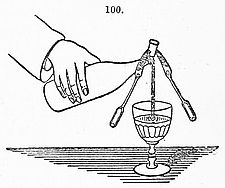
100. Equilibrium Trick.
(a) Equilibrium.—Stick 2 forks into a cork, and place the cork on the brim of the neck of a bottle (Fig. 100). The forks and the cork form a whole, of which the centre of gravity is fixed over the point of support. You can tip the bottle, empty it even, if it contains fluid, without the little construction over its mouth being in the least disturbed from its balance. The vertical line of the centre of gravity passes through the point of support, and the forks oscillate with the cork, which serves as their support, thus forming a movable structure, but much more stable than one is inclined to suppose. This curious experiment is often performed by conjurors, who inform their audience that they will undertake to empty the bottle without disturbing the cork. (b) If a woodcock has been served for dinner, or any other bird with a long beak, take off the head at the extreme end of the neck; then split a cork so that you can insert into it the neck of the bird, which must be tightly clipped to keep it in place; two forks are then fixed into the cork, exactly as in the preceding example, and into the bottom of the cork a pin is inserted. This little contrivance is next placed on a piece of money, which has been put on the opening of the neck of the bottle, and when it is fairly balanced, give it a rotatory movement, by pushing one of the forks as rapidly as you please, but as much as possible without any jerk. You will then see the two forks, and the cork surmounted by the woodcock’s head, turning on the slender pivot of a pin. Nothing can be more comical than to witness the long beak of the bird turning round and round, successively facing all the company assembled round the table, sometimes with a little oscillation, which gives it an almost lifelike appearance. (c) Lifting a glass bottle full of water by means of a simple wisp of straw. The straw is bent before being passed into the bottle of water, so that, when it is lifted, the centre of gravity is displaced, and brought directly under the point of suspension. It is well to have at hand several pieces of straw perfectly intact and free from cracks, in case the experiment does not succeed with the first attempt. (d) The next experiment, though apparently very difficult, will be found easy enough in practice if the hand be steady. Take a key, and by means of a crooked nail, or “holdfast,” attach it to a bar of wood by a string tied tightly round the bar. To the other extremity of the bar attach a weight, and then drive a large-headed nail into the table. It will be found that the key will balance and even move upon the head of the nail, without falling. The weight is under the table, and the centre of gravity is exactly beneath the point of suspension. Inertia.—(e) Take a broomstick, and place it horizontally, passing the ends through two paper rings. Then ask two children to hold the paper rings by means of two razors, so that the rings rest on the blades. This done, take a stout stick, and, with all your strength, strike the broomstick in the centre; it will be broken into shivers, but the paper rings will not be torn in the least, or even cut by the razors! (f) A modification of e. A needle is fixed at each end of the broomstick, and these needles are made to rest on two glasses, placed on chairs; the needles alone must be in contact with the glasses. If the broomstick is then struck violently with another stout stick, the former will be broken, but the glasses will remain intact. The experiment answers all the better the more energetic the action. (g) A wooden ball is suspended from the ceiling by a rather slender thread, and a similar thread is attached to the lower end of the ball. If the lower thread is pulled forcibly it will break with the force of the pull; the movement communicated to it has not time to pass into the ball; if, on the contrary, it is pulled very gradually, and without any shock, the upper thread instead will break, because in this case it supports the weight of the ball. Motion is not imparted simultaneously to all parts of a body, but only to the particles first exposed to a blow, for instance. One might multiply examples of this. If a bullet be shot from a gun, it will make a round hole in a piece of wood or glass, whilst if thrown by the hand—that is to say, with much less force—it will shiver the wood or the pane of glass to pieces. When the celerity of the motive force is very great, the particles directly affected are disturbed so quickly that they separate from the adjacent particles before there is time for the movement to be communicated to the latter. (h) It is possible, for the same reason, to extract from a pile of money a piece placed in the middle of the pile without overturning the others. It suffices to move them forcibly and quickly with a flat wooden ruler. The experiment succeeds very well also if performed with draughtsmen piled up on the draught-board. (i) Take a strip of paper, and upon it place a coin, on a marble chimney-piece. If, holding the paper in the left hand, you strike it rapidly and forcibly, you will be enabled to draw away the paper without causing the coin (say a five-shilling piece) to fall down. (j) It is not impossible to draw away a napkin laid as a tablecloth for one person’s dinner, without disturbing the various articles laid upon it. A quick motion is all that is necessary, keeping the napkin tightly extended by the hands at the same time. This latter experiment, however, is not recommended to boys home for the holidays.
Pressure of Air.—(k) The force of air can be shown as acting with considerable pressure upon an egg in a glass. By blowing in a claret glass containing a hard-boiled egg, it is possible to cause the egg to jump out of the glass; and with practice and strength of lungs it is not impossible to make it pass from one glass to another. (l) The force of heated air ascending can also be ascertained by cutting up a card into a spiral, and holding it above the flame of a lamp. The spiral, if lightly poised, will turn round rapidly. (m) A wine glass, a plate, and water will serve for the next experiment. Pour some water on the plate, light a piece of paper resting on a cork, and cover the flame with the glass, which turn upside down. The water rises in the glass. Why?—Because the burning of the paper having absorbed a part of the oxygen, and the volume of confined gas being diminished, the pressure of the outer air has driven back the fluid. Next fill a goblet with water up to the brim, and cover it with a sheet of paper, which touches both the edge of the glass and the surface of the water. Turn the glass upside down, and the sheet of paper prevents the water running out, because it is held in place by atmospheric pressure. It sometimes happens that this experiment does not succeed till after a few attempts on the part of the operator; thus it is prudent to turn the glass over a basin, so that, in case of failure, the water is not spilt. (n) Having obtained a vase and a bottle, both quite full of water, take the bottle, holding it round the neck so that the thumb can be used as a stopper, then turn it upside down, and pass the neck into the water in the vase. Remove your thumb, or stopper, keeping the bottle in a vertical position, and you will see that the water it contains does not escape, but remains in suspension. It is atmospheric pressure which produces this phenomenon. If, instead of water, we put milk in the bottle, or some other fluid denser than water, we shall see that the milk also remains suspended in the bottle. (o) Light a piece of paper, and let it burn, plunging it into a water-bottle full of air. When the paper has been burning a few seconds close the opening of the water-bottle by means of a hard-boiled egg, which you have previously divested of its shell, so that it forms a hermetic stopper. The burning of the paper has now caused a vacuum of air in the bottle, and the egg is gradually thrust in by the atmospheric pressure outside. (p) Take a thin piece of wood about ⅛ in. thick, 8 in. wide, and 24 in. long, and lay it upon a table so that it shall project over the edge. It is evident that the least pressure will make it tilt and fall. Next spread out a large newspaper over the end that lies upon the table. Now if you strike a sharp blow with your fist on the projecting portion, you will be much surprised to see that the board resists the shock, just as if it were nailed to the table. If you strike hard you may injure your hand, or perhaps the board will break into pieces, but you will not lift the simple paper that holds it. The downward pressure of the atmosphere upon a wide surface explains the phenomenon. In order that the experiment may succeed well, the paper should be spread flat and evenly upon the table, and all the folds should be smoothed out so as to expel the interposed air.
Equilibrium of Floating Bodies.—(q) The equilibrium of bodies floating upon liquids is an occurrence of daily observation, but such is not the case as regards aeriform fluids—a soap bubble filled with air and floating upon a stratum of carbonic acid, for example. Although this pretty experiment would seem to require complicated apparatus to carry it out, it may nevertheless be performed very simply, as follows:—Having procured a glass vessel, such as a bell-glass, of medium size, place it, mouth upward, upon a tripod made of coarse wire, or upon any other support. In the bottom of this vessel place a mixture formed of equal parts soda bicarbonate and tartaric acid reduced to powder. The quantity of powder to be employed depends upon the size of the vessel and the thickness of the stratum of carbonic acid that it is desired to have. Soda bicarbonate contains carbonic acid to the amount of half its weight, and consequently it is necessary to decompose 4 grammes (66 gr.) of bicarbonate to produce 1 litre (61 cub. in.) of carbonic acid gas. Over the mouth of the glass vessel place a disc of cardboard of sufficient size to cover it exactly, and, in the centre of this, make a circular aperture to allow of the passage of a glass rod of sufficient length to rest upon the bottom and project externally. Through this tube, and by means of a small funnel, water is introduced in small quantities at a time (so as not to produce too lively an effervescence) until the powder is entirely covered. When the carbonic acid ceases to be given off, the tube is taken out.
Care should be taken to prepare beforehand a solution of soap in water, or, what is better, some of Plateau’s glyceric liquid. With either of these liquids, bubbles about 4 in. in diameter are blown at the extremity of a tube that flares slightly. This tube should be held vertically while carrying the bubble over the cardboard cover, and the latter should be carefully removed by sliding it off horizontally, and the bubble be then detached in such a way that it shall fall in the direction of the vessel’s axis. If the fall occurs from a certain height, the ball will rebound as if it were repelled by a spring. It will then descend and rise again, and finally become immovable. It is at this moment that it is well to replace the cover, so that no disturbance shall occur in the interior of the vessel.
The bubble then resembles a small balloon in equilibrium in the atmosphere of the vessel; but, in reality, it is floating upon the invisible stratum of carbonic acid. This equilibrium, however, is of short duration, since the carbonic acid rapidly dissolves in the liquid envelope of the bubble, and passes into the interior of the latter, and increases its weight to such a degree as to cause it to gradually descend to the bottom of the vessel, where it disappears. But a suspension of several balls may be obtained successively, that is to say, the experiment may be repeated several times, if, on removing the cover, care be taken not to disturb the atmosphere of the vessel.
The soap bubble may be replaced by one of those small rubber balloons that please children so much, and that weigh, on an average, 1 gramme each. Upon inflating one of these to a diameter of about 6 in., we shall obtain an equilibrium that has greater fixedness and duration, and may observe the phenomenon at our leisure.
Chemical Experiments.—It is well known that the vapours of mercury are very diffusive in their nature, and some quite singular experiments have been devised based upon this, and upon the fact that the salts of silver and the chlorides of gold, platinum, iridium, and palladium are affected by these mercurial vapours. If any one, for instance, write upon a sheet of white paper with platinum chloride, no mark would be visible, as the liquid is quite colourless. If, however, the same sheet of paper be held over a little mercury, the metal will be brought out on the paper in dark tints. This magical apparition of a figure or drawing on a sheet of paper which appears to be perfectly white is very astonishing to the spectator.
On the other hand, reversing the experiment, a no less marvellous result is obtained. At first expose the drawing in writing to the gases of mercury; the lines will become charged with mercury, and then by simply bringing the drawing in contact with a sheet of paper previously sensitised with a solution of platinum, the drawing will be reproduced, line for line, on the white paper. Drawings made in this way give a charming effect, the tones being very soft and the lines being distinct and clear.
Optical Delusions.—Those talking decapitated persons that are so often seen in various kinds of shows are one of the sights that always prove successful. They have already astonished a number of generations past, and will probably prove just as attractive to those that shall succeed our own. These decapitated persons are seen under different aspects according to the tricks employed to produce the illusion, and which all have the same aim in view, that is, to cause the appearance, on a table or tray, of a living head with no visible body. This illusion may be produced in several ways. (a) At the Foire aux Pains d’Epices of 1880, one of the side shows exhibited a decapitated person as follows: The small stage, which was draped with a black fabric covered with silver spangles, was feebly lighted by a sort of night lamp attached to the ceiling. To the right and left were seen panoplies of skulls and cross-bones. The spectators were in darkness. In the middle of this grim place a tray was suspended by 3 small chains at about 3 ft. from the floor, and upon this tray there was a living head—that of a young man who an instant before had shown himself to the public. His body lay extended out under the tray, and his head talked, drank, and smoked, while his arms and legs moved. Both, although quite distinct, were perfectly alive.
The trick by which the illusion was obtained consisted in this: The body belonging to the apparently decapitated head was hidden behind, under the tray, and was completely invisible owing to the shadow of the latter, and the partial darkness of the stage. The apparent body was that of another person of exactly the same height, size, and dress, whose head was in the dark and further hidden by black cloth.
(b) Recently there was exhibited at Paris, in what is called the “Théâtre des Merveilles,” another example of a decapitated person. A young girl first appears before the audience, accompanied by an executioner clad in red and armed with the traditional axe. Then the curtain drops, but rises in a few moments, and shows the stage a little darkened. Near the executioner, however, can be perfectly distinguished the girl’s head lying on a round table at the back of the stage; her body is seen lying on a bed at a few feet from her head, and at her side is the fatal block that has served for the execution. The effect is dramatic. The trick employed is the same as the preceding, in that it requires two persons of the same size wearing the same costume. One of these—the one who showed herself to the public—makes the head, her body being hidden behind the cloth in the rear of the stage. The other, who makes the body, has her head bent far back and hidden in a sort of box, a false cardboard neck contributing to increase the illusion.
(c) Upon entering the room we perceive a black wooden square table having 4 legs. Over one of its angles there is thrown a piece of red fabric whose other end may be perfectly seen hanging from the opposite side. The floor, which is strewn with straw, is continuous to the back of the stage. There is nothing under the table, then—there can be no doubt of it. Still, upon this table there lies on a tray the head of a young girl which smiles and answers questions that are asked it. The ingenuous spectators are almost persuaded that the girl has no body; others ask themselves where it is hidden; and very peculiar suppositions are indulged in on all sides. In a word, the illusion is perfect.
When, through favour or money, we enter the side scene and look at the table sideways, we are almost ashamed of having allowed ourselves to be deceived by so simple a trick; for the apparatus consists, in fact, only of a mirror fixed obliquely to two legs of the table. This mirror hides the body of the girl, who is on her knees or seated on a small stool, and reflects the straw which covers the floor so as to make it appear continuous under the table, and likewise reflects the front leg of the table so as to make it appear at an equal distance from the other side and thus produce the illusion of a fourth leg. It also reflects the end of the red fabric hanging in front of the table, and thus makes it appear to hang down also from behind. It should be remarked that during the exhibition the spectator stands only a few inches away from the table and head, being separated therefrom by a wooden railing from which hangs a curtain reaching to the ground. Such proximity of the spectator and actor would seem to favour a discovery of the trick; but, on the contrary, it is indispensable to its success. Were the spectator placed at a distance, and did the curtain not exist, he might by stooping see his legs reflected in the mirror. The curtain, then, prevents any one from looking under the railing, and the rays that might reach him from the curtain, by being reflected in the glass, are lost beneath the table, owing to the proximity of the latter.
As may be seen, the trick is easily understood, and, moreover, it is one of those that gives the best results, since it deceives the public the best. Besides, it has the merit of great age.
(d) The living half-woman is a very ingenious improvement on the decapitated individual. On entering, we perceive, when the curtain is drawn aside, an elegant little room decorated with flowers and lights and hung with curtains and tapestry. In front there are two railings, and the floor is covered with a carpet. In the centre is seen a small square table, on which rests a sort of three-legged stool supporting a cushion and the half body. The latter is the body of a young woman apparently cut in two just beneath the thighs. Naturally, this young person shows that she is alive by moving her arms and head, and speaking and singing. Now, as we can see the 4 legs of the table and can perfectly distinguish the space under the stool, and that too in full light, we naturally ask by what means the lower part of the girl’s body is hidden. On raising the stool, it will be seen that it is formed only of a hollowed-out disc whose supports are connected by two mirrors, that make with each other an angle of 45°. These mirrors rest on the top of the table, which is decorated with regular designs in mosaic, and reflect the latter in such a way that they seem to continue uninterruptedly under the stool. The table presents an analogous arrangement, two legs being connected with the foremost one by two mirrors (the table is placed cornerwise to the audience). These mirrors reflect not only the designs of the carpet, which by their continuity produce the illusion of a vacancy, but also 2 table legs located on each side behind the railings. The mirror to the left transmits to the spectators on that side the image of the leg placed on the left, and this image seems to them to be the fourth leg of the table. The mirror to the right plays the same rôle with regard to the spectators on that side. These mirrors, in addition, hide the lower portion of the girl’s body.
(e) The Dircksian phantasmagoria, which was more generally known as “Pepper’s Ghost,” is another example of the illusive effects of mirrors suitably arranged. On a moderate scale the same spectral apparitions can be produced as an entertainment for the drawing-room.
Dircks arranged an oblong chamber in two equal portions, making the separation by means of one vertical screen of thin glass having a perfectly true surface. Suppose each chamber to measure 12 ft. square and 12 ft. high. Let one of these be the stage on which the acting is to take place; its floor and three of its walls are solid, and the fourth or front of it is one entire glass screen; the ceiling must be made to open at different parts to let in light, and have suitable blinds to regulate the light and shade in which the actors perform. The chamber opposite, or facing the actors, is in reality a second stage for carrying out the spectral performances, and is differently constructed; the two sides may be large folding or sliding doors, or may be left quite open, or one side closed and the other open; but the ceiling must cover only that half of the top away from the glass screen or partition, thus leaving an open space in the ceiling of 6 ft. by 12 ft.; through this space so left in the ceiling the spectators obtain a full view of the stage, their seats being above the half ceiling described, and thrown rather backwards than forwards; the line of vision thus being at an angle of about 45° with respect to the vertical glass screen, or plane unsilvered crystal mirror. It will now be obvious that the actor on the stage beneath the seats of the spectators can only be seen by reflection, and the trained actor on the opposite stage, knowing the precise situations of the reflection as seen by the spectators, performs accordingly, so that, when really seeming to stand confronting the vision, the actor, whose reflection is thus seen as a vision, is as far from the screen on one side as his reflection is cast on the other.
Some striking effects may be produced illustrative of the illusive properties of optical apparatus constructed on the principle described. Thus, a figure placed before a white screen is so strongly reflected, that the spectator cannot divest his mind of their being the substance and not the shadow which he observes, particularly as he contrasts them with an adjacent solid figure. By placing two figures of corresponding form equidistant, one on each side of the glass mirror or screen, they appear as one, until one is moved; and if they differ in colour, as one blue and one white, the effect seems more remarkable. If a cabinet, box, or the like, is placed, one on each side of the mirror, until the image of one exactly corresponds with the material figure of the other, then the spectator may see the visionary figure open a drawer or door, and remove and replace anything therein, and afterwards the solid figure repeat the same acts. If the reflection of an actor is thrown on a transparent screen it is invisible, but by gradually decreasing the light the spectral appearance will be as gradually developed until apparently it becomes a firm solid figure in all its proper costume, and acting in perfect conformity to its designed character.
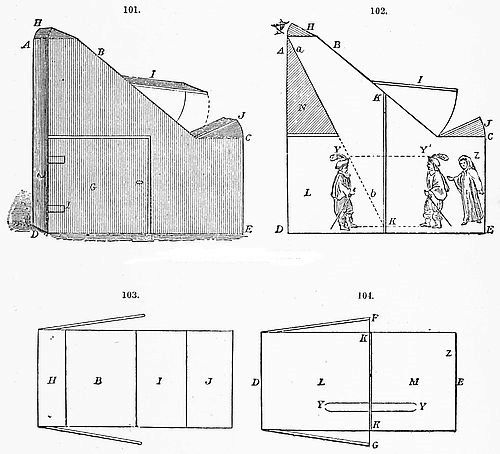
101. 102. The Dircksian Phantasmagoria. 103. 104. The Dircksian Phantasmagoria.
The arrangement of the apparatus will be understood by reference to Figs. 101-104, in which—
Fig. 101 is an external perspective view, Fig. 102 a vertical section, Fig. 103 a top, or bird’s-eye view, and Fig. 104 a plan. A, B, C, D, E is a box, closed on all sides, but provided at D with a door F, and on the other side with another door G, both hinged to the back A, D. H, I, J are flapped openings on the top of the box; K, K a partition dividing the interior of the box, made of a good, clear, and even surface of thin patent plate-glass, kept in its place within two side grooves; L, M, two separate chambers or compartments produced by K, K, the transparent mirror; N, a ceiling or screen over the compartment L, to exclude any object therein from the direct view of the spectator, as shown by the dotted line, a, b.
If two figures be now introduced, one Y, the other Z, and the eye of the spectator be fixed at A, he will observe two images, one the real figure Z, the other Y’, the mere reflection of Y. By this arrangement it is evident that the plain, unsilvered glass, thus viewed at an angle of about 45° has all the properties of a mirror, but owing to its transparency two figures are seen, possessing little or no distinguishable difference between them. Of course a person placed at Z sees only the figure Y, but, as a piece of acting may, under proper arrangements of a suitable stage, approach the situation apparently occupied by Y’, and thus indicate to a spectator placed at A any pre-arranged dramatic scene requiring Z to be in correspondence with the visionary figure Y’.
In using the apparatus the flap H must be open, but I may be shut, being mostly useful to get admission for inserting or withdrawing the screen or the figures; the flap J may be closed or opened to regulate the admission or exclusion of light. The doors F, G may both be wide open, though one is generally sufficient, provided it is turned as direct as possible to the light. A mirror placed at an angle close to the opening F or G, will assist the illusion by illuminating the figure Y, thus heightening the effect of the reflection Y’.
If two geometrically proportionate figures, as spheres, cubes, or the like, be placed in the situations Y, Y’, then the image at Y’ will be a vision and a substance combined, as will at once appear by slightly moving the substantial body in either compartment L or M. Let the duplicate figure be a box, and then the spectator might observe the apparent anomaly of the same box being opened and a substance taken from it and replaced either by a substantial or visionary actor. When the compartment M is lighted up no vision appears, but the light being made gradually to fade and disappear, the vision would seem lifelike, as at first. As it is evident that the right hand of the vision is the left hand of the actor in the compartment L, all his acts requiring the right would have to be performed with the left hand, to appear natural to the spectator. It is also requisite for insuring a good effect, that no solid figure in the compartment M shall come before or behind the visionary image, as its transparency would at once become evident; but if anything of the kind is desired, then the background, figure, or object, should be placed behind the actor Y, and become with him also visionary; in this way a white screen placed behind the actor Y will allow his shadow to appear on it and give great force and solidity to his reflected figure or vision at Y’.
A few examples will better illustrate than any elaborate description, the singular effects that may, in different ways, be adopted for realising spectral dramas.
1.—Dickens’s Haunted Man.
A student is seen sitting at a table spread over with books, papers, and instruments. After a while he rises and walks about the chamber. In this there is nothing remarkable. But the audience is perplexed by a different circumstance: they not only see a man rise from his seat and see him walking about, but they also see that he still sits immovably in his chair—so that evidently there are two persons instead of one, for, although alike in dress, stature, and person, their actions are different. They cross and recross; they alternately take the same seat; while one reads the other is perhaps walking; and yet they appear very sullen and sulky, for they take no notice of each other, until one, after pushing down a pile of books, passes off by walking through the furniture and walls.
The art in this arrangement is to have two actors sufficiently alike in person, similarly dressed, and placed so that the phantom figure sits so exactly like the living figure as to match into it. It consists in having two actors, two chairs, and two tables exactly matching each other. On the acting stage, the actor, table, and chair have each their duplicate; so that, if they were pulled a little to one side, the audience would see two actors, two tables, and two chairs. But such an exhibition would be a defect, as the table and chair are mere guides for the spectre actor: if there were no chair he could not sit, and if no table he could not appear as leaning upon one, or seem to do so.
In this and other pieces of a like nature, it is presumed that the parts are not performed in dumb show, but that an able speaker either explains and gives the dialogue, or that concealed actors address the audience, timing their speech to the action before them.
2.—The Returned Mariner.
A naval officer or other seafaring character, belonging to some particular vessel reported to have been wrecked, is seen in a chamber, into which his wife or sister, &c., on entering rushes forward to embrace him, but, clasping nothing, immediately falls down in a swoon.
3.—The Californian Gamblers, or Robbers.
Two men, dressed almost like brigands, engage to play some game with cards or dice. They sit one on each side of a table, on which they place their revolvers. After a short play they dispute and wrangle, during which, one seizing his pistol discharges it at the other. He is horror-stricken by the bullet being returned to him, and his playmate passing away by neither window nor door.
4.—The Miser and Money-lender.
He is an aged man, counting his money, and writing up his unjust gains. His room is furnished with bookshelves and cabinets. With a small taper before him, he is absorbed in monetary calculations. Presently a careworn female enters. He shudders—with cold. She opens a cabinet, takes out a long roll of parchment, replaces it, and closes the door again—not quietly, but with a clap like thunder. The miser is colder than ever—shivers more and more, and rises to look into his cabinet, from which he apparently takes the same roll, replaces it, and returns to his seat, followed by the reappearing phantom, which again rapidly disappears.
This requires a duplicate cabinet, parchment, &c.
5.—A Strange Christmas-box.
A porter enters the sitting-room of a bachelor while at breakfast. He lays down a deal box, is paid for it, and retires. It is a present—and after being turned over and over, hammered a good deal to burst it open, and seemingly as hard to open as an oyster would be with a pair of scissors; the cord off, the nails out, and all ready for inspection, the bachelor is suddenly called to any little attention, as the over-boiling of his kettle. He has but turned his back a moment, and behold—a cupid sits on his box! On his approach it walks round to his breakfast table. He removes the box lid and finds it crammed full of old clothes returned to him from his last residence. He is very angry, takes a seat, and is rather startled to see the box lid open, cupid get into it, and at the risk of the pretty boy being smothered, down goes the lid again. He reopens the box, taking from it cloaks, coats, boots, pipes, &c. But, where is cupid?
The box has its duplicate, and the appointed place marked out for each. The box seen by the spectators, however tossed and carelessly used, is very carefully placed at last in one precise spot, where it matches an opposite empty box, large enough for a child trained to perform the part. The lid supposed to open does not open, but by rapid action the eye is so easily deceived as not to observe the duplicate lid.
6.—The Duel.
It is to be fought with swords. After various passes, one is stabbed, but instead of falling, he either holds his sword behind him, as if in support, or elevates it, as if appealing to the justice of his cause; but in an instant, to the horror of his affrighted antagonist, he rushes on him with a blazing sword.
The sword is a suitable flat perforated gas tube, with a vulcanised gas tube attached to the handle. A small gas jet above, or an assistant below, enables the actor instantly to produce the desired result.
This example is curious, as showing with what nicety the required effect can be obtained, so as actually to bring the two blades opposite and crossing each other, when the space intervening may be 20 feet or more. It is easily done by stretching a cord or wire, or having movable metal or wood rods held upright by a solid base, placed equidistant on both stages; for it can readily be ascertained where to place them, so that a sword blade crossing a wire on one side is absolutely seen crossing the same on the other side.
7.—The Milliner Bewitched.
A dressmaker and assistants are in a work-room containing a number of empty props, each with a kind of wire-shaped body for displaying dresses upon. She scarcely turns round to her work before every pole has upon it white, black, red, and other dresses, to her evident consternation. Calling in a friend, they are again empty; so, settling down, she is once more terrified by a total change of millinery in cloaks, shawls, bonnets, &c. All this is brought about by employing corresponding wired props.
8.—The Gipsy’s Promise.
A plain country servant-girl in a white under-dress stands at her glass, and, having had her fortune told, is ardently wishing to be a fine lady. As she retires from the glass in her mistress’s room, she is all amazement to find herself suddenly transformed to a princess. She is attired in a splendid pink or other silk dress, and wears a turban with ostrich feathers; but before she can show herself off to her friends the whole proves a vision!
The arrangement is like the former, only requiring more care and management.
9.—A Hand seen Writing.
The spectre hand may actually write or gradually withdraw a slide over the letters. Either way is very surprising. The actor is behind a black curtain, his hand only seen by reflection. There are corresponding boards, that on the acting stage being black without any writing. If the board has a piece inserted in it like a valve, working on centres, the written words or name can thereby be turned out of sight with sufficient rapidity.
10.—The Otranto Picture, or Living Portrait.
A scene from the “Castle of Otranto” may be imitated, representing the full-length figure in a painting stepping from the canvas into the picture gallery.
The picture and frame are a phantasm; the figure being represented by a living actor, or vice versâ. He walks from the frame to the floor; and on returning reassumes the still attitude of painted portraiture.
11.—Wonderful Jugglers.
No end of scenes might be brought out under this title, by employing very little and exceedingly simple mechanical appliances; as,—Swallowing any length of rope, chain, or other material. To be effected by passing a long endless band of the same over pulleys on the real stage, so as to appear entering the mouth of a visionary actor, keeping his head fixed and mouth wide open at one fixed point.
Strong and weak bandboxes—on which an actor is seen standing, but which when another actor attempts he falls through, crushing the whole to the floor. The first actor was a mere spectre, standing on strong duplicate boxes, which being removed, the other actor has nothing but the actual weak bandboxes to sustain his weight, which he therefore crushes flat with the floor.
The handing of flowers, miniatures, letters, or any article, by the spectre to the real actor, is so easy as scarcely to require explanation. There must be two of any article to be so used, one behind a small black screen on the acting stage, and the duplicate before a like screen on the other stage. While the actor appears holding the phantom letter, he in reality has taken hold of its duplicate behind the screen, only producing it the instant the other (or first seen letter) vanishes.
12.—The Wizard’s Incantation.
An aged wizard in a den-like habitation, standing within the magic circle, and with a boiling caldron before him, attended by certain spirit-seekers, is endeavouring to raise the spectre of some departed relative. In due form the phantom does appear amidst the vapours of the caldron.
The caldron has its duplicate, and is in fact the entrance for a trap door on the opposite stage, through which an actor is mechanically raised, appearing to the audience as the spectre, for he would be seen gradually fading away, first becoming transparent and next slowly invisible.
13.—The Greenroom Riot.
A male and female actor are seen vigorously throwing at each other the masks, dresses, boxes, and other furniture of the greenroom, with the absurd effect of never being once incommoded by the hats, cloaks, coats, and dresses littered about.
Of course each is throwing at nothing, and the audience is amused by the mixture of the real and the reflected actions.
14.—A Spirit-rapping Séance.
A company of this sect being assembled, rapping is heard, hands and heads seen, flowers distributed, and a spirit dimly rises, but just as the circle is about to depart the table with its books, lights, &c., turns rapidly round to their great delight.
The table is visionary, and suspended for the purpose.
15.—Will-o’-the-Wisp.
This ignis fatuus may be represented by a young slender actress in a white gauze dress, holding in her hand a small neatly-made paper lantern. A misguided traveller is seen groping his way along a treacherous heath to trace the whereabouts of the fascinating vision, which at last vanishes, all but the dimly lighted lantern, which last of all dies out, and the actor appears emerging from a quagmire.
The small lighted lantern is seen longest, owing to its own illumination, while its smallness allows its being easily extinguished.
16.—Spectre Workman.
Two men appear to be working a pump, one on each side, like some ships’ pumps, or fire-engines, but presently quarrel and fight. The mechanism is connected with an underground shaft, so that opposite actors cannot fail to rise and fall simultaneously in the requisite motions; and all the rest is a mere piece of acting.
17.—The Drunkard’s Dream.
A drunkard is supposed to have ruined himself and family, and hastened the death of his wife and children for want of proper sustenance. He is seen lying on a couch, surrounded by visions of his deceased partner and children. He wakes disturbed as they disappear. Again retiring to rest they surround him once more, each bringing him large goblets of his loved beverage, which he attempts to seize, falls on the floor, and awakens in a state of violent horror and passion.
18.—Clown and Fairies.
A tree is seen rising from a green and flowery mound, on which sits a country clown half asleep, with his basket, bottle, and broken victuals before him. Presently a dozen or more fairies forming a ring dance around the tree, to the great delight of the rustic, who, rubbing his eyes, attempts to join the merry dancers, who as speedily flash out of sight.
The mound and trunk of the tree have their duplicate, otherwise the dancers would not be hid in passing behind it, and would therefore appear shadowy and unnatural.
19.—The Black Ghost.
This effect is produced by the actor being first dressed in as white a dress as possible, and then covered with a cowl and flowing black gown; so that sometimes only the head is seen, at others only the hand or hands, and occasionally only a foot, or both feet. Or he may be dressed as usual, in black velvet, wearing a black mask, becoming observable only whenever he passes before a white screen.
20.—The Spectre Dog.
A well-trained Newfoundland or other dog may appear to cross the stage as if passing through the furniture, and while jumping towards his master behind a screen, may appear by reflection as though attacking the real actor on the stage.
21.—The Haunted Hut, or Witch’s Laundry.
The witch, appropriately dressed, in a low cottage chamber, may be seen with some fantastically dressed young female preparing to wash clothes. They arrange a large tub, fill it with buckets of hot water (judging from the white vapour), and put in quantities of linen. Each takes a turn at washing, raising their work into the air, in the operation. But presently the girl retires, and on returning, is seen taking quantities of all kinds of boots, shoes, hats, cats, dogs, and children out of the washing tub, finishing by throwing the wet linen into the witch’s face, who becomes excessively aggravated.
This pantomime may be carried to any length. It is effected by commencing with two real actors on the stage, and then one of them leaving to commence a series of phantom actions, the audience never suspecting so odd a change.
22.—Temptations of St. Anthony.
St. Anthony may be seen in his cell surrounded by all manner of imps. By having a duplicate seat, a number of youthful actors in pantomime masks and dresses can easily play the phantom part, climbing the arms and back of the chair, and gambolling at its feet, or upon and around a duplicate stand or table.
23.—Metamorphoses.
These may be carried to a great extent; nothing that poets have imagined appearing too difficult, not even the change of the human form to the trunks of trees.
An actress, dressed in a brown or green dress, on taking a certain assigned place and position, with upraised arms and outstretched fingers, would appear gradually to become like the young oak or elm, with but slight indications indeed of humanity, until disenchanted.
Here the only phantom would be that of the trunk and branches of a tree, either natural or artificially arranged to correspond with the body and upraised arms and fingers of the actress.
Changes from age to youth, male to female, friend to foe, and so on, may be achieved by the phantom actor stepping on a small turning portion of the stage, like a double sentry box, of which one half turn does the magic business, being occupied by two actors.
24.—Trial by Fire.
Men in Gothic costume may be seen at an altar, on which wood is burning. The accused has to test his innocence by a fiery ordeal; for which purpose the priest advances, declares the crimes, and promises clearance from guilt should the accused come off scatheless. He is seen as if washing his hands in the blaze, and burning drops falling from his clasped hands.
The duplicate altar has upon it a metal dish of inflamed alcohol, with a sponge dipped in it, which at the moment of clasping the hands, is raised and pressed by iron tongs, from which the dropping spirits take fire.
25.—Any Legendary Saint’s Martyrdom.
Anything of this kind would be too terrible for the stage, but the principle on which it is conducted may be applied in different ways, this being but one out of many striking examples.
The stake and faggots are in duplicate. The duplicate stake and faggots are employed alone for arranging among them gas pipes, and in suitable metal dishes, either spirits, or thin paper, or both, to produce varieties of fiery effect. On the acting stage the martyr would appear surrounded by the terrors of the reality of such a frightful doom.
26.—Executions by Axe or Guillotine.
The descent of the instrument of execution is followed by the rising up or falling down of a black screen, effectively to hide the head, of which there must be a duplicate in waxwork. The executioner only is a real actor, and he only has access to the head. When his axe falls, all the rest takes place on the phantom stage; therefore the axe literally descends upon and adheres to the very block on which the audience saw the culprit place his neck.
Such an exhibition would be anything but desirable; at the same time the modus operandi is capable of happier applications, and therefore is only introduced on account of its impressive character, the Author having no desire to encourage the too prevalent vitiated taste for horrors.
27.—The Nightmare.
Some disturbance has caused a nervous gentleman to dress in a hurry in his night-cap, morning gown, and red slippers. With a blunderbuss under one arm and a night candle in one hand, he proceeds with a horse pistol in the other to look warily about, when suddenly appears before him an old grey mare eating hay—the unconscious intruder on his peace and quiet.
The mare in this instance is the only spectre, and the whole scene is due to a well-known engraving of such a subject.
28.—The Doubtful Visitor.
A lady is informed that a strange lady has called upon her. They meet in the drawing-room, courtesy to each other, and finally take their seats on a couch. Soon afterwards they rise, but the stranger rudely drops her cloak, parasol, reticule, gloves, veil, &c., and runs off. The lady in astonishment attempts taking up the cloak and other things, which to her infinite terror seem to be swallowed up by the floor, so she in her turn makes her escape.
29.—A Pantomime.
Supposing the stage to appear as if supplied with real scenery, which should only after all be phantasms, it is clear that the feats of harlequins would be infinitely more surprising than with interposed wood and canvas. Such a scene as jumping through the mouth of a large mask could in no other way be represented. Fire may be held to the person without danger, outvieing the red-painted poker so amusing to youth in all such wild gambolling scenes. The kicks and cuffs that might be bestowed on a spectre actor, actress, horse, or dog, without disturbing the gravity or person on whom bestowed, is of itself sufficiently ludicrous. In fairy and goblin scenes the rapid appearance and disappearance of such visitors form an essential part in their introduction, and when they are grotesque, their phantom-like character would encircle them with all the sparkling attributes of a lively jest.
30.—Ghost of China.
Among other parts of any suitable scene, large china jars, dishes, jugs, plates, or other earthenware and glass, may appear so placed that on the actor falling on the floor the audience shall hear the crash of china and glass, and see the whole fall upon him, yet shall he rise unhurt, as though nothing had happened.
This is obtained by means of communicating wires or cords between the two stages, so that the one cannot fail to act in concert with the other.
31.—Pilgrim and Saint.
The worthy saint is seen with outstretched sandalled foot, and a pilgrim with pointed iron-shod staff standing beside him. Wishing to show the holy man some relics he strikes his staff into the ground to release his hand in the act of opening out his treasure. But, behold! he has pinned the saint’s foot to the earth with his pilgrim’s staff.
32.—The Spectre’s Kiss.
Two young ladies enter a drawing-room from opposite ends, courtesy and dance; when their performance is over they approach and kiss each other, and then seem to be attempting to shake hands, but in vain, on which one falls down while the other slowly and almost imperceptibly vanishes.
In many other devices, as in this, the same means for effecting a near approach may be resorted to, nothing more being required than a piece of glass supported on a black pole, which, as ascertained beforehand, exactly distances the two heads, the lips approaching the glass on an opposite side, in opposite directions, far apart.
It must not be overlooked that these various scenes require different modes of action, a leading one being the peculiar property that this phantasmagoria affords of uniting as one body a phantom with a substance, whether alike or unlike in form and colour. This is a feature so important that it will not be out of place here to dwell upon it more at large, to impress so important a property on the attention of all who may desire an intimate acquaintance with the subject.
As a preliminary step, let a few chromotographic experiments be made. Set a yellow cube before the mirror and a blue one behind it, in a model apparatus, employing the sun’s light. Blue and yellow it might be supposed would give a cube having a green tint, instead of which it will be snow white. Again, for blue, substitute a deep pink; and for yellow white, when the pink will disappear all but the faintest possible tinge—the shadow or phantom appearing to overwhelm the coloured substance. These effects are so surprising, simple as they appear, that, unless tried and seen, description alone must fail to convince any one of the full force of the results stated.
Acting on this property of matching one body into another, so as to all appearance to absorb it into itself, many curious dramatic effects may be produced, whether the subjects be animate or inanimate. And this mode of procedure is always in demand where the phantom is required to touch, handle, and repeat the actions of an ordinary actor.
On this peculiarity of matching one body into another so exactly depends the striking character of “The Haunted Man,” where the actor himself is so placed; so likewise “The Miser,” with several others, where furniture, chairs, or any other things or vessels require to be so conjoined. In “The Bachelor,” the article used is a box, which is carried and moved about, but ultimately fixed in a pre-arranged spot. It would not be easy to perform such parts with animals or with children, as they would not be likely to keep sufficiently quiet and immovable. Whenever the actors on the opposite stages have to play similar parts, then such duplicates of solid and shadow or reflection must always be employed. Two couches are required to make it appear that two persons are sitting on one couch, although in reality each couch has only one occupant; but in the acting the only spectre that appears is the actor, while the spectral couch is absorbed into and hid by the real couch. So likewise in sitting to a table—two tables and two persons must act the part, and the result that follows is the same as before; but if only one of these actors places anything on the table, then the opposite actor cannot touch it, unless its duplicate is already placed there for the purpose, behind a black screen, by which means flowers, letters, books, &c., may appear to pass from hand to hand.
The necessity of corresponding stops and marks on the two stages is shown in “The Duel.” A mark on the floor directs where to place the feet; slender black rods, set in a weighted foot, mark places for the body, feet, or hands; and suspended wires or cords answer the same purpose. But such marks may be, as in the case of “The Milliner,” some part of the furnishing of the apartment, as there we see taking place with mere clothes’ props; or, indeed, as in “The Gipsy’s Promise,” the very person of the actor.
As the entire person is, sometimes, not required to be seen, it is always easy to exclude any portion by employing a black dress, screen, or curtain, as in “A Hand seen Writing.”
A curious result is obtained by appearing to give animation to the inanimate. This may be seen in “The Otranto Picture,” where the actor standing within a framed recess has all the appearance of a painted full-length portrait, the stepping of which from the canvas realises a romantic story of “The Castle of Otranto.”
The absence of all machinery or trap-doors to get rid of “The Ghost” can be rendered strikingly obvious in two ways: first, by the very gradual dissolving of the vision until it becomes thoroughly transparent; or, secondly, by placing in the hand some very bright object, either a dagger, sword, censor, or small enclosed light. By using a night light, having a paper or ground-glass shade, the same will appear as though floating in the air after entirely losing sight of every other spectral object.
Yet trap-doors and machinery may become accessories in many scenes. “The Wizard’s Incantation” requires a duplicate caldron, which on the spectre stage is merely an upright circular frame around a trap-door, through which the spectre actor has to be raised to be presented to the audience by reflection. So also in “The Spectre Workman,” simultaneous action is produced by an underground shaft, which in some cases may be otherwise produced; even bell-wires, cords, and the like serving for many purposes, as illustrated in “The Ghost of China.”
The method of double acting is shown in “The Witch’s Laundry,” producing some strangely startling results. One or both of two actors may, by changing to the opposite stage, become alternately spectral or solid. What they are seen acting as real actors becomes wildly ridiculous when converted into spectral acts. If after two actors going through performances decidedly requiring mutual intercourse, one adroitly passes to the spectral stage, then his friend, or his adversary, cannot any longer succeed in friendly intercourse, or commit any fatal act by means of sword or pistol.
Advantage may be taken in many scenes of the marvellous property of the phantom to overpower and conceal the colour and features of a corresponding substance. In “Metamorphoses,” this is made evident by the facility shown in causing the human figure to take the form of a branching tree, which the wizard can readily disenchant, reproducing a living actor or actress. By such means the classic stories of Ovid, or the sprightly and wonderful creations of the Arabian Nights, may be set before an admiring audience; and when the changes cannot be exactly thus realised, the mechanical arrangements for turning one actor from and another actor into view, aided by screens, is so exceedingly simple as to render minute details superfluous. Actors may appear to dress and change with the rapidity of lightning; age may become youth, and vice versâ; and even, a gorilla might step forth an altered creature to trip the “light fantastic toe!”
In some scenes the peculiarity may consist in the spectre passing off undiscovered, and only be traced by its phantom accompaniments, as in “The Doubtful Visitor,” who sitting on the same couch with a lady, departs without any other strangeness of action than leaving behind some portions of her phantom dress.
In pantomime and legerdemain the Optical Illusions eclipse every extravaganza hitherto conceived for making the “eyes the fools o’ the other senses.” And what is still more remarkable, this portion of the subject is so exceedingly simple to perform that, although short, yet sufficient directions will be found in the description of scenes under the respective titles of “Pantomime” and “Jugglers.”
These few observations appeared requisite to impress on the general reader that each of the preceding scenes involves some peculiarity in arrangement to produce the effect described, and that, therefore, they are not all on one model. Some show the actors apart, some together, and afterwards separate; some with and some without machinery of any kind; some with phantom actors, others with only phantom dresses or furniture; and others again employing animals, as the horse, dog, &c.
The mechanical portion of the arrangements are too various to enter upon in minute description, but they are generally of such a nature as any practical workman employed on theatrical machinery will readily understand. The modes of arranging the transparent mirror are as numerous as in the employment of ordinary mirrors. It may be used framed, or for some purposes without any frame whatever; it may be suspended and slide on framework placed above, by means of pulleys, thus leaving the stage floor free from any grooving or any raised portion. Or, it may be made to swing like a hinged door, whether hinged at top, bottom, or either side. Or, it may turn on centres, so as to be half in and half out, when turned to right angles with its common position, being thus capable of regulation to any desired angle. It is also obvious that the position of the mirror necessitates a corresponding change in the placing of the spectre stage, so that the one shall always be opposite the other. As it is not requisite to cover the entire front of the stage with one or more mirrors, their use may often be artistically concealed by pillars, trees, or similar devices, in which case the spectral effects will be limited to such mirrored portions. When out of use, these large mirrors can be made to slide, sink, or rise, as done with the scenes in general use.
Games
Games.—Space being limited, choice is made here of a few games not generally known.
Bézique (Polish).—Polish bézique, sometimes called open bézique, or Fildinski, is played by 2 persons in the same way as ordinary bézique, except in the following particulars. The tricks are not left on the table at Polish bézique, but are thus disposed of: 7’s, 8’s, 9’s, and 10’s (except the 10’s of trumps) are turned face down on the table as soon as a trick containing any of them is completed. These cards must not be looked at again during the hand. Other cards, which are cards that can be used in declaring, are taken by the winner of the trick, and placed by him face up on the table close in front of himself, in rows, consisting of aces, kings, queens, and knaves, and of the 10’s of trumps. At the end of the hand all cards that can be used in declaring are thus exposed or open on the table. Having been once played, they can only be used in declaring, and cannot be played a second time. Whether declared or not, they remain open during the hand and the play of the last 8 tricks.
Declarations can only be made from open cards, and never from cards held in the player’s hand. This is the fundamental difference between Polish and ordinary bézique. As soon as a trick is won containing a card or cards that can be used in declaring, those cards are transferred to the open cards (if any) already in possession of the winner of the trick, and as soon as a card is won that completes a scoring combination, the declaration is made and the score marked.
For example. A. has 3 open queens, and he wins a trick containing a queen. Before drawing again, he places the fourth queen in the row which contains the other 3 queens, and scores 60 for queens.
The 7 of trumps can be exchanged for the turn up when a trick is won with it, but not when a trick is won with another card by a player who holds the 7 in his hand. Similarly the 7, if not exchanged, can be declared when a trick is won with it. If the 7 of trumps is played, and is won with a higher trump, the winner of the trick declares or exchanges the 7. The principle is the same throughout, viz. that declarations are made only out of cards won, and by the winner of them.
At Polish bézique compound declarations are allowed, i.e. all the scores that can be made when cards are added to open cards are made at once, and the same card may be declared more than once (in combinations of a different class), without waiting to win another trick. The ordinary rule that a card once declared cannot be again declared in combinations of the same class, e.g. a king once married cannot be married again; a fifth ace added to 4 aces already declared does not entitle to reckon aces over again.
As examples of compound declarations take the following: A. wins the queen of faintest possible tinge—the shadow or phantom appearing to overwhelm the coloured trumps with the king. He has in his open cards 3 kings, 4 queens, and the ace, 10, knave of trumps. He declares royal marriage (40), 4 kings (80), but not 4 queens, as he cannot again reckon any of the 4 queens already declared in that class of combination, and sequence (250), in all 370.
Again, the ace of spades is turned up, and the ace of hearts is led. The second player wins the ace of hearts with the 7 of trumps, and exchanges the 7 for the turn up. He scores 10 for the exchange, and 10 for each of the aces he adds to his open cards—in all 30. If at the same time he were in possession of 2 other open aces, he would score 100 more for 4 aces.
At Polish bézique aces and 10’s must be declared as soon as the trick is won, and not at the end of the hand, a mode of scoring preferred by some players at ordinary bézique.
In the play of the hand it is not compulsory to follow suit nor to win the trick, and a player may win the trick by trumping notwithstanding that he holds a card of the suit led. But in the last 8 tricks suit must be followed if the second player has one of the suit led. The trick in the last 8 tricks must also be won by the second player if he has a higher card of the suit than the one led. If he has none of the suit led, and has a trump, he must win the card led by trumping.
Declarations do not cease at Polish bézique when playing the last 8 tricks. They are made just as in the early part of the hand after winning a trick and before leading again.
Polish bézique is generally played 2000 up, as the average scores are considerably higher than at ordinary bézique.
Block. Implements.—A board as in Fig. 105, the figures not being necessary, except when the game is played by correspondence—they are placed here to simplify the examples—16 pegs, and 2 King pegs; 12 pegs and the King pegs being required for play, the 4 remaining pegs are a reserve force of 2 for each player.
Play.—Divide the pegs, one player taking the White, the other the Black. The first to play is decided by lot. Each player then places a peg into one of the holes in turn, occupying those which he may consider the most advantageous, until the 12 pegs and the 2 King pegs have been placed. Then each moves one of his pegs in turn, but only one hole at a time, and as the lines run.
Points of the Game.—To Block, to Force, and to Make a Line.
(a) To block is to get a peg on each side of one of your adversary’s: this, if an ordinary peg, is its capture, and it is immediately removed off the board.
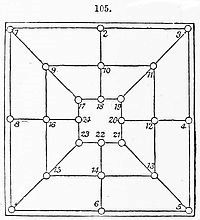
105. Block.
Example.—Black having a peg in 1, and White playing a peg in 2, Black captures that peg by playing a peg in 3; but White having a peg in 4 can capture Black’s peg in 3 by playing another peg in 2; or White having pegs in 1, 10, and 24, and Black a peg in 9 could block Black’s peg by playing peg 24 either into 17 or 16.
But to block the King peg, the other holes surrounding him must be filled, though it is of no consequence by whose pegs. To block the King peg is game. His only means of escape is by immediately capturing one of the pegs blocking; if he cannot do this, and cannot move, the game is over.
Example.—Black’s King peg being in 3, and White having a peg in 4, is not blocked by White placing a peg in 2, because the hole 11 is unoccupied. Or supposing Black to occupy 11 (King peg), and 3, and White 2, 12 and 19, the game would be lost to Black by White playing 2 to 10, which blocks the King; but if Black had a peg in 17, 16 or 1 to immediately play into 9 he would capture 10, which is one of the blocking pegs, and so liberate the King peg. The other blocking peg is 12. Capturing 19 would be of no avail, neither would moving his own peg 3.
(b) To force is to get 2 pegs on a line with one of your adversary’s, in which case you force him to move that peg to the first vacant hole on its square, in whichever direction it may occur, and in the event of there not being one vacant on its square, to whichever square has the nearest.
Example.—Black, occupying hole 1, could force White from hole 3 by placing a peg in hole 2 in which case White’s peg 3 would have to move to 4; or by occupying holes 11 and 19, when White would have 2 holes at equal distance—4 and 2; and could move into either unless the forcer gave the preference.
If the King peg be forced, a peg is thereby gained from the reserve which is placed in the hole vacated by the King.
(c) To make a line is to get 3 of your pegs on one line in any way but diagonally, in which case the third or last peg moved to make the line can be at once removed to any vacant hole on the board.
Example.—By occupying holes 1 2 3, 2 10 18, 9 10 11; in fact any way but from corner to corner as 1 9 17 or 19 11 3.
If your adversary insists upon maintaining a peg in a hole to your great disadvantage, play your pegs so as to force him from it, having first prepared a hole for him to move into. That is to say, be careful that the hole you force him into does not attack your position, as—Black’s pegs in 2, 4, and 7; White’s pegs in 1 and 6; now Black, moving peg 4 to 3, forces White’s peg 1, which is compelled to move to hole 8, and so captures Black’s peg 7. On the contrary, if Black occupied holes 2, 6, 7, 9, 11, and White holes 1, 4, 5, by Black playing peg 11 into 3, White’s peg 1 is forced into 8, and it being Black’s next move, he occupies hole 1 with his 9 peg, or 2 peg, and so captures the peg he forced. The great point is to place the pegs in a good position at the commencement of the game.
Rules.—1. Each player places one peg in turn, and when all are placed, moves in the same manner, but only as the lines run, and one hole at a time.
2. A force made during the placing of the pegs does not interfere with that player’s turn; that is to say, if White in playing the pegs occupies hole 1, and Black hole 3, Black would be forced by White taking hole 2 and would have to move, but would immediately afterwards place his peg as was his turn.
3. The placing of a peg gained from the reserve into the hole vacated by King peg does not count as a move, consequently any advantage so gained is nil.
4. The playing a peg when forced counts the same as its move, and reaps any advantage gained by occupying the hole it is forced into.
5. A forced peg, having the preference of 2 holes to move into, can be compelled by the forcer to occupy either.
6. A made block or made force is of no advantage; that is to say, if Black occupied holes 1 and 3, White could put a peg in hole 2 without being captured; or Black possessing holes 1 and 2, White could place a peg in 3 without being forced. The same applies to a peg when forced into such a position.
7. Any advantage gained in a move, and not noticed before the next move, cannot be counted.
8. A person drawing a peg is compelled to move it, and on the event of its being placed in a hole, must there leave it.
9. A peg played to force or block cannot claim the advantage of a line if it make one by so playing, for instance, Black in 1, 6, 8, and 23, a white peg being in 15; Black by playing 6 to 7 can either take it as a line or block 15, but not both. Neither can 2 pegs be forced or blocked in the one move. The player has the preference in each case. A peg can, however, block and force in the one move.
Example.—White occupying holes 9 and 8, and Black holes 15 and 24, Black by getting a peg into 16 forces both 8 and 9; he therefore compels his adversary to move whichever is most to the forcer’s advantage. Or white in 10, 19, 13, with Black in 9 and 12, captures peg 12, and forces peg 9, by moving from 19 to 11.
10. A player, whose turn it is to move, having his pegs so surrounded that he cannot—draws the game.
11. A player having the whole of his pegs (9) on the board can gain no more by forcing the King.
12. A game being reduced to only 3 pegs on the board can be drawn, if not won in 20 moves. (H. E. Heather, Amateur Chess Magazine.)
Chancery.—This new round game at cards requires no tuition, and can be played by the smallest child, and by any number.
If the company does not exceed 5 or 6, one pack of cards is sufficient; if it does exceed that number, extra cards are preferable.
A pool is then subscribed, say 5 counters by each player; that is generally enough to keep it floating for some time, though should it run out another subscription is called for immediately.
The cards are then scattered in the centre of the table, with their faces downwards. Each player then draws one in turn, displaying it before him and calling what it is. Should it only be an ordinary card or picture drawn each time let the cards drawn lie in a heap before the player; should aces be drawn spread them conspicuously in front of the others.
The cards to score points are:
1. The majority in possession when all are drawn.
2. The majority of court cards.
3. Every ace.
4. Every ace to which you have also drawn the deuce of the same suit.
Should any player draw the deuce of the same suit as an ace drawn he calls the owner’s attention to the fact, who immediately places the ace with his other cards, it being “killed” and reduced in value. Should a deuce be drawn before the ace of its suit it must be replaced with the others again, and another card be taken, the cards being previously shuffled. A player drawing the deuce of the same suit as an ace in his possession places it upon the ace, and keeps them separate from the others, as they score the most points. If a card drawn pairs with the player on either side, the person drawing the pairing card has immediately to pass all his cards to the one so paired, and pay a forfeit of one point to the pool.
When all the cards have been taken the pool-master (it is best always to appoint one player to occupy this post, or confusion is apt to ensue) pays out the points scored as follows:
1. For the majority of cards, 1 point.
2. For each ace on which the deuce has not been drawn, 2 points.
3. For majority of pictures, 3 points.
4. For each ace on which the deuce has been drawn, 4 points.
The cards are then mixed for a fresh start, and the pool again subscribed if run low.
Laws.—1. Each player to take but one card, and in turn; departure from this rule a fine of one to the pool.
2. If a deuce is drawn before the ace, it is to be replaced; if drawn after the ace, and replaced in mistake, it cannot be recovered, provided the ace was conspicuously displayed; the player so doing loses his turn and pays one to the pool.
3. A player turning a card other than that he draws pays one to the pool.
4. A player pairing with the last card drawn by the person on either side of him passes all his cards to that player and pays one to the pool. Should it so happen that he pairs with both, the one on the left has the preference.
5. It is not necessary that a player should have any cards in his possession to be paired with; the last card he drew, whether he has lost it or not, is the one to count.
6. Any dispute to be settled by pool-master.
7. Pool-master to be chosen for each game if desired. (H. E. Heather).
Dominoes.—A set of dominoes usually consists of 28 oblong cards, each consisting of 2 squares united; no 2 pieces are alike, they being distinguished by pips. It is important for the learner to bear in mind that there are 7 dominoes of each number, and that each number is joined to one of each of the others. The calculations of the game are founded on these facts.
Dominoes are usually made with bone or ivory faces and ebony backs. They are shuffled, or “made,” as it is technically termed, by being turned downwards on the table, and mixed quickly by a light pressure and rapid movement with the hands.
On the Continent, where the game is usually played on a marble or hardwood table, the dominoes have frequently a projecting metal stud in the middle of the face; this enables them to be mixed with greater facility on smooth surfaces, but prevents their being effectually shuffled on one covered with a cloth, unless a large sheet of cardboard is interposed. Care should be taken that the back of the dominoes should not be stained or marked, as, if only one is thus capable of being distinguished, it lessens in the highest degree the interest of the game. They should be of good size, as small sets are very inconvenient to play with, and of sufficient thickness to stand firmly on their edges, with their faces turned towards the player and their backs towards his opponent.
As the game usually played is 100, a marker is convenient to score the successive additions made by each player. On the Continent very convenient markers are used; but there is a simple plan of making them extemporaneously with a visiting card. This is to be cut as shown in Fig. 106.
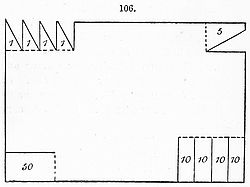
106. Domino Marker.
By turning back the nicks along the dotted lines the number marked on each is scored; a card so notched will score up to 99, and will answer for a large number of games before it becomes useless by the nicks breaking off.
The dominoes having been shuffled face downwards on the table, one of the two players pushes 2 towards the other, who selects one of the two, leaving the other for his opponent. Both are then turned up, and the player who has the highest number has the lead, or “pose,” as it is called. In England it is frequent for the holder of the 6-6 (double six) to pose first—a stupid plan, as it quite spoils the first hand, inasmuch as 6-6 may be a very bad domino to play from the dominoes held.
The 2 dominoes drawn and exposed are again mixed with the others, the non-leader mixing for them last. Each player then selects 7 dominoes; the leader plays one, placing it face upwards on the table, and the opponent matches it from his own hand, playing at either end as he thinks fit.
Thus, if the first player plays 4-5, the second may play either a 5 to his 5, or, should he think it more advantageous, a 4 to the 4, thus:
If a double is played first, which gives the second player only one number to play to, it is usual to place the double in a cross.
In either case the first player plays again, and so on alternately until one or other has played out, when he scores the pips on the domino or dominoes remaining in his opponent’s hand.
If one player cannot play at either end, he says “go,” when his opponent plays on until some number is posed to which he can play. If neither can play, both hands are shown, and the one that has the fewest pips wins the score, which should consist of the whole of the opponent’s pips as well as his own added together. After a score the dominoes are turned and mixed, the pose or lead being taken alternately.
Persons who know but little of the game think that the best play is at once to get rid of the heaviest dominoes, but this is not necessarily the case; but with a heavy hand, every care should be taken not to let the opponent close the game leaving you with a heavy score. In this most simple English game the aim of the player should be to make his long suit, and prevent his opponent playing.
Following are a few examples of hands played in the ordinary English game with 7 pieces. In this game the player sees his whole hand of seven at once, and he knows that his opponent has also seven, or one-third of the remainder; the other 14 dominoes are untouched, and he can make his calculations and play his game accordingly. In this game, each player plays alternately, until one or other has played all his dominoes, when he scores the number of pips left in his opponent’s hand. Should either be unable to play, the other continues until he brings a card to which his opponent can play. Should both players be unable to play, then the one who has the least number of pips scores, not only those in his opponent’s hand, but his own also. To give an example. Suppose 2 players, A. and B., playing the English game, and having drawn for pose, A. plays first from the following hand:—6-6, 5-2, 5-0, 4-3, 4-0, 2-2, 2-1.
An inexperienced player would probably play his 6-6, that being a heavy card, and in all probability he would lose the score if his opponent had 2 or 3 sixes in his hand.
The proper play would be the 2-2, as it gives B. only one number to play to, and if, as not unfrequently happens, B. has no twos, A. has the chance of a splendid game.
Let us take B.’s hand as follows:—6-4, 6-3, 6-1, 5-4, 5-1, 3-0, 1-1.
A. plays 2-2. As B. cannot play, A. plays again, selecting the card of which he has most (so as to lessen B.’s chance as much as possible), this would be the 2-5, as he has 2 fives in his hand and only a single one. If B. plays 5-1, which offers his best chance of success, A. will play 1-2, and the game will be shut up. On counting the pips, A. will be found to have 22 and B. 46. A. consequently scores 68 towards the game of 100.
If, on the contrary, A. plays the 6-6, he may lose, and he cannot possibly win as many as he could have done with the previous play.
If B. replies to 6-6 with 6-1, A. would then play 1-2, B. 6-4, A. 2-2, B. 4-5, A. would close the game by making 2-all, viz. 2 at both ends, by placing 5-2 to the 5 end, and his score would be 36, made up of B.’s 20 pips and A.’s own 16.
A hand with 3 or 4 of any one number is better than a hand with only 2 of each sort, even supposing the first to be much the heavier, as it gives a command of the game, and enables the holder to shut his adversary out and to play his own dominoes as he likes, closing the game if he thinks fit.
Thus take the following hands, A. to play first with the heavy pieces, viz.: 6-6, 6-4, 6-3, 6-1, 5-4, 5-2, 5-1, and B. to be his opponent with the light hand: 5-0, 4-1, 3-3, 3-1, 2-2, 2-1.
If A. commences with 6-6, B. must lose, provided A. plays with the most ordinary skill.
The principle of the game is to play so as to bring the numbers of which you hold most (and therefore in all probability your opponent least) at the ends; by this means you play out more dominoes than he does, and you often have the opportunity of closing the game. But this must be done with judgment, for it sometimes may happen that the player who shuts up the game loses, as his opponent may have a less number than he has, and win the score. It is this uncertainty which gives interest to the game, for to close the game and win when the numbers are nearly equal shows the skill and judgment of the player.
Mill.—This is a good evening game for boys. It somewhat resembles draughts, and is easily manufactured as follows: Take a sheet of stiff white cardboard, such as is sold for mounting water-colour drawings, &c., draw on it 3 oblong squares (Fig. 107) one within the other; the outside square, say 18 in. by 14 in., the second 14 in. by 10 in., and the third 10 in. by 6 in. Unite the 3 squares by drawing 4 opposite lines from the centre square to the outside square, so as to make 4 passages, enabling the players to move their men from one square to the other. Fig. 107 shows the board, with a game in progress.
In this game the black men are supposed to be winning. At the right hand black has a double mill, and a single mill at the top; white has a double mill also, but is afraid to open it, as black would instantly seize his man.
The lines forming each square should be ½ in. wide. The board can be made in a few minutes with the help of a flat rule with the inches marked on it. “Mill” is played by 2 people, each of whom has nine men; draught men will do. Having chosen who is to commence, begin by placing a man on any part of the board, either at the corner of a square or in the centre, of on one of the 4 lines. The men must not be placed in the intermediate spaces. Each line holds a mill, which consists of 3 men in a row, and the object of each player is to make a mill, and to prevent his adversary from making one. When a mill is made call out “mill,” and remove one of your opponent’s men, provided it does not form one of a mill, which cannot be broken as long as it remains closed; try, if possible, to get a double mill, that is, 5 men so placed that by moving one man either forwards or backwards you make a mill each time. If you can get 3 men on 3 corners of one square—which, if your opponent is a good player, he will prevent your doing—you are certain at all events of one mill, if not of a double one. When all the men are on the board you can move a man in any direction on the lines and up or down the cross lines into the other squares, but you must not cross the squares in any other way but by the passages; each passage will hold a mill. A move is from the corner of either square, on the line, to the centre, or back again, so on all round the squares if necessary—i.e. supposing you have only 3 men left, the rest having fallen to your opponent’s skill, and these 3 are in different parts of the board, you must move them till you have succeeded in joining them into a mill. When you have one or more mills, open either by moving a man forward (taking care that your opponent has not a mill ready to be closed, as he will then take your man and break your mill), and when you close it again remove one of your adversary’s men not forming part of a mill. When a mill is open it is of course in danger. The most amusing part of the game is when each has arrived at his last mill and is trying to destroy his opponent’s. The board may also be made of 2 very thin pieces of wood, joined by 2 hinges in the centre, so as to fold it up when not in use, painted white or black, and the squares and passages painted gold or scarlet.
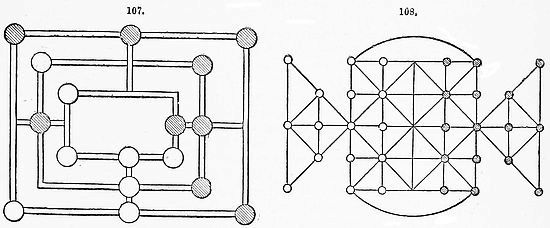
107. Mill. 108. Pachîsî.
Pachîsî.—This is a variety of the game of draughts as played by the natives of India, as good as, if not superior to, the English game. The freedom of moving in any direction, and the fact that it is not obligatory to accept a force, make the game one entirely of tactics, and are productive of many phases before the game is finished. The rules are few and simple. The name Pachîsî is derived from the Oriental expression for “25”—the number of posts in the square (Fig. 108): a are places for the men when off the board.
Pachîsî is played with a board as in Fig. 108, and 16 pieces on each side. The centre line of posts is left vacant. A piece may be moved in any direction along any line (and this includes advancing, retiring, and a lateral or diagonal move), but no farther than one post. Captures are made as in draughts, and are not limited in number, i.e. each piece has the power of a crowned piece in ordinary draughts. It is not obligatory to capture an adverse piece when it is possible to do so. The game is won precisely as in draughts, by capturing all the adverse pieces, or by the adversary being unable to move.
Poker.—Poker is a round game at cards, much played in America, but scarcely known in this country. Recently it has found favour here. The deal is determined by throwing a card to each player, the lowest having the first deal, and the deal afterwards proceeding to the left, as at whist. A pack of 52 cards is used. It is better not to play with more than 6 players.
The dealer, beginning with the person at his left, throws round 5 cards to each player, giving one card at a time. The dealer shuffles and makes up the pack himself, or it may be done by the player at his left, and the player at his right must cut.
To begin the pool, the player next to the dealer on his left must put up money, which is called an “ante,” and then in succession each player, passing round to the left, must, after looking at his hand, determine if he goes in or not; and each person deciding to play for the pool must put in twice the amount of the ante. Those who decline to play throw up their cards face downwards on the table, and for convenience in front of the next dealer.
When all who wish to play have gone in, the person putting up the ante can either give up all interest in the pool, thus forfeiting the ante which has been put up, or else can play like the others who have gone in, by “making good,” that is, putting up in addition to the ante as much more as will make him equal in stake to the rest.
If a number of players have gone in, it is best generally for the ante-man to make good and go in, even with a poor hand, because half his stake is already up, and he can therefore stay in for half as much as the others have had to put up, which is a percentage in favour of his taking the risk. This of course does not apply if any one has “raised,” that is, more than doubled the ante, before it comes around to the starting point.
Any one at the time of going in must put up as much as double the ante, and may put up as much more as he pleases, by way of “raising” the ante; in which case, every other player must put up as much as will make his stake equal to such increase, or else abandon what he has already put in.
Each player as he makes good, and equals the others who are in before him, can thus increase the ante if he chooses, compelling the others still to come up to that increase, or to abandon their share in the pool.
All “going in,” or “raising” of the pool, as well as all betting afterwards, must be in regular order, going round by the left; no one going in, making good, increasing the ante, or betting, except in turn. When all are in equally who intend to play, each player in turn will have the privilege of drawing; that is, of throwing away any number of his 5 cards, and drawing as many others, to try to better his hand. The cards thus thrown up must be placed face downwards on the table, and, for convenience, in front of or near the next dealer.
The dealer, passing around to the left, will ask each player in turn how many cards he will have, and deal him the number asked for, from the top of the pack, without their being seen. The dealer if he has gone in to play for the pool will, in like manner, help himself last.
The players must throw away their discarded cards before taking up, or looking at those they draw.
In the game every player is for himself and against all others, and to that end will not let any of his cards be seen, nor betray the value of his hand by drawing or playing out of his turn, or by change of countenance or any other sign. It is a great object to mystify your adversaries up to the “call” when hands have to be shown. To this end it is permitted to chaff or talk nonsense with a view of misleading your adversaries as to the value of your hand, but this must be without unreasonably delaying the game.
When the drawing is all complete, the betting goes around in order, like the drawing, to the left. The ante man is the first to bet, unless he has declined to play, and in that case the first to bet is the player nearest to the dealer on his left. But the player entitled to bet first may withhold his bet until the others have bet round to him, which is called “holding the age,” and this, being an advantage, should, as a general rule, be practised. Each better in turn must put into the pool a sum equal at least to the first bet made; but each may in turn increase the bet or raise it as it comes to him; in which case the bets, proceeding around in order, must be made by each player in his turn equal to the highest amount put in by any one, or else, failing to do that, the party who fails must go out of the play, forfeiting his interest in the pool.