THE DRAWING-ROOM.
Reading edition
THE DRAWING-ROOM.
The drawing-room is the scene of almost all social gatherings, whether dancing, theatricals, games, or other amusements be provided.
Etiquette
Etiquette.—This chapter cannot commence more appropriately than with a few remarks on the customs observed in society and the rules which regulate visits and parties. To enter fully into all these matters would occupy a very large amount of space. Those requiring more detail cannot do better than consult the weekly pages of the Queen, in which excellent journal often appear articles on the latest fashionable customs, and where an inquiry from one in doubt is sure to meet with a polite reply giving the necessary information.
Styles and Titles.—It seems difficult to make it clear to the understandings of many persons that it is incorrect, in speaking of an earl’s, marquis’s, or duke’s daughter, to omit her Christian name. They must know that she is habitually styled Lady Clara Vere, yet they persist in calling her Lady Vere, as if she were a peeress or a baronet’s wife, instead of a “lady in her own right.” Another equally common blunder is to speak of a baronet’s wife as Lady Emma Jones; if for purposes of identification it is necessary to mention her Christian name at all, it should be as Emma Lady Jones, as nothing but being the daughter of a peer higher in rank than a viscount gives the right to be called Lady Emma. Again, it is impossible to persuade some people that it is the sons of dukes and marquises only who are called lords; they persist in imagining that because earls’ daughters are styled lady, it is impossible that their younger brothers should be only Hon. Mr. The title of dowager is another great stumbling-block. In propriety it should only be borne by the mother of the reigning peer or baronet. Should, therefore, a peer (let us call him Earl of Brighton) succeed his father, his mother, the widowed countess, should be styled the Countess Dowager of Brighton. Should he, however, succeed to his uncle, brother, or cousin, that relative’s widow would have no claim to the title of dowager, but should be addressed as Mary, Countess of Brighton. It is a very common saying that a woman may rise in rank, but can never lose what she has once possessed; but, like many common sayings, this, though the general rule, is not strictly accurate. A duke’s daughter takes precedence far before the wife of a baron. Yet if she marry a baron who is a peer in his own right (not merely a title of courtesy, such as are borne by peers’ eldest sons), she at once, on becoming his wife, loses her own rank, and has no precedence, save that of her husband.
Shaking hands.—You would not shake hands on being casually introduced to a person altogether a stranger to you, but yet there are so many occasions when it is both proper and correct to shake hands on first being introduced, and the rule on this head is a very elastic one. For instance, a host and hostess invariably shake hands with every stranger introduced to them at their house. You would shake hands on being introduced to the relatives of your relations by marriage, such as your sister-in-law’s sister or your sister-in-law’s mother; with your brother-in-law’s brother or father; with your future husband’s uncle and aunt or cousins; with a brother or sister or mother of an intimate friend; or under any similar circumstances. If you do not shake hands on being introduced, ought you to do so on departure? That depends. There are occasions when to shake hands would be polite; and there are occasions when your hand would be de trop. If you had enjoyed conversation to any extent with some one to whom you had been introduced, and found you were getting on very well, and had a good deal in common, you would naturally shake hands in taking leave of each other; but if you had only exchanged a few common-place sentences, a bow would be all that is necessary. The lady usually takes the initiative, as she does with regard to bowing; but in reality it is a spontaneous movement made by both at the same moment, as the hand ought not to be extended or the bow given unless expected and instantaneously reciprocated. For a young lady suddenly to offer her hand in farewell greeting to one not prepared for the honour leads to an abrupt movement on the one part, and to a little confusion on the other. Shaking hands on taking leave is with some few people a graceful and pleasant fashion of saying good-bye. About shaking hands with acquaintances at a dinner party, or at an evening party, many are in doubt. If the dinner party is a small one, and there is time to quietly shake hands with those you know, it would be correct to do so; but if there were little time before dinner, and no good opportunity for shaking hands, bows to acquaintances at distant parts of the room, or when seated at the dinner table, would be sufficient for the time being; while at an evening party it depends upon your being able to get near enough to your friends to enable you to do so. Having once shaken hands with a person, you are of course at liberty to repeat the civility whenever you may happen to meet, unless a decided coolness of manner warns you that a bow would be more acceptable than a shake of the hand.
Letter Writing.—To commence a letter to a comparative stranger, or to a person with whom the writer is but slightly acquainted, on any matter of interest, is the first difficulty to be got over. In all communications with strangers, or almost strangers, it would be correct to write in the third person. A very slight acquaintance, however, or a faint personal knowledge, would authorise a letter being written in the first person if it were to be of any length. Notes are principally confined to the briefest of communications, as, when they are lengthy, the repetition of the pronoun “she” and “her,” “he” and “him,” become wearisome if not involved, to say nothing of the possessive pronouns which are frequently brought into use, with the addition of surnames. When it is imperative to write in the third person, it is most desirable to construct each sentence with care and with due regard to an extravagant use of pronouns, and never at any time to resort to the vulgar expedient of attempting a sort of compromise by making the initial letter of the writer, and of the person written to, do duty for their respective surnames. To frame a note without introducing “compliments” at its commencement is the received mode of writing one. The subject under discussion does not require this preliminary introduction, and it is best to embody it in the opening sentence. There are few people careless or ignorant enough to lapse from the third person into the first in the course of a short note; but still it is worth guarding against. To turn from notes to letters, again it is observable that a cramped style, or a small Italian handwriting, are no longer in vogue, and, when seen, appear very much out of date. The prevailing style of writing is bold and free, the characters very upright, and tall toppling “l’s” and long-tailed “g’s” have quite disappeared from letters in general; a free use of capitals is also indulged in, which gives a dash of originality and spirit to a letter when not overdone. Many gentlemen and a few ladies affect a literary style of letter writing—that is to say, a margin ¾-1 in. wide is left on the near side of the sheet of paper, which gives rather an imposing look to it; but this is only done when the letter is almost a note in the matter of length. A strictly business habit, adopted for the convenience of being copied by letter-press, by no means a fashionable one, is to write on the first and third pages of a sheet of note paper, leaving the second and fourth pages blank, or to write on the first and fourth pages, leaving the other two; but some people fall into the mistake of doing this under the impression that it is rather fine, whereas it is very much the reverse. Some little care should be taken in paragraphing a letter to avoid incoherency. Thus, a fresh line and a capital should be allowed to each new subject. As much variety is introduced into the letters of the present day as possible; thus, should a sentence or a remark require to be referred to, the eye can at once light upon it without re-reading the whole epistle. It used to be an idea that to underline words in a letter was “missish” in the extreme, and rather bad style than not: but now, if a writer wishes to be very emphatic, or to call particular attention to any remark, an additional stroke of the pen is not objected to; but it is a liberty not to be taken when writing to those with whom one is on ceremony. Another practice of the past, which is now happily discarded, is that of crossing letters. Many people experience a certain difficulty in the choice of a conventional term with which to conclude a ceremonious letter, and it must be admitted that there is not much variety at command, “yours truly,” “yours sincerely,” “yours faithfully,” with the addition perhaps of the adverb “very,” being the principal formulas in use; and it is on the whole immaterial whether “truly” or “sincerely” is employed when writing to friends. The affectionate expressions addressed to still dearer friends and relations are beside the question, and yet many devoted husbands make use of the words “yours truly” when writing to their wives, in preference to any more affectionate phrase. By way of not concluding a letter too abruptly, it is usual, before the words “yours truly,” to add one or other of such phrases as these: “Believe me, dear Mrs. Jones,” or “I remain, dear Mrs. Jones,” or “Believe me, dear Mrs. Jones, with kind regards,” and this gives a certain finish and completeness to a letter which would otherwise be wanting.
A few words as to the actual composition of a letter. It should always be borne in mind that if a letter has a purpose, a reason, or an object for being written, this fact should not be lost sight of, or overweighted with a mass of extraneous matter. Again, it is idle to devote the first page of a letter to trivial excuses for not having written sooner, when no particular reason existed why a still longer delay in writing might not have been allowed to elapse, if it suited the convenience of the writer. Of course, when a letter requires an immediate answer, it is then a matter of politeness to give the reason for the omission, but this should be explained without circumlocution, and other matters should at once be referred to. A want of punctuation in a letter will often cause a sentence or paragraph to be misunderstood, and made to convey the reverse of what was intended. Notes of interrogation should not be omitted from a letter when questions are asked, though many consider it a waste of time to make use of them. Notes of exclamation, when required, materially assist the clearer understanding of a passage, which, without them, might have a vague meaning. It is not the fashion in these days to accuse oneself of writing a stupid letter, a dull letter, or an uninteresting letter, one’s friends are only too likely to take one at one’s own valuation, and to endorse the written verdict; while the solecism of laying the blame of bad writing on pens, ink, and paper is confined to the servants’ hall, where writing materials are perhaps not always of the best quality, and seldom ready to hand. In answering a letter, it is a great proof of a poor imagination, besides being extremely tedious, when each paragraph of the letter under treatment is minutely paraphrased. Questions naturally demand answers, and important facts call for comment; but trivial remarks and observations, perhaps pleasantly put, were never expected to be returned to their author with poor platitudes attached to them.
A postscript was formerly supposed to convey the pith or gist of a lady’s letter—a poor compliment, it must be confessed, to her intelligence; it is now considered a vulgarism to put P.S. at the bottom of a letter containing the few last words, if something is remembered when the letter is concluded that should have been said, it is added without apology.
Answering Invitations.—The extremely rude habit of not answering notes as soon as they are received is generally done from idleness and a habit of shirking trouble, though, as the answer must ultimately be written, it is hard to see what exertion is saved by not writing it at the proper time. Of the inconvenience to the sender from not receiving the answer required, no one seems to think, and there are some who labour under the delusion that it is “fine,” and increases their importance, to keep people waiting. The inconvenience to a hostess can hardly be exaggerated. Rooms are not elastic, and having asked the proper number of people, she can ask no more until she knows that some of those invited, as is generally the case in most parties, cannot come. Every day she is kept waiting lessens the time for inviting others; and then only those with whom she is sufficiently intimate to give a very short invitation. Politeness requires that an invitation to dinner should be answered at once; if the servant waits, it should be returned by him; if it is left, an answer should be sent at the earliest moment; if it is sent by post, the reply should be sent by the next one. It is no more trouble to write the answer at once than to wait for the next day. The only valid reason that a lady can have for delay is when her husband is out, and she is not quite sure about his engagements. Of course, if he is only out for a short time it is permissible to wait till he comes in; but if, as is sometimes the case, he is away from home for a day or two, she should answer at once to that effect, and write decisively on hearing his determination. Answers to At Homes, even when they bear the request “R.S.V.P.,” need not be sent so promptly; but as soon as it is quite clear to a lady that she cannot go, it is courteous to say so. Answers to invitations to concerts, private theatricals, or any entertainment where the guests are to be seated, should be sent immediately, as it is necessary for a hostess to know the number of chairs at her disposal. Answers to wedding invitations should also be returned immediately.
The art of making excuses is one which people much in society find it absolutely necessary to cultivate if they wish to retain any command over their own time, movements, and even property. Tact, or savoir vivre, is the key to this art, while frankness might certainly be termed the lock in which to place the key when making polite excuses. Frankness appeals both to the good sense and to the common sense of the one to whom it is addressed; it softens the refusal, of whatever character it may be; it gives the assurance that no slight is intended. There is one stereotyped excuse, a “previous engagement”; but between friends, and by those with whom frankness is practised, this explanation is carried a step further, and the nature of the previous engagement is mentioned, and the name of him or her with whom it is made. A downright refusal savours of ungraciousness and discourtesy; whereas a polite excuse is compassed by a little judicious temporising, which in a way breaks the force of a refusal. The difficulty of making polite excuses is sometimes increased when a verbal invitation is given to a husband and wife, and they are not able to consult as to whether they are unanimous in refusing it. The way of extrication is for the one to refer to the engagements of the other, and leave it in doubt for the moment.
Various excuses are permissible in answer to all save invitations to dinner; this must be accepted, unless a bonâ fide engagement or illness can be pleaded in excuse. Polite excuses to unwelcome requests demand even more readiness of thought and speech, as refusals to such, if not guardedly conveyed, are likely to give offence, or to create an unpleasant feeling of annoyance.
Dancing
Dancing.—Preparing Floors.—(a) A good plan is to use a little beeswax in preparing the floor for dancing. Unless it be perfectly even, a carpenter must be called in to plane away any little roughnesses, or to fill up interstices between boards with little slips of wood. When quite smooth, some beeswax must be rubbed on to one of the weighted brooms sold on purpose, and it must in this way be thoroughly worked into the boards over every part of the room, adding a little more wax when needed, but remembering that the less wax and the more labour bestowed on the floor the better it will be. When the desired polish is attained, sprinkle the floor all over with finely powdered French chalk. Cover the waxed broom by tying a piece of strong baize over it, and with this go up and down the room over and over again, until the French chalk has been well rubbed over every part; this will make the floor just right for dancing, and prevent the possibility of any slight stickiness there might be from the beeswax. As this process with the powdered chalk occasions a good deal of dust, it should be all finished some hours before the room is wanted, so as to give the dust time to settle. The room will require thorough dusting, not forgetting the upper ledges of doors, mirrors, &c., which are sometimes neglected, thereby causing a great clouding of the atmosphere as soon as dancing begins. If the room be a large one, it will take 2 men quite 2 days to polish the floor for the first time, apart from any carpentering which may be necessary. Once done, however, one day will suffice on any future occasion to put it in good dancing order; going over every part just once, first with the wax, and then with the chalk, will be quite sufficient.
(b) Powdered spermaceti answers well for polishing a floor, being clean and easily used; it should be sprinkled over, then rubbed, or, better still, is glided over by some one wearing thin shoes, each board being taken separately.
(c) Wash the boards with milk, and when dry lay on French chalk thinly but evenly all over the floor; then let 2 men scrub it hard with brushes until all signs of the chalk disappear: ½ lb. chalk will do for a large room, as if put on too thick it will soil the ladies’ dresses.
(d) The floor must first be planed as smooth as possible, all nail heads hammered down, well sand-papered with coarse and then fine paper, washed with new milk, and 6 hours after, dusted slightly with French chalk. A rough floor may be transformed in an hour by scraping up a common composite candle very finely, scattering it on the floor, rubbing it into the wood with your boots, and then dusting it with French chalk out of a flour dredger. White wax, and then French chalk, is best treatment for a well-stretched drugget, and the chalk will make an over-waxed parquet perfect.
Scenting Rooms.—(a) When the roses fade, spread the leaves to dry, taking away those which are decayed or discoloured; then, in a jar, place alternate layers of rose leaves, lavender, scented marjoram, lemon plant, or any perfumed plant, sprinkling each layer with crushed bay salt, and pressing down very tightly. In the autumn, when there is nothing more to add, strain away any moisture, turn all out, and mix well; keep in a wide-mouthed jar with a lid, and during the winter sprinkle occasionally with eau de Cologne or other perfume; and, when wishing to scent the room, take off the lid.
(b) 1 lb. bay salt, 2 oz. saltpetre, both in the finest powder, a handful of sweet bay leaves cut as small as possible; the same of myrtle leaves, rosemary, lavender leaves, and lemon thyme in flower, the rinds of 4 lemons cut as fine as possible, ½ oz. cinnamon, ½ oz. cloves, ½ oz. allspice, a large nutmeg in the finest powder, 1 oz. storax, 1 oz. bergamot, 1 oz. spirit of lavender, 1 oz. essence of lemon, 1 dr. musk, 6 oz. powdered orris root. Put all these ingredients into a jar with a lid that shuts very close, then add the following flowers as you gather them: 3 handfuls orange flowers, 3 of clove pinks, 2 of rosemary, 2 of lavender flowers, 2 of jessamine, 6 of rose leaves, and leaves of Aloysia citriodora. Stir it each time fresh flowers are added. Gather 4 rosebuds early in the morning, and put them at once into your jar. Do not leave any two leaves sticking together, and pick out every piece of green. Syringa flowers are a good substitute for orange flowers. If the pot-pourri becomes too moist, add orris root powder and spices; if too dry, add bay salt and saltpetre, only let every powder be as fine as possible, and well mixed. It cannot be too much stirred at first, and, if well made, will keep its perfume for many years.
Old-Fashioned Dances.—The Triumph: The ladies and gentlemen stand in lines opposite to each other; the top gentleman dances down the centre with the second lady, pursued by her own partner; she dances back between the two, and the next couple begin, until all the dancers are engaged. Cottagers: 4 people stand for this as in the quadrille; they cross hands in the centre, and make the half-turn backwards and forwards; then the second couple hold up their hands, and the first couple pass beneath and begin again. Square Eights: Ladies and gentlemen in two lines, hands across, then first polka round, and then galop, and begin again. Morgiana in Iceland: The dancers stand opposite each other in two lines. The top couple go outside the lines, back again, down the middle, and up again; the couple at the top holding up their hands, they pass under, and the next couple begin. Miss Lunsdam’s Fancy: The first couple set to the second lady, hands 3 round, the gentlemen do the same, lead down the middle and up again, right and left at top. Lady Doran Strathspey: Set and hands across and back again, down the middle and up again allemand; turn corners, lead outsides. The Jubilees: First and second couple hand across, back again, lead down the middle and up again; swing corners. The Quadrille Mazurka, danced face to face, in 4, 6, or 8 couples, up to 32. Fig. 1. The 2 couples facing each other make the complete right and left; the 2 gentlemen, advancing with their partners, give each other their left elbows, make a demi tour, change their partners, make the tour sur place forward, and repeat the figure to bring them back to places. Fig. 2. Wait 8 bars. The 2 opposite gentlemen, holding their partners by the hand, advance and fall back, cross by right and change places, make the tour sur place forward, and repeat the figure to bring themselves back to their places. Fig. 3. Wait 8 bars. The 2 opposite ladies cross by their right, and re-cross, giving the left hand; the gentlemen give them the right hand, turning them; their left hand round the waist. Thus the ladies, still holding each other by the left hand, make a half round to change places. The gentlemen, still holding their partners by the waist, make the tour sur place forward. They cross hands in centre, and make an entire round. The gentlemen, having changed sides, take their partners’ hand, and fall back with them, and repeat the figure to regain their places, omitting the cross hands in centre. Fig. 4. Wait 8 bars. The first gentleman promenades with his partner round to his place, advances forward and backwards. The gentleman again advances, and his partner crosses to left; without quitting her hands, he takes the lady from the opposite couple with his other hand, who takes the hand of the other lady behind the gentleman; thus all three advance and retire without turning. The gentleman then stoops, and passes under the arms of the two ladies united behind, with which his own are then found crossed. The three go round to the right; the gentleman then leaves the lady with her partner, and makes a promenade to his place with his own partner; both then advance and retire. Fig. 5. Wait 8 bars. Right and left; the gentlemen, still holding their partners, make a demi tour, and pass the right arm under the left of their partners, and, taking them by the waist, thus make the tour sur place backwards. Half hand round, and petit tour, to return to their places. Then join 4 hands round, and make a demi tour to the left. A tour forward, and demi tour round to the left, tour forward; double right and left, and return to their places. Tour sur place forwards and backwards, and finish by a grand chain as in Lancers. This is a graceful and telling dance. The Spanish Dance is danced in 3 time with the waltz step, and is very graceful. The dancers stand in line as for a country dance, the sexes divided except that the top gentleman stands on the lady’s side, and the top lady on that of the gentleman, and every fourth lady and gentleman change places in like manner; first gentleman and second lady, and first lady and second gentleman of each set of 4; set to each other and change places; repeat; then first gentleman and second lady set to their partners, change, and resume their original places; all four join hands in centre, advance, retire, and change places; ladies passing to left four times; next the couples waltz round each other, the second couple taking the top; while the top couple repeat the figure till the whole line is completed. The Swedish Dance is as follows: Arrange the company in lines of 3, a gentleman and 2 ladies, or a lady and two gentlemen, vis-à-vis, as many sets as can be formed to dance at once; all forward and back join hands; gentlemen set to opposite lady on the right and turn, and set to lady on the left, turn, and back to places; all forward and back, forward again, and pass through to next set; all forward and back twice; the two top ladies and opposite gentleman all three join hands round, and back again to places; all forward and back, forward again, and pass through to the next set; all forward twice; four ladies cross right, hands round and back again to places; hands all round and back to places; all forward and back, forward again, and pass through into next set. (A. H.)
Amateur Theatricals
Amateur Theatricals.—These form an excellent amusement for winter evenings, and may be made highly instructive to young members of the family, besides aiding in developing a degree of culture in manner and speech with proper guidance. A moderate amount of ingenuity, with some pasteboard, paper and paste, will suffice to extemporise a stage and scenery. A few hints on “making up” may be useful.
Making up.—Given a clean shaven face, the features of which are not specially prominent, and it is comparatively easy for an artist in make up to transform it into a fair likeness of any type of character he wishes to represent, or even to imitate a particular individual. Of course the actor cannot remould his features, but by putting on different coloured paints he can present an effect which, viewed from a little distance, has all the appearance of having been remoulded. The great secret underlying all the triumphs of this art is that white brings into prominence and black depresses. For instance, take a nose that is reasonably straight. Suppose it is desired to make it a pug. Put a little dark brown on the bridge and make the end lighter than all the rest of the face. The gradations have to be nicely shaded, and there comes in the art. To reverse the process, and produce a marked aquiline, hook, or Jewish nose, put white on the bridge and darken down the tip a little. That will bring forth an aristocratic nose that would do credit to any duke in the British peerage.
Grease paints can now be purchased. These are colours mixed with a hard grease, a little of which is rubbed on the face and then smoothly spread over with the finger. One of its most valuable properties is that it is not affected by perspiration, and requires grease or soap and water to remove it. Generally the actor rubs a little vaseline or cold cream over his face and wipes this off with a rag before washing, thus removing most of the paint and getting the soap to lather more easily. It does not seem to injure the skin when it is properly washed off at night, but persons who are careless may let it block up the pores of the skin or remain in the roots of the hair or eyebrows. The number of shades in which grease paint is now made is very great, and every actor who takes pride in his make up will have from a dozen to twenty kinds. Even in flesh tint alone there are six varieties, from the very delicate creamy white of youth to the leaden sallowness of extreme old age. Besides these there are shades for Chinamen, and for every gradation of Indian and negro blood. Then there are whites for “high lights” and for whitening mustaches or eyebrows, browns for shading, blues for veins and hollows, reds, blacks, and yellows. You must not think they are all used in one make up, though often seven or eight colours are combined in an elaborate one. The first thing to do in making up is to select the proper flesh tint. This having been chosen and applied, the next thing is generally the rouge. Except in the case of very old characters, some red must be put on the faces, or the yellow glare of the footlights will make them look perfectly ghastly. But where the red is to be put and how much of it and what shade to use, depend entirely upon the age of the person to be represented. The younger the person the more delicate the tint of rouge should be and the higher it should be upon the face. Thus, for a very young man, the rouge is put on in a half-moon shape, one horn beginning at the inner corner of the eye and the other extending well up the temple as high as the eyebrow. As the age increases we cease to run the colour up so high on the outer side, until for mature years it settles down into the hollow below the cheek bone.
The rouge being properly applied, we next go to work upon the wrinkles or hollows. In representing age the principal lines to be emphasised are those from the nose to the corners of the mouth, from the corners of the mouth to the chin, from the inner corners of the eyes to the hollows of the cheeks, and those on the forehead. Some actors make the wrinkles in blue, others in brown, and others in grey. It is a matter of taste. The lines are made with thin sticks of the paint cut to a point, or with a pointed leather stub upon which the paint has been rubbed. After the wrinkles have been put on it may be necessary to accentuate them by a line of white or light colour on the edges, and these lines must be graduated into each other so as not to seem too hard or abrupt. In representing old men the strong muscle above the line from the nose to the mouth must be brought out very strongly with white. The cheek bones under the eyes must be treated in the same way. Then the eyelids require darkening for age, and crows’ feet are carefully drawn with a number of thin irregular lines at the outer comers of the eyes. Where youth is shown, the upper eyelids and skin under the eyebrow are delicately rouged. If hollows in the cheeks, temples, or neck are wanted, these are the next things to be done, and the outlines of the cheeks may be rounded out with light shades or made to assume eccentric shaped with darker ones. The muscles of the neck may need bringing out, and hollows put under each side of the chin. Lips require rouging for youth, and blueing or darkening for age. Large mouths are made small by putting rouge only in the centre of the lips, and small ones made large by rouging all the way, and even extending the corners with a line of red. Where toothlessness is desirable the teeth are covered with a thin coating of black wax, which renders them quite invisible. The process is technically called “stopping out.” The face being now coloured, rouged, lined, wrinkled, and hollowed, the next things to be attended to are the eyebrows, and hair or beard if any are required.
Very few people are aware how important a part the eyebrows play in forming the expression of the face. Bringing them very close together will cause a look of meanness or villainy; a high arch will ensure surprise or vacancy of expression. A slight upward turn of the inner corner makes some faces very handsome. Eyebrows are often painted; but if very heavy ones are needed they are stuck on over the true ones. If the actor is going to wear his own eyebrows or mustache, he colours them to match his wig with grease paint, which, after being rubbed on, is combed so that each hair is coloured and there is no matted appearance. The use of mustaches and beards made on wire and hung from the ears has almost entirely gone out except among supers and utility people, as, being independent of the skin of the face, they did not move with it, and consequently never appeared natural. The best mustaches and beards are now made upon a thin foundation of silk, each hair being drawn through separately and knotted. The foundation is fastened to the face with spirit gum, another modern invention of great value to actors. It consists of gum dissolved in collodion and alcohol. This mixture dries immediately it is exposed to the air, is impervious to moisture, and can only be removed by spirits or grease. When the actor had to depend upon plain glue or gum, he was always in fear of losing his false beard, and many are the funny stories told of swallowing mustaches or transferring them to the faces of ladies who have had to be embraced in the course of the action of the piece.
Many actors prefer to make their own beards or whiskers nightly, as they do not like the feeling of the solid foundation on the skin, and, indeed, an all-round beard is apt to restrict the easy working of the jaws. Whiskers or beards are made from wool or crape hair, both of which can be obtained of any desired shade of the theatrical wig makers. The hair or wool is drawn through a coarse comb to a little longer than the length desired. It is then cut close to the teeth on the under or more solid side. An even mass is thus obtained which is readily fixed to the gummed cheek. The real art is in the subsequent trimming, with very sharp scissors, to the shape desired. Wool is more easily handled, but hair which comes in short lengths, plaited, is the most realistic. It is this that detectives use for disguises, and when well put on it is almost impossible to detect its falsity, as each hair seems to grow out of the skin.
Almost the last stage is the putting on of the wig. If this is not a bald one, the hair is brought down so that the junction with the forehead is not seen. Many foreign actors prefer to have their wigs made with a forehead piece, painted to match the face. Bald wigs are, of course, made in this way, and the edges are hidden with a thick dressing of grease paint, or, as it is sometimes called, joining paste. This being done, a coat of powder of the proper colour is delicately dusted on the face. Powder is prepared in every shade from white to orange. It has the effect of deadening the shininess of the grease paint, of softening the lines and blending the work into one harmonious whole.
Be careful, too, to make up your hands, a thing which many a good actor forgets. Yet how absurd it is to see an old, wrinkled face accompanied by young, plump hands. For an old man, the knuckles should be whitened, the hollows between them darkened, and the veins marked with white blue.
Actresses very seldom use grease paint, and, in fact, it is not necessary for them, as they rarely consent to line their faces. They generally use a liquid white, which has some mineral basis, and is in the end hurtful. The safest compound is a preparation of oxide of zinc, rose-water, and a few drops of glycerine. A little rouge, the darkening of the eyebrows, and a touch of red on the lips complete a lady’s make up. Most of them line below and above the eyelashes with black, which gives brilliancy to the eyes. They are very apt to overdo this, and then their eyes look like burnt holes in a blanket.
Stage Illusions.—Many of the peculiar effects which are produced upon the stage, imitating moonlight, sunlight, thunder, wind, rain, and other natural phenomena, are a puzzle to those outside of the business. How such realistic representations of these things as are often witnessed upon the stage can be made is a question that often enters the mind of the spectator, and is seldom answered in a satisfactory manner. It is always the ambition of scene painters and stage carpenters to devise improved methods of imitating these things, and hence the stage may be said to try to hold the mirror up to nature in a material as well as a moral sense. Years of experience have tended to bring these imitations to a high state of excellence; but the limits do not yet seem to be reached, and new contrivances are continually appearing. The electric light is not yet used, but as its pale blueish tint would be serviceable in particular effects, stage machinists are now deliberating how it can best be employed. All of the operations mentioned, together with some which will be described, are classed under the general term, “stage effects.” Authors, in writing plays, are always on the look-out for an opportunity to produce a telling effect. The amount of work bestowed upon their production in a theatre is simply astonishing to those unacquainted with that mysterious realm known as “behind the scenes.”
Thunder is a common stage effect, and is used with great advantage in many plays. In former days it was produced by shaking a large piece of sheet iron immediately above the prompter’s desk. This contrivance produced a good imitation of sharp, rattling thunder, but failed to give the dull roar which is always heard in storms. A contrivance for this purpose was soon invented. A heavy box frame is made, and over it is tightly drawn a calf skin. Upon this the prompter operates with a stick, one end of which is padded and covered with chamois skin. A flash of lightning, produced with magnesium, and a sharp crack of the sheet iron, followed by a long decreasing roll upon the “thunder drum,” produce an effect which is startlingly realistic. Travelling companies are compelled to be satisfied with the sheet iron alone; and the tragedian who enters a theatre provided with a complete thunder apparatus always is happy to think that his battle with the elements in “King Lear” will be worth fighting.
The rain machine in large theatres is a fixture placed high up in the “flies.” A cylinder is made of “half-inch” wood. It is usually 5 ft. in circumference, and 4 ft. in length. Upon the inside are placed rows of small wooden teeth. A lot of dried peas is placed in the cylinder, a rope belt is run around one end of it and down to the prompter’s desk, and it is ready for a drenching shower. By turning the cylinder, the peas roll down between the teeth, and the noise produced by them makes a good imitation of rain falling upon a roof. A sudden pull of the rope, accompanied by a gust on the “wind machine,” gives the sound of the sweep of a blast of wind during a storm. Travelling companies often meet with theatres where there is no rain machine. A sufficiently good one, however, is easily produced. A common child’s hoop is obtained, and a sheet of heavy brown paper is pasted upon it after the manner of a circus rider’s balloon. A handful of birdshot is placed upon the paper. The “machine” is canted from one side to the other, and the shot rolls around the paper, producing a fairly good rain effect.
Wind is an item that is very useful in heightening the effect of stage storms. It is often dispensed with in theatres where strict attention is not paid to details, but not without a loss of “realism.” It has, moreover, a great influence over the feelings of spectators. The blind Louise in the “Two Orphans” is much more pitied when the audience can hear the pitiless blast that makes her shiver. Hence in every large theatre the wind machine plays an important part. It is not a stationary apparatus, but can be moved to any quarter of the compass from which it is desired that wind should blow. In the last act of “Ours,” every time the door of the hut opens snow flies in and a shriek of wind is heard. The wind machine in that instance is placed just outside the door, and the property man works it, while his assistant amuses himself by trying to throw his paper snow down Lord Shendryn’s back. The wind machine is constructed in this manner: A heavy frame is made, in which is set a cylinder provided with paddles and resembling very much the stern wheels seen on Ohio River towboats. Across the top of this cylinder is stretched as tightly as possible a piece of heavy gros-grain silk. This silk remains stationary while the wheel is turned by a crank. The rapid passage of the paddles across the surface of the silk produces the noise of wind. Often travelling companies are in theatres where there is no wind machine. Then the property man groans audibly and proceeds to do what, in theatrical parlance, is called “faking” the wind. He selects a heavy piece of gas hose, called by stage gasmen “flexible,” and, finding a quiet corner where there is sufficient space to swing a cat without danger—to the cat—he whirls it around his head with the greatest possible rapidity. This method produces very satisfactory results—to every one but the property man. He is a long-suffering person; but the extraction of wind from “flexible” causes him to find life tedious.
Every one has heard the startling crash that is produced when the hero kicks the villain through a four-inch oaken door. One would think that not only the door but the villain must be completely shattered. This noise is produced by the crash machine, one of the oldest implements of imitation still used on the stage. It is similar to the wind machine in construction. A wheel with paddles set at an angle of about forty-five degrees to the radii is the main part of the machine. Upon the top of the wheel one end of a stout piece of wood is pressed down by fastening the other end to a portion of the framework. When the wheel is turned, the slats passing under the stationary piece produce a rattling crash. The principle of the machine is illustrated by the small boy who runs a stick along a paling fence and is gratified by introducing into the world an additional morsel of hubbub.
There is nothing that can be so well counterfeited on the stage as moonlight scenery. And yet there is nothing which requires more work. The artist begins the task by painting a moonlight scene. In daylight such a scene is a ghastly sight. It is done in cold greys and greens, in which Prussian blue and burnt umber play an important part, and the lights are put in with white slightly tinged with emerald green. The strong moonlight of the foreground is produced by a calcium light thrown through a green glass. The fainter light upon the scenery at the back of the stage is obtained from “green mediums,” a row of Argand burners with green chimneys. These are placed upon the stage just in front of the main scene, and are “masked in” from the view of the audience a “ground piece.” A row of them is often suspended from the “flies,” in order to light the top of the scene. This upper row is masked in by “sky borders.” Thus a soft green light is thrown over the entire distance, while its source does not meet the view of the spectator. A usual feature of stage moonlight scenes is water, because it affords an opportunity for the introduction of the “ripple”—a charmingly natural stage effect. The main scene in a moonlight view is always painted on a “drop”—that is, a scene made like the curtain let down between the acts. The position of the moon being determined, immediately under it, beginning at the horizon, a number of small irregular holes is cut in the drop. These are then covered on the back with muslin and painted over on the front to match the rest of the water. Behind these holes is placed an endless towel, about 8 ft. in height, running around two cylinders, one at the top and one at the bottom. The lower cylinder has a crank by which the towel is turned. In this towel is cut a number of holes similar to those cut in the drop. A strong gas burner is placed between the two sides of the towel. When the machine is turned the flashing of the light from the passing holes in the towel through the stationary ones in the drop produce a fine ripple. It is always better to turn the towel so that the holes pass upward, as that helps to make the mimic wavelets seem to dance up toward the sky. Instead of a towel a large tin cylinder has been used, but it is cumbersome and noisy. It is necessary to turn this towel with great steadiness, otherwise the ripples will go by fits and starts, and entirely lose their natural appearance. Stars are easily put into the sky. Each twinkling orb consists of a spangle hung upon a pin bent into a double hook. The slightest motion of the drop causes these stars to shake and the flashing of the light upon them produces the twinkle.
One of the most beautiful effects produced upon the stage is the change from day to night or from night to day. Of these the former is the more striking, and a description of it will serve to explain the principle of both. In order to produce the proper effect the back drop is made nearly double the height of the usual scenes. The upper half of it is painted to represent a sunset sky, and the lower half to represent moonlight. It is hung so that the upper half alone is visible. The scenery of the distance is then painted upon a separate piece, which is “profiled”; that is, the irregular line of the horizon made by trees, mountains, or houses, is sharply cut out with a circular saw. This piece is placed immediately in front of the sky drop. A few feet further in front is hung what is known as a cut gauze drop. This has sides and top of canvas painted as the case requires; while the centre is filled with fine gauze, which lends an aerial effect to the distance. Red “mediums” are employed to give a soft, sunset glow to the scene. At the proper moment, the back drop is very slowly and steadily hauled up, while the red “mediums” are slowly turned off and green ones turned on. The moon is made in the night half of the sky drop, and rises with it. When it rises above the distant horizon the green “mediums” are turned on to their full power and the green calcium light is brought into play. The effect of this change, when carefully managed, is always very beautiful, and is sure to draw forth applause from the audience.
Moonrise, in a scene where there is no change from daylight to darkness, is often produced with a muslin drop and a “moon box.” The muslin drop is painted to represent the sky, the clouds being painted on strips of canvas cut in the required shape and sewn on. The moon is made with a box on one side of which a circular hole is cut. Over this hole is pasted a piece of white muslin. A couple of wires serve to draw the moon upward. Of course the white illuminated circle shows plainly through the muslin sky, but disappears when passing behind the canvas clouds. By having another piece of muslin painted red and imperceptibly fading to white, placed at the back of the drop in the moon’s path, the orb of night can be made to appear red at the horizon and gradually change to pale yellow as it sails slowly upward. Floating clouds are easily imitated by hanging in front of the sky drop a gauze drop upon which are sewn muslin or canvas clouds, and moving the whole slowly.
An ocean of heaving waters is made in this way: Each bounding wave is cut out separately. The first row is set up with a distance of three or four feet between each billow; and the second row is set so as to show in the openings left by the first. Small boys furnish the motive power. The waves are rocked back and forth, not from side to side; and the effect is very good. The noise of water rolling upon a beach is well imitated in a simple manner. A box of light wood is lined with tin. By putting two or three ounces of bird-shot into this and causing it to roll around, the desired sound is produced.
Fire scenes are sometimes dangerous; but with proper care they may be rendered comparatively safe. That they are not so hazardous as is generally supposed by the uninitiated beholder may be learned from the following description:—One of the most familiar fire scenes is that which occurs in the “Streets of New York,” in which a three-story house burns down, the roof caving in, the shutters falling, and the walls breaking with a wonderful appearance of realism. The house is painted on three separate pieces, the top one of which is swung from the flies; this constitutes the roof. Upon the second is painted half the wall, and it is joined to the bottom piece in an irregular zigzag line. The simple dropping in succession of these pieces to the stage produces the falling of roof and wall. The fire itself is represented by chemical red fire and powdered lycopodium used separately, the former to give a red glow and the latter to represent flames. The shutters, which are to fall, are fastened to the scene with a preparation called “quick watch.” This is made of powder, alcohol, and a lamp wick. The window frames and sashes are made of sheet iron, covered with oakum soaked in alcohol or naphtha. These sashes and frames are not fastened to the canvas scene at all, but are placed a short distance behind it on platforms. The quickest possible touch of flame ignites the oakum, and, in a moment, the fire runs round the sash, and nothing apparently is left but the blackened and charred wood. Steam is used to represent the smoke that issues from the crannies in the walls of the burning building; and an occasional crash, followed by the ignition of a little powder to produce a sudden puff of smoke, gives the spectator the idea of a falling rafter. Behind the entire scene is placed a very large endless towel, upon which is painted a mass of flames. This is kept in constant upward motion, and, when viewed through an open window in the house, gives a good idea of the supposed furnace raging within.
Selecting a Play.—The following excellent list of plays adapted for amateurs was published in the Queen some years since.
In 3 or More Acts.M.F.Remarks.
Babes in the Wood74
Don Cæsar de Bazan92Drama.
Game of Speculation94
Heir at Law103
Jealous Wife125
John Bull143
Ladies’ Battle52Robertson’s translation.
Love Chase107
New Men and Old Acres115
Palace of Truth65
Plot and Passion72Drama.
Pygmalion and Galatea54
Rivals84Five acts.
Society115
Still Waters Run Deep93Can be acted in a drawing-room.
Most of the above are beyond the talent and stage resources of any but the strongest amateur companies.
In 2 Acts.M.F.Remarks.
Bachelor of Arts82Good comedy.
Charles XII.72Very good dress piece.
Charles II.42Popular comedy and dress piece.
Court Cards54
Follies of a Night62
House and the Home33
Jacobite33
Liar43
Little Treasure53Very pathetic.
My Heart’s Idol73
Not a Bad Judge92Capital for amateurs.
Our Wife72Good dress piece.
Paul Pry72
Secret Agent83The best dress piece for amateurs.
Sweet Hearts22
Time Tries All62
Who Killed Cock Robin?22
Wonderful Woman63Very popular.
Woodcock’s Little Game43Capital light comedy.
In 1 Act.
Area Belle32
As Like as Two Peas32A little vulgar.
A.S.S.32
B.B.42
Bamboozling63
Betsy Baker22
Birthplace of Podgers73
Boots at the Swan44Very sparkling.
Book the Third21French Proverbe.
Box and Cox21
Box and Cox Married33
Brown and the Brahmins47Burlesque.
Comical Countess31
Conjugal Lesson11A little vulgar.
Cool as a Cucumber32
Cozy Couple22
Creatures of Impulse43Burlesque.
Cup of Tea41French Proverbe.
Cut off with a Shilling21
Day After the Wedding32
Dead Shot52
Deaf as a Post44
Dearest Mama43
Delicate Ground21Light comedy.
Diamond Cut Diamond71
Done on Both Sides32Acts well in a drawing-room.
Double Bedded Room33
Doubtful Victory32
Dumb Belle32
Eclipsing the Sun32
Eton Boy32
Faint Heart Never Won Fair Lady62Pretty dress piece.
Fitz Smyth62Funny.
Give a Dog a Bad Name22
Grimshaw Bradshaw Bagshawe42Funny.
Happy Pair11Sparkling Proverbe.
He Lies Like Truth52Very funny.
He’s a Lunatic32Very amusing.
His Excellency42
Household Fairy11Proverbe.
Ici on Parle Français34Popular, but difficult.
Irish Tutor42
John Dobbs52Capital for amateurs.
Lend me Five Shillings52Funny.
Little Toddlekins38Almost the best farce for amateurs.
Loan of a Lover42
Love and Rain11Pretty Proverbe.
Love Laughs at Locksmiths66
Mad as a Hatter52
Morning Call11Proverbe.
Mummy62
My Heart’s Idol73
My Preserver55
Nice Firm82
Nice Quiet Day53
Night at Notting Hill32Funny.
Nine Points of the Law43
No. 1 round the Corner20Good two-character piece.
Only a Halfpenny22Funny.
Our Clerks84
Pacha of Pimlico62Funny extravaganza.
Perfection32Easy and pretty little piece.
Phenomenon in a Smock Frock42Mathews’ piece.
Pipkin’s Rustic Retreat53
Poor Pillicoddy23Very funny.
Pork Chops31Extravaganza.
Quiet Family44
Raising the Wind63Capital old farce.
Regular Fix64Very good light comedy.
Retained for the Defence51Difficult.
Rifle, and How to Use it43
Rough Diamond42Popular farce.
School for Coquettes33
Sheep in Wolf’s Clothing74Pretty drama.
Slasher and Crasher52
Slowtop’s Engagements22Light comedy.
Spectre Bridegroom72One of the most telling of farces.
Spitalfields Weaver41Telling.
Taming a Tiger30
Thumping Legacy71Very funny.
To Oblige Benson32
To Parents and Guardians173
To Paris and Back for £597Funny, but a little vulgar.
Too Much for Good Nature47
Trying it On33Very good indeed for a drawing-room.
Turkish Bath52
Turn Him Out32
Tweedleton’s Tail Coat42
Twice Killed63
Two Bonnycastles33
Two Flats and a Sharp12Pretty comedy.
Two in the Morning20Best farce for two males.
Uncle’s Will21Very sparkling.
Unwarrantable Intrusion20
Under the Rose22Good.
Vandyke Brown33Good farce.
Whitebait at Greenwich32Popular, but difficult.
Who Speaks First?32
Your Life’s in Danger33
First catch your actors, then choose your play. In other words, fit your available square men into a square piece, and do not try and pare them down to the exigencies of a round one. As a rule dramatic talent and ambition is more common among the emotional than among the sterner sex. Women, too, adapt themselves more easily to any part. Also, their range of parts is narrower. It is easier to make people laugh than to cry, and they also prefer being amused to being harrowed. Of course low comedy is just as difficult as a higher line, but a feeble imitation passes muster better than in the serious parts. Englishmen are less averse to playing the fool in a fool’s part than risking an exhibition of deeper feeling. It is easy, therefore, to group your lesser lights round the central low comedy man, reflecting his genial glow, more or less, according to their several abilities, and to graft upon the whole a farce. A farce need not be vulgar. A farce, too, like charity, covers a multitude of sins in the way of dress, properties, or scenery. Almost any incongruity of the former is allowable, and any makeshift or hitch in the latter can be carried off by a ready wit. But supposing comic talent to be altogether absent in your company, you will probably find the “old man” element predominating. The younger, better looking, and more stalwart the individual the more convinced he will be that his strong point is the impersonation of old men. Yet old men’s parts are difficult. The very make up in anything but the broadest farce is a work of art in itself, and the gait, the tone of voice, the laugh, the down sitting, and the up-rising must never be lost sight of for a moment. Usually, too, the old man character is an adjunct rather than the central figure in a piece, and does not bear upon his shoulders the burden and heat of the day. Yet in skilful hands it is capable of unlimited expansion, and with weaker vessels can, at worst, but sink to the level of low comedy.
Of all the parts most difficult to fill that of the lover is the worst. Like good tenors, there are not enough stage lovers brought into the world. Englishmen are so shy, so afraid of making themselves ridiculous by exhibiting sentiment and emotion. They are not given to making love particularly prettily in real life, much less upon the boards. The result in amateur circles is generally a stick. All the same, the lover is an absolute necessity in most plays, and must be procured somehow or other.
A judicious weighing of the strong points of each member of your company, and a nice balancing of their weak ones, must decide you finally in the choice of the piece to be acted. Take into consideration which characters have much to do together, and whether the weaker one can be pulled through by the stronger. The performance is sure to hang fire if a pair of feeble knees have the stage all to themselves for long, making each other and the audience nervous. On the other hand, if your company is much of a muchness, choose a “level” piece in which the parts are fairly equally divided. If the opposite is the case, give your best actors the strong parts, and subordinate the others to them.
Make up your mind from the beginning that some one is sure to consider him or herself ill-suited and ill-used. Women are greater sinners in this respect than men—more vain, more jealous. But if a piece, however small, is to “go,” each one must subordinate his own importance and his own part to the general effect. The cleverer the actor the more he will make of the smallest part. Nevertheless, the fact remains that private theatricals are productive of more quarrelling and bad blood than any other known form of social amusement. For this reason a stage manager, pure and simple, is absolutely essential. His word must be law and his rule of iron. He must give an eye to the general effect; he must order the sitting down and the getting up, and the crossing, and especially see that there is plenty of the former. He must see that when several characters are on the stage together they group well, do not get behind each other, and balance on the stage. At full rehearsals he should see that, if it is not practicable to rehearse on the stage itself, they take place on a square as large as the stage, and with each piece of furniture and property in its right place; also that the correct exits and entries are adhered to. This prevents amateurs feeling strange when they come to a final dress rehearsal on the stage itself. Any special little scenes between two characters can be gone over and over again privately.
Finally, having got your ingredients together, do not aim too high. The more plot, the more action in a piece, the easier it is to act. Beware of plays which read well, are full of smart dialogue—they require very finished acting.
A “dressed” or costume piece, though more trouble to get up, is more attractive than one of modern time. But when feasible, evening dress refines a modern play very much. Powder must be carefully put on, or after much heat and action, the performer assumes merely a grizzled aspect. In a dressed piece do not neglect the smallest details, and take care the female and male characters are dressed in the same period. In an outdoor scene, avoid an open parasol or umbrella as you would poison. It shades the face unless very dexterously manipulated. Let ladies look well to their “chaussure,” and the length, and especially the hang of the short skirts. These ought to be round, nothing looks so bad as a dab behind, showing the lining from the front.
“Making up” is a very delicate matter in a room where the audience is so near. It is generally overdone. Rouge is usually put on too low, it ought never to come below the cheek bone. Many people do not need to pencil their eyebrows at all, and a mere dab of black on the lower lid is better than a continuous line. When this latter is used, however, it is becoming to continue it a very little beyond the junction of the two lids towards the temples. For a bucolic part of either sex, a nice fat rosy cheek can be made by adding a little cotton wool judiciously rouged. Remember an “old man” does not want his eyes blacked at all.
Now, to touch on a few faults of amateurs.
Firstly, there is a tendency to play too much to the front of the stage. Do not be afraid of the stage; use it all. Do not come on and stand front face to the audience, addressing your remarks to them instead of to the character with whom you are conversing. Turn well away for your asides, or they sound ridiculous, and give the other a similar chance of making his. Remember, it is no crime to take a turn up the stage, with your back to the audience, and say a sentence, with your head well thrown back over your shoulder.
A second most important point is not to run your sentences together. Divide them well, giving each its particular character and its full value. Pause between them. Each word tells, and is put there for a purpose. And here let me beseech the amateur prompter to have some mercy on his victims, and not to hound them on, if they stop a moment, as if their lives depended on their getting the words out.
This brings me to a vital point, that of playing slowly enough. Amateurs can hardly do “business” of any kind—such, for instance, as writing a letter—too slowly.
Do not be ashamed of over-acting; it is better than under-acting a part. Learn your cues with your part, and insist on getting them correctly. Amateurs cannot take too much trouble.
One word as to elocution. Find out the pitch of your voice which carries best, and which is at the same time the most natural and the least exertion to you. You cannot fail then to be heard, always providing you remember not to drop your voice at the end of a sentence, and not to clip the final consonants of words.
A few practical hints, to close, as to stage and scenery. Do not attempt to put a piece with much action and several characters on to a small stage. The result is simply ridiculous. The stage must be raised, but a foot or so is enough in any ordinary-sized drawing-room. If it is too high, the players’ heads appear too near the ceiling. If possible, keep the front row of audience at least five feet from the footlights. Take care these latter are not too strong, but have plenty of lamps fixed on the back of the front wings and over the curtain inside. For this reason wings, though more trouble to set up, are preferable to a box scene. They also obviate the necessity of practicable doors, which do not shut or open properly, and never look real. It looks better to cut off the corners of the stage at the back, or, at any rate, to make the side narrow towards the back. Any trouble devoted to details of furnishing and setting the stage is well repaid by the effect; but of course the size and quantity of furniture must be ruled by the size of the stage. In an evening room scene, take care the lamps or candles are in the centre of the stage. Outdoor scenes are very difficult to manage on a temporary stage. A back painted scene is necessary, and in a room painted scenes look so coarse.
Any carpenter can run up a temporary stage in a drawing room, from a slight sketch, in a day, without doing any damage to the walls. The curtain ought to be rehearsed as much as the play, till it goes up and down or pulls aside without a hitch. (E. E. C.)
Tricks and Illusions
Tricks and Illusions.—Much amusement may be derived from the practice of conjuring tricks and illusions, and such entertainments are not without an educational value, as they excite curiosity and develop a desire in young minds to acquire knowledge, and induce an exercise of the reasoning faculties in endeavouring to learn how they are performed.
Sleight of Hand.—The following notes on sleight of hand tricks are taken from a chapter in A Curious Company, by that entertaining writer, Max Adeler.
“Before beginning to explain the modus operandi of the impromptu illusionist, let me just tabulate eight golden rules, which you must always bear in mind if you hope for anything like success.
“1. Never look at your hands, unless to attract attention to one of them.
“2. Cultivate the art of chattering freely, with as much original wit as you can invent, or plagiarise without fear of detection.
“3. Never tell a lie that you cannot stick to, and illustrate if necessary. You can always ward off an explanation for a few instants whilst you remove the chances of discovery, and you will find as you get on that you can boldly do the most outrageously transparent things coram populo, without being found out or observed.
“4. Your hands must always work together, never be easy with one hand and constrained with the other; unless you can by no other means distract the attention of some horribly sharp person from one hand, when an awkward movement of the other will often divert his undesired watchfulness.
“5. Cultivate the art of scoring off rude people, who ask awkward questions. If any one thinks he has discovered ‘the way it’s done’ (but not the right way), let him think so, and swagger his astuteness, and his desire to slip through to New Zealand will be all the greater when you prove him wrong. Sæpe interereunt aliis meditantes necem. If you are really found out beyond recovery, don’t try to carry it off; throw yourself at once on the generosity of the discoverer or discoverers, and ask him or her not to expose you; remember you are only an amateur, and not getting your living.
“6. Never go on an instant after you detect the least signs among the audience of ‘having had enough of it.’
“7. When doing anything quite harmless, make a great unostentatious parade of your innocence; your audience will be all the more ready to take you on trust when you are taking them in.
“8. Never perform a trick in public which you have not amply rehearsed in private.
“Your dress will of course, as a rule, be the ordinary evening dress, and unless you have a great reputation as a prestidigitateur, no alteration is required. However, a little pocket an inch deep, contrived in and hidden by the seam of the trousers just where the tips of the fingers fall when the hand is naturally lowered to the side is a great convenience for getting rid of small articles when palmed, or for producing them suddenly by the same means. Otherwise, the natural movement of getting at one’s handkerchief, &c., will answer the same purpose, if neatly and unostentatiously done. It is as well to turn up the coat-sleeves, for though they are never used in legerdemain, it is impossible to disabuse people of the notion that they are.
“These maxims (which are, after all, the chief art to be acquired by the amateur conjuror) having been digested, let us turn to the considerations of the principles and practice of the science of legerdemain. These may be summed up thus: Every conjuring trick or illusion, not involving the use of a stage, apparatus, and accomplices, is performed in, and has for its foundation one of three proceedings; these are, (1) The Palm, (2) The Pass, (3) The Slip, and the motive power of the trio is the same, and is expressed in one word, viz. ‘cheek.’
“1. Palming, is the art of holding in one hand any article (coin, card, &c.) unknown and unseen by the spectators, or of retaining in one hand anything which, by the ‘pass’ has apparently left it.
“2. Passing, is the art of so palming any article that it is apparently transferred to some other receptacle, or altering the position of the cards in a pack unseen by the audience.
“3. Slipping, is the art of moving, altering the position of, or getting possession of any single card without being detected, and,
“4. Cheek is—[3].
“Coin Sleights.—Palming.—1. Place a penny or florin across the middle joints of the second and third fingers of either hand, as at a, Fig. 99, reproduced from illustrations by Miss Dora Noyes; on slightly bending the hand in an easy and natural manner, the coin will be clipped, as at b, by the fleshy part of the other two joints, and the hand may be turned over, and in fact placed in any position, so long as the back of the hand is presented to the audience. This is a useful palm on an emergency, as when people suspect that the coin is in the palm of the hand it may be shown empty, the top joints of the fingers hiding the coin thus held.
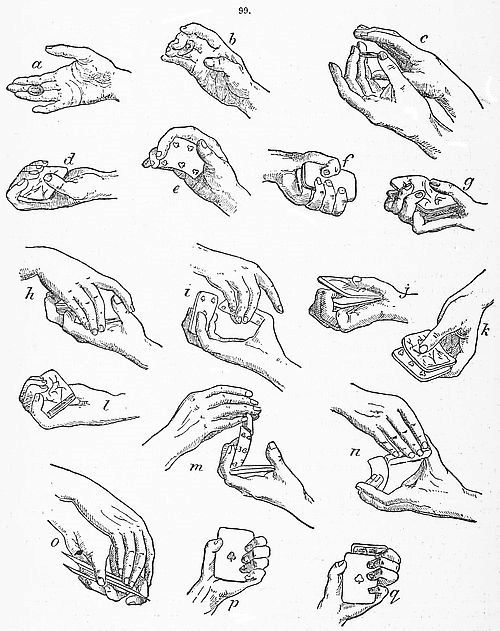
99. Coin and Card Sleights.
“2. Place the coin between the joint of the thumb and the hand, and on slightly bending the thumb the coin will be held flat. This is most useful for changing, described further on, but as an ordinary concealment of a coin it is too dangerous except for small coins which the thumb is large enough to hide.
“3. The principal palm (from which the manipulation derives its name) is as follows: Place the coin so that one edge just touches the highest of the three marked lines that cross the palm of the hand, rather towards the thumb. On slightly bending the hand the coin will be retained; you will find it difficult at first, but practice will show you the exact spot, where the difficulty is reduced to a minimum. If you take the coin flatwise between the thumb, the tips of the second and third fingers, by naturally closing the fingers over and clasping them tight in the palm of the hand, the coin will be brought into the exact position, so that if you pick up a coin, by a sudden outward sweep you can cover this movement, and on recovering the hand the coin will be palmed and the hand apparently empty.
“Other means of holding a coin en cache will naturally present themselves when these have been thoroughly mastered.
“Passing.—1. Take the coin edgeways, between the thumb and the tips of the second and third fingers of the right hand, having the palm of the hand upwards, therefore the backs of the fingers presented to the audience, as at c. Approach the left hand to the right, with back of the hand upwards, and as soon as the left hand hides the tips of the fingers of the right hand, loosen the thumb so as to drop the coin on to the second and third fingers, as at d. Immediately close the left hand as if taking the coin out of the right hand and raise it up; meanwhile bend the fingers of the right hand so as to effect palm No. 1, and lower it steadily to the side or holding the coin as in palm No. 1, and hidden by the bend of the little finger raise the right hand to the mouth and cough slightly before lowering it, this shows the audience (apparently) that the right hand is empty. Meanwhile you play about with the left hand, in which the audience thinks is the coin, and when you have diverted their attention and disposed of the coin you can imitate the motion with the left hand of throwing the (imaginary) coin into the air or rubbing it away to nothing, or any other fanciful way of (apparently) disposing of it, or if you have safely got rid of the coin, suddenly rub your hands together and gradually display the two hands both empty. This is one of the most effective and easy passes.
“2. Lay the coin on the left hand, approach the right to it, take the coin between the fingers and thumb of the right, carry the right hand smartly back, performing palm No. 3. Holding the left hand open jerk the right hand close to it, really holding the penny in the right palm, but apparently throwing it into the left; as you do it shut the fingers of the left hand smartly over the palm so as to produce a slap which people think is the slap of the coin falling into the hand, hold up the left hand so that people look at it, and lower the right with the coin palmed (No. 3); if any one is suspicious shift the coin to palm No. 1, and apparently show the hand empty in some artful manner. Then do what you like with the imaginary coin in the left hand.
“3. To pass several coins, let them all be (if possible) of the same size and hold them tight in the palm of the right hand, then perform pass No. 2, in exactly the same manner as with a single coin, except that instead of holding them in the palm they fall with a clink into the bend of the fingers where they must at once be secured by the thumb beyond fear of further rattle. The chink thus produced, the audience thinks is produced by the coins falling into the other hand, which being immediately closed apparently holds the coins. It is a ticklish trick to perform well, owing to the necessarily constrained position of the right hand, but when got well into control is very effective indeed.
“There are many other palms and passes, but with these all sleight-of-hand tricks may be done, and out of them the amateur can invent a quantity of simple little impromptu experiments.
“Card Sleights.—These are far more extensive than coin tricks, for the cards in themselves are in a way apparatus, the active principles of which are, as with coin, the palm, the pass, and cheek, to which are added last, but not least, the slip and the turnover. You must constantly ‘Ruffle’ the cards, i.e. holding the pack in one hand draw the fingers or thumb of the other across the edges at one end so as to rattle them all together. It conceals any manipulation which may have startled the audience, and should therefore be done in a quick or degagé manner after every sleight or whenever needed, and as the audience do not understand it, they think that this movement is the actual operation by which the wonders are performed.
“Palming.—This is done as follows: Hold the pack as at d, Fig. 99, in the left hand, and covering the pack lengthways with the right, so that the top joint of the fingers touches the top edge of the top card, slide the top card forward, and press down the tips of the fingers; the card will be thus pressed into the hand and lie curled up in it as in e, if thin small cards are used, a card (or even two or three) thus held will be completely hidden by the hand, and may be curled up tight without injury to the card. In this sleight, it is difficult to avoid a constrained position of the hand, but it is very useful as hereinafter described for changing cards.
“Passing.—This is the great stumbling-block of the amateur miracle-monger, and will require most practice, for when you begin it will seem impossible to do it en cache. Its object is to reverse the two halves of the pack (in fact, a sort of automatic cut; in fact the French term is ‘sauter la coupe,’ for by its means the demoralising effect of a cut may be avoided), and when properly practised and perfected it is done noiselessly, in a manner incomprehensible to the conjuror himself. Often, practising the pass before a looking-glass, I have wondered myself at my own performance, so completely does the automatic and sympathetic movement of the hands deceive the eye. The pack being divided into two halves, it is held in the left hand as at f, i.e. as seen from the front there is no division, but really whilst three fingers clasp it, it is divided (above or below any given card, or, as the case may be) by the little finger. Now cover the pack lengthways with the right hand, slip the first finger in also as at g, so that the upper half of the pack is held as it were in a hinge formed by the fingers of the left hand. Now seize the lower half between the thumb and fingers and the right hand, and press it sideways into the lower joint of the thumb as at h. Now by means of the fingers of the left hand raise the upper half hinge-wise, and with the fingers and thumb of the right, lift the lower half till it is just clear of the top half as at i, when on pressing down the thumb the lower half will be pressed over the top half as at j. The fingers may then be removed, and your purpose is accomplished; i.e. the top and bottom halves of the pack have changed places. As you acquire practice it will only be necessary to insert the little finger of the left hand, instead of two. It is well to lower the hands sharply as you perform this sleight, to cover the movement, which, however, by practice is reduced to a minimum. It is also well, if you feel that some one is suspicious, to ruffle the cards immediately afterwards to divert suspicion. This sleight requires much private rehearsal, but is the mainspring of a great many tricks, and its practice gives the hands a suppleness and sympathy not to be acquired in any other way.
“The turnover is a sleight, practised when it is desired to present the backs of the cards whichever way the pack is presented. It is performed as follows: Beginning exactly as with the pass, except that when i is reached instead of pressing the lower half over the top, the movement is continued to k, so that the two halves of the pack face one another, and now whether the top or bottom half be uppermost, the backs of the cards will be visible. You can now deal off cards from either half, and when you want to cease, and begin from the other, hold the cards as in d, but the thumb instead of being over the pack it is underneath as at l, so that the attention of the audience being diverted (by counting the cards already dealt, or otherwise) by an upward pressure of the thumb the pack is completely reversed, and the heretofore undermost card is now at the top. This is the principle of most tricks involving counting off cards.
“Slips.—These are the most useful and frequently required sleights practised by the amateur conjuror, and consist of the knack of drawing a card from the top, middle, or bottom of the pack, and placing it in any position in the pack which may be required by the trick.
“1. The pack being held in the ordinary manner in the left hand, with a chosen card on the top (either placed there by the chooser, or by the pass, or one of the subjoined slips), lift off the top half, raising it rather hingewise, so that the top card being retained by the fingers of the left hand it is left on the top of the half retained in the left hand, as in m.
“2. The chosen card being on the top of the pack, being held as at d, and covered lengthwise by the right hand, by a sudden contraction of the fingers of the left hand, the top card is drawn off (under the right hand) as at n, with a ‘flip,’ caused by the bending of the card as it bends and straightens out at the bottom of the pack. The cards are immediately ‘ruffled’ to disguise the flip. In the same manner a card may be sprung from the bottom to the top, or from the top to the centre, in the latter case the pack being opened a little in the left hand, and the top half slightly raised by the thumb and fingers of the right hand. The elasticity of the card will cause it to spring, in the instant it finds an opening.
“3. A card having been chosen, the pack is presented, just raising the top half to make a place for it, but not looking at the place, or indeed at the hands at all. The card being inserted, before replacing the top half the two middle fingers are inserted just over it, and directly the two halves join, the card is flipped out by the two fingers as in n, and brought to the bottom. The cards are immediately ‘ruffled,’ and your point is gained, i.e. you know the exact card chosen. If the chooser demurs to re-inserting the card at the opening you make—
“4. Spread out the pack fanwise before him, spreading them to your right, and letting the fingers of your two hands meet underneath the fan. By this means wherever he pushes in his card, you can feel it, and in collapsing the fan into pack form, the fingers are slipped in over the top as in slip No. 3, and the card is flipped out as there set down.
“These demonstrate the active principles of slips, which your own ingenuity will multiply ad infinitum. It will be seen that by their means any card chosen and returned to the pack may be at once secured and ascertained, which is the prime object of the card trickster, in whatsoever experiment he may be engaged. Simply a ‘slip,’ combined with any of the following ‘exposures,’ will constitute a trick in itself, far above the comprehension of any one not himself a master of the art.
“Exposures.—These are the methods of ‘exposing’ a card chosen, and returned to the pack. Your own fancy will suggest any quantity of methods, but the following are a few for a start. In fact, almost all card-tricks consist of one sleight, and a more or less complicated exposure.
“1. Slip the chosen card to the top. Let the pack be held by any one (say the chooser of the card) with the face upwards, i.e. so that his card is at the bottom. See that the pack is held well into the hand of the holder, secured by the thumb set rather near the edge of the pack. Now, with your own hand, or let any one else, strike the pack smartly downwards, and all the cards will be knocked out of his hand except the bottom one (his own) which remains staring him in the face, retained by adhesion to his own fingers. Result, natural, but extraordinary.
“2. Slip the chosen card to the top. Take the pack in the right hand, and cover it with the left, as you do so sliding the top (chosen) card sideways till it projects nearly half over the side of the pack. This state of things will be hidden by the left hand, holding the pack endways. On dropping the pack bodily from the left hand at an elevation of about 1½ feet from floor or table, the top (chosen) card will turn as it falls, and lie face upwards on the top of the pack. Result, simple, but startling.
“3. Slip the chosen card to the top. Give the chooser a paper knife, and, holding the pack as at d, tell him to cut the pack with it where he likes. Where he cuts, divide the pack, and lift off the top half, doing at the same time slip No. 1, which will bring his card to the top of the lower half. Put down the top half, and observing that you in no way influenced his cut, tell him to take the (now) top card. He will be surprised to find it his own. Result, easy but supernatural.
“Space forbids me to suggest any others, which you can easily work out for yourself. If time and space would allow, it would be easy to fill a volume with card tricks requiring no preparation, apparatus, or accomplices; but as they are all based upon the above sleights, mere repetition would be useless.
“The following selection are very telling and are easily performed.
“1. To tell any card by looking at its back. This is founded on a manipulation, which I have not described above, and which is called the ‘drawback.’ The pack is held in the left hand as at p, with the faces downwards. Look at the bottom card, and as you turn the pack down draw down the bottom card with the little finger as at q. Asking some one to tell you when to stop, commence drawing back the cards on the top as at o. When told to stop, name the bottom card (looked at and drawn back) and drawing out all the intermediate cards, inform the teller that that is the card he stopped at, and in effect on turning up the remaining cards, the card drawn back and named will be at the bottom, and apparently the one at which he stopped. I have done this trick twenty times running without being detected.
“2. Let any one choose a card and get it to the bottom of the pack by slips Nos. 3 or 4. Put down the cards haphazard in three packs, noting at the bottom of which the chosen card is. Ask the chooser in which pack he would imagine his card to be; if he chooses the right one (which is lucky) throw away the other two; if not, place the one he chooses on the right one and throw away the other wrong one. Redivide the cards left into three packs and proceed as before, always retaining the pack at the bottom of which his card is, until only three cards are left, including the right one. If he now chooses the right one it is exceptional luck, though it often so happens: if not, appear to hesitate a moment, and then retaining his own and the one he chooses, throw away the third, and mixing the two left but remembering his own yourself, throw them down, and the chances are even he will choose his own card. If he doesn’t, boldly throw down the one he chooses and turn up the other, which is his own. Casually observe that you in no way influenced his choice, and leave him astonished.
“3. Pass or slip the chosen card to the top and make a great show of a false shuffle, i.e. shuffle all the cards, but retain or manipulate the top card so that it is shuffled to the bottom and thence back to the top. Then have the cards cut, and taking them up yourself, slip out the card by slip Nos. 3 or 4, and re-slip it to the top, or avoid the entire cut by means of the pass. Having convinced him that his card is lost in gurgite vasto of the pack, let him count off 8 cards from the top and spread them in any order in a row, face downwards, but keep your eye on and note the position of the first or top card, which is his own. Put away the rest of the pack, and tell him to touch four out of the eight. If he touches his own amongst them, take up and throw away the four untouched, or if he does not touch his own, take up those he touches. Then let him touch two of the four left, and throw away as before, leaving his own one of the two left. Then let him touch one of the two left, and as before leave his own solus. Turn it up, and his astonishment will be unbounded. Your victim will often enable you always to throw away the ones touched, and of course this improves the trick, otherwise it is twenty to one against his noticing that you do not always throw away the same set. If he does, you must trust to providence and let the best liar win.
“4. Choose out the four kings (or any other four similar cards) and divide the pack into two halves, place the cards, a black on the top and a red on the bottom of one half, and a red on the top and a black on the bottom of the other half, so that when the halves are united the two blacks will be in the middle and the two reds on the top, as you reunite them slip in the little finger as at f. Make the victim recite aloud the position of the reds and that of the blacks, and repeat it after him so that there is no doubt. Freely expose the faces fanwise (keeping the place) to let him be certain. When this is accomplished make the ‘pass’ so as to reverse the order of things. Expose the pack as reversed, and begging him to be more careful in future repeat the experiment to his utter mystification. If you are really good at ‘passing,’ this trick may be repeated over and over again with great effect.
“5. To change a card without the help of the pack proceed thus: Slip the chosen card to the top, and make a false shuffle. Then take off, apparently only the top one, but really the top two, and hold them up by the edges, so that the top (right) one is completely hidden by the second (wrong) one. Putting the pack quite away behind at some distance from you, bring forward your (double) card in the left hand and show it to the chooser, asking if it is his own. As he will say no, appear confused and let him be quite positive and assertive that it is not his own. Take the (double) card lengthwise and face downwards in the right hand, walk back towards the pack, as you do so draw off the (right) card, leaving the wrong one palmed in the right hand as at d. Bring it forward again in the right hand (which in holding, the right will conceal the wrong card), as if to make quite sure, when the chooser will find it to be changed into his own card.
“6. This trick is somewhat similar to the last. Take out the four kings, and spread them out fanwise, but let the second have concealed behind it as in the last trick, two other court cards (court cards are best as being not so noticeable in case of accident). Hold them up, saying, ‘You see I have here the four kings,’ close them up smartly and lay them face downwards on the top of the pack, so that the order is now, 1 king, 2 false ditto, 3 false ditto, 4, 5 and 6 kings. Take off the first (which is real) and apparently unintentionally show its face and place it at the bottom of the pack. Take off the next (false one) without showing it, and place it into the pack near the bottom. Place the next (false one) similarly into the pack near the top. Take off the fourth (real) and apparently unintentionally exposing its face, commence to put it into the middle; when half way, however, change your mind and place it on the top of the pack. Say, ‘Well, these kings are all well separated now, to mix them still further will you kindly cut the pack;’ this operation will of course join all four again in the middle. ‘Ruffle’ the pack and spreading it out fanwise expose them en masse in the centre. If neatly done this is an excellent illusion.”