THE DRESSING-ROOM. (continued 2)
Reading edition
New Zealand.—In a lonely country district much toilette would not be required. In or near any of the principal towns there is a good deal of gaiety—small and large dances—constant tennis parties for about 7 months in the year, small dinners, luncheons, &c. Any clothes taken should be well made and fashionable, as very many of the ladies there now get their things from England every 6 weeks or so, from the best dressmakers in London. If a lady intends riding, a well cut habit should be taken. Very heavy furs, such as a sealskin jacket, are hardly required in the north island, down south it might be useful. More summer clothes than winter ones are wanted, as the summer season lasts long, although rarely if ever so hot as in London sometimes. It will be well to remember that life in New Zealand, except in one or two remote places, is simply English life, with a bright blue sky and pleasant climate. New Zealand is as large as Great Britain, so of course the climate varies with the situation, warmer in the north island, cooler in the south, although the extremes of heat and cold are not nearly so great as from North of Scotland to the South of England. Of course the outfit for the voyage depends much on the proposed route, whether across America, or by the Suez line, or by direct steam, New Zealand line (easiest and most comfortable of all), or by sailing vessel, a route avoided now by all except those ordered a long sea voyage for their health. In almost any case there is both hot and cold weather. Old underlinen that you can throw away is best, as the sea air ruins good linen. A little change for dinner is needed, but elaborate dressing on the voyage is quite out of taste.
North America.—The outfit a young man requires depends upon the occupation he intends taking up. If he looks forward to employment in a town, he should take a supply of good clothing, such as a gentleman would wear at home, adding 2 or 3 quite cool suits for summer wear. All gentlemen’s clothing, from hats to boots, from coats to vests, is inferior and very costly. Really superior cloth materials are not to be got at any price, nor are flannel shirts that will wash well. If the young man is going to a stock ranche, one good suit for winter, and another for summer, to wear on an occasional visit to town, are sufficient: he will never use them on the ranche, and stockmen’s clothing here is reasonable in price, and made to stand such wear and tear as no one in England has any idea of, even with school-boys. A close fitting, very warm jacket, or extremely thick warm kind of jersey to go on, either of them, under stockman’s jacket, would be invaluable. The rapid fall of temperature, in a few hours, from 70°-80° down to below freezing, accompanied by piercing wind, causes the cold to be felt intensely. The country has greatly changed during the past few years. In organised counties, carrying concealed firearms is prohibited by law. Many do carry them, but they are always liable to have them seized, and to be fined $25 in addition. Some stockmen on the ranges carry six-shooters and Winchester rifles, which are much better for their need than any English rifle. Ammunition for most of the English rifles is not to be obtained. The American six-shooter is much cheaper, and more suitable than the English. For steady men, careful not to get mixed up with gamblers and the rowdy element, Texas is as safe as England. Those who do associate with such classes hold their lives at risk.
West Indies.—(a) The best time for going out to the West Indies is November, after the rains; our winter is their cool season; the hot weather begins towards the end of April. For the voyage take for the first half of the time a serge dress, warm hat, cloaks, wraps, indiarubber-soled shoes. No one dresses for dinner on board the mail packets. The cabins are small. A bag with many pockets to hold all the odds and ends, is a comfort. An overland trunk to go under the berth, a tin bonnet box, and a travelling bag for the cabin, and tin-lined or tin cases for the hold. For the latter half of the voyage, you want a large shady hat and dark cotton dresses, glauntlet gloves, and gauze veils. It is very hot in Kingston; you would wear the same as in summer here, not linen collars or cuffs, lace, which washes easily is best; flannel underclothing, large boots, shoes, and gloves, and a good-sized parasol. People who travel in the island find a solar topee a comfort. A riding habit of thin cloth is necessary, and a low hat, no one wears a high one. A large loose skirt to wear over your dress on the hills is a comfort when you go out to dinner, which you must do on horseback; a low black dress is desirable. There are several parties in the course of the year, lawn-tennis parties, &c.
(b) Any old underlinen answers for the voyage, as one generally throws it overboard, as no washing can be done. Take to wear in Kingston nothing but prints and muslins, and a grey cashmere would be very useful. For large dinners have a couple of pretty satin dresses made, with lace sleeves; and for small dinners some cream muslins, trimmed with lace. As there are a good many balls, 3 dresses would be necessary. One bonnet would be sufficient, but you would want several hats (as light as possible). A white cashmere for tennis is always serviceable, and a habit of light material (in dark green or blue) indispensable. Stockings should be all thin and cool, and all underclothes made of linen or the finest calico. Gloves are easily spotted, so only take out gants de Suede and silk ones. The heat of Kingston during the day is very great, but the evenings are cool and enjoyable; society good (nearly all military and naval) and several old Jamaica families.
Fancy Dress.—The following selection of fancy dresses comprises most of the picturesque national costumes of Europe and the East, adapted for wear at Fancy Dress Balls, &c. There is a striking and distinctive character about the majority of these which places them far above the ordinary type of fancy dress, and it is a great pity they are not more generally adopted.
No. 1. Saxon Bride and Bridegroom of Transylvania.
No. 2. An Austrian woman.
Nos. 3 and 4. Dutch Ladies of the 17th century.
No. 5. Fisherwoman of the Zuider-zee. The petticoat or skirt is made of coarse brown or dark blue frieze, and over it is worn an apron, sometimes red, sometimes green, with a bib of silk or linen, embroidered or interwoven with a large flower pattern, and pinned to the front of a sleeveless jacket, made of the same material as the petticoat, and fastened at the back with hooks and eyes. The skirt is of striped calico, visible in our illustration round the neck and from the shoulders to the elbows, from where to the wrist it is covered with a sort of over-sleeve of frieze. A close-fitting cap of coloured satin or linen encases the hair, as loose tresses are not allowed to float in the wind. This cap is ornamented over the forehead with a piece of gold or silver tinsel cloth.
No. 6. A Bulgarian woman.
No. 7. An Italian girl. The Italian woman chooses white for the principal colour of her dress, knowing from long experience that this is the most suitable colour for lessening the effects of the sun. For the same reason, she has been taught from early youth how to compose fanciful and becoming headdresses from linen scarves. An apron striped in many colours, and a bright border to her skirt, serve the purpose of producing the gay contrast she likes. Her sister in the East, where the climate is less genial and the temperature moves within extremes, needs heavier materials for her costume, and of darker shades, to bring it into accordance with the surroundings. To break the sombre tints, she employs embroidered stripes and squares on her silk bodices and linen under-skirts, as well as on her apron and over-skirt, both made of heavy woollen materials. A bright-coloured ribbon, a flower, or an adroitly draped scarf form her headdress. The effect south and east is the same—picturesqueness and absence of conventionality, more or less the two chief attractions of all national costumes.
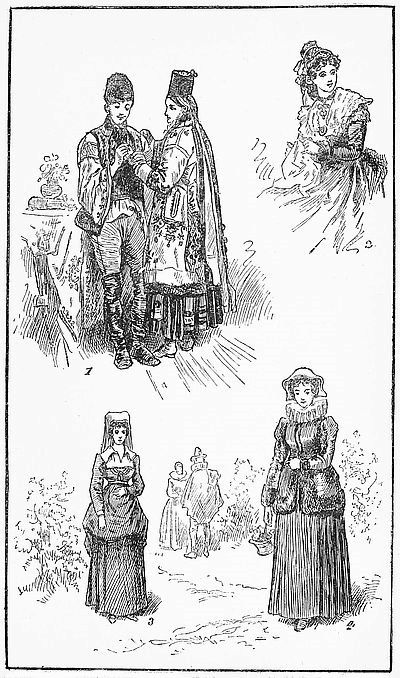
1. 2. 3. 4. W. J. WELCH. PHOTO GRAVEUR 25 WELLINGTON ST. STRAND, W.C.
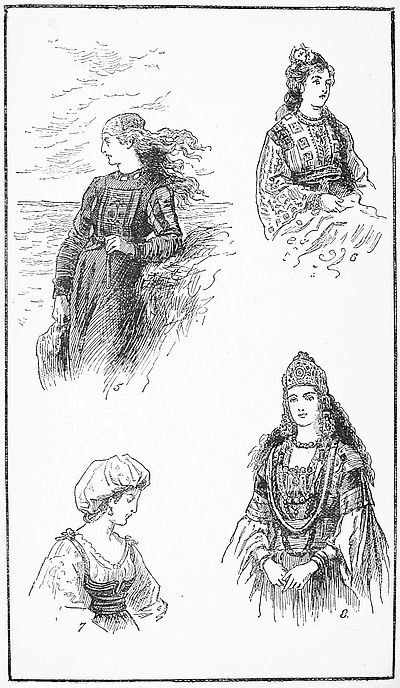
5. 6. 7. 8. W. J. WELCH. PHOTO GRAVEUR 25 WELLINGTON ST. STRAND, W.C.
No. 8. A Jewish Lady, of Tetuawn. The dress is a fanciful combination of velvet, gold braid, and embroidery, with the gauze-like muslin of the Orient, rich in colours, and adorned with a gorgeous silk sash round the waist.
No. 9. Peasant maiden, of Donaueschingen, Black Forest. The bodice is made of black silk, festooned across the chest by blue or violet lace. The little cap, sitting close to the head, has a crescent-shaped opening at the back, through which the long tresses of hair escape. Two long ends of black ribbon fastened together complete the headdress. Short full snow-white chemise sleeves leave the arm bare in summer time. The petticoat is black and the stockings red.
No. 10. A Servian peasant woman.
No. 11. A Bulgarian peasant woman. The unmarried girls ornament their hair with wreaths of flowers, and on festive occasions wear rows of gold coins round their necks. As protection against the sun, the younger women wear on the head a white embroidered scarf, picturesquely draped. Married women deck themselves with tawdry bead jewellery, and wear a belt with large copper gilt buckles round their waist.
No. 12. A Peasant maiden of the Steinlach Valley. On the head is set a flat black cap, decked with floating ribbons. The dress consists of a stuff petticoat and scarlet bodice, the petticoat being made out of light or dark blue cloth, generally bordered with green bands, relieved by gold edging. The bodice is embroidered with gold down the back, and open in front over a handkerchief covering the bosom. The bodice is kept in place by cords, ribbons, or silver chains laced backwards and forwards. A white apron (the matrons wear black), made of fine linen, embroidered at the bottom, completes the dress. A garnet necklace encircles the throat. The full petticoat reaches a little below the knee, showing the feet in buckled shoes. On Sundays a girdle of silk or velvet embellished with metal bosses is worn round the waist.
No. 13. Wallachian girl. The costume consists of a long linen chemise, elaborately embroidered on the shoulders and sleeves with black, red, or blue wools, lace ruffles hanging from the wrists. Round the waist the chemise is held together by a bright coloured scarf, to which a front and a back apron, of a striped woollen material, are attached, leaving the chemise visible at both sides. The ordinary headdress is a white or red handkerchief thrown over the hair and tied in a knot under the chin; but on Sundays a smart little cap, embroidered with gold or silver tinsel, covers, fez-like, the beautiful hair, which is carefully parted in the middle and adorned with bunches of flowers, gold-headed hairpins, and strings of coin jewellery. A necklace of coins is an essential feature.
No. 14. Chinaman. Flowered silk robe; blue jacket; red hat.
No. 15. Dame Trot. Short quilted skirt; tunic and bodice red, with laced stomacher; tall black hat.
No. 16. Little Grannies. Grey cashmere dresses; white caps.
No. 17. Russian Peasant. White dress trimmed with red embroidered bands and Russian lace; long white embroidered apron; beads round neck; gold embroidered Kroshnick headdress of black velvet.
No. 18. Tyrolean peasant. Full black knee breeches; grey silk stockings; red blouse, with bretelles embroidered in yellow and gold; small bouquet at the waist; white Surah shirt, with wide sleeves; black silk necktie; black felt hat, with black and flame-coloured feathers.
No. 19. Normandy peasant. Short red skirt, striped with black; white mousseline de laine tunic, spotted with blue; low pointed bodice, laced with silver; muslin fichu, trimmed with lace; sleeves to match fichu; white muslin headdress, trimmed with lace.
No. 20. Polish costume. Pink satin dress, trimmed with white fur; the plastron is crossed with white brandebourgs, which are continued the entire length; white silk stockings; pink satin shoes.
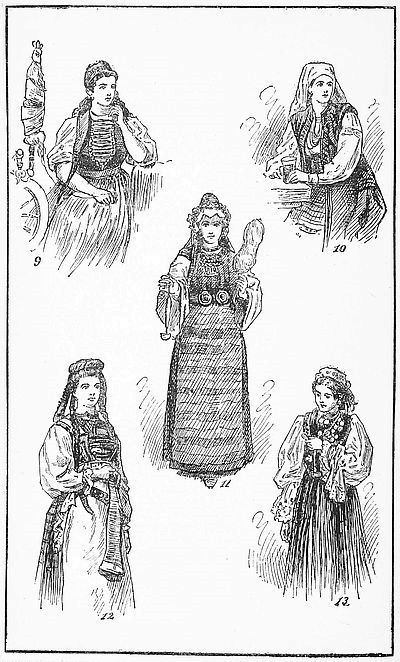
9. 10. 11. 12. 13. W. J. WELCH. 25 WELLINGTON ST. STRAND.
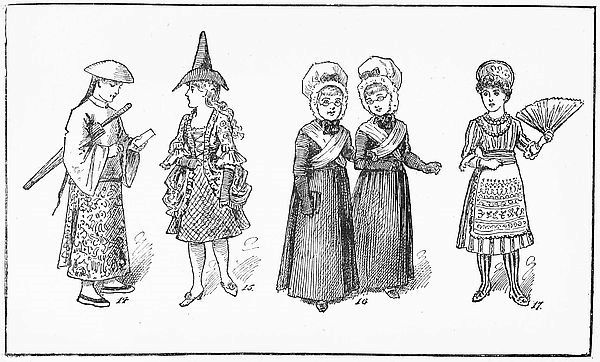
14. 15. 16. 17. W. J. WELCH. PHOTO GRAVEUR. 25 WELLINGTON ST. STRAND.
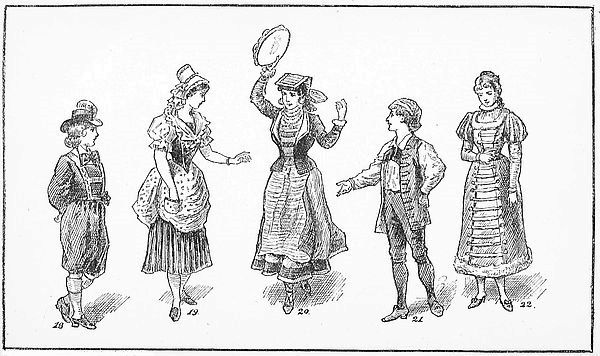
18. 19. 20. 21. 22. W. J. WELCH. PHOTO GRAVEUR. 25 WELLINGTON ST. STRAND.
No. 21. Normandy youth. Dark-blue satin knee breeches; silk stockings of the same colour, with red garters; white lawn skirt, with full sleeves; blue silk necktie; red satin coat opening over the skirt, and ornamented with small red brandebourgs; silk cap and cravat.
No. 22. Neapolitan girl. Pink silk skirt, with a claret velvet hem; white silk apron, striped with many colours; claret velvet bodice, with pink revers opening over a waistcoat to match, crossed with gold bands; long sleeves; claret revers, with gold braid; coral necklace; headdress to match the apron, and fastened with gold pins; tambourine in the right hand.
No. 23. Fop, reign of Henry VI. Long robe of blue cloth, with long hanging sleeves, festooned in shape of leaves; double band and pouch of yellow cloth; large hat of fur, trimmed with a fan of yellow cloth; grey worsted stockings. (Wingfield.)
No. 24. Lady, reign of Henry VI. Particoloured costume of pink and white Italian satin sheeting, trimmed with deep border of ermine on skirt; headdress of same material, with long flowing veil of Indian muslin. (Wingfield.)
No. 25. Page, reign of Charles II. Vest of myrtle-green velvet; blouse bodice, and sleeves in cambric; fringes of gold ribbon loops; skirt in amber silk; lace cravat bow; embroidered satin shoulder sash; green hat with amber plumes.
No. 26. Page, reign of Henry IV. Doublet of black satin trimmed with gold galloon; trunks of figured cherry-coloured silk; black velvet cloak with gold embroidery; black silk tights; velvet cap with turreted brim, and brooch of paste diamonds.
No. 27. Judge. Loose gown in black reps or Ottoman silk; cambric band, and wig. Alpaca may be substituted, if preferred, for the gown; high black cap.
No. 28. Friesland girl. The bust is encased in two bodices, one of cloth with sleeves of gaily coloured silk, and over it another tightly laced with a red or yellow silk ribbon of interminable length. The lacing tag, made of gold or silver, is worn as an ornament on the left side of the bust by girls, and on the right side by married women. A bright coloured silk wrapper covers the upper part of the body, and ends round the throat in a narrow black braid on which is a small red strip, placed on the left by girls and on the right by married women. For outdoor toilet a short jacket with sleeves, and wide open in front, is worn over the two bodices. This jacket is of printed calico for ordinary wear, but embroidered with gold and silver for festive occasions. The most peculiar feature of the costume is the headdress, made of striped calico or fine linen, and supported in its helmet-like shape by starch alone. Two petticoats are worn, one of crimson cloth, with a broad border of black velvet, reaches to the ankles, just showing the broad-toed velvet slippers; the other, of black woollen material, encircles the waist, in numberless plaits, and leaves the velvet border of the first one free. A silk apron completes the Sunday attire. A chatelaine is usually added.
No. 29. Dutch girl, from the Island of Mark.
No. 30. Turkish girl.
No. 31. A woman of Albania.
No. 32. A woman of North Holland.
No. 33. Jane Seymour coif.
No. 34. Charity girl. Black stuff gown; white linen cap; apron; red badge on left side of bodice.
No. 35. Moorish girl. Black velvet bodice and skirt, trimmed with white galloon; apron in muslin, enriched with gold thread and variegated silks; girdle of geranium-red cord with tassels; red satin under sleeves; rows of large beads fall on the muslin chemisette; cap and veil in toile Colbert, embroidered and also edged by a fringe of gold beads.
No. 36. Lady of Tangiers.
No. 37. Servian youth. Green woollen trousers, with bands and golden spangles; blue velvet jacket, trimmed with golden embroidery and grelots; vest in red and blue striped material bound by embroidery; red cashmere scarf, with revolvers passed through; red fez.
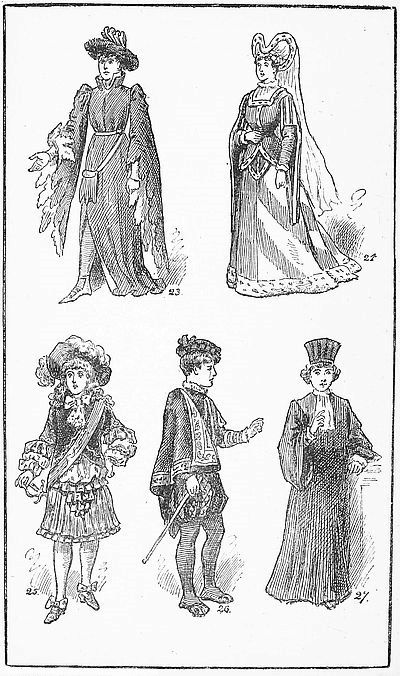
23. 24. 25. 26. 27. W. J. WELCH. PHOTO GRAVEUR. 25 WELLINGTON ST. STRAND.
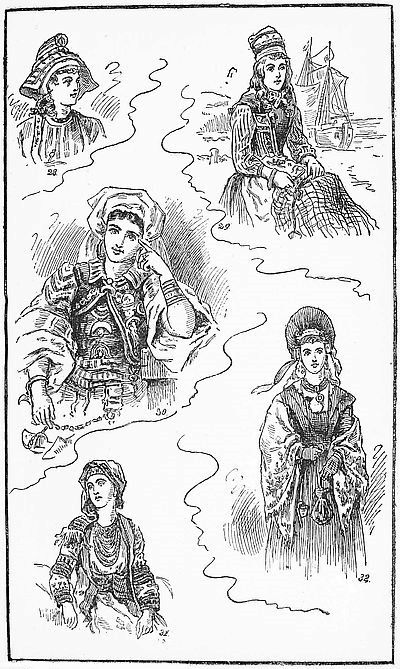
28. 29. 30. 31. 32. W. J. WELCH, PHOTO GRAVEUR. 25 WELLINGTON ST. STRAND.
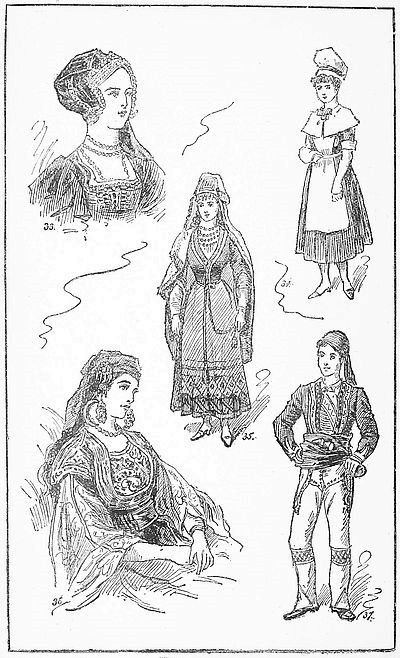
33. 34. 35. 36. 37. W. J. WELCH. PHOTO GRAVEUR. 25 WELLINGTON ST. STRAND. W.C.
No. 38. Tellemarken, Norway.
No. 39. Mecklenburg.
Nos. 40, 41. Brittany.
No. 42. Welsh. Among the different costumes of Wales, there are few more picturesque and elegant than that of Gwent and Morganwg, which ancient district includes the present counties of Monmouth and Glamorgan; and, although now rarely seen, it is by no means extinct. The hat is beaver, which, although so called, was formerly made of the skin of the hare. The brim is sufficiently wide to cast a shade over the eyes and brow, which artists well know is so peculiarly becoming to the face; and from the hat being set on the head to incline downward (higher behind than before), this artistic effect is still more striking. The genuine Welsh cap has a border either of muslin, with narrow edging of lace, or for special dress, the whole border of good thread lace; and without a personal trial few could believe how the combination of such a hat and cap beautifies plain women, and still further improves the beautiful. The handkerchief is worn with the point behind to the waist, which is of natural and moderate length. The handkerchiefs are, for general use, blue and white, or pink and white, cross-barred, with a border, are worn double, and tightly pinned across the chest; for special occasions they are often scarlet and yellow, or blue and white. The gown has sleeves to the elbow, and for elderly persons often turns the elbow. The bodice is tight and low, and fastens in front, being pinned across under the handkerchief, the gown being open before. The skirt (if skirt it can be called) does not extend farther than an inch or two beyond the hips; it is very full behind, and has loops along the edge through which a tape is run, which draws it together, and is tied to another loop which is fixed at the back, in the centre of the waist in the inside. This part of the gown is not much longer than the petticoat, so that when it is drawn up only an inch of the petticoat is seen below, and sometimes it is even with the petticoat. The apron is of black and white or blue and white check—the Welsh national checks being totally different from the Scotch plaids, the only similarity consisting in both having cross bars. The strings of the apron are often passed through a loop which is attached underneath the point of the handkerchief, crossed behind and tied before, not being too wide to allow the coloured petticoat to be seen at the sides. The petticoat is moderately full, and short enough to show the ankles. The shoes, black leather with strong soles, used to be invariably set off with large buckles, which nearly covered the front of the instep; the shoes being high and fastened by the tongue of the buckle, but those worn without buckles had small leather ears on each side, with a hole in each, which tied over the instep. In cold weather, or when required, long sleeves of the same material as the gown, or coloured printed calico, or of knitted black wool, are added, or long-armed black mittens; and a cloak with a hood is thrown on. In the present instance the gown is orange and black, the petticoat violet and black. The present costume admits of many other varieties of ancient national Welsh patterns, both in colour and design, still made in the same district.
No. 43. Mecklenburg.
No. 44. Norway, Sætersdal. The men wear striped trousers, reaching almost to the throat, and showing a white shirt under the arms. A sort of very short jacket covers the shoulders, and closes across the upper part of the chest. To the uninitiated, it appears quite a riddle how they put this peculiar garment on. The jacket worn by the women is of equally curious cut. It opens horizontally across the bust to show a linen bodice, which again appears as a large stand-up collar on the throat. The hair is gathered into a net decorated with ribbons, which entirely hides it, and falls to the shoulders. With their short petticoats and jackets, braided with galloons and studded with silver buttons, a bright-coloured wrapper fastened to one shoulder, and draped round the waist, a Sætersdal girl presents a picturesque appearance.
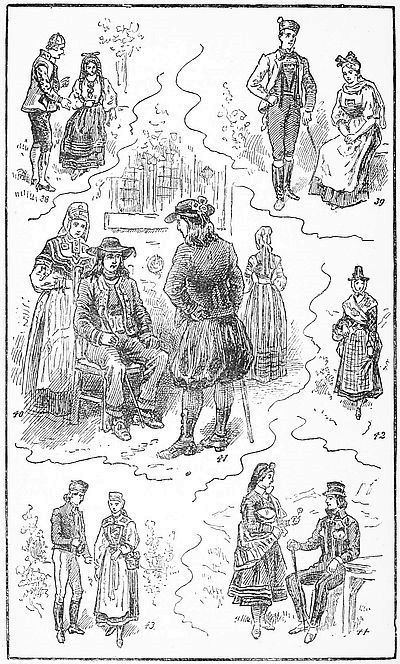
38. 39. 40. 41. 42. 43. 44. W. J. WELCH. 25 WELLINGTON ST. STRAND. PHOTO GRAVEUR.
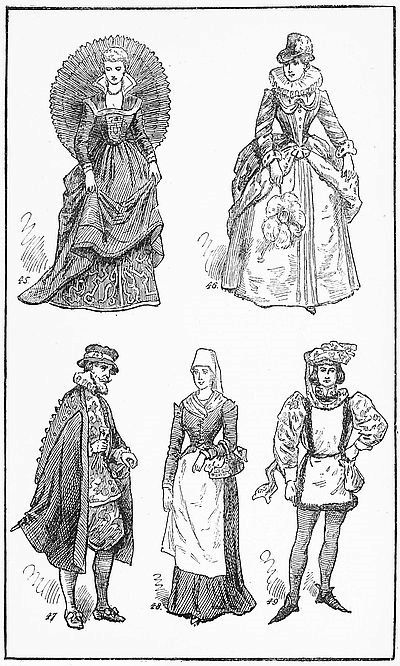
45. 46. 47. 48. 49. W. J. WELCH. PHOTO GRAVEUR. WELLINGTON ST. STRAND.
No. 45. French Lady, Reign of Henry I.
No. 46. Lady, Reign of James I.
No. 47. Italian Gentleman, XVI. Century.
No. 48. Maidservant, Reign of Henry VI. Costume in two shades of grey merino; large apron, handkerchief, and headdress with long flowing veil in fine white nainsook. (Wingfield.)
No. 49. Gentleman, Reign of Henry VI. Shirt of printed velvet, with tabbard of white Italian satin sheeting, bordered with black fur; worsted tights; hat of printed velvet, with long drapery of soft silk; bag pouch. (Wingfield.)
No. 50. Lady, from Saloniki, Macedonia.
No. 51. Girl from Ploaré, Brittany. The petticoat or skirt is generally of white flannel, bordered with a scarlet band above the hem, made very full and short to show the buckles on the shoes. The body or jacket consists of scarlet, blue, violet, or red cloth, cut tight to the shape, open in front, the sleeves long, turned up at the wrist with a deep cuff, and encircled with a sort of arm-band above the elbows. The facings of the bodice, cuffs, and arm-hands are trimmed with a braiding composed of black velvet ribbons embroidered with coloured worsteds. The apron is either a deep mulberry or orange colour, and fastened with an ornamental sash tied in a bow at the side, with a separate pocket for the knitting ball. The chemise, fastened in front with a brooch made of coloured bugles and glass beads, terminates in a kind of plaited ruff, and a small ebony crucifix is suspended by a velvet band from the neck. The headdresses vary in shape. The women of Bignan wear close fitting caps of white linen, and cover them with a sort of conical flap-cap, made of a coarse starched cloth, like brown holland, which serves the purpose of a bonnet.
No. 52. Flemish costume at the time of Rubens.
No. 53. Caucasian Girl. The costume consists of a caftan made of bright coloured silk or satin, buttoned in front, and reaching to the knees, with a belt, richly embroidered in gold and silver round the waist. In winter an overcoat of heavier material, without sleeves or collar, open in front and falling down to the ankles, is worn over the caftan. Very picturesque is the headdress or cap of conical shape, gorgeously embroidered with gold and silver tinsel. A long white veil descends from the point of the cap nearly down to the heels. This veil is likewise worn without the cap, fastened to a kind of diadem in the forehead. From underneath the cap or veil issue long plaited tresses of black hair studded with coin jewellery. Elegant bottines of morocco leather, tightly fitting to the leg, like stockings, and dainty slippers, complete the outfit.
No. 54. Woman of Bethlehem. A dark blue dress contrasts well with the scarlet tunic worn over it in graceful folds, and with the head covering of spotless linen, which frames in the face, just leaving room for the display of Oriental coin jewellery on the forehead and round the neck.
No. 55. Lady of Eleusis, Greece. A maize-coloured silk veil, picturesquely draped, covers head and shoulders, just to show two strings of gold coins on the lovely forehead of the oval face. A long white robe, girded round the waist with an embroidered belt or sash, envelopes the figure like the ancient chiton. The waist is covered with chains of coin jewellery, and an apron of violet silk, striped in two tints, is attached to the belt. But the great pièce de résistance of this becoming costume is a gorgeously ornamented jacket, likewise of white material, with semi-tight sleeves, embroidered, as our illustration indicates, in fanciful patterns, with dark red or black silk interspersed with gold and silver threads. Similar costumes to that of the women of Eleusis, and only slightly differing in cut and colours, are worn in all the northern provinces of the kingdom. In Athens a bright red scarf girds the waist, and silk of the same colour is used for the embroideries on jacket and petticoat. In Bœotia a green veil is worn, and the ornamental stitchery executed in a variety of colours, red prevailing.
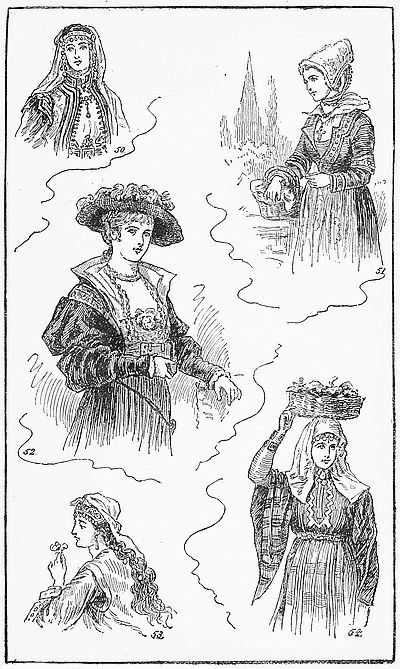
50. 51. 52. 53. 54. W. J. WELCH. PHOTO GRAVEUR. 25 WELLINGTON ST. STRAND. W.C.
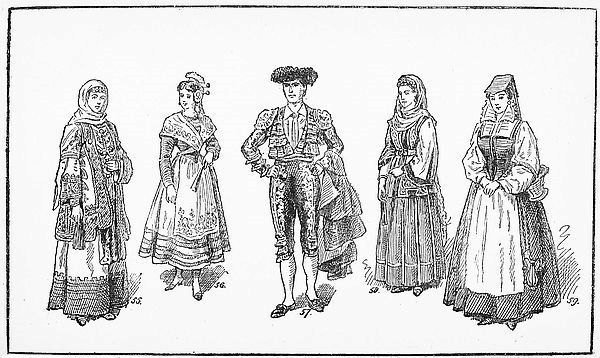
55. 56. 57. 58. 59. W. J. WELCH. PHOTO GRAVEUR. WELLINGTON ST. STRAND. W.C.
No. 56. Spanish Girl. The short petticoat is generally of bright yellow, rose coloured, or green silk, trimmed either with bands of black velvet or with a deep flounce of black blonde. The tight-fitting jacket is made of black velvet, trimmed with gold or silver lace, and buttons to match. The material for the apron and for the neckerchief consists of muslin with a border of white blonde. The hair forms a plaited chignon on the back of the head, and is adorned with the high Spanish comb and with hair pins, with tops of gold or silver filigree.
No. 57. Spanish Toreador. Royal blue plush or velvet jacket and trousers, richly embroidered in silver and ornamented with silver fringe. Red silk sash. Red cloak and pink stockings. Blue plush cap. Heavy silver epaulettes and embroidered shirt.
No. 58. Modern Greek. In the picturesque national costume worn in modern Greece hardly any trace can be found of the ancient dress. The richly embroidered cloth jacket, worn over skirt and bodice of ordinary cut, cannot be compared with the ancient chitonion, although it serves the same purpose. For fancy balls this costume is most becoming, if the proper combination of colours, quite optional, even in Greece, is selected.
No. 59. French Farmer’s Wife, time of Henri III. The close-fitting pointed bodice, of a red material, is laced in front over a band of green silk; the square habit shirt is of fine linen, terminate in a lace-edged lawn ruff corresponding in colour with the long white sleeves; and the ample apron covers the front of a dark-coloured petticoat. The tablier headdress, worn over the hair combed back, is made of a double piece of black satin, stiffened by a stout lining.
Supplementary Literature.
Bernard Roth: ‘Dress: its Sanitary Aspects, a paper read before the Brighton Social Union; with additions and 8 full-page illustrations.’ London. 1880. 2s.
T. Frederick Pearse: ‘Modern Dress and Clothing in its relation to Health and Disease.’ London. 1882. 2s.
Henry Carr: ‘Poisons in Domestic Fabrics.’ London. 1880. 6d.
Ardern Holt: ‘Fancy Dresses described; or what to wear at Fancy Balls.’ London. 1882. 5s.